Category Archives: Travel & Tourism

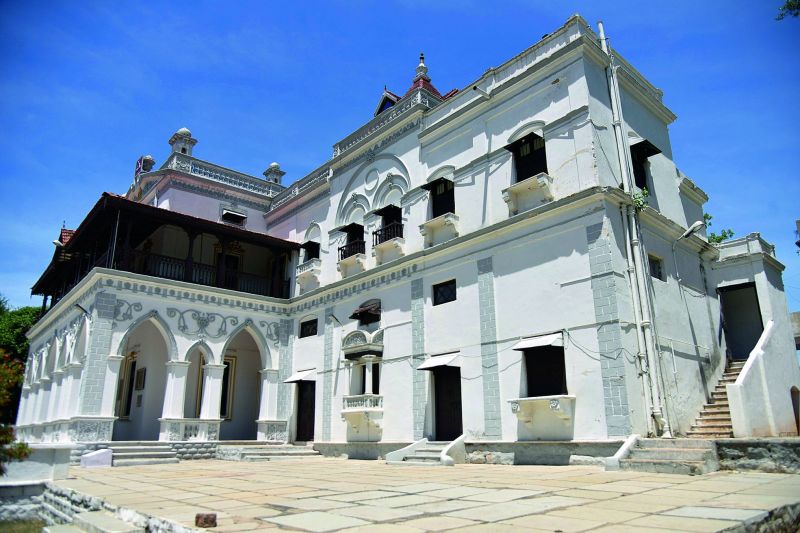
Grandeur of Saif Gulshan lingers on 106 years later

Hyderabad, TELANGANA :

Maintained in pristine condition, it is used as Army mess.

Saif Gulshan was the residence of Sultan Saleh bin Ghalib al Quaiti, Nawab Saif Nawaz Jung, a prominent noble in the Nizam’s court.

Hyderabad:

The erstwhile Hyderabad state had the largest army in the country, and what is now the Sarojini Devi Eye Hospital was the first hospital for the Army here.

The First Lancers of the Hyderabad Army at Asafnagar is still being maintained in its original condition. All of this was originally part of the Golconda Fort and, not surprisingly, there are two Qutb Shahi-era tombs within this area. The Nizam had great respect for the army.

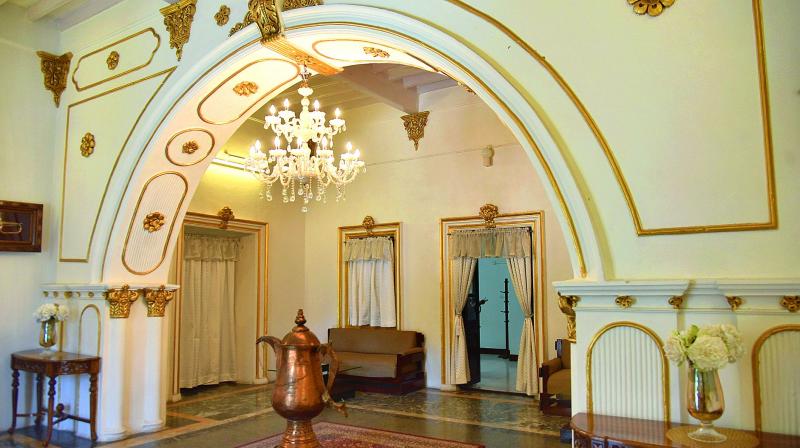
Saif Gulshan was the residence of Sultan Saleh bin Ghalib al Quaiti, Nawab Saif Nawaz Jung, a prominent noble in the Nizam’s court. Constructed in 1912 it has a mixture of European and Qutb Shahi styles. This residence is being maintained in pristine condition and is used as an Army mess.

SaifGulshan02MPOs21jul2018

The building has an elevated basement, which seemed to be in style those days. It has been built with great care, leaving a lot of open space, both in the front and at the sides. A well on one side of the house must have been the water source and it must have been an open and beautiful structure. There are many jharokas and the first floor has rooms. The terrace is covered by a low-tiled roof, which is supported on wooden posts.

The beautiful facade of the building has been well-maintained by the Army. A lot of wood, stained glass and stucco work has been used in the building, which has verandas on three sides, each one ending in a room. The windows look out to this narrow veranda, which has exquisite tiled flooring. The veranda has Gothic arches and since the entire building is on an elevation, it looks imposing. European influences and Indian elements blend wonderfully well in the building.

There is another impressive building about a 100 yards away. This too was connected to the army and officials must have lived here. Or it could have been a zanana. Smaller in size, that building is surrounded by wooden eaved projections with windows on all sides. There are four rooms with one in each corner and in those days the centre used to be a courtyard, open to the sky. It is now covered and is like a big hall. In 2012, the building bagged an Intach award. According to the citation, Awadh bin Abdullah, the founder of the al Quaiti clan, was the first to travel to India in the last quarter of the 18th century. During his brief stay in the country, Awadh is said to have served the Nizam during the Second Mysore War. His son Omar migrated to India in the early 19th century and after a brief stint with the Raja of Nagpur, ended up in Hyderabad as head of the Arab mercenaries who formed a bulk of the Nizam’s irregular troops.

The main structure of the building is flanked on either side by projecting blocks. “The structure is flanked on either side by projecting blocks crowned with tiled pyramids lending majesty to the structure. The central portion is surmounted by a highly decorated pediment which bears the monogram of Saif Nawab Jung in stucco,” says the Intach citation.

The interiors show that the building was well-planned, with huge arches and windows and doorways with stucco to highlight the structure.

A lot of wood has been used and there is a wooden staircase leading to the first floor. Elegance and form are the highlights of this building.

This building stands along with the other smaller building in the midst of a forest and a fountain, while a road nearby brings in the sound of traffic.

Well-kept and still maintained in its original form of limestone and brick, with a little bit of granite, the Army must be lauded for the care it has invested in maintaining this landmark building.

source: http://www.deccanchronicle.com / Deccan Chronicle / Home> Nation> Current Affairs / by Lalitha Iyer, Deccan Chronicle / July 15th, 2018

Rifa-e-aam Club – History Shrouded in Negligence

UTTAR PRADESH :

HIGHLIGHTS

Rifa-e-aam was where literary events were held to provide Rifa (happiness) to people

During struggle for independence, this club became the centre of anti-British activity

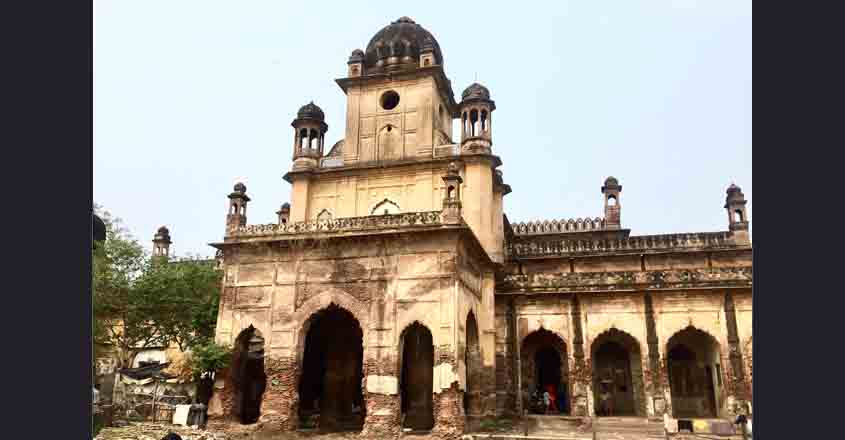
Rifa-e-Aam, Lucknow
Rifa-e-Aam, Lucknow

Lucknow:

The city of adab (etiquette) and tehzeeb (manners) was also an indispensable part of India’s freedom struggle. The Nawabs of Awadh or the rulers who governed the state of Awadh  during 18th and 19th centuries conspicuously nurtured syncretism, which became an integral  part of the culture in the Ganga-Jamuna belt.

Nawabs were the great connoisseurs of art, music, and architecture. Numerous monuments were built  during their time. One among those was Rifa-e-Aam, where literary events were held to provide  Rifa (happiness) to people. When the signboards outside several clubs and gymkhanas signalled ‘dogs and Indians’ to stay out, Rifa-e-Aam welcomed dissenting voices, credit for which  goes to the liberal Raja of Mahmudabad. The historic Lucknow Pact of 1916, between the Congress and Muslim League was signed here.

RifaeAaam02MPOs19jul2018

During India’s struggle for independence, this club became the centre of anti-British intellectual  activity.  In 1936, Anjuman Tarraqi Pasand Mussanafin-e-Hind or Progressive Writers’ Movement was born in this building, under the leadership of Syed Sajjad Zahir and Ahmed Ali. Soon a number of  eminent progressive litterateurs like Saadat Hasan Manto, Ismat Chughtai, Faiz Ahmad Faiz, Mulk Raj Anand, to name a few, joined the movement. To cap it, presidential address was delivered by Munshi Premchand.

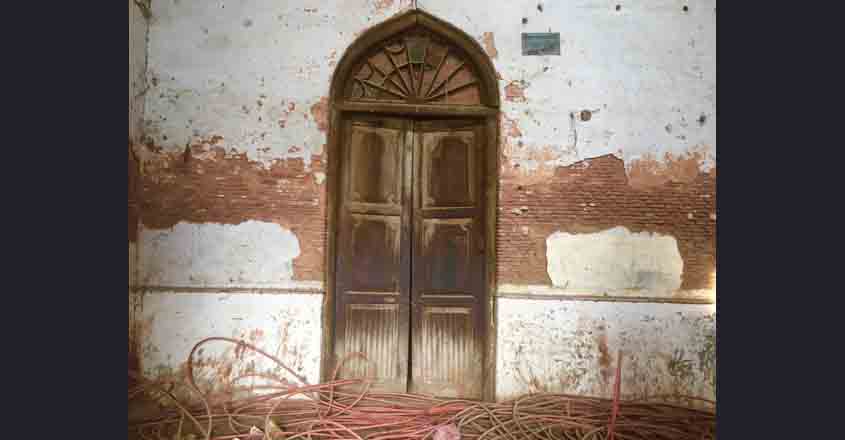
During my recent visit to Lucknow, I asked the person who ferried me around the city, to take me to this forgotten monument, tucked away in the crowded lanes of Qaiserbagh. When Google map  ditched us due to poor network and left us amidst the labyrinth of congested by lanes, the human version of Google maps – paanwala (tobacco seller) helped us locate it. There stood the dilapidated structure which once upon a time heard the speeches of Mahatma Gandhi, Pandit Nehru, and many other visionaries.

The ground in the front of the monument is now a bus station. Lakshmi Narayan parked the car and since it had rained that morning, he asked me to get off from the other side to avoid a stagnated pool of water and filth. At present, one part of the decrepit structure is inhabited by a family of nonagenarian – C P Pandey, who was appointed as the caretaker of the club. The other portion is managed by the association and the only thing common between them is the illegal construction and encroachment, around which stands the cracking monument of Rifa, donning a lugubrious look.

I spent some time envisioning the past associated with it and wondering who is responsible for such sorry state of affairs today. Is it the people, ignorant of the past or the authority which has turned a blind eye to misdemeanour? Perhaps lack of pride in our glorious heritage.

I finally left with a heavy heart remembering Faiz and hoping one day Rifa would be restored.

source: http://www.travel.manoramaonline.com / OnManorama / Home> Travel> Reader’s Discovery / by Pragya Srivastava / July 17th, 2018

Meet Arsh Ali, a young archaeologist

Allahabad, UTTAR PRADESH :

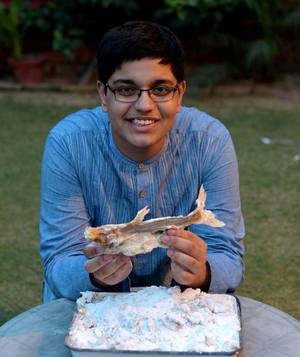
Early start: Arsh Ali shows off his mummified shark. | Photo Credit: Rajeev Bhatt

At 17, Arsh Ali is an archaeology prodigy, already participating in ASI digs and seminars

Three months ago, Arsh Ali lost a coveted member of his aquarium: his little pet shark. But instead of disposing of its body, Arsh buried it in a tray filled with natron. A complex salt known for its ability to dry things up, natron is naturally available in Egypt, but Arsh had to create it by mixing multiple chemical elements.

He has learnt the method from the ancient Egyptians, about whom he knows much. “There is no foul smell or any organisms growing in it, even after so many days,” says Arsh, smiling proudly and pointing to the tray with the dead shark in the lawn of his house in Allahabad. His goal is to mummify his pet shark just like the ancient Egyptians did.

Pharaoh bread

Arsh’s knowledge of Egyptian history, archaeology and mummification runs deep: he has researched coffins, funerary hieroglyphic inscriptions and even knows how to make bread like the ancient Egyptian did. “Every other day he cooks something for me,” laughs Fatima Ali, Arsh’s mother.

At 17, Arsh is already an archaeologist, although he doesn’t have a formal degree yet. Unlike most kids his age, Arsh spends much of his time researching ancient history, visiting digs, attending seminars, and delivering lectures on history and archaeology.

Acknowledging his talent, the Archaeological Survey of India (ASI) has been inviting Arsh since 2015 to their programmes, seminars, excavations and explorations, a privilege often restricted to post-graduate students of archaeology. Arsh has so far taken part in seven excavations and explorations. His first tryst was with the excavations at Binjor in Rajasthan in 2015-16 under the ASI, followed by those in Rakhigarhi, the largest known Harappan site in Harayana, conducted under the supervision of Deccan College in Pune.

“The Harappans were excellent craftsmen. Even 5,000 years ago, they produced a lot of things,” says Arsh as he describes each dig in detail. The cupboard of his room is crammed with specimens he has brought back from sites for further study: wheat grains, terracotta bangles, pot shards, shells, neolithic tools, starfish, and an octopus.

Arsh’s adventure with art and archaeology started early. His parents, Fatima and Faisal, were convinced from the start that their son was special — when he was six, for example, he sat at a restaurant in Kathmandu and sketched the Pashupati temple on a paper napkin in one shot, down to every dome and flag.

When he was in Class VIII, during a visit to Bara Imambara in Lucknow, the family met the site conservator of ASI who was impressed with Arsh’s knowledge. One thing led to another and soon Arsh was participating in ASI fieldwork.

Arsh knows 15 languages, including Hebrew, Arabic, Brahmi, Greek, Ugaritic, Nabatean and Phoenician, besides Kharosthi and Hieroglyphics. He credits his precocious knowledge to curiosity and reading. “I did nothing but read books, and purchased nothing but books every time I got an opportunity,” he says.

Smitten with Anubis

Ancient Egypt had him hooked early. “When I was five, I had an encyclopedia on Ancient Egypt. I didn’t knew how to read and write then, but that’s when I came across an image of Anubis, half-human, half-jackal.” He was smitten with the Egyptian god of mummification.

Arsh’s archaeological interest has culminated in a quest: he wants to establish the evidence of the existence of Buddhism in Egypt by tracing the route of the Buddhist emissaries of the Mauryan emperor Ashoka in Ptolemaic Egypt in particular, and the Hellenistic world in general.

He delivered a lecture on the subject at the National Museum in Delhi last month, and visited Egypt a few months ago.

Arsh was allowed access to the antiquities at the national museums in Cairo and Alexandria, where he came across plenty of evidence to substantiate his theory: a coin with details of King Ashoka, literary references, terracotta items, objects of Indian art, and Brahmi inscriptions on pots. When asked about future plans, Arsh says, “I want to gift something to the world, something that might be useful.”

omar.rashid@thehindu.co.in

source: http://www.thehindu.com / The Hindu / Home> Society> Profile / by Oman Rashid / July 14th, 2018

Pedalling for children’s safety

Kazhakkoottam (Thiruvananthapuram), KERALA  :

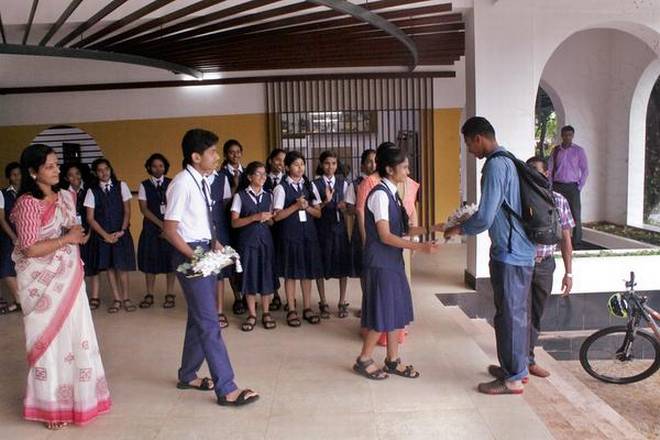
Students welcome Al Ameen at Rajagiri Public School.

Al Ameen is on a Kashmir-to-Kanyakumari bicycle campaign against child abuse

Kochi :

Heavy rain accompanied by strong wind was what received 19-year-old Al Ameen in the city on Monday long before he could pedal his way to Rajagiri Public School for his formal reception.

The two receptions, the other being at Al-Ameen Public School, were among the five stopovers in the city over two days for the second-year sociology student from the Jamia Millia Central University, who is on a Kashmir-to-Kanyakumari bicycle campaign against child abuse.

Having popped antibiotics after getting beset with stomach upset and vomiting, the lashing rain further took its toll on the weakened body of the youngster who is originally from Kazhakkoottam in Thiruvananthapuram.

In fact, he was admitted at a hospital in Karnataka for a day before entering Kerala.

However, that didn’t douse the spirit of Al Ameen who mounted the cycle from Srinagar on June 2 with the noble intention of creating awareness among students about the need to stand up against abuse of varied hues against them.

“I also wanted to encourage students to actively participate in finding solutions to the problems faced by the community around them,” said Al Ameen who had been clocking around 80 kilometres a day.

He was briefly joined by his college mate Shigraf Zahbi in the Delhi-Rajasthan stretch before giving it up owing to hostile climatic conditions.

Asked why he opted for cycling to propagate his cause, the youngster said that the nobility of the cause alone would not win the attention it deserves unless combined with some extraordinary act. “For me, cycle is just the tool to attract attention to my larger goal,” he said.

Before his stopovers at five schools in the city, he had been accorded receptions at schools in Thiruvananthapuram, Kollam and Alappuzha.

The receptions were organised by district child protection officers of the Women and Child Development Department.

He will now meet students of more schools in Malappuram, Kozhikode, Vadakara, Kasaragod and Manjeshwaram before wrapping up his campaign in Kanyakumari on July 23. by which time he would have covered around 4,250 kilometres.

source: http://www.thehindu.com / The Hindu / Home> News> Cities> Kochi / by M.P. Praveen / Kochi – July 10th, 2018

”Taj – A Monument Of Blood”: New Series On Mughal Empire In The Pipeline

Agra, UTTAR PRADESH :

The series will capture the dark side of the story of the Mughal empire and had emperors like Akbar, Jehangir, Shah Jahan and Aurangzeb.

Mumbai :

“Taj – A Monument of Blood”, a period drama series on the rise and fall of the the Mughal empire, is set to be produced by Applause Entertainment in partnership with Contiloe Pictures, who are confident of presenting a story with a mix of blood, betrayal, power, beauty, deceit and heartbreak.

The series will capture the dark side of the story of the Mughal empire, which ruled India for just over 3 centuries and had emperors like Akbar, Jehangir, Shah Jahan and Aurangzeb. Writing is currently underway.

The tale will be told over 5 seasons of twelve episodes each, using the birth and death of Shah Jahan as bookends. It will delve deep into the Mongol origins, bloodlines mixing with Persian and Rajput royalty, the court and palace intrigues, the repeated purging of aspirants to the throne, and the arrival of the British and Portuguese.

Sameer Nair of Applause Entertainment calls himself a big fan of revisionist narratives of history.

“Our history books have been written by victors and often paint very two-dimensional pictures about past empires. When Abhimanyu Singh (Contiloe Pictures) and I first discussed this idea, we immediately moved away from a typical historical to a darker and edgier version of the Mughal empire, a version in which symbolically the Taj is more a monument of blood, than a monument of love,” Mr Nair said in a statement.

Mr Singh, who has produced a slew of historicals for the small screen, says the new series will show viewers the historic journey through a fresh lens.

“It will take viewers on a historic journey showing them an unseen perspective of this illustrious dynasty which lead to their rise as the greatest empire in medieval times and the quest for power, within it, that finally lead to its downfall.”

source: http://www.ndtv.com / NDTV / Home> All India / by  Indo-Asian News Service / July 12th, 2018

Afghan architecture in sandstone

Mandu, MADHYA PRADESH :

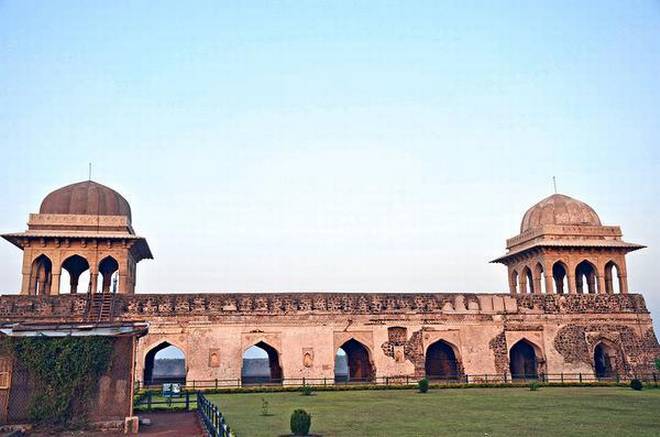
A section of Rani Roopmati Pavilion | Photo Credit: mail

Roopmati Pavilion is perched regally on the edge of a 365m precipice overlooking the Nimar Valley and to the south of the Baz Bahadur Palace in Mandu, Madhya Pradesh. A look by Chitra Ramaswamy

Among the plethora of monuments that dot the landscape of the historical city of Mandu in Madhya Pradesh, is the Roopmati Pavilion, an ode to love. The sandstone structure is perched regally on the edge of a 365m precipice overlooking the Nimar Valley and to the south of the Baz Bahadur Palace. It stands as testimony to the legendary tragic love story of Baz Bahadur, the mid-16th century Sultan of Mandu, a great musician, and his queen, Rani Roopmati, a singer of repute.

We traverse a broad, winding pathway to come upon a flight of stairs that brings us to the 16th century monument. The 72m high fort, Roopmati Pavilion, the southern-most monument in the city, is a magnificent expression of Afghan architecture in sandstone. It is evident that the monument underwent construction in phases during different time periods. The original design, sans pavilions, was built as an observation post for the royal army as a low, large hall with a pair of rooms on each side and a heavy sloping base. A symbol of their undying love, it was later transformed into the abode of Roopmati with a western side extension along the plinth. It was extended so as to enable the queen, who fervently worshipped the Narmada, to see the river and perform religious rites without stepping out of the fort.

The basement of the pavilion is characterised by corridors that have several arched openings along their width. The western ledge has a large reservoir from which rainwater collected during the monsoons would be channelled from the roof of the structure to a tank below by means of conduits.

However, it is the pavilions on the terrace of the original block that we access via spiral stairs, a later addition, which lends the structure its distinctive allure. The square-based pavilions are crowned with hemispherical domes that are fluted on the interior and exterior. We are treated to a visual delight as we climb a flight of steps to reach the pavilion top. Nature’s enchantment leaves us mesmerised as lush forests, plateaus, valleys and vast stretches of far away hills stretch before us.

Twin-storeyed palace

The Baz Bahadur Palace, closeby, lies on the hill-slope to the east of Rewa Kund and is set in the midst of picturesque verdure. Tall, sleek arches welcome us at the entrance to the twin-storeyed palace which is accessed by well laid, broad steps with landings at intervals. In its days of glory, an aqueduct ran on top of the arches, transporting water from Rewa Kund, the adjoining tank, to the pool in the palace courtyard. The water would be drawn upwards by Persian wheels that were powered by animals.

An inscription in Persian on the arch states that the palace was built in 1508 by Nasir-ud-Din. Incidentally, Nasir-ud-Din Shah Khilji, the Sultan of Malwa, is credited with designing this aesthetic structure which underwent repairs and renovations during the period of Baz Bahadur. Big courtyards and high terraces are distinct aspects of the palace that is an aesthetic blend of Mughal and Rajput architectural styles.

Halls and rooms with arched gates skirt the huge courtyard which is adorned by a stunning cistern with crystal clear water in the centre. The palace terrace is further adorned with a couple of chhatris or elevated domed pavilions. One of the big rooms, that even today has astounding natural acoustics, served as the music and dance hall of the palace.

source: http://www.thehindu.com / The Hindu / Home> Life & Style> Homes & Gardens / May 11th, 2018

Hubballi mosque sets an example

Hubballi, KARNATAKA :

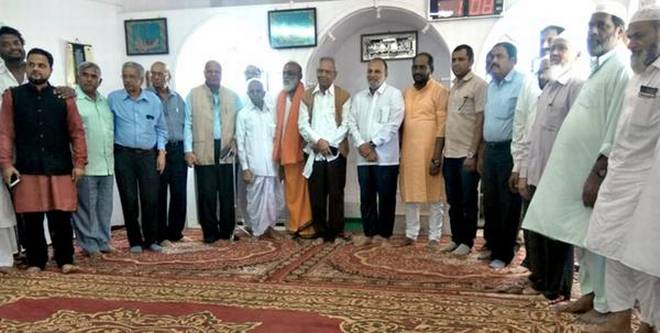
Special occasion: Authorities of the Hubballi mosque organised the programme on Sunday in association with Sadbhavana Vedike Karnataka. | Photo Credit: Special Arrangement

Masjid-e-Usman Ghani throws open its doors for Hindus for Id party

Masjid-e-Usman Ghani, located at Vijayanagar here, witnessed a special Id party on Sunday as authorities of the mosque had invited members of the Hindu community for the occasion.

The organisers said it was for the first time that an Id party was being held by inviting Hindu members on the mosque premises.

Mosque authorities, in association with Sadbhavana Vedike Karnataka ,  took this initiative to promote religious harmony and brotherhood in society.

Vedike secretary Akbar Ali Udupi said he was elated to see the Muslim community members opening the doors of a mosque for their brethren from the Hindu community. “It should have happened long back, but I am happy that it has happened no less than 70 years after Independence,” he said, and asserted that other mosques too should hold similar programmes.

He said the core essence of all religions was the same but they were presented in different ways. The prime reason for violence over religious issues was lack of proper knowledge about religions among their followers. Even those who resort to violence in the name of Islam do so because their knowledge of Islam was limited, he said. There were several examples in the life of Prophet Muhammed where he respected other religions and asked his followers to follow suit, Mr. Udupi said. Truthful knowledge of religion helps achieve peace and harmony, whereas unfair information of religion leads to disturbances in society. Therefore, every human being should strive to gain truthful knowledge of their respective religion in the larger interest of society, Mr. Udupi said.

Venkatesh Savadatti and Subhas Hosmani and others who were present on the occasion appreciated the move. They said division on religious lines was the creation of power-hungry politicians and common people should not fall prey to their devices.

source: http://www.thehindu.com / The Hindu / Home> News> States> Karnataka / by Staff Reporter / Hubballi – July 02nd, 2018

Former cricketer Azharuddin flags off ‘Save Lake Campaign’ at Hussain Sagar

Hyderabad, TELANGANA :

AzharuddinMPOs02jul2018

Hyderabad :
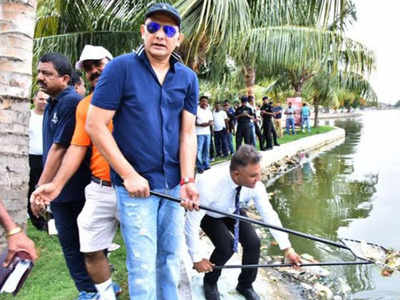
A human chain with more than 6,000 students was formed around the Hussain Sagar in the city on Sunday as part of the “Save Lake Campaign ” organized by the Military College of Electronics and Mechanical Engineering (MCEME) Secunderabad.
Former Indian cricket captain Mohd Azharuddin  and Seema Singh , chairperson, Family Welfare Organisation, MCEME flagged off and participated in the 3.5 km Green Brigade Walk.
The programme was organized in connection with the annual Hyderabad Sailing Week. With the theme “Fit Hyderabad Swachh Hyderabad”, the green brigade walk was organized. Students from Army Public Schools, NCC cadets, army personnel, youth and general public participated in the walk from Sailing Club to Sanjeevaiah Park  to promote fitness and health awareness amongst the citizens of the twin-cities.

As part of the Swachh Bharat Campaign, participants undertook a cleanliness drive promoting ecological awareness.

IT minister K T Rama Rao will inaugurate the “Hyderabad Sailing Week” on July 3, 2018. During the Hyderabad Sailing Week, a national seminar on “Race Management” will be organized.

Major General TSA Narayanan, cice commodore, EME Sailing Association said Hyderabad was a popular destination for the sailing in the country. The wind conditions in June – July are most favorable in the Hussain Sagar Lake to hone the skills in boat handling and understanding wind shifts, he said.

This is a landmark year for the EME Sailing Association as this year the event has been accredited as the Yachting Association of India (YAI) National Ranking event where in the performance of the sailors will be ranked, which will give them points for selection into National Team. The eco friendly sports are getting popular day by day and 200 sailors from all over the country are expected to participate in this year’s event, he said.

Major Alok Kumar, honorary secretary, EME Sailing Association informed that the event will see the biggest congregation of sailors in the country. “Sailing is an eco friendly sport which requires immense technical skills to negotiate wind conditions and water. The concepts of sails and boat handling have undergone huge advancement, however the sport still retains the old world charm of explorers and discoverers who used their wind propelled boats to discover the world,” he said.

source: http://www.timesofindia.indiatimes.com / The Times of India / Home> News> City News> Hyderabad News / Ch. Sushil Rao / TNN / July 01st, 2018

The Nizams’ lost wheels

Hyderabad, TELANGANA :

NizamsCarsMPOs30jun2018

From missing White Steams to a recently found Duesenberg, a new coffee-table book — Automobiles of the Nizams — looks at the Hyderabad royal house’s expansive car collection

Once upon a time, Duesenbergs, Napiers, Rolls-Royces, White Steams and Hispano-Suizas were the playthings of the Nizams, the ruling family of Hyderabad. Then they disappeared. “There were 400 of them; I’ve been able to trace around 50. The others remain missing, scrapped, hidden or in private collections,” says Muhammad Luqman, a Hyderabad-born, Dubai-based banker and vintage car collector who has chronicled the royal wheels in his book, Automobiles of the Nizams. Containing never-before-seen photos, the tome tracks significant cars from production lines to palatial palaces. It is set to be released at the Pebble Beach Concours D’Elegance in California in August.

NizamsCars02MPOs30jun2018

As we walk around the Chowmahalla Palace over the weekend — where some of these cars ferried the sixth Nizam, Mir Mahbub Ali Khan (1869-1911), and later his son, Mir Osman Ali Khan (1911-1948) — Luqman spins a fascinating yarn about the wealthy monarchs’ love affair with automobiles. The first to catch the motoring craze, he says, was Mahbub Ali. The story goes that to acquire one of the first Rolls-Royce Silver Ghosts, he roped in the services of the British Resident (an appointee of the British government), shelled out ₹25,000, and then got it modified to his taste. Painted yellow, as a sign of royalty, he ordered a crest shaped like the dastaar (traditional headgear) and metal work with a delicate lily pattern for the roof fringe. However, by the time the customisation on the Throne Car was completed, he passed away.

The Ghost chronicles

Last year, at Cartier’s Concours d’Elegance at Falaknuma Palace, his great-grandson, Prince Azmet Jah, sat in the Silver Ghost and reminisced about being driven around in Hyderabad. “This was a ceremonial car used on special occasions. The prince recalled how, to celebrate the golden jubilee of Osman Ali’s ascension in 1936, the courtiers wanted him to get a new car. But the Nizam, known for being frugal, asked the Railways (he had his own railway network) to spiff it up instead. They did so by adding horrible fenders,” says the author, who relied on the archival material at Chowmahalla Palace’s royal library for much of his research. “After being left to the elements, it was restored by Rana Manvendra Singh (one of the country’s foremost authorities on vintage vehicles) in 2012, with Cartier picking up the tab.” As we talk, I also spot a massive, newly-restored Wolesley beside the shiny Silver Ghost.

While the sixth Nizam bought cars in pairs and preferred the ultra-luxe versions, his son picked the simpler Humbers and Fords. Today, one of the 1933 Dodges used by Osman Ali is taken out for a spin every Sunday by Captain Kerman Pestonjee, a Hyderabad-based collector, who acquired it with a unique number plate: King Koti Hyd A. So does Luqman’s book overlap with Singh’s 2003 compendium, The Automobiles of the Maharajas, a sweeping history of Indian royalty and their tryst with cars? No, he replies, because his work is a micro history, with details about the vehicles and anecdotes about how the Nizams acquired them. “It has been my obsession for the past 30 years; this book is a culmination of the love story,” says Luqman, who houses his collection of 12 vintage cars, including a small 8 HP post-war Wolseley, in Hyderabad.

Disappearing act

One of the cars he has been able to trace is a Bentley. When Prime Minister Jawaharlal Nehru visited in the ’50s, he was photographed in the vehicle with the Hyderabad number plate intact. Nizam Mukarram Jah had also used it extensively and once, in the ’60s, crashed it near Visakhapatnam — into a cart carrying coconuts. “The glass was smashed, the radiator twisted out of shape, but the Nizam continued with his programme and went to Calcutta. When he relocated to Perth, he took the Bentley with him. I traced it to a collector there,” says the writer, who also traced a Duesenberg to General William Lyon’s collection in the US.

But the mystery of the missing 350 cars remains. How do large automobiles just disappear? Luqman explains that after the 1948 merger with India, Hyderabad’s royal family simply lost interest in the vehicles — till Nizam Mukarram Jah Bahadur, an outdoorsman who loved tinkering with engines, took charge. His biographer, John Zubrzycki, talks about Jah’s fascination with everything with wheels, including earth movers and heavy machinery. “One of the Jeeps he had, had mounted guns,” he says. An interesting story that could explain a few of the disappearances, involves an electrician. “About 10 years back, the family wanted to install an AC at their Chiran Palace. Once done, a grateful Nizam asked the technician for the fee. ‘I want that Jeep,’ he replied, and the generous prince obliged. Now the Jeep, with the 8386 number, has passed on to another Hyderabadi family,” concludes Luqman, who hopes that more stories about the Nizams and their cars will come out once his book hits the market.

Automobiles of the Nizams, planned as the first of a multi-volume series, is published by Oxford Printing Press.

source: http://www.thehindu.com / The Hindu / Home> Life & Style> Luxury / by Serish Nanisetti / June 29th, 2018

Bidar’s officers who became beacons for the entire State

Bidar, KARNATAKA :

Ordinary people continue to talk about the work of Moudgil, Gupta,Jaffer, Tewari, Singh, and Ghosh even today

Bidar district is fortunate to get good officers known for their out-of-the-box thinking. Munish Moudgil, Harsh Gupta, P.C. Jaffer, Anurag Tewari, Naveen Raj Singh and Ujjwal Kumar Ghosh, to name a few, were not only good administrators leading the bureaucratic apparatus but also people-friendly officers who ordinary folk continue to talk about even many years after they have been transferred.

That many of their unique experiments in the district have grabbed the attention of the political class in Bengaluru who, in turn, adopted them for the entire State considering their effectiveness in improving governance is testimony for their outstanding performance.

When Naveen Raj Singh was Bidar Zilla Panchayat Chief Executive Officer (CEO) between 2003 and 2005, the district witnessed a successful experiment of watershed development through arch-check-dams. A civil engineering graduate, Mr. Singh studied the pressure enduring logic behind Idukki Dam, a double curvature arch dam constructed across the Periyar in a narrow gorge between two granite hills in Kerala, and built the first-ever inclined-buttress check-dam, as it was called, in Bidar applying the same logic.

Considering the reduction of construction costs by half as compared to conventional check-dams and increased life expectancy to around 100 years, the arch-check-dams proved to be a successful model in watershed development at affordable costs. The experiment impressed the State government which issued standing directions to all district to adopt the Bidar model for building smaller check-dams.

Munish Moudgil, who served as Deputy Commissioner in the district between 2005 and 2007, was the man who not only forced the mighty to respect and adhere to the law of the land but also significantly contributed to improving the administration. An M.Tech graduate from IIT Bombay, Moudgil was the one who first conceived the idea of time-bound public grievance redressal system.

He began to hold Jana Spandana, a people-meeting programme, on Tuesdays to address public grievances and put a mechanism in place to see that every grievance is addressed within a stipulated time.

Then, all the other department heads also followed him. Impressed by the initiative, the government adopted it for the entire State under a new name, Sakala.

Then came Harsh Gupta. During his tenure as Deputy Commissioner between 2007 and 2010, Bidar saw multi-front development. He put men on task to identify and protect 96 little-known monuments of historical importance. It was during his tenure that around 1,100 acres of public land encroached upon by private parties returned to government’s possession. His groundwork is undeniable in the famous Bidriware getting geographical indication (GI) tag as he was the one who roped in Cauvery Handicrafts Emporium to train Bidri artisans and get their work globally recognised.

Education was P.C. Jaffer’s cup of tea. During his tenure as Deputy Commissioner between 2012 and 2015, he introduced a series of programmes for improving the education scenario in the district. He selected one efficient teacher from each one of the 1,350 government primary schools and get them trained in English teaching training. Experts from English and Foreign Languages University (EFLU), Hyderabad, with whom he entered into an agreement, trained teachers in two sessions with multimedia teaching tools.

Mr. Jaffer conducted a series of career counselling programmes for spreading awareness on UPSC examinations in the backward district. In one of his important initiatives, he conducted a preliminary test for those aspiring for civil services and selected 12 students — eight males and four females, whom he sent to Delhi for higher-level coaching. Two of them cracked the UPSC exams. His efforts to improve the district’s performance in SSLC and PUC examinations were unlimited.

Anurag Tewari, who succeeded Jaffer as Deputy Commissioner and worked between 2015 and 2017, was Bidar’s waterman. In collaboration with Team YUVA, a civil society group of professionals, he identified hundreds of public tanks and wells that were crying for dredging. The collective efforts paved way for the dredging of 100 tanks and 300 open-wells resulting in increased water storage and groundwater table recharge. In 2016, the then Chief Minister Siddaramaiah, who visited a lake in Aurad, locally known as Deshmukh Kere, which was freshly dredged, was so impressed that he extended the initiative to the entire State under the name of Kere Sanjeevini.

Ujjwal Kumar Ghosh, during his tenure as the CEO of Bidar Zilla Panchayat, put a system in place for ensuring punctuality of teachers in government schools. The system inspired the Education Department to further develop it into an SMS-Based School Attendance Monitoring System and extend it to the entire State.

Anirudh Sravan P. is another promising officer that Bidar could expect the furtherance of the legacy from. Transferred as Deputy Commissioner of the district by Election Commission during the recent Assembly polls, he got recognised as people’s officer within a short period. It is his repeated visits to the district hospital that made it a patient-friendly hospital. Known for his style of working more from the field than from office, he is still talked about in the rural areas of Kalaburagi where he had meaningfully implemented MGNREGA as the CEO of Kalaburagi Zilla Panchayat.

source: http://www.thehindu.com / The Hindu / Home> National> Karnataka / by Kumar Buradikatti / Kalaburagi – June 19th, 2018