His was the hand behind the Arabic inscriptions on the Taj Mahal, which have captivated tourists from across the world.
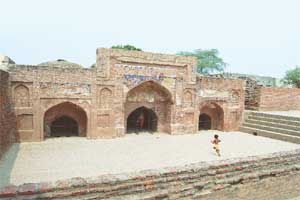
But today, the mausoleum and the dwelling of Amanat Khan, the calligrapher of the Taj Mahal, lies in decay, neglect and encroachment.
Sarai Amanat Khan, about 29 kilometres south-east of Amritsar on Tarn Taran Attari road, was built by Khan in 1640, where he lived a reclusive life following the death of his elder brother Afzal Khan, the prime minister of Shah Jahan.
But here too, Khan, who came to India from Iran in 1609 and whose real name was Abdul Haq before being conferred the title of “Amanat Khan” by Shah Jahan for his impressive calligraphy, has left the imprint of his craft — the sarai has beautiful Islamic calligraphy inscribed on its fading blue and yellow tiles.
Sarai Amanat Khan was also a guest house, where travellers on the Lahore-Agra route on the Grand Trunk Road would stop for rest in the middle of a long strenuous journey. They would live in the small rooms inside the sarai, and pray in the adjacent mosque and large courtyard.
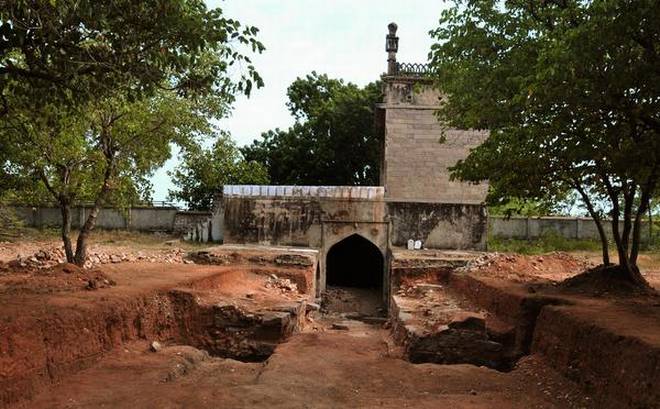
Today, Sarai Amanat Khan is dilapidated — the Nanakshahi bricks are falling off, and the eastern gate is in disarray; some 800 feet below it is Khan’s ruined tomb.
The sarai is in the middle of a densely populated village, also named after Amanat Khan.
With several shops in its immediate vicinity, the Archaeological Survey of India-protected monument is a site of rampant encroachment. Several families live inside the rooms of the sarai illegally, and claim to have been doing so since Partition. “I was born here,” says 50-year-old Ranjit Singh. “People have been living here since 1947. There had been talks about giving us alternative land and compensation, but those have not materialised,” he adds.
source: http://www.archive.indianexpress.com / The Indian Express / Home> Archive / by Navjeevan Gopal, New Delhi / July 29th, 2012
Karim’s had transformed from a local purveyor of aloo gosht into a monument. It was visited by princes and prime ministers, eulogised by journalists, studied by historians, and patronised by tourists.
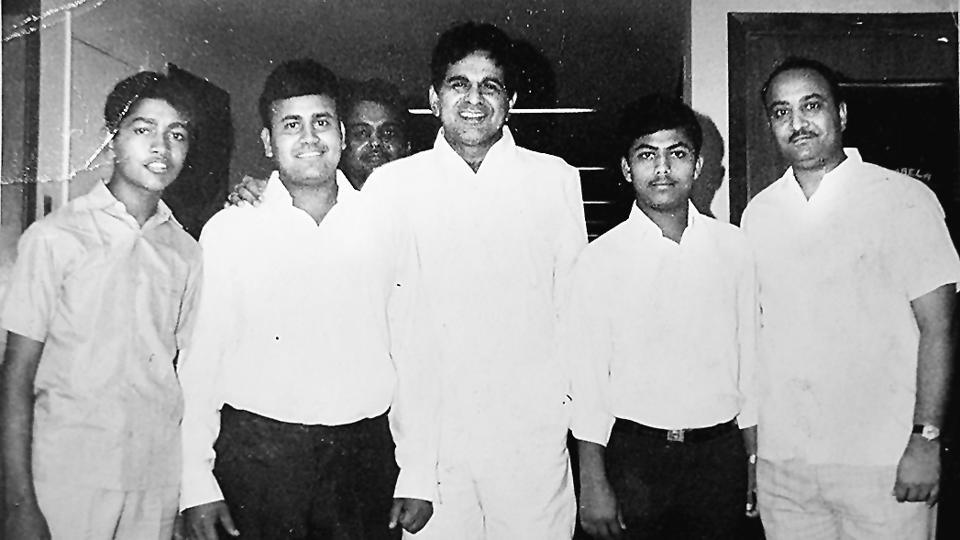
Haji Zahooruddin (extreme right) with Bollywood star Dilip Kumar.(Image courtesy Zain-al-Abedin,Zaeemuddin Ahmed and family))
When Haji Zahooruddin started working at Karim’s over 70 years ago, the business consisted of a single restaurant run by his father and grandfather. On January 27, when he died at the age of 85, Zahooruddin was the managing director of a small empire, with 26 outlets overseen by around a dozen other family members.
Karim’s had transformed from a local purveyor of aloo gosht into a monument. It was visited by princes and prime ministers, eulogised by journalists, studied by historians, and patronised by tourists.
Much though Karim’s success was the result of adaptation to changing times — with the addition of Punjabi butter chicken to the Mughlai menu, for example, and the establishment of small take-out joints throughout the city — Zahooruddin devoted himself to protecting Karim’s most valuable asset: its heritage.
“This is time-tested Mughlai food and we do it well,” he told an English daily in 2013, “so why should we change?”
Karim’s changed only as much as it had to. Striking this balance enabled Zahooruddin’s “number one contribution”, said Shahid Siddiqui, a regular at the restaurant who has written extensively about Old Delhi. “He introduced the food of the old city to New Delhi and to the public in general.”
The Karim’s family attributes their culinary lineage to Mohammad Awaiz, a chef in the royal court of the last Mughal emperor, Bahadur Shah Zafar. When the British sacked Delhi and expelled the king to Rangoon, Awaiz fled. He settled in Ghaziabad and found other work, but taught his son, Haji Karimuddin, everything he knew about Mughal cuisine. During the coronation of King George V in Delhi in 1911, Karimuddin returned to the imperial city and set up a food stall. In two years, he made enough money to open a restaurant.
Karimuddin’s son, Haji Nooruddin, had four sons of his own, including Zahooruddin, who was born around 1932. He started working at Karim’s at the age of 12. The young boy learned the power of belonging to the Karim’s family when a particularly strict teacher demanded Zahooruddin hand over the food in his tiffin box every day at lunchtime. Zahooruddin may have gone hungry, but he was spared the beatings inflicted on his classmates.
He spent his whole adult life working at the restaurant, learning its traditions zubaani (orally) and mixing spices with his male relatives — the only ones allowed to know Karim’s recipes. In the late 1940s, he married Samar Jahan, also a resident of Old Delhi, and had four children, two of them sons who have spent their careers working at Karim’s. Four of Zahooruddin’s grandchildren now manage branches of the restaurant.
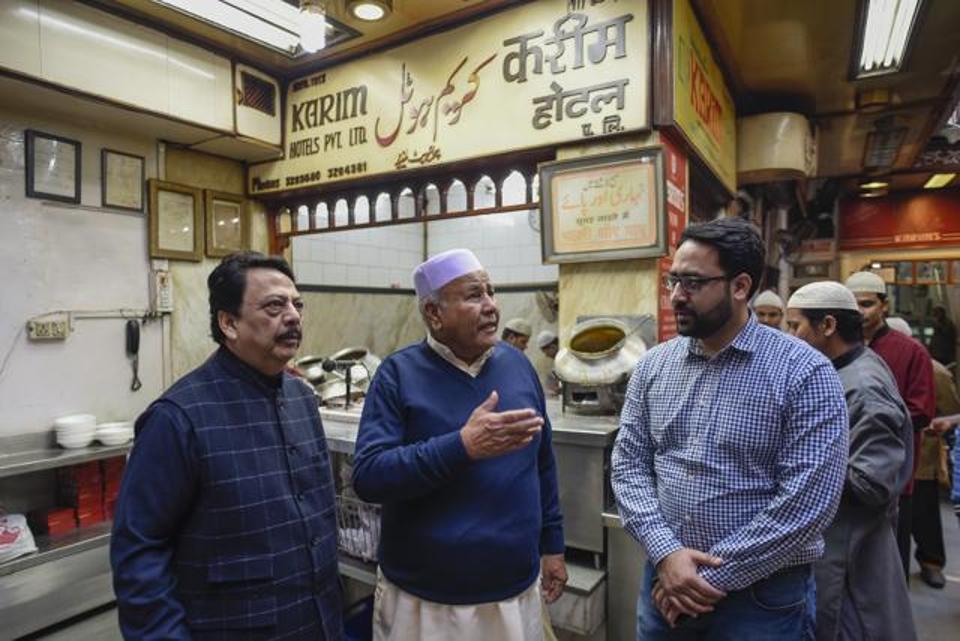
Zahooruddin’s son Zaid-ul-Abedin, his brother Salahuddin, and nephew Zaeemuddin, three of the current directors of Karim’s, say that his focus was always on Karim’s buniyaad, both in terms of values and dishes. (Burhaan Kinu/HT PHOTO)
Clients and business associates found Zahooruddin to be a commanding figure, and heeded his advice. For newlyweds, he recommended nahari; to the sick, thigh meat for its high degree of bone marrow; to one fat customer, Siddiqui remembered Zahooruddin making the suggestion, improbable for a restaurateur, that the man eat a little less. If a customer said something was wrong with their mutton or chicken, Zahooruddin would keep the piece of meat and show it to his butcher in disapproval. “Babu would scold me sometimes,” said Javed Qureshi, whose family has supplied Karim’s with meat for decades, “but he loved me like a son.” Qureshi is one of many people who refer to Zahooruddin as “Babu” (father).
As time went on, Karim’s business grew, and its legend along with it. The family opened a second branch in Nizamuddin in the years before the Emergency. The former Presidents Fakhruddin Ali Ahmed and Zakir Husain became devoted customers, the latter ordering his food to Rashtrapati Bhavan. Indira Gandhi was also fond of Karim’s, but had security guards oversee the meals cooked for her.
The obvious antiquity of Karim’s Jama Masjid alleyway, its family’s claims of royal patronage, their distinctive Old Delhi Urdu, their promotion of old-fashioned dishes such as mutton brains — all this was stimulus for myth-making and myth-debunking. Historians debate whether Karim’s famous ‘istoo’ is authentically Mughal or secretly British. Some trace the family’s origins to a Saudi Arabian soldier who became Babur’s personal cook, but Zaeemuddin Ahmed, Zahooruddin’s nephew, said the family does not know anything about their ancestors prior to Awaiz.
In 1988, when Karim’s registered itself as a company, Zahooruddin was made chairman. When his brother Alimuddin Ahmed died in 2007, Zahooruddin took over from him as managing director. A slim gentleman with a well-trimmed moustache, he became the public face of his venerable restaurant. He attended numerous award ceremonies and made an appearance on the NDTV show Foodistan. At such moments, Zahooruddin smiled with the discomfort of a dignified man in a flamboyant place.
The public image of him as an embodiment of Old Delhi customs was shared by those who knew him personally. When Faiz-ul-Islam, his friend of over 40 years, returned from Haj, Zahooruddin invited 200 of Islam’s friends for a free breakfast at Karim’s, in keeping with his sense of mehmannawazi (hospitality). “He did it without takalluf (hesitation) and without a single line on his forehead,” said Fazl-ul-Islam, Islam’s son.
Zahooruddin performed culinary experiments, sometimes inventing his own dishes, while also sampling the food from different outlets of Karim’s every week to ensure his standards were being upheld. He insisted that the core of the menu — qorma, nahari, mutton burra, kebab — remain untouched.
“Babu used to say, ‘If we let others own a franchise, will they give the same attention to the quality of spices we use?’” said Zain-ul-Abedin, Zahooruddin’s son. “For example, he would say that cloves are something most people don’t eat: they take it out and put it aside on the plate. So another restaurant owner may think, ‘What is the use of putting in the cloves or buying the best-quality cloves?’ But clove adds to the taste, its juices mix with the food and bring out the smell of meat.”
What he was selling, after all, was not just food. Visit Humayun’s Tomb, and you’ll find a silent testament to the dead. Visit Zahooruddin’s restaurant, and you’ll find traces of the past still alive.
source: http://www.hindustantimes.com / Hindustan Times / Home> Delhi / by Alex Traub and Zehra Kazmi, Hindustan Times / February 01st, 2018
Could the Tiger’s position — now behind a glass case, its crank handle inaccessible to the public — be an apology for the disrespect permitted in East India House?
The artefact sitting in V&A was iconic, identifiable and far away from home
The day I saw Tipu’s Tiger behind its glass case at the Victoria and Albert Museum in London was a day of significance. That morning, after months of being cooped up in Oxford, some friends and I took the train to Marylebone and found the absence of dreaming spires refreshing to say the least. At noon, a friend from India was waiting for me on the other side of the busy Camden High Street. As we hugged amidst the crush of gliding Londoners, her muffled exclamation might have been: ‘It’s so crazy we’re meeting here of all places, so far from home.’
That phrase would be borrowed by me on two separate occasions during the day. In the evening, I stood before Julian Barnes at the Royal Institution and told him how I had read ‘A Short History of Hairdressing’ over and over again to teach myself the ‘architecture’ of a short story. I felt a potent urge then to parrot my friend. It was ‘crazy’ to see and hear Barnes in the flesh, so far from my bedroom in Kolkata, the only other place he had seemed real and, dare I say, attainable through his prose and through the material object, that is, his books in my hands, the only feasible rendezvous with the man.
I had never thought then it would happen: to have someone I studied so minutely sit before me and confess he didn’t think as highly of his short prose as I did.
Iconic meeting
The second occasion I was inclined to echo her words that day was when I stood in the South Asia section of the V&A before Tipu’s Tiger, which had always been relegated to the Did You Know section of our history books. It was not exactly like meeting an old friend or a revered author, but it bore all the characteristics of such a meeting. Like Barnes and my Kolkata friend, it was instantly iconic, identifiable from a distance, and a ready reminder of my distance from India. In fact, standing before the wooden automaton, slightly disconcerted, I addressed it and thought: ‘You are so far away from home.’
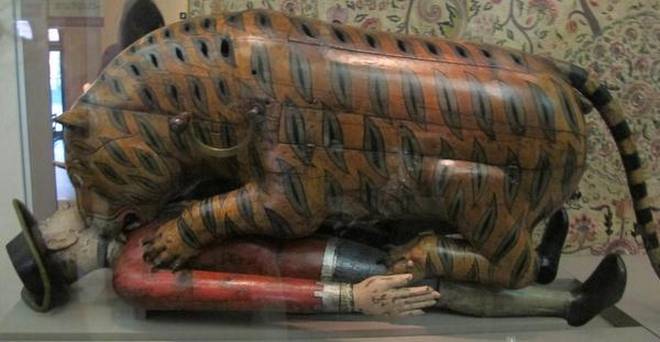
The possible inspiration for the mechanical figure seems fitting to some. Hector Munro Jr, whose father defeated Tipu’s father Hyder Ali in the Second Anglo-Mysore War in 1781, was mauled by a royal Bengal tiger at Saugor Island in 1792 and died from the injuries. This must have seemed like divine intervention to Tipu, a wrong set right. The carved and painted, almost life-size, wooden musical automaton was created for the Sultan, whose personal emblem was a tiger and whose hatred of the British was well-known.
The last laugh
With the fall, however, of Seringapatam and the execution of Tipu in the Fourth Mysore War of 1799, the Tiger travelled from the music room of Tipu’s summer palace to the Company’s East India House at Leadenhall Street in London, where the public was given access to view and play with it.
Its wooden body with a keyboard embedded in the flank was thrown open to the English masses who came in and played ‘God Save the King’ and ‘Rule, Brittania!’ upon it. If Tipu thought he had been mocking the Englishmen with the Tiger, they were now having the last laugh.
I deal with issues of empire and post-colonial anxiety almost on a daily basis, especially in a place like Oxford, especially on a course called World Literatures in English. Of course, when I first saw it, I silently demanded a restoration of the tiger to its previous owner, to its previous nation. My anger at seeing the Tiger in an English museum, so far away from home, was justifiable. The Tiger was not borrowed. Nor was it touring, as it had to New York’s MoMA in the 50s. Instead, it was a ‘permanent’ acquisition at the V&A.
Of collaborations
For every Indian schoolchild, the Tiger, just an artefact but nonetheless awe-inspiring, was not an affordable train or flight away, like Fatehpur Sikri or Sher Shah’s tomb.
For me, the Tiger’s distance from my home was a reiteration of the national and racial distinctions not only of the Anglo-Mysore variety, but also of the Jadavpur-Oxford type that I faced every day. Besides dodging questions like ‘If you’re from India, how’s your English so good?’ for the past few months, I had had to clarify to a white friend who subsisted on the chic-ideal of Zadie Smith that India has Bengalis too, and no, I did not have relatives in Brick Lane, not that I knew of anyway.
Seeing Tipu’s Tiger that day catalysed a recollection of an afternoon in 2016 in the Victoria Memorial Hall with Thomas Daniell and his nephew William. Their tranquil scenes of India, while in stark contrast to the ferocity of the Tiger, do something interesting.
The English hands of the Daniells reproduce the Indian hands of the architects behind the buildings and locations they sketch. Their canvas becomes a surface of Anglo-Indian collaboration, similar to how it is conjectured that the mechanics of the Tiger have an Indo-French history.
This recollection, and the subsequent contemplation on collaboration, made me think of several works of restoration that the V&A carried out upon the Tiger, especially after the bombing of London in World War II. Could this act of restoration be seen as an act of reparation? Could the Tiger’s position — now behind a glass case, its crank handle inaccessible to the public — be an apology for the disrespect permitted in East India House?
The Tiger, so far from home, is an icon that reminds me of a past based on plunder and pillage by the nation it sits in. Yet, its 18th century splendour has weathered war and wear so well. Do present acts of safekeeping obliterate the violent history of its, for want of a better word, theft?
I am persuaded to wonder if the Tiger is now a collaboration between Tipu’s Mysore craftsmen and its modern conservationists in England and if I should be thankful for the restoration. Are the acquisition and conservation of an Indian object in a British museum and the works of British painters displayed in a Calcutta museum an instance of transnational collaboration and exchange? But in the case of Tipu’s Tiger, this then also begs the question: how long is too long before we forget that what is ‘acquired’ is what was once ‘removed’ from its home?
The writer, a Felix Scholar, is studying World Literatures in English at Oxford
source: http://www.thehindu.com / The Hindu / Home> Society> History & Culture / by Rohit Chakraborty / May 05th, 2018
Four friends sat down to hang out one evening in 2016, a couple of months before Durga Puja. The idea was to discuss a plan that one of them had, to bounce it off among the other three. Fortunately, they were very excited at the idea… and thus started their project to feed Kolkata.
It started as one “ATM” to “ladle” out free food to the hungry. In a period of just nine months, it’s gone up to three ATMS. And, if things go according to plan, there’ll be two more before Puja this year.Together, the three Food ATMs, as the project is being lovingly called, feed at least 2,000 people each day. The first one came up on the EM Bypass at Uttarpanchanna Gram, the second opposite Ladies Park on CIT Road, and the third one inside Ramleela Maidan off Moulali. The fourth is supposed to come up at Bhowanipore, near Chakraberia, and then a fifth near the 8B bus stand at Jadavpur.
Restaurateur Asif Ahmed and his three entrepreneur friends Prakash Nahata, Rahul Agarwal and Nirmal Bajaj decided to start their endeavour as a sort of experiment by connecting with clubs that organise Puja. With the first letters of their names they formed Pran, a group to fight for a hunger-free Kolkata. Almost every club cooks and feeds bhog on all four days of Puja. “We requested them to cook some extra bhog, so that we could distribute it among pavement-dwellers,” Ahmed says. “We were able to convince 15 clubs, and they gave us immense quantities of food, which we were able to distribute among hungry pavement-dwellers. The gratitude and satisfaction we saw on those poor faces was the incentive that sowed the seeds of the Food ATM project.”
Ahmed first turned his attention towards the food that his restaurant was left with at the end of each day. At his Uttar Panchannagram outlet, he got his workers to cool, pack and refrigerate the food, so that it could be distributed. His friends got a real estate company to donate a specially designed refrigerator, kept outside his restaurant, packed with food. Twice a day, the food was distributed to the needy. “We started on August 15, 2017 to emphasize the freedom factor. What is the value of freedom unless we are able to give freedom from hunger to everyone in the city?” Ahmed says.
Bengali New Year’s Day was celebrated on April 15 a little differently at the Ramleela Maidan. Members of the Entally Yuvak Brinda joined hands with Pran to start the city’s third food ATM. A special room was built beside the park, where the refrigerator is kept stocked with food, water and cold drinks, to be distributed among the homeless twice each day. At least 10 restaurants in the vicinity have been sending their packed excess food to the food ATM. “We just had to visit the restaurant owners and tell them about our intent, and they readily agreed. If the city restaurants stop wasting their leftover food and refrigerate it, we will be able to eradicate hunger completely,” says Jami Siddique, theclub’s secretary.
Most restaurants have to throw away the food even after feeding their staff, as they do not have extra refrigeration facilities and also because they cannot serve it to customers the next day. They just needed an organised, hygienic and efficient collection and distribution system, which is why the idea of the food-ATM seemed so appealing to the donors. “Once in a while, restaurants also give away cold drink bottles, which we gratefully accept,” says Sujoy Banerjee, a member of the club’s Food ATM organising committee. Members are now going a step further and approaching households in the area, telling them not to waste food but to pack it up neatly and call a helpline number that the club has set up, so that it can be collected from their doorsteps. “Even one small container of rice and a little dal or dry sabzi, which is what we are able to collect from most households, is enough lunch for a hungry mouth,” Siddique says.
You have to be present at Ramleela Maidan around 1pm or 9pm any given day to see how the distribution is done and to see how happily the recipients — especially the kids — are, leaving with the food packets. “Khub bhalo khabar… we even get pieces of chicken, fish or eggs at times,” says Monua Patra, a 70-year-old woman who comes with her grandchildren for the food every day. “We share the food amongst us. God bless these good men,” she says.
Perhaps the most popular of all the food ATMs is the one opposite Ladies Park on CIT Road. “At this ATM, we are not only getting food from restaurants, but also get excess food and cakes from birthday parties, wedding halls and party organisers,” says Surjya Kanta Haldar, the points person for this ATM.
This ATM is also getting a lot of donations from schoolchildren of Don Bosco Park Circus and Mahadevi Birla Girls HS School, who keep chocolate, juices and cakes on their birthdays. “These happen quite often nowadays and we are able to happily distribute the goodies among the needy kids,” Haldar says.
Both in Bhowanipore and Jadavpur, Pran is in the last stages of discussion about starting the ATMs. The refrigerators come free from the real estate group in accordance with the agreement with Pran. “The real challenge is that the club members need to network with local restaurants and in the neighbourhood to get a steady chain of donors,” Ahmed adds.
At each partner restaurant, efforts are on to educate patrons about the initiative so that after they have eaten what they need, they can ask waiters to pack up the leftovers. Needless to say, the idea has clicked.
source: http://www.timesofindia.indiatimes.com / The Times of India / Home> News> City News> Kolkata News> Civic Issues / TNN / May 05th, 2018
Miyan Sahab Ka Imambara in Gorakhpur sees lakhs of devotees around Muharram every year.
Not many might know that Gorakhpur, the epicentre of the Nath sect, is home to a two-century-old Imambara as well. Built with the help of Nawab Asaf-ud-Daulah, the Imambara has been included in the list of places being promoted by UP Tourism.
Legend goes that once when the Nawab was out hunting in a forest in Gorakhpur, he came across a man meditating by the side of a dhuni (slow burning fire) deep in the woods.
Seeing the mystic wearing almost no clothes, the Nawab offered his expensive shawl to him as it was a bonechilling winter evening.
However, not welcoming of the move, the man, identified as mystic Hazrat Roshan Shah, threw it over the dhuni. But, instead of burning to ashes, the shawl did not catch fire at all, leaving the Nawab bewildered. Seeing his expressions, the mystic replied that the shawl was kept in the safest of places and he could reproduce it on demand. Then, the man took the unscathed shawl out from his ‘dhuni’ and offered it back to the Nawab.
Amazed at his spiritual powers, the Nawab offered him a handsome grant but Shah refused. When the Nawab insisted, Shah asked him to get an Imambara built for Imam Hussain and give some land for the Imambara’s waqf.
As ordered, Asaf-ud-Daulah granted 17 villages in Daud Chak area cash and promised to send gold and silver tazias to the saint. In a book titled Shahernama Gorakhpur, an article by Afganullah Khan notes that the land for the Imambara was handed over to Shah in 1796 and construction began soon after.
The saint died in 1805 and was succeeded by his nephew Ahmed Ali Shah, popularly known as Miyan Sahab. The Imambara came to be known as Miyan Sahab Ka Imambara. It is this name that has been included in the list of places being promoted by the Uttar Pradesh government to bring Gorakhpur on the national tourist map.
It found a mention in the ‘list of places of interest for tourism’ at Gorakhpur Mahotsava too. The government also plans to invite proposals from corporates for investment at tourist sites—including this Imambara.
With its impeccably white exterior, the grandeur of the Imambara can be seen only during the first 10 days of Muharram when azadari rituals are performed. “At least 1 lakh devotees visit the Imambara during Muharram,” says Nahid Shama, principal of a girls’ PG college run by the Imambara Trust.
Blogger Mazhar Naqvi has noted that the traditions of azadari came to the Imambara from Awadh. “Nawab Asaf-ud-Daula sent gold- and silver-plated tazias for the Imambara here from Lucknow. It is believed that the saint had promised to conduct azadari on behalf of the Nawab, and he kept his word,” Naqvi has noted in his article ‘Roshan Ali Shah and the Imambara of Gorakhpur’.
Local writer Prem Paraya stated that the estate grew manifold under the leadership of Roshan’s successors who took keen interest in administrative affairs of the Imambara and related property. “It is said that by then, the estate’s exchequer had lakhs in cash, many gold and silver blocks and a treasure of ‘asharfis’. The waqf was so wealthy that it gave a loan to the East India Company as well,” says Paraya.
source: http://www.timesofindia.indiatimes.com / The Times of India / Home> News> City News> Lucknow News / by Shailvee Sharda / TNN / April 01st, 2018
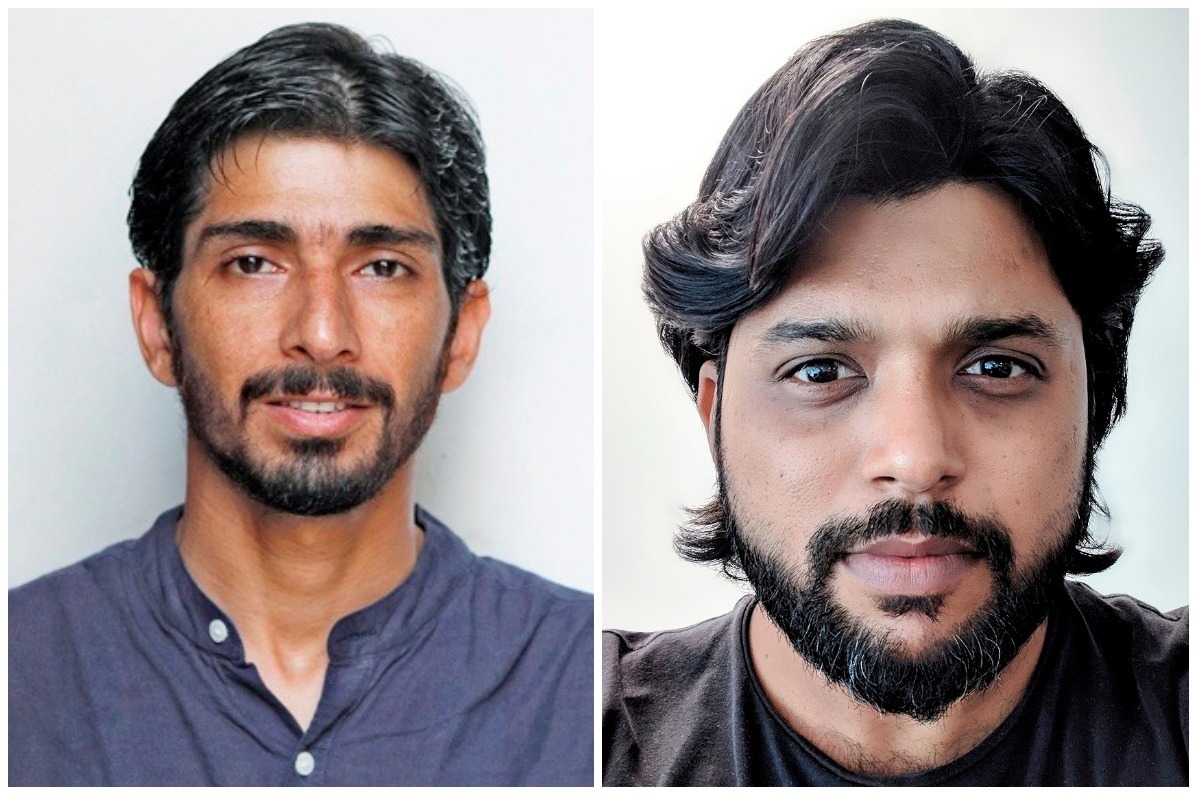
Danish Siddiqui and Adnan Abidi were part of the Reuters team that won the 2018 Pulitzer Prize for Feature Photography announced on Monday.
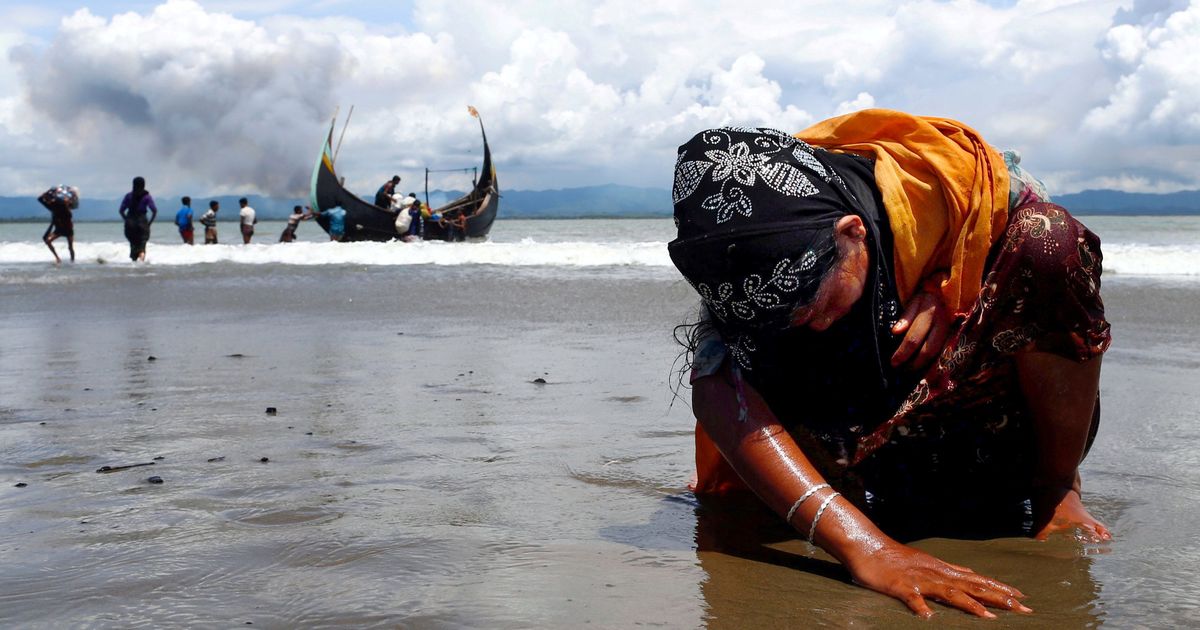
A Rohingya refugee after crossing the Bay of Bengal. | Danish Siddiqui/Reuters
A sun-burnt woman sinks to her knees on the shore, fatigued and forlorn. In the distance, a group of men unload the meagre belongings that they have carried with them in a small boat as they have made their way across the Bay of Bengal from their homes in Myanmar to the safety of Bangladesh.
This striking picture is the work of Danish Siddiqui, one of two Indians in the seven-member Reuters team that won the 2018 Pulitzer Prize for feature photography for their series documenting the violence faced by Myanmar’s minority Rohingya community and their mass exodus to Bangladesh starting from August 2017. The prestigious awards, given out by Columbia University in New York, were announced on Monday.
“A photo should draw people and tell them the whole story without being loud,” Siddiqui told Scroll.in. “You can see the helplessness and the exhaustion of the woman, paired with the action that is happening in the background with the smoke. This was the frame I wanted to show the world.”
Adnan Abidi was the other Indian in the team that won the prize. The other members of the Reuters team were Mohammad Ponir Hossain, Soe Zeya Tun, Hannah McKay, Damir Sagolj and Cathal McNaughton.
The Rohingyas, who are mainly Muslim, have been fleeing their homes in Rakhine state for several years, alleging that they are being discriminated against by the government of Buddhist-majority Myanmar. Myanmar maintains that the Rohingyas are illegal migrants from neighbouring Bangladesh.
The exodus in August was prompted by an intense campaign of violence in Rakhine. Myanmar’s military said that it had launched “clearance operations” against Rohingya militants. It denied that civilians had been targetted.
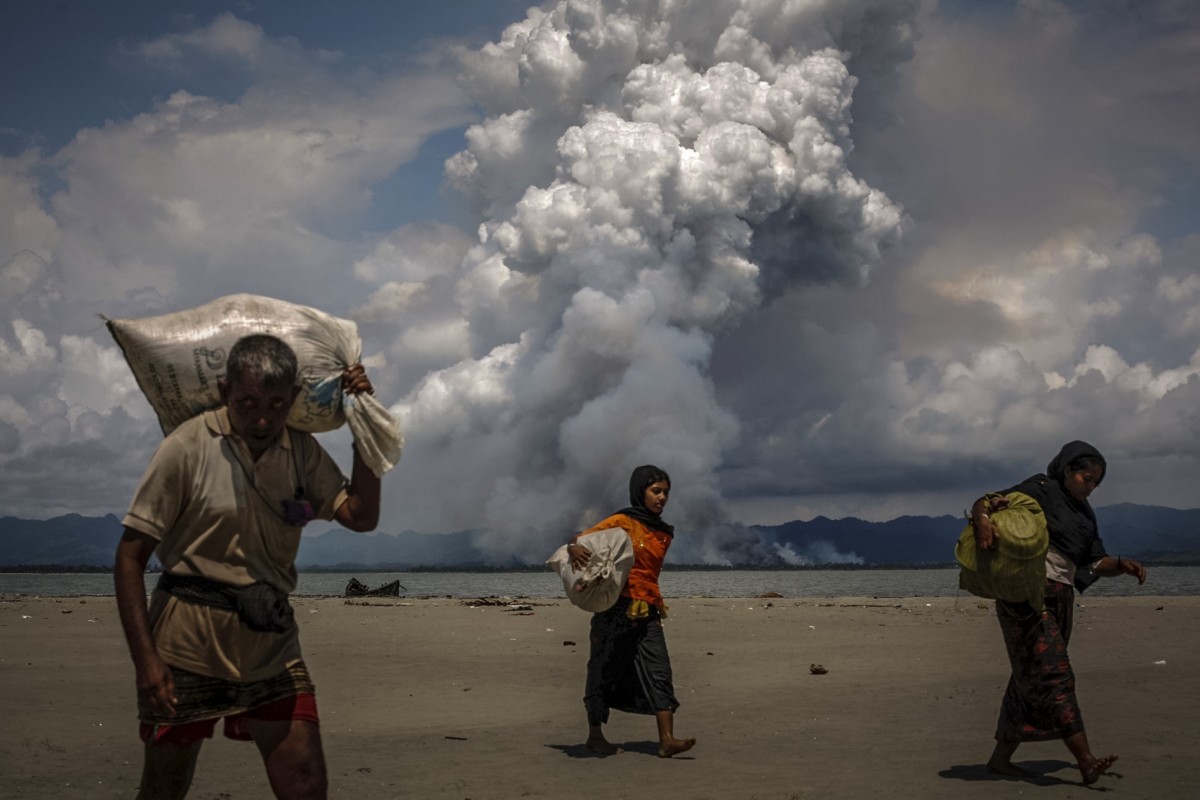
Smoke is seen on the Myanmar border as Rohingya refugees walk on the shore after crossing the Bangladesh-Myanmar border by boat through the Bay of Bengal, in Shah Porir Dwip, Bangladesh, in September 2017. Photo: Danish Siddiqui/Reuters
Complete chaos
Siddiqui was one of the first international photographers to be sent to the field at the outset of the crisis. The photographer had been on vacation in August when he saw the crisis unfold on the news channels. “I told my editors that I wanted to cover the story and within 48 hours I was on the first flight from Mumbai to Dhaka and then to Cox’s Bazar in Bangladesh,” Siddiqui said. “Since I was one of the first wave of journalists to land up there, there weren’t many restrictions, and I was permitted to even click pictures in no man’s land.”
Siddiqui spent around three weeks in the coastal villages of Bangladesh and in refugee camps. “It was completely chaotic,” he recalled. “Fishermen were carrying the refugees illegally from Myanmar to Bangladesh. The boats off coast were not going on the jetty and were landing in the middle of nowhere. Since the waves were really high, the boats were toppling and some people even died. Most of them were so traumatised. What they told me was that nobody should witness these kinds of things in their lives. For them, the first priority was to get food and water for their family.”
Adnan Abidi said that the situation was frantic. “Everybody was in pain,” he said. “We knew it was our job to shoot, but I did not want to randomly go in and click pictures. So I spoke to them and then started shooting. Everybody has lost everything and were living in a 10 by 6 plastic sheet for shelter.”
Abidi spent about 15 days in Bangladesh between late October and early November. “I have worked at Reuters for over 14 years now, but this is the most challenging story I have done till now, including the Nepal earthquake” of 2015, he said.
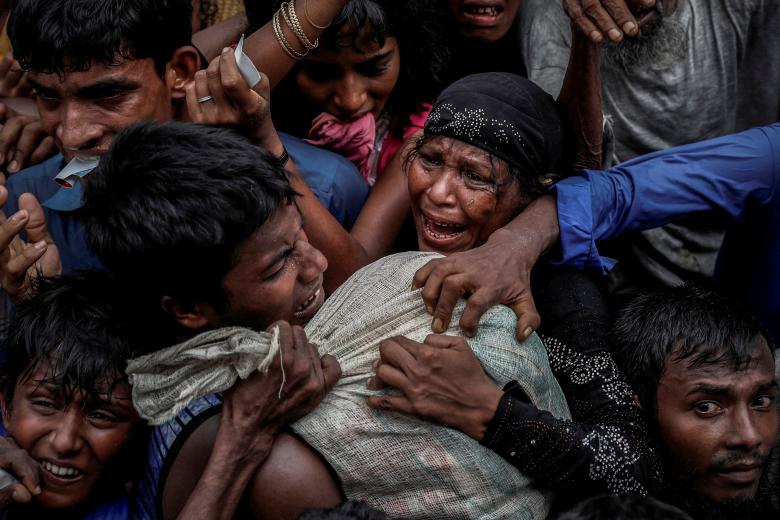
Rohingya refugees scramble for aid at a camp in Cox’s Bazar, Bangladesh September 24, 2017. REUTERS/Cathal McNaughton
Right place at the right time
Each of the 16 photographs in the series portray a different aspect of the vast human tragedy. A great news photograph, says Siddiqui, the result of both knowledge and chance. “You have to be at the right place at the right time,” he said. “It is also important to know the history and culture behind a place. You need to also know the history of the conflict. And in cases like these you have to do research on the monsoon waves. But again, news photography does not involve too much planning. We must think of what the readers want to see.”
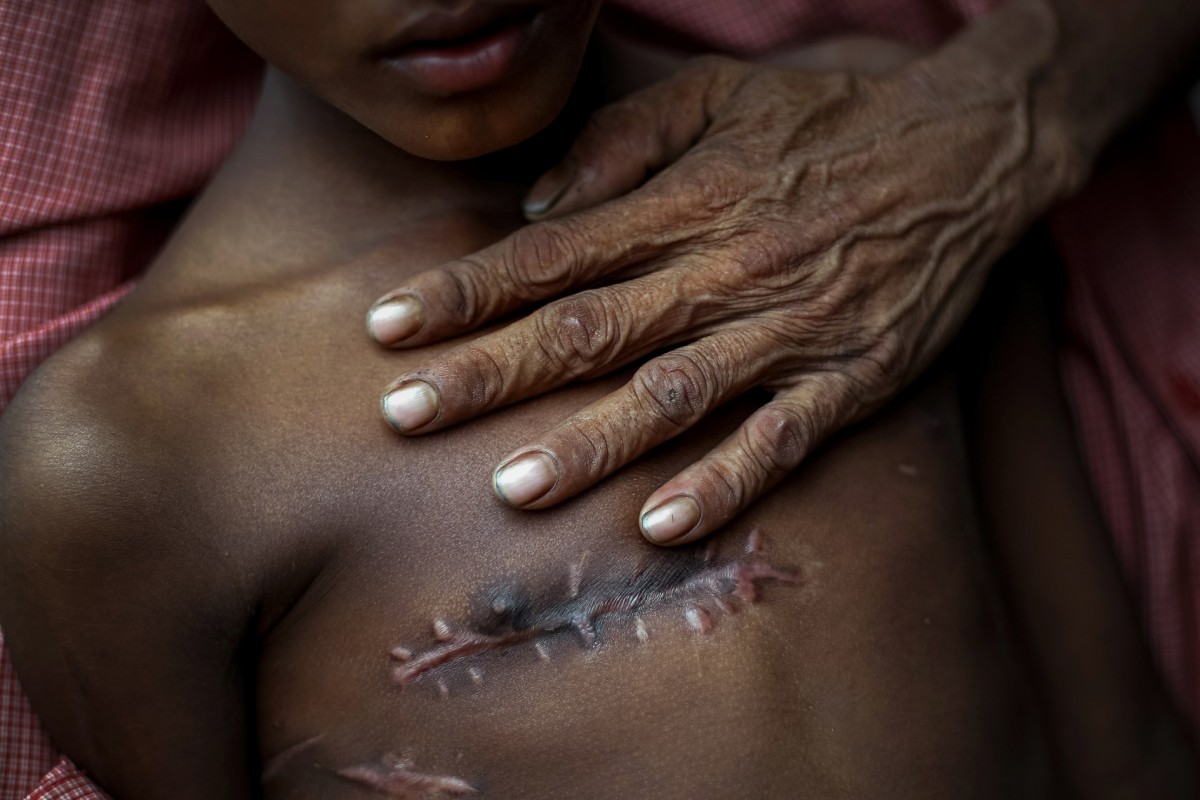
Behind Abidi’s picture of a young boy bearing a scar, there is a Rohingya translator’s presence of mind, the photographer said. “I was very tired that particular day and was having tea at a small dhaba in the camp when my translator Mohammad Farooq noticed that this kid had a scar,” Abidi said. “I quickly went to them and spent some time with them. The father explained that the seven-year-old boy had been shot on his chest.”
The picture speaks volumes. “I decided that I did not want to show the face of the kid and instead show just his chest and the father’s hands because that image says everything,” Abidi said.
Mohammed Shoaib, 7, who was shot in his chest before crossing the border from Myanmar in August, is held by his father outside a medical centre near Cox’s Bazar, Bangladesh November 5, 2017. REUTERS/Adnan Abidi.
A story to tell
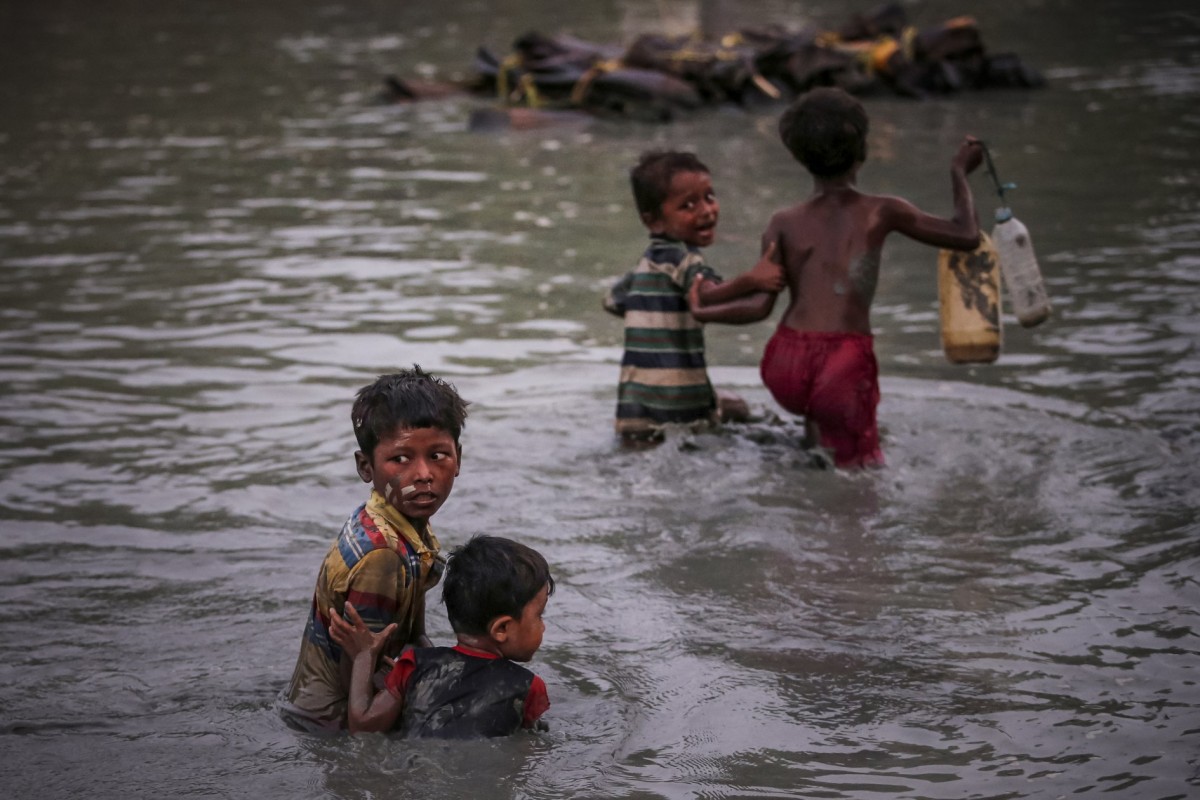
But not everything can ride solely on coincidence, the two photographers noted. When Abidi was in Palong Khali, near Cox’s Bazar, there was an influx of more than 3,000 refugees across the Naf river on November 1. Covering such sudden events needs quick thinking, Abidi said. “We could see a thin line of people crossing the river from around 2 km away from a village,” Abidi said. “So we walked to the river and when we reached there the light was really good. But there was a guard standing at the bank of the river who did not let us go inside to shoot. We pleaded with him to not send us back. He finally let us in and we kept shooting till 11 in the night.”
For Siddiqui, the biggest challenge was physical. “We had to sometimes walk hours to get to a point,” he said. “One day I had to a climb a mountain and walk for six hours barefoot, with leeches on my leg. But you could see that the refugees are also coming from the same side. As a journalist you want to be strong in front of them because I had to tell their story. They should feel that connection with me. If they see me walking by with a bottle of water before them, it will not be nice. You have to be like them.”
Rohingya siblings cross the Naf River along the Bangladesh-Myanmar border in Palong Khali, near Cox’s Bazar, Bangladesh, on November 1, 2017. Photo: Adnan Abidi/Reuters
The seven members of the Reuters team each spent about two weeks in Bangladesh on rotation. “We had photographers from different language backgrounds from Bangaldesh, India, Northern Ireland, Britain and Bosnia,” Siddiqui said. “We had a complete story. We also had pictures from the other side in Myanmar as well, which many don’t. Also as a [news] agency, we are very fast and work on getting raw emotions in a photo.”
The rotations helped the photographers cope with emotional exhaustion, Abidi said. “I followed around this kid who had lost his father and was living with his mother and eight siblings,” he recalled. “This kid was taking care of his family. There were people from NGOs and religious communities who were distributing food and money at certain camps. This kid used to follow them for many kilometers and knew where to find them just to get supplies for his family. A week of following the boy broke me down and I then decided that I could not shoot after that.”
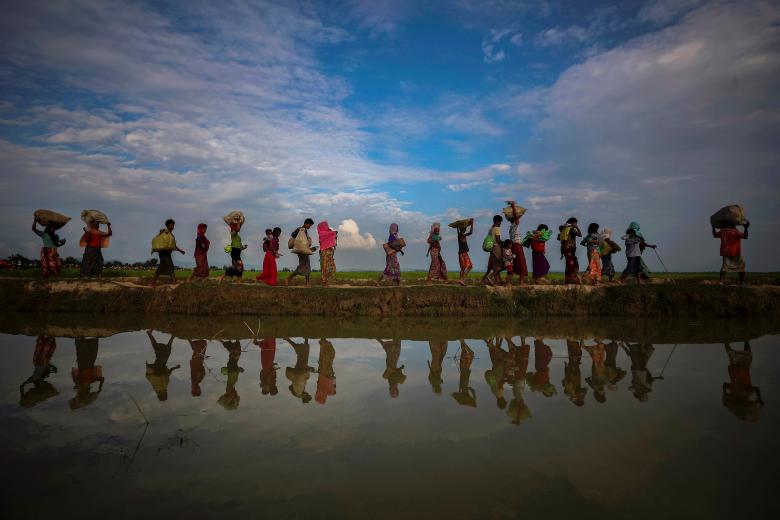
Rohingya refugees are reflected in rain water along an embankment next to paddy fields after fleeing from Myanmar into Palang Khali, near Cox’s Bazar, Bangladesh November 2, 2017. REUTERS/Hannah McKay
Finding new eyes
Siddiqui hopes that the Pulitzer Prize will attract new attention to the tragedy. “I just hope that this award makes a positive difference in the lives of these refugees,” he said. “I hope through these pictures and recognition, more people would get to know about the problem. Because it is not over yet. The crisis is not over yet. These makeshift camps are built on muddy hills which are prone to landslides when the heavy monsoon starts.”
Adnan Abidi (left) and Danish Siddiqui.
Siddiqui added that his field experience had opened up his mind to the various narratives about the Rohingya community and its displacement. In August 2017, the Indian government announced that it was planning to deport all 40,000 Rohingya refugees living in the country, telling the Supreme Court in an affidavit in September that the refugees posed a “serious national security ramifications and threats”. The Supreme Court did not allow any deportations.
“How the narative in India is played out is totally different from what I saw on the ground,” Siddiqui said. “You do not know what is happening unless you are on the ground. Another big takeaway was how too much nationalism can destroy a community of more than one million people. The narrative in Myanmar is totally different. When I went there I could see how helpless people were. They had to fight for a bottle of water. Reading news reports on the crisis was completely different from being on the field and experiencing it first hand.”
source: http://www.scroll.in / Scroll.in / Home> PhotoJournalism / by Sruthi Ganapathy Raman / April 18th, 2018
International artist Wajid Khan, famous for his ‘iron nail art’, is making the tallest statue of Swami Vivekanand in India that would be installed in Uttar Pradesh.
International artist Wajid Khan, famous for his ‘iron nail art’, is making the tallest statue of Swami Vivekanand in India that would be installed in Uttar Pradesh. The statue made of ashtdhatu (alloy) will be 170-feet tall and will be installed either in Lucknow or Agra, said Khan.
He said the statue will be completed in six months. Khan is here to take part in the four-day International Art Festival being organised at the Aligarh Muslim University (AMU).
Though Wajid Khan has not studied in any university or college, he has made a mark for himself by his craftsmanship in metal statue making. He is also making a sculpture for FIFA 2022 to be held in Qatar. The project will take five years to complete.
“A 40-feet statue of Swami Vivekanand is installed in Kolkata and that is his tallest statue. Now, the work on making his 170-feet statue has started in Indore,” said Khan.
“The project is being financed by some businessmen from UP, Delhi and Gujarat. They will decide on the place where the statue will finally be installed. As of now, the first preference is Lucknow and the second is Agra. Due to any reason, if the statue is not installed these cities, the third option will be Delhi,” he added.
“The statue is being made from eight metals including iron, zinc and copper. For the time, the total cost of the statue cannot be revealed,” he said.
Wajid Khan said he is also making a 10×8 ft statue of British Queen Elizabeth, which will be installed at the Royal Palace in London.
Khan has embarked upon a new venture. A proposed retro Bhopal city will be established in 40 acres area in Bhopal and the artist will give it a 2,000 years old look. The project is being financed by some businessmen.
source: http://www.hindustantimes.com / Hindustan Times / Home> Cities> Lucknow / by Pradeep Saxena, Hindustan Times,Aligarh / March 15th, 2018
A tunnel hidden below the garden layout at the Qutb Shahi tombs and connecting with Golconda Fort was unearthed during excavations. File | Photo Credit: G. Ramakrishna
ASI wants to ensure medieval relics aren’t destroyed by an expanding golf course
In another instance of modern technology coming to the aid of medieval heritage, the Archaeological Survey of India (ASI) will be using Ground Penetrating Radar (GPR) to map the contours of the area around the Bagh-e-Naya Qila excavated garden inside the Golconda Fort. It has roped in the Indian Institute of Technology-Madras (IIT-M) to carry out the mapping.
This medieval garden in Hyderabad is the only one of its kind still intact. All the others – built during the Qutb Shahi rule (1518-1687) — have either been built over or have disappeared. The contour mapping was necessitated by the impending advance of the Hyderabad Gold Club, which wants to expand its 18-hole course into a 21-hole one by taking over some of the land adjoining the Bagh-e-Naya Qila site. A GPR map would reveal any medieval relics that may lie buried under the ground, and could thus be saved by the ASI.
“The Hyderabad Golf Club, which has built a golf course in the Naya Qila area, wants to add a few more holes on the other side of the garden. We don’t want to lose any more history. We want to ensure that there are no relics of the Bagh-e-Naya Qila underneath and hence we are planning to map the area with GPR. We would have liked to do this with a Light Detection and Radar (LiDAR) but for that we need the permission of the Defence Ministry,” said ASI Superintending Archaeologist Milan Kumar Chauley.
The Naya Qila garden inside Golconda Fort was built by successive rulers of the Deccan and is one of the few symmetrical gardens extant. In 2014, when the ASI excavated the area after diverting the water flow, it discovered water channels, settlement tanks, walkways, fountains, gravity pumps, and a host of other garden relics.
An earlier excavation unearthed gold coins in the area where the golf course has been created. According to author Ali Akbar Husain, the Naya Qila area also has multiple chabootras (raised platforms) which are remains of garden structures that pre-date the Qutb Shahi rule. In the 1940s, the garden was even used for celebrating Basant Panchami.
The team from IIT-Madras will do a preliminary survey to ascertain the path for the contour-mapping. “We have told the IIT-Madras team that the survey and mapping have to be finished before the monsoon sets in. We will do the preliminary study by end of this month and the mapping might be completed in May,” Mr. Chauley said.
While there is a semi-collapsed ‘baradari’ (a gazebo-like structure with many pillars) in the garden, historians believe that another baradari might lie buried in the ground. GPR uses electromagnetic radiation in the microwave frequency for imaging sub-surface area.
source: http://www.thehindu.com / The Hindu / Home> News> Cities> Hyderabad / by Serish Naninsetti / Hyderabad – April 17th, 2018
APM Mohammed Hanish took over the reins on Thursday as Elias George bowed out from the top job after successfully completing five years with Kerala’s prestigious project. After assuming office, Hanish said his primary aim will be to smoothen the path ahead for KMRL. “Our main focus will be the extension of Kochi Metro up to Tripunithura.
Along with that, we will also launch the second phase of the project, from Jawaharlal Nehru Stadium to Kakkanad.
Another project we are carrying forward is the Water Metro, which is expected to revolutionise the transport sector in Kochi,” Hanish said.
However, the newly appointed managing director of KMRL said there are certain challenges in front of KMRL. “These include the land acquisition hurdles,” he said.”We need to speed up the land acquisition proceedings for completing the project in a time-bound manner. I believe my experiences with the Kerala Roads and Bridges Development Corporation (RBDCK) and PWD will help me in achieving the goals. Kochi Metro is, of course, a prestigious project and I’m happy to become a part of it.
The work culture, as well as the office environment, is quite different at KMRL. The young brigade consisting of vibrant staff members is the real strength of KMRL.” The outgoing MD, Elias George, said the new chief will have to undertake some key challenges, including the second phase of expansion of Kochi Metro.
“Personally, I will say that my tenure with KMRL as its MD is one of the most satisfactory jobs that I have undertaken in my whole career,” he said.
Hanish, who also holds the top position with Supplyco, had served as the nodal officer for the FIFA U-17 World Cup matches in Kochi.
He is also the officer-in-charge of the Kochi Smart City Mission.
source: http://www.newindianexpress.com / The New Indian Express / Home> Cities> Kochi / by Express News Service / November 03rd, 2017
The area of Panje Shah houses relics of saints and the Messenger of God and many stories of forgotten riches .
Kali Kaman road in Panje Shah. — Photos: Surya Sridhar
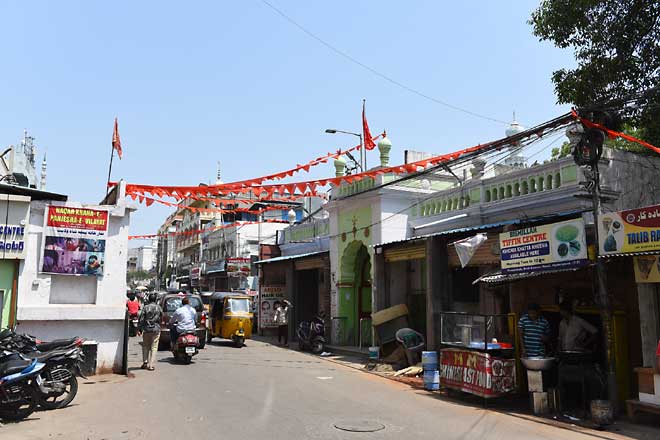
The area of Panje shah has a rich history behind it. The word, ‘Panja’ means an ‘imprint of hand’. It is located on the left of the main road leading towards Kaali Kamaan from Aitbaar Chowk. The story goes that during the reign of Sultan Abdullah Qutb Shah, a person named Ibn-e-Sher Ali came to Golconda from Najaf-e-Shareef in Iraq, where Hazrat Ali is buried.
He brought an imprint of the Hazrat’s hand and gifted it to the Sultan, who built an Aashoor Khana and installed the imprint there. The imprint is an amalgamation of metals and resembles solid wax. Light brown in colour, it is about 15 inches in length and 8-10 inches in width. The holy names of Prophet Mohammed, Hazrat Ali, Hazrat Bibi Fatima, Hazrat Hasan and Hazrat Hussain are engraved on the Panja. It is covered with a piece of cloth. Above the Panja on a platform is an alam(standard). Since it was installed by the king, the area came to be known as Panje shah.
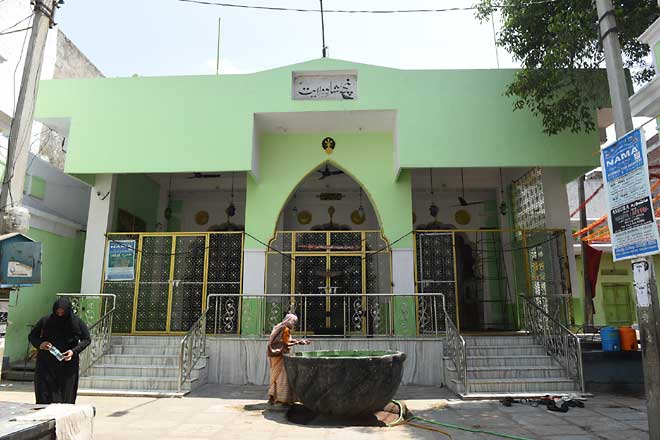
During the mourning month of Moharram, more alams are set up around it. A round stone cistern is placed in the courtyard, where the sharbat prepared during this month is stored and distributed to the visitors.
On the walls are some paintings depicting the martyrs of Karbala, scenes of strange phenomena like bleeding trees among other subjects of the artworks.
Opposite this holy place is another place of faith called ‘Qadam-e-Rasool’, where a foot-print of Prophet Mohammed is placed. Sayyad Mohammed Ali is said to have got it from Isfahan, Iran, in 1575, along with adequate proof of its authenticity. He bought a large house, got it decorated and installed the footprint there. (Qadam-foot, Rasool-Prophet Mohammed). There are two stone reservoirs at the gate which are filled with milk beverage (sharbat) and distributed to the devotees during Moharram.
The annual Bibi ki Sawari, which arrives on an elephant stops here on the 10th day of Moharram. It is said Bibi Fatima, the daughter of the Prophet and mother of Hazrat Hussain, laments and woes about the merciless killing of her son in Karbala. This scene is so heart-rending that it leaves everybody present in tears and inconsolable.
Apart from the holy footprint, relics such as the hair of Hazrat Ali and Hazrat Hussain are also kept here.
A round stone cistern in the courtyard, where the sharbat prepared during the month of Muharram, is stored and distributed to the visitors. — Photos: Surya Sridhar
Gurvanna gali
Opposite Panje shah is a lane named after Hakeem Guruvanna, which leads to Mir Alam Mandi. An important landmark of this lane is Kashmiri Qivam factory, established by the descendants of Guajarati businessman Poorandas Ranchoddas, in 1973. Qivam is a paste made of saffron, tobacco, cardamom and other spices which is added to paan to give it a kick. This Kashmiri Qivam was a favourite with film stars like Sunil Dutt, Meena Kumari and Nargis. Shaik Mujeeb-ur-rahman, the first President of Bangladesh was also a customer. Apart from Qivam, a hair oil named ‘Zulf-e-Kashmir hair oil’ is also prepared here. The factory is spread over a vast area of 3,700 sq yards and is managed by the grandsons of Poorandas ji. A Shivalaya has been constructed here near a large peepal tree.
Deghchi galli
This lane is situated close to Guruvanna galli and owes its name to a fantasy like story. Long ago, a deghchi (a vessel) full of rich gems and jewellery was found here during digging. Close to Panje shah is another lane called Kotaah galli (narrow lane) which is erroneously called Kotta galli.
On the way to Panje shah from Aitbaar Chowk, lies the haveli of Raja Mahipat Ram, an army commander and a minister of the second Nizam. It was called ‘baawan darwaazon ki haveli’ since it had 52 doors. The havelis of Raja Vithal Pershad and Raja Shainblum Pershad were also located here and came on the way to Kaali Kamaan and Gulzar Houz.
Upon crossing the Kaali Kamaan, one also gets to see several shops selling kites, thread, maanja and charqas. The kites have many fascinating names like dulhan, pachchisi, langot, aiyyawar, ek qakam, gola suleman, chand-tara, singhada, and lehanga. Similarly, the names of maanja are also very interesting like motiya, gandhak, feroza, and angoori to name a few.
source: http://www.telanganatoday.com / Telangana Today / Home / by Dr. Anand Raj Varma / April 15th, 2018