Category Archives: Travel & Tourism

Heritage enthusiasts pay rich tributes to seventh Nizam

Hyderabad, TELANGANA :

NizamMPOs08apr2018

Series of public events held to mark his birth anniversary

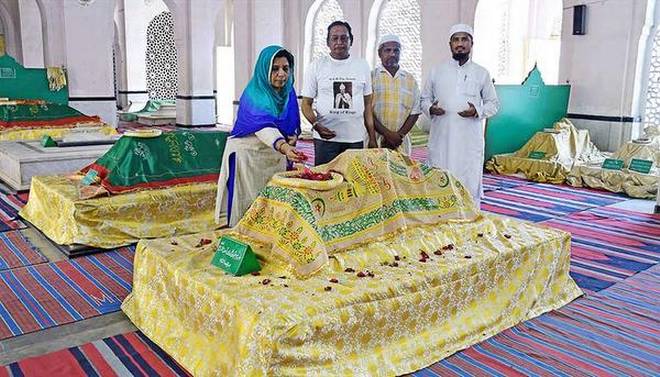
Hyderabad marked the 132nd birth anniversary of the seventh Nizam Mir Osman Ali Khan with rich tributes at his grave near Judi Masjid and a series of public events in different parts of the city. Early in the morning, family members of Nizam offered floral tributes, although they said that they had marked the event as per the Hijri calendar a few days ago.

“We are proud of our heritage. The City Improvement Board was a brilliant idea of Nizam to plan and create the modern city of Hyderabad,” said Sajjad Shahid, convener, Centre for Deccan Studies, speaking at a function organised to showcase achievements of Mir Osman Ali Khan at Ibrahim Mahal in Secunderabad. Rare photographs from the collection of Raja Deen Dayal family were put on display along with a number of firmans and hukums of the seventh Nizam.

Among the rare images were two of Hussainsagar lake with one showing smoke billowing out of the thermal power plant. Another was a document showing the establishment of archaeology department at a cost of ₹ 9,795 on September 30, 1913, with a caveat that the government bear the cost of restoration of murals in the caves of Ajanta. The accompanying photographs showed the before and after effects of Nizam’s intervention in Ajanta caves.

One of the photographs from 1940s showed a paved street near Charkaman. “Visweswariah wanted a dust-free city and the choice was cement. A cement plant was built near Shabad and most of it was used to build road and even the roofing of buildings in Patthergatti are RCC,” informed Mr. Shahid as he narrated the various aspects of Nizam’s rule.

The event was hosted by the Deccan Heritage Trust in partnership with Heritage Buffs, a group of heritage lovers. “We want to make meaningful contributions to sustainable conservation of Hyderabad’s heritage,” said Mohammad Safiullah of Deccan Heritage Trust.

Plea for statue

The Nizam Family Welfare Association made a plea for installation of statues of Mir Osman Ali Khan at Osmania Hospital, Osmania University and NIMS. “The monuments and buildings built by Nizam VII should be protected, preserved and repaired and not demolished,” said Najaf Ali Khan a descendant of Nizam.

source: http://www.thehindu.com / The Hindu / Home> News> Hyderabad / by Special Correspondent / Hyderabad – April 07th, 2018

Hyderabad: 400-year-old Makkah Masjid and its grandeur

Hyderabad, TELANGANA :

MakkaMasjid01MPOs03apr2018

Hyderabad:

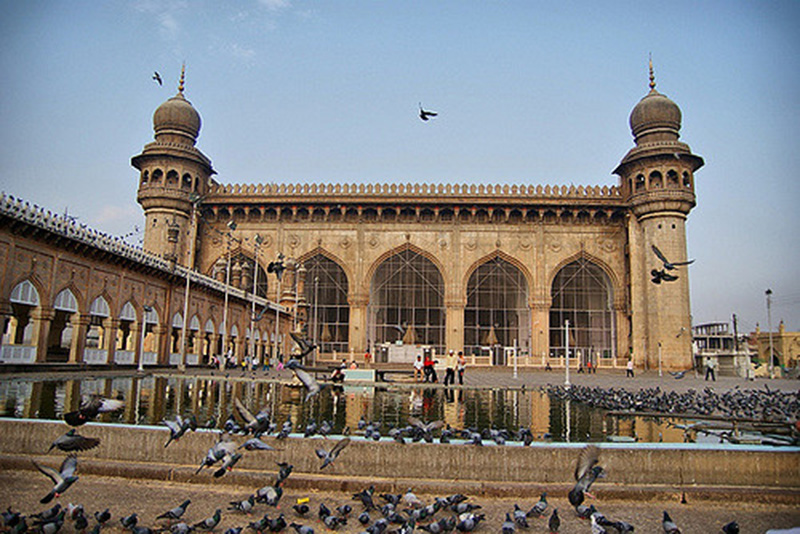
Makkah Masjid in Hyderabad is one of the biggest mosques in India and the foundation stone for its construction was laid during 1616-17 CE and the foundation was laid by the Qutub Shahi ruler, Sultan Mohammad Qutub Shah VI.

MakkaMasjid02MPOs03apr2018

The construction was completed by Mughal Emperor Aurangzeb in 1694 after 77 years.

The mosque is also listed as a heritage building. The Masjid is built in granite and the bricks for its construction were brought from Mecca, the holy city of Saudi Arabia.

source: http://www.siasat.com

The chief mason was Rangaiah Chowdhury while the engineer was Faizullah Baig.

The prayer hall can accommodate 10,000 people owing to its large size with dimensions of 75 feet high, 180 feet long and has a width of 220 feet.

According to the information available on the Hyderabad.org.uk, it is believed that a strand of Prophet Mohammed’s hair is preserved in a room in the mosque’s courtyard.

MakkaMasjid03MPOs03apr2018

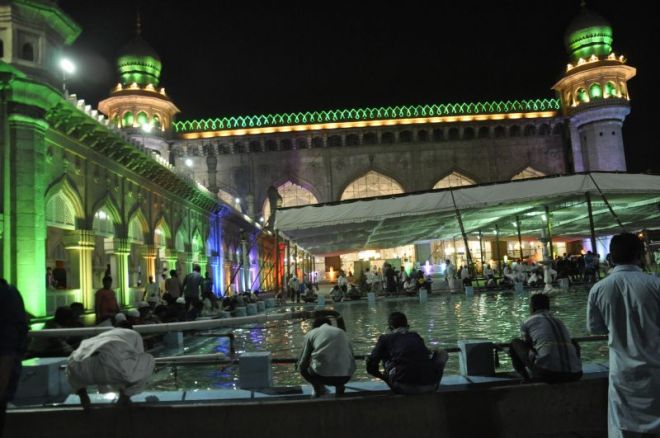
There are 15 intricately designed arches that support the roof of the main hall, in which 5 arches were constructed on 3 walls. The mosque is decked with Belgian crystal chandeliers, which adds to the beauty of the exquisitely designed interiors of the mosque. Inside the mosque, there are 5 passageways and tombs of the rulers belonging to the ‘Asaf Jahi’ dynasty.

MakkaMasjid04MPOs03apr2018

According to the news reported in Times of India, during the Qutub Shahi rule, Iran was specifically mentioned in Friday sermons in all mosques in Hyderabad and elsewhere in the Qutub Shahi kingdom.

According to the historian Abdul Majeed Siddique in his ‘History of Golcunda (1956)’ one of the reasons for the Mughal rulers to attack the Qutub Shahi kingdom was the recital of the name of the Shah of Iran (Safavid dynasty) in Friday sermons. Emperor Shahjahan was so angry that he sent a letter to Abdullah Qutub Shah VII to stop mentioning the name of the Shah.

Historian Abdul Majeed Siddique quotes Emperor Shahjahan’s words that order “the abandonment of the name of the Safavid King and replacement thereof by the emperor’s own name in both, the Friday sermons and coins”.

Currently, the restoration works are being done to welcome the Iranian President Dr. Hassan Rouhani who will be the first Iranian President to address the congregation, though he is the second leader to visit the mosque. After the Islamic Revolution in 1979, Mohammad Khatami became the first Iranian President to visit Hyderabad (January 28, 2004), but he did not participate in the Friday congregation.

source: http://www.siasat.com / The Siasat Daily / Home> Hyderabad> News> Top Stories / February 15th, 2018

Dir museums receives Gaurav Samman award

JAMMU & KASHMIR :

ShafiZahid01MPOs28mar2018

Srinagar:

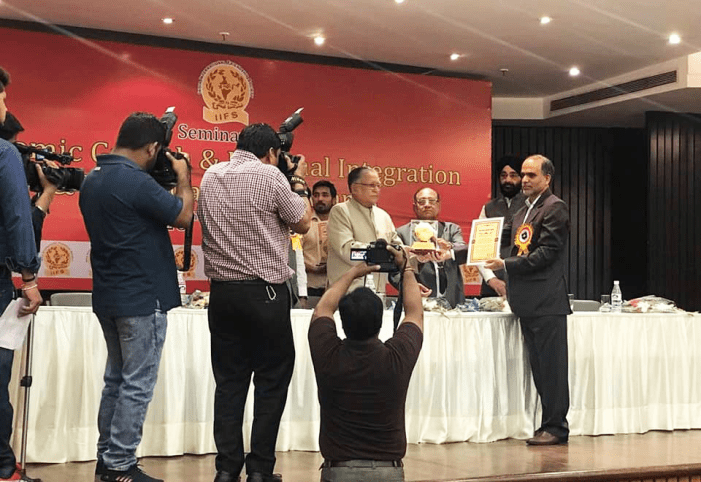
India International Friendship Society on Monday awarded Muhammad Shafi Zahid, Director Department of Archives, Archeology and Museums with ‘Rashtriya Gaurav Award’ at India International Centre, New Delhi.
The award was conferred to him for his contribution in the archeological studies and preservation of artifacts during his tenure in the Department, a statement said.
“The major archaeological discoveries were made during the time of Mohammad Shafi Zahid in early decades of 21st century AD. This young scholar, who had got training from M.S University Baroda (Gujarat and had a passion to explore the hidden treasures.

He excavated the Buddhist site at Letpora (Pulwama) in 2004, wherefrom, he exhumed a treasure of wonderful terracotta heads, busts and jewelry artifacts of early 8th century AD of Karkota Period.

This discovery was followed by another Buddhist site of Kushan era (100-400 AD) at Kotebal in south Kashmir (2005) where a magnificent terracotta tile pavement was exposed,” said the citation received by him.
The department was earlier headed by several learned historians and archaeologists including Prof P N Pushup, Fida Mohammad Hussnain, Dr. Sheikh Mohammad Iqbal and Mohammad Shafi Zahid.
The citation said that Zahid had made remarkable numismatic discoveries of ancient copper Coin hoards, (1500 coins) at Watnar Kokernag, (193coins) at Charari Sharef, Budgam and (850 coins) at Nunar Budgam, in the years 2011, 2014 and 2016 respectively.
“As such he brought to light the numismatic evidences of Hindu Rajas, Muslims sultans and Mughal Emperors of Jammu and Kashmir.

He also discovered a number of rare stone and bronze sculptures from the length and breadth of the state.

At Qasbiyar in District Pulwama, he recovered an exquisite Sculpture identified as Ek Mukh Linga of the 9th century AD.

The most outstanding sculpture discovery was made at Zurhama Kupwara in 2006 where from a treasure trove of rare bronze images of the 9th century AD, was recovered by him,” the citation reads.
“These all archaeological discoveries made by the archaeologist are housed and exhibited in this gallery of the museum. It is in place to mention here that the state archaeology is the main source for the archaeology and numismatic galleries of this museum.”

source: http://www.kashmirreader.com / Kashmir Reader / Home / by Reader Correspondent / March 27th,2018

Women in Lucknow participate in car and two-wheeler rally

Lucknow, UTTAR PRADESH :

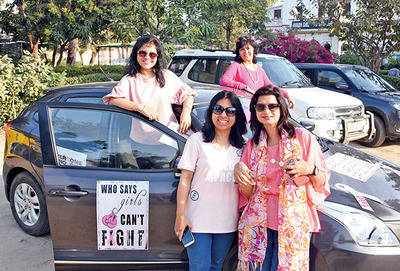
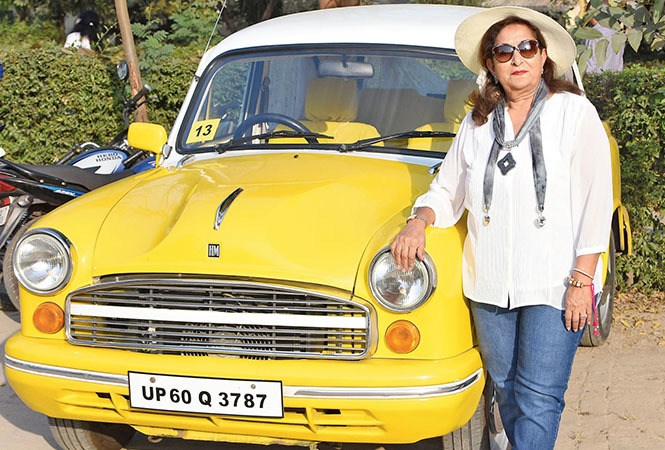
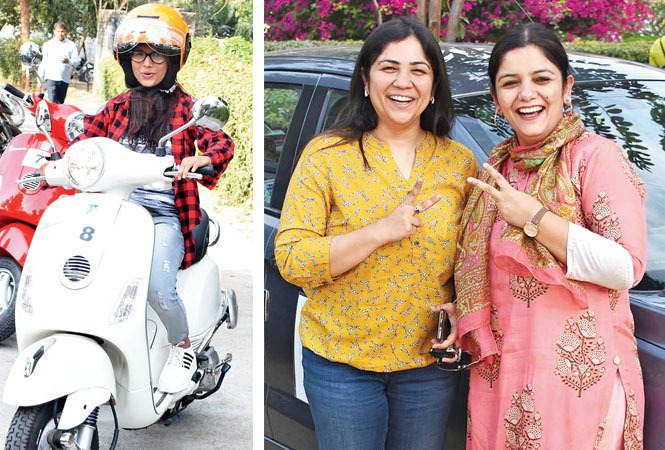
L-R) Neelima Gupta, Andrea Gomes Megrath, Jyoti Mishra and Purvi Singh ( BCCL/ Farhan Ahmad Siddiqui)

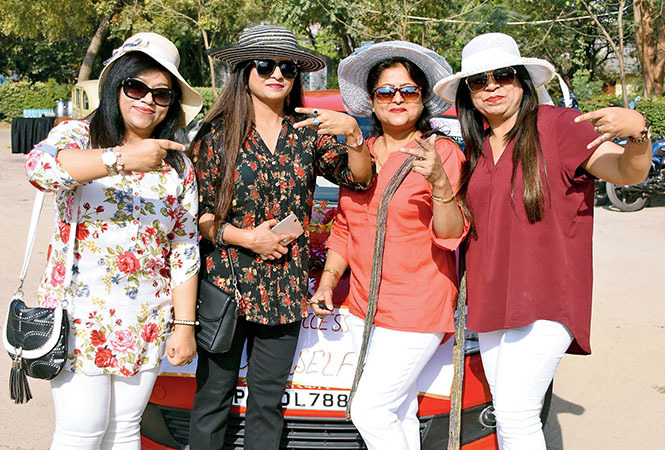
To promote the spirit of womanhood, a car and two-wheeler rally was organized at Awadh Girls’ Degree College, recently.

Organized by the alumnae association of the college, the rally was flagged off by Brijesh Pathak, cabinet minister, Law, Justice and Alternate Energy Resources, Namrata Pathak, former chairperson, UP Women’s Commission and a social activist, and Upma Chaturvedi, principal of the college. “It gives me a great pleasure to be a part of this event. I think talking about women empowerment will not help unless and until we incorporate it with events like these,” said Brijesh.

The rally started from the college campus and covered five major checkpoints in the city which were provided to the participants in the form of riddles.

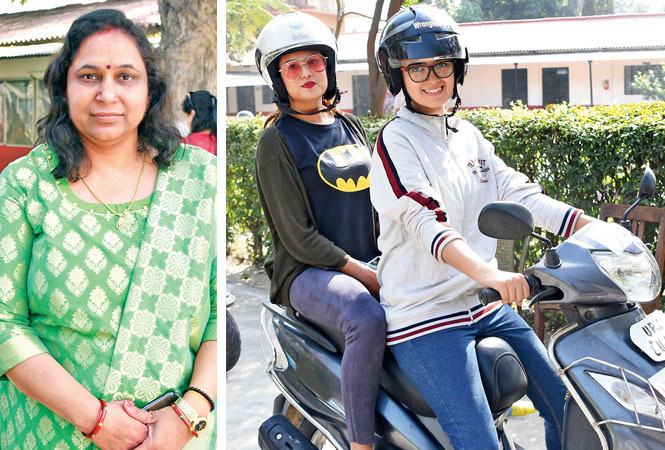
(L-R) Neena, Meeti, Baby and Biba (BCCL/ Farhan Ahmad Siddiqui
(L-R) Saher Bano, Rana Khan, Sheeba Mushahid and Sabina Ahmad (BCCL/ Farhan Ahmad Siddiqui)
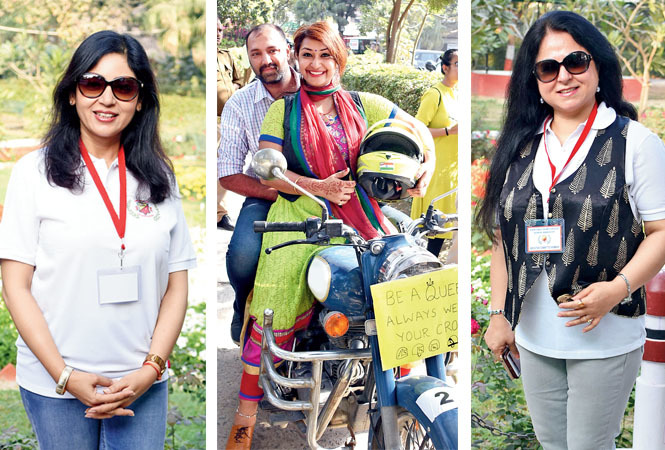
Shakun Prakash (BCCL/ Farhan Ahmad Siddiqui)
Dia Ahuja (L) and Vidhi Agarwal (BCCL/ Farhan Ahmad Siddiqui)
Namrata Pathak (R) Ria and Caroline (BCCL/ Farhan Ahmad Siddiqui)

The best part about the treasure hunt was that each participant had to click a selfie on the spots that they cover.
Several cars and bikes were decorated with various themes. While a few had pictures of Sridevi, giving her a tribute, others had several messages of women empowerment.

Farhana Khan (R) Shachi Singh and Simran (BCCL/ Farhan Ahmad Siddiqui)
Nidhi Praksh, Surya & Suparna Sarkar, Upma Chaturvedi (BCCL/ Farhan Ahmad

Finally, Priyanka Malik and Abeeha Rizvi bagged the first position in the car category while Suparna Sarkar bagged the first position in the two-wheeler category, and were felicitated by Major General Vinod Sharma and Namrata Pathak.

source: http://www.timesofindia.indiatimes.com / The Times of India / Home> News> Entertainment> Hindi> Events> Lucknow /  by Prachi Arya / TNN / March 22nd, 2018

Saleem Beg is member National Monument Authority

UTTARAKHAND / JAMMU & KASHMIR :

Srinagar :

Prominent name in heritage conservation and former bureaucrat from Srinagar City, Muhammad Saleem Beg has been appointed as a member of the prestigious National Monument Authority(NMA), Government of India.
Former Director General Tourism, Beg is also the INTACH’s convener for the state chapter. An official handout said Beg has been appointed as whole time member of the NMA. “The Authority has been setup as per provisions of The Ancient Monuments and Archaeological Sites and Remains AMASR (Amendment and Validation) Act, 2010 which was enacted by the Parliament in March, 2010,” it added.
“The Authority has eminent historians and renowned cultural personalities as its whole time and part-time members. The Authority is mandated to engage with States and central agencies for conservation and preservation of the historic monuments,” the handout added.
Beg’s appointment is being credited to his marathon experience of heritage conservation in Kashmir, particularly in the architectural sector.
The man who accomplished projects like restoration of Aali Masjid and Thag Baab Sahib (RA) shrine apart from conservation of Mughal monuments, Beg is associated with many national and international organizations in the field of art and culture.
He has also been associated with UNESCO, World Monument Fund, Indian Heritage Cities Network as a trustee and other cultural organizations nationally and internationally.
Pundits said under his leadership INTACH has emerged as a premier organization and a credible voice in advocacy and promotion of art and culture. “His work with universities like Jamia Milia Islamia, Kashmir University and University of Illinios, USA has given him high academic credentials in art and heritage,” said an observer.
Since 2006, Beg has been struggling to seek conservation of heritage sites in  Kashmir particularly  Srinagar, which INTACH has listed after a marathon survey.

source: http://www.greaterkashmir.com / Greater Kashmir / Home> Srinagar / November 04th, 2018

Renovating Rahim’s tomb: The original monument of love

NEW DELHI :

Rahim01MPOs22mar2018

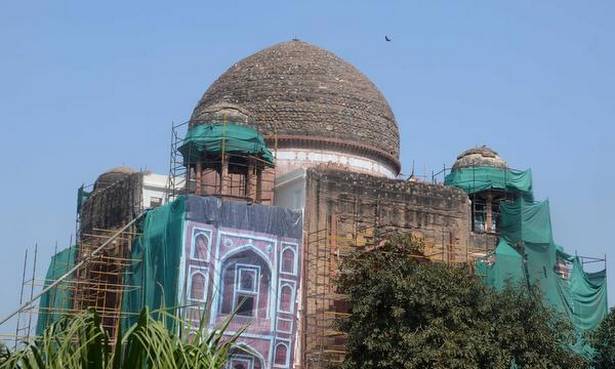
Rahim’s tomb, inspiration behind the Taj Mahal, was about to collapse when it was rescued by a conservation project
Rahim02MPOs22mar2018

Some 50 years before that magnificent monument of love, Taj Mahal, was built, Abdur Rahim Khan-e-Khanan, a poet and diwan in Emperor Akbar’s court, built a tomb in the memory of his wife Mah Banu. It was the first Mughal tomb built for a woman.

Constructed in 1598, the tomb stands a few hundred meters south of the Humayun’s Tomb, a world heritage site, in Delhi. This location was chosen for its proximity to Hazrat Nizamuddin Auliya’s Dargah — it was considered auspicious to be buried near the grave of a saint. Rahim too was eventually buried here in 1627.

Located near one of Delhi’s busiest roads, Mathura Road, Rahim’s tomb remained largely ignored for several years.

Then in 2014 the Ministry of Culture requested the Aga Khan Trust for Culture (AKTC) to restore Rahim’s tomb.

The tomb’s condition was precarious, to say the least, when the project began. “I usually don’t say this, but this building could have collapsed,” says Ratish Nanda, AKTC’s Chief Executive. It was “a very complex” project, he says. The restoration began in association with the Archaeological Survey of India and funding from InterGlobe, an Indian conglomerate.

There were deep cracks in the crypt, the first floor and the dome – “some so wide that you could put your arm through them.”

This needed immediate attention, and he realised it would take up to a year to fix them. Vandalism had added to the structure’s deterioration. Stones were missing, the white marble on the dome had been stripped off, water was seeping through. A flood a few years ago had also created cracks in the crypt’s vault.

Kilos of concrete

The restoration that had been attempted previously was woefully inappropriate and used modern plaster and cement, and had compounded the problem.

AKTC had faced a similar challenge during their restoration of Humayun’s Tomb, where they had to remove over a million kilos of concrete. The tomb wasn’t particularly structurally sound to begin with either, much like Humayun’s Tomb.

The team began with architectural documentation. This involved 3-D laser scanning (a technique first developed to find leaks in nuclear plants), photo archival research, historical research. Every stone was drawn up.

In 1968, the renowned British historian Percy Brown identified Humayun’s and Rahim’s tombs as structures that inspired the Taj Mahal. “But what is most significant about Rahim’s tomb,” Nanda says “is Rahim.” Rahim was just four when his father, Bairam Khan, an important military commander in the Mughal army, was assassinated. He grew up under the foster care of Emperor Akbar. He would later become one of Akbar’s nine most important ministers, the Navaratnas, and prove his own capability as a commander.

Most of us, however, know Rahim better as a poet. Apart from his famous dohas, he also wrote verses in Arabic, Sanskrit and Turkish, and translated Emperor Babur’s autobiography, Baburnama, from Turkish to Persian.

“I like the idea of this multidimensional personality. [He is] almost a renaissance figure,” says former diplomat T.C.A. Raghavan, whose curiosity about Rahim eventually led him to write a book about the man and his father, Attendant Lords (2017).

Secular symbol

Ujwala Menon, a conservation architect with AKTC, says that he was a secular figure and a patron of architecture. “The water supply system that he built in Burhanpur, with underground pipelines to every part, we can’t replicate that even today.”

Menon says that an attempt will also be made to restore the grand garden with plants that the Mughals favoured, such as citrus orchards.

A project of this scale requires several layers of work — preservation to keep the building in the state that it is found, restoration to bring the structure as close to its original condition as possible and reconstruction, which also involves a technique called ‘anastylosis’, where a ruined building or a broken object is restored using its original material. The vaults and parapet here were reconstructed using new pieces of Delhi quartzite and red sandstone respectively. Paint and lime-wash layers had to be painstakingly removed to reveal the incised geometric and floral patterns.

It will be another 16 to 20 months before the restoration of the tomb is complete, as there is major structural work to be done on the dome and facade.

But views on conservation can be subjective. There are those who criticise the work being carried out, saying that such techniques take away the narrative of age from the structure. Some believe that preservation is the only correct conservation technique.

But critics often focus on the aesthetics, not taking into account the structural integrity of the building. Nanda illustrates this with the analogy of skin. “You cannot say, ‘oh my skin is falling off, but I won’t repair it.’ Skin, besides making you look like who you are, is also fulfilling a lot of other functions.”

It is to counter such ‘mad arguments’ that Nanda says AKTC got the project extensively peer reviewed by over 50 different individuals — from architects, archaeologists and engineers, to historians, journalists and bureaucrats. These included Jaya Jaitly, Narayani Gupta, Saleem Beg, William Dalrymple, Gillian Wright and Lynn Meskell.

Nanda says that AKTC doesn’t take up a project unless the work can benefit local people. The Nizamuddin Basti Urban Renewal Initiative, of which the Rahim tomb renovation is a part, has also generated over five lakh man days of work for master craftsmen.

Earlier this year, a book, Celebrating Rahim, was published about Rahim’s life and and his artistic, political and intellectual work. AKTC and InterGlobe hope to bring out a compilation of Rahim’s written verses as well.

Nanda is appreciative about the private sector involvement in the project. “Unless there is a huge public interest in conservation, the future of heritage conservation is bleak.”

When he’s not chasing stories, the writer can be found playing Ultimate Frisbee or endless rounds of Catan.

source: http://www.thehindu.com / The Hindu / Home> Society> History & Culture / by Shashank Bhargava / March 17th, 2018
Prominent Indian businessman Abdul Hameed dies

Kochannoor (Thrissur District), KERALA /  Doha, QATAR :

K P Abdul Hameed
K P Abdul Hameed

Doha :

Long-time Doha resident and prominent Indian entrepreneur K P Abdul Hameed (76) passed away at a hospital in Bengaluru in southern India on Monday.

He was a managing director of Al Muftah Rent A Car, set up in 1970 as the first vehicle rental firm in Qatar.
Hameed will be buried at his native place, Kochannoor, in Kerala’s Thrissur district on Tuesday. He leaves behind his wife Aminu and two sons, Dr K P Najeeb (Hamad Medical Corporation) and Fazil Hameed (Al Muftah Rent A Car). A K Usman, who is also a managing director of Al Muftah Rent A Car, is his brother-in-law.
Hameed had suffered a stroke more than a month ago in Doha and was taken to India for treatment. Hameed, who arrived in Qatar in 1965, was a regular presence at a number of community events over the last four decades.
The veteran businessman was among the founders of MES Indian School, which was the first Indian expatriate institution of the country. The school was established in 1974.
Hameed was also one of the founding members and chief patrons of the Indian Cultural and Arts Society (Incas Qatar).
Indian Community Benevolent Forum (ICBF) and expatriate forums Incas Qatar and Indian Medical Association (Qatar chapter) and Pravasi Malayali Federation have mourned the death of Hameed.
source: http://www.gulf-times.com / Gulf Times / June 19th, 2017

An evening out at a Mumbra Masjid

Mumbai, MAHARASHTRA :

Mosque launches an outreach programme to fight misconceptions

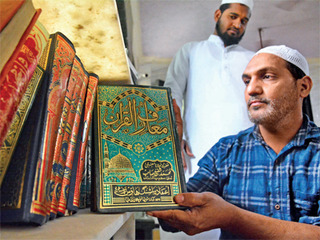
Imam of Al Furqan masjid, Maulana Saud (in white), looks on as Jamaat member Risal Baig displays the Koran. Photo by Sachin Deshmane

A ‘masjid parichay’ is enabling Hindus to visit the Al Furqan mosque and gain a better understanding of Islam.

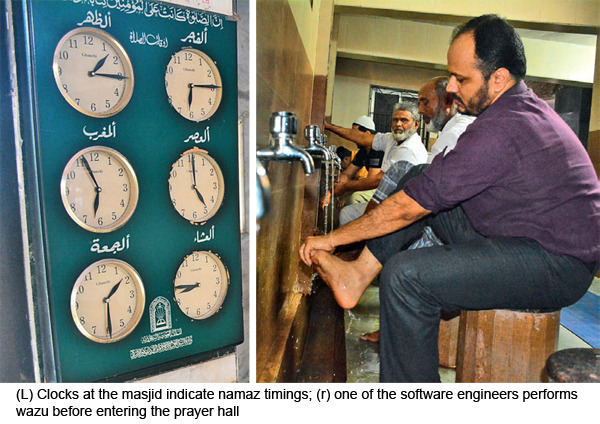
Spending four hours in a mosque is not most people’s idea of a Sunday evening outing. But for two Sundays in the last few weeks, 10 Hindus have travelled long distances to spend the entire evening at the Al Furqan Masjid, located in a bylane of Mumbra, a suburb of Mumbai. Starting off with doing wazu, or the obligatory washing of oneself before namaz, they ended their evening relishing biryani in the hall above the mosque.

None of these Hindus had ever stepped inside a masjid before.

“Going to a masjid in Mumbra? Are you out of your mind?” was the common reaction these Hindus encountered from friends — the shock stemming as much from the mention of a ‘masjid’ as from ‘Mumbra’, a place that was allegedly “internationally notorious for violent fanaticism”. A place where “no non-Muslim could go after sunset.’’

Vikhroli salesman D Gupta’s family didn’t even take him seriously when he told them about his plan. So when he returned home after his Mumbra visit, and casually mentioned where he’d been, his upset mother sent him off to “purify” himself with gau-mutra (cow urine) from the neighbourhood tabela before entering the house again.

Gupta remembers, as a 13-year-old, seeing students from a madarsa in his neighbourhood being beaten up by their teacher. An older friend said it was because the students had probably forgotten to curse Hindus enough, and warned Gupta to stay away from Muslims. The fear that had set in when he was a teenager vanished only after his recent visit to the mosque. Other friends had told him, at the time, that Muslims worshipped the Shiva lingam in masjids by pouring water over it, hence the mandatory tap at the entrance. And also that the Kaaba in Mecca, too, had a Shiva lingam inside it.

MumbaiMasjid02MPOs19mar2018

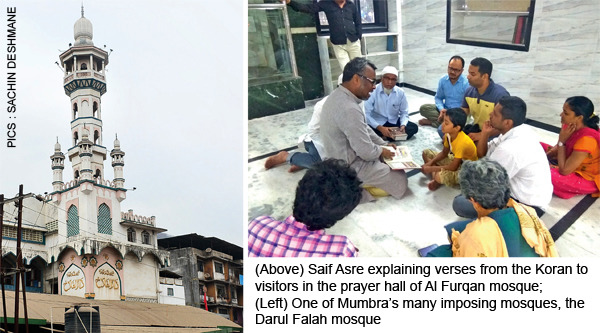
Jamaat-e-Islami member Saif Asre heard another perception about his place of worship while he was manning a bookstall distributing Islamic literature. “Commending me on trying to spread knowledge about Islam, a Hindu man said that he had heard masjids were storehouses for swords, and that one room was reserved only for the bodies of those killed with them. Driven by curiosity, the man had ventured into a mosque — but only after posting a friend to stand guard outside and inform his family if anything happened to the man,” says Asre. “This shocked me. We had no idea these were the ideas Hindus had about masjids.” This encounter was the trigger for the ‘masjid parichay’ programme that has been successfully carried out, so far, by the Jamaat in Nanded and Mumbra.

The first batch of Hindus who visited the Mumbra mosque were all members of the Indian Social Movement, a Vikhroli-based NGO that believes — according to its leaders Dr Deepak Gaekwad and Anand Howal — in being “Indians first and last”. They even use the phrase ‘Jai Bharat’ as a greeting. The group conducts awareness workshops on the Constitution, and had done so for the Jamaat, too. At least three of them had grown up with Muslim neighbours, and pointed to 1985 as the year relations between the two communities started changing. That was the year the Ayodhya movement began.

The second batch did not know anyone from the Jamaat. Their curiosity was aroused after reading a Facebook post about “masjid parichay’’.

While not all these Hindus had farfetched and bizarre ideas about masjids, some of them assumed non-Muslims weren’t allowed inside. Their knowledge of mosques was limited to the azaan, the call they heard on loudspeakers five times a day. “Allah ho Akbar” was the only phrase they could make out in the azaan. Most thought it referred to Mughal emperor Akbar (it means ‘God is great’).

MumbaiMasjid03MPOs19mar2018

The meaning of the azaan and other mysteries — the taps at the entrance to the masjid; the posture assumed for namaz, why it’s performed five times a day and the large turnout on Friday afternoons — were demystified for them by Asre. Helping him in demonstrating how namaz is performed, and how the azaan is called were four other Jamaat members, including a retired teacher and two software engineers. The latter revealed that when their work left them with no time to go to the nearest masjid for namaz, they prayed at their seat. Elevated parking lots in new office buildings made for ideal namaz spaces, where all the Muslims working on the premises could pray together, they said.

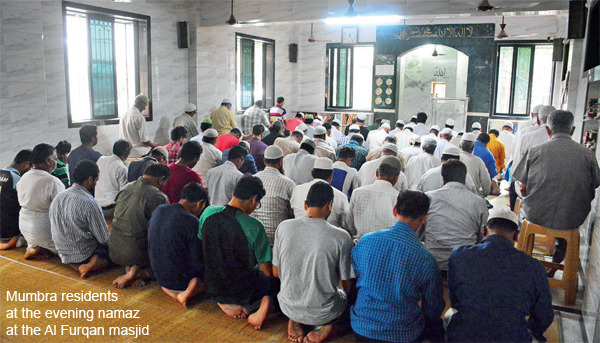
When Asre asked if there were any questions, nine-year-old Advait, who was there with his parents, Tarun Bharat journalist Bhatu Sawant and wife Kranti, put up his hand. What did the Arabic inscription on the wall mean? he asked. Later, he watched in wonder as the empty space where he had been running around a short while ago, filled up with men performing the evening namaz.

Asre revealed that thanks to the Facebook post, the Jamaat had received requests from many other Hindus, including a group of college girls. The visitors were taken to a hall in a building adjoining the mosque, where women pray on Fridays.

The Shia-Sunni divide, the burqa, the “intolerance” of Muslims who believed theirs was the only true faith — several questions were raised on these matters. But some questions remained unasked too, the participants admitted later. For instance, a question about the recurring campaigns organised by Indian Muslims in solidarity with Syria and the Rohingyas remained unarticulated.

“Those who attend such programmes will surely intervene when riots break out to explain that we are brothers,” hopes Howal, of the who felt the Quran expounds the same ideals of justice, equality and fraternity as the Indian Constitution. “If a boss reaches the masjid after his employee, he has to stand behind his employee, and during namaz, his head will be at the latter’s feet,” he pointed out, referring to the democratic nature of the Friday afternoon prayer, which must be held in congregation.

What about a reciprocal programme, where groups of Muslims can visit a temple? Asre felt Muslims were much more familiar with the Hindu religion than the other way around because even those who live in ghettos, encounter Hindus everywhere. While that is a debatable statement, the question also arises: Who would conduct such a programme? Would temple managements allow it, wondered Lokmat journalist Omkar Karambekar, as he returned from Mumbra. And, would Muslims who come to the temples, accept our ‘prasad’, was the question that bothered Gupta.

MumbaiMasjid04MPOs19mar2018

source: http://www.mumbaimirror.indiatimes.com / Mumbai Mirror / Home> Mumbai> Cover Story / by Jyoti Punwani, Mumbai Mirror / March 18th, 2018

Bababudangiri: Shah Khadri is administrator

Chikkamagaluru , KARNATAKA :

Rituals a mix of Hindu-Muslim traditions, says committee

The experts’ committee, constituted by the State government to look at the nature of rituals and worship at the controversial Bababudangiri shrine in Chikkamagaluru, has made it clear that Shah Khadri is the administrator of ‘Sree Dattatreya Bababudan Swamy Dargah’ and also the performer of the rituals.

The committee, headed by Justice Nagamohan Das, said the issue of management of the shrine was part of the “concluded findings” from the historical records.

Shah Khadri is Sajjada Nasheen (hereditary administrator) of the shrine. Syed Ghouse Mohiyuddin Shah Khadri holds the post at present.

The three-member committee submitted its report to the State government and the same has been accepted by the State Cabinet. The government has said that the report would be submitted to the Supreme Court, as the hearing of contempt petition against the government is coming up on April 6. Shah Khadri had moved the SC alleging that the government had been delaying to settle the issue, despite clear instructions from the court.

Ritual status

The committee, after verifying historical records and previous legal proceedings held since 1837, listed seven findings on the dispute. They include the name of the place (which is Sri Guru Dattatreya Bababudan Swamy Dargah) and location of the shrine on the hills. Both Hindus and Muslims are the devotees of the institution, it says. Regarding the rituals at the institute, the report states that the practice of reading Fateha, offering food items, placing flowers on the tomb and paduka, applying sandalwood paste, burning of incense, lighting of Nandadeepa, raising flags, beating of nagara (drums) and offering holy water to the devotees are performed by Shah Khadri. The institution is declared not a wakf property, but one under the jurisdiction of the Muzrai Department.

With regard to allegations against the administrator, the committee states that whenever Sajjada Nasheen committed acts of mismanagement, misappropriation etc., the Muzrai Department had taken action in accordance with the law.

Based on these findings, the committee rejected the Endowment Commissioner’s recommendations filed before the Supreme Court on March 10, 2010. The commissioner had recommended the appointment of a Hindu priest to offer prayers in accordance with Agama. Citing the Places of Worship (Special Provisions) Act, 1991, the committee opined that the Endowment Commissioner’s report was liable to be rejected. The Act prohibits a change in the religious character of any such place after August 15, 1947.

The Endowment Commissioner’s report had cited historian Suryanath Kamath’s article titled ‘Karnataka Dattatreya Aradhane’ to recommend the appointment of a Hindu priest. The experts’ committee stated that Mr. Kamath’s article was “not based on any authentic evidence.”

source: http://www.thehindu.com / The Hindu / Home> News> States> Karnataka / by Sathish G.T. / Chikkamagaluru, March 15th, 2018

The ballad of the Khan Sahib

Madurai, TAMIL NADU :

KhanSahibMPOs07mar2018

One explanation for Kamal Haasan launching his political party in Madurai was that his hero was Maruthanayagam Pillai, soldier, rebel and valiant son of the district.

It was about this hero that he wanted to make a film extraordinaire several years ago.

I was on the fringe of the project as, coining a term, the factioneer, engineering fact with fiction.

Part of the fiction is the name Maruthanayagam. More factual is the name Yusuf Khan, and it’s as Yusuf Khan he’s a military hero of mine. Much has been written about this soldier of fortune, but the Tamil ballad Khan Saibu Sandai (The War of Khan Sahib) offers much more personal detail. In it Maruthanayagam finds no mention; who it sings of is “the hero who belongs to the Alim family”. Adding, “…let me sing the story of the brave warrior of Sikkandar Sahib”.

Whatever his lineage, it is agreed he ran away from Panaiyur in the Pandya heartland and worked with Jacques Law in Pondicherry c.1744, where, possibly, he learnt his soldiering.


Then we hear of him with a troop of Nellore lances-for-hire teaming with Chanda Sahib and the French to besiege Robert Clive in 1751 at Arcot. Seeing him in action, Clive bought over the Nellore Subedar, as he called Yusuf Khan, who the next year helped Clive win at Kaveripakkam. Later, after action near Srirangam, Clive was told by a friend, “Your Nellore sepoys are glorious fellows, their Subedar as good a man as ever breathed. He is my sole dependence.”

Next, when the French besieged Nawab Wallajah and his British protectors in Trichy, Yusuf Khan lost not one food convoy from Madras over three months. Stringer Lawrence, ‘The Father of the Indian Army’, wrote, “He is an excellent partisan… brave and resolute, but cool and sensible in action – in short, a born soldier, and better of his colour I never saw … He never spares himself, but is out on all parties…” All this led to Lawrence recommending Yusuf Khan being made “Commandant of all the Sepoys” in 1754 and for a gold medal from the Company.

With the Nawab and the Company unable to collect revenue from the southern districts they had won, Khan Saheb who had been responsible for the gains was appointed Governor of Madurai.

Over the next three years, he subdued the local chieftains, collected revenue and earned a reputation for outstanding administration. But Yusuf Khan could never get away from soldiering. When Lally besieged Madras in 1758-59, he failed, because Yusuf Khan, racing up from Madurai, cut almost daily over two months Lally’s supply lines. Lally was to say, “They were like the flies, no sooner beat off from one part, they came to another.” Yusuf Khan was a master of guerilla warfare.

With such praise, Yusuf Khan began growing more ambitious. When he found revenue he collected going mostly to Wallajah from the English, he decided to rebel. He hoped for support from Hyder Ali (which never came) and from the French, who supplied a few hundred mercenaries led by a Marchand.

From August to November 1763 the English besieged Madurai, constantly shelling it, but unable to breach Yusuf Khan’s defences. They then withdrew to regroup. In February 1764, they recommenced the siege, but without significant progress. Yusuf Khan sent them a message early in April 1764: “As long as I have a drop of blood in my body I shall never render the place to nobody.”

English attack after attack was beaten back, many a British officer, once his comrades, killed. A British officer wrote: “You’ll easily form an idea of Yusuf Khan’s abilities from his being able to keep together a body of men of different nations, who with cheerfulness undergo the greatest miseries on his account; wretches who have stood two severe sieges, one assault and a blockade of many months.”

By September 1764 Yusuf Khan was prepared to negotiate surrender terms. The English insisted on unconditional surrender. And Marchand and his ilk, impatient with the negotiations (or heavily bribed), acted, arresting Yusuf Khan and surrendering Madurai on October 15, 1764.

The Company wanted Khan Saheb brought to trial in Madras, but Lawrence ordered him given to the Nawab who immediately hanged him and desecrated the body. He was buried where he was executed, two miles west of Madurai, his tomb at Samattipuram a dargah to some, a pallivasal (mosque) to others, but venerated by all in the Pandya country.

Footnote: A dissertation by Dr Asadulla Khan, then of New College, discusses Yusuf Khan’s family. It would appear that he married a Christian girl, Maza, c.1759; father, very likely Portuguese or French, her mother, possibly, a Maravar, a community which she often interceded for with Khan Saheb. They had a son, Mohammed Sultan, born c.1762. As a young man he joined Hyder Ali’s army. Mother and son, it is suggested, sought refuge in Mysore after fleeing Madurai.

The boats on the Canal

It was a lively presentation that Manohar Devadoss made recently at the Madras Literary Society on his life with books, most he’d illustrated. One striking illustration at the presentation is what I feature today; a boat in full sail on the Buckingham Canal. Mano says he saw this long country boat near Pulicat in 1966 and thought it “an artist’s delight”. His sketch became the first subject of “our heritage greeting card project,” ‘our’ being wife Mahema, who used to write the text for the illustrations he did for greeting cards they sold for charities.

Mahema concluded that year: “These boats are very picturesque, with sails billowing in the breeze. When there is no breeze, the boats are sometimes dragged by the boatmen from along the banks, their bare bodies glistening in the sun. As the boats approach the city, the sails are lowered so that they could pass under the numerous bridges. The men then punt the boats in rhythm to their melodious folk songs.” Taken up as he was with them, Mano did his first oil painting that year, based on his sketch, and several water-colours in later years, one of which I feature.

The chronicler of Madras that is Chennai tells stories of people, places, and events from the years gone by, and sometimes from today.

source: http://www.thehindu.com / The Hindu / Home> Society> Madras Miscellany – History & Culture / by S. Muthiah / March 06th, 2018