The historic tank has been revived with water from the Krishna river
Brimming with water, with women washing clothes at the edge while children swim in the fresh water, it is hard to believe that just a month ago, the Begum Talab, spread across over 234 acres, was a barren wasteland, with few small pools of water.
The ancient tank, built during the rule of Mohammad Adil Shah in 1651, has not seen such water levels for the past five decades. But under an ambitious project of the Water Resources Ministry to rejuvenate and replenish tanks, water from the Krishna river has been drawn to fill the tank and recharge ground water. Over the past year, a 50 km pipeline was laid from the river to the tank. The tank was among seven revived in the district at a cost of Rs 190 crore.
Crucial water source
According to historian Abdulghani Imaratwale, Adil Shah built the tank in the name of one his queens; Jahan Begum. The construction was supervised his commander Afzal Khan to provide drinking water to Bijapur city which then had the population of around nine lakh.
Dr. Imaratwale said the water was not only used for the palaces or prominent places of the kingdom, but also for public consumption as the city did not have other drinking water sources.
The tank, located on the southern part of the city, used to supply water through the earthen pipes to many ganjs (overhead stone tanks). It was the second major water source for the city after the Ramalinga tank. Unfortunately the ganjs and the old pipes have fallen into disrepair,
Expressing elation over the government decision to refill the tank, Dr Imaratwale termed the project a significant step in restoring the history of the city.
“ It is heartening to know that Water Resources Ministry led by M. B. Patil is showing concern to restore and revive the ancient tank which had once served a major water source. The tank still has the same capacity if the water is stored and used,” he said.
source: http://www.thehindu.com / The Hindu / Home> National> Karnataka / by Firoz Rozindar / Vijayapura, October 10th, 2016
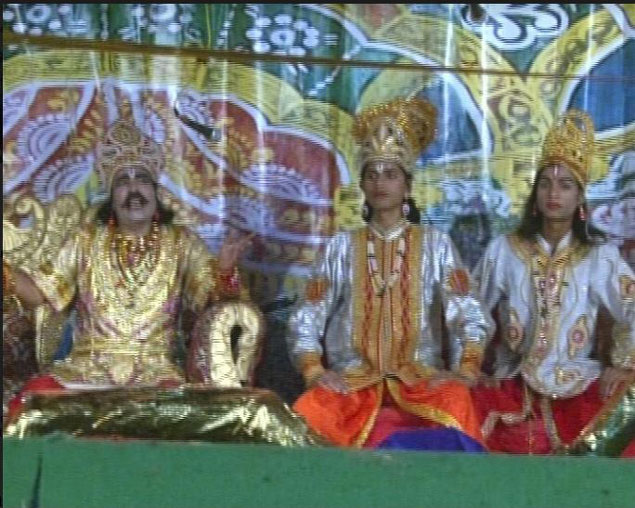
Bollywood actor Nawazuddin Siddiqui may have backed out of his Ramlila act in riot-affected and divided Muzaffarnagar , but in adjoining Agra, Nizamuddin continues to rock the Ramlila stage.
He’s been doing key roles for over last five years and is Janak, the father of Sita, this time, no less. It wasn’t always that easy for Nizamuddin though.
During his early years in the Ramlila theater, he too faced protests and opposition like the way Nawazuddin did. But he stood his ground. In fact, another Muslim will do the part of Bharat along with him this year.
The 55-year-old Nizamuddin, who is the track man at Agra cantt station in north central railway zone, never had any acting classes but landed up for top notch role in 46th edition of Ramlila theater on dussehra.
Speaking to TOI, Nizamuddin said, “Back in 2010 when I gave my first audition for Ramlila play organized by railway, I was offered roles of Shantanu (father of Shravan) and Rishi Atari (mentor of Sabri). But soon, scores of people from my own community raised questioned on my faith in Islam. I was almost ousted.”
Nizamuddin playing Janak character, father of Sita, sits on the extreme left and delivers his dialogues.
“But as an artist I never changed my stance. There is no sin if a Muslim man acts in Hindu play. Ramlila talks about peace and triumph over evil. Getting a role in Ramlila is a matter of pride for me,” he said.
Expressing his dissent on Bollywood actor Nawazuddin Siddiqui backing out from play after opposition from right wing members, Nizamuddin said, “Nawazuddin is an artist, he should have continued with his act instead of giving up against bullies. I’m sure, the local residents and administration would had supported him if he would have stood up.”
Talking to TOI, director of Ramlila theater, Manoj Singh, who has been playing role of Ravan since 1998, said, “It is amazing to see the zeal of men like Nizamuddin, who outsmart other contestant for the roles. This is blunt and appropriate reply to those people, who want to create enmity and disturbance among different communities.”
“This year we had only two Muslim artists who have notched the top roles, while for the first time a woman has joined the play to act as Sita,” added Singh.
source: http://www.timesofindia.indiatimes.com / The Times of India / News Home> City News> Agra / by Arvind Chauhan / TNN / October 08th, 2016
Abortive takeover bids did not prevent the Muslim influences from impacting the Kashmir society. Long before Kashmir’s transition to Islam, the new faith existed and thrived even during the Hindu rule, says Sara Wani
(Manuscripts of the Holy Qur’an calligraphed in 1237 AD on a 25 feet long and 2.5 inch wide scroll paper. Belived to be gifted by Shiekh Hamza Makhdoom (RA) to Khawaja Miram Bazaz, great grand father of Majid and Ashraf Quazi, who displayed it in an exhibition in Srinagar.)
Mohammed bin Qasim packed home never to return and Ghaznavids’ left, as if vowing never to set foot on mountains guarding Kashmir like a wall. Kashmir kingdom was apparently insulated against the changes that swept proper India. Delhi Muslim kings and Turkish Sultans remained too preoccupied with power consolidation to make any advance toward Kashmir.
But for the ideas and influences, high Himalayas were no impregnable. Then, political boundaries did not stop trade, refugees and even fortune hunters. Kashmir knew of Islam much earlier than the two failed conquests.
In his Shah Hamdan of Kashmir, Kashmir’s former Director of Archives, Archeology, Research and Museums, Prof Fida Mohammad Khan Husnain has referred to a legend that then Kashmir ruler Veenditya’s emissaries had trekked through Bahrain and met the prophet of Islam. “This information is further collaborated in a Persian manuscript entitled Anwar-i-Kashmir, where it is informed that the Holy Prophet did depute Abu Hazifa Yamani in about 8 AH (after Hijra) with letters to the Chinese emperor but the above emissary got held up in Kashmir due to a heavy snowfall,” Husnain wrote. “Veenditya, the Raja of Kashmir treated them well.”
While the author offers no detail about the veracity of the manuscript and its writer, he claims that Caliph Umar ibn Khitab had deputed a delegation of five persons to Kashmir in about 21 AH. He offers no reference to substantiate the claim. Extensive research failed to trace the king in Rajatarangini. At that point of time when Islam was getting established in the deserts of Arabia, Kashmir was witnessing transfer of power from Baladitya, the last Gonanda king, to Karkotas whoso rule begun with Durlabhavardhana (627-649). Even the Thang dynasty records in China suggest that the first Muslim delegation comprising 15 Arabs was led by Said Ibn Abi Waqqas. Thabit ibn Qays accompanied him. Dispatched by Caliph Usman, it met Chinese Emperor Yung-Wei in 651.
But the existence of Muslims in Kashmir is well documented after the fall of Sindh. Chachnama author Alafi bin Hamıd al-Kufı, states that Muhammad Alaf, an Arab mercenary who had served Sindh ruler Dahır (712 A D), sought refuge in Kashmir. The then Kashmir ruler Candrapıda, received him well and bestowed on him the territory of Shakalbar. G M Sufi, the author of Kashir: Being A History of Kashmir has quoted Sir Alexander Cunningham locating Shakalbar somewhere around the slat range saying the territory was then under the control of Kashmir king.
After Alafı’s death, his estate was inherited by one Jahm, who, according to al-Kufı, “built many mosques there”.
Writing in the UNESCO publication History of Civilizations of Central Asia (IV), N A Baloch has quoted al-Bırunı recording that Muhammad bin al-Qasim bin Munabbih who took Multan “belonged to the house of Jahm bin Sama al-Shami, who had allegedly settled in Kashmir as far back as 712–14 and whose descendants had reportedly continued to flourish there.”
Baloch says though Kashmir was ruled, from the eighth century onwards, by the local, independent, originally non-Muslim dynasties, the region had “increasing political contacts with the Muslim rulers of Sind and Khurasan.” Kashmir and Kashgar, then, would be the two main trading states through Gilgit.
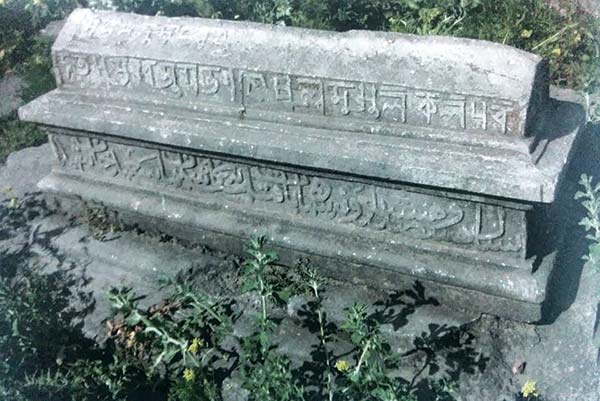
(Arabic and Sharda inscription on the grave of Seda Khan, next to Ziarat of Bahauddin Sahib, who died in a battle in the reign of Mummad Shah (1484-1537).)
Gaznavids’ returned home from Rajouri as winters set in and failed to wrest Kashmir from Sangramaraja in 1021. “It is, however, possible that some of Mahmud’s soldiers, finding it difficult to cross the mountains towards the plains of India, stayed behind and settled in Kashmir,” historian Abdul Qayoom Rafiqui writes in the UNESCO publication. “It is after these Turkish invasions that Kalhana refers, for the first time, to the presence of Turuskas (Muslim) in Kashmir when describing the reign of Harsa (1089–1111).”
Venetian adventurer Marco Polo is still a widely reliable traveler of that era. He visited Kashmir in 1260. His description of an “idolatrous” Kashmir, then ruled by Laksmanadeva (1273-86) – an “incompetent” ruler “consistently harassed by the Turks and his turbulent nobles”, is brief but interesting.
“They have an astonishing acquaintance with the devilries of enchantment; insomuch that they make their idols to speak,” Polo records in his Travels of Marco Polo. “They can also by their sorceries bring on changes of weather and produce darkness, and do a number of things so extraordinary that no one without seeing them would believe them.”
While terming Kashmir as the “very original source from which Idolatry has spread abroad”, Polo has made the predominant faith clear. But he has made two other observations.
“There are in this country Eremites (after the fashion of those parts), who dwell in seclusion and practise great abstinence in eating and drinking. They observe strict chastity, and keep from all sins forbidden in their law, so that they are regarded by their own folk as very holy persons. They live to a very great age,” goes the first one.
“The people of the province do not kill animals nor spill blood; so if they want to eat meat they get the Saracens who dwell among them to play the butcher,” is the other observation. Saracen is a generic term for Muslims that Christian writers widely used in Europe.
Evidences suggesting Muslim presence in thirteenth century were further corroborated in August 2012 by Qazi brothers – Ashraf and Majid, originally from Khawaja Bazaar. At an exhibition, they displayed full text of the Qur’an calligraphed in 1237 AD on a 25 ft x 2.5 inch scroll paper. “It is part of our heirloom and we had forgotten it on our attic in our old house under the shingled rooftop and nobody touched the two boxes for nearly 150 years,” Ashraf said. “Once we discovered and opened the box, we discovered the treasure.” The rare manuscript, calligraphed by Fatahullah Kashmiri was gifted by Sheikh Hamzah Makhdoom to Khawaja Miram Bazaz, the great grandfather of the Qazis. It carries a certificate of authenticity and transfer with 35 Ulema as witness. Historians did not expect Muslims to be living in Kashmir, then.
Focusing on the ‘court’, Rajatarangini, Kashmir’s oldest historical chronicle skips mentioning social changes in detail. But the first major mention of a social change is during the reign of Lohara dynasty king Harsa (1089-1101). The king says Kalhana, “introduced into the country more elaborate fashions in dress and ornaments and made his courtiers imitate his own taste for extravagance in personal attire.” The ‘new dress code’, an apparent ‘Western Disturbance’ was explained by M A Stein as the “Mohammedan influence”.
This observation is indicative of a social impact though not a religious transformation. But the Kashmir court was never immune to foreign influence. Even Lalitaditya’s had a Turk minister Cankuna. Stein says he was from Badakhshan or its immediately adjoining tracts on the upper Oxus. Besides, Lalitaditya, “as overlord of India”, according to Maharajas’ of India, by Annmorrow Shrishti was “already recruiting regiments from Central Asia.”
Vajraditiya-Bappiyaka, Lalitaditya’s son who ruled Kashmir for seven years, says Kalhana “sold many men to and introduced in the country many Mleccha practice”.
Apparently, Mlecchs were to Hindu scholarship what Saracens were to European writers. A Sanskrit word, Mleccha means “alien in language and manners, uncouth, inferior”. Their presence was felt throughout the reign of Korkotas’, the dynasty that reigned Kashmir between 663 – 855 AD, coinciding with the period when Arab armies were being dispatched to the length and breadth of the world. Even the Bhavaishya Purana, one of the 18 Puranas of ancient Vedic literature dealing with the future, anticipates the rise of prophet of Islam as “the Acharay of Mlecchas”, a desert resident who would be the embodiment of divine qualities. Some Kashmir historians see Ali Kadal as the Mleccha Mar that Rajatarangini refers to.
Husnain is correct in saying that Islam was brought to Kashmir by non-Muslim Rajas. While Karkota king Vajraditya (761– 767) introduced Mleccha practices, Lohara dynasty king Harsa not only employed Turuska commanders but made temple spoliation a state policy. He confiscated idols possessing the valuable metals, they were made of.
A Hindu iconoclast, Harsa was an interesting character. Initially prudent, courageous and lover of art and music, Sufi feels “his mind was rather demented”. Kalhana see him as “a jumble of contraries”, who was bankrupted by extravagances. To manage his kitty, Kalhana says he would loot the temple treasures, especially the metallic idols. An exploitative taxman, he would even levy night soil! Even though famines, bandits and plagues attacked Kashmir, Harsa never exempted his subjects from taxes. Eventually, his nephews led a rebellion, putting his palace afire, roasting his queens alive and slaying his successors. He was perhaps the only Kashmir king who head was sliced after being hunted down and left to be cremated by a wood-dealer “as a naked pauper”.
Stein has explained Harsa differently. “As Kalhana is particular to specify the new metal statues of gods throughout Kashmir which escaped Harsa’s clutches, we cannot doubt the extent and thoroughness of Harsa’s iconoclasm,” Stein writes. “Can the latter have been instigated or encouraged somehow by the steady advance of Mohammadanism in the territories? Kalhana when relating to these shameful confiscations, gives to Harsa the epithet Turuska i.e; Mohammadan, and later makes reference to Turuska captains being employed in his army and enjoying his favor”.
Having little faith in his people and his soldiery, Harsa had raised a new model for his army. Comprising mostly Ekangas, the royal bodyguards and the Tantrins, the reformed trouble-makers, each group of hundred soldiers was placed under a Muslim commander, thus making it impossible for soldiers to run away or hatch plots. This was the beginning of Muslim influence in Kashmiri politics. After Harsa, Bhiksacara (1120-21) is understood to have raised a Muslim cavalry for his personal guard, a task they eventually failed in.
Harsa, however, was one of the series of puppet kings who misruled Kashmir for nearly 500 years after Lalitaditya (724-60) when court rivalry would change kings in Kashmir like turbans. In between came Avantivarman (855-883) who tried to put the house in order. Putting foreign conquests at halt, he devoted his attention to his state focusing on development, welfare, and delivery of services. As his son succeeded him, things were back to square one with class-wars and internecine battles triggering the political instability and reducing the kingdom to its old territorial confines.
By the time Jayasimha (1128-1155) took over, Muslim mercenaries had gained so much popularity that the king and his army chief, according to Kalhana, would go “into the camp with Yavanas (Muslims).”
The gradual decay of the state and the society had led to such deterioration, according to Rajatarangini that when Sahadeva (1300-1 to 1319-20 AD) took over, Kashmir had reduced to a kingdom of “drunkards, gamblers and profligate women”. So when Mongol king Karmasena’s commander Dulcha (Zulchu) invaded Kashmir in 1320, the king fled to Kishtwar. Nobody resisted 70,000-strong invaders, who devastated Kashmir for eight months, selling men to Tartar traders, setting afire dwellings and standing crops. But the entire army perished over Devsar Mountains in south Kashmir while fleeing Kashmir winters with thousands of men and women slaves.
Dulcha destruction literally marked the end of a long chaotic Hindu rule. That changed Kashmir forever.
(This is the second in a four part series on advent of Islam in Kashmir. Read the first partIslam’s Kashmir Story.)
source: http://www.kashmirlife.net / Kashmir Life / Home> Faith History / Tuesday – February 16th, 2016
As the city is being spruced up for it to sport a bridal look, inside the Palace too, hectic activities have begun to get the elephants ready for the Vijayadashami grand finale. The main attractions on the last day of the festival are the 12 elephants with Arjuna, carrying the Golden Howdah (Ambari), being the cynosure of all eyes.
Special care is taken by the team of Forest Department officials, mahouts and kavadis to ensure that the elephants are fed well and trained so that they can gain enough weight enabling them to stay composed amidst the cheering crowd at the Jumboo Savari. Care is also taken to decorate them with specially designed robes. Their trunks are painted and metal ornaments with hangings are fixed into their tusks.
Among the specialised team is Pasha and Zakaulla, the two mahouts who have retired from service and who are experts in creating the ‘Gaadhi’ or the cushion and ‘Namdha’ or ‘Gouse’, a robe for the elephants. While the ‘Gaadhi’ is tied to the elephant’s back, a ‘Namdha’ covers the elephant skin and looks like a jacket. The ‘Gaadhi’ and ‘Namdha’ are newly made every year.
Explaining the ‘Gaadhi’, Pasha and Zakaulla say that it makes the uneven surface of the elephant plain and look good when the “Namdha” is spread on the elephant. Each ‘Gaadhi’ has a girth of 1.5 ft and the length depends on the size of the elephant.
While Arjuna, the Howdah Elephant’s ‘Gaadhi’ will weigh 500 to 800 kilograms, the ‘Gaadhi’ made for other elephants weigh 250 to 300 kgs. This is because Arjuna has to carry the 750-kg Golden Howdah with the idol of Goddess Chamundeshwari placed inside. The combined weight of the ‘Gaadhi’ and Ambari is around 1,100 to 1,200 kgs.
A special grass that is grown abundantly on lake and river side is used to make the ‘Gaadhi.’ Locally the grass is called ‘Odake Hullu’ that turns soft when dry. The grass is bundled and filled into a soft but sturdy square shaped cloth specially stitched for the purpose. Along with this grass, dry paddy grass is also used to fill the edges.
“The proportion is important to give a soft and sturdy feel,” say the mahouts. Once the grass is filled, the ‘Gaadhi’ is stitched after covering it with jute gunny bags.
“When I was the mahout before 2006, I used to observe people making the ‘Gaadhis’ and ‘Namdhas’ and slowly I learnt the tricks of the trade. I retired in 2006 and since then I am doing this job every year,” says Pasha.
Pasha and Zakaulla have been a part of the festival and have stitched many ‘Gaadhis’ and ‘Namdhas’ for many elephants in the past. The Forest Department officials too have reposed their trust in their skills and summon them every year for the job. While Pasha is the resident of Gandhinagar in Mysuru, Zakaulla is from Gundlupet.
“I have been the mahout for elephants including Radhika, Jayaprakash, Ramani and Chandrika. I retired 10 years ago and I am happy to serve the Naada Habba. I am willing to teach other mahouts on the making of these specialised equipment,” says Zakaulla.
source: http://www.starofmysore.com / Star of Mysore / Home> Feature Articles / September 26th, 2016
The ongoing curfew in Kashmir has seen a sharp drop in tourists.
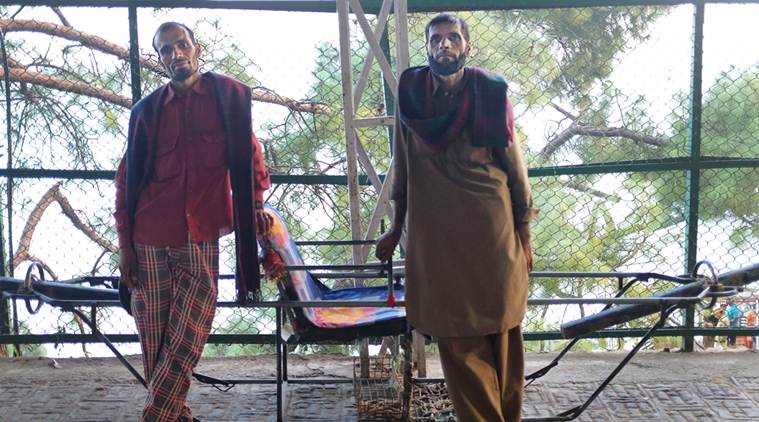
Mohammad Qasim (right), 55, and Khushi Mohammad, 35, have been working as palanquin bearers at Vaishno Devi for decades. They confirm that they have never faced any religious biasness here.
Located at a staggering altitude of 5,200 ft above sea level in the Katra valley in Jammu and Kashmir , is the lofty abode of goddess Vaishno Devi. The 13.5 km stretch to the main bhawan (temple housing the holy shrine) is accessible via various modes of transportation, including ponies, electric vehicles, helicopters and, most popularly, its paalkhis (palanquins), operated by two or four bearers a time.
There are over 5,000 palanquin bearers in the area, out of which around 3,500 are Muslims, often seen chanting “jai mata di” on top of their voices during their steep trek to-and-fro the shrine. “I’ve worked all my life here and have never faced any problem,” says 55-year-old Mohammad Qasim, who has been a palanquin-bearer for the last 32 years. “So what if I’m a Muslim, the goddess protects everybody. I get my food from here, so, this place is my home,” he adds.
The famous Katra market wears a grim, desolate look these days, given the conflict in Kashmir that has brought to halt all forms of functionality. The ongoing curfew in Kashmir has seen a sharp drop in tourists. The shopkeepers and locals depend on the pilgrimage, which sees outsiders in throngs, for their daily livelihood. The last two months have been severe, say some of the locals, pointing at the empty roads. But the palanquin-bearers appear strikingly unperturbed.
Khushi Mohammad, 35, smiles as he recalls the last 20 years of his service at the shrine, facing neither any troubles from his own community for visiting a Hindu pilgrimage, nor from the devotees for being a Muslim at the shrine. “We trek even during our Ramadan fast. People are so nice to us, they wait while we read the namaz during our working hours,” he says.
source: http://www.indianexpress.com / The Indian Express / Home> Lifestyle> Life-Style / by Cheena Kapoor / September 18th, 2016
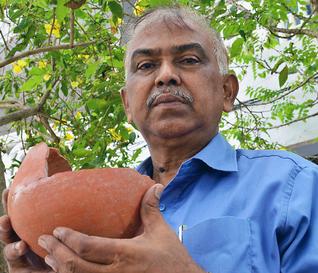
Historian Mohammed Silar with a pot collected from a Buddhist site at Gudivada in Krishna district.
‘Machilipatnam Sarvasvam’, (Encyclopaedia of Bandar), written by Bandar-based modern historian and numismatist Mohammed Silar, is all set to be released by the end of June. The book focuses on the flourishing of Buddhism and Jainism in Krishna district as well as individuals and institutions which brought laurels to the port town.
In 2010, he wrote his first book ‘Tara Tarala Bandar Charitra’, which became a reference guide for history research scholars. It was reprinted in 2013. “My second book has a detailed narration about the rule of several dynasties in Masula – from Mughal, Dutch to British and French. The history of India’s third municipality, Machilipatnam Municipality, is also one of the key chapters of the encyclopaedia,” Mr. Silar said.
Based on Battiprolu inscription in Pulinda script, Mr. Silar is trying to establish the birth of Telugu language in Machilipatnam. As Machilipatnam played an important role in the evolution of education and literature in Andhra Pradesh, the book chronicles the lives of many luminaries including Madras University’s first elected Vice-Chancellor Raghupathi Venkataratnam Naidu of Machilipatnam.
Mr. Silar, a retired Special Grade Tahsildar and a Food Inspector during the cyclonic storm in 1977, has been engaged in documenting the glorious past of the town. “Bandar population was 64,000 in 1865 as against 9,000 of Vijayawada. The demography shows the glorious past and development of the tiny town in those days”, he says.
source: http://www.thehindu.com / The Hindu / Home> Andhra Pradesh / by T. Appala Naidu / Machilipatnam – June 05th, 2014
Built in 1750s, it was used to confine freedom fighters from Krishna and Guntur districts till another jail was built in Vijayawada in 1920s
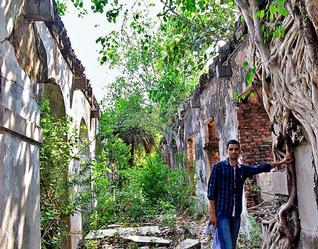
The remains of the British Prison at Bandarkota village near Machilipatnam in Krishna district.
A British construction here stands as a witness to the bravery and sacrifices of the freedom fighters of Masulipatnam and Krishna district.
The giant building, known as ‘British Prison’, reminds one of the history of freedom struggle in Andhra Pradesh.
“It was built after the Anglo-French war in 1750s. The British required a prison in Machilipatnam to incarcerate the local freedom fighters within the area of Krishna and Guntur districts and Nalgonda in Telangana State during the freedom struggle,” local historian Mohammed Silar toldThe Hindu .
According to available literature on Machilipatnam, it was the only prison to confine the freedom fighters until another prison was built in Vijayawada in early 1920s.
Jaggery unit
‘Masula History’ penned by Chitta Bala Krishna Sastry in 1922 predicts that Machilipatnam would witness rapid industrial activity, by citing the jaggery production unit set up in the British prison by then.
“After the British left the prison by early 1920s, local entrepreneur Jaldu Rama Rao obtained permission from the British to use the prison premises for production of jaggery and sugar,” said Mr. Silar. However, sugar cane production had to be stopped by mid 1940s, owing to various business reasons.
Currently, the British prison is owned by the family of Jaldu Rama Rao.
Now, an old woman resides at the entrance of the site, which is yet to get the heritage status.
Only if it gets the heritage status, any conservatory initiatives by the Archaeological Survey of India could be expected to take place.
Another heritage structure
Ironically, the British prison is located opposite another heritage site which was a hospital during the Nizam’s period.
The efforts made by the Indian National Trust for Art and Cultural Heritage (INTACH) for the conservation of the British prison as well as the other sites at Bandarkota have not yielded any results so far.
source: http://www.thehindu.com / The Hindu / Home> Andhra Pradesh / Bankarkota(Krishna) / August 15th, 2016
On the eve of the country’s 69th Independence Day, the Abbie Rich Inter College, one of the oldest schools in Uttar Pradesh, is struggling to preserve its heritage. The school building, a hundred years old, is in dire need of repairs. The school is the alma mater of Ram Prasad Bismil and Ashfaqullah, who, long before their participation in the Kakori train robbery of 1927, were classmates and friends here. The school even has their attendance records up to 1919.
Abbey Rich is owned by the Methodist Church of India (MCI) and run on funds raised by Christian minority institutions. The nearly 700 students are mostly from poor families, with no fees charged from them till class VIII. At present, the school is looking for funds to renovate its buildings. However, fund constraints and absence of financial help from the government has brought the school to dire straits.
Abbey Rich has a past that is intimately connected with Uttar Pradesh and the rest of the country. Bismil and Ashfaqullah forged their well-known friendship while students here. Moreover, its alumni fought in both the First and Second World Wars. In the latter, three teachers and five students are known to have joined the armed forces. Their names have been commemorated in a wall plaque.
In 1991, some students put up statues of the two martyrs on the school grounds. Abbey Rich authorities have since wanted to replace them with better statues in marble and have written several times to the state government. However, no reply has been received. Meanwhile, the statues are placed facing the wall, making it difficult for anyone to see the faces either from inside or outside the school.
“Abbie Leonard Rich was an American social worker who came to Shahjahanpur in the 1850s and began teaching children under a tree. In 1857, he was forced to flee the place because people did not know he was not connected to the East India Company,” said principal Mihir Phillips.
Rich returned a few years later and the government gave him some land on rent to set up a school. In 1867, it moved to another building and got affiliation till class X, one of the first in the province. Finally it moved into the current building in 1916, build on land donated by a local nawab.
“We still have the attendance records of Ashfaqullah and Ram Prasad Bismil. They were here till class VIII, in section B actually. The students and staff feel proud to share this heritage,” said Phillips.
There is an important incident from the freedom struggle connected to both martyrs. In 1919, police raided the school to arrest both the boys. “But then principal Rufus Charan stopped the police at the gate. This gave time to the two boys to escape,” the principal said.
Professor Bikram Mani, who retired from the school told TOI, “This used to be the best school of the city but everything changed with time. We provide free education and this is probably not what people need these days. Otherwise, it would have been declared a heritage institution.”
source: http://www.timesofindia.indiatimes.com / The Times of India / News Home> City> Bareilly / Kanwardeep Singh / TNN / August 23rd, 2016
Prince of Arcot, Nawab Mohammad Abdul Ali, has hailed Chief Minister J Jayalalithaa for sanctioning a sum of Rs14.5 crore for the restoration of the Chepauk Palace (Kalas Mahal).
In a release, the Nawab said that the people of Tamil Nadu, particularly those who have love for history and interest in preserving historical monuments, were overwhelmed by the Chief Minister’s gesture to restore the majestic Kalas Mahal, which is perhaps the first Indo-Saracenic monument in the country.
The Nawab thanked the Chief Minister for her decision not to demolish the historic Kalas Mahal, which was ravaged by a fire in January 2012. That the CM evinced keen interest to restore it, shows her concern and love for history.
The Prince hoped the restoration would be carried out as per detailed drawings provided by a firm belonging to a conservation architect and that the originality of the structure would be maintained.
Kalas Mahal is classified as a grade-I heritage building in the Justice E. Padmanabhan committee report
The direct descendant of the eighth Nawab of Carnatic, Muhammad Ali Wallajah (1749 to 1795), built the Kalas Mahal.
source: http://www.newindianexpress.com / The New Indian Express / Home> Cities> Chennai / by Express News Service – Chennai / July 20th, 2013
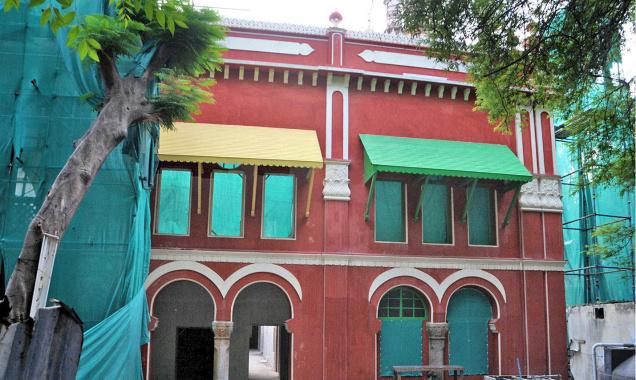
A new look:The building that is being renovated at a cost of Rs. 14.5 crore will be home to the National Green Tribunal, Southern Bench. —Photo: B. Jothi Ramalingam
People who visit the PWD complex cannot miss the once fire-ravaged walls that now sport a new look, coated with fresh terracotta paint.
A portion of the Kalas Mahal, which was once part of the Chepauk Palace and was ravaged in a fire a few years ago, will soon be restored to its original glory.
Work to renovate the ground floor of the 248-year-old building is expected to be completed by September-end.
It will be the home to the National Green Tribunal, Southern Bench. Nearly 100 skilled labourers are giving finishing touches to the building that is being restored at a cost of Rs. 14.5 crore, said officials of the Public Works Department.
“Work is on to provide flooring with kota stones, which is a fine-grained variety of limestone. Labourers who are skilled in lime plastering and ornamental beading works are also engaged in providing wall lining as per the guidelines,” an official said.
Spread over 24,000 sq.ft, the ground floor will be allotted to the tribunal Bench and will house three court halls. The Bench is now functioning at Arumbakkam.
A team of its representatives recently visited the site.
Nearly 80 per cent of the work on the ground floor has been completed so far. Similarly, nearly 50 per cent of the work to renovate the first floor is over.
“We are reconstructing the Madras Terrace roofing using materials from Rajapalayam and Srivilliputhur. The windows and doors are being replicated in the heritage building. We are also making arrangements for water supply and sanitary facilities in the structure,” an official said.
Once the project to restore the first floor is over, work to reconstruct the octagonal dome will be taken up.
Meanwhile, the PWD is also expediting the process to restore the adjacent heritage building, Humayun Mahal, which suffered roof collapses and faced a minor fire over the past few years.
“The process is on to engage a conservation architect to prepare a detailed project report for restoration of the structure. The project may be implemented in five or six months,” an official said.
source: http://www.thehindu.com / The Hindu / Home> News> Cities> Chennai / by K. Lakshmi / Chennai – August 14th, 2016