Category Archives: Travel & Tourism

Nawab who misses the royal culture

Hyderabad, TELANGANA :

At 92, Shah Alam Khan visits his office daily and tries his best to preserve Hyderabad’s culture.

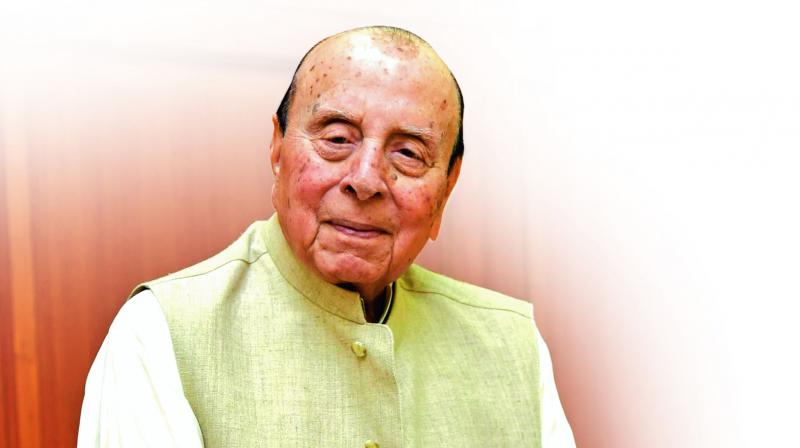
Shah Alam Khan, one of Hyderabad’s royals who is still referred to as ‘Nawab’.

At 92, Shah Alam Khan, one of Hyderabad’s royals who is still referred to as ‘Nawab’, is gracious enough to stand up to welcome you into his study at the Hyderabad Deccan Cigarette Factory in Musheerabad. What’s more, he eloquently reminisces on the “good old days” when Hyderabad was still ruled by the Nizams.

“Life was not expensive at all. I once saw a goat being sold for four rupees… four rupees!” he says incredulously. With seven sons, Alam’s family has, over the years, expanded their businesses in various fields but one thing that they all take pride in is ensuring that the Nawabi and Hyderabadi culture isn’t forgotten.

Alam’s son Mehboob Alam Khan is a well-known food historian and connoisseur who has helped preserve the Hyderabadi Mughlai cuisine that the city is famous for. Working with various restaurants, Mehboob helps them maintain authenticity in their recipes.

“Hyderabad was known for two things — biryani and sherwani!” says Alam, and says that training today’s chefs is all that is required to bring back the lost culture. “The cooks in our city know only a little bit of this and that. But our womenfolk know a lot of recipes,” he says.

Sipping a typically Hyderabadi cup of chai, he talks about growing up in the Cantonment area in Secunderabad and moving on to study at the Jagirdar College — what’s now known as Hyderabad Public School. “We had the best of Continental as well as Mughlai food. Even the schools served amazing food, that we didn’t even get at home!” he remembers.

Alam then pursued a Bachelor’s degree in Economics and Political Science from Osmania University, where he says his professors helped mould his life: “I can’t forget the way my English teacher, Prof Doraiswamy, taught us. When the results came out and I passed, I went to his house and fell at his feet.”

The lessons came in handy when he took over the reins of a cigarette factory from his wife Begum Abida Khader’s father in 1945. “When I used to hoist the flag during ceremonies, I’d tell them that this is the place where you as well as me fill our tummy. If there’s a quarrel in the house between the husband and the wife, then your house is not good. If there’s a quarrel in the factory, it’s not good for the industry,” Alam explains.

Alam still goes to office every day but has one regret: Not doing enough to preserve Hyderabad’s culture — “I once had the opportunity to address the old boys’ association of Osmania University in Karachi. And I told them with tears rolling down my cheeks that I can’t believe that the association is here… it should have been in Hyderabad. And with it, you have also taken away our culture.”

source: http://www.deccanchronicle.com / Deccan Chronicle / Home> Lifestyle> Viral and Trending / Deccan Chronicle – by Christopher Isaac / March 18th, 2016

Discoverers worry for the ‘ World’s Longest Cannon ’

KARNATAKA :

Researchers hope the government will act to protect the cannon at Gulbarga Fort

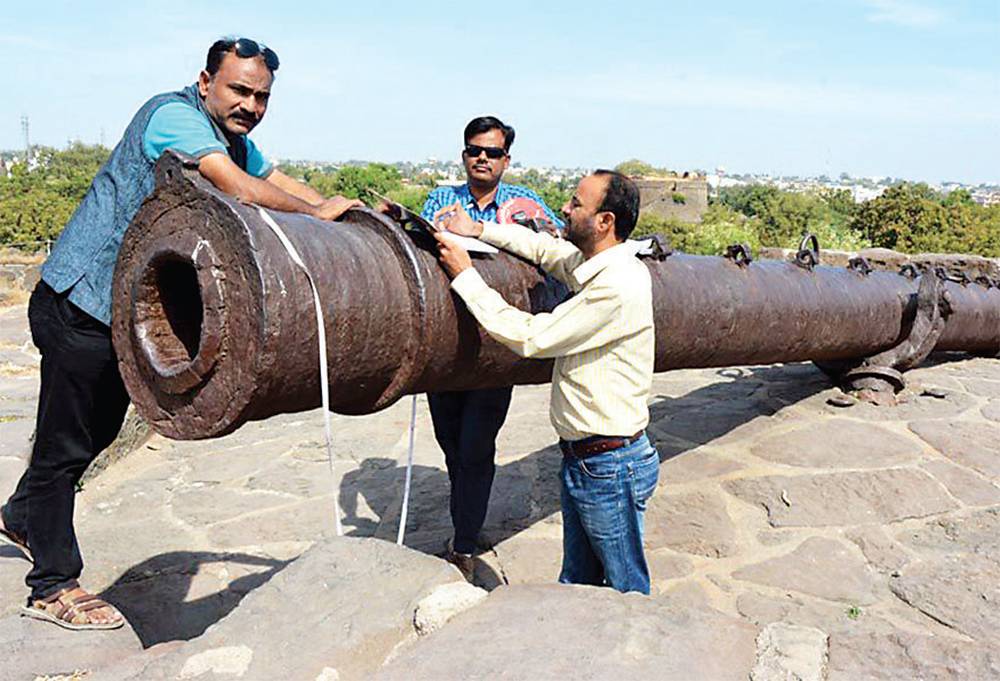
Mohammed Ayazuddin Patel, Dr Rehaman Patel and Mohammed Ismail measuring the Bara Gazi Toph

The three researchers, Mohammed Ayazuddin Patel, the national award winner, artist and photographer, Dr Rehaman Patel, artist and researcher at Indo-Islamic Art, Kalaburagi, and Mohammed Ismail, Bahmani researcher and coin collector who recently discovered a cannon in a fort in Kalaburagi, which they say is the longest in the world, are worried over its preservation.

It was their visit to Gulbarga Fort in search of the name of the first Bahmani sultan, Alauddin Hasan Bahaman Shah among the Persian inscriptions on the Jama Masjid that led to its discovery. Speaking of the cannon to Bangalore Mirror, Mohammed Ayazuddin Patel said, “Since 2010, I have been researching on the subject. The existing world record is in the name of Tsar Cannon that is 17.5 feet long and was built in the 15th century in Russia. The cannon has been named in Guinness Book of World Records, when the fact remains that the top three longest cannons exist in India. It is a matter of pride for the people of Kalaburagi and the Hyderabad-Karnataka region that the longest cannon in the world is located in Bahmani Fort and was manufactured during the reign of Bahmani Empire in the 14th century. It is made of the alloy Panch dhatu.”

The cannon is known as Bara Gazi Toph and measures about 29 feet in length. Its circumference is 7.6 feet and diameter 2 feet. The barrel is 7-inch thick. In India, the largest recorded cannon is about 23 feet long and is located in Koulas Fort in Nizamabad district of Andhra Pradesh. Asaf Jah-1 (first Nizam) granted the Koulas Fort to the Rajput king Raja Kunwar Gopal Singh Gaur in 1724 AD for his bravery in the battle of Balapur and Shakkar Keda. The biggest cannon on wheels, built by Raja Mansingh, is in Jaipur and measures 20.6 feet in length.

“The Jaipur cannon weighs about 50 tonnes. We assume that the weight of the Kalaburagi cannon could be around 70-75 tonnes. While, the firing range of the Jaipur cannon is about 35 kilometres, that of Bara Gazi Toph could be 50-55 kilometres,” Ayazuddin Patel said.

The Bahmani monarchs, who ruled from the present Kalaburagi (Ahasnabad), stand out among other rulers for their contribution to the city. The founder Alauddin Hasan Bahaman Shah (1347-1422) made Gulbarga the capital and before his death he became the master of a vast empire. Even as they extended their territory, the rulers made significant contribution to the fields of art, architecture and literature.

The Bahmani sultanate was the first independent Islamic state of the Deccan in South India and one of the larger medieval Indian kingdoms. They ruled for 191 years (1347-1538 AD). Their other capital was Bidar.

The Gulbarga Fort was significantly expanded in 1347 by Alauddin Hasan Bahmani after he cut off ties with the Delhi sultanate. Islamic monuments such as mosques,
palaces, tombs, and other structures were also built later within the refurbished fort. The Jama Masjid built within the fort in 1367, is a unique structure of Persian architectural. It is fully enclosed, and has elegant domes and arched columns, which is unlike any other mosque in India.

The biggest challenge about historic monuments in the state is their protection, a fact not going to be any easy with the region being a backward area. “The Archaeologi-cal Survey of India and state archaeology department should take steps to protect the cannon at the Bahmani Fort and it should be included in the world record list. It should be fenced. The cannon is filled with sand and pebbles, so should be properly cleaned. Also, a signboard stating its details as the longest cannon in the world is a must. The fort and Jama Masjid must be declared heritage centres,” added Ayazuddin.

The team submitted a memorandum with their pleas to the district in-charge minister Sharan-prakash Patil, the deputy commissioner, regional commissioner, as well as the departments concerned.


GIGANTIC CANNONS OF THE WORLD

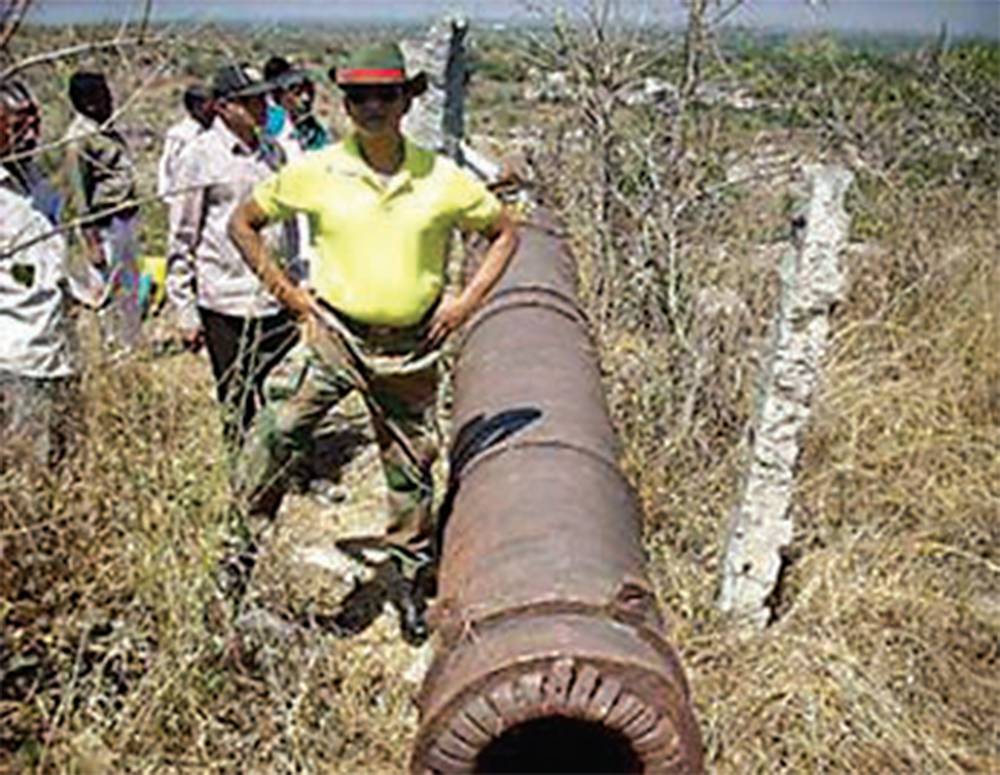
Jagadamba Bhavani Tope: Located at the historic Koulas Fort in Andhra Pradesh is believed to be the largest cannon in the world. The cannon (left), which is 23 feet in length and weighs 70 tonnes, is predominantly made of iron. It has a 16-inch calibre with an explosive head of 150 kg.

cannon02mpos28dec2016
Jaivana: Recorded as the world’s largest cannon on wheels, Jaivana was manufactured during the reign of Maharaja Sawai Jai Singh II (1699–1743) at a foundry in Jaipur, Rajasthan. Jaivana’s barrel measures 20.19 feet in length and 11 inches in diameter. The 50-tonne cannon is mounted on four wheels. The rear wheels are mounted on roller pin bearings, to turn it 360° and fire in any direction. It was designed to fire a 50 kg cannon ball to a distance of 35 km. This cannon was never used in any battle as the Rajput rulers of Amber had friendly relations with the Mughals.

source: http://www.bangaloremirror.indiatimes.com / Bangalore Mirror / Home> News> State / by Deepthi Sanjiv, Bangalore Mirror Bureau / December 28th, 2016

Majlis to remember city’s noted nawabs

Lucknow , UTTAR PRADESH :

Friday's majlis in progress
Friday’s majlis in progress


Lucknow :

In a unique step, from now on Lucknow will pay obeisance to its nawabs who played an important role in starting and continuing with the Muharram rituals that took the city’s name to the world.

Paying tribute to their souls, every Friday after Jumah prayers, a majlis (religious sermon remembering the martyrdom of Imam Hussain  and the tragedy of Karbala) will be organised at the Bara Imambara.

 Earlier,majlis for a few nawabs were organised by their descendants or caretakers of the respective Imambaras set up by them. This is the first time that tribute will be paid in a systematic manner. A list with 25 names has already been drawn which will further be expanded to include descendants who, even in poverty, continued Muharram rituals, and clerics on whose advice the nawabs ruled Avadh.

On Friday, Maulana Kalbe Jawad presided over the majlis in memory of Nawab Ghasiud-din Haider while also talking about the latter’s and his role in Lucknow’s Muharram.

source: http://www.timesofindia.indiatimes.com / The Times of India / News> City News> Lucknow News / TNN / December 24th, 2016

The generous Sultan

NEW DELHI :

A GEOGRAPHICAL LANDMARK - A part of Delhi ridge along which Buddha Jayanti Park has come up | / Photo Credit: HINDU PHOTO ARCHIVES
A GEOGRAPHICAL LANDMARK – A part of Delhi ridge along which Buddha Jayanti Park has come up | / Photo Credit: HINDU PHOTO ARCHIVES

The news of a maulvi living in an alcove of the Ridge area makes one reflect on the legacy of Feroz Shah Tughlaq who respected men of divinity

Police accosting a maulvi in a forest bordering the Bodyguard Lines of the President’s Estate recently should cause little wonder. Ghazi Norool Hassan, say reports, was found living in an alcove of the Ridge area along with his son, claiming to be the caretaker of a mazar. This shrine is supposed to be very old and in keeping with the legacy of the reign of Feroz Shah Tughlaq. A large part of Delhi was forest area in the 14th Century and this helped the Emperor to indulge in his favourite past-time of hunting. Right from Mehrauli to North Delhi there is evidence of the Sultan’s hunting lodges where he sometimes rested at night too.

While in North Delhi he built an observatory, besides a hunting lodge, a Pir of his time also set up abode in the area and, after drawing a lot of devotees, disappeared one fine day, leaving his admirers shocked. The place has come to be known as Pir Ghaib. On the Ridge near Karol Bagh is the ruined gate of Bhuli Bhatiyari-ka-Mahal. Though Sir Syed Ahmad Khan thought it was a distortion of the name of a nobleman, Bhu Ali Bhatti, there are not many takers for this assertion.

If oral history is to be believed, Bhuli Bhatiyari was the comely daughter of a dhaba owner (Bhaitiyara) with whom the Sultan fell in love while passing that way. There is incidentally a Bhuri Bhatiyari-ki-Masjid (dedicated to a fair innkeeper) opposite the Khooni Darwaza. Another story says Feroz Shah actually fell in love with a gypsy girl for whom he built a palace as she had stolen his heart after offering him a drink of water on a hot summer day while the Sultan was out hunting.

Historian Ishwari Prasad says that Feroz Shah was a pious man, despite being an orthodox Sunni who ill-treated the Shias and non-Muslims. But at the same time he was generous and not fond of shedding blood, like his cousin and mentor Mohammed Bin Tughlaq, whom he had succeeded. Feroz was a great devotee of dervishes, many of whom flourished in his empire. One of them probably was the Pir Sahib of the place where the maulvi was found living secretly for 40 years. The forest area of which the shrine is a part, had many other dargahs which were demolished when New Delhi was built. Raisina Hill was also covered with a forest where wolves, leopards and hyenas were found. So a Forest Ranger’s bungalow was set up there. In later times, this bungalow became part of the Sacred Heart Cathedral and now after renovation, is known as Maria Bhawan.

Some old mosques still exist in nearby areas which may be dating back to Tughlaq times, for that matter the place where now stands Gurdwara Rakabganj was also a jungle once in which during Aurangzeb’s time lived a contractor, Lakhi Singh of the Mughal court. When Guru Tegh Bahadur was beheaded on the orders of Aurangzeb, there was a violent storm, taking advantage of which Lakhi Singh and his eight sons (who had come on horses and bullocks) took the body away, while the Guru’s head was taken away by a man named Jatha. Lakhi Singh drove all the way from Chandni Chowk to the forest where he lived and putting the body in his house set it on fire to avoid suspicion. Later Gurdwara Rakabganj came up there.

But to come back to Feroz Shah, the number of mosques and dargahs that were set up in his reign rivalled the inns, gardens and hospitals. He is said to have laid 1,200 gardens around Delhi and nearby areas in each of which a Sufi found refuge. The Sultan lived up to the age of 90, the longest living ruler of Delhi after Aurangzeb. He was so generous at heart that even while laying siege to a city he would often turn back on hearing the cries of women in distress and suffering from the pangs of hunger, along with their children. Even while on shikar, Feroz Shah would pay obeisance to saints who had set up abode in his empire. Many of them were helped by him to set up khankahs or hospices, and when they died the Sultan was always ready to build a mazar for them.

Once while visiting a dervish he was puzzled on seeing a goat and a tendua (panther) lying in the courtyard of the jungle abode. Seeing his amazement at the sight the dervish told him that in the royal darbar this may not be possible but in his khankah the goat and the panther could lie side by side, forgetting their enmity. When the British built what is now President’s Estate, they reclaimed a lot of forest land in which wild animals roamed. But still a lot of the area acquired by Lutyens and Baker was left as forest land. The mazar of which Noorol Hassan claims to be caretaker is only one among many hidden away from the public eye. Don’t be surprised if in course of time the mazar becomes a regular shrine with an annual Urs. But for this the history of the mazar and of the saint buried there would first have to be determined. Until then Ghazi Noorol Hassan can continue to be caretaker of the legacy bequeathed to him by Fakhruddin Ali Ahmed. The late President himself preferred to be buried outside the New Delhi Jama Masjid, opposite Parliament House, where once the heart-broken poet Hasrat Mohani of “Chupke, chupke aansoon bahana” fame had made his bachelor’s quarters.

source: http://www.thehindu.com / The Hindu / Home> Society> History & Culture / December 25th, 2016

Revisiting the life and times of Hayat Bakshi Begum

Hyderabad, TELANGANA :

A day after staging the internationally-feted heritage play, Quli: Dilon ka Shahzaada , actor-director-playwrighter Mohammad Ali Baig staged its sequel, Saavan-e-Hayat in Golconda Fort this Sunday celebrating the splendour of the Qutub Shahs.

A biographical play on the life of Golconda’s de facto empress, Hayat Bakshi, the only child of Mohammad Quli Qutb Shah and perhaps the most powerful lady of medieval Deccan.

A magnificent blend of great writing and commendable acting ensured the 65 minute play in Hindustani kept the audience glued to their seats.

The play featuring Mohammad Ali Baig in triple roles as Hayat’s father, husband and son, Rashmi Seth as old Hayat, Noor Baig as young Hayat and Ayushi Gupta as adolscent Hayat also featured Vijay Prasad, Kavita Golechha and SA Majeed in prominent roles.

It was well-attended and generously applauded by the theatre lovers and the locals alike who thronged the fort to watch the historic play.

source: http://www.timesofindia.indiatimes.com / The Times of India / News> City News> Hyderabad News / December 20th, 2016

Realtor Razack to open Bengaluru’s first Museum of Indian Paper Money

Bengaluru, KARNATAKA :

In 1913, Maharaja Krishna Raja Wadiyar IV appointed William Clarence Rose as the first chief manager of the Bank of Mysore. Whilst in office, Rose collected all British India banknotes of denominations five, ten, fifty and one hundred in a series. When he retired in 1925, he received a wax-paper scroll rolled into a carved silver sheath, mounted on a teak base. Everything was made from melted silver coinage issued by the Raj.

Rose passed all this onto his daughter Vera Katherine Maud Collins, who bequeathed it to her grandson Simon Collins.The latter remembers how the “gift was kept in a 1937 coronation stamp album“ and was passed on two months before his grandmother’s death in 1982. This legacy -along with other historical nuggets -is finding its way back to the city .

The collection will be housed in a museum of Indian currency, expected to come up in Bengaluru next year.

The project is the brainchild of realtor and currency collector Rezwan Razack, who has been collecting Indian paper money since 1971. Spread across 4,000 square feet and located off Brunton Road, the museum is expected to be open to the public in the latter half of 2017. “The intention of setting up the Museum of Indian Paper Money is to display all that there is in my collection. It is to create awareness about our history and our journey so far as a nation, through our currency ,“ says Razack,  who is the managing director of city-based Prestige Estates Projects and chairman of the International Banknotes Society’s India chapter.

Among the world’s most prolific collectors of rare currencies, Razack has preserved bills dating back to early 1770s.These include the uni-face (onesided) notes first launched by the government of India, portrait notes of King George V & VI, cash coupons of princely states, Indian notes issued in Pakistan and Burma, special issues made for the Persian Gulf and Haj Pilgrims and all variants of Indian notes -from the Independence era till the latest demonetisation exercise.

E a ch n o t e links us to the way of life in the past and unearths lesser-known stories of our city and country, believes Razack. For instance, on display will be 100-odd Prisoner of War coupons issued by the British. “There were eight camps across India, including Bengaluru, which issued bills from one anna to ten rupees,“ he says.

The museum will comprise of interactive displays, historic facts and trivia, along with stories and essays written by Razack from his own journey and experience as a collector.Architects are working on the blueprint of the museum and estimates should be drawn up by the end of the year, Razack informs.

source:  http://www.economictimes.indiatimes.com / The Economic Times / Home> ET Home> Magazines> Panache / by Divya Shekhar, ET Bureau / November 24th, 2016

Wahab Khan tomb in Kurnool to get a facelift

Kurnool, Vijayawada, ANDHRA PRADESH  :

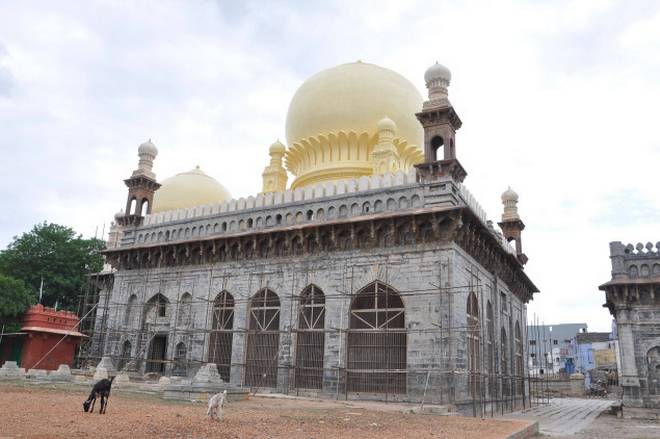
HERITAGE WATCH: The Abdul Wahab Khan tomb in Kurnool. Photo: U. Subramanyam

The Archaeological Survey of India, which is protecting the monument, will carry out repairs to the 400-year-old structure in Kurnool

The mausoleum or tomb of Abdul Wahab Khan here is going to get a facelift soon. The Archaeological Survey of India (ASI) which is protecting the monument has embarked upon the project to carry out repairs to the 400-year-old structure. The Union Tourism Department also announced a grant of Rs. 2 crore for the development of the tomb as tourist spot.

The magnificent structure stands on the bank of river Hundri near Osmania College.

The structure believed to have been constructed in 1618 after death of Abdul Wahab Khan, first nawab of Kurnool, comprises two domes, three verandahs, five arches and parapet walls. The workmanship which is intact four centuries after it was unveiled is much admired.

According to history, Abdul Wahab Khan, Governor of Bijapur Sultan laid siege to Kurnool Fort but failed in his first attempt.

Araviti Gopal Raju, last Kurnool king of Vijayanagara empire, was backed by his relations from Anegondi, Ghani, Own and Penugonda and repulsed the attack. However, when the Bijapur army struck second time, the Kurnool king was left alone and ultimately defeated.

In reward of his victory, the Bijapur Sultan declared Wahab Khan as Nawab of Kurnool. However, his dynasty was replaced by Dawood Khan Panni, representative of Aurangazeb, whose successors continued till the end of 1839 when the British defeated Gulam Rasool Khan.

source: http://www.thehindu.com / The Hindu / Home> News> Cities> Vijayawada / by Special Correspondent / Kurnool – July 02nd, 2013

Fort lends historical backdrop to retell Husain’s sacrifice

Lucknow, UTTAR PRADESH :

Mahmudabad  :

The pallid, smudgy walls of Mahmudabad fort glistened in yellow lights as hundreds of followers of Imam Husain (Prophet Mohammad’s grandson and martyr of Karbala) walked barefoot on the rugged path from the outer gate to its interiors, beating drums and reciting ‘nauha’ (elegy) that filled the air with a tradition that has been part of the cross cultural commemoration of Muharram at the royal estate. For centuries, locals have been an important aspect of the Muharram legacy and on Saturday, Mahmudabad offered a special experience for many first-timers from Lucknow and other cities of India as well as foreign nationals from different religious backgrounds, who took part in the tradition, showcasing the synergistic nature of Awadh’s heritage.

A joint effort of Waqf-e-Maharaja and a citizen-driven initiative working for communal harmony- Shoulder to Shoulder (S2S), ‘Karbala: Beyond Religious Boundaries’ served opportune time for people from different cultures to gather and watch closely what Muharram signifies. An eye-opener to Awadh’s culture, the initiative served also as a platform for breaking several myths about Islam and Shia faith.

“I thought there would be a ‘tamasha’ of people striking their bodies with blades but instead I came to know about the sacrifice of Imam Husain and could feel the pain during the sermon,” said Amit Kumar, part of the entourage from Lucknow.

Visitors witnessed several traditional arts that are part of ‘azadaari’ (mourning) at this Sitapur town and the intangible heritage of Awadh, from melancholic classical Indian ragas on shehnai like Khamaj and Bhairavi , to the recitation of ‘sozkhwani’ and ‘marsiya’ in English and Urdu  and experiencing the age old tradition of Nassari-a dying narrative art.

“In most part of the world, I had met only Sunnis from Asia but here is an example of how much more there is to India than just one culture,” said Philipp Jeun from Switzerland.

When the maulana (priest) began his speech on Karbala with: “Dar-e-Husain pe milte hain har khayal ke log/yeh ittehaad ka markaz hai aadmi ke liye (At Husain’s threshold meet people of all ideologies/this is the hub of unity of mankind),” all agreed in unison.

source: http://www.timesofindia.indiatimes.com / The Times of India / News Home> City News> Lucknow / by Yusra Hussain / TNN / October 11th, 2016

After 50 years, Begum Talab brims with life

Vijayapura, KARNATAKA :

The historic tank has been revived with water from the Krishna river

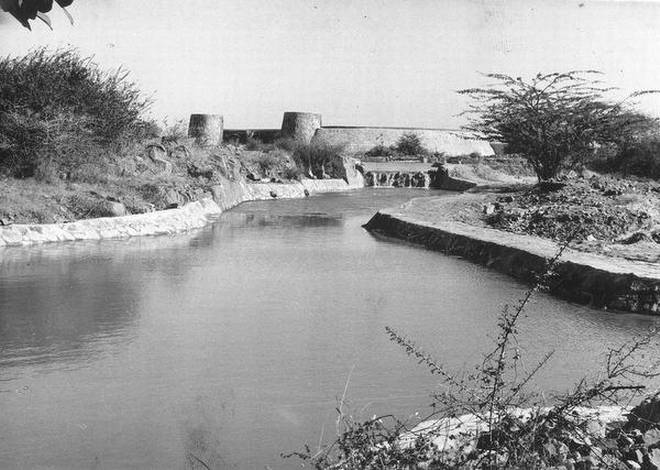
Brimming with water, with women washing clothes at the edge while children swim in the fresh water, it is hard to believe that just a month ago, the Begum Talab, spread across over 234 acres, was a barren wasteland, with few small pools of water.

The ancient tank, built during the rule of Mohammad Adil Shah in 1651, has not seen such water levels for the past five decades. But under an ambitious project of the Water Resources Ministry to rejuvenate and replenish tanks, water from the Krishna river has been drawn to fill the tank and recharge ground water. Over the past year, a 50 km pipeline was laid from the river to the tank. The tank was among seven revived in the district at a cost of Rs 190 crore.

Crucial water source

According to historian Abdulghani Imaratwale, Adil Shah built the tank in the name of one his queens; Jahan Begum. The construction was supervised his commander Afzal Khan to provide drinking water to Bijapur city which then had the population of around nine lakh.

Dr. Imaratwale said the water was not only used for the palaces or prominent places of the kingdom, but also for public consumption as the city did not have other drinking water sources.

The tank, located on the southern part of the city, used to supply water through the earthen pipes to many ganjs (overhead stone tanks). It was the second major water source for the city after the Ramalinga tank. Unfortunately the ganjs and the old pipes have fallen into disrepair,

Expressing elation over the government decision to refill the tank, Dr Imaratwale termed the project a significant step in restoring the history of the city.

“ It is heartening to know that Water Resources Ministry led by M. B. Patil is showing concern to restore and revive the ancient tank which had once served a major water source. The tank still has the same capacity if the water is stored and used,” he said.

source: http://www.thehindu.com / The Hindu / Home> National> Karnataka / by Firoz Rozindar / Vijayapura, October 10th, 2016

Nawazuddin Siddiqui gone in Muzaffarnagar but Nizamuddin continues to rock Ramlila stage in Agra

Agra , UTTAR PRADESH :

Agra :

Bollywood actor Nawazuddin Siddiqui may have backed out of his Ramlila  act in riot-affected and divided Muzaffarnagar , but in adjoining Agra, Nizamuddin continues to rock the Ramlila stage.

He’s been doing key roles for over last five years and is Janak, the father of Sita, this time, no less. It wasn’t always that easy for Nizamuddin though.

During his early years in the Ramlila theater, he too faced protests and opposition like the way Nawazuddin did. But he stood his ground. In fact, another Muslim will do the part of Bharat along with him this year.

The 55-year-old Nizamuddin, who is the track man at Agra cantt station in north central railway zone, never had any acting classes but landed up for top notch role in 46th edition of Ramlila theater on dussehra.

Speaking to TOI, Nizamuddin said, “Back in 2010 when I gave my first audition for Ramlila play organized by railway, I was offered roles of Shantanu (father of Shravan) and Rishi Atari (mentor of Sabri). But soon, scores of people from my own community raised questioned on my faith in Islam. I was almost ousted.”

Nizamuddin playing Janak character, father of Sita, sits on the extreme left and delivers his dialogues.

“But as an artist I never changed my stance. There is no sin if a Muslim man acts in Hindu play. Ramlila talks about peace and triumph over evil. Getting a role in Ramlila is a matter of pride for me,” he said.

Expressing his dissent on Bollywood actor Nawazuddin Siddiqui backing out from play after opposition from right wing members, Nizamuddin said, “Nawazuddin is an artist, he should have continued with his act instead of giving up against bullies. I’m sure, the local residents and administration would had supported him if he would have stood up.”

Talking to TOI, director of Ramlila theater, Manoj Singh, who has been playing role of Ravan since 1998, said, “It is amazing to see the zeal of men like Nizamuddin, who outsmart other contestant for the roles. This is blunt and appropriate reply to those people, who want to create enmity and disturbance among different communities.”

“This year we had only two Muslim artists who have notched the top roles, while for the first time a woman has joined the play to act as Sita,” added Singh.

source: http://www.timesofindia.indiatimes.com / The Times of India / News Home> City News> Agra / by Arvind Chauhan / TNN / October 08th, 2016