Category Archives: Travel & Tourism

PM gifts replica of Kerala mosque to Saudi King

Riyadh, KINGDOM OF SAUDI ARABIA :

ModiMPOs04apr2016

Riyadh :

Prime Minister Narendra Modi today gifted Saudi King Salman bin Abdulaziz a gold-plated replica of Kerala’s Cheraman Juma Masjid, believed to be the first mosque built in India by Arab traders around 629 AD.

“PM @narendramodi gifted His Majesty King Salman bin Abdulaziz Al Saud a gold-plated replica of the Cheraman Juma Masjid in Kerala,” the prime minister’s office tweeted.

The mosque in Karala’s Thrissur district is believed to be the first mosque built in India by Arab traders around 629 AD.

“Cheraman Juma Masjid is symbolic of active trade relations between India and Saudi Arabia since ancient times,” it said.

According to oral tradition, Cheraman Perumal was the Chera King and a contemporary of the Holy Prophet who went to Arabia and embraced Islam after meeting the Holy Prophet at Mecca, the PMO said.

Before he died in Oman due to some illness on the way back to India, he wrote letters asking the local rulers, to whom he had handed over his empire, to extend all help they could to Arab merchants who were planning to visit India.

The mosque has an ancient oil lamp that is always kept burning and believed to be over a thousand years old. People from all religions bring oil for the lamp as an offering.

Many believe that the mosque is a testimony to Islam’s arrival to India long before the Mughals came in from the northwest.

Modi, who is on a two-day visit to Saudi Arabia, was today received at the Royal Court here by King Salman.

He is the fourth Indian Prime Minister to visit Saudi Arabia after Manmohan Singh in 2010, Indira Gandhi in 1982 and Jawaharlal Nehru in 1956.

source:  http://www.ptinews.com / Press Trust of India / Home> International / by Manash Pratim Bhuyan / Riyadh – April 03rd, 2016

Hyderabad body to honour city founder

Hyderabad, TELANGANA :
Trust plans to take it up with the govt to issue a stamp and coin in the king’s name besides building a fitting memorial in his honour.
 The Trust plans to host an international seminar on the relevance of the king in today's world.
The Trust plans to host an international seminar on the relevance of the king in today’s world.
Hyderabad:
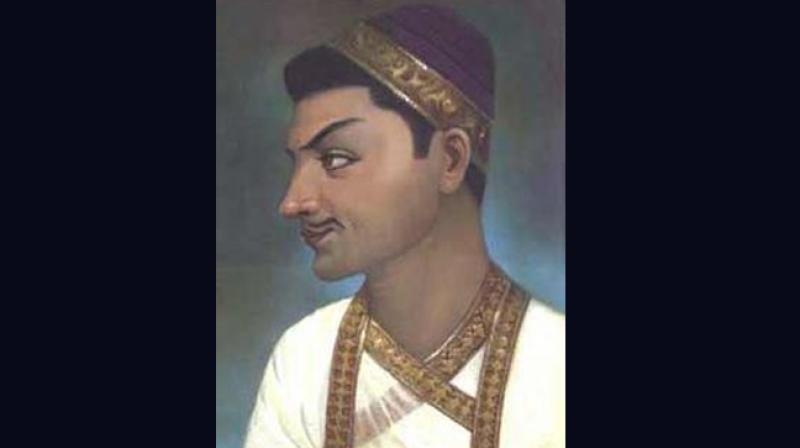
The Deccan Heritage Trust is planning to host year long celebrations to mark the 450th birthday of Muhammad Quli Qutub Shah, the  founder of Hyderabad city, which falls  on  April 4, 2016. The Trust plans to host an international seminar on the relevance of the king in today’s world.

According to Dr Mohammed Safiullah, historian and expert on Hyderabad, the Trust plans to take it up with the government to issue a stamp and coin in the king’s name besides building a fitting memorial in his honour.

source: http://www.deccanchronicle.com / Deccan Chronicle / Home> Nation> Current Affairs / Deccan Chronicle / April 03rd, 2016

K.K. Muhammed – Digger of truth

kkMuhammedMPOs27feb2016

KERALA :

LAST year, a young journalist friend, Rajeev Mangottil, invited me to speak at the Onam Day celebrations at Jamia Millia Islamia. The name of this venerable institution is derived from the Urdu language in which Jamia means ‘university’ and Millia means ‘national’. That is where I first met the youthful-looking K.K. Muhammed, Director of the Archaeological Survey of India (ASI).

Rajeev whispered into my ears that Muhammed would soon be retiring and his story on him was scheduled to appear in the Malayala Manorama supplement. Since the Malayalam daily is fond of showcasing every Malayali as an achiever of sorts, I was not greatly impressed.

One reason why I underestimated him was that I have a poor opinion of the ASI. Just last fortnight a friend from Punjab SMSed to say that he had visited Nangal and seen the glass case which commemorates Chinese leader Chou en Lai’s visit and the discussions he had with Prime Minister Jawaharlal Nehru while formulating Panchsheel or the five principles of peaceful co-existence. I had visited the place a couple of times and was shocked by the fashionable sofa in the glass case. I checked and found that the two leaders had used caned, wooden chairs, which the officials concerned did not find impressive enough to be showcased.

In contrast, I saw at Potsdam, near Berlin, the large table and the chairs used by Stalin, Churchill and other victors of the Second World War, while deciding to divide Berlin into four zones and to constitute the United Nations, preserved in the same manner in which they were used, attracting thousands of tourists every year. But the first time I visited Shimla, I was unable to see the table and the chairs used by Indira Gandhi and Z.A. Bhutto for finalizing what is known as the Simla Agreement because no official had any clue about their existence.

Muhammed preferred to speak after J. Gopikrishnan, the ‘Pioneer’ reporter who unearthed the Spectrum scam, and I had our say. He spoke extempore and quoting the Vedas and the Upanishads, he took the listeners on a conducted tour of ancient Kerala, where the persecuted Jews found asylum and Semitic religious ideas flourished and enriched the native cultural practices and traditions. It was apparent that he had an excellent command of Sanskrit, the language of the gods. No, he did not say anything about the ASI or the work he had been doing.

He gave me his visiting card, which said that he lived in the Red Fort. He certainly could not have found a better place to live in than the fort the Mughals had built and from which they ruled the country. No other monument has witnessed history as the Red Fort from the ramparts of which the Prime Minister addresses the nation on Independence Day. It would not be an exaggeration to say that Muhammed breathes history and archaeology, rather than air.

So when I received an invitation for his lecture on the ancient churches of Goa at the Kerala Club, I could not resist the temptation to attend. What makes Muhammed stand out as an archaeologist is the passion he has for archaeology. We have all studied about Akbar the Great and Din-i Ilahi, the divine faith, he propounded by incorporating the best from Islam, Hinduism, Christianity, Buddhism, Jainism and Zoroastrianism.

It was at Ibadat Khana, the House of Worship, that the Emperor used to hold discussions with religious scholars. Miniature paintings that depict Akbar meeting Christian theologians exist. But where exactly was Ibadat Khana?

Mohammed studied the painting thoroughly and believed that it could be excavated at a particular spot in Fatehpur Sikri. He was in his late twenties and could not, therefore, convince his seniors, who all had a different belief. But he started excavating on the spot and found that the dome, the antechamber, the different layers and the gate depicted in the painting matched his excavation. It was a great archaeological discovery for which then Prime Minister Indira Gandhi congratulated him. What’s more, he also discovered a Christian chapel and a bazar in the same area.

Ask Muhammed and he will tell you that restoration of the 1300-year-old Bateshwar temple in Madhya Pradesh as the high-water mark of his career. He found hundreds of temples in a state of ruin, devastated as they were by an earthquake. Restoring them was a challenging task. Nobody seemed to be bothered. He had heard that dacoits would occasionally drop in to worship at the Hanuman temple there.

One day while returning to his workplace, he found a person smoking beedi in the temple. Muhammed rebuked him for smoking in a sacred place, little knowing that he was none else but dacoit Nirbhay Singh Gujjar! Fortunately, the dacoit did not pull his trigger and he left only after he was told by Muhammed that he belonged to the Gujjar-Pratihara dynasty that had once ruled the region.

He found that he could not carry on his work without the cooperation of the MP government, which was disinterested. Then he hit upon the idea of writing a letter to the then Rashtriya Swayamsevak Sangh (National Volunteer Corps) Sarsanghachalak, V.S. Sudarshan, telling him that though the BJP ruled the state, its government was not at all interested in restoring the ancient temples.

The RSS chief took up the matter with the Chief Minister, who ensured that he received the full support of the state government. He also had to contend with the mining mafia, which took a dim view of the restoration work. Finally, he was able to restore about 80 temples while the work is still going on.

I recently saw a documentary telecast by Asianet on the Bateshwar temple complex, which has started attracting tourists. Restoring a temple from the ruins is not an easy job. One should have a great knowledge of the art of temple construction. On TV, I heard Muhammed explain to the viewers how he came to the conclusion that a statue of Nandi could only have been at that particular spot. Rome was not built in a day. Nor had he learnt archaeology in a day.

Muhammed is modest when he says, “I have always been inspired by the Upanishads”. He knows important texts like Manasara Shilpa Shastra and Mayamata Vastu Shastra by heart. He is unabashed when he says: “I must have been a Namboodiri Brahmin in my previous birth”. I would have certainly believed him, if I had not heard his lecture on the ancient churches of Goa, where he was posted for about six years. He showed slides of various churches before and after restoration. That any ASI official could have done.

What no non-Christian could have done with such finesse was give a graphic account of the religious traditions and practices of Christians. He showed the picture of a temple, which gave Vasco da Gama the impression of a church. He went on to explain how the builders of churches in Goa liberally followed the motifs and styles used in Hindu temples and architecture.

For instance, lotus enjoys a pride of place in Hinduism. Vishnu’s feet are always qualified as the “lotus feet”. But in Christianity, no such importance is given to the lotus, which is like any other flower. Yet, he found that many of the churches in Goa sported lotus paintings and motifs.

There were many other features from Hindu temple architecture that were freely adopted by church builders. In temples, leftover water was always allowed to flow through a pipe the mouth of which resembled a crocodile’s. He showed with slides how the idea had been freely incorporated in church construction also. Of course, Muhammed had an explanation for it. The artisans who built churches came from the same class, which built temples in the area.

I was not surprised by Muhammed’s statement because a Malayalam journal had recently published a photo feature on one Govindan Gopalakrishnan, who specializes in mosque construction despite never having studied at a school of architecture, and never having seen the Taj Mahal, let alone the Jama Masjid in Delhi. He has so far built 88 mosques, including the magnificent Palayam mosque in Thiruvananthapuram and the strikingly beautiful ones along the highways in the state. Gopalakrishnan, who is a practicing Hindu, considers mosque construction as his “karma”.

Mohammed’s knowledge of church architecture was as splendid as his knowledge of the life and work of St. Francis Xavier, whose mortal remains are preserved in a church in Goa. When he spoke about him, I felt there was a devout Catholic in him.

And when he explained the various Stations of the Cross that he helped preserve in a church, and recited a line from the Bible “Elahi Elahi Lama Sabachthani” (My God, my God, why have you forsaken me?), I could see that he was overwhelmed by the enormity of emotions. I would not be surprised if he claimed that he was a bishop in his previous birth.

You and I may brand him as a Muslim or a Hindu or a Christian but Muhammed is a professional archaeologist, who ensures that wherever excavation is carried out, the local children and youth are involved in it so that when they grow up they will not leave vandal-like imprints of “Pappu loves Pappy” on the monuments they visit. In his case, wrong perceptions turned out to be far too costly.

When the post of Vice-Chancellor of Calicut University fell vacant, many knowledgeable people suggested Muhammed’s name but some thought that he was too close to the Sangh Parivar to be trusted with such a job. Instead, a person of lesser merit was chosen. Muhammed would not, however, be bothered for he knew that “an archaeologist is one whose career lies in the ruins”.

It was just the other day that historian M.G.S. Narayanan lamented that in Kerala, the Archaeology Department was headed by people who could not spell the word “archaeology” and would ask whether Alexander Fleming and Alexander Cunningham were the same.

For Muhammed, work is worship and it does not matter that he has not been adequately recognized for his contributions. However, he has many anecdotes to recount. Like the one of the time when he took President Barack Obama and his wife Michelle round the Humayun tomb and answered their questions.

Muhammed has in a recent interview expressed his distress over the low priority archaeology enjoys in the country. When he was in charge of the ASI’s work in Northern India, his budget was a puny Rs 6 crore. How many people know that it took 20,000 workers and artisans 16 years to construct the Taj in 1647-48 at a cost of Rs 50 lakh? This, when it is India’s tourism showpiece and the foremost Indian monument that spurs the international visitor to visit the country!

Do they know that parts of the Taj had fallen into disrepair? It was Lord Curzon, who ordered a comprehensive restoration project, which was completed in 1908. If anything, it shows how restoration is important for any historical site. Instead, we are good at spreading myths. One such myth is that Shah Jahan ordered the amputation of the hands of the architect of Taj Mahal in order to ensure that nobody made such a magnificent monument again. Another such myth is that the Emperor started building his own tomb on the other side of the Yamuna in black marble. Excavations across the river revealed no foundations.

Thus archaeology has its use in not only proving historical facts but also in exposing falsehoods. Muhammed showed how he transplanted a temple brick by brick using a numbering process. At the end of the project, not a single brick had become surplus. In retrospect, the most enduring image from the lecture was a gate, which he restored without spending a single penny from the state exchequer. Instead, he involved the local youth in the preservation work. They were only too happy to join him in his noble endeavor.

In all his pursuits, one thought that has guided Muhammed is “Om Lokah Samastah Sukhino Bhavantu”! (May all the people be happy!). What a pity that in a country where all and sundry are given Padma awards, a person like K.K. Muhammed has not been given such a recognition because to some, he is a Muslim and to some others, a Hindu. Rather like the poet Kabir over whose body the two communities fought only to find that he had transported himself to the realm of the sacred and the holy. K.K. Muhammed’s scholarship belongs to none, because it belongs to all.

The writer can be reached at ajphilip@gmail.com
Courtesy: Indian Currents

source: http://www.heraldofindia.com / The Herald of India / Home> Article / by A.J. Pinto / 2012

In Kerala’s Kozhikode, hunt for a Chinese legend

In Kerala’s Kozhikode, hunt for a Chinese legend

Kozhikode, KERALA :

More than 600 years after a seven-foot tall Chinese naval explorer touched the shores of Calicut (now Kozhikode), a bustling international port city in northern Kerala, an attempt to find his relics and perhaps his final burial place is in order in the state.

Last month, two professors, working in different countries, arrived in Kerala with the aim of finding more information about Zheng He, a fleet admiral of China’s early Ming dynasty and one of the world’s earliest navigators, much ahead of the likes of Christopher Columbus and Vasco da Gama. According to credible historical accounts, Zheng He, who had led seven naval expeditions in the Indian Ocean, was buried at sea off the coast of Calicut after he died of illness in the course of a voyage.

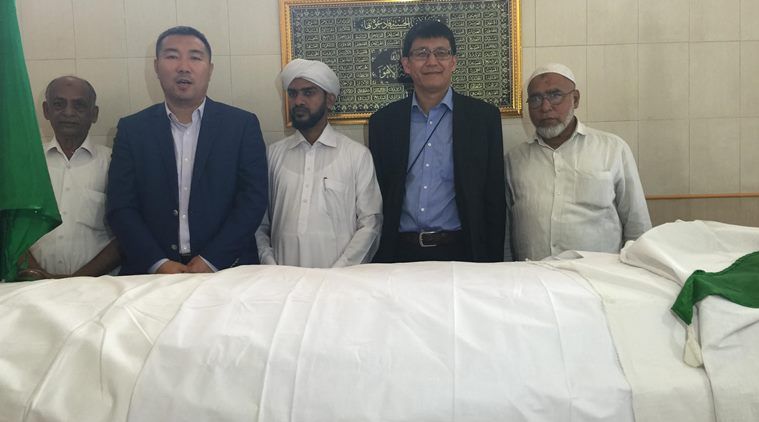
“We came to Kerala on January 7-9 to find information about relics and stories of Zheng He and his crew in Calicut. It was an official trip of Zhenghe International Peace Foundation,” said Shaojin Chai, a senior research fellow at the Ministry of Culture in UAE.

While history books are replete with the exploits of Columbus and Gama, not much is known about Zheng He, whose fleet was considered to be ten times bigger than his contemporaries. In fact, National Geographic magazine described  the naval armada of Zheng He off the coast of Sri Lanka as a ‘massive shadow on the horizon’, that moved like a ‘floating city’ and stretched across miles and miles of the ocean.

Zheng He, who is venerated almost like a God in several parts of China and has temples dedicated to him in Malaysia and Indonesia, was born in China’s Yunnan province in 1371. Born into a Muslim family, Zheng He was ritually castrated at the age of ten at the hands of an invading Ming army. But his life as a eunuch turned out for the better after he was sent to serve in the household of Zhu Di, who would later go on to become the Yongle Emperor. History says Zheng He was able to gain the trust of the emperor in a short period of time and convinced him to let him embark on naval trips that would extend China’s trade potential to Southeast Asia, the Indian subcontinent and the far-away Middle East.

Watch video

Zheng He’s first voyage, according to several accounts, began in the year 1405, sailing from China through Indonesia and Malaysia to finally end at Calicut via Cochin. His fleet was estimated to be more than 20,000 men travelling in more than 60 treasure ships – numbers described astonishing in most accounts. His subsequent trips took him as far as Iran and eastern Africa to the shores of Mogadishu.

For the Chinese explorer, Calicut, then a prosperous trading port that dealt extensively in eastern spices under the rule of the Zamorin, was an ideal base to conduct trade across the Indian Ocean and the Middle East.

“Chinese historian Ma Huan, Zheng He’s translator, described Calicut as very friendly, harmonious and a dynamic place where trading was fair and the Hindu king consulted with Muslim ministers to conduct state affairs,” said Professor Chai, who was accompanied to Kerala by Haiyun Ma, a professor at Frostburg State University, Maryland, US.

During their short visit, both professors visited a few mosques which had Chinese connections and inspected tombstones, but could not unearth any reliable clues that could point to Zheng He’s period.

However, CK Ramachandran, convenor of the Calicut Heritage Forum, dismissed claims that the Chinese naval commander had been buried under land.

“According to early Chinese traditions, a eunuch, after death, cannot go to heaven with a deformed body. That’s why he was ceremonially buried at sea,” said Ramachandran, who has meticulously collated several historian accounts of the Chinese in Kerala.

“I did visit Nanjing in China where a tomb has been erected in Zheng He’s memory. But it is more of a memorial. It is empty,” he added.

Nevertheless, undeterred, Professors Chai and Ma are planning to organise a conference next year in Kerala which would throw light on Zheng He’s exploits for which they have spoken to state government officials as well.

“Zheng He was considered one of the greatest statesmen and explorers in Chinese history and was our national pride for promoting peace and trade with other countries (sic),” said Prof Chai.

source: http://www.in.news.yahoo.com / by Vishnu Varma, The Indian Express / February 20th, 2016

Heavenly… Masala Chai … Atop Chamundi Hill

Mysuru, Chamundi Hill ,  KARNATAKA :

Tourists and localites at Farman's tea shop atop the hill.
Tourists and localites at Farman’s tea shop atop the hill.

Chai, does this 4 letter word make you go into a trance? If yes, then you are a tea lover! There are two types of people in this world — those who love tea and those who don’t. The love for tea can never be understood by the latter category, no matter how much the former group tries to make them understand !

Chai lovers love their cuppa and are very sceptical when it comes to substituting it with something like green tea. Although green tea has various health benefits, masala chai is equally healthy and tastes far better than that bland cuppa.

Though many tea stalls in city prepare and sell masala black chai with their own ingredients in it, one such tapri that sells masala black chai is SDR Cool Point atop Chamundi Hill, which is thronged by locals, to savour the unique masala chai prepared by Mir Farman Ali. Even tourists, who had earlier relished the masala chai, make it a point to visit his shop whenever they came to Mysuru.

Mir Farman Ali, a resident of Turabh Ali Street in Mandi Mohalla, speaking to SOM, said that prior to selling tea he frequented Chamundi Hill to sell the inlay works prepared at his home during the year 1980.

Coming from a family of artisans, Farman, who himself is an expert in inlay works, said things were going good for some days and he used to earn enough to take care of his family. But as the business declined, his meagre earnings were not enough to feed the family.

It was at this juncture he thought of changing his business and embarked on the idea of selling tea to visitors and devotees who thronged the temple as there were just one or two shops atop the hill then.

Instead of the regular tea, he wanted to sell tea prepared out of some unique ingredients that his mother used to give him as a child. So, in the year 1991, Farman opened a small shop and began to sell masala chai.

Disclosing some of the ingredients, Farman said his tea contained Jeera, Ginger, Black and White Pepper, Saffron and Black Salt among others which are powdered in the right proportion. These ingredients are useful to fight inflammation, fatigue, cold and flu, improves digestion, good for heart, boosts metabolism and also helpful in preventing diabetes, he claims.

One of Farman’s customers, P.K. Anil Kumar of Wildwalkers, who organises trekking expeditions to various places in the State, said that though he is not a tea freak, he never forgets to visit Farman and have a glass of that masala chai as it is very refreshing and fights tiredness. Anil has been visiting Farman’s chai shop since 18 years.

Many trekkers, who climb the steps of Chamundi Hill, never forget to visit Farman’s stall located near the parking lot behind Mahishasura’s Statue and savour the cuppa.

So next time you visit the hill-top, don’t forget to have a sip of that magical masala chai as the experience cannot be expressed in mere words !

source: http://www.starofmysore.com / Star of Mysore / Home> Feature Articles / February 19th, 2016

Iconic monument gets hi-tech ‘birthday gift’

The high definition closed circuit cameras in front of Charminar.- Photo. K.V.S. Giri

Two lamp posts with HD CCTV cameras planted near Charminar as it completes 425 years

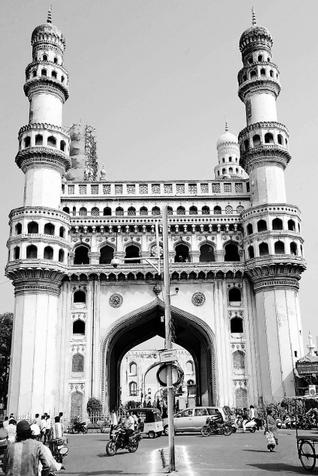
The iconic Charminar got a birthday gift from the police in the year when it completes 425 years. Two lamp posts with CCTV cameras have been planted firmly in line with the view from Mecca Masjid. It is exactly in the line of sight where people take photographs of the monument with the full height of minars in view.

Now, whoever takes a selfie will have a lamp post poking out of the head. “We have installed these HD CCTV cameras as part of the city-wide security upgradation,” informed a police official.

Ironically, it was on February 8, 1591 after 2 p.m. that the foundation of Hyderabad was laid. So, a celebration should have been in order as the city completes 425 years of being a magnet to people from across the world.

“On an auspicious day when the moon was in the constellation of Leo and Jupiter in its own mansion and all the stars were favorable, the foundation of Hyderabad was laid,” are the words in Tarikhe Farishta , which gives a brief history of the foundation of Hyderabad.

“This constellation position occurred in 1591 according to my calculations based on astrological information. Coincidentally after 2 p.m. on February 8, 1591, the moon entered Leo and Jupiter was in Visakha. Mansion usually refers to lunar position or nakshatra. Jupiter rules visakha nakshatra,” informed Anurag Sharma, who does astrology consultancy and research.

According to the history of Qutb Shahi dynasty in Tuzuke Qutbshahi , the foundation of Hyderabad was laid on October 30, 1590 the first day of Muharram, to mark the end of a cholera epidemic. The villagers of Chichilam got together and planted a tazia (a wooden flag appearing like a palm) in the middle of the road that connected the Golconda fort to the port of Machilipatnam. Once the plague subsided in October, at the end of the rainy season, the relieved king built the monument to mark the occasion and also as a marker of the four cardinal points of the city. The building was supposed to work like a charm and the inner arches of monument are capped by images of ferocious rats with gargantuan teeth. The building was completed in 1597.

Today, the Charminar is a centrally protected monument under the Archaeological Survey of India and no construction or defacement is allowed within 100-metres of the monument.

Asked about the cameras within 100 feet of the monument, an ASI official said: Security concerns are paramount and whatever the police are doing is for the good of the society.”

So, whether the city officials celebrate or not, the prayer of Mohammed Qutb Shah when he laid the foundation of the city has come true: “Oh Allah! bestow unto this city peace and prosperity. Let millions of men of all castes, creeds and religions make it their abode, like fish in the water.”

source: http://www.thehindu.com / The Hindu / Home> National> Andhra Pradesh / Serish Nanisetti / Hyderabad – February 10th, 2016

Flower show in Madikeri today

Madikeri (Kodagu) , KARNATAKA :

Vibrant:The flower garden at F.M. Khan's home at Boikeri in Kodagu. The annual flower show will be open for public on Saturday and Sunday.
Vibrant:The flower garden at F.M. Khan’s home at Boikeri in Kodagu. The annual flower show will be open for public on Saturday and Sunday.

Madkeri :

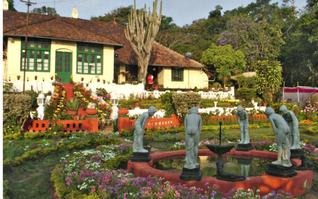
The annual flower show being organised at former MP F.M. Khan’s home at the Balayatrie Estate at Boikeri, on the Madikeri-Sunticoppa-Mysore Road, near Madikeri, is sure to become a hit when it opens for the public on Saturday and Sunday.

Mr. Khan played host to the presspersons at his home on Friday as they were taken around the flower arrangements made in front of his home in Boikeri. More than 80 varieties of flowers, all swaying to the gentle breeze and glowing in different hues, are bewitching to watch. Flower-lovers will be surely in for this annual treat, an arrangement being steadfastly followed by Mr. Khan and his family members for many years now.

Name them, the varieties are there. Dahlia, daisy, zerbera, anthurium, lady lock, cactus, marigold, chrysanthemum, bougainvillaea, bonsai, geranium, love in mist, orchids, exora, spider flower, rose, zenia, pinks, and keep counting them, there are more than 80 varieties providing a magnificent sight. It is not an easy task unless one gives personal attention, says Mr. Khan, who was once a firebrand politician and a close confidante of the late Prime Minister Indira Gandhi. However, Mr. Khan says transition from political arena to the kingdom of flowers was not difficult at all.

Mr. Khan had organised flower shows in New Delhi when he was the MP and came under lavish praise from the parliamentarians and flower lovers in the past. Dew drops settled on the flowers on a dewy morning had given a special lustre to the environment. Mr. Khan admits that rearing flowers was a tough task. He rues over the fact that many plants were lost due to unseasonable rains. He has plans to open seed bank in future for the benefit of flower lovers in the district.

Mr. Khan told presspersons that no person in the private sector had opened the flower show for public and he would set his eye on entering the Limca Book of Records in sometime.

A.M. Khan, brother of Mr. Khan, recalled how their father, Yousuf Ali Khan, loved flowers . The show would be open for public from 10 a.m. to 5 p.m. on Saturday and Sunday.

source: http://www.thehindu.com / The Hindu / Home> Karnataka / by Staff Correspondent / Mysore – January 21st, 2012

Annual Flower Show at Balyatri Estate near Madikeri Today, Tomorrow

Madikeri (Kodagu) , KARNATAKA :

F. M. Khan is taking a walk in his home garden. Picture right shows Dahlia in full bloom.

Madikeri :

Former Rajya Sabha member F. M. Khan is holding the annual flower show at his home garden for the public in Boikeri, near Madikeri, on Jan. 30 and 31.

The garden at Khan’s Balyatrie Estate, with more than 100 varieties of flowers — most of them rare — is spread over more than half-an-acre in front of his house.

Multi-hued roses, dahlia, chrysanthemum, jasmine are in full bloom to welcome the visitors.

Addressing media persons here yesterday, he said floriculture helps in the economic progress of the country and urged the government to support floriculture.

Stating that there is a huge demand for flowers at the international market, he said floriculturists should grow flowers in a natural atmosphere.

With the vagaries of nature, one needs to give special emphasis on protection of plants, he added.

Flowers like Jasmine, anthurium, marigold, salvia, Gerbera, Zenia, Dahlia, Cosmos, croton, colin, Plectranthus, Impatiens, Daisy, Gardenia, sun flower, Hollyhocks, Clarkia, Cockscomb, Lupine, Verbena, Fuchsia, pinks, spider flower, oster flower, calendula flowers, cupia, Gazania, Sweet pea, Cineraria, stock flower, love in a mist flower, devil in the bush and others are on display.

The flower show will be open to visitors from 10 am to 5 pm today and tomorrow.

source: http://www.starofmysore.com / Star of Mysore / Home> General News / January 28th, 2016

Older than Bengaluru, Stands a Grizzled Guard

Bengaluru, KARNATAKA :

Pics: Pushkar V
Pics: Pushkar V

Bengaluru :

The Devannahalli fort, which stands 35 kms away from Bengaluru, is older than the city itself by 37 years.

The fort has been occupied by different dynasties over time. It was built in 1501 by Kempegowda’s ancestor, Malla Baire Gowda. But in 1747, in a battle led by Nanjarajaiah, the dalwai of Mysore, the clan lost it to the Wadiyar dynasty. Marathas later claimed it and lost it back to the Mysore state, in a siege led by Hyder Ali in 1746.

Arun Prasad, from Discover Bangalore Project, says that though Hyder captured the fort, it was his son Tipu Sultan who was responsible for modelling and building the Pulkad fort.

The town surrounding the fort was meant to be a a centre of learning and arts. “The Devannahalli town was supposed to be a place for learned artisans and intellectuals to inhabit,” says Prasad.

Devannahalli was a town typical of the time, with protected farmlands and fields. A lake, behind the fort and seen from the bastions, was meant to serve the needs of the inhabitants.

Today, the lake is dried up and is a sad sight to notice. Prasad blames it on poor urban planning. Earlier, a highway used to pass through the western part of the town. Now, a road has been built, which passes over the lake. A  good portion of the lake was used up for it.

“The lake has always been rain-fed. But the new road cut the lake away from the adjoining canals and channels,” says Prasad. “The rain water could not flow in and the lake dried up. The vast area of 400-500 kms metres has only weeds and little water due to rains. You can also spot some tattered measurement devices, which was a failed attempt to study the level of water in the lake.”

Pics: Pushkar V
Pics: Pushkar V

Bastions

Built on a higher ground, the bastions were used to keep a watch out for the enemy. The fort is 30 to 35 feet high and bastions, along the fort, are placed at equal distance from each other. “The bastions have well protected chambers, used by soldiers. The gun points are holes in the wall which can still be seen today. They are built from lime and brick. The holes were used to keep guns during the war,” adds Prasad.

Tipu’s Birthplace

South-west of the fort, there is memorial with a board, which proclaims that Tipu was born here. A six-foot-tall enclosure marks the spot.

When Tipu was born in 1750, his father Hyder Ali was engrossed in a battle. His mother, Fatima Fakhr-Un-Nisa, was secretly ushered into a carriage to give birth at the fort, as it was considered a safe place. However, she ended up giving birth inside the vehicle, right outside the fort. The monument is built over this birth spot.

A pond was built under the administration of Purnaiah, the then Dewan of Mysore. It is a beautiful pond with the stones and excavations intact. “The water is used for rituals and festivals,” says Prasad. “People take baths here as well.”

Pics: Pushkar V
Pics: Pushkar V

Temples

Inside the Devannahalli fort, there is the Venugopalswamy temple. The temple, which was built in the Vijaynagara style, has several depictions from the Ramayana on the walls. “At the entrance, the two horsemen are believed to belong to the Western Ganga dynasty (which ruled 350 and 1000 AD),” said Prasad.

There are sculptures of seamstresses, as you enter, from the same era. The north and south walls have sculptures showing Rishyasringa being brought from a forest to Ayodhya accompanied by dancing girls. There is also a scene of Vishwamitra caught in a  an archery battle with Rama. The south wall has ten incarnations of Lord Krishna and Rama’s father performing a sacrifice.

Pics: Pushkar V
Pics: Pushkar V

The fort gate and the fort walls are crumbling and there are scribblings on the walls. There is no security at the entrance and anyone can walk in. The commercial establishments all around have failed to preserve the authenticity of the past. “An ASI (Archeological Survey of India) office is located at the entrance, which is always closed and does not provide much information,” says Prasad. “The fort area needs to be protected by ASI and does not come under the corporation. The northern gate is crumbling as well.”

How it Began

Refugees on the run from Kancheepuram settled down near the Nandi Hills. Legend has it that Rana Baire Gowda, their leader, was told in a dream that he had to build a settlement in this region. This family goes by the name of Morasu Wokkalu. His son Malla Baire Gowda founded Devanahalli. Kempegowda also belongs to this family.

source: http://www.newindianexpress.com / The New Indian Express / Home> Cities> Bengaluru / by Seema Prasad / January 28th, 2016

MIT professor covers 1,500 km on bicycle from Bengaluru to Koraput

S.S.S. Shameem, Assistant Professor in Computer Application, Manipal Institute of Technology, with his cycle at Semiliguda in Koraput district of Odisha on December 26, 2015.

Manipal (Udipi) , KARNATAKA :

He began his journey on December 18 and concluded it in nine days

S.S.S. Shameem, Assistant Professor, Department of Computer Application, Manipal Institute of Technology (MIT), has just completed the first leg of solo cycle expedition, a passion he has been pursuing since two years, and calls it as “Bharat Bhraman: Ride-4-Pride.”

According to a press release issued by the Manipal University here on Thursday, Prof. Shameem had covered a distance of 1,500 km on a high-end bicycle from Bengaluru to Koraput in Odisha. Mr. Shameem, who is very lanky, proudly says, “I completed it in nine days.”

“Eastern Ghats was a bit tough, otherwise I enjoyed the first leg and plan many more such solo rides. My aim is to see and know the diversity of our country and do whatever I could. Going around the country on a bicycle gives me a great pleasure and satisfaction. Moreover, I will be, when I finish the journey, sit and look back with pride my achievements,” Prof. Shameem said.

“I began my journey from Bengaluru on December 18, 2015, and reached Koraput on December 26, 2015, via Hyderabad, Vijayawada, Vishakapatnam and Salur,” he said.

“I have been preparing for this trip for the last two years. The next cycling trip would be again taken up in December this year,” he said.

Prof. Shameem had to spend a few nights, sleeping at railway stations, police stations and religious places etc. Prof. Shameem, who is also a marathon runner, plans to alternate his cycling expeditions with running.

Therefore, he is planning to do running during summer and cycling in December. Being ambitious, Prof. Shameem is keen to get into Limca Book of Records with half marathon (21.1 km) runs.

Accordingly, he plans to do 111 half marathons in 70 days and is working on that. He calls it, “Bhaag-run Project.” He has sought details from Limca and is in touch with the athletic associations of Udupi and Mangaluru for assistance.

source: http://www.thehindu.com / The Hindu / Home> National> Karnataka / by Ganesh Prabhu / Manipal – January 22nd, 2016