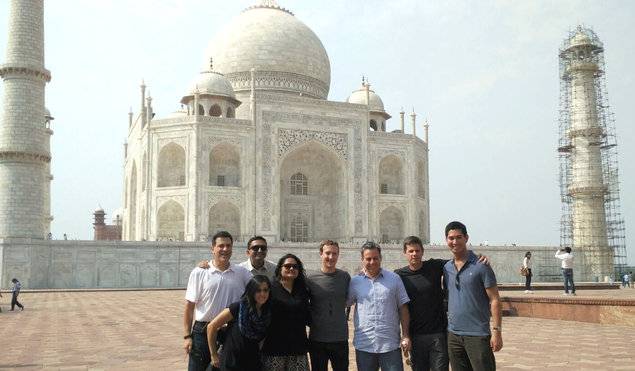
Facebook CEO Mark Zuckerberg visited Taj Mahal on Tuesday, along with group of seven people who were supposedly his colleagues.
At around 4:20pm (GMT + 5:30) Zuckerberg posted an image of him which was clicked by his colleagues while he was sitting on the east side of Taj Mahal watching the magnificent structure.
Confirming Zuckerberg’s visit to Taj, Image Public Relation Pvt Limited — which handles Facebook public relation in India — said, “Yes, CEO of Facebook did visited Taj Mahal on Tuesday.”
However, Ram Ratan, Archaeological Survey of India conservation assistant, Taj Mahal claimed, “We had no idea about his visit to Taj. It might be possible that he wanted to keep his visit low profile to avoid unnecessary attention.”
According to CISF official source, “Since nobody knew about Mark visit, he must had walk through long queue of security check like all ordinary tourist do.”
The tech entrepreneur will visit IIT Delhi tomorrow to interact with students and faculty at the Indian Institute of Technology in Delhi in a town hall.
Last month during PM Modi visit to US, Zuckerberg had shared an anecdote about his earlier visit to India and claimed that, “when things weren’t really going well — we had hit a tough patch and a lot of people wanted to buy Facebook — I went and I met with Steve Jobs and he said that to reconnect with what I believed was the mission of the company, I should go visit this temple in India that he had gone to early in the evolution of Apple, when he was thinking about what he wanted his vision of the future to be.”
source: http://www.timesofindia.indiatimes.com / The Times of India / Home> Tech / by Arvind Chauhan, TNN / October 27th, 2015
Illuminated by earthen lamps and torches (mashals), the idol of Ma Raj Rajeshwari looks resplendent in the Akbar-era Natmandir at the Krishnagar Maharaja’s palace.
The serenity is suddenly shattered by the town crier’s shrill call: “Attention! Agnihotri Bajpeyi Raj Rajendro Maharajadhiraj Nabadwipadhipati Mahashaya Krishno Chandro Roy Bahadur is arriving.”
On cue, 108 dhakis beat drums to frenzy.
The Maharaj arrives in an elaborately carved silver palanquin that was gifted to one of his forefathers by Emperor Jahangir. He approaches the pulpit. Shortly thereafter, the palace cannon booms, a signal for the beginning of sandhi puja. A hundred and eight buffaloes are assembled before the Goddess. At shandhikshan, the heads are severed and placed before the Goddess as offering to cleanse the human spirit of its evils. “As a child, I grew up watching these rituals being performed while sitting on my grandmother Maharani Jyotirmoyee Debi’s lap. Growing up, I always held a grudge against Ma Raj Rajeshwari. How could the divine mother, the supreme protector of good and the destroyer of evil, devour so many harmless, helpless lives? I would often bring this up with my father. Being a God-fearing man, he would stick to tradition till the resistance melted away when he saw my infant son Manish crying on witnessing the sacrifice.The practice was stopped in 1987,” said Saumish Chandra Roy , the 39th descendant of Nadia royal family .
Nadia Rajbari’s Durga Puja remains the oldest puja in what was then Anga-Banga-Kalinga or undivided eastern India region. Started in 1603 by Maharaj Rudra Rai, the great grandfather of Krishno Chandro, it has continued uninterrupted till date. “The puja began two years before the death of Emperor Akbar. Since it all happened at the height of the Mughal era, the influence is very strong in the architecture of the natmandir,” said Saumish’s son Manish. However, though the grandeur of celebrations have shrunk over the centuries, the rituals have remained intact.
Ma Raj Rajeshwari has seen Nadia during the most tumultuous of times. In medieval India, persecution and heinous tyranny on the grounds of religion was common.
Blood was spilt for the protection and defense of Nadia’s “honour”, for the protection of the freedom to choose and profess the religion of our choice.”Jato dharma Stato jayo” (Stay in the path of good dharma and victory will be yours) is embedded in the Krishna gar royal family’s coat of arms.
Ma Raj Rajeshwari’s power was tested during Partition. Nadia had initially been ceded to what was then East Pakistan on grounds of religion. “For three nightmarish days, we were Pakistanis. My father Saurish Chandra Roy , the last officially recognized maharaja, had told Sir Cyril Radcliffe (the chairman of the Boundary Commission in British India) that if Nabadwip was lost to Pakistan, then what would remain of the great Hindu faith in the Anga-Banga-Kalinga region?
After three days of rioting, rape and arson, a significant portion of Nadia was returned back to India. The entire population went wild with joy when the news was broadcast over All India Radio. People arrived in trucks from far and wide and assembled in front of the palace gates, shouting ecstatically “Ma Raj Rajeshwari’r Jai!”
Though the princely order was abolished by former Prime Minister Indira Gandhi, some royal customs are still followed. The Maharaj was believed to be the protector of his people.Accordingly a clay model of a “shatru”, symbolizing evil, is created which is slain by the Maharaj every year during the Durga Puja. Saumish does the slaying now.
source: http://www.timesofindia.indiatimes.com / The Times of India / News Home> City> Kolkata / by Subhro Niyogi, TNN / October 19th, 2015
The traditional Hyderabadi dastarkhwan has a new entrant: Laham Mandi.
From the exotic desert peninsula, the simple dish of rice and tender mutton has taken the city by storm. And nothing could explain the success that it has found as it enjoys a place alongside zafrani biryani, a delicacy Hyderabadis swear by.
But how did Laham Mandi make inroads into the Hyderabadi dastarkhwan that denizens are so fiercely protective of? Experts point out that it is the Hyderabadi diaspora, spread across Arabian countries, which has imported Mandi and its variants to the city.
“There was an import of culture as soon as Indians set foot in the Middle East. Though shawarma came to India before Laham Mandi, the latter became a huge hit with the youngsters. They want something different. The trend, particularly with wedding feasts is about two years old,” says Chef Taha Mohammed Quadri from Feast Express, a company that specialises in Arabian cuisine. “Now, bridegrooms are insisting that Mandi be on the dulhe ka dastar along with biryani,” he adds.
Ask Mohammed Abdul Rasheed, an engineer who recently tied the knot, why Mandi was on the menu and pat comes the reply, “All my friends love gorging on Mandi. Also, it is something different from the tried and tested affair.”
Traditional bawarchis say that the dish itself is simple to make. The meat is boiled in water till the time it is succulent and the rice is cooked separately. However, others, like seasoned chef Mir Asif Ali Khan from Arabian Nights argue that Laham Mandi is a madfoon dish, meaning that it is cooked in a cavity in the earth. He has lost count of the number of Hyderabadi weddings in which he has served Laham Mandi, he claims. While listing the traditional Hyderabadi fare on a dastarkhwan, he says, “The traditional dastarkhwan cannot go without lukhmi, qubani ka meetha, double ka meetha and of course, biryani. The introduction of Mandi is a fad.”
Khan explains that affordability and its large portions have led to its popularity. “The quantity of rice per person is huge, so much so that as many as three people can share it. Not just that, the average quantity of meat per portion is around 300 grams, for just Rs 240. What else would a youngster want,” he asks.
Others like Mohammed Moinuddin from Moghal Caterers says that for those who are not too keen on having Laham Mandi at weddings, the dish has found its place in pre-wedding parties. “Sanchak and Mehendi rituals are examples,” he says.
Experts say that restaurants in Toli Chowki like Four Seasons were one of the first to introduce the dish in the city about a decade ago. But, it was around three years ago that it started to gain popularity -courtesy the Arab tribals residing in Barkas, an Old City suburb. According to sources, of the 50-odd restaurants and cafes in the area, almost a third of them serve Mandi.
“The Yemeni tribes in Barkas used it to their advantage. They exploited their exotic lineage, made Mandi affordable and experimented with it by offering chicken and fish Mandi,” says Waseem Khan, a Mandi lover. The ambience in these restaurants is exotic, he adds. “You sit cross legged on the floor and people eat from the same large plate. Portraits of Arab rulers hang from the walls and there is calligraphy. All this adds to the exoticism,” he explains. Restaurants in Toli Chowki with Arabic names have mushroomed. Others like Spice 6 and All Seasons have made Laham Mandi a fine dining experience, he adds.
source: http://www.timesofindia.indiatimes.com / The Times of India / News Home> City> Hyderabad / TNN / September 28th, 2015
People usually hurry to reach Mina creating tremendous risk for themselves and others. It’s during this ritual that chaos is triggered.
I went for Haj pilgrimage with my wife in December-January 2006. During the journey, we noticed that the Gulf region was unstable owing to the trial of the deposed Iraqi dictator Saddam Hussein in Baghdad and emotions were running high among the Arabs. The political fever in the region also spread among Haj pilgrims. Emotions and arguments add to the atmospherics of Haj. One can imagine the energy and excitement of a pilgrimage in which millions of people from diverse linguistic, ethnic and racial backgrounds are united by religion.
Our delegation was special as we were being accompanied by former Chief Justice of India A.M. Ahmadi and other dignitaries from different parts of India. But from the beginning of the journey, I saw that arrangements on the ground were not quite right. The Saudi officials gave out instructions only in Arabic, though most of the pilgrims were unfamiliar with the language.
Countries that send the largest number of pilgrims are from South and Southeast Asia like Indonesia, Pakistan, Bangladesh, Afghanistan and India. People from this region speak many languages. Special attention is needed for the elderly, many of whom undertake foreign travel for the first time and, therefore, are quite disoriented and find it difficult to adjust to sudden orders yelled out in Arabic by policemen.
Also, the Saudi rules aim at segregation of men and women which creates a lot of problems for first-time travellers from our region. Often families which are separated by the Saudi police have to endure hardship, which is multiplied because neither the pilgrims nor the police can understand each other.
The process of Haj starts from Mina where one has to begin early after a prayer, followed by the circumambulation of the holy mosque Kaaba. The pilgrimage ends at Mina following the ritual of ‘Stoning the Shaitan.’ This last ritual at Mina needs to be completed before sunset and people usually hurry to reach Mina creating tremendous risk for themselves and others. It’s during this ritual that chaos is triggered.
On January 12, as we were returning to Mina for the last ritual of Haj, we saw the big stampede from a distance as waves of people collided. Dust and fear enveloped us. Our group stopped midway out of fear and went back to Mecca.
Next morning, we started early at 3 a.m. for the dash to Mina. On the way, we saw huge piles of shoes, clothes, and water bottles left behind by the stampede victims being loaded onto the trucks by the police. Officials informed us that around 350 people had died in the stampede and hundreds more were injured. The possessions of the pilgrims left behind made me suspicious of the official account.
The road to Mina which is where the stampedes often happen is very risky as it’s the only one for the journey to Mina and for returning to Mecca. I am told that the Saudi government has created an alternative route for the pilgrims returning to Mecca but that route is longer and many pilgrims continue to return by the old, shorter and narrow route which puts them at risk.
Year after year, stampedes have taken place on the same route near Mina, yet the Saudi authorities have failed to do anything to reduce the risk.
The occasion of Haj brings more than three million pilgrims to Mecca. A number of factors can trigger a crisis and a stampede on the ground where the crowd is united by religion and divided by political sentiments of the Arab countries. Sabotage is often suspected when such tragedies take place.
The Saudi government should also be open to learning from other countries where a large number of pilgrims congregate, for example in India’s Kumbh Melas and in the Vatican where authorities take care of the linguistic differences while managing people. There is no harm in learning from others.
Prof. Pasha teaches West Asian politics in JNU.
(As told to Kallol Bhattacherjee)
source: http://www.thehindu.com / The Hindu / Home> National / by Prof. A.K. Pasha / September 26th, 2015
Information Commissioner, Hafiz Usman stressed need of maintaining communal harmony and claimed that every human being in creation of God and all other classification on basis of caste, religion, rich or poor, strong or weak etc are man made.
Speaking at inauguration of Urs Festival at Syed Salar Sahu Gazi mazar in Bara Banki on Tuesday night, Usman, who was also chief guest said that every family had some one elder or younger but only when both lived jointly that family prosper otherwise inner conflict over who is bigger ruin them. Similarly irrespective of who is bigger or who is smaller, if every one live and cared for each other, only than the society would prosper. He said that the message of every saint is similar i.e to maintain brotherhood and communal harmony.
Usman said that even the constitution of India gave similar message i.e every citizen of the country had equal rights and there is no discrimination on basis of caste, religion, rich or poor etc. He called the members of his community to contribute their best in maintaining communal harmony and social fabric of this country.
source: http://www.dailypioneer.com / The Pioneer / Home> State edition> Lucknow / Pioneer News Service, Lucknow / Thursday – August 13th, 2015
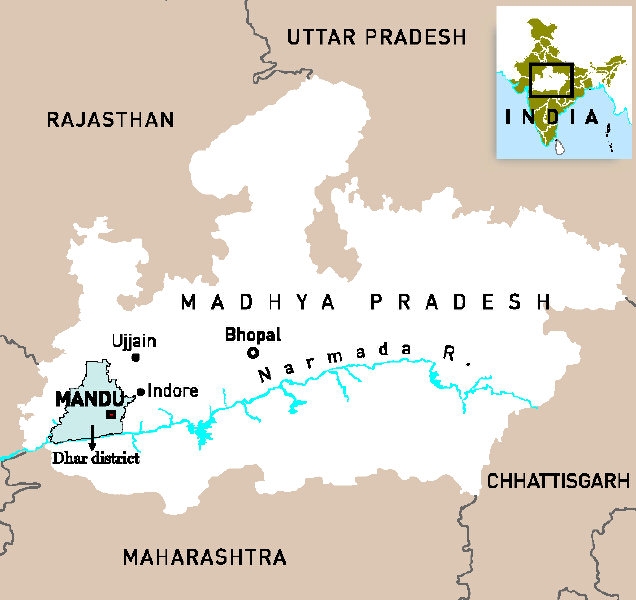
Mandu, the historical town in the Malwa region of Madhya Pradesh, resonates with memories of music and poetry, and its monuments display a vibrant fusion of Persian and Indian elements of architecture. Text & photographs by SHASHANK SHEKHAR SINHA
NESTLED in the volcanic plateau north of the Vindhyas in central India, Mandu has always been envied for its natural fortification. The town, located in Dhar district of Madhya Pradesh, about 100 kilometres from Indore, is separated from the main Malwa plateau by a deep ravine (Kokrah Koh) on three sides and drops on to the Nimar plain, around 1,200 feet below, on the south. This black-soil belt was once dotted with rain-fed lakes and dense forests filled with wildlife.
The hill fort has inscriptional evidence dating back to A.D. 555. However, Mandu’s glorious history began only when it became the seat of power of Hoshang Shah.
The province of Malwa, with the ancient city of Dhar as its capital, was conquered by the Delhi Sultanate in A.D. 1305 and was placed under a governor.
Dhar was the seat of the Hindu rulers Paramaras and Raja Bhoj. When the Sultanate started disintegrating, one of its governors, Dilawar Khan Ghuri, severed his allegiance to the Tughlaqs and declared independence in A.D. 1401-02. He laid the foundations of the independent kingdom of Malwa. His son Hoshang Shah shifted the capital to Mandu after ascending the throne and named it Shadiabad, or city of joy.
The fort city played an important role in some historic power struggles in Medieval India involving the Delhi Sultanate, the Bahmani Kingdom, the Mughal Empire and the Marathas besides the neighbouring regions of present-day Gujarat and Rajasthan.
It is ingrained in popular memory and folklore as the site of the famous romance between Baz Bahadur and Rani Rupmati and their musical and poetic achievements. What, however, makes Mandu distinct is the beautiful synthesis of Indo-Islamic architecture under the Muslim rule—a blend of Persian-Pathan elements with the Hindu traditions of Malwa.
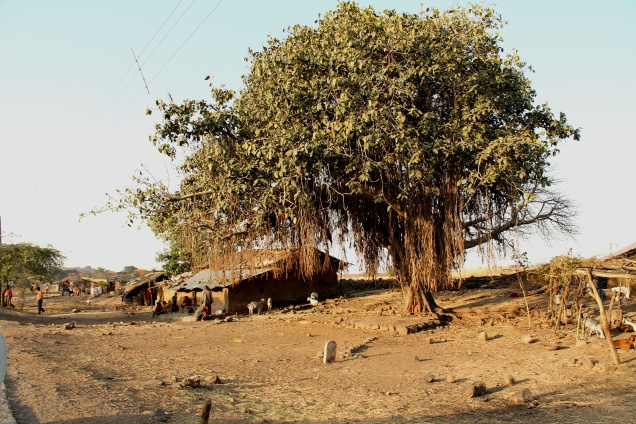
The architecture and the surrounding landscape are imparted a special character by the presence of huge trees such as the banyan, the round mango, the tamarind and the baobab (probably brought from Africa).
Mandu and its monuments come alive during the monsoon, on moonlit nights and in the evenings (thanks to the summer breeze locally called the shab-e-Malwa).
The village setting. The architecture and the surrounding landscape is imparted a special character by the presence of huge trees.
One of the best ways to understand the monuments of Mandu is to see them through the frame of evolution of the architecture in the region.
The rock-cut caves of Lohani and Sat Kothari are among the earliest and rarer types of architecture among the more than 60 structural monuments declared to be of national importance by the Archaeological Survey of India.
The architectural evolution of Mandu can be divided into three phases.
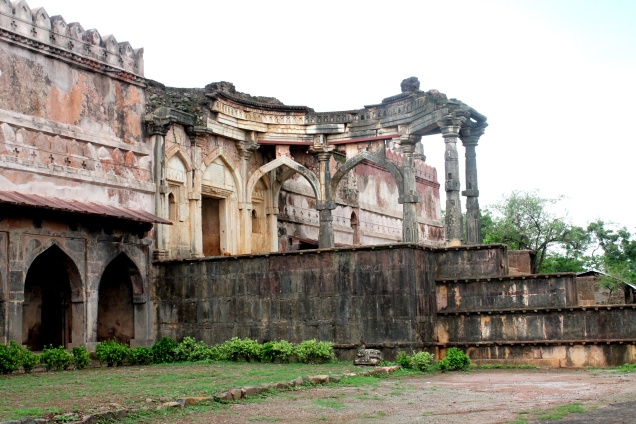
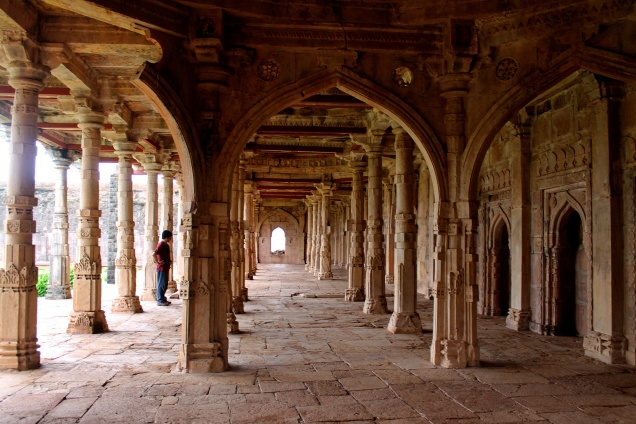
The first phase of development is underlined by the construction of mosques at Dhar and Mandu, mostly using material available from the ruins of Hindu temples. Examples include the Kamal Maula Masjid (A.D. 1395) and the Lat Masjid (A.D. 1405) at Dhar and the Dilawar Khan Masjid (A.D. 1405) and the mosques of Malik Mughis at Mandu.
The Malik Mughi mosque.
An inside view of the Malik Mughi mosque.
The second phase begins with the shifting of the capital from Dhar to Mandu.
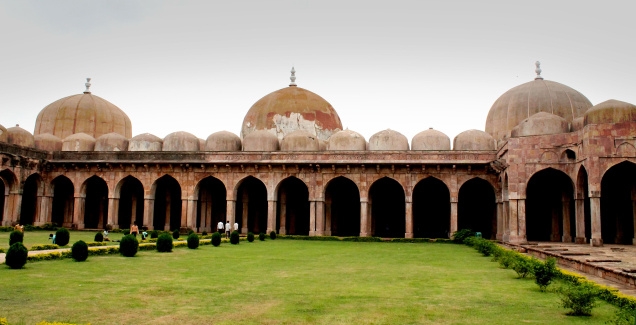
In this phase, the use of natural beauty as a backdrop in the composition of buildings became a significant component of the regional architecture. To this phase belong the Jami Masjid, Hoshang Shah’s mausoleum, the Ashrafi Mahal complex, and the Royal Enclave.
The Jami Masjid.
An inscription on the Jami Masjid mentions how Hoshang Shah constructed a mosque on the lines of the great Omayyad Mosque in Damascus, Syria.
The mosque’s basic plan consists of a liwan (a square courtyard) and the sanctuary. The three large domes and 158 cylindrical cupolas on the sanctuary make the red-stone mosque visible from a long distance. It is located on a high plinth (indented by a sarai) and is approached through a projected flight of steps on the east.
Inspiration for Taj Mahal
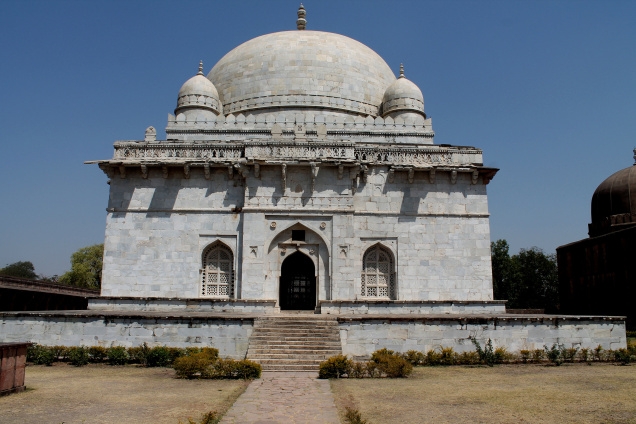
Hoshang Shah’s mausoleum is the first tomb in India made wholly of white marble.
An inscription at the entrance mentions that the Mughal emperor Shah Jahan sent four of his architects to Mandu to draw inspiration for the construction of the Taj Mahal at Agra. The mausoleum is a square structure standing on a broad plinth, surmounted by a central dome with a cupola at each corner. It is crowned with a crescent, thought to have been imported from Persia or Mesopotamia. The mausoleum’s wall is diversified first by stylobate, horizontal bands of masonry, eaves (with curved brackets), and a band of ornamental miniature arches carved in relief.
The tomb of Hoshang Shah, an inspiration for the Taj Mahal. It is the first tomb in India made wholly of white marble.
The Ashrafi Mahal (the Palace of Gold Coin) complex contains three buildings, mostly in ruins now: a madrassa, a tomb and the victory tower. The material used is red sandstone. The tower of victory, built to rival Chittorgarh’s Jaya Stambha, had seven storeys, of which only one is left now.
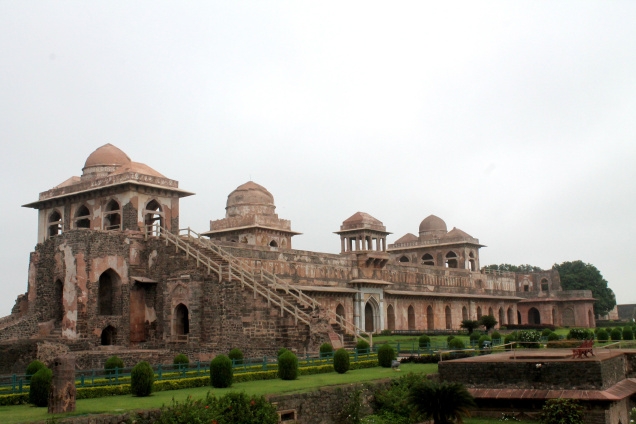
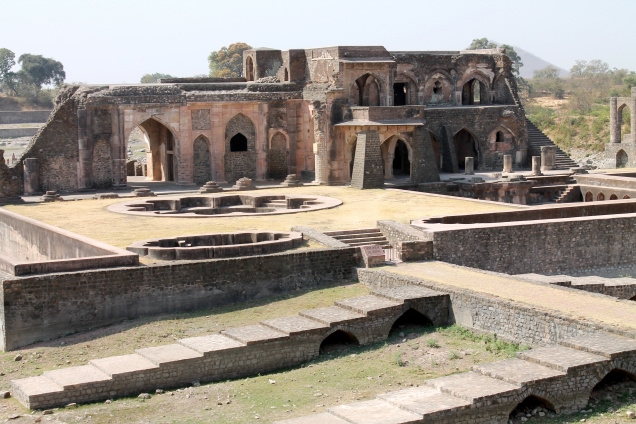
The Jahaz Mahal as seen from the Taveli Mahal.
Prominent among the Royal Enclave monuments are the Hindola Mahal and the Jahaz Mahal.
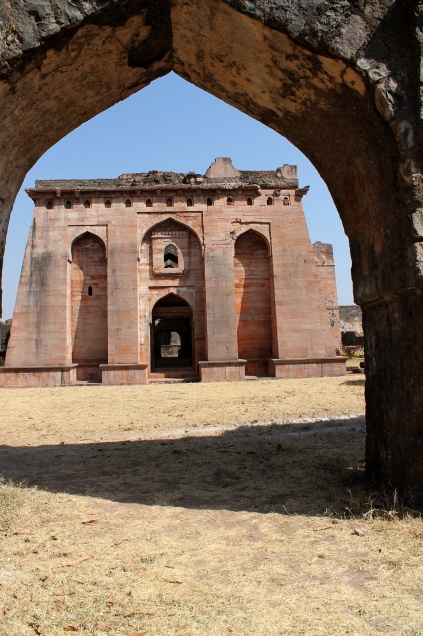
The Hindola Mahal is “T”-shaped with a main hall and a transverse double-storeyed projection. The side walls are strengthened with massive sloping buttresses, which have given the name Hindola, meaning swinging, to the building.
The Jahaz Mahal, on the other hand, is a long double-storeyed ship-shaped building constructed between two ponds—Kapur Talao and Munj Talao. Its interior arrangement consists of pillared compartments, cool corridors and luxurious bathing halls, while its exterior has an arcaded front. The roof has open pavilions and airy kiosks, with overhanging balconies. The earlier love of stone facing had given way to a softer, more pliable, plaster. The underlying idea was to give a sense of comfort and pleasure.
Ghiyas-ud-din, who graced this palace, is believed to have had a harem of 15,000 maidens. The enclave also houses two waterbodies, Champa and Ujala Baoli.
The Hindola Mahal seen through an arch in the Royal Enclave.
A more mature and refined phase developed towards the late 15th and early 16th century.
To this phase belong the palaces associated with Baz Bahadur and Rupmati, although they were not built by them.
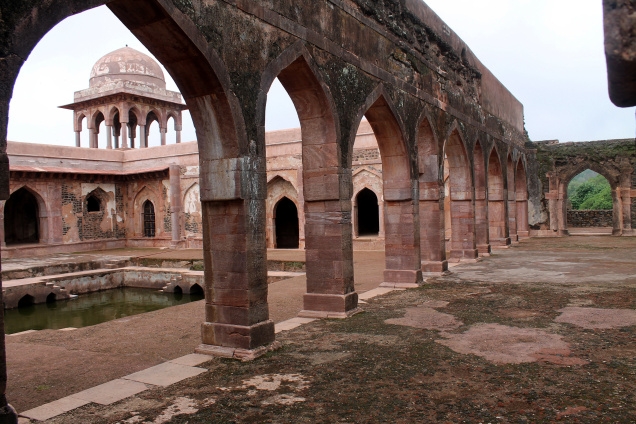
As the historian Percy Brown says, they come across as “summer houses, palaces, and pavilions, the ground floor of which consisted of a series of compartments grouped around a central courtyard graced with pools and fountains, while above were arcaded loggias roofed with fluted domes, the surface everywhere gorgeous with painted tiles”.
A view of the Baz Bahadur palace.
As royal patronage for music and fine arts increased, these buildings depicted the lighter, emotional and romantic side of the court life. The terraces and pavilions of these two palaces are known for the famous musical evenings of Malwa resonating with the romantic liaison between Baz Bahadur and Rupmati.
The queen, it is said, used to come to the palace every day to have a view of the Narmada river, which can be seen at a distance on the Nimar plain on a clear, sunny day.
Other buildings of this phase include the Nilkanth Palace, Chisti Khan’s Palace, Gada Shah’s Shop and Gada Shah’s House.
Besides these more-famous monuments, one also comes across a smaller group of monuments at the Sagar Talao and the Darya Khan complex.
The other interesting places to visit in the fort complex are the museums at the Taveli Mahal and the Chhappan Mahal. The former has a collection of artefacts, some sculptures belonging to the 11th and 12th centuries and stone slabs with Quranic text.
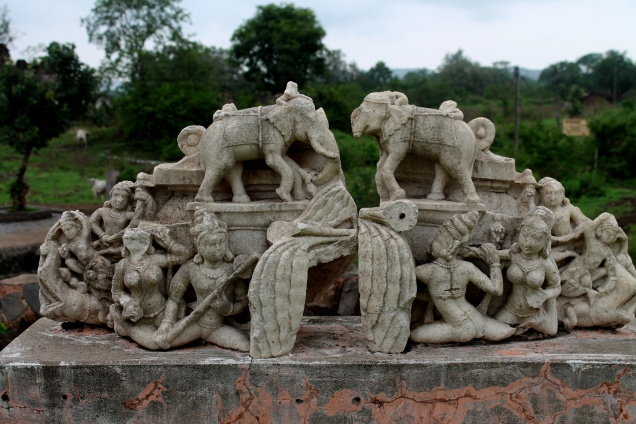
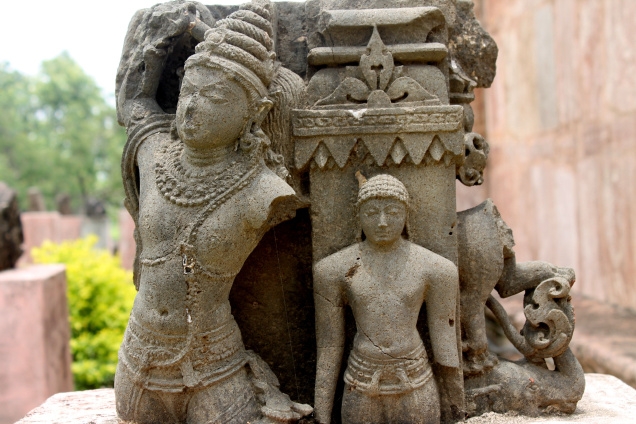
The Chhappan Mahal, a forgotten mausoleum constructed in the 16th century, has a reasonably good, though unorganised, collection of Hindu sculptures and statues of Jain Tirthankaras. There are also galleries documenting tribal cultures.
One of the sculptures at the Chappan Mahal.
Details of a statue in the Chappan Mahal.
Baz Bahadur’s reign also saw a decline in Malwa’s fortunes.
After offering a stiff resistance to the Mughals, he later joined Akbar’s service, and the region became a suba of the Mughal Empire.
The Marathas, under Peshwa Baji Rao I, took control of Malwa in 1732 and shifted the capital back to Dhar. Mandu thus became a ghost town. However, its cultural legacy still lives on.
The region was an active ground for mutually enriching interactions between Islamic and Indian cultural traditions and this could be seen in the development of arts, literature and painting.
The Jal Mahal.
Persian remained the court language of the sultans of Malwa and the region attracted many scholars and theologians. There was growth in historical writings, translations and Hadith literature, and the region became known as “an object of envy to Shiraz and Samarqand”. Sufism, particularly Chisti and Shattari silsilas, became popular in Malwa while Jainism also gained a foothold.
Hindi and Sanskrit were patronised by Mahmud Khalji I, Ghiyas Shah and Nasir Shah, and many transcriptions, commentaries, and treatises were written or compiled. Hindi gained enormous popularity under Baz Bahadur. He was intensely devoted to music and poetry.
Rupmati herself composed poetry in Hindi and left behind a tradition still common among the bards of Malwa.
The sultans also patronised paintings, as is evident in Mandu’s Kalpasutra and the illustrated cookbook Nimatnamah. The fusion of Persian and Indian elements led to a growth of a new style, which inspired painting traditions in Jaunpur and Mewar.
Shashank Shekhar Sinha has taught history at undergraduate colleges in the University of Delhi. He is now doing independent research on issues relating to culture and heritage.
source: http://www.frontline.in / Frontline / Home> Arts & Culture> Heritage / by Shashank Shekhar Sinha / print edition : September 18th, 2015
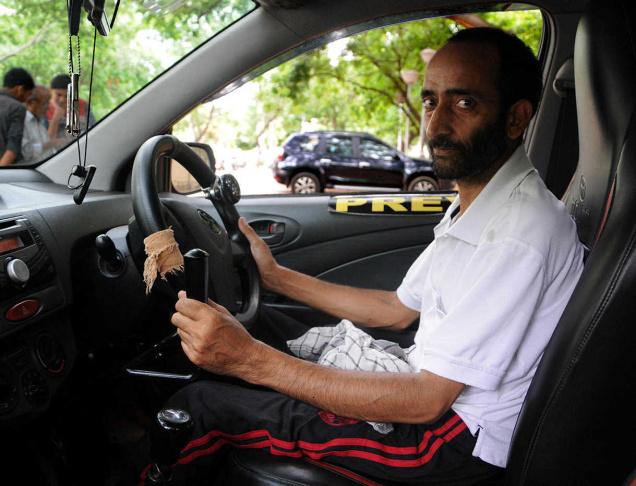
Crossing hurdles:Dildar Ahmed Shapo, who is on a mission from Kashmir to Kanyakumari to mobilise and inspire those on wheelchair, reached Chennai. —Photo: B. Jothi Ramalingam
From Kashmir to Kanyakumari, Dildar Ahmed Shapo’s journey is one of grit and mental strength
Every day, for the last 20 days or so, Dildar Ahmed Shapo has been waking up at midnight, getting dressed, having a cup of tea and a biscuit before getting into his modified car to drive 500 kilometres.
Since August 19, Mr. Shapo, a wheelchair user, has travelled to over 20 towns in 10 states to say: ‘being confined to a wheelchair does not mean it’s the end life of your life.’
“I was 18 when a freak accident put me on a wheelchair. For eight years, I waited to die,” says the 39-year-old from southern Kashmir, who was in Chennai on Sunday. He recalls: “Back then, there were no rehabilitation centres where I lived and it took me a long time to recover. It was even more painful as I was the breadwinner of the family at the time of the accident.”
Speaking to wheelchair users across the country in his travels, he says he has seen that even his own home was inaccessible, let alone public spaces. “Very few wheelchair users go to school as the space is not accessible and even fewer are financially independent. When it comes to marriage, I have seen women marrying men on wheelchairs but not the other way around,” he says.
During talks in schools and rehabilitation centres, he focuses on mental strength. “I encourage them to be tough and to focus on a destination, a goal. While looking out of a window, you do not see your wheelchair,” he elucidates.
Mr. Shapo’s aim is to bring wheelchair users and organisations that work with them together, across the country, and perhaps create a pan-India portal. He will be visiting Andhra Pradesh, Telangana, Odisha, West Bengal, the Northeast and other States before completing his trip.
While a majority of spinal injuries are caused by road accidents, there are also many caused by construction site accidents, sports injuries, surgeries gone wrong as well as congenital defects, points out S. Vaidyanathan, a volunteer at The Spinal Foundation, a self-help group for people with spinal cord injuries. On September 25, Mr. Shapo is hoping to reach Delhi, where ‘India Spinal Cord Injury Day’ is to be launched.
source: http://www.thehindu.com / The Hindu / Home> News> Cities> Chennai / by Zubeda Hamid / Chennai – September 14th, 2015
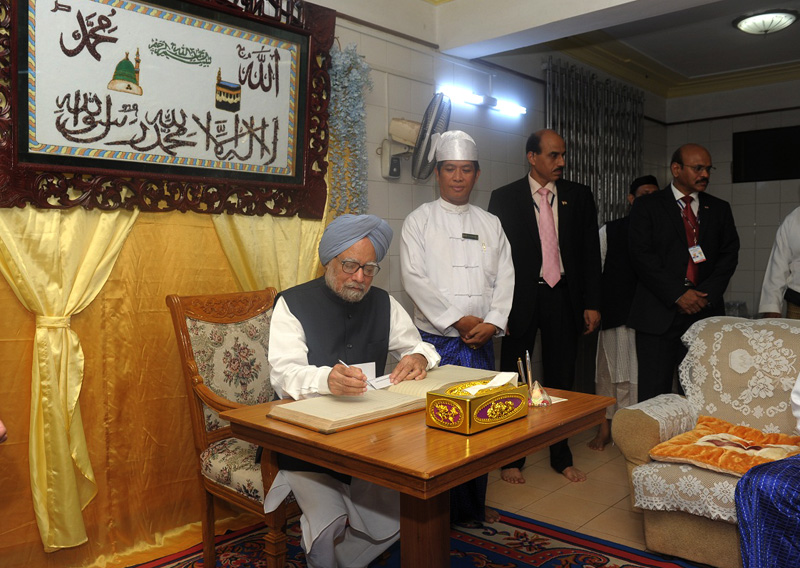
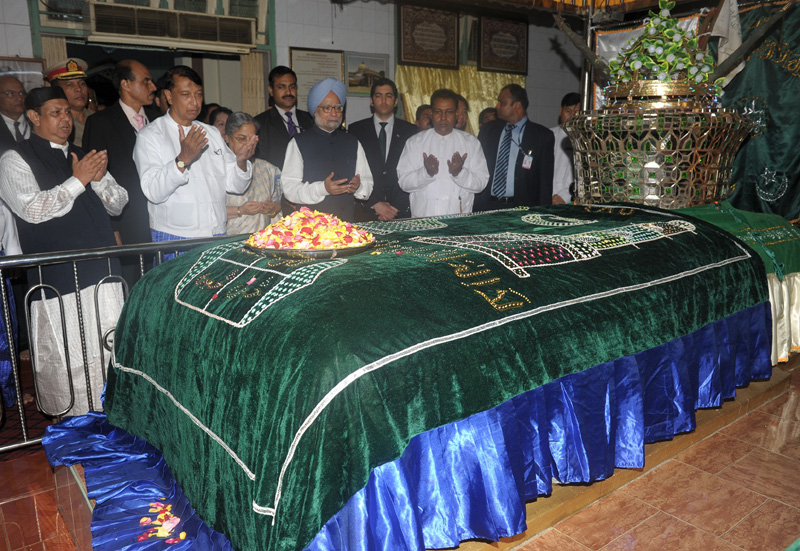
Prime Minister Dr. Manmohan Singh, during his recent visit to Myanmar (erstwhile Burma), offered floral tributes at the memorial of last Mughal emperor Bahadur Shah Zafar which lies at 6 Ziwaka Road in Dagon, Yangon. Prime Minister, accompanied by his wife Gursharan Kaur and External Affairs Minister S.M. Krishna, offered prayer at the graveyard/mazar of the former ruler, who died four years after he was exiled to Yangon following his defeat in the 1857 war of independence.
It has been a tradition for the dignitaries from India, Pakistan and Bangladesh to pay their visit to the graveyard of the Mughal emperor and pay their respect. It is said that Netaji Subhas Chandra Bose started his “Delhi Chalo” campaign in 1942 after paying his respect to the former emperor. Rajiv Gandhi during his official visit to Myanmar in Dec. 1987 paid his tribute to the grave. He wrote in the visitor’s book placed at the grave: “Although you (Bahadur Shah) do not have land in India, you have it here, your name is alive… I pay homage to the memory of the symbol and rallying point of India’s first war of independence….”
Bahadur Shah Zafar [Photo Courtesy: exoticindia.es]The Great Uprising of 1857
Bahadur Shah was 82 years old and in poor health when the revolting sepoys from Meerut stormed into the palace on 11 May 1857. According to William Dalrymple (The Last Mughal, 2006), sepoys and cavalrymen from Meerut numbering 300 rode into Delhi in the morning and massacred Christian men, women and children they could find in the city, and proclaimed Bahadur Shah as their leader and emperor. Bahadur Shah gave his blessing to the sepoys. A.G. Noorani (Indian Political Trails 1775-1947) writes, “Bahadur Shah was the one around whom both the communities rallied as a symbol of revolt and unity…In him have still been centered the hopes and aspirations of millions. They have looked upon him as the source of honour, and, more than this, he has proved the rallying point not only to Muhammadans, but to thousands of others with whom it was supposed no bond of fanatical union could possibly be established.”
The outbreak started in Meerut and Barrackpur from January to May 1857, and then spread to Lucknow, Allahabad, Ghaziabad, Delhi, Allahabad, Kanpur, Jhansi, Gwalior, Bareilley, Madras, Bombay, and several places in Punjab. Leaders like Nana Sahib, Tantia Tope, Bhakt Khan, Azimullah Khan, Rani Laxmi Bai, Begum Hazrat Mahal, Kunwar Singh, Maulvi Ahmadullah, Bahadur Khan, Rao Tula Ram and Raja Nahar Singh of Punjab led the local uprisings.
Within 4 months the uprising was crushed by the British with a strong hand. Poets and princes, mullahs and merchants, Sufis and scholars were hunted down and hanged. Palaces, mosques, shrines, gardens and houses of Mughal Delhi were destroyed. The properties of the Muslims were confiscated. All the leaders of the uprising were either killed or drove out of India.
Bahadur Shah surrendered on 21 Sept. 1857. The next day, Major William Hodson set out to Humayun Tomb to arrest his sons, Mirza Mughal and Mirza Khizr Sultan, and his grandson, Mirza Abu Bakr. Hodson took the princes to Sher Shah Suri’s outpost, then known as Kabuli Darwaza or Lal Darwaza. They were stripped naked and shot. Since the incident the outpost came to be known as Khooni Darwaza. Hodson paid the price for his misdeeds. A few months after the shoot-out, he was killed at Begum Kothi in Lucknow on 11 Mar. 1858.
With the arrest of Bahadur Shah the four centuries of Mughal rule in India came to an end and the Mughal emperor was made a prisoner. He was brought to the walled city and kept under house arrest. Sadly, the poet was not given even a pen to write while in captivity. He scribbled some of his last verses on the wall with a burnt stick.
The Prime Minister, Dr. Manmohan Singh signing the visitors book during his visit to the Mazar of Bahadur Shah Zafar, in Yangon, Myanmar on May 29, 2012.
Last Days of Bahadur Shah
Bahadur Shah’s trial began on 27 Jan. 1858 and ended on 9 Mar. 1858. The trial recommended the transportation of Bahadur Shah to Burma. In Oct 1858, Bahadur Shah accompanied, according to William Dalrymple, by his wife Zinat Mahal and 2 sons Mirza Jiwan Bhakt and Mirza Shah Abbas and daughter-in-law and wife of Jawan Bhakt, Shah Zamani Begum (generally referred to as Raunaq Zamani, the granddaughter of the emperor), who all chose to follow the emperor departed from Delhi for Calcutta, where they were placed on board a warship called Magara and taken to Rangoon.
In Burma British Commissioner Captain H. Nelson Davies received Bahadur Shah and his family. The family was then lodged in a quarter near the Shwe Dagon Pagoda under the supervision of Nelson Davies. The family was provided 4 rooms each of 16 ft. sq., one allotted for Bahadur Shah, another for Jawan Bhakt and his wife Zamani Begum, the rest for Zinat Mahal and Shah Abbas. Pen, ink and paper were completely forbidden. The family was provided 4 Indian attendants (a chaprasi, water carrier, washer-man and a sweeper).
Bahadur Shah died on Nov. 7, 1862 at the ripe old age of 87. Fearing another revolt the last rites of the emperor was performed without informing anyone. The janajah was performed by an old Moulana along with the two princes. After a week Nelson Davies informed about the death of the emperor to the higher officials in London. He wrote in his letter, “Have since visited the remaining State Prisoners- the scum of the reduced Asiatic harem; found all correct…The death of the ex-king may be said to have no effect on the Mohamedan part of the populace of Rangoon, except perhaps for a few final triumph of Islam. A bamboo fence surrounds the grave, and by the time the fence is worn out, the grass will again have properly covered the spot, and no vestige will remain to distinguish where the last of the Great Moghuls rests.” The news of the death of Bahadur Shah reached Delhi a fortnight later.
In one of his couplet Bahadur Shah had lamented on the irony of his fate thus:
Umr-e-daraaz maang ke laye the char din/Do aarzu mein kat gaye, do intezar mein
Hai kitna badnasseb Zafar dafn ke liye/Do gaz zameen bhi mil na saki koo-e-yaar mein.
Na kisii kii ankh ka nur na kisii ke dil ka qarar hun/Jo kisii ke kam na a sake main vo ek musht-e-Gubar hun
Na to main kisii ka habiib hun na to main kisii ka raqiib hun/Jo bigar gaya vo nasiib hun jo ujar gaya vo dayar hun
hamane duniyaa mein aake kyaa dekha/dekhaa jo kucch so Khvaab-saa dekhaa/hai to insaan Khaak kaa putlaa/lekin paanii ka bulbulaa dekhaa)
I had requested for a long life a life of four days/Two passed by in pining, and two in waiting/How unlucky is Zafar! For burial/Even two yards of land were not to be had, in the land (of the) beloved./My life gives no ray of light, I bring no solace to heart or eye/Out of dust to dust again, of no use to anyone am I/Barred the door of the fate for me, bereft of my dear ones am I/The spring of a flower garden ruined/Alas, my autumn wind am I/I came into the world and what did I see?/Whatever I saw was just like a dream/Man is moulded from clay but/I saw him as a bubble of water.
In 1867 the family of Bahadur Shah was allowed to leave the prison enclosure and to settle elsewhere in the Rangoon cantonment. The long confinement made Shah Zamani Begum, who was just around 15 years old, became seriously ill suffering from extreme depression. She started getting blind. To improve her condition she along with her husband was given another house not far from the Rangoon jail. By 1872 Shah Zamani Begum became completely blind. Mirza Shah Abbas married a girl from Rangoon, a daughter of a local Muslim merchant. His descendants still live in Rangoon today. Zinat Mahal lived on alone, comforting her loneliness with opium. She died in 1886. Her body was buried near her husband’s grave. Few years later Mirza Jawan Bakht died of stroke. He was 42.
The Prime Minister, Dr. Manmohan Singh and his wife Smt. Gursharan Kaur pray after offering chadar at the Mazar of Bahadur Shah Zafar, in Yangon, Myanmar on May 29, 2012.
A delegation of visitors from India visited Burma in 1903 to pay their respects at the burial place of Bahadur Shah. By then, due to long years of neglect, the exact location of the graves of Bahadur Shah and his wife became uncertain. In 1905 the Muslims of Rangoon protest demanding that the grave of Bahadur Shah should be marked. The British authorities agreed in 1907 and a railing was also erected around an supposed site of the grave, and the engraved stone slab, marked, “Bahadur Shah, the ex-king of Delhi died at Rangoon Nov. 7th 1862 and was buried near this spot” and “Zinath Mahal wife of Bahadur Shah who died on the 17th July 1886 is also buried near this stone,” was placed.
Surprisingly, in Feb. 1991 labourers while digging a drain at the back of the shrine uncovered the original brick-lined grave of Bahadur Shah. It was found 3 feet under the ground, and about 25 feet away from the earlier supposed graveyard of the emperor. This original graveyard has over the years become a popular place of pilgrimage for the Burmese Muslims. The local Muslims, who believed Bahadur Shah as a powerful saint, come to seek his spiritual blessing and favours. A prayer hall was also constructed in front of the graveyard with Indian assistance, which was inaugurated on 15 Dec. 1994. Today the graveyard is managed by a trust named Bahadur Shah Zafar Mausoleum Committee. Before the military takeover in Myanmar, the shrine was managed by a trust set up by the descendants of Bahadur Shah.
[Photo Courtesy: PIB]
source: http://www.twocircles.net / TwoCircles.net / Home / by Dr. Syed Ahmed for TwoCircles.net / May 31st, 2012
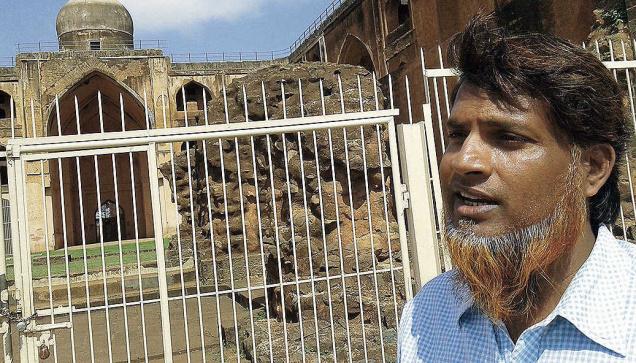
Religion is irrelevant to the study of these structures and heritage, says Abdul Aziz Rajput Bijapuri, a researcher from Vijayapura.— Photo: Gopichand T.
Abdul Aziz Rajput Bijapuri has travelled extensively in the Deccan and visited every Jain historical place ‘at least twice in the last 10 years’
It is not often that one comes across a book on Jain iconography written by a scholar of Islamic art. Abdul Aziz Rajput Bijapuri, a researcher from Vijayapura, has just completed the book on Jain icons and sculptures of the Deccan, with special reference to Vijayapura, Kalaburagi and Bidar.
He is planning another book on the monuments relating to the Jain period in Karnataka. In Bidar to study Sri Parshwanatha temple at Kamthana village, he spoke to The Hindu on how Jain iconography fascinated him.
“The Kamthana temple was built by the Rattarasa kings in the 10th century. It served as a gurukul or school for several hundred years. However, it fell into disuse till it was renovated in 1987,” Mr. Bijapuri explains.
He has travelled extensively in the Deccan and visited every Jain historical place “at least twice in the last 10 years”. He has compiled history, architecture and present condition of the monuments, along with the statues, art plates and stucco and other craft in the buildings.
He has also documented Hindu temples in the Deccan and written treatises about their art and architecture. He has written 12 books, on monuments and religious places of Hinduism, Islam and Jainism.
“Religion is irrelevant to the study of these structures and heritage,” he said. He recalled how scholar late M.M. Kalburgi praised him during a seminar in Dharwad for focusing on his area of research, without bothering about criticism from some quarters about his religious affiliation. “Kalburgi had told me we need more people who study the heritage of religions other than their own,” he recalled.
Mr. Bijapuri has translated books between Arabic, Persian, Urdu, English, Kannada, Marathi and Hindi. He has also set up an NGO, Deccan Studies and Historical Research, that organises seminars, heritage walks and publishes books and brochures in Vijayapura.
source: http://www.thehindu.com / The Hindu / Home> National> Karnataka / by Rishikesh Bahadur Desai / Bidar – September 13th, 2015
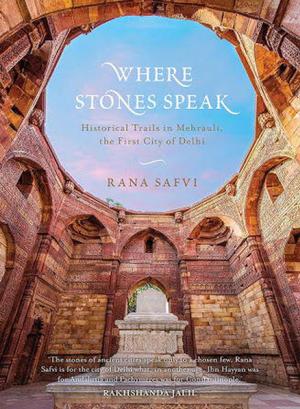
Historian and writer Rana Safvi’s blog, ‘Hazrat-e-Dilli’, is a little corner of the Internet dedicated entirely to the Capital — its new and old architecture, the dizzying variety of food, age-old traditions and much more. Her new book, “Where Stones Speak”, is another tribute to Delhi, and arguably its first city, Mehrauli. Safvi traces Mehrauli’s history through simple words and haunting couplets, takes us through its diverse monuments and weaves facts with storytelling in a way that paints a picture achingly beautiful in its richness and depth.
Excerpts from an interview:
What brought about the idea?
Delhi for us was just a transit point for changing trains to Lucknow or Nainital. Except for a visit to Red Fort and Qutub Minar with a university group I had never visited any of its beautiful monuments. It is only in the past few years when my daughter shifted here that I spent time in Delhi. I started going out for heritage walks with various groups. It was during these that I realised though there was a lot of material it was scattered and quite a lot of it was in Urdu so inaccessible to many. I wanted to write a book on the lines of Hearn’s “Seven Cities of Delhi” but when I reached Mehrauli the first city I realised that it had enough treasures to form a full book on its own. This book happened – I had set out to write something else. I feel it was blessed and willed by Mehrauli’s guardian saint Qutub Sahab.
It’s an ambitious book, one that would require you to go through reams of material. What kind of initial research did you do?
The first thing I did was to shift from Dubai to Delhi NCR as I accessed books for research. I did not want to rely on online resources only. I went through bibliographies of ASI (Archaeological Survey of India) and books written on Delhi. I went to the Urdu Bazaar. Then I bought the books. I feel I became Flipkart’s biggest customer, with books pouring in every week. I have built quite a library now and it’s ongoing. ASI itself has many books on Delhi especially on the Qutub Complex which I went through. Their library and photo section are treasure houses and I got a lot of help from them. There are many Urdu books available. A 1919 book by Bashiruddin Ahmed called ‘Waqi’at-Dar-ul-Hukumat Dehli’ is full of stories and anecdotes.
How difficult was it to find preserved records and materials for the book?
ASI publications are the best source for records and materials. Records of excavations and research done from the time of Sir Alexander Cunningham in Delhi in the latter part of 19th Century are all available with them. Carr Stephen’s 1876 book “Archaeology and Monumental Remains of Delhi” was also invaluable. Many British officers of ASI have written books on Delhi in late 19th and early 20th Century. Maulvi Zafar Hasan’s book, ‘Monuments of Delhi’, published in 1916 for the ASI details all the monuments of Delhi. Many of these are lost to us now. For contemporary history I relied on ‘The History of India, as told by Its Own Historians’ Henry Miers Elliot and John Dowson. Some of the books are now out of print or badly reprinted. I got these from the U.S. where there were second hand sellers.
Delhi’s history is a curious mix of facts and folklore. What kind of balance were you looking to provide in this book?
I have taught history in middle and senior school for many years. I know how bored people get if we just keep presenting fact after fact. I tried to use the same technique I used for my students: tell the story as accurately as I could and make it interesting. I have used anecdotes I found in my reference books as well as a few recounted to me. Wherever they are unsubstantiated by records I have mentioned that too. I have tried to enliven it by using Urdu verses which describe the stunning photographs taken by Syed Mohammad Qasim better than I ever could with my prose. It also embellishes the prose and breaks the monotony of facts. This is a style not used by any other English book on history (at least I haven’t come across it). It has been used in Urdu books though not to this extent.
What is the legacy of this past, and how you think it defines contemporary Delhi and its people?
In 1947, when India was partitioned, many of the old inhabitants of Mehrauli and Shahjahanabad left for Pakistan. The refugees who came here were shell-shocked by the trauma of being torn away from their native lands and having to start anew. For them it was survival that mattered the most. These old buildings held no meaning for them. There was a lot of encroachment those days. Those who didn’t migrate had different problems to cope with. Thankfully, the interest in heritage and our cultural legacy has once again been awakened. The younger generation is identifying with it and showing interest in preserving it. This can be seen in the wealth of books and programmes on our historical and cultural legacy.
Delhi is a juxtaposition of age old monuments and modern architecture. Do you think even by themselves these structures carry an impact?
For me every stone has a story to tell. It is up to us to tell those stories in such a way that these monuments speak to everyone. This can’t be done only through dry facts. It’s only when factual stories are associated with it that people will remember and talk of them fondly. For instance the feedback I get is that Sultan Razia’s story has made them look at Quwwatul ul Islam Mosque with new perspective. It is no longer a pile of stones but a place where a great historical event took place. Structures carry impact when we associate something which we found interesting with it. I don’t know how far I have succeeded but that has been my attempt.
source: http://www.m.thehindu.com / The Hindu / Home> MetroPlus / by Swati Daftuar / September 12th, 2015
![Bahadur Shah Zafar [Photo Courtesy: exoticindia.es]](http://www.mpositive.in/wp-content/uploads/2015/09/Zafar01MPOs14sept2015.jpg)