Category Archives: Travel & Tourism

Les Clefs d’Or India Concierge holds its 9th AGM in Kolkata

LeClefKOLKATA31aug2015

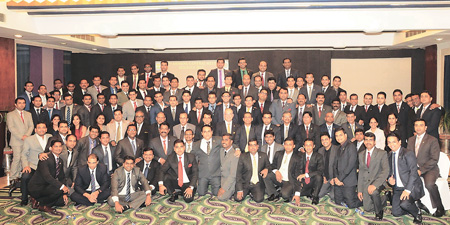
Les Clefs d’Or India Concierge recently held its ninth Annual General Meeting (AGM) in Kolkata recently.

The AGM was inaugurated by Zaid Farooqi, resident manager, Taj Bengal, Kolkata; James Ridenour chief concierge, InterContinental, Sydney and general secretary, Les Clefs d’Or International; Stephen Fernandes, past president, Les Clefs d’Or India; and Edwin Saldanha, president, Les Clefs d’Or India and Asian zone director, Les Clefs d’Or International.

Regional presentations were made by Rajesh Kumar Yadav from northern region, Sachin Singh and Apeksha Boricha from western region, David Aaron from eastern region, and Sri Kishen from southern region.

The treasurer and PRO reports were shared by Arun Baidya and Shaunak Vengurlekar respectively, and a speech on current trends was given by George Kuruvilla, general manager, The Oberoi Grand, Kolkata.

A brand presentation on social media was conducted by James Ridenour who urged for maximum participation in the communications committee.

The new executive committee for the period 2015-2017 was also announced during the AGM.

The AGM continued with the opening of networking eve by Samrat Dutta, general manager, Taj Bengal Kolkata.

During the pinning ceremony 32 new members received adherent membership to Les Clefs d’Or India and 36 adherent members were upgraded to full membership status.

The UICH Honorary Member was awarded to Biswajit Chakraborty, general manager, Sofitel BKC, Mumbai for his contribution and support extended to the concierge society in India.

This was followed by the Concierge of the Year 2015 award which was given to Debayan Ghosh from Shangri-La, Bengaluru.

source: http://www.financialexpress.com / Home> Food & Hospitality World / by FWH Staff – Mumbai / August 18th, 2015

Ahead of annual Urs, dargah gets new facilities

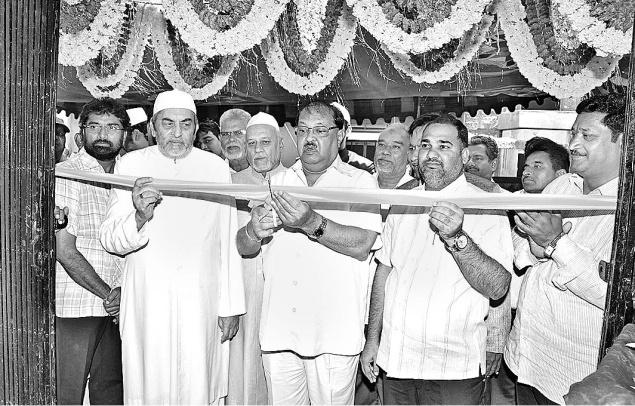
Municipal Administration Minister Qamarul Islam inaugurating the newly constructed toilet and bathroom block at the Khaja Banda Nawaz Dargahin Kalaburagi on Tuesday.— PHOTO: ARUN KULKARNI

New toilets, bathrooms will be open 24 hours for pilgrims visiting the shrine

The famous Khaja Banda Nawaz Dargah, frequented by thousands of pilgrims every day, now has a modern multi-purpose block consisting of kitchen-cum-dining hall with store room, exclusive toilets and bathrooms for the pilgrims visiting the dargah.

Up until now, the dargah had limited toilets and bathrooms which remained always overcrowded due to the heavy flow of pilgrims. At the time of the annual Urs, the situation used to become very difficult.

The new block constructed at a cost of Rs. 2.25 crore is entirely funded by the Karnataka Urban Infrastructure Development Finance Corporation-North Karnataka Urban Sector Investment Programme (KUIFDFC-NKUSIP) with the Asian Development Bank (ADB).

The multipurpose block has 125 toilets and 39 bathrooms, with exclusive bathroom and toilets for the physically challenged persons.

The kitchen facility has six cubicles, a tone room and a slaughter room also. The entire block is constructed on 1,098 square meters and this would be maintained by Sulab International. Inaugurating the new facility on the dargah premises, Municipal Administration and Minority Affairs Minister Qamarul Islam said that the long felt need of the pilgrims has been fulfilled.

Another toilet block constructed at a cost of Rs. 40 lakh has been completed and handed over to the authorities, he said.

Mr. Qamarul said that the multipurpose block would be available for the use of the general public and the pilgrims visiting the dargah for 24 hours.

The annual urs of the Khaja Banda Nawaz Dargah is scheduled to begin on August 30.

Sajjada Nasheen of the Khaja Banda Nawaz Darga Dr. Syed Shah Khusroo Hussaini, in his brief address, thanked the State government and the former Union Minister M. Mallikarjun Kharge for sanctioning the multipurpose block to the dargah.

source: http://www.thehindu.com / The Hindu / Home> National /by T.V. Sivanandan / Kalaburagi – August 26th, 2015

Shaikh Al Shareef, who belongs to family of Prophet, visits AMU

ShaikhAlSharifMPOs24aug2015

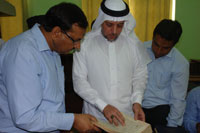
Shaikh Al Shareef Mustafa Fouad Shafaee, who belongs to the family of the Prophet of Islam, Hazrat Mohammad Mustafa (Peace Be Upon Him) recently, visited Aligarh Muslim University’s Maulana Azad Library to see the collection of rare manuscripts and books.

During his visit, he expressed happiness over the availability of the rare documents relating to the pre 18th century particularly on the history of Islam and the cities of Makkah and of Medina.

The visitor’s family has been holding the key of the Tomb of the Prophet (Peace Be Upon Him) for the last 14 centuries.

Shaikh Al Shareef belongs to the 41st generation of the Prophet and he has arrived in India to see the culture of the country. He had mentioned that he was interested to visit AMU and the Taj Mahal in Agra.

The AMU Librarian, Dr Amjad Ali accompanied Shaikh Al Shareef to the Manuscripts Division where he spent an hour consulting the documents relating to the geography, geology and history of Arab specially the cities of Makkah and Madina.

Shaikh Al Shareef had a look on Futuhat-e-Makkiah of Ibne Arabi and expressed joy over the method of scanning and preservation of the Islamic heritage. He added that he has visited libraries of some Islamic countries including Egypt and Turkey but could not see such a well-maintained rich collection, displayed for the visitors.

While praying for peace and prosperity of India, Shaikh Al Shareef added that this is the land where Hazarat Adam descended from Heaven and from where the human race spread all over the world. During his visit to the Manuscripts Division, the Shaikh added “I love India” and promised the Librarian, Dr. Amjad Ali to visit the Library again for a longer time.

Photo from AMU official

source: http://www.okhlatimes.com / Okhla Times / Home> Despatches / by OTNS – AMU / OT – August 23rd, 2015

Ambur and the art of biryani

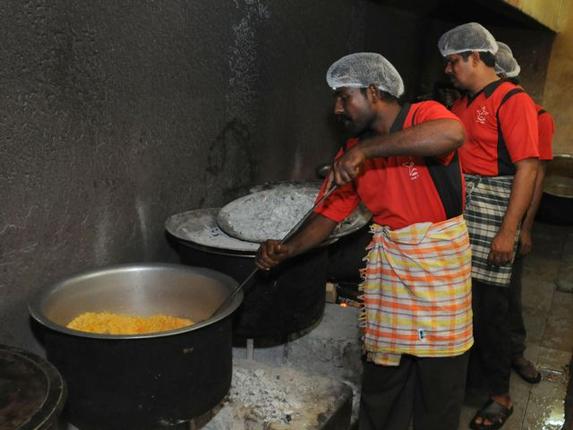
In the kitchen of Star Briyani, Ambur. Photo: R. Ragu / The HIndu

The writer spends a day tasting the town’s staple dish to find out what makes it so appealing.

There was once a man who loved biryani so much that he braved the rain to eat it under the leaky roof of an eatery. Another ate it for lunch every single day for 15 years. He continued the ritual even after he became old and toothless, except that he had it plain, without the meat. Stories of such biryani fanatics are common in Ambur, a town some 180km from Chennai. Here, people eat biryani for breakfast.

What’s so special about Ambur’s biriyani?

We walk into Star Briyani, one of the town’s well-known and oldest establishments to find out. It’s 11 a.m. and customers are already walking out after a meal. Brothers Muneer Ahmed and Anees Ahmed run the business now, that has branches across Ambur, Bangalore, and Chennai.

Brothers Anees and Muneer of Star Briyani Photo: R. Ragu / The Hindu

It all started with Hasin Baig, their great-grandfather, who is said to have cooked in the kitchens of the Arcot Nawabs. He brought what was once the food of the royals to the common man by opening a restaurant in his hometown, Ambur. Hasin’s son Khursheed then took over the business, which was then taken over by his son Nazeer Ahmed. In all, the family nurtures a 110-year-old biryani heritage. “At Khursheed Hotel that thatha ran in the 1900s, biryani was ready as early as 7 a.m.,” says Anees, who manages the Chennai wing of restaurants.

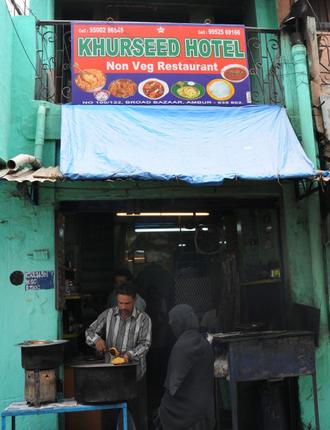
A view of Khurseed Hotel at Ambur. Photo: R. Ragu / The Hindu

He recalls how his ancestors used a short and thin rice variety called ‘surdas’ and country chicken. “We’ve replaced the rice with its closest match — seeraga samba, which we source from West Bengal,” he explains. Ambur purists will scoff at any other rice variety, even if it’s the slender basmati.

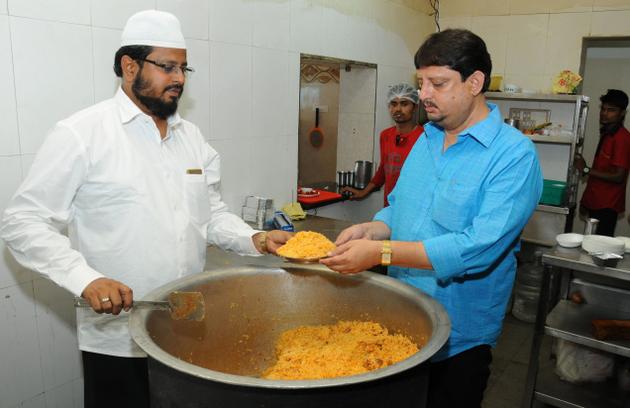
At the kitchen of Star’s branch that’s located on the Chennai-Bangalore highway, biryani masters Krishnan and Irfan are preparing mutton biryani. Cooked in gigantic containers over wood-fired stoves, the crucial aspect behind the biryani’s consistency is the ‘dum’ — a procedure where it’s removed from fire and covered with a lid over which hot coals are placed. The recipe consists of the usual ingredients that goes into biryani — onions, tomatoes, spices such as cardamom, cloves, and cinnamon, ginger and garlic paste (ground separately to incorporate each ingredient’s flavour), red chilli paste, salt, rice (par boiled) and meat.

As an over-powering aroma engulfs us, a mild whiff of sambar comes our way. “Oh, that’s our lunch,” Irfan informs us.

Khursheed is still present inside the main bazaar of the town, where it was originally started, and is now taken care of by Anees’ cousins. In a narrow lane where tring-tringing tricycles, autos, scooters, load men lugging heavy sacks on their shoulders and pedestrians jostle for space, the clang of the steelkarandi against the soot-smeared container, announces the birth of a fresh batch of biryani to the neighbourhood.

We follow the sound into Khursheed, a hole-in-the-wall eatery that can house not more than eight at a time. The biryani here is priced at Rs. 45 and is made of basmati rice unlike a typical Ambur biryani. This is probably to cut cost — the outlet mostly caters to the hard-working labourer who cannot afford the more expensive varieties. Ambur has plenty of such restaurants that serve biryani for less than Rs. 100.

Anees recalls how his grandfather’s friendly demeanour was responsible for him securing a loyal customer-base. “He would stand at the entrance and greet people he knew with ‘enna machan, rumba naala kanom?’ (long time no see?) and they would instantly step in for a plate.”

At Star’s bazaar outlet, a plate of mutton biryani costs Rs. 150. It’s peak hour at lunch time and biryani is getting sold out fresh off the wood-fired stove. The atmosphere here is rather informal — many of the diners are regulars who nod at each other as they polish off a greasy dish of pepper chicken. Back in the kitchen, Faizal is ladling a gigantic container of brinjal curry on the stove, while Kalim, the chicken 65 expert, is carrying a fresh batch of the dish that gleams like rubies, to the serving counter.

Then, our first plate of Ambur biryani is served — orangish-pink in colour, the rice is mildly spiced, the meat, a tad spicier and cooked to perfection. M. Rahman, a 75-year-old ex-councillor, a regular, sits with us to eat. “So, what…” we begin when he cuts us short. “Don’t ever talk when eating biryani. It distracts you.”

Just then, Anees’ father Nazeer comes into the restaurant, assisted to his seat by his son. Over 70 years old, he recently suffered a stroke. Although he has lost his speech, the man insists that he sit at the counter for at least two hours every day, amidst the steam of the biryani he dearly loves. It occurs to us then, the reason behind the success of Ambur biryani. True, it tastes good; but what makes it special are the people of the town. Their passion for biryani — that’s the secret ingredient.

source: http://www.thehindu.com / The Hindu / Home> Features> MetroPlus> Society / by Akila Kannadasa / Chennai – August 20th, 2015

States’ Monumental Revenue Rise as Taj Mahal Stays on Top

New Delhi  :

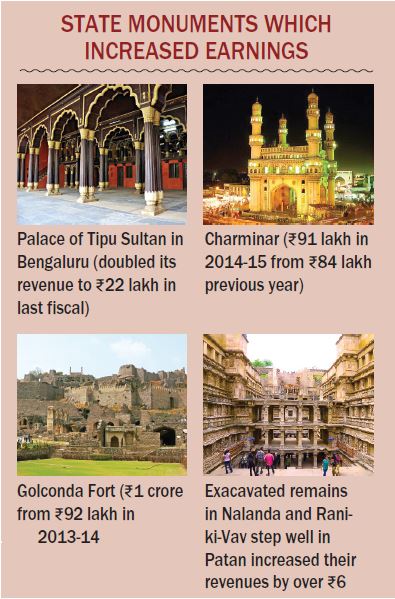
The alluring romance of famous monuments seems to be getting a little jaded with lesser-known ones tucked away in mofussil India garnering increased interest by domestic and foreign tourists. While the iconic Taj Mahal continues to maintain its top position in earnings through entry fees, smaller monuments in states witnessed a spike in revenue. The  Palace of Tipu Sultan in Bengaluru almost doubled its revenue with Rs 22 lakhs last fiscal.

StateMonumentsMPOs23aug2015

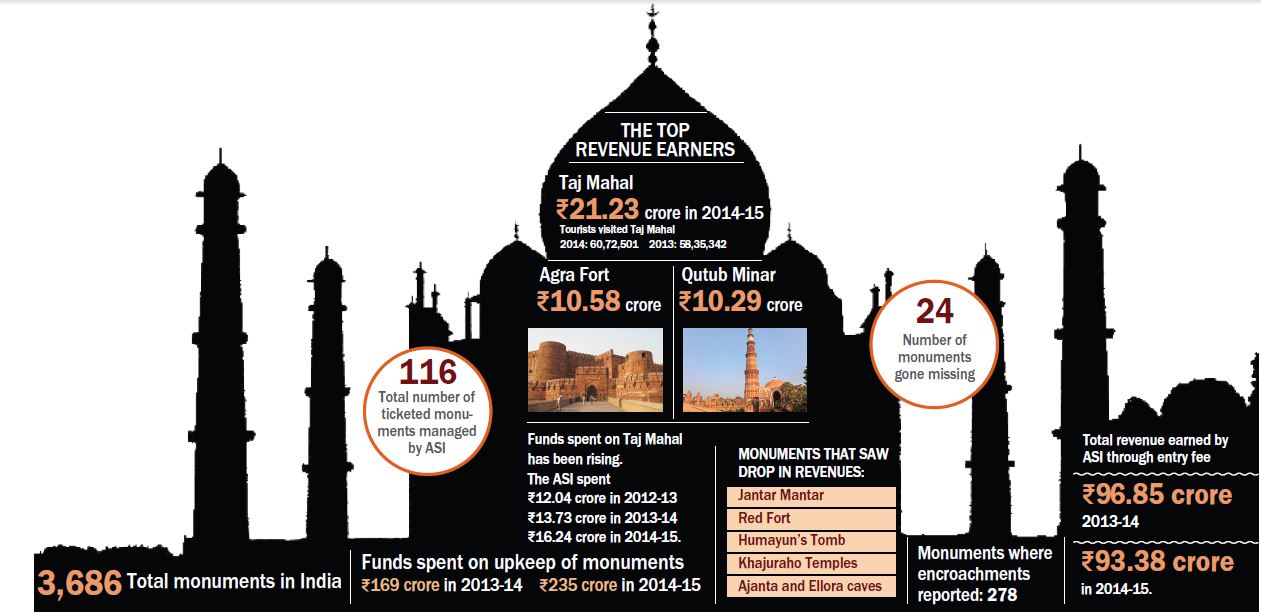
Last year, the Taj Mahal lost nearly Rs 60 lakh in revenues earned through entry tickets. In the 2014-15 fiscal, the ‘monument of love’ earned Rs 21.78 crore, while in 2012-13, its revenue was Rs 24.58 crore and Rs 22.40 crore in 2013-14.

Lesser known monuments such as, the Charminar in Hyderabad and Golconda Fort saw a surge in revenues this year; Rs 91 lakh in 2014-15 over Rs 84 lakh in 2013-14, and Rs 1 crore, up from Rs 92 lakh in the previous fiscal respectively.

Taj Mahal apart, some other big attractions showed a downward revenue trend. Revenues from UNESCO monument Red Fort dropped by Rs 10 lakh to earn Rs 5.9 crore, while the newly restored Humayun Tomb earned nearly Rs 70 lakh during 2014-15.

In Delhi, Jantar Mantar made Rs 23 lakh in the last fiscal, a drop of Rs 5 lakh. The Khajuraho Temples lost Rs 20 lakh to earn Rs 2 crore in 2014-15 and Ajanta and Ellora also saw a drop of Rs 2 lakh each.

According to the latest Ministry of Culture figures, many of the 116 ticketed monuments under the jurisdiction of the Archaeological Survey of India (ASI) were helping fill government coffers. In 2013-14, the ASI earned Rs 96.85 crore from monuments, which dropped to Rs 93.38 crore in 2014-15. Ironically, the money does not to go to the cash-starved ASI’s kitty but to the national treasury. Its battle to get the money for conservation of monuments has come to naught.

LowestEarnersMPOs23aug2015

The excavated remains in Nalanda in Bihar and Rani-ki-Vav (queen’s step well) in Patan, Gujarat, increased their revenues by over Rs 6 lakh each. Rani-ki-Vav was given a Unesco World Heritage Site status this year.

Other monuments that showed increase in revenues, though marginally, include the Rock-cut Hindu Temple at Undavalli and Buddhist Monuments at Guntuplli, both in Andhra Pradesh; Ahom Raja’s Palace at Sibsagar and Ranghar Pavilion at Bisnhudol, both in Assam;  ruins of Vikramshila, that was established by King Dharmapala (783 to 820) after a supposed decline in the quality of scholarship at Nalanda, and Sher Shah Suri’s Tomb in Bihar. On the other hand, the famed remains of Pataliputra in Patna showed a downward trend in ticket earnings.

The other significant monuments with increased entry tickets earnings are Sheikh Chilli (Haryana), Kangra Fort (Himachal Pradesh), Badami Caves and Gol Gumbaz in Karnataka, and Mandu monuments and Sanchi (Madhya Pradesh).

In Maharashtra, Ajanta and Ellora’s losses in revenue were gains for Aurangabad, Elephanta , Karla and Buddhist Kanheri Caves. In Delhi, Purana Qila, (which dates back to the days of the Mahabharata), Safdarjung Tomb and Tughlaqabad earned more this year while earnings from Red Fort and Humayun’s Tomb dipped. In Tamil Nadu, except for the Rock Cut Jain Temple in Sittannavassal, ticketed monuments like forts in Gingee and Dindigul had lesser earnings in 2014-15.

Interestingly, the Taj Mahal, Agra Fort and Qutub Minar collectively contributed over 45 per cent of the revenues through entry fee for ASI-run monuments The 17-century marble tomb with its intricate inlay work built by Mughal emperor Shah Jahan has been earning over Rs 20 crore every year through entry fees. Its revenue collections saw a drop in the last three years even though footfalls have been increasing. In 2012-13, Taj Mahal earned Rs 24.58 crore, Rs 22.40 crore in 2013-14 and Rs 21.78 crore in 2014-15.

“There has been no decrease in the number of total tourist footfalls in the past two years. In 2014, 60,72,501 domestic and foreign tourists visited Taj Mahal, against 58,35,342 in 2013,” culture minister Mahesh Sharma said.

Ironically, it isn’t just the Taj Mahal whose revenues have dropped. Revenue from the Khajuraho temples fell by Rs 20 lakh to Rs 2 crore in 2014-15, and Ajanta and Ellora also saw a drop of Rs 2 lakh each.

Indians and those from SAARC and BIMSTEC countries pay between Rs 5-10 while foreigners have to pony up between Rs 100 to Rs 500, depending on the monument.

On the other hand, funds spent on the upkeep of the Taj has been rising. The ASI spent Rs 12.04 crore in 2012-13, Rs 13.73 crore next year and Rs 16.24 crore in 2014-15.  Agra Fort, built by the Mughals in neighbourhood of the Taj earned Rs 10.58 crore in the last fiscal, while Qutub Minar grossed Rs 10.29 crore through ticket sales, a marginal increase over the previous year.

TajChartMPOs23aug2015

source: http://www.newindianexpress.com / The New Indian Express / The Sunday Standard / by Pratul Sharma  / August 02nd, 2015

A Space for Missile Man at the Country’s Oldest Mosque

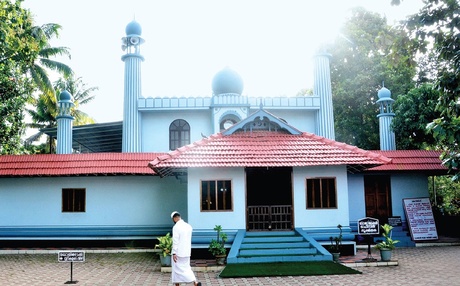
Cheraman Juma Masjid

Kochi  :

As a mark of tribute to the memory of the legendary man who took the pride of the country to the world and beyond, India’s first mosque, Cheraman Juma Masjid, will dedicate a portion of its Islamic Heritage Museum to A P J Abdul Kalam.

“The Islamic museum sheds light on the composite culture that existed in the God’s Own Country during the medieval period and showcases the relics of the rich past. In honour of the former President, it will be equipped with the digital collections of his visit to the legendary mosque and the town along with other documents,” said Faisal E B, administrative officer of the mosque. “We would also hold a meeting of various stakeholders this week to chalk out a plan to this effect,” he added.

It was hardly a decade ago when Kalam visited Cheraman Juma Masjid, considered to be the oldest mosque in the country, situated at the ancient port town of Kodungallur in Thrissur. The illustrious son of the country who visited the legendary 1400-year-old mosque on July 29 in 2005, wrote on the guest book, “I pray in the ancient mosque for the peace and prosperity of the country.”

The mosque committee is renovating the ancient monument under Muzaris Heritage Project of the state government. It is being renovated in tune with the style of Kerala architecture that existed during the times of the Cherman Perumal, the last of the Chera kings who ruled Kerala with Kodungalloor as their capital. The mosque is believed to have been constructed in 629 AD by Malik Bin Dinar, a contemporary of king Cheraman Perumal. “We would set aside a space for the former President in the renovated mosque, which already carries a plaque of his visit. The museum in the mosque would soon be expanded to include digital collection of the Muslim culture in Kerala. It will also carry the relics of the visit of the Missile Man to the mosque,” said Dr Mohammed Syed, president of the mosque committee.

The committee is already in the process of collecting audio-video footages of the Muslim culture in Kerala, which include the traditional art forms of the community, the artifacts associated with their daily life and other such memorials.

“The digitalised museum will be a top choice for global tourists and we are in the process renovating it in tune with world standards,” said a member of the mosque authority.

source: http://www.newindianexpress.com / The New Indian Express / The Sunday Standard / by Dhinesh Kallungal / August 02nd, 2015

Ikka Daud: 200-year-old tradition in Shrawan

Allahabad :

The holy month of Shrawan brings along several traditions unique to a particular area. Sangam City too has a unique tradition of organizing age-old ‘Ghehre Baazi’ (‘Ghehre’ means steps and ‘Baazi’ means bet) or Ikka Daud (horse cart race) on Yamuna Bank Road on every Monday of the holy month.

The race has a 200-year-old history. The tradition was started by pandas of the city and they have continued to patronize it. Around 1940s, zamindars of Allahabad and neighbouring areas started participating in this unique race.

Winner gets accolades and appreciation of the cheering crowd as a reward for winning the strenuous race. No money is given out. “This public appreciation provides an unexplainable satisfaction for the ‘saais’ (horse keeper),” says Badre Alam, who has participated in at least 30 races and won 10 of them.

Alam’s forefathers were zamindars of Katra. He has continued his family tradition of participating in the race, which he feels “is an example of the Ganga-Jamuni tehzeeb of the region. It is held on Monday of Shrawan. Both Hindus and Muslims participate enthusiastically in this race.” Continuing in the same vein he says, “Shiva signifies ‘shakti’ (power). Horse too symbolizes power. Hence, the race is held in Shrawan.”

“The race is unique in many ways. As per the rule, horses used in commercial activities are banned. Only racing horses can canter (movement of horse wherein it moves in fast steps) and not gallop,” says Badre and adds this race helps horse cart owners prepare for the 14-km-long competitive race held in October-November held on the route between Hanumanganj and Shashtri bridge or Sahson and Phaphamau. “This race too is quite prestigious and witnesses participants from Lucknow, Kanpur, Mirzapur, Pratapgarh etc,” he said.

Badre Alam relies on Sindhi horses for Ikka Daud. “Sindhi horses brought from the Sindh province of Pakistan are the best for the purpose. They have inborn talent for moving fast on sand and not gallop. We bring these horses from the famous animal fair of Barmer,” said Alam.

Even the cart of this unique race is equally special and manufactured in Delhi. The huge wooden wheel and the riding platform are made of Shisham wood and best ball bearings are used to give it required speed.

“Two persons sit on a cart. One handles the horse through leash and another, sitting in the rear, navigates the cart by informing the location of other competitors,” he said Alam.

Another regular participant Lalji Yadav, who has named his horse ‘Bhaiya’, said, “It is a pity that no one cares about offering prize money for the horse. Even pigeons are more fortunate as they at least get a prize after winning tournaments held for them.” He also wants proper security during race. “The district administration should see to it that people don’t jump on the road and no vehicles should be allowed on the track,” he demanded.

source: http://www.timesofindia.indiatimes.com / The Times of India / News Home> City> Allahabad / by Rajeev Mani, TNN / August 18th, 2015

Taj Mahal In World’s Top 5 Travel Hotspots In New List

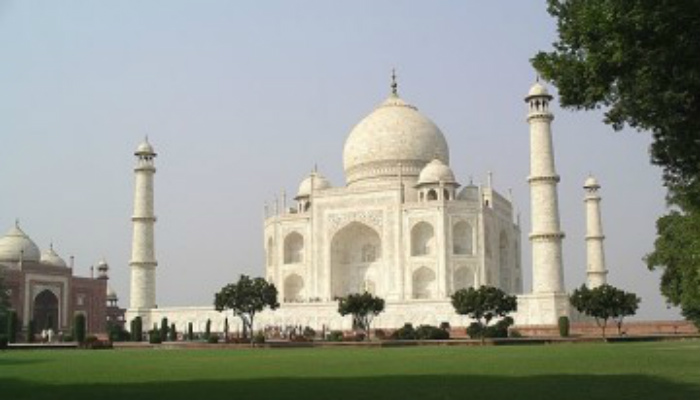
The Taj Mahal has made it to the top five of a prestigious new list of the world’s best tourist attractions.

TajMahalMPOs21aug2015

Lonely Planet’s “Ultimate Travelist” ranks the historic mausoleum built in Agra by Mughal emperor Shah Jahan as the fifth most attractive travel hotspot in the world and describes it as a “magnificent Mughal masterpiece”.

According to the list, the architectural perfection is reached beginning with “acres of shimmering white marble. Add a few thousand semi-precious stones, carved and inlaid in intricate Islamic patterns. Take a sublime setting by a sacred river, in jewel-like formal gardens. Apply a little perfect symmetry, and tie up the whole package in an outlandish story of timeless love. And there you have the Taj Mahal”.

It notes that there’s no other building in India that so perfectly encapsulates the attitudes and atmosphere of its era.

The Temples of Angkor, a UNESCO World Heritage site in northern Cambodia, tops the list as a complex of more than 1,000 temples, shrines and tombs which attracts more than 2 million visitors annually.

The Great Barrier Reef in Australia comes in at number two, the Inca city of Machu Picchu in Peru at number three, and the Great Wall of China at four.

Travel writers and Lonely Planet staff were invited to submit ideas before voting on their favourites.

Voters were asked to consider which sights enthused, inspired, and excited them the most.

The one UK entry was the British Museum, which came in 15th on the wish list.

To celebrate the release of the new book, some of the world’s finest sand sculptors will recreate five sights from around the world on Peter’s Hill near St. Paul’s Cathedral in central London later this week.

source: http://www.focusnews.com / FocusNews.com / Home> LifeStyle> Food And Travel / Press Trust of India, New Delhi / August 21st, 2015

Young, veiled and free: Meet Uber Delhi’s first woman driver

In the backdrop of security-related suspicions associated with the cab service Parveen’s large green eyes peeping out from her trendy hijab, hold promise.

“Today in the morning I dropped two young boys to Anand Vihar,” says Zamarrud Parveen, a pleasant surprise in her black-and-white hijab and bright yellow salwar kameez behind the wheel during my last Uber ride. “They started talking to me and asked where I was from. I told them I grew up in Bijnor, UP (Uttar Pradesh).” She changes gears and breaks into a proud chuckle. “They said, ‘Seriously?! We’re also from there, but we didn’t think any girl from there would ever choose this profession.’ I just laughed and asked them why. I said I loved driving! They had no idea what to say after that.”

The spirited 21-year-old says she is presently the only woman driver at Uber in Delhi and has been with the company for two months now. In the backdrop of the infamy and security-related suspicion associated with the cab service – given an incident of rape, sexual harassment and the general misbehaviour of male drivers with female passengers – Parveen’s mugshot with large green eyes peeping out from behind her trendy hijab, pops up on the app, with promise.

ZamarrudParveen01MPOs21aug2015

“I love the niqab. I’ve always worn it,” she says. “I usually wear a full burqa and niqab to college and everywhere, but while driving I only wear the niqab with ordinary clothes because it becomes difficult to drive,” adds Parveen, who is simultaneously pursuing a BA pass course from Jamia Millia Islamia and hopes to one day complete her MA and teach Islamic Studies, her favourite subject. “When I told my college friends about my job as a taxi driver, they didn’t believe me. Because of the way I am in college – always in a full burqa and niqab and all,” she says. “They only believed me when I showed them my visiting card. But they were really happy.”

Parveen grew up in a conservative mohalla in Bijnor and lived there until she graduated from the eighth grade, from Muslim Kudrat Girls Intercollege. She moved to Delhi, along with her mother and three younger sisters (Zoya, 19 and married, Shafaq, 12 and Ufaq, 10) and presently lives on rent in a one-room home where her father, a construction labourer had lived for 20 years. After graduating from school, Parveen was encouraged by her mother to learn how to drive and enrolled herself at Sakha Consulting Pvt Ltd. “My family is very supportive. My mother always wanted to learn how to drive, but couldn’t because she grew up in a conservative background… and culture. But she told me, ‘So what if I couldn’t drive? You must.'”

ZamarrudParveen02MPOs21aug2015

Parveen chose to take the job at Uber because they were offering to pay her a higher salary than her employers at Sakha. “I had a commercial licence so they were happy to take me,” she says. The country can expect more women like Parveen since Uber is working on recruiting close to 50,000 women drivers, who are presently being trained by the organisation, iCare Life. “They will be footing the bill to get them training and licences – learners’, permanent and commercial,” says Parveen, who enjoys her weekdays on the road. “This job is very convenient, if I have some personal work I can just go offline, finish my work and go back online.” She usually logs in at 7am, goes off between noon and 4pm and officially logs out for the day by around 7 or 8pm. This routine, she says, allows her to do namaz five times a day and spend time with her family.

The once shy, young girl, instructed as a child, as most girls in her neighbourhood were, never to speak to people or leave the house, felt liberated in Delhi and claims the course at Sakha helped her become exponentially more confident. “When I was young I couldn’t speak to or even stand in front of people. In Delhi, I spoke to more people, Sakha gave me training in self grooming, English classes, self defence and that really helped me open up.” The course at Sakha also had a week of law classes, in which Parveen learned different acts and “my rights out in the world and at home”.

ZamarrudParveen03MPOs21aug2015

But though Parveen has the support of her family, breaking out of an orthodox Muslim community was something her mother bravely battled. Ghazala Parveen defied all odds (and a disapproving mother-in-law) to educate herself and her three daughters. She graduated from class 10 after marrying her husband Habib-ur-Rahman and conceiving her eldest daughter Parveen. “You know what people think of women – by 18 or 19, get her married and that’s her whole life. Just chulha, chaaka, bachche, that’s it,” says Parveen. “But my mother was just completely different. The amount of turmoil she’s been through in her sasural, I don’t think anyone else would be able to. Her mother-in-law didn’t like girls at all. But my ‘abbu’ always wanted to have daughters.” Parveen’s three younger sisters all study in an English medium school near their home in Madanpur Khadar in Kalindi Kunj.

Being a lady taxi driver in a veil is not the only power statement Parveen is making. She’s also breaking the sexist stereotype associated with women behind the wheel. “During training, my sir used to say ‘jab tak gaadi thukegi nahi, seekhoge nahi (you won’t learn how to drive until you bang the car)’,” she says. “I used to say ‘aisa kisne bola hai‘. In the three years I have been driving I haven’t even touched another car with my car; no scratch, nothing.” She smirks, “Bhagaai bhi bohot hai. (I’ve driven very fast too).”

Parveen is happy with the response she’s got from passengers so far. “Most male passengers remain calm and silent. I don’t think they have anything to say,” she says. “Others are friendly and speak to me nicely. They definitely say this is the first time they’ve seen a lady driver. I love hearing that.”

The ambitious and dynamic Parveen is a powerhouse of resistance and part of a new generation of formidable women. Riding the wave of defiance her mother set in motion, Parveen is chatty and respectful, polite and witty. She is firm in her beliefs (“I have been allowed to even have a love marriage, but I’d prefer to be in an arranged marriage so my family can intervene if I have any marital trouble) and determined to achieve her goals (“I want to learn and when I become a teacher, I one day want to give other people the opportunity to learn”). At 21, her salary of Rs 15,000 per month, smacks full in the face every “how can you even educate the girl child” taunt from ladies in Bijnor. And her resilience is truly inspiring.

As she drives aggressively through the barriers of patriarchy, Parveen – who once successfully juggled her job, fasting for ramzan, an ailing mother and exams in college – says, “I love driving on the highway. It’s liberating when the car runs at 100-120km/h. I’m responsible for my own safety. And I absolutely love it.”

source: http://www.dailyo.in / Daily O / Home Page> Politics> Out of Order / by Asmita Bakshi @asmitabee / August 20th, 2015

Dailyo spots Jamia student, only woman driver at Uber in Delhi

The only woman driver at Uber in Delhi is a student from Jamia Millia Islamia, according to a report from dailyo.in. The reported pointed out that Zamarrud Parveen who grew up in Uttar Pradesh’ Bijnor has joined the company for two months now.

The hijab wearing Parveen, is also doing a BA pass course from Jamia. When asked about her future, she told the daily that one day she plans to complete her MA and teach Islamic studies, her favourite subject. “When I told my college friends about my job as a taxi driver, they didn’t believe me. Because of the way I am in college – always in a full burqa and niqab and all. They only believed me when I showed them my visiting card. But they were really happy,” she told the daily.

It was a few months ago when she moved to Delhi, along with her mother and three younger sisters (Zoya, 19 and married, Shafaq, 12 and Ufaq, 10).  The family live lives on rent in a one-room home where her father, a construction labourer has lived for 20 years, according to the report.

CAPTION: Photo of Parveen via dailyo.in

source: http://www.okhlatimes.com / Okhla Times / Home> JMI /OT Campus Reporter-JMI / OT – August 20th, 2015