Tortured by her in-laws for dowry, Tabassum was thrown out of the house with her six months old son, she decided to not give up.
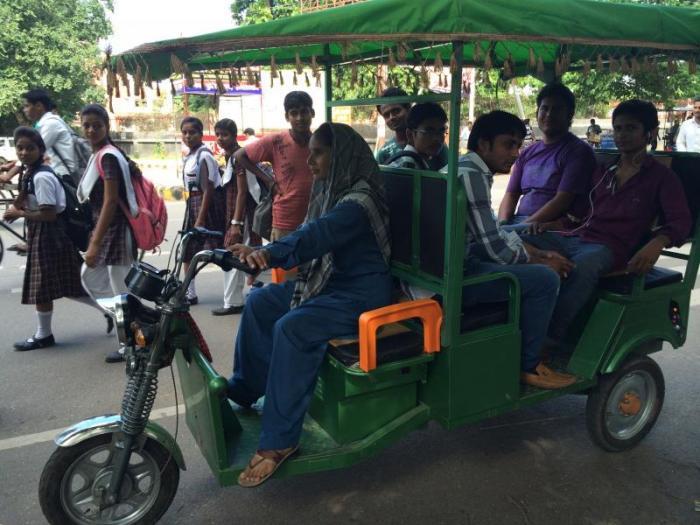
Tabassum Bano riding the e-riskshaw – Mohammad Anas
Tabassum Bano decided to fight and not surrender despite facing so many hardships some years back. She had been tortured physically and mentally by her in-laws for dowry, she was thrown out of the house with her six months old son, but Bano didn’t give up. She braved all the difficulties and challenges of her life. Confident and self dependent, Bano has set an example of courage as the first female e-rickshaw driver of Allahabad.
“I came to Allahabad in the year 2005. My family lives in a small village Narsimhagarh in Pratapgarh. One year after marriage, my in-laws started torturing me for more dowry. My son was just six months old at that time. One day they even took my clothes off and threw me out of the house. Tired of their torture, I had even thought of committing suicide, but my child gave me the reason to live and fight,” Bano broke into tears as she narrated her life story to iamin.
“Finally, I decided to get divorce from my husband and made up my mind to come to Allahabad and start a new life. With just two rupees in hand and my son in my arms, I began my journey from Pratapgarh by foot and reached Allahabad after walking 50 kilometres. Once when I wa at new Yamuna bridge, out of hunger, my son started crying uncontrollably and I became restless and helpless in this unknown city. An old man saw us and brought us to Sister Sheeba Jones. My life changed since that day,” said Bano who lives in a rented room at Teliyarganj colony in Allahabad with her son.
Bano gives the credit to Sister Sheeba for changing her life. “Sister Sheeba first taught me how to ride a scooty and then four-wheelers.” Besides riding the e-rickshaw, Bano also works as a maid in houses to bear her expenses of her family members.
Yes, apart from her own son, Bano is taking care of six other members of the family. “After my brother-in-law’s death, I took care of my sister and her three children. My brother died in the year 2011 and his daughter is also my responsibility. There is no male member in our family. I take care of my old mother too,” said Bano.
Besides work, Bano who was an illiterate before coming to Allahabad started studying and cleared class X examination. Her son Abdullah studies in a reputed English school in the city. “I want a better life for my son so, I work hard to send him in a good English medium school.”
Sharing her experience as a female e-rickshaw driver, Bano asserted, “I want to change people’s attitude towards women. There are different types of people in our society. Some people stare at me awkwardly while some praise and encourage me. I want to show that women are strong and can face challenges.”
Bano also uses her scooty to carry people. She sometimes drops school children to their homes free of cost in her e-rickshaw. Tabassum is surely an inspiration for women in the country.
source: http://www.iamin.in / I am in DNA of Allahabad / Home> Allahabad> Trending News / by Mohammad Anas, Edited by : Longjam Dineshwori/ Tuesday – October 21st, 2014
Structure built to remember 30,00 who died in cyclone
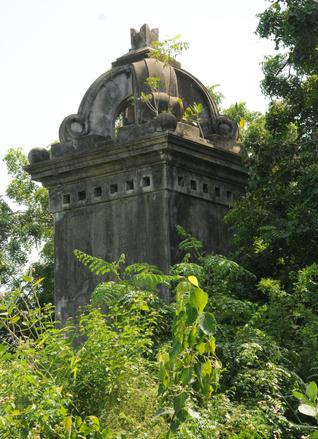
A view of cylcone victims memorial constructed during British rule at Gilakaladindi near Machilipatnam in Krishna District of Andhra Pradesh. Photo: Ch. Vijaya Bhaskar / The Hindu
People tend to recollect harrowing times of Diviseema uppena, a cyclone that devastated Machilipatnam, whenever a cyclone hits the State. But, here is a cyclone memorial which has faded in the memories of times gone by.
Great tragedy
Close to 30,000 people were swept away by the giant ocean wave over Machilipatnam town on the night of the cyclone of November 1, 1864. Following the great tragedy, Manuel Fruvall had constructed the memorial in the memory of his brother’s family and 30,000 people of this tiny town who died in the cyclone, at Bandarkota village near here.
A plaque put up outside the this monument says that the memorial was constructed in remembrance of Anthony and Maria Fruvall, their sons Peter Manuel and Daniel and their daughter Honey and her children Joseph and Georgiana and 30,000 people who were swept into the eternity by the ocean.
In 1860s, the total population of the town was around 60,000. In remembrance of then Machilipatnam Chief Magistrate G. Thornhill, who strove to control post-cyclone deaths due to spread of several diseases, Mr. Fravell also dedicated the memorial to him, says amateur Historian Md. Silar.
Many people of the town do not even know where the monument is located there. But, fishermen community in the vicinity recollected that thousands were killed in 1864 cyclone.
Many demanded that the government come up with a plan to restore and preserve the memorial.
Mr. Silar says that the monument commemorates the fate of thousands of people.
The memorial withstood vagaries of nature. But, now stands testimony to negligence by government machinery.
Dilapidated monument
The dilapidated monument is surrounded by the bushes and trees. “Our repeated appeals to the District Collector and authorities concerned to protect the heritage fell on deaf ears,” he adds.
source: http://www.thehindu.com / The Hindu / Home> News> Cities> Vijayawada / by G. V. R. Subba Rao / Machilipatnam – October 16th, 2014
It was a packed house when the Lucknow Expressions society organised another literary evening, this time with historian Rosie Llewellyn Jones.
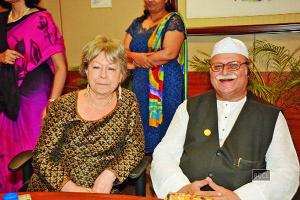
Rosie Llewellyn Jones (left)
Rosie’s writings on Nawab Wajid Ali Shah were released by filmmaker Muzaffar Ali, who was the chief guest at the event. Introducing the audience to the life of Wajid Ali Shah, Jayant Krishna expressed disappointment over the lack of monuments or places in the city named after the Nawab.
“Perhaps, we are looking for the international airport to be named after him,” joked Jayant. Muzaffar Ali, on the other hand, spoke about a temple in Vrindavan with a statue of Nawab Wajid Ali Shah.
The event concluded with a question-answer session, followed by high tea.
source: http://www.timesofindia.indiatimes.com / The Times of India / Home> City> Lucknow / by Renu Singh, TNN / October 16th, 2014
In a move that could shed more light on the important historical aspects of Naya Qila heritage complex, the Archaeological Survey of India (ASI) has started excavating the site of what was once the Qutub Shahi Gardens.
Reliable sources from the Archaeological Survey of India told TOI that officials of the Hyderabad Circle of the archaeological juggernaut conducted an inspection of the heritage precinct last week. The land is currently in possession of the tourism department and its private partner, the Hyderabad Golf Association, the sources said.
“We have received orders from the director general of the ASI in New Delhi to begin work. The intention is to expose the Qutub Shahi Gardens, also known as Deccani Gardens. Further, there has been a long-pending demand from the activists for us to begin work,” said an ASI official who did not wish to be identified.
The ASI plans to drain the land parcel of the sewage water that has been accumulated over the years. Further, the vegetation and the debris on the heritage land would be also cleared as part of the plan.
“A report by eminent historian Ghulam Yazdani explains the presence of Qutub Shahi Gardens. We are hopeful that the results will be seen within a week of the excavation,” said ASI superintending archaeologist R Krishnaiah.
Rumours about the ASI unearthing a treasure chest began spreading early last week. The ASI, on the other hand, was swift enough to deny these claims.
“There is no treasure. The land was tilled by farmers until a few years ago. All these reports are baseless,” an ASI official said.
source: http://www.timesofindia.indiatimes.com / The Times of India / Home> City> Hyderabad / TNN / October 06th, 2014
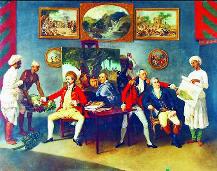
The painting titled ‘General Claude Martin and his Friends’ or ‘Colonel Polier with his Friends’ depicts Colonel Antoine Polier, Claude Martin, and John Wombwell with the painter himself, Johann Zoffany (1733-1810), in the background, being waited on by Indian servants, probably in Lucknow around 1786-87.
Kolkata :
The Victoria Memorial Hall’s collections will find a place in the largest-ever digital repository of exhibits and collections on a global platform created by Google. Apart from Victoria, some others on the list are Metropolitan Museum of Art and Museum of Modern Art in New York, British Museum, National Gallery and Tate Gallery in London, Musee d’Orsay in Paris, Acropolis Museum in Athens and Hiroshima Peace Memorial Museum.
Victoria Memorial curator Jayanta Sengupta told TOI that the museum and its finest collection of art and artifacts are expected to join the Google Cultural Institute, a cyber platform created by Google Art that enables users to view high resolution images from various museums and even compile their own digital collection. It is fast emerging as an invaluable resource for researchers as they can have access to objects from museums across the world and learn about art objects, their history and artists at the click of a mouse.
“A team from Google will reach Kolkata with sophisticated video and still cameras to film the museum and photograph the 120-odd highlights. Of these, they will select one item and photograph it with high-definition gigapixel camera so that it can be magnified online without distortion. Once the exercise is over in a couple of months, a virtual tour of the galleries at Victoria Memorial will be created and the images uploaded on Google Cultural Institute,” said Sengupta.
Victoria Memorial signed a memorandum of understanding with Google Art in February 2013 and has been communicating with the team since. The museum has sent the list of 120 items it considers the best among its collection of 33,000+ objects of art apart from the 10,000+ small objects like stamps.
Though the Google team is at liberty to select any one of the 120 objects listed by Sengupta’s team as the museum’s highlight for the gigapixel photography, the curator has suggested a painting titled ‘General Claude Martin & his Friends’. The painting that has an alternative title ‘Colonel Polier with his Friends’ depicts Colonel Antoine Polier, Claude Martin, and John Wombwell with the painter himself, Johann Zoffany (1733-1810), in the background, being waited on by Indian servants, probably in Lucknow around 1786-87.
“We have suggested the painting by 18th century German neoclassical painter because it is intricate. There are six paintings within the painting that can be enlarged and viewed in detail when photographed in a gigapixel image,” explained Sengupta. Other paintings that make the cut are ‘Bharat Mata’ and ‘Passing of Shah Jahan’.
Among the other objects in the highlights shortlist are oil paintings by Thomas and William Daniel, Abanindranath Tagore and Gaganendranath Tagore, a 1964 copy of the Ain-e-Akbari manuscript, Persian translation of Aristotle’s treatise Six Principles of Ethical Life and commentary by Dara Shukoh as well as his Persian translations of Gita and Upanishad, Aurungzeb’s personal Quran, Tipu Sultan’s dagger, Maharaja Ranjit Singh’s sword and Queen Victoria’s piano.
“Once Victoria Memorial Hall joins the others on the Google Cultural Institute website, all objects that comprise the museum highlights will be there for the world to see and experience online. We have been working on documenting each object, detailing the history, the artist and its relevance. We are currently in the final lap of that exercise and expect to be on the website by this yearend or early next year,” said Sengupta.
source: http://www.timesofindia.indiatimes.com / The Times of India / Home> City> Kolkata / by Subhro Niyogi, TNN / September 07th, 2014
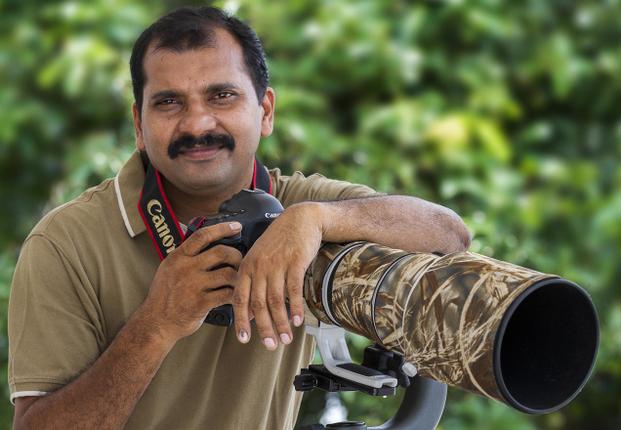
Motor vehicle inspector Shefiq B.’s photograph of a leopard at the Parambikulam wildlife sanctuary won a prize at the State-level wildlife photography competition. Photo: K.K. Mustafah / The Hindu
A motor vehicle inspector’s commitment to wildlife photography
: His passion for photography almost cost him his life a decade ago when he was chased around by a herd of wild elephants in Thekkady. And that night in 2003, he stayed atop a tree to escape the wrath of the pachyderms.
For someone who took pictures with trembling hands and landed himself in trouble out of his ignorance about positioning, Shefiq B. has come a long way to grab the victor’s prize at the State-level wildlife photography conducted by the forest department.
A motor vehicle inspector by profession, Mr. Shefiq will receive the award from Forest Minister Thiruvanchoor Radhakrishnan on Tuesday at the Periyar Tiger Reserve in Thekkady.
Motor vehicle inspector Shefiq B.’s photograph of a leopard at the Parambikulam wildlife sanctuary won a prize at the State-level wildlife photography competition. Photo: K.K. Mustafah / The Hindu
The picture of a leopard lying on a rock at the Parambikulam wildlife sanctuary won him the prize.
“Initially, the animal was behind a rock and was not fully visible before it stepped on to the rock. From its stomach I could gauge that the animal had had its prey just then and would be resting there for a while,” he said.
Photography became his passion after he took a five-year break from his job as a vehicle inspector.
During this time, he took up a job in the Middle East which gave him the opportunity to travel to the wildlife sanctuaries of Kenya, a photographer’s delight.
So much was he consumed by the passion that he didn’t think twice before taking a loan for purchasing a professional worth Rs. 2.5 lakh.
Since rejoining duty at the Aluva Regional Transport Office last year, Shefiq puts in extra hours at work, so that he can go exploring nature in the company of his camera on weekends .
source: http://www.thehindu.com / The Hindu / Home> News> Cities> Kochi / by M.P. Praveen / Kochi – October 07th, 2014
A majestic pre-Independence era haveli in Old City is caught in a controversy with the UP Sunni Waqf Board asking district administration to halt shooting schedule of a Hindi film in it.
Tucked away in the congested Akbari Gate area on Abdul Aziz Road, Ahmad Manzil was built in 1922 and belonged to tobacco merchants Ahmad Ali and Sons of global fame. In the 1940’s, owner Khan Bahadur Syed Ahmad Husain Rizvi declared it wakf property and laid out conditions under which the property was to be utilised by his descendants. The current mutawalli (caretaker) Iqbal Rizvi allegedly granted permission to the makers of ‘Tanu Weds Manu-2’ to shoot inside the building.
This has irked other residents of the haveli who allege that shooting of the film in the building is against the will of the wakif Khan Bahadur Syed Ahmad Husain Rizvi. “Shooting cannot be allowed since no such activity can take place on the haveli compound without unanimous consent of all beneficiaries of the property. Also, nothing that’s against the ‘Shariah’ (Islamic jurisprudence) can be allowed,” says Fareed Rizvi whose letter to the Waqf Board prompted the latter’s letter to the district magistrate.
Incidentally, the Waqf Board had written a similar letter to the DM during the shooting of ‘Dabangg-2’ but by the time a district administration inspection team reached the venue, shooting for the film had already concluded.
When contacted, the haveli’s caretaker Iqbal Rizvi remained tight-lipped on the issue. DM Raj Shekhar said the Wakf Board letter could not be tabled for discussion due to holidays but appropriate action will be taken after studying the facts of the case.
source: http://www.timesofindia.indiatimes.com / The Times of India / Home> City>Lucknow / by Ali Rizvi, TNN / October 08th, 2014
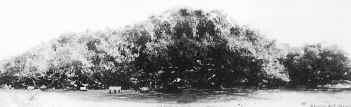
The 700-year-old banyan tree, Pillalamarri, which will appear on a special cover being brought out by the Postal Department.
Hyderabad :
Pillalamarri, the famed 700-year-old banyan tree near Mahabubnagar, will appear on a special cover being brought out by the Department of Posts.
The magnificent tree with its branches stretching over an area of three acres is acclaimed as a “living legend” of the district. Over the years, the heritage symbol, located in the fields 4 km from Mahabubnagar town, attracted tourists from far and near. From a distance, it presents the look of a small hillock covered with thick foliage. As one draws closer, the majestic tree stands out like a giant umbrella, which can shelter upto 1,000 persons. There is a tomb of a Muslim saint underneath the tree.
On its part, the Postal Department has resolved to do its bit to commemorate the tree by releasing a special cover during a philatelic exhibition at Mahabubnagar on August 29 and 30. The special cover will be released by T.S.Govindarajan, Chief Postmaster General, Andhra Pradesh Circle.
A special video show for children on “stamp collection-an educative hobby”, philately workshop, essay and quiz competitions for students will be the highlights of the two-day exhibition. As an on-going effort to popularise stamp collection, the facility of philately deposit account is provided at all head post offices through which children can get newly released stamps with an initial deposit of Rs 200.
source: http://www.thehindu.com / The Hindu, Online edition / Home> Southern States – Andhra Pradesh / by The Hindu Special Correspondent / Thursday – August 14th, 2003
With the major business streets of Srinagar in Lal Chwok, Jawahar Nagar, Dalgate and Karan Nagar devastated by the historic flood, people see the ‘old city’ as the only address for shopping. Safwat Zargar spent a day in the busy markets of the ‘down town’ to argue if trade in Srinagar is returning back to its roots?
On the front side of the compound wall 15th century king Budshah’s tomb at Maharaj Gunj, a young lady, hand in hand, with her three-year old son is walking past a display of bright coloured shoes. Shahida has come from Dalgate to buy apparels and shoes for her son, Burooj.
“You can’t refute the desires of children,” Shahida says, adding “otherwise, there is very less to celebrate this Eid.” Since her marriage, five years back, Shahida, a government employee, has shopped for Eid at Lal Chowk, but this season, nature seems to have broken her habit.
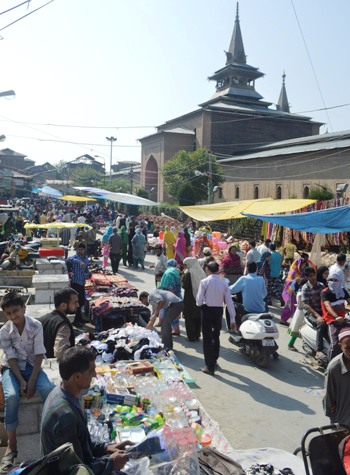
Kashmir is in mourning and Eid is a day far. With Srinagar’s heart, Lal Chowk, weeping mud and dust, the old city or Shahr e Khaas, a week before Eid, is witnessing the festival buzz. While floods washed away the rush of Lal Chowk seems, it is old city’s narrow lanes and streets, bustling with traffic and people.
The two, century-old markets – Maharaj Gunj and Jamia Masjid – are the prime attractions for shoppers. Circled around the archetypal dome of mother’s tomb of Sultan Ghiyas-ud-Din Zain-ul-Abidin’s, well known as Bud Shah, on the banks of Jhelum, floods seem to have livened up Maharaj Gunj’s past glory for now. Known for textiles, spices and marriage items, Maharaj Gunj, in past, would have everything for everyone. It was hard to imagine for a citizen of old city to buy anywhere except Maharaj Gunj.
Over the years with city expanding “un-naturally” and haphazardly to upper areas in flood basins, it triggered the migration of better economic class. The old city dwindled into a myth. For many living in the posh-neighbourhoods and housing colonies, downtown became synonymous with protests, backwardness and stone-pelting. Politics dominated the air but businesses struggled. Now, with floods having ravaged all the new and mostly peaceful markets and destroying stock, people are now flocking back to the old city.
82-year old Hajira of Kadi Kadal still recalls the pinnacle days of Maharaj Gunj to her grandchildren. Young, Hajira, with lunch and fresh curd in a copper jug in her hand, would navigate through crowds of shoppers, vendors and carts men, to reach Zaina Kadal where her father had a jewellery shop. “There is hardly that kind of rush and business now,” she says. “I haven’t been there for years.” However, Hajira believes “it would be beautiful if the grandeur and finery of the old city comes alive again.”
President, Gada Bazar, Maharaj Gunj Traders Association, Nisar Ahmad feels that the damage to Lal Chowk and other uptown area markets have stirred up sales in old city markets. “For last few days, we are realizing the upward trend of new customers visiting our shops. Though, the overall market is sunken but people, with whatever need and money they have, are thronging markets,” he says. “Most of the sales are compulsive sales.”
On the other hand, Fayaz Ahmad, owner of Janta Bakers at Aali Kadal, one of the best bakeries in old city, says people from places outside downtown might be turning in numbers in the old city markets but the average sales are down. “It is as if there is an implicit understanding of spending less. My sales are down by 70 per cent as compared to the previous year,” he says.
Fayaz also says there is indirect shopping taking place this year. “Relatives of flood affected areas are also buying, though in very less quantity, for their flood affected friends and relatives. It includes all those families who are putting up at their relatives’ homes’ in old city.”
The Nalla Mar road, once a water canal of Jhelum and now a two-way macadamized road, cuts the city into two halves. While the Maharaj Gunj market flurries with wholesale dealing mostly, Jamia Masjid market retails all the items ranging from readymade garments to kitchen items.
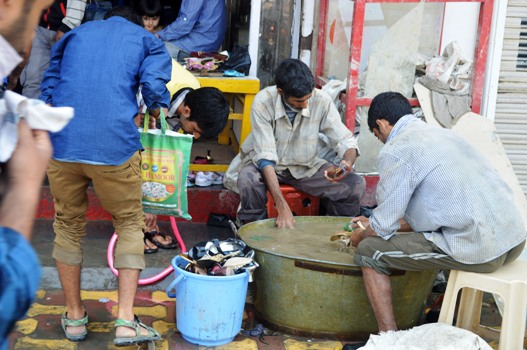
At one of the gates of Jamia Masjid, Tariq Ahmad, who owns a sprawling showroom of crockery, kitchen and household items, a lady from Raj Bagh is checking rates of the plastic water buckets. “Ninety per cent of my business from last week has been from the people belonging to flood affected areas. They usually look for water buckets, jugs, wipers, mops; to clean their homes,” Tariq says.
We are witnessing huge rush of customers, says Tariq, but we aren’t selling items beyond a price of few hundred rupees. “On Eid, a customer would prefer to buy expensive items. Last Eid, a customer won’t step out from my shop without spending 3-4000 rupees, at present, 500 rupees is a blessing,” he says.
Some traders trying to salvage whatever is possible
Noted poet and historian, Zareef Ahmad Zareef, believes the trend is an indication of city returning back to its roots but more than that it also evidences the quality of city planning and development of towns. “Old city stretched from Habba Kadal to Safa Kadal – city of seven bridges – and the quality of city planned by British engineers is still in front of us. What happened to Lal Chowk and other surrounding areas raises many questions about the quality and procedure followed in planning,” Zareef says.
Zareef who lives on the foothills of Koh–e–Maraan while recalling past says Maharaj Gunj used to be a wholesale market, its another arm, Gada Bazar, sold retail items, Bohri Kadal was a fruit and vegetable market, transported there from Dal lake through Nalla Mar on boats. Bohri Kadal was also known for herbs and organic medicines. On Chattabal bridge, fish from Wullar lake would be sold in huge numbers, every day.
“Water transport was the major transport. Roads for carts and tongas came later,” he says. “I feel that people, particularly business class, has realized the importance of old city vis-a-vis vulnerability to dangers. Whatever they will plan in future, it would be solely based on introspection and safety in future.”
One of the best textile garment and fashion wear shops in old city, Taj Fancy Store, has relatively thin footfalls, this Eid. The shop owner, Abdul Rashid Chonka, says whatever sales are taking place is due to the compulsion only. “Nobody wants to buy like before. We have people affected by floods coming here and asking for cheap clothes. Some of them even say they have only what they are wearing,” he says.
The sales graph of Chonka might have downed but he agrees his customer diversity, however short-living, has risen. “Many customers, who used to buy clothes from Lal Chowk and uptown shops, came to my shop, but even they don’t seem to be in good mood of spending.”
Major axe of floods seems to have fallen on the several-hundred crore mutton industry. There is no rush of Gujjars and Bakerwals at Eidgah with their flock except some dispersed huddles around them. Last year, more than three lakh sheep worth 250 crore rupees were sold on Eid-ul-Azha by wholesale mutton dealers throughout Kashmir valley. This year, mutton dealers are already experiencing the flood onslaught. According to Mehraj-Ud-Din Ganaie, President, Wholesale Mutton Dealers Association, Kashmir, only 30 per cent demand is in the market, despite that sheep are available with mutton dealers. In downtown interiors, herd-owners are sitting at main intersections with their flock of few sheep to attract buyers. At Nowhatta chowk, Shah Khan, a Bakerwal from North Kashmir, is mulling to return back. “People seem to have been lost. By this time last year, I had disposed of half of my flock. This year, I pray only for that half to sell,” he says.
“In the first week of floods, more than 5000 marriages were cancelled in Kashmir valley. It means thirty thousand sheep weren’t consumed at all. The mutton industry lost 15 crores in a single week,” Ganaie says.
The major demand for sheep on this Eid used to be in the city, Ganaie says, now when most of the city is in ruins, we are targeting downtown. “But that can’t help us to recover losses. No government agency or department is talking about us,” he says.
“Our fingers are crossed. We are hopeful, a day or two before the Eid, the sales might pick up as many prefer to buy the sacrificial animal a day before, to avoid the burden of sheltering and feeding the animal,” Ganaie says. “However, the damage has been already done.”
In a consumerist economy, the growth of market is directly related to the mood of society, says Zeeshan Ahmad, a student pursuing Masters in Marketing. “Kashmir is grappling with one of the severest catastrophe in its history. It is very hard to expect the flow of money in economy like before,” adds Ahmad, who studies at a university in New Delhi.
“As far as the revival of old city market is concerned, it is just situation driven. Once the other markets are restored the focus will shift back again” he adds.
Historian Zareef says whatever the case, lessons have been learnt,
“Nature is a brutal teacher.”
source: http://www.kashmirlife.net / Kashmir Life / Home> Latest News> Special Report / Sunday – October 05th, 2014
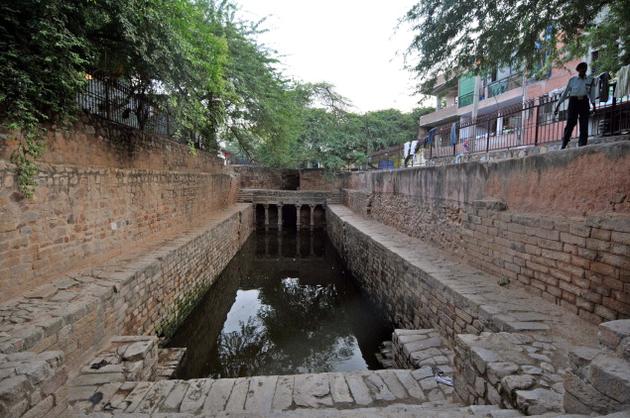
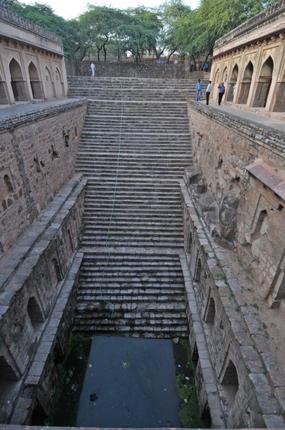
The 13th Century Gandhak ki Baoli. — PHOTOS: SUSHIL KUMAR VERMA
The Archaeological Survey of India (ASI) has revived three water bodies — Rajon ki Baoli, Gandhak ki Baoli, and Hauz-i-Shamsi or Shamsi talab — inside the Qutub premises.
All these baolis, except Shamsi talab, were nearly dry till recently. But for the last couple of months, the water level in these baolis has increased despite negligible rain this season.
“The more the level of water went down in Delhi, the water level in these baolis increased,” said an ASI representative, reasoning constant cleaning of these baolis, which till sometime ago were filled with mud and filth thrown by visitors and people living close by.
While water conservationists opined that the water level increased due to sealing of several borewells in the area, ASI representative argued that the same happened after the cleaning of the choked openings in the baolis, something even the locals agree with.
Ghulam Mohammad, an 80-year-old old resident of Mehrauli village, said: “Sumant Dogra of the ASI used to come here even when the temperature was nearly 49 degrees Celsius and get the baolis cleaned every day for past many months. Soon after the cleaning, we saw water gushing up despite the poor monsoon this year.”
A visit to all the baolis, however, reveals the careless attitude people have towards them.
The 13th Century Gandhak ki Baoli. — PHOTOS: SUSHIL KUMAR VERMA
The Rajon ki Baoli, which dates back to the 15 Century, “was chocked with 20 feet of filth — meaning two storeys of the baoli, leaving only the third or the last storey was visible. We got it cleared. It took us six months. Now the water level has come up to 20 feet. We had to stop intermittently due to lack of funds. We completed the cleaning, which the ASI started in 2004-05, in 2014.”
The baoli is filled with stagnant water covered with algae. One can reach it by climbing down nearly 60 stairs. The ASI official adds: “Visitors throw wrappers, packets and even spit in it. If we don’t clean it every day, the filth will reach 20 feet within a week.”
Gandak ki Baoli is located about 200 meters from this one. The water there “started rising two-three years ago. It now has about 40 feet of water,” he added.
Built in the 13 Century, the water in this baoli, as the name suggests, is mixed with Sulphur, which supposedly has medicinal qualities. Due to this, the locals bathe and wash their clothes in it.
When the reporter visited the spot, a man who has just finished washing his clothes was then seen urinating in the baoli, as a guard looked on helplessly. The ASI official, who comes here daily for inspection, said: “The locals use the baolis as their personal property. Vagabonds roam this area and it turns dangerous by the evening. If we ask them not to dirty the baoli, they take out knives in no time. Even the police is scared of them.”
The third water body or the Shamsi talab, is located in the middle of the Mehrauli market, most of which is unauthorised. The talab was once spread over a huge area, with a tomb in the centre. As the talab started shrinking due to lack of water, the tomb, which is still visible, has been relegated to a side. Water beyond it has dried up already. But “it now has 15 to 20 feet water,” the official adds.
The area around this talab remains unspoilt, filled with the chirps of thousands of birds. A reminder of what the baolis may have looked like in the past.
source: http://www.thehindu.com / The Hindu / Home> News> Cities> Delhi / by Rana Siddiqui Zaman / New Delhi – October 0th, 2014