The city just might have the pride of an underground museum corridor from Darshanbilas to Farhat Baksh via Lal Baradari connecting it to river Gomti.
Teachers at faculty of architecture (affiliated to UPTU) have come up with a proposal to revitalise the Chhatar Manzil complex, a relic of the Nawabi era. The proposed connection of Farhat Bakhsh (earlier part of Chhatar Manzil) can be restored with an underground museum corridor from Lal Baradari and the pavilion bridge can be reconstructed as pedestrian connection across the river. The objective is to revive glory of Chhatar Manzil’s historic manifestation and its connection with the river.
“Chhatar Manzil and Farhat Baksh are isolated monuments on the banks of Gomti. Chhatar Manzil comprises the Lucknow skyline but the royal building does not enjoy the glory it deserves,” said Vandana Sehgal and Ritu Gulati, experts who’ve made the proposal.
As per the proposed design, Farhat Baksh and Bada Chhatarmanzil can be live museums of handicraft and live performance of traditional Lucknowi dance and drama (dastaangoi). The landscaped court of the Bada Chhatarmanzil and the Chhota Chhatarmanzil footprint can be an open sculpture court and area for live fine art demonstration.
The riverside can be developed as a promenade with kiosks for food, drinks and curios, which will also direct movement towards the Gomti, where it will connect the complex to the erstwhile Bridge of Pavilions that needs to be reconstructed to go across the river to the esplanade on the other side, said Vandana. This perspective weaves all the fragmented parts of the complex physically and metaphorically with the river and the city.
During Ghazi-ud-din Haider’s time, the Chhatarmanzil Kalan badaa (next to Farhat Baksh) and the Chhatarmanzil Khurd chhota were connected through a court. The latter was flanked by Darshanbilas and Chaulakhikothi. These two monuments can be connected through a court as a foreground for performances in the backdrop, said Ritu.
source: http://www.timesofindia.indiatimes.com / The Times of India / Home> City> Lucknow / TNN / October 01st, 2014
BMTC launched an electric bus at Shantinagar Bus Station on Thursday; Right: A view of the interiors | Sudhakara Jain
The Bangalore Metropolitan Transport Corporation (BMTC) introduced the country’s first electric zero-emission bus in the city on Thursday.
Although the bus has been in Bangalore for over a month now, it was officially launched by Transport Minister Ramalinga Reddy after getting the required permissions from the Transport Department.
The bus will run on a trial basis for the next three months. During this time, it will operate along various routes, beginning with one from Majestic to Kadugodi that is likely to cost `80.
Plans are also afoot to run the bus along the airport routes. The charging point for the bus is at the Volvo depot at Majestic.
“We will study whether the bus is economical and if it can function efficiently in the city. When the battery is fully charged (six hours), the bus can run for about 250 km, which is ideal for BMTC. However, this needs to be tested. We also need to see how it fares on various roads in the city and which routes are best suited to operate the bus,” said BMTC managing director Anjum Parvez.
Transport Minister Ramalinga Reddy said that though the bus is expensive, it is likely to be a good deal as a long-term investment.
“The bus costs about `2.7 crore and this is expensive. But this is one bus in the entire country. Once the demand for the bus goes up and more people express interest in purchasing it, the rates are likely to come down. Moreover, the research and development wings of various bus manufacturers are working on this and it is some only time before the initial cost of the bus is reduced,” he said.
When asked if the state government would be willing to share the cost or offer subsidies, Reddy said, “We will consider various options if the bus is found to be suitable for the city. At present, it is on a three-month trial and following this, a decision will be taken on whether or not to purchase the bus,” he said. He added that what was important was that pollution levels would be brought down by using electric buses, hybrid or CNG-operated buses. The bus, manufactured by Build Your Dreams (BYD), was brought to India by Utopia Pvt Ltd. At least 5,000 such buses are operational in countries such as the United States, Netherlands, Switzerland and some European countries.
GOING GREEN
Zero emission
No oil required
Costs Rs 2.7 crore (Volvo Rs 88 lakh)
Fare from Majestic to Kadugodi – Rs 80
Runs for 250 km with 6 hours of charging
source: http://www.newindianexpress.com / The New Indian Express / Home> Cities> Bangalore / by Express News Service- Bangalore / February 28th, 2014
The grand construction of General Claude Martin, the Constantia, served as a lodge for Freemasons, a secret society, as many of the English officers including Martin were Freemasons.
Many such lesser known facets pertaining to the life and times of Claude Martin were brought to light by celebrated British historian, Dr Rosie Llewellyn Jones at La Martiniere College on Sunday. The talk was organised by Indian National Trust for Art and Cultural heritage (INTACH), Lucknow Chapter.
After being attacked by the Raja of Banaras invading Lucknow through Farhat Baksh Kothi, General Claude Martin began residing in the Constantia which he built as a fort. Constructed with four spiral columns that go right up to the terrace, cleverly with a lone staircase, Gen Martin made sure the building he liked to show off to his fellow Englishmen was secure with iron doors made from imported English iron. These doors could then be shut once a single man defending the building from the top took position upstairs.
Constantia was safeguarded by cannons on the first floor of the building next to lion statues with lamps within them. “Its construction as a defensive structure to frighten people, basically its attackers, is one of the least known features of the Constantia, which prior to being an educational institution, was a fort,” shared Dr Jones.
INTACH’s convenor Vipul Varshney talked about the axial symmetry and architectural genius of the gigantic structure with pioneering ventilation. Dr Jones also spoke about many paintings of Claude Martin.
Iron girders in the basement of the Constantia go deep down to its foundation. Dr Jones denied presence of any such tunnels opening into the Gomti against a popular myth.
Convernor Vipul Varshney talking about the architectural skyline of Lucknow said, “the heterogeneity of cultural conceptions and artistic styles triumphed to strike a harmony between the many buildings of Lucknow getting along the Nawabi and English architecture successfully in Lucknow’s skyline, and so in that order we decided to educate and inform Lucknowites about one such magnificent structure, the Constantia.”
Gen Martin a self taught man had as many as 5000 books and the presence of certain books on creating electricity have made historians like Dr Jones believe that he might have attempted to create electricity as well in the lower rooms of the Constantia. The result of his trial and error techniques on it though are yet to be studied further.
Heritage conservationist and lawyer by profession, Mohammad Haider stating the building as an unprotected monument applauded the efforts of Principal Carlyle McFarland, the staff and students of the college, ” the unique feature of this building stands in the fact that it has been well maintained within the precincts of its original form and the monument an architectural masterpiece is devoid of any uncalled for scribbling on the walls of the campus unlike the state of most protected monuments in the country.”
source: http://www.timesofindia.indiatimes.com / The Times of India / Home> City> Lucknow / by Yusra Husain, TNN / September 29th, 2014
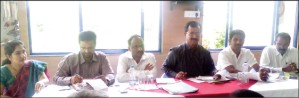
Dasara Tourism Sub-Committee President Sudhakar S. Shetty speaking at the Sub-Committee meeting at Hotel Hoysala this morning as Member Secretary C. Anitha, Sub-Committee Executive President S.K. Husseini, Special Officer H.M. Ramesh, Vice-Presidents Kumar and L. Parshuram look on.
Mysore :
For the first time in the history of Dasara, the Dasara Tourism Sub-Committee plans to display as many as 50,000 Circuit Maps containing details of roads from Mysore to tourist spots in Mysore, Chamarajanagar, Mandya, Kodagu districts at tourists spots and vantage points for the benefit of tourists, said Sub-Committee President Sudhakar S. Shetty here this morning.
Addressing a meeting of the Sub-Committee at Hotel Hoysala on JLB Road in city, he said that the primary objective of the Committee was to ensure proper infrastructure like drinking water, toilets, bathrooms and cleanliness around all tourist spots to meet the needs of tourists.
Stating that 18 tourist kiosks at a cost of Rs. 26,000 each, manned by the students of tourism courses in Mahajana and Vidya Vikas Colleges in city and foreign students in city and 32 guides around Mysore Palace, dressed in specially designed blazers, will be set up at tourist spots and vantage points to guide tourists.
Sudhakar Shetty also said that the Sub-Committee had urged City Police Commissioner Dr. M.A. Saleem to initiate criminal action against those found guilty of selling duplicate products to visitors besides urging the MCC Commissioner to ensure that debris and garbage around the tourist spots in particular and the city in general before the commencement of the Naada Habba.
The Sub-Committee President also said that literature containing details of tourist spots will be placed at boxes which will be placed at all hotels and tourist agency offices in city.
Tourism Development Authority sought: As Mysore and surrounding districts have abundant tourist potential, there is an absolute need for formation of a Tourism Development Authority to promote tourism, which is one of the most flourishing industries in parts of old Mysore region which has numerous places of tourist interest, some members opined.
S.K. Husseini, Assistant Director, Department of Tourism, who is also Sub-Committee Executive President, H.M. Ramesh, Divisional Traffic Controller (City Division), KSRTC, who is also the Sub-Committee Special Officer, C. Anitha, Sub-Committee Member Secretary, Kumar and P arashuram, Sub-Committee Vice-Presidents and Sub-Committee members were present at the meeting.
source: http://www.starofmysore.com / Star of Mysore / Home> General News / Saturday , September 20th, 2014
The great patriot, however, remained unsung on January 24, which marks his 153rd death anniversary
The name of Turehbaz Khan conjures up images of valour and sacrifice. The name also puts Hyderabad on the map of the country’s First War of Independence or the Sepoy Mutiny of 1857. But how many of us know that January 24 marked the 153rd death anniversary of Turehbaz Khan, who, along with several others, rebelled against the English Resident, Major Cuthbert Davidson. The day simply passed off without a whimper.
It was in January 24, 1859, that many believe that Turehbaz Khan was killed in the forests of Toopran by the Talukdar, Mirza Qurban Ali Baig.
His body was brought to Hyderabad and according to several historical accounts was hung near the Residency, what is now Koti Women’s College, for public display and to act as a deterrent against any future rebellion.
Many in Hyderabad also do not know that the road in front of Osmania Medical College is named after Turehbaz Khan.
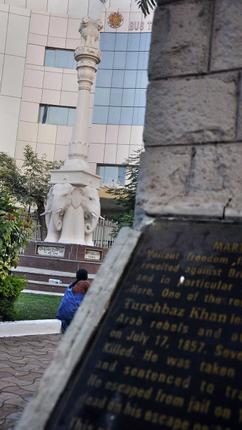
To mark the revolt of 1857, a memorial with the words ‘Memorial to the martyrs of July 17, 1857′ was constructed near Koti bus stand.
Even today, the name Turehbaz Khan is etched on the plaque.
Stark reminder:The memorial for Turehbaz Khan and others at Koti.– Photos: G. Ramakrishna / The Hindu
The uprising was led by Turehbaz Khan and a fiery preacher, Maulvi Allauddin, along with 500 Rohillas, who were of Pashtun (Pathan) stock.
Unequal fight
Essentially, the revolt was to free Jamedar Cheeda Khan, who was held in the prison inside the Residency. The 500 Rohillas tried to storm the Residency under the direction of Turehbaz Khan and Maulvi Allauddin, who controlled the revolt by occupying the houses of two local moneylenders, Abban Saheb and Jaigopal Das.
Historians point out that the fight between the Rohillas and British troops, who were led by Major S. C. Briggs, continued throughout the night. Apparently, Salar Jung alerted the British about the impending revolt. The British troops were prepared and waiting for Khan to attack.
Needless to say, the Rohillas, who wielded swords, were outclassed by trained British soldiers who opened fire on them. By morning the rebellion was crushed.
Shot dead
Many armed men who took part in the revolt were caught and sent to prison. Among them was Turehbaz Khan, who received a life sentence. However, the canny Turehbaz Khan managed to escape from prison on January 8, 1859.
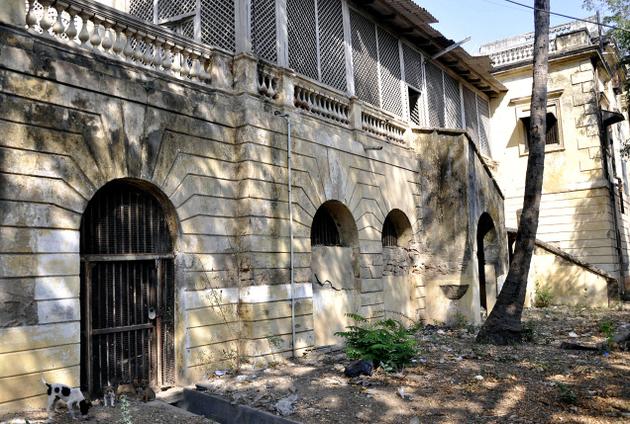
Sentinel of history:The prison inside the Residency building, which is now the Koti Women’s College, where it is believed that Jamedar Cheeda Khan was kept.
Immediately after the escape, the British authorities offered a reward of Rs. 5,000 to anyone who could apprehend Turehbaz Khan.
Within a few days, many believe that it was on January 24, 1859, when Turehbaz Khan was shot in the forest of Toopran by Talukdar Mirza Qurban Ali Baig. As a reward, the Talukdar received Rs. 5,000 and his salary was also raised by Rs. 200.
He was also promoted as Sadar Talukdar, say historical accounts.
The cricketer, who whacks the ball around the stadium ruthlessly, is extremely gentle while dealing with animals. Pathan works with the NGO Gujarat Society for Prevention of Cruelty to Animals
The brutality with which he smacks a cricket ball makes Yusuf Pathan appear ruthless. There’s little or no expression on his face as he wields his willow. But under it all, there is a very soft spot. The one he reserves for animals.
Yusuf accepted our invitation to supper at Port Elizabeth, where India was playing a one-day international against South Africa. With Discovery Channel running in the background, he started talking about his favourite animal – the lion.
When the word ajeeb — perhaps not the most accurate one — was used to describe the king of beasts, he subjected us to a terse lecture. “How can you use the word ajeeb? Have you taken a close look at it? It’s truly a wonderful creation of Allah,” he thundered. Yusuf then went on to describe his encounter with a lion inside Johannesburg’s Lion’s Park.
“We were following this really magnificent creature. Suddenly, it turned and pounced on the car, stood on the jeep’s bonnet and stared at us through the windscreen. Its face with the full mane was awesome.
As it opened its mouth and roared, I could only think of the prey it must have devoured. The lion stood on the vehicle for three minutes and those three minutes were like three hours for us.” The calm Yusuf brings to the crease and the instinct that takes over him when he’s attacking bowlers are perhaps traits he shares in common with the animal he so loves.
This incident was an insight into the man’s love for his environment. He said he inherited his passion from an uncle. “My late maamu, Azizul Islam, was really fond of wildlife. Whenever possible, I would tag along with him on his excursions into forests.
That is how I got hooked,” he says. Initially, Yusuf says, his abba didn’t approve of him bringing animals home. But gradually, he too started loving them. “Now, when I’m not around, he takes care of them.”
The life of an Indian cricketer alternates between various stadiums around the world and the plush environs of multi-starrer hotels.
The first thing Yusuf does when he gets into his hotel room is surf for Animal Planet, which needless to say, is his favourite channel. “I don’t like watching movies. Animal Planet or Discovery is all I want in my spare time,” he says.
Whenever he tours abroad he shops for items that come in handy for a night out in the jungle. “I’ve spent nights out in deep forests and it is the most wonderful of experiences. I usually carry three to four pairs of clothes, a small tent and a torch.
To be honest, I’ve managed to spot only a few wild cats in Gujarat till now. The moment I find time, I will be off to Ranthambore or Gir to see the big cats,” he says.
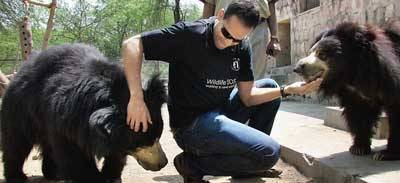
But his love for animals is not confined to watching wildlife. Snehal Bhatt Bhavsar, who works with the Gujarat Society for Prevention of Cruelty to Animals (GSPCA), is full of tales of the work Yusuf does with her NGO. She says that even before Yusuf became a household name, he would often volunteer for GSPCA and take great interest in rescuing animals, even taking them home to nurse them back to health.
“He has answered our calls in the middle of night and driven around with us to rescue abused animals. It doesn’t matter if it’s a dog, a chicken, a goat, a horse, a pigeon or a baby owl. He’s always there.
He takes the animals to his farm house outside Baroda, treats them and then releases them. He currently has a couple of horses there and really loves them although he has been kicked hard by one of them once,” she says.
Bhavsar says that when chickens were being culled mercilessly during the bird flu, Yusuf was so disturbed that he would plead with people to stop the killing. “When I visited his old house, there was an open air chicken shop on the same lane.
I couldn’t stand the ghastly sight. I pointed out to Yusuf that this was happening right outside his house even though he cared so much for animals. The next time I went there, the shop had disappeared,” Bhavsar adds.
Yusuf says, “I love all animals. Like us, Allah has given them life. What I really like about them is their wafaadari (loyalty). If you give them love, despite their inability to speak, they reciprocate in their own ways. It is so touching and tells you about the greatness of God and how he has balanced things so wonderfully in this world. It’s only we humans who don’t understand.”
source: http://www.punemirror.in / Pune Mirror / Home> Others> Sunday Read / by Ehtesham Hasan / February 06th, 2011
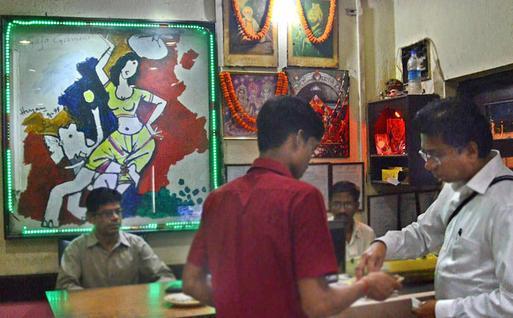
The wall of the Azad Hind Dhaba in Kolkata adorned with M.F. Husain’s Gaja Gamini. Photo: SUSHANTA PATRONOBISH
The now-famous painting, titled Gaja Gamini (one with a walk like an elephant), depicts a dancing woman, in a bright red background, while a white elephant looks on with its trunk held aloft
The memory of seeing M.F. Husain colouring one of his sketches back in 1999 is still fresh in the mind of Madan Sharma, one of the owners of Azad Hind Dhaba, a popular eatery in south Kolkata.
One fine afternoon years back, Mr. Husain walked into the dhaba, which he frequented during his visits here, and all of a sudden started adding colour to the black and white sketch on the wall that he had drawn three years before.
“The experience made me speechless,” Mr. Sharma said, on the eve of the 99th birth anniversary of the iconic painter.
The now-famous painting, titled Gaja Gamini (one with a walk like an elephant), depicts a dancing woman, in a bright red background, while a white elephant looks on with its trunk held aloft. Mr. Husain arranged a private show of his film Gaja Gamini at Azad Hind in 1999.
Sitting at the cash counter with the painting behind him, Mr. Sharma fondly recalled his memories of the famous artist. He remembers Mr. Husain as a “moody and humble person” who would come to the restaurant and sit quietly in one corner sipping his favourite “kadak chai [strong tea].”
“He did not talk much. But sometimes told me what kind of food he wants,” Mr. Sharma said. He was initially apprehensive of talking to an artist of Mr. Husain’s calibre, but eventually they became friends. “Mr. Husain could mingle with adults and children with equal ease. He was totally devoid of arrogance.” Whenever schoolchildren spotted him at the eatery, they flocked to him and asked for autographs. The world-famous painter complied with their demands with a smile and even drew them impromptu sketches.
When asked about the controversy that erupted in 2006 over Mr. Husain’s depiction of Hindu gods and goddesses, Mr. Sharma said the thought of removing the painting never entered his mind. “Nobody asked me to remove the painting even when the controversy erupted.”
Mr. Husain eventually had to leave the country under pressure from Hindu nationalist forces. He passed away in London in August 2011.
Meanwhile, the dancing woman with an elephant walk lives on happily on the central wall of Azad Hind Dhaba, in the company of numerous Hindu gods and goddesses.
source: http://www.thehindu.com / The Hindu / Home> Features> Friday Review> Art / by Soumya Das / Kolkata – September 17th, 2014
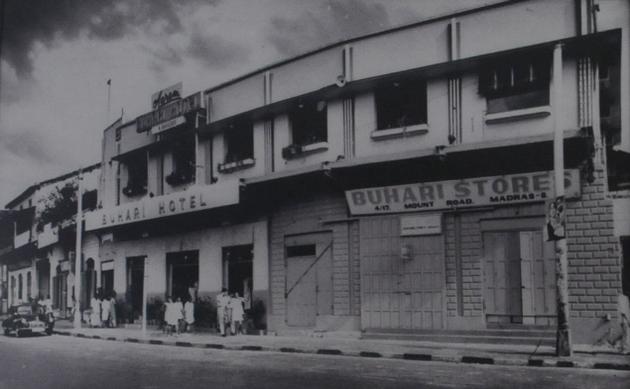
The Anna Salai branch of Buhari Hotel is its most famous — Photo: Special Arrangement / The Hindu
When Buhari hotel on Anna Salai threw its gates open to the public in 1951, it ushered in a number of firsts: espresso machines making cup after cup of steaming coffee, a jukebox playing tunes of the times, and cutlery and crockery brought from London to give a “fine-dining experience to Madras’ foodies.”
A.M. Buhari, who brought the mildly spiced, fragrant biryani from Colombo, was a pioneer of sorts. Whether it was a boiled egg nestled in a bed of saffron-infused rice or Chicken 65 fried to perfection —called thus after the year it was created in, he set himself apart in the restaurant business early on.
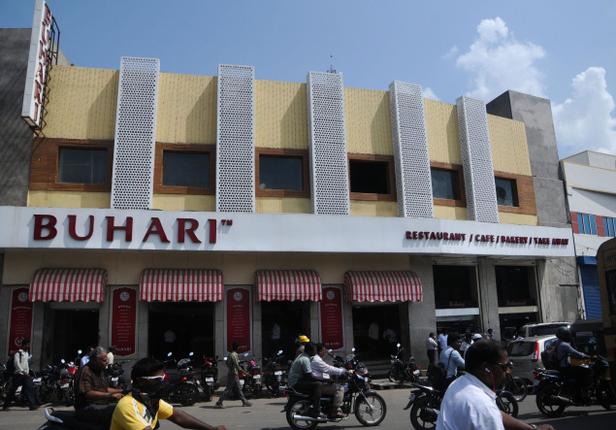
Buhari Hotel’s Anna Salai branch is its most famous — Photo: R. Ragu / The Hindu
The brand Buhari that has now become synonymous with biryani in the city emerged out of 200 different blends Mr. Buhari experimented with.
As a ten-year-old, Mr. Buhari had to leave his village in Tirunelveli district and go to Sri Lanka. After a self-sponsored education, it just took a few years to figure out his calling. Starting with trading in food and groceries, he finally set up Hotel De Buhari in Colombo and introduced the brand’s eponymous dish.
“My grandfather then wanted to return to India and came to Madras to set up Buhari,” says Nawaz Buhari, who currently heads the original branch. Today, the brand has proliferated with nine branches in the city and is looking to set up four more in the near future.
1956
A.M. Buhari introduced a jukebox and a espresso coffee machine at the Anna Salai branch
1965
Chicken 65, a deep fired chicken dish with telltale red colouring, was introduced at the hotel
1996
The one-man show by A.M. Buhari ended, after a 45 year period with his death
Did you know !
Actor M.G. Ramachandran loved the special almond chicken soup and the cassata icecream from buhari so much that a parcel of both was frequently requested to be delivered to his house
While the Anna Salai branch is its most famous, the one at Marina, set up in 1956, became the popular hangout of the 60s and 70s.
Seventy-year-old A.H. Lathif, as famous as the restaurant, has worked in the restaurant for 54 years. “I have served actors Raj Kapoor, Sivaji Ganesan and Sridevi,” he says.
Having lost the branch at Marina beach in the 80s, and the one opposite Central station very recently, the brand, headed by the patriarch till the time of his death in 1996, is now run by the family’s third generation.
With the increase in the number of branches, there are, predictably, differences in the quality and taste of the biryani. “The family has taken a decision to never go for the franchise model of business, because we cannot compromise on the brand image my grandfather worked so hard to build,” says Mr. Nawaz Buhari.
source: http://www.thehindu.com / The Hindu / Home> News> Cities> Chennai> Madras 375 / by Evelyn Ratnakumar / Chennai – August 13th, 2014
People entering Taj Mahal complex for prayers on Fridays will now have to carry identity documents, according to a directive issued by Archaeological Survey of India (ASI) following a complaint that non-Indians were also entering the mosque despite it being closed for visitors.
The directive, issued by ASI’s Agra unit superintending archaeologist N.K. Pathak on Thursday, has, however, received criticism from Taj Mahal’s Mosque Committee which has said that no Muslim, irrespective of nationality, can be stopped from offering prayers at the mosque.
The local ASI unit had received a complaint that an Indian Muslim had allegedly brought five Bangladeshi nationals along with him to Taj Mahal’s mosque last Friday, leading to a row over as to who all should be allowed inside the mosque.
The ASI authorities claim that the body’s Director General has ruled that only Indians should be allowed to enter the mosque to offer prayers on Fridays, when the monument is closed for visitors.
The Taj Mahal Mosque Committee President Ibrahim Hussain Zaidi, however, criticised the directive and said Muslims should not be discriminated on the basis of nationality.
“The Gazette notification of January 1, 2001 issued by Government of India states that Muslims will be allowed to offer prayers at the Taj mosque on Fridays even though it is closed for visitors. Nowhere does it say that Muslims of other nationality should not be allowed,” he said.
Reacting to Zaidi’s criticism, ASI caretaker at Taj Mahal Syed Muazzar Ali said that the mosque committee has no locus standi on the matter.
source: http://www.thehindu.com / The Hindu / Home> News> National> Other States / PTI / Agra – December 27th, 2014
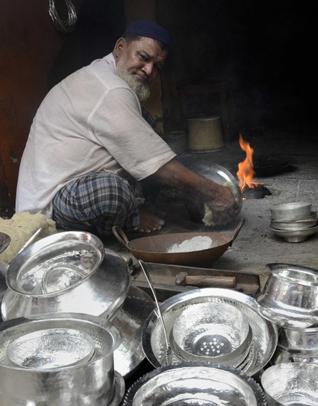
In a sharp contrast to the sweltering heat, a smiling Mohammad Faisal picks up a huge cooking vessel called degh with his right hand, and applies hair-thin Malaysian tin foil on it. Then, with a thick pad of old cotton soaked innausadar (ammonium chloride) ash, he moves the foil within the vessel, while rotating a fixed iron fan on the floor with his left hand. The result: within minutes an ultra shining degh is ready. This polishing technique is called qalai – a tin polish done only on copper and brass utensil.
Faisal is perhaps the last of this generation who inherited this craft from his grandfather Mohammad Sharfuddin, now 82. His uncle Irfan is managing shop No. 1132 at Matiya Mahal Bazar called Qalai Ghar. It is a nondescript shop in a row of attractive ones, except that it draws attention with its shining vessels – from a small bowl to a degh with 80 kg capacity.
The shop has three naand or pits full of water, as big as the bottom of an 80 kg degh , in which it is immersed slowly, soon after the hot tin foil is rubbed on it. After the wash the shine is exemplary.
Says the 52-year-old Irfan: “This shop is 150 years old but we have been in the business of qalai for about 80 years. We learnt it from our father. For now we have quite a lot of work, especially because in Old Delhi, people still keep brass and copper utensils in their homes and also gift them at weddings. Moreover, Karim Hotel gives us its qalai work every two months – we polish their 70 to 80 big and small utensils and this work remains our main source of income.”
Mohammad Irfan charges as little as Rs.20 for a small bowl measuring three inches in diameter to Rs.800 for an 80 kg degh .
Earlier, Delhi’s Bhogal and Sundar Nagar used to be the hubs for qalaiwalas; some of them can still be located in small corners. Muslim Punjabis or sadagars from Pakistan are the main users of copper and brass utensils and most of them live in Old Delhi.
The Walled City used to have as many as 10-15 qalai shops earlier. Three of the big ones were located at Turkman Gate. One of these closed during the Emergency, another one some 25 years ago, and the third one vanished without a trace, say the area residents.
Qalai Ghar too may close down in a few years from now. Sharing the reason, Irfan says: “I have not taught this skill to my three sons. They sell ready-made garments. This business may not grow in future.” He had also stopped getting ‘boys’ as trainees nearly “40 years ago”. Then inflation has also affected the skill adversely. “Earlier wood coal used to cost me Rs.3 per kg, now it is Rs.35. Earlier, a tin foil used to cost Rs.7, now it comes for Rs.1,800. Moreover, the work needs high energy levels, as we are constantly exposed to heat, fumes and our hands do not stop working for almost eight to 10 hours every day.”
There has been no technology invented to keep this skill alive either. Technology, says Irfan, is a far cry because utensil sizes vary. “How many machines can be invented to polish the vessels of all sizes and thickness,” he asks.
Though now almost all five star hotels, especially in the Capital, have again started using copper and brass utensils for health reasons and for showing a ‘connect’ with the Indian roots, yet that hasn’t got people like Irfan going.
Notably, the food cooked in an unpolished brass or copper utensil becomes poisonous, and so is the water kept in one. But some families with diabetic patients still use copper vessels for health benefits. But this is not enough to sustain the waning skill either.
The Walled City however, still has a few qalai walas . A couple of them are pheriwalas who go from door to door; a few have fixed shops at Uncha Charagh, Tazana House and Kala Mahal; while one sits on the footpath at Chandni Mahal.
Veteran Sharfuddin warns: “One should not go for pheriwalas as they do ‘duplicate’ work. They use solder rod foil (used for stitching in electronic goods), while the genuine polish can be achieved only through Malaysian tin foil which is expensive. If you rub your finger on fake-polish utensils, they will turn black, while rubbing finger on genuine polish won’t.”
source: http://www.thehindu.com / The Hindu / Home> National> Other States / by Rana Siddiqui Zaman / New Delhi – September 09th, 2014