At Saad Bin Jung’s luxury eco-tourism lodge in Kabini, Karnataka, villagers and tribals work together to conserve the forest and the big cats that inhabit it
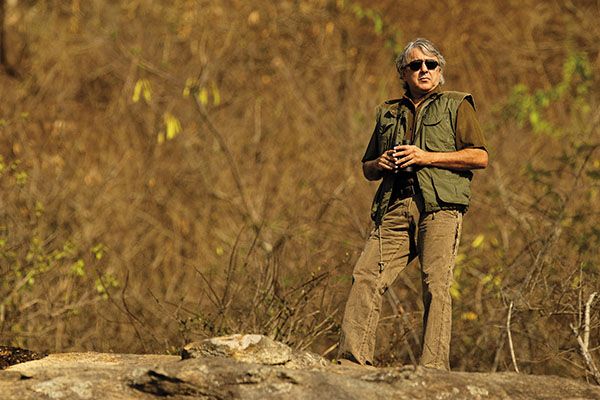
Image: Shaaz Jung A new calling: Saad Jung believes in eco-tourism that conserves more than animals
As the last rays of sunlight filter through the leaves, a shadow slinks out of the thick foliage with an unmistakable feline elegance. “There,” whispers 27-year-old Shaaz Jung from his perch atop a jeep. Immediately, seven pairs of eyes turn to the clearing ahead. Under the rapt gaze of the tourists, a male leopard emerges from the foliage. A flurry of clicks from SLR cameras breaks the silence of the waning dusk. But the leopard makes an indifferent model. He was aware of the jeep the moment the vehicle entered his territory, deep in the jungles of Karnataka. For the tourists, however, this sighting is a privilege. The shy animal deigned to make an appearance on the last of the five game drives organised by Bison Wildlife Resort near Kabini Lake, Karnataka. The resort, started by Shaaz’s father, 53-year-old Saad Bin Jung, lies between two national parks, Nagarhole and Bandipur, and is a two-hour drive from Mysore. It is also a labour of love, one in which villagers and tribals work with the Jungs to conserve and preserve this ecologically vibrant zone.
Though the eco-resort opened five years ago, it took over a decade to come to fruition. Consider its back story.
Like his uncle Mansur Ali Khan—the late nawab who is remembered by his moniker ‘Tiger’ Pataudi—Saad Jung started his career as a cricketer. A descendant of the royal Pataudi family of Bhopal and the Paigahs of Hyderabad, he acknowledges and accepts the popular portrayal of Indian nobility as hunters. “I now realise the mistakes we made while addressing wildlife conservation within the forests that belonged to our family,” says Jung. “The rulers, to a large extent, permitted community usage of forest produce. Locals were asked to manage forest land, but were banned from hunting. That was the sole prerogative of the royals. There was control, but there was also inclusion.”
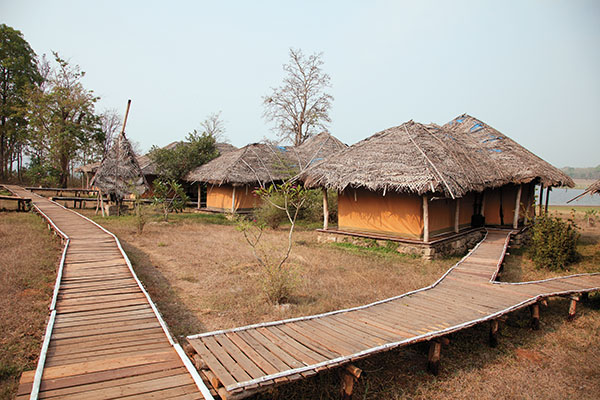
Image: Prasad Gori for Forbes Life India The village: The resort maintains a rustic look and feel, although it houses luxurious facilities
Saad began taking an active interest in conservation in 1986. He started with Bush Betta Resort at Bandipur and an angling camp on the Kaveri river soon after. In 1997, he acquired patta (registered) land outside the protected forest area and worked with locals to build a luxury resort, one that doesn’t intrude on or disturb the ecologically sensitive zone. The Bison Resort, made up of African lodge-style stilted, elaborate tents and decks that overlook the forest and Kabini lake, is the result. Most of the building material for it was sourced locally. Rather than alienating tribals and villagers from the land, Saad brokered a symbiotic relationship between resort and village.
The Bison, which opened in 2009, has succeeded because it combines luxury with inclusive growth. Saad and Shaaz, who is the resort manager, create a rustic yet opulent experience. From sunken showers in bathrooms to bars that overlook the lake, the resort delivers a unique kind of grandeur—one that typically costs more than Rs 10,000 a night for Indians and Rs 24,240 ($400) a night for foreign nationals. Most employees are locals and their intimate knowledge of the land heightens a visitor’s experience.
source: http://www.forbesindia.com / Forbes India / Home> Forbes India/Live / by Shravan Bhat / August 16th, 2014
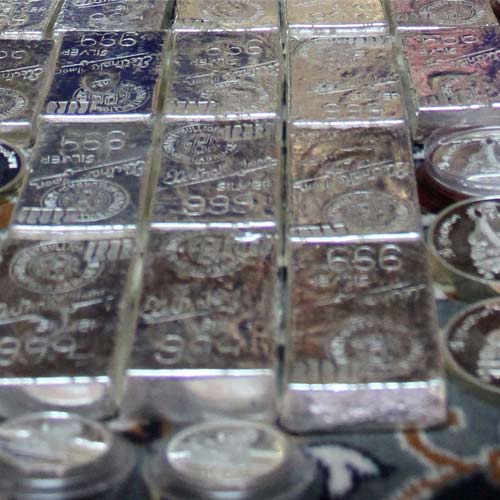
A total of sixty-one Mughal-era silver coins with Arabic inscriptions imprinted on them have been found from an earthen pot near the bank of river Ganga in Cantonment area in Kanpur .
The coins were found last evening when a few kids had gone to the river Ganga’s wharf in Cantonment area to take bath where they found an earthen pot filled with shining coins in it, police said.
Ram Kishan Das, a priest at the wharf, after knowing the incident, informed police and Army officials which then took the relics under its authority and has informed Archaeological Survey of India about the coins, Major CP Bhadola said.
ASI has conducted a search at the site and sent a preliminary report to their Lucknow office, an official said.
“The coins have some inscriptions on it in Arabic script, we are guessing that these might belong to the Mughal era,” ASI officer Manoj Verma said.
source: http://www.dnaindia.com / DNA / Home> News> India / Place: Kanpur, Agency: PTI / Saturday – September 13th, 2014
Centuries before Peter Stillman the elder, the eccentric/insane professor in the first part of Paul Auster’s The New York Trilogy, had conducted a ghastly linguistic experiment on his son by locking him up in a dark, empty room from birth to find out his ‘natural’ language, a famous Indian emperor had supervised a similar research in real life. In the outskirts of Fatehpur Sikri, Akbar kept a ‘dumb house’, where babies were reared by dumb wet nurses: the emperor wanted to ascertain what language they would speak once they grew up under these laboratory conditions. Disappointingly, the experiment failed, and the children were found to have acquired no god-given or natural language when they were visited a few years later.
This incident may suggest that Akbar was a cruel man but the moral judgment would overlook his keen scientific temperament — this disposition had also led him to order the mating of a goat and a deer. The same urge to look beyond the given and to find out what happens when boundaries are crossed must have inspired him to create Din-i-Ilahi, the syncretic religion that still speaks volumes for that progressive man who could think of a faith combining elements from several existing religions in the 16th century. Akbar’s character, as analysed by Lucy Peck in FATEHPUR SIKRI: REVISITING AKBAR’S MASTERPIECE (Roli, Rs 795), is as intriguing as this palace complex built by the emperor over years and then, suddenly abandoned. Peck revisits the old mystery surrounding Akbar’s unexpected moving of court from Fatehpur Sikri, and although she doesn’t join the dots, the solution seems to lurk somewhere in the emperor’s character rather than in material causes, like the alleged shortage of water there.
Peck’s Akbar is an artist, with all the attendant symptoms and characteristics of artisthood. He seems perfectly capabale of believing six contradictory things before breakfast. However, that may well be because the Akbar about whom we read now is a construct of texts by three different people with different agendas — Abul Fazl, who is all-praise for the emperor; Badauni, who, displeased by Akbar’s religious tolerance and out of favour in the court as a result, is embittered; and the Jesuit priest, Monserrate, whose account is seemingly unbiased because it is by an outsider. Sifting through their stories, Peck presents a flamboyant Akbar whose interests range from block-printing, carpet-weaving, taming elephants, flying pigeons to settling his subjects’ disputes hands-on, debating tirelessly on religious issues, sometimes throughout the night. He is possibly an epileptic — given his frequent trances — a dyslexic and an opium eater, subject to bingeing bouts. He spends nights meditating alone on a rock, seeking answers to life’s questions. Add to this driven, excessive nature the emperor’s prerogative, and one can begin to fathom why, for instance, he ordered the dumb house experiment or built a place like Fatehpur Sikri, with its eccentric blend of varied styles, its mix of austerity and extravagance. As Peck writes of the buildings of Fatehpur: “[They] reveal themselves to be remarkably disparate. One can well imagine Akbar hearing about or seeing an unusual building and saying, ‘I’ll have one of those.’”
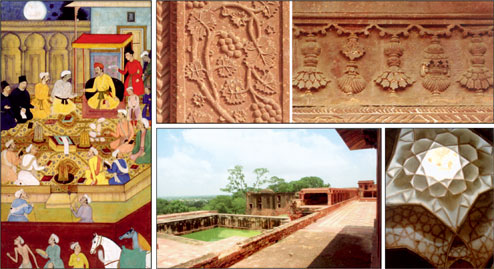
Top right is an illustration of the diverse designs that come together in Fatehpur Sikri. The grapevines look European while the pattern on the right panel resembles the stringed decorations that Hindus hang from the top of door frames on festive occasions. Left shows Akbar in the Ibadat Khana, where he held the discussions with people of other faiths that eventually resulted in Din-i-Ilahi. Bottom left is the tank on the banks of which Akbar’s courtiers had met on the emperor’s birthday in 1582 to celebrate the occasion with games of chaupar, chess and cards. Akbar had looked on with mixed feelings at such frivolities until disaster struck: a side of the tank collapsed and the water swept downhill, washing away settlements. The breathtaking ceiling of the Royal Baths is on bottom right.
source: http://www.telegraphindia.com / The Telegraph, Calcutta / Front Page> Opinion> Story / by Anusua Mukherjee / Friday – September 05th, 2014
Historian and painter Rehman Patel says illustrations on the political and social history of India are included on either side of the map. / The Hindu
The map is included in an atlas produced by Colonel Jean Baptiste Gentil, Military Adviser to the Nawab of Awadh Shuja-ud-Daula
In exciting news for historians, an ancient atlas, which includes a map of Bidar, prepared by French officer Colonel Jean Baptiste Gentil, Military Adviser to the Nawab of Awadh Shuja-ud-Daula (1763 to 75), was found tucked away in the India Office Library at London. The map shows Bidar, which was once a capital city of the Bahamani Kingdom and an educational centre with historical importance.
Historian and painter Rehman Patel, who reproduced the map, said that in the interests of preserving the historic post and throwing more light about the history of the Bidar and its cultural heritage, the State government should put pressure on the Union government to bring it back to India and place it in Bidar.
Illustrations
He added that Col. Gentil had utilised the services of local artists to produce a series of illustrations on the political and social history of India.
Dr. Patel pointed out that illustrations were included on either side of the map. They reveal the representatives of different Sufi orders and thick forests with drawings of wild animals. These drawings also include Bidri craftsman and the different wares that were produced in Bidar. The bespectacled artisan at the bottom left of the page is portrayed as engraving a floral pattern on the side of a globular huqqa, with his wife and pet parrot looking on.
The illustration is reinforced by having a caption: ‘Fabrique de Beder ou on incruste en or et argent’ (Beder workshop for inlaying in gold and silver).
At the bottom right corner, there is a drawing of the types of wares produced: ‘vases incrustes’, or ‘inlaid vessels’. These include a globular huqqua on a stand, a bell-shaped huqqua, spittoons, boxes, a ewer and wash basin.
Reference to Bidriware
Dr. Patel said so far, the earliest unambiguous reference to Bidriware was in the Chahar Gulshan, written in Persian in 1759 AD. This includes a statistical account taken, on internal evidence, from an earlier compilation of about 1720 AD.
Book II of the Chahar Gulshan is ‘an account of five Subhas (administrative divisions) of Deccan’, one of the five being Bidar, referred to by its Bahmani and Mughal names. A manuscript in the British Library has the following passage: ‘The subah of Mohammadabad called Zafarabad (Bidar).
Bidar was also known from an illustration in an atlas produced in Faizabad, Uttar Pradesh in (1770 AD) under the Nawab of Awadh (Oudh) Shuja-ud-Daula, who ruled from 1754-75 AD. During this period, Bidar was under the control of Muhammad Ghauth Saif-ud-Daula, but he died shortly after his appointment, and his brother Saif Jang Najm-ud-Daula Bahadur became the governor in his place.
Dr. Patel said that enquiries at the office of the Deputy Commissioner in Bidar revealed that the district administration did not have a copy of the manuscript and the atlas produced by Col. Gentil.
source: http://www.thehindu.com / The Hindu / Home> News> National> Karnataka / by T. V. Sivanandan / Gulbarga – September 01st, 2014
The district administration has initiated steps to restore the Moti Jheel that is located behind Fatehpur Sikri fort complex, following the directions from the central government.
The project is aimed at rediscovering the beauty of this Mughal lake by preventing encroachments and settlements around it. The union tourism ministry wants the water body to be restored near the Unesco heritage site (Sikri fort complex) so as to promote tourism in the area.
Speaking on this aspect, district magistrate Pankaj Kumar said, “The Moti Jheel is a massive project. So, in the meantime we plan to build a pond nearby the fort. The biggest obstacles that would make the task of reviving the Jheel quite difficult, are the settlements and farm lands, surrounding it.”
“The work for constructing the pond will start in the next 15 to 20 days. As far as the Jheel is concerned, we have two options – either we compensate the villagers and ask them to vacate the land or convince them for the same. We are looking in to the matter,” Kumar added.
Sources said kumar recently conducted an inspection of the area along with a team of revenue and irrigation department officials to identify the area, where once this lake existed. The officials were asked to demarcate the lake area with the help of old maps. They were also directed to file a report on the size and appropriate depth of the lake.
The project has been gathering dust for the last two years, but revived once again during the visit of union tourism minister Shripad Naik, who instructed the ASI and the local administration to look into the feasibility of restoring the Moti Jheel.
An ASI official said, “It is the responsibility of the administration to restore the lake. There are historical evidences about the Jheel and about its tributaries. No doubt, it will take time to acquire land before restoration work can starts.”
source: http://www.timesofindia.indiatimes.com / The Times of India / Home> City> Agra / Aditya Dev, TNN / August 25th, 2014
Feisal Alkazi, author of Srinagar: An Architectural Legacy talks to Payel Majumdar about Kashmir’s multi-racial architectural heritage, its existence as a periphery kingdom, and its 777 gardens.
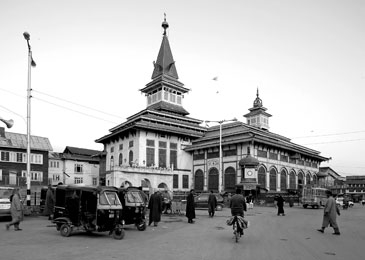
Khanqah-i-Muallah, with its traditional Kashmiri pagoda-style spire
Could you tell me how this book came about?
A. I have been in and out of Srinagar for the Rajiv Gandhi Foundation, that runs a rehabilitation programme for children whose parents have been killed by terrorists. I ran a project called “Discovering Kashmir” with them over a period of three-four years. This was my first set of trips to Kashmir, and I became interested in its heritage, its unique history, its sections of Buddhism, Hinduism and Islam. Then INTACH’s Delhi office got in touch with me about writing this particular book because of my background, based on the listings (what INTACH does is list about 500 buildings, a group of architects go around and write a description.) They felt a self-directed guide book based on these listings had great potential.
Q. History is often looked upon as a dry subject. Do you think this is something that needs to be addressed within our education system?
A. With young people, my work has primarily been about making history come alive. I have worked a lot on heritage education, and I think it is very important that we stop teaching history as a lot of dates to cram up. Very often when I work with young people, I start with, “What in your house is 50 years old?” Then they start thinking, woh bartan hai, woh kursi hai. This is how we start with personal histories, and then we arrive at the history of a nation. Heritage education is about looking back at our roots, because we have this collective sense of what makes us Indian, whether it is something as simple as tandoorichicken or cricket. So what is it that we perceive as being Indian, and ourselves? How is someone who lives in Jaipur, different from someone who lives in Delhi, different from someone who lives in Srinagar? Every place has its own unique stamp. And I’ve done this exercise for 25 years.
Q. Three aspects of Kashmiri architecture that fascinates you?
A. One, that so much of Kashmiri architecture was done without cement. You can’t think of any building these days without cement. And if you think of the buildings there — sufi shrines like Khanqah-i-Muaallah or the other sufi shrines, they structure the building in a way that the weight of it keeps it down, using deodar logs with bricks, and building a whole structure without concrete. Another aspect of the traditional structure is that all buildings are earthquake proof, for it is a seismic zone. They use these diagonal members, like how they use in Simla — very rarely do you have buildings where horizontal and vertical beams aren’t in use. And then there are these very specific features — how they use papier mache in the decoration of walls, or the idea of the balcony — the dub — which is always wooden. These structures have been there since the 15th-16th century. You might replace the knobs, but essentially the structures are unchanged. You have those Maharaja bricks as well, which you see in the Old Delhi.
Q. How are gardens a crucial aspect of Kashmiri architecture?
A. Kashmir held a strategic position for the Mughal Empire because the main cities were Delhi, Agra and Lahore. All the early Mughals never built palaces, because they lived inshamianas. Theirs was a moving, transient culture. When the Emperor annually moved out of Delhi, 65% of the population moved with him. 2,00,000-3,00,000 people were on the move and there would be two travelling tented cities, one that the Emperor would stay at for the night, and one that would be set up ahead for the next halt.
{
When the Emperor moved out of Delhi, 65% of the population moved with him. 2,00,000-3,00,000 people were on the move.
There is no flat land in Kashmir where you can pitch tents for these many people. To accommodate the Emperor’s entourage the gardens came up with pavilions and palace tents. There is the whole structure of the Red Fort in the royal gardens of Kashmir—Diwaan-i-khaas, a diwaan-i-aam, a zenana, a mardaana. There would be two or three pavilions — like the one in black marble in Shalimar Garden — around which colourful tents would be pitched. They say that there were 777 gardens around the Dal lake. And Dal Lake was never the centre of the city. Gardens would be built because the soil is so fertile, that everything thrives in it under Kashmiri weather. The Mughals had come from Bukhara and Samarkhand, which also have prominent gardens. The very idea is crucial to Mughal architecture as a whole.
Q. How have the different rulers influenced different styles of architecture, and how have these architectural styles come together?
A. Architecture anywhere is an outcome of what is locally available as building material. Say, if in your vicinity there is a particular kind of tree, which becomes the building material, then you are limited by the height of that tree, the durability of that tree. For instance, for those khatamband ceilings in Kashmir, you use pine which is very thin, like plywood, that can be replaced, while the exteriors last forever.
So structures that come up traditionally reflect the surroundings completely and are built for that time. Kashmir was never the centre of an empire, it was the periphery of an empire. As a result, being on the periphery, too much of the architecture did not change. And when the Dogras came, in the last 110 years — when they bought it from the British for 75,00,000, they brought in a lot of British influences — the similarity of the Gothic arches, specific style of building, use of repetition, and the Kashmiri architecture since then is sometimes a combination of that and older traditions. There was hardly any Mughal influence on residential architecture. The Mughals created those pavilions in the gardens and created the gardens, one gateway and a couple of mosques. And really, the mosque Noor Jehan created was never prayed in, whether it was because it was built in stone, built by a woman, or by someone who wasn’t perceived to be Kashmiri.
Q. Are there ongoing efforts in Kashmir by the locals to preserve their architectural heritage proactively?
A. Certainly, the local INTACH chapter has done quite a bit. They have done a beautiful conservation job on the Aali Masjid. The government has stepped in as well to restore the temples in Martand; so yes, there is an interest in keeping that style of architecture alive. But builders come into question, and suddenly things change when money comes in from other parts of the world, which influences the whole thing. When Hazratbal was built in the ’60s, they decided to use a dome, which is a West Asian influence. A dome is not suitable for a place where it snows, marble is not a good for Kashmir which has three months of winter. But there were political pressures there, which decided not to use traditional Kashmriri three-tiered pagoda roof but build something that looked like it was out of the Middle East.
source: http://www.sunday-guardian.com / The Sunday Guardian / Home> Artbeat / by Payel Majumdar / August 23rd, 2014
Aliyeh Rizvi used to run a niche design store called Native Place many years ago. It encapsulated her love for handcrafted traditions, nostalgia and fading remnants of culture. She took to passionate blogging subsequently to revisit everything that Bangalore stands for. Native Place no longer exists as a physical space but it is now a “collaborative mind space that works to build awareness of Bangalore’s local history and culture through curated experiences, travel writing and city based collaterals. It explores ways in which information can be used to create meaning and build a deeper connect.”
In a chat with City Express, she talks about the many projects she has undertaken to keep the memory of a genteel city alive that is now being overtaken by change at every level.
Poignant memories
The best memories I have are of Bangalore’s trees and gardens, and a life lived among them. Avenues were awash with different colours all through the year, jacaranda petals fell on our shoulders as we passed. Large family picnics were organised in Cubbon Park and Lalbagh when the weather was good. I miss the beautiful bungalows that had lovely large gardens: fruits, flowers and scented plants. I miss the Queen of the Night that bloomed after sunset, scenting an entire lane with its fragrance. We made passion fruit juice and gooseberry jam from our own fruit trees and compound walls had moss! Which means it was traditionally a cold, damp climate where early morning baths were always accompanied by shivering!
A Turquoise Cloud
I blog and write offline about the Bangalore I grew up in, to save it from vanishing. The city is my home and I am rooted in it. My blog, A Turquoise Cloud, is an archive of information and stories about local culture, city people and our symbolic spaces. The city I grew up with was being knocked down rapidly and it was becoming increasingly difficult to connect with it physically. Houses I had played in were now hi-rise buildings. The local grocery store I stopped at for sweets after school had disappeared. Trees were cut down, roads had changed. Streetscapes in the city were altered forever. I felt a terrible sense of displacement in my own hometown. I could not recognise or identify with it anymore.
That’s why we old Bangaloreans spend so much time in sentimental nostalgia and B&W photographs. It’s our only way of coping with loss.
So where does one go to find this other Bangalore? I chose to recreate it online, where it can stay virtually untouched. ATC is a space where I create a context for the present through memories, images and stories of the city. I choose to focus on the present, by giving it a meaning through the past.
historical connect
One of my most memorable projects was as Curator, Centre for Public History, Srishti School of Art Design and Technology where I co-facilitated a successful Public History Project titled ‘The Tiger Comes to Town’ to commemorate the 150th anniversary of the Archaeological Survey of India. The focus was the Bangalore Fort in Bangalore’s busy Kalasipalayam area and its role in local history during the 18th Sultanate, the time of Tipu Sultan, and the Third Anglo-Mysore War of 1791.
It aimed to reconnect the public with their local heritage sites through deeper engagement, build awareness and instil pride in the same. It combined elements from oral history, design, academic enquiry and performance so students could look at multiple ways to engage with the site during the course of the project. The outcome was a true city project in more ways than one.
breakfast specials
One of my most popular posts was the Bangalore Breakfast Special, since the and the eating out-breakfast tradition is so unique to our city. I wrote that Bangaloreans love their breakfast and discuss it intensely.
Replies flooded in with suggestions to try other favourite joints, NRIs posted with intense nostalgia for iconic restaurants mentioned, more discussions about food happened, vows to visit, and even arguments over the best idlis-and dosas! Like I said, we are obsessed with our tiffin! It is always wonderful when people write in with comments and stories of their own, volunteer to share information and photographs.
We also have a page on Facebook for daily interactions and information. The blog allows you to access information by usage (eat, breathe, know) and geography (north, south, east). All posts are research intensive and constructed to provide comprehensive information, painstakingly collected, in one place.
It often takes days to track down information, locate people or join the dots, but it has to be done. In this space, I can now see the Bangalore I know and love.
Back to Native Place
Native Place is the seed of an idea which will hopefully grow into a larger organisation where people interested in the city can work together on creating new formats for city history and culture based projects- through documentation, interactions, performance and information based collateral.
Perhaps knowing a little more will build a relationship, create protectiveness and then generate the ownership we require so badly right now. Our website will be up soon and city based activities will hopefully start with the onset of the festive season.
source: http://www.newindianexpress.com / The New Indian Express / Home> Cities> Bangalore / by Express News Service / August 19th, 2014
The aircraft lands on a narrow piece of land that leads straight to a valley. And that valley was where an ill-fated aircraft had crashed a few years ago. That is all I could think of during my descent into Mangalore. I held onto to the sides of the chair and hoped that I would live. It was a smooth landing and for once I was grateful for that sharp brake. Once out of the airport, I caught a cab and headed out to the hotel.
But I wasn’t ready for what was coming next. On steep roads, swirling down the hill was like going down a softie curl. And then my first glimpse of the glimmering city. It looked beautiful.. laid out in front of me like a carpet of twinkling lights. I passed by a group of people – a large family with adults and children. I wondered what they were doing so far from the city at 9.30 pm, and then I saw a plane in the distance. It made sense. With heads lifted and upturned faces, they watched the flight come closer and got their fix of the day.
And that got me thinking about Mangalore. In my first 30 minutes here, I had moved from extreme fear to delight to warm-fuzziness. It had a small-town quality that made me wish for more.
Historically Mangalore is grand, Tipu Sultan had been here. It has had an important place in history. But what had happened to it now? Was it just another mid-sized city, now? I didn’t associate it with the grandeur of a big city or a city that had dynasties fighting for it. I associated Mangalore with crime and communal tensions, and that was all I knew about it. But surely Mangalore is much more than that.
The next morning, with just four hours before I made my way to Kasargode, the actual destination of the holiday, plans had to be remade. Maps were scrutinised and the reception lady thoroughly grilled. The plan was finalised- the day would include Sultan Battery, the College Chapel, the Mangaladevi temple and a stop at Ideal Cafe since everyone was raving about it.
The driver of my car was not from Mangalore. He had no clue where Sultan Battery was. He tried asking local people who didn’t seem to be very clear either, but were aggravated that I did not know how to pronounce the word ‘battery.’
Then Google Maps came to the rescue. On the way, Mangalore refused to let me get surly by tempting me with vistas of green spaces and simple but beautiful houses.
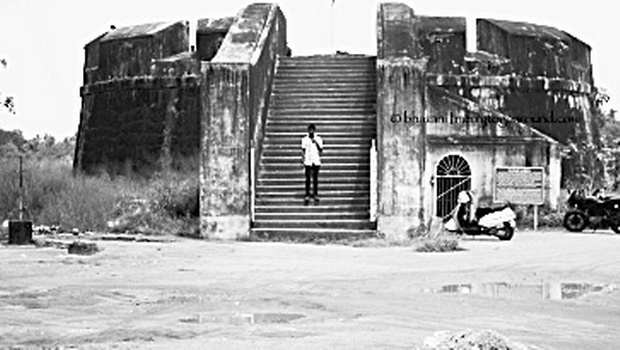
Sultan Battery is situated on a bend along a river as it snakes through to the sea. It seemed to have a very strategic position, overlooking both sides of the river. Built by Tipu Sultan, this was a watch-tower to see if anyone was crossing the river and coming over with dark intentions.
Built with black basalt rocks, with viewing holes lining the entire wall, the structure seemed almost too simple in today’s complex understanding of war and defence. But then you put on the perspective of more than 200 years ago, and it seems that the location was indeed perfect for the purpose.
With every dynasty’s uprise, there is growth and also destruction of legacies. Legend has it that the rocks used to build this watchtower could have come from places of worship though no one knows for sure.
There were a few ships next to the river and we decided to go and take a look. It was a ship-building yard. It took them three months of hard work to make just one ship and then she took off, to prove herself worthy of the toil.
I watched the imposing Vajralaxmi enter the water for the first time in awe. Though there were some other ships too that looked gorgeous. Funnily these ships looked battle weary even though they were all brand new. These were meant to serve as fishing trawlers and were not built to be gleaming and swanky.
I left Sultan Battery and made my way to the College Chapel. Again, no one knew where it was, and even Google seemed flummoxed this time.
It took me around 20 minutes to find a person who could give me directions. Important note to self: don’t call a chapel just a ‘chapel’, when it’s called ‘College Chapel’.
I got to go on a lovely personal tour courtesy the person-in-charge. The entire place is painted beautifully, and when I say entire… I mean every inch! What looks like marble at first glance is not, it’s art. What seems like a painting on a curtain and hanging on the wall, is also a painting. The illusions go on and on.
It was time for lunch and stomachs were grumbling all around. And so the next destination was Ideal Cafe! The food was okay, nothing exceptional but it was definitely the coolest restaurant in Mangalore and everyone with some time to spare seemed to be there.
The filter coffee that everyone praised was not that great. It had a rough, burnt taste with some of the coffee residue at the base. They say that’s how Turkish coffee tastes, so there might be some who like it.
But if you are someone with a sweet tooth, skip a meal to just have ice-cream at Ideal Café. It was simply fabulous.
The last stop in Mangalore was the Mangaladevi temple. This is the temple that Mangalore is named after, so it had to be seen. A large temple, it was quiet and peaceful all the more as it was shut for the afternoon. We weren’t allowed inside as the Gods were sleeping and so we were asked not to disturb them.
Mangalore was quaint. A neat and clean city that still seems enveloped in the past and happily so, given the rapidly changing face of every city in the country. I wouldn’t say it surprised me, but it didn’t disappoint. It was small, roads were relatively peaceful and the streets were still lined with houses exuding old-world charm.
source: http://www.newindianexpress.com / The New Indian Express / Home> Cities> Mangalore / by Bhavani Blogs / August 21st, 2014
Khasim Raza conquers Mt. Elbrus, wants to climb all ‘Seven Summits’ by 2017. Though the ascent to the base camp which is at an elevation of 10,000 ft by chairlift is easy, it took nine days for his five-member team and guide to scale the mountain.
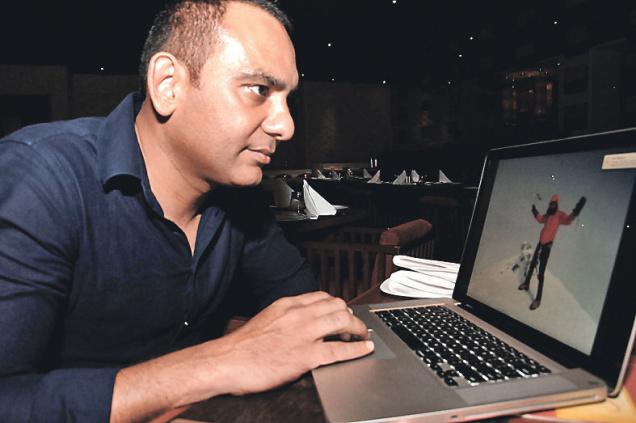
Vijayawada-born Khasim Raza made big news in the city when he climbed the Khilimanjaro, the highest free-standing mountain in the world. Now he is back in the limelight by conquering Mt. Elbrus the highest mountain in Europe. He plans to climb all ‘Seven Summits’ of the world by 2017.
It is the dream of every mountaineer to climb all seven mountains on the list. Mount Everest is the highest peak with an elevation of 29,020 feet. It is followed by Aconcagua (22,838 ft), McKinley (20,322 ft), Kilimanjaro (19,341 ft), Elbrus (18,510 ft), Vinson (16,050), Puncak Jaya (16,050 ft) and Kosciuszko (7,310). (The names of eight mountains are listed because there are two different lists of the Seven Summits. Mountaineer Bass lists Kosciuszko in his list, but mountaineer Messner lists Puncak Jaya in his list.)
Mr Raza did his schooling in N.S.M. Public School here and went on to become a British citizen.
He now operates with Dubai has his base. His father, owner of Metro Opticals in Gandhi Nagar, is one of the first opticians of the town. Mr Raza’s sights are trained next on Aconcagua, the second highest peak in the list, located in South America.
“Every mountain teaches you something. Kili (the affectionate way he refers to the mountain) taught me how to deal with wind speeds and high altitude, Elbrus taught me about cold. It is all snow and ice there,” he said.
Though the ascent to the base camp which is at an elevation of 10,000 ft by chairlift is easy, it took nine days for his five-member team and guide to scale the mountain. “We lived in accommodation that is similar to a container used for shipping goods. Every alternate day we went out on acclimatisation climbs. Unlike in Kili, the gradients on Elbrus are very steep,” he said. He says the view from the mountain slopes were really breathtaking.
Besides mountaineering, Mr Raza is every inch an adventure junkie. Just a couple of months ago he and some friends went on a cross-country cycling expedition in Cyprus. “I want to share my experiences to inspire youngsters to become more adventures and pursue challenges,” he said.
source: http://www.thehindu.com / The Hindu / Home> News> Cities> Vijayawada / by G. Venkataramana Rao / Vijayawada – August 09th, 2014
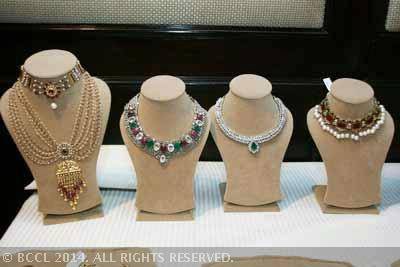
A decade after a strong pitch was made to shift the Nizam’s jewels worth millions of dollars to Hyderabad, they are still in the custody of the National Museum, Delhi and safe in the vaults of the Reserve Bank of India.
Hyderabad :
A decade after a strong pitch was made to shift the Nizam’s jewels worth millions of dollars to Hyderabad, they are still in the custody of the National Museum, Delhi and safe in the vaults of the Reserve Bank of India.
From 12 April to 27 July 2014, some of the jewels were displayed for the first time outside the country at the State Museum of Moscow, Kremlin.
For permanent display of the jewellery in Hyderabad, the state government even offered to look at different places in the city for a decision to be taken on where the permanent museum could be located. One was a building at the public gardens, another place that was considered was said to be on Road no. 3, Banjara Hills which was, however, ruled out due to security considerations, and another proposal was to buy land behind the museum where a building could be constructed for the permanent display of the jewels.
One location that was felt appropriate was the Dewan Devdi, where the Quli Qutub Shah Urban Development Authority (QQSUDA) office is located. Sources said there was, however, one hitch. The state government wanted the centre to pay for the land and premises. The union ministry of culture outrightly dismissed the idea. Since then, the proposal, which was at least being considered, has been in a limbo.
Some of the Nizam’s jewels were displayed for the first time outside the country last month in the State Museum of Moscow, Kremlin. The centre had acquired the famed jewellery in 1995 after a protracted legal battle with the heirs of the Nizams. For the first time, the dazzling jewellery was displayed at the National Museum in 2001. The 173 set collection comprising 348 pieces was brought to Hyderabad and displayed at the Salar Jung Museum the same year. Subsequently, for the second time, the exhibition was organized from December 31, 2005 to October 2006. This exhibition was followed by another exhibition at the National Museum, Delhi.
In 1991, the entire jewellery was valued at $ 162 million by Sotheby’s. The jewellery included the third largest diamond in the world — the Jacob diamond.
When contacted, Salar Jung Museum director A Nagendar Reddy said the state government would have to take the initiative to bring the jewels to Hyderabad and talk to the centre about it. “Even if we had to organize an exhibition like we did two times in the past, it may not be possible at the Salar Jung Musem. The Eastern block where the jewellery exhibition was conducted now has many galleries where several artefacts are on display,” he said.
Chief minister K Chandrasekhar Rao who is showing interest in organizing the Independence Day celebrations at the centuries old Golconda fort may also have to think of bringing the Nizams jewels back to Hyderabad for permanent display.
source: http://www.timesofindia.indiatimes.com / The Times of India / Home> City> Hyderabad / Ch. Sushil Rao, TNN / August 06th, 2014