Category Archives: Travel & Tourism

Tipu armoury will not be affected

Mysore :

Railway Minister Sadananda Gowda, yesterday, said that his Ministry has worked out a plan to lay a second track in the Mysore-Bangalore sector without disturbing the 225-year-old Tipu armoury near Srirangapatna Station.

Refusing to disclose details of the plan, he said that Railway Engineers had chalked out a plan and the track-doubling work would be completed by March, 2015 and maintained “If I disclose the plans now, there will be unnecessary hurdles as this is a sensitive issue and there is no dearth of people who want to rake up controversies.”

The work had hit a road block as the track was expected to pass through Tipu’s armoury. A proposal to relocate the armoury was met with opposition which resulted in the delay, he added.

Funds

Speaking about the funds for other projects in the State, the Railway Minister said that Rs.1,543 crore had been allotted for works that are underway in Karnataka and declared that there was no question of shelving any project initiated by his predecessorMallikarjuna Kharge.

source: http://www.starofmysore.com / Star of Mysore / Home> General News  / July 14th, 2014

Shah Jahan’s summer palace found near Taj

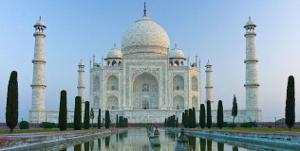
The Taj Mahal, built between 1632 and 1653, is regarded by many as the finest example of Mughal architecture.

Agra :

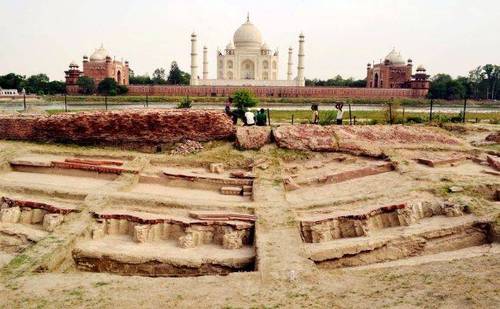
In an interesting discovery following excavations carried out by the Archaeological Survey of India recently, remains of a summer palace, presumably a baradari, a pavilion designed to allow free flow of air – have been reportedly found at the centuries-old Mughal-era garden Mehtab Bagh located opposite the Taj Mahal.

The garden was reputedly Shah Jahan’s favourite spot which he used to visit to get a view of the Taj at night, hence it’s name (Mehtab means moonlight in Urdu).

“The remains of the baradari-like structure have been found just opposite the Taj Mahal which strengthens our belief that the Mughal emperor must have built this place to enjoy the view of the Taj sitting near the bank of river.

The place seems to have sunk beneath the surface either due to floods or because of the presence of hollow space under the structure,” said a senior ASI official.

The excavated remains of the walls at the garden complex, situated on the opposite bank of the Taj Mahal in Agra. (PTI photo)

Incidentally, Mehtab Bagh has been associated with the myth of the black Taj which is believed to have been spun by guides to fascinate foreign tourists. According to the story, Shah Jahan wanted to build another Taj in black marble across the Yamuna and connect the two by a bridge. Mehtab Bagh is pointed out by some as the possible site where the black Taj would have come up.

“There has never been any historical evidence to prove the existence of a black Taj,” said the official.

During excavation work carried out between 1997 and 1999 at Mehtab Bagh, the ASI had found remains of a huge octagonal tank furnished with 25 fountains, a small central tank and a baradari in the east of the garden. “The present work is going in the south direction of the garden in the straight alignment of the Taj Mahal which makes the discovery an interesting one,” added the official.

source: http://www.timesofindia.indiatimes.com / The Times of India / Home> India / by Adithya Dev, TNN / July 02nd, 2014

A ‘Taj Mahal’ in Kuwait

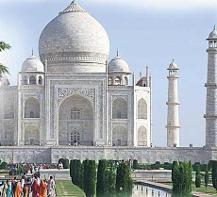
Taj Mahal of India is widely recognized as “the jewel of art in India and one of the universally admired masterpieces of the world’s heritage”. It’s a unique monument built by Mughal emperor Shah Jahan in memory of his wife Mumtaz Mahal. Taj Mahal is one of the Seven Wonders of the World and one of the best examples of Islamic architecture.

Millions visit India to get glimpses of this unique architectural beauty and this includes a large number from Middle East. How about seeing the beauty of Taj Mahal here itself in Kuwait?

Inspired by the architecture of Taj Mahal, Kuwait has designed a mosque exactly like Taj Mahal, a replica. The mosque is a bigger version of India’s Taj Mahal. It’s 3 times bigger.

Sadeeqa Fatimatul Zahra Mosque, a prayer place for the Kuwaitis, looks similar to India’s Taj Mahal from the outside. Located at Block 6, Abdullah Al-Mubarak area, West of Jleeb Al-Shuyoukh, the mosque is already gaining a reputation as one of Kuwait’s most distinctive buildings and is called the “Taj Mahal of Kuwait”.

It’s learned that Hassan Johar, a Member of Parliament, who was behind this unique project here, received the blessing of the Indian embassy before building the mosque.

Internal design of the mosque differs from the original. It consists of carvings of verses from the Quran. The four minarets and central dome of the mosque are adorned with brass crescents. The main prayer area is at the ground floor with library and utilities. It has a separate prayer hall for the women in the first floor. The Mosque was officially opened for the public in 2011.

The beauty of the mosque in middle of the desert is mesmerizing. It’s a proud feeling for all Indians here in Kuwait to witness a replica of the Taj Mahal in Kuwait. Those who have not seen the Taj Mahal in India, they can now see it in Kuwait.

source: http://www.timesofindia.indiatimes.com / The Times of India / Home> NRI> Contributions> Contributors / by Deepika Nambiar, TOI Contributor / April 30th, 2014

359th Urs of Shah Jahan to commence from May 25

The 359th annual Urs of Mughal emperor Shah Jahan will begin at the Taj Mahal from May 25 to 27.

Agra :

The 359th annual Urs of Mughal emperor Shah Jahan will begin at the Taj Mahal from May 25 to 27 and entry will be free for visitors during the three-day celebrations.

“There would be free entry to the monument from 2pm until sunset on May 25 and 26, and on May 27 no entree fee will be charged throughout the day,” N K Pathak, chief superintending archaeologist, ASI, Agra zone said here today.

Khudddam-e-Rauza Committee, the traditional caretaker of the Taj, would put a 735-meter-long chadar on the cenotaph of Shah Jahan, he said.

Committee president Tahiruddin Tahir said that the length of the chadar to be placed on the tomb had been increased by 70-metres from the 635-meters length of last year.

Besides, a chadar made of 359 garlands would also be offered by the Shahi mosque Fatehpuri to mark the Urs on May 27, Saeed Khan, the mutawalli of the mosque said.

During the Urs, prince Yakub Habeebuddin Tusi of Hyderabad, who claims to be the great grandson of the last Mughal emperor, Bahadur Shah Zafar, makes an annual pilgrimage to the monument and offers prayers there.

Shahjahan was the fifth Mughal emperor who ruled the empire for 30 years from 1628 to 1658 before he was deposed by his son Aurangzeb. He died in 1666.

He had erected the Taj Mahal in memory of his beloved wife Mumtaz Mahal.

source: http://www.timesofindia.indiatimes.com / The Times of India / Home> City> Lucknow / PTI / May 22nd, 2014

UK Marks Centenary of Indian-Origin WW II Spy Noor Inayat Khan

BritishFlagMPOs23jun2014

London: 

The birth centenary year of Noor Inayat Khan, the famous Indian-origin World War II spy, was observed in the UK this week.

Popular English novelist and political commentator Frederick Forsyth was among the key guests at a special memorial event in London to celebrate the life of Noor, the great-great-great-grand-daughter of Tipu Sultan, who became the first female radio operator to be sent from Britain into occupied France.

“What is so remarkable about Noor Inayat Khan is that she owed us nothing; she didn’t have to go,” said Forsyth, the well-known thriller writer behind books such as ‘The Day of the Jackal’ and ‘The Odessa File’ who compared her to the 18th century ruler, Tipu Sultan, known as the ‘Tiger of Mysore’.

“When it came to being recruited for the SOE (Special Operations Executive), she could have said ‘thank you but no’…but she volunteered. There must be something of the old tiger in her genes. It is recorded that she fought like a tigress…Noor absolutely did not die for nothing.

“She is an amazement, a remarkable and extraordinarily brave woman who did what she did for a country to which she owed nothing,” Forsyth said.

The memorial event was organised by the Noor Inayat Khan Memorial Trust set up by Shrabani Basu – author of the World War II heroine’s biography ‘Spy Princess’.

It coincided with the dates of June 16-17, 1943, when Noor – under her codename Madeleine – was flown to the landing ground in Northern France.

“She combined the rational side of her personality with her hatred of injustice and became one of our greatest heroines. My hope is that she would have gone back to that inner life that sustained her,” said Christine Crawley, a Labour party politician who has campaigned for the contribution of women agents in the war to be commemorated.

The SOE was an underground force established in Britain in 1940 by war-time Prime Minister Winston Churchill to “set Europe ablaze”.

It recruited men and women to launch a guerilla war against Hitler’s forces.

Noor, born in September 1914 to an Indian Muslim father and an American mother, grew up in Britain and France.

Despite her pacifist views, she decided to join the war effort to defeat the Nazis and was eventually captured.

In spite of being repeatedly tortured and interrogated, she revealed nothing and was executed by an SS officer on September 13, 1944, at Dachau concentration camp at the age of 30.

She was later awarded the George Cross, the highest civilian decoration in the UK, in recognition of her bravery.

A bust in Noor’s memory now stands at Gordon Square in central London, a stone’s throw from the home she briefly lived in.

source: http://www.ndtv.com / NDTV / Home> Diaspora / Press Trust of India / June 19th, 2014

Book released

Krishna University Registrar D. Suryachandra Rao released the second printed version of ‘Taratarala Bandar Charitra’ book, authored by amateur historian Mohammed Silar, here on Monday at the Town Hall.

Addressing a galaxy of literary personalities and historians of Machilipatnam, Mr. Suryachandra Rao opined that the book would serve as a reference for those who wanted to research in Telugu as well as History.

“A few copies of the book will be made available in the Krishna University Library and given access to the readers”, he added. Krishna District and Sessions Judge G. Chakradhara Rao recollected the glorious past of Machilipatnam and how the port town became key location for all means of administrative and legal services in Coastal Andhra Pradesh during the post-independence period.

A well-known doctor Dhanwanthari Acharya received the first copy and other guests discussed at length about the hardship involved in bringing out of the book, which was based on the ten-year research by Mr. Silar, in 2010.

source: http://www.thehindu.com / The Hindu / Home> National> Andhra Pradesh / by Staff Reporter / Machilipatnam – October 08th, 2013

Historian of Bandar pens encyclopaedia

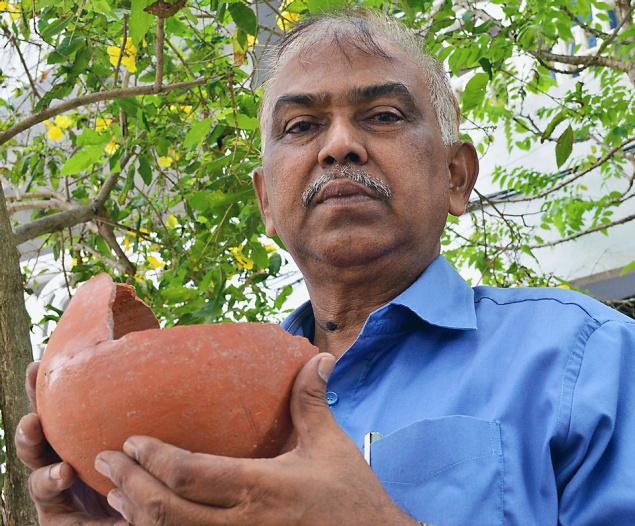
Machilipatnam-based historian Mohammed Silar./ The Hindu

‘Machilipatnam Sarvasvam’, (Encyclopaedia of Bandar), written by Bandar-based modern historian and numismatist Mohammed Silar, is all set to be released by the end of June. The book focuses on the flourishing of Buddhism and Jainism in Krishna district as well as individuals and institutions which brought laurels to the port town.

In 2010, he wrote his first book ‘Tara Tarala Bandar Charitra’, which became a reference guide for history research scholars. It was reprinted in 2013. “My second book has a detailed narration about the rule of several dynasties in Masula – from Mughal, Dutch to British and French. The history of India’s third municipality, Machilipatnam Municipality, is also one of the key chapters of the encyclopaedia,” Mr. Silar said.

Based on Battiprolu inscription in Pulinda script, Mr. Silar is trying to establish the birth of Telugu language in Machilipatnam. As Machilipatnam played an important role in the evolution of education and literature in Andhra Pradesh, the book chronicles the lives of many luminaries including Madras University’s first elected Vice-Chancellor Raghupathi Venkataratnam Naidu of Machilipatnam.

Mr. Silar, a retired Special Grade Tahsildar and a Food Inspector during the cyclonic storm in 1977, has been engaged in documenting the glorious past of the town. “Bandar population was 64,000 in 1865 as against 9,000 of Vijayawada. The demography shows the glorious past and development of the tiny town in those days”, he says.

source: http://www.thehindu.com / The Hindu / Home> News> Cities> Vijayawada / by T. Appala Naidu / Machilipatnam – June 02nd, 2014

MELANGE : A mouthful of goodness

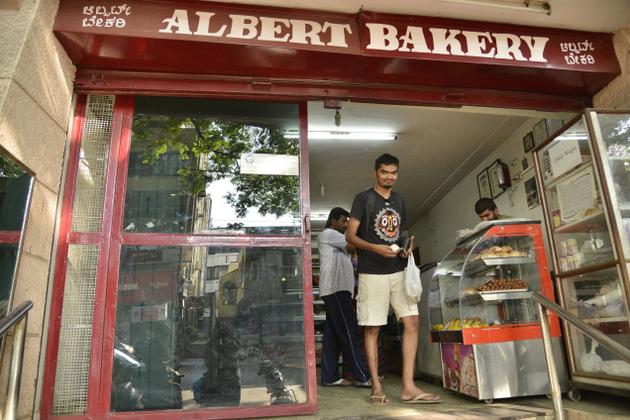
Tradition rules at Albert Bakery./  Photo Murali Kumar K. / The Hindu
Tradition rules at Albert Bakery./ Photo Murali Kumar K. / The Hindu

Come one, come all to Albert Bakery and indulge in an array of nostalgic slices of confectionaries that are a rich part of Bangalore’s culinary heritage

Nestled in the heart of Frazer Town on the famous Mosque Road is a slice of the city’s history so unassumingly located that you would miss it entirely if you were walking or driving fast enough. And yet, Albert Bakery is one spot you would always want to stop by and taste their array of confectionaries. Bangalore is famous not only for its music and climate but also, over the years, for its food and Albert Bakery has been a major player in the city foodscape forever. The 112-year-old bakery is easily the city’s oldest and has been upholding a gastronomical tradition over the decades.

A thriving hotspot, the bakery is open only from 3 p.m. to 9 p.m. and is sometimes so packed that there are traffic snarls on Mosque Road.

And for those who frequent the street during the festive season of Ramzan, if you haven’t stopped at Albert Bakery to grab a bite of their goodies, then everyone will tell you that you haven’t lived life to the fullest.

Mohammad Sabir Faizan, the son of the proprietor Nawab Jan, says they strive to uphold the traditional baking practises. “We have always opened from 3 to 9 p.m. because we make the confectionaries fresh in the morning. Other bakeries may belong to a chain of supplies so they add preservatives and improvers which we never do. We make batches that are sufficient for each day.”

Established in 1902 by Sabir’s great grandfather Mohammad Yacoob, the bakery was initially a godown in Sangam lane off Kamaraj Road. “We used to deliver only buns and bread. That used to be the usual catering back then. We cycled down the roads with baskets of bread and buns delivering it to people in the locality. We shifted to Mosque Road in 1921 and since then we have stayed here,” recalls Sabir.

When my grandfather Mohammad Ibrahim was around, they had bread, biscuits, rusks, tea biscuits and other regular items. “It was only after my father Nawab took over that he introduced the kova naans, coconut cherry cookies, mini cocktail samosas and other specialities.”

From delicious hot kova and keema naans and mini cocktail samosas to butter salt biscuits and coconut cherry cookies, Albert Bakery boasts of a variety of foodstuffs that make mouths water at the mention of the bakeries name.

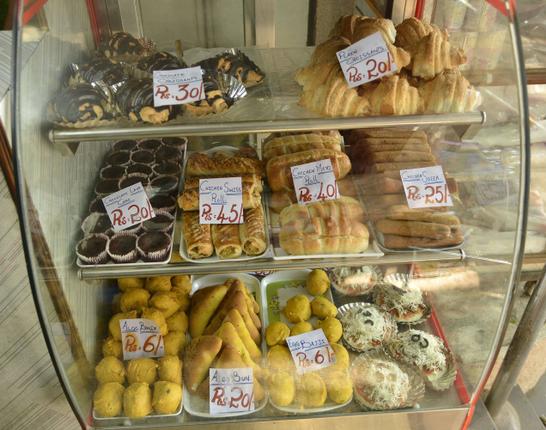
The spread available at Albert Bakery / Photo Murali Kumar K. / The Hindu

On the name, Sabir says back in the early 1900s, “My great grandfather felt it would appeal to everyone if it had an English name. There is a common misconception that the shop was started by some foreigner called Albert. We had a lot of Britishers as customers so a common name like Albert would make it easy to relate to and the name stuck.”

Being the fourth generation in this line, Sabir hopes to carry this legacy forward. “We may launch an outlet elsewhere but all the production will always be here. We don’t want to expand much because of the freshness factor. We will never compromise on quality.”

A bakery like Albert in a city like Bangalore is a blessing, says Sabir. “There were no shops in this area when we started. Now there is a huge boom in development. The city has helped us come up. We also have a lot of competition so that helps us strive to be more creative and innovative. We are proud to be part of Bangalore’s rich cultural and culinary heritage.” The bakery’s other specialties are the hot cross buns on Good Friday, marzipan Easter eggs on Easter Sunday, non-alcoholic plum cakes for Christmas and brain puff for Ramzan.

They also have daily specialties like the chocolate lava cake, chicken Swiss and mayo rolls, tarts, quiches, banana and grape muffins, chocolate croissants and donuts and pizzas.

source: http://www.thehindu.com / The Hindu / Home> Features> MetroPlus> Food / by Allan Moses Rodricks / Bangalore – May 16th, 2014

Whiff of an Arabian spread


‘Instant’ kabsah kits are in much demand in Kozhikode. / The Hindu

Shawarma, Shawaya, and Khubuz came to Kerala crossing the Arabian seas several years ago. They were served in wayside eateries and fast-food outlets, initially started by the Gulf-returned cafeteria employees.

These dishes, however, did not make their way to the Malayali kitchen even in the Malabar region, where most of the households have at least one member employed in the Middle East.

Of late, a few Arabian dishes such as Mandi, Kabsah, and Majboos, which figure on the main course menu of Arabian countries have become popular in Malabar. These rice-meat combination dishes are not only cooked in the kitchens of the region, but are also served as “prestige” dishes on occasions such as weddings.

Some places like Koduvally, with a huge expatriate population, also have exclusive Mandi and Kabsah eateries. “I know many who come from the city just to eat these dishes,” says P. Abid, a native of Koduvally.

Author and sociologist Hafiz Mohammed says this is only a continuation of the culinary influence Arabia has cast on Kerala for the past 30 years. “The close socio-cultural association between the two countries has paved the way for these dishes’ smooth entry into our society,” says Dr. Mohammed. Ready-to-cook kits of these dishes, including Majboosthe regional variant of Kabsah, are available in shops and supermarkets here now. Dealers of these kits also provide cooking instructions in regional languages on their cover. “I prepare them at home quite often,” says A.K. Ali, who returned from Saudi Arabia a few years ago and is settled at Kalanthode in Kozhikode.

The dishes are much in demand for weddings and parties in the region. Local chefs, with some experience in eateries in the Gulf, have started advertising their skills here, says Mr. Ali.

Dr. Mohammed sees ‘status symbol’ in play here. “Many affluent families in Malabar serve these Arabian dishes during wedding parties for this reason,” he says.

The trend is here to stay for some time at least. “My father, who was in the Gulf for several years, prepared Kabsah at home a couple of years ago during his vacation. All of us liked it. Now I too can prepare the dish,” says Sayed Junaid, from Ayencheri near Vadakara in Kozhikode.

source: http://www.thehindu.com /  The Hindu / Home> News> Cities> Kozhikode / by Jabir Mushthari / Kozhikode – May 10th, 2014

World’s largest diamond, Mughal necklace in Geneva auction

A staff member poses with 'The Blue' diamond during an auction preview for Christie's in Geneva. (Reuters photo)
A staff member poses with ‘The Blue’ diamond during an auction preview for Christie’s in Geneva. (Reuters photo)

New Delhi :

A rare necklace, engraved with names of Mughal emperors Akbar and Jahangir goes under the hammer in Geneva tomorrow by Christie’s, which is also auctioning the world’s largest flawless blue diamond, in a sale expected to total $80 million.

Dating 17th century, the seven Mughal engraved spinel bead necklace is estimated to fetch between $1,500,00 to $2,000,000 at ‘Magnificent Jewels’ sale, auctioneers said.

Mughal emperors were known for their love of precious stones. The tradition of engraving titles and names on stones began with the Timurids, who were the ancestors of Mughals. They did their engraving on diamonds, emeralds and other outstanding quality stones with large spinel beads considered to be their favourites.

As much as these gems were a symbol of the opulence and dignity of the empire, they were also treasured as protective talismans.

The Museum of Islamic Art in Qatar exhibits an important necklace with eleven Mughal spinel beads with a total weight of 877.23 carats. Three of them engraved with names of Emperor Jahangir and one with that of Emperor Shah Jahan.

Leading the ‘Magnificent Jewels’ sale is world’s largest flawless vivid blue diamond ‘The Blue’ estimated to fetch between $21,000,000- $25,000,000.

The diamond leads the 250 lot strong sale, estimated to mop up a total in the region of $80 million, Christie’s said.

Six months earlier, Christie’s Geneva sold ‘The Orange’ the largest fancy vivid orange diamond in the world for $35.5 million, a global record for an orange diamond and a world auction record price per carat for any diamond at $2.4 million.

The sale will also feature many important coloured and colourless diamonds such as the 5.50 carat ‘The Ocean Dream’, the largest fancy vivid blue-green diamond in the world to come to auction, with an estimate of $7,500,00- $9,500,000.

‘The Rajah Diamond’ a 26.14 carat old-mine brilliant-cut diamond of is among 14 jewels that are being auctioned under ‘A Passion for Jewels: Collection of an European Gentleman’. The diamond is estimated to go for $3,000,00-5,000,000.

Another section of the sale ‘Noble Jewels’ features a natural pearl and diamond necklace estimated at $550,000-700,000 and was orginally in the personal jewellery casket of Queen Elizabeth of Prussia.

source: http://www.timesofindia.indiatimes.com / The Times of India / Home> India / PTI / May 13th, 2014