Category Archives: Travel & Tourism

Of passion and pure thrill of flying high

Hyderabad : 

The Air Force Station at Begumpet was one of six heritages of the city to be acknowledged with an award by the Indian National Trust for Art and Cultural Heritage (Intach) on the occasion of World Heritage Day 2014. The event brought into focus little known facts about Hyderabad’s history, including the city’s pioneering efforts in the field of aviation which commenced in 1911 when a Belgian aviator, Baron de Caters, along with his assistant Jules Tyck, arrived with a fleet of planes to give demonstration at the Secunderabad Parade Ground.

The three-day affair received wide publicity and drew large crowds of onlookers including quite a few women. A newspaper report preceding the event announced that “a popular society lady will be taken up by the Baron on the first day”. Unfortunately the identity of this enigmatic passenger remains unknown and it is believed that it must have been a member of the European community then living in the cantonment.

The first direct association of Hyderabad with aviation was established a few years later when during World War I, a British pilot challenged the enemy while flying an aircraft bearing the name of ‘Hyderabad’ over the skies of Germany in 1917. In recognition of contributions to the Imperial war effort, the names of native states had been inscribed on the aircraft of ‘Gift Squadrons’ raised and maintained with funds donated by the Indian rulers. Subsequently, the British formed two more Hyderabad Squadrons during World War II with public contributions raised at Hyderabad, and the Spitfires and Hurricanes of these units had the legend “Presented by His Exalted Highness, the Nizam of Hyderabad” emblazoned on their fuselage. Among the three Hyderabad Squadrons of the Royal Air Force, the 152nd had the Nizam’s crown, the distinctive ‘dastar’, displayed prominently on its insignia.

The credit of introducing Hyderabad to flying as a hobby goes to two adventurous youngsters, Babar Mirza and Pingle Madhusudhan Reddy, who developed a keen interest in flying while pursuing their studies in England. While Reddy managed to keep his passion for flying in check long enough to obtain a degree in mechanical engineering from Leeds, Mirza concentrated more on developing an expertise in handling aircraft. Reckless by nature, he purchased a Simmonds Spartan and set out from Croydon in late 1932 with the sole obsession of reaching Hyderabad within the shortest possible time despite his father having explicitly banned him from undertaking such a “perilous and foolish adventure”. Without giving a second thought to the logistics involved in undertaking such an arduous journey and despite refusal of permission to transit Turkey, Mirza successfully bluffed his way out of tricky situations including some perilous moments at Konya where he inadvertently landed on a military parade ground and was promptly marched off at gunpoint! Unable to take the punishment of the “Air Mad” Hyderabadi anymore, the plane’s engine gave way over the Iraqi desert. Rescued by Bedouins, he was packed off to India along with the wreckage of his aircraft.

Within a year of the mishap, Babar Mirza had somehow convinced his father Manzoor Jung to support his plans of establishing an Aero Club at Hyderabad. Laying out a landing strip on the polo ground of the family estate at Habsiguda, he flew in the now restored Spartan from Karachi and applied to the Nizam’s government for permission to start a private Flying Club and ordered another aircraft from London. Meanwhile Reddy, having purchased an Avro Avian in England in 1933, flew it to Hyderabad and touched down at Habsiguda to join the Deccan Aero Club. Official permission still pending, Babar Mirza took it upon himself to garner support and went about it in a unique way. Inviting the then Prime Minister of Hyderabad Maharaja Kishen Pershad and other elite to Habsiguda for an evening of flight demonstrations, he put on a show that they would never forget. After his colleagues had shown their skills in performing ‘loops’ and ‘rolls’, Mirza swooped down low over the heads of the visiting dignitaries creating ‘quite a sensation’! The dare seems to have had little effect on the administration as it was another three years before the Hyderabad State Aero Club was formally inaugurated in 1936. Mirza’s antics though, seem to have set a precedent for disgruntled aviators. Old-timers of the city narrate the exploits of another pioneer, a scion of the Bilgrami family who, jilted by his beloved because of a stubborn refusal to give up his ‘dangerous’ passion for flying, made repeated low passes over her wedding venue; blowing away the shamiana, scattering the guests and turning a lavish spread inedible with a coating of dust!

(This is the first of a two-part series on Hyderabad’s aviation. The writer is a heritage activist)

source: http://www.timesofindia.indiatimes.com / The Times of India / Home> City> Hyderabad / by Sajjad Shahid, TNN / April 27th, 2014

_________________________________________________________________________

PM Reddy: An aviator and engineer par excellence

The founding of the Hyderabad State Aero Club ushered in an era of relative decorum and the unchecked exploits of buccaneering aviation pioneers of the city were finally tamed to a large extent. Over succeeding years Babar Mirza and P M Reddy, matured into serious aviators who took on the task of ensuring that aviation in the Deccan kept pace with international trends. Their enthusiasm for flying inspired others to take up the hobby and also hastened the plans of the Nizam’s government to establish an airline. Aban Pestonji Chenoy, the teenaged daughter of the Nizam’s Mint Master, became the first woman member of the Hyderabad State Aero Club to qualify for an aviator’s license in 1938, a year in which 55 of the club’s 70 members were Indians.

The club’s operations were suspended during World War II and its pilots, aircraft and facilities were commandeered for use by a training squadron. The association of Begumpet with the Air Force has continued ever since. The acute need for pilots during the war resulted in the establishment of a center of the Indian Air Training Corps on the Osmania University campus in 1945. Trained by Hyderabad’s own pilots along with British officers, cadets of the very first batch passing out from the Osmania University made such a strong impression on the recruiting board that a majority of them were recommended for a commission in the Air Force.

Princess Durru Shehwar laid the foundation stone for the passenger terminal at Begumpet in 1936 as part of the Nizam’s Silver Jubilee celebrations and Deccan Airways Limited was incorporated in 1945, becoming the first airline to be promoted by a native State. A joint venture of Hyderabad State and Tata Airlines, Deccan Airways had a fleet of a dozen Douglas DC-3 ‘Dakota’ aircraft when Hyderabad was absorbed into the Indian Union in 1948.

It was with Pingle Madhusudhan Reddy’s encouragement that the last Nizam, Mir Osman Ali Khan, first boarded an aircraft for a sortie over the city intended to check out his reactions to flying. Initially thrilled at being able to view from the skies, the Nizam is said to have later issued orders prohibiting any aircraft from flying over his palace. On one of his later flights in a twin engine aircraft, he enquired from PM as to what would happen if an engine conked off during flight. “Not a problem Your Exalted Highness”, PM replied, “We can safely carry on with the remaining engine”.

Years later when boarding a flight for Delhi, he pointed to the four engines of the Super Constellation and exclaimed; “Now that is what I call a safe aero-plane!”

By 1947 Deccan Airways had a fleet of sturdy Douglas DC-3 ‘Dakota’ aircraft which connected Hyderabad with key cities through regular services. Apart from scheduled flights, the airline also took on charters and diplomatic sorties on behalf of the Nizam and his government. The airline continued to serve the ruler of Hyderabad in his capacity as the Rajparmukh subsequent to merger and one of the tasks personally supervised by PM was to ensure a daily supply of fresh water for the Nizam during his sojourns away from Hyderabad. Drawn from a protected source which had supplied his ancestors, the waters of the Bam Rukn-ud Dowlah, a spring near the Mir Alam Tank, were shipped under guard in special sealed containers for the Nizam and his family.

Pingle Madhusudhan Reddy saw the airline through its most difficult phases of existence including a ban imposed by the Indian government just prior to the Police Action and later when Deccan Airways along with all other private airlines of the country, was nationalized in 1953 becoming part of the Indian Airlines Corporation. Having been appointed the first Operations Manager of Deccan Airways in 1945, he rose to become its General Manager and later Managing Director. Under his dynamic leadership Deccan Airways gained the reputation of being one of the best and the most efficient airlines in the country. Despite being named Regional Director of Indian Airlines, PM resigned and opted to revert to Hyderabad State service in 1954 and was put in charge of the Industrial Trust Fund and its operations; Praga Tools and Hyderabad Asbestos which was eventually handed over to the Birlas. At the request of the defense ministry, PM was released from state service and took charge of HAL Bangalore in 1957 to set up the jet engine factory from where he retired in 1967. After a long and eventful life PM passed away in Hyderabad in 1986.

(This is the second and concluding part of the column on pioneers of aviation in Hyderabad. The writer is a well known heritage activist)

source: http://www.timesofindia.indiatimes.com / The Times of India / Home> City> Hyderabad / by Sajjad Shahid, TNN /  May 04th,  2014
These mango trees date back to Tipu’s era

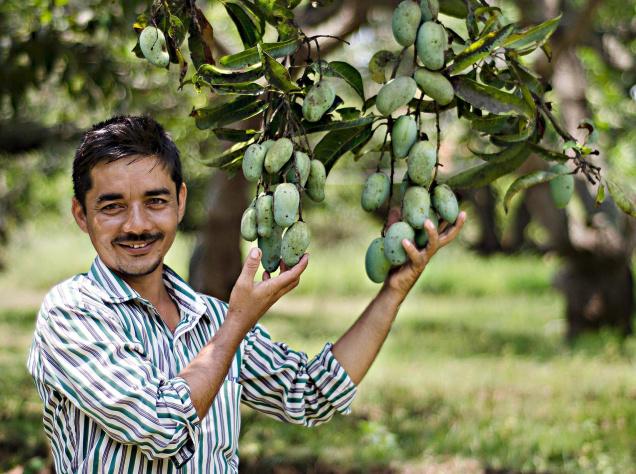
LUSCIOUS: Syed Ghani Khan in his orchard at Kirugavalu village in Malavalli taluk of Mandya district. / The Hindu

Kirugavalu farmer has 116 mango trees which are 200-year-old

This farmer from Kirugavalu village in Malavalli taluk of Mandya district has preserved 116 mango trees dating back to the times of the then Mysore ruler Tipu Sultan.

Carbon dating and other scientific assessment by the Genetics and Plant Breeding Department of the University of Agricultural Sciences, Bangalore, have shown that these trees are more than 200 years old.

This 20-acre orchard, popularly known as ‘Bada Bagh’, is said to have been raised by those in the palace of Tipu, who was a great lover of fruits, especially mangoes. The orchard was later gifted to a farmer by Tipu. Syed Ghani Khan (39), who has inherited this from his forefathers, is preserving it with care.

According to Mr. Khan, the trees yield exotic varieties of fruits. “While some trees yield fruits that taste like sweet lime, others produce fruits with cumin flavour. There are some trees that yield fruits resembling the shape of fish,” he said.

In great demand

Till recently, his family used to sell the fruits locally. But from the last two years, he has been selling the fruits at organic outlets in Mysore apart from exporting them to Dubai and Abu Dhabi, where they are in great demand and also fetch a premium price.

In fact, Mr. Khan, who was passionate about becoming a curator at an archaeological museum, he did his graduation in archaeology and museology. But he had to return to his native village from Mysore to take care of his farm and support his family after his father became bedridden due to an ailment. “I then decided to turn my exotic farm itself into a live museum and started working on it,” he said.

Paddy varieties too
Mr. Khan also pursues another avocation passionately. He collects native varieties of paddy and grows them mainly to preserve those rare varieties. “Presently, I have a collection of about 600 native varieties of paddy, including ‘rakta dham’, ‘naadikeli’ and ‘jugal’,” he said.

His efforts paid off as his farm caught the attention of Delhi-based Protection of Plant Varieties and Farmers’ Rights Authority, which has started registration of the exotic varieties of mangoes in the garden. He will get legal right over the plant species after the registration.

Mr. Khan was also honoured with the ‘Plant Genome Saviour Farmer Recognition’ award by the authority in 2012.

Mr. Khan now wants other farmers to grow these rare varieties of mangoes. He, however, is unable to take up propagation of these rare varieties systematically by constructing a poly-house as it requires big investment. As none of the government agencies offered him any help, Mr. Khan himself started an organisation to train farmers and students about local varieties of crops.

He is looking forward to getting government assistance to take his mission forward and ensure that these exotic varieties of mangoes are grown in the orchards of many more farmers.

source: http://www.thehindu.com / The Hindu / Home> News> National> Karnataka / by B. S. Satish Kumar / Bangalore – May 12th, 2014

The last of Delhi’s calligraphy brigade?

With the arrival of technology, calligraphic fonts are on computer keyboards now, pushing more and more the likes of Yakub to scurry harder for work. / Photo: Sangeeta Barooah Pisharoty / The Hindu

With calligraphic writing now computerised, the katibs of Old Delhi’s Urdu Bazaar, once a vibrant community, have shrunk to a mere three

More he waits for work, more he fears it shall stop coming to him. Altogether.

When 62-year-old Mohammad Yakub, a katib or traditional calligrapher in Old Delhi’s Urdu Bazaar, breaks into a near monologue on a hot May day after some prodding, the fear of losing a job that he knows best — that too at an age when he “just can’t think of doing anything else” — is pretty blatant. “I have been without work for the last two days. Who knows, you might bring me good luck,” he says with a half-smile. Two teacups with the hot brew arrive from a nearby teashop, indication enough that he is in a mood to talk now.

Yakub’s story turns out to be one of standing against the tide and not calling it quits. Not yet. Every day, at 9 in the morning, he steps out of his house in Okhla to board Bus No. 403 to bring him to Jama Masjid. A short walk from near the Mughal era masjid to Urdu Bazaar brings him to his designated seat in a shop that sells Urdu books. A shop he has been employed with for the last 28 years, a shop with blue paint peeling off at places, its lone copying machine standing at a cobwebbed corner, unused, discoloured with age. The books kept in glass showcases make you wonder which of them is older, their yellowing pages or the showcases with stains on the glasses.

“The last time I sold a book here was a month ago,” he plaits it in to the conversation to help you understand that his state of near joblessness is linked to a drastic drop in the sale of books published in Urdu these days, which in turn, is increasingly leading shopkeepers at the Bazaar to replace their bookshops with those of readymade garments and eateries.

It is also linked to where the art of calligraphy is heading. With the arrival of technology, calligraphic fonts are on computer keyboards now, pushing more and more the likes of Yakub to scurry harder for work. No wonder then, besides Yakub, Urdu Bazaar — once a vibrant hub of katibs — is now left with just three of this ilk.

Katibs Mohammad Yaqub at work in Urdu Bazaar /  Photo: Sangeeta Barooah  / Pisharoty / The Hindu
Katibs Mohammad Yaqub at work in Urdu Bazaar / Photo: Sangeeta Barooah / Pisharoty / The Hindu

Yakub can do calligraphy in Urdu, Arabic and Persian. “But what I usually end up doing now is to write in Urdu the names of various offices and departments required to make stamps since Urdu is also an official language of the Delhi Government,” states Yakub. Out of the Rs.100 that he gets per stamp, Rs. 40 goes to the shop owner. “Most times, it doesn’t pay for my day’s trip from home and back,” he points out before startling you by suddenly breaking into a Mughal-e-Azam song. Even as you recover from the shock, he asks you, “Do you think I can end up as a singer at this age?” In his ensuing laughter, the fear of the foreseeable doesn’t quite get lost. No wonder his daughter, a trained calligrapher, is joining as a teacher in a school

Taking leave of Yakub, you walk along the Bazaar. A few shops away from him sits Mohammad Ghalib, one of the last of the brigade. In his early 50s, Ghalib seems the only one among the three to be getting regular work. “I can’t say that what I am earning is sufficient but I have been able to run my kitchen with it so far. I think it is God’s grace,” he says raising his head from writing a graduation ceremony poster in Urdu for a madrasa in the Okhla area. The colourful poster will thereafter go for printing a dozen copies of it. “Look at these fonts, the unevenness of them, the colour play I do here. No computer can do this because everything in it is of certain size and shape. You can’t play with those fonts, like you can do with a handwritten calligraphic work,” he stops his work to explain the finer point to you.

Like Yakub, Ghalib too picked his skills from Darul Uloom in Deoband years ago. “They still teach it but I ask, what for? Things can change only when the Government does something concrete to keep going the skill of people like us,” he minces no words here.

You enquire about the third katib of Urdu Bazar. Ghalib says he sits just opposite the road. “He has not been coming to work for some days now. He is unwell. Also, there is a wedding in the family,” he says. What Ghalib doesn’t say is said by a bookseller who gives the katib space to operate from, “He doesn’t get much work anyway.”

Riding on a rickshaw to the Chawri Bazasr Metro Station to return home, you only hope that you have turned lucky for Yakub. Because he just can’t sing!

source: http://www.thehindu.com / The Hindu / Home> Features> MetroPlus> Society / by Sangeetha Barooah Pisharoty / New Delhi – May 11th, 2014

DOWN MEMORY LANE : Quaint reminders of 1857

Revisiting the half-forgotten episodes of 1857 when we almost embraced freedom

Today is May 12, the day in 1867 when the British fugitives from Delhi were hurrying on their way to Karnal or some other nearby town. “The four children of Captain William Wallace were spirited away by a faithful khansama and found their way to Meerut. The merchant James Morley, whose family had been killed in his house in the Kashmiri Bazaar, put on a petticoat and veil belonging to the wife of his old dhobi, and following the dhobi, as he drove a bullock laden with old clothes through one of the city gates, managed to reach Kurnaul road,” says Christopher Hibbert in his book “The Great Mutiny of 1857”. A lady, said a fellow-survivor, put on a pagri and, dressed as a villager, with a small hookah in hand, made her way out of town but was recognised by her ex-cook who wanted to make the amply-built memsahib his second wife. But she gave him the slip at night and somehow reached Flagstaff Tower on the Ridge. A girl, who had been disguised as a rustic boy was kidnapped on her way to Sonepat by a group of eunuchs who planned to sell the youngster to a gay zamindar. When the man discovered that the “boy” was actually a girl, he told his sister to take care of her until such time as he could secure ransom for her release. All this happened 157 years ago but still comes to mind as one wanders over Delhi to piece together quaint events of which the nikaah of a sepoy with the wife of a “sahib” he had killed is an amazing one, indeed. The cannonading marks on the walls of the Kashmere Gate and the fierce attack on Mori Gate, where the Maulvi of Faizabad, Ahmedullah Shah stayed before the outbreak on his arrival from Agra, are vivid memories. It is said that the tall, gaunt long-bearded Maulvi “with coarse hair falling on his naked shoulders” and the same hypnotic gaze as that of the latter-day Mehdi of Sudan, however, did not stay here for long and moved to the denser locality of Bara Hindu Rao and finally the Jama Masjid where, according to old-timers, he was seen in the evenings; vehemently trying to convince namazis to throw off the British yoke.

In Ballimaran the haveli of Hakim Ahsanullah Khan can still be seen with its old ambience preserved. The hakim was not only the personal doctor of Bahadur Shah Zafar but also his closest adviser. Some distance away at Lal Kuan is the Zeenat Mahal, ancestral home of the emperor’s youngest wife now turned into a school, and not far from it Mubarak Masjid built by the Bibi of Gen Ochterlony. An ex-dancing girl she later married a Mughal soldier, Wilayat Khan and took active part in the First War of Independence.

In Karol Bagh, Rao Tula Ram School is a reminder of the brave ruler of Rewari whose ancestor, Rao Tej Singh sided with Scindia at the Battle of Patparganj in 1803, which Lord Lake won for the British. After Tula Ram’s defeat at the battle of Narnaul in November 1857, the gallant ruler joined Tantya Tope and in 1862 escaped to Russia. Another hero of the Revolt was Raja Nahar Singh of Ballabgarh who blocked the road to Delhi. This “Barrier of Delhi”, admitted Sir John Lawrance to the Governor-General Lord Canning, was very difficult to break unless “we receive reinforcements from China or England”.

According to Purushottam Salvi’s book, “A Long Drawn War of Freedom”, Nahar Singh tried to persuade Bahadur Shah to take refuge in Ballabhgarh but the emperor refused and was captured at Humayun’s tomb. However, Nahar Singh avenged the death of Zafar’s sons and grandson at the hands of Hodson by killing a large number of firangi soldiers. Eventually Nahar Singh was captured and hanged on his 35th birthday, September 21, 1858.

One prince who escaped the vengeful British was Feroz Shah, who had been away on Haj when the Revolt broke out. On his way to Delhi on August 26, 1857, the troops in Gwalior pleaded with him to lead them. The prince agreed and captured Dhar but was later defeated and, after joining Tope, managed to escape to Nepal. His not so fortunate younger brother was Mirza Nasir-ul-Mulk who became a cripple and was reduced to begging. Besides the more famous events of 1857, these remain half-forgotten episodes of those tumultuous times when Independence was almost achieved by the rebel sepoys.

source: http://www.thehindu.com / The Hindu / Home> Features> MetroPlus> Society / by R. V. Smith / New Delhi – May 11th, 2014


Tindipotha gastronomic delight from a food truck

TindiPothaBF10may2014

by Phalgunn Maharishi

The residents of Mysore, especially in the neighbourhoods of Bannimantap and Rajeev Nagar are now familiar with a big truck parked on the roadside near JSS Dental College with shining lights and people surrounding it eating costly food. But wait a minute! Costly food in a big truck? Well, it seems to be costly as the big truck sells fresh American-Mexican food but that’s not really costly. “A Mysorean can now fill his stomach with some classy food for just Rs. 80 on an average,” said Syed Manju while speaking about his big boy “Tindipotha.”

Syed Manju previously held the position of an Area Manager handling Public Relations and Marketing for 28 years in Costco, USA, the Number 3 retailer in the world which directly competes with Walmart, before heading towards Mysore to come up with his dream boy. “I had a passion towards cooking due to which I quit the job and came to Mysore with an interest in doing something unique, something which never existed here. That’s when Tindipotha was born,” commented Syed Manju while speaking about how it all started. The ecstatic and energetic Syed Manju keeps travelling back and forth between Mysore and Bellingham (90 miles north of Seattle in the United States) where his wife (Diane Houston), little girl Zara (16) and a little boy Iyan (14) lives.

Originally born in Channapatna and brought up in Mandya, Syed Manju is a self made man. He studied B.Sc and Diploma in Film Acting. He soon landed into Kannada Film Industry during his late 20s by directing films like Neenakkaga and Kanoonige Sawaal after which he travelled to USA for a trip to stay with his brothers and sisters for a while. Manju said, “Don’t ask me how, but I got my green card over there” with a wink and also added, “I never wanted to be there forever. Infact I had plans of directing more films in Kannada, but my fate made me stay there,” with a sweet smile. The last film produced by Manju was Appaji starring late Dr. Vishnuvardhan in the lead role released in 1996.

Coming back to Tindipotha, it all started roughly an year ago when Syed Manju and his brother Rafi Manju bought an old truck and got it rebuilt in Mandya to bring the new fancy boy to the streets of Mysore. “I was scared in the beginning. It was something new, something which the Mysoreans never experienced before. A new food to a new market. We had to prepare American-Mexican style foods with the ingredients available in Mysore and it didn’t seem easy for us in the beginning. But we did it and still doing it. It’s been an year and we are doing good,” said Syed Manju while speaking about Tindipotha.

Tindipotha has recently transformed itself from being just a food truck into a youth junction where we can find college going kids spending their cool evenings eating the sizzling new dishes like Nachos, Chicken Melt, Roti Lapat, Gilli Chicken, Turpi Chicken, Rollito, Apple Dream, Lava Pie, and many more summing up to over twenty different types of food.

“My brother Rafi Manju manages the front end and cash while my nephew Syed Umair Manju is our grill master. He even looks after the crew. Farhan, the cousin of Umair, assists the crew inside out and Tausif does all the deep fry and plating. Siddique and Atiq have been newly added to the crew and are learning ropes. Tausif, Siddique and Atiq are all family friends. We are all family and its a family business. The whole crew, except me and my brother, are college going kids,” said Syed Manju while introducing the team of Tindipotha.

People love the food. We had an interactive session with some regular customers of Tindipotha who expressed their hearts out. Bashar and Abdur Razzak, who stay in Bannimantap said, “This is really nice. It’s different than what we find elsewhere. We don’t find such tasty food at any other place, especially the Nachos! We come here for Nachos,” when asked to express how they feel about Tindipotha. Areb and his friends Mohammed Fahad and Rakshad, who come all the way from Bangalore just to eat at Tindipotha, said that they still haven’t yet got over the taste of Chicken Melt. The trio commented, “Its been a year and we still come here to eat the same thing,” with a laugh. Dental students Alley and Ahmad, who are from Iran visit Tindipotha atleast twice a week and mentioned that they love the tasty food and also the hospitality given to them by Syed Manju and his crew.

While speaking about the unpredictability of such food business in a city like Mysore, Syed Manju said, “Usually weekends are the busiest days for us, yet we can never predict. Sometimes customers ask me, which is the best dish prepared here! Well, I tell them to close their eyes and put their finger on the menu and we will serve it. If they don’t like the food, let them not pay us but if they like it, they need to pay us double.” He also added, “We are different from other eating places in the city saying that we smile at our customers which we can never find in any other hotels in Mysore. We also appreciate each and every customer, thank them and enquire in person whether they liked the dish. The food is also custom made for every single customer according to his likes and dislikes and we keep changing the taste one plate at a time.”

Tindipotha is for sure a place to be cherished and one of its kind in Mysore. It’s both vegetarian and non-vegetarian food truck with some tasty healthy and classy American-Mexican food at low prices. Do you want to try some different custom made food? Just head towards Tindipotha in Bannimantap near JSS Dental College between 7 pm and 11 pm any day! For more details, type in TINDIPOTHA in facebook and you will get the fan page.

source: http://www.starofmysore.com / Star of Mysore / Home> Feature Articles / May 04th, 2014

MELANGE : Royal treat for bibliophiles

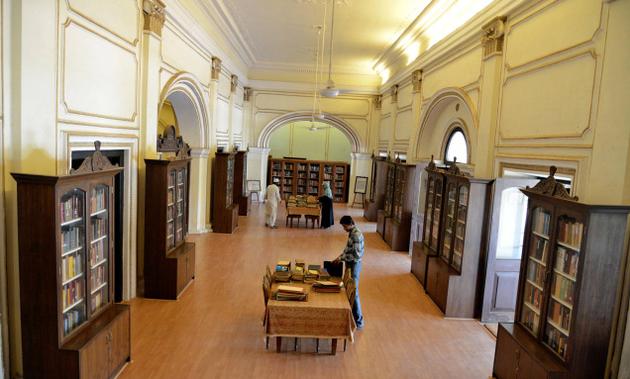
Books restored from different Asaf Jahi dynasties are in the Chowmahallah Palace library./ Photos: Nagara Gopal / The Hindu

The Mehtab Mahal library at Chowmahalla Palace throws open a treasure trove from the Nizam’s era

The Nizams, it turns out, had an eye for everything exquisite. From the jewellery they wore to the silks that adorned their wardrobe, the cars they rode in, and the cuisine they partook, everything simply spelt royalty. While these indicate their lavish lifestyle, their interest in books and literature is less known.

Throwing light on their urge to discover and relate to the world around is the Royal Library in Chowmahalla Palace; its collection of books includes The Life of Samuel JohnsonHistory of Don QuixoteJohn F Kennedy – Portrait of a PresidentGlimpses of India,The Princes of India and an array of Encyclopaedias and much more .

Situated in the Mehtab Mahal of the Chowmahalla, the Royal Library houses more than 10,000 books and “is a haven for researchers and book lovers.”

The library that was thrown open to book lovers last year has been digitized recently, not only to help book lovers but also ensure safety of the royal treasure.

The idea of the library is to protect and preserve the valuable collection of the Asaf Jahi kings. The collection mostly belonged to the Mir Mahboob Ali Khan (VI Nizam), Mir Osman Ali Khan (VII Nizam) and Nizam Mukarram Jah. The books have been sourced from different Asaf Jahi palaces like the Nazri Bagh, Chiran Palace and Chowmahalla to be housed in the Royal Library here.

The books thus collected were sorted and segregated into various categories.

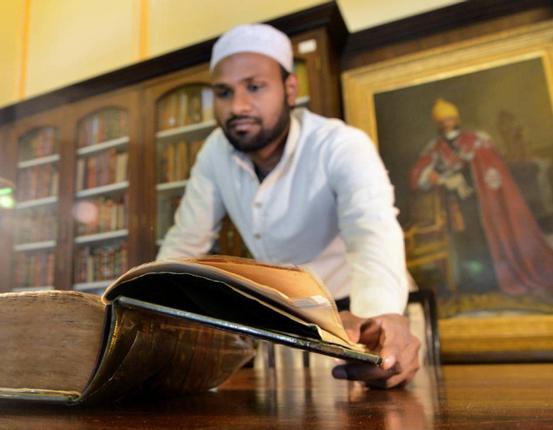
Books restored from different Asaf Jahi dynasties are in the Chowmahallah Palace library./ The Hindu

“A lot of work went into making them ready to be put in the cases for readers to read them in the library. Various professionals worked to clean, bind and make the books fit for reading. We have applied all preservation techniques, including fumigation, to protect the books,” informs G. Kishan Rao. He adds, “The collection of books range from history, literature, poetry, philosophy, geography, culture and religion. This library also houses the exclusive collection of Qurans by the Nizams which was inaugurated recently.” A few books also hint at the Nizam’s passion to learn languages. The number of English books is close to 3000, followed by Urdu, Persian and Arabic.

“There is also a good number of Persian manuscripts containing the firmans issued by the Asaf Jahis as well as several volumes of Mir Osman Ali Khan’s poetry,” informs the librarian. Qurans of different sizes are in the process of being restored and will find place in the library after that.

source: http://www.thehindu.com / The Hindu / Home> Features> MetroPlus / by Prabalika M. Borah / Hyderabad – April 25th, 2014

Mosque with a Spanish touch

While the neighbouring region is resplendent with the remnants of the glorious Vijayanagar empire in Hampi, adjacent to it are the vestiges of the Bahmani Sultanate.
BahmaniMosqueGulbargaMPOs28apr2014
 
The Jama Masjid, the great mosque inside the Gulbarga Fort is a testimony to this.
One of its kind
From an architectural viewpoint, the Mosque is considered unique in South Asia for its form and structure.  The material used is lime and brick. 

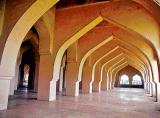
The arches of Jama Masjid are similar to the interiors of Spanish Mosque of Hyderabad.

These are the only two mosques in India which have the similarity in interiors of the Great Cathedral–Mosque of Cordoba in Spain.
The Jama Masjid was built by Muhammad Shah I (1358-75) to commemorate Gulbarga as the capital of the Bahmani Sultanate.
The Bahmani dynasty was founded by Ala al-Din Hasan Bahman Shah, a Bahmin’s servant at the court of Muhammad bin Tughluq.  The Bahmanis established themselves in Gulbarga once the Delhi Sultanate began losing its hold.
The Jama Masjid does not have minarets. But the mosque built inside the Fort is unique because of a huge dome and many smaller ones which adds to its grandeur.
It was built in 1367 AD, by a Spanish  architect, with arched doorways on the same lines as that of the Great Cathedral–Mosque of Cordoba in Spain. It has a large dome on the west side and middle-size domes at the four corners of the mosque, making it a beautiful sight to behold. Instead of having a courtyard, it has 63 small domes in line in the central area.
The main entrance is at the north side and has a higher arch-shaped gate than the other sides.
The mosque has a natural lighting  system. Instead of solid outer walls, there are open arcades to allow light that would generally be filtered in from a courtyard.
In the west prayer room, pillars are painted in white with no decoration.
In addition, wide spans of these pillars’ supporting large arches create a majestic atmosphere.
The floor measures 216 feet by 177 feet (66 by 54 m) with widely arched enclosures defining the perimeter.  The west bay is spacious and covered in the centre with a high dome, which is surrounded by twelve smaller domes.  This high central dome is given even greater prominence by being slightly larger and because it is placed on an arcade, forming a square cloister that rises above the smaller domes. It has a capacity to accommodate 2,000 persons.
The interior of the mosque has a span of arches, which turned out rather appealing and were used in many other Deccan buildings. The arches here are supported on short imposts. These unconventional ‘stretched’ arches later became a characteristic of Deccan architecture.
source: http://www.deccanherald.com / Deccan Herald / Home> Supplements> Spectrum /  Sumitra Malipatil, DHNS / April 22nd, 2014

Region’s earliest interface with Islam was here

Madurai :

The wide Kazimar Street, which branches off from the busy TPK Road near Periyar Bus stand, is one of the oldest settlements of Muslims in Madurai. Historical legends state that Hazrat Kazi Syed Tajuddin came to Madurai from Oman in the 13th century and established the Kazimar Big Mosque on a land given to him by a Pandya monarch.

Till date, the descendants of Syed Tajuddin, who is believed to be a descendant of Prophet Mohammed, live on the Kazimar Street. They are hereditarily elected as the town kazis.

Syed Ahja Mueenudeen, the current town kazi, said that the Kazimar Big Mosque, which was constructed by Tajuddin as a thatched structure initially, was the first place of worship for Muslims in Madurai. The street has had Muslims settlement for over 700 years, he said. Thus, Islam arrived in Madurai even before Malik Kafur’s invasion of Madurai in the 14th century.

History professor R Venkataraman opines King Maravarman Sundarapandian might have been the contemporary of Tajuddin. Even before the advent of Islam, Arabs maintained trade links with South India, especially for the pearls Madurai Pandya Kingdom was famous for. “Sufis, Muslim saints, started coming to Tamil Nadu by 900 AD. The entry of Islam to the region was peaceful as Sufis conceived God as love,” he said.

The short-lived Madurai Sultanate and Islamic influence did have their impact on the city, especially on warfare and town planning. “Muslim rulers introduced arch construction they learnt from the Romans. It changed the style of architecture here in a significant way,” Venkataraman remarked.

The Big Mosque, which is an architectural attraction, accommodates Madurai Maqbara which is the dargah of sufi saints Hazrat Meer Ahamad Ibrahim, Hazrat Meer Amjad Ibrahim and Hazrat Syed Abdus Salaam Ibrahim Rahmatullahi Alaihim.

Syed Ali Hussaini, the renowned Chennai-based stunt artist, is originally from Kazimar Street. Recalling the legend of Tajuddin, he said: “It is believed that Tajuddin came from Arabia to Kerala and reached Madurai where he established a mosque. He became popular for divine healing powers. The Pandya king was irked with his fame, but Tajuddin cured the king himself when he suffered from a stomach ailment. The king gave away a land for mosque in gratitude,” he said. “Even today Tajuddin’s descendents, numbering more than 2,000, are annually given a customary nominal share of the income from the waqf lands originally donated by the king,” he added.

Till the 1980s, the residents of the street were engaged in rearing horses, rams, cocks and pigeons. “People were crazy about horses and many raised them. Rekla or bull cart race and pigeon racing were popular when I grew up in the area in the 1960s,” Hussaini recalled.

However, the face of the area has changed since then with many moving out for education and jobs, he said.

source: http://www.timesofindia.indiatimes.com / The Times of India / Home> City> Madurai / by J. Arockiaraj, TNN / April 27th, 2014

Remembering a titan of Hyderabad’s heritage

Remembering a titan of Hyderabad’s heritage

He played cricket and football for St Stephen’s Delhi with distinction. He did his masters in English as well as Arabic and he topped Punjab University in Persian. And if you are to name a saviour of the cave art of Ajanta and Ellora it is him:   Ghulam Yazdani,   a Padma Bhushan awardee as well as a recipient of OBE (Order of British Empire). 

As the Archaeology Department of Andhra Pradesh marks its 100 years the coming Friday, it is time to remember the man who created the department out of nothing.

If Hyderabad has a vestige of its heritage left, it is thanks to him. Deputed to Hyderabad as a Superintendent in 1914, he brought with him his expertise, energy and accountability. Not for him the claptrap of archaeology department doing the job of cataloguing and executing conservation work, Yazdani was a hands on man who got a road laid between Hyderabad and Bidar to protect the Bahamani heritage of Bidar and also between Toli Masjid and Golconda.

A man of sharp wit, he dismisses the decorative motifs of Toli Masjid as: “The impression made by such buildings overloaded with decorations is like the impression left by the ostentatious and lavish display of personal adornment, generally favoured by lowly persons suddenly become rich.”

For the restoration of the Ellora cave art, he tried to get Luigi Cavenaghi, the man linked to restoration of Leonardo’s Last Supper, to work on the paintings. Unfortunately, he could get only Lorenzo Cecconi, who applied shellac on the paintings, ruining them further. Ghulam Yazdani published a series of photographs and reproductions of the cave art with his explanations.

And by the way, Ghulam Yazdani’s salary was ` 560 per month. And just recently, the Archeology Department found it fit to name its museum after YS Rajasekhara Reddy!

source: http://www.timesofindia.indiatimes.com / The Times of India / Home> Life & Style> People / by Serish Nanisetti, TNN / April 21st, 2014

Facelift for Abdul Wahab tomb

Grandiose plans:The 400-year-old tomb in Kurnool is set to be developed as a tourist spot.-Photo U.Subramanyam / The Hindu

Abdul Wahab tomb, popularly known as Gol Gummaz, located near Osmania College here will soon get a facelift under the Special Tourism package. Financial assistance was given under Archaeological Survey of India (ASI) and Central Tourism package.

The Union Tourism Ministry sanctioned an amount of Rs 4.30 crore for development of Gol Gummaz, Kondareddy Fort, Vijayavanam as landscape and Rupala Sangameswara temple.

Special focus was laid on the 400-year-old tomb for development as tourist spot along with three other places, which will form a tourism circuit. Gol Gummaz has a special place in the history of Kurnool city. The tomb of Abdul Wahab, the military commander of Bijapur army and first Muslim ruler of Kurnool was believed to have been constructed in 1618 after the death of Wahab. After successful invasion of the Kurnool fort, Bijapur Sultan Adil Shah declared Wahab as its chieftain. His successors ruled the fort until another dynasty headed Davud Khan was installed as rulers of Kurnool fort.

The monument with a large dome was constructed in typical Bijapur style of architecture. The Archeological Survey of India (ASI) notified the structure as monument and took all measures to protect its ambience. However, with the latest decision of developing it as a tourist centre, every care was being taken to preserve the originality of the monument, said Krishna Chaitanya of ASI.

source: http://www.thehindu.com / The Hindu / Home> National> Andhra Pradesh / by  D. Sreenivasulu / Kurnool – March 19th, 2014