Category Archives: Travel & Tourism

DOWN MEMORY LANE : Emperor’s daughter-in-law

The winds of change prevented Nawab Shah Zamani Begum from becoming a Mughal Empress

EmpressMPos19jan2014

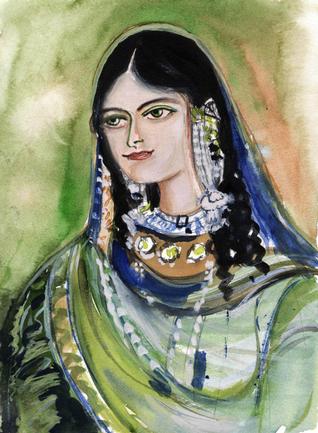
One spent an entire day looking for information on Nawab Shah Zamani Begum or some trace of the house of Bahadur Shah Zafar’s youngest daughter-in-law. Just as pretty as Zinat Mahal, she was felicitated by Mirza Ghalib in the sehra (panegyric) he recited at her wedding to Mirza Jawan Bakht. Zinat Mahal’s house still stands as a ruin in the Lal Kuan area. May be Zamani Begum too lived close by. But it dawned that the house was probably in Jaipur, her “maika” or maternal home. But before January 6 (when X’mas ends) got over one was pleasantly surprised by what seemed like a belated present. “Zafar and The Raj” seen in the light of the new moon peeping from the window, did contain some valuable information on the subject. But first about Bahadur Shah, fondly called “Abban” in the zenana. Like his forebears, he too celebrated all festivals and enjoyed eating Twelfth Night (after Christmas) plum cakes presented by Sir Thomas Metcalfe, say some records.

So much has been published on Zafar (1775-1862) that anything written now sounds trite, but Prof Amar Farooqui’s treatise, covering the period 1800-1850s, seems an exception. Talking about religious festivals, he says Zafar celebrated the two Eids, Dussehra, Diwali and Holi with great enthusiasm, being bathed in seven kinds of water and weighed in gold coins and grain, which were later given in charity. Only a buffalo and a goat were officially sacrificed in the fort on Eid-uz-Zuha and the meat distributed to the poor. For his own table, Zafar preferred venison from deer shot by him on the Yamuna bank. A good shot with the fowling piece, he trained many disciples to use the gun. It’s a tragic irony that he couldn’t even take a sip from a spoon of soup during his last illness.

According to Farooqui, “The abundance of game in the forest zone beyond Mehrauli took the Emperor annually for a prolonged stay to the Qutb during winters. A routine followed since (his father) Akbar Shah’s time.” On 6 January, 1851 Mahbub Ali Khan, Bahadur Shah’s factotum, was ordered to prepare for the move to the Qutb. In Mehrauli he was invited by Mahbub Ali to look at a garden he had developed near the Minar. Bahadur Shah visited the garden along with his wives, who spent the entire day there amusing themselves with plucking the oranges — 2000 of which were sent to the Red Fort for the princes who had stayed behind. Bahadur Shah then went hunting in the surrounding area, though he had prohibited the killing of peacocks and nilgai (blue bull). “During the winter he would set up camp at Najafgarh jhil, accompanied by his wives, for a spot of bird-shooting.” The one animal he had an aversion to was alligators, which abounded the Yamuna and often preyed on humans. “Fishermen had instructions to catch them so that they could be brought to the palace to be killed in his presence. A reward of Rs. 2 was given for every reptile killed.” Rupees two must have been equal to more than Rs.2,000 at today’s inflated rates.

The treatise gives such interesting facts and more like how Mirza Jawan Bakht, Zafar’s favourite son, died in Moulmein (Burma) of liver cirrhosis in 1884, as he had taken to drinking heavily. He had been sent from Rangoon to Moulmein to convalesce. His mother, Zinat Mahal, died in July 1886 of colic. She had been addicted to opium for 17 years (probably to get over the tragedies she had suffered).

Jawan Bakht’s wife, Shah Zamani Begum died in July 1899, when Jawaharlal Nehru was nearly 10 years old. Zamani Begum had accompanied the Emperor, the queen and her husband to Rangoon. A year after Zafar’s death, in 1863 she, along with her son and daughter, was allowed to visit her mother and other relatives in Jaipur and Delhi. She was to originally spend a year in north India but the visit was abruptly curtailed after three months as the British thought that her presence could lead to trouble for them. She had arrived in December 1863, accompanied by a Mrs Cannon, who then returned to Rangoon. The Begum’s mother came to Delhi from Jaipur to meet her.

The Lt-Governor of Punjab got to know of the visit in February 1864 and immediately objected to it, saying she should be directed to return to Burma, now that she had met her mother. Later James Talboys Wheeler, Secretary to the Chief Commissioner of British Burma, who had taken charge of the royal family, suggested that Zamani Begum be allowed to travel to Calcutta with Jawan Bakht, who could return after a month while she stayed back for treatment of a serious eye ailment that was threatening her vision. Wheeler also asked for funds for the marriage of her 11-year -old daughter. He had suggested a sum of Rs.2,000 but the Government sanctioned only Rs.1,000. It also rejected the suggestion that Jawan Bakht should accompany his wife to Calcutta.

Their son, Mirza Jamshed Bakht (born about the same year as Tagore) went on to get an English education at the Diocesan School and Rangoon College and turned out to be a man of pleasing personality. He was associated with the initiative to build a mausoleum to his grandfather and was regarded as one who spoke the “English language gracefully”. “He lived a life of genteel poverty,” dying at the age of 60 in 1921, some 22 years after his mother. Had she had the good fortune of being the next Mughal Empress after Zinat Mahal, Shah Zamani Begum’s name would have enlivened history but the wind suddenly changed (“Gayi yak ba yak jo hawa palat”). As for her ancestral house, it may be there in Ghat Gate, Jaipur where some of the well-known Muslim families still reside, despite the noise pollution caused by the ironsmiths of Loharon-ka-Khura.

source: http://www.thehindu.com / The Hindu / Home> Features> MetroPlus / Down Memory Lane / by R. V. Smith / January 19th, 2014

Ghalib celebrated, even as his Agra birthplace lies forgotten

Pic Courtesy: - Ghalib The Man, The Times
Pic Courtesy: – Ghalib The Man, The Times

Agra :

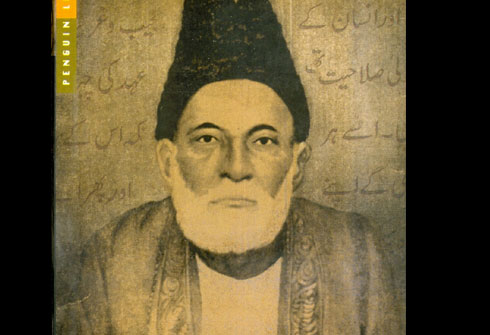
Friday marked the 216th birth anniversary of Mirza Asad Ullah Khan “Ghalib”.   In Agra, the city of the Urdu poet and cultural icon`s birth, there is no proper memorial to him. There is not even a lane in the city named after him.

At the place of his birth, the Kala Mahal area in the heart of Agra, there is little to mark the occasion.

The demand for a Mirza Ghalib chair at the Agra University and an auditorium with a research library named after the poet has been hanging fire for decades.

The Taj city is identified with three pillars of Urdu “adab” or culture Mir Taqi Mir, Ghalib and Nazeer Akbarabadi. Unfortunately, nothing has been done to perpetuate their memory.

“Stones alone do not make for heritage. Literature, traditions, culture are all part of the heritage that we must preserve,” said Sandeep Arora, former president of the Agra Hotels and Restaurants Association, hinting at the fervour with which Mughal-era buildings are preserved, while other aspects of the city`s culture face neglect.

“Foreign tourists, especially those from Pakistan and West Asian countries, ask after Ghalib`s house. We have been requesting the tourism and other departments to build a fitting memorial to the great poet, but nothing has been done,” said Rakesh Chauhan, hotelier and president of the Hotels` Association.

Ghalib is to Urdu literature what Shakespeare is to English. Born in 1797 in Agra, once the capital of Mughal rulers, he moved as a teenager to Delhi, where his poetic talent blossomed in the court of Bahadur Shah Zafar, Mughal emperor at the time.

He died in Delhi in 1869, leaving behind a rich legacy of poetry that continues to inspire.

“The haveli where Ghalib was born should be acquired by the state government and converted into a fitting memorial to Mirza Ghalib,” a resolution passed at a meeting of experts said.

The haveli in Kala Mahal area houses an educational institution. Agra`s literary fraternity has petitioned the government to acquire it and open a research academy there.

“The central and state governments should jointly build a fitting memorial and a library in Agra where Urdu poetry lovers can spend time and enlighten themselves,” Syed Ifteqar Jafrey, director of the Mirza Ghalib Research Academy said.

Agra, also called Akbarabad, is known as a city of romance, love, bhakti and culture. Although it is associated with monuments, it also has a rich tradition of literature in both Urdu and Braj Bhasha.

“Urdu poetry has stagnated in modern times as new poets are not getting recognition. But even so, who has not heard: “Dil-e-nadan tujhe hua kya hai; Hazaron Khwaishen aisee; Yeh na thi hamari kismat; Har ek baat pe kahte ho,” says Chandra Kant Tripathi, registrar of the Central Hindi Institute.

Syed Jaffrey, director of the Mirza Ghalib Academy in Agra, wants better facilities and support from government agencies to promote research in Urdu literature.

All that Agra has to remember its famous poet by is one park in the cantonment area, named after Ghalib a year ago. “This is indicative of society transforming into a wasteland,” says Sudhir Gupta, an admirer of Ghalib.

Meanwhile, in Delhi, at Gali Qasim Jaan in Ballimaran, Chandni Chowk, where Ghalib lived, Friends for Education, an NGO is organising a reading of Ghalib`s poetry in the haveli where he lived. The haveli was restored after a public interest litigation was filed in the Delhi High Court in 1997.

source: http://www.zeenews.india.com / Z News / Home> Entertainment> Bookworm /  by IANS / Friday – December 27th, 2013

Remembering Mirza Ghalib in his haveli

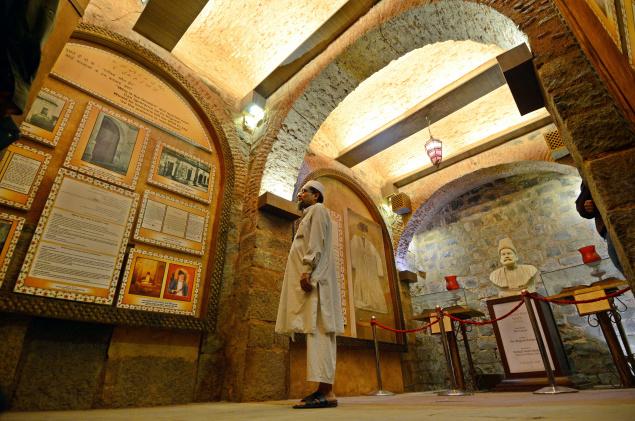
Mirza Ghalib’s bust in his haveli.

To mark noted Urdu poet and cultural icon Mirza Ghalib’s birth anniversary a cultural extravaganza will be hosted in his haveli at Gali Qasim Jaan in Ballimaran in New Delhi on Friday. The event is being organised by Friends for Education, an NGO working to uplift education, civic sense and cultural heritage in the Walled City.

Heritage activist Firoz Bakht Ahmed, who filed a public interest litigation in the Delhi High Court in 1997, which led to the restoration of Ghalib haveli, will conduct a session on “The Neglect of Ghalib and Urdu in Delhi”.

“Ghalib lived a life as deeply and humanly as any sensitive individual could have done. So, I am making a small attempt to create awareness about this genius whose poems in Persian and Urdu need to be read by the young generation. This would enable them to understand his philosophy of the need to live in peace and harmony. And what better way to commemorate his memory than to read his work in the haveli where he lived.”

For years, Mr. Bakht has been emphasising the need to breathe life into the monument. “Ghalib is in the heart of all the connoisseurs of poetry. However, what is to be lamented is that the memorial is now dead and defunct.”

The heritage activist said the need of the hour is to turn the dead monument into a living one by managing a reading room and a small chamber for teaching Urdu.

He feels a great service will be done to Ghalib if his translated poetry collections, especially in Hindi, can be put on display in the haveli. He also wants a tea stall to be set up in the haveli by the Indian Council for Cultural Relations.

“Unless Ghalib is brought closer to the local community, or people in general, merely celebrating his birth anniversary will have little efficacy,” he rues.

source: http://www.thehindu.com / The Hindu / Home> News> Cities> Delhi / by Madhur Tankha / New Delhi – December 27th, 2013

GRAB YOUR GRUB : Breaking bread

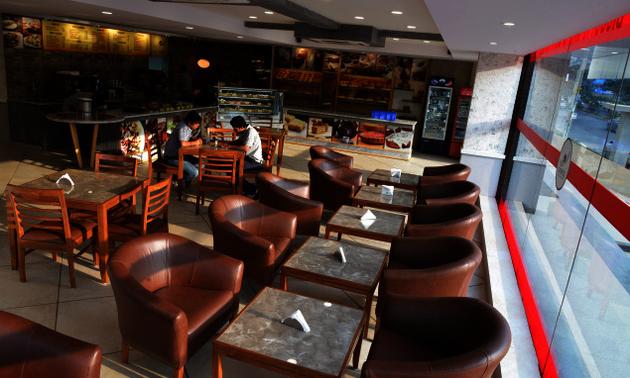
A view of the open space outside the Griffin. / Photo: Nagara Gopal / The Hindu

From artisan breads to scones, pastries, sandwiches and pastas, Griffin has something in store for everyone

Fancy some sourdough bread or maybe some ciabatta? You could try Griffin- The Artisan Bread Store in Madhapur, which promises to dish out fresh breads of various kinds. Fairly new, this store was the brain child of Mohd. Mujahid, who wanted to give the city a taste of different breads. The store, which is already a hit with the expat crowd in the area, also offers a variety of short eats for gastronomes.

The little bread store-cum-café has an interesting array of baked goodies that are perfect for those long conversations over a cup of coffee. You could take your pick from their cookies, scones, donuts, croissants, muffins, cheesecakes or tarts. Priced at around Rs. 50 each, they hardly burn a hole in your pocket.

The artisan bread store at Madhapur in Hyderabad. / Photo: Nagara Gopal / The Hindu

Griffin can also be a pit-stop for a quick lunch or casual dinner with its selection of pizzas, sandwiches and pastas. You could choose from their delicious pastas in an array of sauces like arrabiata, pesto, alfredo or a juicy sandwich with some smoked or grilled meat or roasted veggies of your choice. You can’t really get bored with their selection of sandwiches, which are served in different breads each day. “I started this store mainly so I could introduce people to different varieties of breads. The idea behind serving sandwiches in different kinds of breads is to give our clients an idea of the kinds of breads we offer and how they can use them in different ways,” says Mujahid.

You can’t really get bored with their selection of sandwiches, which are served in different breads each day. / Photo: Nagara Gopal / The Hindu

The café section of this bread store is also a good place to spend an afternoon just reading or browsing the internet with a free wi-fi connection available to patrons. For the coffee lovers there are a variety of coffees to choose from while those watching their weight can pick a salad of their choice.

Griffin also has a bread shelf with different breads like sourdough, ciabatta, bagels and baguettes among others that you can choose from. The breads that are baked in two batches a day are brought in from the Griffin factory in Shamshabad. “We want to keep the products as fresh as possible,” explains Mujahid. The breads like the items on the menu are priced affordably with a whole wheat bread costing as less as Rs.50, while a sourdough could go up to Rs.100 The ciabatta and panini cost around Rs. 30, while a Scottish Bap comes for around Rs. 20.

Griffin – The Artisan Bread Store

Where: Kavuri Hills, Phase-1, Madhapur

When: 7.30 a.m. to 11p.m.

Contact: 040-30512844 ext:454

source: http://www.thehindu.com / The Hindu / Home> Features> MetroPlus> Food / by Ranjani Rajendra / Hyderabad – December 12th, 2013

LIGHTS, CAMERA, CONVERSATION… A road movie about roots

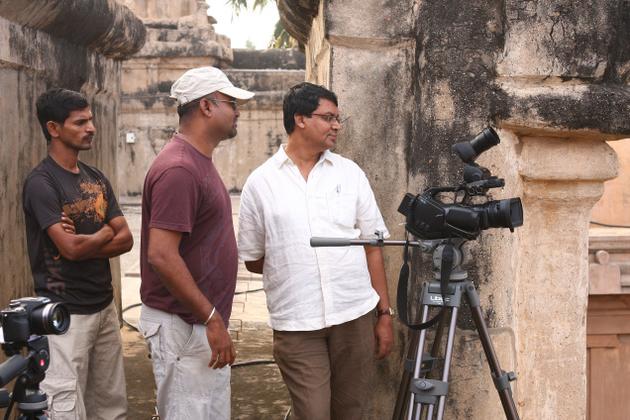
A journey within: The shooting of the documentary / by Special Arrangement / The Hindu

A documentarian sets out in search of his identity and comes up with the untold story of Tamil Muslims

“O Mankind! We created you from a single (pair) of a male and a female, and made you into nations and tribes, that ye may know each other…” Yaadhum, a documentary by the filmmaker Kombai S Anwar, opens with this quote from the Quran, and the image that follows is practically a counterpoint — the procession of Lord Ranganatha along the streets of Kombai, in the Theni district of Tamil Nadu, accompanied by traditional temple sounds from the nagaswaram and a large drum.

Then, as the procession passes the local mosque, we see the reason for this juxtaposition of word and picture: the investigation into the arrival of Islam in a place of Hindus and Tamils. In a voiceover, Anwar says, “While ‘who am I’ is never a question that bothered me during my growing-up years, it became quite important to me and to countless other Muslims, especially in these increasingly troubled times.” The documentary is labelled ‘A Tamil Muslim’s Journey In Search Of His Roots And Identity.’

Anwar told me that the idea for the film took shape from a paper he presented — Tamil Muslims: The Untold Story — at a national seminar. The paper was well received, and he was invited to give more talks on the subject. “After every presentation,” he said, “there would invariably be a few from the audience asking if a CD of the same material was available, so that they can pass it on to friends. With many such requests, and tired of the stereotyping of Muslims as well as the increasing polarisation, I thought I should make this the subject of a documentary film, so that it can reach a bigger audience.”

When he started about four years ago, he found it difficult to get funding, as Yaadhum was seen as a “religious project.” So he went ahead on his own, with money from his sister, a few friends, and his professional assignments in photography and filmmaking, which included a series of short films on the Big Temple at Thanjavur commissioned by the ASI.

Yaadhum, which loosely means “all” or “everything,” showcases the close relationship between Muslims and those from other communities. In one stretch in Madurai, we meet the Muslim family that has, for generations, been building the fence around the sacrificial pit in Puttu Koil, the site of one of the Thiruvilaiyadals of Lord Shiva. “These relationships have evolved into kinship in southern Tamil Nadu,” says Anwar, who found it difficult to get permission to shoot inside mosques and temples. To film the prayers at the Kombai mosque, for instance, he had to ask the jamaath leaders (office bearers of the mosque), who, in turn, asked the congregation during the Friday-afternoon Jumma prayer. Only after they agreed could Anwar go ahead. The officials at the temple, on the other hand, wanted some time to think about it; eventually they said he could go ahead. Later on, when they got to know him, they admitted that they were initially wary about a Muslim showing interest in the temple, so they checked with a friend from the CB-CID. Anwar told me, “It was my luck that the CB-CID asked them not to worry.”

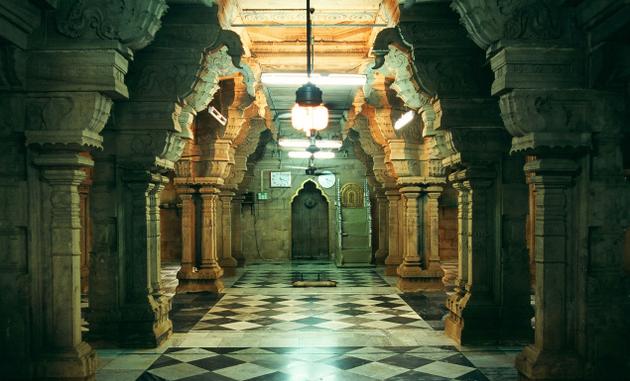
The Kilakarai Jumma Mosque / by Special Arrangement / The Hindu

It is precisely these rifts that the film intends to bridge, by showing how, once, these rifts didn’t exist at all. At the site of a dig near Kodungallur, a major port of the Chera kingdom, Prof. PJ Cherian, Director, Kerala Council for Historical Research, speaks of its “multi-cultural character 2000 years back”, and how “people belonging to different cultural groups, different belief systems, different practices, different traditions had an opportunity to come together and have interfaces. They all may have come here as traders. But you know trade doesn’t carry just goods. It brings in ideas, technology and new thinking… Multiple groups from the Mediterranean, from the Saudi Arabian region, from West Asia, from the Mesopotamian region, from the Indian Ocean rims, all were active here.”

This cultural overlap is found in Tamil Nadu too — say, in the Vaishnavite pilgrimage town of Alwar Thirunagari, where the mosque is built in the Dravidian architecture style. Dr. Raja Mohamad, Asst. Director of Museums (Retired), Govt. Museum, Chennai, says that there are no regulations with respect to Islamic architecture. “All that’s needed is a quiet place for prayer. And while building this space, the builders adopted the local architectural style.” Yaadhum is some sort of road movie, and Anwar’s stops along the way illuminate various aspects of Islam in the South and even Goa. He goes to Chola country, establishing the presence of Muslims through an inscription that refers to “Ahmed the Turk.” He goes to Kayalpattinam, which belonged to the Pandyas, and finds an almost 1000-year-old mosque to which additions have been made at different times. He narrates the history of the Tamil Muslims of Pulicat, most of whom are boat builders. He goes to Calicut, home of the Mapilla Muslims. Prof. MGS Narayanan, Director General, Centre for Heritage Studies, Dept. of Cultural Affairs, Govt. of Kerala, talks about a law which is supposed to have been passed by the Zamorin that at least one member of the fishermen families in Calicut must get converted to Islam so that there will be enough people to support naval warfare against the Portuguese who wanted to conquer Malabar in the 16th Century. (Hindus were generally reluctant to go to sea.)

We see venues, like Kottar in Nagercoil, where Tamil-Muslim literature flowered. The Arabic, Persian and Urdu influences introduced many new genres to Tamil literature — Kissa, Nama, Padaipor, and Munajaath. Among the most pleasant surprises of the film — and one that underscores the narrative crux of cultural osmosis — comes in these portions. We see a palm-leaf manuscript of Mihraj Maalai, poems written by Aali Pulavar in the 16th Century in memory of the ascent of the Prophet, and then we hear Isai Aruvi Seera Aboobacker sing these verses like a virutham (a free-style rendition, not set to a beat) in the Carnatic raga Kapi.

At the end of the film, Anwar says, “I am only halfway through my journey.” He still has many more miles to go and oceans to cross, this time in search of the Tamil Muslim Diaspora — but he has no more doubts about his roots. “I am a Tamil, a Muslim, and so many other things. In short, I am all of this —Yaadhum.”

source: http://www.thehindu.com / The Hindu / Home> Features> MetroPlus / by Baradwaj Ranjan / Chennai – November 29th, 2013

The Turkish connection

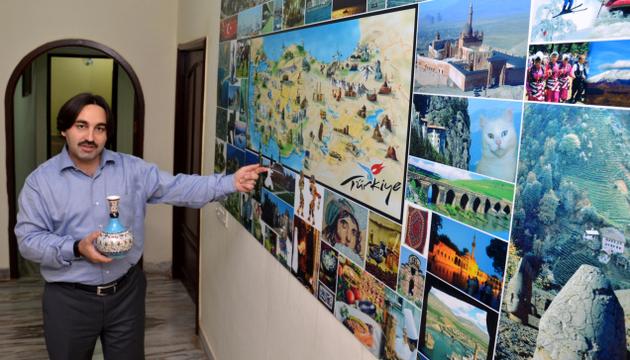
Indialogue Foundation director Osman Kayaoglu talks about the places to see in Turkey as he holds a traditional Turkish vase./  Photo: Nagara Gopal / The Hindu
Indialogue Foundation director Osman Kayaoglu talks about the places to see in Turkey as he holds a traditional Turkish vase./ Photo: Nagara Gopal / The Hindu

As the Turkish Consulate gets ready to set up office in Hyderabad, Neeraja Murthy finds a Turkey-Hyderabad connect

Enter the first floor of Learnium School on Road No. 44, Jubilee Hills and you’ll find a slice of Turkey in Hyderabad. On the walls is a Turkish Corner that displays photographs of ‘Turk folklor’, a Turkish bride, ‘Turk Lokumu’ among other things. Move around and there is a Indo-Turk Corner and photographs of famous Turkish palaces. As we soak in the pictures, we hear the booming voice of Sevim Kayaogolu calling out “Bir, iki, uch, dort… “(one, two, three four… in Turkish). She is teaching a Turkish dance to a group of young girls who are dancing to the beats of Yeni bir dunya, dressed in their traditional Turkish dresses.

Sevim (in the centre) joins a group of girls dancing to the tune of Turkish song ‘Yeni bir dunya’. / Photo: Nagara Gopal / The Hindu

“The students are presenting this Turkish dance for the Parents Day meeting,” informs Sevim. The school (will be called Iqbalia International School) run by a Trust (which also includes Turkish people) teaches Turkish language art, dance and culture to its students, in addition to its regular CBSE syllabus. Osman Kayaogolu, director of Indialogue Foundation’s second year in Hyderabad, calls the city ‘historical’. “Among the different cities in India, Hyderabad has a beautiful history,” he says and adds, “Turkey and Hyderabad share a lot in common in culture. We have given our daughters here in marriage – Princess Durru Shehvar who married Azam Jah, Princesses Esin and Esra have also come to Hyderabad after marriage.”

Osman talks about the ‘royal’ similarity between the two regions. “The Chowmahalla Palace looks like a replica of Dolmabahche palace, only the former is smaller. It is said that the Chowmahalla was built for Durru Shehvar so that she would feel at home in a place that reminds her of Turkey,” he smiles.

Indialogue Foundation, the Turkish cultural centre acts as a hub for the 15 Turkish families living in Hyderabad. “We get together here during religious ceremonies like Eid and we organise inter-faith seminars, talks, conferences and cultural programmes. We arrange business meetings between Turkish and Indian businessmen and also organise Turkish celebrations.”

Osman says the Turks enjoy their stay in the city. “The climate is nice and we enjoy eating biryani which is like our not-so-spicy Osmani pulao. We have made many friends here and people are affectionate too.”

What baffles Osman however is the way friendly Hyderabadis behave while driving on roads. “During busy traffic, they are not at all friendly and act differently,” he says with a smile. The Turkish women volunteers try to spread their art and culture in the city. Osman and his group of friends also play football every Sunday. “We don’t know about cricket, but now our children are picking up the game in Hyderabad.”

There is also good news for the Turkish families in the city with the Turkish Consulate coming up here. “The Turkish Consulate General Murat Omeroglu is in Hyderabad with his family and the work to establish the Consulate has begun. The process might take six months,” says Osman.

Osman says Turkish people in the city do miss their family and friends back home as well as Turkish food; but they have found a home away from home here.

“Hyderabad is our second home. Merhaba Hydarabad (Salaam Hyderabad),” he signs off.

Short film contest

Indialogue Foundation and Sarojini Naidu School of Arts and Communication, University of Hyderabad had organised a Indialogue Short Film Contest 2013on the theme ‘Peaceful Coexistence” which aimed to foster universally shared values among public .

The contest had two categories – YouTube award and Jury award. Emrah Alpaslan from Saritha Vidya Niketan with his short film titled Dedicated Life won the YouTube award with 2100+ views. Jhilam Chattaraj, from University of Hyderabad with her movie In Search of History was selected for the Jury award.

Both the awards carried a prize money of Rs. 35,000 each.

source: http://www.thehindu.com / The Hindu / Home> Features> MetroPlus / by Neeraja Murthy / November 19th, 2013

Ruins in perfect preservation

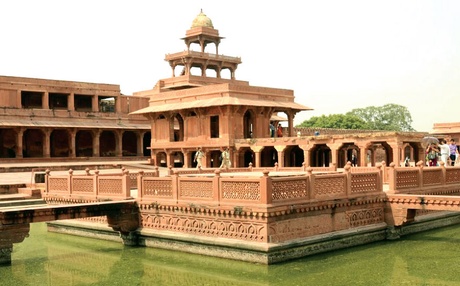
Akbar’s tribute to Sheikh Salim Chisti, Fatehpur Sikri is an abandoned city of red and white sandstone.

Fatehpur Sikri is considered the greatest Mughal city ever built and there is a fascinating story on how the idea behind its construction came about.

As Akbar grew older, his principal anxiety was the lack of a male heir. He learnt of a dervish called Sheikh Salim Chisti, the last of the many great sages in the Chisti line and journeyed to seek his blessings in the tiny town of Sikri — 23 miles west of Agra.  Sheikh recited blessings and made promises. Soon thereafter in 1569, Akbar’s Hindu wife gave birth to a son, Salim, later known as Jahangir followed by two more sons, Murad and Daniyal.

Akbar’s response to Chisti’s magic  probably ranks as one of the most outstanding examples in history of royal gratitude. He commanded that a city be built on the spot where the saint’s retreat was situated and the Sheikh was made the spiritual mentor of the entire metropolis. Almost overnight an army of labourers was mobilised to fashion the city of Akbar’s dreams and by 1570, the construction was in full swing using a kind of pre-fabrication technique.

Wrote Father Monserrate, “The house was built of stone made ready before it was brought thither so that there was neither hammer nor any tool heard in the house when it was building.”

Most of the city was completed in seven years, which was a remarkable feat considering the fact that the Taj Mahal took 22 long years to construct.

Emperor Akbar designed many of the structures himself and worked in the pits with the stonemasons cutting bricks and carving sandstone corbels. Huge battlements and a wall with nine gates appeared and a five story mosque  known as Panch Mahal was later constructed in the style of a Buddhist temple.

A huge rectangular courtyard was erected bounded by symmetrical gardens. There were three palaces, waterworks and baths, a mint for stamping coins with Akbar’s profile, a Turkish palace for his Turkish wife, a Hindu palace for his Hindu wife, a Muslim palace for his Muslim wives, an enamelled hall for the emperor to play hide and seek with all his wives, a court on which to play pachisi with human pieces, viaducts, stables, octagonal towers, domed pigeon houses and more.

There was also a seventy foot octagonal tower built in honour of a pet elephant, a girl’s school, a zoo, a sewage system and the largest gateway in the east — the Buland Darwaza — which served as a gateway to the city.

In Fatehpur Sikri, Akbar gathered the finest singers, the boldest statesmen and the wisest philosophers. His cabinet, known then as the ‘nine gems’ was reputed to hold the nine most capable men in the world.

After 15 years of life at Fatehpur Sikri, the fickle sovereign began to grow bored with his magnificent project. The harsh landscape around Sikri was not conducive to gaiety and drinking water was inaccessible (a manmade lake, dug nearby collected only brackish water).

In 1585, when a military campaign called him to Northwest India, he moved his headquarters to Lahore and abandoned Fatehpur Sikri forever.

The story that Akbar left the city to oblige Sheikh Chisti when he complained that the noise was disturbing his devotions is apocryphal, for Salim died some years before the city was abandoned.

As quickly as it had been populated, the magnificent city emptied.

A few years later, the city was described by a European as “ruinate, lying like a waste district, and very dangerous to pass through at night”.

Today, except for a small community that lives at the foot of the city and lives off the largesse of occasional tourists, the city of Fatehpur Sikri is unoccupied, a ghostly red and white necropolis of sandstone courtyards and endless silent corridors, which are all in a state of perfect preservation.

It really seems too perfect.

In fact, the ingredients of the time — resilient mortar used between the bricks have never been chemically analysed with any real success.

source: http://www.newindianexpress.com / The New Indian Express / Home> Education> Student / by Anjali Sharma – ENS / November 21st, 2013

Works from Adil Shahi era to be available in Kannada

Seven volumes of the translation are likely to be released in January

The Persian and Arabic literature dating back to the times of the Adil Shahi dynasty, that ruled Bijapur, will soon be available in Kannada, with the ambitious translation project nearing completion. The seven volumes are likely to be released in January.

Krishna Kolhar Kulkarni, director, Adil Shahi Literature Translation Project, hopes that some misconceptions about this phase of history will be dispelled once the project is completed.— photo: RAJENDRA SINGH HAJERI / The Hindu

Krishna Kolhar Kulkarni, director, Adil Shahi Literature Translation Project, says this was the first effort of its kind and a major portion of the work had been completed. He hoped that some misconceptions about this phase of history (from 15th to 17th century) would be dispelled once the project was completed.

In English

Meanwhile, the Archaeological Survey of India (ASI) has expressed willingness to fund the translation works of these books into English. “The ASI officials said this when I was in Delhi to collect some books for translation,” said Mr. Kulkarni, adding that it will be taken up after the Kannada project.

He said in the first phase, 10 rare books of the Adil Shahi era written in Persian, have been taken up for translation into Kannada, of which the translation of six books is underway. Stating that most of the books taken up for translation were written in the 17th century, he said the project will translate some of the rarest books, some not even heard of.

Mr. Kulkarni said books include ‘Tareekh-e-Farishta’ by Mohammad Farishta and ‘Ibrahim Nama’ by Abdulla Dehelvi.

“Among them, ‘Mohammad Nama’ by Kazi Nurallah is believed to have only two copies in the world, that too are reproduced versions and not original. We have succeeded in getting a copy for translation,” he said.

Mr. Kulkarni said these books have been collected from the Salar Jung Museum, Hyderabad, the archives of Andhra Pradesh and the ASI headquarter, New Delhi.

“We are making all arrangements to get some books from London Museum for translation,” he said.

While collecting some known books, he said he came across some unknown books of the era written by several foreign authors.

Informing that the committee has meticulously selected a dozen translators, Mr. Kulkarni said that some 3,500 translated pages in seven volumes will be released in January.

He added that the committee has also collected hundreds of manuscripts, Farmans (orders), Sanads (deeds) and poetries written in Persian, which will also be translated.

source: http://www.thehindu.com / The Hindu / Home> National / by Firoz Rozindar / Biijapur – September 16th, 2013

Tryst with Adil Shahi

The septuagenarian professor’s enthusiasm to translate, from Persian to Kannada, the ancient history of a dynasty that ruled Bijapur deserves to be recognised and applauded

Prof. Krishna Kolhar Kulkarni(74), historian and research scholar based in Bijapur, has been conferred the annual Kanakashree award, in recognition of his extensive research on Dasa Sahitya. He is also an expert on Gamaka art and is the president of Karnataka Gamaka Kala Parishat. He also heads the Adil Shahi Literature Translation Project. Prof Kulkarni has written over 50 books on various subjects.

Bijapur has a special place in the history of Karnataka (as well as that of south India). “The Adil Shahi dynasty ruled the Bijapur Sultanate in the Deccan region from 1490 to 1686,”explains Prof Kulkarni. “They developed Bijapur as a great city that at times it surpassed the glory of Delhi and Agra of the Mughals in the north. It was a seat of education, culture, trade and commerce. It was even called the Banaras of the South. The Adil Shahi dynasty invited scholars and writers from all over the world and several first- hand account of the visiting travelers are recorded in Persian and Arabic. As they covered the Gujarathi, Marathi, Tamil and Kannada provinces a peculiar language that was an amalgamation of all these languages came into existence called the Dakhani. Many literary works were published in Dakhani during their rule. In fact it was here that mushaira – poetic symposium evolved and later travelled to north.

“The 200 years of Adil Shahi rule with Bijapur as their seat of power is an important aspect of Indian history. They were the contemporaries of the great Mughals of the north. The Adil Shahi writings are as important as the Akbar nama, Babar nama and Jehangir nama that document the history of the Mughals. The Adil Shahis recorded the history of their time in Persian and Arabic and there are first person accounts of very important historical incidents. All these were not translated to Kannada or even to English. Only Captain Briggs translated some extracts to suit the purpose of the British government, failing which detailed translations are not available. In fact the Adil Shahi documents dispel some misconceptions about this phase of history (from 15th to 17th century). Hence, the importance of the translation project. We have completed seven volumes. In the first phase, ten rare books of the Adil Shahi era, written in Persian, have been taken up for translation into Kannada, of which the translation of six books is underway. Some books are so rare that they are not even heard of until now!” Prof Kulkarni himself has authored several books pertaining to this era.

“Actually I was researching about Mahipathidasa who carried several works of Purandaradasa and Kanakadasa and arrived at Bijpaur after the collapse of Vijayanagara empire. He was the treasurer at the court of Adil Shahi king. He renounced his position and gave up his wealth to become a dasa. There are not many Persian scholars who also know Kannada and can translate. With great difficulty I found some and started the translation project. Prof Kalburgi of Hampi University took interest and helped me. Now the Archaeological Survey of India (ASI) has expressed willingness to fund the translation works of these books into English, and we can translate them from English to Kannada.”

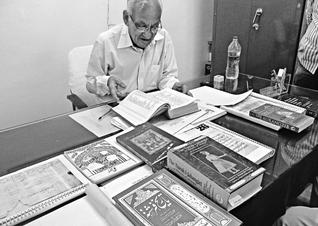
The seven volumes that are ready will be launched in January. Prof Kulkarni also has plans to establish a museum in Bijapur to preserve the valuable manuscripts. He has collected rare manuscripts from Salar Jung Museum in Hyderabad, British Archives and other sources. “We need to preserve them for the next generation. Otherwise precious historical documents will be lost” he says with concern.

source: http://www.bangaloremirror.com / Bangalore Mirror / Home> Entertainment> Lounge / by Pratibha Nandakumar, Bangalore Mirror Bureau / November 22nd, 2013

Idea of Taj Mahal was born here

Ahmedabad :

The Moghul great Shah Jahan, who built the greatest monument for love anywhere in the world — the  Taj Mahal  — had his early training in Ahmedabad. The great builder was inspired by the architectural marvels of Gujarat and honed his skills as a builder in Ahmedabad. Also giving him company was Mumtaz Mahal who stayed with him in Ahmedabad around 1618 when he was serving as governor of Gujarat for his father Emperor Jehangir.

Today, Shahibaug in Ahmedabad is named after him and the present Sardar Patel Smarak was built by him to give employment to locals during a famine. Shah Jahan had not built any monuments before coming to Ahmedabad. Then, he was known as prince Khurram. If historian James Douglas  is to be believed, Ahmedabad’s  picturesque architecture, which was already two centuries old then, inspired Shah Jahan to erect great architectural marvels later in Agra.

Douglas notes in his book ‘Western India’ published in 1893 that the Moghul king acquired a taste for architecture and cultivated it during his stay in this city. He writes, “Shah Jahan in Ahmedabad was watching the flecked light as it fall on panement of marble or alabastar; alone and silent , observing, measuring, comparing, digesting, perhaps copying, drinking in all wisdom, deftness of hand, cunning craft and workmanship, beauty of colour, harmony of form.

Shah Jahan, who ruled as an emperor from 1627 to 1658, also got the Azamkhan Sarai built near the Bhadra fort. Taj Mahal, which was completed in 1653, sent Shah Jahan’s earlier construction into oblivion. But a connoisseur like Douglas was quick to recognise the roots of the architectural revolution in India . He paid the ultimate tribute to the city: “The bud was here: The blossom and fruit to be in Agra? Everything has a beginning, Greece  before Rome, Damacus before Cairo , Agra follows Ahmedabad.”

He further wrote: “Ten of Ahmedabad’s mosques were built before Columbus discovered America…It was here the master builder drank in the elements of his taste which was to display such glorious results elsewhere.”

source: http://www.articles.timesofindia.indiatimes.com / The Times of India / Home> City> Ahmedabad / by Ashish Vashi , TNN / November 22nd, 2013