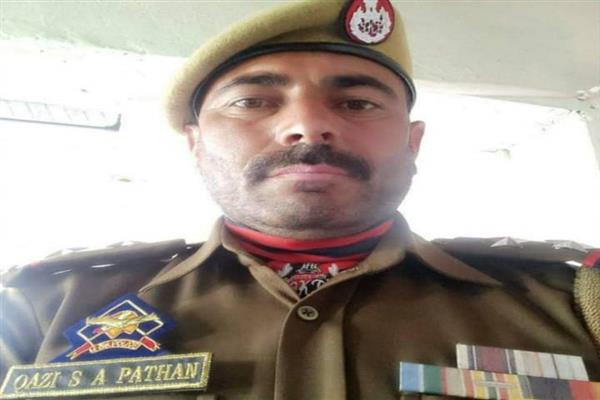
A 42-year-old JKP slain police Sub-Inspecter Qazi Sageer Ahmad Pathan on late Sunday evening was laid to rest in his ancestral graveyard in Tadd village of Karnah north Kashmir’s Kupwara district amid sobs ad tears.
According to Kashmir News Service (KNS), a pall of gloom desended on Tadd village of Karnah when body of slain police officer reached his ancestral place where hundreds of mourners attended his funeral prayers before he was laid to rest. His premonition of death left tadd villagers awash with tears. His two minor siblings six-year-old Insha and Eight-year-old Towfeeq watched bewildered, what happned.
Inconsolable his wife Rasheeda Begum and aged parents wailed and were beating their chests, trying to come to terms with the devastating loss. Slain police officer was appointed as constable in 1999 in Armed wing of Jammu and Kashmir Police, later on he volunteered himself for working with Police Special Operational Group (SOG), an elite counter insurgency force from 2006.
As per official sources, the slain police officer was honored with various medals which include Sher-e-Kashmir Police Medal for gallantry in 2009, Police medal for gallantry by President of India in 2011, DGP Jammu and Kashmir Commendation Medal and GOC-in-C, Northern Command commendation Disc.
Notably slain police officer was among five forces personnel who got killed in a night-long gun battle that broke out in Chanjmulla hamlet of Handwara town. Two militants including top Jaish commander Haider, a foriegner, were also killed in exchange of fire. (KNS)
source: http://www.knskashmir.com / Kashmir News Service / by Zubair Ahmad / May 04th, 2020
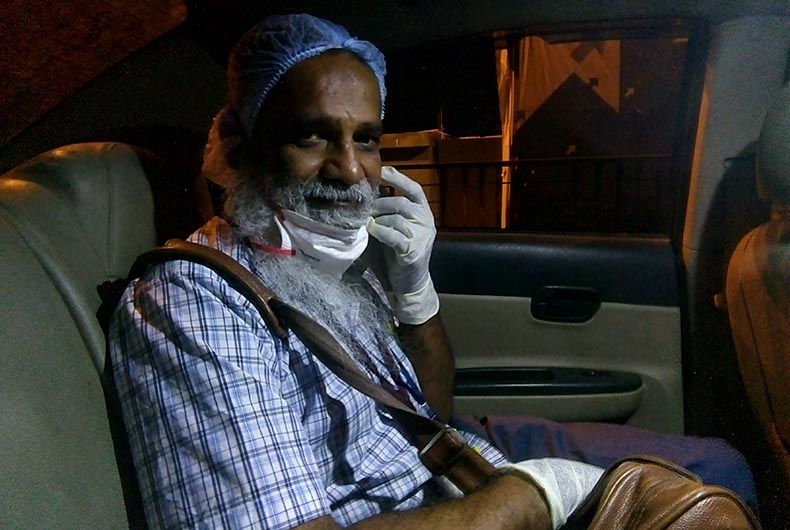
Dr Pervez Faizee was originally posted at Karajgavan Primary Health Centre (PHC) – some 14 kms from Malegaon
Dr Pervez Faizee – Corona warrior of Malegaon. (ummid.com) / [Dr Pervez Faizee was deputed to Malegaon as Medical Officer of Health (MoH) Corona Hospitals to manage and administer private hospitals taken by the Malegaon civic body to tackle the Coronavirus epidemic in the city. (Photo: Zohair M Safwan/ummid.com)]
Malegaon:
Its 03:45 a.m. and he has just settled on the steps of a dilapidated building after attending a patient – a diabetic who was in need of emergency medical aid.
With mask already on his face and gloves around his hands, he packs up for Suhur – the pre-dawn meal Muslims take during Ramadan. But, his phone rings again – nth times on the day.
“Another emergency doctor”, his aide directly came to the point. “A patient is serious and urgently needs oxygen. His relatives had moved pillar and post to get one, but failed. Can we do something for him?” he asked.
Instead of going home he rushed to the hospital. And for Suhur meal, he asked his wife to send tiffin.
For Dr Pervez Faizee, a Medical Officer in Malegaon, working for almost 15 to 17 hour daily became a routine ever since Coronavirus Disease (Covid-19) outbreak in the City on April 8.
Dr Pervez Faizee was originally posted at Karajgavan Primary Health Centre (PHC) – some 14 kms from Malegaon. He was deputed to Malegaon as Medical Officer of Health (MoH) Corona Hospitals to manage and administer private hospitals taken by the Malegaon civic body to tackle the Coronavirus epidemic in the city.
Malegaon Corona Hotspot
Malegaon has recorded 18 deaths and over 500 positive cases so far, 44 Corona positive patients found on Saturday alone. There is no “Corona Care Hospital” as could be seen in big cities. The Malegaon Municipal Corporation (MMC) has taken control of Jeevan Hospital, As Sayer Hospital Mansoora and few school buildings as a makeshift arrangement to admit Corona patients. All of them are full to their capacity.
“Faran Hospital offered its services for Corona patients after the Malegaon General Hospital was reserved for general patients. We have 30 beds at Faran Hospital for Corona patients, all of them occupied”, Dr Pervez Faizee, currently working as its superintendent, told ummid.com.
While tackling the Coronavirus fury, Malegaon is also battling the unprecedented task of controlling the alarming surge in the deaths of people suffering from ailments other than Coronavirus. Unable to get timely medical aid, over 700 people have died ever since March when the lockdown was clamped in the City.
Commendable role of BUMS doctors
With Faran Hospital reserved for Corona patients and other hospitals closed due to the lockdown the onus of providing medical aid to local residents has fallen on the shoulders of private medical practitioners – most of them holding BUMS degree from Mohammadia Tibbia College in Malegaon.
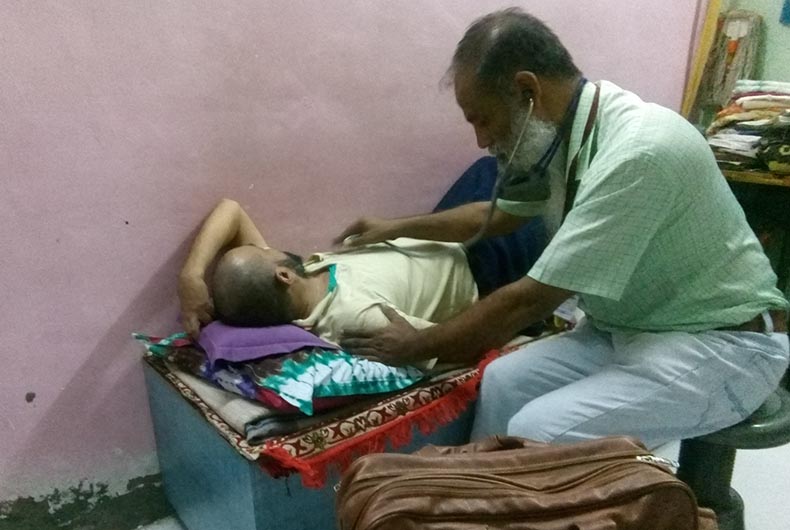
These corona warriors of the City are visiting patients at their home, and seeking help from Dr Pervez Faizee – on phone, and in case of emergencies also requesting him to visit a patient, are trying to provide relief to the ailing residents.
“Whether it is early morning or deep late in the night, we always see Dr Pervez Faizee shuttling from one hospital to another to help patients”, his close aide said.
“Apart from taking care of Corona patients admitted at Faran Hospital, As Sayer Hospital Mansoora and Jeevan Hospital, Dr Pervez is helping round the clock the patients who are not able to avail the medical aid because of the lockdown”, he added.
Taking help of technology
Relatives call Dr Pervez for help. He asks them to connect him with their family physician. He requests the family physician to rush to the patient’s home, monitor and discuss with him the patient’s condition, and prescribe the needed medicines.
“This has been his routine ever since the lockdown deaths in Malegaon started mounting”, he said.
“Sometimes when he is held up somewhere, Dr Faizee solicits a WhatsApp video call to assess the general condition of the patient”, his aide said.
At the same Dr Pervez Faizee does not forget to advise the patients to take Covid test done.
Corona warriors of Malegaon
Dr Pervez Faizee, who turned 50 in March this year, had worked under some of the very senior and best doctors of Maharashtra. However he developed the tendency of working overnight and going extra miles to provide relief to the patients during his tenure as Resident Medical Officer (RMO) at Sai Baba Charitable Trust Hospital in Shirdi 2006-08.
After joining the Maharashtra Health Department as Government Medical Officer, he rendered his services in tribal areas of the state. As a Medical Officer of Karajgavan and Neemgaon PHCs, he was instrumental in transforming and giving pleasant look to the premises. Earlier in 2012-13, he had redeveloped and renovated the Nampur Rural Hospital.
Fear of Coronavirus
Immediately after taking charge as Medical Officer of Health (MoH) Corona Hospitals, Dr Pervez Faizee worked overnight to bring in order Jeevan Hospital and As Sayer Hospital Mansoora that were in total disarray.
“What will go down in the history in golden words is his field work, management of the hospitals where Corona patients are admitted with little medical facilities, segregation of patients based on the gravity of their infection and in order to break the corona chain, and then making easier their release once their reports are negative”, his aides said.
“He even took wiper and cleaner in his own hands seeing the ward boys reluctant out of fear to clean the toilets”, his aides said.
Not the ward boys alone, majority of the local doctors, including those running their own hospitals, have chosen to remain indoors out of fear. The local civic body too is so helpless that it could not even hire drivers for the 11 mobile ambulances (Mobile Dispensary Seva) donated by Bharatiya Jain Sanghatna and Force Motors.
Before impressing the local residents for his services after Covid-19 outbreak, Dr Pervez was already known in the city for the help he used to provide to the patients in getting expensive surgeries and medical treatment done availing different government schemes.
“People in Malegaon generally hesitate in availing the government schemes due to lack of awareness and tiring paper work. Whenever contacted, Dr Pervez uses his contacts with medical fraternity and helps such patients”, his aide said.
source: http://www.ummid.com / Ummid.com / Home> India / by ummid.com Staff Reporter / May 12th, 2020
Mohammad Khalid rushed to donate blood at the blood bank of Maharao Bhim Singh Hospital in Kota though he was observing the Ramzan fast without knowing receivers blood type.
A 31-year-old man broke his Roza (fast) to donate blood to a hospitalised patient in need of a rare blood type.(HT File Photo)
A 31-year-old man won several hearts on Thursday after he broke his Roza (fast) to donate blood to a hospitalised patient in need of a rare blood type.
Mohammad Khalid, who works as tyre puncture repairer, rushed to donate blood at the blood bank of Maharao Bhim Singh Hospital in Kota though he was observing the Ramzan fast, after he got a call from a voluntary blood donors group, seeking his rare A negative (A-) blood type, to save the life of one Rajendra Sharma, a 48-year-old road accident victim from Bundi.
“Saving life of a human being is bigger than observing Roza or pursuing religious rituals, so I broke my fast and donated blood for the patient”, said Khalid adding that such gestures would send the message of communal harmony in society. “I did not know the religion of the injured patient when I got a call for blood donation,” said Khalid. “It is a matter of pride that God has made me a giver,” he added.
Said Bhuvnesh Gupta, a social activist and a team member of Jeevandata group that got in touch with Khalid: “Rajendra had a rare A negative (A-) blood group, and our search finally ended with Khalid”, he said.
“Khalid had donated blood on 10 other occasions in the past,” said Gupta.
source: http://www.hindustantimes.com / Hindustan Times / Home> Jaipur / by Aabshar H Quazi / Hindustan Times, Jaipur / May 17th, 2019
‘Service to the humanity is the greatest religion’
Patna:
Tales of humanity and brotherhood have brought much-needed comfort to the people in distress as they battle the coronavirus pandemic, locking themselves in homes for the past 40 days. Two such incidents in four days stand out.
A man from the Indian state of Bihar broke his fast to donate blood in a bid to save the life of a little girl admitted to a government hospital. The heart-warming incident took place in Gopalganj district on Friday.
As per the report, the condition of three-year-old Nishtha Kumari, daughter of Ujjwal Singh from Kaithwali village, deteriorated suddenly on Friday after which she was admitted to a local government hospital. The girl had been suffering from thalassemia, a blood disorder in which the body makes an abnormal form or inadequate amount of haemoglobin.
Finding her condition critical, the doctors asked her parents to immediately arrange blood for her. Singh rushed to the local blood banks but returned disappointed. Subsequently, he contacted the District Blood Donor Committee (DBDC), which promised to help him. However, it wasn’t convincing.
Singh was pleasantly surprised when he found a youth, Waqar Ahmed, eagerly waiting for him once he returned to the hospital. “Someone told me you urgently need blood for your daughter. I have come to donate blood,” Ahmed said.
The youth broke his fast with a glass of juice and donated blood, helping save the little girl’s life.
“Service to the humanity is the greatest religion,” Waqar said. Singh said he had no words to express his gratitude.
In another incident from Jharkhand’s Giridih district, a Muslim youth broke his fast to donate blood so that a boy’s life could be saved.
Parents of eight-year-old Nikhil had been finding it hard to arrange blood for their child suffering from pneumonia duet to lockdown.
As a last resort, he sent a message to the local villagers to donate blood. As the news reached, a villager, Salim Ansari, rushed to the hospital on Wednesday and offered to donate blood. Without wasting a moment, Ansari broke his fast and donated his blood to the boy.
source: http://www.gulfnews.com / Gulf News / Home> World> Asia> India / by Lata Rani , Correspondent / May 09th, 2020
Wanihama-Dialgam Village (Anantnag District) J & K / NEW DELHI :
Patient still on ventilator while the doctor is under quarantine
Zahid Abdul Majeed, a senior resident doctor at All India Institute of Medical Sciences (AIIMS), put his life at risk to save a COVID-19 patient on the way to the hospital’s trauma centre in an ambulance on May 7.
Dr. Zahid, who works at the critical care division of the hospital, had to remove his PPE (goggles and face-shield) to re-intubate the patient. While the patient continues to be on a ventilator, the doctor is under quarantine after the exposure.
“My father called me today [Sunday] and said even if I were to die from COVID -19, he would not grieve as I saved the life of a patient and may die as a martyr. It felt like a weight had been lifted from my heart. My parents appreciated the spirit with which this intervention was performed,’’ noted Dr. Zahid on Sunday.
Hailing from Kashmir’s Wanihama-Dialgam village in Anantnag district, Dr. Zahid has been working at AIIMS for nearly two years.
“Of course, this is not an example to follow. All healthcare professionals should use PPEs. When the transfer was happening, I realised that the patient’s tube was mal-positioned and that without immediate intervention, the patient would go into a cardiac arrest. In a dim-lit ambulance, working with PPE wasn’t a viable option and I quickly removed the face-shield [they were fogging up] and goggles while keeping my N-95 mask on to perform the procedure. I immediately reported the breach in PPE and was advised to proceed to quarantine,’’ said Dr. Zahid.
Intubation and the steps leading up to it are some of the high-risk moments for COVID-19 spread to healthcare workers and other patients, according to World Health Organization, which has recommended that strict protocols to limit viral exposure must be followed.
“This is the holy month of Ramadan and I reacted to a fellow human being in distress. As a doctor and a human being, I couldn’t have let harm come to my patient. The thinking and orientation at AIIMS are such that I have always seen my teachers and seniors go that extra mile for the patients….it does affect the way you start looking at your duty,’’ said Dr. Zahid.
The doctor said he hasn’t been able to meet his parents in nearly a year now and hopes that the COVID-19 situation improves enough for him to head to his village. “I was worried about what my father would say but his reaction has filled my heart with joy and I feel so much stronger now,’’ said Dr. Zahid, adding that he is looking forward to heading back to the hospital and back to his patients at the earliest.
source: http://www.thehindu.com / The Hindu / Home> News> Cities> Delhi / by Bindu Shajan Perappadan / New Delhi – May 10th, 2020
Mumbai MFD Nikhat Ashraf Mohamedy has been offering home-cooked meals to underprivileged people during lockdown.
Maiñ akelā hī chalā thā jānib-e-manzil, magar log saath aate gae aur kārvāñ bantā gayā (I started a journey for the betterment of mankind alone but many people joined me and eventually it became a movement). By Mazrooh Sultanpuri, famous lyricist and poet.
This is what happened with Mumbai mutual fund distributor Nikhat Ashraf Mohamedy who started offering meals to those starving for food during lockdown and today many people have joined her in this noble cause.
It all started when Nikhat came across a child who did not eat food for two days. Nikhat took this child home and offered him homemade food. This episode made her realize that there must be many people around her vicinity starving for food due to the nationwide lockdown. She then started cooking food for 150 people on her own to distribute it among them.
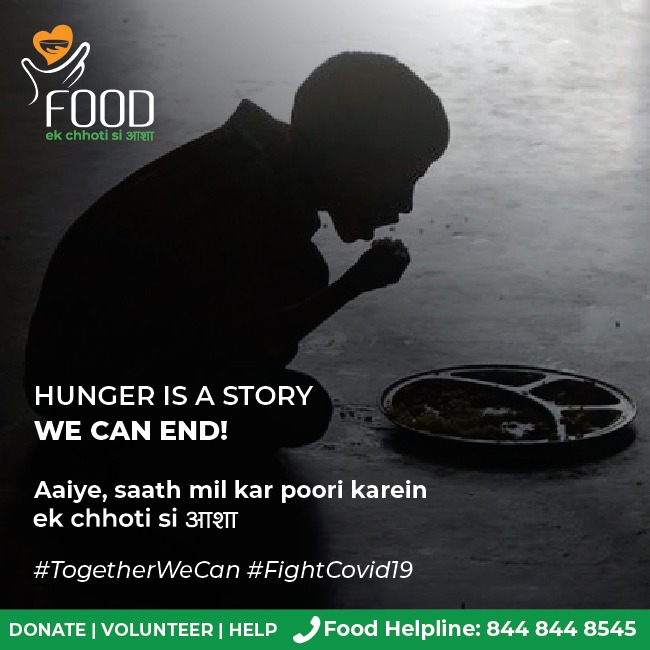
Soon, her neighbour and friends joined her in this initiative and set up a group called Food-Ek Choti Si Asha (A ray of hope) to help people starving for food. Today, her group provides meal for 10,000 people every day.
Nikhat believes that it is her moral duty to take care of those who are less fortunate. “We have been providing food to daily wage earners as these people did not have money to arrange for food due to sudden lockdown.”
Today, 75 volunteers across the city work with Nikhat to ensure that nobody sleeps hungry.
You can help Nikhat by becoming a volunteer or making contribution to her group. You can contact her @9967322224.
source: http://www.cafemutual.com / CafeMutual / Home> Tarraki Corner / by Vidyut Deshpande / April 16th, 2020
A Hindu priest and a Muslim social worker have come together to promote harmony during times of polarisation and communal discord.
Mujtaba Hasan Askari with C.S. Rangarajan
Despite differences in their faith, culture, attire and, as some would see, calling, a Hindu priest and a Muslim social worker have been making a statement in humanity as they work together to foster love and goodwill. The polarisation they witness around them appears to be of no consequence to the duo.
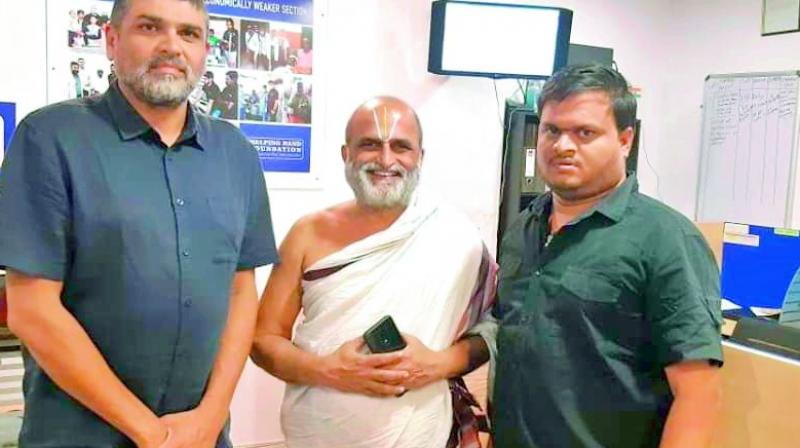
C.S. Rangarajan, chief priest at the Chilkur Balaji Temple in the city, and Mujtaba Hasan Askari, of Helping Hand Foundation (HHF), have been working ceaselessly to give communal harmony a chance. They’ve been doing their best in promoting shared values and upholding the doctrine of ‘unity in diversity’ through well thought-out programmes.
“Our aim is to ensure that human values are placed above religion and faith. Humanity is the biggest religion,” they say in unison.
The divine intervention Both batch mates of the College of Engineering, Osmania University, Rangarajan and Askari quit their lucrative jobs at the peak of their career to bring about social change. While the former, a social reformer who wants to purge the society of caste-based prejudices, turned to spirituality and became the chief priest at the Chilkur Balaji Temple, the latter founded the NGO Helping Hand Foundation to serve humanity in his way.
Interestingly, what brought the duo together was a deaf Dalit woman named Kamalamma, who sells flowers at the Chilkur Temple. In 2018, she tied rakhi on Rangarajan’s wrist, but it would be much later that he learns about her handicap.
Rangarajan recounts how after he learnt of her deafness, with her rakhi on his wrist, he felt duty-bound to help the woman. He quickly took Kamalamma to the Gandhi Hospital in Hyderabad, where the ENT surgeon diagnosed her with profound hearing loss and recommended a hearing aid. The hearing aid, priced at `55,000, was expensive. The local newspaper reported the story, and as luck would have it, Askari read about it and got in touch with Rangarajan to let him know that his NGO would foot the bill. The hearing aid restored Kamalamma’s hearing. “There’s no doubt. Divine intervention has brought us together,” says Rangarajan, smiling. “God operates through human beings.”
Serving God through humanity Instead of parting ways after that incident, the good Samaritans stayed in touch. They met regularly to exchange ideas on the positive work they could do for a society caught in the whirlpool of political turmoil and religious polarisation.’
Then, sometime last year, Lucas — a Lallaguda-resident — approached Rangarajan, looking for support for his daughter’s education at the St Francis College, Begumpet. The priest immediately contacted Askari, who arranged the money from HHF. Here was a Muslim NGO reaching out to help a Christian girl on the recommendation of a Hindu priest.
Since then, the duo has been working closely to promote interfaith dialogue. Clearly, for the duo, humanity is an integral part of religion, while religion is a private thing. A few months ago, Rangarajan even visited the Masjid-e-Ishaq in the Old City, where HHF runs a primary healthcare centre. There, he addressed the community on the need for communal harmony.
Rangarajan and Askari plan to promote communal harmony in a visible manner, through social work and dialogue.
In fact, in the coming days, they intend to conduct health camps by Muslim doctors in some temples and by Hindu physicians in some mosques. The idea is simple-to make a difference through the work they do, and it’s heartening to watch just that restoring peaceful co-existence, one kind act at a time.
source: http://www.deccanchronicle.com / Deccan Chronicle / Home> Lifestyle & Trending / by J.S. Ifthekhar / January 23rd, 2020
Across India, Muslims have been as engaged in operations to help people worst affected by the crisis as anyone else.
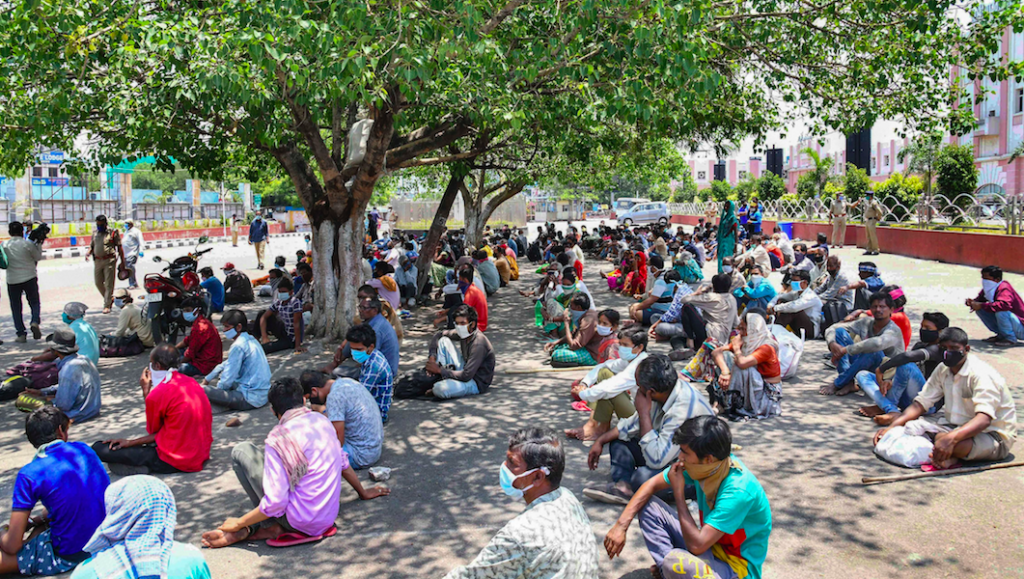
People sit in Hyderabad as volunteers distribute relief material. Photo: PTI
By its very nature, hate destroys and tears down; by its very nature, love creates and builds up.”
– Martin Luther King Jr.
As India soldiers through its lockdown amid the COVID-19 crisis, it is clear that the devastation it has wrought on lives and livelihoods is unprecedented in living memory.
From living on the fringes of society to now struggling for survival, the lived reality of millions of Indians today is one of deprivation and desperation. Dominating the narrative is also a vile and hateful worldview that seeks to find opportunity in a humanitarian catastrophe, and reflects a willingness to advance a “nationalist” agenda, albeit at the cost of the nation.
Thankfully, the story of COVID-19 in India does not begin with deprivation and end in hate. An integral aspect of our collective situation today is that tragedy has engendered resolve, and for some noble souls, countering hate is an exercise in demonstrating love and compassion.
Initiatives across the country to provide relief to the most vulnerable segment of society reflect how civil society can make a difference even in the face of government inefficacy and ineptitude. Especially heartening is the work of organisations that are working to provide succour to all, regardless of religious or caste identities.
In Mumbai, “Food – Ek Chhoti Si Asha” is a broad community relief effort initiated by Nikhat Mohamedy, a Hijab-clad Muslim lady.
Now serving over 25,000 meals a day to the poor and destitute across the metropolitan city and far-flung suburbs, it all started with Mohamedy coming across a daily wage worker from the slums who had not eaten for two days. This led to her cooking food for 150 people in the vicinity of her home near Crawford Market.
The sheer extent of the need and Mohamedy’s passion for relieving hunger saw many more people join and contribute to the effort with their time and money. Today, the organisation has one main kitchen serving 15,000 meals a day and several “satellite kitchens” across the city serving an additional 10,000 to 15,000 people.
Volunteers, donors and beneficiaries come from every religious community and every sect. “This is about recognising the fact that we are all children of Adam and Eve, and feeding those brothers and sisters who are hungry and deprived is fundamental to expressing our humanity, ” says Mohamedy.
“For me, personally, this work is also an expression of my identity as a Muslim. Widespread prejudice against Muslims cannot be allowed to get in the way of serving all who are impacted by this crisis regardless of their religious identify or social status,” she adds.
Helping Hand Foundation, a nationwide NGO operating in the health sector is another organisation that has pivoted towards awareness campaigns and emergency assistance in the wake of the COVID-19 crisis.
A dedicated team of 100 volunteers including several ambulance drivers, nurses, paramedics, counsellors and patient care givers are working on a daily basis to reach out to areas where food and medical attention are urgently needed. This is in addition to awareness campaigns on social distancing and hygiene, in government hospitals as well as in slums, along with the efforts it takes in educating the masses on ways to safeguard their health at this time.
“We have been engaged in the mission to serve our fellow citizens even before COVID-19. The magnitude of the challenge facing our country and the sheer plight of those in need has only strengthened our resolve to do more,” says Mujtaba Askari, the organisation’s founder and trustee who is based in Hyderabad.
“As for the demonisation of Muslims, the antidote to hate can never be hate. It is love and compassion,” Askari adds.
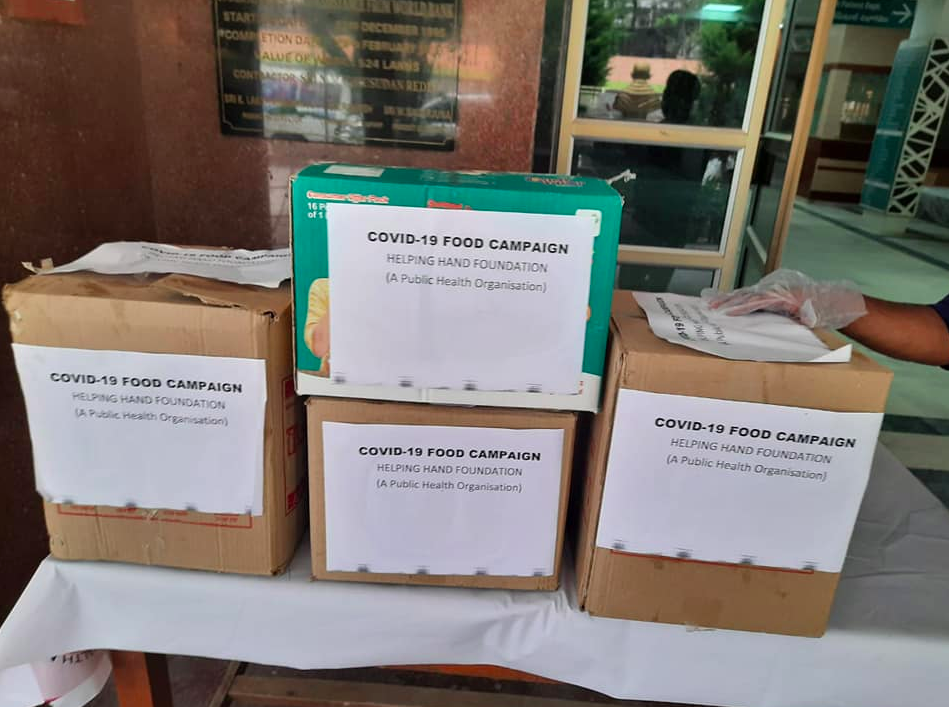
Food packets to be distributed by the Helping Hand Foundation. Photo: Facebook
The phenomenon of individuals and organisations transcending religious differences to serve all is not limited to Muslims.
In Mumbai, a Bengali Welfare Association has reallocated the funds meant for Durga Puja celebrations towards COVID-19 relief efforts. From Gurdwaras to Buddhist monasteries hundreds of houses of worship of practically every religious community have recognised the existential nature of the crisis facing the country and the world, and have risen to the occasion by welcoming everyone who needs help.
The point of highlighting Muslims doing the same is not to take anything away from the magnanimity of these laudable efforts. In the current climate, however, of unending vitriol being poured on Muslims by some public figures and media outlets, there is something especially uplifting about so many Indian Muslims rising above anger and bitterness to stay focused on providing relief to fellow citizens.
Not only are Muslim-led efforts in various states working towards relief a common phenomenon, established nationwide organisations of Indian Muslims such as the Jamaat-e-Islami Hind (JIH) have a long track record of being in the forefront of relief efforts in the face of natural calamities. Their grassroots-based nationwide network is now being effectively leveraged to provide relief to Indians of every creed and caste, which the organisation plans to continue until the lockdown is in place.
Undoubtedly, the struggle to save India’s soul will be long and hard, and things will likely get worse before they get better.
However, it is the acts of kindness that so many people of every religious community are willing to extend to each other that keeps the hope alive for millions of Indians.
These acts already represent a triumph of pluralism over bigotry, and of compassion over cruelty.
Musaddique Thange is a project management professional based in the US. He has served as a board member of the Indian American Muslim Council and has been engaged in social services in San Diego, California for the last 10 years.
source: http://www.thewire.in / The Wire / Home> Analysis / by Musaddique Thange / April 27th, 2020
What do people like Jahanara Bibi, Zakir Hussain, Heera, Rebecca, Mansura, Reshma, Hassanujjaman, Akbar, Raju and Rahim have in common?
One, they all are residents of West Bengal; two, they are Muslim and three, immune to the communal strife reported all around, they have dedicated themselves to help the poor, the ignorant and the needy in these times of Covid-19 irrespective of their communal identity.
Some of them are making masks and distributing these free of cost among poor people who cannot afford to buy them, creating awareness in their respective neighbourhoods about the need for wearing masks, maintaining social distancing and staying indoors during the lockdown. They live in neighbourhoods in extended Kolkata where the majority is Muslim but Hindus live here too and there does not seem any communal strife raising its head here.
According to Arunakshya Bhattacharya of the Anandbazar Patrika (May 4, 2020), Jahanara Bibi, a housewife, who lives in the neighbourhood of Duttapukur Police Station, happened to chance upon a group of children moving about without masks during the lockdown. So, she asked them why they were not wearing masks. They chorused that they did not have the means to buy masks. She at once made up her mind to make masks herself at home with leftover pieces of cloth and distribute these for free among poor children. She personally distributed these masks to different localities in the neighbourhood. To end this happy story, her husband, Zakir Hussain, has joined her in this effort.
Explaining what motivated her, Jahanara says, “I know that people in these outskirts and suburbs areas are not aware of the importance of wearing masks and the ill effects of not wearing them. There are many who cannot afford to buy masks or know to make them, So, I took it upon myself not to make masks but also to visit homes from door to door and distribute the masks and also, if possible, to explain the importance of wearing masks when stepping out.”
Happily, other women of the community such as Heera, Rebecca and Mansura are distributing masks across neighbourhoods like Jagulia, Duttapukur, Golabadi, etc from one house to the next and also selling some masks to those who can pay.
Aamdanga is a neighbourhood crowded with people of the minority community. The same applies to Hadipur and Gorpara in Deganga. A group of women from the minority community noticed that the residents of these places were crowding needlessly in some areas, in violation of the rules of social distancing. Some were even seen chit-chatting at small tea shops.
A group of Muslim women took it upon themselves to form small groups and visit these crowded areas and counsel the locals against crowding needlessly and advising them to stay home. Reshma Tarafdar, a college student, went from door to door to advise them to stay at home and not step out during the lockdown. Some among these groups are also helping out in the distribution of free food among the poor and the very poor.
Hassanujjaman Choudhury, a young man who lives in Noornagar within Deganga, has invented an original “Food ATM” machine which carries the label “Please maintain social distancing” on its body. The very poor who cannot afford their daily meals are handed a metal token with the picture of Netaji Subhash Chandra Bose. They have to slip this token into a slot in the machine and at once, two packets of rice, potatoes, onions, soyabean and oil come out. Others involved in similar volunteer work are Akbar, Raju and Rahim who have vowed to stand beside the deprived and the downtrodden in these dark days.
These incidents come in the wake of the story of Abdul Rehman Sheikh, 30, a businessman, who, along with other Muslim neighbours, came to the aid of the sons of Draupadi Bai Verma when her sister refused to take care of her as she suspected the old woman of being a Covid-19 patient. No one was there to take her to a hospital and she died the following day. This happened in the beginning of April this year.
She lived with one son who is very poor while the other was away and could not come down when the mother was serious. They were very poor. The neighbours refused to even touch the body leave alone joining to help in the funeral rites. At this juncture, Sheikh brought ten Muslim men and came forward to arrange the cremation of the lady by Hindu rites both physically and financially.
This happened in South Toda in Indore. The old woman was suffering from paralysis for three months. According to Sheikh, her sister’s sons, who live just 100 metres away refused to step inside the house. “If she was taken to a hospital the same day, she probably wouldn’t have died,” said Sheikh. the 10 men, along with her two sons and their children, took out the procession to the cremation ground around a kilometre away.
Man-made schisms within two communities do not exist except when politicians try to ignite them for their own axe-grinding motives irrespective of the degree and intensity of the harm this igniting of hate can fall on the harmony and secular feelings the present situation demands. These are just a few examples that illustrate how Kolkata and its suburbs are being witness to the wonderful effort being put in by women of the minority community in volunteering to help people in distress, specially the economically deprived classes, with their help, without thinking about how their exposure in the public domain might place them at risk.
According to a Reuters Report in The Japan Times,(April 20, 2020), “There is no official breakdown of coronavirus cases by religion. But many Muslims feel unfairly blamed for spreading the disease after a cluster emerged at a gathering of Muslim missionaries in New Delhi last month. Sensational news coverage about the event, fanned by some Hindu nationalist politicians, helped spur the trending topic “Coronajihad” on social media.
source: http://www.thecitizen.in / The Citizen / Home / By Shoma A. Chatterji / West Bengal / May 06th, 2020
Mango growers of UP seeks institutional procurement of produce due to lockdown in the state which produces around 65 per cent of global yield of the fruit.
Haji Kalimullah Khan in his orchard (Photo | EPS)
Lucknow :
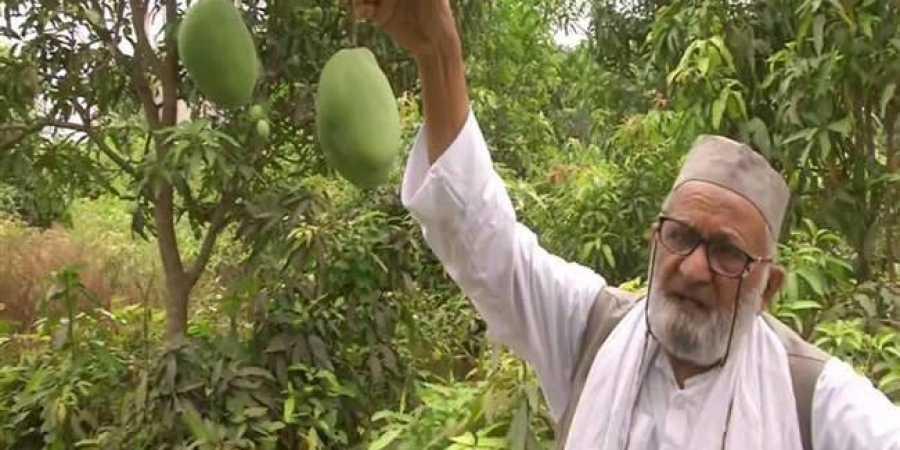
Uttar Pradesh’s Haji Kalimullah Khan, who is popularly known as India’s ‘Mango Man’, has developed two varieties of mango and has dedicated them to ‘corona warriors’ of the country.
Khan developed the two varieties of ‘dussehri’ mango and named them as ‘police aam’ and ‘doctor aam’ in the acknowledgment of their contribution to the war on deadly coronavirus.
In fact, Khan, 85, is credited with developing around 300 different sub-varieties of ‘dussehri,’ the most prominent mango variety grown in the mango belt, especially, Malihabad, 28 km from Lucknow. He has developed the new varieties by using graft technique and has got them named after prominent Bollywood and sport celebrities and political figures including PM Narendra Modi, Home Minister Amit Shah,, UP CM Yogi Adityanath, Congress chief Sonia, Gandhi, Aishwarya Rai, Amitabh Bachchan , cricketer Sachin Tendulkar and many more.
“The hard work being put to fight the pandemic in these difficult times by keeping their families behind moved me to name these two varieties after ‘doctor’ and ‘police’ personnel,” said Khan.
Sharing more details about the new varieties, Khan said he was waiting for the varieties to ripe in his orchard and hopefully they would be ready for plucking next month.
However, Khan could not hide his concern for the market prospects of dussehri given the persistent restrictions in the domestic and export market following the lockdown. In fact, by this time of the year, mango growers of UP, which produces around 65 per cent of global yield of the fruit, finalise sales contracts for the season with the traders and exporters. But this year, the process has not taken off yet due to the COVID -19 lockdown.
Meanwhile, the mango growers have sought institutional procurement of the crop as they have not been able to sell the produce in the open market due to restrictions.
In UP, mango is produced in an area of 2.5 lakh hectares. Lucknow, Pratapgarh, Allahabad, Bulandshahar, Saharanpur, Faizabad, Varanasi, Moradabad, Barabanki, Meerut, Unnao, Sitapur, Hardoi, Gorakhpur, Basti, JP Nagar and Mathura are the major mango producing belts in the state.
Popular varieties like chausa, dusheri, fazli, gulab khas, langra, mallika and amrapali are produced in the state. With the prices of ready mango varieties — alphonso and kesar — dwindling due to the lockdown, the growers of dussehri have knocked at the doors of the state government for relief.
In a letter to UP Chief Minister Yogi Adityanath, Mango Growers Association of India has demanded a slew of urgent measures to protect state mango farmers, on the lines of growers of alphonso and kesar varieties, which are primarily grown in Maharashtra and Gujarat, respectively, from economic losses.
“Alphonso, which normally sells at Rs 1,500 a dozen, is currently selling at Rs 400-500 a dozen this year, owing to the slump in domestic and export demand. Even transportation of the fruit to the market is also a major issue,” said Insram Ali, Association president. He said kesar farmers were suffering. “Kesar sale peaks in April. But, consignments are not reaching big markets, such as Delhi, and thus incurring losses to growers,” he added.
Moreover, the loss to the crop due to unpredictable weather has also increased the plight of the mango growers. According to Ali, UP’s mango production, which is dominated by dussehri with an 80 per cent share, is estimated at almost 3.5 million tonnes (MT), down 12.5 per cent compared to last year’s yield of over 4 MT. UP exports mango to the Gulf countries including Iran, United Arab of Emirates (UAE), Saudi Arabia, Kuwait, Qatar and Bangladesh besides, US and Europe.
source: http://www.newindianexpress.com / The New Indian Express / Home> Good News / by Namita Bajpai / Express News Service / May 07th, 2020