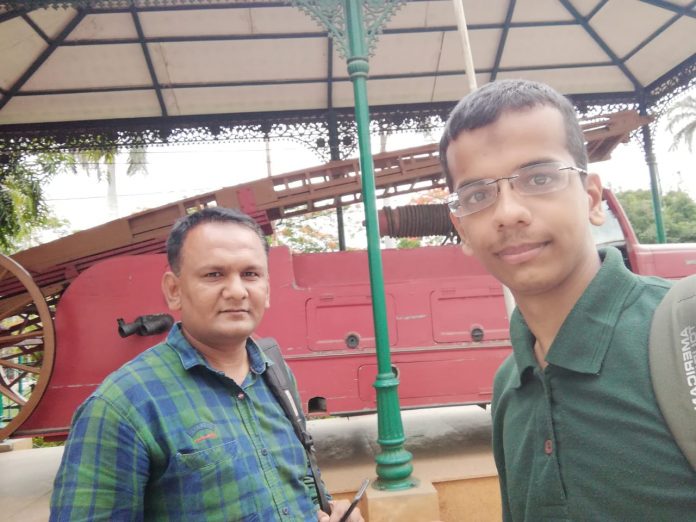
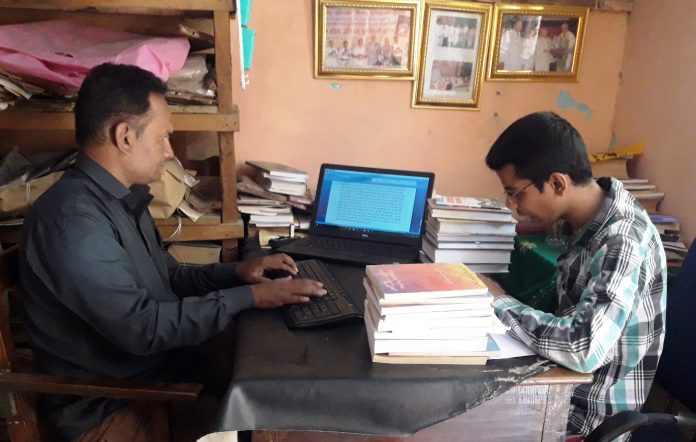
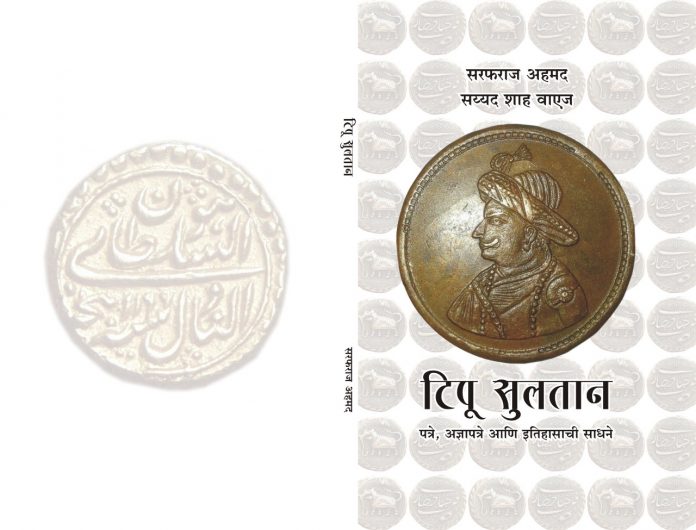
In an attempt to highlight Tipu Sultan’s personality, diplomacy, relationships with other rulers, foreign policies and other facets of his rule, two youths from Solapur city, Sarfaraz Ahmed and Wayez Sayed are bringing out a Marathi book named “Tipu Sultan – Patre, Hukum Name aani Itihasache Sadhne” (Tipu Sultan – Letters, Orders and History materials).
About 415 letters and 10 orders (Hukm name) of Tipu Sultan have been collected by these two youths and translated into Marathi.
The book containing Tipu’s written material is ready for release and will be published by Adv. Gaziuddin Research Center, Solapur, Maharashtra. This research centre has released five books on Tipu Sultan.
Speaking with Twocircles.net, Sarfaraz Ahmed informed that they worked for nearly six years to translate this 300-page book.They had to travel across India to collect these 415 letters written by Tipu which have been preserved in different libraries of the country, he added.
“These letters show that he had very good relations with Maratha Sardars of Maharashtra, Nizam II of Hyderabad and other Indian kings. He also contacted foreign rulers, including Napoleon Bonaparte and British rulers as a part of foreign policy, ” Ahmad added.
Come author Sayed Shah Wayez said they had to work hard to translate these letters because they were written in seven languages since Tipu Sultan used to communicate with other rulers in their mother tongue only.
Renowned activist Ram Punyani, who has written the introduction for this book, lauded the efforts and the hardwork of Sarfaraz and Wayez.
source: http://www.twocircles.net / TwoCircles.net / Home> Historical Facts> Indian Muslims> Lead Story / by Imran Inamdar, Twocirlces.net / September 22nd, 2019
As elected members in Tamil Nadu Waqf Board are not more than the nominated members, the Governor has superseded the Tamil Nadu Waqf Board for six months. The Governor has appointed M.A. Siddique as special officer to exercise and perform all the powers and duties as long as the board remains superseded.
As per sub-section (4) of section 14 of the Waqf Act, 1995, the Tamil Nadu Waqf Board would be unable to perform if the elected members were not more than the nominated members. The special officer, at present a Principal Secretary to Government (Expenditure), Finance Department, would perform all the powers and duties under the provisions of the Waqf Act, 1995, according to a notification issued by the State government.
While the board’s chairperson A. Anwhar Raajhaa ceased to be a Member of Parliament, two senior Muslim advocates, who were earlier considered elected members, would have to be considered nominated members, as per the legal advice received by the State government. Although there were two Muslim MPs from the State, even their appointment would still make it six members, whereas the rule demands elected members should be more than nominated members.
Legal opinion
Following show-cause notices sent to all 10 members of the Board as per the rule, only four members replied seeking to drop the superseding process and urged that senior advocates be considered elected members. “The government has received legal opinion that the senior advocates can be considered as nominated members. In view of the above, the elected members are less than the nominated members and the board is unable to perform its functions..,” the notification stated.
The 10 members on the board were: A. Anwhar Raajhaa, K.A.M. Muhammed Abubacker, K.S. Masthan, A. Sirajudeen, M. Ajmal Khan, A. Tamilmahan Hussain, Amatul Aatifa, A.S. Fathima Muzaffer, Haja K. Majeed and Syed Ali Akbar. Mr. Siddique was a government nominee.
source: http://www.thehindu.com / The Hindu / Home> News> States> Tamil Nadu / by Special Correspondent / Chennai – September 20th, 2019
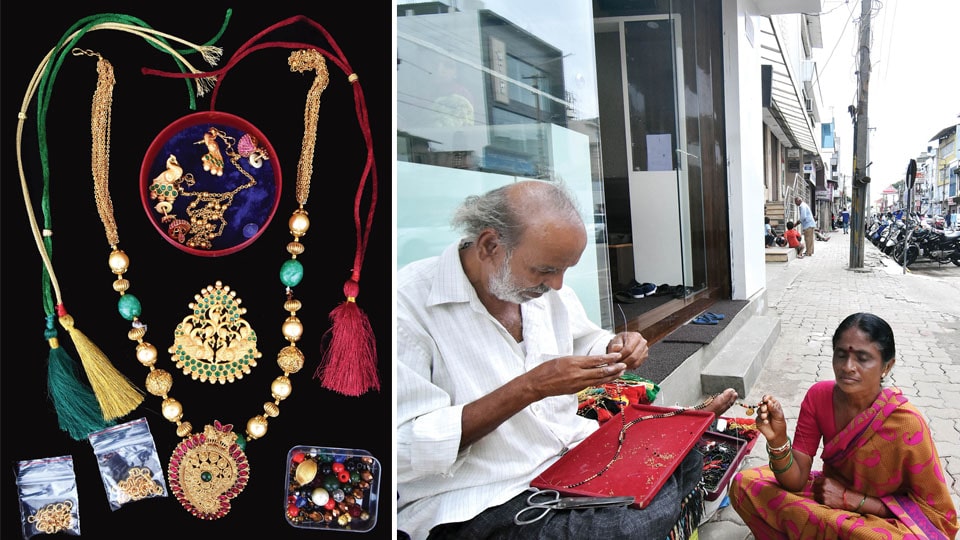
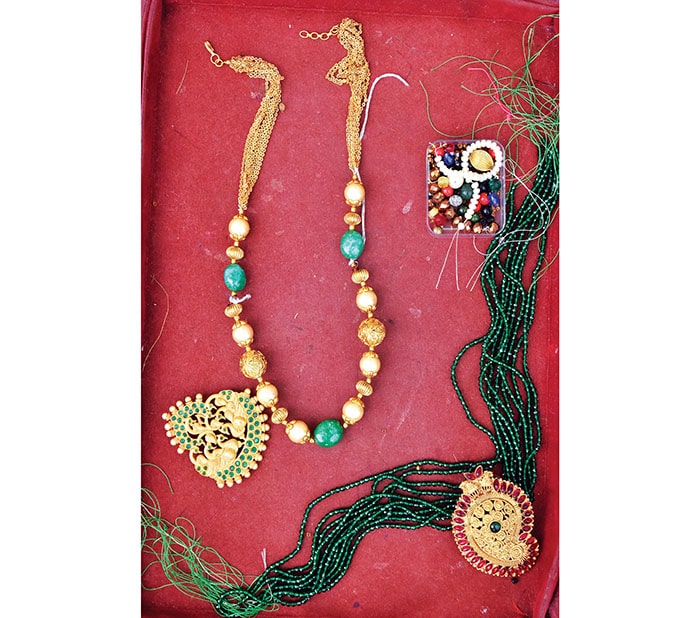
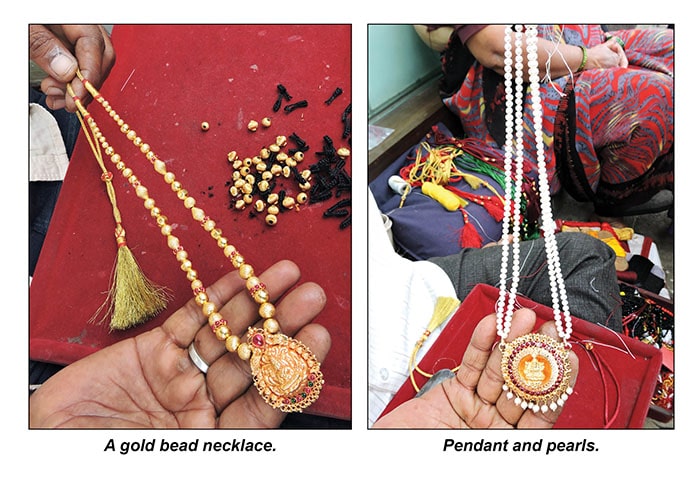
Beadwork is the use of beads in fabric decoration and ornamental design. Beads were used decoratively in ancient Egypt, Greece and Rome and during the Indus Valley civilisation. However, today, the art that is handmade is becoming increasingly hard to find, which is reflected in its price point in the marketplace. Beadwork, with its symmetric or asymmetric patterning, stands out for its intricate and innovative designs. The practice of beading transmutes a jumble of beads into a meaningful whole. This Weekend Star Supplement introduces some of the unsung traditional bead artists on Ashoka Road pavement who have mastered the delicate art and made it their own.
Unsung Beadstringers of Ashoka Road
These threads full of enchantment have entangled in your caress…
No clue or hint I can fathom, how this knot could be unravelled…
Each shred hums in my body, like a stream from the heaven…
These are the lyrics of the Hindi hit song “Yeh moh moh ke dhaage…Teri ungliyon se ja uljhe” roughly translated to English.
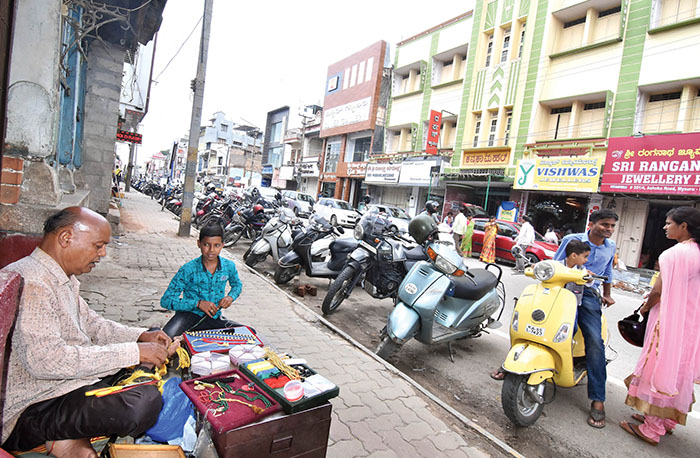
A melange of colours, a dash of design — Craftsmen engrossed with threads and shimmering beads artistically woven around their deft fingers, their tools stacked on the roadside, usually flocked by women, intrigued by their skills on display. One would be forgiven for thinking that these are scenes from a bygone era but this is a common sight on Ashoka Road, if you have the eyes to spot it.
Bead art in India dates back to Indus Valley Civilisation and is said to be 5,000 years old. People during that age made beads out of silver, gold, clay, ivory and even wood. Indian jewellery, made out of various stones, pearls and metals stands out for its uniqueness of design and craftsmanship. As much as we praise the magnificence of jewellery, the toil and talent of the master craftsmen usually escapes into obscurity and these unsung craftsmen are a classic example of hardly being recognised for their talent or effort.
Deeply personal art
Speak to them and each craftsman educates us through the vocabulary of beads. Individual beads act like words, strung together in sentences. Each craftsman on the sidewalk tells the story of beads and what inspiration triggered the design. These beaded objects are deeply personal and the men share bits about themselves, how the art was transferred from their forefathers and how they attentively followed the instructions — though they were tough to follow initially.
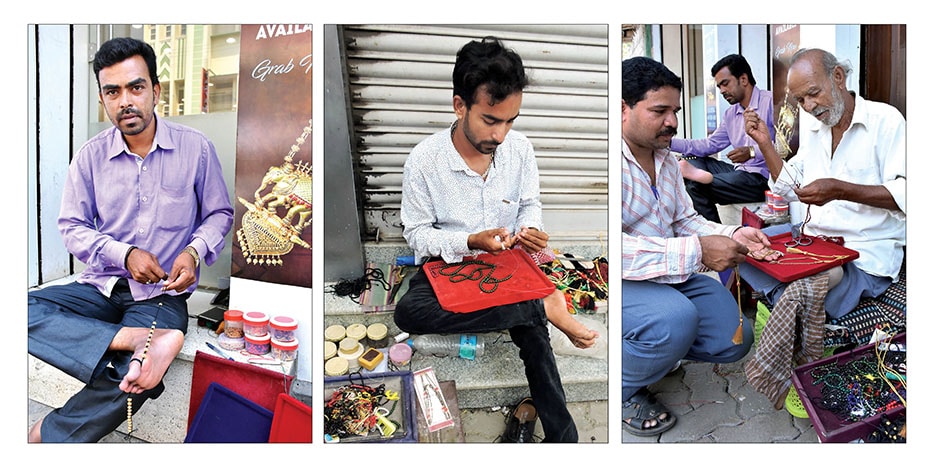
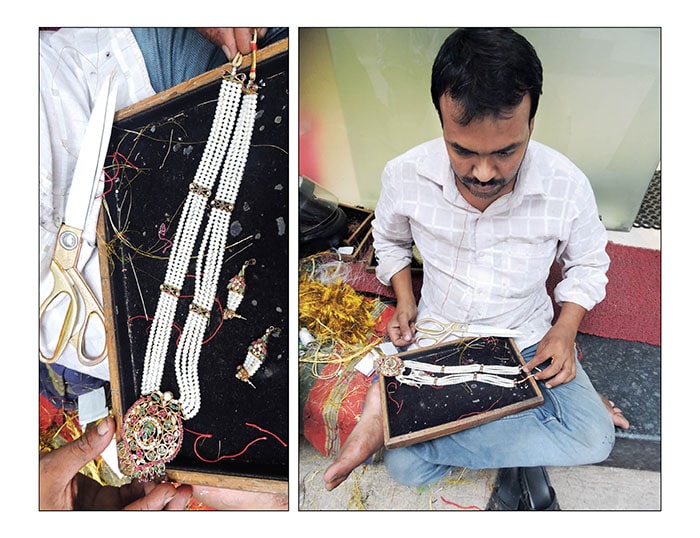
Master-craftsmen string beads for that alluring look: Mohammad Shaukat, Mubarak Pasha and Abdul Wajid display their expertise and dexterity in stringing pearls that adorn the necks of womenfolk, enhancing their beauty.
Nimble hands to the needle
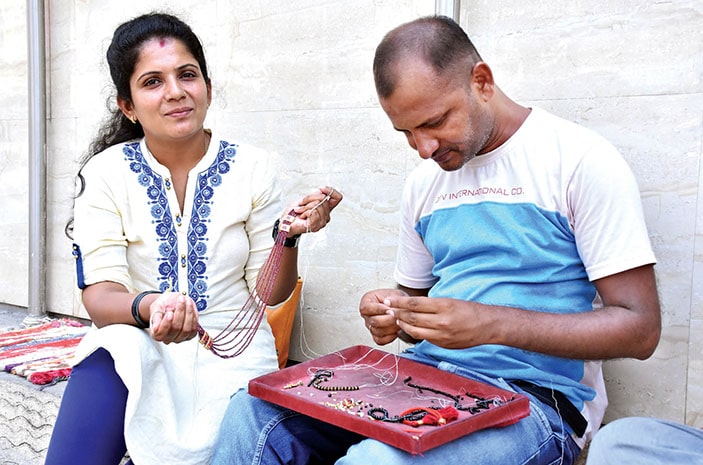
One can actually see how the beads are dexterously moved from their nimble hands to the needle and string to create that exquisite design. These designs become a prized possession of a woman who proudly shares them with the world.
Many cultures have rich beadwork traditions and aesthetics and motifs can vary. Like other traditional craft forms, such as embroidery or weaving, beadwork symbolises visual language and messages that are passed down within a community or family. Their works simultaneously keep their culture’s traditions alive apart from providing them livelihood.
Syed Rafiq, Shahrukh and their pearl work.
Adding beauty to clothing
Embroidery has been the art form that adds beauty to clothing to express individual creativity. Beadwork is respected as a traditional craft and there are amazing bead artists who are blurring the boundaries of art and craft, creating works of art that reflect rich traditions. The craftsmen on Ashoka Road, undeterred by the chaotic traffic and surging pedestrians, are busy threading, stringing and modifying a variety of ornaments as per the demands of their customers. Star of Mysore caught up with these beadwork artisans who are seen with their small silver boxes comprising velvet trays, colourful threads, strings, needles and scissors.
These artisans have been into this profession from generations and have been eking out their living on Ashoka Road, which was known as Jewellery Bazar during the time of erstwhile Maharajas.
Replacing threads and strings
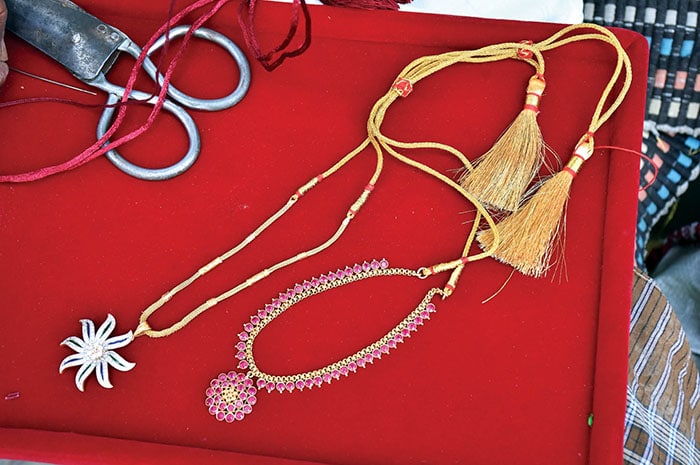
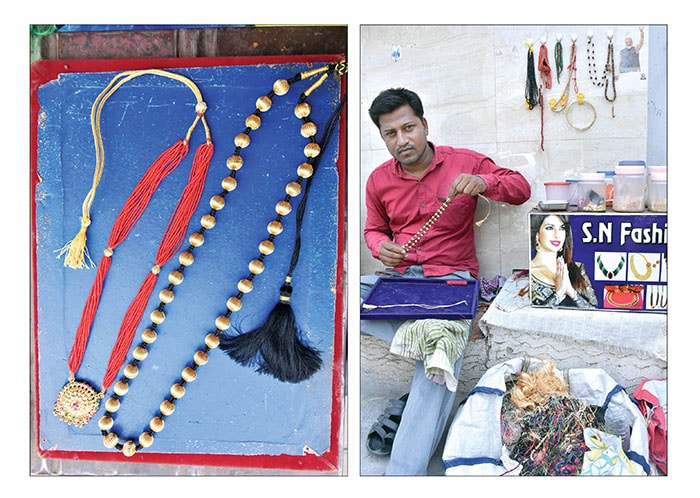
Bead-makers, also called ‘Patvegar’ or ‘Moti Puranewale’ in Hindi and ‘Mani Ponsouru’ in Kannada offer a range of services which include black beads stringing for mangalsutra, jaumala haar, white pearl stringing, kasina sara or galsar (gold coin necklace), lachcha, replacing threads and strings of necklaces, adding gold thread rope for gold necklaces, multiple bead stringing, replacing stones among others.
Various branded jewellery stores across the city also avail their services for stringing beads of precious stones such as emeralds, rubies and also semi-precious stones. Their service charges depend on the pattern, starting from mere Rs.30 and could go up to Rs.800 for real gem stones.
Zabiulla stringing antique real pearls set.
Passed on from forefathers
My forefathers have been into this profession from the past 60 years. I too picked up my beading needle and thread watching them do it since childhood. Our work is related to jewels so we sit near jewellery stores,” quips Syed Rafiq, one of the beadwork artisans with more than 30 years of experience.
He also adds that his father Nisar Ahmed is one of the oldest beadwork artisans and informs that his father had worked as a jewellery artisan even for the royals during those good old days.
ON A BUSY STREET: Abdulla and his assistant at work.
From Royalty to Commoners
Mubarak Pasha, another bead maker who is into stringing from the past 20 years and also hails from a family of artisans told SOM: “My grandfather and my father got me into this line. I usually get customers who want me to string ‘kasina sara’ and ‘taali sara’. I charge between Rs. 30 and Rs.100.”
He also mentions that his father too had worked on the ornaments like the braid jewellery belonging to the royal family. When asked if he would pass on the craft to his children, he opines: “It is left to them to decide what they want to do”.
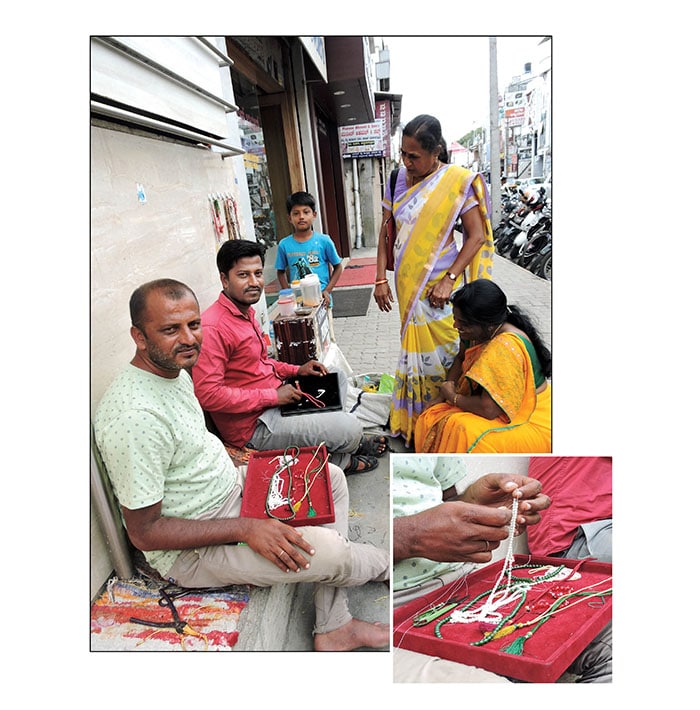
Delicate work: A woman waits to get her beads stringed.
Bringing good fortune
Little further away was a father-son duo busy stringing pearls on the same street. Abdul Wajid, who has 56 years of experience in this art says: “This is my livelihood and passion. The variety of beads that I work on not only suffices the aesthetic sense but has also religious angle to it. Genuine pearls were believed to bring in good fortune and were popular with the royals in olden days. Gradually common man took a passion towards them. Black beads are also known to fight negative energy.”
Abdul Wajid also adds that the most special work till date he has worked on is the jewellery belonging to the Palace. Zabiullah, who was seen sitting opposite to the Arali Mara on Ashoka Road, has an experience of over two decades.
“This is a delicate art and we have to carefully string it, the love for jewellery in Mysuru can be judged from the presence of many jewellery shops. Customers keep me busy all day,” he says as he replaces a string of an antique pearl set.
READY-TO-WEAR: Shahrukh displays a finished ‘Jaumala haar’.
Time and cost saving
As we converse with these talented artisans, we noticed that many customers visit these craftsmen to avail their services. “I have come here to attach a coin pendant to the black beads for the ‘mangalsutra’ for my daughter who is getting married next month. Availing services here saves a lot of time and it is also low on cost,” says Gowramma, a locality resident.
Rehana Afroz reveals her reason for the visit. “The pearl necklace that I had once brought from Hyderabad was broken by my child and I am here to get it stringed again and also to change the back rope ‘Dori’ of my multi-layered beaded necklace.”
“I have purchased the beads and I want to get a ‘jaumala’ done here with knots and I also have to replace a stone in my ring,” says Kavitha, a housewife.
These beadstringers are available from 11 in the morning to 8 in the night at their respective spots. We salute these skilled craftsmen who eke out their living by sitting on the pavements beating all odds and help womenfolk enhance their beauty through their delicate and dedicated work.
source: http://www.starofmysore.com / Star of Mysore / Home> Feature Articles / by Shadaan Muneer / September 14th, 2019
Sania is an aggressive player with one of the biggest forehands in the game
The stupendous success of tennis duo Sania Mirza and Martina Hingis in 2015 has helped them attain the title of 2015 Women’s Doubles World Champions
Sania was born in Mumbai but has lived in Hyderabad for much of her life
Sania Mirza is a path-breaking athlete who almost single-handedly put Indian women’s tennis on the global map. She is the first and so far the only Indian female player to have won a Grand Slam title in any format, and is also the only player to have broken into the top 30 of the WTA singles rankings. Sania’s doubles partnership with Martina Hingis is widely celebrated for its style and success. In 2015 and 2016, Sania and Hingis were the best doubles players on the planet, winning three Slams and two WTA Finals titles. Today, Sania is a sporting and socio-cultural icon in India, whose stature rivals that of the top cricketers in the country.
Sania Mirza Early Life
Sania is an aggressive player with one of the biggest forehands in the game. She can dictate any rally by powering her forehand into the corners and is capable of hitting winners off that wing even from defensive positions. Sania’s forehand was one of the main reasons why she could challenge the top players in singles at the start of her career. While she had a few weaknesses in her game, her forehand was so unique that it regularly featured in the ‘best forehands in the game’ lists. Sania’s backhand is fairly efficient, but her serve is attackable and inconsistent. Her movement is not the greatest either, which hampers her during long rallies and long matches. Sania started out as an aggressive baseliner but started approaching the net a lot more as her focus shifted to doubles. Her volleys have improved over time, and during her partnership with Hingis, she occasionally matched the Swiss’ finesse at the net.
Sania Mirza’s Personal Life
Sania was born in Mumbai but has lived in Hyderabad for much of her life. She started playing tennis at the age of six, and her father Imran Mirza has been her primary coach ever since. Sania married Pakistani cricketer Shoaib Malik in April 2010. In April 2018, the couple announced that they were pregnant with their first child, which put Sania’s tennis career on hold. Sania’s popularity with the Indian masses has earned her a number of endorsement deals, and she has also taken up modelling on some occasions.
Sania Mirza Stats
The stupendous success of tennis duo Sania Mirza and Martina Hingis in 2015 has helped them attain the title of 2015 Women’s Doubles World Champions. Conferred upon the two tennis stars by the International Tennis Federation (ITF), this title has brought the two women, tennis players, closer to each other. Quite contented with the award received from the ITF, Sania Mirza seeks to become an inspiration to all female tennis aspirants in India. Both, Sania and Martina have played together to win their last 22 matches, beginning from the US Open to wins recorded in Asia at Wuhan, Guangzhou, Beijing and finally the WTA Finals.
source: http://www.republicworld.com / Republic TV / Home> Sports News> Tennis News / by Asmita Shukla / Mumbai – September 18th, 2019
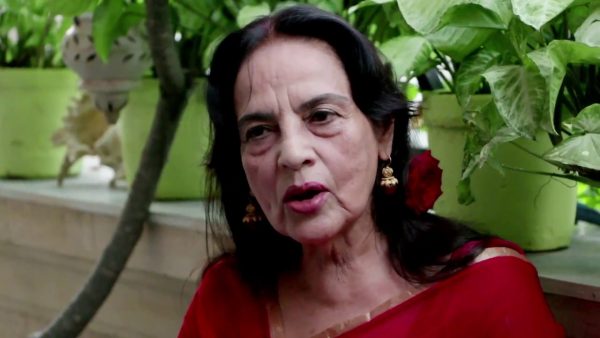
Salma Sultan , the iconic news anchor of the public service broadcaster, Doordarshan graced the ramp at the age of 72. The elegant lady mesmerised the audience with her dance moves on Bollywood numbers including the R. Rajkumar’s movie song, ‘Saree kay fall sa.’
The event was organised by Saree Sanskriti in association with the Fashion Lifestyle Magazine. Celebrities including Padma Shree awardee Shovana Narayan, graced the event.
Key Takeaways:
Iconic Doordarshan news anchor Salma Sultan walks the ramp at 72.
Sultan is best known for her news reading and her signature style – “Namaskar! Aaj kay samaachaar iss prakaar hain.”
The event was organised by Saree Sanskriti in association with the Fashion Lifestyle Magazine.
Celebrities including Padma Shree awardee Shovana Narayan, graced the event.
Sultan was wearing a brown bordered saree along with some neatly tucked white flowers on her hair while using ‘jhumkaas’ as the elegant accessory. She managed to get a traditional look with a modern twist.
Saree Sanskriti
Along with being a new anchor, Salma Sultan is also keen on promoting the traditional Indian culture of Saree. She owns a clothing brand with the name, Saree Sanskriti. She herself is very famous for her sartorial style.
“I do not believe millennials have any problem wearing the saree, it is all about ensuring that they have confidence. When confidence is there you can pull off any attire,”
“It is a very happy occasion . Many people have come together to make this a successful event. I do not believe millennials have any problem wearing the saree, it is all about ensuring that they have confidence. When confidence is there you can pull off any attire,” Sultan said at the event.
Her style quotient
“We were our own fashion consultants back then. Black-and-white TV offered us the facility to wear whichever colours we wanted to, but the onset of colour TV shattered it. A new sari a day I could manage, but matching blouses? No way. It was a pretty tall order. So, the idea of draping a sari over both shoulders came to my rescue and believe me…it works even now.” said Salma Sultan while conversing with the Verve .
Sultan also gave some details about her style quotient to the Verve. She added, “The day when I plucked a red rose from my garden, I hadn’t the faintest idea that its story would become viral. Can you imagine that even now, the rose fever is unabated? Yes, it did give heartburn to some people helming affairs at that time, who issued memos and warnings but…let’s leave it at that. The important thing is that the rose lives on in the memory of viewers, and I feel grateful and humbled.”
Sultan is best known for her news reading and her signature style – “Namaskar! Aaj kay samaachaar iss prakaar hain.”
News reader par excellence
She worked for Doordarshan for almost three decades from 1967 to 1997. After her retirement, she moved to directing serials on social topics for Doordarshan under her production house Lensview Private Limited. Some of her serials like Panchtantra Se, Suno Kahani, Swar Mere Tumhare and Jalte Sawal drew attention and indeed became very famous.
Her education
Salma did her schooling from Sultanpur, Madhya Pradesh and did her graduation from Bhopal. She did her post-graduation in English from Indraprastha College for Women, Delhi. Simultaneously, she also gave the audition for an announcer on Doordarshan at the age of 23. She was born as second child to scholar and secretary in the Ministry of Agriculture Mohammed Asghar Ansari.
Picture credit: You Tube
Udisha Srivastav is an intern with SheThePeople.Tv
source: http://www.shethepeople.tv/ SheThePeople / Home / by Udisha Srivastav / September 18th, 2019
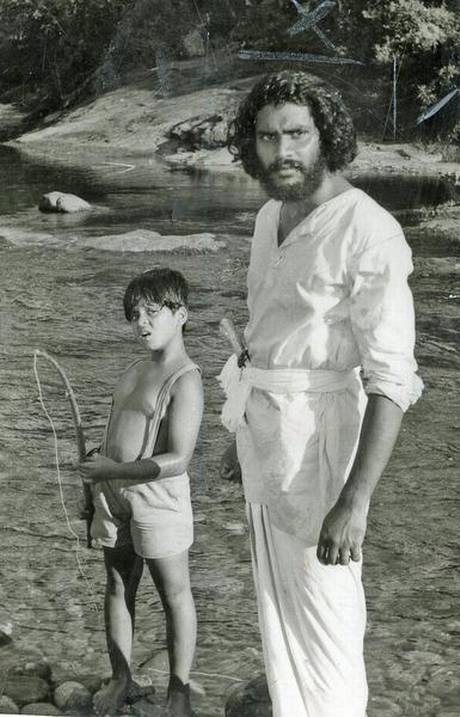
Sathar and Master Raghu in “Anavaranam” | Photo Credit: The Hindu Archives
Sathar, who made his debut in Malayalam movie Bharyaye Aavashyamundu , has acted in over 300 movies, including Tamil and Telugu films
Veteran actor Sathar, who figured prominently in South Indian films in the 1970s and 80s, died in a private hospital at Aluva near here early on Tuesday. He was 67.
He had been undergoing treatment for liver-related ailment for the last three months. The body was taken to his house at Kadungalloor and will be laid to rest at the Juma Masjid at 4 p.m.
Sathar made his debut in the Malayalam movie Bharyaye Aavashyamundu directed by M. Krishnan Nair in 1975. He was the lead actor in Anaavaranam released the very next year.
He, however, made his mark as an actor for his portrayal of villainous roles, including in the hit movie Sarapanjaram. Sathar has over 300 movies to his credit, including Tamil and Telugu films. He also produced three movies, including the Babu Antony-starrer Malayalam movie Kambolam in 1994.
Inactive in movies since 2003, Sathar made a brief comeback with notable roles in 22 Female Kottayam in 2012 and Natholi Cheriya Meenalla the year after. His last outing as an actor was in Parayaan Baakki Vechathu in 2014.
At the height of his acting career, Sathar married his popular co-star Jayabharathy in 1979 though they got separated later. Their son Krish J. Sathar had made his debut in Ladies and Gentlemen starring Mohanlal.
Krish was by his father’s side at the time of his demise.
Sathar was born in Kadungalloor near Aluva in 1952 as the ninth child of Khadarpillai and Fathima. He did his schooling at the Government High School, West Kadungalloor, and his Masters in history at UC College, Aluva.
source: http://www.thehindu.com / The Hindu / Home> News> States> Kerala / by Special Correspondent / Kochi – September 17th, 2019
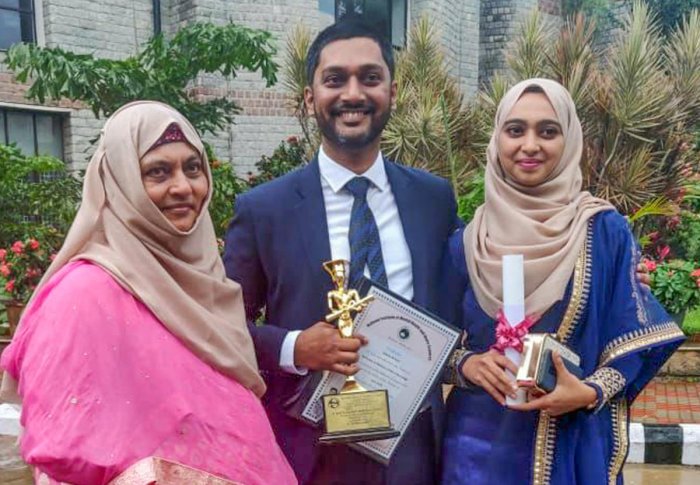
Dr Safwan Ahmed, Best Post Graduate Resident in Neurology, with his mother and wife at the 24th convocation of Nimhans. dh photo
Every time his father and Safwan Ahmed passed by Kasturba Medical College in Manipal, his father would say that it was his dream to see his son study there some day. He was only a child back then. It was not too long after, that Ahmed’s father died of a heart attack. A student of class 11 then, he decided to live his father’s dream and graduated from there.
On Monday, he was among the 14 meritorious students who got recognised for their achievements at the 24th convocation of Nimhans.
He was awarded the Dr Anisya Vasanth Memorial Award for the best postgraduate resident in Neurology. “I dedicate this award to my mother. Every time I burnt the midnight oil, she was beside me. She would wake up along with me, even if it was 3 am and has been my strong support,” said Ahmed. He recollected that most of his education was in government school and college and that merits and scholarships have helped him adequately.
“I want to start a new sub-speciality centre in cognitive neurosciences in Father Muller College in Mangaluru, where I work at present,” he said, when asked about future plans.
source: http://www.deccanherald.com / Deccan Herald / Home> State / by Reshma Ravishanker / DH News Service / September 16th, 2019
The city has many structures built during the time of Nizam Mir Osman Ali Khan Bahadur
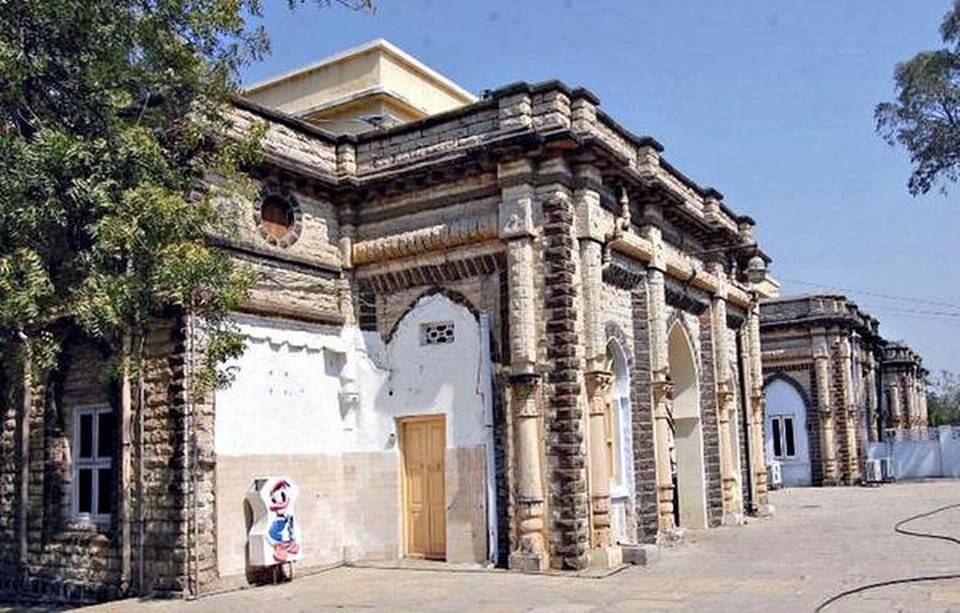
A kilometre away from Kalaburagi railway station is Aiwan-e-Shahi, a magnificent stone structure built in early 19th Century. For political leaders and bureaucrats visiting the city, it’s the most preferred accommodation.
Kalaburagi has several such architectural remnants of the times of the Nizam rule, uniquely Indo-Islamic in style, and still in use. Nizam Mir Osman Ali Khan Bahadur, the last monarch, who ruled the province between 1911 and 1948, stayed in Aiwan-e-Shahi when he visited the city and is today a government guest house. The Nizam used to travel in his own train from Hyderabad to reach the palace in Kalaburagi and a special railway track was laid up to the entrance of the complex for the purpose.
Like most buildings constructed during the Nizam’s rule, the Aiwan-e-Shahi portrays a rich and imposing architecture synthesising medieval and modern styles. It is constructed using local white stones, popularly known as Shahabad stones, abundantly available in the surrounding area. The front view of the palace was greatly inspired by Gothic style architecture.
Kalaburagi-based heritage collector and artiste Mohammed Ayazuddin Patel has copies of some rare photograph of Nizam. In one of them, he is the Nizam is seen playing tennis outside the Aiwan-e-Shahi palace complex. His train is also visible in the background. The picture was said to have been taken by Raja Deen Dayal, the official photographer at the Nizam’s court.
The Nizam, known as the architect of modern Hyderabad, left an impression on Kalaburagi too. The building now houses the tahsildar office, zilla panchayat and central library. The entrance arch gate of Vikas Bhavan, the mini Vidhana Soudha that has the district administrative complex and one of the entrances of Mahbub Gushan Garden in the heart of the city were built during his time. There are several private houses across the city that were built for the families of Deshpande, Deshmukh, Mali Patil, Police Patil, Jamadar, Mansafdar, Pattedar, Inamdar, Jagirdar, Kulkarni, Hawaldar – the official and administrative titles given by the Nizam.
“At least, the Aiwan-e-Shahi should be included in the protected monuments and converted into a museum to showcase the region’s cultural past,” says Rehaman Patel, Kalaburagi-based researcher and artiste. According to him, the Nizam had expanded public spaces such as parks, lakes, town hall, and gardens in the city engaging several engineers. Mahbub Sagar (now called Sharnbasweshwar lake) and Mahbub Gulshan Garden continued to be used by the public. The town hall is used by the Kalaburagi City Municipal Corporation as a conference hall.
The Filter Bed built for providing pure water to the residents continues to supply drinking water to parts of the city. The Mahbub Shahi Kapda Mill that produced high-quality cloth and supplied it not just to various cities across India, but to other countries as well, was in operation till the 1980s. The Nizam had also established Asif Gunj School and MPHS school, the oldest educational institutions of the city.
“In the early 1930s, he formed the Hyderabad Aero Club and built Begumpet Airport for his Deccan Airways, one of the earliest airlines in British India. He had the distinction of employing, perhaps, the world’s first woman commercial pilot, Captain Prema Mathur, during the late 1940s. The other airport built in Bidar in 1942 is now used by the Indian Air Force to train its pilots. The Nizam was also credited for renovating several monuments belong to Buddhists, Jains, Chalukyas, and Bahmanis. The renovation and excavation of the caves of Ajanta and Ellora was undertaken with the funds of the Nizam government and supervised by then archaeology director Ghulam Yazdani,” Mr. Rehaman said.
source: http://www.thehindu.com / The Hindu / Home> News> States> Karnataka / by Kumar Buradikatti / Kalaburagi – September 16th, 2019
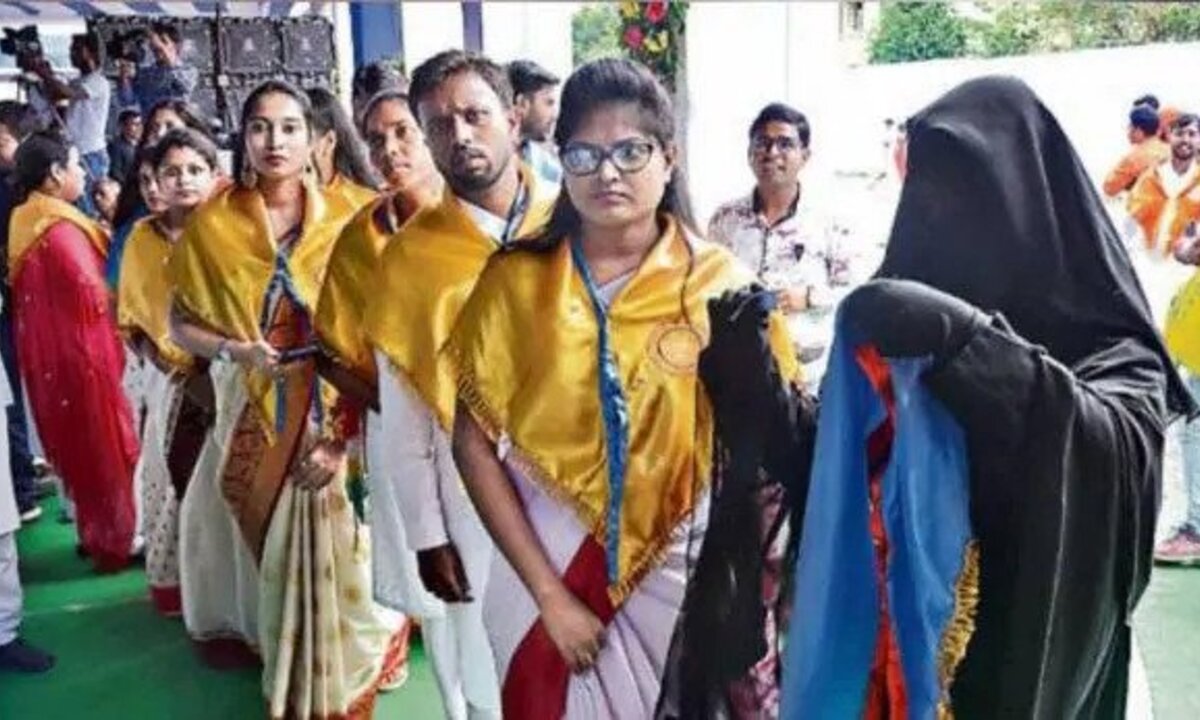
Nishat Fatima, who came to Ranchi’s Marwari College to take her degree in graduation ceremony could not get it in the ceremony
There are bizarre rules being made about clothes in colleges these days. Recently, a girls college in Hyderabad made a strange rule for wearing suits, now a case of a college in Jharkhand has come up in which a student was not given a degree as she was wearing a burqa.
As per reports, the over-all best graduate Nishat Fatima, who came to Ranchi’s Marwari College to take her degree in graduation ceremony could not get it in the ceremony on Sunday.
Nishat Fatima came wearing a burqa to attend the program. Her name was called for the gold medal at the ceremony as she had to take the medal first.
However, at the same time, it was announced that she was not in the dress code fixed by the college, due to which she could not be given a degree in the ceremony. After which the process of awarding medals and degrees to other toppers was started. Despite the dress code being fixed, Nishat’s father Muhammad Ikramul Haq said that the burqa is included in their tradition.
The dress code was decided by the college in which the male student had to come in a white colored kurta pajama and the female students in a salwar-suit, scarf or sari blouse. For this, the college had already issued a notice.
source: http://www.newsd.com / Newsd. / Home> Beyond Metros> Jharkhand / by Newsd / September 16th, 2019
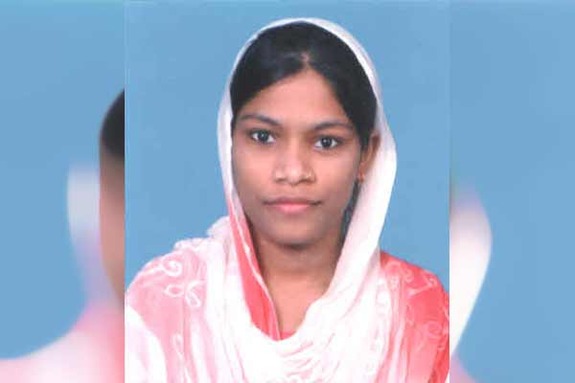
Subia Parveen, a student of class 10th of Jamia Senior Secondary School has been selected for Kennedy-Lugar Youth Exchange and Study (YES) scholarship, sponsored by the U.S. Department of State.
She will be getting 28 thousand US Dollar scholarship to study for a 10-month duration programme in U.S. The programme will be held from August 2019 to June 2020.
Subia is the eldest child of Mr. Kalimuddin Ahmad, an electrician working in Jamia. She has been studying in Jamia from nursery class and is a very bright student. She appeared in class 10th board examination this year and is very hopeful that she will top the list. She had received several prizes in education and co-curricular activities in the school and outside too. Her aim is to become a scientist.
Registrar, JMI, Mr. A.P. Siddiqui (IPS) congratulated Subia on her achievement and said, “The selection process for this programme (YES schorarship) has been very competitive and its a proud moment for both Subia and Jamia”.
Kennedy-Lugar Youth Exchange and Study (YES) program was established in October, 2002. The Bureau of Educational and Cultural Affairs of the U.S. Department of State, along with the U.S. exchange community, recognized the importance of youth exchange as a key component to building bridges between citizens of the U.S. and countries around the world, particularly those with significant Muslim populations.
source: http://www.milligazette.com / The Milli Gazette Online / Home> Online News> Community News / by Press Release , JMI / April 06th, 2019