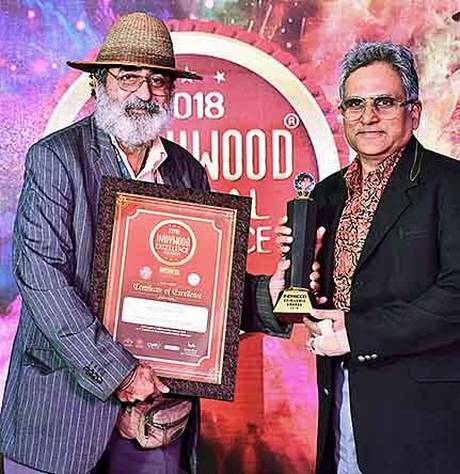
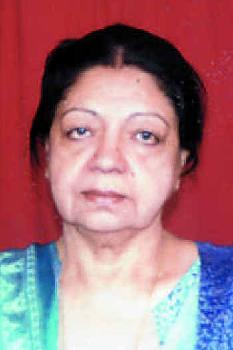
Personality of the year healthcare award being presented to Gauthamadas Udipi at the Indywood medical excellence awards in HITEX. | Photo Credit: K.V.S. GIRI
Twenty five medical practitioners were awarded Indywood medical excellence awards, which was organised as part of Indywood film carnival-2018.
The awards are meant for felicitating healthcare practitioners and organisations who offer healthcare services to the society.
Dr. Gauthamadas Udipi, Professor of Psychiatry was awarded the personality of the year in health care sector, this year.
Indywood’s life time achievement award was given to Dr. Kamini Rao (Golden Pioneer In Gynaecology), Dr. Mohan (Specialist Care Diabetologist) and Padma Shree Dr. Ahmed Ali(Surgical Wizard Of Gastroenterology).
The awards were presented by Mohammed Ibrahim Al Qahtani who is with Saudi Armaco,Saudi Arabia and Ravindra Arora, president of Bharat Cine and TV writer & TV writer association. Mr. Arora is also a committee member of Dada Saheb Phalke Academy, Western India film producers association.
Other awards which were presented during the day were in two categories including medical excellence among individual and organisations of medical excellence.
Winners in the organisations category included Apollo Remote Healthcare Services for largest telemedicine network, Maa ENT Hospital, best ENT care hospital, Grewal Eye Institute as best hospital for opthalmic care, Aster MIMS for excellence in patient care, Fathima Healthcare Group in best overseas healthcare insurance firm and Sai life sciences limited for being leading organisation in integrated CRO.
At the event, Mr. Arora congratulated all award winners and requested them to continue their services in the health care segment, “for that is important to build a healthy India”.
Indywood also awarded media excellence awards-2018.
source: http://www.thehindu.com / The Hindu / Home> News> Cities> Hyderabad / by Special Correspondent / Hyderabad – December 05th, 2018
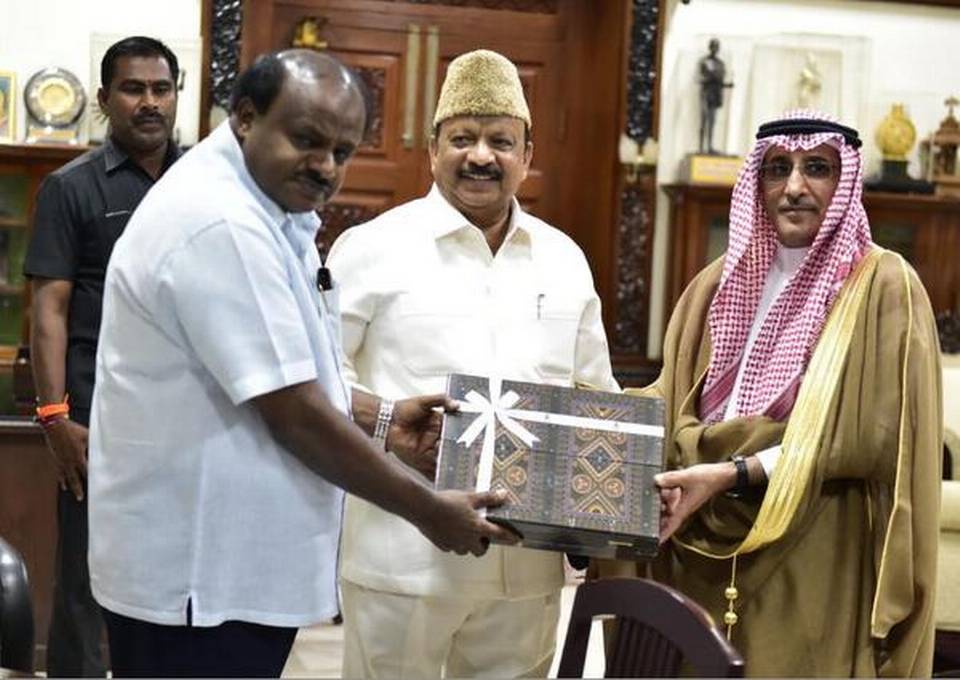
Saudi Arabia Ambassador to India Saud Mohammed Al-sati shared this information when he called on Chief Minister H.D. Kumaraswamy, along with Karnataka State Haj Committee Chairman and former Minister Roshan Baig, on Tuesday. | Photo Credit: the hindu
About a 100 years ago, a woman philanthropist from Bengaluru had set up a school for girls in Mecca, Saudi Arabia.
On Tuesday, many people in Bengaluru were in for a pleasant surprise when Saudi Arabia Ambassador to India Saud Mohammed Al-sati shared this information during a meeting with Chief Minister H.D. Kumaraswamy. The ambassador informed that they had all the records pertaining to the woman, named Saulath Unnisa, and expressed a desire to honour her family members if they could be located.
Karnataka State Haj Committee Chairman and former Minister Roshan Baig told The Hindu that they would try to trace the family. “These days, we take a five-and-a-half hours flight to Jeddah for Haj or Umra. But back then, pilgrims would have to take a ship from Bombay and sail for a fortnight to reach Mecca. It is a great contribution by the lady at that time,” he said.
Saudi consulate in city
Meanwhile, one of the long-standing demands of pilgrims and the large Kannadiga diaspora in Saudi Arabia for a consulate in Bengaluru could be fructifying shortly.
According to Mr. Baig, around 50,000 pilgrims travel from Karnataka annually for Haj and Umra. This is apart from a large number of people employed in Saudi Arabia.
The ambassador is learnt to have told Mr. Kumaraswamy that work on establishing the consulate is in progress, and it is waiting for approval from the Ministry of External Affairs. The ambassador said that the number of people seeking a visa to Saudi Arabia had doubled, and that it was the reason for opening a consulate. Currently, residents of Karnataka have to travel to Mumbai for the paperwork.
Mr. Kumaraswamy welcomed the move to open a consulate in Bengaluru, and also invited Saudi Arabian businessmen to invest in Bengaluru.
source: http://www.thehindu.com / The Hindu / Home> News> Cities> Bengaluru / by Special Correspondent / December 04th, 2018
A proposal to build a memorial for 14th century Moroccan traveller Ibn Battuta in Kozhikode, where he stopped over during his 24-year travel around the world, was made here on Tuesday.
Ibn Battuta wrote about this port city, then known as Calicut, much before the landing of Vasco da Gama. His accounts gave a glimpse of the arrival of merchants from various parts of the world here and the rise of the Zamorins to prominence.
The suggestion to build a memorial was put forward by M.K. Raghavan, Kozhikode MP, at the second international Ibn Battuta conference on ‘Travel, trade, tradition, and trajectories’ organised by the Malappuram-based Ma’din Academy. Mr. Raghavan said that along with holding conferences and discussions, a permanent structure such a museum could be built to commemorate Battuta’s visit to Kozhikode.
Mohamed Maliki, Morocco’s Ambassador to India, later told the media that the idea “definitely deserves our attention” and it could be the world’s tribute to the man who travelled around the globe 600 years ago.
Earlier, opening the conference, Mr. Maliki said Ibn Battuta’s trip was not for financial purposes as he was the son of a judge in Tangier, his home town. He was a well-educated person, a man of culture and religion, but especially a curious man “having an eye on the world”, as the saying in Arabic goes.
‘A free world’
“The journey of Ibn Battuta gave us a real illustration of a diplomacy that existed at that time in a free world. A world completely different from ours. A world where no one spoke of passports, visas, or special permits…. It was a world without hurdles for the lovers of travel and discovery,” Mr. Maliki said.
He pointed out that Battuta put down what he observed after he returned to Morocco. “Through his narrative, he allowed many generations of the bygone centuries and others to come to know of the 14th century history of the world, lifestyles, gastronomy, religion. etc. His description of places and people, traditions, and their way of life were so accurate that some of them are still valid,” Mr. Maliki added.
In her keynote address, Ross E. Dunn of San Diego University, US, author of The Adventures of Ibn Battuta: A Muslim Traveller of the 14th Century, said the Moroccan traveller was a participant among many in a huge trans-hemispheric web of Muslim social interaction that embraced a large part of ‘Afroeurasia’ in the 14th century.
The extensive growth of Islam in that period involved a social movement, the journeys, and migrations of individuals who possessed literacy and special skills, and who were needed in places where Islamisation of society was taking place.
The two-day conference will conclude on Wednesday.
source: http://www.thehindu.com / The Hindu / Home> News> Cities> Kozhikode / by Staff Reporter / Kozhikode – December 04th, 2018
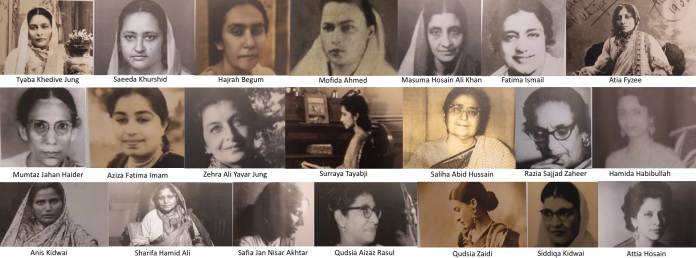
Stories of conviction and contribution of Indian Muslim women, who “gave up the purdah” and were at “the forefront of the nationalist and feminist discourse” in the past century are on display here.
The exhibition on 21 “pathbreakers” opened for public view on Saturday.
Organised by Muslim Women’s Forum at the India International Centre (IIC), the show “Pathbreakers: The Twentieth Century Muslim Women of India” features women who remain largely unheard of and unsung in the mainstream narrative.
During and after the freedom movement, a note on the exhibition said, many Muslim women shed the ‘purdah’ and became partners in the project to build a new India.
They went on to become writers, teachers, artists, scientists, lawyers, educators, political workers, trade unions, MPs, and MLAs.
“With a few exceptions, most of them have been forgotten in time.”
The show, inaugurated by author-filmmaker Syeda Imam (granddaughter of early 20th century writer-educator Tyaba Khedive Jung), embodies the spirit of the active contribution of these women, and as Imam said, “were not in the recesses of home and kitchen”.
Far from the commonly-held impression of silenced, cloistered and acquiescent women, ‘Pathbreakers’ narrates the stories of strong, determined and engaged women, the note said.
Some of these women include Qudsia Aizaz Rasul, the only Muslim woman member of the Constituent Assembly and author of “From Purdah to Parliament: A Muslim Woman in Indian Politics”; Assam’s first woman MP Mofida Ahmed, elected from Jorhat in 1957; and Aziza Fatima Imam, who served in the Rajya Sabha for 13 years starting 1973.
Why Muslim women?
The exhibition of photographs, text and video installations, points to their significant contribution towards the building of the nation, along with their sisters of other communities, through its freedom struggle, independence and beyond.
“A multiplicity of stereotypes are constructed by diverse actors regarding Muslim women. But the fact is there is no undifferentiated amass’ of Muslim women. Like women of all socio-cultural groups, they too are a divergent, shifting composition of individuals, often dumped in popular parlance into one single heap. This homogenisation has to be rejected,” the note read.
The show also projects video recordings of readings from writings of some of the featuring women.
The organisers, however, said while the participating women might seem elite, it is only the first step in identifying and recognising pathbreakers from all sections.
Defending champion Gagan Sethi lived up to his top billing and won the 2018 JK Tyre Hornbill Motor Rally alongside co-driver Sabatullah Khan. The duo completed the 55 km TSD rally with a penalty of 29 seconds to emerge victorious.
Following them in the Open category, at some distance, were other national level competitors. The second place was taken by Bijo Awom and Chandrasekhar (1:44 minutes penalty), while Tali Akang and Nirav Mehta finished third with a penalty of 2:05 minutes.
The event was being held in the backdrop of the Hornbill Festival. The event was flagged off from IG Stadium, following which participants traversed dirt roads, broken tarmac and winding hilly roads around Kohima. The drivers crossed seven time controls before making it to the finish in Kisama village.
Sethi contended with a last minute car change and navigators, including Khan, faced a bigger challenge with the ban on high level odometers. They used basic mobile-based odo’s, which were trickier. The presence of other top competitors made him work harder still for this win.
“It was a difficult rally and I was facing a lot of problems with the car. But my navigator was brilliant and he helped us cruise past the field to claim the title,” Gagan said after the rally.
“Even though we were driving together for the first time, we hit it off instantly and our co-ordination was really very great,” he added.
In the North East category of the event, Alex Suohu and Akhrielie Vizo took the first place with a penalty of 9:44 minutes. Thezakkielie Zuyie (co-driver Moamarimsong) with a total penalty of 10.5 mins finished second while Anguzo Sekhose and Mengu Yhome (12:29 mins) claimed third.
The chief minister of Nagaland Neiphiu Riphu commented, “I am really thankful to JK Tyre for their support in promoting motorsports in the country. The CMD of the company Dr. Raghupati Singhania reposed his faith in us and we shall walk together to make Nagaland the new motorsports hub of the country.” He also called the event a grand success and vowed to make it even bigger in the years to come.
A number of special category prizes were also given out. Kevin Puro/Neihu Dzuvichu were facilitated for having the best decorated car. The Couple Team award went to Atoka Awomi and Mercy Mezhatsu. Other winners were the “most disciplined team” of Mikrio Kyina/Arun Kyina and the Nagaland Adventure Club was adjudged the “best club”.
source: http://www.overdrive.in / OverDrive / Home> News / by Tuhin Guha / December 04th, 2018
Deaf and mute by birth, Mehtab Hussain, in his 30s, is an athlete of international repute and has won a number of national and international tournaments, including Asia Pacific Deaf Games.
Mehtab Hussain, a daily wager at a meat factory in Bareilly, is locally famous as ‘Bolt’— the last name of Jamaican sprinter and nine-time Olympic gold medallist Usain Bolt – for his athletic prowess.
Deaf and mute by birth, Hussain, in his 30s, is an athlete of international repute and has won a number of national and international tournaments, including Asia Pacific Deaf Games.
However, his sporting talent and achievements have failed to fetch him a job and the fame he deserves, thanks to official apathy. Despite overcoming his physical disability, financial constraints have forced him work at a local meat factory to support his family in Chak Mehmood area of Bareilly.
Gritty to the core, Hussain still wakes up at 4am and runs at least 10km a day to keep himself fit as he never knows when his financial condition permits him to participate in sporting events.
Hussain’s mother Ashraf Jahan says, “As my daughter was already suffering from hearing and speech impairment, we did not take long to understand that Hussain was also suffering from the same problem. He was only three then.”
“His behaviour was very much like his sister. He hardly responded to any sound,” she recalls. Hussain is the youngest among three brothers and a sister. Soon after Hussain’s birth, his father Latafat Hussain, a teacher at a primary school, passed away.
However, Ashraf Jahan didn’t lose hope and got Hussain admitted to a school for differently-abled students in Bareilly where he showed much interest in athletics.
“During his school days, he never hired a rickshaw or public transport to reach his school which was 7 kms away. He always preferred to go by foot. Once he bought me a present from the money I gave him for conveyance,” she recalls.
After winning innumerable interschool athletic championships, he participated in state-level championship in Faizabad and stood first.
“I couldn’t believe that I had overpowered all the other athletes there,” says Hussain, using sign language.Winning the championship fetched him entry to national-level championship and he became a member of the All-India Sports Council for Deaf (AISCD), the apex body for sports for the deaf.
“I participated in national level athletic meet in West Bengal in 1995 and won the 400-metre relay. I was on cloud nine. This was what I wanted,” says Hussain. The period from 1995-2000 proved to be the golden one for Hussain as during this time he participated in about 22 state and 19 national athletic meets.
In 2000, he was informed by AISCD that he has been selected in the 6th Asia Pacific for Deaf, to be held in Taiwan.
“I had to sell a piece of land for Rs 50,000 to bear the expenses. Representatives of the council assured us that the money we spent would be reimbursed but they did not keep their word,” Ashraf Jahan says.
Hussain, who was the only player from the state to participate in the event, bagged third position in 5000-metre race. Later, Hussain received several calls from the council informing him about his entry in several international championships but his financial condition did not permit him.
Showing letters from the council, Hussain says he got calls from Australia, Italy, Kuwait, Canada and Turkey but could not go there for the want of money.
“I don’t have any problem in playing providing I get help from the government, which seems to be a distant dream,” says Hussain. In the hope of playing for his state and country again, Hussain still continues to practice daily before leaving for his 12-hour shift in the meat factory.
source: http://www.hindustantimes.com / Hindustan Times / Home> Lucknow / by Hindustan Times,Lucknow / November 30th, 2018
Growing up in Lucknow meant chef Mujeebur Rehman heard many tales of kings, queens and the nizams.
Bengaluru :
Growing up in Lucknow meant chef Mujeebur Rehman heard many tales of kings, queens and the nizams. Since his great-grandfather worked in the royal kitchen, he also learned of the food the royals feasted on.
Many years later, we are treated to a replication of these fond memories as the chef and his team personally come down from Lucknow to give Bengalureans a taste of Awadhi food, at JW Kitchen, JW Marriott Hotel.
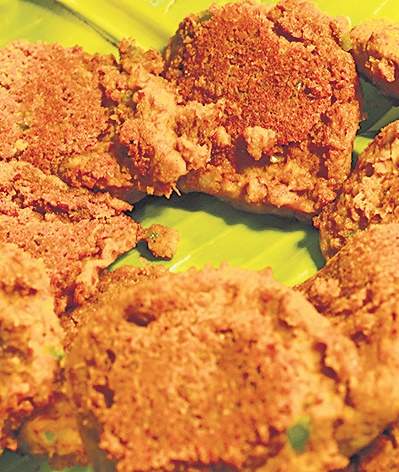
It’s a good thing we went on empty stomachs since the buffet didn’t seem to end. We started with soups -–Gosht Arq Shorba and Shorba Bhune Badam Ka. Both the vegetarian and non-vegetarian soups were just the right consistency – not too watery, not to thick, just perfect. What’s Awadhi food without some kebabs? Both the non-vegetarian starters – Murgh Tikka Mirza Hasnu and Galawati Kebab – were a hit. In the vegetarian variants, surprisingly, the Kale Chane Ke Asharfi shone brighter than the Paneer Tikka Achar Masala. It was, however, quite the challenge to not load our plates with just the kebabs and leave room for the rest of the dishes.
In mains, the vegetarian dishes comprised everything. However, it was the Nawabi Baigan Bhurta and Lahsunni Zeera Bhindi that stole our hearts. And made their way to our stomachs as we scooped up seconds on to our plates. Who knew the vegetables we often ignored would turn out to be our favourites?
Among the non vegetarian dishes, the Lagan Ka Murgh and Bong Zafrani Nehari were softer than imagined, each bite melting in our mouths, but not before exploding in vibrant flavours, leaving behind a tinge of a smoky aftertaste. We learn that this has more to do with the technique of cooking – slow cooking. The food is cooked on a low flame to let the flavours develop longer. The dhungar process (pouring ghee or butter over live coal and then placing a bowl of this with the dish as it cooks) gave the food a distinct rusty flavour that instantly won us over.
To conclude this royally gastronomical affair, we ended our meal on a sweet note with the Sheer Khurma and Doodh Ki Kheer. The cold kheer complemented the warm khurma well and we were left looking forward to the deep slumber only a good, satisfying meal can induce. The buffet will be served at JW Marriot Hotel, Vittal Mallya Road, till November 4, 2018. Costs: `1750 ++ for adults and `875 ++ for kids
source: http://www.newindianexpress.com / The New Indian Express / Home> Cities> Bengaluru / by Express News Service / November 02nd, 2018
Indira Iyengar’s book flounders on history, making some foundational conclusions untenable.
Shazi Zaman who has recently written a well-researched book on Akbar and has a detailed account of Akbar’s contact with the Europeans who visited his court, makes no mention of a Bourbon. Credit: Wikipedia
Some books need to be read because they are likely to tell you things you have always wanted to know. Some stories need to be told because they make for riveting narratives or expand your frontiers of knowledge in exciting and dramatic ways.
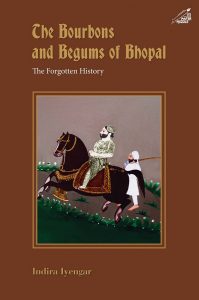
It is with such noble (and hopeful) intentions that one embarks upon The Bourbons and Begums of Bhopal: The Forgotten History despite its awkward size and substantial weight. In its size and appearance, it is is an unfortunate mix of a book with pictures and copious amounts of running text: too large to carry while travelling and not sufficiently picturesque to qualify as a coffee-table book. Its contents prove to be an awkward mix too, floundering between academic research and family lore.
The Bourbons and Begums of Bhopal: The Forgotten History Indira Iyengar, Niyogi Books Private Limited, 2018.
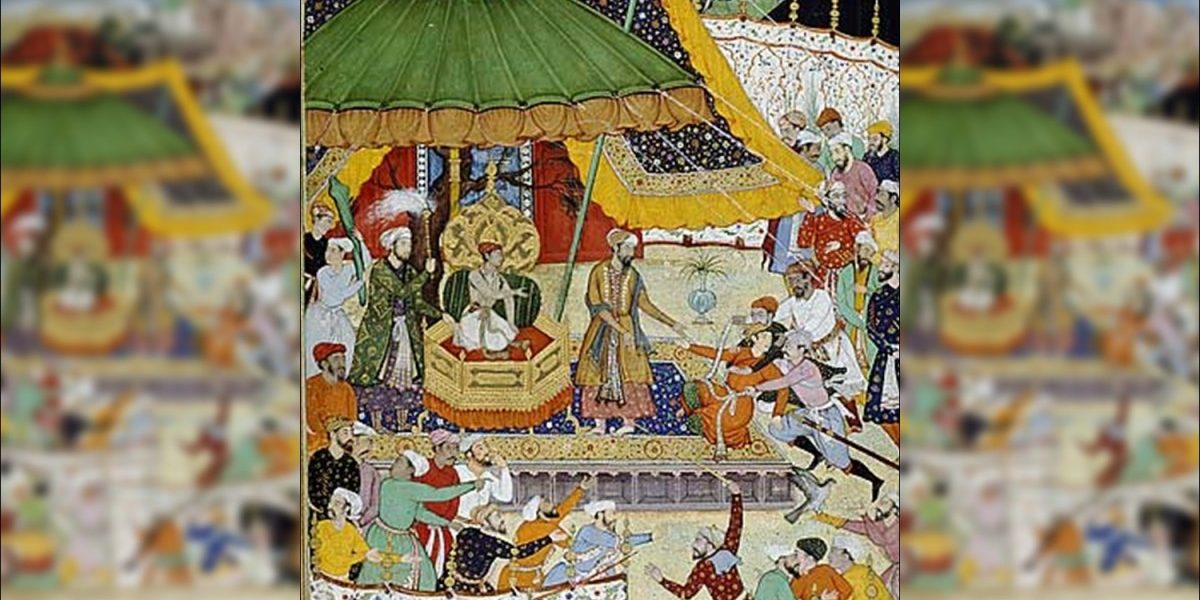
Indira Iyengar’s tale is part family history, part archival research and part anecdotal memoir. It opens with a disarming admission: ‘I am no historian, but I have a story to tell.’ Iyengar’s mother, Magdaline Bourbon traced her lineage to Jean Philippe de Bourbon who left his native France to arrive in Mughal India, sought and received employment in Emperor Akbar’s court, was actively involved in Akbar’s meeting with the Jesuit priests from Goa. For his services, Akbar is said to have gifted him a small principality, Shergarh near Narwar in present-day Madhya Pradesh and the sister of his Christian wife, an Armenian woman (Portuguese by some accounts) by the name of Juliana who apparently also served as a doctor in Akbar’s harem. Thus began the Bourbon line in India which spread its roots from the Mughal court to the princely state of Bhopal where the descendants of this first Bourbon eventually settled down. Being neither Muslim nor Hindu the Frenchmen were viewed as unbiased and loyal to their masters. The stories of their swashbuckling past and alleged purported ‘royal bloodline’ no doubt added to their mystique.
While Iyengar is at pains to establish her ancestor’s descent from the Bourbons of Navarre, historians are divided as to whether Jean Philipe was indeed from the royal house of Bourbon or simply a fugitive Frenchman, a mercenary who found name and fame in distant India, established a lineage and bestowed a legacy. Iyengar seems to be working on the principle that her mother’s version of the family history should suffice and she, as the custodian of that family history, is obligated to tell the story. ‘My mother’s narration of the family was also very interesting,’ Iyengar writes, ‘and I feel it needs to find a place in recorded history’. It is this assertion that proves to be problematic. For, had it been told as a colourful yarn with anecdotes and family portraits or even bits and pieces of trivia and family lore it could have been a charming story – as history it is on decidedly shaky grounds.
Also, while Iyengar’s research in the archives of the Agra Archdiocese may well establish the role of her French forefathers in various administrative capacities, it does not satisfactorily establish Jean Philippe’s link with Duke Charles III de Bourbon (1490-1527), also known as Connetable de Bourbon. The earliest account of Jean Philippe she is able to offer is by Madame Dulhan Bourbon, wife of Balthazar Bourbon; this comes in the form of a testimony made to a British general. Coming from a family member, that too as late as the late-19th century, it carries dubious weight at best. All other accounts, by missionaries, are in the nature of hearsay, urban legends that acquired veneers of half-truths with each telling. Jean Philippe himself is said to have presented a document to Jahangir in 1605 or 1606, according to Iyengar, stating that he was the son of Charles Connetable de Bourbon and that he had to flee France after arranging a mock funeral for himself. Since such a document does not exist, we can only rely on the author’s mother, Magdaline Bourbon’s memory of a ‘certain priest from Bombay’ who possessed the Bourbon family records that were subsequently ‘lost with time’. Shazi Zaman who has recently written a well-researched book on Akbar and has a detailed account of Akbar’s contact with the Europeans who visited his court, makes no mention of a Bourbon.
While Jean Philippe’s relationship with the House of Bourbon may be in dispute, Iyengar’s research in the archives of the Agra Archdiocese shows that there existed a certain Jean Philipe de Bourbon, who was married to a certain Bibi Juliana (referred to in later Jesuit accounts as Dona Juliana Dias da Costa) who helped build the first Catholic church in Agra in 1588 on land gifted by Akbar. Jean Philipe is said to have died in Agra in 1592 leaving behind two sons one of whom, according to Iyengar, was in charge of the seraglio. At the time of Nadir Shah’s invasion, the Bourbons left poor, ravaged Delhi and the clan, by now comprising 300 men and women, sought refuge in the family estate in Shergarh and thence began the southern sojourn of Jean Philippe’s descendents. Mamola Bai, the first woman ruler of Bhopal, offered Salvador Bourbon the position of general in the Bhopal state army. Salvador married a certain Miss Thome and the family then embarked on a long innings serving as confidantes, generals, even Prime Ministers to the Bgeums of Bhopal.
Already carrying two names, a European and a Muslim one, the Bourbons began to wear Bhopali dress and live like the local nobility. However, the fleur de lis in their coat of arms never failed to remind them and their local patrons of their royal past in distant France.
Rakshanda Jalil is a writer, translator and literary historian.
source: http://www.thewire.in / The Wire / Home> Books / by Rakshanda Jalil / October 05th, 2018
Begum Laila Umahani, said to hail from the family of Bahadur Shah Zafar, is living a life of obscurity with her two sons. Film-maker Arijeet Gupta convinced her to talk of her pedigree for “The Living Moghuls”, a documentary on the descendants of the Moghuls. On the other hand, we have Pakeeza Sultan Begum asserting her case as the last known direct descendant. RANA A. SIDDIQUI reports… .
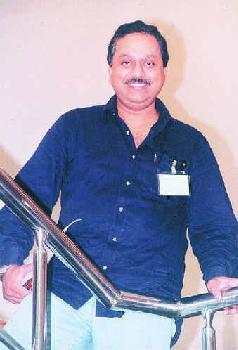
Arijeet Gupta: the documentary film-maker.
HE SCOOTS of to buy vegetables, leave his children at a local school and lives the life of a common man. He is Ziauddin Tucy. His mother tells fairy tales to her grandchildren. But those tales do not constitute fairies, who help people in their moments of distress. They talk of Moghuls, their grandeur, the last Moghul Emperor Bahadur Shah Zafar and his four wives till the period of what is called India’s First War of Independence – the Mutiny of 1857. All these not because the children have inclination for history of Moghuls but because their grandmother herself is said to be the last surviving member and direct descendant of Bahadur Shah Zafar and his first wife, Begum Ashraf Mahal.
Eighty-year-old Begum Laila Umahani, who lives in Asmangarh, a small city in Hyderabad, is this grandmother. She narrates the glorious family history to her grandchildren, knowing that it won’t have any takers if she goes to tell it to people beyond the periphery of her small house.
This is what Arijeet Gupta, the man behind the documentary “The Living Moghuls” screened at India Habitat Centre in New Delhi the other day, tries to prove. Said to be the first-ever archival documentary produced by Public Service Broadcasting Trust – PSBT and financed by Prasar Bharti, it traces the history of Moghuls from1857 to 2002 – a period of 145 years which saw the sudden disappearance of Moghuls from the historical centrestage. But Begum Laila Umahani helps tracing it when she reveals that after Bahadur Shah Zafar’s exile to Burma by the British in 1857, his son Mirza Quaish – the first generation — managed to save his life and fled to Kathmandu. After he secretly came back to India, he was given shelter by Maharana of Udaipur. His son Mirza Abdullah — the second generation — again a fugitive, went to Nagpur and then Aurangabad and finally Hyderabad. Here, Nizam of Hyderabad helped him. His son Mirza Pyre later married Habeeb Begum, hailing from the family of the sixth Nizam of Hyderabad. One “Habeeb Mahal” near Char Minar in Hyderabad, belongs to her which is occupied by one family and they have moved High Court for its possession. Begum Laila Umahani, daughter of Mirza is the fourth and only surviving Moghul from the family.
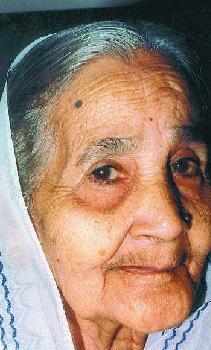
Begum Laila Umahani: Waiting for recognition.
Begum Laila now lives in a rented house in Aamangarh with her two sons, Ziauddin Tucy and Masiduddin Tucy — the fifth generation. Her husband died earlier. While Ziauddin Tucy is retired marketing supervisor from Andhra Pradesh Government, Masiduddin Tucy is a food consultant in Welcome Group of Hotels in Hyderbad.
The family after several futile approaches made to Indira Gandhi and subsequent governments in Delhi, preferred to take a backseat “Who will listen to me now? Instead they will mock so it is better to remain silent to keep our dignity intact,” Begum Laila says in the documentary. She reportedly broke her silence before the camera after much coaxing from Arijeet Gupta.
There are historians who believe that it is difficult to trace that period after145 years. It simply because after Moghuls were deposed, many records also were destroyed. They were just fleeing for their lives and carried no identity cards.
Pakeeza Sultan Begum: known direct descendant of Bahadur Shah Zafar.
The film-maker, Arijeet Gupta met the family in 1998 after he saw a letter from Ziauddin Tucy addressed to the powers that be requesting the family to grant benefits/ pensions to help them survive with dignity. Since Laila Begum was not ready to articulate her viewpoint, and there could not be many compromises on authenticity, this documentary took five years to complete, he says.
EVEN AS Begum Laila Umahani fights for recognition from the Government, she has to encounter another battle of words and letters – from Pakeeza Begum, claimed to be the only direct descendant of Bahadur Shah Zafar. A resident of Neeti Bagh in New Delhi — her ancestral house Chandni Mahal is in the Walled City — Begum Pakeeza denies that Begum Laila is a direct descendant of the last Moghul Emperor. “The entire Delhi knows that only I am only the direct descendant of the king and not she because only the heir apparent – Vali Ahad — was supposed to be one and Mirza Qwesh — whom she refers to as her forefather — was never a crown prince as reported in a Delhi daily earlier. He wanted to be one and to do that he also accepted the humiliating conditions of the British but never succeeded. While he was only attempting to become one, the 1857 Mutiny broke out. My great grandfather Mirza Fatehul Mulk was the heir apparent.”
She narrates the historical background that she says is found in record books too. It is reported that historians Maheshwar Dayal and Tara Chand also verified the same in their books. “Mirza Fatehul Mulk Bahadur alias Mirza Fakhruh was appointed the heir apparent in 1853. At the time of Mutiny, the son of Mirza Fakhruh, Mirza Farkhunda Jamal was only four or five year old. When Major Hudson killed the sons and grandsons of Bahadur Shah Zafar at Khooni Darwaza, Delhi on Bahadur Shah Zafar Marg, and soon after this news broke out, the nurse – Anna — of Mirza Farkhunda Jamal took the child secretly without even informing the family because those who were responsible for the Mutiny were among the family only. For years, she did not reveal his identity and nurtured him by doing different work at different places. That is how she managed to save the last successor.”
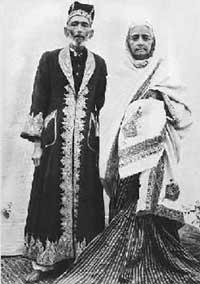
Begum Qamar Sultan with younger brother Hamid Shah in royal costume, 1963.
Some time after the Mutiny the British announced that there would be no killings and punishment, Anna brought the child back to the mother. The British Government released political pension in favour of Mirza Farkhunda Jamal as the heir apparent. After the death of Mirza Jamal, the pension was received by his sons and daughters — Qamar Sultan Begum — daughter of Mirza Jamal who kept receiving this share even after Independence. She refused to take it sometime after the Independence saying now we are free citizens and everyone is equal in this democratic country. Sultan Begum died in June 1993. She had two daughters, Begum Tahira Sultan and Pakeeza Sultan Begum. The former is settled in London while the latter lives in Delhi and is also an ex-director ICCR and an expert on Africa.
She questions the authenticity of Begum Laila’s statements: “Why was Mirza Qwesh running away even after the Mutiny? Despite the fact British announced that there would be no killings? Who was he afraid of? The British? Who, as her statements go that he was helped by the Indian soldiers of British Army to flee to Kathmandu? There were no Indian soldiers in British Army and even if there had been any, they were British soldiers and not from the King’s Army.”
She contends: “He was running away from his own people who got to know of his schemes and policies that he accepted the Britishers’ humiliating condition to become the successor of the Moghuls.”
The lady argues: “I don’t have any problem if she gets any help from the Government but she should not disturb the lineage by giving wrong statements.” She also expresses regret that without going to history books and records with the Government Arijeet Gupta went ahead to make his documentary film.
source: http://www.thehindu.com / The Hindu / Home> MetroPlus – Delhi / September 12th, 2002
PAKEEZA SULTAN BEGUM, daughter of Princess Qamar Sultan Begum, the great-grand-daughter of the last successor of the throne of Mughal dynasty Mirza Fatahul Mulk Bahadur alias Mirza Fakhru (who was killed by the British after 1857), thus the direct descendent of the last Emperor of Hindustan Bahadur Shah Zafar, left for her heavenly abode on 20 September 2014.
She was born on 13 November 1937. She was married to the senior advocate of Supreme Court of India late Danial Latifi who had died on 17 June 2000.
She was educated at AMU and taught for some time at Lady Shriram College. Later she joined as librarian in the Indian Council of Cultural Relations under the Ministry of External Affairs where she worked at the Africa desk and retired as director of the foreign cultural centres in the capital. She had moved to Noida a few years back to live with a relative.
Princess Qamar Sultan Begum was recognized by Government of India as a direct descendant of the last Mughal emperor. She used to be invited to attend official functions in that capacity. Qamar Sultan Begum died in June 1993.
Begum Qamar Sultan with her younger brother Hamid Shah in 1963
source: http://www.milligazette.com / The Milli Gazette / Home> Online News> Community News / Published online Oct 04th, 2014 / Print edition: 1 -15th Oct 2014