NEW DELHI :
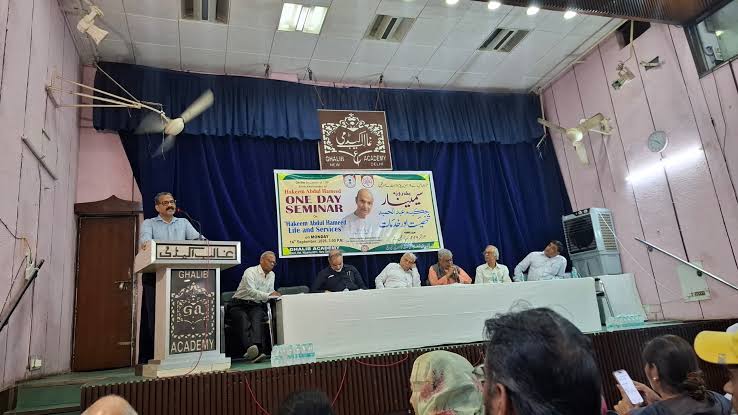
Rich tributes paid to the legacy of renowned Unani medicine at a seminar in New Delhi; speakers recall his multifaceted contributions to Ghalib Academy.
New Delhi :
Rich tributes were paid to Hakeem Abdul Hameed, the visionary institution-builder, educationist, Unani physician and champion of humanity, at a seminar organised at the Ghalib Academy here recently to mark his 118th birth anniversary.
Eminent Unani medicine experts, writers, academics and scholars recalled his multifaceted contributions to medicine, education, Urdu language and literature, public welfare and humanitarian service. Several speakers also presented papers highlighting different aspects of his life and enduring legacy.
Welcoming the participants, Dr Aqeel Ahmad, secretary of the academy, said Hakeem Abdul Hameed laid the foundation of the Ghalib Academy in 1935 after acquiring land near the tomb of Mirza Ghalib. The academy, he said, was among the earliest institutions established by Hakeem Abdul Hameed and has continued the tradition of commemorating its founder’s birth anniversary every year.
Delivering the presidential address, eminent litterateur Dr G R Kanwal said Hakeem Abdul Hameed had rendered an “unforgettable service” to Urdu through the establishment of the Ghalib Academy.
“He spoke little, slept little and ate little,” Dr Kanwal said, describing him as a simple and unassuming person. The Ghalib Academy was inaugurated by Dr Zakir Husain, then President of India and a noted admirer of Mirza Ghalib, he added.
Dr Kanwal said Hakeem Abdul Hameed remained detached from honours and recognition. “Honours and awards were contrary to his nature. In the real sense, he was a Bharat Ratna. He was a leader of humanity. Sufism was reflected in his actions. He was a man of action—Abu-ul-Amal,” he said.
Dr Amanullah of the Central Council for Research in Unani Medicine (CCRUM) said Hakeem Abdul Hameed, guided by patience, gratitude and contentment, transformed Hamdard, founded by his father, into a major institution.
Prof. Akhtar-ul Wasey, former president of Maulana Azad University, Jodhpur, said Hakeem Abdul Hameed’s mother had raised him “like a living saint”. Recalling his contribution to education, he said Hakeem Abdul Hameed established the Rabia Girls Public School in Old Delhi and later set up an English-medium school in Sangam Vihar. The latter, he said, has attracted families living abroad seeking quality education for their children.
Prof Wasey said the establishment of the Ghalib Academy marked an exceptional contribution to Urdu language and literature. Hakeem Abdul Hameed also launched Hamdard Sehat, helping to pioneer medical journalism, he added.
Dr Syed Farooq, CEO of Himalaya Drugs, described Hakeem Abdul Hameed as a remarkable personality with a deep interest in education. He established a hospital in Burhanpur and extended assistance to people in need, Dr Farooq said.
Presenting a paper titled “Hakeem Abdul Hameed: Hikmat, Services and a Beacon of Humanity,” Hakim Nazish Ihtisham Azmi said Hakeem Abdul Hameed occupied a prominent place in India’s modern intellectual, medical and social history.
His contributions, he said, illuminated and strengthened several fields, including Unani medicine, higher education, public welfare and humanitarian service. He described Hakeem Abdul Hameed’s life as a rare combination of knowledge and action, moral excellence, institution-building, personal discipline and sincerity of purpose.
Dr Rakhshanda Roohi from Jamia Millia Islamia, presenting a paper titled “Champion of Linguistic Harmony: Hakeem Abdul Hameed,” said his contributions went far beyond medicine and education. He played an important role in promoting national integration, India’s composite Ganga-Jamuni culture, and cultural and linguistic harmony between Hindi and Urdu, she said.
Dr Roohi said Hakeem Abdul Hameed had established the Indian Project at the Ghalib Academy under the leadership of Prof Mohammad Hasan, reflecting his commitment to India’s composite cultural heritage.
Dr Samar Jahan, a teacher in a govt school, also presented a paper highlighting the life and multifaceted services of Hakeem Abdul Hameed.
Prof. Shareef Husain Qasmi, formerly associated with the Persian Department in Delhi University, recalled several scholarly and research-related episodes from Hakeem Abdul Hameed’s life. He said many important medical works were written in Persian until the time of Aurangzeb. Hakeem Abdul Hameed arranged for such works to be translated and also established an institution called Islamic Studies, where Arabic works were translated.
Syed Ausaf Ali headed the institution and played an important role in advancing its work, Prof Qasmi said.
The seminar was attended by a large number of scholars, writers, academics and other prominent personalities, including Dr Nigar Azim, Shama Afroz Zaidi, Zaheer Ahmad Barni, Prof Moazzamuddin, Mazhar Mahmood, Dr Tabassum Shadab, Prof Salim Qidwai, Advocate Sharfuddin Ahmad, Sarfaraz Ahmad Faraz, Ehteram Siddiqui, Kamaluddin, Arif Husain, Shamim, Abu Noman, Ravi Patwardhan, Khizr-ul-Islam, Khursheed Bano, A Bari Masoud, Saud Akhtar, Menak Aston Sufi, Sadiq Shirwani, Shri Kant Kohli, Parveen Vyas, Pawan Kumar Tomar, Nitin Chadha and Sabiha, among others.
source: http://www.clarionindia.net / Clarion India / Home> Editor’s Pick> India / by Abdul Bari Masoud / September 20th, 2026