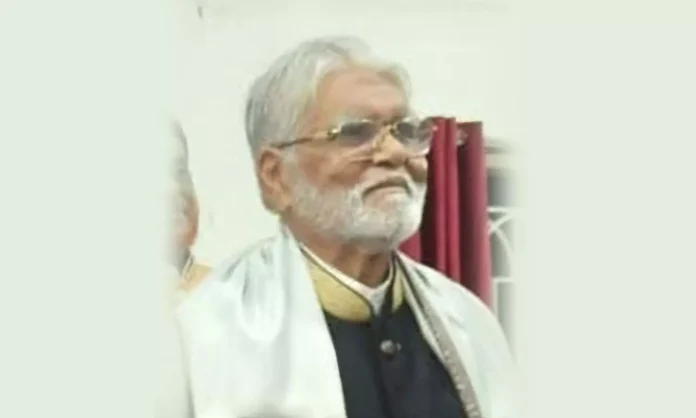
The Urdu literary world mourns the demise of one of its gentle giants, Azizuddin Aziz Belgaumi, the celebrated Na’at poet, ghazal writer, teacher, and literary guide, who returned to his Lord on the morning of Friday, November 28, shortly after the Fajr prayer in Bengaluru.
Azizuddin Aziz was not merely a poet; he was a custodian of spiritual emotion, a voice that blended devotion, beauty, and sincerity in every syllable.
He was renowned for his Na’ats – soulful, tender, and overflowing with love for Prophet Muhammad ﷺ. His unique style of recitation, coupled with his soothing voice, made his poetry beloved among Urdu lovers across the region and beyond.
His iconic Na’ats, including:
اہلِ ستم کے پتھر کھا کر گل برسانے والے ہم
دعوتِ ہدایت کی ایک حسیں شفق لے کر میرے مصطفیٰ آئے
had gone viral among Urdu audiences, each line steeped in deep reverence and spiritual longing.
On his final night in this world, he once again recited “Dawat-e-Hidayat ki ek haseen shafaq lekar mere Mustafa aaye” on special request at a mushaira organized by Idara-e-Adab-e-Islami Hind, Karnataka. The audience responded with extraordinary affection, as if witnessing a sacred farewell.
By the next morning, he left this world – a departure many lovingly regard as a sign of divine acceptance.
Azizuddin Aziz’s published works reflect his emotional depth and mastery of language. His poetry collections include:
حرف و صوت
سکون کے لمحوں کی تازگی
دل کے دامن پر
نقد و انتقاد
زنجیرِ دست و پا
ذکر میرے حبیب کا
These works capture the freshness of spiritual experience, the fragrance of emotion, and the honesty of a heart in constant remembrance.
Azizuddin Aziz worked with Doordarshan Bangalore Urdu, where he interviewed prominent literary personalities. His conversations reflected both scholarship and humility, making him a respected voice representing Urdu culture on national media.
He served for a time as a teacher and later as the Principal of Zubaida College, Shikaripur, shaping young minds with the same warmth and refinement that characterised his poetry.
As an educator, he was loved for his gentle discipline, cultured manner, and his ability to ignite a love for language among students.
He also served as editor of several literary magazines, contributing significantly to Karnataka’s Urdu literary landscape. His editorial vision was marked by sincerity, high standards, and a deep respect for classical tradition.
Early on November 28, he experienced severe chest pain at his residence in Bengaluru. Despite attempts to rush him to the hospital, he breathed his last at home. He leaves behind his wife, three sons, two daughters, and a large community of admirers, students, and peers.
May Allah accept every word of love he wrote for His Beloved Prophet ﷺ. May He grant Azizuddin Aziz a lofty place in Jannat-ul-Firdous, and grant patience, strength, and peace to his grieving family. His voice has returned to silence – but his Na’ats will continue to illuminate gatherings, his ghazals will continue to warm hearts, and his legacy will remain a torch of devotion and grace.
Inna lillahi wa inna ilayhi raji’un. Most certainly we belong to Allah, and most certainly we will return to Him.
source: http://www.radiancenews.com / Radiance News / Home> Focus> Obituary / by Radiance News Bureau / by Mohammed Talha Siddi Bapa / November 29th, 2025
Seeds of Change Muslim Women from Dharwad Who Won the UN’s Biodiversity Prize / source: youtube.com/Radiance News
Awardee of the prestigious UNDP Equator Prize 2025 – often called the “Nobel Prize for Biodiversity.”
A Global Recognition for Rural Women: In a small corner of Karnataka, far from the corridors of power and the glare of television studios, a quiet revolution has been taking place. In Teertha village of Dharwad district, a group of Muslim women farmers have done what many thought impossible: they have revived traditional agriculture, empowered women, and built a sustainable rural economy – earning them global recognition.
Earlier this year, the Bibi Fathima Self-Help Group (SHG) was named one of the 10 winners of the UNDP Equator Prize 2025. Often described as the “Nobel Prize for Biodiversity,” the award recognises outstanding local initiatives that offer nature-based solutions to climate change and development challenges. Out of 700 nominations from 103 countries, these women stood out.
From Small Beginnings to a Wider Network
The journey began in 2019, when the SHG was formed under the guidance of the NGO Sambhvida. What started as a modest effort soon grew into a larger movement. Today, the Bibi Fathima SHG is part of a federation of 83 self-help groups, linking together nearly 300 women across Dharwad.
At the forefront is Bibi Fathima, a graduate in Arts, whose vision and determination have inspired women from different backgrounds to participate. Under her leadership, the SHG has become more than just an economic unit – it has become a space for learning, cooperation, and social change.
Millet: From Margins to the Mainstream
At the heart of their work lies a humble but powerful grain: millet. Once a staple of Karnataka’s fields and kitchens, millets were pushed to the margins by the Green Revolution’s focus on rice and wheat. The result was water scarcity, soil exhaustion, and loss of dietary diversity.
Their focus on millets also resonates globally. In fact, the United Nations declared 2023 as the International Year of Millets, recognising the grain’s role in ensuring food security and combating climate change. Governments, scientists, and nutritionists around the world are now looking at millets as the “crops of the future.” What the world is beginning to rediscover, the women of Dharwad have been practising for years – placing millets back at the heart of farming and household nutrition.
The women of Teertha decided to turn back to their roots. Through the SHG, they revived millet-based mixed cropping systems, promoting traditional practices that require less water, restore soil health, and provide nutritious food. They did not stop at farming – they built a movement around biodiversity.
The Seed Bank: A Living Library
One of their most significant achievements is the establishment of a community seed bank, where dozens of indigenous varieties of millets and pulses are preserved in earthen jars and carefully catalogued. The seed bank is more than a storage system – it is a lifeline. It ensures that farmers do not have to depend on costly hybrid seeds from outside markets.
The shelves lined with jars of foxtail, little millet, kodo, and pulses symbolise something larger: the preservation of biodiversity for future generations. As one member put it, “Every jar holds not just seeds, but the story of our ancestors and the hope of our children.”
Voices from the Ground
Speaking to Radiance News, Bibi Fathima explained how cooperation has been the backbone of their success.
“No single group can do this alone. We work together – sharing seeds, knowledge, and experiences. The seed bank has become our lifeline. It is not just a storehouse of grains, it is a storehouse of trust,” she told Radiance correspondent Mushtaq.
Her words capture the essence of the movement: solidarity across communities, generations, and villages.
From Seed to Market
The SHG’s innovation extends beyond cultivation. Recognising the need for value addition, they established a solar-powered millet processing unit, managed entirely by women. This unit transforms raw millet into flour, snacks, and packaged products that are finding markets in both rural and urban areas.
Partnerships have been crucial in this journey:
With Sahaja Samruddha, the SHG built marketing and certification channels.
With the Indian Institute of Millets Research, they accessed technical expertise.
With the Devadhanya Farmer Producer Company, they entered wider markets.
This blend of grassroots energy and institutional cooperation has turned a local SHG into a regional model for sustainable farming.
Breaking Stereotypes in a Polarised Society
In today’s climate, Muslims are often asked – sometimes with suspicion – what they contribute to the nation. Muslim women, in particular, are portrayed as silent or confined to the margins.
The Bibi Fathima SHG challenges these stereotypes powerfully. Here are Muslim women, in a rural corner of Karnataka, who are not just participating but leading. They are reviving biodiversity, protecting food security, and building rural enterprises. Their work proves that Muslim women are at the heart of India’s agricultural and social transformation.
Building Bridges: Hindu and Muslim Women Together
Perhaps the most inspiring part of this story is its inclusivity. The network of 83 SHGs is not confined to one community. Hindu and Muslim women farm together, share seeds, and manage enterprises as equal partners.
In an age when some try to inflame communal divisions for political purposes, these women are building bridges of unity through the soil itself. Their fields are places of cooperation, not conflict; of shared harvests, not suspicion. Biodiversity conservation here is not just ecological – it is social.
Faith and Social Service
Their commitment is also rooted in a broader moral principle of service. Prophet Muhammad ﷺ said:
“The best among you are those who are best for society.”
Through farming, seed conservation, and entrepreneurship, the women of Teertha embody this ethos. Their contribution benefits not only Muslims but the entire community, from farmers and consumers to future generations.
A Long History of Muslim Contributions to Agriculture
This achievement is not an isolated story. For centuries, Muslims have enriched India’s agricultural landscape:
Irrigation systems built by engineers in medieval India turned barren land fertile.
New crops such as guava, pomegranate, and certain citrus varieties spread through trade routes maintained by Muslim communities.
Orchards and gardens in the Deccan and Mughal India reflected a philosophy of harmony between beauty and utility.
Women in rural households played critical roles in livestock, kitchen gardens, and seed saving – long before these terms became development jargon.
The women of Teertha stand in this tradition, carrying forward a legacy of stewardship and innovation.
Global Recognition, Local Pride
The Equator Prize 2025 is more than a trophy. It comes with a cash award of USD 10,000, but its symbolic value is greater. It tells the world that solutions to climate change and food insecurity are not found only in international conferences, but also in the daily work of rural women.
Later this year, representatives of the SHG will be virtually honoured at the UN Climate Conference (COP30) in Brazil. Their story will stand alongside other grassroots champions from Africa, Latin America, and Asia – proof that local action has global relevance.
Seeds of Hope for Plural India
The journey of the Bibi Fathima SHG is more than a story of millet farming. It is a story of agency, dignity, and unity. It shows that Muslim women are not passive observers but active leaders – biodiversity promoters, community builders, and entrepreneurs.
Their fields are not just producing crops – they are producing harmony, resilience, and hope. At a time when divisions are deepened for political gain, these women remind us that India’s real strength lies in cooperation across communities and in valuing every contribution, no matter how small.
The seeds planted in Teertha are not only for Karnataka’s soil. They are seeds for India’s future.
source: http://www.radiancenews.com / Radiance News / Home> Features> Focus / by Mohammed Talha Siddi Bapa / Radiance News Bureau / September 09th, 2025
Tucked between the roaring waves of the Arabian Sea and the lush green canopy of the Western Ghats lies a jewel of a town – Bhatkal.
A place where coconut palms sway in the ocean breeze, where the call to prayer echoes through the valleys, and where the scent of cardamom-laced biryani mingles with the salty sea air. But beyond its scenic charm and poetic quietude, Bhatkal tells an inspiring story – a story of legacy, faith, culture, and a deep-rooted commitment to education.
Once a humble trading post frequented by Arab merchants, Bhatkal today is a dynamic blend of history and modernity. Its people, mostly of Arab descent, still carry the flame of their forefathers – traders who braved the seas, settled in distant lands, and left behind more than just wealth. They bequeathed a way of life, a sense of community, and a passion for learning that continues to flourish in remarkable ways.
Imagine waking up to a view where mist-kissed mountains tumble into spice-scented fields, only to meet a coastline where waves pound golden sands under the watchful gaze of age-old palms. That’s Bhatkal – not just a town, but a canvas painted with the green of the hills, the blue of the sea, and the gold of tradition. And amid this natural splendour, an educational movement has quietly taken root – transforming lives and reaffirming the town’s historic role as a cradle of knowledge and cultural resilience.
A Legacy Carried on the Tides
The story begins not just in Bhatkal, but far beyond – across the seas in the Gulf. Over the last five decades, thousands of Bhatkalis migrated to the UAE, Saudi Arabia, Oman, and Kuwait – carrying with them their culture, values, and a remarkable sense of unity. Wherever they went, they established Jamaats (community organisations), which became lifelines of cultural preservation and mutual support.
But by the 1990s, community elders noticed a worrying trend. Amid the glitz of Gulf jobs and the comfort of petro-dollar salaries, education was beginning to take a back seat. Young boys were dropping out after high school, opting to join the workforce early. The allure of quick earnings began to eclipse the pursuit of knowledge.
It was then that the Bhatkal Muslim Khaleej Council – an umbrella body of 11 Gulf-based Bhatkali Jamaats – decided to act.
The Birth of the Rabita Educational Award
The Council launched the Rabita Educational Award to rekindle academic ambition among Bhatkali youth. It wasn’t just about giving away medals or cash – it was about igniting pride, ambition, and a sense of purpose. The idea was simple: if we honour excellence, others will strive for it.
When the initiative began 30 years ago, the bar was modest. Students securing 65-70% were among the awardees. Yet even then, it was revolutionary. For the first time, young boys and girls felt seen and celebrated, and parents began to regard education as a shared community value.
Fast forward to today: Rabita Award winners score as high as 98% and above. This year, the difference between the topper and the runner-up was a mere 0.0375%. That’s not a gap – it’s a heartbeat.
This Year’s Celebration: A Festival of Learning
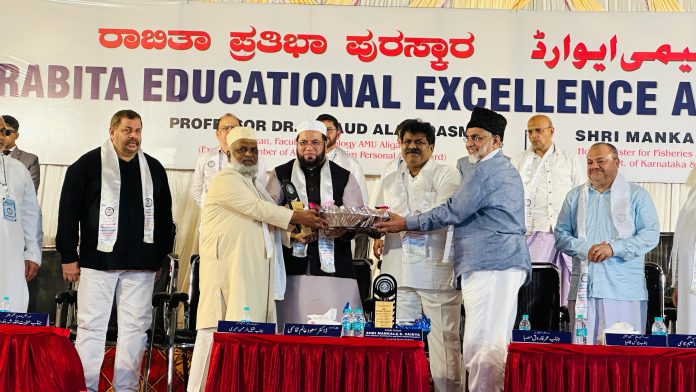
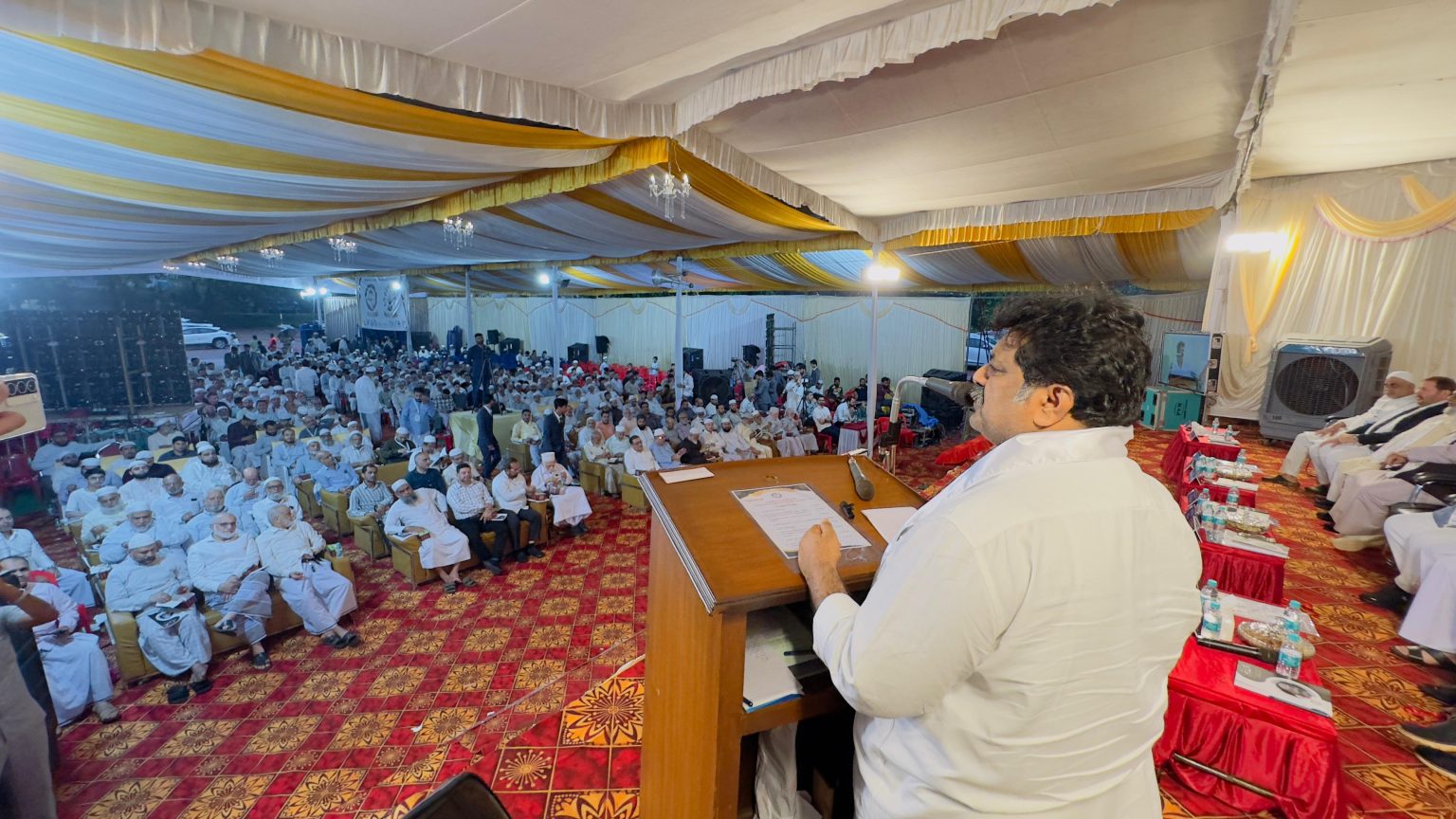
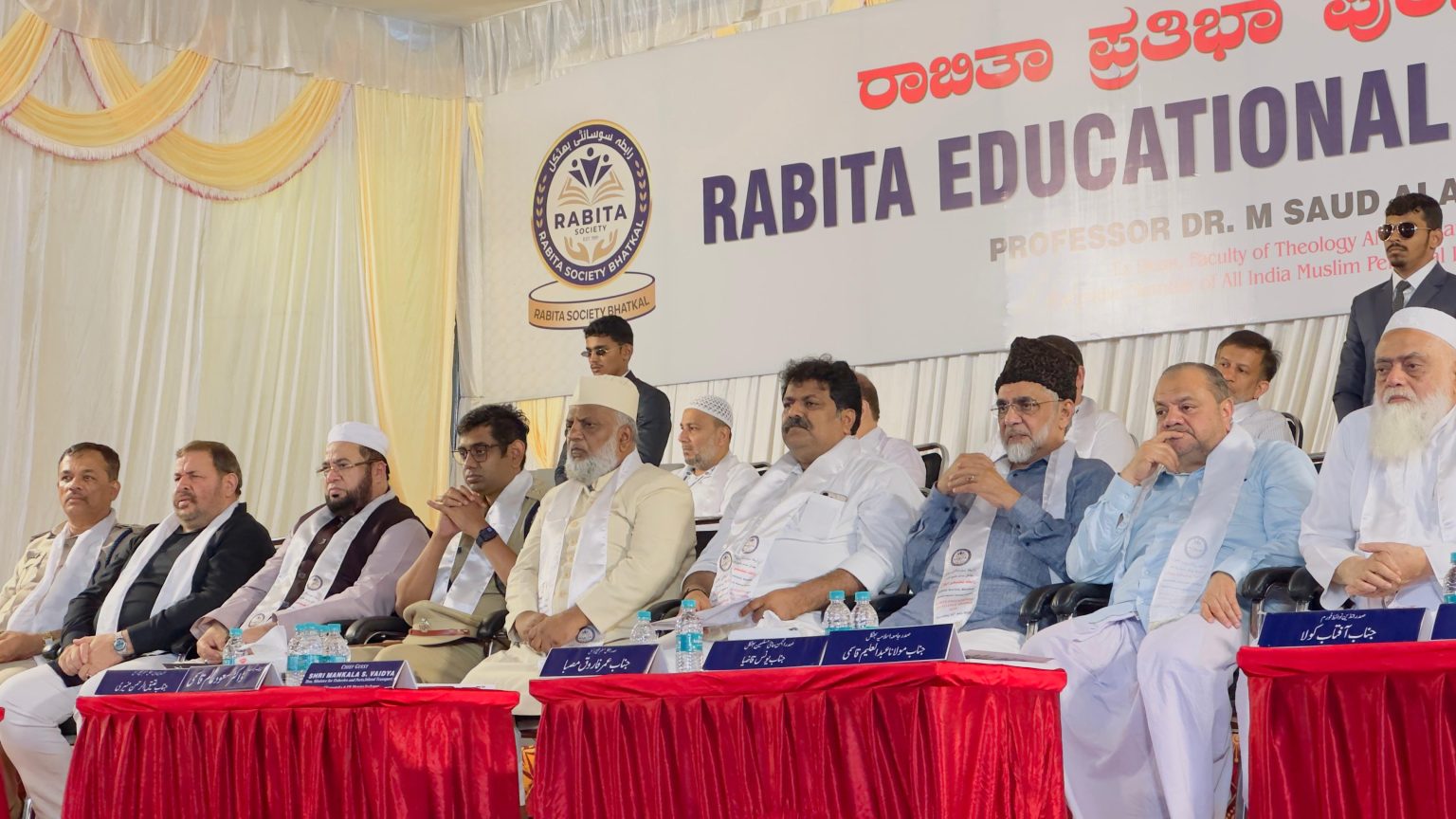
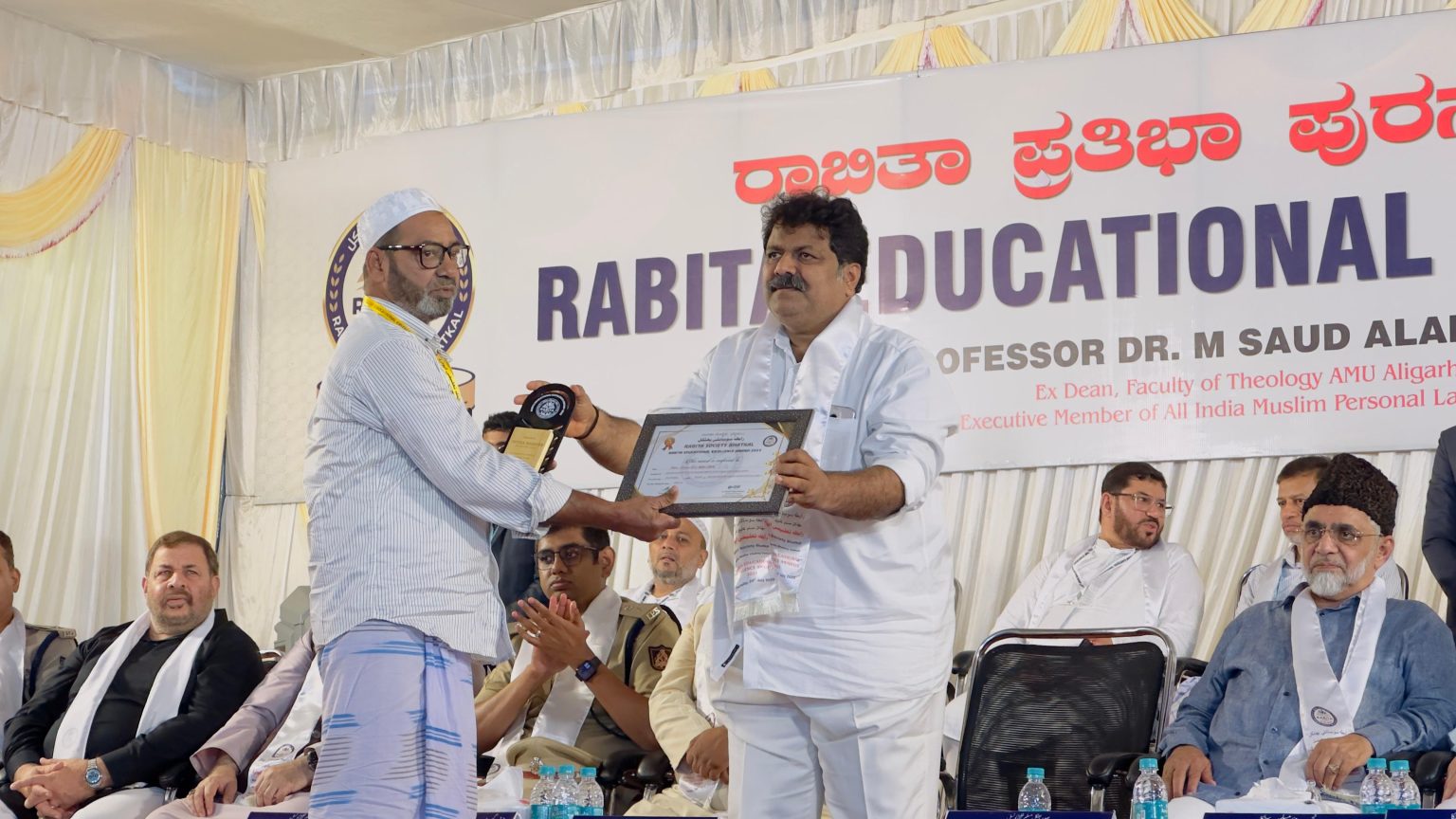
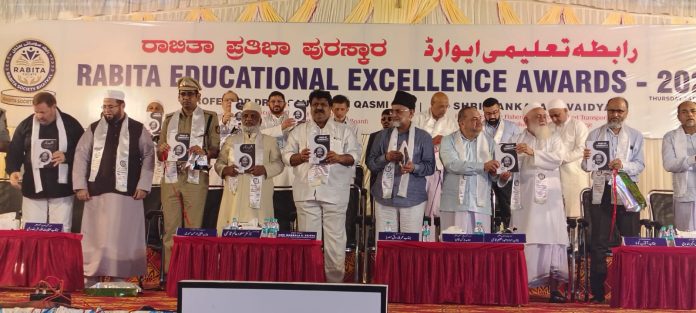
The 2025 Rabita Award Ceremony, held on 24th July at the sprawling grounds of Anjuman Islamiah Anglo-Urdu High School, was nothing short of majestic.
Even as rain poured steadily over the coastal town, the people of Bhatkal gathered in full strength. The makeshift auditorium overflowed with parents, teachers, and well-wishers – proving once again that no weather can dampen a community’s spirit when the cause is education. The stage, draped in the colours of Bhatkal’s spirit, welcomed an audience of thousands – parents, educators, students, and dignitaries.
Dr. Saud Alam Qasmi, a respected professor from Aligarh Muslim University and member of the All India Muslim Personal Law Board, addressed the gathering. His words resonated deeply:
“The United Nations declared education a basic human right in 1947. But 1,450 years ago, Islam declared: ‘Seeking knowledge is an obligation upon every Muslim man and woman.’”
His speech wove together spiritual insight and modern urgency, urging families to view education not as a luxury, but as both a sacred duty and a social necessity.
Joining him was Karnataka State Minister Mankal Vaidya, who praised Bhatkal’s educational institutions and pledged full support for establishing a medical college – recognising that Anjuman already offers nearly every other academic faculty.
More Than Medals: The Power of Encouragement
This year, 35 students across SSLC, PUC, and degree levels were honoured with gold medals and thoughtful gifts. Among them, female students once again outshone their peers, capturing two-thirds of the recognitions – a heartening sign of changing mindsets and growing gender parity in education.
The Best School Award continues to be named after Janab Usman Hassan, the legendary headmaster of Islamia Anglo High School, who worked tirelessly to promote education in Bhatkal. A pioneer in his own right, he laid the foundation for a culture of academic excellence that still echoes through the town’s institutions.
In a meaningful addition this year, the Best Teacher Award was named after Janab Syed Khaleelur Rahman Sahib, the very same visionary celebrated in the tribute volume “Iftikhar-e-Qaum Janab SM Khaleelur Rahman”. From his Gulf office in Dubai, he dreamt of uplifting his people through knowledge – and worked quietly but tirelessly to turn that vision into reality.
Though he now rests in the desert sands of Arabia, his legacy continues to bloom each year in the smiles and successes of the awardees he once imagined. Honouring him through the Best Teacher Award is both a tribute and a reminder that behind every great student is a teacher who believed in their potential.
This year’s recognitions reflected that enduring vision.
Ali Public School (Girls) received the Best School title, led by their standout student Hafsa Bint Hafeezullah, who scored an impressive 98.04%.
The Best Teacher honour went to Ms. Fatima Wida Siddiqui of Noonahal Central School, recognised for her outstanding dedication to education.
District toppers such as Shagufta Anjum (Urdu) and Bhoomika (English) were also felicitated, symbolising the inclusive spirit of academic celebration that the Rabita Awards embody.
Why This Model Deserves to Be Replicated
In an age when education is increasingly commodified, where coaching institutes manufacture toppers and commercial schools chase ranks, the Rabita model stands apart.
It is community-funded, value-driven, and inclusive. It celebrates the bright, uplifts the average, and motivates the struggling. It views education not merely as individual success, but as a shared legacy and a community responsibility.
The Rabita Award isn’t just a medal; it’s a signal fire – telling every child, “We see you. We believe in you. We’re with you.”
Imagine This in Every Town
What if every small town like Bhatkal decided to invest in its children this way?
What if the diaspora of Hyderabad, Azamgarh, Kutch, or Kolkata pooled their earnings not just for lavish marriages and luxury homes, but for educational dreams?
What if every community – regardless of faith, culture, or geography – told its youth: “We are proud of your academic journey. Keep going. We’re watching. We care.”
Communities that value knowledge rise. Those that don’t, perish slowly.
A Lesson from the Sea and the Ghats
Just like the waves of the Arabian Sea, education must be relentless – always pushing, always reshaping. And like the roots of the Western Ghats, it must be deep, nourishing generations, and anchoring identity against the floods of time.
Bhatkal is not just a place; it’s a model of what’s possible when community, culture, and commitment converge.
As the sun sets behind its palm-draped shores, one truth becomes clear:
Awards don’t just honour achievers. They create them.
Let This Be Your Takeaway
If you’re reading this in another town, another country, another community – know this: you too can start your Rabita. You too can plant the seeds of pride, perseverance, and purpose in your youth.
Start small. Honour the top three in your school. Involve your elders. Call the students to the stage. Clap for them. Gift them a medal. Take their picture. Tell the story. And do it again next year.
That’s how legacies begin.
And who knows? One day, someone may write about your town the way we write about Bhatkal – a place where the sea sings songs of learning, and the mountains stand tall in witness to dreams fulfilled.
source: http://www.radiancenews.com / Radiance News / Home> Education / by Mohammed Talha Siddi Bapa / July 26th, 2025
When Ibrahim Saeed breathed his last in the quiet hours between May 26 and 27, 2007, it was not merely the passing of a leader – it was the end of an era. For the people of Karnataka, particularly those in the fold of Jamaat-e-Islami Hind (JIH), his death marked the departure of a towering moral force, a bridge-builder, and a man whose words carried the weight of wisdom and the warmth of sincerity.
Ibrahim Saeed(L) with Maulana Sirajul Hasan, then Ameer Jamaat-e-Islami Hind
As a former President of JIH Karnataka, Ibrahim Saeed was not just a man of designation – he was a man of deep dedication. He led with humility, served with sincerity, and above all, connected with people at the human level. His leadership was rooted not in authority, but in affection.
A Childhood of Values, A Youth of Vision Born in coastal Karnataka, Ibrahim Saeed grew up in an environment where religious grounding and intellectual openness walked hand in hand. From an early age, he was drawn to the Qur’an, not merely as scripture to be recited, but as a message to be understood and shared. This foundational attitude remained the hallmark of his life-long da’wah journey.
His eloquence in Kannada and Urdu, coupled with a rare sensitivity to social realities, made him a powerful communicator. He spoke not to impress, but to illuminate. For young Muslims and for non-Muslim listeners alike, he offered Islam not as an ideology to be defended, but as a path of truth, mercy, and justice.
A Da’ee Who Belonged to All Perhaps the most defining feature of Ibrahim Saeed’s personality was his deep affection for all people, regardless of faith or background. His relationship with non-Muslim brothers and sisters was truly extraordinary. Whether it was participating in interfaith programmes, comforting victims of injustice, or simply walking the narrow streets of Mangalore or Udupi, greeting people with a smile – he was universally loved and respected.
He was never one to see da’wah as monologue. To him, it was dialogue – rooted in respect, empathy, and sincerity. His tone was always soft, yet his message never diluted. Non-Muslim intellectuals and activists often remarked on how deeply they admired his character, and how Islam seemed more beautiful when explained by Ibrahim Saeed.
His inclusive vision of Islam was most evident in the way he reached out to Dalit communities across Karnataka. He would often visit Dalit colonies, organising interactions with men and women in their own neighbourhoods. On one such occasion, a woman asked him plainly, “You are a Muslim. Why do you come to our colony and conduct programmes?” He replied with characteristic humility, “Dalits are the most marginalised communities in India, and Islam teaches that every human being is equal. I want to convey that you and I are the same – no discrimination, no untouchability.”
This brief yet profound exchange summed up the essence of his mission: to live and preach the Qur’anic message of human dignity, social justice, and equality.
Leading Without Holding On During his tenure as President of JIH Karnataka, Ibrahim Saeed steered the organisation with clarity of purpose and a focus on grassroots empowerment. He built bridges across regions, across communities, and across hearts. His vision was long-term: develop not only structures but people – individuals with integrity, faith, and commitment to social transformation.
What set him apart was his ability to let go. Even as his health declined due to terminal cancer, he made it a point to travel to Bangalore to formally hand over his responsibilities to his successor. It was a gesture that reflected his humility and organisational discipline. He believed in nazam or system, not in personality cults.
Courage in the Shadow of Death When the diagnosis of Stage IV lung cancer came, he did not flinch. His calm reply – “Alhamdulillah” – shocked even the doctors. He rejected aggressive treatments, choosing instead to accept Allah’s decree and live his remaining days with dignity and devotion.
Despite his declining health, he continued to write, meet people, and offer guidance. He even addressed national-level meetings, delivered Qur’anic lectures in towns like Uppinangady, and met with activists who sought his counsel. His final I’tikaf – spent in the Kutchi Memon Masjid – fulfilled a long-held yearning and marked a full spiritual circle.
His close friends recall that even in moments of physical weakness, his humour remained intact. His conversations were never heavy with sorrow. They were light with grace.
A Funeral Like No Other When the end came, the grief was personal and collective. People poured in from every district of Karnataka. The Janazah at Central Juma Masjid in Mangalore drew an unprecedented crowd – cutting across class, creed, and political affiliations. Senior leaders like H.D. Kumaraswamy, Mallikarjun Kharge, Jaffer Sharif, and Roshan Baig came to pay their respects. Rahman Khan embraced his son and said what many felt in their hearts: “We’ve lost a rare gem.”
A Legacy of Light Today, Ibrahim Saeed lives on – not only through his family and writings, but through the countless people he inspired. He lives in the students who remember his compassionate words. He lives in the non-Muslim neighbours who saw Islam’s beauty through his actions. He lives in the members of JIH Karnataka who still consider him a moral guide and fatherly mentor.
In a time when voices grow louder but less sincere, when leadership is often reduced to branding and bravado, the life of Ibrahim Saeed stands as a timeless example of principled activism, prophetic wisdom, and universal compassion.
His passing left a void that perhaps no one can fill – but his legacy lights the path for those who dare to walk it.
[With input from Mohammed Markada and Ameen Hassan]
source: http://www.radiancenews.com / Radiance News / Home> Focus> Pride of the Nation> Personality / by Mohammed Talha Siddi Bapa / May 30th, 2025
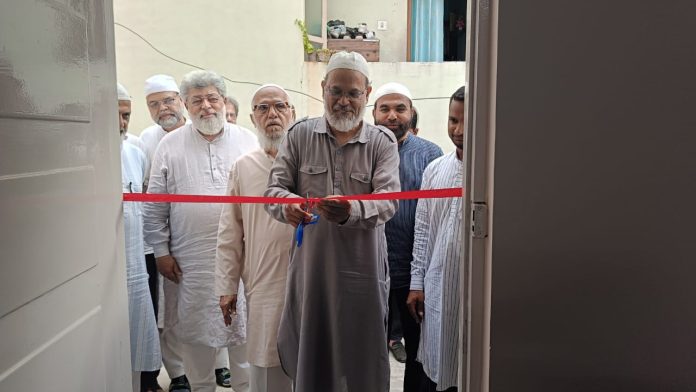
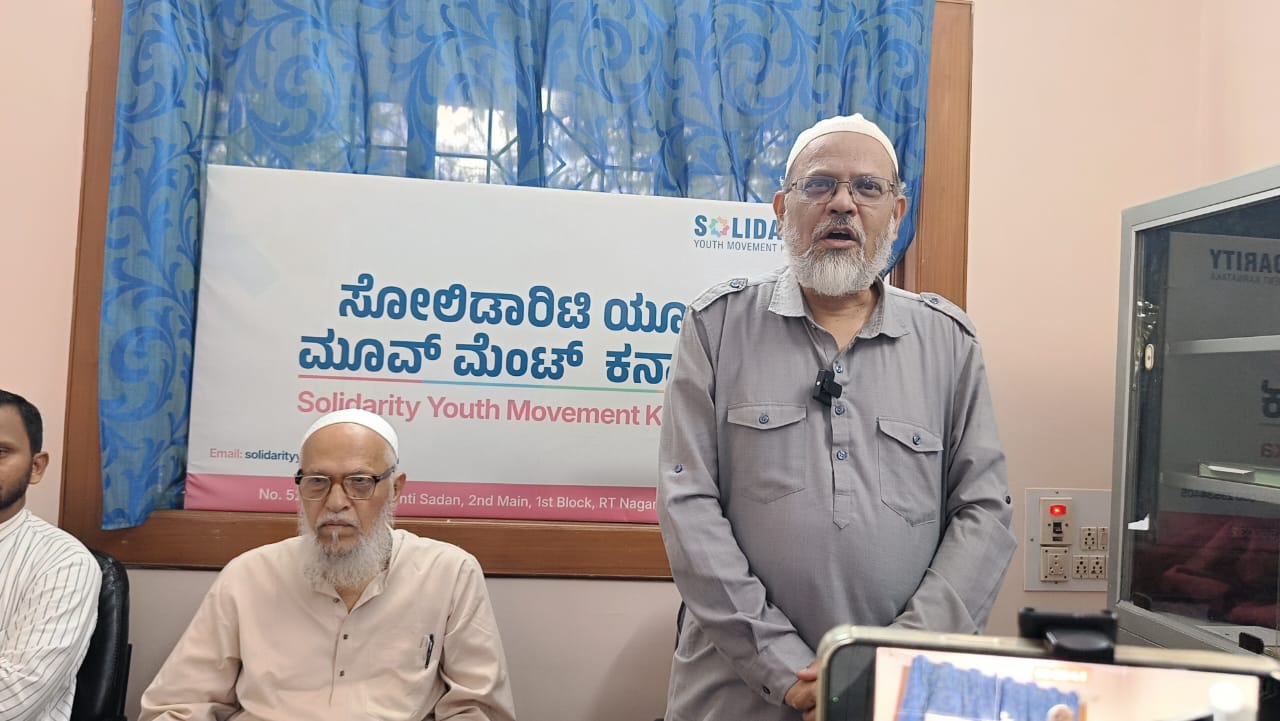
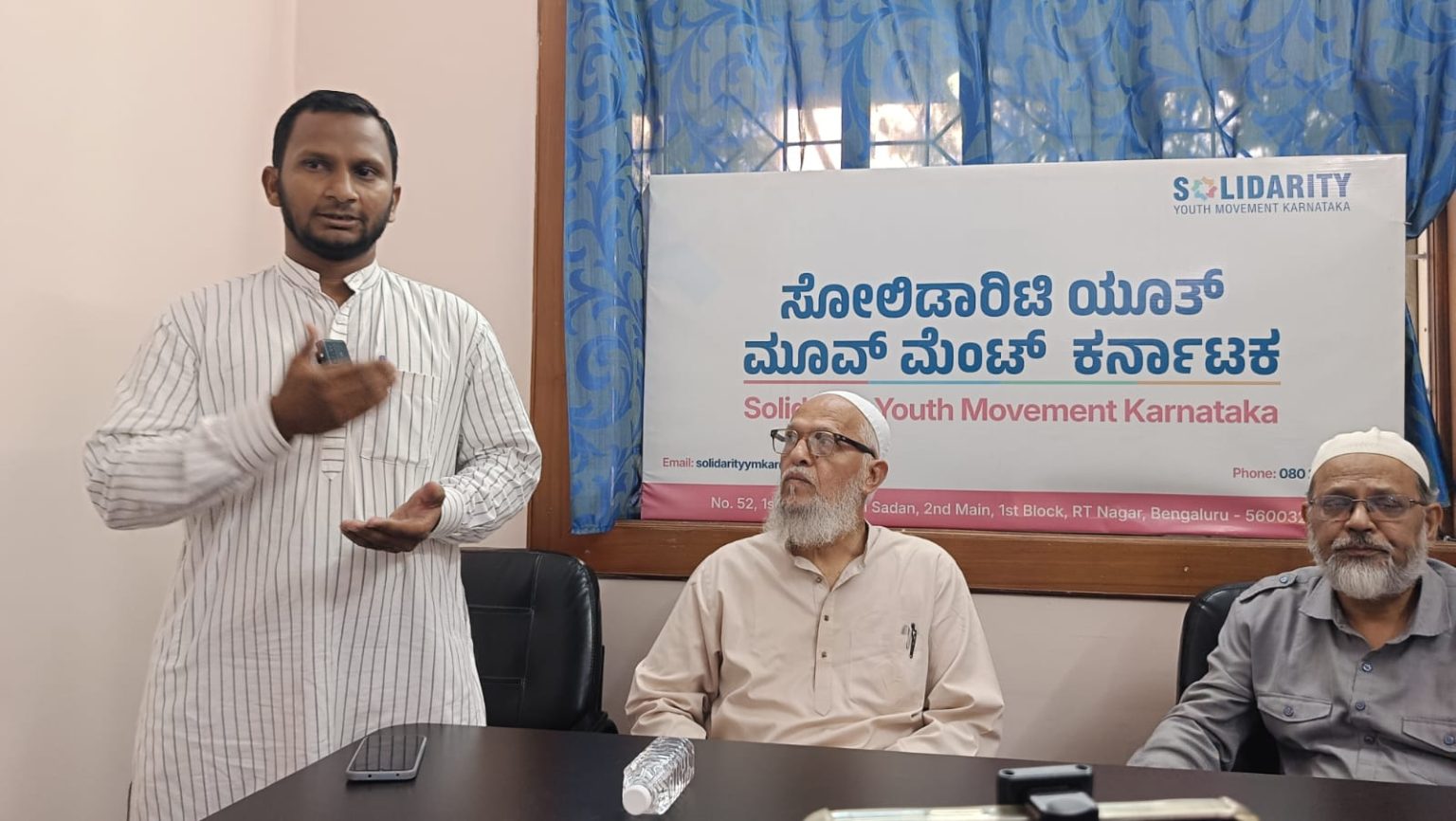
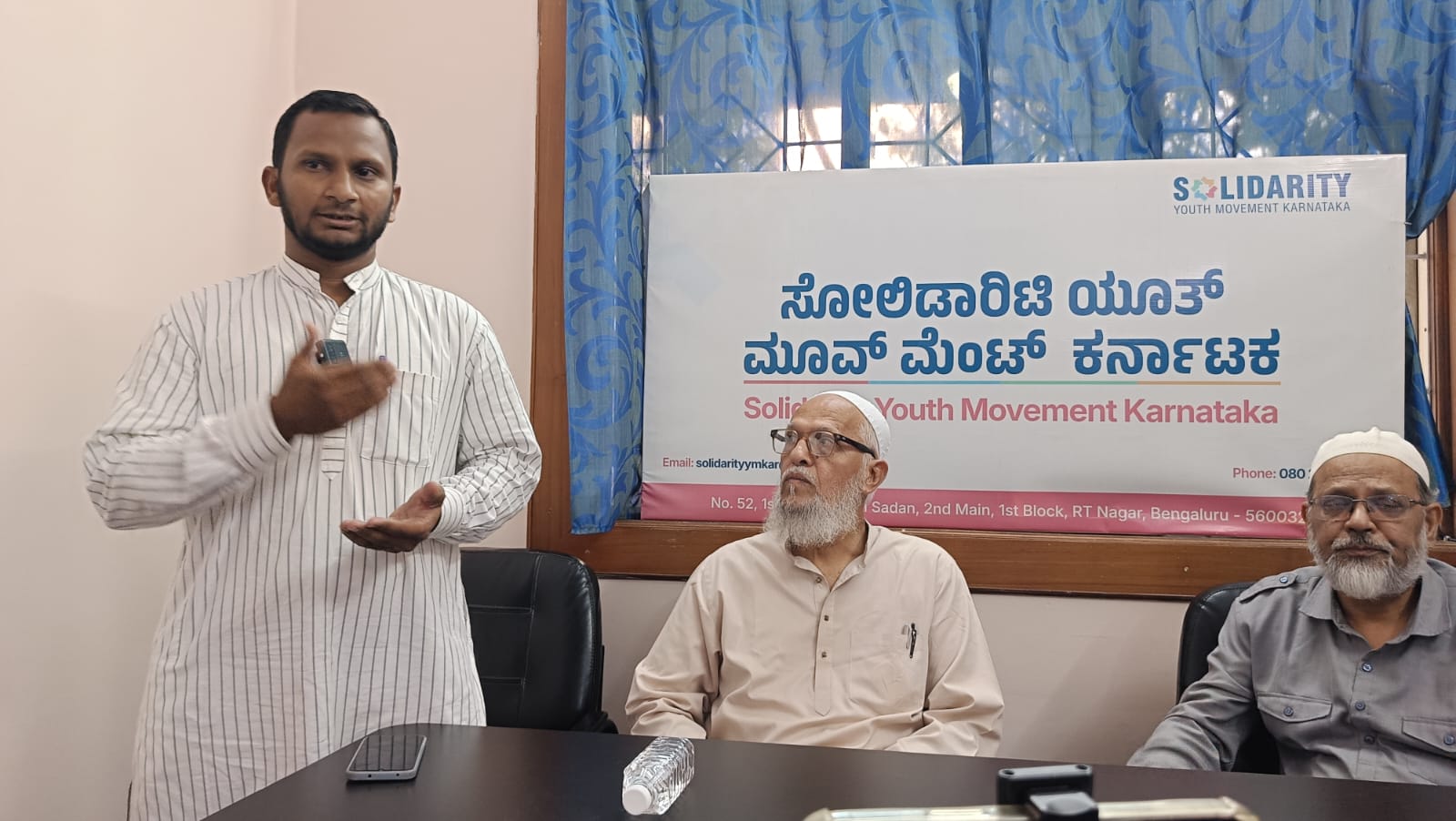
In a bold stride towards structured youth empowerment, the Solidarity Youth Movement Karnataka marked a significant milestone with the inauguration of its new state office in Bengaluru.
The formal opening ceremony was led by Dr. Mohammed Saad Belgami, Ameer-e-Halqa of Jamaat-e-Islami Hind, Karnataka, coinciding with the annual state Shura session.
Far from being a mere administrative facility, the new office symbolises the growing institutional presence and ideological clarity of a movement that has evolved from grassroots activism to state-wide influence. Speaking at the event, Dr. Naseem, State President of Solidarity Youth Movement, described the organisation not just as a protest platform, but as “a transformative force for grooming morally conscious and socially responsible youth leaders.”
From a Youth Wing to a Mass Movement What began in 2008 as the “Youth Wing of JIH Karnataka” with just 250 members, formally transitioned into the Solidarity Youth Movement in 2016. Today, it boasts an expansive network across 27 districts with over 80 local units and a membership exceeding 7,000 – out of which more than 900 are actively engaged as trained “Activists.”
According to Dr. Naseem, this journey reflects the urgent need to channel the dynamism of youth towards constructive and long-term social reform. “We envision a generation of youth who are ethically upright and capable of leading society toward peace, progress, and justice,” he said. He emphasised the movement’s focus on skill development, employability training, and intellectual empowerment, aligning with both the constitutional ethos of India and the legacy of Islamic civilizational values.
Leadership Speaks Addressing the gathering, Dr. Saad Belgami remarked, “From its inception, the Islamic movement has placed youth at the centre of its mission. Solidarity Youth Movement is a natural extension of this vision – shaping minds and building character.” He added that the 2022 Youth Convention acted as a catalyst, significantly expanding the movement’s outreach and operational capacity across Karnataka.
The event was also graced by former state presidents of JIH, Mr. Iqbal Mulla and Mr. Atherulla Shariff, along with other senior functionaries from various wings of the organisation.
A Nerve Centre for Change With the establishment of this new state office, Solidarity Youth Movement is poised to further institutionalise its efforts in leadership training, civic engagement, and ideological grounding. The office is envisioned as a nerve centre for nurturing grassroots leadership, mentoring youth activists, and coordinating state-wide programs aimed at social justice and pluralistic harmony.
“This will be more than brick and mortar. It will be a lighthouse for Karnataka’s aspiring youth leadership,” said Dr. Naseem. “And a strategic base for long-term nation-building efforts,” he added with conviction.
As the curtain drew on the inaugural ceremony, the message was loud and clear: Solidarity Youth Movement is not just responding to the times – it is shaping them. And this new office stands as a testament to that mission. A platform today, a movement tomorrow. Indeed, a future-defining institution in the making.
source: http://www.radiancenews.com / Radiance News / Home> Latest News / by Mohammed Talha Siddi Bapa / May 12th, 2025