Ramsha is an alumna of Azim Premji University, Bangalore, where she pursued her undergraduate degree in Liberal Arts. She later went on to complete a Master’s in History and Persian from the School of Oriental and African Studies (SOAS), University of London.
Hyderabad:
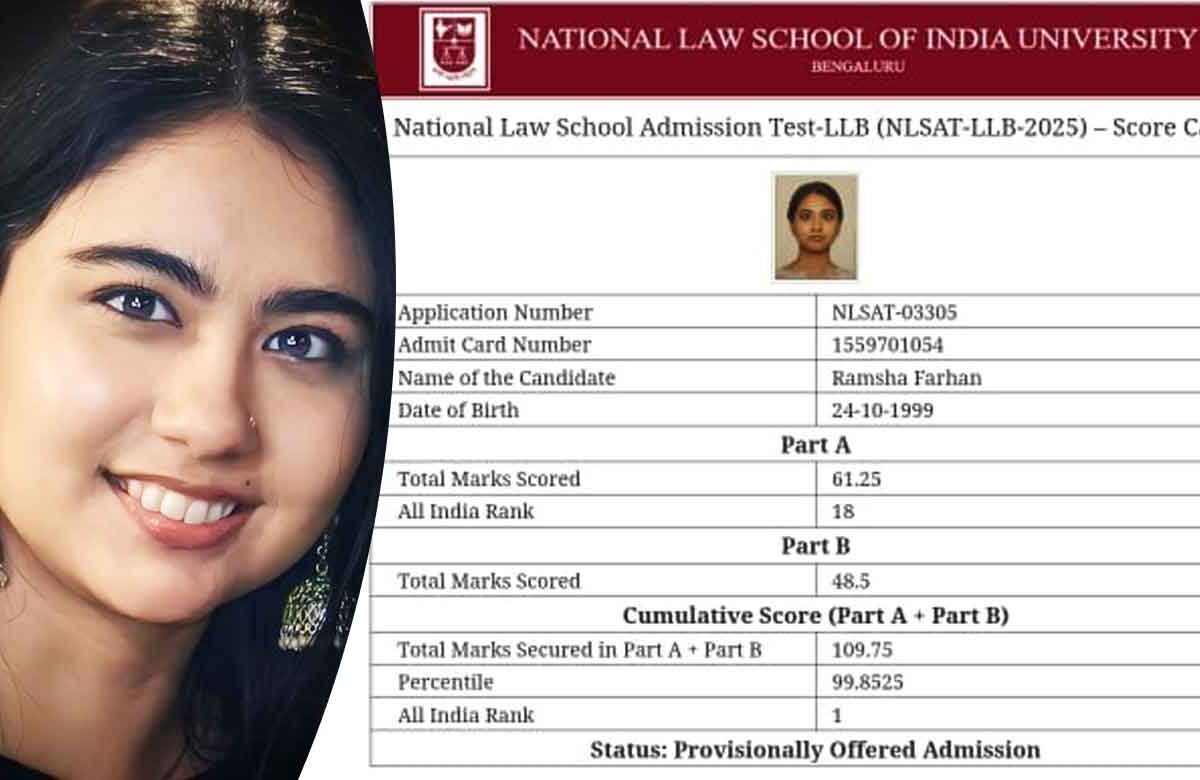
In a moment of immense pride for Hyderabad, RamshaFarhan has secured the 1st Rank in NLSAT-LLB 2025, the national-level entrance examination for admission to the prestigious National Law School of India University (NLSIU), Bangalore — widely regarded as the top law school in the country.
Ramsha is an alumna of Azim Premji University, Bangalore, where she pursued her undergraduate degree in Liberal Arts. She later went on to complete a Master’s in History and Persian from the School of Oriental and African Studies (SOAS), University of London.
She hails from a family with a strong legacy of intellectual and cultural contributions. Ramsha is the daughter of Ashhar Farhan and Humera Ahmed, co-founders of Lamakaan, Hyderabad’s iconic open cultural space. She is also the granddaughter of the celebrated writer and Padma Shri awardee Jeelani Bano.
Known for her academic excellence and deep social commitment, Ramsha Farhan’s achievement is not just personal but a proud milestone for her city and community. Her success is a testament to the values of education, culture, and progressive thought that her family has championed for decades.
We extend our heartfelt congratulations to Ramsha and wish her continued success as she embarks on her legal journey at NLSIU.
source: http://www.munsifdaily.com / Munsif News 24 x 7/ Home> Hyderabad / by Syed Mubashir / June 03rd, 2025
Another area where his enthusiasm manifested itself was in exploring the religious history of meteors.
Mohammad Abdur Rahman Khan
The night sky has been one of the oldest sources of wonder. Through the ages men and women have looked up to the stars and been filled with curiosity and awe. This peculiar awe inspired by the diamond-studded vault has also inspired a number of distinct disciplines and practices. From hobbies like stargazing to highly systematised knowledges like astronomy and astrology and several cosmological myths in every major world religion have all been inspired by the awe one feels for the “heavens”. When we write the history of our all-too-human interest in the night skies, however, we usually parse these various practices and knowledges into neat silos.
Stargazing is seen to be an activity proper to children and hobbyists. Religious cosmologies are mostly left to theologians or historians of religion. Astronomy becomes the province of the savant. Even if some traffic between these distinct groups and their practices may be allowed in earlier eras, the distinctions seem to have become watertight by the 20th century. And that might be why no one today remembers Mohammad Abdur Rahman Khan.
A passion for meteors
In the last decade of British rule in India, Khan published a whopping ten papers and reports in Nature, the preeminent scientific journal of the time. Khan only had a bachelor’s degree to his name and had taught all his life at the Osmania College, away both from the then-new research institutions like the IISc and the old universities like those at Calcutta, Bombay, or Madras.
By the end of the 1940s, however, Khan had become well-known to the international scientific community. Besides his regular contributions to Nature and other scientific publications, he had also been elected a Fellow of the Royal Astronomical Society and appointed a Research Associate at the Institute of Meteoritics at the University of New Mexico. In 1936 and again in 1948 Khan was invited to present papers at the annual meetings of the Society for Research on Meteorites in the United States.
Khan’s passion was meteors. He had first become interested in them as a schoolboy at the Madrasa-i-aliya in Hyderabad in the late 1880s.
Later, the arrival of Halley’s Comet in 1910 reinvigorated his interest in astral phenomena and he set about translating Sir John Herschel’s Outlines of Astronomy into Urdu. It was also the time when he began to systematically observe the night skies. In 1940, by then nearly 60 years old, he reported to Nature that he had spent a total of 103.25 hours over 152 nights observing the skies that year. As a result, in just that single year, he had observed and mapped the paths of 1390 meteors!
Apart from personal observations, Khan managed to put together a network of other amateur observers who regularly sent him their observances as well. One 1945 publication, for example, contained observations from MM Ali Beg, a school headmaster, MA Latif Khan, a lawyer, and MT Ali, an official in the Finance Department of Hyderabad. What Khan had thus managed to do was link up a number of hobbyists and turn them into data collectors. Here was an early example of what would later sometimes be called “citizen science”, i.e., incorporating lay citizens into the task of scientific knowledge production.
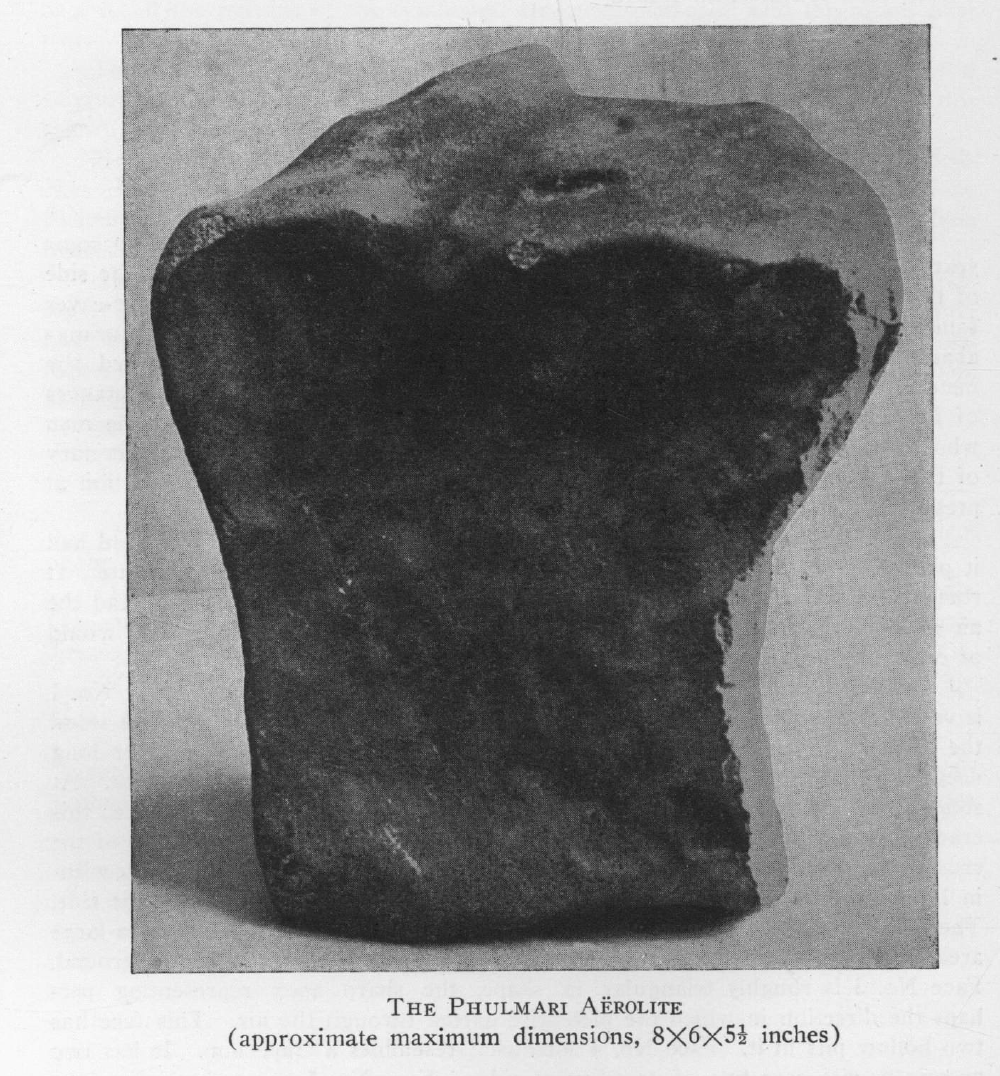
The study of meteors at the time depended not only upon the mapping of aerial pathways and frequencies but also on the study of the actual meteorites. Here again, Khan utilised his social networks to great advantage. In August 1936, for instance, he received from Maulvi Abdul Hag Saheb an aerolite that had fallen a couple of years ago onto a farm near the village of Phulmari in Aurangabad district. At other times, he heard of an old meteor shower in an area and personally went to search for meteorites. Since, unfortunately for Khan, the ground had been flattened in the intervening years, he offered a financial reward to the local villagers to induce them to part with any pieces of the old “shooting star” that anyone might have kept back.
The Phulmari aërolite.
Not satisfied with simply collecting local meteorites, Khan also started buying rarer meteorites from international dealers. He bought several pieces, for instance, from Wards’ Natural Science Establishment – a dealership trading in rare scientific specimens based at Rochester. On another occasion, possibly in the 1920s, he paid the then-princely sum of $24 to a dealer in Denver for some rare meteorites. His collection, in time, became a significant scientific resource. The eminent physicist Satyendra Nath Bose, remembered today as the discovery of the “boson”, once borrowed some meteorites from Khan’s personal collection for x-ray analysis at Bose’s laboratory at Dhaka University. What is also noteworthy is that Khan financed his collection entirely out of his salary as a college teacher. The prices charged by foreign dealers, the financial rewards given to locals etc. all came out of his personal finances.
Yet, Khan had not been a rich man. He came from a scholarly family with roots originally in Ghazni. His ancestors had then served the Nawabs of Arcot before switching to British employment upon the fall of Arcot. The family had been comfortably off as a result of employment in the British military and civil establishments. But Khan’s father had died suddenly when he was still in college, putting the entire family in straightened circumstances. A small scholarship given to him by the government allowed him to tide over the lean period. Always a very good student, he was able to find employment soon after graduation and thus eventually mend his financial circumstances. That neither this experience of precarity nor the relatively modest salary of a college teacher discouraged him from spending lavishly on the collection of meteorites is a testament to the depth of his passion.
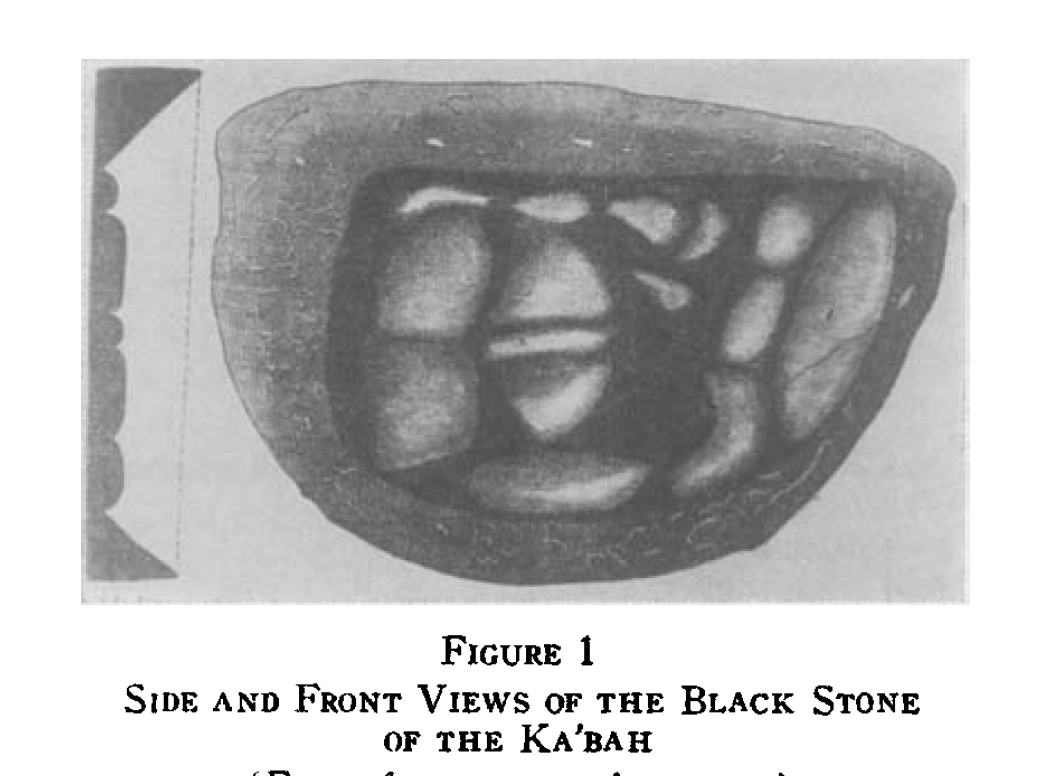
Spending hours staring at the night sky or shelling out generous sums for buying meteorites did not exhaust Khan’s passion for the topic. A third area where his enthusiasm manifested itself was in exploring the religious history of meteors. Hailing from a scholarly family and being educated in classical Persian and Arabic, Khan sought to document and analyze the reports of meteorites in religious texts. One of his most interesting studies in this regard comprised attempts to establish the meteoric origins of the holy black stone of Ka’aba in Mecca. Though he was far from being the first one to propose the theory, it was to his credit to bring both scientific knowledge about meteors and classical textual references together to try to establish the case.
Side and front view of the black stone of the Ka’bah.
A node at which several disparate worlds came together
Khan’s career as a man of mid-20th-century science is a curious blend. At one level he is a hobbyist who managed to keep alive an interest in stargazing that arose as a child. On another level, he is a man brought up in an old Islamic scholarly culture with an abiding antiquarian interest in classical works in Arabic and Persian. At a third level, he is a figure in a global scientific network organised in the form of scientific societies, research institutes, and scholarly journals. Above all, however, he was a node. A node at which several disparate worlds came together. The worlds of hobbyists and scientists, the worlds of antiquarians and astronomers, the worlds of old Hyderabad and modern America, to name only a few.
As a node connecting these heterogeneous worlds, he is reminiscent of an early modern practitioner of natural history. A kind of meta-discipline that predated the birth of modern science, natural history combined the collection of specimens, particularly of exotic and rare objects, with textual studies of classical texts. It was largely displaced by the middle of the 19th century when modern, organised, and increasingly professionalised science took its place. Disciplines gradually became more specialised, collections became institutionalised, and scholarly enquiry became less interested in classical precedents to their topics. The relish with which Khan is said to have displayed his personal collections of meteors to visitors, like SN Bose, after lavish Hyderabadi dinners, or the way he would recite both Sa’adi’s poetry and talk about meteorites at the same event, clearly recalls a world of early modern natural history than modern, scientific astral sciences.
The success of Khan’s career demonstrates the incompleteness of the transitions from natural history to modern science. The former, it would seem, could continue to coexist with modern scientific practices. Moreover, it could even inspire new modes of participatory citizen science, thereby turning dilettantism into a valuable resource for cutting-edge scientific work.
Astronomy was once called the Queen of the Sciences. But the Queen always had more lowly siblings, like stargazing, that remained outside the hallowed halls of science. Remembering Khan and his likes reminds us that on occasion the Queen did in fact meet and learn from her humbler siblings.
Projit Bihari Mukharji is the Head of the Department and a Professor of History at Ashoka University.
source: http://www.scroll.in / Scroll.in / Home> Reading Science / by Projit Bihari Mukherji / August 05th, 2025
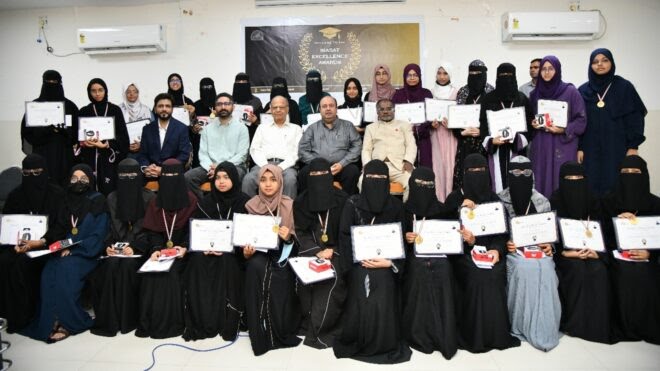
In a celebration of academic excellence and community empowerment, The Siasat Daily hosted a grand felicitation ceremony to honour 373 Intermediate BiPC students who scored above 90% in their board examinations. The event, held at the Siasat Auditorium on Tuesday, is part of a larger educational upliftment initiative spearheaded by Congress MLC Amer Ali Khan.
Addressing the packed hall, Amer Ali Khan declared, “This is not just a function—it is a movement. A campaign to build an atmosphere of academic pride and ambition among Muslim youth.” His powerful words echoed the core message of the ceremony: education is the most effective tool to uplift India’s Muslim community and ensure a dignified future.
Over 1,500 students had responded to an open call, out of which 373 were selected for recognition. Notably, 43 top performers scoring between 99% and 99.6% were awarded cash prizes, certificates, medals, and boAt smartwatches under the tagline “Smart Watches for Smart Students.” An additional 204 students scoring above 95% also received smartwatches as a token of encouragement.
The students were honoured in the following score brackets:
43 students with 99% and above
97 students with 98% and above
49 students with 97% and above
36 students with 96% and above
33 students with 95% and above
27 students with 94% and above
29 students with 93% and above
19 students with 92% and above
98 students with 91% and above
19 students with 90%
Speaking with heartfelt emotion, Amer Ali Khan reminded students of their heritage: “Knowledge is noor (light), and hard work is ibaadat (worship). With Allah’s help, even the impossible becomes possible.” He urged them to emulate Islamic historical figures such as Muhammad bin Qasim, Salahuddin Ayyubi, and Imam Bukhari, who once were students and later transformed the world through their knowledge and leadership.
The event emphasized the importance of both male and female education. Faiz-e-Aam Trust Secretary Iftekhar Hussain passionately appealed to parents to support their daughters’ education. “Girls often outperform boys. We must break the practice of marrying them off immediately after exams,” he said.
The ceremony began with the recitation of the Quran and concluded with the distribution of awards. Despite his busy schedule, Amer Ali Khan remained present throughout, personally honouring each student and motivating their families.
Other dignitaries present included Asghar Ali Khan, M.A. Hameed (Career Counselor), Zahed Farooqui (Director, Siasat Hub), N. Snehith, and Sai Sree (Managers). The event proceedings were conducted by senior journalist Mohammed Riyaz Ahmed.
With applause reverberating through the auditorium, the atmosphere brimmed with pride, inspiration, and a strong sense of community direction. The initiative reinforced the idea that education is not just a means to employment, but a path to dignity, empowerment, and leadership.
source: http://www.radiancenews.com / Radiance News / Home> Education> Latest News>Markers of Excellence / by Radiance News Bureau / June 06th, 2025
The Hyderabad Institute of Excellence (HIE) has once again proven its academic prowess with an impressive performance in the IIT-JEE Mains 2025. Around 85% of the students from the institute’s prestigious ‘Super 40’ batch have qualified for the IIT-JEE Advanced 2025, reported the Siasat.
Among the top achievers, Mohammed Aman Mustafa Khan stood out by securing an outstanding 99.831 percentile, earning him an All India Rank (AIR) of 244 in the IIT-JEE Mains 2025.
The HIE, a residential junior college known for its 100% success rate in intermediate examinations, offers a focused academic environment for students aiming for careers in engineering, medicine, or defense through the NDA. Situated on a sprawling 115-acre campus, the institute boasts world-class facilities including international-standard sports infrastructure, a gym, swimming pool, horse riding tracks, and more.
The remarkable results this year are a testament to the institute’s dedicated mentoring and comprehensive academic strategy.
source: http://www.radiancenews.com / Radiance News / Home> Latest News> Report / by Radiance News Bureau (headline edited) / April 20th, 2025
Seven students of MS Junior College scored above 99 percentile in JEE mains result 2025.
Among the students, Munazza Siddiqui scored 99.016 percentile in the exam.
The result of JEE mains 2025 was declared nationwide on Saturday, April 20 by the NTA.
Alongside Munazza, several other students from MS Junior College also showcased excellent performance in JEE Main 2025.
List of 7 MS students who scored above 99 percentile in IIT-JEE mains result 2025
A total of 7 students scored above the impressive 99 percentile. They are as follows:
Hafiz Mohammed Abdul Muheeth Simal – 99.86 percentile
Mohammed Ridhan – 99.74 percentile
Muhammed Zahi Faisal – 99.57 percentile
Hamza Wesal – 99.42 percentile
Afnan Ahmed – 99.30 percentile
Adnan Fayas NK – 99.08 percentile
Munazza Siddiqui – 99.016 percentile
In addition, 21 students scored above 93.10 percentile. The total number of MS students qualifying for the prestigious JEE Advanced is 37.
Toppers were felicitated
To celebrate the achievement, Munazza Siddiqui and other top-performing students were felicitated at a special ceremony held at the MS Education Academy’s Corporate Office, Masab Tank, Hyderabad.
On the occasion, the Founder and Chairman of MS Education Academy Mohammed Lateef Khan described Munazza’s success as “historic,” calling it a guiding light for girls of the entire community. He also extended congratulations to all the successful students, their parents and teachers.
The event was also graced by MS Education Academy’s Managing Directors Anwar Ahmed and Dr. Moazzam Hussain.
So far, 173 students from MS have secured admission into IITs, NITs, and other top national institutions.
source: http://www.siasat.com / The Siasat Daily / Home> Lifestyle / by Sameer Khan / April 20th, 2025