Hyderabad, TELANGANA :
An interview with Nazia Akhtar, the author of ‘Bibi’s Room: Hyderabadi Women and Twentieth-Century Urdu Prose.’

Translator Nazia Akhtar.
‘Bibi’s room’ refers to the space of a woman which purportedly belongs to her but is never hers. Bibi (an affectionate form of address for a woman in Urdu) represents all women whose identity is often ignored in lieu of her duties to her home.
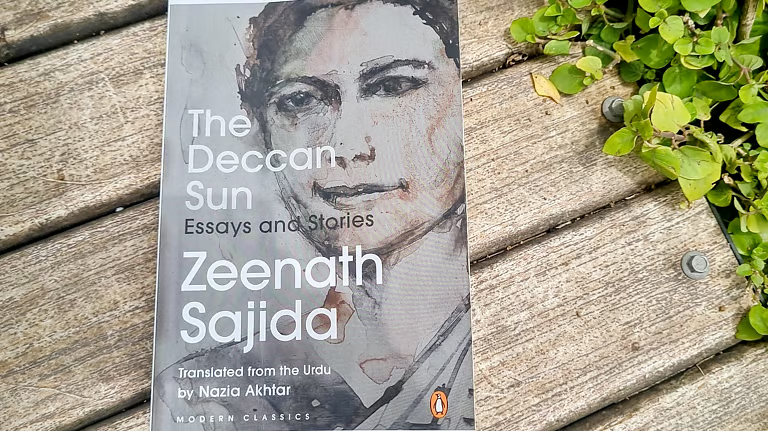
A new book, Bibi’s Room : Hyderabadi Women and Twentieth-Century Urdu Prose studies the lives and works of three Hyderabad Urdu writers, Zeenath Sajida (1924-2009), Najma Nikhat (1936-1997), and Jeelani Bano (b. 1936). The title of the book emerges from an essay by Sajida and is an insightful giveaway into the tone and tenor of the book.
Nazia Akhtar, an Assistant Professor of Literature at the Indian Institute of Information Technology, Hyderabad had no formal education in Urdu or substantial training in literary translation. She learnt Urdu by reading Nikhat’s work and gradually acquired the confidence to expand the scope of her project. Over three years, she delved into the writings and lives of these three writers and studied their milieu and read and wrote about them. The narrative style is informative and educative: it outlines the writer’s personal lives, provides translation of some of their works, and an assessment of what they wrote about.
Akhtar manages to bring to life the stories in all their complexities. Sajida wrote on themes as diverse as gender, the follies and foibles of the Indian middle-class, the literary culture of Urdu circles, and the urban and natural landscapes of her beloved Hyderabad. Nikhat wrote short stories, and Akhtar says she was struck by her poignant depictions of the lives of both working-class and upper-class women in deodis, the urban mansions of the feudal elite of Hyderabad. Meanwhile, Bano, is critically acclaimed and is the recipient of many awards, including the Padma Shri in 2001. Apart from the versatility and longevity of her career as a writer of short stories on gender, class, and communalism, Bano has also written two novels.
Expertly weaving in the lives and stories of these oft neglected writers, Akhtar’s writing is seamless and observes, interprets and reports the cultural practices, status of women and socio-economic conditions of Hyderabad in a newly Independent India. In a conversation with Scroll.in, Akhtar discusses the writers and their expansive oeuvre.
Excerpts from the conversation:
When and why did you start working on the book? What was the idea behind writing a book on Urdu women writers of Hyderabad?
The idea for this book came to me in around 2015. I had been working on literary texts in the context of Hyderabad for some time already. Over the years, I had noticed that there were many texts in Urdu that were written by women. As I began to read them and learn more about the writers and the world they lived in, I realised that there was a long tradition of women’s writing in Urdu in Hyderabad that we did not seem to know much about. I started working on this book in earnest when I received a New India Foundation fellowship in 2017. The fellowship made it possible for me to devote all my time to this project.
What made you zero in on these three Urdu writers, what was it about their work that drew them to you?
I simply stumbled across two of these writers. The writings of Zeenath Sajida and Najma Nikhat were gifted to me by their respective children, who knew that I was interested in Hyderabad and the literature that was created here in the 20th century. I chose Jeelani Bano because of the longevity of her literary career, and the currency and relevance of her work to the present day.
I also came across other writers, of course, and many books can be written about them too. I chose these three in particular because, first and foremost, I liked them and wanted to write about them. Secondly, I wanted to represent a range of women’s Urdu prose from Hyderabad. These three writers wrote on a variety of themes across different genres but yet had enough in common between them to justify inclusion in one book.
You use the phrase, “thrice marginalised” which I found striking to describe these women writers. What do you mean by this?
There is a triple neglect at work behind our forgetting of these Hyderabadi women writers of Urdu. First, they are neglected in the canonical literary historiography of Urdu, which gives short shrift to women’s writing. Apart from the excellent work of Nasiruddin Hashmi and Amena Tahseen, there is little engagement with this hundred-and-fifty-year-old tradition of women’s writing in Hyderabad.
Second, Urdu literary historiography (in both Urdu- and English-language texts) also overlooks Urdu literary traditions in the south, which is ironic given the crucial role the Deccan played in the development of Urdu as a literary language.
Finally, colonial attitudes have persisted in research, so that until recently, the assumption was that princely states were static, medieval entities, where nothing much happened by way of social and cultural progress. Recent research by scholars such as Siobhan Lambert-Hurley, Janaki Nair, and Razak Khan proves otherwise. Bibi’s Room is a part of this shift in perspective.

The themes and characters employed by these writers are inherently plural. They celebrate Hindu festivals, some have written in Telugu and use local character. This syncretic pluralism is fast vanishing today. Do you think that such thinking and writing has space in today’s India?
There are still women writers and scholars of Urdu in Hyderabad and other parts of the country who hold on to plural and inclusive values in their journalism and scholarship. But yes, as a country, we are rapidly forgetting the shared, inclusive pasts on which our civilisation is based.
All these writers dispel the notion of a meek submissive Muslim women. You write how Zeenat Sajida’s classes were much sought after and celebrated by students. So in a way these women defy stereotypes. While reading, translating, and writing about them, what is the sense you get of them?
It is not necessary that a piece of writing will demonstrate a writer’s personality. Of course, literature depicts the worldview and priorities of writers, and that is visible in the writings of the three women profiled in this book. All three wrote about women’s lives and concerns, their specific gendered experiences and problems. They wrote about mothers and daughters and about the relationships between women and men, and certainly, they drew from their lived experiences to write about these. They wrote about their city and their country and the politics, society, history, and culture of these places. The context of their lives and location is implicit in their work.
But to find easy equivalences between their lives and writings is difficult. There are a couple of short stories by Nikhat which are clearly drawn from her life. We know this from the diary entries she left behind and from other sources of her life. Scholars have also pointed out that the witty and endearing narrator of Zeenath Sajida’s essays is clearly modelled on her own vivacious and irrepressible self.
All three writers were women with distinct and different personalities. While Sajida was outgoing and vivacious, Bano kept more to herself and was part of a close personal and social circle. Nikhat was a mother who gave up everything to raise her step-daughters. All three writers had to struggle with social and financial circumstances and restrictions and fought hard to achieve what they did, while at the same time, attempting to protect and care for their families and maintain their social and professional relationships and networks.
What has been the influence of these writers on Urdu writing and Hyderabad?
Each of these writers has shaped Urdu literary culture in distinct ways. Zeenath Sajida is a prominent figure in a long history of women’s humorous writing, which has received some institutional support in Hyderabad but has been mostly ignored by scholars and translators of the wider world of Urdu literature.
Najma Nikhat held firmly to her Progressive ideals and continued to write in this idiom long after the Progressive Writers’ Movement had waned. She remained an important figure in the Progressive Writers’ Association of Hyderabad till the day she died in 1997.
Jeelani Bano’s skillful deployment of the ideals and principles of at least three schools of literature – Progressive writing, modernism, and abstractism (tajreediyat) – is an education in itself, both for other writers as well as literary scholars. Her two novels take on momentous and difficult chapters of Hyderabad’s history and depict the lives of people and the way these collective and public histories affect their individual and private lives.
How are these stories relevant in today’s India and Hyderabad?
Thematically, these stories, essays, and novels deal with many issues associated with identity that are relevant to our country today. They remind us that there are old historical precedents for many of the questions and issues that are being raised today by women – all women in general, and Muslim women in particular. These texts give us an insight into how this generation of women thought and approached these things in the mid-twentieth century and what the environment – that is, the literary circles and socio-cultural networks of their time – were like.
They are also part of a long tradition of women’s writing in Urdu from Hyderabad that fictionally documents the history, landscapes, society, and culture of Hyderabad. These texts give us a sense of the specific history and identity of Urdu in the Deccan and help us to trace the history of specific modes of writing, thought, and engagement in Urdu in this region. The literary essays of Zeenath Sajida, for instance, are an example of a rich but relatively neglected tradition of non-fiction writing by Hyderabadi women on a diverse range of topics that also demonstrates experimentation and skilful use of existing or new literary genres.
source: http://www.scroll.in / Scroll.in / Home> Meet the Translators / by Mallik Thatipalli / November 26th, 2022