Tag Archives: Telugu Muslim Authors

The Poet of Palnadu: How Sheikh Kareemullah Taught a Generation to Question

Palnadu District, ANDHRA PRADESH :

Beyond the Classroom: Honouring the literary soul and dedicated leadership of Headmaster Sheikh Kareemullah on his retirement, May 31, 2026

In the rural classrooms of Palnadu, a quiet revolution has been unfolding for decades. It did not begin with protests or speeches, but with the cadence of Vemana’s poems and the relentless commitment of a man who believed the classroom was a laboratory for democracy. As Sheikh Kareemullah, a senior educator and luminary of contemporary Telugu literature, hangs up his boots as a Headmaster this May 31, his legacy remains etched not in the service records of the state, but in the social consciousness of a generation.

For Kareemullah, teaching was never a mechanical transfer of curriculum. His tenure, particularly in the village of Enugupalem, became legendary. When news of his transfer broke, the village didn’t just file a grievance; two tractor-loads of residents reportedly arrived at the district office, demanding his retention.

It was a rare instance where the bureaucracy bowed to the pedagogical impact of an individual. Kareemullah had transformed his classroom into a crucible for critical thought, teaching children the nuances of pluralism, equality, and the weight of historical justice. He did not just teach the future; he nurtured it.

If teaching was his primary vocation, literature was his chosen battlefield. Kareemullah’s evolution as a writer is a mirror to the anxieties of the era. As communal tensions and social polarisation grew, his poetry shifted from traditional progressive themes to a sharper, more visceral exploration of identity.

His poem ‘Naa Raktham Kaaru Chauka’ (My Blood is Cheap) became more than a verse; it became a rallying cry for dignity. His long poem, ‘Saibu’, remains a seminal text in the Telugu literature, articulating the Muslim experience in India with a defiance that was both unapologetic and profoundly human.

Perhaps his most significant contribution to the literary canon is the introduction of the ‘Ababeel’, a poetic form inspired by Qur’anic allegory. By using the metaphor of small birds confronting overwhelming might, Kareemullah demonstrated that brevity could harbour immense political weight. The form took root, inspiring a new wave of younger poets to find their voices, and transforming what began as a creative experiment into a full-fledged literary movement.

Through the establishment of ‘Murasam’, Kareemullah created a vital space for Muslim writers to find a common ground, turning a literary collective into a school of critical thinking.

Throughout his career, Kareemullah has been the recipient of numerous honours, including the ‘Janmabhoomi Best Teacher’ award and the ‘Adarsha Guru Brahma’ title. Yet, to those who know him, these awards are mere footnotes.

His true achievement lies in his ability to bridge the gap between the teacher’s desk and the poet’s podium. His work, now part of university curricula, continues to be subjected to the rigorous academic scrutiny that defines a classic. He has navigated the complexities of domestic politics, critiqued imperialism, and remained a staunch defender of humanism.

As he steps into retirement, Kareemullah leaves behind a roadmap for the modern intellectual: to remain a teacher when the world is in chaos, and a poet when the world has lost its words. He remains not just a chronicler of his times, but an architect of the resistance against the silencing of voices.

[The writer is a journalist based in Hyderabad.]

source: http://www.radiancenews.com / Radiance News/ Home> Features>Focus / by Md. Mujahid / May 31st, 2026
For the Love of Telugu: How a Warangal Madrasa Teacher Bridged Faith and Literature

Warangal, TELANGANA :

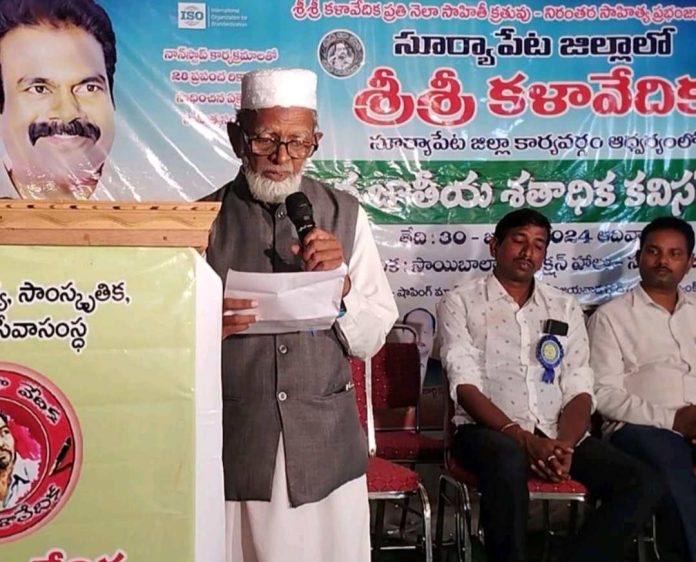
With a copy of the Holy Qur’an in one hand and the nectar of Telugu verse in the other, Mohammad Abdul Rasheed’s life is a testament to an enduring truth: language knows no faith, and the alphabet recognises no borders.

Mohammad Abdul Rasheed is a rare crimson rose blooming in the sprawling Nandanavanam, the celestial garden of Telugu literature. His faith is Islam, yet the consciousness of being profoundly, unapologetically ‘Telugu’ flows through his very veins. He possesses no grand academic degrees, but armed with nothing more than an insatiable appetite for the written word and a fierce determination to weaponize the alphabet, he has authored 43 books. His life is an epic poem in motion.

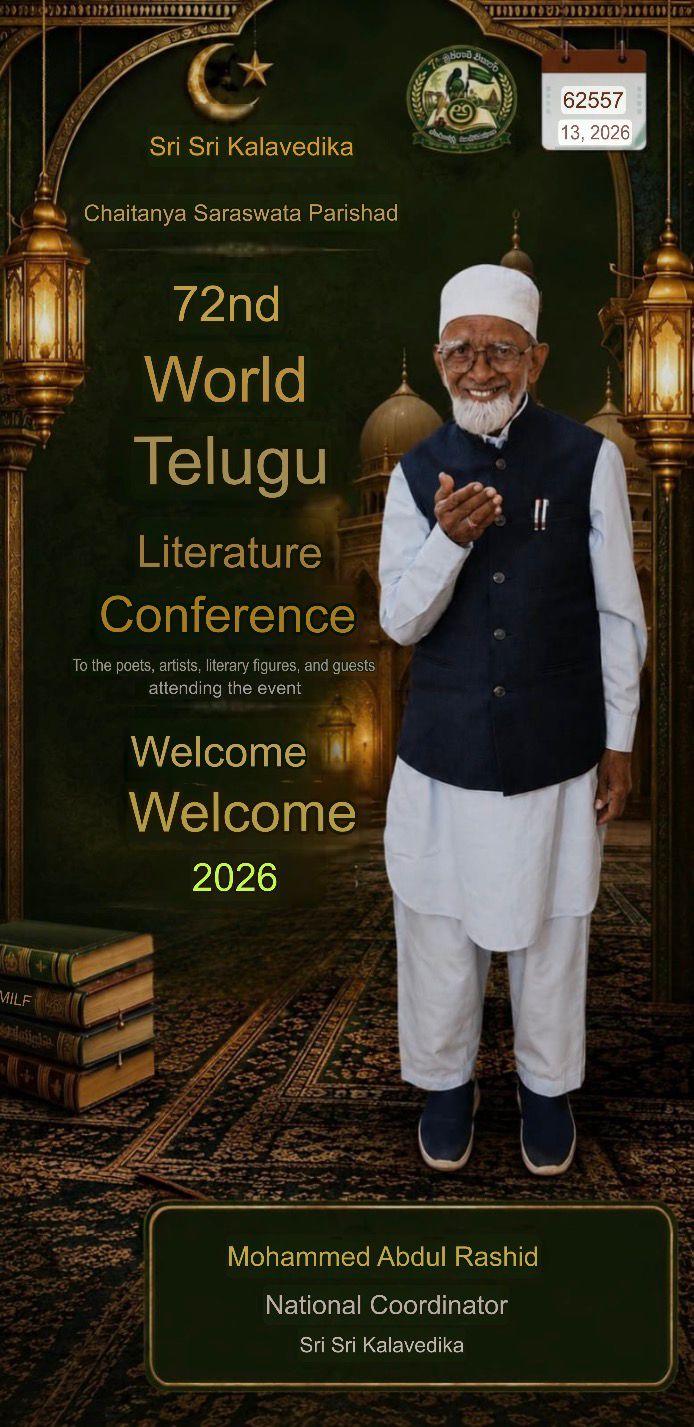
Recently appointed as the National Coordinator for the prestigious Sri Sri Kala Vedika 7th World Telugu Literature Conference, this Akshara Tapasvi (an ascetic of letters) stands as a monument to cultural synthesis.

The Ten-Paise Genesis

Born on April 12, 1952, in the Desaipeta locality of Warangal, Rasheed was the third of 12 children born to the impoverished couple Mohammad Abdul Sattar and Sarabi. His romance with literature began with a childhood snub. At the age of nine, while lingering in a local eatery, he was mesmerised by the vibrant, multi-coloured jacket of a novel held by a customer. When the young boy instinctively reached out to touch it, he was harshly rebuked. That sting did not discourage him; instead, it ignited a lifelong obsession.

He found his sanctuary at a makeshift wooden kiosk outside the Rajarajeswari Talkies. For a deposit of one rupee, the shopkeeper let him rent pulp novels and magazines for 10 paise a day. Flipping through the iconic pages of ChandamamaBalamitra, and Vijayachitra, Rasheed devoured stories the way others consumed food.

“I have no higher education,” Rasheed reflects, his voice tinged with quiet pride. “But it was that raw, unadulterated reading habit of my childhood that gave me the spine to stand tall in the literary world today.”

The Epiphany in ‘Geeturai’ and the Accidental Teacher

As the years rolled on, the writer within Rasheed found his awakening in the columns of the Geeturai weekly magazine, where he began contributing sharp opinion pieces. His turning point, however, came during an Islamic training seminar. Tasked with speaking on the theme “Desh Bachao” (Save the Nation), Rasheed delivered an electrifying five-minute speech that stunned his mentors.

Recognising a rare linguistic prodigy, authorities appointed him in 1985 to teach Telugu as a second language at Hyderabad’s renowned Jamia Darul Huda Madrasa. For 12 years, he served as a bridge between communities, earning the revered title of ‘Rasheed Master’ among generations of students.

A Harvest of 43 Volumes

The year 1990 marked a seismic shift in his literary career when he took up the monumental task of translating four dense volumes by the globally acclaimed Islamic scholar, Maulana Abul Hasan Ali Nadwi, into Telugu. Since then, the ink has never dried on his pen. Of the 43 books he has delivered to the Telugu literary canon, nine are original creative works:

In 2003, his seminal book ‘Jihad’ – an effort to demystify and contextually reclaim the term – was unveiled and lauded by Jnanpith Award laureate, Dr. C. Narayana Reddy (CiNaRe).

In 2021, his poignant poetry anthology ‘Bangaru Desam Naa Desam’ (My Country, A Golden Country) was launched at the historic Ravindra Bharathi stage by the venerable academician Acharya Kolakaluri Enoch.

Verse for a New State

When the fires of the Telangana statehood movement were raging, Rasheed’s verses became an anthem for progress. During the 2017 World Telugu Conference, standing on the Jagruthi platforms helmed by then Chief Minister K. Chandrashekar Rao and Kalvakuntla Kavitha, Rasheed’s voice echoed across the auditorium:

“Then, it was a Telangana of barren rocks… today, it is a Telangana of precious gems. / Then, it was wrapped in pitch darkness… today, it is a Telangana radiant with the light of electric progress.”

The stanza brought the house down, proving that his poetry was intimately tied to the soil that raised him.

To the Zenith of Global Telugu Stages

Rasheed’s contribution extends far beyond the quiet solitude of writing; he is a lifetime member who has shaped four distinct World Telugu Conferences. He famously shared stages with cultural ambassadors like Ghazal Srinivas, felicitating contemporary poets.

In a crowning achievement for his decades of silent service, the ‘Sri Sri Kala Vedika’ has named Rasheed the National Coordinator for its upcoming 7th World Telugu Literature Conference, slated for June 6–7, 2026, at the Godavari Global University in Rajamahendravaram. For a scholar from a Muslim minority background to be elevated to the vanguard of Telugu cultural custodianship is a historic moment of pride for the entire state.

A Decorated Journey

Over the decades, a garland of prestigious accolades has found its way to Rasheed:

  1. Gidugu Rammurthi Panthulu National Award (for linguistic service)
  2. Joshua Sahitya Bhushan Award
  3. International Sri Sri Kala Vedika ‘Kaviratna’ National Merit Award
  4. Prajakavi Kaloji Narayana Rao Literary Service Award
  5. Maulana Abul Kalam National Award
  6. NTR Legendary Award by the Helping Hand Foundation

The Final Verse

Mohammad Abdul Rasheed remains an inherently humble man who has spent a lifetime proving that while faiths may vary, language remains a singular, unifying thread. He is the living embodiment of the truth that letters possess no caste, and syntax bears no religion. The boy from the Warangal cinema kiosk who traded ten paise for a dream has climbed to the absolute zenith of the Telugu literary world. As his pen continues to slash through biases, the Telugu linguistic world smiles upon its extraordinary son.

source: http://www.radiancenews.com / Radiance News / Home> Features> Focus / by Radiance News Bureau / June 03rd, 2026