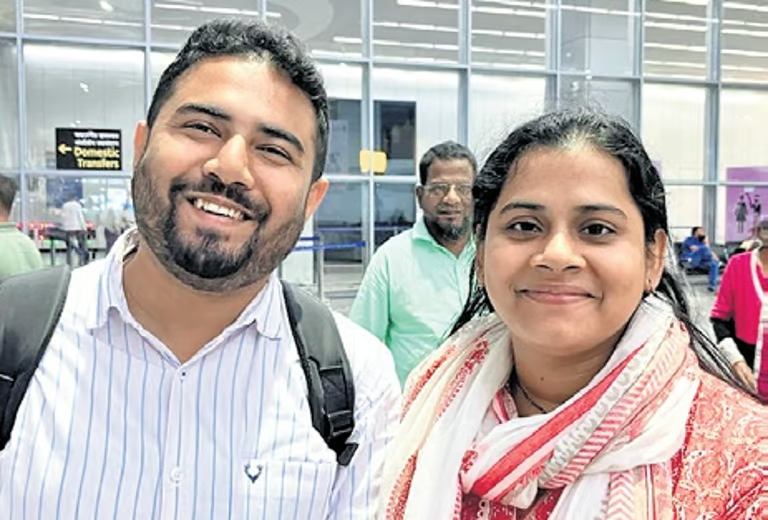
Insiyah Vahanvaty on revisiting the life of the formidable ‘Muslim’ judge who was her grandfather.
Being a Muslim judge in India is not easy. It has never been.
The Indian judiciary has long struggled with a lack of Muslim representation, with only four Muslim Chief Justices in the history of the republic. Currently, there is just one Muslim judge on the Supreme Court – another proof of this lack of diversity. It also indicates that another Muslim Chief Justice may be a long way off.
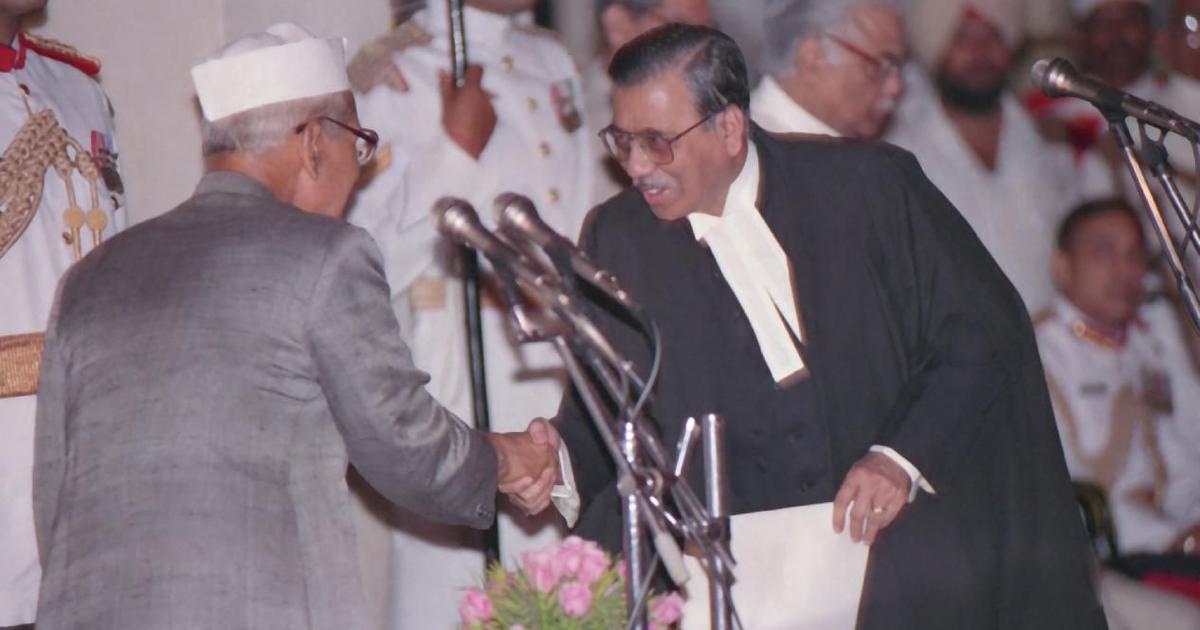
For me, the difficulties faced by Muslim judges have been witnessed through the life of my grandfather, Justice Aziz Mushabber Ahmadi, who served as Chief Justice of India from 1994 to 1997. That he was only the third Muslim to occupy this role is made starker by the fact that there has been only one more that succeeded him in the thirty years since.
When Aziz Ahmadi was appointed as a judge to the City Civil Court of Ahmedabad, he was 32 years old. Young and inexperienced, he knew that this appointment would make him the only Muslim judge on the bench; yet it had simply not occurred to him that his faith would suddenly become a matter of contention. When news of his elevation broke, it stirred up an unsettling, religiously charged atmosphere within legal and administrative circles. Bar Associations across the state of Gujarat united and called for a strike against his appointment, boycotting Ahmadi’s court. Communally charged allegations flew thick and fast with his appointment questioned in the legislative assembly. Concerns about his young age and fitness for the role were voiced. In the end, however, his appointment held – and Aziz Ahmadi began an extraordinary judicial career that would span three decades, culminating in the highest office of the Indian judiciary.
Yet, it would never be free of challenges.
Twenty-four years later, when his name was proposed for elevation to the Supreme Court of India in a closed-door meeting, a prominent member of the Bench hesitated, saying, “But he is a Muslim. Can we trust him?” And when he retired, Justice Ahmadi faced allegations of favouring the appointment of Muslim judges to High Courts and the Supreme Court. Unperturbed, he responded to these saying, “Such an allegation every Muslim Chief Justice, I suppose, has to face.” Although he did not voice it then, he felt a deep disappointment in witnessing such prejudice even in the highest offices of the country.
And yet, he wore his life with a remarkable lightness, with his easy laugh and mischievous wit. It was almost as if he was determined not to allow these experiences to make him bitter or dampen his natural optimism. Ironically, it was perhaps these very experiences that fuelled his commitment to secularism and tireless advocacy for the separation of religion and state.
My first memory of these values was during a particularly turbulent chapter in Indian history when I was just ten years old.
The year was 1992. The Babri Mosque had just fallen. A word which I had never heard before was now coming up every day at our dinner table. Kar seva. The television at home stayed locked on the news channel all day. My grandfather’s disappearance from family life, his secretaries rushing to and from the office with pens and notepads in hand, and worried family conversations about the future of the Indian Muslim marked those days.
But despite his inner turmoil, my grandfather maintained an outward calm, his composed demeanour never betraying the storm within. As ever, Justice Ahmadi, when distressed, would retire to his haven, his work. I knew the enormity of his mental anguish only because of the extent to which he did this. Those days, he emerged only for meals and slept for less than five hours a day. Pacing on the carpeted floor, he fought the numbness in his legs from hours spent hunched over his files, fuelled by endless cups of black tea.
It was only later that I learnt of his dissent in Ismail Faruqui vs Union of India – a challenge to the Acquisition of Certain Area at Ayodhya Act 1993 which was an attempt by the Central Government to gain control of administration and maintenance of the Ram Janma Bhumi-Babri Masjid structure along with its premises. In his view, validating the Ayodhya Act would effectively condone the trespass and destruction that occurred, with no consequences for those involved – especially as the effect of the Act would require pujas to continue at the site while failing to address the right of Muslims to offer namaaz.
It was while writing The Fearless Judge and going through his draft memoirs that I learnt of the immense strain my grandfather was under at the time to accept the majority judgement. But he would not succumb. Risking the ire of both, the incumbent Chief Justice as well as the executive, he knew that such a stand could come at great personal cost. Yet, he stood firm in this test of integrity, refusing to give in. Ultimately, he and Justice Bharucha dissented from the majority view.
Citing the Act to be unsecular and constitutionally unfit, the dissenting judgement authored by Justice Bharucha stated, “When…adherents of the religion of the majority of Indian citizens make a claim upon and assail the place of worship of another religion and, by dint of numbers, create conditions that are conducive to public disorder, it is the Constitutional obligation of the State to protect that place of worship and to preserve public order…To condone the acquisition of a place of worship in such circumstances is to efface the principle of secularism from the Constitution.” Once retired and therefore released from the bounds of propriety and decorum, my grandfather would speak freely about the regrettable and unlawful demolition of a place of worship – and the subsequent erosion of secularism in India.
The demolition of the mosque sent shockwaves throughout the country, prompting the Union government to dismiss state governments in a panic. This led to the landmark case SR Bommai vs. UOI, which addressed the limits of central authority over states. Because these dismissals were in response to the violence following the Babri Masjid demolition, the court also examined secularism as a key element of the Constitution’s basic structure. Justice Ahmadi wrote a separate 37-page judgment emphasizing the need for accommodation and tolerance toward vulnerable groups. Quoting Mahatma Gandhi to highlight the importance of the separation of religion and state, he wrote, “I swear by my religion. I will die for it. But it is my personal affair. The State has nothing to do with it. The State will look after your secular welfare, health, communication, foreign relations, currency and so on, but not my religion. That is everybody’s personal concern.”
Despite his deep understanding of the discriminations that Indian Muslims face in every sphere of life, he encouraged the community to resist the temptation to view itself from the lens of victims of prejudice; rather to focus on empowerment through education. Addressing the Muslim community, he said, “It is high time that we stop living in the past and start living in the present and work for a brighter future. We have to mould our own destiny – mustaqbil, no one else can do it for you. The only sure way is through education.”
A firm and vocal advocate for equality of opportunity until the end of his days, Justice Ahmadi remained troubled by the lack of diversity in the judiciary at all levels. With Muslims making up nearly 15 per cent of the population yet holding alarmingly few judicial positions, this lack of representation remains concerning to this day, raising questions about fairness and inclusivity. The implications of this imbalance are significant: Judges from diverse backgrounds ensure the judiciary mirrors the society it serves, bringing different perspectives and more fair-minded decisions. In turn, this shores up public trust in the legal system.
And as Justice Ahmadi put it so succinctly, “The judiciary has neither the purse nor the sword; its only shield is the trust of the people in the judicial process.”
source: http://www.scroll.in / Scroll.in / Home> Talking Books / by Insiyah Vahanvaty / September 30th, 2024
The fifth in an exclusive series of essays to mark the 75th anniversary of India’s independence, by winners of the New India Foundation Fellowship for writers.
Fatima Alam Ali.
As India completes 75 years of Independence, it is important to ask: what is the place of women in its historical imagination? Where in the corridors of memory – official, scholarly, and popular – are the women of this country to be found? The lives of women, whose voices have at best been indifferently preserved, necessitate that we think differently to locate and retrieve these marginalised histories. This also applies to the way literary historiography treats women writers.
Let us examine these questions through the archive of Fatima Alam Ali (1923-2020), an Urdu writer who lived in Hyderabad and wrote non-fiction essays in the genres of khaaka (pen-portrait) and tanzo-mizah (humour and satire). These essays were published in newspapers or read out over All India Radio, and later compiled into a book.
When Fatima passed away two years ago, her literary drafts, scholarly research, and college notes were found preserved in diaries and re-used school notebooks. She was also a fastidious record-keeper and left behind several hisaab ki kitaabein – books of expenses.
The way Fatima organised and conducted her writing offers us glimpses into not only her writing process but the realities of her life – as a busy homemaker with a husband and three children, and as a respected and active member of social and literary organisations.
She wrote on every available paper surface, demonstrating middle-class thrift in the way she used the blank pages of school notebooks discarded by her children and nieces at the end of every school year. She re-used institutional diaries – a common practice in the subcontinent – disregarding the outdated calendar year printed in them and putting them to any purpose she wished.
She produced entire drafts of essays, speeches, and letters on the backs of calendars, wedding invitations, and grocery receipts. She wrote with regular pencil, colour pencil, fountain pen, and ball-point pen, in inks of different colour. She did not follow any particular system of filling one notebook or diary before moving on to another, but moved back and forth between different ones with no apparent pattern that I have been able to discern thus far.
She wrote draft upon draft of some essays across notebooks and diaries. Sometimes she used the same notebook or diary from both ends for the same or different purposes. What we learn about her from this flexible approach to pen and paper is how versatile she was with these possessions and their applications in her full and hectic days, both because of the weight of the mental load she carried and because it was cheaper and more responsible to re-use things.
Among her papers are the many hisaab ki kitaabein Fatima maintained conscientiously over a number of years in re-used school notebooks. These contain details of her homemaking and domestic activity as well as documentation of important personal and family events, alongside drafts of her essays.
In fact, it is clear from the way these expense books were used that they were meant to serve as multipurpose sites for documenting and recording meaningful things in relation to her professional as well as her personal and family life.
The varied contents of these expense books give us insights into the social culture and domestic economy of the period; the contemporary history of her family; and Fatima’s writing process and the circumstances in which she produced her work.
Even in its most basic definition, a hisaab ki kitaab is of great importance to a historian or a sociologist for a time when people relied on writing to keep domestic records, something the advent of digital technology has changed forever for many of us. No longer do we maintain the kind of meticulous handwritten accounts that we may once have done. After all, online statements and instant text messages from the bank tell us when and what we have spent on groceries or school fees.
Itemised invoices sent by retailers and organisations give us a breakdown of what we have bought or how much we have paid for any service. Note-taking apps and other digital organisers help us to make sense of our everyday transactions and track our needs and wants.
But much before the arrival of digital technology, in the decades after Independence – that golden period in the history of this country when women finally had broad access to education and writing – these written accounts of domestic economy give us indispensable insights into middle-class households, lifestyles, and aspirations.
How did women manage homes? Can we tell from these accounts and lists how much time they spent in homemaking, ie, planning, management, and execution? What does that tell us about the quality of their lives?
What were the items – food and other necessities, such as fuel or paper – that were regularly consumed in a home, and what can that tell us about social position, class, and caste affiliations? Can we learn something about the aspirations of a particular family and, perhaps, by extrapolation, a certain society at a specific period of time, by looking at these weekly, monthly, or annual accounts and lists?
What commodities were sparingly purchased? What were the occasions for which special items were ordered, and what can we tell about the age from the things that were considered grand or fashionable? Can we learn something broader about the state of the economy and its impact on individual households by comparing prices, quantities, and substitutions that may have been made over months or years? What kind of wages were paid to domestic help and other service staff? How many such domestic helpers were there, and what role did they play in the family? Again, what can we learn about a family’s social or economic status from these things?
In short, there is a world of information and insight waiting for the willing in these unassuming accounts. These records of expenses are metaphor and synecdoche for aspirations, anxieties, and lived realities. They embody and document the everyday realities, banalities, and priorities of women’s lives.
A hisaab ki kitaab also often contains other kinds of lists and information about dates, events, people, and places. Fatima’s expense books contain lists of wedding and travel expenses as well as lists of books to buy or consider buying, which help us to re-create both everyday moments and unique experiences in her life as well as those of others around her.
But the most extraordinary and poignant documentation in her expense books consists of a single date on an otherwise blank page, bookmarked by an open blue Reynold’s pen: 8.6.2002. The eighth of June in the year 2002. Written at the top right corner of the right page, the date is the only writing on those two facing pages. Several pages – perhaps fifty on either side – are left blank. The date is significant, although no outsider could possibly know what it may have meant or why it is there. Fatima’s daughter Asma Burney, however, recognised it immediately: it was the day Alam Ali – Fatima’s husband and Asma’s father – had died.
Fatima and Alam Ali had been married for 53 years, and she had privately recorded the date of their earthly separation. The significance of this moment is marked in the brevity of what is written on the page. No words are needed to describe what had happened.
Fatima writes the date and places an open (still functioning) pen to mark the page, in recognition of its import and the magnitude of her loss. The blank pages before and after the recorded date appear to gesture towards the nature of bereavement. With grown-up children and grandchildren living elsewhere, Fatima was unarguably the one most affected by Alam Ali’s death, and so in some ways her grief stands alone.
One is reminded of Helen Macdonald’s words in H is for Hawk (2014), her deeply moving account of losing her father and trying to come to terms with her grief. “It happens to everyone,” she explains. “But you feel it alone. Shocking loss isn’t to be shared, no matter how hard you try.”
That Fatima allowed this date to vanish among the blank pages around it – separated from her accounts and lists – suggests that her loss was so profound that it isolated her from the bustle and activity of everyday life. She lived through it alone, despite the presence of family and friends who rallied around. Life was not the same again, and perhaps such an inscription was part of acknowledging that reality and coming to terms with it on her own.
And yet, the ink still flows from the pen that marks the page. Fatima continued to write and was an active member of various literary and social organizations, writing letters, giving interviews, and attending literary gatherings almost up to the year of her passing.
For women writers like Fatima, a hisaab ki kitaab can go even further than documenting domestic economy and important events in the life cycle. It may start out with the intent of being used for one purpose alone. But soon, the overburdened mind of the busy homemaker gives in to the demands of the writer, who begins to intrude quite aggressively on the business of the day.
In fact, Hyderabadi writer Zeenath Sajida (1924-2009), whose life and work are explored in my new book, once wrote that women’s expense books represent the daily struggle they undergo to find time and space for themselves and their craft.
Zeenath was one of Fatima’s dearest friends. She writes that every homemaking woman has a diary, in which household accounts, laundry lists, and knitting patterns jostle for space with nazms and ghazals. This, she stresses, is the reality of not only women who write, squeezing their compositions between lists and expenses, but also women who may not write but still indulge their creativity by copying a sher or nazm that has caught their fancy.
What she refers to, of course, is what we today call the mental load of women, ie. the constant pressure on the homemaker’s mind of the all-consuming labour and management involved in making a home and caring for a family, while also trying to juggle a writing career from home and even perhaps keeping a full-time job. Women write in the margins of time and space – at “the edges of the day,” as a weary Toni Morrison once explained.
And indeed, amid the pages of Fatima’s own expense books, sandwiched between the relentless and hectic paraphernalia of everyday life, are welcome drafts of her essays, worked and re-worked, again and again, with faithful and constant rigour. These drafts tell us how much labour and planning went into essays which seem so spontaneous and natural in published form, belying the workings of the craft that went into their making.
They demonstrate to us also what a normal day for her would have been like: full of the work that goes into making a home, her mind would still be preoccupied with her essays, so that she would stubbornly write and re-write until she deemed them ready to see the light of print.
Fatima’s expense books are also excellent illustrations of the workings of mind and memory. After all, neither thought nor memory is linear: it rambles and is frequently fragmented, disjointed, and interrupted, organising thought, feelings, and sensibility in shifting and fluid ways.
There are quick shifts in content and register in Fatima’s expense books as she goes from recording expenses to documenting an experience of intense loss to contemplating the title of an essay. These multiple registers of language, thought, and sensibility illuminate different aspects of women’s experiences and subjectivities.
They perform as well as demonstrate the gendered making, maintenance, and transmission of personal and family memory among women. There is so much more, then, to these multipurpose diaries, which encapsulate a way of life when seen in their entirety.
It is rare to come across such records in official or public archives, betraying our collective lack of understanding of not only the importance of hisaab in itself as a source, but also the multipurpose nature of the hisaab ki kitaab.
Furthermore, archives are not only sites of memory, but also sites of power, representing forms of national, public, and collective remembering. They embody official and institutional positions about what is believed to constitute knowledge deserving of transmission, who can thus be validated as a legitimate agent of such deserving knowledge, and what textual materials, therefore, are considered worthy of preservation. The inclusion of women in these archives is limited and conditional upon these constraints.
The circumstances of women’s lives and the conditions in which they work call for a redefinition of the archive. The dense, multipurpose notebooks and diaries that Fatima and no doubt many other women of her generation owned demand other ways of looking at women’s histories and also women’s writing, ie, the process and conditions in which texts are produced by women.
What Fatima’s hisaab ki kitaabein bring to us is a world gone by, where educated middle-class women used writing to document and capture their everyday lives, experiences, and aspirations. With the advent of digital technology, this world is rapidly changing for many women of this demographic.
It remains to be seen how digital records of home-making will fare in the choppy tides of history. Whether these will even take the same shape is debatable. What would a digital archive of homemaking by a woman writer today look like? It has never been easier to keep accounts and lists using apps with increasing degrees of sophistication and convenience, but it has also never been easier to delete data or lose it forever to the vagaries of short-lived technology.
In an age where there is so much information saturation and quick shifts in digital technology, data and the vessels in which we put them are, by definition, ephemeral. They become rapidly obsolete, moving along and beyond the conveyor belt of our days. With the ease of classification and separation into folders and labels, will digital records demonstrate the overlaps and variety of registers that Fatima’s work demonstrates and which Zeenath reveals to us as the reality of home-making women who write? Or are our records going to be equally chaotic, as we move from one app or device to another, depending on where we are and what we are doing? The mental load of women, after all, remains the same.
Also, how would the absence of tactility and materiality affect what we can learn from this digital archive? The smell, texture, and sound of paper; the conditions and locations in which records are preserved; and the uniqueness of an individual’s handwriting – shifting and changing with age, health, mood, and other circumstances – are particular to the written page and document the circumstances in which texts are produced and preserved. The ease of digital reproduction smoothens an individual’s handwriting down to the uniformity and anonymity of a font on a screen, so that critical dimensions of the human experience are lost from the archive.
Accounts such as the hisaab ki kitaabein of Fatima Alam Ali are vital for the historian of modern India. Such sources unravel and unmoor standardized notions of both history and archive, demanding greater creativity and, therefore, more effort to interpret and understand.
They attest to an age when writing became an important and accessible technology for educated women to harness in the management of their lives as well as in the channelling of their creative expression and aspirations.
While magisterial didactic tomes of domestic economy, such as those of Sultan Jahan Begum of princely Bhopal or Isabella Beeton of Victorian England, are known and celebrated and have been used by historians and scholars to make sense of domestic economy, the more modest everyday offerings – often interspersed with literary writings – have been neglected and deserve the attention and regard of both the social historian and the literary historian. Only then can we write more inclusive histories that represent the experiences of women in this country.
Nazia Akhtar is a Fellow of the New India Foundation whose book Bibi’s Room: Hyderabadi Women and Twentieth-Century Urdu Prose has just been published by Orient Black Swan.
source: http://www.scroll.in / Scroll.in / Home> Literature & History> Hyderabad> / by Nazia Akhtar / August 16th, 2022
Graduated with distinction from Lovely Professional University in aeronautical engineering.
Hyderabad:
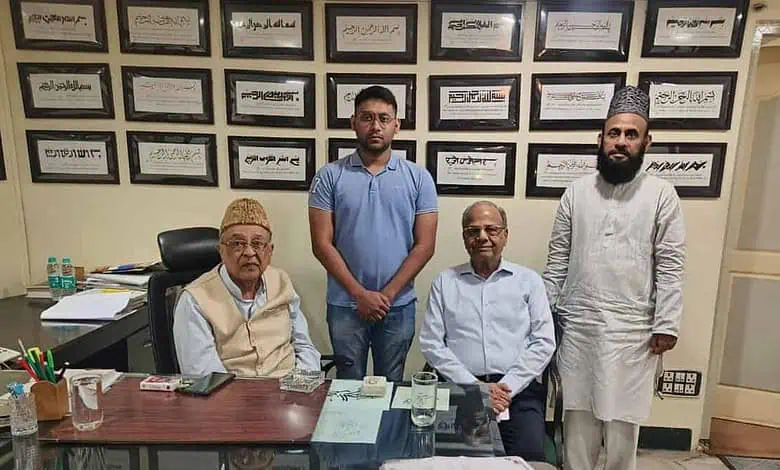
Mohammad Yar Alam, a determined aerospace engineer and son of Former Imam Mohammad Shehriyar Alam of Masjid-e-Mohammedia, has long nurtured a dream of soaring the skies as a pilot. To turn his vision into reality, he enrolled in the prestigious Chimes Aviation Academy in Sagar, Madhya Pradesh, where he embarked on the challenging journey of a pilot training course.
The Rs. 51 lakh program cost, however, posed a significant challenge for the Alam family. Recognizing his son’s unwavering dedication and academic prowess, Mohammad Shehriyar Alam went to great lengths to support his aspirations, mortgaging their family home, liquidating precious jewelry assets, and securing loans from relatives. Despite these efforts, an additional Rs. 26 lakh is urgently needed by end of June 2024 to meet the tuition requirements.
In their quest for assistance, Mohammad Shehriyar Alam and Mohammad Yar Alam approached The Siasat Daily, where they met with Editor Zahid Ali Khan Secretary of Faiz Aam Trust, Iftekhar Hussain. They appealed for financial aid, emphasizing the urgency of their situation.
Moved by the Alam family’s plight, Zahid Ali Khan and Iftekhar Hussain pledged their support, requesting the community to come to Mohammad Yar Alam’s aid. They urged Hyderabadis, particularly those residing abroad, to contribute generously, ensuring that the talented young aspirant can pursue his dream of becoming a pilot.
Mohammad Yar Alam’s academic track record speaks to his exceptional abilities. He graduated with distinction from Lovely Professional University in aeronautical engineering and demonstrated academic excellence in both his SSC and Intermediate studies. Today, he embarks on his journey in the pilot training course, determined to turn his aspirations into reality.
Salva Fatima, a resident of Old City Hyderabad, also aspired to become a pilot. Editor Zahid Ali Khan had personally contributed 16 lakh rupees to Salva Fatima and secured an additional 36 lakh rupees from the government. As a result, Salva Fatima became the first Muslim woman pilot of Telangana.
Zahid Ali Khan and Iftekhar Hussain highlighted that with the community’s financial backing, Mohammad Yar Alam’s dream of becoming a pilot will be realized, inspiring other young individuals to pursue their ambitions with determination. They expressed their confidence in the power of collective support to help Mohammad Yar Alam achieve his dream and soar the skies as a pilot.
Bank Details
Interested individuals can directly send money to his saving bank account given below:
Mohammed Yar Alam Account Number 50100372006386 HDFC Bank, Branch: JEEDIMETLA, IFSC: HDFC0001041 Phone: +917989228679
source: http://www.siasat.com / The Siasat Daily / Home> News> Hyderabad / by Zahed Farooqui / May 21st, 2024
By Nikhil Mandalaparthy. Nikhil is a journalist, community activist, and consultant focused on religious pluralism and social justice in South Asia and North America. He is the curator of Voices of Bhakti, a digital archive that showcases translations of South Asian poetry and art on religion, caste, and gender. He recently served as Deputy Executive Director of Hindus for Human Rights and is currently conducting research as a 2024-25 Luce Scholar.
Editor’s Note: This story was supported by the Pulitzer Center for Crisis Reporting.
___________________________________
kitne pyare hai yeh badshah jis pe hum marte hain yeh haqeeqat hai tasawwur mein unka deedar karte hain unka roza hai beshaq maqaam-e-madad hum ghareeb ki taqdeer ko acche mein badal dete hain
How loving is this Badsha whom we “die” for The truth is: in our imagination, it’s him we see Without a doubt, his tomb is the destination for help; He changes our unfortunate destinies to good.
– Iqbal Sarrang (2002) (Translated by Goolam Vahed, with edits
_______________________________
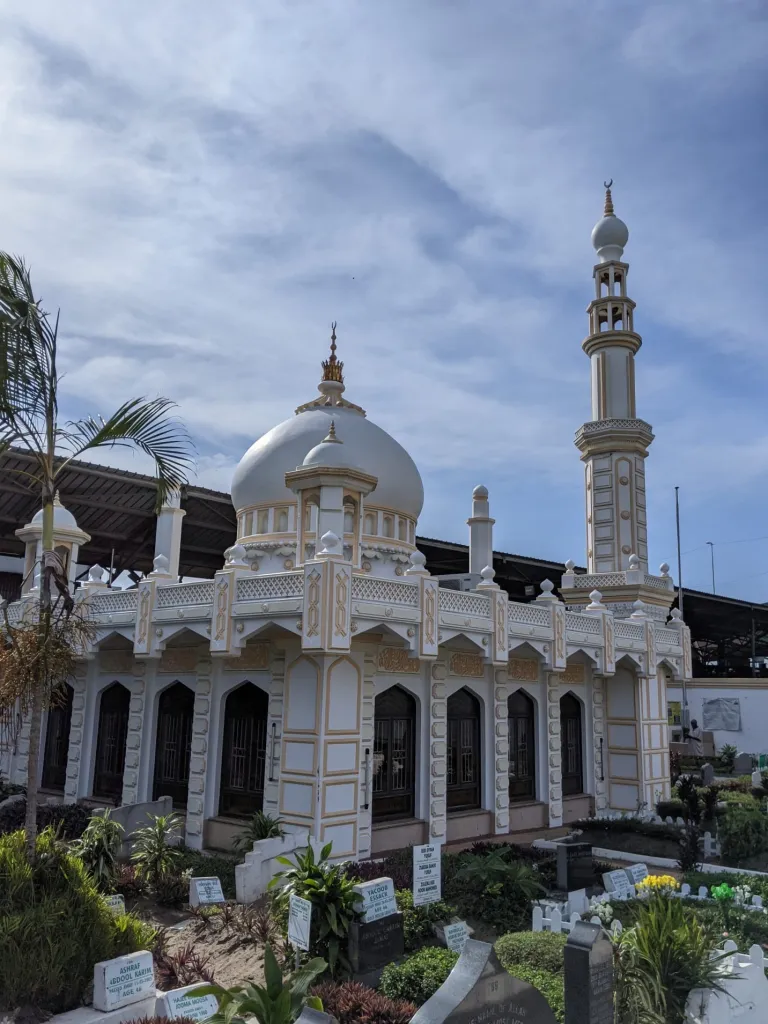
Mazaar of Badsha Peer, Durban, South Africa / Source: Author
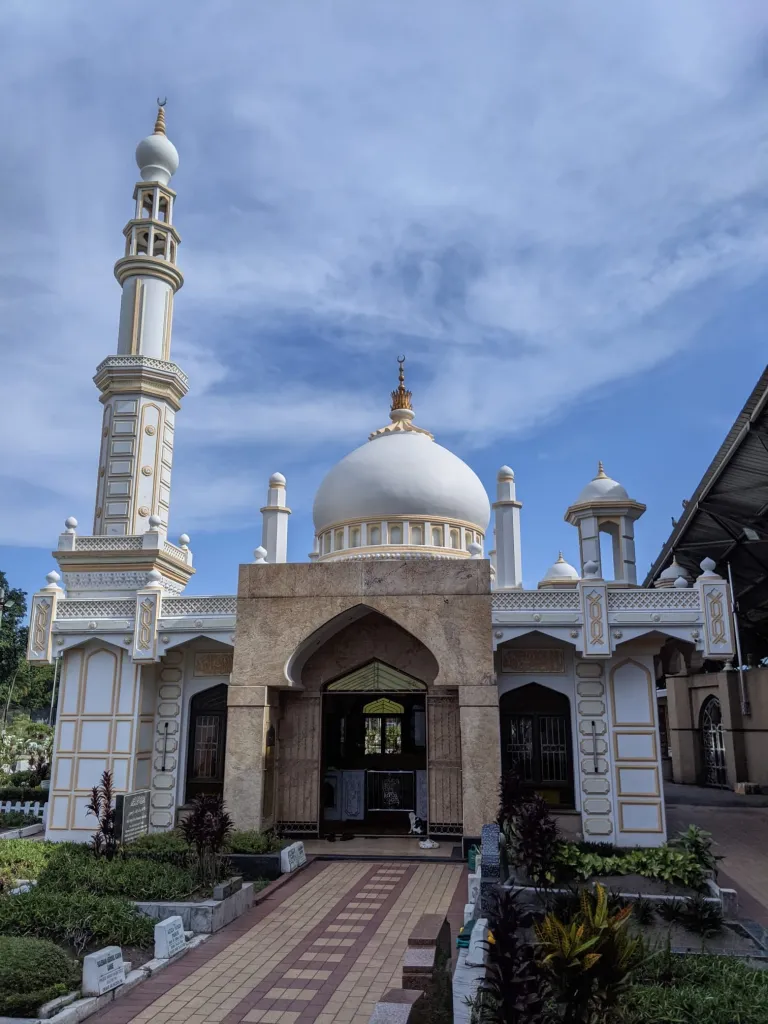
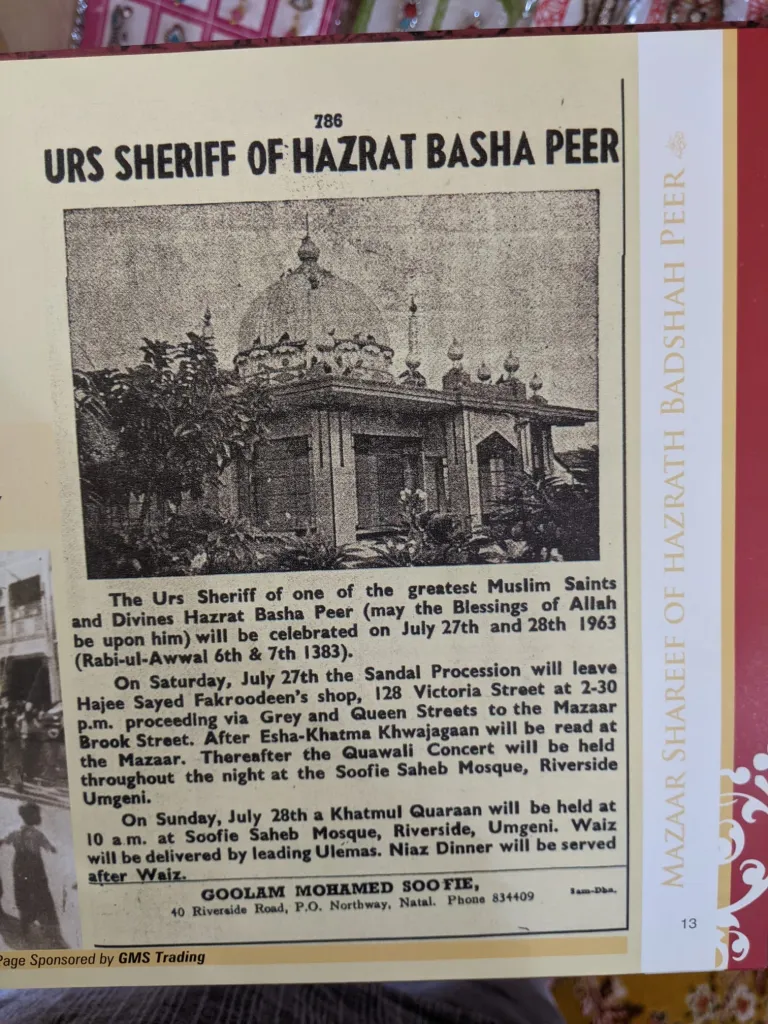
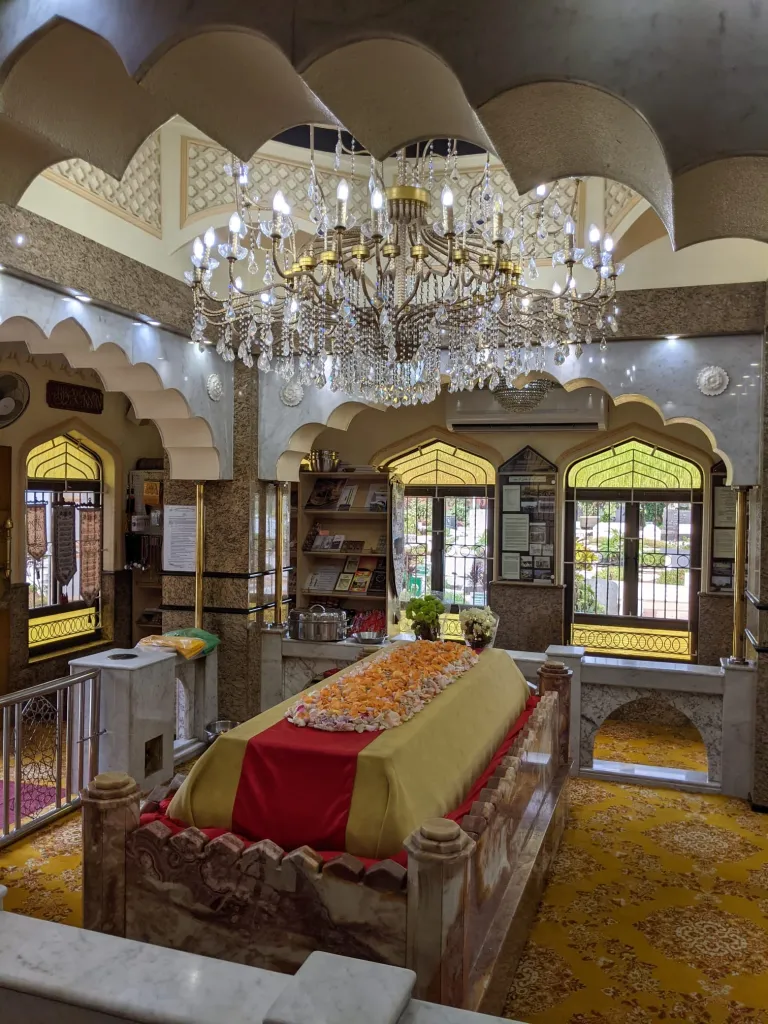
In the historic Brook Street cemetery in Durban, South Africa, a gleaming white and gold structure towers over dozens of tombstones. This is the mazaar (tomb) of Sufi saint Badsha Peer. Thousands of miles from his birthplace in southern India, he is said to have found his final resting place here in 1894.
Inside the shrine, an inscription declares that this is “The MAQAAM (Resting Place) Of The King Of Africa – HAZRATH SHAYKH AHMED BADSHA PEER (RA)”.
Visiting Badsha Peer’s shrine challenged much of what I was told about South African Indian identity and history. In my conversations with South African Indians, I was told that most Muslims in the community were Gujarati or Konkani, and that most South Indians were Hindu or Christian. But here I was, at the shrine of a Muslim saint who was also South Indian. I was intrigued—and confused.
Digging deeper, I found that the story of this “King of Africa,” Badsha Peer, is a tale of multiple migrations, across the Deccan, South India, and beyond. His story involves Konkani Muslims and Hyderabadi Sufi teachers traveling to colonial Bombay, and Tamil and Telugu indentured workers making the long and treacherous journey from Madras to South Africa.
Tracing the story of Badsha Peer—and Soofie Saheb, the man who popularized his memory—shines light on how Indian religious, linguistic, and regional identities were transformed in the Deccan and South Africa, during the colonial period and through indenture and migration.
Locating Badsha Peer in History
Pinning down the historical Badsha Peer is difficult. Goolam Vahed, a scholar of South African Indian and Muslim history, describes the saint as having a “sketchy biographical profile and unclear genealogy”.
Ashwin Desai and Goolam Vahed write of a Sheikh Ahmed who arrived from Chittoor (modern-day Andhra Pradesh) or Arni in North Arcot district (modern-day Tamil Nadu) on the first ship from India, the SS Truro, which arrived on November 16, 1860. On the other hand, Nile Green, a historian of Indian Ocean Muslim networks, points to a Sheik Ahmed from Machilipatnam (modern-day Andhra Pradesh) who arrived a month later, in December 1860, on the Lord George Bentinc.
Either way, according to oral tradition and popular anecdotes, Badsha Peer is remembered as arriving with the first indentured laborers from India. A man of great spiritual power, he is popular for the miracles he performed on the colonial sugarcane plantations, such as accomplishing his tasks in the fields while simultaneously meditating all day.
According to Nile Green, South African oral traditions declare that he was “released early from his indenture due to ‘insanity’”, which was later given a Sufi interpretation as “spiritual rapture (jazb).” Following his release, he is said to have lived the rest of his life as a faqir (mendicant) around the Grey Street mosque until his death in 1894.
Muslims like Badsha Peer made up about 10 percent of the approximately 152,000 Indians who were brought to South Africa as indentured workers; over 80 percent were Hindu. Around 44 percent of indentured Muslims departed from Madras, and among these workers, over 60 percent came from four areas: Arcot (31 percent), Malabar (14 percent), Madras (11 percent), and Mysore (7 percent).
Indentured Muslims, like Hindus, largely came from marginalized castes. In his shrine, Badsha Peer’s caste is simply listed as “Muslim” and “Mohamedan”, which is how around half of indentured Muslims named their caste according to immigration records.
However, Desai and Vahed mention Badsha Peer’s caste as julaha (weaver). He may have been from the Dudekula community , a Telugu-speaking Muslim caste associated with weaving and cotton cleaning.
Soofie Saheb and His “Overpowering Influence”
Shrine of Badsha Peer, Durban, South Africa / Source: Author
The reason that Badsha Peer is remembered today is due to the efforts of a non-indentured Indian migrant. This pivotal figure is Shah Ghulam Muhammad (d. 1911), popularly remembered in South Africa as “Soofie Saheb.”
Soofie Saheb was born into a Konkani Muslim family in the town of Ibrahimpatan in Ratnagiri district. The family held a high social status on account of its claim to descend from Abu Bakr, the first caliph of Islam. After studying in Kalyan, he departed for Bombay. Nile Green situates his move within “a much larger migration of Konkani Muslims to the city that had taken place over the previous decades”.
In the early 1890s, Soofie Saheb became a disciple of Habib ‘Ali Shah (d. 1906), a Sufi teacher of the Chishti order. Habib ‘Ali Shah himself was a migrant from Hyderabad who developed a following primarily among Konkani Muslims in Bombay, particularly workers around the Mazgaon dockyard. In 1895, Soofie Saheb was instructed by his teacher to go to South Africa to spread the message of the Chishti order to the indentured Indian population.
Soon after arriving in Durban in 1895, Soofie Saheb “encountered a situation of close proximity and mixing between Muslims and the large majority of Hindu laborers,” as anthropologist Thomas Blom Hansen writes . Faced with the fact that “Muslims participated widely in Hindu rituals and festivals”, Soofie Saheb began to promote a more “proper” Islamic identity for indentured Muslims. Similar efforts would soon take place among the Hindu community as well, led by Arya Samaj missionaries like Bhai Parmanand and Swami Shankaranand.
One of the first actions of Soofie Saheb in South Africa was to build a shrine over Badsha Peer’s grave, which he is said to have identified through a dream or vision. Shortly afterwards, in April 1896, he purchased a plot of land on the banks of the Umgeni river, upon which he built a complex that included a mosque, khanqah, madrasa, and Muslim cemetery.
Interestingly, the legal documentation for this purchase was prepared by a young Gujarati lawyer who had arrived in South Africa just a few years prior: Mohandas K. Gandhi. Vahed writes that “Between 1898 and his death in 1911 Soofie Saheb built 11 mosques, madrasas and cemeteries all over Natal.”
Reimagining South Asian Languages and Religions in South Africa
A book published by Soofie Saheb’s madrasa in 1970 includes this quote by a Hindu observer: “there were many Tamil-speaking Muslims who, but for the recitals of the Koran, were by tradition and culture typically South Indian. Soofie Saheb’s mystic personality had an overpowering influence on the Muslim community widely scattered.” (emphasis mine)
This framing positions South Indian and Muslim identities as mutually exclusive, with the suggestion that shifting towards a more explicitly Muslim identity necessitated shifting away from South Indian culture. The framing also implicitly links South Indian and Hindu identities together.
What was the nature of Soofie Saheb’s “overpowering influence” among indentured Muslims in South Africa? As Nile Green has noted, Soofie Saheb promoted the Urdu language as core to Muslim identity, even though few indentured Muslims spoke the language.
Green argues that Soofie Saheb was simply following “specific currents of linguistic change in his own Konkani community in India, in which the use of Urdu spread significantly during the early twentieth century, partly as a result of migration” from the Konkan coast to Bombay. Similar developments had taken place elsewhere in the Deccan, such as the rise of Urdu in Hyderabad State in the 1880s as the prestige language of education and social status.
Soofie Saheb’s efforts made Badsha Peer the most revered Sufi saint in South Africa. At the same time, he promoted a cosmopolitan, Urdu-centric Muslim identity that likely would have been unfamiliar to Badsha Peer himself, as a Telugu- or Tamil-speaking indentured Muslim.
These shifts were perhaps aided by the fact that in decades following Soofie Saheb’s death in 1911, many South Indian associations in South Africa adopted explicitly Hindu orientations.
For example, a year after the Andhra Maha Sabha of South Africa was formed in 1931, the organization became an affiliate of the South African Hindu Maha Sabha. The Andhra Maha Sabha’s logo is a Telugu-script Om, and the organization’s headquarters in the Indian township of Chatsworth includes an elaborate Venkateswara temple, which was built in 1983.
Thus, on one side, Telugu cultural associations in South Africa defined Telugu and Hindu identities as synonymous, while Muslim leaders like Soofie Saheb consolidated an Urdu-oriented Muslim identity.
South Asian Legacies: Shared Devotion at Badsha Peer’s Shrine
Interior of the Shrine for Badsha Peer / Source: Author
Although Badsha Peer is remembered as coming from Andhra Pradesh or Tamil Nadu, Soofie Saheb’s emphasis on an Urdu-centric Muslim identity means there is little to no visible South Indian influence in the rituals and practices associated with his shrine today.
And yet, despite Soofie Saheb’s activities to consolidate a distinct Muslim identity among indentured Indians, Badsha Peer’s shrine became a site for prayer, pilgrimage, and worship for Indians across regional and religious identities. In a way, his shrine provided a conduit for older South Asian practices of multi-religious devotion, such as reverence for Sufi mazaars and dargahs.
From the earliest years of the shrine, non-Muslim devotees played a role—Goolam Vahed notes that in 1917, “A corrugated iron structure was erected by a Hindu, Bhaga, around the dome” of the shrine. In 2002, one of the qawwali groups performing at the saint’s urs (death anniversary) was led by a Hindu singer.
Community archivist Selvan Naidoo, director of the 1860 Heritage Centre, recalls that “In my early childhood days, such was the power of this place that my staunch Tamil mother would often take us there to pray at this great place of indentured reverence.”
This reverence for Badsha Peer continues to this day. Mark Naicker, an interfaith activist in Durban from a Catholic family, shared with me that “sometimes you hear Hindus also go to Badsha Peer … when people have a baby, they would go to that shrine” to seek blessings.
It has been over 160 years since Badsha Peer and the first indentured Indians set foot on South African shores. He is a unique figure in South African Indian history. Unlike most indentured Indians, he was Muslim. Unlike most Indian Muslims in South Africa, he was from southern India. And unlike nearly any other indentured Indian Muslim in South Africa, he is revered as a saint whose power is manifest even to this day.
Badsha Peer’s story, intertwined with that of Soofie Saheb, provides us with a glimpse into how Indian identities were transformed and reconfigured in South Africa. “Muslim” and “South Indian” identities took increasingly divergent paths. And yet, despite these shifts, his memory lives on, drawing devotees from across religious and regional backgrounds who seek the blessings of this “King of Africa.”
source: http://www.maidaanam.com / Maidaanam / Home / by Nikhil Mandalaparthy / June 17th, 2024
‘Patent Man of India’ Prof Shamshad Ali so far bagged seven patents for his multifarious innovations. The professor of engineering at Aligarh Muslim University’s polytechnic is differently abled and keeps underscoring the need for innovation to achieve progress.
Professor of engineering Shamshad Ali at AMU
Aligarh:
Shamshad Ali, a professor of engineering at the polytechnic college of Aligarh Muslim University (AMU) has become popularly known as Patent Man of India for his multifarious innovations. Prof Shamshad Ali, who after taking classes keeps busy with his inventions, has over seven patents to his credit till now, granted by the Patent Office, Government of India, Delhi.
This differently-abled professor never loses heart and always strives for excellence. Be it teaching students or discovering something new, this physically challenged person’s hard work has become a source of inspiration for other teachers and innovators. Prof Shamshad Ali was granted three patents in 2022 alone.
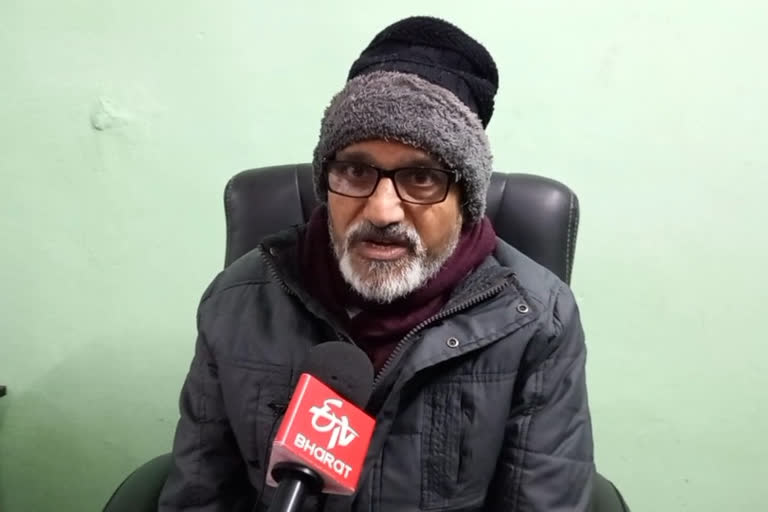
The professor underscores the need for innovation to achieve progress. In his appeal to students and teaching faculty in the AMU, he said, “Innovation plays an important role in upping the university’s ranking. Discovering new things helps teachers and students. So they should keep on doing new research. I have bagged seven patents so far and two more patents will be granted soon.”
“When someone discovers new things. Then the innovator is supposed to apply and submit application online to Delhi patent office. Thereafter an exam is conducted. If you pass the test, they will grant you patent. If not, then you will have to work on it again. It all depends upon the examiner,” said Prof Shamshad.
source: http://www.etvbharat.in / ETV Bharat / Home> ETV Bharat> Bharat / January 07th, 2023
Yousuf Tekri is a bungalow built by Syed Yousufuddin Mohammed who was a Subedar during Nizam rule. This building was a farm house built during 1850’s which later served as a residence for his progeny.
Tolichowki:
This building is now in the list of heritage structures in Hyderabad and is being restored by the hereditary family Syed Mohammed Aliuddin grandson of Yousufuddin, and his great grandsons Syed Mohammed Najmuddin and Syed Mohammed Mawaheduddin are financing and restoring the building independently.
This building is beautifully constructed uphill, which gives a scenic view of the city which was all farm and isolated landscape, which is now a concrete jungle. Syed Aliuddin said “Yousufuddin was born in the city of Hyderabad and was appointed as an officer in the revenue services working for Asaf Jah VI, Mahbub Ali Khan. Yousufuddin was later entitled as a Subedar for Gulbarga District”.
The bungalow was built by Yousufuddin as a farmhouse as it was away from city back in those days, surrounding the area of about 290 acres. During land acquisition most of it was acquired by Indian Army and colonies were build, Yousuf Tekri colony is where our family lives. Now we are renovating the structure with plaster and cement, because preparation of lime takes much effort and time.
Syed Mohammed Najmuddin said “We are restoring the building independently there as is no financial aid from the government. In spite of being in the list of the heritage structure, government is taking no initiative”.
source: http://www.thehansindia.com / The Hans India / Home> News> Cities> Hyderabad / by Mayank Tiwari / Abhyudaya Ya Karamchetu / March 05th, 2015
Hyderabad, TELANGANA / SAUDI ARABIA / California, U.S.A :
Hyderabad:
Syed Burhan Badshah Quadri alias Salik, a well-known media person in the Kingdom of Saudi Arabia, lost a five-year long and painful battle with cancer in Santa Clara, California, the USA, on Thursday (December 22).
Burhan, as he was known among most of his friends, came from a traditional and elite family of Hyderabad. He was 74 years old.
His father Syed Kaleemullah Qadri was the last Subedar of Hyderabad of the Nizam era. After the Police Action of 1948 he was arrested and released after some time. After he was reinstated he worked as head of several departments before his superannuation.
Burhan is survived by his wife Shahnaz and four children–two daughters and two sons.
Burhan after completing his bachelor’s degree with the Nizam College had joined Nizams Sugar Factor as a management trainee and moved over to the Kingdom of Saudi Arabia somewhere in the mid-seventies.
Within few years of him arriving in the Kingdom, he became one of the topnotch executives from India. He worked with several companies and finally began his own advertising agency Zee Ads which counted many major companies among its clients. He was one of the few Indian executives in the Kingdom at that time who owned a BMW and lived comfortable, if not luxurious, life. The company had to be closed down owing to some managerial issues. From there started the next phase Burhan’s life.
Among a host of his close friends who are deeply bereaving his loss are Mohammad Majid Ali, Nadir Yar Khan, Zahyr Siddiqi and Syed Inamur Rahman Ghayur.
Burhan a photographer by passion took keen interest in the political developments taking place in India and expressed his opinion without any hesitation. His talk which he considered free and frank was painful for many of his friends. Among his favourite personalities was Nawab Mir Osman Ali Khan, the last Nizam of Hyderabad. He would never keep quiet if he heard any negative comment about the Nizam. In his eyes the Nizam was a symbol of tolerance, development and Hindu-Muslim unity.
It is not yet known when and where he would laid to rest.
source: http://www.siasat.com / The Siasat Daily / Home> Obituaries / by Mir Ayoob Ali Khan / December 23rd, 2022
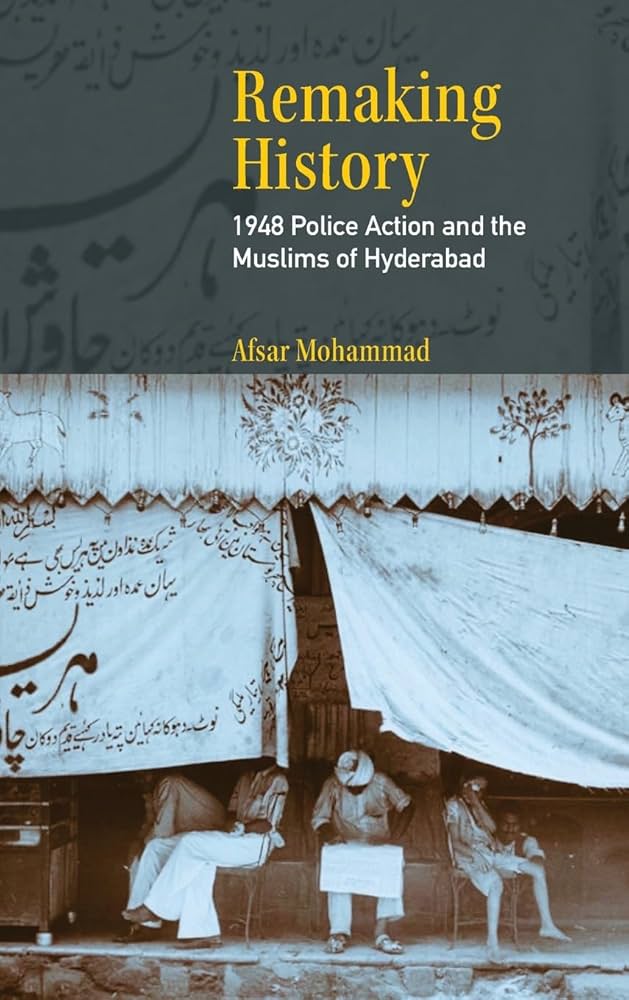
Hyderabad, known for its grandeur and the unique confluence of Hindu-Muslim culture, found itself at a crossroads of political and religious tensions. Afsar Mohammad sheds light on the brutal military campaign, where the ordinary citizens of Hyderabad became casualties in a political power play between the Nizam and the Indian government. The book emphasizes that…
Book: Remaking History: 1948 Police Action and the Muslims of Hyderabad
Author: Afsar Mohammad / Publisher: Cambridge University Press / Published:June 2023 /Hardcover: 320 pages
Afsar Mohammad, a renowned poet, scholar, and expert on South Asian literary cultures, brings forth a deeply researched and compelling narrative in his book Remaking History: 1948 Police Action and the Muslims of Hyderabad. As a professor of South Asian Studies at the University of Pennsylvania, Afsar has extensively studied the intersection of politics, religion, and literature in the Indian subcontinent. His previous works have explored themes of religious identity and cultural expression in the context of Hyderabad. With Remaking History, he delves into one of the most tragic and often overlooked episodes in India’s postcolonial history – the 1948 police action in Hyderabad.
The book addresses the military operation launched by the Indian government from September 14 to 18, 1948, to forcibly integrate the princely state of Hyderabad into the Indian Union. As India was celebrating its newfound independence, the state of Hyderabad was caught in a violent struggle. The operation, commonly referred to as the “police action,” resulted in immense bloodshed, with the Muslim population of Hyderabad suffering disproportionately.
Hyderabad, known for its grandeur and the unique confluence of Hindu-Muslim culture, found itself at a crossroads of political and religious tensions. Afsar Mohammad sheds light on the brutal military campaign, where the ordinary citizens of Hyderabad became casualties in a political power play between the Nizam and the Indian government. The book emphasizes that while the Razakars, a military group loyal to the Nizam, escaped across borders, it was the common Muslims of Hyderabad who bore the brunt of the violence that followed the military intervention. Thousands of lives were lost, and many more were displaced during the five days of turmoil.
One of the pivotal aspects of the book is its reliance on the Sunderlal Committee Report, an investigation commissioned by Prime Minister Jawaharlal Nehru in the immediate aftermath of the operation. This committee traveled across Hyderabad and the Deccan region, gathering firsthand testimonies from survivors. The report revealed shocking truths: thousands of Muslims were massacred during the police action, and the violence forced many others to flee to Pakistan and other countries. However, the report was suppressed for decades under the guise of “national security,” only surfacing in recent years thanks to the persistent efforts of historians. This suppression of critical historical evidence is a central theme of the book, as Afsar Mohammad argues that official narratives have long ignored or downplayed the extent of the violence.
In addition to exposing the atrocities committed, Remaking History explores how this dark period shaped the literary and cultural landscapes of postcolonial Hyderabad. The traumatic events of 1948 found their way into novels, poems, memoirs, and personal narratives written by survivors and their descendants. Afsar Mohammad highlights how literature became a means for the people of Hyderabad to process their grief, remember their dead, and make sense of the immense suffering they endured. The book documents the ways in which Hyderabad’s writers and poets used their work to preserve the memory of the police action, even as the official narrative sought to erase or obscure these painful truths.
Afsar Mohammad also critically examines the political reframing of the police action in later years. In 1998, L.K. Advani, a key figure in India’s Hindutva movement, proclaimed the police action as a “liberation” of Hyderabad, casting it as a moment of triumph rather than tragedy. This reinterpretation of history, the book argues, was part of a larger effort to further a communal agenda, obscuring the fact that the violence was largely directed at Muslims. Afsar Mohammad challenges readers to question whether the police action was truly a moment of liberation, or if it was a tool used to suppress the region’s Muslim population and further political interests.
One of the most striking aspects of Remaking History is the emphasis on the role of personal stories in reconstructing the past. Afsar Mohammad stresses that official documents and reports can only go so far in revealing the full picture. The true history, he argues, is often found in the personal memoirs, oral histories, and forgotten novels of those who lived through these events. Many of the eyewitnesses and survivors of the 1948 police action are no longer alive, their stories lost to time. However, the book insists that these personal accounts are essential to understanding the true scope of the violence and its lasting impact on Hyderabad.
The book also highlights the lasting cultural and social shifts that emerged from the violence. Despite the bloodshed, Hyderabad’s centuries-old legacy of Hindu-Muslim unity endured, and the city’s cultural landscape continued to evolve. In the years following the police action, a wave of literary and artistic movements arose, particularly in the Telangana region, shaping the social and cultural identity of Hyderabad for generations to come.
Afsar Mohammad’s Remaking History is a crucial work that brings much-needed attention to a neglected chapter in India’s postcolonial history. It challenges the sanitized narratives of Indian nationalism and raises important questions about the consequences of political violence. By combining rigorous historical research with a deep understanding of Hyderabad’s literary cultures, Afsar Mohammad presents a nuanced and powerful account of the 1948 police action and its aftermath. The book serves as both a historical investigation and a tribute to the resilience of Hyderabad’s people and culture in the face of adversity.
In conclusion, Remaking History is an essential contribution to the historiography of postcolonial India. It calls on readers to confront the uncomfortable truths of the past and reflects on how history is often manipulated to serve political agendas. Afsar Mohammad’s work is a timely reminder that the trauma of violence and suppression should not be forgotten, but instead, recognized and remembered in its entirety, for the sake of future generations.
source: http://www.radianceweekly.com / Radiance Viewsweekly / Home> Book Review / by Ayesha Sultana / September 24th, 2024
The flight had three doctors on board and they managed to stabilise him and take him safely up to the Kolkata airport.
Doctor couple Dr MM Samim and his wife, Dr Naznin Parvin
Bengaluru :
High drama unfolded on an IndiGo flight that had taken off from Bengaluru to Kolkata on Saturday when a flyer in his 40s with preexisting health issues developed an emergency. The flight had three doctors on board and they managed to stabilise him and take him safely up to the Kolkata airport.
Dr MM Samim, who was conferred a gold medal just a day earlier during NIMHANS convocation, and his wife Dr Naznin Parvin, a paediatrician, along with a surgeon from MS Ramaiah Hospital saved the flyer’s life.
Man suffered from chronic liver issue
Their timely action also saved a potential diversion of the flight to Bhubaneswar airport and a disruption of weekend travel plans of 200-plus passengers.
The Flight No 6E 503 took off from Terminal 1 of Kempegowda International Airport at 10.42 am, which was late by 20 minutes. It was an hour later that the flyer, who is from West Bengal and works as a labourer in Kerala, developed breathlessness and threw up. He was travelling with his son to get himself admitted to a government hospital in Kolkata for his chronic liver condition.
Harilakshmi Ratan, a retired chartered accountant seated on 1B, told TNSE, “A flyer seated in the middle (Row no. 16) started vomiting blood. One of the cabin staff made an announcement appealing for doctors on board to assist the patient. Three of them stepped forward and saved his life.”
Dr Parvin, who works at a private hospital in Siliguri, said they rushed to the patient. “He was struggling to breathe and was vomiting blood. His BP was low. We gave him oxygen from the cylinder and also administered drips with normal saline, all of which were available on the flight. The vomiting was brought under control immediately. Soon, the oximeter too showed a stable oxygen level (95),” Dr Parvin said.
Dr Samim, who is the recipient of Best Outgoing Resident in Doctor in Medicine (DM) (Neurology) and who also works at a private hospital in Siliguri, said, “Since the patient was not in a good financial position, I decided it would be better if he reaches his hometown. We had stabilised him too.”
source: http://www.newindianexpress.com / The New Indian Express / Home> Karnataka / by S Lalitha / October 06th, 2024
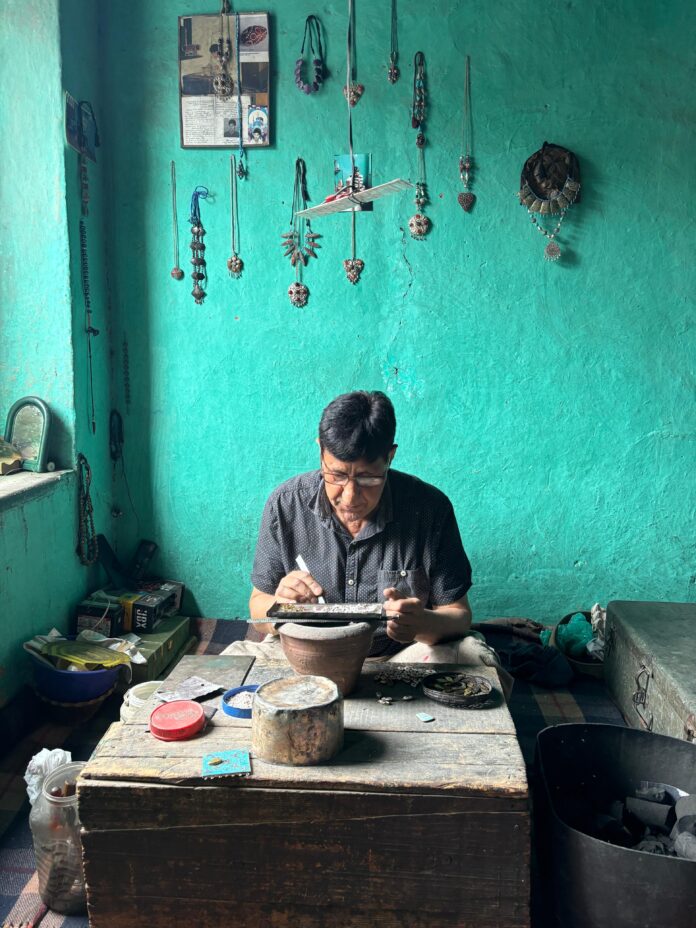
Mohammad Hanief Bhat at his workstation. Photo: Aatif Ammad
Srinagar:
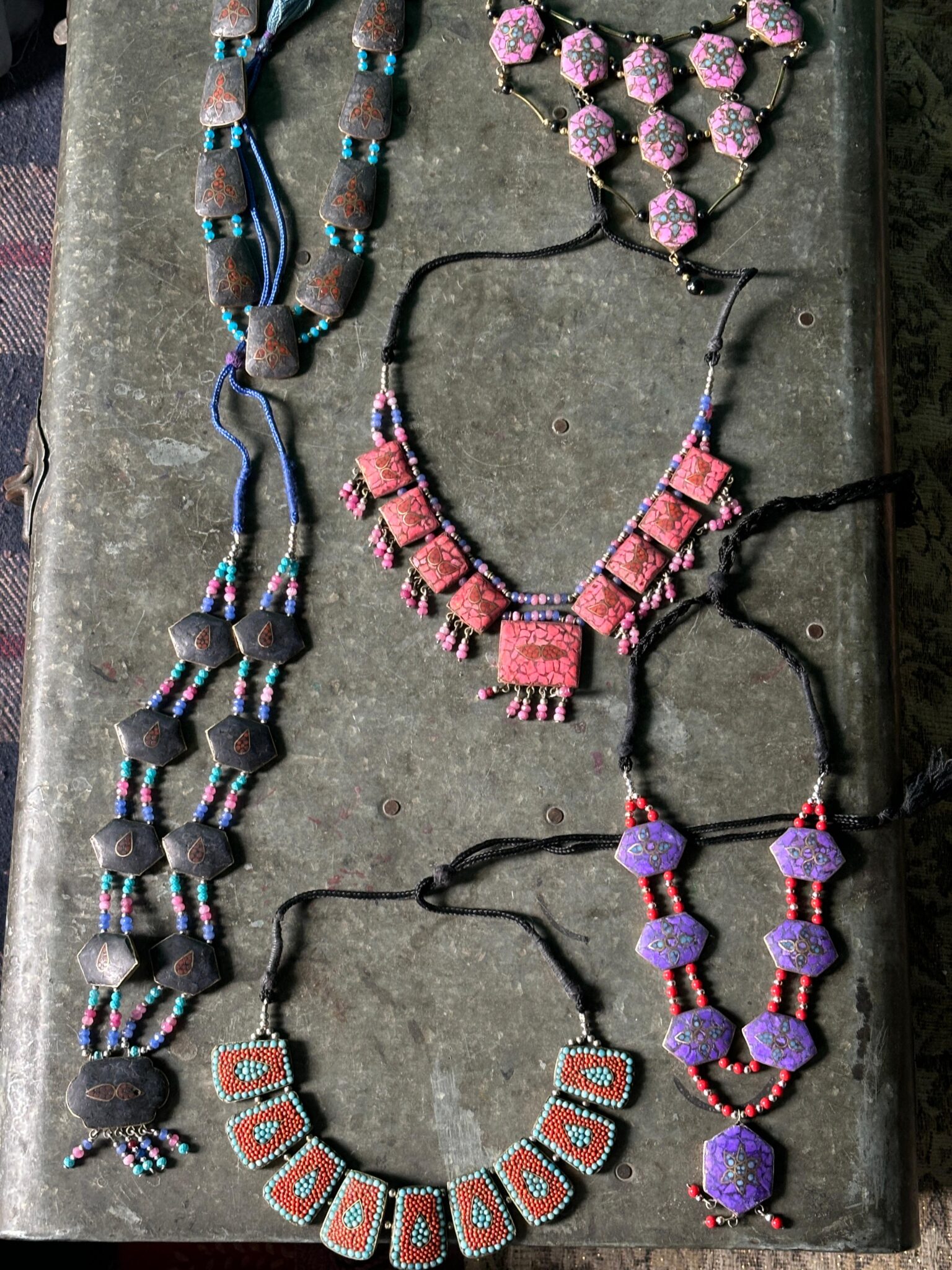
In the early morning, as the streets of downtown Srinagar — known for its artisans and art forms — begin to buzz with activity, shopkeepers display their goods and autowalas wait for customers. Mohammad Hanief Bhat, 62, starts his day by opening a window in his workstation, located on the first floor of a 100-year-old building. As sunlight streams into his room, he begins assembling small pebbles, which he will set into a brass shell to create a necklace. This craft, known as Ferozi in Kashmiri and Turquoise in English, involves making jewellery with stones fixed in brass, and Hanief is its last guardian.
“This is a challenging art, but it is my identity. My father practiced it, and back then, this craft was well-recognized and loved by foreigners. They would come here and purchase items from us. In the 1970s, my father employed more than 30 artisans who worked under him,” he said.
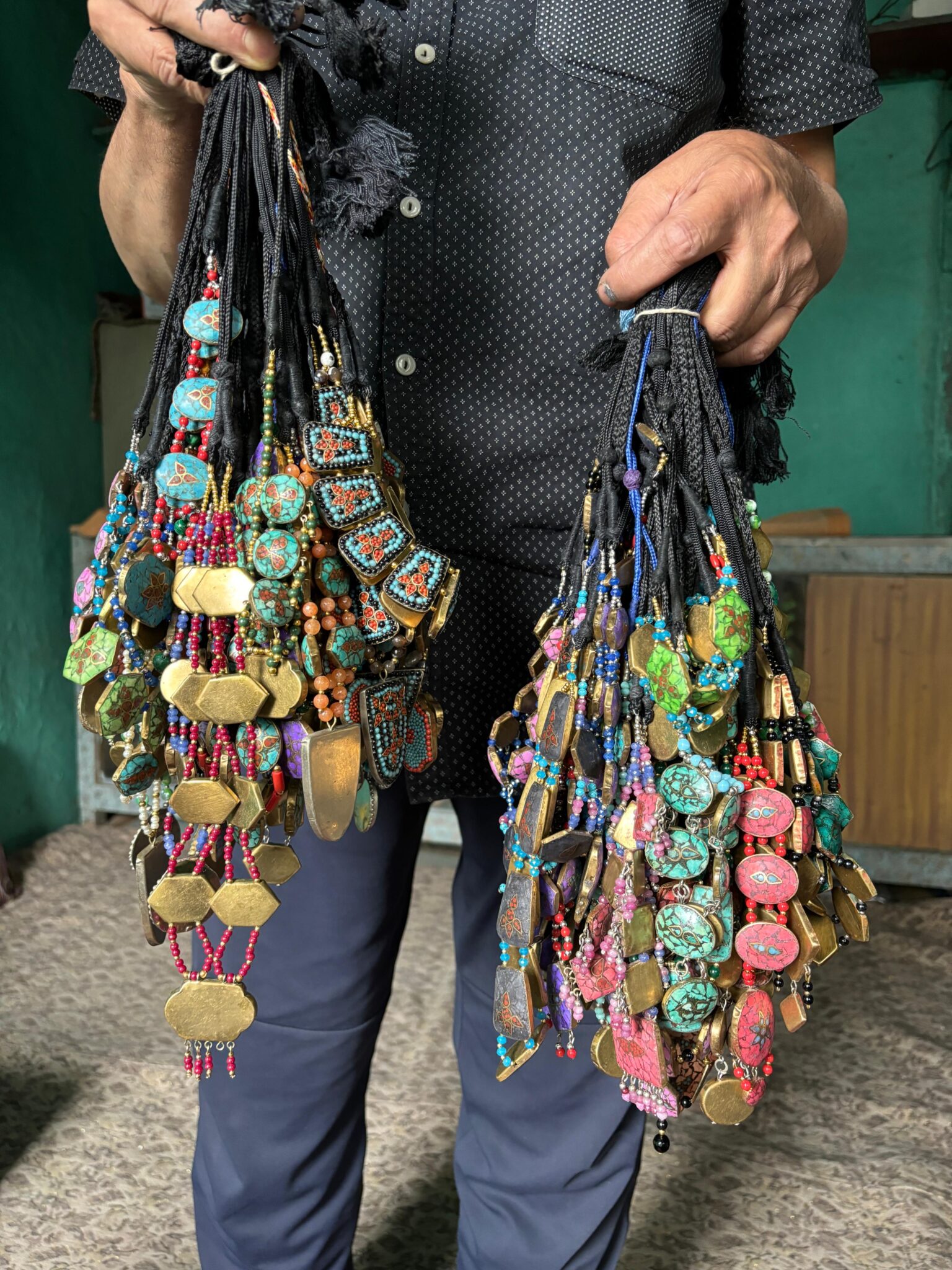
Mohammad Hanief displays a variety of necklaces he has crafted over the past few years. Photo: Aatif Ammad
Hanief was young but the eldest in his family when he lost his father. Since this art form was their only source of income, he eventually had to take matters into his own hands and manage the small workstation where 30 artisans who had worked under his father taught him the craft.
He was just a child, a grade five student, when he lost his father. Being the eldest among his siblings, he had to take on the responsibility of managing the family’s turquoise art workshop, their sole source of income. Fortunately, the artisans working in their workshop were kind and taught him the craft very well.
Over time, Hanief mastered the art, but the demand for it mysteriously declined. Consequently, many artisans abandoned the craft as it no longer provided a sufficient income for survival. The number of artisans dwindled from 30 to just 5.
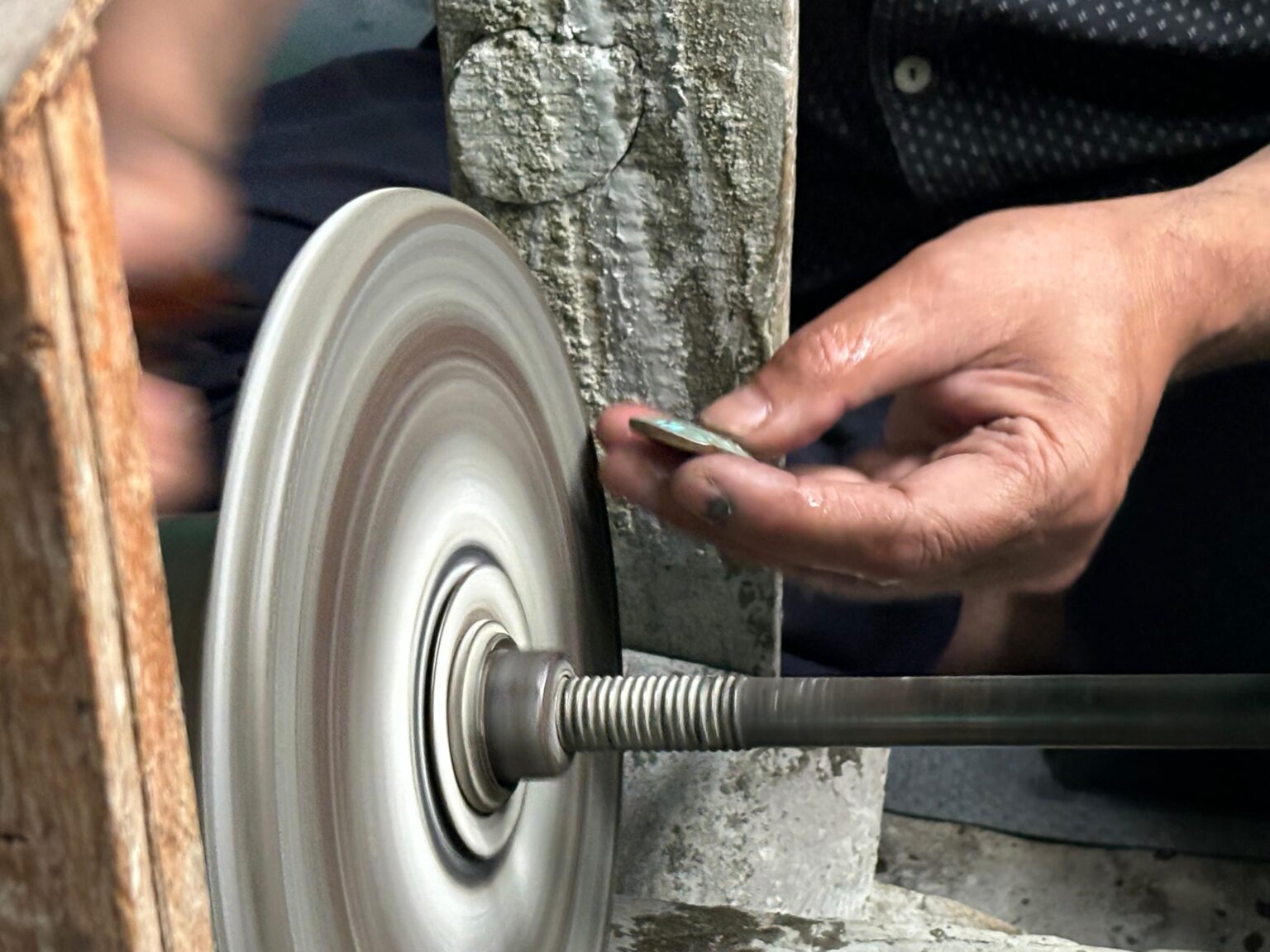
Hanief adding the finishing touch to a pendant. Photo: Aatif Ammad
Hanief’s father crafted hundreds of pieces of jewellery each week, which he would take in a large basket every Friday to a family with a showroom in Zainakadal, just 2 kilometers from Hanief’s home. This family would then sell the jewellery in their showroom. According to Hanief, they always managed to sell everything they made, despite never having any pre-orders, as everything they produced was sold to that business family.
The same trend persisted when Hanief took over; the demand remained steady, and he was able to sell everything he made. However, over time, the demand declined for reasons Hanief couldn’t understand. Consequently, many artisans abandoned the craft, leaving Hanief as the only one who continued it.
Aside from Hanief’s father, more than 60 families were involved in the craft of turquoise. However, over time, everyone abandoned the craft, leaving Hanief as its last guardian. As the artisans departed, Hanief also quit for a few months, leaving no artisans remaining, and he began selling carpets instead.
“In the 1990s, nearly everyone abandoned the art, and I also thought it was not worth continuing since there were no buyers. I eventually left it and started selling carpets. Although I earned more from selling carpets, I was never satisfied with that profession. I felt it would be a great injustice to the art that my father devoted his life to. So, I left everything else and returned to practicing the art of Ferozi,” Hanief explained.
When Hanief resumed making turquoise jewellery, he found that there were no longer any major buyers to sell it to customers, as the previous showroom owners had lost interest due to decreased demand.
However, his sister, whose family runs businesses in Bangalore, suggested he come to Bangalore for art exhibitions to sell his jewellery. There, he discovered that people were attracted to his art, with many NRIs and foreigners purchasing from him. This allowed him to sell a significant amount of jewellery, but the exhibitions only lasted a few days.
Hanief visited Bangalore every year and set up a stall at the exhibition, managing to sell a good quantity of jewellery. However, it wasn’t enough for him to sustain a livelihood solely from the craft.
“Bangalore exhibitions gave me a lot of hope and motivation to continue the craft,” said Hanief, adding, “People used to come and praise me there. It gave me a lot of confidence and recognition”.
New Innovations in the Craft
Traditionally, turquoise jewellery was exclusively blue and featured very simple designs. However, Mohammad Hanief introduced innovations after several buyers in Bangalore expressed a desire for more colours and designs. Upon returning to Kashmir, he thoughtfully incorporated new colourful stones and created different designs. He even added unique elements, such as breaking thin wires into small pieces to use in necklaces for a distinctive look.
Colourful necklaces from Hanief’s collection. Photo: Aatif Ammad
Hanief remarked, “I used to get bored making the same designs and colours every time, but I never thought of doing something new. It was only when some foreign buyers at an exhibition in Bangalore suggested that I introduce more varieties and colours. I then started creating jewellery in different colours that people would love and adore. I felt happy and satisfied making these new types of jewellery.”
He currently makes turquoise jewellery in almost every colour.
No Government Support
Despite the widespread appreciation for Hanief’s art of crafting turquoise jewellery, the local government has never recognized his efforts, even though he received accolades from states like Kerala.
Hanief remarked, “Although I have carried this art on my shoulders for years and I am the only one left practicing it, our government has never appreciated or recognized me. However, officials from Kerala and Karnataka have always praised me and assisted in setting up stalls in Bangalore.”
Mohammad Hanief’s artisan card, issued to artisans of various crafts, expired in 2022. Despite submitting it to officials for renewal, the process is still pending. Hanief believes that the officials do not take his art seriously, which is why they show little interest in his official matters.
Concern for the Art’s Survival
Mohammad Hanief, now in his sixties, is deeply concerned that his craft will perish with him, as he has no children to carry on his legacy as he did after his father’s passing.
source: http://www.twocircles.net / TwoCircles.net / Home> Art>Culture / by Muhammad Aatif Ammad Kanth, TwoCirlces.net / August 18th, 2024