Tourist Guide Who Saved Five Lives But Unfortunately Lost His Life In A Act Of Bravery
Srinagar
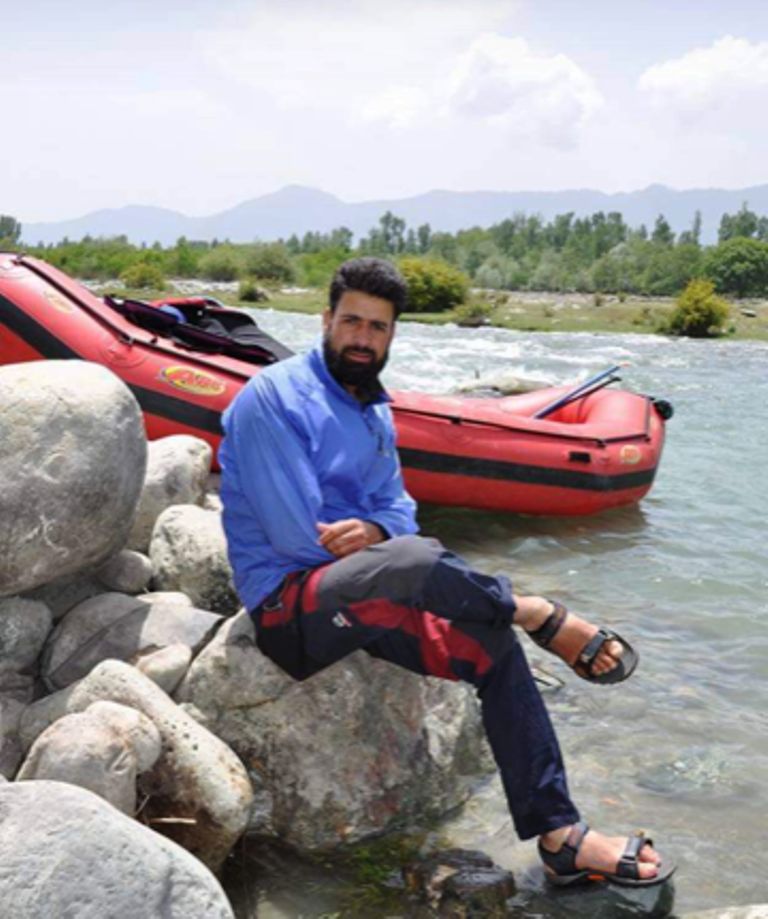
Governor Satya Pal Malik has saluted the bravery of Tourist Guide Rouf Ahmad Dar, who lost his life while rescuing tourists from the Lidder river in Pahalgam. He described Rouf as a real-life hero who sacrificed his life for saving the lives of others.
Governor has prayed for eternal peace to the departed soul and strength to the bereaved family in its hour of grief.
Honouring the exemplary display of selfless action, Governor has announced financial assistance of Rs 5 lakh for the family of Rouf.
Dar saved five tourists, two of them foreigners, after their boat capsized in fast flowing river Lidder near Mawoora area of Pahalgam in south Kashmir’s Anantnag district on Friday evening.
Unfortunately, Dar lost his life in an act of bravery which is being hailed by people and the administration.
source: http://www.kashmirlife.net / Kashmir Life / Home> Latest News / by KL News Network / June 01st, 2019
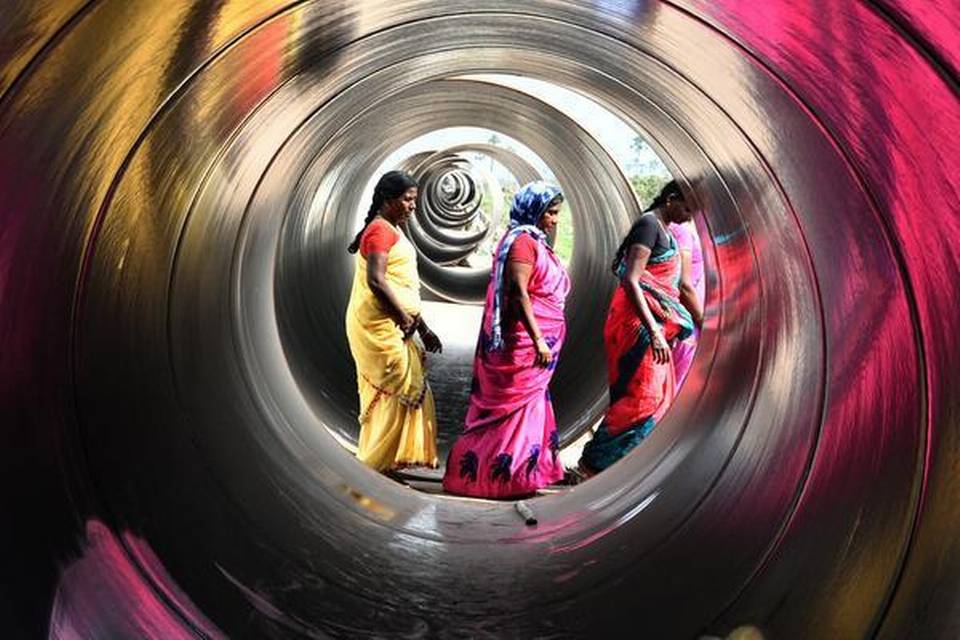
This photograph has been selected second prize in the Press Club Hyderabad Photo contest this year. Women from a nearby village walk between huge pipes used in the construction activity at Mandadam in the core capital region near Vijayawada of AP, | Photo Credit: CH_VIJAYA BHASKAR
The Hindu photographer at Vijayawada, Ch.V.S. Vijaya Bhaskara Rao, won second prize in the third edition of photo contest for photo journalists conducted by the Press Club of Hyderabad on the occasion of the club’s foundation day celebrations.
The first prize went to Sakshi Nalgonda photographer K.B. Prasad and the third to Bhaskar Reddy of V6 Velugu daily in Siddipet.
The first three prizes carry cash award of ₹ 15,000, ₹ 10,000 and ₹ 5,000 respectively.
The consolation prize winners were K.V.S. Giri (The Hindu – Hyderabad), A. Ramachandra Rao (Andhra Bhoomi – Vijayawada), V. Peddi Raju (The Hindu – Vijayawada), G. Ramu (Eenadu – Hyderabad), Gunti Vinod (Namasthe Telangana – Wanaparthy), J. Azeez (Sakshi –Machilipatnam), N. Rajesh Reddy (Sakshi – Hyderabad), K. Bajrang Prasad (Sakshi – Nalgonda), A. Yakaiah (Sakshi – Suryapet) and S. Ravinder (Eenadu – Suryapet).
All of them will get ₹ 2,000 each.
The prize distribution will be held at Press Club Hyderabad on June 9.
source: http://www.thehindu.com / The Hindu / Home> News> States> Telangana / by Special Correspondent / Hyderabad June 01st, 2019
Exquisite detailing goes into Mohammed Osman’s renditions of Gangireddu cow and ox
Did you ever think a cow or bull could inspire an artist to such an extent, he would make it his favourite subject? “I used to see these beautifully-decorated cows and bulls being paraded during festivals in my hometown, Achchampet in Telengana and I fell in love with their form,” says artist Mohammed Osman at his ongoing exhibition at Gallery G. The visually stunning body of work “Dance with the Bulls” captures the bovine form in all their embellished glory.
Talking of his fascination for cows and bulls, Osman says, “It is a rare subject. When you see the grace with which Gangireddu animals are decked with clothes, beads, paint and bells, it is visually enriching,” says Osman, 47, who grew up in rural Achchampet, which is on the way from Hyderabad to Srisailam. “There have been times when I’ve gazed at these beautiful beasts for hours on end, when they would be part of pageants and their caretakers collected gifts for their upkeep,” he says.
Osman, after finishing a course in Fine Arts in Hyderabad in 2002, meticulously worked on his art pieces, all the while looking for the ‘right subject’ on which to pursue a full-fledged career. He zeroed in on Gangireddu or Basava (in Kannada) and the decorated bull now forms the crux of his artistic subject. “I attempt to capture the beauty of these lavishly-decorated animals in the best possible way. From 2006, I have created nearly 500 pieces and sold most of them,” says Osman, who regularly gets orders from connoisseurs.
Settling on a subject is a challenge for any artist, as according to Osman, “this is what makes an artist exclusive.” Specialisation is the key to any career, he adds. On whether he faced any difficulties on the choice of subject, Osman says, “When I started my work in 2006, I gathered reams of information from Indian mythology. I introduced Lord Krishna beside the cows as he is often depicted alongside cows and bulls. Radha Krishna and Gangireddu cows are frequently used in my canvas, as the form captures scenes from days of yore. I believe in Indian culture, in integrating myself and not in segregations such as Hindu or Muslim. I am happy that from the time I took up this work I have been flooded with orders. Khuda Ki Meharbani (god’s grace),” says Osman.
Having spent 20 years in rural landscapes outside Hyderabad, Osman’s palette is bright and brilliant, borrowing from the colourful garments and lifestyle of village folk there. His visual language is strong and his strokes are bold, using nearly 50 colours to capture a single Gangireddu. “I have done 100 variants of the subject; each one taking up to 20 days to finish given the minutiae of details I provide,” Osman explains.
The kind of ‘feats’ a Gangireddu can perform are stunning. “An ox can dance to the tune of its master’s nadaswara, it can nod at his command or shake its head to indicate no, kneel down and prostrate or bow when asked to. You can often see a Gangireddu stand on its master’s chest and bow in complete humility, appreciating a patron who has bestowed money or food on them. The ‘Dance with the Bulls’ series showcases the feats they perform,” says Osman.
(Dance With The Bulls – Gangireddu, solo by artist Mohammed Osman, is on till June 5 at Gallery G, Lavelle Road)
source: http://www.thehindu.com / The Hindu / Home> Society> History & Culture / by Ranjani Govind / May 30th, 2019
Malnad, KARNATAKA , INDIA / Riyadh, SAUDI ARABIA :
Riyadh :
Malnad Gulf Association®, a prominent social and community development organization in KSA recently hosted Iftar event at Ramada Hotel Riyadh, Saudi Arabia.
The event was organized to promote the activities conducted by Malnad Gulf Association® and to spread the message of peace and brotherhood. “I believe every great community work starts with giving and the wealth is a blessing from Almighty God which must be spent on less fortunate among the people,” said Niyaz Ahmad, who headed the Iftar event.
The association has been working for the past five years with various branches in Dammam, Jubail, Khobar, Riyadh, Al Hasa, Jeddah and Madinah with over 300 active members. The association also has India branches in Chikkamagaluru, Shivamogga, Kodagu and Hassan currently focusing on uplifting the less fortunate people among the community in the region.
The Riyadh zone president Junaid Ismail Chakmakki welcomed the gathering and the emcee of the event was Irshad Ahmed Chakmakki.
The event had a special guest, Saad Abu Nahyaan, a Saudi national, who delivered an inspiring message of community and taking care of the other around us. The event was attended by over 150 people from different walks of life.
It was attended by various dignitaries including Basheer Balupete, president MGA central committee, Ismail Yousuf, president of India Fraternity Forum, Aziz Bajpe, president of Dakshina Karnataka Sunni Center, Fazalurrahman, president of Khidma Foundation, Illyas, president of Hidaya foundation and Saad Tarin, DGM of Saady Group of Companies.
The event concluded with a determined plan to increase the support to communities in different parts of the region.
source: http://www.daijiworld.com / DaijiWorld.com / Home> Middle East / by Media Release / May 29th, 2019
The book releasing ceremony was attended by a large number of the intelligentsia, academics, scribes, and others.
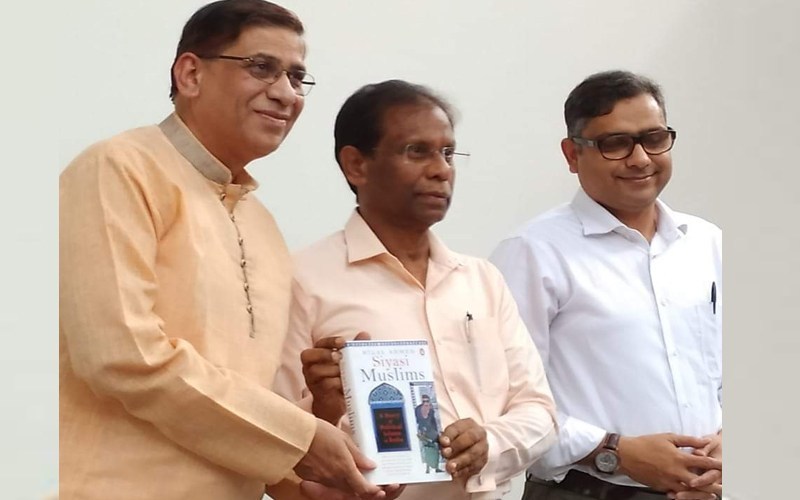
Mr. AK Khan and Prof Faizan Mustafa holding the book following its release by Mr. Khan at Lamakaan, Banjara Hills. Author of the book Dr. Hilal Ahmed looks on.
Hyderabad :
Mr. AK. Khan, advisor to the Telangana State government on Minority Affairs, released a book, Siyasi Muslims, on Thursday evening at Lamakaan, Banjara Hills, Hyderabad.
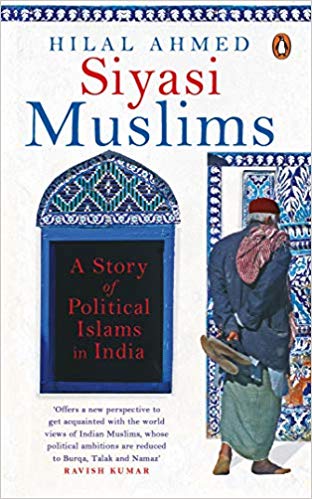
The book written by Hilal Ahmed is ‘a story of Political Islam in India.’ It is published by Penguin India.
Prof M Faizan Mustafa, an eminent jurist and Vice Chancellor of NALSAR, reviewed the book describing it as an important read in changing political and economic scenarios in India.
According to the author, “The book answers questions on political Islam; nationalist Islam; Good Muslim vs Bad Muslim, etc.
The other pertinent questions asked by Hilal Ahmed, Associate Professor at the Centre for the Study of Developing Societies (CSDS), New Delhi, include, “How do we make sense of the Muslims in India? Do they form a political community? Does the imagine conflict between Islam and modernity affect the Muslims’ political behavior in the country? Are the Muslim religious institutions—mosques and madrassas directly involved in politics? Do they instruct the community to vote strategically in all elections? What are Muslim issues? And finally, are Muslims in India truly nationalists?”
The book releasing ceremony was attended by a large number of the intelligentsia, academics, scribes, and others.
source: http://www.siasat.com / The Siasat Daily / Home> Hyderabad> News / by Safoora / May 03rd, 2019
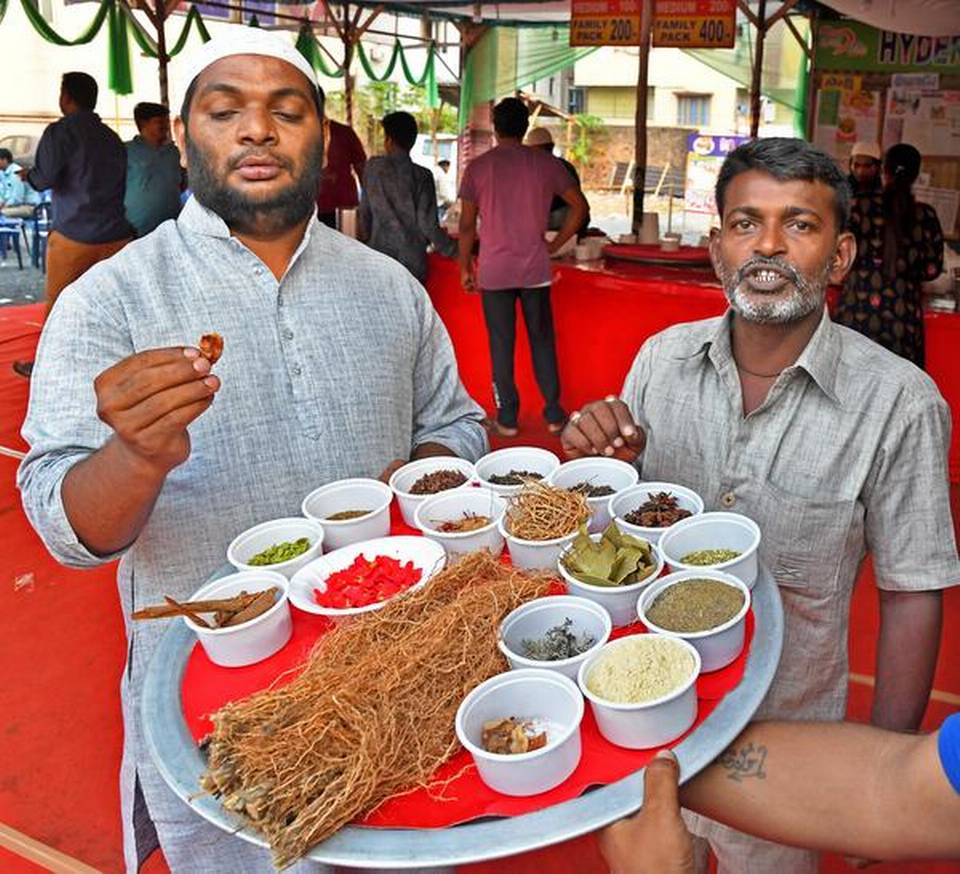
Sheikh Zuber and ‘master’ Rasool Bhai describe the Ramzan-special haleem they cook that has earned them considerable fame
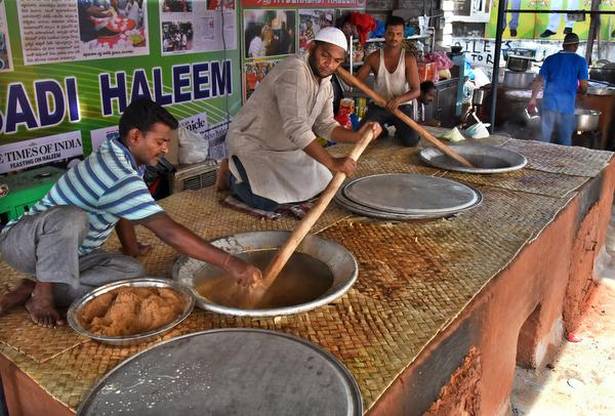
Through the cacophony of Jagadamba Junction one can still hear the call to prayers from the Macca Masjid. I am standing at the ‘Dil Se Hyderabadi Haleem’ stall where Sheikh Zuber and Rasool Bhai with two big wooden ladles stir something aromatic in the two huge cauldrons. It’s the holy month of Ramzan and in less than an hour’s time this stall will be teeming with people, waiting to be served one of the the most sought after haleems in the city.
In the 10 years it has been here, the demand for haleem has only gone up, says stall owner Sheikh Zuber. “We make haleem with 25 kilograms of mutton and 70 kilograms of chicken every day,” he says as he prepares to ladle the creamy haleem from the cauldron into small aluminium containers.
The process of making this Ramzan special dish is laborious and time-consuming. It requires physical strength and an ability to tolerate the fiery heat generated by the cooking food .
When Sheikh first set up his stall, it was not even half the size of what it is today. He says, when he started, all he wanted was to bring the flavour of the authentic Hyderabadi haleem to Visakhapatnam. In the initial four years, he offered just chicken haleem as it was more economical. “I hardly used more than 20 kilograms of chicken every day. At that time the city had just about a handful of haleem stalls. But over the years more stalls came up,” he says. Today, the bylanes around Jagadamba Junction have a festive feel during Ramzan and the celebrations are centred around this delicacy.
Sheikh attributes the magic of his haleem to haleem master Rasool Bhai who always “wields his magic”. Growing up in Hyderabad, Rasool learnt to perfect this dish from an early age. Even after three decades of experience he is never complacent. His job begins at midnight once the cauldrons are cleaned and prepared for the 28-hour cooking process. Assisting him are two other junior haleem masters and a team of workers who work through the night.
Mutton and chicken, sourced from local vendors, are put to boil with the potlimasala in the cauldrons. “The secret to the best haleem flavour is trapped in this masala,” shares Rasool. Each haleem master has a potli masala, which includes cardamom, black pepper, shah jeera, rose buds and other ingredients.
_________________________
Best flavours in town
Dil Se Hyderabadi Haleem – Jagadamba Junction
Nawabi Haleem – In front of Macca Masjid and Siripuram (opp. HSBC)
Nizam’s Kitchen Haleem – Jagadamba Junction
Ramzan Specialities – Hotel Green Park
_________________________
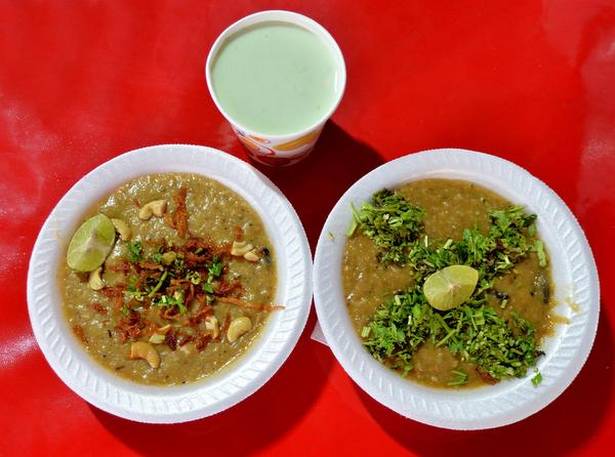
The meat is boiled for about 24 hours and then put on ‘dum’ for a couple of hours. This is accompanied by periodic rounds of breaking up the meat with the wooden ladles. Sheikh and Rasool keep a watchful eye on it and even take turns with the ladles. Once the creamy meat is ready, it is served with a garnish of caramelised onions and cashews. “It is worth all the hard work when we see the satisfied smile on our customer’s face,” says Sheikh. His stall draws people not just from across the city, but even from neighbouring districts. Krishna Chaitanya, an engineering graduate who is a regular at Sheikh’s stall describes it as a “rich and deliciously spicy dish that makes it a great evening snack.” The haleem is served from 4 pm onwards and on most days it is sold out by 7 pm.
Sheikh also serves paya roti in his month-long Ramzan menu and kaddu ka kheer.
(Living Vizag is a weekly column that profiles people who make the city special, and explore it through their eyes.)
source: http://www.thehindu.com / The Hindu / Home> Life & Style> Food / by Nivedita Ganguly / May 15th, 2019
The startup makes bespoke shoes for customers, offering a wide array of designs to choose from
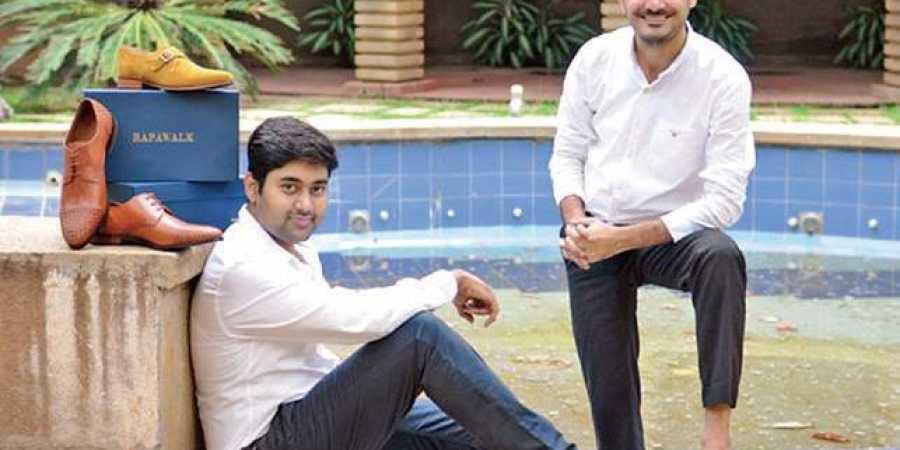
Rapawalk is an one-year-old brand launched by two 29-year-old IIM-A graduates Aravind Maddireddy (left) and Kashif Mohammad
Bengaluru :
Men, if you feel like the choices in a retail footwear store don’t match your taste, you can design your own pair of oxfords, derbys, mocassins, boots or whatever may be your style in a size that fits you perfectly. Rapawalk, a year-old brand launched by two 29-year-old IIM-A graduates Kashif Mohammad and Aravind Maddireddy, is all about giving a buyer a range of designs in shoes to choose from and customise to the required size and fit.
“In India alone, about 10 different foot profiles exist. A standard size cannot fit all,” says Mohammad, who along with Maddireddy, spent 18 months doing research on foot profiles, sizes, designs and fitting to cater to the specific needs of the Indian population. Rapawalk offers two range of shoes: An essential collection, which is priced between `2,000 and `3,500 and a premium range, which is priced above `5,000. They currently outsource material from Italy and Argentina and have set up two manufacturing units in North and South India, the principal one being located in Bengaluru.
A team of designers and artisans run the show with equipment carefully curated and accumulated from around the world. The founders are driven by the idea of providing a seamless fitting mechanism for shoes that are, according to them, an ideal part of every outfit.
“We’ve built a steady base of 1,500 customers who buy from us regularly. The response has been good after we recently launched the casual wear range. Leather sneakers customisation is on the cards next,” added Mohammad.To place your order, book an appointment at www.rapawalk.com.Alternatively, you can place your order online on the website or at Myntra, the e-commerce platform the company has recently partnered with.
Why Rapawalk?
The duo was inspired by the ‘Rapa Nui’ islands in the pacific. These islands are surrounded by many types and forms of crustaceans that change size, form and colour if under threat. Size, form and color customisation is what the brand goes by, thus the name Rapawalk.
source: http://www.newindianexpress.com / The New Indian Express / Home> Cities> Bengaluru / by Eva Mathews / Express News Service / May 28th, 2019
Shaamil Karim, a grade 11 student at the Indian High School Dubai, was selected from thousands of entries.
Karim’s project detects if a car or person is passing by and makes the next street light brighter and the previous light dimmer, saving energy.(Shaamil Karim/ facebook)
A Dubai-based Indian boy has ranked among the top 100 regional finalists for the Google Science Fair global contest for his project to make street lights smarter, the media reported.
Shaamil Karim, a grade 11 student at the Indian High School Dubai, was selected from thousands of entries, Gulf News reported on Saturday.
His project detects if a car or person is passing by and makes the next street light brighter and the previous light dimmer, saving energy.
Karim, a 15-year-old computer whizkid who originally hail from Chennai, said his father was his inspiration to come up with a solution for power wastage.
“We were at a park late at night and all the lights were switched on. My dad said, ‘Can’t we do something about this?’ I decided to do my project to make street lights smart,” he told the Gulf News.
Karim added that his project would be around 63 per cent cheaper than infrared-based sensors.
The global 20 finalists are expected to be announced this month.
source: http://www.hindustantimes.com / Hindustan Times / Home> Education / by Indo-Asian News Service, Dubai / May 26th, 2019
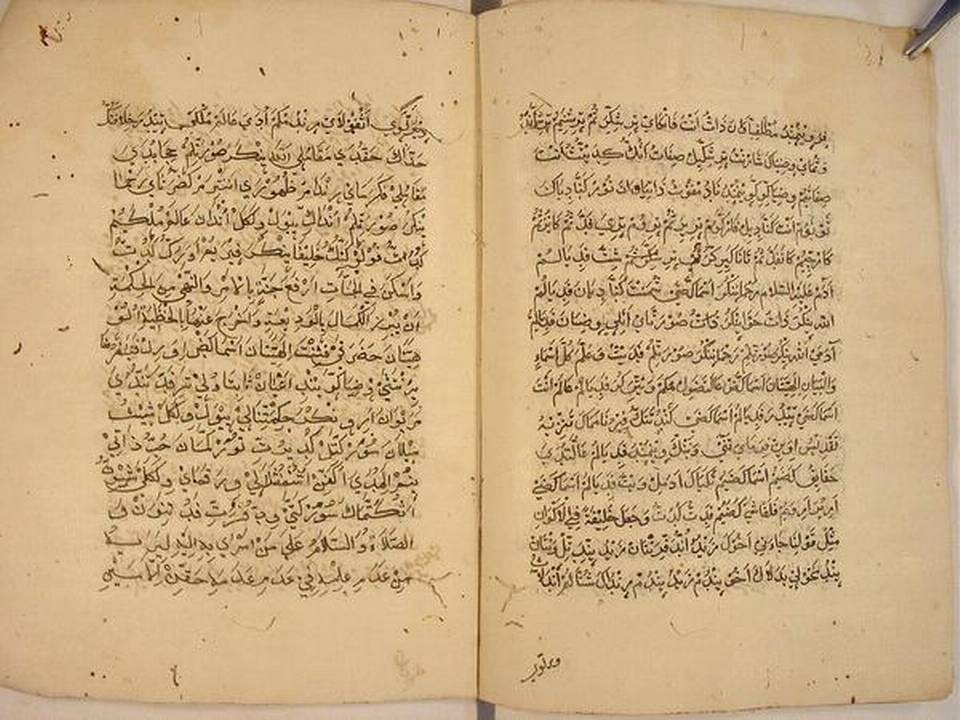
An Arwi manuscript. Photo: Special Arrangement/The Hindu
Tracing the roots of Arabu-Tamil, a link-language that evolved to facilitate communication between Arab settlers and Tamil Muslims
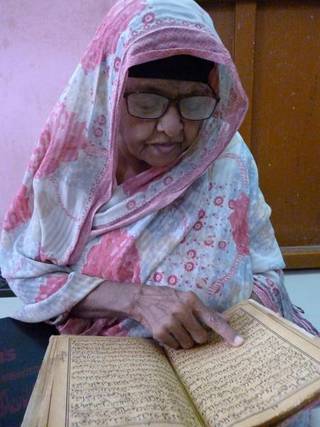
A hush falls over the room when Ammaji Akka starts reading out from the yellowing pages of a textbook called Simt-us-Sibyan (Pearls of Wisdom for the Young). Her voice may quaver, but her fingers glide surely on the modified Arabic alphabet that expresses ideas in Tamil.
The Salem-based septuagenarian is among a dwindling number of people who know Arabu-Tamil (or Lisan al-Arwi), the link-language that texts like Simt-us-Sibyan are written in. A language that evolved to facilitate communication between Arab settlers and the Tamil Muslims in southern India and Sri Lanka, Arwi was in active use from the 8th century up to 19th century.
A former Ustad Bi, or female teacher of Islamic scriptures, Ammaji Akka used to visit Tamil Muslim families at home to tutor adolescent girls and women in how to recite the Holy Quran in Arabic.
Simt-us-Sibyan (written by Maulana Mohamed Yusuf al-Hanafi al-Qadiri) was a learning tool in religious studies; and for many Tamil Muslim children up to the 1970s, used to be a part of Quran recitation classes.
Ammaji Akka, a former Ustad Bi or teacher of Islamic scriptures, reads an Arabu-Tamil booklet at her home in Salem. Photo: Special Arrangement/The Hindu
“I have four Arabu-Tamil books — Noor Nama (an account of Prophet Muhammad’s life), Simt-us-Sibyan, Ya Sayed Maalai (songs in praise of the Prophet) and Penn Buththi Maalai (advice for Muslim women). Though nobody wants to learn Arabu-Tamil anymore, I still read these books out loud after the evening (Maghrib) prayer, because I believe they will bring good fortune to the neighbourhood,” says Ammaji Akka.
Linguistic influence
The impact of Arabs on the Indian subcontinent is most evident in its languages; and Arabu-Tamil is just one of the several hybrid tongues that were once prevalent here.
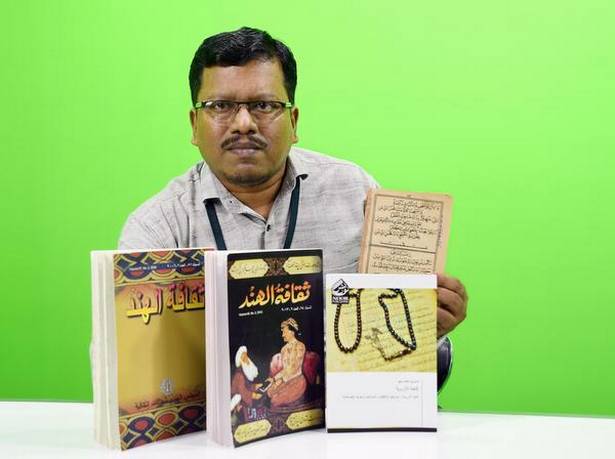
“The vocabulary and certain grammatical features of indigenous languages like Hindi, Punjabi, Bengali and Sindhi have been affected by Arabic,” says KMA Ahamed Zubair, assistant professor, Department of Arabic, New College, Chennai, who has written four books on Arabu-Tamil. “Some of the languages along the western and southern coasts of India even adapted the Arabic script, as evident in Sindhi, Arabu-Tamil, Gujarati, Arabu-Malayalam, Arabu-Telugu and Arabu-Bengali.
“According to catalogues maintained in the Madras Archives Library, there are 3000 Arabu-Tamil books dating from 1890-1915, on a variety of subjects,” says Zubair. While the Arabu-Tamil texts still in use seem to be primarily religious in nature, the language had covered general topics like sports, astronomy, horticulture, medicine, and children’s literature, among others, when it was in common usage. On most social occasions, such as weddings, invitations would be issued in Arabu-Tamil.
“The Bible was translated in Arwi. There are four Arwi dictionaries published in the 1930s. Magazines in the language were printed in Ceylon and Rangoon since the 1870s,” says Zubair.
Dr KMA Ahmed Zubair of New College, Chennai, with books on Arabu-Tamil. Photo: R. Ravindran/The Hindu
Literacy drive
Arabu-Tamil spurred a major literacy drive in the Tamil Muslim community in pre-independence India, with women especially using the language to play vital roles in education, medicine and even politics.
“In those days, Tamil Muslims were invariably taught Arabic, not Tamil,” says J Raja Mohamed, former curator of Pudukottai Government Museum, who has chronicled the use of the language in his book Maritime History of the Coromandel Muslims (A Socio-Historical Study on the Tamil Muslims 1750-1900). “In conservative families, women were educated in Arabu-Tamil rather than Western languages. Many people still have archive files of personal correspondence and bookkeeping ledgers in Arabu-Tamil. Most of the Islamic folkloric traditions such as prayer songs and hymns in praise of the Prophet were recorded in this language.”
Tamil Muslim merchants were the descendants of Arab maritime traders who had settled down in the coastal areas of southern India. The power of this mercantile community declined in the early 20th century due to stiff competition from the British and the reluctance of the Tamil Muslims to adopt new shipping technology and modern education.
After independence, Arabu-Tamil started losing out to the predominance of English in nearly every sphere of life, and has become an heirloom language that only a few can remember. Seminaries in Kayalpattinam and Kilakkarai are among the places where rare Arwi manuscripts can be found. With qualified calligraphers of Arwi no longer available, most printers have stopped publishing Arabu-Tamil books.
_________________________________________
How it works
The Arwi alphabet consists of 40 letters, out of which 28 are from Arabic, and 12 are devised by adding diacritical marks that allow Arabic letters to express sounds particular to Tamil.
Common loan words from Arabic that are still in use in Tamil:
Abattu (danger, from the Arabic root Aafat)
Baaki (remaining, from Arabic root Baaqi)
Jilla (district/zone, from Arabic root Zill’a, one side of a triangle)
Wasool (levying/collection, from the Arabic root Wusool, arrival
_______________________________________
Need for revival
It is ironic that while Arabic is taught at graduate level in several colleges across the State, Arabu-Tamil doesn’t get much attention, except in a few madrassas (religious schools).
“Arwi works should be introduced as Open Educational Resources (OER) content to reach Tamil Muslims and the diaspora living in Malaysia, Singapore, Myanmar and Bangladesh,” says Zubair, who has devised Unicode substitutes for four Arwi characters in a research paper.
There are others who are hoping to revive interest in the language among young people. E Mohamed Ali, a former telecom employee based in Tiruchi, learned Arwi in his childhood through the devotional songs taught by his mother.
He is currently transliterating into Tamil, the Arwi song anthologies Tohfat-ul-Atfal and Minhat-ul-Atfal written by noted Sri Lankan Islamic scholar Syed Mohamed Alimsa for a local magazine, and is also planning to release an audio CD of the same with young singers.
“Arabu-Tamil enriched not just Arabic, but also Tamil, in many ways. Notable poets and writers of the coastal districts have written extensively in this language. Bringing it back would be a rewarding experience for the coming generations,” says Ali.
source: http://www.thehindu.com / The Hindu / Home> Society> History & Culture / by Nahla Nainar / May 24th, 2019
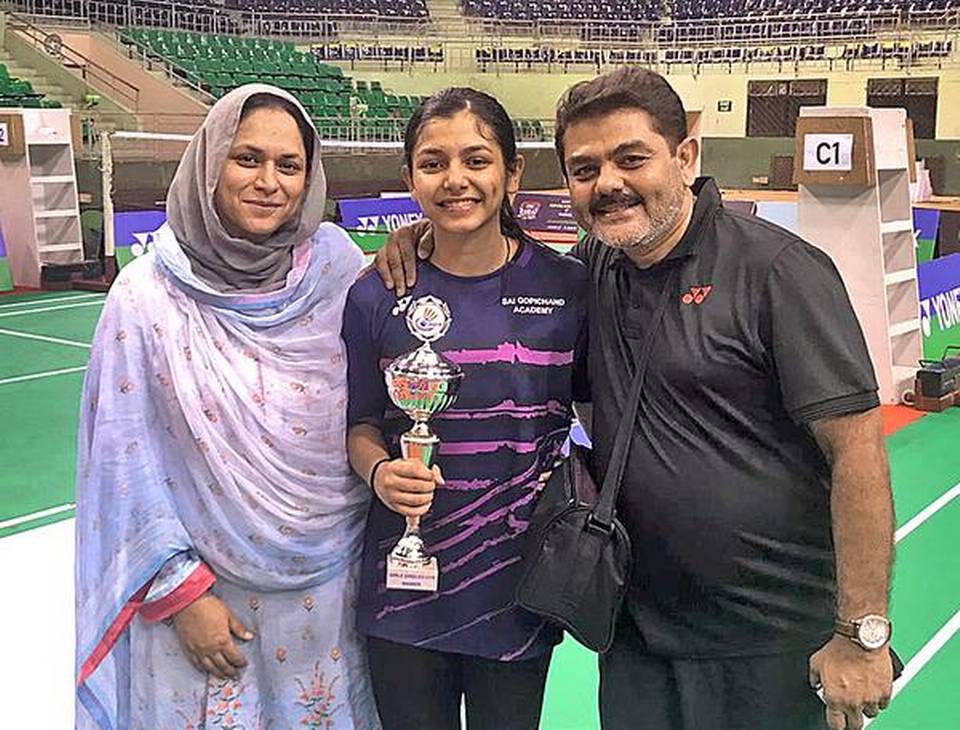
Champion shuttler Samiya Imad Farooqui with her parents.
City girl wins national ranking tourney in Chennai
She is rated to be one of the best young badminton talent in India. And, on Sunday, the 15-year-old gifted shuttler from the city, Samiya Imad Farooqui, served a reminder of her growing stature, winning her maiden National under-19 ranking tournament in Chennai on Sunday.
“It feels great to win the first-ever title as I really worked had in extremely hot weather and it will remain a special one. Frankly, I never expected to win it but just tried to give off my best,” the articulate young champion from the city informed The Hindu on her return on Sunday evening.
The 10th standard Open school student interestingly won the ABC under-15 title two years ago but never a national-ranking event. “Yes, when I look ahead, this title is sure to spur me to achieve big. I am thankful to Gopi Sir who has been my mentor and always there to help me in giving those invaluable tips,” says Samiya. “I am privileged to see the big guns like Saina, Sindhu train in the same Academy since 2009 and sometimes they do encourage me, stressing the importance of fitness,” she said.
A huge fan of the World No.1 Tai Tzu Ying of Taipei, the young Hyderabad shuttler confesses that sometimes she tries to play like her idol even while acknowledging that it is never going to be easy. “Yes I see a lot of her videos, she is such a great player,” she added. Samiya also points out that she needs to work a lot more on fitness and reduce the unforced errors for better results.
Mantra for success
Her mantra for success is pretty simple – under pressure, keep the shuttle in play and minimise the errors. And, Samiya says she did exactly that in Chennai to win her maiden national title and hopes to repeat such performances in the days to come.
And, her next big assignment is in Thiruvananthapuram – All India ranking championship this month-end. This young girl will be flying back from the city within two days and is not deterred by the hectic schedule.
source: http://www.thehindu.com / The Hindu / Home> News> States> Telangana / b y V.V. Subhrahmanyam / Hyderabad – May 26th, 2019