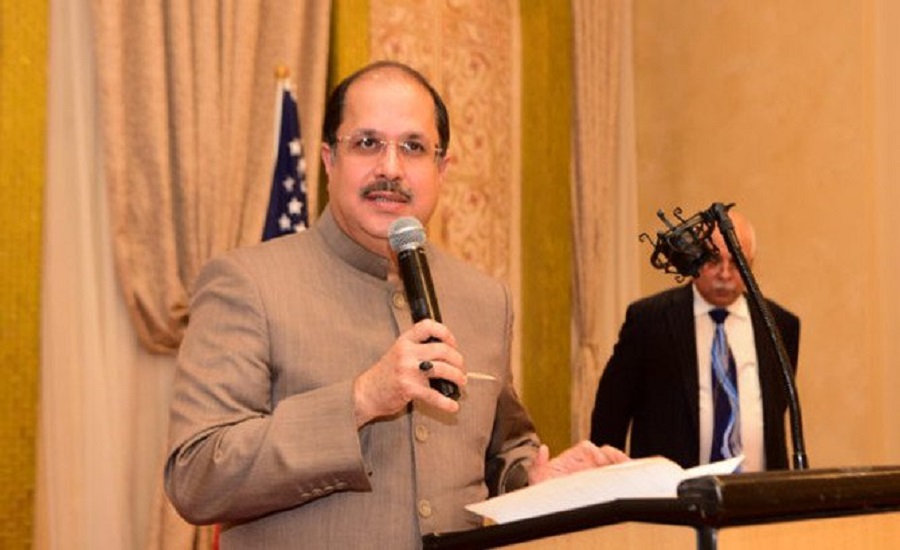
Dr Ausaf Sayeed’s last posting in the Kingdom was as the consul general in Jeddah from August 2004 to July 2008. — File photo
Exclusive Interview
HYDERABAD-based Dr Sayeed served in Saudi Arabia thrice in different capacities – first, as the Consul (Haj) in Jeddah in 1995-96, then as the Second/First Secretary in Riyadh from 1996-98 and as Consul General of India in Jeddah from 2004-2008. He has earlier served as the Consul General of India in Chicago (for mid-west US) and as the Ambassador of India to Seychelles before assuming charge as the subcontinent’s Ambassador to Saudi Arabia. Dr Ausaf Sayeed hails from a literary family. His father Awaz Sayeed is a literary figure in Hyderabad.
“The bilateral relations between India and Saudi Arabia are at an all-time high”, believes the newly appointed Indian Ambassador to the country Dr Ausaf Sayeed. Crediting the step up to the recently concluded ‘highly successful’ first state visit of the Saudi Crown Prince Mohammed Bin Salman, the Indian Ambassador discusses the benefit of Saudi investments in India, problems of the Indian Diaspora and plans to adopt a pro-people approach in this exclusive first interview with Syed Khalid Shahbaz, after his appointment as the Ambassador of India to Saudi Arabia.
Following are the excerpts of the interview:
How do you perceive returning to Saudi Arabia this time as an Ambassador?
I have served in the Kingdom of Saudi Arabia thrice before in various capacities – first as Consul (Haj) in Jeddah in 1995 to 1996, then as Second/First Secretary in Riyadh from 1996 to 1998 and as Consul General of India in Jeddah from 2004-2008. However, I regard my current assignment as Ambassador of India to Saudi Arabia as one of my most important and prestigious postings. It also comes at a time when the bilateral relations between India and Saudi Arabia are at an all-time high with the recently concluded highly successful first State visit of His Royal Highness Crown Prince Mohammed bin Salman bin Abdul Aziz Al Saud, Deputy Prime Minister and Minister of Defence of the Kingdom of Saudi Arabia to India from 19-20 February 2019.
What according to you are issues faced by Indians in Saudi Arabia?
We have a large Indian Diaspora comprising of 27 lakhs individuals who are working in different sectors of the Saudi economy and contributing meaningfully to the development of the Kingdom. The Indian workers generally enjoy a very good reputation in all the Gulf Countries, including Saudi Arabia and are much sought after for their sincerity, dedication and hard work. Over the years, the Ministry of Labor and Social Development of Saudi Arabia and the Protectorate of Emigrants and other official bodies in India have evolved a healthy mechanism of early resolution of common issues affecting the Indian workers. The Community Welfare wings of the Indian Embassy and the Consulate General of India are very proactive and are rendering real-time assistance to the Indians in need. Typically, the issues related to service conditions, payment of dues, etc. Those Indian community members with children going to high school are also faced with the challenge of higher education for their children for which opportunities are limited for expatriate children in the Kingdom.
Your service as the Haj Council and Consul General is perceived as remarkable by many. What is the reason behind this success?
I have been fortunate to work closely with people in my various assignments starting from the Regional Passport Officer in Hyderabad (May 1993- January 1995) and later as a diplomat in different countries. I had always made myself accessible to people, who could reach out to me very easily through email, phone or social media to discuss anything of concern to them. This also enabled me to understand the pulse of the people and helped me in dealing with issues in a practical and fair manner.
The bilateral relations between India and Saudi are strong. As an Ambassador to Saudi Arabia, what role will you be playing to help bilateral relations become even more formidable?
India and Saudi Arabia enjoy cordial and friendly relations reflecting the centuries-old economic and socio-cultural ties. Both countries have decided to work together closely in different fields such as oil & gas, trade & commerce, investments, security and strategic cooperation and to jointly counter the menace of international terrorism which is threatening global peace.
Saudi Arabia is a major source of energy for India, as we import about 20% of our crude oil requirement from the Kingdom. As you are aware India is the third largest consumer of crude in the world after the US and China.
Saudi Arabia is India’s fourth-largest trading partner, after China, USA and the UAE. India’s bilateral trade with Saudi Arabia is worth the US $27.48 billion. More than 420 Indian companies operate in the Kingdom through joint ventures or with 100 per cent ownership.
Recently, the Kingdom of Saudi Arabia has announced its decision to invest around US $100 billion in India in the areas of energy, refining, petrochemicals, infrastructure, agriculture, minerals and mining, manufacturing, education and health care. This includes Saudi Aramco’s proposed investment in the world’s biggest oil refinery and petrochemical complex to be set up on the West Coast of India.
My endeavour would be to closely follow-up on the various Agreements signed and other important decisions taken during the recent high-level visits between the two countries so that the bilateral political, strategic, economic and people-to-people relations are consolidated and strengthened further.
A significant proportion of Indians are returning to India from Saudi Arabia? What can be done to prevent further fallback and offer them employment in Saudi Arabia?
The migration of Indian workers to the Gulf Countries is robust and dynamic and depends on the demand and supply in these countries. Despite the nationalization of jobs in many countries, a large number of Indians continued to go to the Gulf Countries seeking newer job opportunities. We have 33 lakh Indians working in the UAE and 27 lakhs in Saudi Arabia. There were special measures put in place for Indian workers to mitigate the effects of nationalization and minimize the impact. The governments of India and Saudi Arabia have started working on integrating the migration platforms of both the countries viz., e-Migrate and e-Tawtheeq to create a robust migration environment.
Saudi Arabia is investing one billion dollars in India. Can these NRIs who are returning home be accommodated in new and proposed projects for their employment in any way?
The proposed investments from the Kingdom of Saudi Arabia in India cover diverse sectors of the economy and are expected to create growth and dynamism in these sectors which would be very good for the overall economic growth.
During your previous terms, you have proactively promoted and propagated the use of Urdu language, culture, and related traditions but the activities were not continued after your departure. Does your return to Saudi Arabia hint at its revival?
I had always encouraged cultural diplomacy and greater people-to-people engagement as an effective way of creating understanding between civilizations. During my previous stint in Jeddah, I have organized the first India Festival, the First Asian Festival the First Asian Film Festival in Saudi Arabia. I was also closely involved with the formation of the Saudi-India Friendship Society under the patronage of the Saudi Ministry of Information and Culture and the Saudi-India Civil Society Dialogue. Certainly, I would do everything possible to encourage all such constructive activities.
What is your opinion about organizing a global Urdu conference in Riyadh / Jeddah?
A large section of the Indian Diaspora in the Kingdom is Urdu speaking. I had encouraged the introduction of external Urdu examinations of MANUU in Saudi Arabia for the benefit of Non-resident Indians (NRIs). However, due to unavoidable circumstances, these examinations had to be discontinued. I was also instrumental in introducing an Annual Urdu Mushaira in Jeddah since 1995. This has become one of the most sought-after literary events in Saudi Arabia with Mushairas and other literary events being held in Riyadh and other cities too. An International Urdu Conference was also organized in Jeddah under the umbrella of the Consulate in 2008 in coordination with MAANU and several socio-cultural organizations in Jeddah. Certainly, all literary and cultural activities would be given due encouragement.
What are goals and targets during your tenure as an ambassador in Saudi Arabia?
Once I settle down I will focus on each of the areas of bilateral importance to both countries.
Your message for the NRIs?
I wish to complement all members of the Indian Diaspora for their hard-work, sincerity and dedication and for creating strong bridges of understanding between India and Saudi Arabia. I would like to assure everyone that both the Embassy of India in Riyadh and the Consulate General of India in Jeddah would adopt a pro-people approach and work closely for the welfare of the Indian community.
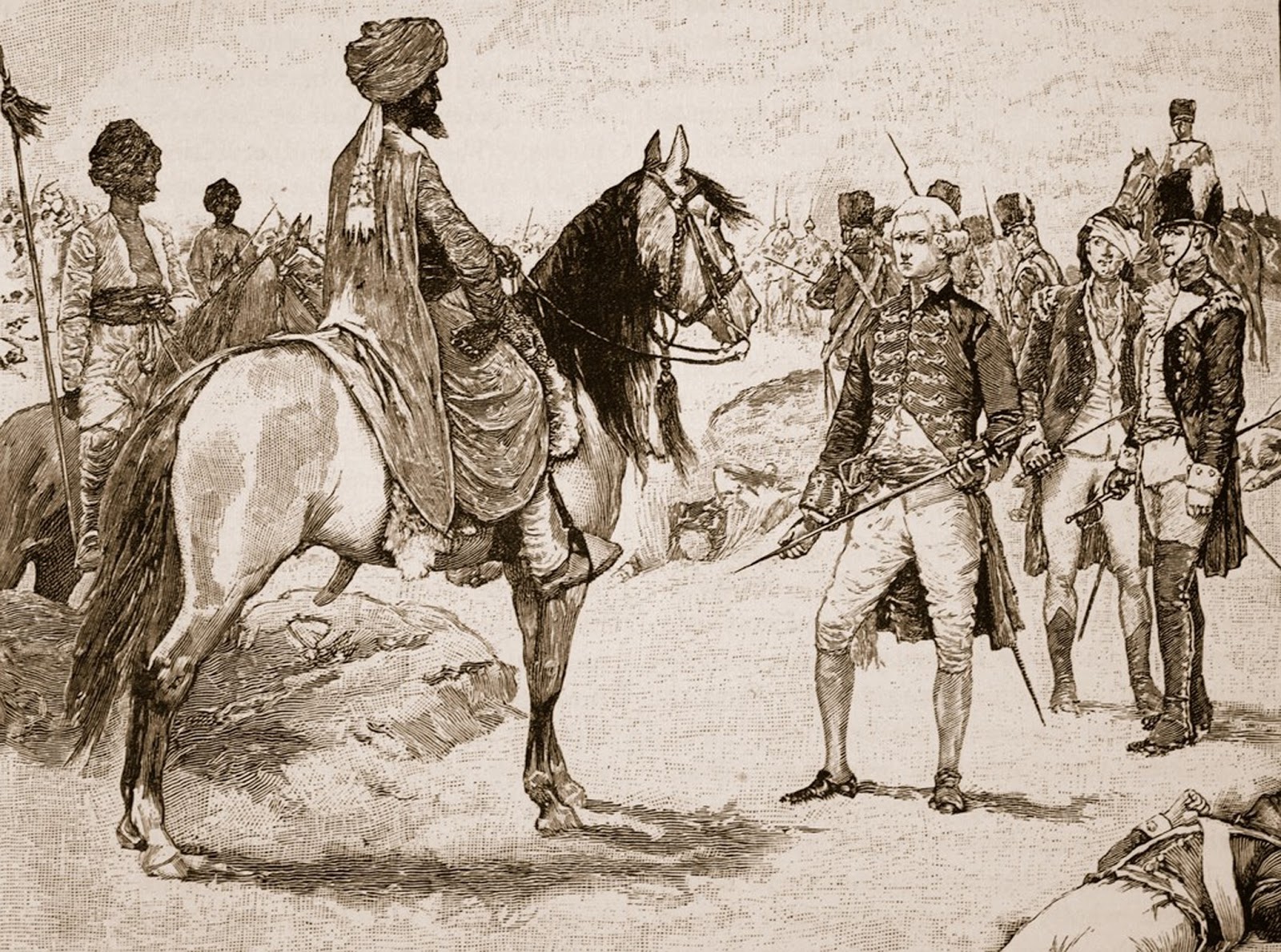
Surrender of Baillie to Hyder Ali, 1780, illustration from ‘Cassell’s Illustrated History of England’ (20th century) 1780
It was 1765 and a Duke in faraway England known for breeding race horses named his foal Hyder Ally. A few years later in 1782, and many more thousand miles away at the other end of the world, a single mast ship named Hyder Ally gave the fledgling navy of United States of America one of its greatest victories. How are these two events related and what connection did they have with the people of the erstwhile Kingdom of Mysore, the precursor to modern day Karnataka state, India?
In 1749 a 27-year old youth Haidar Ali (Hyder Ally as the British spelled his name), born at Budikote in modern day Kolar district, Karnataka put his military skills in action for the Mysore Army during the nine month siege of Devanahally Fort against a Poligor. Poligars (or Palegaras in Kannada language) were the local strong men, each controlling a few fortified settlements prior to the British rule. In early 1750s Haidar was also part of the action between the French and English in their struggle to install a person of their choice as Nawab of Arcot in which the Mysore Army sided with the English. Haidar Ali increased his stature among the military circles of the Mysore Army and was elevated asFaujdar of Dindigul in 1755. He successfully led Mysorean resistance to the Maratha invasion in 1759 and was consequently elevated as the Chief Commander of its army. Haidar’s perseverance in fighting his political foes paid off and in 1761 he was the lone survivor around the utterly weak Mysore King of the Wodeyar dynasty. He proclaimed himself a Nawab soon and found himself the de-facto ruler of Mysore Kingdom, being the most successful in protecting it from invasions by both other Indian kingdoms as well as Europeans 1. By then the British East India Company had its eyes set firmly on peninsular India having taken control of Bengal in 1757 as a consequent of the Battle of Plassey.
Back in England, Peregrine Bertie was the 3rd Duke of Ancaster in England having succeeded his father in Jan 1742 2. He raised a regiment of foot for the King of England during the rebellion in Scotland in 1745 3. He was subsequently promoted to the rank of a General in the Army in 1755 and later as a Lieut. Gen., in 1759 4. Peregrine was a leading horse racer who started a number of famous racing lines 5. He was appointed Master of the Horse to Queen Charlotte, Queen of Great Britain and Ireland in 1765. Peregrine as a military administrator was probably aware of the military and political happenings in India. In fact he was transferred in a year from the post of the Master of the Horse to the Queen to that of the King, where he was ‘responsible for overall management of all the royal stables, horses, carriages’. This transfer was due to the changes affected by the stock-holders of East India (EI) Company in England. The stock-holders were apparently alarmed by the acts of the English Prime Minister Lord Chatham to curb the influence of EI Company which by then controlled huge resources and land across in India. Given this background Peregrine was probably informed of the meteoric rise of Haidar Ali in south India’s political and military theatre. Indeed in 1760 an overconfident English Army detachment under Major Moore tasted its first defeat at the hands of Mysoreans under Haidar Ali at Trivadi near Pondicherry. And through that decade Haidar continued to spoil the political, economic and military aims of East India Company in Peninsular India with ramifications beyond this country given the global nature of the company’s trade. Did the military acumen of this Mysorean soldier play a role in Peregrine in naming his foal Hyder Ally in 1765 6,7? This may not be surprising as another race horse breeder in England named a foal Tippoo Saib in 1769 8, 9. Just a couple of years ago in June 1767, 17-year old Tipu Sultan (or Tippoo Saib as the British preferred to call him), heading a small force of the Mysore Army, stormed East India Company’s HQ in south India at Madras and nearly imprisoned the Madras councillors who threw themselves into the sea and escaped in a dingy. A year later Tipu recovered Mangalore from the British who fled the fort leaving behind their sick and wounded 10. The military and political deeds of this father-son seem to have left an impression on the British psyche.
US Navy’s tryst with Hyder Ally
Chance a race horse imported into USA by Col. Tayloe was a line of Peregrine’s Hyder Ally 8,11. Interestingly foals within America were also being named Hyder Ally (and Tippoo Saib) in 1770s.
A pamphlet advertisement for a stallion of Hyder Ally’s line published in the city of Portsmouth, USA in 1798. Accessed from Library of Congress, USA on November 5, 2017 from this link.
The first Hyder Ally to be foaled in America was in 1777 and four other foals were recorded with the name in 18th century 12, 13. But something very interesting was recorded in eye witness accounts of America’s history in 1770s. An upheaval overtook the country in 1775 as ordinary Americans rose against the Government of Great Britain, declared independence and flew their own flag 14, 15. Apparently the first flag of the Union, now the US national flag- the Stars and Stripes, sent to the state of Maryland was hosted on a sailboat by teenaged Joshua Barney at Baltimore in October 1775 who served the US Navy since then.
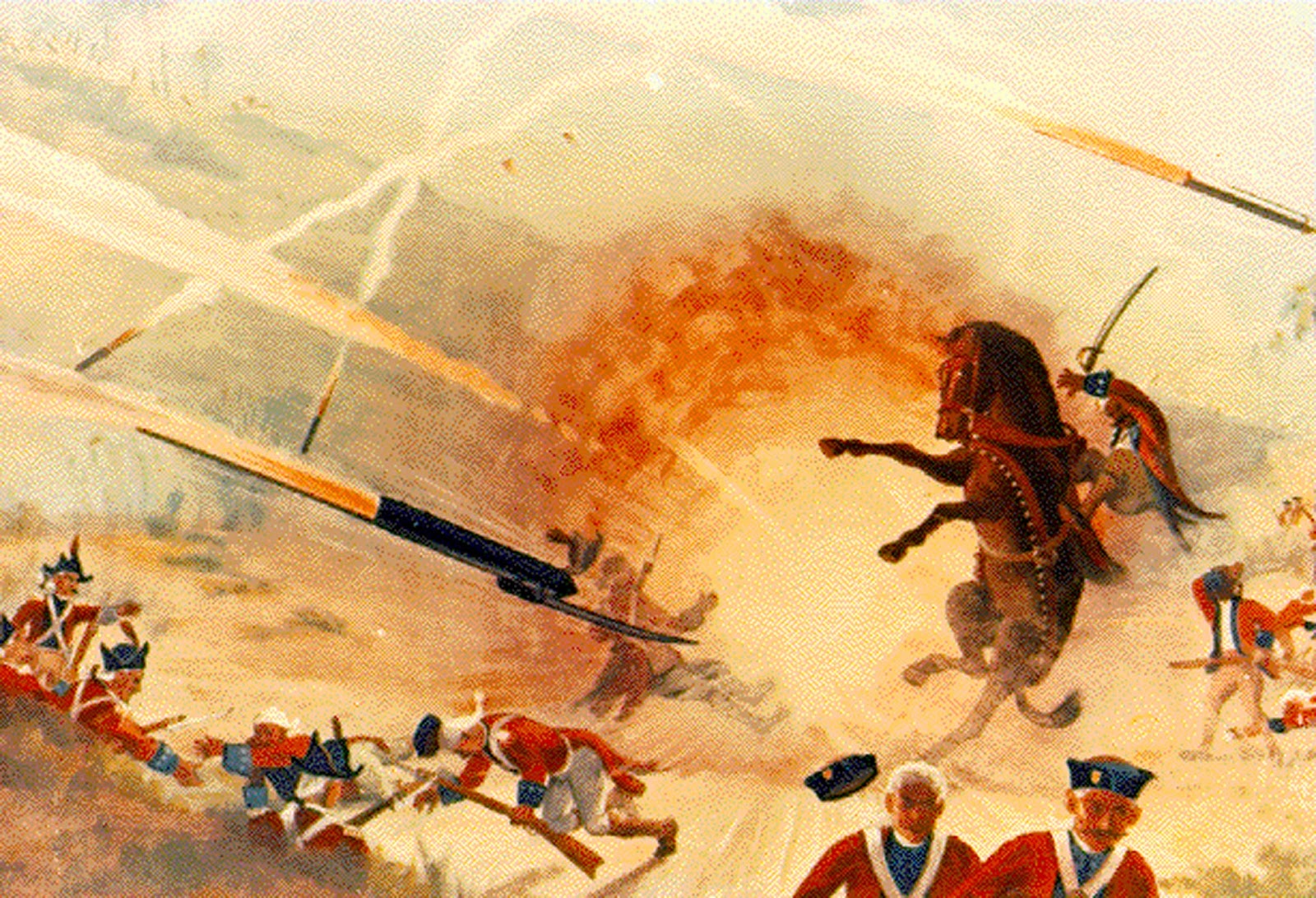
‘Rocket Warfare’, by Charles H. Hubbell (1898–1971) captures the humiliation of British at the Battle of Pollilur (Sep. 1780) by Mysorean war rockets
In 1780, in far-away Mysore Kingdom, America’s ally against the British through the French, the East India Company was suffering one of its worst reverses in its military history. The reverberations of the humiliation of British at Battle of Pollilur in September 1780 inspired the Americans who received the news 16 on 23 August 1781. On 19 October 1781, the British land force led by Charles Cornwallis (who later led EI Company’s army and its Indian allies to defeat Haidar Ali’s son Tipu Sultan in the 3rd Anglo Mysore War) surrendered to the Americans led by George Washington. Nine days later Cornwallis’ surrender was celebrated at Trenton, New Jersey with the town being decorated with American colours. The town’s who’s who along with inhabitants attended a service at the Presbyterian Church, where a discourse highlighting the occasion was delivered by a Reverend. In the afternoon the gathering drank 13 toasts accompanied with a discharge of artillery one of which was for ‘The great and heroic Hyder Ali, raised up by Providence to avenge the numberless cruelties perpetrated by the English on his unoffending countrymen, and to check the insolence and reduce the power of Britain in the East Indies’.
In October 1781, the British land force led by Charles Cornwallis surrendered to the Americans led by George Washington (Incidentally a decade later Cornwallis gave EI Company and its Indian allies victory over Haidar Ali’s son Tipu Sultan in the 3rd Anglo Mysore War in India). But America was far from being an independent nation. The British still ruled the seas. They kept a keen watch on the ships entering and exiting the ports of north east USA, often capturing the vessels and looting goods 17.
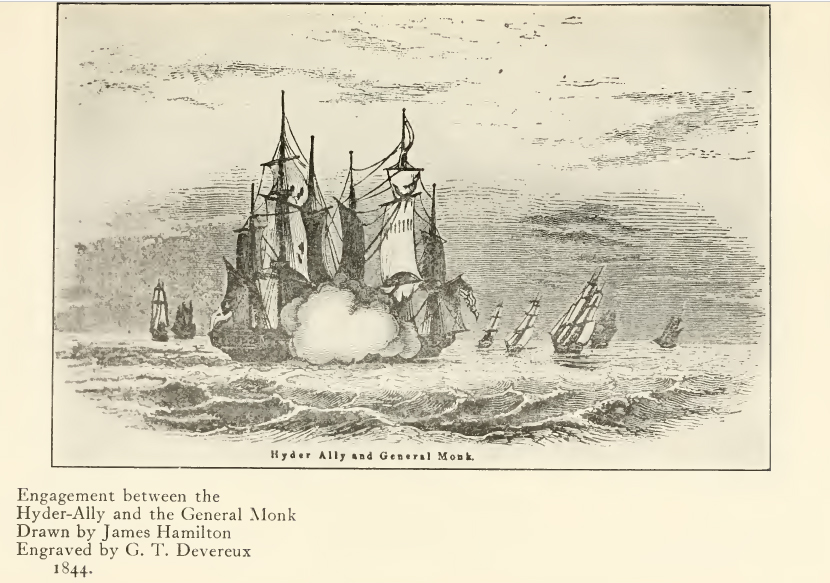
General Washington an American sloop-of-war was captured by Admiral Arbuthnot, and placed in the king’s service under a new name The General Monk, which was then used to pirate American ships. By 1782 the commerce of Philadelphia City as well as the ordinary life of the residents of the coast and nearby streams was deteriorating. As the fledgling American Union was not in a position to protect the affected vessels the State of Pennsylvania, at its own expense, fitted a number of armed vessels that operated in waters leading to Philadelphia. The state purchased Hyder Ally, a small sloop (single mast ship) equipped it with sixteen six-pounder guns to help protect the American vessels. 23-year old Lieutenant Joshua Barney, now in the US navy, arrived at Philadelphia where he was honoured with the command of Hyder Ally17. Assigned with recruiting men, Barney used a poem penned by Philip Morin Freneau18 to attract young American men to the ship. The poem exalted Haidar Ali’s bravery against the British with the following lines:
Come, all ye lads who know no fear,
To wealth and honour with me steer
In the Hyder Ali privateer,
Commanded by brave Barney.
From an eastern prince she takes her name,
Who, smit with freedom’s sacred flame,
Usurping Britons brought to shame,
His country’s wrongs avenging;
Come, all ye lads that know no fear.
With hand and heart united all
Prepared to conqueror to fall.
Attend, my lads! to honor’s call —
Embark in our Hyder-Ally!
And soon Barney led a force of a hundred and ten men. On April 8, 1872, he received instructions to protect a fleet of merchantmen to the Capes just before the sea, at the entrance of Delaware Bay. Dropping the convoy at Cape May road he was awaiting a fair wind to take the merchant ship to sea when he saw three ships19 which he realised were waiting to plunder the convoy. Barney immediately turned the convoy back into the bay, using Hyder Ally to cover the retreat. Soon the bigger General Monk under the command of Captain Rogers of the Royal Navy nearly double his own force of metal, and nearly one-fourth superior in number of men caught up with Hyder Ally. Despite being fired upon, Barney held Hyder Ally’s fire till within pistol shot when both the two vessels got entangled. A desperate fight, lasting for only 26 minutes though, resulted in the lowering of flags by General Monk indicating her surrender. Both vessels arrived at Philadelphia a few hours after the action, bearing their respective dead. The Hyder Ally had four men killed and eleven wounded. The General Monk lost twenty men killed and had thirty-three wounded including Captain Rogers himself, and every officer on board, except one midshipman!20
Source: ‘Life of Commodore Joshua Barney, Hero of the US Navy (1776-1812), 1912
A hero is celebrated
Philadelphia burst in celebrations. Ballads were made upon this brilliant victory and sung through the streets of the city! And echoing with Barney’s name was that of Hyder Ally. Here are some lines 14:
And fortune still, that crowns the brave
Shall guard us o’er the gloomy wave —
A fearful heart betrays a knave!
Success to the Hyder-Ally!
While the roaring Hyder-Ally
Cover’do’er his decks with dead !
When from their tops, their dead men tumbled
And the streams of blood did flow,
Then their proudest hopes were humbled
By their brave inferior foe.
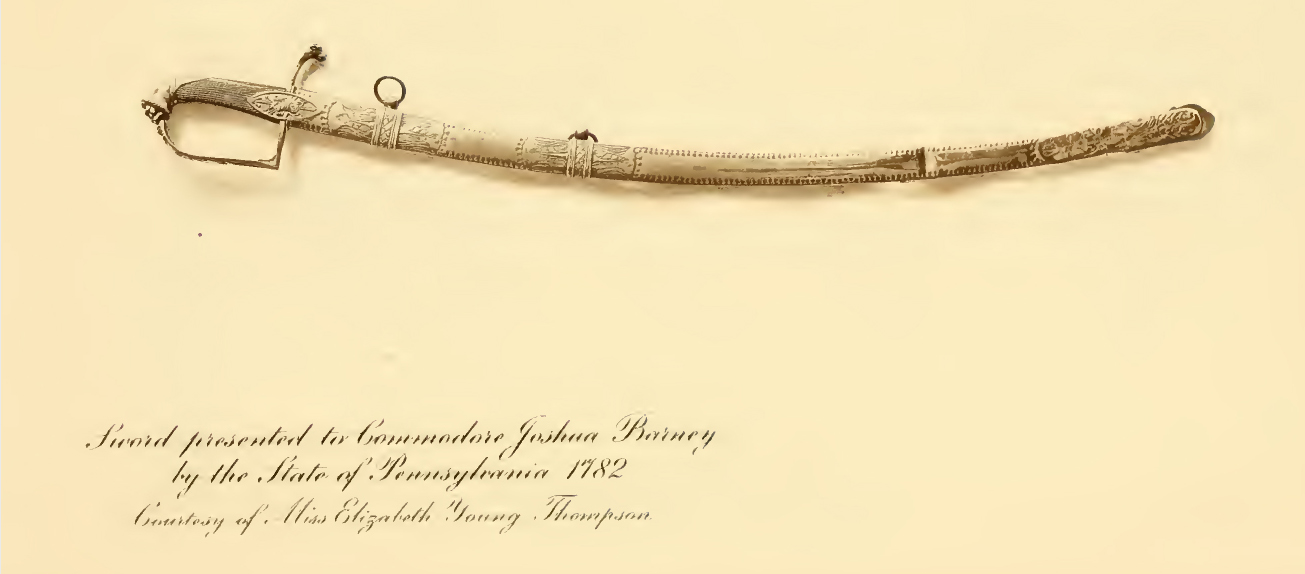
In 1782 the Legislature of Pennsylvania passed a vote of thanks to Captain Barney and ordered a gold-hilted sword to be prepared, which was afterwards presented to him in the name of the state by Governor Dickinson. It was a small sword with mountings of chased gold- the guard of which on the one side had a representation of the Hyder Ally, and on the other the General Monk 14. Barney was the last officer to quit the Union’s service, in July, 1784, having been for many months before the only officer retained by the United States.
Source: ‘Life of Commodore Joshua Barney, Hero of the US Navy (1776-1812), 1912
Barney was sent by the American Government to Paris. A reception was given in France him as a hero of dashing naval exploits during the Revolutionary War 21. A painting representing the action between the two shipswas executed in 1802 by L. P. Crepin in Paris by order of Barney, while in the service of the French Republic. The same was presented by him on his return to the United States, to Robert Smith, Esquire, then secretary of the navy 22. The painting is now in the United States Naval Academy, Annapolis, Maryland 14. Barney was an intimate friend of Count Bertrand, one of Napoleon’s generals 15. Napolean incidentally had an alliance against the British with Haidar Ali’s son Tipu Sultan, during the latter’s life time 23.
Barney was appointed a Captain in the Flotilla Service, US Navy on 1814 April 25 24. He took part in seventeen battles during the Revolutionary War and in nine battles during the War of 1812. A British Musket-ball lodged inside his body in battle at Bladensburg, Maryland in August 1814 25. He passed away on December 1, 1818, aged 60.
70 years after Hyder Ally’s victory over General Monk, James Cooper wrote “This action has been justly deemed one of the most brilliant that ever occurred under the American Flag. It was fought in the presence of a vastly superior force that was not engaged, and the ship taken was in every essential respect superior to her conqueror.”17
The world today is considered a global village thanks to the scaling down of boundaries between nation states and individuals alike. But it may surprise us even in the 18th century seemingly local political events and humans made an impact on lands and societies far away. The name Haidar Ali, after an adventurer from an obscure place in the erstwhile Kingdom of Mysore who gave many a lesson in military and political strategies to global colonial powers of England and France, echoing across the proverbial seven seas in distant North America for nearly a century is testament of this 26, 27.
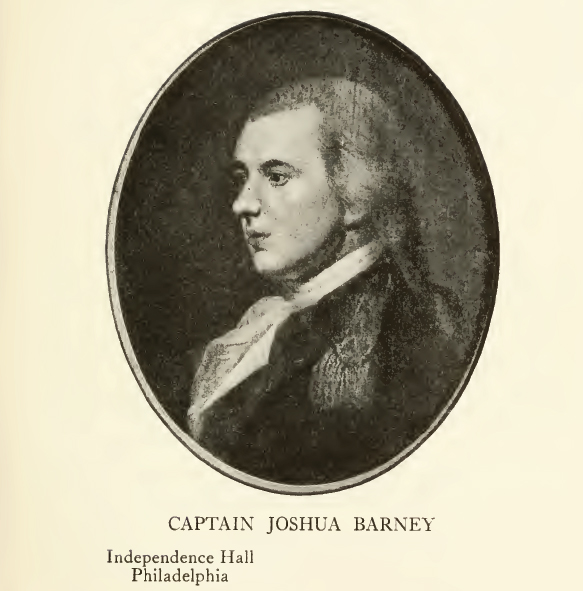
Painting of Commodore Joshua Barney at Independence Hall, Philadelphia, ‘Life of Commodore Joshua Barney, Hero of the US Navy (1776-1812), 1912
Sources/ Notes:
Col. Mark Wilks, Historical Sketches of the South of India, Volume 1 of 3, 1810. Wilks traces the origins and political lives of Mysore Kingdom’s rulers and provides an insight into their military campaigns.
The New Peerage, or Present state of the Nobility of England, Vol. 1 of 4, 1784
The Gentleman’s Magazine, Vol.78, Part 1, 1808
George Cokayne, Complete peerage of England, Scotland, Ireland, Great Britain and the United Kingdom, 1887
Allan Chivers, The Berties of Grimsthorpe Castle, 2010. Peregrine established the racing lines of Blank, Paymaster and Pacolet which were well-known in England. Their foals went to establish themselves in the US.
Blank was one of his favourite horses and he named a foal sired by it as Hyder Ally.
Hyder Ally was later sold by Bertie to C.Blake who then sold it to Richard Vernon. The later, in Oct. 1773, raced it at New Market, considered the birthplace and global centre of thoroughbred horse racing. Many of this horse’s progeny were imported into America and entered racing.
allbreedpedigree.com Online database on Pedigree horses. Downloaded Oct. 10, 2017.
It is interesting that it was not uncommon for race horses to have names originating in the east. Such names in 1700s included Mumtaz Mahal and Salim7. But Pergerine’s only horse named after a human was Hyder Ally.
Prof. B Sheikh Ali, Tipu Sultan – A Crusader for Change
American Turf Register and Sporting Magazine, Vol. 2, 1831
J.H.Wallace, American Stud Book, Vol. 1, 1867
Other books that document Hyder Ally foals and sires are William Pick and R.Johnson’s The Turf Register, and Sportsman & Breeder’s Stud-Book (1803) and Patrick Nisbett Edgar’s The American Race-turf Register, Sportsman’s Herald, and General Stud Book, Vol. 1 of 2 (1833)
A biographical memoir of the late Commodore Joshua Barney (1832) by Mary Barney sister of Joshua Barney provides in-depth information of the latter’s personal and military life.Born on July 6, 1759, 13-year old young Philadelphia Joshua Barney set sail on his maiden merchant ship journey to Ireland in 1771 with his brother in law Captain Thomas Drysdale. He sailed back home the following year and made trips to ports in Europe again. He set sail for Nice, France in December 1774 during which journey Captain Drysdale died. He took control of the ship which needed urgent repairs and therefore docked at Gibraltar, Spain instead. In a few months he sailed to Algiers, Algeria from Alicant, Spain to deliver Spanish troops during which he witnessed the annihilation of these troops by the Algerians which made him return to Alicant soon. He immediately set sail across the vast Atlantic Ocean for Baltimore, USA. As he entered the Chesapeake Bay on 1st October he was surprised by the British Sloop of war Kingfisher. An officer searched his ship and informed him that Americans had rebelled and that battles were being fought. He was fortunate enough to escape detention. Returning to Philadelphia he was determined to serve the Americans fight against British. At that time a couple of small vessels were under at Baltimore ready to join the small squadron of ships stationed then at Philadelphia and commanded by Commodore Hopkins. Barney offered his services to the commander the sloop Hornet, one of these vessels. He was made the master’s-mate, the sloop’s second in command. A new American Flag, the first ‘ Star-spangled Banner’ in the State of Maryland, sent by Commodore Hopkins for the service of the ten gun Hornet, arrived from Philadelphia. At the next sunrise, Barney unfurled it in all pomp and glory. In 1776, Robert Morris, President of the Marine Committee of the Congress offered him a letter of Appointment as a Lieutenant in the Navy of the United States in recognition of his efforts during a naval battle engagement in Delaware.
A summary of Mary Barney’s book14 is well recapped with notes in William Frederick Adams’ Commodore Joshua Barney: many interesting facts connected with the life of Commodore Joshua Barney, hero of the United States navy, 1776-1812 (1912).
Frank Moore, ‘Diary of the American Revolution’, Volume 2, 1860
James Fenimore Cooper in History of the Navy of the United States of America (1853)
‘The sailor’s invitation’, Freneau’s Poems written and published during the American Revolutionary War (1809)
Two ships and a brig- a sailing vessel with two masts
As explained by Barney himself in his painting of this war commissioned later
A. Bowen, The Naval Monument,1815, Concord, Massachusetts, U. S. A. gives an account of the reception received by Barney in France
The painting was accompanied by a description, in the hand-writing of Commodore Barney, which is reproduced in Mary Barney’s book
Record of Service, Bureau of Navigation, Navy Department, United States Navy
The conduct of Commodore Barney, at the battle of Bladensburgh, was appreciated by his military opponents as well. He was wounded in the engagement and was taken prisoner by General Ross and Admiral Cockburn but paroled on the spot. At the time of his death in 1818, the ball was extracted and given to his eldest son. For the valuable services of her husband, Congress granted Mrs. Barney a pension for life.
William Goold, Portland in the past, 1886 has information of at least one more well-known ship named Hyder Ally built in the US in 1800s after the one described in this story. This ship, like many other US ships, resorted to pirating British ships in the Indian Ocean all the way up to the island of Sumatra and around the Cape of Good Hope in South Africa in the run up to the British-American War of 1812.27. Corbett’s Annual register (1802) documents the ship ‘Tippoo Saib’ registered in Savannah, Georgia, the southern most of the 13 colonies that declared independence from the British in 1776 and formed the original ‘United States of America’.
Given the hate-spewing era that we are living in, Mumbai’s Farzeen Chaudhary is setting an example of love, peace, and motherhood
Mumbai :
Who said that having four kids, managing two schools in different cities was more than a woman can handle? Meet Mrs. Farzeen Chaudhary, 34, from Mumbai who thought that 4 kids and two schools weren’t enough things to do in a lifetime that she went ahead to foster a baby.
“I’ve always wanted to adopt, even before I became a mother of four. Little did I know that those with 3 or more kids cannot adopt as per the Indian Law”, said Farzeen. Then one random day she said she received a message looking for a foster family for a new born baby. Fostering is a relatively new concept in India. A child who has been given up for adoption takes anywhere from 2-6 months to move into his/her permanent adoptive home. So when a child is being fostered by a family he/she lives with the family temporarily and then goes away.
Some NGO’s like The Family Service Centre based in Colaba, Mumbai, believes in fostering. Where instead of keeping the baby in an orphanage during this waiting period they keep babies under their care with foster families.
Coming back to the story, Farzeen first discussed the idea with her husband who was equally excited to participate in this selfless act. It’s not everyday that such an opportunity comes your way, she said.
They both immediately got in touch with the NGO that confirmed to the message. Mrs. Chaudhary said, “We were a little apprehensive that being a Muslim shouldn’t come in our way of fostering a baby who may belong to another faith. As a Muslim I am very clear that my religion not only allows but promotes helping one another, no matter whatever be the religion. You know in the Quran there is a verse that says, ‘You were made into nations and tribes so that you may know one another, not so that you may despise each. When my religion supports me then there is no botheration.”
Farzeen Chaudhary with Rahil.
The next big concern before them were their children. How would they tell their children who are only 12, 10, 7 and 2 years old that a baby will come home, stay with them and after some time leave and go away? Being a part-time trained counselor she was concerned her children would get attached to the baby and it could cause some emotional disturbances. After some discussion, they decided to openly talk to their children.
“We both sat our kids down and told them that there is one such baby who needs a temporary house. We put it up as a problem that we were still trying to solve. My older son Ali said that of course, we should keep him with us. I was so touched and reassured we were working in the right direction. We then discussed how in life there are some things that we need to do for others. Fostering this baby will mean that we are willing to do everything for him while keeping our needs and emotions aside. It’s not about us here but all about him. Being Muslims we discussed incidences from the Prophet’s (SAW) lifetime where he had acted selflessly only to benefit a total stranger”, she said philosophically.
Now that the ground was set there were only a few days before 7 days old little angel, baby Rahil came to their house. She said it was a day of celebration coupled with equal anxiety. With tears in her eyes, Farzeen went into a flashback saying, “I’ll never forget the first few days he spent with us. As a mother of four, I could tell that he was very anxious and could sense he had been moved away from his birth mother. He would constantly cry. I had moved into my living room with him so that others could sleep peacefully. Each time he cried I held him close to my heart and while looking in his eyes I would reassure him that I would not give up on him. That he was safe with me and no one could harm him. To my astonishment, he would immediately fall back to sleep. So many nights I’ve slept with him on my chest, close to my heart. To me, he is purely a gift sent by God to teach us some very difficult lessons in life.”
She continued, “Whenever I see Rahil in the day my blood boils. I want to ask for what fault of his was he abandoned? Two people decide to indulge in sexual behaviours without being committed to marriage and out comes a baby like Rahil only to be thrown away? A few moments of pleasure can cost an innocent baby displacement for an entire lifetime! To the youngsters reading this, please think about Rahil before you indulge in such acts. He deserves the loving security of his own birth parents”. She repeated herself in anguish over and over again. The anger and the disappointment was very apparent.
It’s already been seven months since Rahil has been with Farzeen and her family. She worked out his presence in the family very strategically and says that no one in the family is very attached to him. She said it was done keeping in mind that his leaving should not disturb anyone. “After all, I am just a foster parent, any day he would be given away to someone for adoption by the NGO. When Rahil has found us who are willing to keep him forever why does the law want to displace him one more time? That kid has had enough already. I still am hopeful of a miracle happening and Rahil staying back with us, but that isn’t stopping us from being mentally prepared that one day he might leave us to stay with another family,” said Farzeen with a sigh.
On being asked, if she would continue fostering such kids, she said, “Yes. If Rahil leaves us, we will foster another child. It has been a fulfilling experience for us as a family. We have learnt to love unconditionally and open our doors to total strangers.”
source: http://www.caravandaily.com / Caravan / Home> India / Caravan News / April 17th, 2019
As Union Public Service Commission announced civil services final examination results this year some 30 Muslims appeared in the list. Muslim Mirror talked to some of the youth at the felicitation ceremony done by Zakat Foundation who cleared the exam this year.
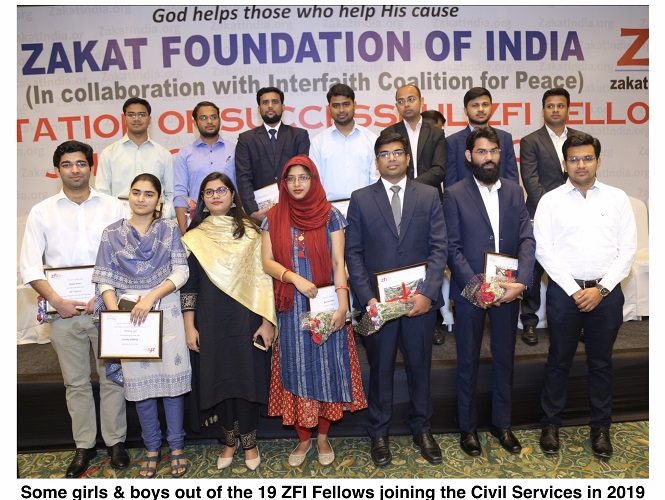
Zakat Foundation of India (ZFI) in collaboration with Interfaith Coalition for Peace organised a felicitation program for the 19 ZFI fellows who cleared the Union Public Service Commission (UPSC) exams this year.
During the event, many ZFI fellows shared the experience of their UPSC journey.
“ It doesn’t matter if you have done your schooling from a prestigious school or some of a govt. school what actually matters is the dedication level you have towards the goal,” said Shafqat Amna UPSC topper from Bihar.
Shafqat Amna is the daughter of a retired teacher of the village of East Champaran, Md Zafir Alam. She secured 186th rank in the Civil Service of UPSC, and has shown a way for Muslim girls aspiring to be IAS officer in the country.
Another inspiring story is of Maulana Shahid Raza Khan, an Islamic theology graduate from Al Jamiatul Ashrafia, and a M.Phil in West Asian Studies from Jawaharlal Nehru University (JNU). He has cleared the UPSC Civil Services Exam with a national rank of 751.
Shahid, who hails from Aminabad village in Bihar, completed his schooling from Sahapur High School in Gaya in 2007. He has an Alimiyah degree from Al Jamiatul Ashrafia, an Islamic seminary in Mubarakpur, Uttar Pradesh. Shahid is one of the few graduates of a madrasa, to receive a degree from a university and then clear the prestigious civil services exam.
“I did all my schooling from Madrasa and I had no idea about the common schooling process. I had to start from a very basic level. I used to study maths that people usually study in their class 3rd. It was a tough journey to start all over from the beginning but I am glad I made it in my second attempt, said Maulana Shahid Raza Khan from Bihar.
Another inspiring story is that of Bushra Bano. Bushara , who was a professor in Saudi Arabia said that she wanted to serve her own country and that was the reason that strengthened her goal.
“I am married, I have a child and I was doing a job so I had lot of responsibilities. It is very tough to manage your home, job and study at the same time. I didn’t join a coaching but I am very much dedicated towards my country and it motivated me to stay on the path of the UPSC journey’” she said.
If you have a ‘killer instinct’ and believe in ‘never give up’ then nothing is impossible for you. The story of Sayyed Riyaz Ahmed, a successful candidate from Maharashtra is the best example of it .
“I failed in grade 12 and made five attempts to clear UPSC exams in 2018 with 261 ranks. Failures are not a stumbling block for those who try harder,” Ahmed told the gathering who succeeded to crack UPSC in his fifth attempt.
Another successful candidate was Rena Jamil from Jharkhand who had prepared for the exams from home through ZFI guidance.
“It gives us the confidence that though the competitive exams are challenging, there is always hope for those who work hard to achieve the heights,” said Jamil, who was placed at 380 in the rank list.
The ZFI was established in 1997 as a grassroots level organization to train and empower aspirants from minority and socially backward communities to the UPSC exams.
Syed Zafar Mahmood, its president, and his team coach candidates for Civil Service examinations by placing them in reputed coaching centers.
The event was attended by SM Shakil (VP ZIF), Dr Nazira Mahmood, Justice Zakiullah Khan, Dr Tariq Mansoor (VP Aligarh Muslim University), Ms Robyn Glokoski (First Secretary, New Zealand High Commission in India), Zamiruddin Shah (ex vice chief of army staff),Prof Najma Akhter (VC Jamia Millia Islamia) and many other dignitaries from India.
source: Muslim Mirror
source: http://www.siasat.com / The Siasat Daily / Home> Featured News> News> Top Stories / by Yasmeen Khan / May 06th, 2019
The new social media-driven Indian Muslim has suddenly realised that ‘haleem’ is a name for God. What does that say about religion in a hyperconnected age?
Baba Ki Haleem/Facebook
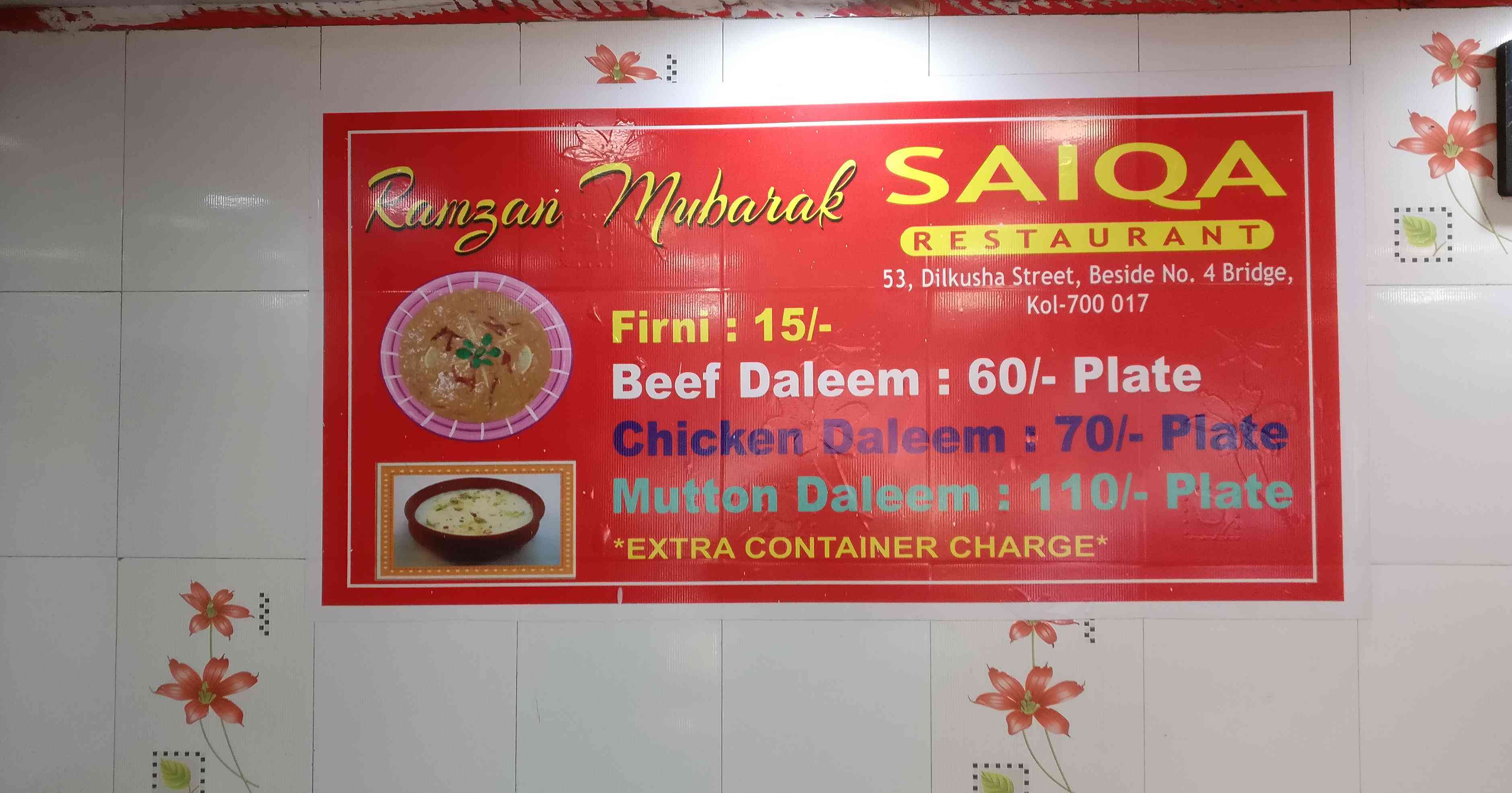
While out to buy some haleem during the first week of Ramzan, I discovered that the popular Kolkata restaurant Saiqa had introduced a new dish: daleem. A red menu board on a tiled wall proudly advertised the dish, ensuring nobody missed it.
There is a lot to be said for Saiqa, a mostly working-class place, but I had never thought food innovation to be among its charms. Curious, I asked the person manning the counter about the culinary invention – only to be met with a googly. “It’s not a new thing – it’s haleem only,” said Mohammad Asghar Ali, the son of the proprietor. “Daleem is actually the correct name.”
Photo credit: Shoaib Daniyal
Was daleem actually the right name? I had grown up eating the lentil-wheat-meat stew that was available only during Ramzan, the Islamic month of dawn-to-dusk fasting. I was pretty sure it had always been called haleem.
But as it turned out, Saiqa wasn’t an outlier. A number of Mughlai restaurants across Kolkata had made the nomenclatural switch, breaking away other restaurants that still stuck to a name of which I now suddenly felt possessive: haleem.
The question was why. Why were eateries across Kolkata – and other parts of South Asia – suddenly changing the name of this dish that crowns iftar spreads during Ramzan? As it happens, this almost trivial renaming is an indicator of just how radically social media is impacting religion and, in this case, Indian Muslims.
From Arabia to India
The origin of India’s haleem goes back to an ancient Arab dish: the hareesah. There are records of it being consumed in the Abbasid Caliphate in the 8th century. The dish was simple but laborious to prepare it : it involved boiling shredded meat, cooking it again with ground wheat all night in a tannur (or tandoor) and then, grinding this mixture to a smooth paste. This dish is still consumed in West Asia, Iran and in Hyderabad’s Arab quarter , Barkas.
Once it reached India, the simple hareesah received some significant upgrades to suit desi palates. Spices were added, as also a variety of lentils (Saiqa claims it includes 13 different kinds). A new name was given to this dish: haleem, the Persian name for the bland wheat-and-meat hareesah.
The hareesah from Hyderabad’s Arab quarter, Barkas. Photo credit: Shoaib Daniyal
Saiqa’s Asghar Ali was clear on why daleem was the correct name for the dish: “Dal se banta hai, isliye daleem.” It’s made with dal (lentils), hence daleem.
But the real reason had less to do with alliteration and more to do with the almighty. “Haleem is a name for Allah,” explained Shamsher Alam of Zam Zam, another Mughlai restaurant in Kolkata that now goes with daleem. “It seemed wrong to name a food item that uses a name for Allah, so last year I changed it.”
How did Alam realise this evident fact after happily selling haleem for two decades? As with so much else in these fractious times, the culprit was social media. “Nowadays, mashallah, we have a lot of information on WhatsApp and on the internet,” said Alam. “Someone saw it there and told me. That’s when I realised I should change the name.”
Going viral
Alam wasn’t alone. Debates around whether it’s right to name a stew after an attribute of God have raged across South Asia. In 2017, The Times of India reported on this tussle among the Muslims of Hyderabad, the world capital of haleem. Much the same discussion is happening in Pakistan and Bangladesh , too.
Not everyone in the subcontinent supports the rechristening. One Pakistani user on Twitter brusquely called it a “postmodern renaming attempt by mullah clowns ”. A Bangladeshi food blogger argued that it is clear that when she uses haleem for the name of a dish, she is not referring to the attributes of God. “Allah knows what is in my heart. I don’t intend to please a few important people,” she wrote on her Facebook page, showing the incredible power of social media in engendering conflict even on a thing as universally loved as haleem.
Kolkata’s biggest Mughlai restaurant chain Arsalan has also resisted calls to change the name. “Wakeel [the Urdu word for lawyer] is also one name for Allah. Will people stop using that too?” asked Mohammad Ghulam Mustafa, a member of the family that owns Arsalan. “People who don’t read the namaaz, read a few messages on WhatsApp and start to think they are an alim [Islamic scholar]. That is the problem.”
Social media faith
Mustafa’s snarky dismissal of “WhatsApp alims” is the most interesting insight to arise from what is at best a quirky change of name. Social media has given – for better or worse – the average Muslim more of a say in his religion, a role that was earlier performed by religious scholars.
Quite a bit of social science research has noted the impact of social media on faith and its role in weakening religious gatekeepers. American sociologist Paul McClure argues that the internet encourages “religious tinkering” and “religious participation as free agents”. Adding to that, Heidi Campbell, an American scholar of religion, notes how social media allows people to constantly reinvent their religious identities:
“It used to be that a religious identity was something you took on through maybe religious education or confirmation or baptism. You kind of put it on like a cloak. But now people see identity as something that you can negotiate, that you construct and you perform. So individuals especially use the Internet and other resources to seek out their own ‘spiritual tribe’ online – a group of people where they can make sense of their religious self and their religious belief. Facebook and Twitter, blogs, social media allow people to express their religious identity, to experiment and to create a cohesive identity that’s free from institutional constraints.”
Predating Mustafa’s “WhatsApp alim” quip, a 2011 article in The Guardian says: “Individuals now have a much more autonomous role in deciding whom to approach as a source. Those people may have official, traditional credentials or they may be Rabbi Google.”
A pot of haleem at Saiqa in Kolkata. Photo credit: Shoaib Daniyal
While the greatest impact of social media is on Christianity, given the deep penetration of the internet in the West, its effects are spreading to Muslims and how they practise their faith. Mohammed Ibahrine of the American University in Sharjah writes on the London School of Economics’ Middle East Centre blog:
“For centuries, interpretations of the Quran were kept a reserved domain for a small minority of ulama (the plural of alim). Social networking websites have become avenues for disseminating sacred interpretations, sometimes undermining traditional religious authorities. The blossoming of digital fatwas is also an indication of the splintering of orthodoxies and the emergence of heresies. Consequently, religious authority has become a contested domain, rather than an accepted reality by the uneducated masses.”
Modern conservatism
While this undermining of the traditional ulama is democratic, it might also, paradoxically, lead to conservative outcomes. In Indonesia, for example, social media is encouraging irreligious millennials to become born-again, ultra-orthodox Muslims as part of a movement known as hijrah .
While there has been no such stark change in India, clearly even here, social media is allowing people to fashion their own understanding of Islam, free of traditional social structures. One outcome of this is an attempt to follow a so-called purer form of Islam in which even a detail as trivial as the name of a stew – unnoticed for centuries – is “corrected” by social media didacticians.
source: http://www.scroll.in / Scroll.in / Home> Magazine> Language Log / by Shoaib Daniyal / June 03rd, 2019
In Aurangabad, Dalits, Muslims and other communities who faced communal violence united to buck the national trend.
Aurangabad MP Imtiaz Jaleel is congratulated by supporters. Photo: Facebook
Aurangabad:
Anyone visiting Aurangabad can sense the brewing emergency in the air. In late April, in the thick of the election, a video surfaced of a teenager – seemingly a Muslim – who abused prominent personalities of Maharashtra. Rival parties alleged that the video was being distributed by the All India Majlis-E-Ittehadul Muslimeen (AIMIM), a newcomer to the city’s politics.
Harshvardhan Jadhav, an independent candidate who was formerly with the Shiv Sena, responded with his own video, demanding an apology from the AIMIM and threatening to ransack its offices. Jadhav is also the son-in-law of the state BJP president, Raosaheb Danve.
Imtiaz Jaleel, the AIMIM’s candidate, shared another video in response, which helped calm the situation. In the video, Jaleel, while appealing for peace, denied all allegations against the AIMIM and urged the police to take strict action against those trying to instigate violence in the city. Jadhav was forced to share another video taking back his threat and apologising to the city police . This timely and sensible intervention both by the police and Imtiaz Jaleel, who represents the alliance of Vanchit Bahujan Aghadi (VBA) and AIMIM from the Aurangabad constituency, saved the city from another bout of violence.
On May 23, Imtiaz Jaleel won the Aurangabad Lok Sabha seat, becoming the first Muslim MP from Maharashtra in 15 years, and the first Muslim MP from this constituency since the Congress’s Qazi Saleem in 1980.
A new solidarity
During the campaign, the city witnessed a new solidarity, especially between Muslims and Dalit-Bahujans of the city, regularly on display at the party office of MIM at Buddi Lane near Jama Masjid in the old part of the city. In my conversations with supporters of Imtiaz Jaleel, everyone was enthusiastic about the cross-community alliance – and its potential as a watershed moment for the growth of and peace in Aurangabad in the coming years.
With a Muslim population of about 31% and Schedule Caste population of 15.7%, Aurangabad, in the heartland of Marathwada, is a hotbed of communal polarisation. Incessant violence since the 1980s, and the militant politics of the Shiv Sena resulted in a deep segregation of the city on religious and caste lines. The demand to rename Aurangabad as Sambhaji Nagar has created a more recent spectacle of Hindutva power-politics.
In January 2018, the city was hit by violence after the Bhima-Koregaon clashes . That May, again, two people died and many shops and properties were destroyed in communal violence.
The city seems on the edge of descending into a curfew-like situation. Even on the day of the Lok Sabha election results, offices and shops closed early as rumors of possible violence spread.
Urban local body elections in Aurangabad are essential for control over the city. The first corporation elections in 1988 turned the city into a battleground, and many people died. In 1985, just three years before the elections, the Shiv Sena had inaugurated the party’s city branch. There was full-scale rioting during the municipal elections in 1988 because of the Sena’s anti-Muslim politics. It won 27 of the 60 seats in the first municipal corporation elections of the city. Since then, it has been the main contender. Its dominance has led to deep-fissures in the city’s social fabric.
From the late 1980s, the Shiv Sena would dominate the parliamentary constituency; Chandrakant Khaire held his seat from 1999 to 2014.
MIM’s entry
Imtiaz Jaleel with Asaduddin Owaisi / pic Facebook
In 2015, AIMIM made its debut in civic body polls. It won 25 of the 113 seats, and emerged as the second-largest party, after the Sena-BJP alliance. In the 2014 Maharashtra assembly elections, the AIMIM’s Imtiaz Jaleel won the Aurangabad Central seat. In later municipal elections, the party worked to consolidate Dalit, Muslim and OBC votes. It has worked in its favor, presenting a secular and accommodative image on the ground.
After last year’s Bhima-Koregaon attacks, many Dalit voters moved away from the Shiv Sena. Four-term MP Chandrakant Khaire lost the citizens’ confidence more generally. His interference in the municipal corporation and zilla parishad had alienated residents, and the city’s garbage and water crisis had become his signature failures. This also contributed to Harshvardhan Jadhav’s split from the Sena-BJP alliance. As a result, this election was a battle between two pro-Hindutva candidates, Jadhav and Khaire. This allowed the MIM-VBA candidate to win by a margin of just 4,492 votes over Khaire.
Post-1980, incessant violence in cities like Mumbai, Ahmedabad and Aurangabad has forced Muslims into geographic areas where they are cut-off from the mainstream. This spatial division has made Muslim spaces more vulnerable to violence, and irrelevant and invisible to the larger electoral and cultural politics of the nation.
Since the communal violence of 1988 in Aurangabad, the city has become more segregated everyday due to the capture of the political stage by Hindutva parties. In the absence of a progressive politics to bridge the gaps between the communities, ties could not be rebuilt.
In 2019, however, a new assertion – bringing together Dalits, Muslims and other communities who faced the worst of the violence these last three decades – offered a glimpse of a new politics, and of a city turning from hate and toward assimilation and peace.
Asaf Ali Lone is an independent researcher. His research interests are urban segregation, marginalities and resistances.
source: http://www.thewire.in / The Wire / Home> Politics / by Asif Ali Lone / June 08th, 2019
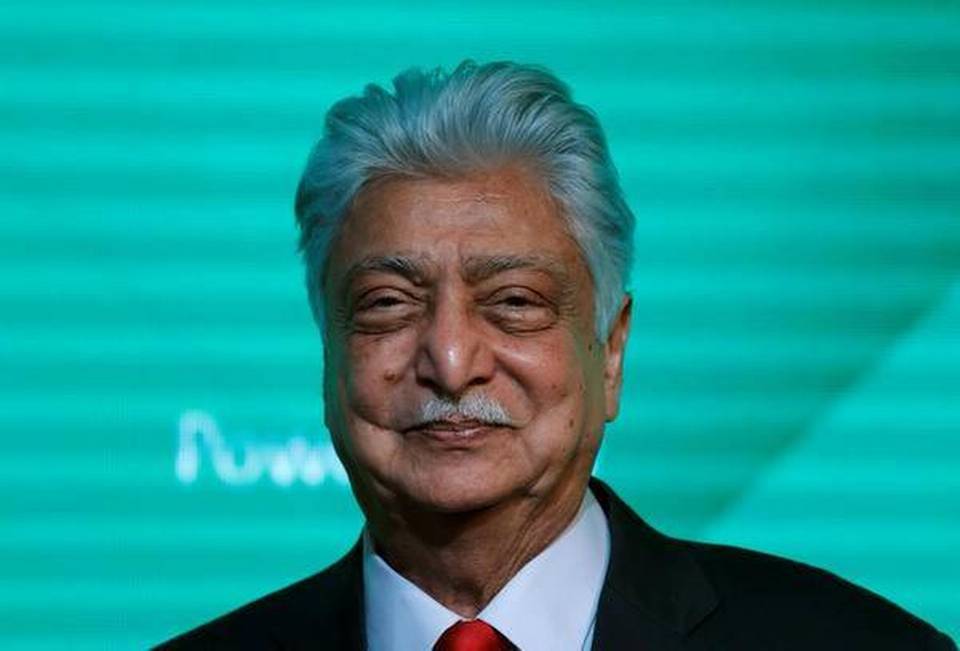
IT major Wipro founder Azim H. Premji, who turned a small maker of vegetable oil into a $8.5 billion software behemoth, will retire as the company head by July-end and handover reins of the firm to his son, Rishad.
Mr. Premji, who turns 74 next month, will retire as executive chairman upon the completion of his current term on July 30, 2019, after having led the company for 53 years, Wipro said in a statement.
He, however, will continue to serve on the board as a non-executive director for five years till July 2024 and has also been conferred the title of founder chairman.
Wipro board also announced that chief executive officer and executive director Abidali Z. Neemuchwala will be re-designated as CEO and managing director, while Rishad Premji will be re-appointed as whole-time director for a period of five years with effect from July 31, 2019, to July 30, 2024. Mr. Rishad Premji will be designated as executive chairman.
These changes will be effective July 31, 2019, subject to shareholders’ approval.
₹52,750 crore for philanthropic activities
A recipient of Padma Bhushan and Padma Vibhushan awards, Mr. Azim Premji now plans to devote more time for philanthropic activities.
He had, in March 2019 gifted an additional ₹52,750 crore of the company’s shares to support philanthropic activities, making it the most generous donation in the nation’s history.
About 34% of shares held by companies controlled by Mr. Azim Premji, India’s second-richest person, were irrevocably renounced and earmarked to the Azim Premji Foundation, taking the total donations to over ₹1.4 lakh crore.
Mr. Azim Premji’s Foundation, which works in the education sector and supports over 150 non-profits serving under-privileged with financial grants, has 67% of economic ownership of Wipro.
‘Pioneers of Indian technology industry’
“Azim Premji, one of the pioneers of the Indian technology industry and founder of Wipro Limited will retire as executive chairman upon the completion of his current term on July 30, 2019 after having led the company for 53 years. However, he will continue to serve on the board as non-executive director and founder chairman,” Wipro said in a statement announcing the top deck changes.
Mr. Azim Premji transformed a small hydrogenated cooking fat firm to a $8.5 billion global tech titan that is counted among India’s top IT exporters and also led the transformation of Wipro Enterprises into a global FMCG, infrastructure engineering and medical devices powerhouse, with revenues of about $2 billion.
He will remain the chairman of Wipro Enterprises and continue to chair the board of Wipro-GE Healthcare, the statement added.
“It has been a long and satisfying journey for me. As I look into the future, I plan to devote more time to focus on our philanthropic activities. I have great confidence and trust in Rishad’s leadership to steer Wipro in its next phase of growth as we move forward,” Mr. Azim Premji said.
‘Unflinching commitment’
Commenting on the changes, chairman designate Mr. Rishad Premji said Wipro has, over the decades, demonstrated that success can built on the foundation of strong values and uncompromising integrity.
“This is a testament to the spirit and dedication of thousands of Wiproites. I am very excited about our future and the opportunity to create value for all our stakeholders in these transformative times for Wipro and the technology industry,” he said.
Ashok S. Ganguly — independent director and chairman, Board Governance, Nomination and Compensation Committee at Wipro — said Mr. Azim Premji’s “unflinching commitment” to values made him an exemplar of how business and ethics can and must go together.
“His exceptional generosity makes him one of the greatest philanthropists of our time,” he added.
Mr. Ganguly further said that Mr. Rishad Premji’s understanding of the global technology industry, strong strategic orientation and diverse leadership experience make him the “right person to guide Wipro”.
“He is also best positioned to represent the interests and fundamental social purpose of the largest shareholder of Wipro,” Mr. Ganguly noted.
source: http://www.thehindu.com / The Hindu / Home> Business / by PTI / Bengaluru – June 06th, 2019
These women embodied feminism long before it became a part of the zeitgeist.
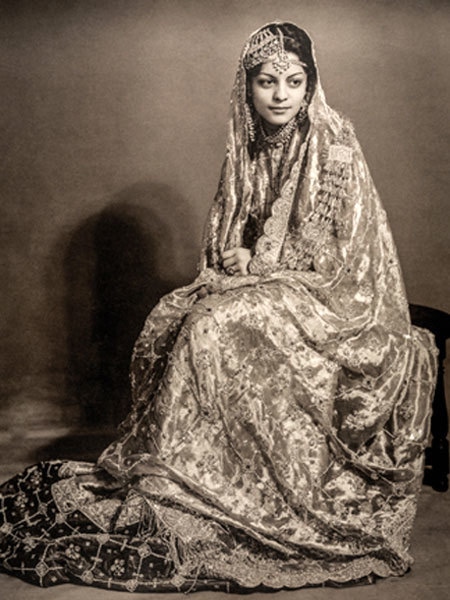
The heiress apparent to the throne of Bhopal, Abida Sultan, wore her hair short, played the saxophone, had her own band, sped around in a Daimler, and when her husband announced that he’ll assume custody of their son, threatened to kill him with the pistol she kept in her pocket. All the while, she remained pious and committed to Islam.
Abida Sultan’s autobiography, Memoirs of a Rebel Princess, was unabashed and far from removed from the stereotypical picture of an oppressed Muslim woman. In the book, she wrote frankly about her conjugal life and her inability to be the good, dutiful wife. But could one expect any less from the child of a feminist royal lineage?
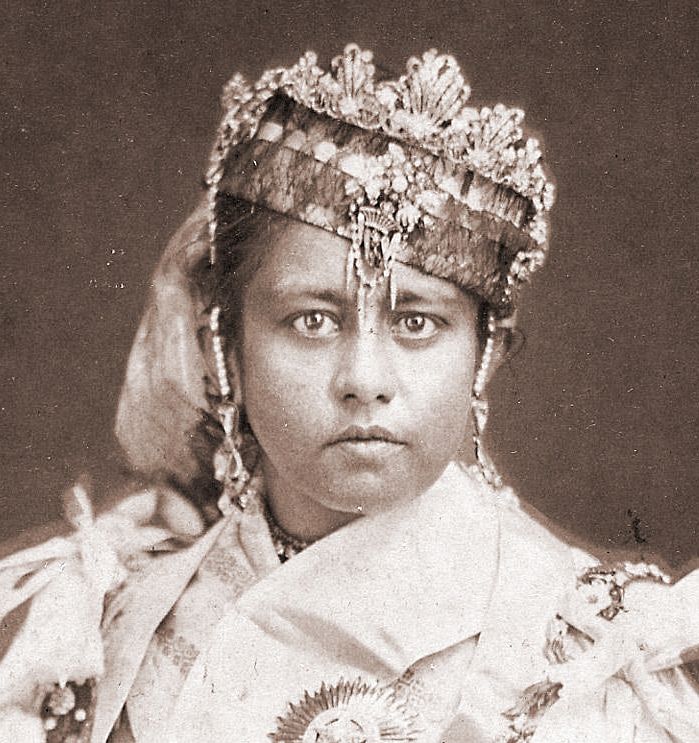
This matrilineal reign, which began in 1819, lasted more than a hundred years, with the lone interruption in 1926, when Sultan Jahan Begum abdicated in favour of Nawab Hamidullah Khan. Hamidullah Khan’s daughter Abida Sultan was to succeed to the throne, but when she chose to leave for Pakistan after the Partition of India, her younger sister Sajida became the Begum of Bhopal.
Sajida Sultan. — Unknown/Wikimedia Commons
Unlike the Queen-Regent of Travancore, whose brief radical rule ran only till her son came of age, these women ruled for unexpectedly long periods, facilitated by the absence or death of male contenders to the throne, and through sheer grit. A photograph taken in 1872 of Nawab Shah Jahan Begum, Abida Begum’s great-grandmother, shows a booted woman staring straight at the camera, much in the manner of a Vogue cover shoot. The Begums of Bhopal practised feminism much before it gained prominence. They were interesting, headstrong and opinionated, but their wars weren’t fought on the battlefield.
Archival records are filled with the Begums exhibiting their commitment to Islam: donating money to build a mosque in Basra, Iraq, funding the Muslim University at Aligarh, and opening a school for girls in Delhi in the early 1920s. At the time, it was unusual to have a ruler devote time and money to women’s education — even a progressive thinker like Syed Ahmad Khan was focused on Muslim men getting Western education — but to do so outside their state was truly remarkable. So much so that when Lord Edwin Montagu, the British Secretary of State for India, met Begum Sultan Jahan in 1917, he noted in his diary that she was “frightfully keen on education, and jabbered about nothing else”.
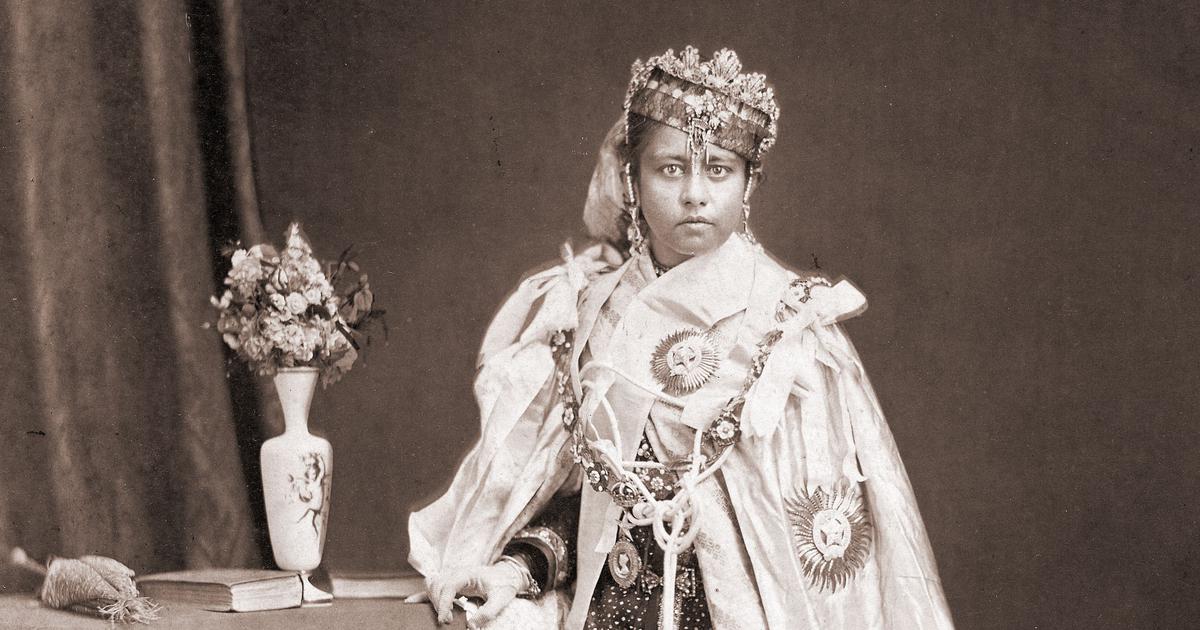
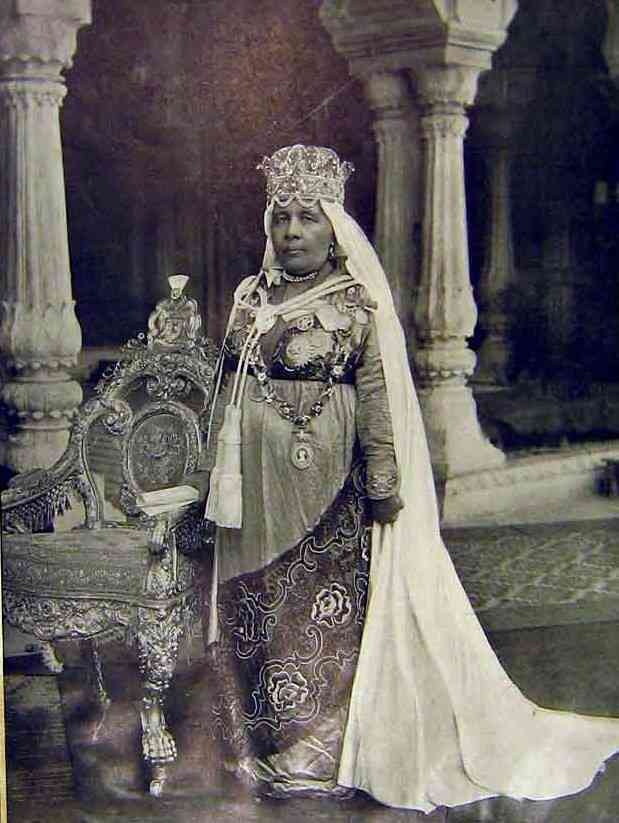
Sultan Jahan Begum. — Wikimedia Commons
Fringes of history
Women and their assumption of political power have always been sidelined in Islamic history, though there is reason to believe that Aisha, the Prophet’s wife, had a role to play in the establishment of the first Islamic state. Razia Sultana’s brief reign as the Sultanah of Delhi in the 1200s and her killing demonstrated the near impossibility and legitimacy of a Muslim women ruler.
Nothing changed over the centuries. Though it was a young woman, Queen Victoria, who reigned over the hundreds of Indian monarchs at the start of the Paramountcy, assuring them gently of their territorial sovereignty, this mattered little in India. Indian monarchies have been patrilineal and patriarchal, guarding the male and natural right to ascend the throne.
Against this background, to have four Muslim women successively rule a state is unprecedented in world history. But what makes it all the more remarkable is that these women administered a state dominated by feudal warlords accustomed to male privilege over the throne.
The modern city of Bhopal was founded in the early 18th century by Dost Mohammad Khan, an Orakzai Pathan from Afghanistan, and it soon became the second-most important Muslim princely state after Hyderabad. Its geographical location — in Central India — was vital for the suppression of the 1858 War of Independence.
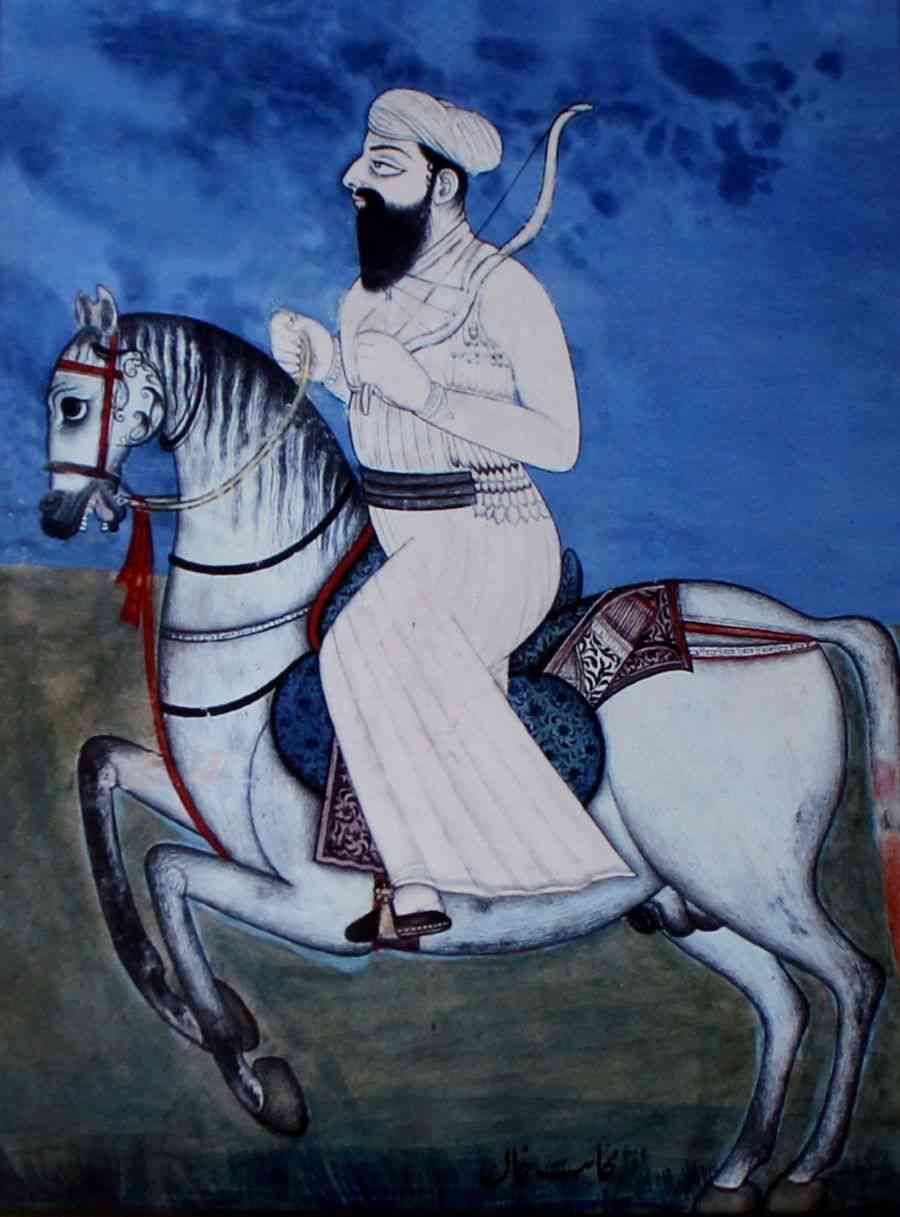
Dost Mohammad Khan. — Wikimedia Commons
In North India, there were several Muslim princely states — such as Bahawalpur, Mahmudabad, Tonk, Pataudi and Rampur — which were supported by the British under the Paramountcy. Under this policy, while nearly 500 princely states were autonomous and maintained internal sovereignty, their foreign policy and right to wage wars was controlled by the British.
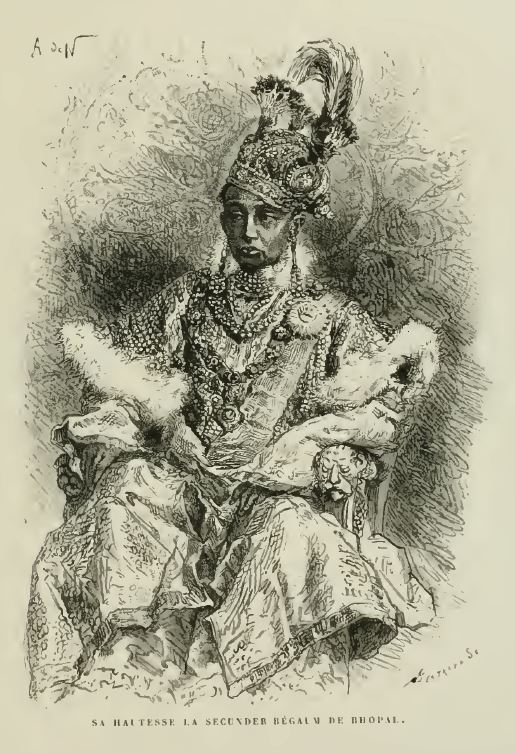
The reign of the Begums began in Bhopal in 1819, when the ruling Nawab, Mohammad Khan, died without an heir and the British decided to crown his young wife Qudsia till her daughter Sikandar came of age. Sikandar Begum’s husband too died in 1844, and she proved to be a competent ruler and a worthy ally to the British, playing a vital role in the First War of Independence in 1857-1858. This compelled the British to make a provision that the Begum was a sovereign in her own right. Three years later, in 1861, she was invested with the Exalted Order of the Star of India, making her, at the time, the only female knight in the British Empire besides Queen Victoria. She was succeeded by her daughter Shah Jahan Begum and then by Sultan Jahan Begum.
Sultan Jahan Begum went on to have a 25-year-long reign, marked by a commitment to progress, education and women’s health reforms. She was the last Begum of Bhopal as the heiress apparent, Abida Sultan, abdicated the throne in 1948.
Sikandar Begum. — Louis Rousselet/Wikimedia Commons
‘Magical island’
The first and foremost among them, Qudsia Begum, set the template of the ideal ruler. Spartan, and shunning jewellery, she refused to take loans and made sure that any money spent would be solely for education and philanthropy. As the British agent Lancelot Wilkinson in Bhopal noted: “She rides and walks about in public, and betrays her determination to maintain herself in power by learning the use of the spear and other manly accomplishments. At times she became quite frantic; and as one of the soldiers observed, more terrible to approach than a tigress.”
This “magical island”, as at least one commentator called it, was as rare as it was difficult to create. Like all figures of power, the Begums too attracted people who wanted to manipulate them — and in their case, this meant both the British and the ruling clan.
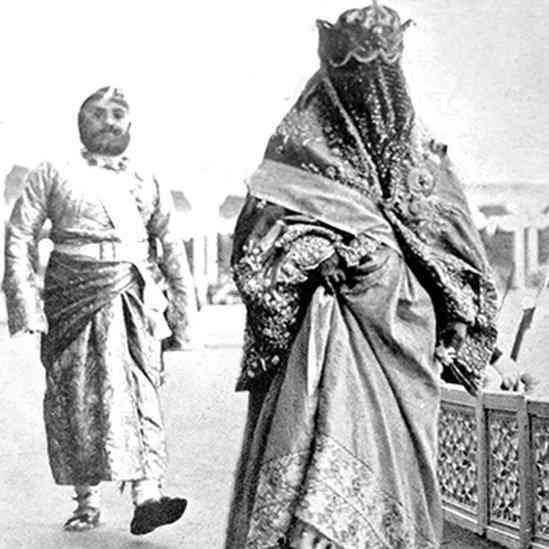
Qudsia Begum and her daughter, early inheritors of an uneasy throne, responded to the tugs and pulls by quickly learning traditional masculine skills like fencing and hunting. Shah Jahan Begum embraced the Purdah, asserting notions of orthodox Islamic femininity. She withdrew from public life into strict seclusion and refused to meet the British Viceroy in 1875. Her daughter would later recount in her autobiography that “even as a young girl, she preferred to meet with other girls of her age to discuss ‘a thousand little points of household duties and of domestic management than to perform outdoor activities’.” None of this though got in the way of being a good ruler, and she proved that a veiled woman could rule as competently as anybody else.
Shah Jahan Begum. — Louis Rousselet/Wikimedia Commons
Balance of power
The Begums carefully navigated the multiple demands of power by ingeniously playing around with tradition and modernity. They would sometimes opt to let go of the burkha and at times wear it to demonstrate a different modernity. In their writings, the Begums constantly acknowledged their mothers and grandmothers, paying obeisance to the strong women who shaped their lives and characters.
Their commitment to austerity and Islam set them apart from the wasted royal lives that were given to overindulgence and dissipation. They constantly drew upon the Quran and respected Islamic scholars, reinforcing the idea that Islam speaks of equity between the sexes. Their spartan lives struck Mahatma Gandhi too, when he visited the state in the late 1920s, on invitation. He was suspicious that the Begum’s cotton clothes and thin mattress had been “put on as a show”, till his travelling companion Sarojini Naidu assured him otherwise.
The Begums of Bhopal, who styled themselves as “Nawab Begums”, were radical and unconventional (the term ‘Nawab Begum’ itself was ingenious as there is no word for queen in the Islamic political imagination). Nonetheless, with consummate ease and success, they proved they were no less. Keeping in line with the Islamic tradition of maintaining a diary, like the founder of their state used to, the Begums invested much energy in maintaining records — of the state and of themselves.
Sultan Jahan Begum. — The Graphic/Wikimedia Commons
Shah Jahan Begum, the third in the line, established a History Office, along with a system for retrieving and maintaining records of important characters in her family. Abida Sultan’s son, Shahryar Khan, a former career diplomat in Pakistan, has carried on this family tradition by writing an authoritative account of the dynasty, The Begums of Bhopal.
Like a host of other wealthy Muslim ashraf women, the Begums travelled to Europe and to West Asia as part of the obligatory hajj. And despite the seriousness of the occasion, they never failed to display flashes of their chutzpah. There are anecdotes of Sikandar Begum not disembarking from the ship to Europe without her bottles of pickle. And upon reaching London, she mistakenly wore a dressing gown to meet King George V and Queen Mary, a realisation made only owing to the headlines in the newspapers the next morning.
Many princesses have ascended to power in democratic India by contesting and winning parliamentary elections. The Begums of Bhopal, however, are remarkable for sustaining a determined succession of women monarchs, despite hostility to their gender ruling — the very first Begum, Qudsia, had declared that her infant daughter would succeed after her. Despite the religious and political odds against them, their reign was marked by benevolence and modernity, a radical openness to change, like women’s education and medicine, while maintaining a steadfast commitment to the tenets of Islam. The Begums are icons for women, Muslim or otherwise.
This piece was originally published on Scroll and has been reproduced with permission.
source: http://www.dawn.com / Dawn / Home> Prism / by Priya Mirza / June 04th, 2019
The paintings by Zayn al-Din were commissioned by Mary Impey, an English natural historian and patron of the arts in Bengal
Falsa Tree with King’s Nightingale was painted on a 53.5cm x 75cm canvas by Zayn al-Din in 1782 . / Picture courtesy: Stockholm Auction House
Two watercolour and pencil-on-paper artworks painted in Calcutta in the late 18th century by one of the most famous exponents of the Company School of Art will go under the hammer at the world’s oldest auction house in Sweden on June 12.
The paintings by Zayn al-Din were commissioned by Mary Impey (March 2, 1749 -February 20, 1818), an English natural historian and patron of the arts in Bengal. She was the wife of Elijah Impey, the first chief justice of the Supreme Court at Calcutta (1774-82), who had infamously sent Maharaja Nandakumar — a highly-placed officer in the nawabi administration — to the gallows on charges of perjury.
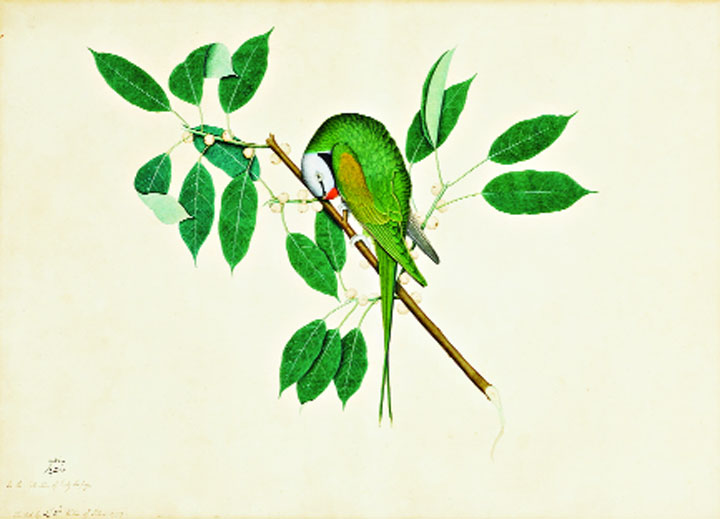
Falsa Tree with King’s Nightingale, dated 1782, and Parrot in a Parkar Tree, dated 1779, have been in the possession of a Swedish family for long.
“We are immensely proud to present these rare artworks. We are not sure how they reached Sweden. They have been in the same Swedish family for a long time and this is the first time that they reach the market,” Victoria Svederberg Bojsen, a specialist in classic and modern art at the Stockholms Auktionsverk (Stockholm Auction House), founded in 1674, told Metro over phone from Stockholm.
“The estimate price is Euro 51,000 (Rs 40 lakh) to 61,500 (Rs 48 lakh). However, we believe they will reach an even higher price. Our hope is naturally that they will now be returned to India where they originated,” she said.
Birds are the subjects of both the paintings. Falsa Tree with King’s Nightingale is a 53.5cm x 75cm canvas.
The inscriptions on both pictures read: In the Collection of Lady Impey of Calcutta. Painted by Zayn al-Din Native of Patna 1782.
“Both paintings include a description of the subject in Persian — Darakht ban falsa, Shah Bulbul in the first and Madna Tota, Darkaht Pakar in the other. The artist’s name is also written in Persian,” said Nandini Chatterjee, associate professor of history at the University of Exeter in the UK.
The painting (right), titled Parrot in a Parkar Tree, is signed and dated 1779. The inscriptions on both artworks read: “In the Collection of Lady Impey of Calcutta. Painted by Zayn al-Din Native of Patna 1782”. / Picture courtesy: Stockholm Auction House
Metro had sent the images to Chatterjee, who is part of a research on two sets of natural history drawings produced between the late 18th and early 19th centuries in Calcutta. The drawings are held at the Victoria Memorial Hall and the Royal Albert Memorial Museum & Art Gallery in Exeter.
The Impeys moved to India in 1773 after Elijah Impey was made the chief justice of Bengal. They set up a menagerie at their house in Calcutta’s Middleton Row. When they shifted to Fort William two years later, they started a collection of native birds and animals on the extensive gardens of the estate.
Mary Impey commissioned several local artists to paint the fauna and flora they had collected. Her three principal artists were Sheikh Zayn al-Din, and brothers Bhawani Das and Ram Das. All three had come from Patna.
Together, Zayn al-Din and the Das brothers painted more than 300 artworks, half of them of birds. The collection, often known as the Impey Album, is an important example of Company style painting.
“With the decline of the Mughal courts, the artists sought the patronage of Europeans. These artists had to change their traditional techniques to suit their new masters. These revisions included a more accurate representation of the subject and a change in perspectives,” said Jayanta Sengupta, the curator of the Victoria Memorial.
Little is known of Zayn al-Din, the artist whose works will be auctioned in Sweden next month. He is known for his extraordinarily detailed paintings for the Impey Album. His drawings of mountain rats, hanging bats, parrots and storks serve as interesting zoological studies and are now preserved at the Ashmolean Museum in Oxford.
“The artworks from the Impey Album rarely reach the international market and the few that have been sold previously at Christies, Sothebys and Bonhams have fetched between $80,000 (Rs 55.5 lakh) and $140 000 (Rs 97.7 lakh),” Bojsen said.
The real study of the Indian subcontinent’s natural history is said to have started with the Mughals. Baburnama — the memoirs of the first Mughal ruler — has beautiful illustrations of birds and animals. Shah Jahan also took a keen interest in the flora and fauna.
With the fall of the Mughals, the artists sought the patronage of Europeans. Calcutta became a thriving centre of the (East India) Company school of painting.
“India was an unknown land for Europeans and along with its indigenous archaeology and history, they also wanted to explore its abundant flora and fauna. Imperial documentation differs from its Mughal predecessor in scale and systematic approach,” Sengupta said.
“Mary Impey was part of a circuit of Europeans who commissioned paintings of Indian natural history. Apart from the pictorial documentation of flora and fauna, the extensive notes kept by her about their habitat and behaviour were of great use to later biologists,” he said.
The collection went to England with the Impeys in 1783 and were sold at a London auction in 1810. Several pieces are in various museums, including the Metropolitan Museum of Art in New York and the Victoria and Albert Museum in London.
“The style of inscription, and the handwriting is identical to other paintings all around the world. I do not believe Zayn al-Din’s name is in his own handwriting. It was probably written by a British collector, maybe Lady Impey herself. Many such British Orientalists (and perhaps some of their spouses) knew Persian,” Chatterjee said.
Some of Zayn al-Din’s works are at the Royal Albert Memorial Museum too. “But those have his name written in English and Bengali, perhaps by a collector who was interested more in the vernacular language, than Persian, which was the Mughal language of administration and courtly culture,” Chatterjee said.
source: http://www.telegraphindia.com / The Telegraph, online edition / Home> West Bengal / by Debraj Mitra in Calcutta / May 28th, 2019
Indian football head coach Igor Stimac on Sunday named six newcomers in the final list of 23 players for the King’s Cup, to be held in Buriram, Thailand from June 5.
The six are Rahul Bheke, Brandon Fernandes, Raynier Fernandes, Michael Soosairaj, AbdulSahal and India U-17 World Cup team captain Amarjit Singh.
The final list: Goalkeeper: Gurpreet Singh Sandhu, Amrinder Singh, Kamaljit Singh.
Defenders: Pritam Kotal, Rahul Bheke, Sandesh Jhingan, Adil Khan, Subhasish Bose.