All posts by mpositiveone@gmail.com

Lohri legends: the tale of Abdullah Khan ‘Dullah’ Bhatti, the Punjabi who led a revolt against Akbar

PUNJAB :

The Punjabi festival of Lohri commemorates Dullah Bhatti for his act of defiance against the Mughal emperor.
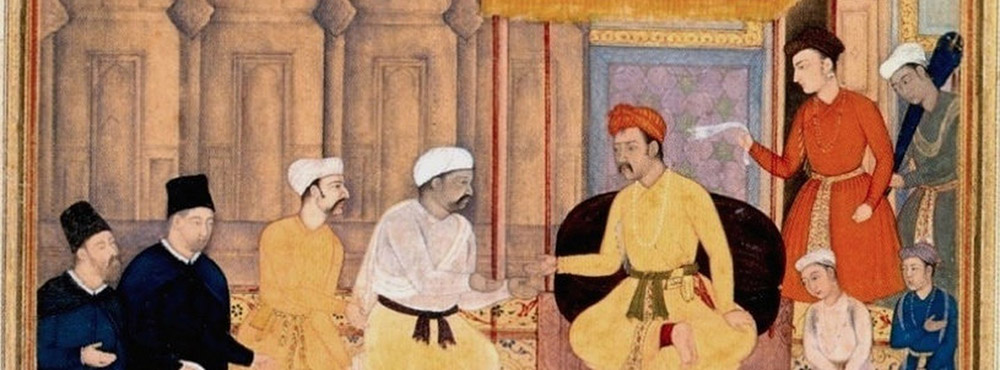
Wikimedia Commons
Wikimedia Commons

Lohri in Delhi has bonfires, popcorn, peanuts, pine nuts, gur or jaggery and til and sundry sesame sweets. Around the bonfire, people gather to sing a popular Punjabi folk song , Sundar munderiye, about a certain Dullah Bhatti who helped to rescue poor Punjabi women from the rather cruel zamindar, landlord.

In the big city, cut off from folk legends, most of the people who sing that song are unaware of who Dullah Bhatti was. Bhatti, though, is a historical figure, a contemporary of Mughal emperor Akbar who lived  in Pind Bhattian, a town about 50 kilometres west of Lahore.

Rai Abdullah Khan Bhatti – to use Dullah’s full name and title – lived in tumultuous times. Akbar was just beginning to consolidate the Mughal state, setting in process a new order that would ensure that his dynasty would rule Delhi for the next three centuries to come. The Mughal state proceeded to implement a system of land revenue devised by Akbar’s brilliant Rajput finance minister, Todar Mal, called the Zabt system. The Zabt revenue system made Mughal officers responsible for both the assessment and collection of revenue.

Punjab in chaos

What was victory from Delhi, though, often meant chaos and destruction on the ground, as old ways of life were overturned. The Zabt system underpinned the Mughal state but proved to be the end of the road for local power centres in the Punjab, as all authority was concentrated in the Mughal administration. One of those local power centres was Dullah Bhatti’s family, a Rajput landowning clan made powerless by the financial scheme of Mughal finance minister, Todar Mal. As a result, the Bhattis rebelled against Akbar – and lost. Both Dullah’s father and grandfather were executed – at the time, Dullah’s mother was pregnant with him.

Legend now has it that Akbar’s son Jahangir and Dullah were born on the same day. To make Jahangir brave, Akbar was advised to have his son breastfed by a Rajput wet nurse who – in an incredibly filmy twist – happened to be Dullah Bhatti’s mother, in one version of the legend. A more prosaic explanation for this myth is that the Mughals initiated a policy of reconciliation with the Bhattis. By providing Dullah and his mother with royal patronage, the Mughal state hoped to assuage their hurt, win them over and – most importantly – prevent future rebellions.

Things, however, didn’t go according to plan. Bhatti grew up to swear revenge on the Chughtais, Mughals who had executed his father and grandfather. So fierce was this local resistance that, says historian Ishwar Dayal Gaur, Akbar had to shift his capital to Lahore from Delhi for two decades to try and get things under control. Gaur also adds that Akbar exempted the Bari Doab or Majha (the region between the rivers Beas and Ravi) from taxes and also made peace with the Sikh guru, Arjan Dev by visiting him in Goindwal – Bhatti’s revolt was so effective that the Mughals couldn’t afford to make any new enemies.

Dullah Bhatti becomes legend

Ultimately, though, Akbar prevailed, the Mughals capturing and beheading Dullah publicly in the main bazar area of Lahore. Till the last, though, Bhatti remained defiant and his final words as recorded by sufi poet  Shah Hussain were, “No honourable son of Punjab will ever sell the soil of Punjab”. His grave still exists in Lahore, although interestingly, there is no official recognition of the spot. Pakistan – a country which is dominated by Punjabis – still takes much of its national mythos from the Mughal state, making its recognition of Dullah Bhatti’s revolt against Akbar a rather delicate matter.

Nevertheless, Dullah’s revolt passed into popular Punjabi legend and his feats as a Robin Hood are still celebrated today in the popular song Sundar munderiye, which talks of how he protected Punjabi girls from being abducted by the Mughal zamindar. The custom of giving money and sweets to children, who go from door to door singing the song, is said to honour Bhatti’s acts of generosity, of looting the tributes and taxes sent to the emperor and redistributing them among the poor.

In 2015, Bhatti’s tale was even made into a Punjabi pop number, although the video of the song, interestingly, portrayed him as a Sikh battling the Mughals, rather than the Muslim Rajput Bhatti historically was. Given that our histories rarely talk of the complex nature of Mughal India, and reduce most situations to a mirror of the communal conflicts of the modern age, this, perhaps, is an expected error.

source: http://www.scroll.in / Scroll.in / Home> Festival Celebrations / by Shoaib Daniyal / January 13th, 2016
The last song of Awadh

Awadh, UTTAR PRADESH / BENGAL :

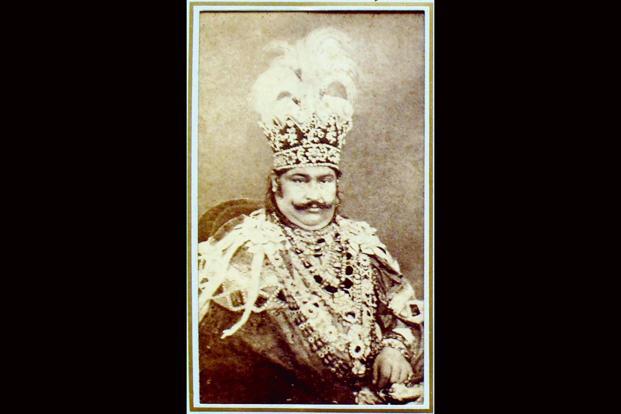
Wajid Ali Shah. / Courtesy Lakshmi G Joshi

Of Wajid Ali Shah, and how a popular ‘thumri’ from another century reached us.

The Lucknow gharana of Kathak is famous for its repository of thumris. In fact, the very genre of thumri found immense patronage in the nawabs of Awadh. The last ruler, nawab Wajid Ali Shah, was a great lover of the arts. He wrote his first play, Radha Kanhaiya Ka Qissa, in 1843, when he was barely 21 years old. The British saw him as a debauched ruler wasting his wealth on entertainment.

Nineteenth-century India remembers the nawab as a romantic poet, a benefactor of the arts and a great lover of classical music and dance. By the time he ascended the throne in 1847, he had written two long romantic narrative poems (or masnavis) titled Bahr-E-Ishq (The Ocean Of Affection) and Darya-Yi-Ta’Ashshuq (The River Of Love). He adopted the pen name Akhtarpiya. An admirer of the Hindu god Krishna, he wanted to adapt these poems into a play in raas/rahas format.

Shah’s idea of staging these plays was beyond grandiose. According to the account of one Iqtidar-ud-daula who witnessed the play in February and March 1851: “The play was staged in 14 sessions (with intervals of one-two days between each session. The whole play took a month and 10 days to finish). Not every scene was staged in Qaisarbagh (a large complex housing gardens, manicured lawns and palatial buildings). Consecutive scenes were played out in different parts of the garden. In fact, some scenes were played out in different parts of the city.” It goes on to vividly describe the setting where canvas tents on bamboo frames were erected across the city along with “larger-than-life frames of scenery”. The elaborate preparations for each play took a whole year and cost £12,000 (around Rs10 lakh now) to produce.

Thus, Shah entertained himself with grand sessions of rahas. Here was a Shia Muslim king who consulted priests and celebrated Hindu festivals like Saawan, Holi and Basant Panchami with great pomp. He learnt Kathak from his court dancer-musician, Pandit Thakur Prasad. He appointed to his court the dancing duo of brothers Kalka and Bindadin Maharaj. The Kathak legend, Pandit Birju Maharaj, is a descendant of this family.

The nawab invested state wealth on arts and culture for the benefit and entertainment of his people. If the mounting expenses didn’t bother the British, Shah’s secular love for the arts and excessive indulgence did. They annexed his throne in 1854 and sent him into exile.

The book Asrar-I-Wajidi (1856) by Zahiruddin Bilgrami describes scenes of sorrowful locals who lined up on streets and wailed as the nawab left Lucknow. A caravan of a thousand people started from Lucknow on 13 March 1854 towards Calcutta (now Kolkata). For Wajid Ali Shah, there was nothing more painful than being separated from a place he loved so much and its people. His sorrow took the form of a song that spoke of displacement and loss. The song reflected an allegory to a human being’s last journey on this earth, when the body is carried on the shoulders of four pall-bearers.

Babul mora naihar chhooto jaaye

chaar kahaar mil, mori doliya sajaave

mora apna begaana chhooto jaaye

angnaa toh parbat bhayo, dehri bhayi bides

le ghar babul apno, main chali piya ki des

A large part of Shah’s writings have, unfortunately, been lost. Those that have remained, have luckily been preserved through music and dance by the descendants of his court musicians and dancers. This particular thumri reached us in its pristine condition from Kathak doyen Pandit Shambhu Maharaj. According to his first student, the late Maya Rao (in her autobiography Maya Rao—A Lifetime in Choreography, 2013), K.L. Saigal, who learnt the song from Pandit Shambhu Maharaj, spending months with him, seeing him perform it countless times and finally learning it, decided that he would sing it in the film Street Singer (1938).

In 1947, when Saigal died, All India Radio broadcast the song as a tribute. Thumri got a new lease of life on the classical music concert stage. The late Akhtaribai Faizabadi aka Begum Akhtar, Pandit Bhimsen Joshi and Kishori Amonkar, among others, immortalized the song. In the 1974 film Aavishkar, starring Rajesh Khanna and Sharmila Tagore, this song, sung by the late ghazal singer Jagjit Singh and wife Chitra Singh, weaves many scenes together. While Wajid Ali Shah might have been a political eccentric, he is credited with being a revivalist in the world of Hindustani classical music, dance and Urdu drama.

source: http://www.livemint.com / LiveMint / Home / by Veejay Sai / December 01st, 2017

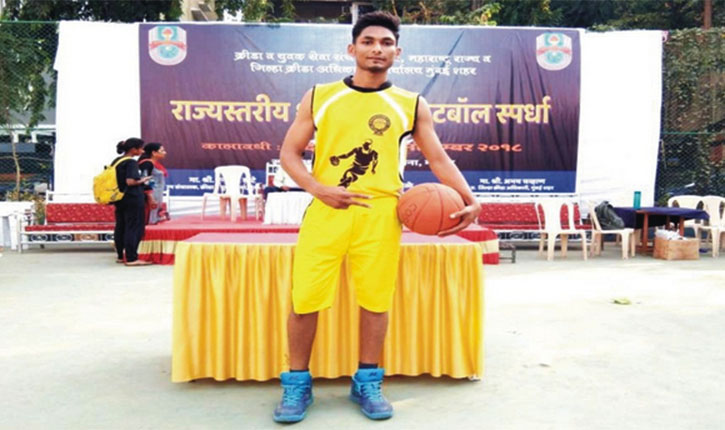
Malegaon’s Abdullah selected for National Basketball Team

Malegaon, MAHARASHTRA :

One of the prominent cities in Maharshtra, Malegaon knwon for its textile industry, has regularly sent players to state and national level competitions

AbdullahMPOs18dec2018

Malegaon:

 Abdullah Khaleel Ahmed, a 12th standard student of Malegaon High School and Junior College, has been selected for the National Basketball Team Delhi.

According to a report published by UrduCity, a total of 05 students from each district of Maharashtra were selected for a trial game. Out of them 16 players, (12 + 04 reserved), were selected for the final game. 17-year-old Abdullah was the only player from the team of 16 selected for the National Basketball Team.

Abdullah is likely to play in an upcoming match in New Delhi.

Abdullah had in May 2018 played for Nashik district team representing Maharashtra at the YMCA National Invitational Basketball tournament held in Goa. He was accompanied by 03 other players – Ansari Urooj Ahmed, Ansari Fahad and Abdur Rahman, all from the textile city.

Earlier, Abdullah’s team had defeated Dhule district’s basketball team at district level tournament to qualify for the state level competition. At the state level tournament, Abdullah’s team could not win. But, because of his personal performance, Abdullah was able to get the selectors’ nod to play in the trial game held for selection to the National Basketball Team.

One of the prominent cities in Maharshtra, Malegaon knwon for its textile industry, has regularly sent players to state and national level competitions. In 2009, Zubair Ansari, Zahid Akhter and Ziya Nisar of the city had participated in the National Level Shooting Ball Championship. The three players were representing Maharashtra in the finals and won the under-19 National School Games Shooting Ball Championship against Karnataka.

Again in 2009, Azhar Ahmed, a young cricketer from Malegaon was selected for the State Ranji Test Cricket Team. before that Azhar Ahmed had represented the Maharashtra Cricket Association’s (MCA) under-19 cricket team visiting Sri Lanka in 2008 for the Challenger Trophy.

source: http://www.ummid.com / Ummid.com / Home> India> Sports / by ummid.com Staff Reporter / November 27th, 2018

Meet India’s only oud maker

Rampur, UTTAR PRADESH :

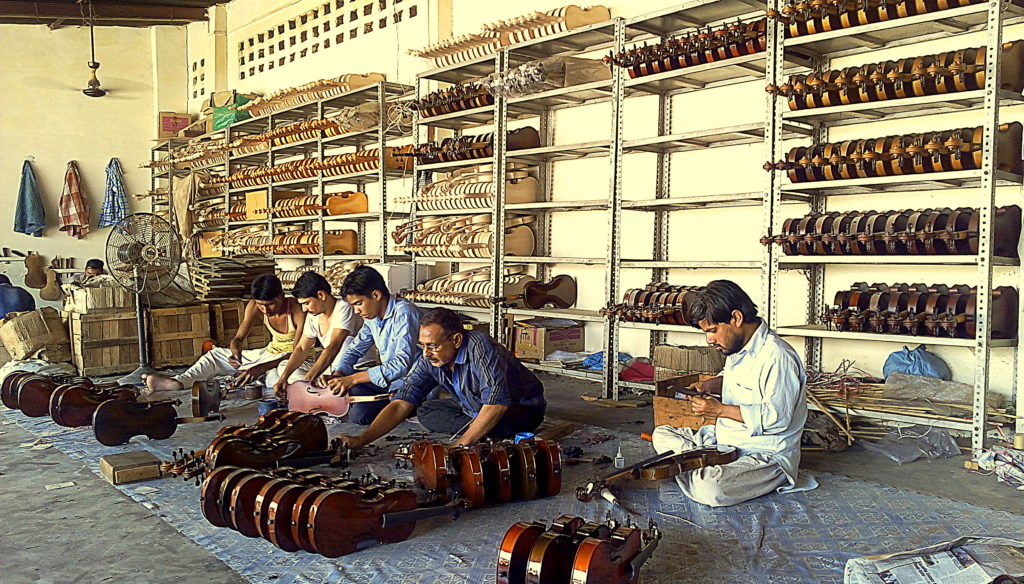
Workers put finishing touches to violins at Zamiruddin's workshop in Rampur, UP. / Credits: Rohit Ghosh/Qrius
Workers put finishing touches to violins at Zamiruddin’s workshop in Rampur, UP. / Credits: Rohit Ghosh/Qrius

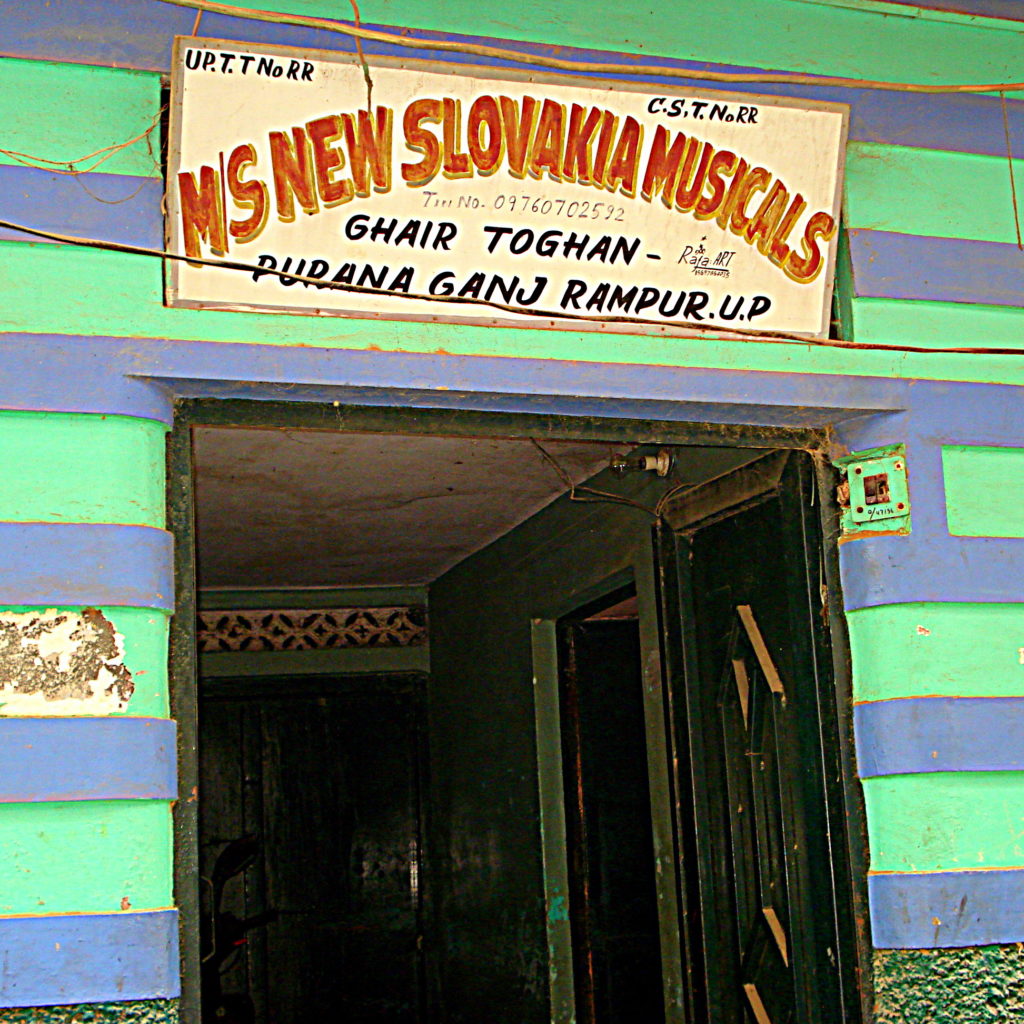
Zamiruddin’s old house in Purana Gunj, Rampur, a town 175 km east of New Delhi, is as nondescript as they come. But enter it and you might just find yourself transported, musically, to ancient Egypt.

Stacked on the shelves and lofts in rooms around the house’s rectangular courtyard are ouds, a musical instrument dating back thousands of years to the time of the Pharaohs.

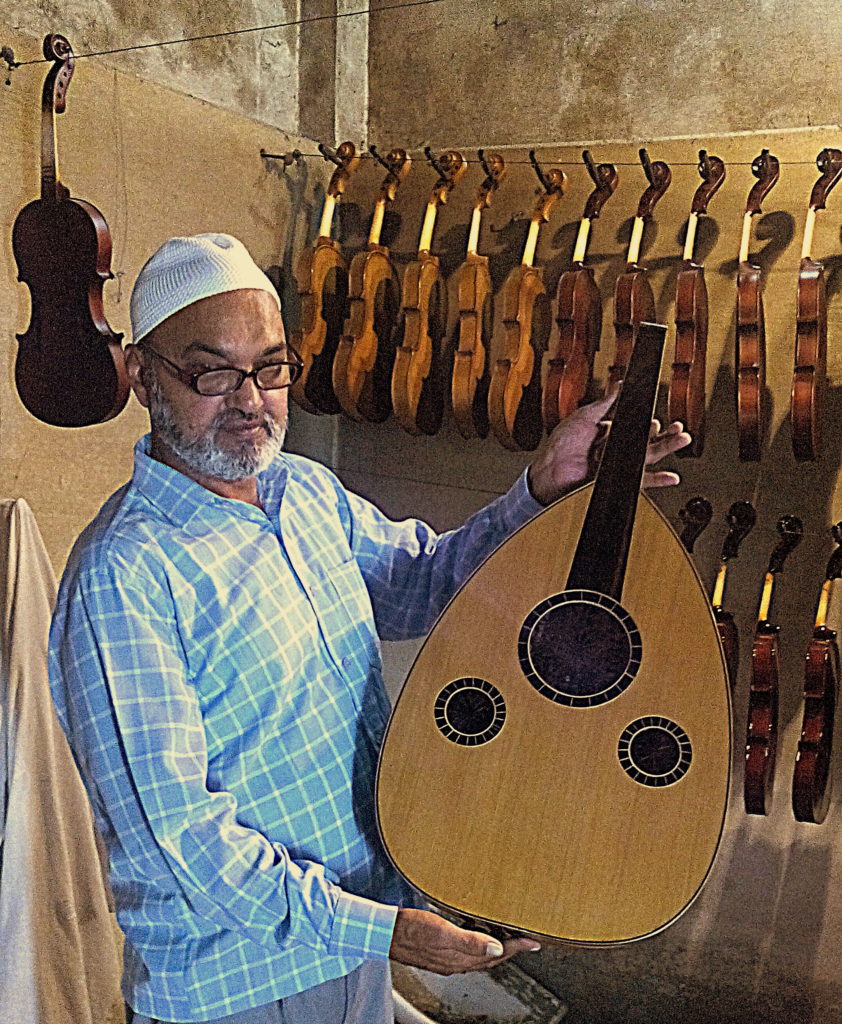
This is the only place in India where you can buy an oud, a short-necked, pear-shaped stringed instrument that produces a sound similar to that of the sarod. The oud is oft used in Middle Eastern and North African music.

“My father [Haseenuddin] was the first and only person in India to make ouds,” said Zamiruddin, owner of New Slovakia Musicals. “Now, I am the only one…”

How the oud came to India

The oud dates back to ancient Egpyt. When it came to be used in Persia, some 3000 years ago, it was called the barbat, while it was called the al Oud (wood, or specifically thin wood) by the Arabs.

The oud came to India with the spread of Islam. In his book Two Nations and Kashmir (1956), Lord Birdwood notes that it was during the rule of Zain-ul-Abuldin in Kashmir that musicians from the West Asian region came, and brought the lute and the oud with them.

Discovering the instrument: Haseenuddin’s story

Zamiruddin inherited the business from his father Haseenuddin in 1996 and named it New Slovakia Musicals. / Credits: Rohit Ghosh/Qrius

Once a cabinet-maker in Rampur, the lyrical story of how Haseenuddin started making ouds goes back 70-odd years.

“My father and his younger brother Ameeruddin lived together. In 1942, my uncle visited Bombay and bought a violin. He became so engrossed in playing it day in and day out that he completely detached from his surroundings,” recalled Zamiruddin.

One day, Ameeruddin accidentally dropped the violin and it shattered to pieces. Heartbroken, he continued to become more and more miserable as the weeks passed. Unable to see his brother in that state, Haseenuddin then studied the violin that had become a tangled lump of wood and strings, Zamiruddin told me.

“My father was a genius. Using his skills and things available at hand, he made a new violin for my uncle.”

Seeing the joy on Ameeruddin’s face made Haseenuddin realise his latent potential in making the instrument. “Along with chairs, tables, beds, and wardrobes, he started making violins on a large scale. The year was 1947.”

Gradually, the demand for violins soared so high that Haseenuddin gave up making furniture and concentrated only on the instrument, becoming an established violin-maker in India. His violins had a big market in Goa, Kerala, Tamil Nadu and Karnataka, where music was a big part of the school curriculum.

Zamiruddin started assisting his father soon after finishing his graduation.

Then came the oud

Zamiruddin shows an oud crafted at his workshop. / Credits: Rohit Ghosh/Qrius

“Some people visited us with an oud in 1984 and introduced themselves as dealers and exporters of musical instruments. They showed the stringed instrument to my father and asked if he could make it and said that every other craftsman in India had refused to,” said Zamiruddin.

Haseenuddin, who had already made a name for himself by making quality violins, was up to the challenge.

“I advised my father against it, owing to the oud’s complicated design. He, however, chided me and said I should never doubt the skills of a master craftsman. His first oud was a success, after which we started producing them on a large scale—120-odd ouds a month,” reminisced Zamiruddin.

During that time, the ouds were exported to Syria, Iraq, Lebanon, and other Middle Eastern countries. “Ouds are made in the Middle East, but my product is better. India has a variety and better quality of wood compared to the Gulf, which is a desert. Also, my ouds are cheaper. An oud made in Syria may cost Rs 80,000, but mine are Rs 18,000 a piece,” said Zamiruddin, who inherited the business in 1996 after his father passed away.

Yet, despite the many pluses his ouds have, he has no immediate plans to export them to foreign markets, given the low returns.

According to him, no two ouds are the same, neither in dimensions nor the sound they produce. “Ouds are handmade. So, something that has been cut and carved by hand won’t have the precision of machines. Hence, every oud is unique, even if made by the same craftsman.”

Spreading the music

Zamiruddin uses the backyard of his house as his workshop, where 30-odd workmen sit cross-legged on the floor, designing violins and ouds. At any point, he has about 40 ouds ready.

Although the ouds do not sell as much as the other musical instruments, Zamiruddin has found many buyers online. “Connoisseurs of music contact me online. Two months back, I even sold one to a person from Mumbai,” he said.

So, although not as well known as its more famous stringed siblings, the oud may yet find a wider market and fanbase.


Rohit Ghosh is an independent journalist based in Kanpur.

source: http://www.qrius.com / Qrius / Home> Music / by Rohit Ghosh / February 19th, 2002

Dr Rehan Ansari: A medical practitioner keeping the art of Urdu Calligraphy alive

Bhiwandi (Thane District), MAHARASHTRA :

DrRehanMPOs18dec2018

Calligraphy is one of the many arts that has been on the decline in the modern age: with people not even using pen and paper these days, the art of calligraphy has few takers, or at least that is what the image around calligraphy has been. But in Bhiwandi, a city in Thane district, a medical practitioner is working hard to ensure that the future generations both treasure and learn the art of Urdu Calligraphy.

Dr.Rehan Ansari has been conducting weekend Urdu Calligraphy (Khattati) classes for the past many months at a local school for the benefit of all. Dr Ansari, who is a calligraphy expert and has been practising it since his school days, says that his classes have been met with an enthusiastic response from students of all age groups and professions.
In a conversation with TwoCircles.net, Dr Rehan says that these classes are at an attempt to save the script. In an interesting observation, he says, “This art has helped me a lot in being a doctor. Observing the words, the art of turning the hand and setting words in a proper shape is a unique art which is called calligraphy and it needs sincere efforts. I regularly use a blackboard as a teaching aid to draw letters and explain the various aspects of calligraphy.”
The one thing that sets Dr Rehan apart from other people is he disagrees to the statement that calligraphy is a dying art form. “In Bhiwandi, Hyderabad and other cities of India, calligraphers exist and extend their services. Nowadays, social media is also playing a favourable role in promoting this and expanding the market. It would be wrong to expect hundreds of calligraphers; one or two are enough for the amount of work that exists,” he says. To add to his point, He further told Twocircles.net that India will be hosting the International calligraphy conference of Urdu, Arabic and Persian on October 22 and 23 in Jaipur, which will see delegates of about 50 countries participate in the event.
Talking about his teaching methods, Dr Rehan says he provides beginners with the Reed Pen (Baru Qalam), which is a well-known tool in the world of Urdu and Arabic Calligraphy. Sajida Jamal, a teacher and an Urdu story writer, shared her experience with TwoCircles.net. “This is really a good opportunity for me to improve my writing skill…it is a skill that helps everyone and I believe it makes a person love the language a little more and appreciate the art of writing a lot better.”
Another student of Dr Rehan, Fahim Bari, who is a lecturer at the local commerce college, was full of praise for the classes. “This is our literary and cultural asset…it’s promotion and progress can only be possible when we protect it and reach more and more people. Dr Rehan is the creator of the famous Faiz Nastaliq font and his classes are doing a lot to help us fall in love with the language again.”
source:  http://www.twocircles.net / TwoCircles.net / Home> Indian Muslim / by Imran Inamdar, TwoCircles.net / September 28th, 2018

Eight Muslims MLAs from Rajasthan this time, up from just two in 2013

RAJASTHAN :

MuslimLadyMLAmpos18dec2018

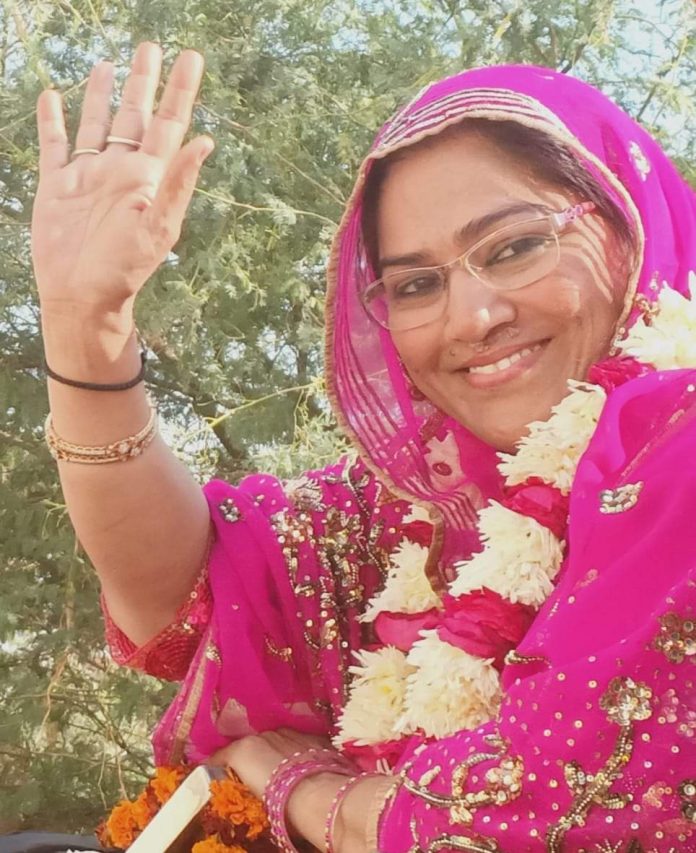
The Rajasthan elections are out and the Congress is all set to form a government in the state along with also doing the same in Madhya Pradesh and Chhattisgarh. The ousting of the BJP from Rajasthan has also resulted in a larger number of Muslim candidates being elected to the Rajasthan assembly, even though interestingly this is the first time that no Muslim won from the BJP since 1998.  Compared with 2013 elections when the Rajasthan assembly had only two Muslim MLAs, this election resulted in seven Muslims from Congress and one Muslim from BSP winning. The Congress had given tickets to 15 Muslims in these elections.

Rafeek Khan, Adarshnagar Constituency(Photo: Social Media)

Rafeek Khan of Congress won from Adarsh Nagar seat with a margin of 12,553 over BJP’s Ashok Pamami, who was the current MLA of the region. In Kishan pole, Amin Kagzi won by a narrow margin of  a little less than 1,500 votes. The closest fight among the eight Muslim candidates was for Saleh Mohammed from Pokhran, who beat Pratap Pani from the BJP by a margin of just 929 votes. The same could not be said about Zahida Khan, however. The only Muslim female candidate who won, Khan received over 1 lakh votes. She defeated her closest candidate by a margin of over 39,000 votes. Along with Khan, another strong victory for Muslim candidates came from Danish Abrar, who is also the party’s spokesperson for the state. Abrar beat popular BJP leader Ashok Meena by a margin of over 25,000 votes. The other Muslim candidates who won on a Congress seat were Hakam Ali from Fatehpur and Amin Khan from Shau constituency.

Hakim Ali Khan (Photo: Social Media)

Interestingly, the only non-Congress Muslim candidate who won from Rajasthan came not from the BJP but the Bahujan Samaj Party (BSP). Ali won by a margin of over 25,000 against Nempal Singh of the Samajwadi Party with the Congress and the BJP relegated to third and fourth respectively.

WajibAli Naagar constituency ( Photo: Social Media)

The only BJP candidate who won in 2013 elections, Mohammed Younus, was essentially turned into a sacrificial lamb for these elections. Younus, who was the number 2 to Vasundhara Raje, was made to change his constituency on the last day and to make matters worse, he was made to contest against Sachin Pilot in Tonk. No surprises, then, that Younus lost by over 56,000 votes to Pilot who polled over 1 lakh votes.

Amin Khan who won for the 5th time (Photo: Social Media)

These elections across five states have resulted in a total of 19 Muslim candidates winning across Madhya Pradesh, Rajasthan,  Telangana and Chattisgarh. While Rajasthan and Telangana saw eight Muslim candidates each, two Muslim candidates won from Madhya Pradesh while one Muslim candidate also won from Chattisgarh. No Muslim candidate contested from Mizoram.

Sohail Mohammed with his father Ghazi Fakeer from Pohkhran ( Photo: Social Meida)

source: http://www.twocircles.net / TwoCircles.net / Home> Elections Update> Indian Muslim> Lead Story / by Aas Mohammed Kaif, TwoCircles.net / December 12th, 2018

From a humble party worker to MLA-in-waiting

Hyderabad, TELANGANA :

Mirza Rahmat Baig
Mirza Rahmat Baig

Once driver and PA to a legislator, Mirza Rahmat Baig is MIM’s Rajendranagar nominee

Mirza Rahmat Baig criss-crosses several localities in the Rajendranagar Assembly segment as part of his paidal daura (canvassing). He is the Majlis-e-Ittehadul Muslimeen (MIM)’s candidate from the constituency. As he meets people, some at the doorstep and others passing by, he greets them with the traditional aadaab and says “Mere liye dua kijiye (pray for me)” as he promises to solve their problems once elected.

Speaking to The Hindu, he says, “The jamaat is not new here,” and proceeds to clarify that by jamaat, he means the MIM. “In fact, we have had a strong presence in this constituency for several years. We have always been with the people.”

The 31-year-old claims to have had humble beginnings. It was in 1994 that he first came in contact with the party leadership. Soon, he began to work with the MIM’s Ibrahimbagh primary unit. “After serving in the primary unit, Asad sahab (Asaduddin Owaisi) in 2004 instructed me to work for Charminar MLA Syed Ahmed Pasha Qadri. So, I became his driver, and then his personal assistant. I am grateful to Asad sahab for choosing me as a candidate,” he says.

Mr Baig says that the contest in the Assembly segment is between him and Bharatiya Janata Party candidate Baddam Bal Reddy. “Our fight has always been with the BJP,” he says.

While that may be the case, Mr Baig claims the constituency is in dire need of developmental work. The primary concerns are potable water and the drainage system. “Places in Narsingi, Sun City and Khizara Colony, among many others, have been facing major water supply issues. Also, drainage issues are seen in Narasareddy Colony and other places.”

He claims the area is in need of government schools, junior and degree colleges and accuses former MLA T. Prakash Goud of doing little there. “I would like to ask the MLA how many new Urdu medium schools have been sanctioned? How many new government schools have been established? There is a lot that needs to be done,” he says.

source: http://www.thehindu.com / The Hindu / Home> News> States> Telangana / by Syed Mohammed / Hyderabad – December 01st, 2018

Owaisi’s AIMIM wins 04 seats, Azmi’s Samajwadi wins 02 in Dhule Municipal Corporation 2018 Polls

Dhule, MAHARASHTRA :

A total of 356 candidates of different parties and independents are in fray for the 74 seats of Dhule Municipal Corporation (DMC)

[AIMIM MLA Imtyaz Jaleel addressing an election rally in Dhule. (Photo: @imtiaz_jaleel)]
[AIMIM MLA Imtyaz Jaleel addressing an election rally in Dhule. (Photo: @imtiaz_jaleel)]
Dhule :

Contesting the Dhule Municipal Corporation (DMC) elections for the first time, Asaduddin Owaisi’s All India Majlis-e-Ittehadul Muslimeen (AIMIM) has won 04 seats, election officers said after counting of votes Monday.

The AIMIM had fielded 11 candidates in the 2018 Dhule elections. Of them 04 candidates have won. 03 AIMIM candidates – Ansari Saeeda M Iqbal, Naziya Bano Nasir Khan Pathan and Saeed Baig Hashim Baig have won from Prabhag 03. The 4th one Mehrunnisa Zakir Shaikh has won from Prabhag 13.

On the other hand, Samajwadi Party (SP) led bu Abu Asim Azmi had fielded 09 candidates. Two of them have won. One of them, Ansari Fatema, was declared unopposed. The other SP who has won the Dhule civic election is Patel Ameen Ab Kareem. He has won from Prabhag 12.

According to trends available at 02:15 pm, the BJP has won 50 seats of the total 74 Dhule Mahanagar Palika.

Congress+NCP alliance is a distant second with lead on 14 seats. Anil Gote’s Loksangram is also leading on 01 seat. Gote, a BJP MLA, is contesting this election on his own. He has projected his wife as Mayor of Dhule.

Dhule Municipal Corporation 2018 Election Result Live Updates

02:00 pm – BJP set to sweep Dhule Municipal Corporation 2018 Elections, leads on 50 seats

The Bhartiya Janta Party (BJP) look set to sweep the Dhule Municipal Corporation 2018 elections where counting of votes is in its final phase.

According to trends available at 02:00 pm, the BJP is leading in 50 seats of the total 74 Dhule Mahanagar Palika.

Congress+NCP alliance is a distant second with lead on 14 seats. Anil Gote’s Loksangram is also leading on 01 seat. Gote, a BJP MLA, is contesting this election on his own. He has projected his wife as Mayor of Dhule.

01:00 pm – BJP consolidates its lead

The Bhartiya Janta Party (BJP), which had taken early lead in Dhule Municipal Corporation (DMC), also known as Dhule Mahanagar Palika, has consolidated its lead.

According to trends available at 01:00 pm, the BJP is leading on 38 seats. Congress+NCP alliance leads on 18 seats. Anil Gote’s Loksangram is also leading on 03 seat. Gote, a BJP MLA, is contesting this election on his own. He has projected his wife as Mayor of Dhule.

Shiv Sena is leading on 07 seats. Others are ahead on 01. Samajwadi Party (SP) has already won 01 seat. Asaduddin Owaisi’s AIMIM and Raj Thackeray’s MNS have so far not leading on any seat.

11:30 am – BJP:31, Cong+NCP:28, Lok Sangram:03, Sena:03

The Bhartiya Janta Party (BJP) takes early lead in Dhule Municipal Corporation (DMC), also known as Dhule Mahanagar Palika, elections where counting of votes to elect a new body is underway.

According to trends available at 11:30 am, the BJP is leading on 31 seats. Congress+NCP alliance leads on 28 seats. Anil Gote’s Loksangram is also leading on 03 seat. Gote, a BJP MLA, is contesting this election on his own. He has projected his wife as Mayor of Dhule.

Shiv Sena is leading on 03 seats. Others are ahead on 01. Samajwadi Party (SP) has already won 01 seat. Asaduddin Owaisi’s AIMIM and Raj Thackeray’s MNS have so far not leading on any seat.

10:00 am – Counting of votes begins

Counting of votes in Dhule where polling to elect new body of the Dhule Municipal Corporation (DMC), also known as Dhule Mahanagar Palika, started at 10:00 am today i.e. Monday December 10, 2018.

Poll officers said counting of votes in Dhule started with counting of Postal Ballots. This will follow counting of votes registered in Electronic Voting Machines (EVMs).

07:15 am – Counting of votes to begin at 10 am

Counting of votes in Dhule where polling to elect new body of the Dhule Municipal Corporation (DMC), also known as Dhule Mahanagar Palika, was held on Sunday will start today i.e. Monday December 10, 2018 at 10:00 am, State Election Commission officials said.

Poll officers said counting of votes will start in Dhule to count votes in 19 prabhags comprising of 73 members. The process will start with counting of Postal Ballots, if any. After this, votes registered in Electronic Voting Machines (EVMs) will be counted. Dhule Municipal Corporation (DMS) has a total of 74 members. In Ward 12A, Samajwadi Party Candidate Ansari Fatema has been declared elected unopposed.

Voting for the remaining wards were held on Sunday December 09, 2018. According to the election commission officials, Dhule recored around 60% voting in the 2018 December Civic Elections. Poll percentage in 2013 Dhule Local Body election was 61%.

A total of 356 candidates of different parties and independents are in fray for the 74 seats of Dhule Municipal Corporation (DMC). Of them 82 candidates are Muslims who are contesting the elections in 08 Prabhags dominated by the members of the community.

Among the 82 Muslims contesting the Dhule Mahanagar Palika Chunav, Congress-NCP alliance has fielded 17 candidates, Samajwadi Party (SP) has fielded 09, Rashtriya Samaj Paksh has given its tickets to 11, Shiv Sena has given its tickets to 03 Muslims, BJP has given tickets to 02 Muslims whereas the Muslim League and Bahujan Samajwadi Party (BSP) have fielded 01 Muslim candidate each on their party symbol.

The All India Majlis-e-Ittehadul Muslimeen (AIMIM) of Asaduddin Owaisi is contesting the Dhule Municipal Corporation, also known as Dhule Maha Nagar Palika, election for the first time. It has fielded 11 candidates in the 2018 Dhule civic elections. The AIMIM had earlier won elections in the neighbouring Shahada local body election.

Besides the candidates from the mainstream and prominent regional parties, as many as 26 Muslims are contesting the Dhule local body polls as independents.

The Dhule Municipal Corporation (DMC) has a population of 4,46,094 and total number of voters are 3,29,596. More than 700 candidates had filed nomination papers for the 2018 Dhule civic election. Last date of withdrawal was November 26. After withdrawal of about half the candidates, 356 candidates finally contested the election.

In 2013, Dhule Municipal Corporation (DMC) election was held on Decemver 15, 2013 for 35 wards to elect a total of 70 councillors – two each from a ward.

As per the Dhule Municipal Corporation 2013 results, Nationalist Congress Party (NCP) won 34 seats in the 70-member house. Shiv-Sena won 11 seats. Its alliance partner BJP won just 03 seats whereas the Congress party won 07 seats. On the other hand, the Loksangram Party of local MLA Anil Gote could win just 01 seat.

The Independents had won on 10 seats whereas the Bahujan Samaj Party had won on 01 seat. The Samajwadi Party, which fought the election for the first time from Dhule had won 03 seats in the 2013 Dhule Municipal Corporation (DMC) elections. A total of 16 Muslims belonging to the NCP, Congress, Samajwadi Party and independents had won in the 2013 Dhule Municipal Corporation election.

source: http://www.ummid.com / Ummid.com / Home> India / ummid.com news network / December 10th, 2018

The Akbar of Chhattisgarh: Lone Muslim MLA in the state wins by a record margin

CHHATTISGARH :

AkbarMPOs12dec2018

As Congress comes back to power in Chhattisgarh after fifteen years, one of the most talked about victories in the state elections has come from Kawardha.

Senior Congress leader Mohammad Akbar has won by a huge margin–he was leading by over 51,000 votes as per latest trends.

Akbar will be the sole Muslim MLA in the 90 member Assembly of the tribal-dominated state. He had secured over 1.15 lakh votes while the other candidate, BJP’s Ashok Sahu had secured 64,000 votes.

Congress has swept the state but it is the margin of victory that tells the real story about Akbar, one of the most popular leaders of the state, who strangely is not as much known outside Chhattisgarh.

In fact, this is the biggest win after Amitesh Shukla’s victory over Santosh Upadhyay by a margin of 59,000 votes. Shukla has beaten an earlier record of Ajit Jogi’s victory margin (52,000).

Akbar was a former minister in Congress government (during Ajit Jogi’s tenure).

Though in the last Assembly polls, he had lost, he has won repeatedly from various constituencies across the State.

Though Chhattisgarh doesn’t have a sizable Muslim population–the community is more concentrated in cities and towns, Md Akbar has won from constituencies that had less than 5% Muslims.

In times of polarization, it is no mean achievement. In 1990, he had contested from Raipur rural seat and had lost to Tarun Chatterji, a local strongman and former Mayor of Raipur. Akbar had lost but got nearly 42% votes, even then.

In 1993, he lost from Virendra Nagar constituency but won in the year 1998. The other senior Muslim leader from Chhattisgarh, Badruddin Qureshi, was elected from Bhilai the same year.

Akbar kept getting elected laster also. In 2008, he had won from Pandaria.
Chhattisgarh has a population of over 2.56 crore as per the last Census. There are less than one million Muslims in the state.

In the year 2013, there was no Muslim MLA in Chhattisgarh Assembly. In this election, Akbar will be the sole Muslim legislator. The other Congress leader, Badruddin Qureshi has lost from Vaishalinagar constituency by a margin of around 18,000 votes.

source: http://www.newsd.in / Newsd.in / Home> Assembly Elections 2018> Chattisgarh Election> Politics / by Shams Ur Rehman Alavi / December 12th, 2018

Out of 16 Muslim candidates, 7 register win in Rajasthan polls

RAJASTHAN :

RajasthanMuslimsMPOs12dec2018

In Rajasthan, there were 16 Muslim candidates fielded by both the Congress and the BJP. Congress fielded 15 whereas BJP fielded 1 candidate.

BJP’s lone candidate Yoonus Khan fielded from Tonk was defeated by Sachin Pilot and among 15 candidates of Congress, 7 tasted the victory but 8 of them lost.

The list of winning Muslim candidates in Rajasthan is as follows:

  1. Danish Abrar won from Sawai Madhopur by 85655 votes
  2. Ameen Khan won from Sheo by 84338 votes
  3. Shaleh Mohammad won from Pokaran by 82964 votes
  4. RAFEEK KHAN won from Aadarsh Nagar by 88541 votes
  5. Zahida Khan won from Kaman by 110789 votes
  6. Hakam Ali Khan won from Fatehpur by 80354 votes
  7. Amin Kagzi won from Kishan pole by 71189 votes

This time Congress fielded nearly same number of Muslim candidates in comparison to the last assembly election, but all of them had faced defeat.

This time the scenario has changed. Whereas, the BJP had given tickets to four Muslim candidates in 2013, two of them had won but this time the lone Muslim candidate Yoonus Khan who was a minister in Vasundhara Raje government lost to Rajasthan Congress chief Sachin Pilot in Tonk.

source: http://www.newsd.in  / Newsd.in / Home> India> Election Politics> Rajasthan / by Newsd / December 12th, 2018