Six more books from the period of Adil Shah have been released
A GLIMPSE OF… the books, manuscripts and maps
The ambitious work of translating Adil Shahi literature in Kannada, has now achieved another milestone. Six more rare books of that era written in Persian and Dakhani Urdu have been released and are available for the readers.
The Adil Shahi Literature Translation Committee which was earlier headed by the late M. M. Kalburgi, is rapidly doing its work to complete the entire project by the end of this year.
Writer Krishna Kolhar Kulkarni, director of the committee, who now heads the project after the demise of Prof. Kalburgi, said that last year the committee came up with six books, this year, as the second instalment, the committee has released six more rare books after translating them into Kannada.
It was a difficult task to collect these books, since they are rare and hard to find. Names of the books that will be released and their brief description:
Mohammad Naama: The book written by Zahoor Bin Zahoori in Persian is gives demographic details of Karnataka and the expansion of Adil Shahi dynasty into southern parts of the country. The writer offers critical information about the life of Mohammad Adil Shah (1636-1656) who got the historic Gol Gumbaz built. The book has been translated by Dr. Mehnoor Zamani Begum, Prof. A.H. Masapati, Fakir Mohammad Katpadi and Moulana Rashid Al Khashmi.
Ali Naama and Tarikh-e- Sikandari: The books written in Dakhani Urdu by Mulla Nusrati, are primarily poems in which writer gives illustrated description of Ali Adil Shah-II (1656-1672) and Sikandar Adil Shah (1672-1686). The book meticulously writes about the historic Umarani war between Maratha King, Shivaji and Ali Adil Shah-II in which Shah humiliatingly sends Shivaji back from the battle field.
The books are translated by the late, Dr. Mohammad Sibkhatullah and Dr. Vithalrao Gaikwad.
Urus-e-Irfan: The book written by Hazrat Kazi Mehmood Behri in Persian, is about contemporary details of religious and historical moments. The book is translated by Bode Riyaz Ahmed Timmapuri.
Tazkirat-ul-Mulk: The book written by Rafiuddin Ibrahim Shirazi in Persian, is one of the best books on ancient Bijapur history of the famous Rakkasaki-Tandagi war in 1565.
The writer gives an eye-witness account of the war and mentions the fall of Vijayanagar Empire. The book is translated by Fakir Mohammed Katpadi.
Kitab-e-Nouras: Written by Ibrahim Adil Shah-II in Dakhani Urdu, who adored art and music. In his books, the king introduced Indian music to Persian people. The book is translated by Dr. Krishna Kolhar Kulkarni.
Rouzat-ul-Auliya: The book written by Mohammed Ibrahim Zuberi in Persian is about some 105 men and eight women Muslim Saints who lived in Bijapur district.
The writer visits each tomb and collects details of all the saints before compiling a book on their lives. The book is translated by Dr. Amiruddin Kazi.
While six book are translated now, previously, another six books that were translated and released are: Tareekh-e-Farishta, Basateen-e-Salateen, Guldasta-e-Bijapur, Ibrahim Naama, Tareekh-e-Haftakursi and Futuhat-e-Alamgeer .
Meanwhile, Dr. Kulkarni said that the team of experts is busy working on the final volume of eight books to be released by the end of this year.
“It is surely a painstaking and labour-intensive job. It has to be translated without distorting the originality,” he said.
Maps and manuscripts
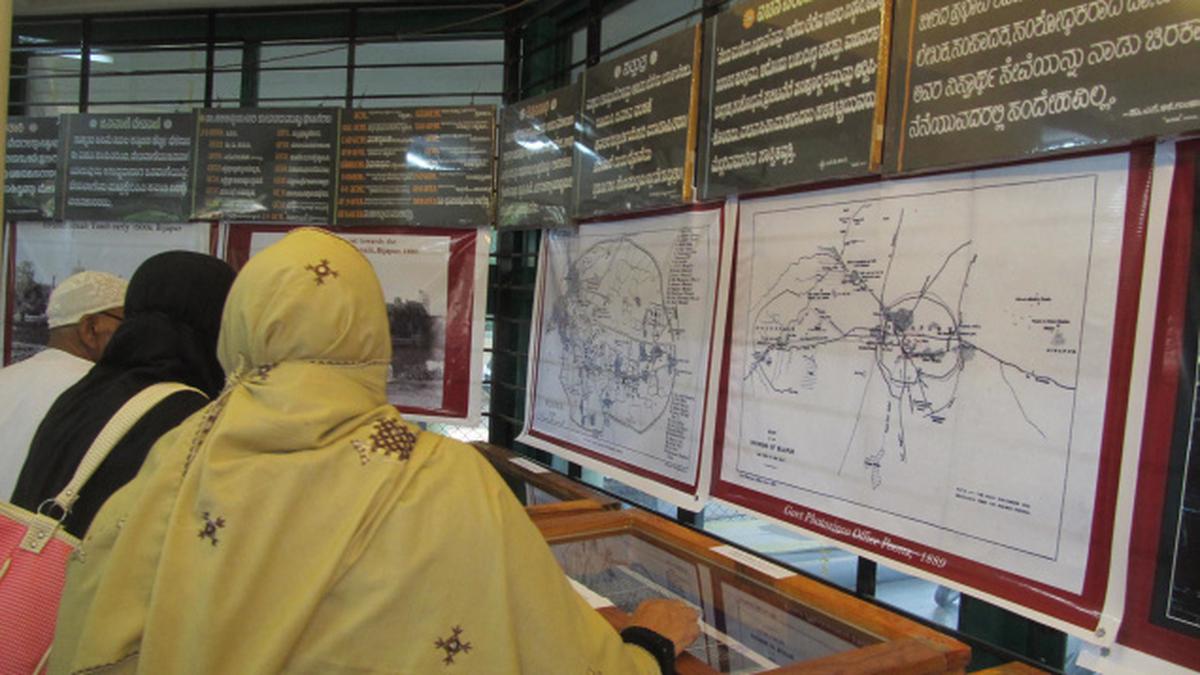
He said that during their search of books, the team laid hands on some of the rare maps of ancient Bijapur district prepared between 1763 and 1909.
“This is no less than a treasure for us . We also got hundreds of manuscripts and ‘Farmaans’ (official correspondents between Kings and landlords).
We have decided to display them in a museum to be established in future,” he said.
source: http://www.thehindu.com / The Hindu / Home> Features> Friday Review / by Firoz Rozindar / October 18th, 2016
The myriad monuments of Bijapur, such as the Gol Gumbaz, the Jami Masjid, the Malik-e-Maidan and the Ibrahim Rauza, continue to evoke the grandeur of its past as the capital city of a sultanate that held sway for two centuries.
The Ibrahim Rauza contains the tomb of Ibrahim Adil Shah II (r. 1580-1627). The tomb and the mosque in the complex were built by Malik Sandal, the celebrated Abyssinian architect in the Adil Shahi Sultanate of Bijapur.
DURING the reigns of Ibrahim Adil Shah II (r. 1580-1627) and Mohammed Adil Shah (r. 1627-1656) over the Deccan Sultanate of Bijapur, there lived an architect of Abyssinian origin called Malik Sandal who, some historians aver, learnt his trade in Turkey before being lured to the lands of the Deccan. Among the many splendorous monuments that this architect designed is the Ibrahim Rauza, the tomb of Ibrahim Adil Shah II, which the architectural historian Helen Philon describes “as the most beautiful and splendid of all Adil Shahi funerary monuments”. Malik Sandal used the services of a guild of builders whom he trained, called the imaratwale (builders).
Almost four centuries after Malik Sandal’s time, a descendant of this guild of builders continues to live in the city of Bijapur (now Vijayapura). While he has abandoned the profession of his ancestors, Abdul Gani Imaratwale often wanders into monuments that his forebears must have built, laying one basaltic block over another. His wanderings are not nostalgic strolls but serious forays of a historian of the medieval Sultanate of Bijapur who teaches at the Anjuman Degree College in Vijayapura. Seeking a deeper understanding of the history of Bijapur, Imaratwale often finds himself staring for hours at something as obscure as the fish motifs that adorn many of the monuments in this grand city. Bijapur in its heyday, rivalled and, at times, surpassed its Mughal contemporaries such as Delhi, Agra and Lahore in magnificence.
Imaratwale, who has published several books on various aspects of medieval Bijapur, has now brought out his latest edited volume, Studies in Bijapur Sultanate . His co-editor in this work is Maqsood Afzal Jagirdar, who is the direct descendant of Afzal Khan (d. 1659), a powerful generalissimo of the Adil Shahis. Thus, the two editors of the volume, apart from being scholars, have primordial familial links with the history of the Adil Shahi Sultanate of Bijapur.
Studies in Bijapur Sultanate consists of 43 academic papers, of which 17 are from an academic seminar that took place in 1983 in Bijapur when Imaratwale was a young historian, while the remainder are the outputs of modern research. In the latter section, the majority of the papers are authored by Imaratwale, followed by Jagirdar. The work of a few more scholars complete the volume.
The inclusion of unpublished papers from the seminar of 1983 is an academic scoop of sorts as they add tremendously to our understanding of the history of this epoch. Scholars from New Delhi, Hyderabad, Pune, Kolhapur, Bangalore (now Bengaluru) and Mysore (now Mysuru) had made the journey to Bijapur to participate in this pathbreaking seminar. On the second day of the seminar, they were taken around Bijapur in horse-drawn tongas to see the Gol Gumbaz, Jama Masjid, the massive cannon called the Malik-e-Maidan and the Ibrahim Rauza. Many of these historians, who had spent most of their academic lives researching the Deccan and south India, have since passed away, making this exercise of publishing their papers even more precious.
The Bijapur Sultanate was founded in 1489 by the Persian migrant Yusuf Adil Khan (known as Shah in later histories) (r. 1489-1510), who was a protege of the Bahmani Prime Minister Mahmud Gawan. At the time, the almost 150-year-old Bahmani Sultanate that stretched across the northern Deccan was in its death throes because of internecine differences among the native and foreign components in its nobility. The execution of Mahmud Gawan in 1481 at the behest of Mohammed Shah III (r. 1463-1482), the last notable king of the Bahmani throne who ruled from Bidar, catalysed the breakneck speed at which this empire unravelled as governors of different provinces gradually assumed independent power.
Over the next two decades, the boundaries of the northern Deccan would have to be redrawn to account for the birth of five new principalities, or Sultanates, of the Deccan that emerged from the implosion of the Bahmani Empire. The Deccan Sultanates that emerged were Bijapur (the Adil Shahi Sultanate), Golconda (the Qutb Shahi Sultanate), Ahmednagar (the Nizam Shahi Sultanate), Bidar (the Barid Shahi Sultanate) and Berar (the Imad Shahi Sultanate). Of these five, the three Sultanates of Bijapur, Golconda and Ahmednagar survived as robust and strong states into the 17th century when the imperial ambitions of the Mughals snuffed them out forever. The last great Mughal, Aurangzeb (r. 1658-1707), personally led campaigns to the Deccan, vanquishing Bijapur and Golconda in 1686 and 1687 respectively, ending the era of the Deccan Sultanates. Thus, historians like S.K. Aruni argue that the Deccan Sultanates formidably “resisted the north Indian imperialism” of the Mughals. Nine Sultans ruled the Adil Shahi Sultanate of Bijapur over the two centuries of its independent existence between 1489 and 1686. They ruled over a linguistically diverse land from their headquarters of Bijapur that lay at the nebulous meeting point of the Kannada- and Marathi-speaking lands. Their reign would later extend into the Tamil-speaking areas of the deep south as well. Like the other Deccan Sultanates of Ahmednagar and Golconda, which were ruled by ardent Shiites (as opposed to the Sunni Mughals), Bijapur, too, had a Shiite orientation that manifested in its close relationship with the Shiite Safavid dynasty of Persia.
Here, it is important to mention that even though Yusuf Adil Shah was the first Muslim king in India to declare himself as Shiite, his descendants often vacillated between Shiism and the Sunni creed. These rulers also never imposed their Shiite creed on their fellow Muslims, which is vindicated by the fact that Shiites continue to remain a negligible minority among modern Muslims even in the city of Vijayapura. Sufi saints such as Sayyed Hashim Husaini Alvi (the full name of Hazrat Hashimpeer) were also patronised by the ruling clique.
Like the Bahmanis before them, the Sultans of Bijapur ruled over a variety of people. Among the nobility itself, the factional schism between the Afaqis (or the foreign component which Imaratwale prefers to call Gharibuddiyar ) and the Dakhnis (or the native component) that had been the bane of the Bahmani court continued to fester in the Bijapur court as well. There were also Habshis or the Abyssinians who were an important faction in the court as well. Among its non-Muslim population, the Bijapur rulers formed a tight patron-client relationship with the Maratha nobility, with at least one prominent historian of the medieval Deccan, P.M. Joshi, comparing this relationship to the one that existed between the Mughals and the Rajputs in Hindustan or north India.
Imaratwale lists some of the prominent Maratha families that served the Adil Shahis militarily. These include the “Nimbalkars of Phaltan, Ghatges of Maun, Manes of Muswar, Ghorpades of Mudhol, Dafles of Jath, Sawants of Wari, etc.”. Marathi-speaking brahmins also served Bijapur in its civil administrative work. This relationship dates back to the founder of the dynasty, Yusuf Adil Shah, who married a Maratha noblewoman, and before him to the Bahmanis who had built a close relationship with the Marathas.
Bijapur was often involved in wars with the empire of Vijayanagara, its powerful neighbour in the south. In direct confrontations such as the battles that took place in 1510 and 1520, Vijayanagara (that was ruled by Krishnadevaraya [r. 1510-1529] at the time) was able to trump Bijapur. In the chequerboard of the medieval Deccan, victories or losses were never permanent, which meant that Bijapur would often ally with Vijayanagara over the next few decades in conflicts with its sibling Sultanates, until a final breach in this fluctuating relationship led to the Battle of Talikota in 1565. Four (of the five) Deccan Sultanates, including Bijapur, set aside their squabbles to briefly ally in this ultimate battle, which sounded the death knell for Vijayanagara. Historians have argued that the confederation of Sultanates, while having the smaller army, gained an immense advantage because of their advances in artillery pioneered by engineers such as Fatehullah Shirazi who lived in Bijapur during the reign of Ali Adil Shah I (r. 1558-1579). Bijapur benefited tremendously from this battle as it paved the path for the southern expansion of its territory across the Tungabhadra river as they were able to defeat a number of vassals of Vijayanagara over the next century.
Moment of glory
The victory at Talikota also led to the commencement of a golden period for Bijapur which saw a flurry of construction as Hindu artisans from the defeated capital of Vijayanagara sought new patrons. Bijapur entered its moment of glory with the ascension of Ibrahim Adil Shah II in 1580, who ruled for almost 50 years and is considered the greatest Adil Shahi Sultan. Part of his reign coincided with the reign of the greatest Mughal king, Akbar (r. 1556-1605), and aspects of Ibrahim Adil Shah II’s personality were similar to those of Akbar as the Bijapur ruler also had an eclectic outlook and, some argue, tried to establish a syncretic religious creed on the lines of Din-i-Ilahi .
In fact, Ibrahim Adil Shah II was addressed as “Jagat Guru”, for, as an aesthete steeped in musical and literary pursuits, he was a devotee of Goddess Saraswati. In some of the farmans (royal edicts) issued during his rule, he is referred to as Az Puja Shri Saraswati . Ibrahim Adil Shah II’s own composition, the Kitab-e-Nauras , contains lavish praise of Saraswati. Ibrahim Adil Shah II was also more comfortable in Marathi, a consequence of the ruling dynasty’s close links with Maratha nobility and the status that the language had as the lingua franca, than with Persian, which he spoke with some difficulty. He also patronised poets in his court, including Mulla Zuhuri, who wrote: “If they make the elixir of mirth and pleasure/They make it from the holy dust of Bijapur”.
A Mughal envoy, Asad Baig, who visited Bijapur during the reign of Ibrahim Adil Shah II, describes it thus: “In one street [of the bazaar in Bijapur] were thousands of people drinking; and dancers, lovers and pleasure seekers assembled. None quarrelled or disputed with one another and this state of things was perpetual. Perhaps no other place in the world could present a more wonderful spectacle to the eye of the traveller.” On his return to the court of Akbar, he took along with him fabulous gifts, including tobacco and Chanchal, the favourite elephant of the Sultan, who was “accustomed to drinking two mans [one man is equal to 37.324 kilograms] of wine daily”.
Mohammed Adil Shah (r. 1627-1656) also displayed some of his father’s penchant for art, music and literature, apart from being a wise ruler. It is his remains that are interred in the Gol Gumbaz, the awe-inspiring mausoleum that has one of the largest free-standing domes in the world.
At its peak in the first half of the 17th century, the boundaries of the Bijapur Sultanate touched both the Arabian Sea and the Bay of Bengal. In the West, Bijapur traded with Persia, Arabia, East Africa and Europe through its entrepots of Chaul, Dabhol, Bhatkal and Goa (which it lost to the Portuguese in 1510). Leaving the eastern Deccan in the hands of its neighbour, the Sultanate of Golconda, Bijapur’s tentacle of power extended south and south-east across Bangalore, Mysore, Tanjore and Madurai. This vast swathe meant that it was the second largest kingdom in India at the time after the Mughal Empire. The territory of the Sultanate encompassed regions in the modern Indian States of Karnataka, Maharashtra, Goa, Telangana, Andhra Pradesh and Tamil Nadu.
Evan as Bijapur reached the apogee of its power, its clashes with the Mughals who had become its northern neighbour after gobbling up the Sultanate of Ahmednagar, and increasingly fractious wrangling with the Marathas who had coalesced under Shivaji’s leadership, restricted its power. The early rise of Shivaji, who became the first Chhatrapati of the Maratha Empire reigning between 1674 and 1680, can be indirectly attributed to the Adil Shahis. His father Shahji was one of the chief generals of the Bijapur army during the reign of Mohammed Adil Shah and Ali Adil Shah II (r. 1656-1672) and was even granted a string of titles and the jagir (landholding) of Bangalore for his services.
The decline of the Bijapur Sultanate set in after the ascension of Ali Adil Shah II, who was unable to complete the building of his own tomb (the incomplete structure is erroneously called Barakaman and was possibly conceived to be larger than the Gol Gumbaz), and continued under Sikandar Adil Shah (r. 1672-1686) who, after a year-long siege of Bijapur, was captured by Mughal forces in 1686 ending the saga of the Adil Shahis.
The Adil Shahis’ liberal religious policies, their broad outlook towards their subjects of various ethnicities, their patronage of art and literature also ensured that their reign engendered a unique Deccani culture in their territories, vestiges of which continue to linger on in modern Karnataka and Maharashtra. Their legacy in language can be seen in Dakhni Urdu, which continues to be spoken by Deccani and south Indian Muslims even to this day. In the implementation of justice, the “Adil Shahi kings preferred Hindu law for Hindu subjects and the Muslims were governed by Shariah .” The farmans of the Adil Shahis were in Persian but often appended by a translation in Marathi or Kannada. The historian and archaeologist Dr A. Sundara has demonstrated that the Deccani architectural style of the Adil Shahis even had an impact on temple architecture.
Imaratwale makes the important point that “Hindus enjoyed socio-religious freedom” during the Adil Shahi period. Many of the Persian histories written during the Adil Shahi period mention how the Hindu population celebrated festivals such as Ugadi, Holi, Deepavali and Dasara, and the rulers financially supported “annual fairs and the maintenance of religious places such as temples and mathas ”. The contemporary Persian histories that Imaratwale relies upon are valuable sources of Bijapur history. Chief among these is Tarikh-e-Farishtah of Muhammad Qasim Hindu Shah Astrabadi, who wrote this history under the patronage of Ibrahim Adil Shah II.
While modern Vijayapura, also the district headquarters, is a nondescript city, its myriad monuments continue to evoke the grandeur of its past. Both religious structures, be they tombs or mosques, and secular structures, such as forts, tanks, palaces, markets and gardens, still vie for the attention of the modern-day tourist. The detritus of majestic structures that survives in its suburbs and neighbouring towns and villages such as Afzalpur, Tikota, Kumatagi, Ainapur, Aliabad and Nauraspur, also beckon discerning visitors.
Abdul Gani Imaratwale can be contacted at dr.imaratwale@gmail.com
source: http://www.frontline.thehindu.com / Frontline / Home> Arts & Culture> Heritage / by Vikhar Ahmed Sayeed / July 09th, 2021
A secure inn for gem traders during the Adil Shahi era, Nawab Mustafa Khan Sarai houses prisoners today.
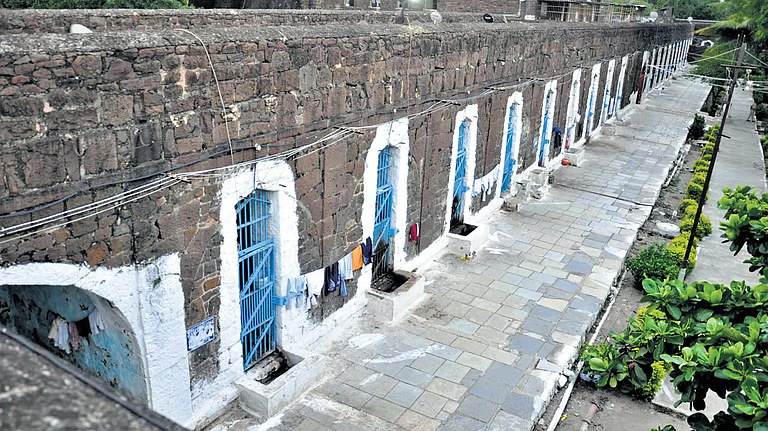
The interiors of the Nawab Mustafa Khan Sarai now known as Dargah Jail Photo | Express
Vijayapura :
Several historical remnants dot the landscape of Vijayapura, reflecting Bijapur’s glorious past. While Gol Gumbaz and Ibrahim Roza are some shining examples of Deccan Indo-Islamic architecture, there is another imposing structure of that bygone era, which is still alive and in use today.
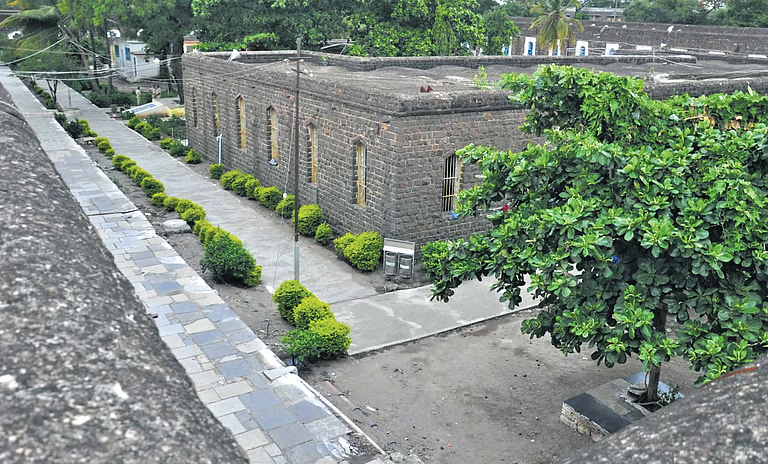
With its formidable heightened walls built with large black stone over five acres of land; a narrow arched-entrance, flanked by small rooms for guards; and a grand courtyard, surrounded by rooms for accommodation, a large kitchen, and bathrooms, Nawab Mustafa Khan Sarai served as the most secure place of stay and rest for travellers and traders in precious gems for over four decades.
Nawab Mustafa Khan Sarai, translated as Nawab Mustafa Khan Inn, continues as a secure place of boarding even today, the only difference being that it’s no longer an inn. Located around 4 km from the central bus stand in Vijayapura city, this splendid monument houses hundreds of prisoners, since being converted into a jail during the British Raj.
Dargah Jail
Popularly known as Dargah Jail, owing to its proximity to the shrine (Dargah) of Sufi saint Hazrat Khwaja Ameen Chishti, the monument is a reminder of the architectural marvels sanctioned by the Adil Shahi dynasty that ruled the South-Western part of India during 1490-1686 CE. Specifically, the Bijapur Central Prison, which is historically Nawab Mustafa Khan Sarai, was built by Nawab Mustafa Khan in 1636 CE. Khan was appointed Commander-in-Chief during the reign of Sultan Mohammed Adil Shah, and proved himself to be an astute administrator.
Elucidating the need for such an inn or boarding house, historians cite the wealth and prestige of the Sultanate of Bijapur in the 17th century that called for such structures to be built.
“Since Bijapur had gained immense prosperity during the Adil Shahi period, hundreds of domestic and international travellers and traders started visiting it. At that time, a new suburb called Shahapur was commissioned, which had all modern facilities of the time. Since travellers traded in precious stones from across the globe, they needed a safe and secure place to stay in Bijapur. Considering the need, Mustafa Khan got the inn built in 1636 CE near Vijayapura city, which was located close to Shahapur then,” explains Dr Abdul Gani Imaratwale.
A painting Nawab Mustafa Khan
The veteran historian, who has written several books on Bijapur’s history, said the inn’s tall walls were designed to prevent intruders from entering the premises, protecting the resident traders and their priceless wares.
“To instil a sense of security among traders and travellers, Khan also got a verse of the Quran inscribed on a wall of the monument. The verse means – ‘Allah is assuring all those who have entered heaven they need not to be scared or carry any fear as they are now safe and secure because they are in the custody of Allah’. This verse is meant to reassure visitors that they are in a very safe and secure place,” Dr Imaratwale elaborates.
Further, he says the sultan had appointed guards, whose job was to keep the precious items of the traders in their custody and maintain a complete record. The visitors were charged some fee for the service.
Inn becomes prison
The inn continued to function for several years until the end of the Adil Shahi dynasty, and then it was captured by Mughal Emperor Aurangzeb in 1686 CE. Soon after, the traders stopped arriving, and the once bustling structure fell to ruin and disrepair, and remained deserted for another two centuries.
In 1885, the British, under whose control Bijapur was at that time as part of the Bombay Presidency, decided to convert the Sarai into a prison. Historical records suggest that the British wanted to build a prison, but first wished to explore the possibility of converting any monument into one, with some minor changes. The colonial authorities found the inn suitable, and decided to go ahead with turning it into a jail, allocating Rs 20,000. “The British found the monument best-suited for a prison, because of the high walls surrounding it. Also, it had rooms that could be converted into barracks for inmates,” Dr Imaratwale informs.
Today, the jail has 10 barracks, with each having a capacity to house around 40 inmates. There are around 500 prisoners (male and female, and convicts and undertrials) lodged here. In due course, more amenities have been added for the inmates. Security features such as CCTV cameras too have been installed.
In 1983, the jail was converted into a District Central Prison, where convicts began to be incarcerated. But over time, the authorities found the prison proving to be small to accommodate an increasing number of prisoners, prompting the government to construct a new high-tech jail on the city’s outskirts. Officials said that work on the new building is under way. Soon, the present jail will be shifted to a new facility. Till then, Dargah Jail will remain one of the oldest prisons in the country.
A symbol of piety
Besides constructing a ‘sarai’ or inn for travellers, Nawab Mustafa Khan also got a large mosque built in the central part of old Bijapur city. Located on Bari Kamaan (large arch) Road, the mosque is said to be built in 1639 CE, and later became popular as Nawab Masjid. It is still used regularly for prayers. Though a masjid committee is taking care of the Masjid, since it is listed as a ‘protected monument’ by the Archaeological Survey of India as it is an edifice of historical importance. Historians view the Masjid as a unique monument, constructed using only large stone slabs. Another striking feature is that it has no pillars, entirely standing on huge stone walls. The design of the inner arch, where the Imam leads the namaz, is said to have been derived from the historical Jama Masjid. The inner area can accommodate at least 200 worshippers, while an equal number of people can offer prayers in the outer area. The mosque also has a tank for ablution, which used to be full of water round the year in past, since it was connected via underground pipes to the Begum Talab, almost 3 km away.
source: http://www.newindianexpress.com / The New Indian Express / Home> Good News / by Firoz Rozindar / July 21st, 2024
Prayagraj (formerly Allahabad), UTTAR PRADESH / NEW DELHI :
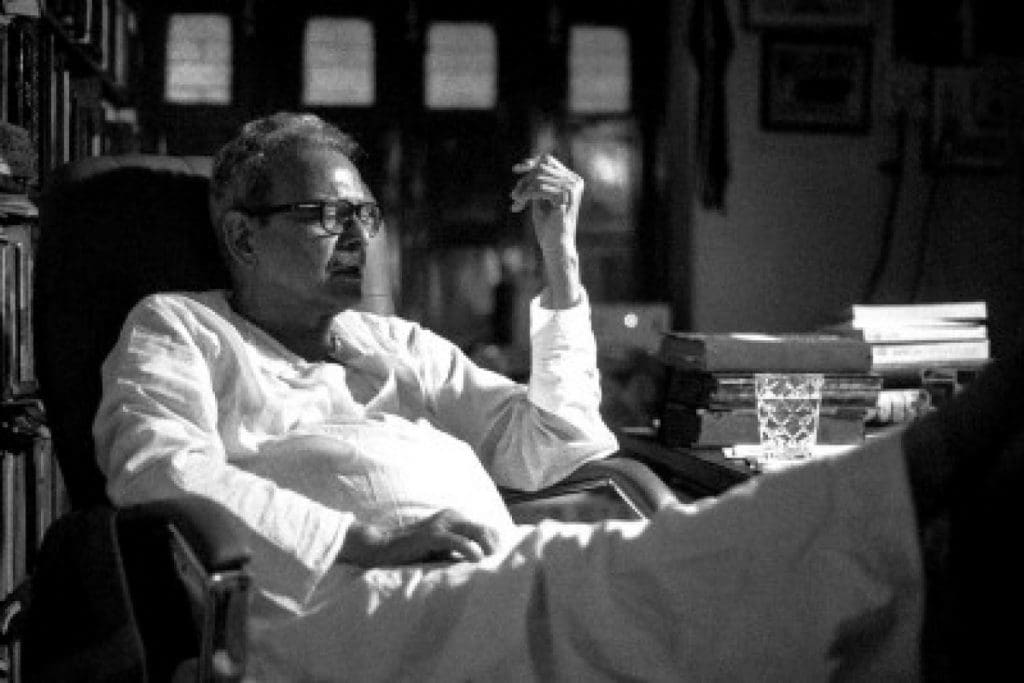
Shamsur Rahman Faruqi with Baran Farooqi. Photos courtesy: Baran Farooqi
Abba was the magician who introduced me to the wide and varied wonders of the world, taught me everything about life and its customs and kept me enamoured of his extraordinary personality. I was awe- struck by his learning, his cool, confident air and the way and adulation he commanded sat comfortably on his shoulders.
And may there be no sadness of farewell
When I embark;
Alfred Lord Tennyson
“Yeh meri akhiri bimari hai (this is my last illness),” spoke Abba with a wry smile on his face. He was addressing Dr Nandani Sharma, a homeopath in Shivalik, Malviya Nagar (New Delhi), whom we were all very fond of and trusted. That evening we had taken him there since he had expressed a desire to actually see her and not consult her over a video call to ask about the chances of curing the fungal infection which had invaded his eye during his stint at Fortis Escorts hospital where he had been hospitalised after having tested Covid positive. None of us had imagined that it was a matter of just a few days before he would be gone, transited peacefully and in full preparation of “seeing his pilot face to face.” Dr Nandani assured him that he still had long to live and accomplish some more as she was confident her medicines would be able to control the fungus. This conversation had taken place in her driveway as Abba was not able to walk since he had returned from hospital and so it was decided that instead of him having to go into her clinic, he would be seated on his wheelchair near the car and she would examine him. We returned upbeat from Dr Nandani’s place but it was as if Abba knew better than Dr Nandani this time. He had been sent the summons and he had answered them with acceptance and great sporting spirit. So, he laughed at our jokes in his weak strength and held out his hands or arms to embrace whenever he saw me or my sister or my daughters enter the room. He would kiss my hands and softly caress my head if he happened to be sitting, bolstered by the electrically operated bed we had arranged, half a dozen pillows and bolsters around him.
Of late, in fact, right from the time he would send voice notes from the hospital, he would often repeat, “I love you” or “know that I love you.” Of course, we had never had any doubts about this ever because Abba was the master of expression. A vocal person, he taught me how I need to say “thank you” even to my own parents if they got me something and to house helps and friends for services rendered or acts of kindness. I once overheard him reproaching my mother for never doing salam to him first when he got home from office or smilingly extending her hand of welcome. Always cheerful and smiling when he came home from office, he expected everyone else at home to be as smiling and welcoming as he was. Each time any of us would enter his room for something, he would beam aaiye aaiye (do come in) and show his pleasure. He used to call me “funny face” sometimes, which didn’t seem very amusing to me but I knew I was supposed to show a sense of humour and not sulk over little things. I finally asked him one day, “Why do you call me funny?” He answered that funny faces are those who are delightful and make him feel happy and full of mirth. Once, when I made him fill out my columns of questions like, who is your best friend, what’s your favourite colour, what are you scared of and so on, (this was a raging activity in my school those days that you took autographs of people in your autograph book for no reason and also made them fill columns which were made in a double page of a register.) I remember almost all his answers to this day but I’ll speak of only a couple, to the question, “If you had a wishing wand, what would you wish me to be?” he had answered “Queen of Sheba.” I immediately understood this is something divinely great and luminous and so on, since I didn’t really know who queen of Sheba was at that time. In the answer to the question, “what are you scared of?” he had answered “centipedes,” making me aware that he was human and vulnerable in his own way.
I have wandered far from what I was initially talking about — his illness and his demeanour during those days. After stretching out his hands and making me sit close, he told me one day that the time for him to leave this world had come and that I should allow him to go. That the ceaseless struggle that we were putting up to withhold him was futile and he was convinced about his departure. He needed to go back to his spacious and open house where his favourite pet dog Bholi and others were, and he wanted the birds to sing near his window before he ceased to breathe. On those nights when he was awake and not faint with weakness, I would sit by him and read out his WhatsApp messages to him and also make him listen to the voice notes people had sent. He chose to respond to one or two voice notes or emails and messages every day. He would speak the voice notes himself and dictate the written messages or emails. He once made me write a mail to CM Naim sahib though there wasn’t one from him that day and also to Frances Pritchett, informing them about his health. One of the voice notes that he sent to Amin Akhtar (a relative of ours who has been assisting him in his library-cum-office and miscellaneous affairs for many years) was about the local graveyard which Abba’s efforts had helped restore and put in order after his return to Allahabad after retirement. He asked Amin to go to my mother’s grave and convey his salam there. He also asked Amin to see if it was still possible if he could be laid to rest right next to her, but in case anyone objected, he reminded Amin, he had chosen a remote corner of the graveyard for himself as a second choice. Amin responded next day tearfully that he had carried out his instructions and that there was no question of anyone objecting to his burial next to his wife. He had written the ayat he would like to be written on his tombstone and given it to Amin many years back already. I felt heart-broken at these conversations but I, too, knew that they must happen and not be left unfinished, for the day of parting may come if it had to, and there was nothing anyone would be able to do about it.
I marvel at Faruqi’s (as he would like to refer to himself, sometimes even calling himself “saala Faruqi” or “Fraudie”), courage and foresight for the way he bore his illness. He was also very kind and forbearing towards us, always succumbing to our pleas for making him eat or drink something despite being terribly averse to both ideas. Every time he would ask when we were planning to go back to Allahabad with him, and my sister or I would give a date a week or two away, he would nod patiently and agree. Ever since Ammi passed away, Abba had been careful to hand over all that she had left behind as money or property to both of us, saying this belongs to you both as she was your mother. But when it came to caring for us and endowing us with gifts or maintaining the large house, he acted as the perfect father. Never once did he ask us to bear any financial burden of any kind, be it the property Ammi left behind — he continued to pay property tax for it — or other charities that she was used to doing at her native village.
Unselfish by nature, and generous towards the world and its people, he once told me that he had spent his life with the aim to be of help to any number of human beings he came across in the journey of his life, particularly during his career in civil service. I have never known or seen, nor do I ever hope to see, another more good-hearted person who is also competent, capable and one of the greatest literary minds of the century. Abba loved exploring new things and enjoy them if the children so wanted. Any new joke, and we wanted to share it with him, a new piece of machinery or a gadget and he would be curious to know about it, any adventurous outing, and he would want to be a part of it. In fact, most of the interesting outings in my and my daughters’ lives were either planned by him or planned for him. It was just last winter that we all went to Kochi together to explore the backwaters of Kerala and spend some part of winter there to avoid the low temperatures up North. As he grew older, he had begun dreading the winters, as they confined him to his room and restricted his hours in the study. There were arrangements to keep his room, his study, and even his bathroom warm, but the cold got to him since he was finicky about wearing “inners” and heavy quilts bothered his frail body with their weight.
Apart from travelling to new places and exploring places of historical interest or natural beauty, Abba had a penchant for stylish and tasteful clothes and good food (which he always ate very little of, but wanted to be served in good quantity). However, he had this little thing in his head about what are supposedly “manly” dishes and which foods are meant to be consumed only by women. Consequently, I never saw him relishing anything even slightly sour. He was supremely dismissive of achar and chutneys or chaat of any kind. Even remotely foul-smelling vegetables were banned in our house, not to speak of home-made sirka or ghee being extracted from malai. I once witnessed a bitter exchange he had with my mother for having gotten mooli achar prepared in the courtyard of our house. This was even worse than cooking sabzi out of the mooli! Like any other subversive spouse, Ammi would sneak such things into the house and eat them secretly when he was in office.
Abba was a great animal lover, too. As children, having animals and birds around us was as natural as breathing and it must never have occurred to us that in the eyes of the world, we qualified as “animal lovers.” At any given time in our lives, there were always dogs, cats, turtles, mynahs, peacock chicks or grown peacocks, pigeons, partridges, quails and finches and other singing birds. Abba would often send a tid-bit or two to his pets (I said “send” because the house was really so huge in area that things had to be delivered from one place to another) and tell the person he had chosen for the task, “greet him with my salam and say that Faruqi sahib has sent this. We knew a lot about birds, which ones could be tamed or caged and which couldn’t be bred in captivity. He also had a collection of coffee-table type books on birds and animals and some of the exciting times of my childhood were certainly made of browsing through those books. Sea creatures like starfish, octopus or dolphins intrigued me greatly and I was enamoured by pictures of the mighty ocean. I longed for a trip to a coastal town but my wish was deferred for quite some time as my parents had already been to places like Bombay and Calcutta many times and were more focussed on the hills or animal and bird sanctuaries.
Abba played his favourite musical records of ghazals and classical ragas in the mornings which were spent enjoying three to four cups of bed tea. The tea, which would be brewed in an elegant tea pot and had a bitter aroma, would cool gradually as he read the morning papers. The music would continue to play up until he was almost ready for breakfast. Gradually though, I, too, developed a taste for singers like Farida Khanum, Iqbal Bano, Mehdi Hassan, Kishori Amonkar, and artists like Hari Prasad Chaurasiya, Ustad Bismillah Khan and other such maestros. My sister and I were also subjected to regular doses of mushairas and seminars which we had to duly attend along with our parents; I was still wearing frocks at that time. By the time I grew up, I had sat on the laps of many a great Urdu writer, poet or artist. I grew particularly familiar with Naiyer chacha (Naiyer Masud), Shamim chacha (Shamim Hanfi), Shahryar chacha and Balraj Komal uncle. The critic Khalil-ur-Rahman Azmi was someone I don’t clearly remember but I recall Abba grieving over him so much that Ammi had to chide him about moping a couple of times.
Abba was the magician who introduced me to the wide and varied wonders of the world, taught me everything about life and its customs and kept me enamoured of his extraordinary personality. I was awe- struck by his learning, his cool, confident air and the way and adulation he commanded sat comfortably on his shoulders. He lived a life of grace and élan. Once, when on one of our usual summer holiday road trips, when we were touring Uttar Pradesh and Himachal, there was an incident which impacted me for the rest of my life. It so happened that the road we were on was broken severely, blocked, you may say, so Abba decided to take a detour through another path, which was on the lower side of the road, beside the fields. It was a water-logged path but he estimated that our Ambassador car would be able to successfully wade through it. But to our chagrin, the car got stuck in the slush beneath and water began to enter the car at a high speed! The car seemed to be floating in the water, I began to bawl loudly saying, “Hum doob jayenge, hum doob jayenge, (I’m going to drown, I’m going to drown).” I got one of the most unexpected and loud scoldings of my life from him at that time, “Abey tu apne liye ro rahi hai sirf! Aur baqi tere ma baap aur behen? (Stop crying and saying such a selfish thing! Why are you worried about only yourself drowning and not your parents and your sister?)”. I wiped my eyes and looked at him, bewildered. It was a lesson I have remembered to this day — unselfishness and courage.
So close, so friendly and participative and yet so distinguished and awe-inspiring! They don’t make men like you any longer, Abba. I conclude my piece again from the poem quoted above. Abba would sometimes teach us English poetry, too, apart from Urdu and Persian. Abba had read out the poem to me many, many years ago and explained it to me. Alfred Lord Tennyson’s “Crossing the Bar” was one of his top favourite poems of the English language. I remember his voice almost choking at the sombre grandeur and sonority of the poem:
For tho’ from out our bourne of Time and Place
The flood may bear me far,
I hope to see my Pilot face to face
When I have crost the bar.
Perhaps, the very same lines were echoing in his mind when he breathed his last, in full control of his senses, aware and courageously ready for the journey across.
source: http://www.thepunchmagazine.com / The Punch Magazine / Home> Non fiction – Essay / by Baran Farooqi / February 28th, 2021
“It’s not just the world of Urdu, I feel I’ve been orphaned again,” historian Rana Safvi sent her condolences.
It's not just the world of Urdu, I feel I've been orphaned again.💔 Go well Sir. Allah Jannat mein jagah ata farmaaye Inna Lillahi wa inna ilayhi raji'un pic.twitter.com/zhcGb6nqWO
Writer and historian William Dalrymple took to Twitter to mourn the demise of Faruqi, calling him “one of the last great Padshahs of the Urdu literary world.”
Sanjiv Saraf, the founder of Urdu festival Jashn-e-Rekhta, also condoled the death of “the century’s most iconic figure in the realm of Urdu literature”.
“His demise has left us bereaved as an entire generation of literature lovers mourn this loss. I extend heartfelt condolences to his family and loved ones,” Saraf said.
“Shamsur Rehman Farooqui’s demise is a big loss to the world of scholarship, and adab. His work built many bridges across India’s diverse traditions. He was immensely valuable to us in so many ways and will be sorely missed, ” said CPIM general secretary Sitaram Yechury.
Shamsur Rehman Farooqui’s demise is a big loss to the world of scholarship, and adab. His work built many bridges across India’s diverse traditions. He was immensely valuable to us in so many ways and will be sorely missed. Heartfelt condolences. pic.twitter.com/CKy0Dan0Lq
“Am just gutted. Shamsur Rehman Faaroqui saheb has passed away. Innalillahi wa inna ilayhi rajeeon. May allah grant him jannat..aameen,” wrote journalist Rana Ayyub.
“His modernist style had irked the traditionalists and contemporaries in the sixties, seventies. But he wasn’t just a critic and theorist, whenever he took to fiction, he created magic. And, his Allahabad home had been the nucleus of Urdu literary world, for over half-a-century,” wrote journalist Shamsur Rehman Alavi in a condolence note.
His modernist style had irked the traditionalists and contemporaries in the sixties, seventies. But he wasn't just a critic & theorist, whenever he took to fiction, he created magic. And, his Allahabad home had been the nucleus of Urdu literary world, for over half-a-century.
A profile of his on Caravan Magazine alluded to his immense and immeasurable contribution to Urdu literature.
Shemsur Rehman began writing in 1960. Initially he worked for the Indian postal service (1960–1968), and then as a chief postmaster-general and member of the Postal Services Board, New Delhi until 1994. He was also editor of his literary magazine Shabkhoon and part-time professor at the South Asia Regional Studies Center at the University of Pennsylvania.
An expert in classical prosody and ‘ilm-e bayan (the science of poetic discourse), he has contributed to modern literary discourse with a profundity rarely seen in contemporary Urdu critics. His most recent books, The Mirror of Beauty (translated into English from the Urdu Kai Chaand The Sar-e-Aasmaan in 2006), and The Sun That Rose From The Earth (Penguin India, 2014), have been highly critically acclaimed. He is the recipient of numerous honors and awards. Most recently he was awarded the prestigious Saraswati Samman for his work She`r-e Shor-Angez, a four-volume study of the eighteenth-century poet Mir Taqi Mir.
He was awarded the Saraswati Samman, an Indian literary award, in 1996. The Government of India awarded him the civilian honour of Padma Shri in 2009.
source: http://www.maktoobmedia.com / Maktoob Media / Home> India / by Maktoob Staff / September 25th, 2020
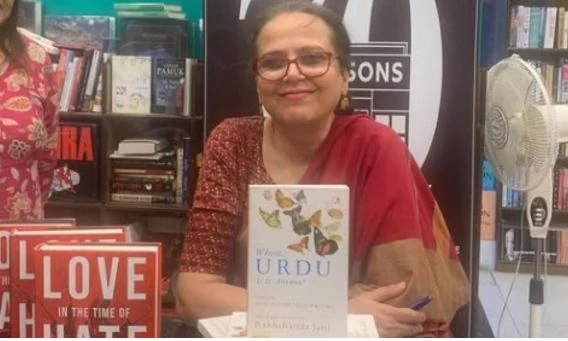
Literary historian Dr Rakhshanda Jalil has once again reminded Indians that Urdu is deeply rooted in the country’s soil and belongs to all communities, not only Muslims. In a detailed interview with the Indian Express about her new anthology Whose Urdu Is It Anyway?, Jalil traced the rise, decline, and contested identity of Urdu in modern India.
She explained that Urdu developed through centuries of cultural exchange, drawing from Persian, Arabic, Turkic, and local dialects, and eventually became the lingua franca of North India. From courtrooms to markets, it was a language spoken across caste and creed. Yet, political movements in the early twentieth century began to link Hindi with Hindu nationalism, sidelining Urdu and associating it exclusively with Muslims.
Jalil underlined how Partition worsened this perception. With Pakistan adopting Urdu as its national language in 1947, Urdu was treated as “enemy property” in India. This shift, she argued, accelerated the decline of Urdu and restricted its public identity. Today, while the government occasionally honours Urdu writers, stereotypes and misinformation continue to reduce Urdu to a religious marker rather than a shared cultural heritage.
Her anthology features sixteen short stories by non-Muslim Urdu writers such as Krishan Chander, Rajinder Singh Bedi, and Gulzar. The collection challenges the misconception that Urdu belongs only to Muslims. Jalil believes that Urdu is “as Indian as anybody or anything can be regarded as Indian” and insists that the language is willing to belong to anyone who values it.
Despite fears about its future, she remains optimistic. Urdu continues to thrive in poetry, Bollywood lyrics, and growing digital platforms. While fewer people read its script, its cultural resonance persists. Echoing Manto, Jalil recalled his words that no human effort can kill a language. Urdu, she said, will remain part of India’s consciousness for years to come.
Dr Rakhshanda Jalil is a noted literary historian, translator, and cultural commentator with over 25 books to her credit. She is widely recognized for her work on Urdu literature and the Progressive Writers’ Movement.
source: http://www.radiancenews.com / Radiance News / Home> Arts & Culture> Focus> Report / by Radiance News Bureau / August 29th, 2025
Mumbai Youth Congress member Zeenat Shabrin has been elected the new president of the outfit, becoming the first woman to hold the post after securing the highest 10,076 votes in the recently concluded organisational elections.
The elections for office-bearers in the Congress’s youth wing in Mumbai were conducted between May 16 and June 17 with nine candidates in the fray for the president’s post. The results were announced on Sunday with Shabrin, who secured the maximum 10,076 votes, emerging victorious, a party press release said on Monday.
Indian Youth Congress (IYC) office-bearers are chosen through internal elections rather than nominations.
Shabrin, who hails from a non-political background, said under her leadership, the Congress wing try to become the voice of Mumbai’s youth.
The party statement quoted her as saying, “The Indian Youth Congress has given me, a person from a non-political background, a platform. I thank the Indian National Congress, the Mumbai Congress, the Maharashtra Congress, and the Mumbai Youth Congress family for their guidance and trust. We will work to become the voice of Mumbai’s youth.”
The organisation would continue to fight under the leadership of Congress MP Rahul Gandhi and IYC national president Uday Bhanu Chib to strengthen the outfit and safeguard democracy and the Constitution, she asserted.
source: http://www.awazthevoice.in / Awaz, The Voice / Home> Sports / by PTI / posted by Vidushi Gaur / September 22nd, 2025
Muran Village (Pulwama District), JAMMU & KASHMIR :
Owais Yaqoob’s moment of victory at Guangzhou, China
New Delhi :
Owais Yaqoob, a 26-year-old mixed martial arts (MMA) fighter from South Kashmir’s Pulwama district, registered a win at an international competition in China by defeating Ian Paul “Choco” Lora of the Philippines, on Friday
He was fighting under the Bahrain-based BRAVE Combat Federation in China’s Guongzhou.
Born in Muran, a village surrounded by apple orchards, some 6 km from Pulwama town, Owais has been active in sports since his childhood.
Just 3 minutes and 6 seconds into the match, Owais secured a takedown and then landed a barrage of powerful punches, knocking him to the ground. Lora surrendered and tapped out. This victory represented more than just winning a match for Owais. It was a dream come true, a dream that had come true after years of hard work, struggle, and dedication.
Today, our very own Owais Yaqoob (@MartialKashmir) has made history in China by defeating the undefeated Ian Paul Lora and raising our tricolor high on the international stage once again. 🇮🇳
Owais Yaqoob began his martial arts journey in 2013 with taekwondo. Over the next ten years, he won 11 national gold medals, 6 silver medals, and 17 state-level titles. Owais’s exceptional performance earned him the titles of “Champion of Champions” and “Best Fighter Boy” in 2018.
In 2022, Owais participated in the WEKAF World Championships held in the Philippines, where he won a bronze medal and represented India in Filipino stick fighting (Eskrima). This performance established him as a world-class martial artist.
Owais’s inspiration for MMA came after watching a match featuring UFC superstar Khabib Nurmagomedov in 2018. Owais was determined to pursue a career in the sport. Before entering the world of professional MMA, Owais also won three national amateur MMA titles.
Owais shared his bout on X:
Owais Yaqoob (@MartialKashmir) from Kashmir defeats the undefeated Ian Paul “Choco” Lora at #BRAVECF98, raising the Indian Tricolour 🇮🇳 high on Int'l MMA stage
He made his professional debut in 2023 and defeated Mohammed Azim Mokhlis by unanimous decision in March 2024. He then defeated Shetty Pratik Sadashiv by technical knockout (TKO) in April 2024. His professional record now stands at 3-1.
Owais had, for some time, deviated into stone pelting but was counseled and brought back into the mainstream, and today is an example of how positivity can change lives in Kashmir.
According to Kashmir media, his victory was celebrated in his village, where people visited his home to congratulate his parents. Friends and family celebrated his victory by distributing sweetmeats.
“His victory shows what Kashmiri fighters are capable of on the international stage,” said Waseem Ahmad, an athlete from Pulwama.
Rouf said the win has strengthened his brother’s resolve to push forward. “Every fight is a test. It will embolden him to train harder and prepare for bigger challenges ahead,” he added.
His achievement has sparked interest among youngsters in Pulwama, many of whom now aspire to pursue MMA professionally.
source: http://www.awazthevoice.in / Awaz, The Voice / Home> Sports / by Aasha Khosa / September 21st, 2025
BanuMushtaq was accompanied by Chief Minister Siddaramaiah, several ministers in the state cabinet, among others.
Banu Mushtaq inaugurated the Mysuru Dasara festival.
Mysuru :
The famous Mysuru Dasara festival commenced in the city and palaces on Monday with religious and traditional fervour, with International Booker Prize-winning writer Banu Mushtaq inaugurating the festivities.
Banu Mushtaq inaugurated the festivities during the auspicious “Vrushchika Lagna” by showering flowers on the idol of goddess Chamundeshwari, the presiding deity of Mysuru and its royals, amid chanting of Vedic hymns by priests, at the premises of Chamundeshwari temple atop the Chamundi Hills here.
Celebrated as ‘Nada Habba’ (state festival), the 11-day Dasara or ‘Sharan Navaratri’ festivities are expected to be a grand affair this year, showcasing Karnataka’s rich culture and traditions, coupled with reminiscence of royal pomp and glory.
In the inaugural event, Banu Mushtaq was accompanied by Chief Minister Siddaramaiah, several ministers in the state cabinet, among others.
Earlier, Banu Mushtaq, along with Chief Minister and other dignitaries, visited the Chamundeshwari temple and offered prayers to the goddess, referred to as the “Naada Devate” (state deity), ahead of the inaugural.
(This story has not been edited by NDTV staff and is auto-generated from a syndicated feed.)
source: http://www.ndtv.com / NDTV / Home> News> India News / by Press Trust of India / September 22nd, 2025
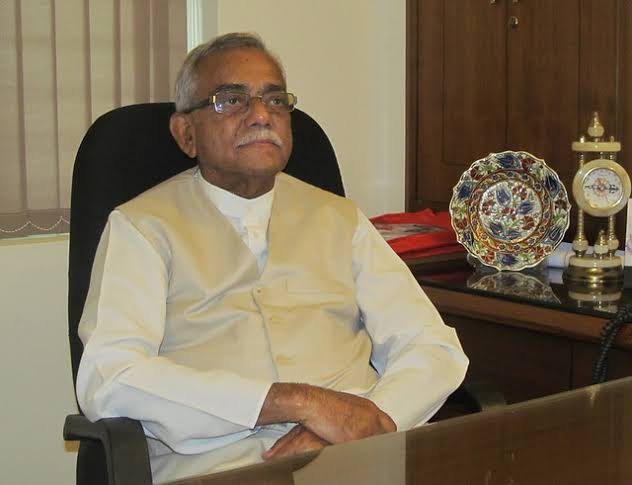
Ghiasuddin Babukhan, one of Hyderabad’s most respected builders, philanthropists, and educationists, died Monday at 83. He is survived by his wife, three sons, and a daughter.
Known for his compassion, Babukhan leaves behind a legacy that bridged stone and society — architectural heritage inherited from his father and a philanthropic network of his own making.
He was the son of Khan Bahadur Abdul Karim Babukhan, a legendary builder who left an indelible mark on India’s architectural history. Abdul Karim Babukhan’s construction empire produced some of the most celebrated structures of the 20th century, including the Arts College at Osmania University, the Hyderabad House in New Delhi, and the Kadam Dam in Nirmal, then in Adilabad district.
Ghiasuddin inherited not just this construction legacy, but also the conviction that enterprise must serve society. In the early 1990s, he shifted decisively from business to social service. In 1992–93, he founded the Hyderabad Zakat and Charitable Trust (HZCT), creating a structured and transparent system of charitable giving. For him, philanthropy was not about token donations but about building institutions that could sustain dignity and hope for generations.
The trust focused primarily on education, which Babukhan believed to be the most powerful tool for empowerment. Its annual scholarship program for orphans became one of its most impactful initiatives. For more than a decade, over 10,000 orphaned students across Andhra Pradesh and Telangana pursued education with dignity through these scholarships. Many went on to become doctors, engineers, teachers, and entrepreneurs — living proof of Babukhan’s belief that charity must enable, not merely provide.
Unlike many who confined themselves to charity within their community, Babukhan’s work cut across religious and social lines. He was committed to humanitarian relief, healthcare support, and the preservation of Hyderabad’s plural cultural ethos. His schools, social programs, and charitable initiatives reflected an inclusive philosophy rooted in compassion, justice, and service.
“The passing of Ghiasuddin Babukhan is a great loss for Hyderabad. He was a dedicated philanthropist whose efforts in educating the poor will be remembered. My condolences to his family and friends. May Allah grant him maghfirah and patience to his loved ones,” Hyderabad MP Asaduddin Owaisi said in an X post.
Jamaat-e-Islami Hind president Syed Sadatullah Husaini called him a “true champion of education and a benefactor to the Muslim community.” In a post on X, Husaini said Babukhan’s contributions through the Hyderabad Zakat and Charitable Trust transformed the lives of thousands and would be remembered for generations.
“He was a true champion of education, a liberator of the marginalised, and a benefactor of the Muslim community — an embodiment of the noble spirit of zakat and compassion. Through his philanthropic initiatives, he played a pivotal role in the educational upliftment of the Ummah, poverty alleviation, relief work, and community development,” Husaini wrote.
source: http://www.maktoobmedia.com / Maktoob Media / Home> India / by Maktoob Staff / August 26th, 2025