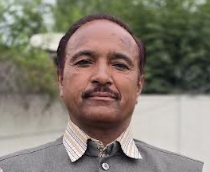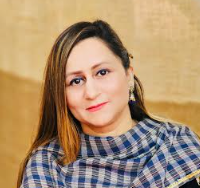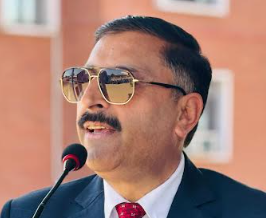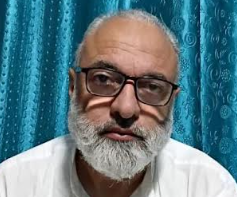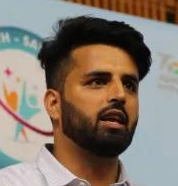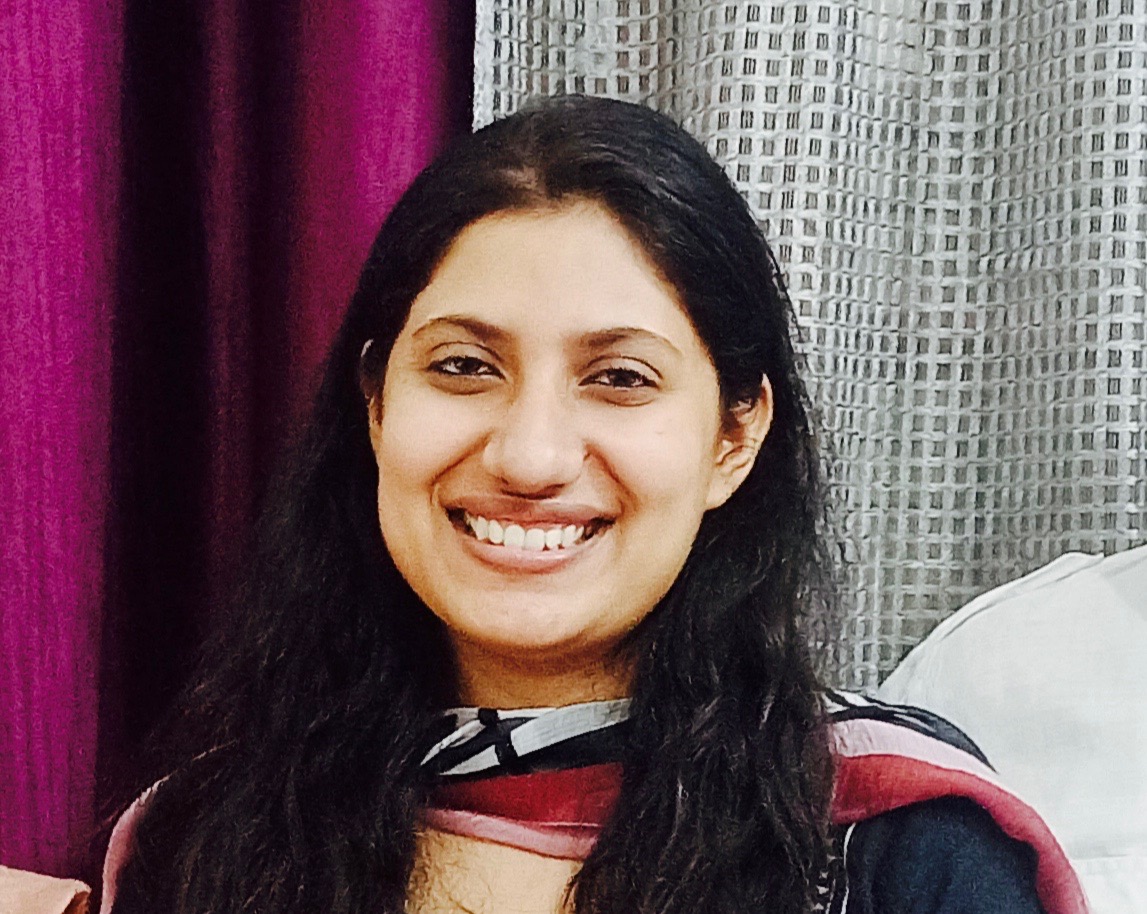
Saniya Samreen receiving a Gold Medal from Justice Dinesh Maheshwari, Chairperson of the Law Commission of India and former Judge of the Supreme Court, at the 9th Convocation of the Central University of Karnataka (CUK) held on Saturday. | Photo Credit: ARUN KULKARNI
Defying all odds, Saniya Samreen, daughter of a fruit vendor from Aland town in Kalaburagi district, bagged the Gold Medal in Master of Commerce (MCom) at the 9th convocation ceremony of the Central University of Karnataka (CUK) held on Saturday.
She received the medal from Justice Dinesh Maheshwari, Chairperson of the Law Commission of India and former Judge of the Supreme Court, in the presence of Vice-Chancellor Battu Satyanarayana, Registrar R.R. Biradar and Controller of Examinations Kota Sai Krishna, on Saturday.
Ms. Samreen, who completed her schooling and college education in Aland before joining CUK for her postgraduate studies, said that her achievement was a result of perseverance and family support.
“All of my achievements are the result of hard work, dedication, and the unwavering support and guidance from my family and mentors,” she with gratitude during her interaction with media representatives on the sidelines of the convocation.
Her father, Mr. Shamu Bagwan, earns his livelihood as a fruit vendor, while her mother, Mrs. Raziya Begum, is a homemaker. “My parents’ constant belief in me has been the driving force behind my success,” Saniya added.
Saniya, who has also qualified both the Karnataka State Eligibility Test (KSET) and the National Eligibility Test (NET) for assistant professor, said she wishes to build her career in academia.
“I aspire to contribute to the field of commerce through teaching and by shaping future professionals,” she said.
source: http://www.thehindu.com / The Hindu / Home> News> India> Karnataka / by The Hindu Bureau / November 08th, 2025
Mangaluru, KARNATAKA / Kozhikode, KERALA / Dubai, U.A.E :
Shabana Faizal with her husband Faizal Kottikollon
New Delhi :
Mangalore-based Shabana Faizal has emerged as the youngest woman among India’s top 10 philanthropists, according to the EdelGive Hurun India Philanthropy List 2025.
She has donated ₹40 crore (approximately $1.5 billion) through the Faisal & Shabana Foundation to education, health, and social development.
Shabana Faisal’s journey from being raised in a small town in Mangalore to co-leading a global enterprise is about he hard work and ambition.
Her entrepreneurial journey began in 1995 as a retailer of unique, speciality and luxury products. After leading the company for eight successful years, she decided to team up with her husband, entrepreneur Faizal Kottikollon, and support him in running the world-class foundry, Emirates Techno Casting (ETC).
Shabana took charge of all human resources and administrative processes at ETC, where she created a significant impact in shaping the company’s business success.
In her role as Vice Chairperson of KEF Holdings, she is actively involved in guiding the business’s growth strategy across global markets. Deeply committed to social improvement, Shabana and her husband founded the Faizal & Shabana Foundation in 2007, with the vision of ‘Giving to Create Impact’.
At 53, Shabana’s work has placed her among some of the most influential women in India’s philanthropy world, including Rohini Nilekani, Kiran Mazumdar-Shaw and Bina Shah.
EdelGive Foundation, in collaboration with Hurun Research Institute, recently released the 12th edition of the EdelGive Hurun India Philanthropy List 2025.
The list honors India’s most generous individuals and families. Over the past three years, 191 philanthropists have donated a total of ₹10,380 crore, representing an 85% increase in contributions.
The education sector continues to lead as the top donor, receiving ₹4,166 crore from 107 donors.
Shabana is the mother of four children – Sophia, Sara, Zakaria, and Zarina – but continues to play an active role in business and philanthropy. Her work makes her one of India’s most influential female philanthropists, exemplifying how professional leadership and a commitment to giving can combine to create widespread social impact.
The EdelGive Hurun India Philanthropy List 2025 states that the top 25 donors contributed ₹50,000 crore in just five years, or an average of ₹46 crore per day. Mumbai leads in philanthropy, contributing 28% of total donations, followed by New Delhi and Bengaluru.
source: http://www.awazthevoice.in / Awaz, The Voice / Home / posted by Aasha Khosa / November 10th, 2025
Tushar Goel’s film, ‘The Taj Story’, has reignited controversy over the Taj Mahal’s origins, claiming it is a Hindu temple rather than a mausoleum built by Mughal emperor Shah Jahan. The film’s debut highlights debates about the interplay of history and ideology in contemporary India.
Scaffoldings are pictured as restoration work goes on at the dome of the Taj Mahal in Agra on October 17. | Photo Credit: AFP
A little over 60 years ago, Purushottam Nagesh Oak slept and dreamt. He woke up and claimed that the Taj Mahal in Agra was actually a Hindu palace going back all the way to 4th century. Friends of Mr. Oak, an English teacher-turned-lawyer-turned-journalist but never a historian, told him that the Taj Mahal couldn’t have been a fourth century structure as the technology employed in building the Taj in the 17th century didn’t exist back then. The fantasist turned a pragmatist, and Oak brought his argument forward by a few centuries. The Taj was now claimed to be a Hindu temple. This was in 1989. He wrote articles and a book too, but found no support from historians. Even the Supreme Court dismissed his claims as “a bee in his bonnet” in 2000.
But post-2014, history is like a revolving door, you enter and exit at your ease and pleasure. You pick and choose, you circumvent and invent. Dress it up as a movie and claim you are looking at history anew. That is how we get a movie like Tushar Amrish Goel’s The Taj Story, starring former BJP MP Paresh Rawal; just like we had The Kashmir Files and The Bengal Files, starring Anupam Kher and Mithun Chakraborty, all ideological partners of the Bharatiya Janata Party (BJP).
With The Taj Story, Goel goes where no historian has gone. Proof, evidence and knowledge amount for nothing as the director makes a case for the Mughal monument being actually a Hindu temple, much like the BJP leader Sangeet Som who called it alternately a Shiva temple and a monument built by a man who incarcerated his father. Mr. Som obviously couldn’t make out a Shah Jahan from an Aurangzeb and hence got mixed up. Much like Oak, oops, Goel, who sees no difference between history and mythology, facts and fantasy.
Recorded history
Talking of facts, the Taj Mahal was built by the Mughal emperor Shah Jahan after his favourite wife Arjumand Bano Begum breathed her last after bearing the last of their 14 children. Its chief architect was Ustad Ahmed Lahori. The land for her last resting place was procured from Mirza Raja Jai Singh of Amber who had inherited it from Raja Man Singh, a celebrated general of Akbar, who was Shah Jahan’s grandfather. Shah Jahan compensated Jai Singh with four havelis from the royal property for the massive haveli in which rests Mumtaz Mahal. His firman to Jai Singh, the latter’s agreement and the Mughal emperor’s subsequent letter of granting him four havelis in lieu of one, are all part of history; unlike the claim of The Taj Story which talks in terms of a massacre and genocide of the locals for fulfilling the wishes of an emperor and his consort!
The work on the tomb started in 1632 with the finest craftsmen from across the country and West Asia. The chief mason was Mohammed Hanif from Baghdad who earned ₹1000 a month for his efforts. The pinnacle was built by Qayam Khan of Lahore and its Quranic inscriptions were done by Amanat Khan Shirazi. The mosaic work was done by local Hindu workers. Above all, some 20,000 workmen toiled for 22 years to build the monument to love. Its white marble came from Jaipur, lapis lazuli from Sri Lanka, crystal from China and coral from Arabia. The monument uses the double dome technique, previously seen only in the Humayun’s tomb in Delhi, and never seen in the country before the arrivals of the Turks.
Not the first time
Over the years, many have tried to appropriate credit for its beauty and majesty. In the 17th century, it was claimed by many in the West that the architect of the Taj was Venetian Geronimo Veroneo, a jeweller by profession. Then came the claim by Mughal Beg in Tarikh-e-Taj Mahal that it was designed by Muhammad Effendi, an architect supposedly sent by the Sultan of Turkey. Effendi though was as much an architect as Oak was a historian. In the mid 19th century it was claimed that the monument was the result of the genius of Frenchman Austin de Bordeaux, a jeweller. However, Austin died in 1632, the year the work on the Taj began. With his death all claims of Austin being the Taj’s architect were buried. And facts began to be raised.
As for fantasy, well there is Goel’s film, never mind its claim of presenting the “untold history of the Taj Mahal”. The film, replete with stereotypes of kohl-lined, skullcap-donning Muslims aims at building a nation’s memory on unreasoned mythology, far removed from the well argued debates of history. Much like Oak’s view that Christianity was nothing but Krishan-Niti. Not game for any ridiculous claims in an insipid film which opened with a mere 14% attendance in the first show? Watch M. Sadiq’s 1963-saga Taj Mahal. Sure, you would remember its song, ‘Jo wada kiya woh nibhana padega’, penned by Sahir Ludhianvi and sung with much love by Mohammad Rafi and Lata Mangeshkar. Sadiq’s film with Pradip Kumar and Bina Rai in the lead cast, made no effort at replacing history with mythology.
source: http://www.thehindu.com / The Hindu / Home> Entertainment> Movies> In the limelight / by Zia Us Salam / November 07th, 2025
Sohail Shamshuddin Shaikh with Fattesingh Raje Bhosale at Pune
The home of Sohail Shamshuddin Shaikh in Pune, Maharashtra, is a piece of living history. He has preserved the legacy of his ancestors’ service and valour dating back to the era of Chhatrapati Shahajiraje Bhosale (the father of the iconic 17th-century Maratha king, Chhatrapati Shivaji Maharaj) and the Peshwas.
This story begins about 400 years ago. Shahajiraje Bhosale had granted a special sanad (royal charter) to Sohail Shaikh’s ancestors. Sohail Shaikh has preserved this charter to this day. It is not just a document; it is a testament to his family’s glorious history and their unbreakable bond with the Bhosale dynasty.
After Shahaji Maharaj’s passing, the Shaikh family continued to serve. Later, during the Peshwa era (the period of the Maratha prime ministers), his ancestors served in an important position of Qazi (an Islamic judge). For eight to ten generations, they served the Swarajya (Shivaji’s self-rule movement) and later the Peshwas.
The families of Sohail Shamshuddin Shaikh and Fattesingh Raje Bhosale at the Pune meet
Sohail Shaikh has also preserved many judicial documents and historical records from Shivaji’s time. These documents offer insights into the work of his ancestors and the social system of that era.
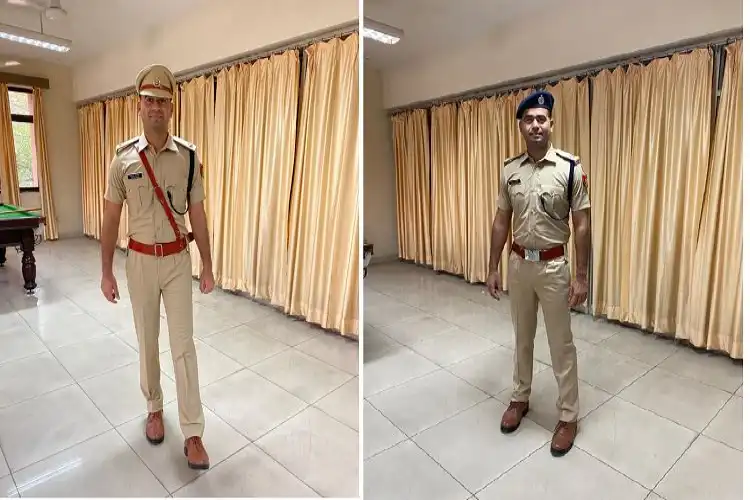
Today, his 14th generation is settled in Pune, and remarkably, they have continued the legacy of service. Just as his ancestors were in the service of the king and the state, today’s generation is in government service. Following in his ancestors’ footsteps, Sohail Shaikh is the fifth generation of his family to serve in the police force.
Unfortunately, this great legacy of Sohail Shaikh’s family was largely overlooked. However, ‘Awaz Marathi’ brought his story to all of Maharashtra through a video. Since that time, Sohail has been interviewed by many news channels and media outlets. He has since become known as a descendant of Qazi Haider, who held an important position in Chhatrapati Shivaji Maharaj’s court.
The Pune meeting
As the next step, a historic event took place on November 2. A meeting was held between Babasaheb alias Fattesingh Raje Bhosale, the 13th descendant of Raja Vyankoji Maharaj of Tanjore (Chhatrapati Shivaji Maharaj’s brother), and Qazi Sohail Shaikh, the 13th descendant of Chhatrapati Shivaji Maharaj’s secretary, lawyer, and envoy, Qazi Haider Shaikh.
This is an example of how historical religious harmony is being preserved. ‘Awaz-the Voice, Marathi played a significant role in making this meeting happen.
Speaking about this meeting, Sohail Shaikh says, “‘My interview with Awaz Marathi made this meeting possible. My video reached Fattesingh Raje Bhosale, and he immediately contacted me. He then set a date and came to meet me. This meeting was historic and upheld social commitment, which is why we named the ceremony the ‘Social Commitment Meet’.”
Fattesingh Raje Bhosale entering the venue of the meeting in Pune
Sohail Shaikh said, “This ceremony was truly historic. Descendants of Maharaj’s Muslim and Maratha commanders, police officers, and social activists were present. Fattesingh Raje was overjoyed to see this all. He spoke to everyone with deep emotion and pride. We have put up banners outside my residence detailing my ancestors’ history, which were inaugurated by Raje.”
He added, “Speaking with Maharaj, we learned more historical facts. About 375 years ago, when Chhatrapati Shivaji Maharaj was on his Karnataka campaign, he went to meet the Qutubshah of Golconda. At that time, our ancestor Qazi Haider was with him, along with other commanders. That is when Vyankoji and my ancestors had met. Meeting Chhatrapati Shivaji Maharaj’s family is a matter of pride”
Sohail Shaikh proudly states, “We have always had a place of deep respect for Chhatrapati Shivaji Maharaj in our hearts. And for our families to be connected is truly a matter of great pride. This was a golden moment for Fattesingh Raje and me to meet after nearly 375 years. We are happy to be part of this.”
Sohail Shamshuddin Shaikh with Fattesingh Raje Bhosale at the Pune meet
Babasaheb alias Fattesingh Raje Bhosale, the 13th descendant of Raja Vyankoji Maharaj of Tanjore, told Awaz-the Voice, Marathi, “This meeting was very important for maintaining unity in society. The main purpose behind this meeting was to stop the ongoing Hindu-Muslim disputes in society and to re-establish an atmosphere of harmony, just like in the old days.
“We have to carry forward the principles of Chhatrapati Shivaji Maharaj and Vyankoji Raje, which was to take everyone along—the Bara Balutedar (the 12 traditional village artisans) and the Athara Pagad Jati (all 18 castes and communities) … We all must follow the constitution that Babasaheb Ambedkar wrote based on Shivaji Maharaj’s principles.”
Fattesingh Raje Bhosale said that this meeting was held to create harmony in society. He said, “Today, political people are fanning the flames of caste disputes for their own benefit, which must stop somewhere. All communities must maintain their unity. This is our heartfelt wish.”
source: http://www.awazthevoice.in / Awaz, The Voice / Home> Stories / by Bhakti Chalak, Pune / November 07th, 2025
Indian-American Ghazala Hashmi, who is closely linked with the prestigious Aligarh Muslim University (AMU), has won the Virginia Lieutenant Governor 2025 Election result of which was declared on Monday.
Virginia:
Indian-American Ghazala Hashmi, who is closely linked with the prestigious Aligarh Muslim University (AMU), has won the Virginia Lieutenant Governor 2025 Election result of which was declared on Monday.
A Democrat Party candidate, Ghazala Hashmi, defeated Republican candidate and the state’s first gay statewide nominee, John Reid, to become first Muslim and first South Asian American elected as Lieutenant Governor of Virginia, a Republican stronghold.
Ghazala Hashmi polled over 55% votes as against her nearest rival John Reid who got the support of around 44.7% voters. Hashmi had earlier defeated five primary challengers in June, narrowly winning the nomination with 28% of the vote, as per the final result of the Virginia Lieutenant Governor Election 2025.
Ghazala Hashmi was the first Muslim woman to be elected to the Virginia State Senate following her stunning victory over sitting Republican Senator Republican Glen Sturtevant in the 2019 U.S. elections.
Ghazala Hashmi was born in India and emigrated to the US as a child with her family. She is also a former director of the Center for Excellence in Teaching & Learning at Reynolds Community College.
Ghazala Hashmi’s AMU Link
Ghazala Hashmi was born to Zia Hashmi and Tanveer Hashmi in Hyderabad in 1964. She spent her childhood days at her maternal grandparents’ house in Malakpet, Telangana.
She migrated to the United States with her mother and older brother as a 4-year-old child to join her father in Georgia.
Ghazala Hashmi’s mother, Tanveer Hashmi, is an alumna of Osmania University’s Women’s College in Kothi from where she did BA and B.Ed before migrating to the United States.
Ghazala’s father Professor Zia Hashmi is the alumnus of Aligarh Muslim University (AMU) from where he did MA and LLB. He completed his PhD in International Relations from University of South Carolina and soon after began his university teaching career. He retired as the Director of Centre for International Studies which he founded.
Ghazala Hashmi is married to Azhar Rafiq. The couple have two adult daughters – Yasmin and Noor – who both graduated from Chesterfield County Public Schools and the University of Virginia.
According to information available on her official website, Ghazala Hashmi is an experienced educator and an advocate of inclusive values and social justice. Her legislative priorities focus on public education, voting rights and the preservation of democracy, reproductive freedom, gun violence prevention, environmental protection, housing, and affordable healthcare access.
Hashmi spent nearly 30 years as a professor, first teaching at the University of Richmond and then at Reynolds Community College. At Reynolds Community College, Hashmi also served as the Founding Director of the Center for Excellence in Teaching and Learning (CETL).
Former Minister, MLA and BRS leader KT Ramarao has congratulated Ghazala Hashmi on her victory.
“This is massive! From Malakpet to Virginia… Congratulations to Ghazala Hashmi on becoming the first Indian-American Lieutenant Governor of Virginia. There is nothing more beautiful when democracies celebrate diversity of the world”. KTR wrote on X.
source: http://www.ummid.com / Ummid.com / Home> United States / by ummid.com news network / November 05th, 2025
Writer Bolwar Mahamad Kunhi talks about literature and fests.
Karnataka : Bengaluru : 30/10/2017 : Bolwar Mohammed kunhi during The Bengaluru Literature festival in Bengaluru on Sunday. Photo : Sudhakara Jain.
Bolwar Mahamad Kunhi, 66, is the only Indian writer conferred with two Central Sahitya Academy Awards (2010 & 2016) for creative prose in Kannada. He received the Atta Gallata Bangalore Lit Fest 2017 Award for Kannada for his overall contribution on the concluding day of the Lit Fest on Sunday. With 250 short stories and a host of novels, with several directed towards children behind him, Kunhi a recipient of the Karnataka Rajyothsava Award and Karnataka Sahitya Academy’s Lifetime Achievement Award says, “Young writers should regularly read what seniors write and get inspired to find their own words and voice.” Kunhi, who said every recognition is a moment of inspiration to writers, spoke to MetroPlus regarding his life and writing. Excerpts:
Do you think such literary fests are important for the growth of literature?
Yes. Such festivals also add their share to other ingredients required for a healthy literary growth, look at the buzz they create, have you ever seen this kind of an unprecedented crowd? I am not as aware of the present statistics of other languages. This is my uncorroborated research. In recent times Kannada literature has seen a huge number of publications, possibly surpassing that of any other Indian language. The number of literary events or the number of Jnanapeeth awardees we have could surpass those from any other language. This could be another reason some Kannada writers have achieved celebrity status.
Is literature the voice of society?
Literature always augurs well for society and provides wisdom to humanity. All religious books, which I consider part of literature, are works of wisdom which have had a great impact on humankind. Literature also taught civic sense to man who lived like a wild animal. The conversations and dialogues in such events also propagate the same wisdom.
After Chand Ali in ‘Swathantrayada Ota’ who is the next character in your work awaiting attention?
In the last two years I have been busy in understanding two important characters for different reasons. First to write 1000 couplets about Ambedkar and second to write a novel on the Prophet’s beloved wife, Ayesha. The second has gained more traction in the last few months. When I wrote the first ever historic novel on Prophet Muhammad Oidiri two years ago, it was well-received. But most of the characters in Odiri were male. The thoughts, words, actions, and the attitude was male. I always wondered if the women of that time had opinions of their own. Did they ever voice what they felt? Even in solitude? This is the subject of the proposed novel titled Umma (Mother) inspired by the life of Ayesha. I am not sure which one will be completed first.
After Gorur Ramaswamy Iyengar who wrote on Gandhiji, your book on the Mahatma received instant recognition. How important is it for today’s children to read about Gandhiji?
To guide our children in the right way we show them role models. It is a shame we are unable to give them contemporary examples to encourage and mould their personality. The examples that we provide from history or mythology seem too overwhelming for them. Historical characters are kept on a pedestal and are inaccessible. Gandhiji maybe one example which children can relate to since they read and learn about him a lot and he is the most recent of those examples! To these children my book attempts to show that Mahatma Gandhi was not an unachievable superhuman. He was a common, simple boy, who grew up like most of us, as a darling to his parents, went to school, studied prescribed text books and qualified as a lawyer. As a young man he fought for the downtrodden and stood for truth, non-violence and social justice. I tried to depict him as a common man who lived an uncommon life to become a Mahatma.
Do female characters get more importance in your novels?
I don’t think so. Being feminist writer is not an easy way to popularity. Though I was born in a male-dominated community, I was brought up with the love of various women in my early life – my mother, my sisters and my first teacher. They were the ones who tolerated my anger, frustration and ego and loved me unconditionally. That guilt might be the reason women are central to my work. I dedicated my first story collection to ‘Appi Bayi’, the teacher who taught me to write alphabets. The second one was to my mother who I buried with the same hands that I dedicated it to. Another work was to my elder sister and another to my two daughters. My mega novel is dedicated to my beloved. All of this could be due the same guilt. May be my work as an emotional man resonates with like-minded people and thus gets appreciated.
How was your experience writing the screenplay for ‘Munnudi’ and ‘Athithi’?
My writing is like a sculptor’s. It takes shape with time. I don’t believe in inspirations. Cinema, definitely is not my medium. I wrote the screenplay under the persuasion and for the love of my friends P. Sheshadri, who bagged nine National awards in a row and Dattanna, an inimitable character actor. I wrote what I felt for both movies and they incidentally won national awards. I cannot comment on what else I might be able to do in cinema, at least not now.
Can you talk about your initiation to writing considering you have no writers in the family?
I joined Syndicate Bank in Gulbarga after my B.Sc. Much later when I was associated with the Sahitya Academy I discovered that most members had masters degrees. It enthused me into getting an MA in Kannada in the 1980s.
My desire to write was another one of such self-imposed challenges. During a casual conversation while playing carrom with writer Arooru Lakshmana Seth in Gulbarga, I asked him how he was able to visualise and write so much. His said “non-writers like me cannot understand the process.” That comment propelled me into writing a short story and getting published in Navbharat which was the beginning.
source: http://www.thehindu.com / The Hindu / Home> Books> Authors / by Ranjani Govind / October 30th, 2017
The recipient of Padmashri award for communal harmony had earned the sobriquet of ‘Karnataka’s Kabir’
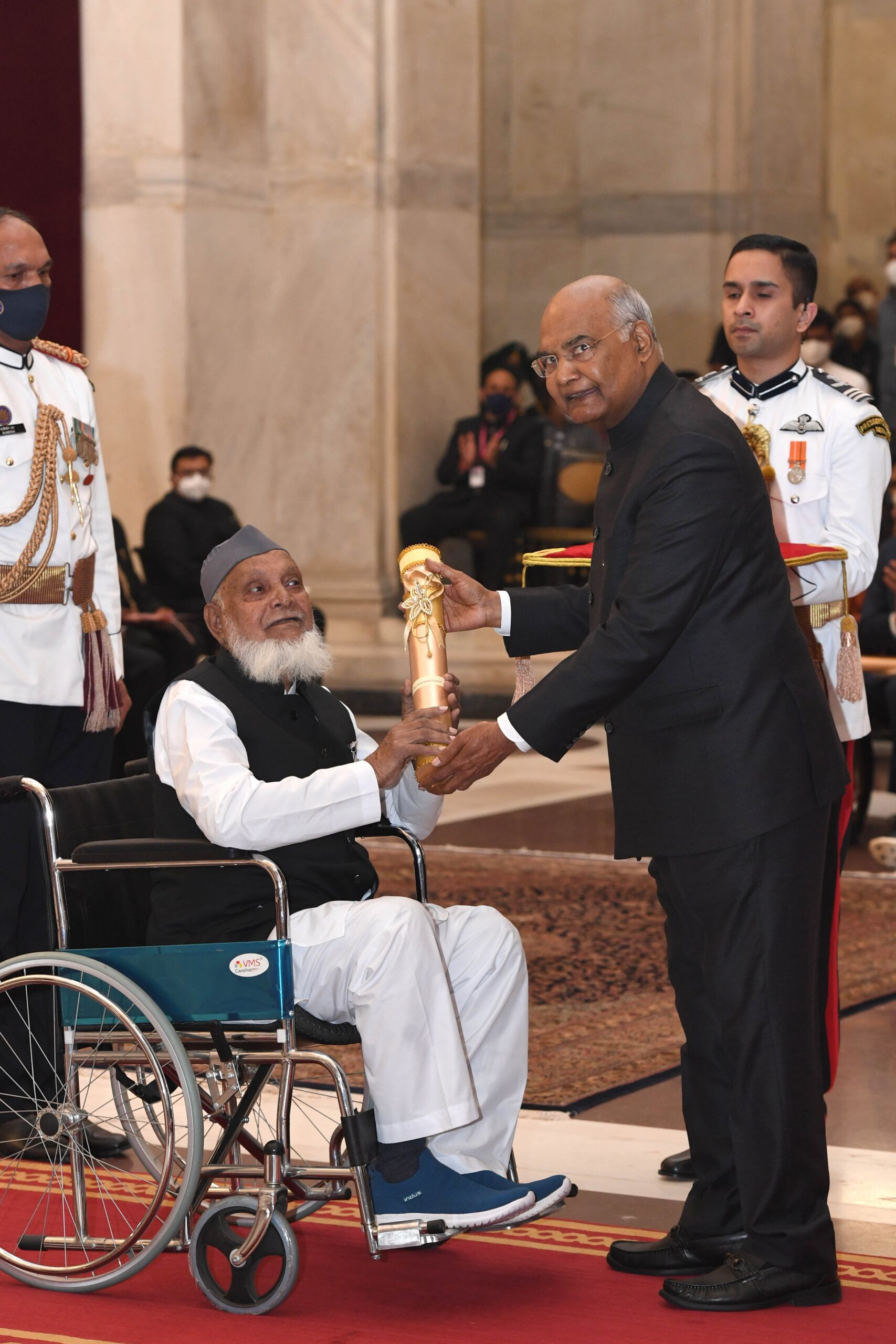
‘Karnataka’s Kabir’ Ibrahim Nabisaheb Sutar is presented the Padmashri award by President Ram Nath Kovind at Rashtrapati Bhawan, in New Delhi on April 2, 2018.
Ibrahim Sutar, polyglot folk singer, who toured India spreading the message of Hindu-Muslim unity, died in Mahalingpur in Bagalkot district on February 5. He suffered a massive heart attack around 6.30 in the morning. He died a few minutes later, family sources said. He was 82. He leaves behind his wife, son and two daughters.
The recipient of Padmashri award for communal harmony had earned the sobriquet of ‘Karnataka’s Kabir’.
The founder of ‘Bhavaikyate Bhajana Mela’ began his career as a Harikathe bhajan singer going around villages and towns. He regaled audiences with stories from Hindu and Islamic scriptures always leaving with a message of harmony, and need for ethics in personal life. He sang songs and gave lectures, quoting from multiple scriptures without the need to read from notes. He was equally well-versed in Kannada and Urdu.
In his later life, he emerged as a public speaker, visiting schools, colleges and Lingayat mutts to speak on vachana and dasa literature. He was honoured with the Karnataka Rajyotsava award in 1995, and the Padmashri in 2018.
Born in a poor weaver family in Mahalingpur, he dropped out of primary school to work as an assistant to a weaver. He developed a spiritual bent of mind early in life. He began attending lectures in the Sri Basavananda Swami mutt and participating in bhajans in Sadhu Maharaj temple. He was a member of the mosque committee that went around villages, asking the faithful to wake up early during the month of Ramzan. He studied Hindu and Islamic scriptures with equal zeal and developed a team of bhajan singers. The ‘Bhavaikyate Bhajana Mela’ performed across Karnataka and Maharashtra.
A routine performance was in the question–answer format interspersed with songs of dasa saints and vachanas . One of the team members came up with a question that sounded very ordinary, but had deep spiritual undertones, like: ‘Who is important in life – god or guru?’ Sutar used anecdotes from the Ramayana and Mahabharata, Islamic scriptures and stories from the life of prophets to give his opinion, that was directed at the audience, rather than the team member who kept asking questions.
source: http://www.thehindu.com / The Hindu / Home> News> India> Karnataka / by Special Correspondent / February 05th, 2022
Tamkeen Fatima, a past student of Aligarh Muslim University (AMU), has been selected as Scientist ‘B’ by the Defence Research and Development Organisation (DRDO), Ministry of Defence, Government of India
Aligarh Muslim University:
Tamkeen Fatima, a past student of Aligarh Muslim University (AMU), has been selected as Scientist ‘B’ by the Defence Research and Development Organisation (DRDO), Ministry of Defence, Government of India.
Tamkeen Fatima is a recent M.Tech. graduate from the Department of Computer Engineering. Her selection came through a highly competitive process comprising academic performance, GATE score and interview.
Tamkeen completed her M.Tech. (Computer Science & Engineering) in 2025 with an outstanding CPI of 9.944, securing the top rank in her class.
She also completed her B.Tech. from AMU in 2023 and qualified UG-NET (JRF) 2024 in Computer Science with an All-India Rank 2 (99.9933 percentile) in her very first attempt.
“A Consistent Performer”
Tamkeen is a Second Year student pursuing M. Tech. in Computer Science and Engineering at the Department of Computer Engineering, Z.H. College of Engineering and Technology, Aligarh Muslim University.
She completed her B Tech from AMU in 2023 with 9.703 CPI. She has been a consistent recipient of Merit Scholarships from class X onwards, including UP STSE, University Merit Financial Award (AMU), and GATE scholarship.
During her B Tech, Fatima participated in research internship programmes at ISRO, McMaster University, Toronto, Canada (Mitacs GRI), and The Fields Institute, Toronto, Canada (Fields Undergraduate Summer Research Programme). She has also published a research paper in ACM Conference Proceedings.
Recognising her academic excellence and research potential, she was selected as Assistant Professor (Contractual) through the Local Selection Committee and joined the Department of Computer Engineering, AMU in August 2025.
source: http://www.ummid.com / Ummid.com / Home> Career / by Ummid.com news network / November 01st, 2025
Kashmiri local guide Nazakat Ahmed Shah, who saved the family of a BJP youth worker during the April Pahalgam terror attack, received a warm welcome in Chhattisgarh nearly six months after the incident. The attack in South Kashmir had left 26 people dead and several injured.
Shah, who has been visiting Chhattisgarh for over three decades to sell clothes, became a hero after rescuing the family of BJP youth wing worker Arvind Agrawal. During his first visit to the state since the attack, Shah was felicitated by Agrawal and around 50 residents in Chirmiri, Manendragarh-Chirmiri-Bharatpur district. The group expressed their gratitude with garlands, flowers, and a shared lunch.
Agrawal recalled that Shah’s quick thinking saved his wife and four-year-old daughter. “When the firing began, he asked us to lie down and shielded my daughter and my friend’s son. He took them to safety and returned to rescue my wife,” Agrawal said.
Speaking to reporters after the ceremony, Shah said he felt emotional meeting the families he had saved. “Chhattisgarh feels like home to us. We come here for three months every year for business, and people here have always treated us like family,” he said.
Shah’s act of courage has been widely praised across communities, highlighting the enduring human bonds that transcend politics and geography.
source: www.radiancenews.com / Radiance News / Home> Latest News> Reports / by Radiance News Bureau / November 01st, 2025
Dr. Mohammad Manzoor Alam, the founder of the Institute of Objective Studies (IOS), stands as one of the most prominent leaders of the Indian Muslim community. Recently, his biography “Dr. Manzoor Alam: Empowering the Marginalized” written by senior multilingual journalist A. U. Asif, was released at the Constitution Club of India in New Delhi. The event was attended by several distinguished personalities from politics, academia, the judiciary, and the media.
The biography reveals many unknown aspects of Dr. Manzoor Alam’s life, his contributions, and his wide national and international connections — from Dr. Manmohan Singh to Ahmed Patel, from cabinet ministers to chief ministers and governors. His close friendships extended to Malaysian Prime Minister Anwar Ibrahim and several prominent personalities across the Gulf Cooperation Council (GCC), including ministers and academicians. Among his international associates were Prof. Omar Hasan Kasule, Secretary General of the International Institute of Islamic Thought (IIIT), USA; Dr. Ahmad Muhammad Ali, the first President of the Islamic Development Bank (IDB); Dr. Ahmed Tutunji, General Secretary of the International Islamic Federation of Student Organizations (IIFSO); and Professor Ismail Raji al-Faruqi, co-founder of IIIT, Dr. Abdullah Al-Maatouq, Chairman of the International Islamic Charity Organization (IICO) Kuwait etc.
The Institute of Objective Studies: A Pioneering Muslim Think Tank
Undoubtedly, the IOS — the first Muslim-run think tank in India — has played an unparalleled role in academic and intellectual engagement. Over the past four decades, it has organized more than 1,230 conferences, seminars, symposia, and workshops on diverse issues affecting Muslims and Indian society at large. It has completed over 410 research projects and produced around 405 publications focusing on socio-economic, educational, and cultural challenges.
Through its data-based research, collection, and presentation, IOS provided valuable insights into the conditions of marginalized communities. The institution succeeded in building a network of more than 500 research scholars, social scientists, academicians, judges, lawyers, and politicians. Its studies and deliberations form a crucial body of work on the socio-economic conditions of Indian Muslims.
However, despite its achievements, the IOS has failed to evolve a sustainable mechanism for implementing the findings of its research. After nearly four decades of existence, the impact of its ideas on the ground remains negligible. The think tank, while rich in intellect and intent, fell short of translating its research into practical policies for the empowerment of marginalized communities. When one examines the ground realities, the absence of tangible transformation makes this collective effort appear more like an academic exercise than a movement for social change.
The Promise and the Reality
The Institute of Objective Studies was established in 1986 with the vision of empowering the 200 million-strong Indian Muslim community — a group that, even today, lags behind many other marginalized sections, including Dalits, on multiple socio-economic parameters. While IOS produced a wealth of research and data, it failed to create models of empowerment or tangible change on the ground.
It would be unfair to assume that Dr. Manzoor Alam’s vision was limited to research and conferences alone. He unsuccessfully attempted to extend his work into education, media, and healthcare. Unfortunately, many of those initiatives remained unrealized.
Dr. Alam had conceived numerous projects, including a dream university and television channels Al-Hind and Falak TV — both designed to serve as platforms for education and social awareness. He presented these projects at several events in India and abroad, yet they never materialized beyond the planning stage. Why these ideas remained confined to files is a question that only Dr. Alam himself can answer.
Dr. Manzoor Alam’s Tryst with Education and Development
In the 1990s, Dr. Alam invited Mohammad Yunus Saleem, then Governor of Bihar, to lay the foundation stone of an educational institution in his native village, Ranipur, in Madhubani district. Decades later, that very school continues to function from a thatched hut.
Similarly, he invited another Governor, Akhlaqur Rahman Kidwai, to lay the foundation of a hospital in the same village. However, there is no trace of that foundation today, and the land has reverted to agriculture. It is said that even a few delegations of Arab dignitaries visited the site to explore funding possibilities for these projects. Yet, despite such visits and promises, Ranipur remains a mirror reflecting the unfulfilled dreams of Dr. Alam’s vision for grassroots empowerment.
Akhlaq Ur Rehman Kidwai, then Governor of Bihar, during his visit to Ranipur — the native village of Dr. Manzoor Alam — for the foundation stone-laying ceremony of a school.
The Unfulfilled Dream of an Islamic University in India
Following the model of the International Islamic University Malaysia (IIUM), the International Islamic University Islamabad, and the International Islamic University Dhaka, it is said that funds were once earmarked for a similar university in India. The responsibility for establishing it reportedly rested with Dr. Manzoor Alam. A 25 acres of land were even purchased in Palwal district, Haryana, under the Taawun Trust which was formed in 1980s for the same purpose. However, the project never moved forward, and its current status remains unknown.
Under the same trust, a clinic in Zakir Nagar, New Delhi, was inaugurated by the then Chief Minister, Sheila Dikshit. But today, little remains of that initiative — its fate is known only to its former manager, Mohammad Alam, son of Dr Manzoor Alam. Likewise, a valuable piece of land (D-16 worth over 10 crores) in Abul Fazal Enclave, earmarked for the Taawun Trust office, was later developed into a five-storey building. The ownership and purpose of this property are known only to Dr. Alam and other trustees.
Other Institutions and Initiatives
Along with the late Qazi Mujahidul Islam Qasmi, Dr. Manzoor Alam co-founded several organizations, including the All India Milli Council, Islamic Fiqh Academy (IFA), Qazi Publications, Universal Peace Foundation (UPF), Featured and News Analysis (FANA), United Mass Media Association (UMMA), Indo-Arab Economic Cooperation Forum, and the Taawun Trust. Except for IOS and IFA, most of these institutions are now nearly defunct.
In earlier years, FANA and UMMA operated from 166 Zakir Bagh but were later shifted to the IFA premises at Zakir Nagar. The present status of the Zakir Bagh flat remains unclear. Similarly, behind the IOS office once stood the premises of the Universal Peace Foundation (UPF), which was closed many years ago.
A Malaysian organization once sponsored Bharat Offset Press, located at 2035 Mumtaz Building, Gali Kasim Jan, Ballimaran, Delhi. The press was set up under Dr. Manzoor Alam’s patronage to provide financial support to widows and orphans. One can only hope it continues to serve that noble purpose today.
Interestingly, most of the important publications of the Institute of Objective Studies are now being published and marketed by Genuine Publications and Media Pvt. Ltd., where Dr. Alam’s younger son, Ibrahim Alam, serves as the Executive Director.
Now, his elder son Mohammad Alam has taken over as the General Secretary of the IOS. It is hoped that the unfulfilled dreams of Dr. Manzoor Alam will be realized and a university will be established on the proposed land in Palwal
The Unasked Questions
A serious question arises: Why has no one from among Dr. Manzoor Alam’s large circle of associates — including intellectuals, professors, writers, and bureaucrats — ever raised concerns or sought accountability? Why has there been such silence around the unrealized projects and abandoned initiatives?
Dr. Alam is a man of extraordinary connections and resources, with access to national and international leaders, institutions, and philanthropists. Yet, despite such privilege and goodwill, he could not establish even a modest school or clinic in his own native village — a village that once saw two governors visit to inaugurate his projects.
Dr. Manzoor Alam’s journey represents a paradox: a leader of vision and intellect who created one of India’s most influential Muslim think tanks, yet whose dreams for practical empowerment of the marginalized remain largely unrealized. His ideas, no doubt, inspired a generation of scholars and activists. But without concrete implementation, the towering edifice of research and conferences risks standing as a monument to missed opportunities.
source: http://www.muslimmirror.com / Muslim Mirror / Home> Exclusive Reports / by Syed Zubair Ahmad / October 30th, 2025