As Altaf received his first national medal, Shah Altaf Hussain spread the news of his son’s achievements amongst his fellow shopkeepers in the bazaar.
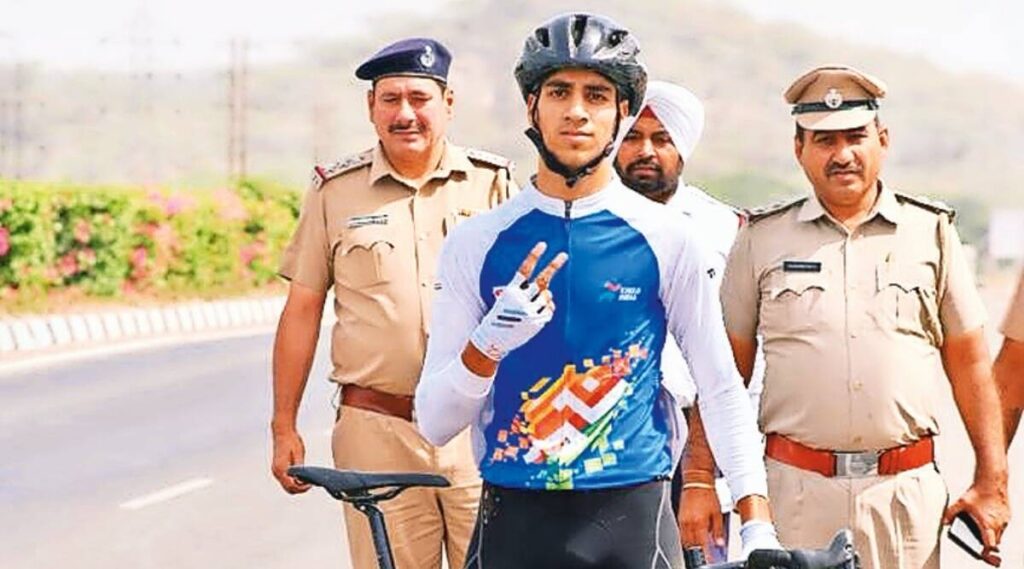
Adil Altaf after winning the gold medal in Khelo India Youth Games in Panchkula. Express photo
On Saturday morning, when 18-year-old Adil Altaf won the gold medal in the boys’ individual 70 kilometres cycle road race at Khelo India Youth Games, his father was leaving his tailoring shop in Srinagar.
As Altaf received his first national medal, Shah Altaf Hussain spread the news of his son’s achievements amongst his fellow shopkeepers in the bazaar. Once his father celebrated Altaf’s victory with other shopkeepers, he then went to his wife, Zahida Akhtar, to tell her about the good news.
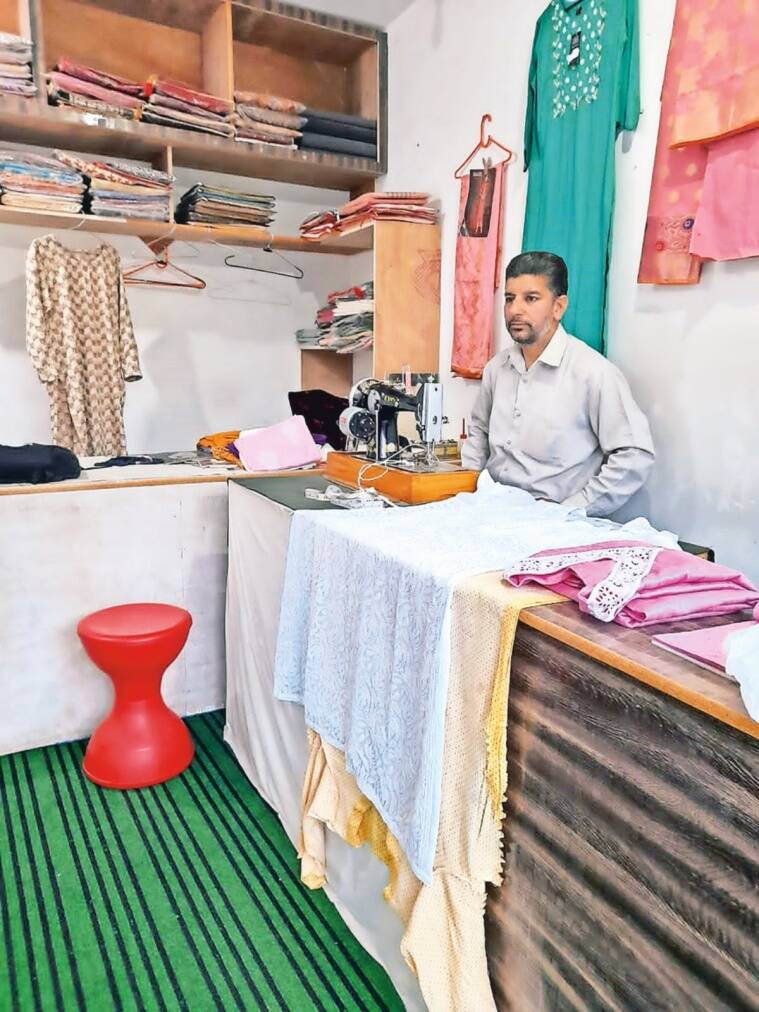
“When he (Altaf) started cycling, he would bring a cloth and other materials for me before his training started. I used to work as a weaver before running this small shop. Getting him a cycle worth 5,000 or 15,000 was tough and I would work extra hours to support him. The last two years have been tough due to Covid-19; the only helper I had has left and stitching orders have reduced. But seeing Adil win medals brings joy to us and he makes us proud,” Hussain told The Indian Express.
Altaf won his first bronze medal in a 10 kilometres cycling race in 2019 before winning a gold in the individual 35 km road race and a silver in a time trial event in the 2020 Jammu and Kashmir State Cycling Championship.
Last year, the youngster would finish fifth in a 20 kilometres time trail race and 11th in the individual 60 kilometres road race in the National Cycling Championship in Mumbai in 2020 before finishing fourth in the individual 30 kilometres time trial race and 25th in the individual 50 kilometres road race in National Road Cycling Championship in Kurukshetra, Haryana, organised by Cycling Federation of India.
Adil Altaf’s father Shah Altaf Hussain at his tailoring shop in Srinagar. Express photo
On Friday, the youngster won a silver medal in a 30 metres time trial race at the Khelo India Youth Games before winning the gold on Saturday.
“I would cycle with my friends in our colony apart from dropping some items at my father’s shop. That’s where my love of cycling grew. Initially, I saved money to get my first cycle worth Rs 5,000 and later my school got me a new cycle. In Srinagar, it gets too cold for at least four months in a year so I had to train on a home cycling trainer at one of my friends’ home. During Covid-19 restrictions, I would go to my friends home to train,” Altaf shared. Last year, Altaf was selected in the National Centre of Excellence in cycling at NIS, Patiala and now trains at a cycling facility.
NIS coach Joginder Singh has been training him and believes that he can achieve further success.
“Adil’s biggest strength has been his endurance level and he has shown an eagerness to improve. Nowadays, he cycles an average of 80-90 kilometres per week and our simulator will help him gain strength so he can gather more speed. He can qualify for Asian Games or CWG in coming years for India,” said coach Joginder Singh.
As for Altaf, he sees the gold medal as a huge source of motivation and is inspired to achieve laurels for his country.
“I missed winning the gold medal yesterday but to win the gold today feels special. It’s my dream to compete in Asian Games and CWG while wearing the Indian jersey and win a medal for India,” he said.
Altaf idolises Italian professional track and road cyclist Filippo Ganna, a four-time world individual race champion, and has set big goals for himself.
source: http://www.indianexpress.com / The Indian Express / Home> Sports> Sports Other / by Nitin Sharma, Panchkula / June 12th, 2022
Amid the gloom, there is a whiff of fresh air. A young woman photojournalist has made Kashmir proud by winning the prestigious Pulitzer Prize this year.
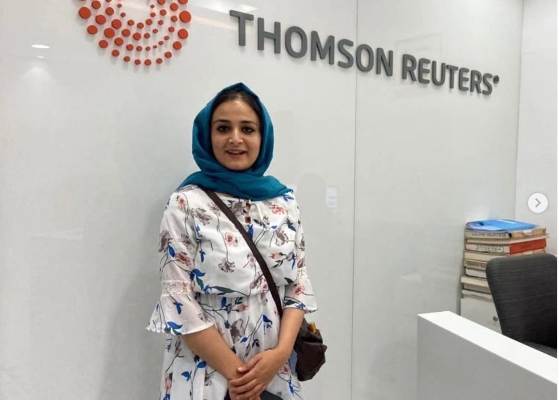
Sanna Irshad Mattoo became the first Kashmiri woman photographer to win the Prize.
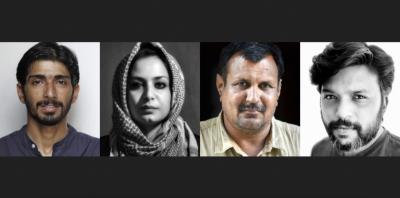
She is among the three from India to have won the award this year. Besides, Sanna, slain Reuters photographer Danish Siddiqui and Adnan Abidi have won the award for their images about Covid’s toll in India.
Siddiqui was killed last year in Afghanistan.
Sanna Irshad Mattoo has won the prestigious Pulitzer Prize award in the feature photography category for 2022.
“Congratulations to @adnanabidi, @mattoosanna, @AmitDav46549614, the family and friends of the late, @dansiddiqui, and @Reuters. #Pulitzer,” Pulitzer announced on Twitter.
Sanna, who holds a Master’s in Convergent Journalism from the Central University of Kashmir, has her work published in international media outlets, including Al Jazeera, TIME, and TRT World. She has also done a fellowship with the prestigious Magnum Foundation in 2021.
“Sanna Irshad Mattoo is a photojournalist and documentary photographer based in Kashmir. Ranging from groundbreaking news to in-depth storytelling, her work concentrates on depicting the tension between the seeming ordinariness of life and the stark symbols of a menacing militarised milieu of Kashmir. Her work has been published in newspapers and magazines around the world and has been screened and exhibited in various exhibitions and festivals. She presently contributes to Reuters as a Multimedia Journalist,” Sanna’s Pulitzer introduction said.
In 2020, three Jammu and Kashmir photojournalists Dar Yasin, Mukhtar Khan, and Channi Anand won the prestigious Pulitzer award. Established in 1917, Pulitzer Prize is an award for achievements in newspaper, magazine, online journalism, literature, and musical composition within the US.
source: http://www.indiatomorrow.net / India Tomorrow / Home> Featured> Inspiring Personality / by Ishfaq-ul-Hassan / May 10th, 2022
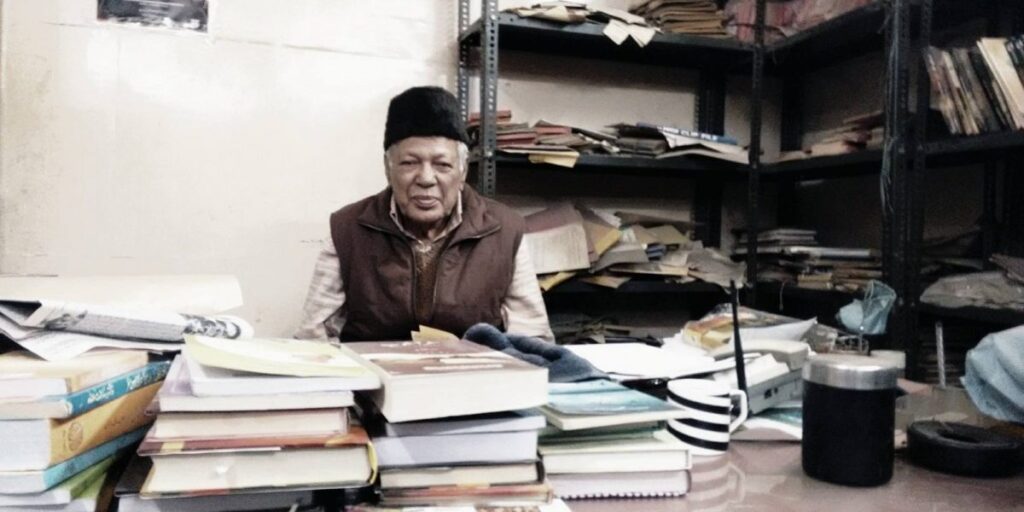
Shahid sahab or Shahid bhai, as he was called by most, was not a writer or a poet himself but helped many become successful writers, poets and researchers.
Shahid Ali Khan at his Bookshop in New Delhi. Photo: Mahtab Alam
Since the onset of the pandemic, so many gems from the world of Urdu language and literature have been lost that I have now lost count. It was only last year that a few of us compiled a list of at least 75 Urdu writers and poets who had passed away. It included the likes of Shamsur Rahman Faruqi, Anand Mohan Zutshi ‘Gulzar Dehlvi’, Rahat Indori, Mujtaba Hussain, Nusrat Zaheer and Asrar Jamayee. Notably, this list does not include any Urdu writers, poets, researchers and translators outside India.
This year so far, we have not been able to gather the courage to collate such a list. I am sure the numbers are higher than last year, even though we are still to go through more than half the year. While it’s true that not all succumbed to the virus, the pandemic coupled with the lockdown ensured that most of the friends, admirers and other Urdu lovers were deprived of having one last glimpse or participating in the last journey of their favourite literary heroes.
One such person was Shahid Ali Khan, whom we lost in April this year. He passed away in the wee hours of April 21. This news was not wholly unexpected, as he was 91 years old and was not keeping well for the past few months. Despite that, when the news of his death reached me, I was engulfed in an inexplicable layer of grief. In fact, I felt more helpless than sad. Helpless because despite my strong will to participate in his last journey, I could not do so as I was down with a high-grade fever myself and had been briefly hospitalised due to COVID-19.
Shahid sahab or Shahid bhai, as he was called by most, was not a writer or a poet himself, but he helped and enabled many to become successful writers, poets and researchers. Ram Prakash Kapoor, who retired from the Bhilai Steel Plant, recounts in an article that Shahid sahab encouraged him to write in Urdu and invited him to write a guest editorial for one of the issues of Kitab Numa, a magazine of which Shahid sahab was the editor. Thanks to Shahid sahab’s constant encouragement, Kapoor went on to author at least two books in Urdu after his retirement.
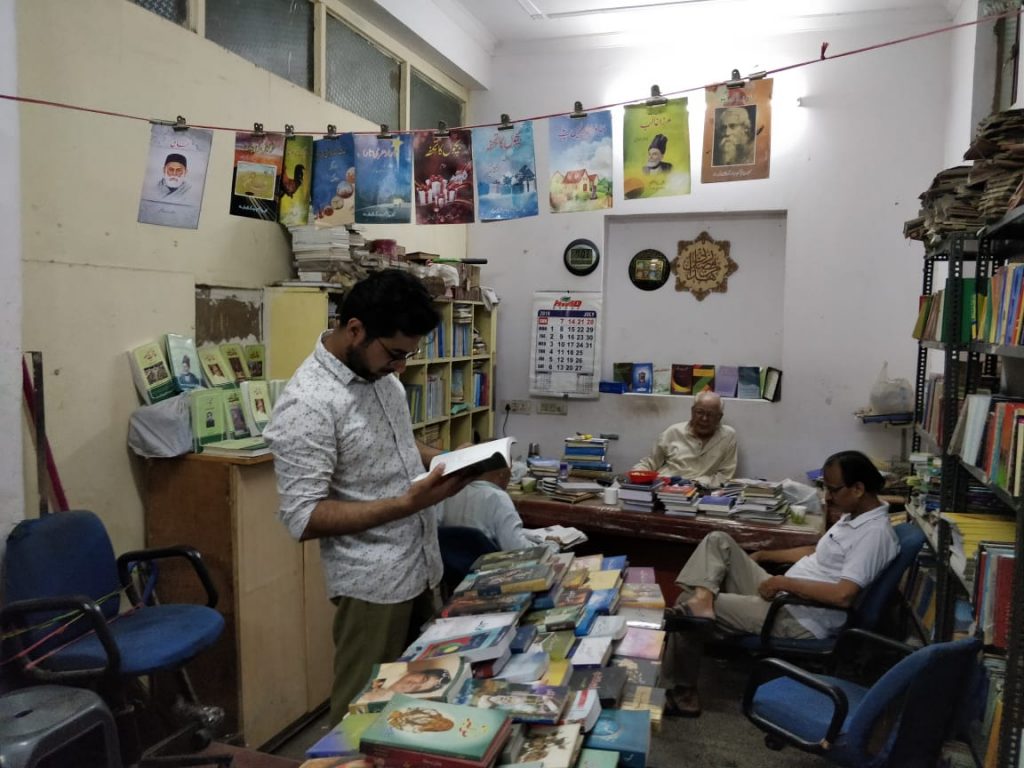
Nai Kitab bookshop in Jamia Nagar, New Delhi. Photo: Mahtab Alam
Like Kapoor, there are probably dozens of writers who were nourished by Shahid sahab during his lifetime. Amongst his admirers included noted writers such as Shamsur Rahman Faruqi, Mujtaba Hussain, Shameem Hanafi, Sughra Mehdi and Sadiq-ur-Rahman Kidwai. For many years, he was also associated with the Maktaba Jamia, the Urdu publication division of Jamia Millia Islamia. The Maktaba is one of the largest and longest surviving Urdu publishers in India. He had joined the Maktaba in 1951 as a junior clerk and retired as its general manager in 2006.
He had also worked as the in-charge of Maktaba Jamia’s Mumbai branch. According to noted screenwriter and playwright Javed Siddiqi, there was a time when the Maktaba in Mumbai used to be packed with writers, poets, journalists, professors and (then) young lovers of literature like him. So much so that people had to take refuge on the steps of the Maktaba and the footpath outside it. It was a place for debate and discussions on issues related to literature and beyond. Every Saturday evening witnessed a literary gathering in which Urdu lovers from across the city used to participate.
It is here that he befriended writers and poets like Jan Nisar Akhtar, Meena Kumari, Sahir Ludhianvi, Kaifi Azmi and Jagan Nath Azad. Some of them were regular visitors at the Maktaba. There are several interesting stories about their friendship which can be heard here in his own words. Though he had left the city several decades ago, several Urdu writers and journalists who used to visit the Maktaba (located near JJ hospital naka) would tell me of how they missed Shahid Sahab’s presence.
He continued to attract and host Urdu lovers in Delhi. It would often happen that whenever an Urdu lover visited the city, they would make it a point to meet him. One of the reasons behind this was that he possessed an encyclopaedic knowledge about Urdu and its literature. He also often had Urdu books which were not available in the market. At times, he would also make arrangements for books on request.
After his retirement from the Maktaba, he started an independent publishing house and book store in Jamia Nagar by the name of Nai Kitab and a quarterly literary journal by the same name. It is here that I met him for the first time in 2007. Though the magazine ceased to be published after a few years – owing to his growing age and deteriorating health, he continued with the book shop even though it was time for him to take a break. “The bookstore is like oxygen for me,” he had once told me. It was open till a few months before the lockdown in March last year.
One of the attractions for me while visiting Jamia Nagar (after having shifted out) was to meet Shahid sahab and spend some time at his bookshop. It was not just another bookshop where one would primarily buy books. It was like a centre of learning and Shahid sahab was always there to host you no matter how young one was. He was a guide for those interested in Urdu and wanted to know more about the language and its literature.
During my umpteen visits to the bookstore, I always found him surrounded by people – poets, writers, journalists, researchers and students of varying ages. He would always pay individual attention to each visitor and if you were regular, you were likely to be treated with black tea and chips. It was no surprise then that Urdu lovers missed his warmth when the bookshop was closed.
“It is not just a bookshop but an institution where one got to meet noted writers and lovers of Urdu literature,” young Urdu poet Rizwan Khan, who used to visit the shop at least twice a week, told me last year. “I miss the black tea and chips that Shahid sahib served us with love and affection,” he recalled, adding that “he is a storehouse of information, and several veteran writers were his friends, so he would tell us stories all the time.”
In my own case, after enquiring about his khabar-khairyat on each of my visits, he would say, “Achcha aap bahut dino baad aayen hain, ye nayi kitaabein aayi hai dekh lein (You’ve come after a long time, here are some new books for your perusal),” pointing towards the book rack where new arrivals were kept or those that were on his table. It is no surprise to me that some of the best Urdu books in my personal library are from his shop, often on his recommendation. I had been reading the works of noted Urdu writer Shaukat Thanvi in the past few days, all brought from his shop and which are either out of print or seldom available in the market.
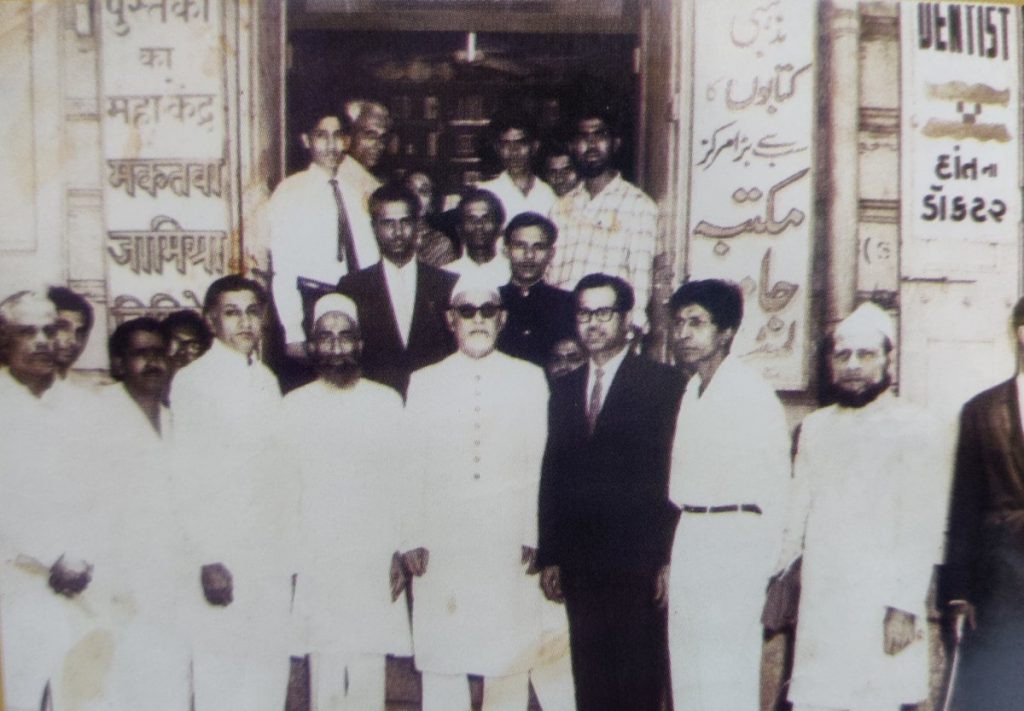
Shahid Ali Khan and other staff of Maktaba Jamia (Mumbai) with Zakir Hussain, former president of India and VC of Jamia Millia Islamia. Photo: Shahid Ali Khan: Ek Fard, Ek Idara (Arshia Publications)
It is our misfortune that despite requests from several admirers, he never paid heed to write his biography or memoirs. Had he done so, we would not have been deprived of the knowledge and stories which have now gone with him. In my understanding, he didn’t write his memoirs for two reasons. He was always busy with work and never had the time – so much so that his children would say that the Maktaba (and later, Nai Kitab) was his first love. Secondly, and more importantly, he hardly ever spoke about himself.
He had a special interest in young researchers of Urdu. God only knows how many of them he has helped by supplying important books and literature for their research, providing guidance (what to read, whom to interview or contact) and getting their work published.
There are many who claim to be, or are often referred to as Khadim-e-Urdu (Servant of Urdu). But I have not met a servant of Urdu like Shahid sahab. He was a selfless benefactor of Urdu and his services can’t and shouldn’t be forgotten. Now that Shahid sahab is no more, it is unlikely that the bookshop will open again. Even if it does, it will never be the same.
source: http://www.thewire.in / The Wire / Home> Culture / by Mahtab Alam / June 01st, 2021
Monday was a momentous day in the history of the school run by the South Western Railway Women’s Welfare Organisation (SWRWWO) in Hubballi.
It held a mega felicitation function for its only student in its 32-year-old history who cracked the Civil Services Exam in the results announced a week ago. What makes it all the more remarkable is that Tahseen Banu Dawadi, the only Muslim woman to clear the exams out of 26 in the State, is the daughter of a retired goods train guard. Dawadi secured 482nd rank in her second attempt.
Khadar Basha, who retired from Railways as a chief trains clerk in 2012, told TNIE, “I was very happy when the results were out. I was confident she would clear it. My two sons and two daughters are all good in academics. It was a proud moment for me when the General Manager, SWR and the Divisional Railway Manager, Hubballi invited us to their office and honoured my daughter.”
Dawadi, 24, who completed her B.Sc in Agriculture from University of Agricultural Sciences, Dharwad in 2019, set her sights on the civil services exams when she was studying in the final year of her graduation.
She told The New Indian Express, “My father and mother Hasina Begum supported me and even sent me to Mumbai Hajj House in Mumbai for my coaching, which is conducted by the Ministry of Minority Affairs. I could not clear even the preliminary exams in my first attempt in 2020. But in my next attempt in 2021, I have cleared the prelims, mains and the interview. I was confident I would clear it as I have been good in academics throughout.” She also took coaching from the Residential Coaching Academy of Jamia Millia Islamia in Delhi.
Dawadi says, “It was a surprise for me that I secured 482nd rank out of 680. I had thought I would be in the bottom five. I am also the only Muslim girl from Karnataka to clear the exams,” she said. Sharing her keenness to take up a career in bureaucracy, she said, “I was keen on civil services as it directly gives one a chance to serve the society. I always wanted to be in a government job.”
source: http://www.newindianexpress.com / The New Indian Express / Home> Good News / by S Lalitha, Express News Service / June 08th, 2022
Thiruvananthapuram girl enters India Book of Records for Warli paintings
Thiruvananthapuram :
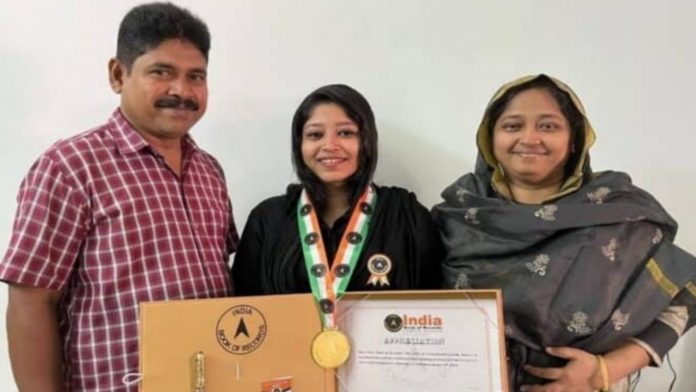
Najiya Navas, a graduate from Thiruvananthapuram, has entered the India Book of Records by drawing pictures in the technique of Warli painting, an art form unique to the tribal community of North Sahyadri Range in Maharashtra.
A Warli painting made by her of 5 inches in length and breadth has fetched her the India Book of Records recognition. Her entry breaks the previous record of a 10-inch length and breadth Warli painting.
Najiya has not learned painting formally and picked up the tricks of the trade from the internet. She has drawn more than 100 pictures so far.
Talking to IANS, Najiya said that it was during the Covid-19 lockdown that she entered the world of Warli painting and has already sold several of her drawings online and earned money from it.
She said that she is planning to learn drawing and painting in a systematic manner from Mumbai in the coming days. Najiya has already sent her pictures to the Guinness World Records.
Najiya is the daughter of Navas and Najma of Kaniyauram in Thiruvananthapuram.— IANS
source: http://www.muslimmirror.com / Muslim Mirror / Home> Indian Muslim> Women / by IANS / June 05th, 2022
Perunthalmanna Thazekadu Village / Kalikavu (Malappuram District) KERALA :
An ordinary Muslim woman from a remote village in North Kerala’s Malappuram district is today one of the general secretaries of the Congress party in Kerala.
Any woman involved in public service in Kerala, or for that matter anywhere in the country, faces several difficulties and challenges. It is all the more daunting if you are an ordinary woman and a Muslim to boot. Especially in today’s ‘New India’. Let us face the facts: unlike men, the circumstances are not conducive for a woman to enter politics in Kerala.
It is after a lot of uncertainty and dithering that the Congress party in Kerala managed to recently release a list of new office-bearers of the Pradesh Congress Committee. Though the leadership has claimed that the list is a reflection of a unified Congress – remember the local Congress has been ravaged by group rivalry for decades that had once again cost the party dearly in the recent Assembly elections in the state – it has naturally come under criticism for minimal representation for women in different committees. The AICC has co-opted five women, including three general secretaries and two executive committee members, into the KPCC leadership hierarchy. The women general secretaries are K.A. Thulsi, Alippatta Jameela and Deepthi Mary Varghese. The executive committee members are Padmaja Venugopal and P.R. Sona.
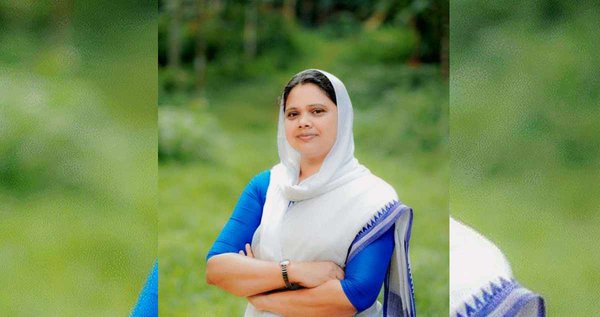
It is in this backdrop that Alipatta Jameela, the only Muslim woman general secretary of the KPCC, spoke to DoolNews Malayalam about her political journey. Asked how as a Muslim woman from Perunthalmanna Thazekadu, a village situated in the hilly terrain in Malappuram, one of the most backward districts in north Kerala till not very long ago, she rose to become a KPCC general secretary, Jameela said she had represented the KSU (Kerala Students Union, student organisation of the Congress in Kerala) in the College Union when she was studying in Mannarkkad MES (Muslim Education Society) College. She said she moved to Kalikavu, where she is settled now, after her marriage. She became active in politics after being elected president of the local Kalikavu Mandalam Congress in 2000. In 2005 she became a member of the Kalikavu panchayat after winning from Eenadi ward. In 2010 she contested from another ward and became president of the Kalikavu panchayat.
In 2015 she contested the Zilla panchayat election from Vandiyur division. In 2018 she became the district secretary of the Mahila Congress. In the 2020 panchayat elections, she successfully contested from Thenjippalam division. Currently she is a member of the Thenjippalam division and chairperson of the Public Works Department (PWD) standing committee there.
Jameela said it is significant that the party chose to select her to the PCC while she is already holding the post of general secretary of the Kerala Mahila Congress. “I consider it an honour and a sign of the party’s continuing faith in me. It is a great achievement to become one of the general secretaries of the State Congress, especially for someone hailing from the hilly terrain and living in this small town of Eranadu Kalikavu. I consider it recognition of the work I have done so far and I hope to fulfil the responsibilities bestowed on me to the full extent of my abilities,” she said.
Asked if she had a long struggle to reach the level she has, Jameela admitted that it was very difficult as a woman, especially as an ordinary woman from Malappuram, to embark on a life of public service, which is full of hazards and challenges entirely different from what men face in such circumstances. “When I contested for the panchayat in 2005, my younger child was not even a year old. The elder one was just three. To go out and campaign leaving my two children at home was very tough. This is not in my case alone. A lot of women face the same problems. Many of them are forced to give up as they fail to get enough support at home,” she said.
Jameela asserted that she could reach this level purely because of the support and encouragement she got at home. Despite that as a woman she faces many difficulties which she somehow overcomes to go forward.
On whether she belonged to a traditional Congress family and how she came into the party, she confessed that her family is basically a Muslim League one, but her late brother Nalakath Yusuf was a staunch Congress supporter and introduced her to the party’s ideology. “It was he who initiated me to the basics of politics. That was how I got involved in student politics,” Jameela said.
On the criticism over the shrinking representation of women in Congress forums, Jameela said compared to the previous jumbo KPCC (over 100) the current one has been trimmed to 51. “There are three women general secretaries and two in the executive committee. So, five of us are here. I think this is a decent number. I am myself an answer to that criticism. The fact that of the three woman general secretaries one is from Malappuram (Muslim-dominated district where League roots are deep) is in itself, in my opinion, an important signal to the changes that are sure to happen,” Jameela said.
On the new Congress leadership in Kerala vowing to end group rivalry in the state unit and whether she belongs to any group, Jameela admitted that leaders in the state Congress have grown only through these groups. “All along I have worked above these groups, but it is a fact that Thenjippalam from where I am a member belongs to the I (Indira) group. So, in a way, many see or identify me as spokesperson of the I group. But I try to be above all this and consider myself a humble worker of the Indian National Congress,” she said.
(Note for those who are not familiar with Congress politics in Kerala: For years these groups – A and I – are identified as the former aligned with senior Congress leader from the state, A K Antony, whose soulmate is former chief minister Oommen Chandy. The other group consists of followers of the late K Karunakaran who had stood with Indira Gandhi at the time she split the Congress a second time. Their current leader is former leader of the opposition Ramesh Chennithala.)
Asked whether the Congress, which is not in power either in the state or at the Centre, and is passing through perhaps the worst period in its history can make a comeback, Jameela said the country is passing through a grave crisis and is heading towards total anarchy without the Congress in power. She said the BJP is destroying India’s secular democracy by the day. “Women in particular are facing many problems in the state and the country in general. We see only such news these days. If Congress was in power these things would not have happened. In such circumstances people want the Congress to return to power. The new state Congress president and the leader of the Opposition are working for that only – to bring Congress back to its glory in the state. We will emerge victorious,” she said.
Asked what advice she would give to those women wanting to come into public life, Jameela said more and more women have started joining mainstream politics. She said it is the need of the hour as the country is passing through dangerous times. She added that she will always be there to guide women, Muslim or otherwise, who come forward to play a role in shaping the destiny of the country.
source: http://www.milligazette.com / The Milli Gazette / Home> News> Community News / by MG Correspondent / January 14th, 2022
Dr A Remla Beevi, director of medical education who bade adieu to a tumultuous stint on Tuesday, terms her last seven years as the most challenging in her 34-year career.
Thiruvananthapuram :
Dr A Remla Beevi, director of medical education who bade adieu to a tumultuous stint on Tuesday, terms her last seven years as the most challenging in her 34-year career. She had an arduous task as the DME during the Nipah and then the pandemic outbreak in the state.
When the Nipah virus outbreak was reported in Kozhikode district in 2018, like any other health professional, Dr Remla was also at sea. Even today, Thiruvananthapuram native Dr Remla remembers that once the diagnosis was reached, health authorities took steps to set up isolation facilities in a jiffy.
However, she is still upset that the state lost Lini Puthussery, the nurse who died in the first outbreak. Dr Remla recalls that the diagnosis had not come when Lini fell ill. Dr Remla gives credit to the entire health department, including then health minister K K Shailaja and former health secretary Rajiv Sadanandan, for working unitedly to contain the Nipah virus spread within Kozhikode district. In 2020, when she was busy with her administrative work at the directorate of medical education in Thiruvananthapuram, the first Covid case was reported in the state. Later, the Covid spread was declared a pandemic.
“The biggest challenge was that apart from Covid patients, people affected with other illnesses as well as pregnant ladies were thronging the Thiruvananthapuram Medical College and SAT hospitals. We had to set up separate labour rooms, operation theatres, ICUs and separate wards and divide our staff into three pools – Covid, non-Covid and reserve,” Dr Remla told TNIE.
Many a time, she missed her family – comprising husband Dr E Abdul Khadar, former professor and head of the cardiology department of Kottayam Medical College, engineer son Mohammed Farooq Husain and daughter Dr A Sumayya residing in Kottayam – when she returned home after a long and tiring day.
Dr Remla became the DME in 2015 after serving as the principal in Thrissur, Alappuzha and Kottayam government medical colleges. She joined the government service in 1988 as a lecturer at the Government Medical College in Kottayam.
Dr Remla who has specialised in radiology, fondly remembers the team work rendered by former health minister Shailaja who went out of the way by reading medical books and journals about Nipah and Covid so that these would help her “health army” to combat the deadly viruses.
source: http://www.newindianexpress.com / The New Indian Express / Home> Good News / by Cynthia Chandran, Express News Service / June 02nd, 2022
Shamnad was not just an expert in intellectual property rights, but a relentless crusader who worked towards ensuring diversity and representation of marginalised communities in legal practice.
The untimely and tragic death of professor Shamnad Basheer was a bolt from the blue for many of us. As I scuttled to get more information on what initially seemed impossible to believe, I realised that apart from the loss of a friend, the country had also lost one of its finest legal minds. Globally renowned for his expertise in the field of intellectual property rights (IPR), Shamnad was found dead in his car near Bababundangiri in Chikkamagaluru of Karnataka.
As news of his death spread and tributes started pouring in all over my social media timeline, there remained no doubt that his sudden demise was a great loss to the legal fraternity and academia across the globe. Shamnad was a relentless crusader, working day in and out to ensure diversity and representation of marginalised communities in the field of law and legal practice. An alumni of the National Law University, Bangalore and Oxford University, Shamnad was a man on a mission as he championed many causes ranging from internet equality, fairness in IPR, public interest litigation, judicial accountability, to the rights of sexual minorities, visually impaired and physically disabled persons.
For me, Shamnad was more a social justice warrior than a globally-known IPR expert. He was not just the force behind Increasing Diversity by Increasing Access to Legal Education (IDIA), but also Access to Legal Education for Muslims in India (ALEM India).
I first heard of him in 2009, when he wrote a blog about remarks made by then Supreme Court judge Markandey Katju. In open court, Justice Katju equated a young Muslim sporting a beard with a Taliban militant. That year, Justice Katju had rejected an appeal of a Muslim student that he should be permitted to sport a beard in his convent school. Rejecting the plea the judge had remarked that, “We don’t want to have Talibans in the country. Tomorrow a girl student may come and say that she wants to wear a burqa. Can we allow it?”
According to Shamnad, “notwithstanding the merits of the case”, Justice Katju’s comments were “callous and insensitive” and he was “unfit to be an impartial judge”. Back then, Shamnad was the HRD ministry’s professor of intellectual property law at the National University of Juridical Sciences (NUJS), Kolkata. In the conclusion of his blog, he wrote:
“The Supreme Court bench may have been right in denying admission to Salim’s SLP. However, in view of Justice Katju’s statements made in open court that equated every bearded Muslim with a Taliban, the possibility of bias against a community cannot be ruled out. And the Chief Justice must not only censure such remarks, but take immediate steps to have this case reheard before another bench. For justice must not only be done, but also be seen to be done!”
Years passed by, and I kept reading his insightful articles and commentaries in various newspapers and websites. He was prolific, writing on a range of issues related to law, policy and public good. In 2015, a common friend (Tarunabh Khaitan) connected us, asking me if I would be interested in helping Shamnad’s team at IDIA to reach out to the Muslim community. Having admired Shamnad’s writings, the opportunity to work with him was like a dream come true. I readily agreed and eventually, we became good friends.
Shamnad Basheer at a panel discussion of intellectual property rights. Photo: Flickr/World Intellectual Property Organisation CC BY NC ND 2.0
Diversifying the legal field
More than anything, he was always on the lookout for ways and means to ensure that IDIA reaches the remotest parts of the country. To contextualise the need of diversity in national law schools, let me quote a study conducted by the students of NLS Bangalore in 2016. According to the study:
“While the students are somewhat evenly divided across sexes, the income, caste and religion statistics are telling of what constitutes ‘merit’ in this country. While 15% of the students reported their family’s annual income to be above Rs 36 lakh per annum, more than 50% reported an annual income of more than Rs. 12 lakh per annum. Eighty two percent were Hindus and the next largest religious group was the wealthy Jain community (5%), which constitute less than 0.5% of India’s population. On the other hand, Muslims, who constitute 14% of India’s population, make up only 0.5% of that of NLS. The NLS also has predominantly upper-caste students at 65%, with about 27% identifying as Brahmins.”
Similarly, another report found:
“In the last 15 years i.e., from 2000 onwards, only one Dalit advocate has been designated senior by the Supreme Court, and only two from the Muslim Community. The Advocates from backward States like Uttar Pradesh, Chhattisgarh, Jharkhand or Bihar have not been designated at all. The Advocates from rural background are totally ignored. Even with regard to a progressive State like Karnataka, only one Advocate has been designated after a gap of 25 years. It is relevant to mention that in the last round of designation, out of five advocates designated, four of them belonged to one caste.”
Despite being an extremely busy person, Shamnad believed in and practiced mentoring and coaching young minds, individually and personally. Few years ago, when I visited his flat in Bangalore, he was helping two students who were staying at his house to prepare for the CLAT exam. Both belonged to an unprivileged background, a common thread among the spectrum of students whom IDIA supported. A glance at IDIA scholars, like visually impaired Najrul Islam from Siliguri, West Bengal, who studies at the National Law University, Delhi (NLU) or Meraka Mani from Srikakulam district of Andhra Pradesh, currently studying at IFIM Law College, Bangalore, Aparna Amnekar from Nagpur, Maharashtra, a student of Government Law College, Mumbai, Sonia Sabu of Ernakulam district in Kerala, studying at NLIU, Bhopal and Vinatoli of Dimapur (Nagaland), studying at NUJS Kolkata shows an incredible initiative founded and run by him, with diversity and representation at its core.
Learning from IDIA’s experiment and under the guidance of Shamnad, ALEM India was started last year. The initiative tries to ensure access for socio-economically disadvantaged Muslims and improve their representation in Indian law schools.
Personally coaching legal professionals
His objective was not just to coach students for national law schools or produce batches of successful lawyers and legal professionals. He wanted to prepare young minds who are competent yet socially committed. It is hardly a surprise that IDIA produced graduates like Yogendra Yadav, better known as Yogi. The son of a manual labourer (working in Alang, Gujarat) and a resident of Pitij village in Chhatra district of Jharkhand, Yogi graduated from the National University for Study and Research in Law (NUSRL), Ranchi in 2017. He is currently a lawyer in the Ranchi high court. He worked as a newspaper hawker in and around his village from a very early age and it is while distributing newspapers that he got to know about IDIA and CLAT.
In the recently concluded Lok Sabha elections, he contested as an independent candidate. Explaining his rationale to contest the election, Yogi told Bar & Bench, “IDIA always encouraged me to take up community causes and help as best as I could, They were training me to become a CHAMP and this is all part of that.” I clearly remember Shamnad informing us of Yogi’s inspiring story with pride. “Yogendra Yadav, our IDIA Scholar makes his Political Debut!,” read the email he had sent to some of us.
Shamnad was also keen to highlight IDIA scholars to people working in different walks of life, not just those in the law and judiciary. In 2017, got in touch with me to invite the anti-manual scavenging activist and convener of the Safai Karmachari Andolan, Bezwada Wilson, to deliver the key note address at the IDIA conference on creativity and leadership.
Bezwada Wilson. Photo: PTI
“We share the same set of ideals in terms of empowering the marginalised and building a more inclusive India,” he had written to Bezwada, copying me in the email. Bezwada’s key note, according to Shamnad was “a provocative address”. A year later, he also wrote an article on Bandicoot, a robot to replace manual scavenging. He noted:
“Bandicoot is not just a clever idea; it is a game changer, and dare I say a life saver! Putting some teeth back into India’s constitutional promise of “equality” for Dalits and other marginalized sections who’ve had to clean our crap for years. Only a few days ago, the Delhi high court ruled on a case involving the death of two manual scavengers; making the government pay for its murderous negligence!”
His latest email to me was in July this year, a heart breaker titled: “Deeply Disappointing News: 7 IDIA Scholars Still Without Committed Donors!”. “I am deeply saddened to bring you this disheartening message. Unfortunately, of the 12 IDIA scholars that gained admission to leading law schools this year, we found donor support (covering all expenses) for only 5 of our scholars. Which means 7 of our kids are left behind and it will be a struggle to put them through law school without some promise of a committed donor (or donors),” read his email. Little did I know then that this was going to be his last email to me.
Now that Shamnad is gone and we cherish his memory, our duty is to ensure that we carry forward the work he initiated, in the same spirit that he always professed. And that, I believe, would be our real tribute to him.
source: http://www.thewire.in / The Wire / Home> Law> Rights / by Mahtab Alam / August 11th, 2019
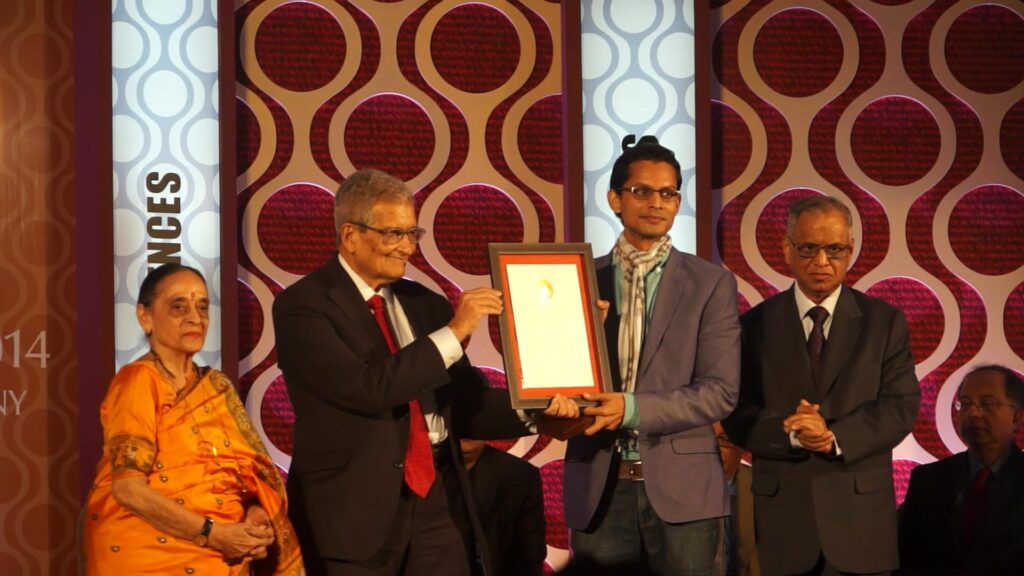
Photo of Shamnad receiving the Infosys Prize (Humanities) in 2014 from Mr. Amartya Sen / pix: shamnad.com
Bengaluru :
Indian Institute of Science (IISc) professor Jayant Haritsa and Intellectual Property (IP) academic and consultant professor Shamnad Basheer, both from Bengaluru, are among six winners of the Infosys Prize for this year.
Each prize, comprising a purse of Rs.55 lakh, a 22-carat gold medallion and a citation, is awarded by Infosys Science Foundation, a not-for-profit trust, set up by the global software major and funded by a corpus of Rs.100 crore ($16 million), contributed by the IT firm, its trustees and co-founders in 2009.
“Haritsa, computer science and automation department professor at IISc, has been awarded the prize under the Engineering and Computer Science category for his contribution to the design and optimisation of database engines,” the Foundation said in a statement here Thursday.
Haritsa also heads the supercomputer education and research centre at the institute.
Basheer, founder of SpicyIP, India, bagged the prize for his contribution to the analysis of a range of legal issues, including pharmaceutical patent injunctions and enforcement in the Humanities category.
As India’s premier blog on IP and innovation law and policy, SpicyIP does accurate reporting of IP developments across the country.
Basheer is also founder and managing trustee of Increasing Diversity by Increasing Access (IDIA) in Bengaluru.
Shubha Tole, associate professor at Mumbai-based Tata Institute of Fundamental Research (TIFR), got the prize under the Life Sciences category for her contribution to studying the hippocampus and amygdale centres of learning and memory in the brain.
“Tole’s work can lead to a better understanding of human behaviour, cognition and emotions,” the statement noted.
Tole is also a principal investigator at the TIFR’s biological sciences department.
Massachusetts Institute of Technology (MIT) adjunct professor Madhu Sudhan has been awarded the prize under the Mathematical Sciences category for his seminal contribution to probabilistically checkable proofs and error-correcting codes.
As a principal researcher at Microsoft Research in New England in the US, Sudan also heads the electrical engineering and computer sciences (EECS) department and computer science and artificial intelligence laboratory (CSASIL) at MIT in Boston.
Council of Scientific and Industrial Research (CSIR) senior scientist Srivari Chandrasekhar at the Hyderabad-based Indian Institute of Chemical Technology (IICT) has bagged the prize under the Physical Sciences category for his contribution to the synthetic organic chemistry with special focus on the synthesis of complex molecules from natural sources.
Abdul Latif Jameel Professor of Poverty Alleviation and Development Economics at MIT, Esther Duflo, got the prize under the Social Sciences category for her pioneering contribution to development economics, including the work related to India and Africa.
Duflo is also founder-director of Abdul Latif Jameel Poverty Action Lab in the US.
“The Foundation has been able to recognise some of the best researchers of our time through the prize. Their contributions are an inspiration to students and professionals and have the potential for real-time impact on individuals and society,” Infosys co-founder and Foundation president N.R. Narayana Murthy said on the occasion.
A panel of jurors, comprising renowned scientists and professors from the world over, evaluated the noted winners.
The Infosys Prize jury chairs are Pradeep Khosla, Nobel Laureate Amartya Sen, Inder Verma, Srinivasa S.R. Varadhan, Shrinivas Kulkarni and Kaushik Basu.
President Pranab Mukherjee will award the winners and felicitate them Jan 5 in Kolkata.–-IANS
www.shamnad.com
source: http://www.muslimmirror.com / Muslim Mirror / Home> Exclusive Reports> Indian Muslims> Youth / November 15th, 2014
Mohammed Shaukath Azeem, son of taxi driver, resident of Jarigudde near here has secured 545th rank scoring 914 marks in the UPSC examination that was held recently.
Shaukath got his primary education from SVT school of Karkala and completed his high school and degree studies in KMES college. He did the engineering graduation in Electronics and Communication from MITE at Mijar near Moodbidri. Later when he wanted to appear for UPSC, he was selected for UPSC training by the government of Karnataka and he was given stipend during training.
Shaukath started writing the UPSC examination for the first time in 2016. This was his seventh attempt and he came out with flying colours.
The Public Service Commission of 2021 has selected 685 candidates throughout the country and Shaukath is one of the few who are selected from Karnataka. Shaukath comes from a financially poor family. His father Sheikh Abdul drives a taxi for a living, while his mother Maimuna is a housewife.
An elated Mohammed Shaukath Azeem said, “My parents, who stressed on my education even during financial difficulties are my inspiration. I used to prepare everyday for five hours before the examination. Not only studying, but the social knowledge helped me a lot. I will most probably get selected for revenue or chartered accountancy. Selection process will be held within two months.”
source: http://www.daijiworld.com / DaijiWorld.com /(Headline edited) / Home> Top Stories / by Daijiworld Media Network – Karakala (MS) / June 01st, 2022