Khan achieved the rare feat recently by qualifying for the his second event — giant slalom — a month after booking his first Winter Olympics ticket in alpine skiing slalom category in an Olympic qualifier in Dubai.
Alpine skier Arif Mohammed Khan. (Twitter/jswsports)
Jammu and Kashmir-based alpine skier Arif Mohammed Khan has become the first Indian athlete to qualify for two different events of the Winter Olympics, set to be held in Beijing from February 4, next year.
Khan achieved the rare feat recently by qualifying for his second event — giant slalom — a month after booking his first Winter Olympics ticket in alpine skiing slalom category in an Olympic qualifier in Dubai.
The news was confirmed by his promoter JSW Sports.
JSW-supported Alpine skier Arif Khan, who had earlier earned a provisional quota for the Slalom event at the 2022 Winter Olympics, has now qualified for the Giant Slalom event as well. ??#BetterEveryday ???? #Beijing2022pic.twitter.com/Ua6EfIRJ65
— JSW Sports (@jswsports) December 29, 2021
“JSW-supported Alpine skier Arif Khan who had earlier earned a provisional quota for the slalom event at the 2022 Winter Olympics, has now qualified for the giant slalom event as well.
“For the first time in history, an Indian will be competing in two different events at the Winter Olympics,” JSW Sports wrote in a facebook post on Wednesday night.
While India was represented by two athletes — Jagdish Singh (cross country skiing) and Shiva Keshavan (luge) — in the 2018 Winter Games, Khan is the only person to have qualified for the 2022 Winter Games so far.
Khan is a professional alpine skier from north Kashmir’s Tangmarg and has qualified for giant slalom event at Kolasin, Montenegro recently. He has represented India in more than 100 ski events held across the world and has been undergoing training in Europe for the most part of this year.
source: http://www.indianexpress.com / The Indian Express / Home> Sports / December 30th, 2021
While the origin of Mygurudu is unknown, it is believed that the word originated from ‘Mozhi Kurudu’, which means misleading with words.
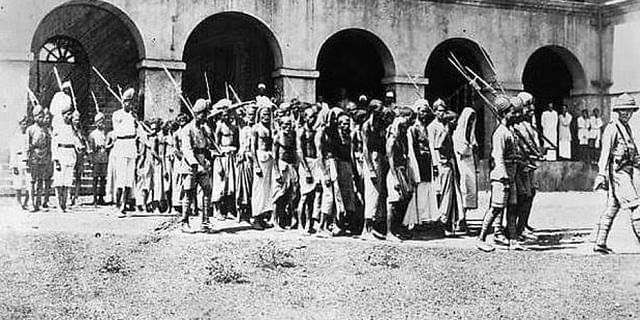
The 1921 revolt grew as an agitation against the feudal lords who aided the British. (Photo | Special Arrangement)
Kozhikode :
The centenary observations of the Malabar rebellion of 1921 are also becoming an occasion to retrieve many forgotten things part of local history. Mygurudu, the secret language that was prevalent in some parts of Malabar, is among them. For the coded language was used widely by the rebels to hoodwink the British during the rebellion.
While the origin of Mygurudu is unknown, it is believed that the word originated from ‘Mozhi Kurudu’, which means misleading with words. The language was developed by swapping Malayalam alphabets. For example, Malayalam alphabet ‘Aa’ is replaced by ‘Sa’ and ‘Eee’ by ‘See’.
In his book ‘Anglo-Mappila War 1921’, historian A K Kodoor recorded that the rebel leaders had instructed that all messages should be communicated through Mygurudu. He added that rebels’ meeting at Vellinezhi had decided to teach all group members the language, and that the Mappilas of Malabar used the secret language from 15th century AD when they were battling the Portuguese.
The Students Islamic Organisation (SIO) recently organised an exhibition ‘Al Jamia Mygurudu’ at the Al Jamia Al Islamia at Santhapuram near here. “The exhibition was part of a protest against the move from the Indian Council of Historical Research (ICHR) to delete the name of those who participated in the 1921 rebellion from the list of freedom fighters,” said Ayman M A, convener of the exhibition.
Dr Pramod Irumbuzhi, who has done extensive research on the language, said he first came to know about it when he was studying at the Calicut University. “I realised that some people can still speak the language. There will be around 500 people who can fluently speak Mygurudu in the seven districts of Malabar,” said Pramod, whose book on the subject has run into the fourth edition.
source: http://www.newindianexpress.com / The New Indian Express / Home> States> Kerala / by Express News Service / October 24th, 2021
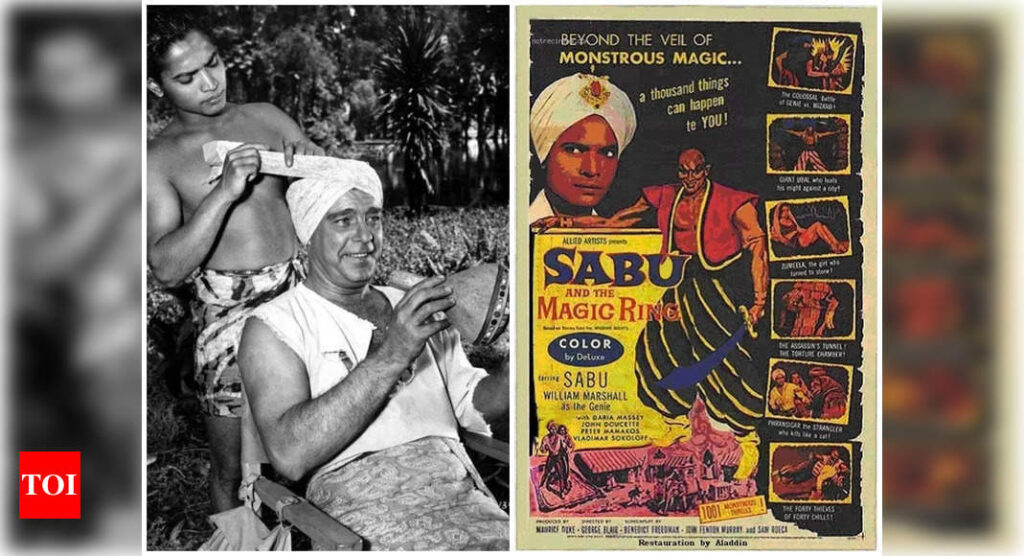
Sabu Dastagir, or Selar Sabu, might be an overlooked name in Indian Cinema’s vibrant history but many wouldn’t be aware that he was perhaps the first actor to find bonafide success in Hollywood. These are the early 1930s that we refer to, much before the likes of Om Puri, Saeed Jaffrey, Irffan Khan or even Priyanka Chopra made their mark on the foreign shores.
Born in the Mysuru kingdom of the pre-independent India to the then king’s official mahout, Sabu was spotted at the age of 13 by director Robert Flaherty (or his wife, some sources claim) who would later cast him in the screen adaptation of Rudyard Kipling’s Toomai and the Elephants (from the Jungle Book). While portions of the film were shot in Mysuru, the rest of the film was shot in London which meant that Sabu was flown over, along with his brother, to England where he is said to have attended school for a brief period.
But this was only the beginning for Sabu Dastagir as he chanced upon more such golden opportunities with projects like ‘The Drum (1938), wherein he played prince Azim, or Zoltan Korda’s ‘The Thief of Baghdad’ in 1940 in which he played Abu, the outwitter who ultimately saves the princess. ‘The Thief of Baghdad’ won the Oscars for Cinematography, Art, and Special Effects while ‘The Drum’ ended up causing riots in Mumbai for its subservient attitude towards the British in the film.
Around the time of ‘The Thief of Baghdad’s release, the second World War was looming large over the entire world, and Sabu, during its peak, had just completed shooting for ‘Jungle Book’ in Hollywood.
He would go on to serve the American military and become an integral member of more than 40 air missions across the pacific as their tail or machine gunner. Along with the acting accolades he had received till then, Sabu also became a decorated military officer after being awarded the Flying Cross.
Sabu would then continue residing in the United States of American and become the face of the “Empire Movies” with several hits like ‘White Savage (1942)’, ‘Cobra Woman (1944)’, ‘Man-Eater of Kumaon (1948), and many more to his name.
It was on the sets of ‘Song of India’ in 1949 that he met actor and future wife Marilyn Cooper for the first time.
Sabu Dastagir breathed his last on 2nd December, 1963 in California, despite being in the pink of his health at the time.
source: http://www.timesofindia.indiatimes.com / TimesofIndia.com / Home> Entertainment> Kannada> Movies / by Swaroop Kodur / September 07th, 2021
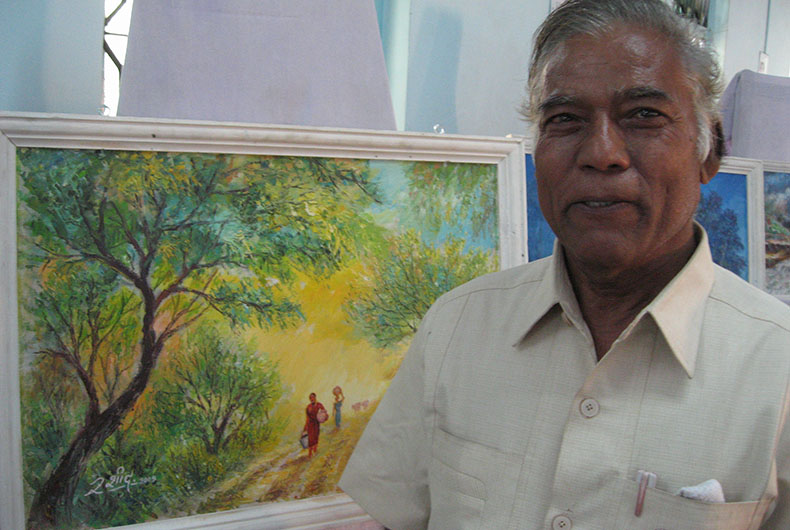
Rasheed Artist is one among these people in Malegaon, who despite all odds went on to achieve such a position, which is difficult for many even under most favourable conditions
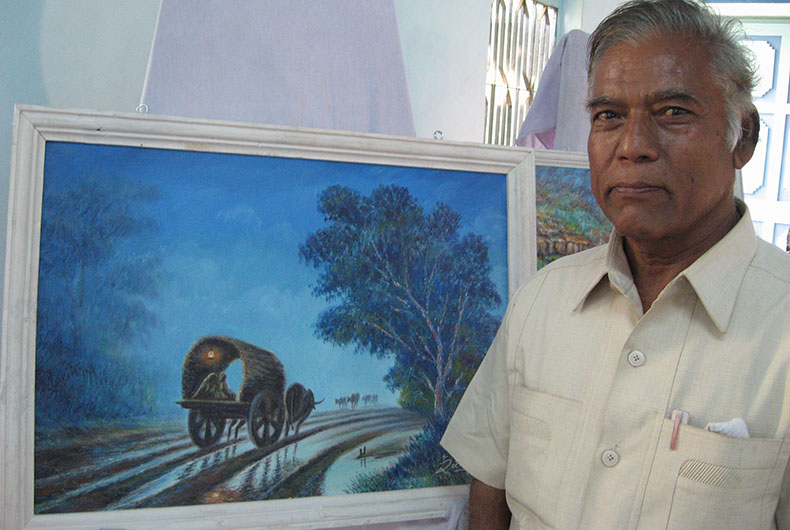
Rasheed Artist – renowned artist of Malegaon
The powerloom factories in Malegaon might have been the only available option for the Malegaonians, the deprived people of the Muslim dominated textile town in North Maharashtra. Yet the amount earned after working in these factories was sufficient till a few decades ago to make one’s end meet easily. This perhaps is the reason why the town has surprising number of poets, laureates, scholars and artists who would work in these factories like petty labourers during the day and then indulge themselves in creative activities till late in the evening.
Rasheed Artist is one among these people in Malegaon, who despite all odds went on to achieve such a position, which is difficult for many even under most favourable conditions. Hanging against the walls of the main halls inside the plush bungalows owned by the dignitaries in India as well as in various other countries in the world, Rasheed Artist’s paintings are point of attraction for visitors since many years. Fabulous achievement indeed! However the journey that led to these walls was not easy, and for Rasheed Artist, it needed a matchless and unprecedented effort since childhood.
Malegaon in the sixties though had quite a good number of schools, managements could hardly find a good drawing teacher during those difficult days. Under these circumstances having a professional artist to teach the art of painting to students using watercolor was beyond one’s imaginations. However Rasheed Artist was resolute. He was just 15 but when he failed in fulfilling his strong desire for commercial art in the corridors of the education campus, he decided to quit schooling.
“It was my craze for paintings that forced me to drop out of the school in the early age”, he recalled.
Holding brush in one hand and color box in the other, he began roaming here and there to satisfy his lust for Art. It was then that Wad Saheb, a Director at Camel, the stationary giant famous for manufacturing pencils, watercolor and other stationary items till recently, came to Malegaon. Wad Saheb, as Rasheed Artist described the renowned artist from Shimla, visited Malegaon as part of his nation-wide talent-search program.
“He visited Malegaon for consecutive years in the seventies, shared valuable tips with the students like us and organised painting and drawing competitions to encourage us”, Rasheed Artist said adding:
“In his second visit to Malegaon in 1968, I won the competition. Wad Saheb was thrilled watching the improvement I had attained in one year.”
In Wad Saheb, Rashid Artist found a mentor. But he was not a lord and any further continuation from now had become unbearable for his parents. To bear the expenses hence Rasheed Artist began working in a local powerloom factory along with his father – without of course sharing hardly any money with him for regular household needs. Rasheed Artist would work for three to four days in a week and the moment he would get some cash would rush to Mumbai and wander around the city’s art galleries in his humble and simple attire which is part of his persona even now.
“Jahangir and Taj Art Galleries in Mumbai were my favorite hunting grounds”, he recalled.
His encounter with the masters of the time – including the legendaries Jahangir Sabhawala and Sarvayya at these galleries are still the precious moments of his life.
“My comments and discussions would make them dumb. They could not believe a humble looking person like me had such a sound knowledge of canvas paintings.”, he said.
Rasheed Artist
In 1970, Rasheed Artist permanently moved to Mumbai,and started working on banners, sketches and art works for the upcoming films at V. Shantaram’s Mumbai Central Film Department. He was earning reasonably well now. But to earn was never in his priority list. Therefore he decided to leave Mumbai and return back to Malegaon where his talent soon witnessed a surprising turnaround.
“Innovation and creativity have always been my passions. Back in Malegaon, I began working on popular couplets of Urdu poets and tried to portray them in my paintings”, he recalled.
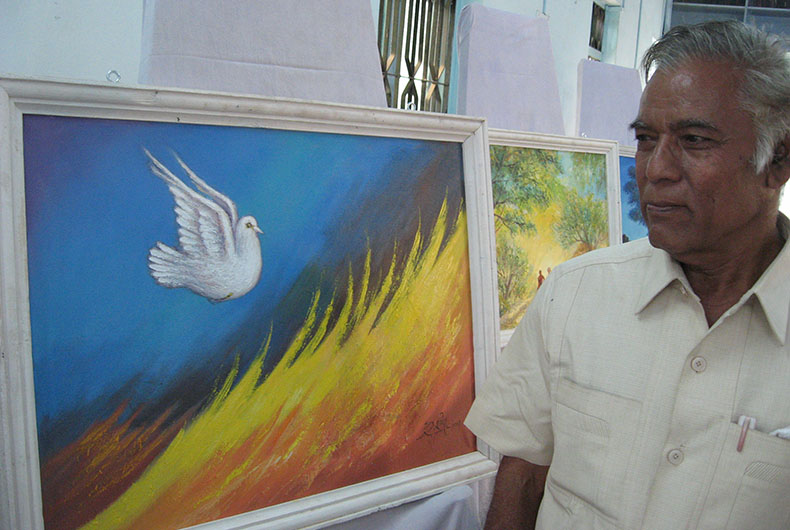
There was no looking back after that. He soon acquired perfection in transferring Urdi couplets over the canvas with amazing interpretational skills. Hundreds of canvas paintings portraying Urdu couplets by the poets like Mirza Ghalib, Firaq Gorakhpuri, Meer Taqi Meer, Majrooh Sultanpuri, Rahat Indori, Shabina Adeeb, Parvin Shakir and others were ready in quick succession. Subsequently, it became customary for the Malegaonians to gift Rasheed Artist’s paintings to the dignitaries who would visit the town.
While the one gifted to veteran musician Naushad painted on the famous couplet Aabadiyon main dasht ka manzar bhi ayega; Guzroge shaher se to mera ghar bhi ayega is still greeting the visitors in his hall, Shabana Azmi has put the one presented to her father Kaifi Azmi portrayed on Aik woh keh jinko fikre nashaib o faraz hai; Aik hum keh chal pade toh behr haal chal pade in her office.
Rashid Artist with his paintings.
Majrooh Sulatnpuri was lucky to get two paintings. Of these two, the one on Sutoone daar pe rakhte chalo saron ke charaag; Jahan talak yeh sitam ki siyah raat chale is in Canada and the other on Phir koi masloob hua sare rahe tamnna; Aawaze jaras pichle pahar taiz bahut hai is part of the splendid collection at Dubai Urdu Library.
Simultaneously, Rasheed Artist also perfectly worked on portraits of the people he loved the most. They included freedom fighters, world leaders, artists and poets. When Dilip Kumar visited Malegaon in 1980, he was thrilled to see his portrait. The portrait presented to him is now greeting the people at his Bandra residence. The portraits of Iranian leader Ayatollah Khomeini and Mirza Ghalib presented to Ferhad Parizaad of the Iranian Cultural Centre in Mumbai in 1985 are in Iran.
Today Rasheed Artist is the ultimate and globally recognized name when it comes to canvas paintings. In fact, he is perhaps the only artist in the Indian sub continent who portrays Urdu couplets over the canvas with such a sound interpretational skills. Yet Rasheed Artist has few more dreams in his life.
“Apart from writing a book on Sketching and Painting, it’s my dream to transfer the history of Urdu Ghazals from Ameer Khusroo till date over the canvas”, he said in a determined tone.
Rasheed Artist at this stage of his life is finding it easier to run the expenses of his family. However to run his dream project is of course an expensive affair. Moreover, looking at him who resolutely turned down the offers by popular art galleries in London and Australia to auction his paintings, it seems impossible for him to make any compromises merely for the sake of arranging funds needed to work on these projects. Yet one thing is certain. The stubborn in him would not let him sit idle. It would be really interesting to see how he achieves these targets.
[An abridged version of this article was published by The Times of India, on August 25, 2010 in its Nashik edition.]
source: http://www.ummid.com / Ummid.com / Home> India> Life & Style / by Aleem Faizee, ummid.com / June 13th, 2009
South Africans across the board voted for Sooliman, putting Deputy Chief Justice Raymond Zondo in second place.
Johannesburg:
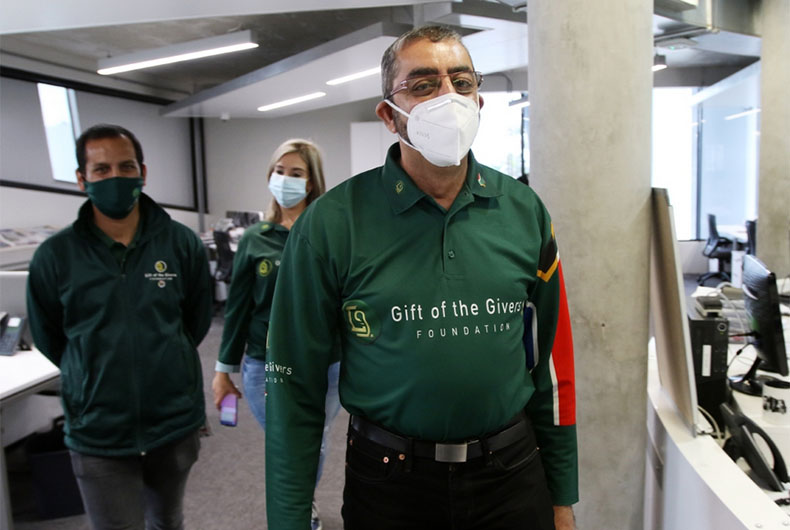
Indian-origin philanthropist and founder of disaster relief group ‘Gift of the Givers’, Dr Imtiaz Sooliman has won the prestigious South African of the Year Award run by the Daily Maverick newspaper.
South Africans across the board voted for Sooliman, putting Deputy Chief Justice Raymond Zondo in second place. Zondo heads the Commission of Inquiry into State Capture, which investigates fraud and corruption in the public sector, including state organs.
Dr Sooliman, in his acceptance speech at the Al Quds Mosque in Cape Town on Friday, called on Muslims worldwide to engage in caring for all communities to change Islamophobic perceptions.
“About Gift of the Givers”
Dr Sooliman started ‘Gift of the Givers’ after his religious mentor in Turkey, Muhammed Safer Dal Effendi, asked him to do so in 1994.
Since then, the charitable and relief organisation has undertaken relief work in more than 44 countries after natural disasters such as earthquakes as well as assisting people in war-torn countries.
Besides the Middle East, Eastern Europe and many countries in Africa, ‘Gift Of The Givers’ teams have also assisted during natural disasters in India and Pakistan.
“Utlization of Zakat”
Relying almost entirely on donations and the obligatory ‘Zakat’ paid by Muslims, ‘Gift of the Givers’ has provided almost 4 billion rand (USD 260 million) worth of aid to drought-stricken areas, ranging from mobile hospitals, food hampers, and digging boreholes.
The doctor recalled how Sheikh Muhammed Safer Dal Effendi, his religious leader in Turkey, had instructed him to establish the organisation ‘Waqful Waqifin‘, which translates to ‘gift of the givers’ from Arabic.
“My son, the Sheikh said, you will serve all people, of all religions, of all races; all colours, all cultures; all classes, of any geographical locations and of any political affiliation, but you will serve them unconditionally. You will expect nothing in return, not even a thank you,” recalled Dr Sooliman, who practises medicine.
“When we go into an area to do our work, we don’t look at their belief systems. Whether they are Hindu, Muslim or Christians, whatever they may be, we don’t go to be judgemental about anyone,” he said.
“This award came by South Africans who had voted across cultures, across religions, across people who do not have any faith too, but all of them were willing to vote for me,” Dr Sooliman said this symbolised that people in their souls, support goodness.
“Other Awards”
Dr Sooliman is recognised internationally for his works, winning scores of awards and accolades over the decades, lauded by South African and foreign heads of state for his organisation’s assistance during times of crises.
Dr Sooliman has also received National Orders, South Africa’s highest civilian honour, and earlier this year was named Social Justice Champion by the University of Stellenbosch in Western Cape province.
Dr Imtiaz Sooliman was born on March 07, 1962 in Potchefstroom. He completed his high school education at Sastri College in Durban, Natal in 1978, and later qualified as a medical doctor by obtaining his MBChB at the University of Natal.
source: http://www.ummid.com / Ummid.com / Home> India> Life & Style / by ummid.com with inputs from PTI / December 26th, 2021
A worker of Hospital Development Fund (HDF) was awarded by Indian Army for his bravery.
As per the report, a woman namely Reena Devi wife of Naresh Chand, resident of Mir Pancheri (Udhampur) tried to commit suicide by jumping into Chenab River from Karol Bridge, Ramban on the evening of December 2.
While the woman was about to get drowned, she was saved by one person namely Mehrazuddin son of Farooq Ahmad, resident of Karol (Ramban) by showing exemplary courage and swimming skills.
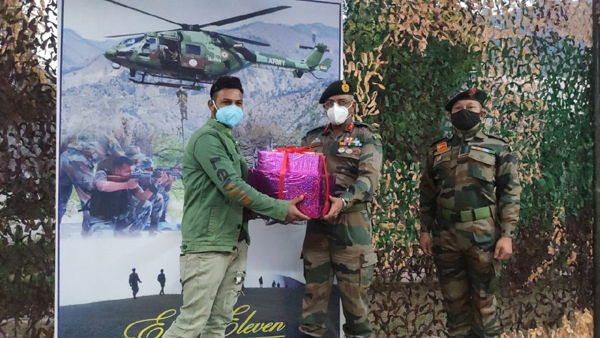
The Mehraj was awarded by india Army in for his remarkable courage which led to saving of life of the aggrieved woman.
Mehraj was presented cash reward for his brave act.
source: http://www.dailyexcelsior.com / Daily Excelsior / Home> State / by Excelsior Correspondent / December 06th, 2021
The revolt of 1857-58 is largely considered and is widely seen as a ‘Popular Uprising’. The uprising had centres spread across North India as well as Central and Western India. The uprising in different centres had its own leaders. The most important names associated with the uprising that comes in one’s mind are those of the Indian soldier Mangal Pandey at Barrackpore, Rani Laxmibai at Jhansi, Veer Kunwar Singh at Arrah, Maulvi Ahmad Shah at Faizabad, Tantia Tope at Kanpur, Begum Hazrat Mahal at Lucknow.
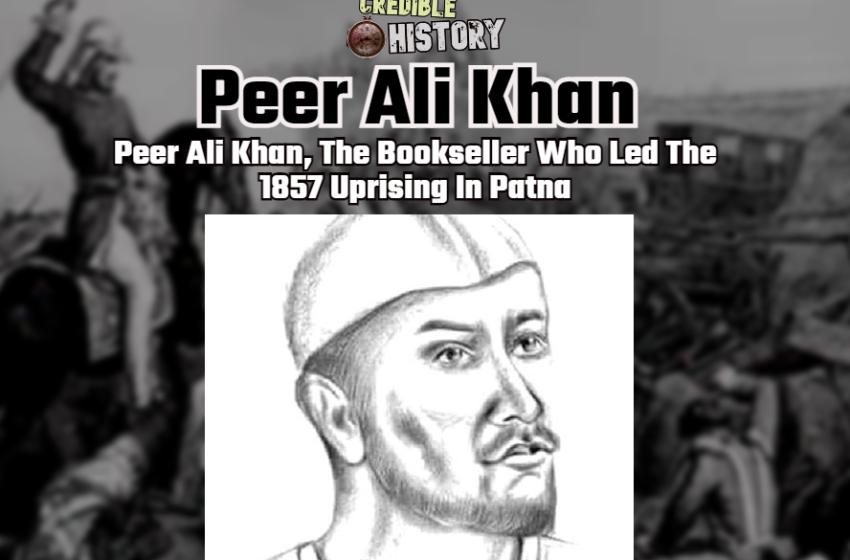
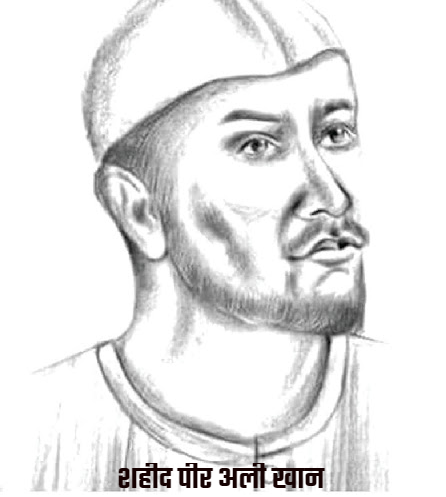
Peer Ali Khan
At the same time, there are many heroes who are largely unheard of or are often forgotten. One such name is that of Peer Ali Khan, a bookseller who led the uprising in Patna. Peer Ali Khan has been described as the “Chief Rebel of the city”[1] by William Tayler who was the Commissioner of Patna between 1855 and 1859.
Peer Ali Khan was born in Muhammadpur in Azamgarh district of Uttar Pradesh. Around the age of seven he ran away and arrived in Patna. In Patna he was provided shelter and refuge by a zamindar who brought him up along with his son and educated him.[2]Peer Ali Khan owned a bookshop in Patna. The bookshop became the meeting point for rebels and also a contact point for rebels and the disenchanted Indian soldiers in the British Army.
According to William Tayler:
“Peer Ali was a native of Lucknow, but had resided for many years at Patna; he was by trade, a Book-seller, and I strongly suspect that he may have originally established himself here, for the express purpose of carrying on the intrigues which issued in this abortive out-break.”[3]
Peer Ali secretly distributed important leaflets, pamphlets and coded messages to the rebels.
He regularly organised campaigns against the British, and became the leader of the July 1857 upsurge in Patna.
William Tayler in his narration of the events of 1857 in Patna says:
“Two days before the emeute at Patna, which will be described in a subsequent chapter, Ahmed Oollah’s father, Illahee Buksh, the blind man, whom I have above mentioned, sent a message to apprise me, that the leader of the Rebels, Peer Ali Khan, was collecting arms and men”.[4]
Uprising in Patna
The uprising in Patna took place on the 3rd of July 1857 and it was carried out by Peer Ali and the other rebels.
The rebels led by Peer Ali first attacked the house of a Roman Catholic priest in the heart of the city but the priest escaped. They then shot and killed Dr Lyell who was the principal assistant to an opium agent. When a reinforcement of British soldiers was sent to the scene of attack some of the rebels were shot and killed whereas others fled.
“The most serious affair at Patna, however, occurred about the close of the period to which this chapter more particularly relates. At about eight o’clock in the evening of the 3d of July, a body of Mohammedans, variously estimated from eighty to two hundred, assembled at the house of one of their number, one Peer Ali Khan, a book-seller, and proceeded thence to the Roman Catholic Church and mission-house in Patna, with two large green flags, a drum beating, and cries of ‘Ali! Ali!’ The priest, whom they probably intended to murder, fortunately escaped. They emerged into the street, reiterated their cries, and called on the populace to join them. Dr Lyell, principal assistant to the opium agent, immediately went to the spot, accompanied by nine Sikhs. He rode ahead of his support, was shot down by the rioters, and his body mangled and mutilated before the Sikhs could come up. A force of Sikhs and nujeebs speedily recovered the unfortunate gentleman’s body, killed some of the insurgents, and put the rest to flight.”[5]
In the aftermath of the attack, Peer Ali’s house was searched by the British, where they found and seized arms and a number of letters. He was designated as the leader of the upsurge by William Tayler.
William Tayler describes it as follows:
“Somewhat later in the day, the deputy Magistrate, Moula Buksh to whom the Magistrate had entrusted the investigation of the case, came to me in great triumph with some murderous looking arms and implements (among which was an English fencing mask) and a large packet of letters, all of which had been found in the house of Peer Ali Khan, the leader of the outbreak and Captain of the rebels;”[6]
“The letters discovered in his house serve to show, that, for several years past, he had been in correspondence with different parties, principally with one “Musee” ool “zuman”, a Lucknow man, who followed the same trade, and that he had, in communication with these parties, deliberately discussed and matured seditious plans against the British Government.”[7]
Thereafter, Peer Ali Khan and the other rebels were arrested and tried. Most of the rebels were hanged within hours of sentencing. Peer Ali who was believed to be the murderer of Dr Lyell was also handed death sentence for his overall role as the leader in the uprising of 3rd July 1857.
“….. numerous accomplices were seized during the next few days, and among them, after a short resistance, in which he was wounded, Peer Ali himself; ample evidence was, by the exertions of Moula Buksh, obtained, convicting these men of active participation in the outrage, 21 were hanged, 23 imprisoned.”[8]
He refused amnesty
After being sentenced to death, Peer Ali was offered amnesty in lieu of providing more evidence and information regarding the nature of the uprising, but nothing could break him. History therefore stands witness to the fact that this ordinary bookseller did not concede to the demands of the British and refused the amnesty. He accepted the gallows rather than a life of disgrace.
William Tayler goes on to note:
“After capital punishment had been pronounced upon him, I sent for him (as I generally did with such criminals) and questioned him in my private room, in hopes of eliciting some further information regarding the plot.
Heavily fettered, his soiled garments stained deeply with blood from a wound in his side, confronted with myself and several other English gentlemen, the last hope of life departed, not for a moment did he betray agitation, despondency, or fear.”[9]
Declining the pardon being offered, Peer Ali proclaimed:
“On being asked whether he could do anything to make it worth while to spare his life, he answered with supreme coolness and some contempt: “There are some cases in which it is good to save life, others in which it is better to lose it”. He then taunted me with the oppression I had exercised, and concluded his speech by saying, “You may hang me, or such as me, every day, but thousand will rise in my place, and your object will never be gained.””[10]
William Tayler seems to be in awe of Peer Ali and says:
“….. men, whose unconquerable fanaticism renders them dangerous enemies, and whose sternresolution entitles them, in some measure, to admiration and respect”.[11]
The Hanging
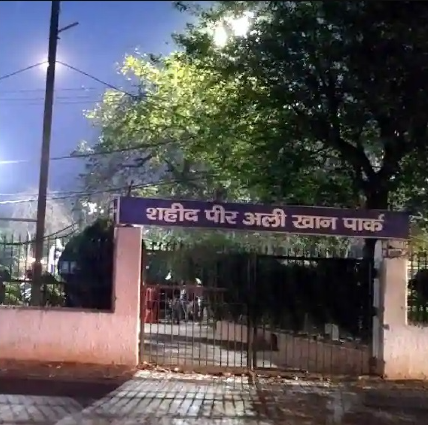
On 7th July 1857, Peer Ali was hanged in full public view in Patna. In present day Patna a children’s park opposite the DM’s office near Gandhi Maidan has been named the Shaheed Peer Ali Khan Park by the Govt. of Bihar to commemorate the sacrifice of this ordinary bookseller whose deeds made him extraordinary and memorable. The park is considered to be the place where Peer Ali was hanged in 1857.
Naming a park after a forgotten hero of the 1857 uprising goes a long way in making him and his contribution known to the people. Moreover, reading and writing about Peer Ali khan made me realize once again and ever more that our freedom is very hard earned. We cannot take it for granted. I and we all need to cherish it, nourish it and strengthen it.
[1] William Tayler, Our Crisis Or Three Months at Patna during the Insurrection of 1857, (2007 Reprint), Khuda Bakhsh Oriental Public Library, Patna, p.4
[3] William Tayler, Our Crisis Or Three Months at Patna during the Insurrection of 1857, (2007Reprint), Khuda Bakhsh Oriental Public Library, Patna, p.45
[4] William Tayler, Our Crisis Or Three Months at Patna during the Insurrection of 1857, (2007 Reprint), Khuda Bakhsh Oriental Public Library, Patna, p.30
[6]William Tayler, Our Crisis Or Three Months at Patna during the Insurrection of 1857, (2007 Reprint), Khuda Bakhsh Oriental Public Library, Patna, p.44
7William Tayler, Our Crisis Or Three Months at Patna during the Insurrection of 1857, (2007 Reprint), Khuda Bakhsh Oriental Public Library, Patna, p.45-46
8William Tayler, Our Crisis Or Three Months at Patna during the Insurrection of 1857, (2007 Reprint), Khuda Bakhsh Oriental Public Library, Patna, p.44
[9] William Tayler, Our Crisis Or Three Months at Patna during the Insurrection of 1857, (2007 Reprint), Khuda Bakhsh Oriental Public Library, Patna, p. 44
[10] William Tayler, Our Crisis Or Three Months at Patna during the Insurrection of 1857, (2007 Reprint), Khuda Bakhsh Oriental Public Library, Patna, p.44-45
[11] William Tayler, Our Crisis Or Three Months at Patna during the Insurrection of 1857, (2007 Reprint), Khuda Bakhsh Oriental Public Library, Patna, p. 45
source: http://www.thecrediblehistory.com / Credible History / Home> English> Freedom Movement> Others / by Kanupriya Gautam / October 20th, 2021
__________________
Kanupriya Gautam : Kanupriya has done her Master’s in Modern Indian History from University of Delhi and has deep Interest in History, Politics and Literature.
source: http://www.thecrediblehistory.com / Credible History / Home> English> Freedom Movement / by Kanupriya Gautam / October 20th, 2021
Bihar,INDIA / North Carolina / Washington, U.S.A. :
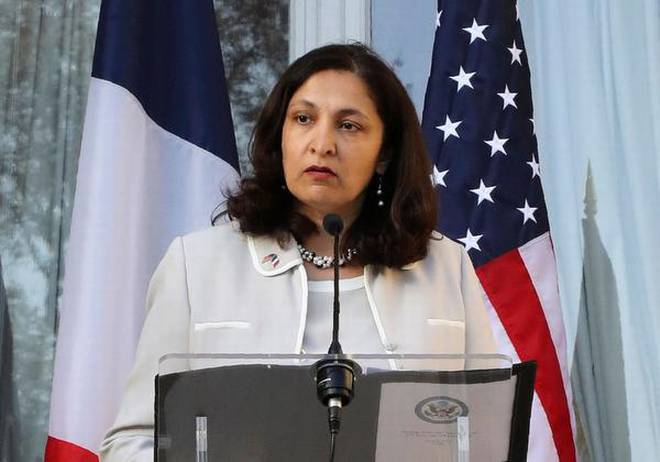
File photo of Uzra Zeya. | Photo Credit: AFP
The coordinator’s role involves promoting “substantive dialogue” between the Chinese government and the Dalai Lama.
U.S. official Uzra Zeya has been appointed the country’s new Special Coordinator for Tibetan Issues. She will hold the position concurrently with her current role as Under Secretary for Civilian Security, Democracy, and Human Rights, Secretary of State Antony Blinken said via a statement.
The coordinator’s role involves promoting “substantive dialogue” between the Chinese government and the Dalai Lama. The coordinator is also supposed to promote the unique identity of Tibet, safeguards human rights of Tibetans and coordinates U.S. policy on Tibet.
“Specifically, she [ Ms. Zeya] will promote substantive dialogue, without preconditions, between the Government of the People’s Republic of China (PRC) and the Dalai Lama, his representatives, or democratically elected Tibetan leaders in support of a negotiated agreement on Tibet,” Mr Blinken said in a statement, as part of a list of activities Ms Zeya would undertake in her new role.
In addition to her responsibilities around promoting human rights and preserving the distinct heritage of Tibetans, Ms. Zeya “ also will promote activities to protect the environment and sustainably manage the water and other natural resources of the Tibetan plateau,” Mr Blinken said.
The position, which was established by U.S.’s Tibetan Policy Act (2002), had been lying vacant for much of the Trump administration, i.e., from January 2017 to October 2020, when State Department official Robert Destro was appointed to the role.
Ms. Zeya was born in North Carolina to parents who emigrated from India. She quit the State Department during the Trump administration (2018), speaking and writing, after her departure, of the decline in diversity at the top levels of the administration.
Ms. Zeya has worked at the U.S. Embassy in New Delhi as a politicial-minister counselor, in addition to deputy chief of mission and charge d’affaires in Paris and postings in West Asia and North Africa.
source: http://www.thehindu.com / The Hindu / Home> News> World / by Srriram Lakshman / December 20th, 2021
Chief Commissioner Gaurav Gupta flags off a Covid-19 vaccination vehicle at the BBMP head office in Bengaluru on December 15, 2021. | Photo Credit: Sudhakara Jain
To cover 110 million people in 25 States by June 2022’
Salesforce, a customer relationship management player, and Azim Premji Foundation have entered into a collaboration to introduce VaxIT, an app to help accelerate Covid-19 vaccination in India.
The programme would use VaxIT across 25 States to cover a population of 110 million (11 crore) across over 3,500 Primary Healthcare Centres (PHCs) by June 2022.
The VaxIT app, developed on the Salesforce platform for Azim Premji Foundation and its partners, would capture the status of vaccination to help individuals plan and stay updated on their progress in the healthcare programme.
VaxIT is available on the Android app store and offers multi-lingual, and offline capabilities.
Anurag Behar, CEO, Azim Premji Foundation, said, “Throughout the Covid-19 pandemic, we have organised ourselves to provide a comprehensive response to the situation – addressing healthcare and humanitarian needs.”
Arundhati Bhattacharya, CEO, and Chairperson, Salesforce India, said, “As we race to deliver one of the largest mass vaccination campaigns in human history, we believe our collaboration with Azim Premji Foundation will help with the safe and equitable distribution of Covid-19 vaccines across India.”
source: http://www.thehindu.com / The Hindu / Home> News> Cities> Bengaluru / by Special Correspondent / Bengaluru – December 22nd, 2021
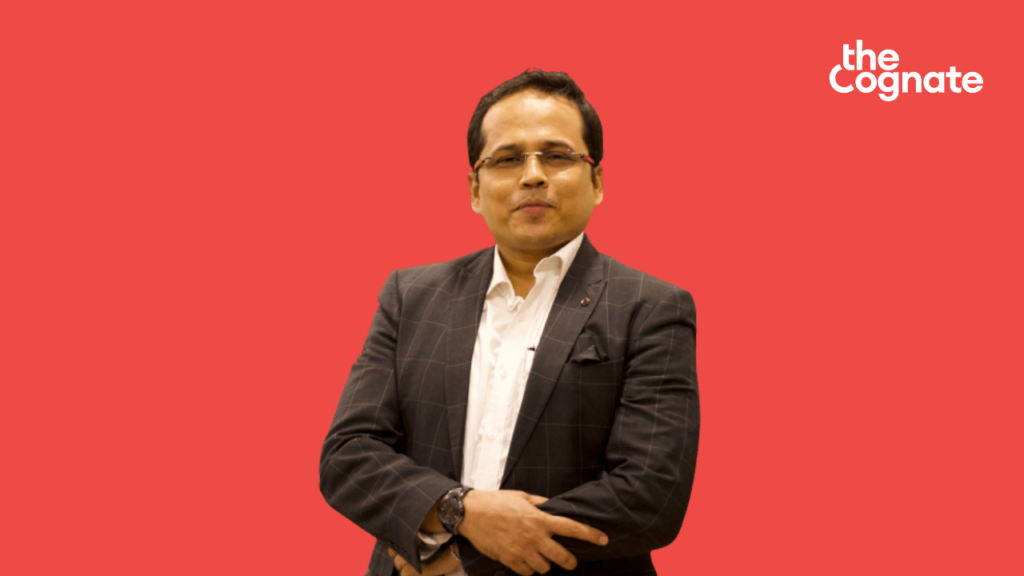
Bengaluru-based author and coach Mohammed Ali Athar Ahmed, also known as MD Ahmed, entered the Guinness World Records for memorising the most number of three-digit flashcards.
Ahmed bagged the world record for recalling 32 three-digit flash numbers. The previous record was held by an Iranian (30 three-digit cards).
Ahmed is highly trained in memory techniques and also trains others to use such techniques. He decided to attempt a Guinness World Records title to help inspire others who are also interested in memorising as a skill and sport, Guinness World Records noted.
A Neuro-Linguistic-Psychology (NLP) practitioner, Ahmed is the author of the book “Hidden Secrets Of The Topper’s Mind”.
source: http://www.thecognate.com / The Cognate / Home> News / by The Cognate News Desk / December 10th, 2021