Category Archives: Amazing Feats

Bihar’s NEET topper Zeya Bilal credits success to Rahmani 30

Pandaul Village (Madhubani District), BIHAR :
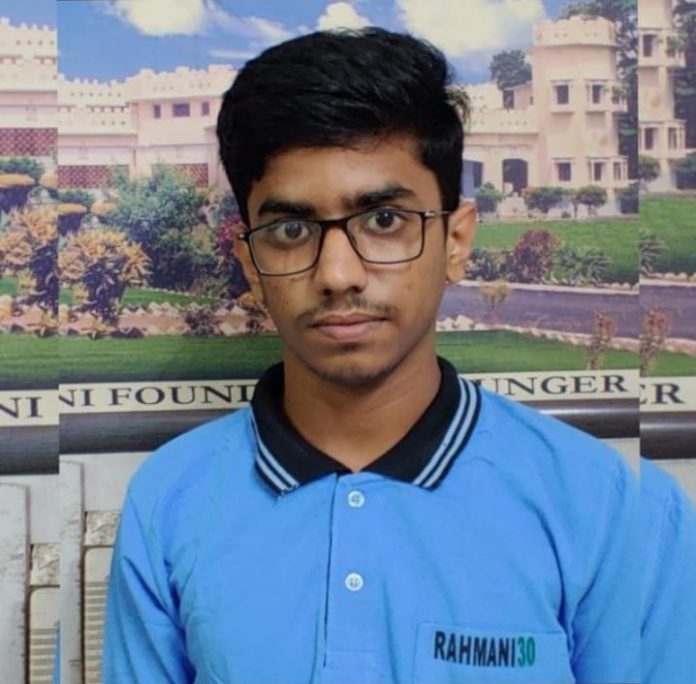
Belal’s All-India Category Rank (OBC) is 3rd. He will turn 18 on November 28 and is a product of renowned Rahmani 30 of Patna, Bihar. | Picture by arrangement

Mohammad Zeya Belal from a remote village in Bihar has topped the list of successful candidates from Bihar in this year’s NEET. A Rahmani 30 alumni, Belal credited his success to the positive environment at the institute founded by late Maulana Wali Rahmani.

Bihar :

Mohmmad Zeya Belal is a brilliant student. He has topped the list of successful candidates from Bihar in this year’s NEET – the top medical entrance test of India held by the National Testing Agency (NTA). His All India Rank (AIR) is 19th with a score of 715 out of a total of 720. He answered just one question incorrectly out of 180 questions.

His All-India Category Rank (OBC) is 3rd. Belal will turn 18 on November 28. He is a product of renowned Rahmani 30 of Patna.

Belal hails from Pandaul, a remote village in the Madhubani district of Bihar, some 180 kilometres north of the capital Patna. Interestingly, he has cracked the toughest engineering entrance test JEE (Advanced) meant for the IITs. Even more importantly, he got admitted to the top-ranked Indian Institute of Sciences, Bangalore after clearing the Kishore Vaigyanik Protsahan Yojna – a test meant to tap the young scientists.

Belal told TwoCircles.net that he is interested in medical studies and is raring to get admission at AIIMS, New Delhi, India’s top medical studies college.

Belal is the youngest of three brothers. One of his brothers Abdullah Ansari works in Guwahati and the eldest one is a teacher.

Belal said his elder brother is like a mentor for him as “our father Mohammad Masud Alam Ansari, who was a Physics teacher, died in 2010.” Belal was 7-years-old at that time. His mother Ruhi Khatoon is a housemaker.

Belal passed his 10th from S.K. High School, Pandaul with 90% marks and 86.2% in his 12th. He got to know about Rahmani 30 from his senior Nafe Faiz. His studies at Rahmani 30 was a mix of offline and online education amid the Covid-19 lockdown.

Belal is all praise for his teachers at Rahmani 30. He aspires to be a cardiologist after completing his MBBS. “I want to thank Atul sir for his continuous support. He is an academic chief there and keeps away from any limelight,” he said.

Belal cites two things as U.S.P. of Rahmani 30. “The environment for self-study and group discussions are its hallmark. The group discussion is a big help in doubt clearing,” he said.

Belal believes in focused and disciplined studies. He was focused to succeed in NEET though he cleared JEE (Advanced).

He said that that he had to study Mathematics for his Physics preparation which helped him crack the engineering test too.

His mother Ruhi Khatoon told TwoCircles.net said that she didn’t have to tell Belal to study. Her only complaint with Belal is that he doesn’t eat well. She is ecstatic about her son’s success and distributed sweets in the village.
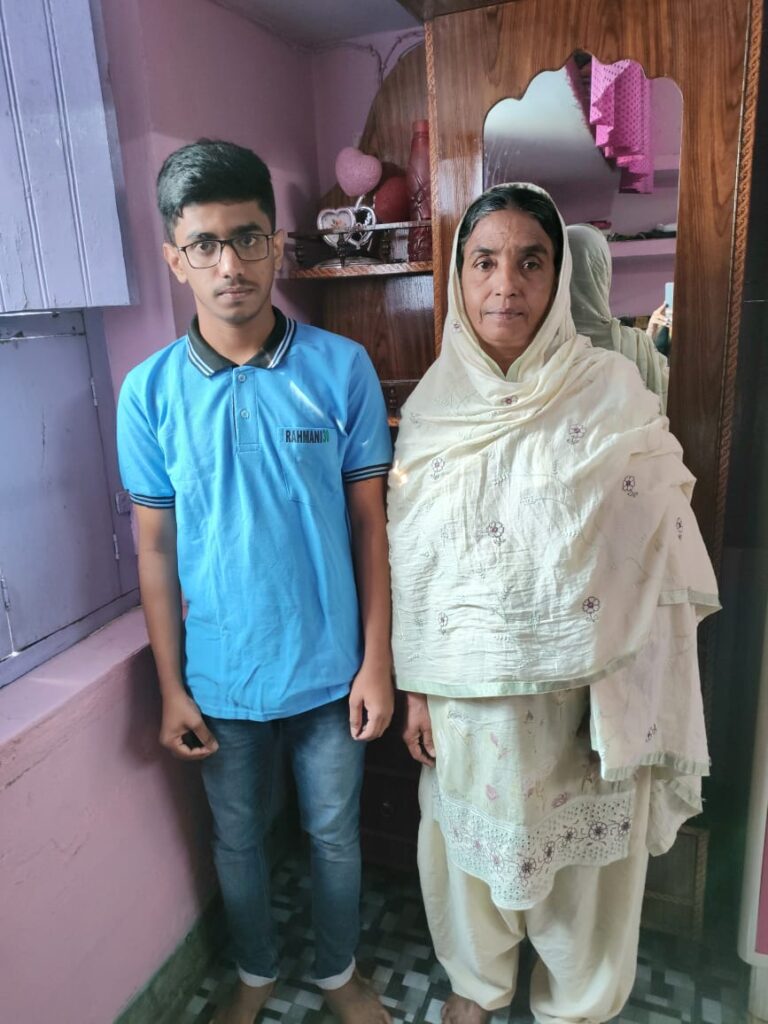
Bilal with his mother Ruhi Khatoon at their home. | Picture by arrangement

Belal’s brother Abdullah said that it was Amir-e-Shariat late Hazrat Maulana Wali Rahmani’s efforts that brought success for all the students of Rahmani 30. “Belal was helped immensely by Atul sir there,” he said,” he said, adding, “The environment at Rahmani 30 is quite helpful for organized studies.”

“Despite the absence of our father, I didn’t have to force Bilal to study. He would always do it on his own,” he said.

Belal said that he follows sports but cites a lack of time for not pursuing it fully. His scores at NEET (National Eligibility cum Entrance Test) give a picture of what he has achieved. His percentile obtained in Physics is 99.9969565. He obtained 99.9942368 percentile in Chemistry and Biology he got 99.9987049 percentile. The cut-off marks for qualifying as per Medical Council of India is 50th for unreserved and EWS (Economically Weaker Section) category which falls between 720-138 number. For OBC (Other Backward Castes) it is 40th percentile which falls 137-108 marks.

Tausif Alam has studied with Belal for quite some time and himself has been allotted a seat in IIT, Delhi. Talking about Bilal’s success, he said, “Belal has a completely different mind. He is both a hard worker and a smart working boy. We all knew that he would do better. We all are happy that he achieved such a feat.”

On the night when the NEET results were announced, discussions went on till 3 o’clock. In 2020, fifty students of Rahmani 30 qualified NEET and got admission in different government medical colleges for MBBS. This year the number is expected to be better.

Sami Ahmad is a journalist based in Patna, Bihar. He tweets at @samipkb. 

source: http://www.twocircles.net / TwoCircles.net / Home> Lead Story / by Sami Ahmad , TwoCircles.net / November 04th, 2021
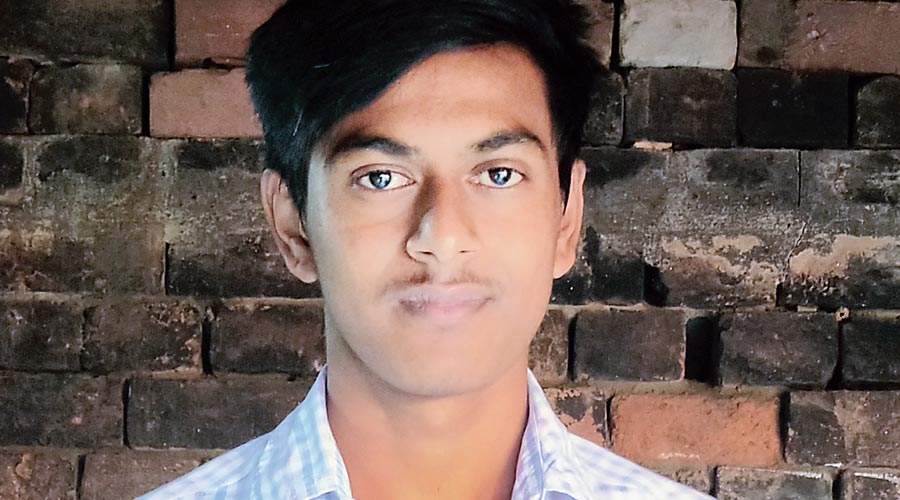
Bidi-rolling part of Sohail Anwar’s NEET journey

WEST BENGAL :

The 20-year-old scored an all-India 12,550 rank in the just-declared NEET medical results, scoring 616 out of the possible 720.

Sohail Anwar / Telegraph picture

Successful NEET aspirant Sohail Anwar, 20, knows the fundamentals of biology and bidis. 

A few months ago, Sohail would spend afternoons helping his mother Keshbanu Biwi, 44, roll bidis for a local manufacturer in Jadavnagar, Murshidabad. His father Bani Israel, 48, was a hawker of bedsheets in villages but lockdown dampened sales. His family’s income did not exceed Rs 10,000 a month, so everyone had to pitch in.

Sohail scored an all-India 12,550 rank in the just-declared NEET medical results, scoring 616 out of the possible 720.

“My brother Saeed, who is two years elder to me, has always been my inspiration,”  Sohail said on Tuesday, when asked by this paper about his success, which places him  among candidates eligible for top medical colleges in Bengal.

Two years ago, Saeed secured admission to Murshidabad Medical College. Besides studies, Saeed tutors medical aspirants in Behrampore town.

“Saeed and my uncle Samirul, a WBCS officer, have been a huge support and inspiration,” added Sohail, adding he misses his brother. 

How did he manage to crack NEET while rolling out bidis? ‘I could not prioritise on one thing, both were equally important,” says Sohail, who helped his mother in the afternoons and studying on his own in the evenings and nights.

Sohail’s father Bani Israel said he was “fortunate and grateful to god” for his sons.

“I have not been able to do more for my boys than give them two rooms, four brick walls and a tiled roof. I cannot ask for more than what they have already done,” Bani said softly. 

The head of an eight-member family, Bani feels academic success of this scale in his home “is like a dream”

Sohail passed his higher secondary with 83 per cent from a high madrasa in Malda and got coached for NEET from Al-Ameen Mission,  Howrah. He devoted two years to NEET coaching. “That paid off,” he said. 

He added that  he will continue helping his family in their chores till the next phase of his academic career becomes clearer.

source: http://www.telegraphindia.com / The Telegraph Online / Home> West Bengal / by Alamgir Hossain, Behrampore / November 03rd, 2021

Kashmiri teen brings gold for India in World Kickboxing Championship

Tarkpora (Bandipora District), JAMMU & KASHMIR / Mumbai, MAHARASHTRA :

My next aim is to win gold medal for my country in Olympics, Tajamul Islam said.

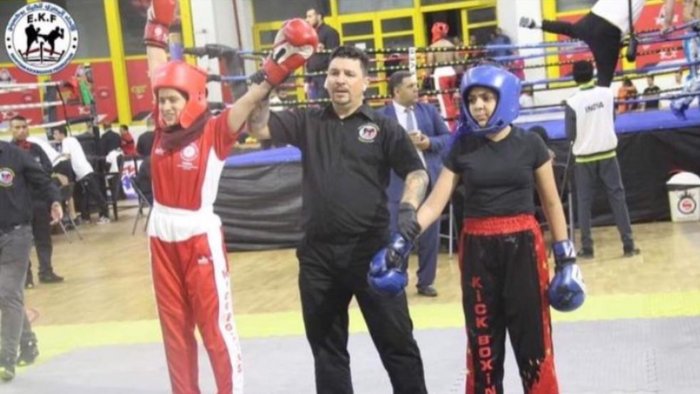
Tajamul Islam, 13, from Tarkpora in Bandipora defeated Argentina’s Lalina in the under-14 finals. Credit: Tajamul Islam

A teenage girl from a remote village in north Kashmir’s Bandipora district recently scripted history by winning a second gold medal in World Kickboxing Championship held in Egypt’s Cairo on October 22.

Tajamul Islam, 13, from Tarkpora in Bandipora defeated Argentina’s Lalina in the under-14 finals. “I had represented India in Italy in 2016 too, in the under-9 category in which players from 90 other countries had participated. I won gold in that event also,” she told DH.

A class 7 student of Army Goodwill School in Bandipora, Tajamul won national recognition when she bagged the gold medal in the sub-junior category at the 2015 National Kickboxing Championship in New Delhi. Her achievement at the national level got her an entry to the World events.

A six-year-old Tajamul started her kickboxing journey in 2014 from a local martial arts academy for young boys and girls. “I was watching kickboxing on TV and decided that one day I too will do something big in this sport. And when I saw young boys and girls training, punching, I told my father that I want to join them,” she said.

But the initial journey was not so easy for the little girl. “I faced a lot of taunts from my relatives and neighbors initially when I started practicing the game. But my mom supported me and somehow persuaded my dad to allow me to continue my practice. Martial art was also the passion of my elder siblings and their support was crucial,” she said.

Daughter of a businessman based in Mumbai, the gold-medalist has a word of advice for parents and children. “Parents should understand that sports keep children away from negativity like drug addiction and other activities and allow them to participate. Kids should also not hide anything from parents and take their consent before choosing any game,” she said.

Asked how difficult her journey was being a girl, she replied, “Girls can do better than boys if they are given equal opportunities.  My next aim is to win a gold medal for my country in the World Olympics.”

Tajamul is also a brand ambassador of ‘Beti Bachao Beti Padhao’ scheme. She also concentrates on her studies and wants to become an orthopedic surgeon. “I want to break as well as join the bones by becoming an orthopedic surgeon,” she said laughingly.

source: http://www.deccanherald.com / Deccan Herald / Home> National> North and Central / by Zulfikar Majid, DHNS / November 01st, 2021

G Santha Teacher Memorial Journalism Award 2021 for Kashmir-based journalist Mudassir Kuloo

JAMMU & KASHMIR :

The award has been instituted in the memory of G Shantha, an English teacher hailing from Thalavadi in Kerala’s Alappuzha district. 

Rekha Satheesh from The New Indian Express was the first winner.

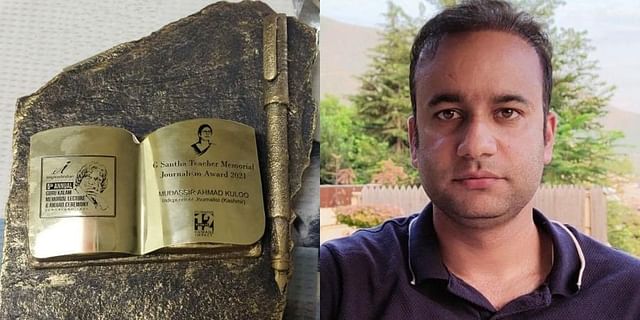
The specially-crafted stone memento made by noted mural artist MS Chandramouli that will be awarded to Mudassir Ahmad (right). (Photos | Special Arrangement)

Bengaluru :

Mudassir Ahmad Kuloo (33), an independent journalist from Kashmir, has been awarded the 5th G Santha Teacher Memorial Journalism Award instituted by the Inspired Indian Foundation (IIF), Bengaluru.

The award will be presented on November 6 in Bengaluru, during the 5th Guru Kalam Memorial Lecture, an annual national event being organised by the IIF to commemorate the birth anniversary of former President Dr APJ Abdul Kalam. The IIF spearheads several missions of Dr Kalam in association with Dr APJ Abdul Kalam International Foundation, Rameswaram.

This year the award carries a specially-crafted stone memento made by noted mural artist MS Chandramouli from Karnataka in addition to Rs 25,000 as a cash component.

The 2021 jury included aerospace and defence scientists, writers, teachers and activists in addition to the trustees of IIF. Mudassir was chosen from a list of three shortlisted Indian journalists.

Mudassir pursued his Masters in Mass Communication and Journalism from University of Kashmir and has been a Senior Correspondent with The Kashmir Monitor for six years. 

His reports have also featured in The Third PoleTRT WorldFirst PostThe TehelkaHuffPostCNBC TV and Dainik Bhaskar among others.

Ashfaq ul Hassan, Editor of The Kashmir Monitor, termed Mudassir as a dependable journalist who covers all possible angles of a story. “His honest, enthusiastic and realistic approach is highly commendable,” Ashfaq noted.

Ishtiyaq Ahmad, Editor of Kashmir Indepth, also hailed Mudassir terming him an extremely intelligent journalist who has always strived to highlight issues of human rights, gender, social justice, environment and health. “A perfect team man who has his ear to the ground” was how Ishtiyaq summed him up.

The award has been instituted in the memory of G Shantha, an English teacher hailing from Thalavadi in Kerala’s Alappuzha district. Born in 1942, she dedicated her career to instilling in her young wards an unshakeable determination to chase their dreams wherever she taught, including at Seethalakshmi Ramaswami College, Trichy, Tamil Nadu, and Devasvom Board College, Thalayolaparambu, Kerala, and Mahatma High School for Girls, Chennithala, Kerala. 

G Shanta passed away in 2007 at the age of 65. She worked selflessly to promote the English language among rural kids. She also found time to write short stories and poetry.

Rekha Satheesh, a Senior Chief Sub-Editor with The New Indian Express, Kochi, was the first recipient of the award in 2016, while Rajeev Kumar Mishra, a Chief Sub-Editor with the Bengaluru edition of Rajasthan Patrika, won the honour in 2017. 

The award went to Jugal Purohit, a Senior Broadcast Journalist with BBC India, in 2018 and in 2019 M Nanjundaswamy a Mysuru -based stringer of Kannada daily Vijay Karnataka, was the recipient.

(Mudassir can be reached at: mudasirkuloo00@gmail.com | Twitter: @MudasirKuloo)

If you have any queries w.r.t. this release, please contact the following: Madhusoodanan A: 9731065269 / Snigdha Jha: 7899778888

source: http://www.newindianexpress.com / The New Indian Express / Home> Nation / by Press Release – Madhusoodanan / November 01st, 2021

Leander Paes and Nafisa Ali join Trinamul Congress in Goa

Kolkata, WEST BENGAL :

While the names of swimmer and activist Ali and Deshprabhu had been doing the rounds, the tennis icon was a surprise for most.

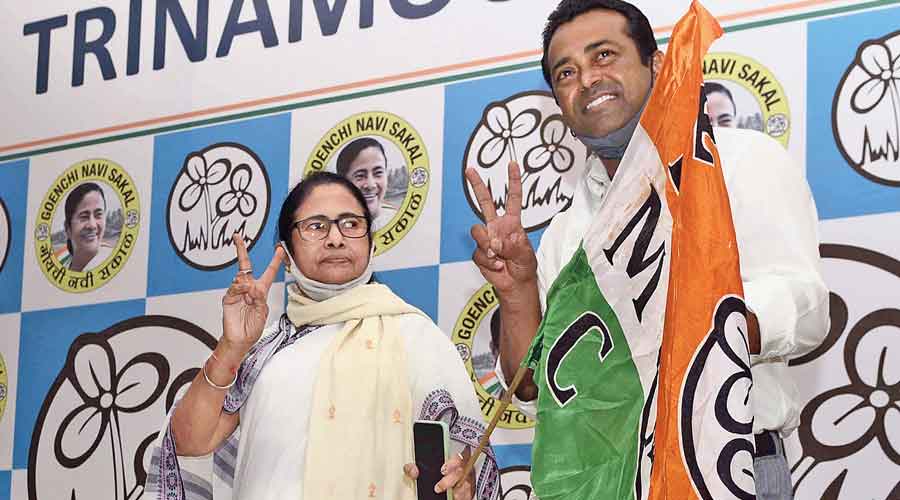
Mamata Banerjee with Leander Paes in Dona Paula, Goa / Telegraph picture

Trinamul chief Mamata Banerjee on Friday inducted celebrities such as Leander Paes and Nafisa Ali and entrepreneur Mrinalini Deshprabhu into her party for its Goa foray, which she formally launched over the course of a busy day of political and PR exercises.

While the names of swimmer and activist Ali and Deshprabhu had been doing the rounds, tennis icon Paes was a surprise for most.

“When, at the age of 14, I went to play tennis for India, Didi (Mamata) was the (junior) Union sports minister. She used to always encourage, always support…. Now, after three decades of tennis, I would like to support the lady who has been going forward with immense courage. She is a real champion to me,” said Paes, 48, a Calcutta boy and now a resident of Goa.

Regarded as one of the greatest players in doubles, he won 18 Grand Slams in men’s and mixed doubles, and a bronze for India in men’s singles at the 1996 Olympics in Atlanta.

“I would like to serve the people by means of politics. I would like to serve the youth of the nation. That is why I have joined Didi,” said Paes. “India is the world’s largest democracy. There cannot be division here on the basis of caste, creed, or religion,” he added.

Now 64, Ali was a Congress candidate against Mamata in Calcutta South in the 2004 Lok Sabha polls. She lost. Ali also had a brief stint with Samajwadi Party before returning to the Congress in 2009.

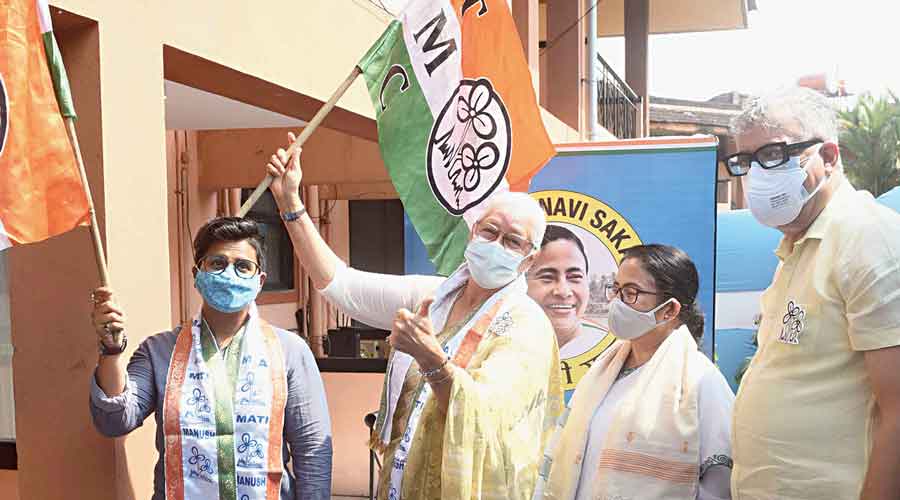
Mamata Banerjee with Nafisa Ali in Goa / Telegraph picture

“She (Mamata) is such a champion for the cause of protecting the inclusive ethos of India…. It is important, now more than ever, to close the ranks on forces that seek to divide this great nation,” said Ali, a Calcutta girl who was the national swimming champion in the early 1970s, was crowned Miss India in 1976, and went on to act in films.

Sources in Trinamul said Mamata was keen on engaging civil society members in politics in Goa, something she did successfully in Bengal.

The BJP’s Pramod Sawant-led government would seek re-election to the 40-seat Goa Assembly in  February 2022.

The principal Opposition there is the Congress, with the AAP testing waters there for some time.

Last month, Mamata inducted Goa’s former chief minister Luizinho Faleiro, with four decades in the Congress. He is now a national vice-president of Trinamul, helping it not only in Goa but also in several states of the Northeast, which he handled organisationally for the Grand Old Party.

After Faleiro came a number of political leaders from Goa, from various parties there. From the civil society, Trinamul has already managed to get the likes of poet N. Shivdas, filmmaker Tony Dias, environmentalist Rajendra Shivaji Kakodkar, footballer Denzil Franco, and boxer Lenny Da Gama.

source: http://www.telegraphindia.com / The Telegraph Online / Home> West Bengal / by Meghdeep Bhattacharrya, Calcutta / October 30th, 2021

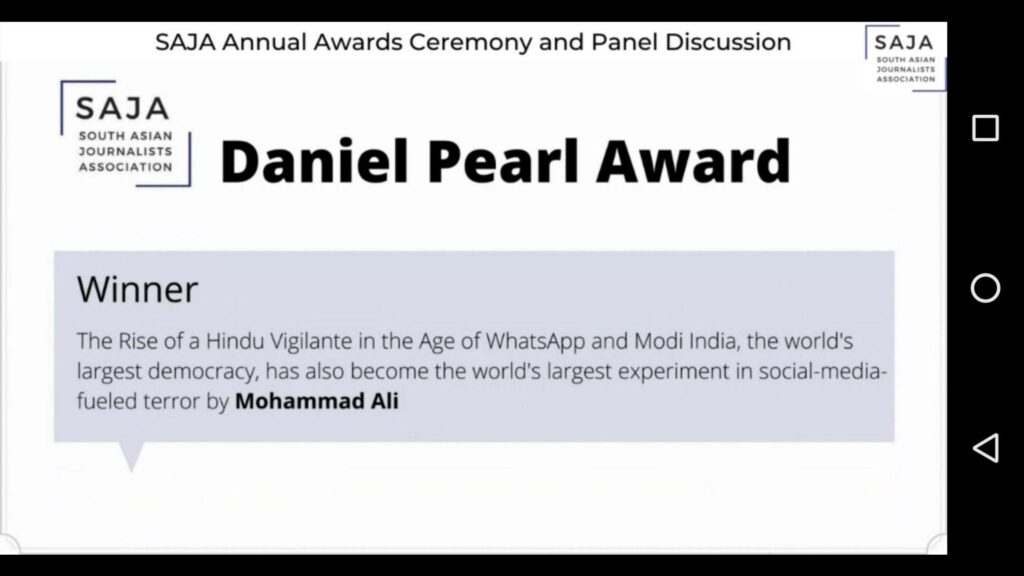
Independent journalist Mohammad Ali wins Daniel Pearl Award for Outstanding Reporting on South Asia 2021

New York, USA :

Mohammad Ali is an independent journalist based in New York.

Independent journalist Mohammad Ali was announced as the winner of this year’s Daniel Pearl Award for Outstanding Reporting on South Asia by the South Asian Journalists Association (SAJA) for his report on right-wing vigilantes’ radicalization of India’s Hindus. The past winners of the award include Pulitzer Prize winning American journalist Dexter Filkins and renowned investigative journalist Azmat Zahra. 

New Delhi : 

Independent journalist Mohammad Ali was last week announced as the winner of the Daniel Pearl Award for Outstanding Reporting on South Asia 2021 by the South Asian Journalists Association (SAJA), a journalism organization based in the U.S. and Canada. 

Ali was awarded for his investigative piece on the Hindu vigilante’s radicalization of India’s Hindu’s by “using a dangerous cocktail of social media and Hindutva.” The 10,000-word long piece titled ‘The Rise of a Hindu Vigilante in the Age of WhatsApp and Modi’ appeared in the American magazine WIRED, well known for its focus on “how emerging technologies affect culture, the economy, and politics.” The piece appeared as a cover story in May 2020 of WIRED magazine. 

Taking to micro-blogging site Twitter, Ali announced, “I am grateful to @sajahq for the Daniel Pearl Award for Outstanding Reporting on South Asia 2021 for my profile of a Hindu vigilante in @WIRED. It was an investigation into the process of radicalization of India’s Hindus using a dangerous cocktail of social media & Hindutva.”

Picture: Mohammad Ali Twitter

The Daniel Pearl Award for Outstanding Reporting on South Asia is awarded yearly by SAJA. Named after American journalist Daniel Pearl, who was killed in Pakistan in 2002, the past winners of the award include Pulitzer Prize winning journalist Dexter Filkins, and renowned investigative journalist Azmat Zahra. 

Ali said that he is elated at the award. “Besides helping my career, the award will draw more attention to the rise of Hindu extremism in India,” Ali told TwoCircles.net. 

Ali said the idea for the WIRED story on the rise of Hindu vigilante in India, especially after right-wing Bharatiya Janata Party (BJP) came to power in India in 2014, was spawned as he “didn’t like the liberal media coverage of Hindutva in India.”

Ali said for the story he spent a lot of time with the foot soldiers Hindutva, who would carry out the task of propaganda for “India’s slide towards right-wing Hindu extremism.”

“I didn’t want to demonize them (the workers of right-wing parties in India) but instead to humanize them and tell their story,” Ali said, adding, “With all being said, these workers and the work they do is historically significant as it is changing the course of India’s fate as a democracy.”

Ali’s has been reporting and writing on the rise of Hindu nationalism and violence against Muslims in India for over twelve years.

A post-graduate in literature, Ali started his journalism career with TwoCircles.net in 2008 before joining The Hindu in 2012.

“I belong to the generation of Indian Muslims who witnessed the anti-Muslim pogrom in Gujarat and became conscious of the oppression against the community,” Ali said. 

Ali said his foray into journalism came naturally as “becoming conscious of the issues facing Indian Muslims lead me to write about it.”

TwoCircles.net, Ali said, gave him a platform to write about these issues. 

“At TCN, the reportage on Muslims was a priority. It was not done before in any other mainstream publication. Working at TCN provided me with a great experience in understanding the issues facing the Muslim community in India beyond what was being written about them in the mainstream press,” Ali said. 

It was at TwoCircles.net, Ali said that he did his best stories. His series of stories on the wrongful incarceration of Mohammad Amir brought the focus on the impact of the war on terror on India’s marginalized Muslim community. 

Mohammad Amir, a resident of Azad Market in Old Delhi, was falsely charged in 20 cases of bomb blasts in and around Delhi in 1998. He was finally released in January 2012, after 14 year long wrongful incarceration.

TwoCircles.net was the first news portal to break the sad story of Aamir. 

Ali detailed the plight of Aamir and his family in a 2010 article titled ‘12 yrs in jail and counting: Story of Amir – a victim of war on terror,’ after he met briefly met Aamir by chance at Teeshazari Court in Delhi.

“Aamir’s story is the defining story of my career. The story brought focus on him and he was eventually released. I still keep in touch with him,” Ali said. 

Currently based in New York, Ali’s work has been featured in WIRED, Al Jazeera and The Hindu, among others. 

Ali said that due to threats to his life in 2017 from extremist Hindu groups he had to move to the US in 2018 when Columbia Journalism School offered him a fellowship. 

Ali has been interviewed by The NewYorker (in a piece on the lynching of Muslims in India), Al-Jazeera (The Listening Post episode on use of WhatsApp in spreading violence and propaganda in India), Harper’s Magazine (on the lynching of Muslims in India), Guardian, (on murders triggered by fake news on WhatsApp), and dozen other Indian publications.

His WIRED piece, which won him the Daniel Pearl Award, which was over a year-long investigation into the functioning of the foot soldiers of RSS, is a powerful account of “how Modi’s rise has unleashed an army of violent Hindu extremists on India’s minority communities pushing them to the possibility of second-class citizenship.” 

To report for the story, Ali spent months with workers of Bajrang Dal which is part of a larger ideological fraternity patronized by BJP and Modi. 

“The WIRED piece is one of the very few instances of reporting in American magazines on Bajrang Dal’s functioning on a day-to-day basis, and demonstrated how politics transforms a society, how hatred is created between communities in the name of ancient wounds and how it is deployed to control power in the present,” Ali said. 

Ali said that his WIRED piece documents “how the most commonplace and most humane things like eating a meal or falling in love can be politicized and turned into sources of majoritarian rage and violence against minorities.”

Ali is currently working on a book on India. 

source: http://www.twocircles.net / TwoCircles.net / Home> Lead Story / by Irfan Mehraj, TwoCirlces.net / October 29th, 2021

Auto drivers return bag with cash, mobile phone to owner

Kodagu, KARNATAKA :

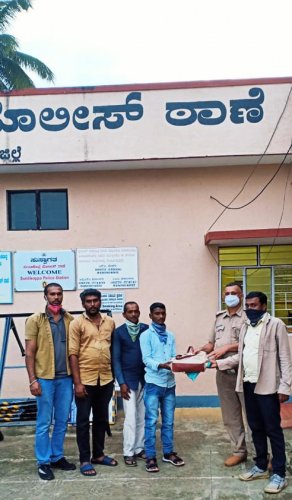
Auto drivers Sunil and Mujeeb returned a bag with cash, a mobilephone and documents to its owner at Suntikoppa in the presence of the police

Two honest auto drivers have returned a bag containing Rs 28,000 in cash, a mobile phone and documents to its owner.

Auto drivers Mujeeb and Sunil had found a bag lying on the ground at Panya Junction in Madapura. After opening the bag, they found that it had cash, documents and a mobile phone.

The duo handed the bag over to Autorickshaw Drivers and Owners’ Association president A M Shareef, who in turn handed it over to PSI Puneeth Kumar.

The police informed the owner of the bag.

It is said that plantation labourers Ravi and his wife were travelling in an auto and did not realise that their bag had fallen while they were travelling.

source: http://www.deccanherald.com / Deccan Herald / Home> State> Mangaluru / by DHNS, Suntikoppa / October 27th, 2021

Wipro’s Azim Premji donated Rs 27 crore per day in FY21, retains top giver rank

Bengaluru, KARNATAKA :

Wipro’s Azim Premji donated Rs 9,713 crore or Rs 27 crore a day to retain his top rank among Indian philanthropists in FY21.

Indian business tycoon Azim Premji
Indian business tycoon Azim Premji (Photo | PTI)

Mumbai :

Software exporter Wipro’s Azim Premji donated Rs 9,713 crore or Rs 27 crore a day to retain his top rank among Indian philanthropists in FY21.

Premji, the founder chairman of the company, increased his donation by nearly a fourth during the pandemic year, as per the Edelgive Hurun India Philanthropy List 2021, which had HCL’s Shiv Nadar at second place with contributions of Rs 1,263 crore towards upliftment causes.

Mukesh Ambani of Reliance Industries, India’s richest man by a distance, came third on the list with a Rs 577 crore contribution and was succeeded by Kumar Mangalam Birla with Rs 377 crore.

The second richest Indian Gautam Adani is eighth on the givers’ list with a donation of Rs 130 crore towards disaster relief.

Infosys co-founder Nandan Nilekani’s ranking improved to fifth with a Rs 183 crore donation with “societal thinking” being identified as the primary cause.

“At present, most of the money is going to fundamental aspects like education and healthcare because of the requirements on the ground. Nilekani has indeed made interesting contributions, and in 10 years, we will have broader civil society issues feature as primary causes,” Hurun India’s managing director and chief researcher Anas Rahman Junaid said.

He said as the age profile of the givers shifts to those under-40, and many of them being self-made ones also presents a hopeful picture.

There are a few new entrants into the list, including the largest stocks investor Rakesh Jhunjunwala, who donated a fourth of his overall earnings or Rs 50 crore in FY21 with efforts on education.

hunjunwala, who recently had a private meet with Prime Minister Narendra Modi, is among the backers of Ashoka University, as per a statement.

Brothers Nithin and Nikhil Kamath committed USD 100 million (Rs 750 crore) over the next few years to support individuals, organisations and companies working on solutions for climate change and are 35th on the list.

Former chairman of engineering major Larsen & Toubro, A M Naik, is 11th on the list with a donation of Rs 112 crore, it said, adding that he has pledged to give away 75 per cent of his income for charitable purposes.

Others in the top ten givers include the Hinduja Family, Bajaj Family, Anil Agarwal and the Burman family.

Nine women find their place in the list led by a Rs 69 crore donation by Rohini Nilekani of Rohini Nilekani Philanthropies and, followed by Leena Gandhi Tewari of USV who donated Rs 24 crore, and Anu Aga of Thermax donated Rs 20 crore.

Based on the place of residence, Mumbai led with 31 per cent of the list and was followed by New Delhi 17 per cent and Bengaluru 10 per cent.

The pharma industry has the largest number of philanthropists followed by automobile and auto components and software and services.

source: http://www.newindianexpress.com / The New Indian Express / Home> Business / by PTI / October 28th, 2021

How Rahmani 30 has made a difference in these Muslim students career

Anisabad, Patna, BIHAR :

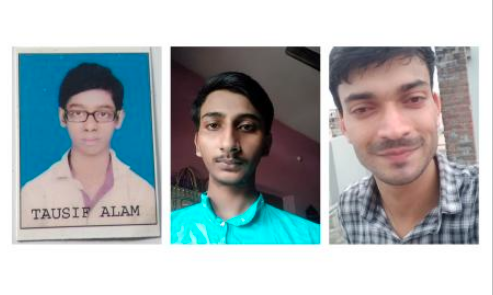
Tausif, Zuarez and Qaif have qualified for admission at India’s prestigious institutes. | Photos by arrangement

At least 65 students, including one girl, of Rahmani 30 – an educational movement for underprivileged students started in Patna, Bihar by late Wali Rahmani, have qualified for admission in the prestigious Indian Institutes of Techonlogy (IITs) this year. TCN features some of them.

Bihar :

Zaurez Ahmed (17) has secured 393rd rank this year in India’s topmost engineering entrance test known as Joint Entrance Exam (Advanced). His father Shakeel runs a modest general store in Jalwara, Kewti of Darbhanga, one of the most backward areas of Bihar. His family was in no position to afford the expensive private coaching for such exams. It was Rahmani 30 that came to his rescue. 

Like Zaurez, there are atleast 65 students, including one girl, of Rahmani 30 who have qualified for admission in the Indian Institutes of Technology (IITs) this year from the main centre at Patna. All 93 aspirants from Rahmani 30 qualified for JEE (Main). Across India, there are 23 IITs having 16000 seats for which more than 1.6 lakh applicants participated in the JEE (Advanced). These are shortlisted from one million aspirants of JEE (Main).

Rahmani 30 is modelled on Super30, the first such centre for coaching students for the IIT entrance test. Rahmani 30 was founded by the renowned Islamic scholar late Hazrat Maulana Wali Rahmani in 2008. Since 2009, Rahmani 30 boasts of more than 400 successful students who have qualified for admission in different IITs. Apart from this, nearly 1000 students have qualified for JEE (Main) and the National Institutes of Technology (NITs), the second most prestigious engineering institute of India. 

Rahmani 30 offers the top 30 students free stay, food and education which costs around Rs. 60 lakhs for two years. 

What is special about Rahmani 30?
“Apart from the low cost or no cost stay at Rahmani 30, the ever availability of teachers and mentors here is immensely helpful,” Zaurez told TwoCircles.net. 

He said that teachers at Rahmani 30 are “quite supportive.” 

Zaurez cites ‘deeni mahaul (religious atmosphere)’ at the centre as helpful in having a ‘useful break’. His EWS (Economically Weaker Section) category rank is 28 and he is quite hopeful to get Computer Science at IIT, New Delhi. 

Rahmani 30 has its branches at Aurangabad (Maharashtra), Bangalore and Hyderabad. Apart from the main centre, there is a girls unit in Patna. The main centre is being run in a rented apartment ‘Anand Palace’ at Anisabad, Patna. 

A normal day for studies starts at 7 in the morning and continues till 9 in the evening. 

Mantasha Firdous (17), who qualified this year, is the first female student of Rahmani 30 since its establishment to compete successfully for JEE (Advanced). Generally, the girl aspirants join Rahmani 30 for the medical entrance test NEET. However, Mantasha has a knack for mathematics. She has secured an EWS rank of 4074 and hopes to get “a good branch at a good IIT’. She said that the “group of girls” at the centre was quite helpful for her to remain focused on studies. 

At Rahmani 30, the aspirants are admitted for a two-year residential course. As Covid-19 hit their preparation, an online mode was learning was started in 2020. Most students attended online classes on mobile phones though there were network issues for those residing in remote areas. 

Tausif Alamhas (17) secured CRL (Common Rank List) 7169 and a category rank of 1339. His father Mohammad Rashid works as a tailor and his mother is a homemaker. His family could not send him to study at any coaching centre as they charged a hefty fee. He came to know about Rahmani 30 from one of his senior and passed the test to get admission. 

Talking to TwoCircles.net, he said the most helping part of Rahmani 30 is “group study where peers help in doubt clearing.”

“My motivation level only rose with the continuous encouragement from the teachers. It helped increase my willpower too,” Tausif said. His next aim is to crack the country’s top exam for civil services U.P.S.C. 

Seventeen-year-old Qais Alam’s success has a twist. His father is a small farmer and suffers from poor eyesight. Qais hails from Marar, a remote village in the Khagaria district of Bihar. He didn’t have much of an idea about IITs. He appeared for Aligarh Muslim University’s entrance test for a three-year Engineering diploma course and qualified. He studied there for two years, and quit before completing his degree. This was during 2016-17. He came to know about Rahmani 30 and was selected for its two-year preparation course. He appeared for JEE (Advanced) in 2020 in his first attempt but was not satisfied with his result. He reappeared for JEE again in 2021. He bettered his All India Ranking to 6025 from his 2020’s performance of 28000th rank. His EWS rank also improved to 639 from above 3000. He is hoping to get admission at IIT Delhi or IIT Madras. He too aims to clear U.P.S.C. after graduation from the IIT.

Twenty-three-year old Atif Hussain is in his 3rd year at IIT Guwahati. He originally hails from Bihar but his family is settled in Kolkata, West Bengal. Atif’s father Phool Mohammad sells Lahti bangles (lac bangles) which and his business has been hit due to Covid-19 lockdown. His mother is a housemaker. Atif studied in Urdu medium Howrah High School and got 84% marks in his 10th Board examination. He came to know about Rahmani 30 from a senior. He said that getting admission in Rahmani 30 was the ‘turning point’ of his life. “Teaching guidance and peer study environment at Rahmani 30 was very useful,” Atif, who is fond of research and coding, said. 

Though Rahmani 30 was started for helping underprivileged students crack the IIT entrance test, it has ventured into other top examinations like Medical, Commerce and Law. In its CA/CS program, out of 10 successful candidates this year, five were girls. 

Rahmani 30 calls itself “a movement, not an institution” which hankers “to demonstrate that economically, socially and educationally backwards and suppressed students when given the opportunity rise to the occasion.” It is “established to be the catalyst for inspiring the minorities to aim high to seek their rightful places.” 

Rahmani 30’s founder late Maulana Rahmani had a clear vision about this centre. He was of the opinion that, “Utmost service to the religion during these times is to educate our youth and upcoming generations with contemporary subjects while keeping their faith firmly established and their self-confidence high; so that, they excel in religion, are adorned with education, have an appreciation of hard work and therefore are able to navigate and make confident decisions in their life.”

Bihar’s former Director General of Police (DGP) Abhayanand has been a great help for Rahmani 30 as a mentor since its beginning. Known for his Physics teaching skills, Abhayanand is credited with starting super 30 along with Anand Kumar, to teach poor students of Bihar to crack IIT JEE. 

Talking to TwoCircles.net, Abhayanad was delighted that Rahmani 30 is expanding in size and dimension in the right direction. 

Late Maulana Wali Rahmani had approached him to be the mentor of this centre and he readily accepted the proposal. “There didn’t exist a good trend for education in Muslim community, particularly in the weaker sections. I thought it would be in the broader interest of the country to help such students,” Abhayanand said. 

His only and interesting condition was, “I will not interfere in the administration of the centre and Maulana will not interfere in teaching at the centre.” 

Maulana Fahad Rahmani, the younger son of late Maulana Wali Rahmani is the current CEO of Rahmani 30. 

He told TwoCircles.net that Rahmani 30 initially started with 10 students and “in 12 years the number of students has gone up to 900.” 

Maulana Fahad aims to increase the number to 15000 across India at the end of this decade. “If we consider the total number of institutions of national importance to be one lakh, its corresponding number for the Muslim community should be 15 % of it, which is roughly the population of the community in India,” he argues, adding, “To achieve this goal the community support needs to be increased. If we can arrange one donor for one student we will need 15000 donors, which is not beyond reach.” 

Maulana Fahad insists that he doesn’t believe in the traditional fund collection. 

On the success rate of girl students of Rahmani 30, Maulana Fahad said that it was his father and the late chairman Maulana Wali’s wish to see the girl students excel in engineering too. “Alhamdulillah, this year it has started, and it get better in the coming years.”

Sami Ahmad is a freelance journalist based in Patna, Bihar. He tweets at @samipkb

source: http://www.twocircles.net / TwoCircles.net / Home> Lead Story / by Sami Ahmad, TwoCircles.net / October 23rd, 2021

Six daughters and all of them doctors: A heart-warming story from Kerala’s Kozhikode

Nadapuram (Kozhikode District) , KERALA :

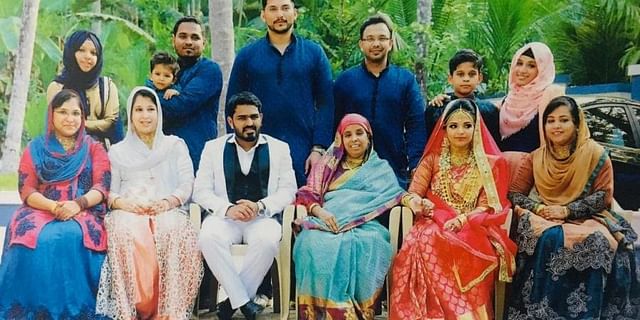
Interestingly, the spouses of Fathima, Hajra, Ayesha, and Faiza are also doctors. Kumhamed Kutty and his wife were also against dowry.

Zaina (third from right) flanked by her doctor family. (Photo | Special Arrangement)

Sometimes fact is stranger than fiction. This is true in the case of Ahamed Kunhamed Kutty and his wife Zaina Ahmed of Nadapuram in Kozhikode district of Kerala.

When Zaina Ahamed gave birth to six daughters, Ahamed and his wife didn’t despair. Rather they were happy. Ahamed was a progressive thinker. He envisioned a life for his daughters in which they would serve society better and be role models for others. 

His wish did not take long to turn into reality. All the six daughters of the couple did well in their studies and would go on to be doctors. Wait, we are getting ahead of ourselves.

Four daughters namely, Fathima Ahamed 39, Hajra Ahamed 33,  Ayesha Ahamed 30, and Faiza Ahamed are already practicing doctors. Raihana Ahamed 23 is doing her final year MBBS in Chennai while the youngest Ameera Ahamed is in the first year of her MBBS course in Mangalore.

Interestingly, the spouses of Fathima, Hajra, Ayesha, and Faiza, namely, Dr Rishad Rasheed, Dr Ajnas Mohammed Ali, Dr Abdurahman Padiyath Manapat, and Dr Ajas Haroon respectively are also doctors.

Zaina was only 12 years old when she was married off to her cousin Ahamed. At the time, he was running a business in Chennai. After the birth of their first daughter, Ahamed went to Qatar with his wife and daughter where he was employed in a refinery. 

Hajra, who did a BDS course while all the others opted for MBBS, recalls the evenings in Qatar when their parents used to infuse them with the importance of doing well in their studies and serving society.

Once they returned from school, there used to be a family gathering when their parents chatted with their daughters about several things, particularly their studies and future.

Ahamed Kunhamed Kutty and his wife Zaina Ahmed

My Uppa liked medicine. When he couldn’t become a doctor he dreamt of making his brother a doctor. But his brother went on to become a teacher and he’s known as Soofi teacher in our place,” Hajra said.

So, naturally, Ahamed wished that one of his daughters would fulfill his dreams. Fathima opted for MBBS and she took to the course like a duck to water. The positive feedback from Fathima inspired her other sisters also to go in for medicine. Behind it, all was the advice of their parents. 

In fact, one of the sisters, Ayesha was interested in doing law. But her parents told her she can pursue it after completing her MBBS course.

Similarly, when it came to the marriage of their daughters, Ahamed and his wife were specific that their daughters should marry someone from the same profession so that it would help the young couple understand each other better. They were also against the practice of dowry. They didn’t want to “sell off” their daughters but marry them off to a person who understood and loved them. 

After working in Qatar for nearly 35 years, the couple with their daughters returned to Kerala. About two years later, Ahamed suffered chest pain and passed away. At the time, only two of the daughters were married off. Thereafter, Zaina encouraged and inspired her daughters to pursue their courses and married off two other daughters.

Fathima is presently working in a military hospital in Abu Dhabi. Hajra said she had returned from abroad and is planning to do her PG course.

Ayesha is serving in a hospital in Kodungallur while Faiza and her husband work in Kochi.

This story would read like a dream. But, as they say, Rome was not built in a day. The six women doctors and their mother would testify. 

The sisters don’t have a photograph taken together with their Uppa. They carry an image of him in their hearts. 

source: http://www.newindianexpress.com / The New Indian Express / Home> Good News / by Gladwin Emmanuel, Online Desk / October 20th, 2021