Category Archives: Amazing Feats

Dr. Ahamed Irshad: Developing Hydrogen Fuel and High Energy Batteries For Green Vehicles

Kerala, INDIA / Los Angeles, USA :
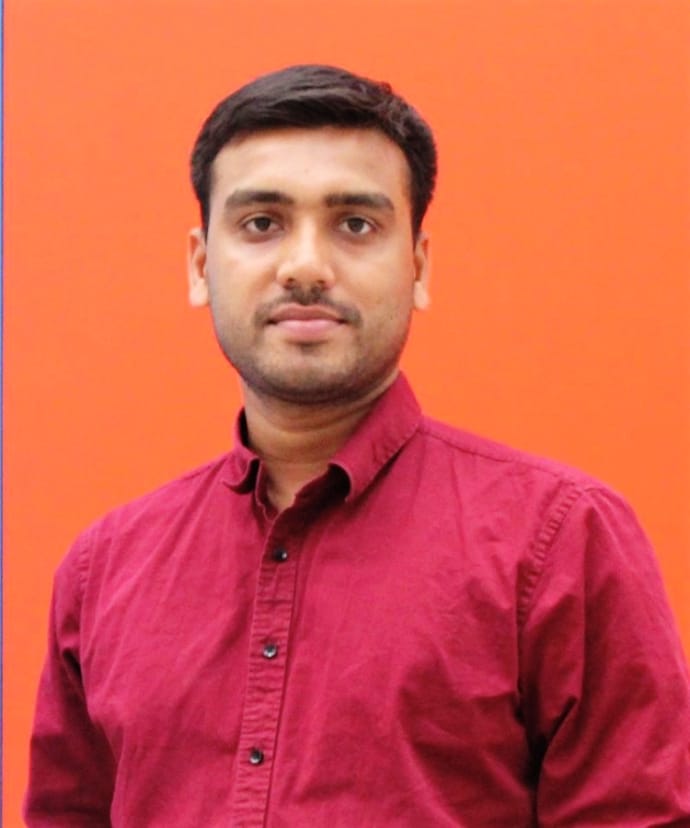
Dr. Ahamed Irshad.

This is the fifth part of the series called `Scientist Says’ where we bring for our readers the significant and commendable research works of young scientists.

Dr. Ahamed Irshad is a research associate in the department of chemistry, University of Southern California, Los Angeles. He has been associated with National Science Foundation, US Army, and Department of Energy on various battery projects. He has authored several articles in international journals published by American Chemical Society, Royal Society of Chemistry and Electrochemical Society. He served as the topic editor for Journal of Energy and Power Technology, and reviewer for international journals. He is also a recipient of Cottrell scholar award, Bristol-Myers-Squibb fellowship, Dr. J. C. Gosh medal, and Indian Academy of Science award. He shares some of his significant research works with Rashida Bakait of India Tomorrow.

Q. Please briefly explain your research.

Ans: My research interest is on developing novel materials for electrochemical energy conversion and storage devices. The research area can be broadly classified into two: (i) hydrogen fuel production from water and (ii) high energy batteries for electric vehicles.

The first project on hydrogen fuel was carried out during my PhD at Indian Institute of Science, Bangalore. Hydrogen is considered as a fuel for the future. While burning petrol or diesel release huge amount of greenhouse gases, the only by-product of hydrogen fuel is water. Currently, hydrogen is produced from methane by steam-methane reforming. This method also produces CO2 and hence cannot be counted as a green method. My research topic was on utilizing carbon free, inexpensive, and abundant water (H2O) molecules as the hydrogen source and use electricity to split water. The process requires energy close to 237 kJ mol-1 or theoretical voltage of 1.23 V. However, practical voltage is as high as  1.8-2 V due to sluggish kinetics. This limits the efficiency to 65-70 % and necessitates expensive catalysts such as IrO2 or RuO2. My research goal was to design and develop highly active, low-cost, and stable cobalt and nickel-based catalysts to improve the efficiency. The use of inexpensive catalysts would also reduce the overall cost and make hydrogen an attractive fuel.

The battery research was done in collaboration with US Army and Department of Energy at University of Southern California, Los Angeles. There is a growing demand for high energy batteries for electric vehicles. Current lithium-ion battery (LIB) technology has limited range (200-300 miles) and high cost of $130/kWh. In addition, LIBs use toxic cobalt-based materials. In recent years, lithium sulfur (Li-S) batteries have emerged as a promising substitute to LIBs due to its five times high energy density.  In addition, sulfur is earth abundant and less expensive. Commercialization of Li-S batteries is still hindered by its inability to charge/discharge quickly for several cycles. This has been attributed to high internal resistance and dissolution of soluble polysulfides. We proposed an electrode design with different carbons to reduce the resistance and developed an interlayer to improve the cyclability.

Q. What was the objective of your research?

Ans: Although water electrolysis is used to produce high purity hydrogen, its widespread deployment is impeded by the high cost. My goal was to develop cost-effective and robust catalysts based on nickel and cobalt instead of expensive platinum (Pt), ruthenium (Ru), and iridium (Ir) . I also wanted to investigate the key factors that affect the stability and activity. Similarly, Li-S battery technology has a high potential to replace LIBs(Lithium batteries). My primary objective was to identify the fundamental origin of the high internal resistance in Li-S batteries using a technique called electrochemical impedance spectroscopy. It was also intended to develop an advanced electrode structure to reduce the resistance that would allow to charge and discharge battery fast. Then again, we proposed a novel interlayer to stop soluble polysulfides diffusing from cathode to anode.

Q. What were the new findings of your research?

Ans: We prepared a series of novel materials such as cobalt-phosphate, cobalt-acetate, manganese-phosphate, etc. for water electrolysis. Our electrochemical quartz crystal microbalance studies suggested that the cobalt-phosphate catalysts are not stable at high voltage. In addition, the catalyst deposition was slow due to poor solubility of Co2+ in phosphate. We proposed the catalyst preparation from an acetate solution because the solubility of Co2+ in acetate is high and a large quantity of materials can be prepared in a short time. Cobalt-acetate also exhibited higher activity than cobalt-phosphate. In the case of Li-S battery, we used electrochemical impedance spectroscopy to probe the internal resistance. Our studies indicated that the high resistance originate from poor interparticle contact and sluggish battery reaction kinetics. When we added high surface area carbon, battery performed much better than before due to improved interparticle contact and high number of reaction sites. Adding an interlayer between electrodes stopped diffusion of soluble polysulfides. As a result of advanced cathode design and additional layer, our Li-S battery could be charged and discharged quickly for several cycles.

Q. What kind of challenges did you face?

Ans: The ideal catalyst should have high activity, stability, and preferably made of earth abundant, inexpensive, and non-toxic materials. It was a great challenge to incorporate all the features in a single material. For instance, cobalt-phosphate was very active but not stable. Low-cost manganese-phosphate didn’t show any catalytic activity or stability whereas highly expensive iridium-phosphate exhibited highest activity. Among all the materials tested, we identified cobalt-acetate as the most promising catalyst that showed high activity, stability, and relatively low cost. In the case of Li-S (Lithium-Sulfur) battery testing, identifying the key factors affecting the battery performance was a bit challenging. Impedance spectroscopy aided us to isolate a few factors that affected battery performance significantly. Fabrication of electrodes with different compositions and optimizing the electrode design was a herculean task.

Q. Any scholarship or award for research.

Ans: The battery project was financially supported by various federal and private agencies such as National Science Foundation, US Army, Department of Energy, and a battery startup called STAQ Energy. I was awarded the prestigious Cottrell award by the US National Science Foundation (NSF) and Research Corporation in 2020. I am also a recipient of Dr. J. C. Gosh gold medal in Physical Chemistry and Bristol-Myers-Squibb fellowship. The Council of Scientific and Industrial Research (CSIR), India, provided me fellowship for five years during my PhD. I also received Indian Academy of Science fellowship.

Q. How do you think your research would be beneficial to the society or industry?

Ans: There is a gradual increase in the CO2 and other greenhouse gases in the atmosphere. The transport sector contributes almost 30 % of the greenhouse gases. Moreover, the petrol and diesel price keep increasing every day, and these fuels will run out soon. It is the time to look for clean fuel like hydrogen. My research findings on low-cost catalysts will reduce the hydrogen fuel price and improve the efficiency of electrolyzer. It is also possible to interface the electrolyzer with solar panel or wind turbine to store renewable energy. Similarly, high energy batteries are essential for electric vehicles and portable applications. Our results on Li-S batteries will advance the battery technology beyond lithium-ion battery and reduce the weight and cost of car batteries. The use of high energy batteries will increase the driving range as well. These batteries will be useful for drones and other aerial vehicles also.

Q. When did you begin and complete your research? 

Ans: I have been doing battery research since I joined USC in 2017. My PhD started in 2011 and I submitted thesis in 2016. During five years of PhD, I entirely focused on developing catalyst for hydrogen production.

Q. Any other new research you are working on now?

Ans: Currently, I am investigating materials for fluoride-ion battery. In this case, the negatively charged fluoride ions are the charge carriers instead of positively charged lithium ions in lithium-ion battery. This is a new concept that has not been well explored. Another project is on alkaline batteries that are suitable for large scale stationary energy storage. I also continue to work on Li-S batteries for electric vehicles.

Q. How do you think your research can be carried forward further?

Ans: We have an extensive collaboration with scientists and research groups across the world. Currently, we are trying to utilize the technology and skills from different groups to understand the detailed molecular and crystal structure of the catalyst. This would allow us to establish structure-property relationship in these catalysts and investigate the fundamental reaction mechanism. We also communicated with battery companies and federal agencies to examine the feasibility of commercialization of our battery technology.

Q. Tips and suggestions for the budding scientists.

Ans: Career as a scientist is challenging yet a very rewarding experience. To be successful, you need to nurture scientific curiosity, creativity, deep passion, and perseverance. Always make sure that you learn the basic concepts thoroughly and keep yourself updated with scientific literature. Use the early years’ research career to learn as many techniques as possible that will help to tackle many scientific problems in future. Don’t hesitate to expose yourself to different ways of thinking by discussing ideas with peers, gaining experience in different research groups, and creating a network of friends. Communication is also important. You should learn to give presentations and write papers to share your research outputs with others. Just like in any other career, life as a scientist will have many ups and downs, but it’s your choice to scream or enjoy the journey.

source:http://www.indiatomorrow.net / India Tomorrow / Home> Education> Featured / by Rashida Bakait, IndiaTomorrow.net / April 16th, 2021
Razia Sultana first Muslim female to become DSP in Bihar

Gopalganj District, BIHAR :

Besides Razia Sultana, 03 other Muslims have also qualified the coveted exam to become Deputy Superintendent of Police (DSP) in Bihar Police

Patna: 

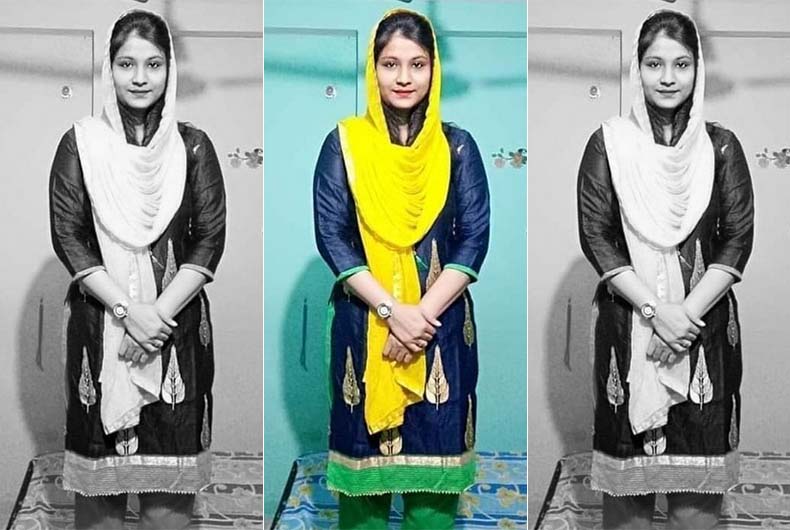
Razia Sultana has become the first Muslim female from Bihar to become Deputy Superintendent of Police (DSP) in the state police department.

Razia Sultana, 27, cracked the Bihar Public Service Commission (BPSC) 64th Combined Competitive Exam (CCE) in her first attempt and was recommended for the post of Deputy Superintendent of Police (DSP).

Raziya Sultana originally hails from Gopalganj district of Bihar. Daughter of Mohammad Aslam Ansari, a stenographer at Bokaro Steel Plant who died in 2016, Razia Sultana completed her education from Bokaro in Jharkhand and Rajasthan.

A total of 1,454 candidates have qualified Bihar Public Service Commission (BPSC) 64th Combined Competitive Exam (CCE) result of which was declared on Sunday June 6, 2021.

“04 Muslims become DSP”

Of them a total of 28 candidates have been selected for Bihar Administrative Service, 40 for Bihar Police Service, 10 for Bihar Finance Service (Commercial Tax Officer), 02 for Jail Superintendent and 8 for Sub Registrar/Joint Sub Registrar.

Besides Raziya Sultana, 03 other Muslims have also qualified the coveted exam to become Deputy Superintendent of Police (DSP) in Bihar Police. They are: Mohammed Adil Belal, Faisal Raza and Mohammad Shahnawaz Akhtar.

“No Gender Discrimination”

While preparing for the Bihar Public Service Commission (BPSC) exam, Razia Sultana was working as Assistant Engineer at local electricity department.

Razia had passed the 12th board exams from Bokaro and later graduated from Jodhpur in Rajasthan and earned a degree in Electrical Engineering.

“Besides other things, there was no gender discrimination vis-à-vis education and learning in my family. This is why my mother had no objection when I got admission in a Jodhpur college to complete my graduation”, Razia said while sharing her success mantra.

source: http://www.ummid.com / Ummid.com / Home> India> Education & Career / by ummid.com News Network / June 09th, 2021

This biography of Agha Shahid Ali reads his life and his poetry together to join the dots

JAMMU & KASHMIR / NEW DELHI / U.S.A :

An excerpt from ‘A Map of Longings’, by Manan Kapoor.

Agha Shahid Ali.

In Delhi, Shahid also became aware of the city’s Mughal and colonial history, and was impressed by its architecture. In the early ’60s, the Mexican poet Octavio Paz had visited New Delhi and had been charmed by its architecture. He wrote numerous poems about the city and about all that he had witnessed here. He found Delhi’s “aesthetic equivalent” in “novels, not in architecture”, and to him, wandering the city was “like passing through the pages of Victor Hugo, Walter Scott, or Alexandre Dumas”.

Paz’s gaze, wherever he went, was directed inwards. For him, all the experiences, including the splendour of the Mughal architecture that attracted him, were revelatory and enlightening in one way or the other. In his book In Light of India, he called Delhi’s architecture “an assemblage of images more than buildings”. It was quite the same for Shahid who, after nineteen years, had returned to the city of his birth.

He was a student at Delhi University, which wasn’t too far from Old Delhi or what was once known as Shahjahanabad, the walled city of Delhi constructed by Shah Jahan – the emperor who “knew the depth of stones, / how they turn smooth rubbed on a heart. / And then? Imprisoned / with no consoling ghosts…”

The tomb of Amir Khusro at Hazrat Nizamuddin in Delhi was a place that had attracted Paz. In “The Tomb of Amir Khusro”, he wrote: “Amir Khusru, parrot or mockingbird: / the two halves of each moment, muddy sorrow, voice of light. / Syllables, wandering fires, vagabond architectures.”

The tomb attracted Shahid as well when he visited the dargah in Delhi almost a decade later: “I come here to sing Khusro’s songs. / I burn to the end of the lit essence… / The muezzin interrupts the dawn, calls / the faithful to the prayer with a monster-cry: / We walk through the streets calligraphed with blood.”

In Delhi, Shahid found poetry at each turn. In an interview with First City in 1991, he said: “For me the lanes of Delhi, particularly the ones leading to and from the Jama Masjid, hold a dazzling value. When I used to go to Kareem restaurant or was having nihari or kulfi on the steps of Jama Masjid, I used to imagine that I was living in the days of Ghalib.”

Unlike Paz, who as an outsider in Delhi could only adore the architecture, Shahid also saw history in the city. Although he had been exposed to the historical forces that had shaped Kashmir, it was in Delhi that he discovered, for the first time, history in brick walls, minarets and on the streets. In “The Walled City: Seven Poems on Delhi”, he wrote about Jama Masjid:

Imagine: Once there was nothing here.
Now look how minarets camouflage the sunset.Do you hear the call to prayer?
It leaves me unwinding scrolls of legend
till I reach the first brick they brought here.
How the prayers rose, brick by brick?

Shahid’s poetic concerns were largely a constant for most of his life, and are palpable in these early poems. His engagement with history, which he deals with as both an insider and outsider, reflects his tenderness and the experience of a poet who belongs to multiple worlds and none at the same time.

For the next three decades, he wrote about loss and the memory of loss, the burden of history and injustices of all kinds. The seeds of these poetic concerns were sown during his childhood, mostly at home. However, they were nourished in Delhi, by the city’s air and its history, which Shahid couldn’t ignore.

In the poems from Bone Sculpture and In Memory of Begum Akhtar, Shahid emerges as a poet who feels deeply about South Asian culture as well as politics. Both the collections are influenced by Delhi and reflect an understanding of history. From a very young age, he was aware of the historical movements, the revolutions and leaders who had shaped the world he lived in.

In time, he established his position as a poet of witness with the publication of his poem “After Seeing Kozintsev’s King Lear in Delhi”, which talks about the last Mughal emperor Bahadur Shah Zafar. In the poem, Shahid makes a conscious choice as he turns from King Lear and looks at Zafar, turning away from fiction towards fact, from the stories of the colonisers to the histories of the colonised.

This turn marks an important moment in Shahid’s poetry, and it is from here that his poems and sensibility come to be defined by a certain post-colonial outlook, where he sheds light on those whom history had ignored:

I think of Zafar, poet and Emperor,
being led through this street
by British soldiers, his feet in chains,
to watch his sons hanged.

In exile he wrote:
“Unfortunate Zafar
spent half his life in hope,
the other half waiting.
He begs for two yards of Delhi for burial.”

He was exiled to Burma, buried in Rangoon.

In the late ’60s, when Shahid joined Hindu College, the syllabus was still under a colonial shadow and predominantly included English writers like John Milton, Shakespeare, Thomas Hardy and the Romantic poets. Although he had read all their works and admired most of them, Shahid’s language was very different from the poets that were taught to him.

Shahid once said that he was often aware that the music of his language was different, that he was able to bring certain flavours to English poetry in India for the first time, which he believed was a result of the combination of Hindu, Muslim and Western cultures in him, and the fact that he had a “natural and profound inwardness with them”.

His use of these cultures was not exotic – unlike, say, Eliot importing the word “shantih” in “The Waste Land”. Shahid felt them in three languages and didn’t have to “hunt” for subjects. In an essay written much later, he reflected on English poetry in India and said that Satyajit Ray had accomplished what he had because Ray was using a specifically Indian idiom for the first time on celluloid.

“I can use the Indian landscape, and the subcontinent’s myths and legends and history from within, and I can do so for the first time in what might seem like a new idiom, a new language – subcontinental English.”

Salman Rushdie’s case was similar. Ray, Rushdie (as well as Shahid when it came to English subcontinental poetry) had an abundance of history, tradition and what seemed like an endless river of subjects that they could explore. Shahid had, in fact, acknowledged that if the novel had done it, poetry couldn’t be far behind.

Little did he know that along with poets like Arun Kolatkar and AK Ramanujan, he would become a proponent of English writing in the Indian subcontinent, a poet who had tradition and the flavour of the soil in his bones. In an essay written much later, he reflected on how the English language was changing in the subcontinent:

The colonisers left fifty years ago, and subcontinental writers, particularly poets, can breathe greater confidence into Indian English (as Walt Whitman did into American English) not only because they belong to what, with qualifications, is the international-ism of the English language (in this context, note the awarding of the Nobel Prize to Patrick White, Wole Soyinka, Nadine Gordimer, and Derek Walcott) but because, by re-creating the language, by infusing into it all the traditions and forms at their command, they can make subcontinentals feel that they do not have to seek approval for any idiosyncrasy in syntax and grammar from the queens, Victoria or Elizabeth (the second, of course). As a matter of fact, for all kinds of reasons, it is gratifying to give an insult to the English language.

By the ’60s and ’70s, some young Indian English poets had started emerging on the literary scene, much of which had to do with Purushottama Lal, the founder of Writers’ Workshop, Calcutta. The publishing house started by Lal, which operated out of the library of his residence in Calcutta, had turned into a platform for publishing Indian writing in English. It published the first works of such poets as Nissim Ezekiel, Vikram Seth, Ruskin Bond and AK Ramanujan. Lal also published Shahid’s first two collections of poetry, Bone Sculpture and In Memory of Begum Akhtar.

Yet, in the ’90s, Shahid wrote in an essay that the “Indo-English scene” during those decades was “thoroughly empty and corrupt” and that “in some quarters” it continued to remain the same, singling out Lal’s publishing house, which he said had been functioning as a near vanity press.

In his essay “Indian Poetry in English”, Shahid wrote, “Educated Indians generally speak three languages, write in two, and dream in one – English.” Although they were written in English at a time when the chutnification, or what he called the biriyanisation, of the language hadn’t taken place, Shahid’s poems were indeed very Indian in nature and in terms of the subjects they dealt with.

The English language came to him naturally, while his ideas were deeply rooted in the culture of the subcontinent. Shahid’s English wasn’t the Queen’s “propah” English but a product of the biriyanisation of the language. Although as a poet he was slowly learning, poems like “Bones”, “Introducing”, “The Walled City” and others not only marked the beginning of a poetic career but also a poetic style that was steeped in a sense of loss, language and the history of the subcontinent. When at last, in the late ’60s, he met Begum Akhtar, his appreciation for the traditions of the subcontinent grew and his poetry changed in unimaginable ways.

A Map of Longings: The Life and Works of Agha Shahid Ali

Excerpted with permission from A Map of Longings: The Life and Works of Agha Shahid Ali, Manan Kapoor, Vintage.

source: http://www.scroll.in / Scroll.in / Home> Book Excerpt / by Manan Kapoor / June 03rd, 2021

Meet Sofia Khan: Covid Warrior of West Bengal

WEST BENGAL :

Kolkata :

The world is in chaos. The pandemic happened when none of us were expecting it. It has been one of the most disastrous and depressing things throughout history. It wasn’t in our plans, but it happened. People have lost their jobs and their loved ones. Moreover, people are losing their will to live. The lower class of society is struggling. They are even lacking the necessities needed to survive. However, the pandemic has given rise to people who have come forward to help poor, needy, and unarmed people to fight the pandemic. These people are the warriors of the nation and Sofia Khan is one such warrior.

Sofia Khan cleared School Service Commission in 2009 and was the topper of her zone as well. Then, she was appointed as a government school teacher. However, she is also a social activist, chairman, and founder of the ‘Sufi Humanity Foundation,’ a no cash or fund transfer NGO. She is a very active participant in the improvement of our society. She has been given the post of secretary in the NGO named ‘Udaan Empowering Women’ in the year 2016 and then in the Rotary Club of Kolkata in 2018. Her performance was remarkable in the two organisations. She then joined the TMC Minority Cell, West Bengal, as a general secretary.

Sofia Khan has organized various literacy awareness campaigns in different states of the country as she is the president of the Sarparast Literacy Awareness Movement in West Bengal. She has also participated in many debates in national media as a panelist from the TMC. She conducted campaigns and rallies for TMC during the 2021 West Bengal elections. She has continuously been a keen supporter of girls, always ready to support and empower them. She helped the girls of the Milli Al-Ameen College for Girls by joining their protest against injustice to the college students. These girls were not being allowed to sit for their exams due to the college’s internal disputes. Sofia fought for them and got them justice.

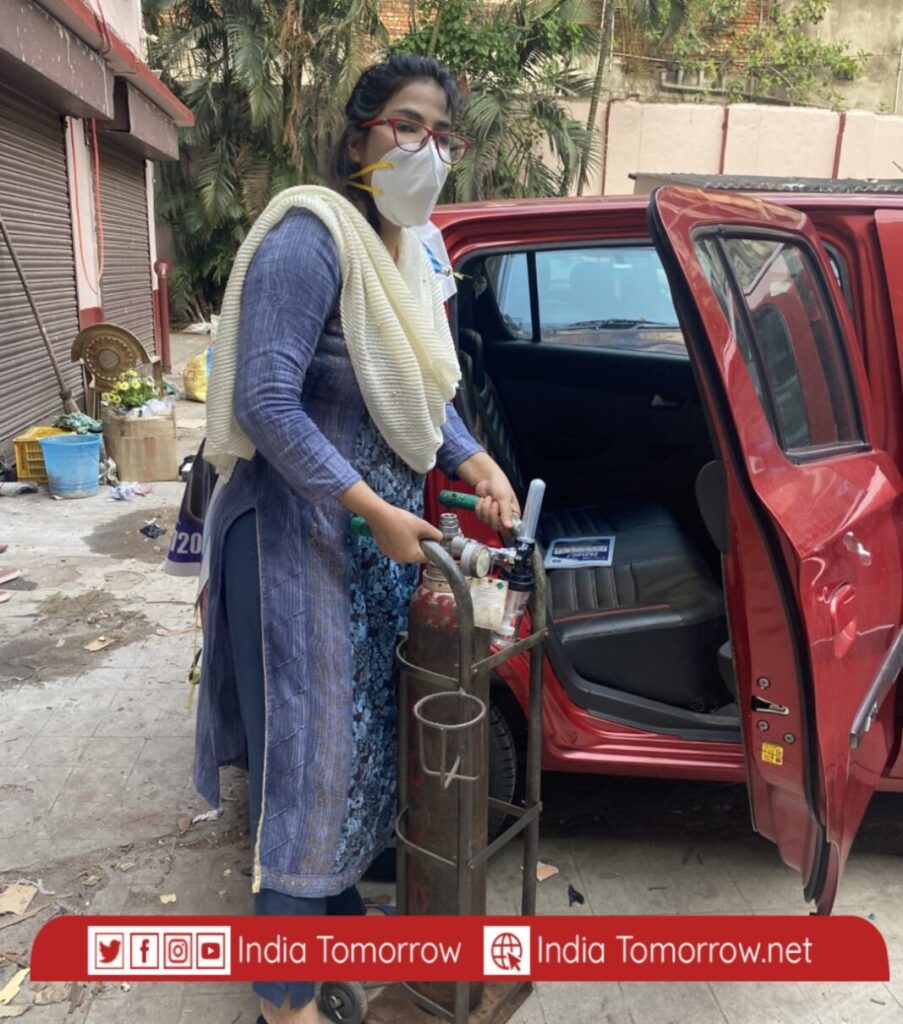
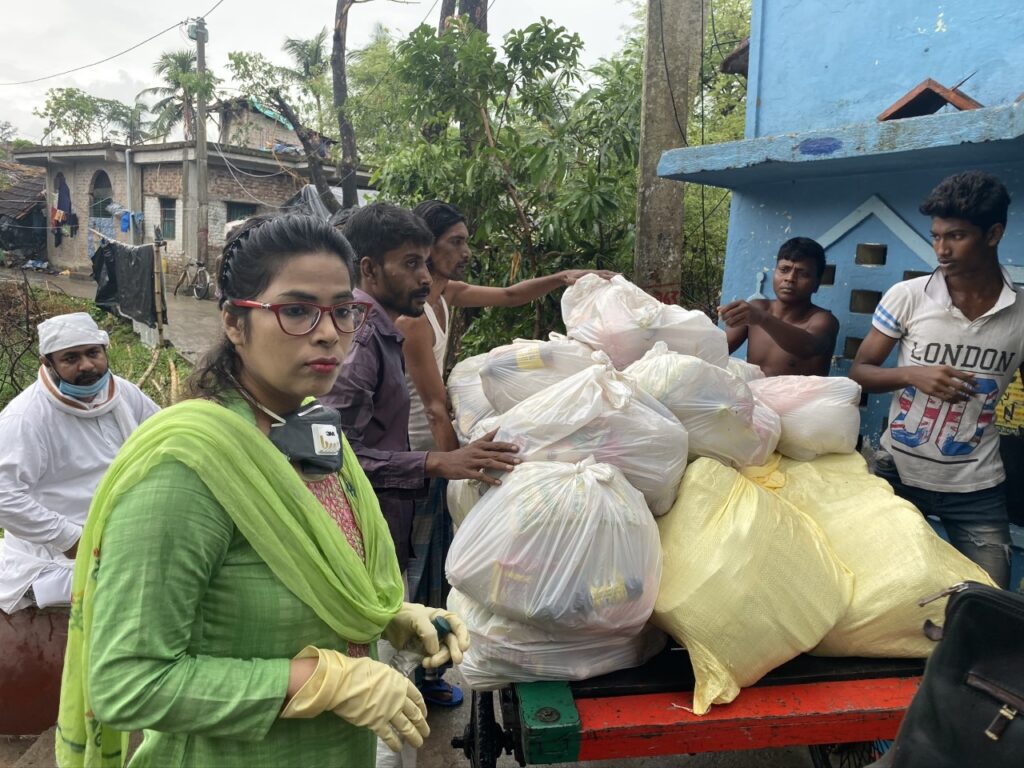
It’s commendable and worth mentioning how she did not waver from her motive of helping the people even in lockdown. Sofia Khan has helped many people by providing them food amidst the lockdown. She sent back numerous migrant labourers to their native places during the first phase of the lockdown in 2020. This year when second wave was on its peak and people were dying without oxygen she was there to help people across West Bengal with free oxygen cylinders. She later extended the help and converted four cars into free ambulance service with oxygen cylinders for Covid patients.  When the state was hit by a deadly tropical cyclone called the ‘Amphan’, Sofia Khan, along with her team distributed tarpaulins and ration to almost a thousand families. She also showed her support during the Yaas cyclone. She sent relief materials like biscuits, cakes, drinking water containers each of 20 litres, clothes, etc. to the affected families. Her works and contributions have also been recognized by the Sanmarg Hindi daily, Echo of India, Awami News, etc.

Life has been tougher than usual for all of us but that doesn’t stop some of us from being an inspiration to others. While our nation and the world are fighting against the pandemic, it is important that we stay alert and be responsible for each other. We need to support and help those who are unable to survive on their own. Warriors like Sofia Khan do not wait for a chance rather they create the opportunity to help others because they realize that ‘Warriors are not born, but self-made’.

(The author of the article is a freelance journalist).

source: http://www.indiatomorrow.net / India Tomorrow / Home> Featured> National Interest / by Meer Faisal / June 18th, 2021

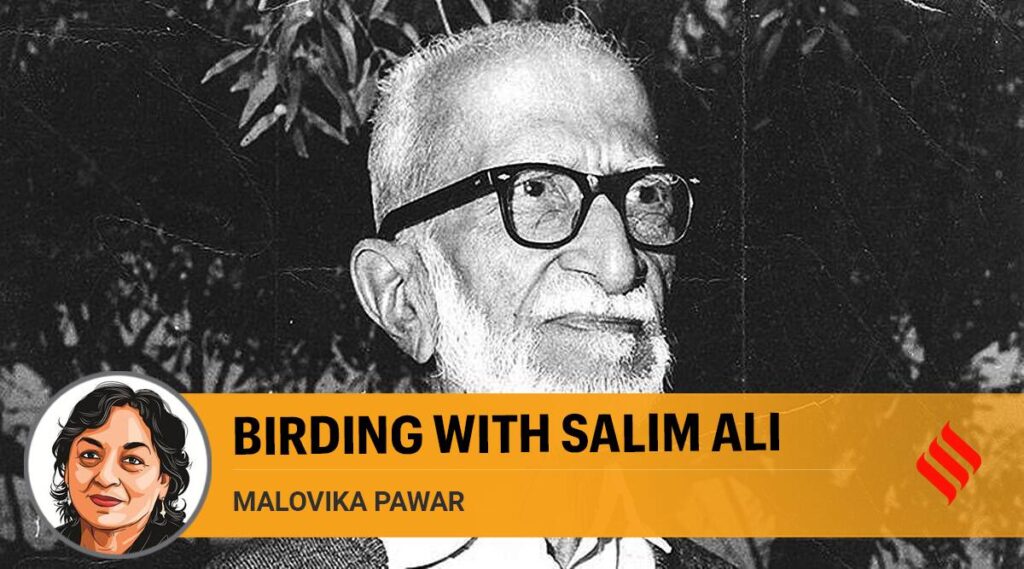
Why Salim Ali’s ‘The Book of Indian Birds’ is Indian birdwatchers’ favourite guide

Mumbai, MAHARASHTRA :

Glossier, more attractive birding books have been published in the 80 years since Ali’s guide first appeared, but it remains indispensable.

The first edition of Salim Ali’s book appeared in 1941. (Source: Wikimedia Commons)

It is a small book, my copy of Salim Ali’s The Book of Indian Birds — a hardcover version, bound in green, a mere 187 pages. I have the 1979 edition. The cover is long gone, leaving behind a few tatters of the original, but I am hard put to think of a book I have treasured and used as much. The book and an old pair of Bushnell binoculars acquired some 20 years ago are a part of my essential travelling kit, as essential as a toothbrush and comb.

The first edition of the book appeared in 1941. Jawaharlal Nehru , a keen nature lover, gifted a copy to his daughter while lodged in Dehradun jail.

Ali was quite matter-of-fact in his autobiography, The Fall of a Sparrow. According to him, the book was “acknowledged as largely responsible for creating and fostering much of the interest in birds and birdwatching seen in the country today”. Indeed, for people of a certain generation, no other guide has been valued and loved in the same way, and even among Ali’s other classic works, it is this book that has iconic status among Indian birdwatchers. While setting off on a birding trip, we would ask each other: “Have you taken your Salim Ali?” Or: “Oh, no, I forgot my Salim Ali.” It was always the small green book that we were talking of. It is the essential — the foundational — field guide for Indian birders. It is now in its 13th edition. No other book can take its place.

I came to birdwatching by serendipity. No one on either side of my family was even remotely interested in birds. By a throw of the dice, I was allotted Bharatpur for my district training in the IAS. The Keoladeo Ghana National Park beckoned. I was hooked. Ali, who had done more than anyone alive to create this “Garden of God” out of a Maharaja’s private wetlands reserve, was still alive, and visited a few times while I was there. Two bird guides, Sohan Lal and Bholu Khan, still active today, were being trained by him and other naturalists. They were to mature into fine birding guides, much in demand.

The Book of Indian Birds is where we learned our basic vocabulary of birdwatching. For instance, we learned that “pied” meant black and white, that “rufous” meant reddish-brown as in rust or oxidised iron, and that “fulvous” indicated tawny. Every carefully chosen word signified something. The clarity and the precision of expression meant that in a short half-page entry, we would have all the necessary information about a species. Each write-up was organised around five or six points — size, field characters or appearance, distribution, habits, food, call and nesting. Size was always charmingly described as myna plus, or house crow minus, or with reference to a sparrow, a bulbul or other common bird. Under “field characters”, Ali beautifully and accurately described the appearance: Colour of the feathers, the shape of the bill, silhouette in flight. A crimson-breasted barbet was “heavy-billed”, a blue-throated barbet “a gaudily coloured, dumpy green, arboreal bird” and the common grey hornbill a “clumsy brownish-grey bird”. Birds are described variously as handsome, squat, soft-plumaged, lively, dapper, dainty, spruce, slim, perky, well-groomed. The common roller or blue jay (neelkanth) is described as a “striking, Oxford and Cambridge blue bird”.

People who have always noticed the easy readability of the prose might not be aware that Ali himself gave credit to his wife, Tehmina, for ironing out the “stilted passages” and for “moderating the language”. He did not fail to praise her “remarkable feeling for colloquial English prose style”.

My Salim Ali bears the marks of the trajectory of my life, where I went, what I did. It is not merely well-worn and well-thumbed, with an unravelling spine and precarious binding; it also bears the added signs of pickle stains and tick marks in ink and pencil. Like me, it has seen better days. I know that many bird guides have been subsequently published with much better production values and better colour plates. I am aware that many of the illustrations in the Salim Ali book are decidedly not true to life. For instance, never did a rosy pastor look as pink in real life as it does in the book. But this is mere quibbling. The core and kernel of the book is that it communicates to us so successfully the magical universe of the birds of India.

The international jury which selected Ali for the J Paul Getty Wildlife Conservation Prize of the World Wildlife Fund in 1975 said in its citation: “Your message has gone high and low across the land and we are sure that weaver birds weave your initials in their nests, and swifts perform parabolas in the sky in your honour.”

On his 34th death anniversary on June 20, it is time to remember the book that Ali gave us, which took us on this magical journey to the birds.

This column first appeared in the print edition on June 19, 2021 under the title ‘Birding with Salim Ali’. The writer is a former IAS officer.

source: http://www.indianexpress.com / The Indian Express / Home> Opinion> Columns / by Malovika Pawar / June 19th, 2021

This breadman at Hyderabad’s Tolichowki is setting kindness goals

Hyderabad, TELANGANA :

Like many others, Iqbal too is going through hard times amid the pandemic-imposed lockdown.

In 2020, Abdullah Naan Mahal used to serve Nahari Sherwa too, but had to stop because of Covid-19 and consecutive lockdown.

Hyderabad : 

We’ve heard of people donating money, distributing essentials and cooking for the needy during this pandemic. But here’s a breadman in Tolichowki who is helping the needy with his out-of-the-box initiative. 

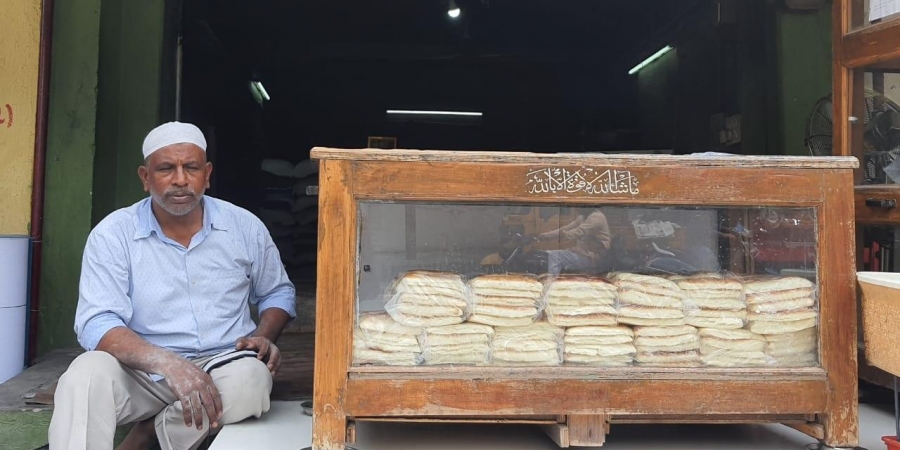
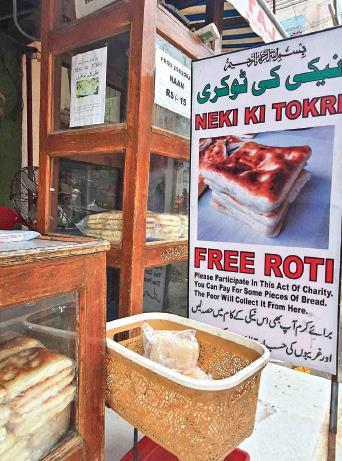
Mohammed Iqbal, who runs Abdullah Naan Mahal, does not want anyone to go hungry. So, he came up with Neki ki Roti (Bread of Goodness). Every morning, he places a basket outside his eatery for people to buy naan rotis and put them in it. “Anyone, rich or poor, can pick up the rotis from this basket. No one should go hungry,” he says. 

Iqbal himself places at least 20 rotis a day in the basket. “By doing this, we are not helping people but God. It is God who is making us do this,” he believes. “Even those, who are not my regular customers, are now buying Neki ki Rotis to help the poor.” 

Like many others, Iqbal too is going through hard times amid the pandemic-imposed lockdown. “As soon as I get back to being financially stable, I will start making Nahari Sherwa. The poor can have the rotis with it,” he says, adding that, “Nobody likes dry bread. Not even me. But what can we do in these difficult times?” 

In 2020, Abdullah Naan Mahal used to serve Nahari Sherwa too, but had to stop because of Covid-19 and consecutive lockdown. However, Iqbal is hopeful that this difficult phase passes and the world becomes a better place again. He wants to continue his initiative for as long as he can. “People ride down to my shop to take these free rotis. We never question them because we do not know what they are going through,” he says.

That’s very thoughtful of him. Long live Neki ki Roti.

source: http://www.newindianexpress.com / The New Indian Express / Home> Good News / by Express News Service / June 12th, 2021

These Muslim Covid Warriors helped Hyderabad in overcoming Oxygen crisis

Hyderabad, TELANGANA :

Relief organizations of Hyderabad, run by Muslims, have come to the rescue of the state and offered help to fight the shortage of Oxygen.

A TCN Ground Report features some of them. 

Amid a surge in Covid-19 cases in Hyderabad in the southern Indian state of Telangana and rise in deaths due to the virus, the severe shortage of oxygen, ventilators and beds in both the government and private-run hospitals exposed the shortfalls of the healthcare system of the state.

Reports said that many patients were turned away from the hospitals due to a shortage of beds and died in their homes. Those admitted to the hospitals died due to lack of oxygen supply and delay in oxygen tankers reaching them. This lead to hundreds of deaths in Hyderabad alone. 

Reports also said that hospitals were overcharging Covid-19 patients. These factors contributed to many people choosing to opt for home treatment. 

It was then that the relief organizations of the state, run by Muslims, came to the rescue and offered help to fight the shortage of Oxygen. 

Talking to TwoCircles.net, Shiba Minai, an activist said, “I make at least 50 to 60 calls to get a bed for a patient”. 

Shiba helps people by connecting them with groups, hospitals and organizations that have been helping patients with beds and oxygen facilities. 

Shiba has been doing relief work since the first wave of the Covid-19 pandemic by providing food for the homeless, migrants, poor people in the slums. She has also helped with the funeral services of the victims. 

She said that a lot of people reach out to her during crisis time. To help these desperate families, she would seek financial help from friends and family members. 

“I get calls from people who are unable to find a bed or oxygen if they are already in the hospital or are under home treatment. Then, I call up hospitals and once I get the right hospital, I then connect the patient or the attendant to that hospital,” she said.  

Shiba said the work she does is exhausting. “Making several calls to hospitals that want to know how much can the patient be able to pay and meanwhile handling calls from attendants of patients is taxing,”. 

Talking about an incident wherein a 45-year-old woman whose saturation levels dipped low and her family could not find a hospital with a bed, Shiba said that she tried her best but “the hospitals refused to admit her after coming to know that her oxygen levels were quite low and she had fewer chances of survival.”

The family of the patient roamed to 6 hospitals, who earlier had assured of the availability of bed refused to admit her once they saw the saturation levels. The woman was taken home where she later succumbed. 

“I tried to help this lady from 9 p.m. till the wee hours of the morning when it was time for Suhoor (early morning meal during the Muslim month of Ramadan). Sadly, she could not be saved,” Shiba said in a sad tone. 


Although Shiba has helped sixty persons with beds with oxygen facilities, what makes her sad is that the “number of patients who I could not help is higher than the ones I helped.” 

Shiba is not alone in doing Covid-19 relief work. Like her, several organizations have helped Hyderabad overcome the Covid-19 crisis from the last year. This year too they have come forward to battle the oxygen shortage in the state. 

‘Oxygen on Wheels’

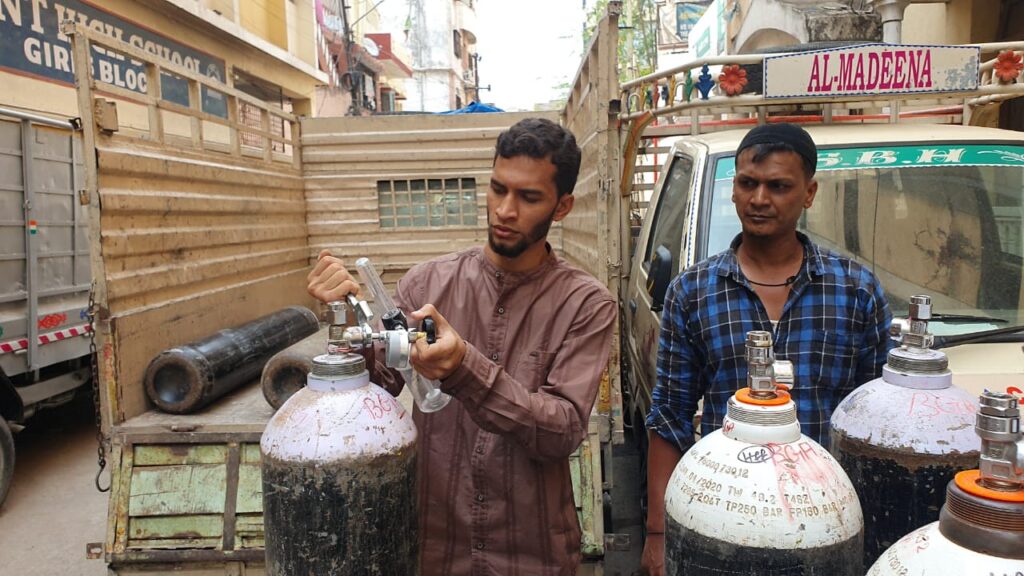
Mohammed Asif Hussain Sohail, the chairperson of Sakina Foundation, who is popularly known as the ‘Hyderabad Hunger Warrior’ for feeding the hungry for more than 10 years, has been receiving close to 200 calls every day from patients who are being treated at home. He also gets calls from hospitals especially Osmania and Gandhi General Hospitals requesting him for oxygen facilities. 

“The price of oxygen cylinders is quite high at Rs 30,000 and the cost of refilling has gone up to Rs 2500 which a common man cannot afford,” Sohail said.  

Md Asif Hussain Sohail of Sakina Foundation

Sohail said that as hospitals are running out of oxygen and due to black marketing, he has to verify if the patient needs oxygen or not before helping. 

“Sometimes, they don’t need oxygen and we have to counsel and advise them not to give in to their fear and explain to them that a needier person requires it more,” he explained.

Sohail claims that he has “spent more than Rs 10 lakhs from his pocket to buy cylinders and send them to the homes of the needy.” 

“Every day, in Hyderabad itself, my Foundation has provided more than 200 free cylinders. We have reached out to at least 2000 people so far,” he said. 

Oxygen on Wheels is another initiative of the Sakina Foundation. As part of this initiative, oxygen cylinders are provided to patients who are on their way to the city for treatment from their towns and villages. 

“Many people were dying on the way to Hyderabad. Not being able to get proper treatment in their villages they would travel to advanced hospitals in the city. The patients would only be saved if they arrived on time and if the hospital had oxygen,” he said. 

“I wanted to save lives so I came up with this idea to provide emergency oxygen cylinders on the highway,” Sohail said.

As soon as they receive an SOS call, his volunteers drive to the spot where the patient is and help him/her with the oxygen. 

Sohail said that they have driven up to 200 kilometers to provide oxygen to a patient on the highway.  

“Patients were coming not just from the districts of Telangana state but also from Bhopal, Maharashtra, Karnataka. We met them all on the highway and immediately helped them with the oxygen if their saturation levels were low,” Sohail said, adding, “Nearly 150 persons were helped on the highway.”

Sohail said that “love and compassion are necessities, not luxuries.” “Without it, humanity cannot survive,” he added. 

700 people given oxygen aid by Helping Hand Foundation

With the oxygen crisis in the state, volunteers of the relief organization Helping Hand Foundation (HHF), headed by Mujtaba Aksari, have been at the forefront. 

The group distributed a flyer with their contact numbers for people to seek help in cases of Covid-19 emergency. The group also provide help with giving decent funeral services to Covid-19 victims deaths irrespective of religion. 

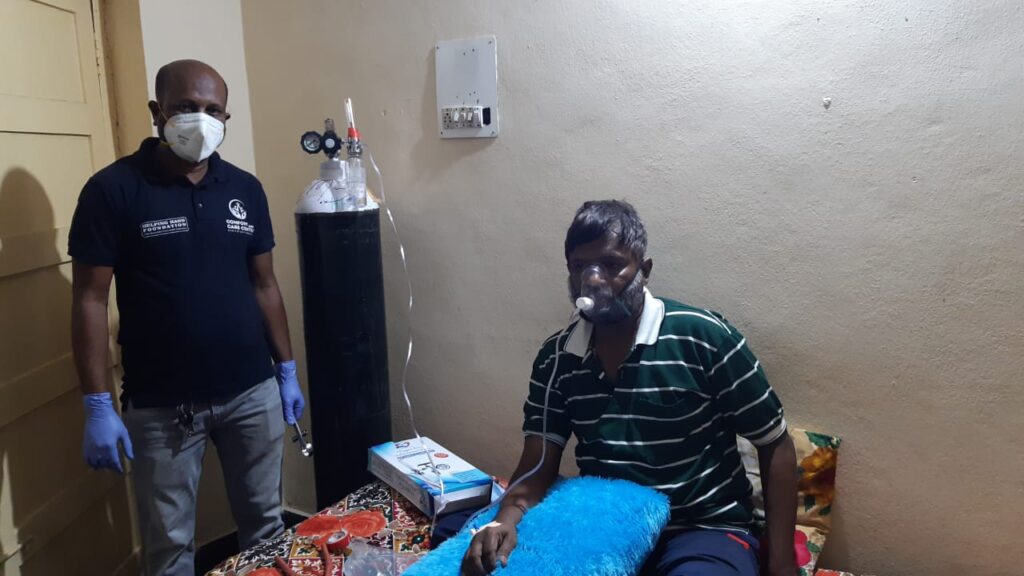
Mohammed Fareedullah, who heads the project told TwoCircles.net, “When we receive a call for help, our doctors consult them online and based on the doctor’s recommendation, if the patient needs oxygen, we advise the attendant to come to our godown and take the oxygen cylinder without paying any advance or rent. 

A patient receiving oxygen help from HHF | Photo by HHF

Fareedullah said that the families of the patients just have “to pay the refilling charges.” 

“The plant where we get the cylinders refilled have begun to charge double of what they used to charge earlier. But we charge the people a nominal amount,” he said.  

 “The cylinders provided by HHF are usually for home patients but if the patient develops complications and their saturation level drops despite the oxygen therapy then we help them reach the hospital where again our counsellors in the hospital help them with other needs. When the patient recovers and is discharged we ferry them home in HHF ambulances. If they do not recover the volunteers help the family with the last rites too,” explained Fareedullah. 

Helping Hands Foundation owns about 15 ambulances which are free for all patients. The group has 100 cylinders and a luggage trolley to transport the cylinders to the houses of people who cannot come to their go down.

To date, HHF claims to have helped more than 700 people covering the entire old city and many other localities.  

Humanity First Foundation: from feeding hungry to procuring Oxygen

Mohammed Shujatullah,founder of relief organization Humanity First Foundation has been feeding patients and their attendants at three government hospitals for the last 5 years. 

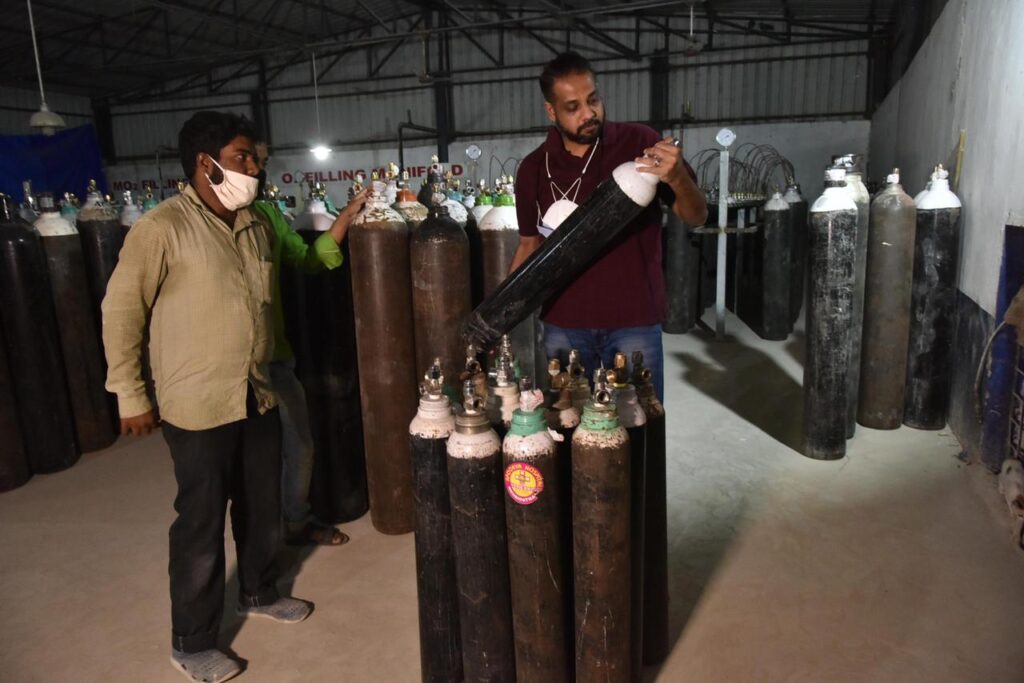
One day when Shujatallah received a call requesting help with oxygen, he decided to buy cylinders and give them for free to patients and then refill the empty ones and help whoever needed them. “Prices had doubled for both the oxygen cylinders and for refilling but through donations to Humanity First, I continued helping people every day with the 110 cylinders we have,” he said. 

Md Shujatullah of Humanity First Foundation checking oxygen cylinders | Photo by HFF

His organization has an ambulance, which carries the oxygen cylinders to hospitals and homes of patients. 

In the month of Ramadan, Shujatallah said that his foundation received good donations and he managed to help as many people as was possible for him. 

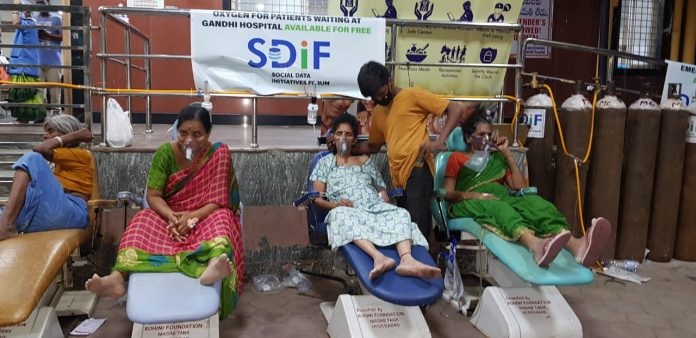
Patients at the gate of a hospital supported by SDIF | Picture: SDIF

‘Our motive to save lives keeps us going’

Another local initiative known as Social Data Initiative Forum (SDIF)founded by Azam Khan and Khalid Saifullah started oxygen services during the first wave of the pandemic with their stock of 15 cylinders. 


During the second wave, as the oxygen crisis has only gone worse, the group has been adding to their stockpile of oxygen cylinders. 

The founders said that they had to pay more than the normal price for both purchasing and refilling the cylinders. 

“Our services are not restricted to just providing oxygen cylinders. We also set up an oxygen bank at Government notified Covid-19 hospitals where usually the poorest of the poor come to access health care. People from the rural parts come to Hyderabad with hopes of quality treatment and they face a lot of hurdles waiting to get admitted after already having travelled a long distance,” Azam Khan said. 

“The waiting period at the hospital and the travel time further delays the process of the treatment, which is why we opted to help in the government hospitals,” he clarified. 

In Gandhi Hospital alone, which is the largest Covid-19 hospital of Hyderabad, Azam Khan said they have “20 oxygen cylinders in circulation which are serving at least 400 patients per day.” 

“This supply of oxygen is crucial to their recovery,” Khalid added. 

Apart from the 20 cylinders, they have 100 more cylinders at the other two government-run Covid-19 hospitals of Hyderabad. 

They said they have helped more than 100 people so far. 

Azam Khan narrated an experience that made them realise the significance of their work. 

The King Kothi Government hospital had requested SDIF to set up an oxygen bank. 

“I felt we had to start the work immediately and even though it was Sunday, our team went to the hospital. As soon as we reached the hospital, we saw four dead bodies being carried away. We were told the hospital had run out of oxygen causing the death of these four persons. We immediately set up our oxygen cylinders. Later the doctors informed us that our timely help had saved three persons who were critical and would not have survived had we not reached on time. This experience both saddened us and also made us feel happy that we could at least save the lives of other three persons,” he said.  

“Our motive to save lives keeps us going,” the duo said.

The SDIF is helped by two other charity organizations from Hyderabad namely Safa Baitul Maal and Access Foundation, who work in close collaboration with them. 

Pre and post-Covid care given by Al Hamd Foundation

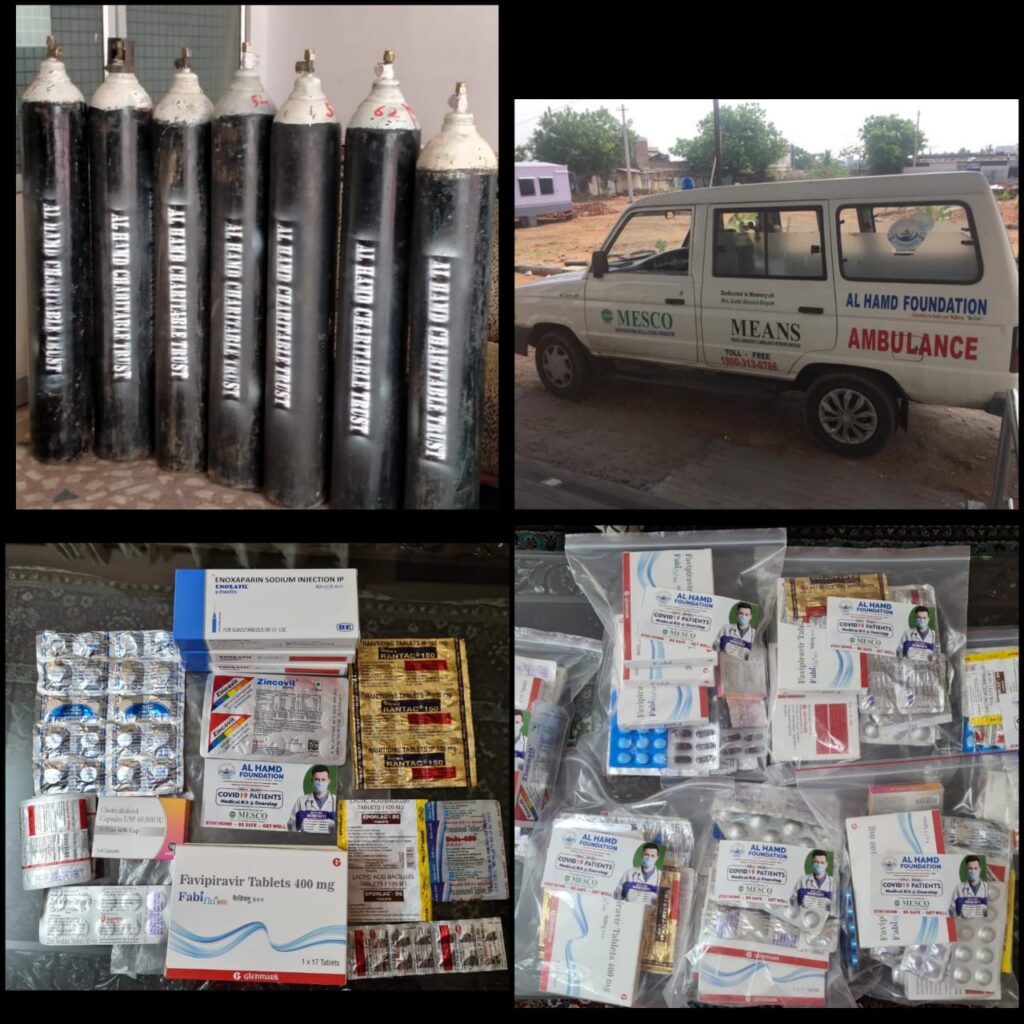
Al Hamd Foundation, a charitable trust that helps widows, students and the poor, took up Covid-19 relief operations during the last year’s lockdown. 

Amid the ongoing second wave, the foundation is continuing with online consultations of patients with doctors. 

When patients contact them online, they are connected to doctors who advise home treatment keeping in view the severe crunch in the hospitals and also the fact that many cases can be treated at home with proper medications and care.

Al Hamd Foundation Covid relief services

The foundation has provided home treatment to fifty-two patients, who had reported low oxygen levels. 

The founder of Al Hamd Abdul Azeem Mohammed told TwoCircles.net that the treatment cost they incurred for each patient would have run up to Rs. 7 to 8 lakhs had they been treated in a hospital. 

“The team of AL Hamd ensures that the patient does not panic and develops a strong will to fight the disease and survive. The team also helps with the oxygen cylinders, the medicines and regular monitoring by the doctor who visits the patient. At times when the patients are poor and the team notices that they need provisions apart from the medical assistance, Al Hamd provides the family members with rations as well,” Azeem said. 

Al Hamd has given 300 oxygen cylinders and 6 oxygen concentrators to other organizations that are helping people affected with Covid-19. 

They have four oxygen hubs and seven ambulances in Hyderabad-Secunderabad and a fifth one is coming up soon.  

“We have ordered 25 oxygen concentrators from the UK which is likely to arrive by in the last week of May. Each oxygen concentrator of 5-6 litres costs around Rs 46,000. We have also ordered 5 C PAP machines that cure respiratory disorders. And since we are not a hospital, we intend to donate these C PAP machines to the hospitals where there are facilities to treat patient with respiratory disorders that are linked to Covid” explained Azeem. 

“We also give post-Covid care by giving immunity-boosting drugs and foodstuff,” he added. 

Al Hamd is run with funds from family and close friends. 

50-bed oxygen therapy centre set up by Jamaat-e-Islami Hind 

Well-known socio-religious organization Jamaat-e-Islami Hind (JIH) Telangana has also set up a 50-bed oxygen therapy centre in Wadi-e-Huda near Shaheen Nagar, Hyderabad. JIH’s sister concern Students Islamic Organisation (SIO) supports recycling the cylinders, rifling them, coordinating with other organisations for availability. 


Post Script

To support Helping Hand Foundation, you can make a GooglePay donation here: 8125203286

Donate to Humanity First Foundation here: https://www.donatekart.com/humanity-first/Help-Shujatullah

To help SDIF reach out to more needy persons, donate here: 

https://www.donatekart.com/SDIF/Help-SDIF

source: http://www.twocircles.net / TwoCircles.net / Home> Lead Story / b y Nikhat Fatima, TwoCircles.net / May 21st, 2021

Covid: Last journey breaks barriers of religion

Rampurhat (Birbhum District), WEST BENGAL :

Muslim tutor helps cremate Hindu trader who died of the infection

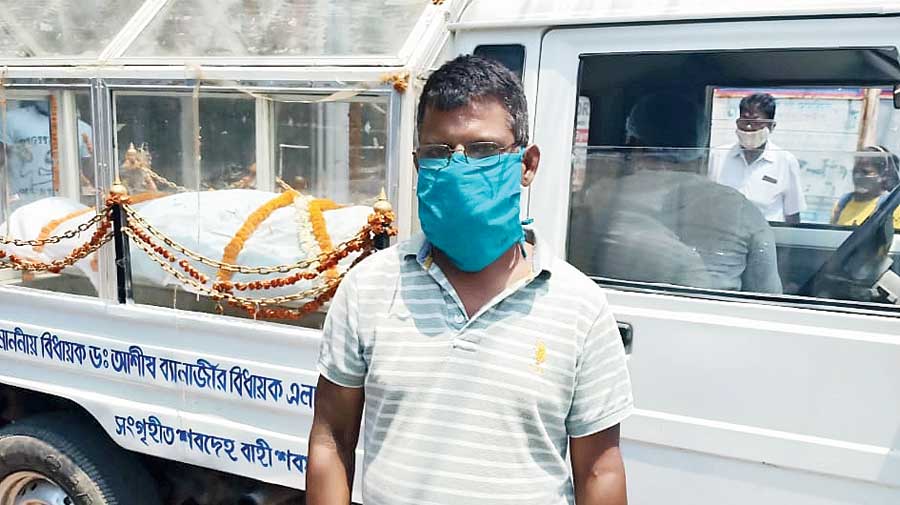
Ataur Rahaman with the Hindu trader’s body in Rampurhat, Birbhum district, on Friday / Telegraph picture

A Muslim private tutor in Birbhum’s Rampurhat spent an entire day to overcome hurdles and cremate the body of a Hindu trader who died of Covid-19 on Friday.

Sudhanshu Karmakar, 37, a trader hailing from Bankura who stayed in Birbhum’s Mohammedbazar, died at a private nursing home in Rampurhat town on Friday.

Radharaman, his elder brother who stays in Bolpur, came to Rampurhat but had no idea how to cremate Sudhanshu.

“I was completely helpless after hospital authorities asked me to receive the body. I had no idea what to do apart from crying out loud,” said Radharaman.

He tried to reach out to people at the hospital but most did not help as the body was of a Covid patient. It was at this point that Ataur Rahaman, 47, appeared.

Ataur, a member of the local social outfit Bangla Sanskriti Mancha, assured Radharaman that he would arrange everything for him. “It was my first experience in handling a Covid body. I took the risk seeing Radharaman’s helplessness,” said Ataur.

However, Ataur had no idea what he would have to face. He arranged a hearse for Rs 1,000 from Rampurhat Municipality but the driver backed out when told he would have to ferry a Covid body to the crematorium.

A local driver, Akbar Ali, agreed to drive the hearse to the crematorium.

But the challenges did not end here.

As soon as the body reached the crematorium in Nalhati, people who found out that the body was of a Covid patient started pelting stones at the hearse.

Ataur called up the former chairman of Rampurhat municipality, Aswini Tiwari, who asked him to take the body to a crematorium dedicated to Covid-19 bodies. “There, I was told Covid bodies are cremated after dusk to avoid protest from residents. But I had to break my Ramazan fast in time too,” he said.

He added that he hired three people who knew Hindu cremation rituals, and went and bought garland and other items needed for last rites. Then, Radharaman cremated his brother and Ataur broke his fast. 

“I honestly never thought whether the body was that of a Hindu or a Muslim,” the private tutor told this paper.

Almost in tears, Radharaman said: “I have no idea if there is a God or Allah but he (Ataur) appeared to be that supreme power. I am really grateful to Ataur bhai.”

Samirul Islam, president of Bangla Sanskriti Mancha, said what Ataur did sent the message that Bengal would never allow division on communal lines. “We have seen forces trying to divide Bengal on religious lines. But it can’t be done in Bengal. Here, brotherhood is beyond religion and politics,” said Islam.

Ayodhya couple cured

The Covid-infected couple who had travelled 850km in an ambulance from Ayodhya to Bengal’s Hooghly for oxygen, have recovered and were  released late on Friday.

Lalji Yadav, 50, and his wife Rekha, 48, who were denied treatment in their home state Uttar Pradesh, apparently for lack of oxygen, recovered in a private hospital in Hooghly’s Chinsurah. 

The couple profusely thanked the hospital and the Bengal government. Lalji said he would return to Uttar Pradesh and tell people that if there was some hope for life amid the pandemic, it was in Bengal. “I have no words to thank the Bengal government and hospital,” said Lalji. 

The state government had also arranged Remdesivir for him at the private hospital.

source: http://www.telegraphindia.com / The Telegraph Online / Home> West Bengal / by Snehamoy Chakraborty, Rampurhat / May 09th, 2021

This hearse driver from Belagavi is there to say final goodbyes to Covid victims

Belagavi, KARNATAKA :

Working for the last 13 years with BCC, Samsher has been picking up dead bodies of several persons and taking them to the graveyard till date for performing their last rites.

Nisar Ahmed Abdulgani Samsher

Belagavi :  

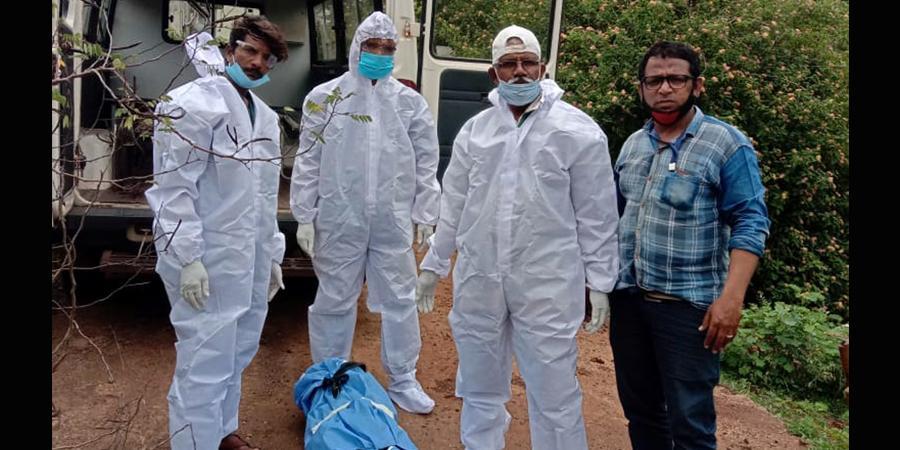
Dedicated to his work, Nisar Ahmed Abdulgani Samsher, a driver of hearse van belonging to Belagavi City Corporation (BCC) has proved himself to be an outstanding Covid warrior by performing his work beyond his duties which can only be said for ‘humanity’.

Working for the last 13 years with BCC, Samsher has been picking up dead bodies of several persons and taking them to the graveyard till date for performing their last rites. But after the Covid – 19 pandemic commenced, his profession was a big challenge for him, which he accepted heartily.

Speaking to ‘The New Indian Express’, Samsher said that on an average he used to pick as many as 40 to 50 dead bodies per month located within BCC limits. But, he said that during Covid pandemic, he has been picking up more than 70 to 80 dead bodies per month. And many of them have died due to Covid, he said.The most tragic thing that comes after Covid is the question in the minds of relatives of the deceased which asks – ‘Who will perform the last rites of the Covid positive patient?’, said Samsher.

He said that he has seen several people refusing to receive the dead body of their relative because that deceased has died due to Covid. Following the same Samsher started taking the responsibility to perform the last rites of those persons who have died due to Covid as his or her relatives are denying to perform the last rites due to the same. Several people have paid him the required amount to perform the last rites of the deceased, who has died due to Covid which amounts about Rs 2,000 to Rs 3,000 per body.

He has even collected the ashes of the cremated dead body from the graveyard and handed it over to the relatives of the deceased at their door steps on their request. Recalling an incident, Samsher said that an old woman died to Covid recently and she had no relative in Belagavi to perform her last rites. He said that there were two sons of the deceased who had died a couple of years ago and her only daughter was residing at Goa.

“The daughter of the deceased called me on my mobile phone and requested to perform the last rites of her mother. Following the same I performed the last rites of the old woman and managed to send the ashes packed in a box to her daughter at her Goa address. The expenses for performing the mentioned last rites was donated by a social worker,” he said. Samsher is working from 6 am to 8 pm per day and during the ongoing Covid pandemic he has been working in a very hectic schedule.

Due to the same, most of his senior officials attached to BCC have appreciated him and several organizations have felicitated him. When speaking to TNIE, Samsher was carrying three orphan dead bodies to the Sadashiv Nagar graveyard and all of them had died due to Covid. Samsher said that he feels happy to help people and the profession into which he is, is the best way to help them. ‘And for whatever good I do, there is a god to bless me, which is more than what earning matters to me,’ he concluded.

source: http://www.newindianexpress.com / The New Indian Express / Home> States> Karnataka / by Tushar A Majukar / Express News Service / June 13th, 2021

Indian student gets 10-year UAE Golden Visa

Alappuzha District, KERALA / Dubai, UAE :

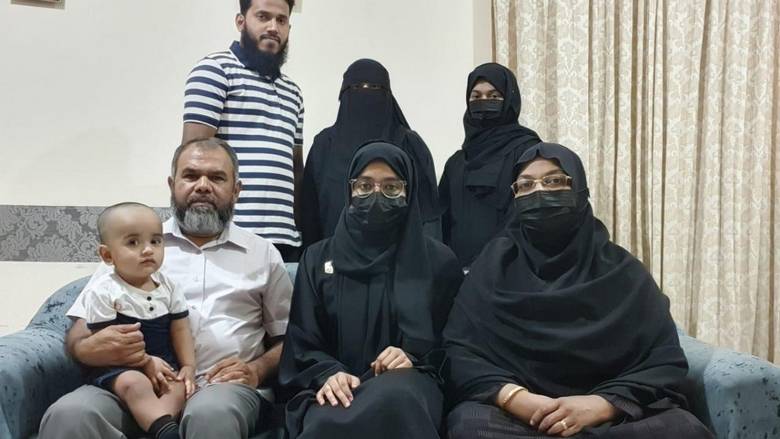
Standing: (from left) Safeer (husband of first daughter Sumayya), Amal (daughter); (sitting) Aslam with grand son Mazyoun , Tasneem Aslam and mother Sunitha Syed. (Supplied)

Tasneem Aslam is pursuing a PG degree in Islamic jurisprudence from the University of Sharjah.

Tasneem Aslam, an Indian student from India’s southern most state Kerala’s Alappuzha district and a namesake of Pakistan’s career diplomat and a former spokesperson of the Ministry of Foreign Affairs, is a proud recipient of a coveted honour of the UAE government.

Her hard work, diligence and intelligence have paid off.

The UAE government has recognised her merit and excellent academic credentials to extend her a 10-year Golden Visa, which is reserved only for prominent global personalities.

Tasneem received the Golden Visa in the exceptional student category and is allowed to stay in the country till 2031, as the UAE unveils major reforms to attract global talents from people belonging to all walks of life.

Tasneem, but naturally, is thrilled by the honour.

“This is one of the best moments in my life. I feel privileged to achieve this and I am thankful to Almighty Allah. My parents ‘support has been enormous, and Insha Allah I hope to sponsor them in near future,” Tasneem told Khaleej Times.

“I take this opportunity to express my gratitude to the wise and visionary leadership of this great nation that has been making rapid strides to promote education. Students, educators, and institutions enjoy great value in this young nation that’s celebrating 50 years of its foundation. I seek solace in the immortal words of Sheikh Mohammed bin Rashid Al Maktoum, Vice-President and Prime Minister of the UAE and Ruler of Dubai, that ‘knowledge is the shortcut to success,’ ” she said.

Tasneem studied Islamic Sharia from Al Qasimia University in Sharjah and topped her class, which consisted of pupils from 72 nationalities, with a grade point average (GPA) of 3.94 on 4.

Tasneem has memorised the Quran. She has enroled for a postgraduate degree in Fiqh (Islamic Jurisprudence) at the University of Sharjah.

She had attended the Emirates National School in Sharjah, where her mother Sunita works as a teacher, and had secured 95.6 per cent in her Grade XII examinations.

Tasneem’s father Muhammad Aslam is a former employee of the Sharjah City Municipality and now runs a typing centre in the emirate.

Her father is ecstatic about their daughter’s feat.

He said: “I’m proud of her achievements. We’ve been flooded with congratulatory calls and messages for the past two days from our friends and relatives from across the globe.”

Tasneem, who is proficient in Arabic, has multitasking skills. She helps her father with Arabic translation at the typing centre and simultaneously manages the social media account of Zahaar perfumes.

Earlier, she worked as a teacher at Nobel Qur’an and Sunnah centre in the emirate. She also taught the Quran and hadith at the Abu Bakr Siddique mosque in Sharjah.

“Tasneem is very creative, and she spends her free time designing her own abaya,” her father signed off

source: http://www.khaleejtimes.com / Khaleej Times / Home> News / by Syed Ayaz Basha, Dubai / filed May 29th, 2021 and updated June 02nd, 2021