Category Archives: Amazing Feats

Syed Mohammad ‘Rainbow’ Hadi: First man to score a Ranji Trophy hundred

Hyderabad, TELANGANA :

Syed Mohammad Hadi was nicknamed Rainbow for his prowess in cricket, tennis, field hockey, football, table-tennis, chess, and polo.
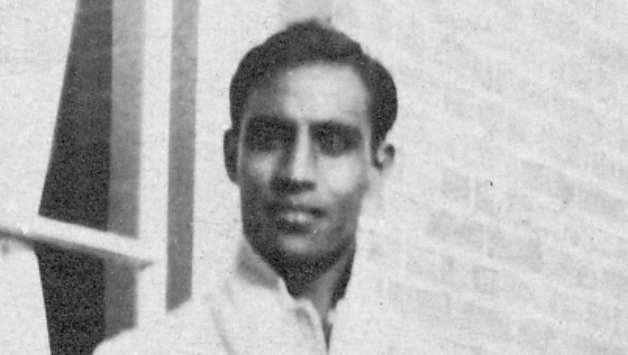
Syed Mohammad Hadi scored 132 not out in his team’s score of 227, becoming the first ever centurion in Ranji Trophy cricket. Photo courtesy: Wikimedia Commons.

One of the main issues under discussion during the July 1934 meeting of BCCI, held in Bombay, was a detailed discussion regarding the introduction of a nation-wide First-Class cricket competition, where teams representing the different local cricket associations of the nation would participate to ultimately determine the national champion. It was founded as “The Cricket Championship of India”. The tournament kicked off in 1934-35. The handsome trophy was donated by His Highness Sir Bhupinder Singh, Maharaja of Patiala, in memory of Ranji to cricket lovers all over the world.

As all students of Indian First-Class cricket history are aware, the very first Ranji Trophy match of all, between Madras and Mysore at Madras on November 4, 1934 turned out to be a bit of a letdown, the whole match being completed in one day. It remains the first of only 2 First-Class matches played in India to be completed in a day till date (the second being Saurashtra vs Baroda at Rajkot on December 5, 1959).

This match will forever be remembered for the wonderful bowling performance that resulted in a match of such short duration, 6 for 19 (out of total of 48) and 5 for 16 (out of 59) by the doyen of Madras cricket at the time, the great left-handed all-rounder, AG Ram Singh, patriarch of the first family of contemporary Madras cricket.

Perhaps a little overshadowed by AG Ram Singh was a right arm medium-pace and off-break bowler from the Mysore team, appropriately named Mysore Vijayasarathi, who picked up 6 for 23 in the only Madras innings of 130. Vijayasarathi would later cause a flutter among lovers of cricket trivia by umpiring a Ranji Trophy match between Mysore and Andhra in Dec/1960 at Bangalore along with his son, MV Nagendra.

The sad but undeniable fact was that there were no outstanding batting performances in the first two Ranji Trophy matches played.

The third Ranji Trophy match of the inaugural season began on the Friday, November 23, at Secunderabad. Hosts Hyderabad, led by Syed Mohamad Hussain, were taking on the Madras team, led by M Venkataramanjulu.

The hosts won the toss and decided to take strike. They reached a competitive score of 256 in their 1st innings, captain SM Hussain top-scoring with 80 and F Toorkey, opening the innings, making 72 runs. As if it were pre-ordained, Ram Singh captured 5 for 88. The Madras 1st innings finished at 301, with only Ram Singh (74) and Cotar Ramaswami (61) reaching double figures.

The Hyderabad 2nd innings was in disarray when the 3rd wicket fell at the team score of 12. Syed Mohammad Hadi then arrived at the crease to take strike. He scored 132 not out in his team’s score of 227, becoming the first ever centurion in Ranji Trophy cricket. This match was his Ranji Trophy debut match as well, and this century his maiden First-Class century.

In a surprising turn of events, the visitors were dismissed for 169 in their 2nd innings. That man Ram Singh (70) scored another half-century and MJ Gopalan made 58. The man who wrecked the Madras 2nd innings was one Tata Rao (8 for 73), and Hyderabad won by 13 runs.

Born August 12, 1899 in India, Hadi was a right-hand batsman who has no record of ever bowling in this format of cricket. In a span of 1930-31 to 1940-41, SM Hadi played 24 First-Class matches aggregating 1,043 runs with a highest of 132 not out (as mentioned above) and an average of 32.59. He was to later score another century and 3 fifties, and to take 9 catches.

Hadi’s profile informs us that his father Captain Syed Mohammed, erstwhile officer in army of Hyderabad state, had passed away when Hadi was just about two years of age. Hadi’s subsequent upbringing was through the support and supervision of the family of Sir Asman Jah, former Prime Minister in the court of the Nizam of Hyderabad.

He was brought up alongside the son of Sir Jah, Nawab Moin-ud-Dowlah, after whom the famous cricket tournament was to be named and who would become a famous patron of the sports of the region. Hadi had the opportunity of learning horse riding as a youngster and was sufficiently good at soccer to play for Nizam College. In view of the boy’s obvious aptitude for a number of sports, the family of Sir Jah decided to send him over to England to continue his studies.

In the newsletter VARSITY, dated June 12, 2016 from Cambridge is an article by Matt Worth, in which he comments, “The wardrobe in his room at Peterhouse must have been bursting with light blue jackets, as he shone at polo, tennis, soccer, field hockey, cricket and table tennis. A particularly fine tennis player, it is at the racket game that his sporting career perhaps hit its greatest heights, as he played at Wimbledon five times, reaching the doubles quarter final in 1926. He also represented India at the 1924 summer Olympics and in the Davis Cups of 1925 and 1926. The run of representative appearances for his country must have more than made up for his frustration at being denied the Light Blues’ tennis captaincy on account of his nationality.” He had an MA from Cambridge and a Masters from the University of Pennsylvania.

Hadi made his First-Class debut for Hyderabad against Maharaj Kumar of Vizianagram’s XI in the Moin-ud-Dowlah Gold Cup semi-final of 1930-31, played at Secunderabad in 1930-31, under the leadership of wicketkeeper SM Hussain, who was also keeping wickets.

He was well past the age of 30 at that time, and scored 17 and 42 not out against a team captained by Jack Hobbs, and for whom Herbert Sutcliffe scored 165 in the side’s only innings of 329. Hyderabad managed totals of 265 and 194 in a drawn match that was awarded to the visiting team on the basis of their 1st-innings lead.

It may be mentioned here that Hyderabad batted against the bowling of the brothers CK and Cs Nayudu and Ghulam Mohammad, among others. An interesting sidelight of this match was the fact that while Naoomal Jaoomal kept wickets in the home team’s first innings, he not only bowled but took 2 for 7 from his 3 overs while one P Shankerdas, who was not in the playing eleven for the visiting team, was allowed to keep wickets as a substitute.

In the Ranji Trophy clash with Madras at Chepauk in December 1935, Hadi, captaining the Hyderabad team, scored 85 and 0 in a match that Madras won by 6 wickets, Ram Singh being the undisputed hero of the match, scoring 121 and 57, both not out, and taking 2 for 77 and 6 for 32.

It was at Chepauk in February 1936 that India took on an Australian team in an “unofficial Test”. The home team was led by Wazir Ali and included luminaries like Kartick Bose, Mushtaq Ali, Lala Amarnath, Amar Singh, Ram Singh, Hadi and Mohammad Nissar. The Australian team was led by the ageing Jack Ryder and included, among others, ‘Stork’ Hendry, ‘Hammy’ Love (though he did not keep wickets in this match), and the one and only ‘Governor-General’ — Charlie Macartney.

India batted first and put up 189, thanks to 45 by Amar Singh and 43 by Mushtaq Ali. Macartney took 3 for 52. The Australian 1st innings ended at 162, with a good 48 from Fred Mair. Nissar (5 for 61) and Amar Singh (5 for 54) shared the wickets.

India managed only 113 in their 2nd knock, the top-scorer being Hadi with 19 not out (he had also made 19 not out in the 1st innings). Once again, it was Macartney among the wickets with 6 for 41.

The Australian 2nd innings was an even feebler effort — 107, with the only worthwhile score being 41 by captain Jack Ryder. Nissar (6 for 36) and Amar Singh (2 for 54) ensured an Indian victory by 33 runs. It must be said, however, that for the visitors, Hendry, Ryder, Love, wicketkeeper John Ellis, Macartney, Joe Davis, and Harry Alexander were past their prime and playing their last First-Class match. For the home team, Wazir Ali completed 1,000 First-Class runs for the season, and Hadi completed 500 career First-Class runs.

It was against the old foes, Madras again, that Hadi scored his other First-Class century, in the Ranji Trophy match at Secunderabad in December 1939, with a score of 106 (his 100 coming in 120 minutes) in a total of 443. Hyderabad batted only once in a match and won by an innings and 2 runs. Ram Singh, however, had still not finished with them, capturing 5 for 136 and scoring a solid 44 in the Madras 1st innings of 262. When he had scored 81, in this match, Hadi completed 1,000 First-Class runs.

His final First-Class match, again against Madras, was at Chepauk in December 1940. As captain of Hyderabad, his contributions were 2 (out of 98) and 16 (out of 132). Ram Singh, perennial nemesis of the team, turned in another stellar performance with 27 and 53, and picked up 6 for 30 and 4 for 26, as Madras won by 254 runs.

Retirement from his active playing days did not diminish his interest in sports. Along with his step-brother, Col. Ali Raza and with Nawab Mahmood Yar Jung, SA Rahim and Ahmed Mohiuddin, Hadi founded the Hyderabad Cricket Association and Hyderabad Football Association in 1934, with himself as the first Secretary.

He became the Director of Physical Education in Hyderabad and later, Joint Secretary of Education of the Indian Government. He was National Commissioner of Boy Scouts of India and, when the All-India National Council of Sports was founded in 1959, he was the first Secretary. The runners-up trophy of the Mon-ud-Dowlah Gold Cup tournament is now called the SM Hadi Memorial Trophy.

This multidisciplinary sportsman died in his native Hyderabad on July 14, 1971 of lung cancer. For his extraordinary skill at the seven sports of cricket, tennis, field hockey, football, table-tennis, chess, and polo, SM Hadi is fondly remembered by all Indian lovers of sport as ‘Rainbow’ Hadi.

(Pradip  Dhole  is a retired medical doctor with a life-long interest in cricket history and statistics)

source: http://www.cricketcountry.com / Cricket Country / Home> English> Features> Moments in History / by Pradip Dhole / June 16th, 2016
Baqa Jilani: Controversial in life, and afterwards

Jalandhar, PUNJAB :

Baqa Jilani was the first bowler to take a hat-trick in Ranji Trophy.

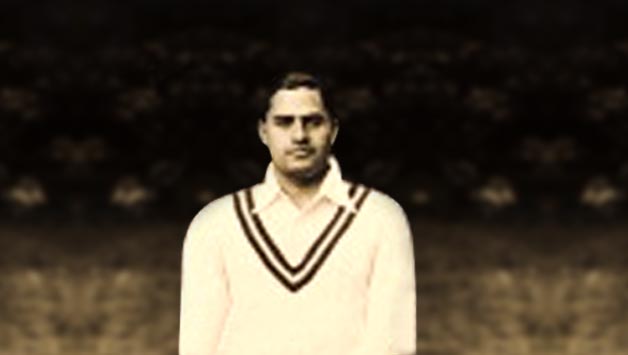
Baqa Jalani. Photo Courtesy: Post Card World

Baqa Jilani, born July 20, 1911, was the first bowler to take a hat-trick in Ranji Trophy. Abhishek Mukherjee looks at a man controversial in life and death.

Had Mohammad Baqa Khan Jilani  been a more renowned person, they would probably have made a movie on him. In fact, though he did not live to see an age of 30, he had a life too eventful to ignore, both on and off the field. He played in an era when India were in its nascent stage of Test cricket, and could have had a significant career had he not been plagued by numerous physical ailments.

Baqa Jilani was a decent batsman with 928 runs at 18.56 with a hundred from 31 First-Class matches. For a man of 6 feet it was surprising that he bowled leg-breaks and medium-paced leg-cutters, but he captured 83 wickets at 19.93 with 3 five-fors and a ten-for; if we go by the usual definition of a good all-rounder (the closer the batting and bowling averages are to each other, the better the all-rounder he is) then his numbers were certainly not poor.

“There was no doubting his class,” wrote David Frith. Charlie Macartney hailed him a “champion”. Despite that, Baqa Jilani is known more for his off-the-field activities than his class.

He also played a solitary Test with not much of an impact, but more of that later.

Early days

Born in Jullundur, Baqa Jilani made his First-Class debut for Northern India in 1934-35. It was as spectacular a debut as one can think of: opening bowling he routed Sind for 114 and 155 with figures of 7 for 37 (his best figures) and 5 for 50, making it his only First-Class ten-wicket haul. Playing against Parsees in the Bombay Quadrangular next month he returned figures of 4 for 30 and 3 for 55, leading Muslims an innings victory.

Then came the big match, against Southern Punjab: Northern India scored 142 before Baqa Jilani’s 4 for 46 gave them an 11-run lead. Then, when Southern Punjab were set a target of a mere 118, he took charge: Dev Puri and Amir Elahi contributed in bowling out the opposition (that had five cricketers who played Tests at some point of time or the other) for 22, which remained the lowest Ranji Trophy score till 2010-11.

Baqa Jilani, however, stole the show with figures of 4.1-1-7-5. In the process he also registered the first hat-trick in Ranji Trophy, dismissing  Joginder Singh, Yuvraj of Patiala, and Lall Singh.

The next season started on a high note as well. Baqa Jilani claimed 2 for 45 and 4 for 16 in the first “Test” against the touring Australians at Lahore. There was also a 4 for 32 against Delhi at Kotla, and a consecutive second season with the ball earned Baqa Jilani a spot on the 1936 tour of England.

Baqa Jilani’s bowling was never the same. His first two seasons, which included 16 matches, had resulted in 66 wickets at 15.85. The next 15 yielded a mere 17 at 35.82.

The controversial Test debut

The murk of the 1936 tour has been discussed at lengths by every student of Indian cricket. Once Maharajkumar of Vizianagram had his way to national leadership, he had his way in every possible matter throughout the Test series. He led India in all three Tests and scored 33, but his antics had a deeper impact in dampening the spirit of the squad.

Sending Lala Amarnath back home was enough to set any team back, but Vizzy went a bit further: he had created a rift in the dressing-room, splitting the team into two sections. The majority of the team backed CK Nayudu as the obvious leader, much to Vizzy’s dislike: he wanted his way, and slowly created a band of loyal supporters.

Mushtaq Ali later wrote in Cricket Delightful: “It may not be possible today to apportion the respective parts played by the captain and the manager, but the job was successfully done with Nissar, Dilawar Hussain, Baqa Jilani Khan and PE Palia effectively estranged from CK Nayudu. Costly and lucrative presents were lavishly distributed to favourites by the Maharajkumar and this created further rifts in the team.”

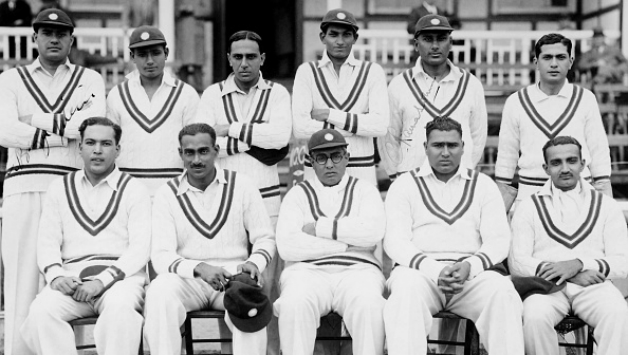
Indian team for the Worcestershire match at New Road, 1936 © Getty Images Back, from left: Baqa Jilani, Lala Amarnath, Syed Mohammad Hussain, Mushtaq Ali, Cotar Ramaswami, Khershed Meherhomji (wk) Front, from left: Phiroze Palia, CK Nayudu, Vizzy (c), Mohammad Nissar, Vijay Merchant
Indian team for the Worcestershire match at New Road, 1936 © Getty Images
Back, from left: Baqa Jilani, Lala Amarnath, Syed Mohammad Hussain, Mushtaq Ali, Cotar Ramaswami, Khershed Meherhomji (wk)
Front, from left: Phiroze Palia, CK Nayudu, Vizzy (c), Mohammad Nissar, Vijay Merchant

One of these was Mohammad Nissar : when Vizzy was being knighted, news had gone out that Nayudu was leading Indians to a victory against Lancashire at Liverpool. Vizzy cabled Nissar to bowl full-tosses; the moment Nayudu realised what was going on, he took Nissar off, and won the match for the tourists himself in a partnership with Jahangir Khan.

This did not go very well with Vizzy. He took things a bit too far. As Mihir Bose wrote in A History of Indian Cricket, “Those in the Vizzy party received all sorts of favours including a trip to Paris and they could curry favour with Vizzy by insulting Nayudu.”

On the morning of the Test, Baqa Jilani obliged. Ramachandra Guha later in Wickets in the East: “Shute was replaced by Baqa Jilani [a vastly inferior cricketer] for the Oval Test of 1936 only because Jilani had fulfilled his captain Vizzy’s desire by abusing CK Nayudu at the breakfast table.”

Mushtaq was in agreement: “It was widely believed that Baqa Jilani Khan earned his place in the third Test by fulfilling the condition of insulting CK Nayudu in the presence of other players inside the dressing room. In fact, when the team was announced Shute Banerjee had been shown among the first eleven players with Baqa Jilani specifically mentioned as the 12th man.”

Bose’s version was the same: “Baqa Jilani did that [insulted CK Nayudu] before the Oval Test: coming down to breakfast one day he insulted Nayudu and was rewarded with his first Test cap.”

Boria Majumdar’s version in Lost Histories of Indian Cricket: Battles Off the Pitch is slightly different, but he is in agreement with Baqa Jilani’s action: “With Vizzy forever keen to humiliate Nayudu, he had even ordered Baqa Jilani to abuse Nayudu at the breakfast table promising him his maiden Test cap if he carried out the orders.”

Baqa Jilani played at The Oval — a Test that started, somewhat ironically, on August 15, exactly 11 years before India’s Independence. He conceded 55 runs from 15 overs, being at the receiving end of a majestic 217 from Wally Hammond; and as India plummeted to an innings defeat and a 0-2 loss in the series, Baqa Jilani scored four not out and 12. He never played another Test.

It was not a great tour for him either. He scored the only hundred of his career against Leicestershire, scoring 113 and taking the score from 233 for 7 to 426, and added 24* and 2 wickets for good measure. Against Gloucestershire he scored 59 not out and returned match figures of 5 for 78, but he failed in the other ten matches he played.

The final few matches and deteriorating health

Baqa Jilani career lasted for three more matches after his return. He missed the winter of 1936-37, but did a decent job the next season with 4 for 33 against United Provinces and 74 against Southern Punjab, both at Patiala. By this time illness had already been creeping in.

In Personalities of the 1936 Tour of England, Cota (or Cotah, or Cotar) Ramaswami had written of Baqa Jilani’s strange behaviour: “Nobody could say when he was normal and when he got into uncontrollable temper. He was constantly undergoing treatment during the tour.” He suffered from high blood pressure, insomnia, and somnambulism. He was also an epileptic.

In Silence of the Heart: Cricket Suicides David Frith cited more incidents: “During the Indians’ final match (of the 1936 tour), against Indian Gymkhana at Osterley, Jilani viciously hurled the ball at his friend Gopalan and displayed temper when moved from slip to cover [Ramaswami was captain for this game]. Baqa Jilani sat down in the field, kicked the ball towards the boundary instead of fielding it and deliberately threw wide of the bowler.”

Ramaswami did not react. As he wrote in Ramblings of a Games Addict, “knowing fully well that he was slightly off his head, I ignored his presence in the field.”.

He came back to play a single match — his last — in 1938-39 against Hindus in the final of the Lahore tournament but did not do much of note.

Personal life and controversy regarding death

Baqa Jilani was the brother-in-law of Jahangir Khan, and was an Extra Assistant Commissioner in Jullundur. In 1941 he suffered an epileptic fit, fell down from the balcony of his residence, and met with an instant death eighteen days before his 30th birthday. He was the second Indian Test cricketer to die after Amar Singh (who had passed away on May 21, 1940); he also remains the second-youngest Indian Test cricketer to die after Amar Singh (29 years 169 days).

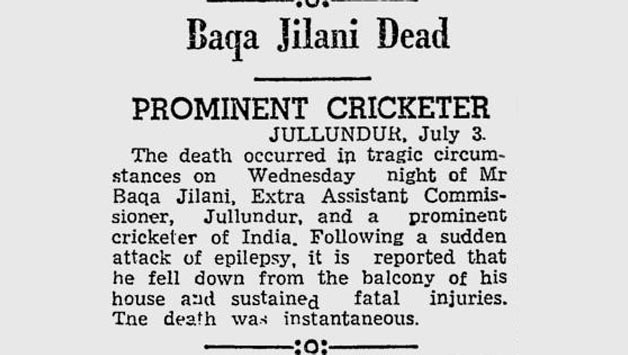
The report of Baqa Jilani’s death was published in Indian Express as the same. Strangely, there were rumours that he had hanged himself out of depression.

Baqa Jalani died tragically. Photo Courtesy: Indian Express

It was not until much later that the truth came out (though Indian Express archives were always available). As Frith wrote, “The great Vijay Merchant told statistician Anandji Dossa, who told young writer Mudar Patherya, who told the author, that Jilani had suffered an epileptic fit, lost his balance on the veranda of his house in Jullundur and fallen to his death.”

(Abhishek Mukherjee  is the Deputy Editor and Cricket Historian at CricketCountry. He blogs here  and can be followed on Twitter here .)

Meet nonagenarian SM Miskeen, the oldest ever to earn a PhD in Tamil Nadu

Thiruvarur, TAMIL NADU :

Miskeen, who still practices as a chartered accountant in Thiruvarur, did his research on cheque fraud and fines concerning loan repayments.

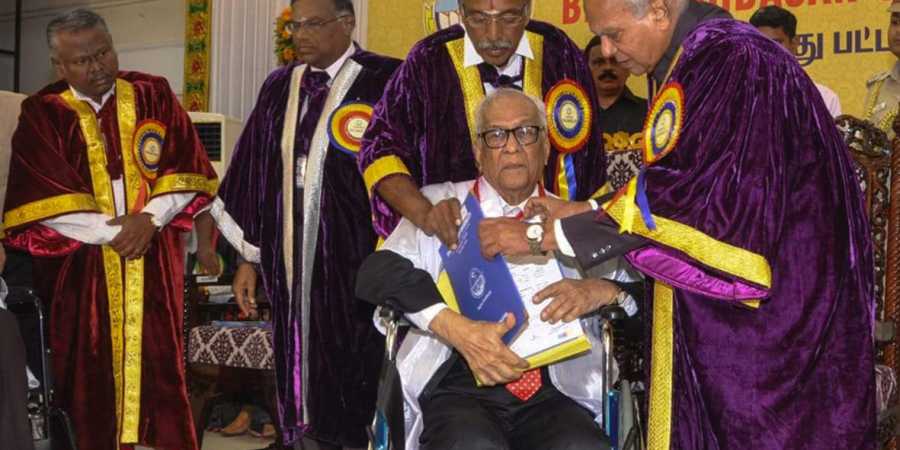
SM Miskeen receiving PhD from the governor of Tamil Nadu on Tuesday (Photo|EPS)

Tiruchi :

With a doctorate at 91, he proved that age is just a number. Nonagenarian SM Miskeen from a village in Thiruvarur village, who earned his PhD on Tuesday, received the certificate from the governor of Tamil Nadu at Bharatidasan University.

Miskeen, who still practices as a chartered accountant in Thiruvarur, did his research on cheque fraud and fines concerning loan repayments.

A chartered accountant with an active clientele, a lifetime Lions Club member who started the first eye hospital in Thiruvarur through the organisation, and an educationalist who brought the first-ever women’s college – all of these show an eventful timeline Miskeen has crafted over the years.

Miskeen was born in the hamlet of Koothanallur in Thiruvarur district in 1928. After finishing primary schooling in his village, Miseek was moved to Madras for secondary schooling. “My father believed that education was very important and moved with me to Chennai where he set up shop,” said Miskeen.

Later he completed his college at Loyola in Chennai in 1950 with a B. Com. This was followed by a three-year stint handling his family business in Vietnam.

Miskeen said he did not want to continue in Vietnam and came back to India to pursue CA, which he completed in 3 years.

In 1960, Lion’s Club International had introduced a scheme to establish eye hospitals to eliminate reversible blindness. Miskeen, who joined the organisation in 1968, gradually became the club’s Multi Council Chairman of South India. He established an eye hospital in Thiruvarur and treated over 10 lakh persons with cataract free of cost. He founded RA College for Women in 1999. At present about 2000 girls, mostly from economically backward backgrounds, are studying in the college.

While speaking about the research, he said: “Many are unaware about the penalty in cheque dishonouring. This research analysis would create awareness about it and prevent such offences among individuals, small firms and even corporates as those involved in cheque bouncing cases may be awarded up to two years in jail and fined twice the amount involved.” He said such cases were in great numbers at many high courts and even the supreme court.

Miskeen studied over 400 check dishonouring cases across India for his analysis. He took up the research in 2014 under the guidance of Dr. Issac Francis Gnanasekar from St. Jospeh’s college.

source: http://www.newindianexpress.com / The New Indian Express / Home> Good News / by Express News Service / Ocotber 01st, 2019

India’s blind judokas win 19 medals at Commonwealth Judo Championships

INDIA :

JudokasMPOs01oct2019

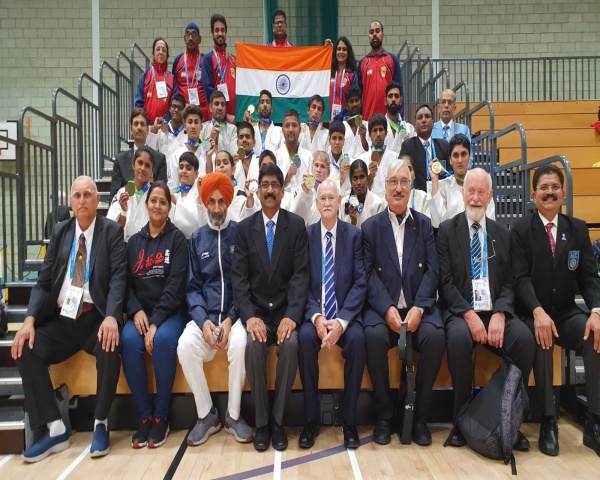
Visually impaired judokas of India made a clean sweep at the 16th edition of the Commonwealth Judo Championships held in the United Kingdom winning seven gold medals.

The Indian national anthem could be heard 19 times at the University of Wolverhampton Sports Centre in Walsall, United Kingdom, venue of the Commonwealth Judo Championships as India’s visually impaired judokas made a clean sweep walking away with seven gold, seven silver and five bronze medals.

Nineteen members of the 20- strong Indian contingent won medals at the event, making it a day to remember.

The names of the medal-winners in each category were as follows:

  • Gold – Kusum, Poonam Sharma, M. Manoharan, Karmpal, Kapil Parmar, Swati Sharma and Subhashini.
  • Silver – Syed Ahtram Hussain Naqvi, Kokila, Muthulakshmi, Monu, Ramesh, Sonali and Mohit.
  • Bronze – Rohit, Buddhadeb Jana, Sarita Choure, Renuka, and Ajay Birajdar.

The other countries taking part in the event were England, Wales, Scotland and South Africa. Scotland, England and Wales also won gold medals, but India was far ahead of the rest. The performance has made the Indian Blind and Para Judo Association, which manages visually impaired judo in India since 2010, very proud.

We are very happy to have made a clean sweep at the Commonwealth Judo Championships. I really hope that the experience and exposure that the players have got will help them play better in the future. Also, the confidence that the team gets after a performance like this, is unparalleled. – Munawar Anzar, General Secretary, Indian Blind and Para Judo Association

Aaesha MunawarJoint Secretary of the association, told NewzHook that given the challenges faced by people with disabilities in India, their success was truly remarkable. “Compared to the kind of support that non-disabled sportspersons get, para sports gets nothing”, said Munawar. “We have to beg and borrow for everything and when you cast a glance at the support other countries give, the contrast is glaring”.

Over the years the number of visually impaired judokas in India has grown. There are now about 700 visually impaired judokas playing at the national level, about 45% of them girls. The maximum participation is seen from the states of Tamil Nadu, Haryana and Uttar Pradesh. Judo, says Munawar, gives them the opportunity to empower themselves, but convincing families and blind schools to send students for judo training is hard.

“We have girls as young as 10 taking part and its great to see that but the challenges are many. We want to make their parents proud and help the judokas improve their levels”. The association hopes to send a team to the Tokyo 2020 Paralympics and all efforts are currently geared towards that.

source: http://www.newzhook.com / Newz Hook / Home> Stories / September 2019

How Budha Ismail Jam, a Gujarati fisherman, challenged multinationals in a US Court

Tragadi Village (Mandvi Taluk, Kachchh District), GUJARAT :

BudhaIsmail01MPOs30sept2019

In 2005/06, when coal plants were set up in Kutch District of Gujarat district, locals were promised employment. The project, set up by Adani and Tata Groups and backed by international financial institutions, was considered ‘efficient’ and aimed at selling power to other states too.

More than a decade later, locals continue to count the ecological costs of these plants.

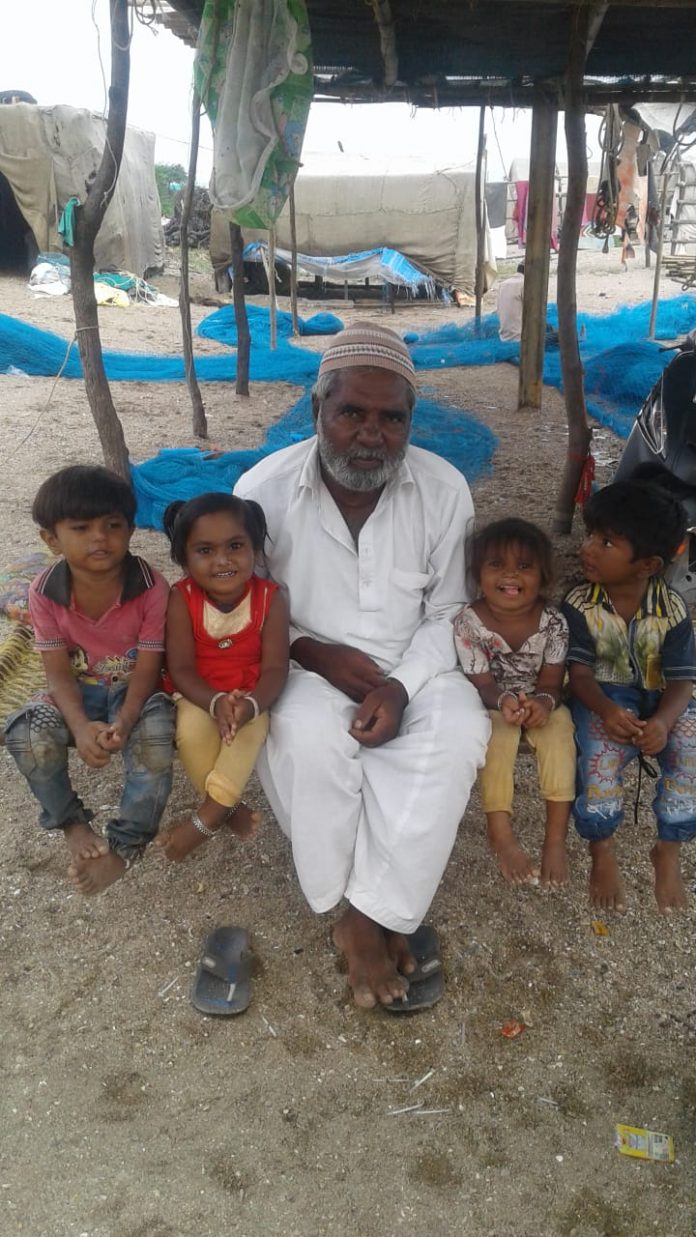
Tragadi, one of the villages, is home to fishermen who realised that their catch has decreased dramatically after the plants were set up, while the village of Navinal, which was rich in horticulture and agricultural produce, saw damaged date palms and other fruits and reduction in farming.

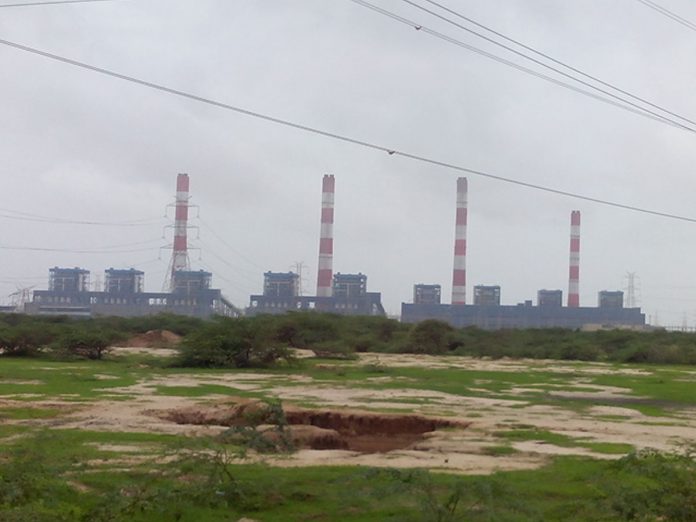
Adani Power started the region’s first coal-fired power plant. The village of Navinal is about 8 km from the Adani Mundra plant. The Tata Mundra “ultra mega power project,” built by the Tata Group is also nearby.

The heated wastewater released from the plants containing saline, from the outflow channel of the plant, released in the sea waters at the rate of 600 million litres per hour, was badly affecting marine resources.

Apart from this, huge amounts of sand were deposited near wells used for drinking water, turning them saline and non-potable.

The coal dust and fly ash and the groundwater now contaminated with saline water have made farming difficult and many people have given up growing crops.

And this is when Budha Ismail Jam, a fisherman from Tragadi, and the people of Navinal came together to form MASS (Machimar Adhikhar Sangharsh Sanghathan) in 2010 and act collectively to make accountable the powers behind their woes.

In a conversation with TwoCircles.net, Jam explained how their lives had been impacted after the power plants were set up. “Earlier, I and my sons used to catch plenty of fish within a short distance of just 2 kilometres with just one fishing boat. But gradually our catch decreased and we had to sail at least 12 kilometres to catch fish. And since one boat was not enough, I had to avail a loan and buy 3 more fishing boats.”

“Today, our catch from the 4 boats equals the catch of one boat before the power plant was set up,” he explained.

They first complained to the companies about the damage to marine life and demanded that the companies switch to a closed-cycle cooling system instead of the open cooling system that required 3 times more water. But the company refused to comply.

Then, the people had a series of meetings with the whole community and the leaders approached a Delhi-based NGO called Centre for Financial Accountability’. The executive director of this NGO, Joe Athialy, helped the fishermen and farmers moved the complaint advisor ombudsman of IFC (International Finance Corporation). The ombudsman conducted an internal audit and submitted its report in 2012 and the CRP submitted its report in 2015 but nothing changed.

The Role of the International Finance Corporation

The IFC, which has its headquarters in the United States, has partially funded the TATA power project. The entire project costs $4.14 billion and the IFC has funded $450 million, while the remaining was funded by Asian Development Bank and other agencies.

IFC, which is a member of the World Bank Group, focuses on financing private sector developmental projects in poor and developing countries. The mission of IFC is to “carry out investment and advisory activities with the intent to not harm people and the environment.”

However while investing in the TATA Mundra Plant; they went against their mission causing damage to the environment, livelihood and health of the people.

Jam, also the leader of the fishermen community which is mostly Muslim, told TwoCircles.net, “due to the water contamination, many people here keep falling sick frequently”.

The Suit in the US court

Jam, Bharat Patel from the Fishing Union and Joe Athialy sent a petition signed by 30,000 signatories to the World Bank President asking them to withdraw the funds to the TATA project due to the environmental violations caused by the plant. They even wrote to Indian tribunals that worked on environmental issues.

They tasted brief victory when the nearby plants were halted. But operations resumed when the plant got environmental clearance a year later.

But after their petition reached the World Bank, their story became known in other parts of the world and soon activist lawyers from EarthRights International came to their village and met the aggrieved fishermen.

And thus in 2015 began the Jam et al v. International Finance Corporation trial. EarthRights International (ERI), an NGO which works extensively in defense of human rights and the environment, supported Jam and the others in suing the IFC in the Federal District Court for the District of Columbia claiming damages and injunctive relief for the harm caused due to air, water and land pollution by the power plant financed by IFC.

IFC claimed immunity because groups like the World Bank were exempt from prosecution under the US International Organisation Immunities Act (IOIA), 1945. And in 2016 the court agreed that IFC enjoys ‘absolute immunity’ and dismissed the case.

But Jam and his team did not give up. They appealed again in the court of Appeals (which is like High Court) for the District of Columbia Circuit where again IFC won because the order of the district was upheld.

Just when things were becoming bleak, Stanford Supreme Court Litigation Clinic, a law school which offers hands-on legal experience in Supreme Court litigations, offered to help the litigants Jam, Patel, Earthrights International to move the Supreme Court of US in 2018.

Mundra thermal power station ( Photo from Wikipedia)

TwoCircles.net also spoke to Joe Athialy, who had attended the proceedings at Washington on behalf of the litigants back home and he explained, “We understood the importance of our case being heard in the Supreme Court when we learnt that out of 7,000 cases, the Supreme Court agrees to hear only 150 cases. And we were lucky our case was one among these. Here, all the 9 judges sit for all the cases unlike in India.”

“But in our case one judge, who was in the Appeals court, excused himself and the other 8 judges heard the case.”

He also explained that there were a lot of people present in the courtroom and that the entire proceedings were completed very fast.

And then came the verdict this year in February 2019, wherein the Supreme Court, ruled in favour of Jam and others and ruled that even International organisations can be sued and that they do not enjoy absolute immunity.

This was a landmark judgment and a huge victory, not just for the plaintiffs from India but to all the people who think that international organisations are not above the law.

On winning the suit Joe Athialy told TwoCircles.net, “This is a big deal not just for the people of Mundra but for multiple reasons because this is the first time in the world, a case against the World Bank has come to this level, this is the first time the immunity of the world bank is challenged. And this allows people anywhere in the world to sue the World Bank if there has been damage to the environment and lives of the people.”

“We believe this is another step towards holding these institutions accountable,” he added. “Now the case has been sent to the district court for further litigation.”

Apart from this case against the IFC, Jam, Patel and Joe have also written to the other financial institutions that have funded this project like ADB. They have also written to the pollution control board in India.

“We also wrote to the Indian Banks through whom the project is operating. But none of the banks has even responded”, Athilay said. “At least international banks respond. They don’t even have such policies”.

Jam says, “I am happy that our efforts have paid off and we have won the case. But I have asked for compensation for the losses we have incurred in our livelihood and I hope we will be given compensation.”

“I was offered money for not fighting the case but I stood my ground because I was not thinking of just myself but all the fishermen community,” he said proudly. But in a sad tone he added, “Earlier when our fish business was good, I had many dreams for my grandchildren. But today we are not earning half of what we did before and I don’t give much thought to my dreams.”

However, he hopes for better days if the courts order the power plant to stop the open cooling system then the wastewater outflow will be reduced and things might improve slightly better.

source: http://www.twocircles.net / TwoCircles.net / Home> Lead Story> TCN Positive / by Nikhat Faima, TwoCircles.net / September 28th, 2019

This Bengaluru Ola cab driver’s heartwarming gesture is going viral on the internet

Bengaluru, KARNATAKA :

When it comes to taking cab rides, there have always been many bad experiences for the commuters compared to the good ones.

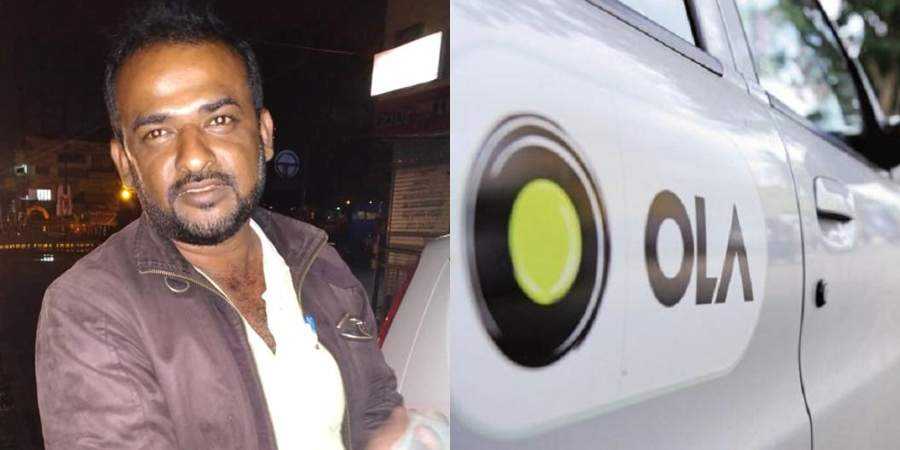
Bengaluru Ola cabbie Khateeb UR Rahman (Photo | Facebook and PTI)

When it comes to taking cab rides, there have always been many bad experiences for the commuters compared to the good ones.

Two of the dominant cab aggregators Uber and Ola are no different as they have also been in the wrong side of the news in the past.

But this time around it was an Ola cab driver who is in the news for all the good reasons. On September 17th, a Bengaluru based man took to Facebook and shared a heartwarming story of an Ola cab driver.

The commuter, Sayuj Ravindran, said that the cab driver returned valuables and gadgets worth Rs 2.5 lakh to him after he had left them behind in the cab.

He wrote, “Returning after my cousins wedding, I took an Ola cab (with my family) from KR Puram railway station to home at around 3:30 am. Halfway down, the car tyre got punctured. The driver requested me to book another cab since it will take some time for him to replace the tyre. I got another one in 10 mins and I was about to reach home when I got a call from the first cab driver informing that I left a handbag in the car. I then realized it was my laptop bag which also had some valuables in it. He said he will wait for me right there. I took my car from home and rushed back. He was kind enough to come a little further towards my home. We met at the Marathahalli bridge and he gave me the laptop bag.”

Sayuj also mentioned that the cabbie refused to take money from him as a favour.

“Meet Mr Khateeb UR Rahman, who returned my bag (with stuff worth Rs 2.5 lakhs approx). He refused to take any money from me in return of the favour and got back into his cab. But I did manage to slip in the money to his jacket pocket forcefully. Please reward this gentleman for what he has done, ” he said.

The post had gone viral with over 10,000 people liking the post and over 2,600 people sharing it.

The RT Nagar Old office (SGP Group), who came across the heartwarming act of the Khateeb UR Rahman rewarded him with a cheque of Rs 25,000.

This heartwarming gesture once again proves to be an example of how one will be rewarded according to his/her act.

source: http://www.newindianexpress.com / The New Indian Express / Home> Good News / by Online Desk / September 25th, 2019

The last Nizam’s indelible imprint on Kalaburagi

Hyderabad / Kalaburagi (formerly Gulbarga) , KARNATAKA :

AiyaneShahiMPOs17sept2019

The city has many structures built during the time of Nizam Mir Osman Ali Khan Bahadur

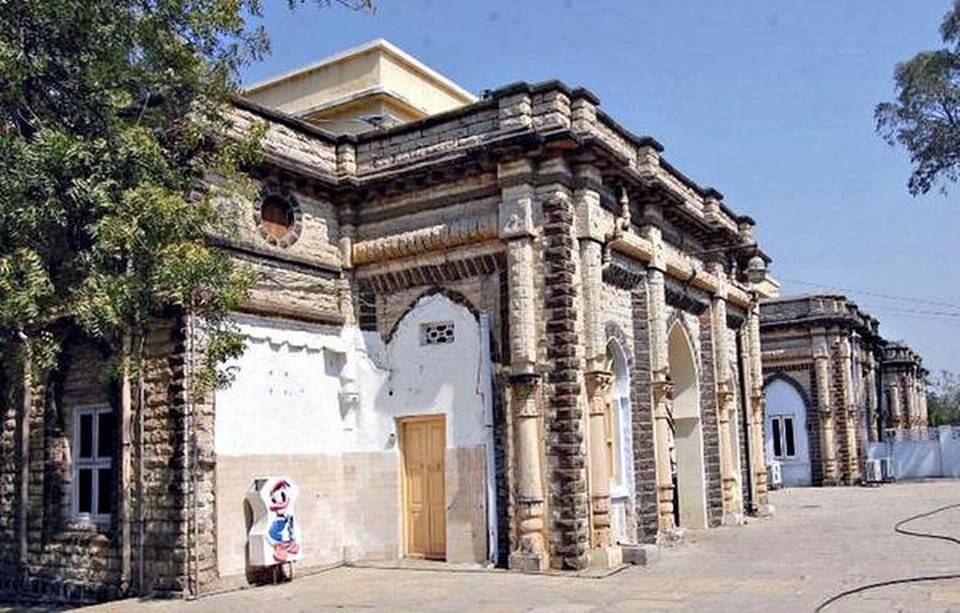
A kilometre away from Kalaburagi railway station is Aiwan-e-Shahi, a magnificent stone structure built in early 19th Century. For political leaders and bureaucrats visiting the city, it’s the most preferred accommodation.

Kalaburagi has several such architectural remnants of the times of the Nizam rule, uniquely Indo-Islamic in style, and still in use. Nizam Mir Osman Ali Khan Bahadur, the last monarch, who ruled the province between 1911 and 1948, stayed in Aiwan-e-Shahi when he visited the city and is today a government guest house. The Nizam used to travel in his own train from Hyderabad to reach the palace in Kalaburagi and a special railway track was laid up to the entrance of the complex for the purpose.

Like most buildings constructed during the Nizam’s rule, the Aiwan-e-Shahi portrays a rich and imposing architecture synthesising medieval and modern styles. It is constructed using local white stones, popularly known as Shahabad stones, abundantly available in the surrounding area. The front view of the palace was greatly inspired by Gothic style architecture.

Kalaburagi-based heritage collector and artiste Mohammed Ayazuddin Patel has copies of some rare photograph of Nizam. In one of them, he is the Nizam is seen playing tennis outside the Aiwan-e-Shahi palace complex. His train is also visible in the background. The picture was said to have been taken by Raja Deen Dayal, the official photographer at the Nizam’s court.

The Nizam, known as the architect of modern Hyderabad, left an impression on Kalaburagi too. The building now houses the tahsildar office, zilla panchayat and central library. The entrance arch gate of Vikas Bhavan, the mini Vidhana Soudha that has the district administrative complex and one of the entrances of Mahbub Gushan Garden in the heart of the city were built during his time. There are several private houses across the city that were built for the families of Deshpande, Deshmukh, Mali Patil, Police Patil, Jamadar, Mansafdar, Pattedar, Inamdar, Jagirdar, Kulkarni, Hawaldar – the official and administrative titles given by the Nizam.

“At least, the Aiwan-e-Shahi should be included in the protected monuments and converted into a museum to showcase the region’s cultural past,” says Rehaman Patel, Kalaburagi-based researcher and artiste. According to him, the Nizam had expanded public spaces such as parks, lakes, town hall, and gardens in the city engaging several engineers. Mahbub Sagar (now called Sharnbasweshwar lake) and Mahbub Gulshan Garden continued to be used by the public. The town hall is used by the Kalaburagi City Municipal Corporation as a conference hall.

The Filter Bed built for providing pure water to the residents continues to supply drinking water to parts of the city. The Mahbub Shahi Kapda Mill that produced high-quality cloth and supplied it not just to various cities across India, but to other countries as well, was in operation till the 1980s. The Nizam had also established Asif Gunj School and MPHS school, the oldest educational institutions of the city.

“In the early 1930s, he formed the Hyderabad Aero Club and built Begumpet Airport for his Deccan Airways, one of the earliest airlines in British India. He had the distinction of employing, perhaps, the world’s first woman commercial pilot, Captain Prema Mathur, during the late 1940s. The other airport built in Bidar in 1942 is now used by the Indian Air Force to train its pilots. The Nizam was also credited for renovating several monuments belong to Buddhists, Jains, Chalukyas, and Bahmanis. The renovation and excavation of the caves of Ajanta and Ellora was undertaken with the funds of the Nizam government and supervised by then archaeology director Ghulam Yazdani,” Mr. Rehaman said.

source: http://www.thehindu.com / The Hindu / Home> News> States> Karnataka / by Kumar Buradikatti / Kalaburagi – September 16th, 2019

Jharkhand: College topper denied degree over wearing burqa at graduation ceremony

Ranchi, JHARKHAND :

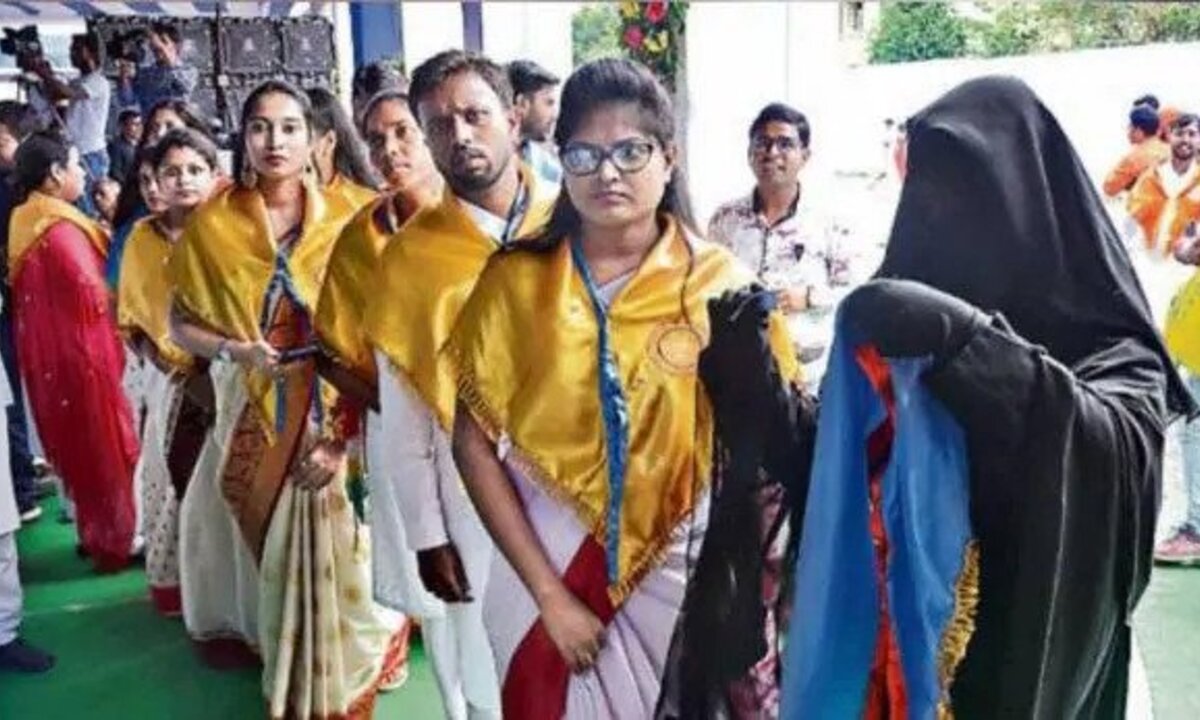
Nishat Fatima, who came to Ranchi’s Marwari College to take her degree in graduation ceremony could not get it in the ceremony

NusratFatimaMPOs17sept2019

There are bizarre rules being made about clothes in colleges these days. Recently, a girls college in Hyderabad made a strange rule for wearing suits, now a case of a college in Jharkhand has come up in which a student was not given a degree as she was wearing a burqa.

As per reports,  the over-all best graduate Nishat Fatima, who came to Ranchi’s Marwari College to take her degree in graduation ceremony could not get it in the ceremony on Sunday.

Nishat Fatima came wearing a burqa to attend the program. Her name was called for the gold medal at the ceremony as she had to take the medal first.

However, at the same time, it was announced that she was not in the dress code fixed by the college, due to which she could not be given a degree in the ceremony. After which the process of awarding medals and degrees to other toppers was started. Despite the dress code being fixed, Nishat’s father Muhammad Ikramul Haq said that the burqa is included in their tradition.

The dress code was decided by the college in which the male student had to come in a white colored kurta pajama and the female students in a salwar-suit, scarf or sari blouse. For this, the college had already issued a notice.

source: http://www.newsd.com / Newsd. / Home> Beyond Metros> Jharkhand / by Newsd / September 16th, 2019

Feroz Shah Kotla or Firozabad – The 5th city of Delhi

NEW DELHI :

Feroz Shah Tughlaq (Reign 1351 – 88), the third ruler of the Tughlaq Dynasty  was embarked on a vigorous campaign of construction activity, consisting mainly of public buildings of utilitarian nature.

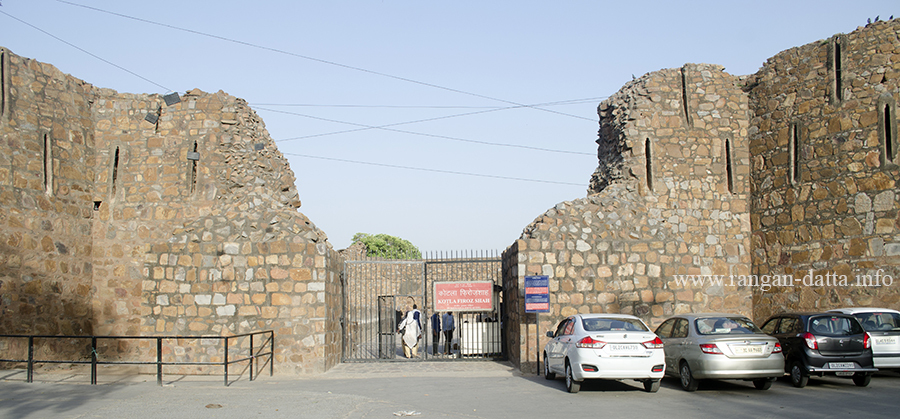
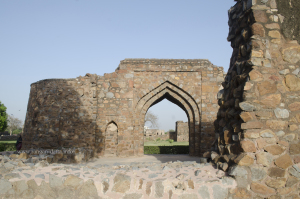
Gate of the citadel of Feroz Shah Kotla or Firozabad, Delhi

He made 1200 garden around Delhi and is credited with the erection of 200 towns, 40 mosque, 30 villages, 30 reserviors, 50 dams, 100 hospitals, 100 public baths and 150 bridges

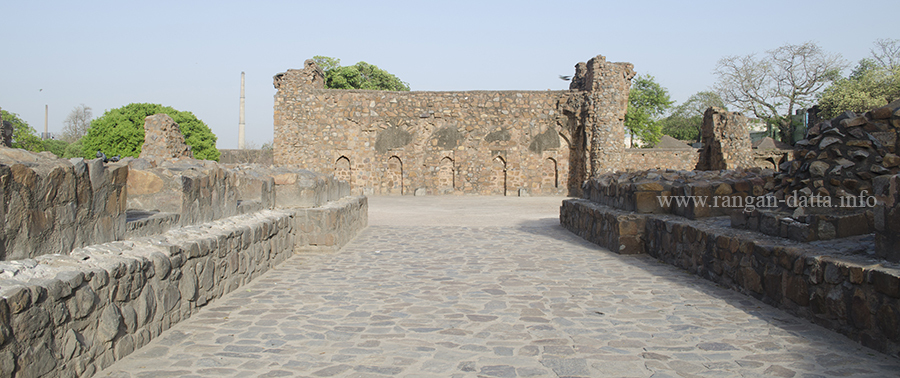
Passageway leading to the interiors of Feroz Shah Kotla or Firozabad, Delhi

In 1354 Feroze Shah Tughlaq built Feroz Shah Kotla or Firozabad, the fifth citadel of Delhi. His predecessors Ghiyasuddin Tughlaq (Reign: 1321 -25) and Muhammad bin Tughluq (Reign: 1324 – 51) has the credit of erecting the third and fourth citadel of Delhi.

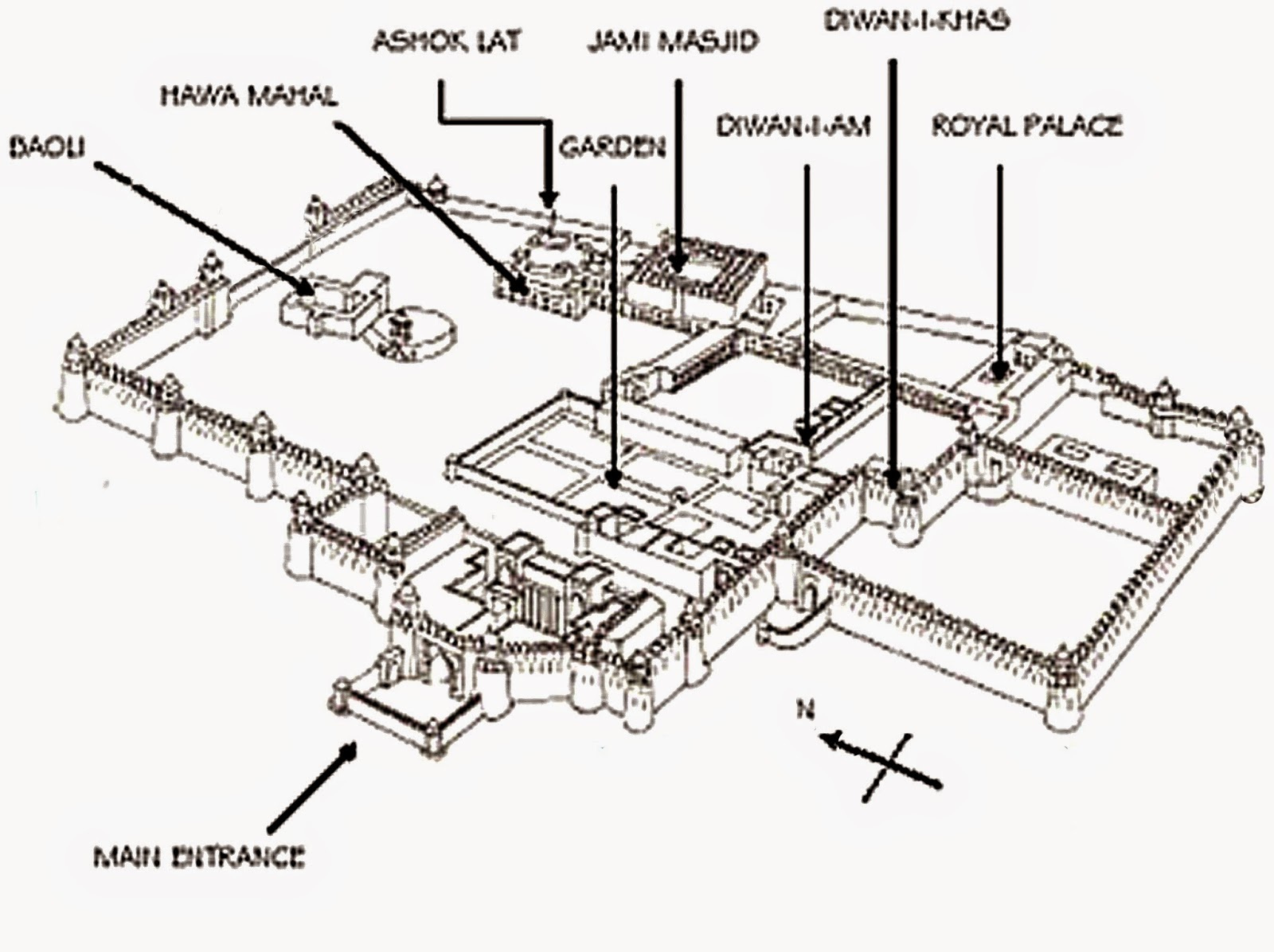
Plan of Feroz Shah Kotla or Firozabad (Source: http://www.pixels-memories.blogspot.in)

Tughlaqbad, the third citadel of Delhi, along with Jahanpanah, the fourth citadel of Delhi were abandoned  because of acute water shortage. This lead Feroze Shah Tughlaq to move further north and to construct its citadel along the west bank of Yamuna River.

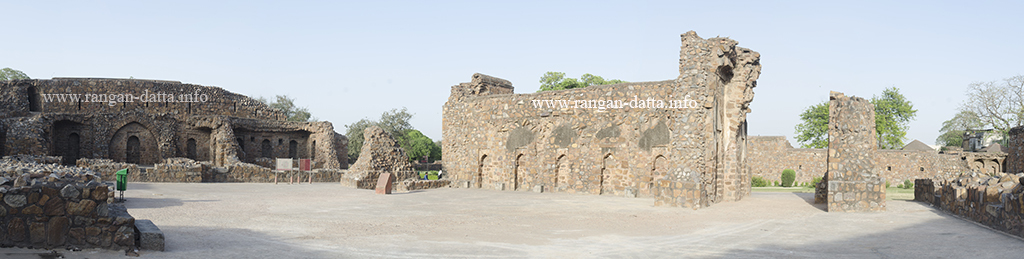
Panoramic view of the ruins of Feroz Shah Kotla or Firozabad, Delhi

Unlike Tuglaqabad, Feroz Shah Kotla lacked the defensive construction and after the collapse of the Tuglaq empire the Mongol invader Timur found it an easy target. In 1398 Timur gladly carried out all the riches of the citadel leaving behind the ruined rubble structures, which was again plundered and reused by Shahjahan (Reign AD 1627-57) for the construction of Shahjanabad, the seventh and last ancient citadel of Delhi.

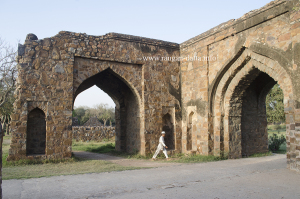
An arched gateway, Feroz Shah Kotla, Delhi

Despite being plundered by several rulers in the past and with centuries of neglect Feroz Shah Kotla still houses several interesting ruins, although minimalistic in nature, they still reveal the former glory and splendor of the ancient citadel.

Today the ruins of Feroz Shah Kotla nestles between the cricket stadium, of the same name, and the Ring Road. Every Thursday thousand of visitors visit the ruins of the ancient citadel.

Strangely these visitors are not history or heritage enthusiasts but are devotees looking for the blessings of Djinns, who according to legend are residents of the ruins of Feroz Shah Kotla. No wonder Delhi has always been a “City of Djinns.

Djinns live in the heart of Delhi: they are spirits tending to the faithful seeking help. On Thursdays, they are busy when thousands turn up with letters for them.

A kid makes his way through the arched gateways of Feroz Shah Kotla, Delhi

Every Thursday hordes of devotees, irrespective of religion, visit the ruins of Feroz Shah Kotla with photocopies of letters, citing there problems. They stick the letters on different strategic spots of the citadel and offer prayers to the Djinns.

Strangely the concept of letters to the Djinns has only been an recent concept in the ancient citadel, which dates back to the 14th century.

The first records of people coming to Firoz Shah Kotla in large numbers began shortly after the emergency of 1977.

It was only in 1977, a few months after the end of the Emergency, that we have the first record of people starting to come to Firoz Shah Kotla in large numbers. This seems significant, given how destructive the Emergency was for the Old City and how many poor and working class people were displaced from the Old City to resettlement colonies across the river

Anand Vivek Taneja, Anthropologist

Ruined structures of Feroz Shah Kotla, Delhi

Even on other days large groups of Muslim devotes visit Feroz Shah Kotla to offer their Namaz at the Jami Masjid, one of the few structures of the citadel that have remained, more or less, intact to this day.

Designed by Feroz Shah Tughlaq’s state architects Malik Ghazi Samana and Abdul Haq the citadel of Feroz Shah Kotla follows a rectangular plan with dimensions 800 m by 400 m, with the longer side along the north – south axis.

The entire citadel is encased  within a high stone wall. Although the walls look solid but it lacks the massive bastions of Tuglaqabad. The entrance is through a small and simple gateway on the eastern side and a broad passageway leads to the scattered ruins of Feroz Shah Kotla or Ferozabad

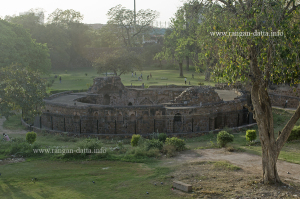
Circular Baoli (Stepwell) at Feroz Shah Kotla

Most of the buildings within the citadel are made of rubble masonry covered with heavy plaster and without any surface ornamentation.

The passages leads to series of scattered ruins, which was once part of the citadel’s garden.

It leads further to the Diwan – i – Am (hall of audience) and Diwan – i – Khas (hall of private audience).

A few pavilions and archways are all that remains today of the famed halls of audience of Feroz Shah Tughlaq. The Royal Palace located at the far end of the citadel lies in similar ruined condition.

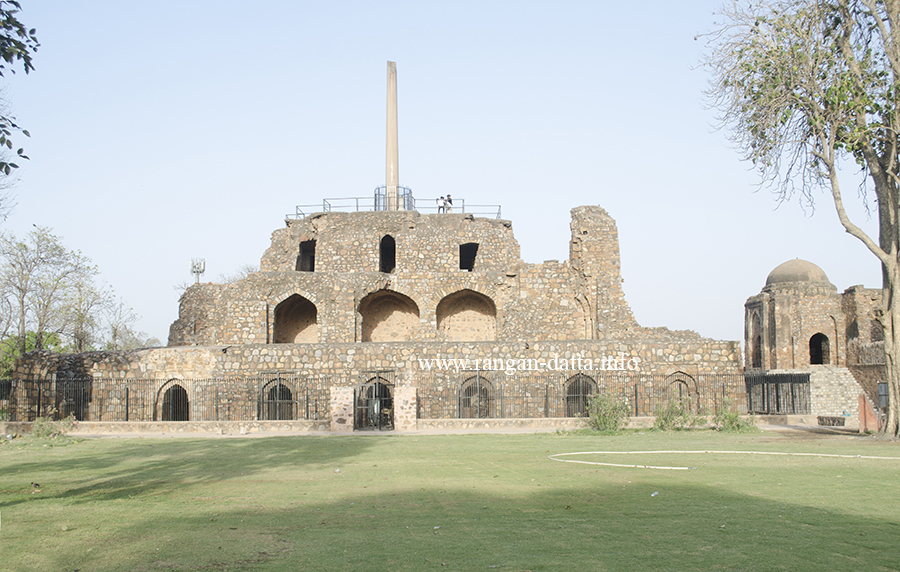
Stepped pyramidal structure, crowned with the Ashokan Pillar, Feroz Shah Kotla, Delhi

The more intact and interesting structures of Feroz Shah Kotla are located on its northern side. Towering above the lawns is the massive Jami Masjid and towards its left is the stepped pyramidal structure, known as the Hawa Mahal or Kushk-i-Shikar. It is crowned with the Ashokan Pillar, also referred as the Minar-e-Zarreen.

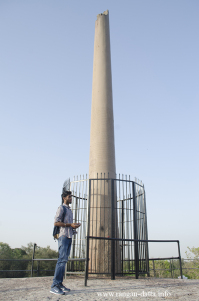
Ashokan Pillar, Feroz Shah Kotla

Just in front of the stepped pyramidal structure is a baoli (stepwell).

Delhi is no stranger to Baolis and even a century ago more than a hundred of them existed in Delhi.

Inscription on Ashokan Pillar

Today more than a dozen remains (Also see: Baolis of Delhi) but what makes the Feroz Shah Kotla baoli unique is its circular shape. It is the only circular baoli in Delhi. Sadly the baoli is kept under lock and key and the interiors are out of reach for the common tourist. But the baoli is best viewed from the differnt levels of the nearby stepped pyramid.

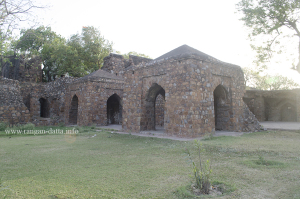
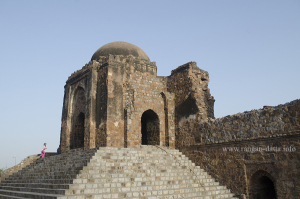
Domed Pavilion at the entrance of Jami Masjid

The Hawa Mahal is a three tired stepped pyramid with diminishing floors. Built with a central solid core and vaulted cells around it. Stairs at the comers lead to the uppermost terrace where the Ashokan pillar is planted.

The Ashokan Pillar was shifted from Topar in Ambala by Feroz Shah Tughlaq and placed atop the Hawa Mahal.

The 13 m high 27 ton pillar was shifted on a custom built 42 wheel carriage operated by 8400 men, which transported it to the banks of Yamuna River. From where it was transported by boat to Feroz Shah Kotla in Delhi

Incidentally Delhi contains another Ashokan Pillar, which was also shifted by Feroz Shah Tughlaq and placed near his hunting lodge on Delhi’s North Ridge, also known as the Kamala Nehru Ridge. (Also see: Historical Trail along Delhi’s North Ridge)

Tanks, along Jami Masjid, for ritual wash

The structure is open to public and one can take the stairs all the way to the base of the pillar. The pillar still maintains its shining police and the inscriptions in Prakrit are clearly visible.

According to popular belief  Laat (pillar) Waale Baba, the chief of the Kotla djinns, dwells in the Ashokan Pillar, which is also referred to as the Minar-e-Zarreen. Every Thursdaay devotees ties up their wish letters on the railing surmounting the Ashokan Pillar.

The top story of the Hawa Mahal offers grand bird eye view of the circular baoli (stepwell) and also the Jami Masjid, which lies on its southern side.

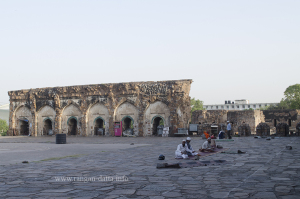
Namaz being offered at the Jami Masjid, Feroz Shah Kotla, Delhi

South of the Hawa Mahal lies the gigantic mosqque of Feroz Shah Kotla, the Jami Masjid. Built of Delhi quartzite stone. During the time of its construction it was the largest mosque in India.

The mosque rests on a series of cells on the ground floor and is approachable by a long flight of stairs leading to a domed pavilion gateway on the northern side. The grand dome pavilion, which once stood at the centre of courtyard has long vanished.

Even Taimur, who plundered Feroz  Shah Kotla, was so impressed with the mosque that he commissioned a similar one in his capital Samarkhand. Even Shah Jahan constructed a underground tunnel connecting the Jami Masjid to his newly constructed citadel of Shahjanabad. The tunnel still exist but is sealed for obvious reasons.

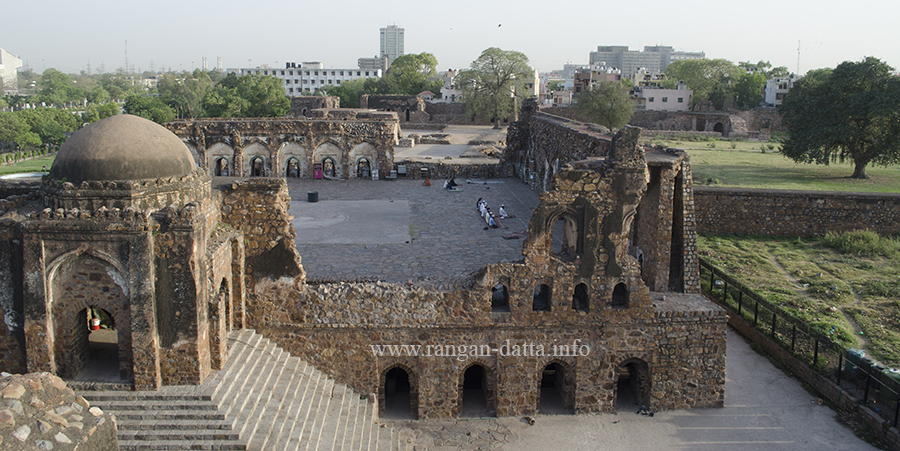
Grand view of the Jami Masjid, from Hawa Mahal, Feroz Shah Kotla or Firozabad, Delhi

Strangely the Jami Masjid is still an active mosque and attracts thousand of devotees during the time of eid. Even on normal days large groups of local Muslims along with Muslim office staff from nearby offices drop in for there daily namaz.

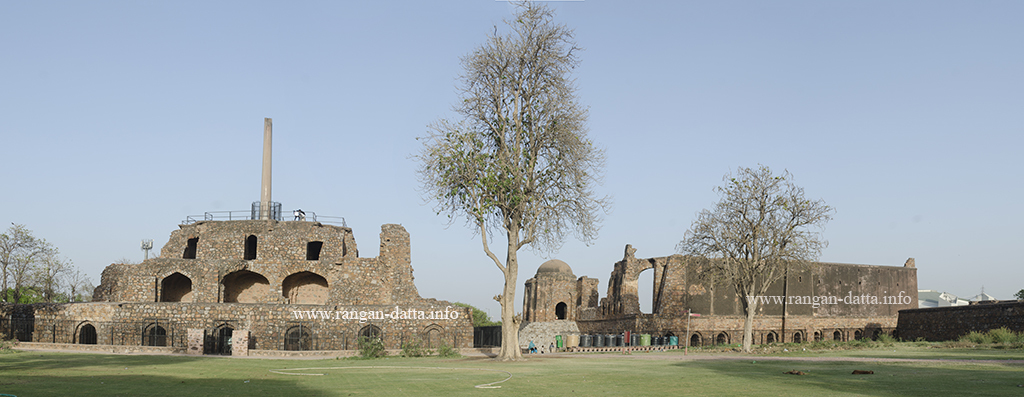
Panoramic view of Stepped Pyramid Structure and Jami Masjid, Feroz Shah Kotla or Firozabad

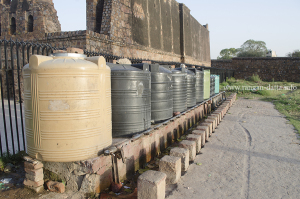
Colourfull plastic tanks, along the eastern wall of the ancient mosque, serve as a makeshift ritual wash (wudu) area for the devotees, who drop in to offer namaz.

Just outside the citadel of Firozabad or Feroz Shah Kotla, on a road divider lies the notorious gateway of Khooni Darwaza.

source: http://www.rangandatta.wordpress.com / Rangan Datta – Travel Writer & Photographer / September 30th, 2017

‘Undaunted: Lt. Ummer Fayaz of Kashmir’: A tribute in words to an officer from Shopian

Shopian District (South Kashmir) , JAMMU & KASHMIR :

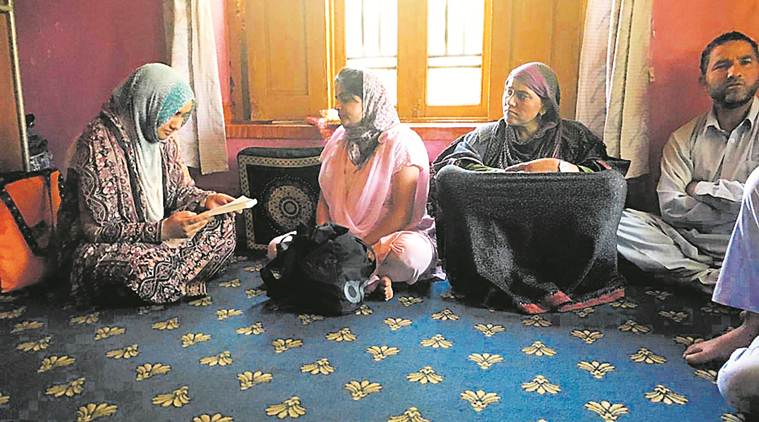
When the author asked Ummer’s schoolmates whether they would want to be like Lt. Ummer Fayaz, they said no. ‘’Ma’am he joined the army, the society here does not accept him and some who don’t even consider him a Kashmiri.’’

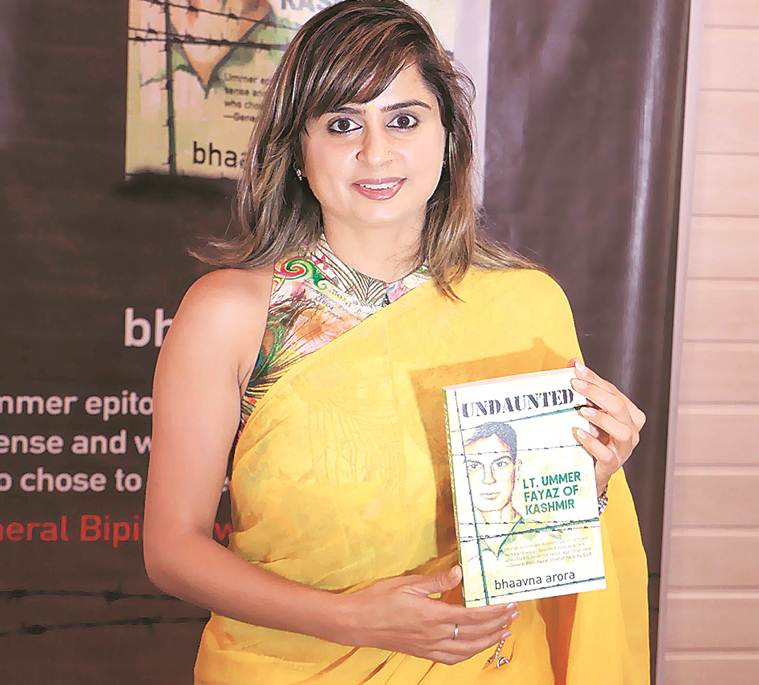
‘Undaunted: Lt. Ummer Fayaz of Kashmir’: A tribute in words to an officer from ShopianBhawan Arora with her book at Chandigarh Press club
“Musrat is my sister, mama. If I don’t come for her wedding, what sort of brother am I? And for how long will I run, Mama? Kashmir is my home. With all of you there, can I stay away forever?” These were the words of Lt. Ummer Fayaz, when his family, fearful for his life, was urging him not to come home, weeks before he was killed by militants on 9 May 2017.

‘Undaunted: Lt. Ummer Fayaz of Kashmir’ by Bhaavna Arora, chronicles his life. The 232-page book took the author two years during which she visited Ummer’s family and met a large number of people who knew him.

Lt. Ummer was born on 8 June 1994, to an apple  orchardist of South Kashmir’s Shopian district. He was abducted by veiled gunmen at 8.00 pm from his maternal uncle’s house on 8 May 2017 where he was attending the wedding of his cousin sister Musrat. His body drenched in blood was found at Herman Chowk of Shopian the next morning.

“Three men with scarves covering their face and shawls around their bodies swiftly entered through the front door of the house. They climbed the stairs and threw open the door of the room that Ummer was sitting in and asked, Are you Ummer Fayaz? Yes, I am, Ummer replied. Come with us, one of the veiled man commanded,” writes the book.
The book brings to life the high-spirited youngster, right from his childhood days. ‘’One day, a child from the Ummer’s class lost his geometry box. The teacher called all the students and asked them to swear by the holy Quran that they had not stolen it. One by one the students did and when it was Ummer’s turn, he took one look at the book and said, ‘Sir, this this is a dictionary, not the Quran.’ After that the teacher informed his father of his son’s cheekiness. His father gave him a dressing down, but was secretly pleased that his son had spotted what the entire class had missed.’’

Bhaavna Arora said he was also a very wam-hearted and friendly young man .

‘Undaunted: Lt. Ummer Fayaz of Kashmir’: A tribute in words to an officer from ShopianBhawan Arora with Ummer’s famil

“At the National Defence Academy (NDA), he was the first to seek permission from instructors for offering Friday prayers; from then on every Friday Muslim soldiers are allowed to pray even during trainings,” she said.

Piecing together the life of the young officer turned out to be an emotionally charged journey. Bhaavna said, ‘’It is not easy to meet a family that has lost a son. When I first met his sister Asmat, we cried for half an hour. She asked me what does your brother do, and I had no answer.’’

Ummer was 11 when he joined Jawahar Navodaya Vidyalaya (JNV) in Anantnag district. The author recounts in the book how she was bombarded by questions from his schoolmates at JNV Anantnag. ‘’Students were eager to know if I was on their side. They asked me why I was there. When I told them whether they knew Lt. Ummer Fayaz, they said, ‘Yes, ma’am, he was our senior’.’’

When she asked them whether they would want to be like Lt. Ummer Fayaz, they said no. ‘’Ma’am he joined the army, the society here does not accept him and some who don’t even consider him a Kashmiri.’’

Once on his way home from Khodwani to Kulgam he was stopped by Army soldiers near Kulgam. They wanted to inspect his bag but he refused to let them do so. Ummer was trying to free himself from the grip of the soldier but failed. When the soldier could not control him anymore, he slapped Ummer, and he cried. Later, Ummer asked him whether he would let him go if he did not find anything in the bag. The soldier said, of course, and asked him what he wanted to become when he grew up. ‘’Someone like you. How can I become like you?’’, Ummer asked the soldier. When the soldier asked him what was so special about him, Ummer said, ‘’You are not like other soldiers who beat and torture my friends.’’

Before Ummer left the camp, the officer said to him, if you want to be an officer like me, join the National Defence Academy when you complete your Class XII.

Ummer reported at National Defence Academy, Pune, on December 30. Bhaavna Arora, who comes from an Army family, says it was Lt Fayaz’s coursemate who asked her to wrote the book. ‘’They wanted him to be immortalised in words.’’

Arora has in the past written three works of fiction. Her first book ‘The Deliberate Sinner’ revolves around infidelity.

source: http://www.indianexpress.com / The Indian Express / Home> India / by Dar Ovais / Chandigarh – March 29th, 2019