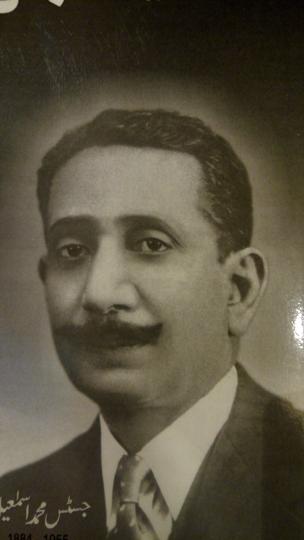
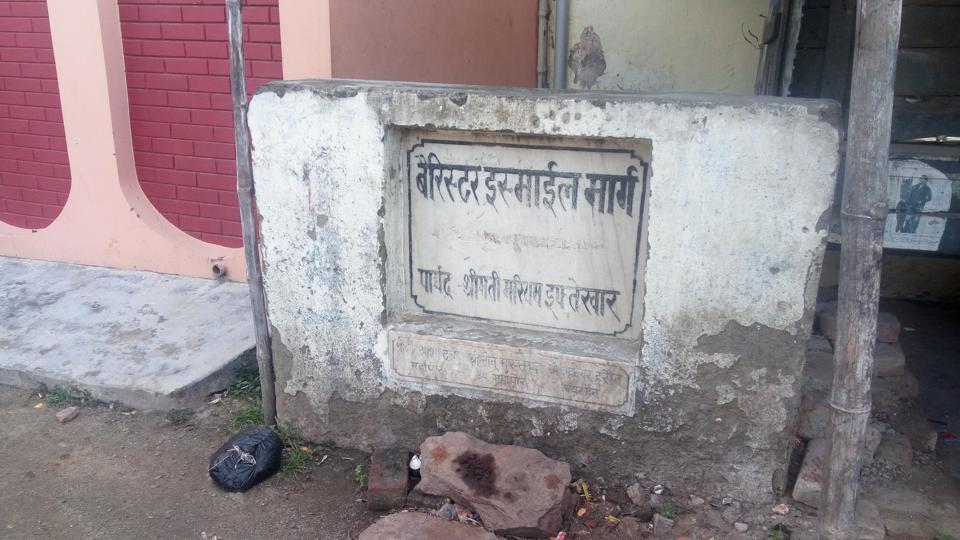
An old, white building located in Unchwa area and a road named after him are just a few markers left to remind posterity of justice Mohammad Ismail, who agreed to serve as Pakistan’s first high commissioner in India but on the condition that he would discharge his duties as an Indian citizen.
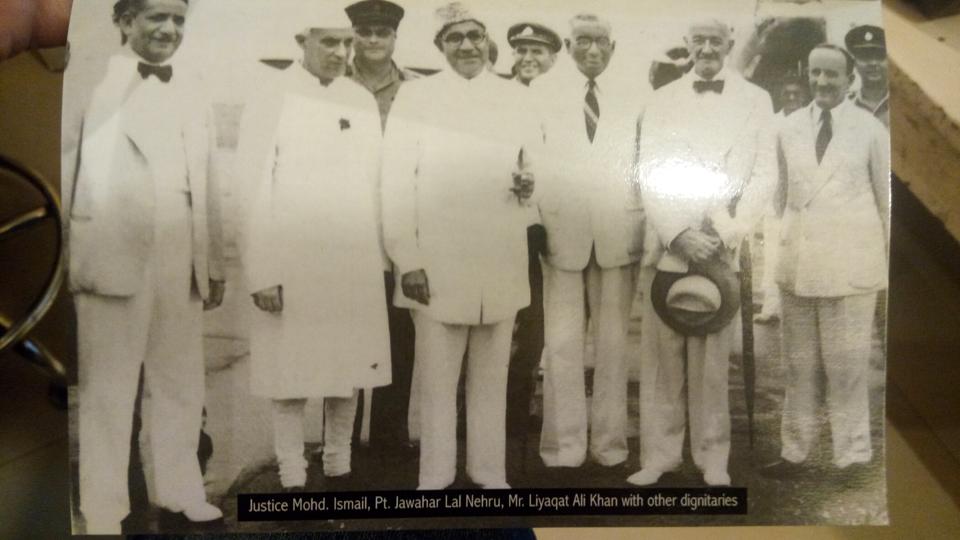
Pakistan PM Liaquat Ali Khan insisted that justice Ismail serve as high commissioner but the offer was only accepted when Indian PM Jawahar Lal Nehru and his Pakistan counterpart agreed to accept the condition, which showed the immense love of justice Ismail towards his country.
Born in Gorakhpur in 1844, justice Ismail, also held several eminent posts including Chairman of Gorakhpur Municipal Board between 1915 to 1932, besides acting as government pleader.
“Yes, justice Ismail was the first High commissioner of Pakistan in India. Those days, instead of embassies there were offices of the high commissioner in all Commonwealth countries,” explained DDU Gorakhpur University Modern History professor Chandra Bhushan Ankur.
The road named after justice Ismail
Justice Ismail’s nephew and city-based physician, Aziz, who has preserved rare photographs of justice Ismail with dignitaries including Nehru, Sarojni Naidu, and others, said “Since Ismail was well known to leaders of both countries, the Pakistan government approached him to take charge as Pakistan’s high commissioner in Delhi. Considering the prevailing situation in the subcontinent after partition, he agreed to function as their high commissioner on condition that he shall not relinquish his Indian citizenship and the proposal was accepted by both countries and he remained the sole example in international diplomatic history to have acted as High commissioner of one country while being the citizen of another.
“It’s important to note that after his tenure came to end, Pakistan further proposed his name as its representative in the United Nations but justice Ismail declined the offer as it would again require him accept Pakistani citizenship, which he didn’t like. He loved his motherland so he declined the offer and came back to Gorakhpur in 1953. He died in Unnao and was buried in Gorakhpur.”
Justice Imail , Pt Jawahar Lal Nehru and Pakistan PM Liaquat Ali Khan
Aziz further said: “It was then during this period that Ismail managed the affairs of refugees for the safe passage and was instrumental in bringing together the PMs of both countries to pen the Nehru-Liaquat Pact, a bilateral treaty which allowed refugees to return and dispose of their property, abducted women and looted property to be returned and most importantly guaranteeing the rights of minorities.
In 1922, during the freedom movement, when Nehru was arrested from Gorakhpur, justice Ismail as government prosecutor politely refused to pursue the case against the latter, citing his close relationship with the Nehru family. Years later, when Nehru Became PM, he proposed to name Lal Diggi Park after justice Ismail but that couldn’t happen.
Justice Ismail completed his graduation from Anglo Oriental College, which later become Aligarh Muslim University, before moving to England to earn a degree of Barrister from Lincoln’s Inc. On returning to India around 1915, he started practising in court and later rose to become government advocate in the Allahabad high court and then acted as Chief Judge in central India with headquarters in Raigarh.
source: http://www.hindustantimes.com / HindustanTimes / Home> India> Cities / by Abdul Jadid / August 14th, 2019
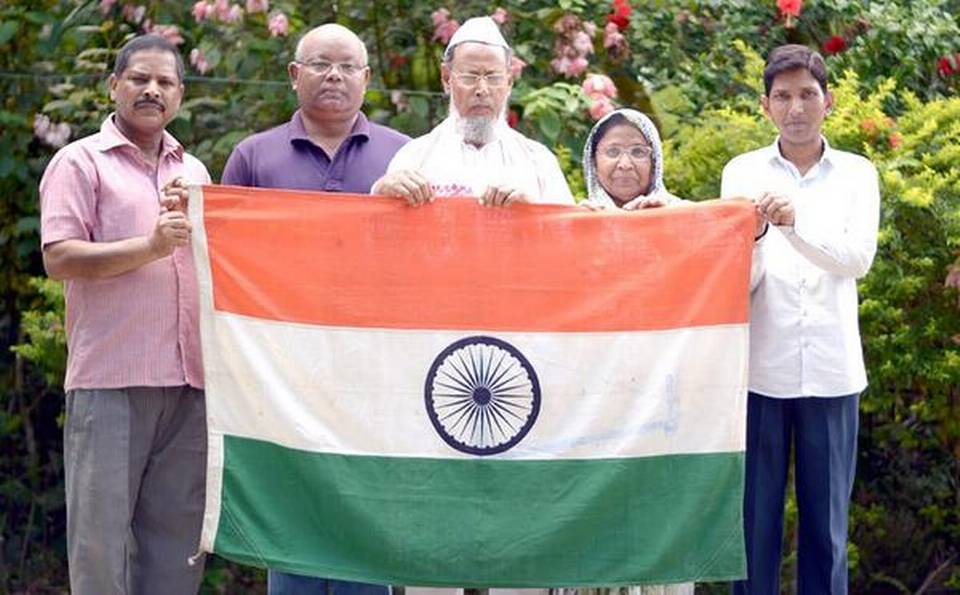
Khadi flag was specially made in 1947 after it was clear that the British were leaving
Nurul Hussain had intended to display his father’s most prized possession — a khadi Tricolour of 1947 vintage — to mark India’s 75th Independence Day.
But friends and neighbours in Sivasagar district’s Demow town, about 380 km east of Guwahati, advised him not to wait that long. He agreed to unfurl the National Flag on Thursday.
“They have a point. I am 78 and the only survivor among Mohammed Hussain’s five sons,” he said.
Mohammed Hussain spent the later part of his life as a cleric. Locals, however, knew him more as Commander Sahib than a maulvi. “He had sown the seeds of revolt against the British in this part. People gradually began to call him Commander Sahib. The British were so angry with his rebellion that they confiscated 47 ‘bighas’ of land he owned,” Mr. Hussain told The Hindu from Demow.
After Commander Sahib died in 1971, his youngest son took over the responsibility of preserving what his father referred to as his treasure box.
More than a flag
“The box contains much more than the spotless khadi flag. There are records pertaining to his joining the freedom movement under Mahatma Gandhi, his joining the Indian National Congress and assorted items associated with many a great leader,” said Mr. Hussain, who was the founder-teacher of the Demow Town High School in 1970.
The flag was specially made in 1947 after it became clear that the British were leaving India. The records, Mr. Hussain said, trace the history of the movement in eastern Assam from 1938 to 1947, including the Quit India movement.
Many among the town’s 30,000 people will turn up at the courtyard of the Hussain house for the unfurling of the flag at 7 a.m.
“Everybody knows Commander Sahib’s house. Many of us will be there for the unfurling to see a 72-year-old National Flag, neatly preserved, being hoisted for the first time since 1947,” said Umesh Chetia, a local resident.
source: http://www.thehindu.com / The Hindu / Home> News> States> Other States / by Rahul Karmakar / Guwahati – August 15th, 2019
Around 50 residents of Kodagu’s Goodugadde village were stranded in their flooded homes on Friday morning.
Around 50 residents of Kodagu’s Goodugadde village were stranded in their flooded homes on Friday morning, hoping that help would come before the river Cauvery would take away their lives.
Luckily for Goodugadde’s residents, help came in the form of eight Good Samaritans, who ferried them to safe places through small iron-made coracles.
Mustafa, a 32-year-old activist from Kodagu, suspected that people were stranded in Goodugadde and other villages along the banks of the Cauvery river. Mustafa had heard from the local grapevine that many people had not left their homes despite a flood warning.
At around 6 am on Friday, Mustafa and his friends Ranjith Kumar, Afzal, Iliyas, Shafiq and four others from Siddapura, were anxious as the Dubbare Rafting Team was busy with rescue elsewhere.
Mustafa and his friends rushed to the Siddapura Police Station and requested the police to lend them the iron-made coracle lookalikes that the police had kept in the evidence room, which they had seized when they busted an illegal sand mining ring.
“We call it thappe in Kannada. They are circular, iron made vessels sand miners use to transport sand. It’s smaller than a coracle but bigger than the round vessels used to carry sand in construction sites. We wanted those so we could row it and look for stranded people,” Mustafa explains.
When the group reached Goodugadde, they found several senior citizens, children and middle aged people stranded in their flooded homes. Many were sitting on their rooftops, while some of them clung to trees, waiting for help.
“There were about 50 people. We began rescue at 7am and it went on till 11 am. We lost count of the number of trips we made to bring all of them to safety. They were sent to relief camps in Siddapura. By 12 pm, the Dubbare Rafting Team came to help us and we continued rescue operations in Baradi and Kakkattagadu villages,” Ranjith Kumar says.
Mustafa, Ranjith and the team of local rescuers claim that they are experienced swimmers and that they had volunteered during rescue operations in the floods that hit Kodagu in 2018.
“We have lived along the banks of river Cauvery all our lives. We have a very close relationship with the river and swimming is the first thing we learnt as children. We are expert swimmers and if our skill could be put to use to help people in need, then it’s our duty to help them. What is the point of being an expert at something and not helping those who could benefit from it?” Mustafa says.
Mustafa and his motley crew continue their rescue operations even now. “We will help as much as we can. Our people have seen too much damage due to rains and floods. Currently, we are going back and forth Goodugadde and recovering their belongings,” Mustafa adds.
source: http://www.thenewsminute.com / The News Minute / Home> Karnataka Floods / by Theja Ram / August 10th, 2019
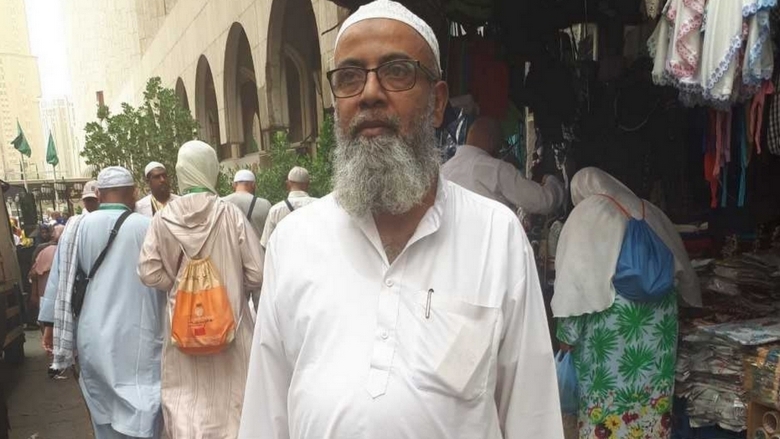
Taqiullah Khan leads at least five Umrah groups to the holy city every year (Photograph: Sahim Salim / Khaleej Times )
62-year-old Taqiullah Khan has also performed Umrah an epic 126 times.
Indian national Taqiullah Khan performed Haj for the first time in 1994. The Bengaluru resident, now 62, has undertaken the journey 25 times in as many years ever since.
Khan is now back in Makkah to perform his 26th Haj.
Khan has also performed the lesser pilgrimage, Umrah, an epic 126 times!
For most Muslims, the holy journey is a once-in-a-lifetime experience due to the costs, difficulties and sacrifices involved. For Khan, it’s an annual affair, thanks to his tours and travels company.
“I have been coming here so many times that I know Makkah and Madina better than Bengaluru,” he quipped.
The first Haj
Interestingly, Khan’s mother had “predicted” that Haj would become an annual journey for him.
A year before he went for his first Haj, he had sent his parents for the journey in 1993.
“I requested that they pray for me to be able to visit the blessed land. When my mother came back, she told she had made this particular dua (supplication) so much that she believed I would perform Haj every year.”
Just like his mother predicted, Khan’s journey began in 1994. “I went as a Haji (pilgrim) like any other Muslim back then. I went back again the next year with my wife.”
He founded Tawakkul Tours and Travels in 1996 and applied for the Haj quota. He has been coming as a Haj guide ever since.
The father of three doesn’t necessarily have to come to the holy city along with the groups that his firm is responsible for. “For me, this is an honour from Allah and I wouldn’t miss it for the world. Most people consider themselves lucky if they are able to undertake the journey once in their lifetime. Allah has blessed me to perform Haj every year.”
Khan also leads at least five Umrah groups to the holy city every year.
He holds something called the Munazzam licence, which is granted to Haj organisers. “So you see, Allah has blessed me so much that this is actually my bread and butter, too.”
The Indian’s wife and two of their three children are Hajis as well.
The ‘missed’ Haj
Khan has just missed the Haj of 1999 since 1994. He had suffered a motorbike accident and his doctor asked him to avoid undertaking the arduous journey.
“But I have still performed Haj 25 times in 25 Gregorian years because I was lucky enough to get two pilgrimages in 1996.”
That year, Dhul Hijjah – the Islamic calendar month in which the journey is undertaken – came twice in 1996: January and December.
Preparations
Khan’s company gets a quota of 100 pilgrims every year. “This time, our quota increased by seven, Alhamdulillah.”
Khan said he starts preparing for the Haj season as soon the fasting month of Ramadan ends. “That’s when the government of India announces the Haj quotas.”
Khan’s biggest strength is his family. “They have been very supportive of my endeavours. Not once have they asked me to depute someone else to lead the groups since they, too, believe that this is an honour.”
Safety guaranteed
Khan is most impressed with the way the annual pilgrimage is organised.
“In the 25 years I have been leading Haj groups, not once have I heard a Haja (female pilgrim) complain about harassment. Not once has anyone complained about robberies or any serious crimes.
“It is amazing how the government manages to organise all this so efficiently year after year despite receiving in excess of two million pilgrims.”
Most memorable Haj
Though Khan maintained that each of his 25 pilgrimages was special, his first Haj in 1994 is the “most memorable”. “Haj season fell in the month of May. It was very hot then. But it remains the most special Haj for me. I remember every single aspect of that maiden trip. I enjoyed it.”
During the Haj of 1997, when a massive fire broke out in the tent city of Mina, Khan and his group of 60 Hajis were just 500 metres away from the tent in which a cylinder exploded. The tragedy had claimed over 200 lives.
“The police evacuated us and we managed to escape. We came back to the holy city. Thanks to the government’s efficiency, we were able to go back to Mina the very next day. That’s another Haj memory that will always remain with me.”
When asked how long he plans to continue the annual journey, pat comes the reply: “As long as my health permits, I don’t plan to give this up.”
1. Photo ban lifted: According to Takiullah Khan, photography was banned in the holy sanctuary till about a decade ago.
2. End of ‘rocket stretchers’: In the 90s, elderly or disabled pilgrims would be taken for circumambulation on a stretcher by four men, who would “speed through the crowds”. “It was a very dangerous practice and people would just move out of the way as they were afraid of getting hurt. Thank God, we have wheelchairs now,” said Khan.
3. Drinking Zamzam from the source: Till about five years ago, pilgrims could descend to the Zamzam well and drink the holy water from its source.
4. Just two ‘mataf’ areas: Masjid Al Haram has four Mataf (areas to circumambulate the Holy Kaabah) floors today. It used to be just two when Khan first went for Haj.
5. Ascending Mount Safa: Pilgrims could previously ascend the Mount Safa and look at the Holy Kaabah while praying. Today, it stands behind a glass enclosure.
source: http://www.khaleejtimes.com / Khaleej Times / Home> Region> Saudi Arabia / by Sahim Salim (reporting from Makkah) / August 08th, 2019
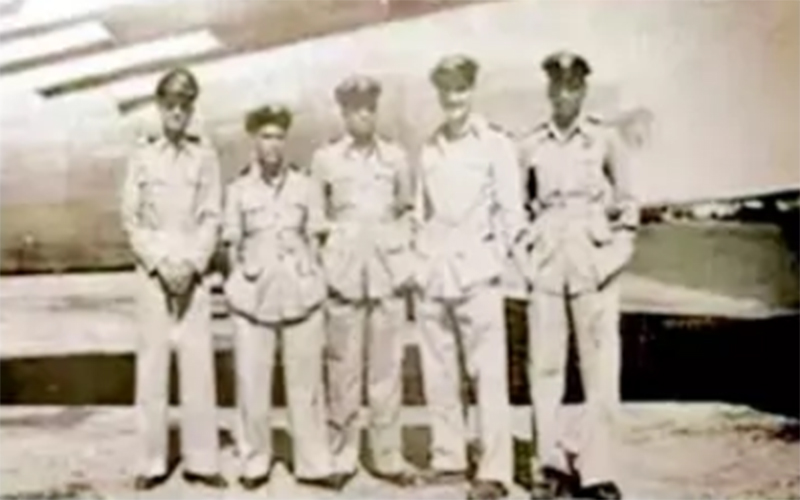
India’s first flight carrying Haj pilgrims took off from Hyderabad On 22nd October 1946. Earlier, pilgrims used to travel by a sea route for performing Haj.
According to the report published in Times of India , the first flight carried 18 Haj pilgrims. Two Deccan Airways Dakota aircrafts took off from the old airport of Hyderabad located at Begumpet in 1946 amid slogans “Allah-u-Akbar”. Khan Bahadur Nawab Ahmed Nawaz Jung was also traveling on that flight.
It may be noted that at that time, there was no flight from other Indian cities to Jeddah.
The name of the pilot who took off the first flight was Captain Cox and his junior was Munshi. The technical support was provided by Nasir, Radio Officer and Lord, Flight Engineer.
It may be mentioned that Deccan Airways was the leading airlines at that time. In 1948, the flights of Deccan Airways were discontinued due to uncertain political situation in erstwhile Hyderabad State. It was again started in 1949 after the Police Action.
source: http://www.siasat.com / The Siasat Daily / Home> News> Hyderabad / posted by Sameer / August 08th, 2019
Karnataka’s BJP govt has cancelled Tipu Jayanti, celebrating a ruler once hailed for his bravery and genius, but seen by the right wing as a bigot. We must reexamine Tipu Sultan.
The BJP government in Karnataka has done away with Tipu Sultan celebrations. But, as it is vital to remember Tipu Sultan, in this first-part series, I lead you into the life of Tipu Sultan, the ruler of Mysore.
The recent efforts of the Hindu right to project him as a Muslim bigot show that their political stakes in him have changed.
Any opinion on the rule of Tipu Sultan in Mysore will in fact be incomplete without mention of the political situation prevailing in and around Mysore towards the end of the 18th century. Mysore, which had emerged from the ruins of the Vijayanagar empire, was moulded into a small but dynamic Hindu state primarily during the rule of Chikka Devaraja Wodeyar in the early decades of the 18th century.
The Wodiyar kings, who had been ruling Mysore for over 300 years, were only nominal rulers by then — the actual power was wielded by their prime ministers or ‘dalavai’.
Tipu’s father, Haider Ali, began his career in Mysore around 1749, as a soldier under one of these powerful ministers.
He used his tact and bravery to stave off Maratha raids into Mysore, fought against the British and expanded Mysore’s territory down south to the coast of wealthy Calicut. He thus eased himself into the title of the ‘sarvadhikari’ or ‘regent of the kingdom’ in 1760.
After Haider’s death in 1782, Tipu took over his father’s position, keeping the Wodeyar king as a proxy but publicly continuing to put on a show of respect. Tipu’s appropriation of this position would not have been possible without the assistance of some of Haider’s closest friends and advisors as well as the acquiescence of the local populace, who had by then come to see a stronger and more prosperous Mysore under Haider and the young Tipu.
From Madras, the British were cautiously observing the rise of Mysore — and resented Haider’s and Tipu’s push into Malabar.
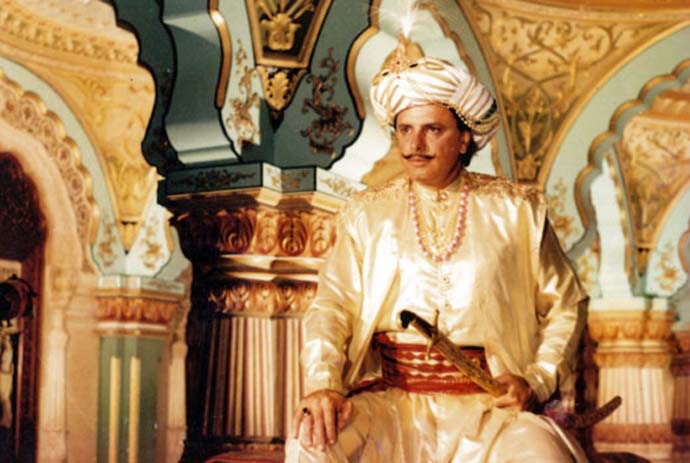
Tipu Sultan took over Mysore in 1782: He remains its most iconic ruler. (Still from The Sword of Tipu Sultan: Via Author)
A 17-year-old Tipu had given the British a fright by galloping with his army into the East India Company’s garden house near the beach in Madras.
He rattled them so much that the governor there fled offshore in a small boat. A series of four Anglo-Mysore Wars started in 1767. These propelled the hitherto unknown Kingdom of Mysore into the powder rooms of Europe and America.
The first war saw Mysore dictating terms to England at the gates of Madras; the second war was Tipu’s brightest moment. At the battle of Pollilur (1780), the sun-and-tiger-stripes banner of Tipu’s Mysore oversaw the worst disaster that ever befell an English army in India — out of 3,000 men in the British army, only about 400 survived.
With these two victories, the mood in England began to change — and a vicious propaganda and diplomatic campaign against Mysore began.
By 1785, one in seven Englishmen in India was imprisoned by Tipu. By this time, the British had won in Plassey and Buxar; the whole of India except the Punjab and the Marathas had capitulated to them. Tipu’s Mysore stood as a bulwark against the British. What rankled the British even more was that here was a native ruler — or ‘despot’, as they branded all of them — who was different from the others.
He did not while away his time in pleasure orgies, nor leave the management of state to some palace coterie; and not once did he ask the British for help against his neighbours. He created an army which, in the words of his nemesis, Arthur Wellesley (later Duke of Wellington), was “the best fighting force in the whole of India”.
He took advantage of the enmities being played out in Europe, recruited the French as willing allies and drilled his army in modern European manoeuvres.
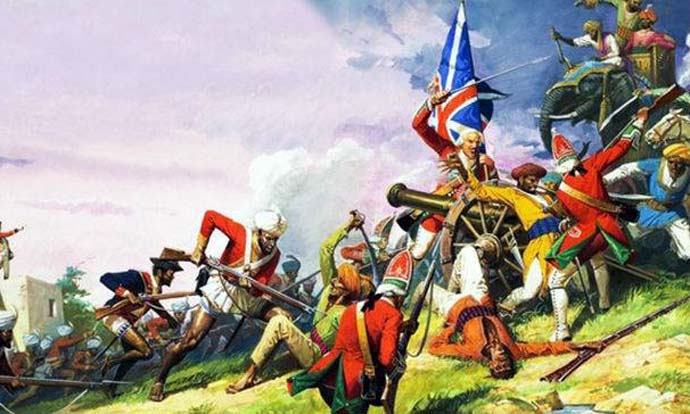
Giving It Back: Unlike several other princely states, Tipu Sultan took the British head-on in ferocious battles. (Picture: India Today)
Mysore was the first state to demonstrate the efficacy of rockets in war by modifying what was until then a mere firecracker into something that could carry a sword or wooden blade with it. Tipu even sent back French weapons with a letter stating they were substandard compared to the ones in his arsenal.
Working almost 18 hours a day, he kept meticulous records of revenue and personnel across his kingdom. He created a set of revenue regulations that rationalised land taxes — and even offered subsidies to farmers if they farmed more land. Landowners and temple trusts with excess landholding were asked to hand it over to landless or tenant farmers. He created a navy that sent ships with his diplomats to meet the Ottoman sultan in Constantinople and the French emperor in Paris. He built a powerful navy, consisting of 20 battleships of 72 cannons and 20 frigates of 62 cannons.
A separate board of admiralty was established in September 1786 and massive dockyards at Jamalabad, Wajidabad and Majidabad were constructed on the west coast to build 40 warships and a number of transport ships to strengthen the naval power. The 200-odd forts under Tipu’s reign were mostly named on Hindu script ions.
An elite group of Brahmin civil servants was nurtured during his early rule to make sure that revenue was properly collected. His forts were among the strongest in south India and his currency so beautifully minted that the Mughal emperor apparently felt slighted at receiving coins more beautiful than his own — he even minted coins with Hindu deities on them.
Deep in the midst of war, he wrote of receiving silkworms to create the silk factories of Mysore.
Sugar and paper factories were established for the first time under him. Sword blades and gunpowder were manufactured locally. He was also liberal with gifts to Hindu religious establishments in Mysore and Malabar after subduing it.
A Visionary Leader: Tipu Sultan was an extraordinary mix of courage, skill and heart. (Still from The Sword of Tipu Sultan: Via Author)
The third Anglo-Mysore war in 1792, with Cornwallis at the helm of the British army, did not go well for Tipu.
He was hard-pressed by the British-Maratha-Nizam allied powers to surrender half his kingdom, submit to a war indemnity of ₹3.3 crore — and deliver two of his sons as hostages to the British. Thanks to his financial prudence, he managed to pay the British their ransom and have his sons released a year earlier than the stipulated three years.
This period between 1792 and the fourth Mysore war in 1799 was one of great tribulation for Mysore — rebellions raged and finances were tight on account of the indemnity paid. However, it is to Tipu’s credit that not once during his rule, in the midst of almost incessant war, did his subjects suffer from famine or pestilence.
At the same time in British Bengal, millions of Indians perished in a famine…
(To be continued).
source: http://www.dailyo.in / DailyO / Home> Open To Opinion> Politics / by Sanjay Khan / August 03rd, 2019
Booklet with profiles of the women also launched on the occasion
The travelling exhibition of path-breaking Muslim women achievers of the 20th Century rolled into the city on Saturday.
Called ‘Pathbreakers’, the invitation for the event had the enigmatic photograph of Tyeba Khedive Jung who was born in 1873 in Hyderabad. Moving away from Hyderabad, she became the first woman from the city who received university education graduating from University of Madras in 1894. Tyeba Khedive Jung wrote Anwari Begum in 1905 and she even presided over the annual conference of Brahmo Samaj.
“I stumbled upon the book Anwari Begum in my mother’s library. Then I realised I have to do something to tell the story about Muslim women who came onto their own at a time when the stereotype was that of a conservative society with many problems,” said Syeda Hameed of Muslim Women’s Forum, the brain behind the exhibition. A small booklet with the profiles of the women was also launched on the occasion.
Defying stereotypes
The exhibition had a captive audience as students from the Telangana Minority Residential School students as well as students from other government schools trooped in to listen to the stories of women who defied stereotypes. “We want the children to be inspired by these women. It will give them confidence that even they can achieve anything they want. We are giving them books with stories of these women to inspire them,” said A.K. Khan advisor on Minorities Welfare, Telangana Government.
One of the inspiring stories is that of Zehra Ali Yavar Jung who studied at Mahbubia Girls School and later started the Society for Clean Cities much before Swacch Bharat Abhiyaan.
“Hyderabad is a city of Hayat Bakshi Begum. It is a city of Mah Laqa Bai Chanda who donated Rs. 1 crore to the Nizam Sikander Jah for educating women. It is great to have this exhibition of these inspiring women in the city,” said Oudesh Rani Bawa, who spoke about other women from the city who worked for women’s emancipation.
The exhibition at Salar Jung Museum will continue till August 7 between 10 a.m. and 4.30 p.m.
source: http://www.thehindu.com / The Hindu / Home> News> Cities> Hyderabad / by Special Correspondent / Hyderabad – August 04th, 2019
Shafiq ur Rahman Khan has been chosen as the winner of the coveted “Grinnell prize” for the year 2019. Notably, he is also the first Indian to receive this award in recognition of his exemplary dedication in working to safeguard the rights of vulnerable women and children.
The Grinnell College Innovator for Social Justice Prize (the Grinnell Prize) honours individuals who have demonstrated innovative leadership in their respective fields and who show creativity, commitment and extraordinary accomplishment in effecting positive social change.
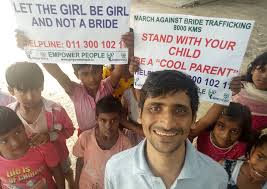
Shafiq R Khan has been honoured with the Grinnell prize for his outstanding contribution in working to eradicate the Indian bride trafficking trade (the selling of women into often multiple forced marriages) and further empowering the agency and leadership of survivors. He has risen above the norm and worked single-mindedly for the cause of rescuing girls who fall victim to “bride trafficking.” His humility and passion for social welfare is worth the commendation from the Global community.
Shafiq R Khan, 35 years, hails from Gaya, Bihar. His foray in activism began at a tender age of 15 when he joined a communist party with the hope of working for the well-being of the poor. He witnessed the sorrowful plight of people entrenched in poverty and bonded labour, and the power equations that worked to ensure the divide between the rich and poor remained wide and after around four years of work, he moved away from the party because he felt called to do more and do it differently.
In 2004, he moved to Delhi to explore different ways of tackling oppression and to understand the various dynamics more keenly. He joined the Bonded labour liberation front which was at the time working against sex-selective abortions where he became part of the back office team for ‘Multipath march against Female foeticide’. Shafiq especially noted the power dynamics with regard to gender and realised how a lot of the entrenched ‘societal values’ were actually ‘enemies of women.’
He began to study the movement of feminism which helped him understand the systemic nature of women’s oppression and thus the importance of land rights for women. He took up Bachelor of Social Work (BSW) for graduation in 2006 and it was during these days, that an event set him off on his unique path that he continues to walk 13 years on, even today.
Shafiq organised a 300 km long March against Female Foeticide in 2006 with a group of friends as part of a social mobilization campaign, where he met a trafficked bride who talked about her helpless plight and asked for his help. Due to the insistence of his co-travellers to focus on the March, he continued onward unable to do much at the time. Her story and plea though remained with Shafiq and he returned a month later only to find that she had been sold off and moved forward to another man. Upon further enquiry, no trace of the woman was found. She had disappeared. It came about as a shock for him to discover how men were uninhibitedly dealing in the sale and purchase of women in broad daylight and disposing of them once their needs were met.
Seeing someone suffer at the hands of others, seeing girl children being killed in the womb, seeing girls getting sold for less than a hundred bucks and living the life of slaves—all of these instances were a good enough reason for him to sharpen his focus on the issue of human trafficking and gender inequality. This incident served as a turning point in Shafiq’s life and he returned to Delhi with a decision to do something about it. He began chalking out a plan for bringing about a much-needed change while he continued advocating for the rights of women and applied for a fellowship to further his work. Notably, he became the first male fellow of Jagori, a prominent feminist organization in Delhi.
Shafiq founded an organisation by the name of ‘EMPOWER PEOPLE’ in 2006 with an initial aim to provide alternatives to women trafficked in the name of marriage. The organisation soon began working also on the factors contributing to Bride trafficking.
While Empower People began with the support of its founding members, it began generating funds from various individuals as well as community-based organizations. This phenomenon served to shape the organisation’s unique multi-pronged approach which involved spreading awareness among people about the menace of bride trafficking and the different ways they could engage with the work thus leading them to eventually become lifelong supporters of the cause.
EMPOWER PEOPLE is based out of New Delhi, India and operates in many regions across North and East India, most notably in Haryana and Assam. Today, the organization works to support law enforcement agencies and families of trafficked brides by locating and rescuing missing girls and women. The organization carries out due follow-up through an intensive rehabilitation and tracking process that aims to ensure that the women and their ostracized children live safer, more equitable lives and do not fall prey to trafficking again.
It may happen at times that the survivors do not wish to be repatriated to their families. Some women prefer to remain where they were brought to, and for such families, EMPOWER PEOPLE develops local communities of support and solidarity among trafficked brides. Led by the trafficked women themselves and supported by EMPOWER PEOPLE, these “communes” provide trafficked brides and their children with the education, resources and the skills they need to gain independence, to access justice, to avoid future trafficking, and to encourage men to accept new ideas about equality and ways of behaving.
In addition to being CEO of EMPOWER PEOPLE, Shafiq also works to recruit male allies to the causes the organization promotes. Shafiq acknowledges that being a male places him in a privileged position to challenge patriarchy. He works to convince men of the importance of granting women power and agency and in order to change minds, behaviours and systems of oppression, Shafiq regularly organizes informal discussions with groups of village men and religious leaders to talk about issues of justice, gender equality, education, land rights, domestic violence, honour crimes, issues related to dowry, “share of daughters” in inheritance, and rights of women in general.
Shafiq with his inspiring personality stands by his concept of making people the real instrument of change through awareness and participation. He believes in developing a holistic understanding of issues related to Violence against Women and addressing the problem at its root instead of working in project-wise schemes with a limited focus. He plans to have a mass movement and an ideological campaign within the society against female foeticide and gender-based exploitation.
He organizes Marches against Bride Trafficking for awareness generation and sensitization which serve as a platform for people’s participation and as an interface between the Government/NGO/NPO officials and vulnerable communities. In 2012, he carried out a 4400 km long March covering 2 Indian States while in 2018, he carried out a 14000 km long March covering 10 Indian States- an ambitious achievement to connect various dots across the breadth of the country and to gain an understanding of cross-State ground realities. He plans to conduct more Marches across the length of the country as well. His consistent curiosity to know the pulse on the ground and his willingness to modify and strengthen his approach based on new information gathered makes him a true innovator and a change-maker to watch out for and reckon with.
The Trustees of Grinnell College have recognised Shafiq to be thoroughly deserving of the honour of being a recipient of the Grinnell College Innovator for Social Justice Prize (the Grinnell Prize) for the year for his incredibly worthy work of about 20 years. The honour will include conferring of a prize amount of $50,000 for the organisation and $50,000 for his personal use. The Grinnell Prize ceremony is scheduled to be conducted in the first week of October and will be accompanied by a series of workshops conducted by Shafiq R Khan in collaboration with the University.
source: http://www.beyoundheadlines.in / Beyound Headlines / Home> India / by Beyond Headlines News Desk / July 30th, 2019
He completed his B.Tech from Aligarh Muslim University in 2009. “This was the place where I developed myself and prepared my personality for civil service and corporate world,” he said.
Reaching the pillars of success traversing the lanes of hardship is the story of IPS Noorul Hassan. ” You may belong to any religion or caste, but if you have the determination to cross any limits by your sheer hard work, you can achieve anything”, he believes. An IPS Officer of Maharashtra cadre, he had earlier worked as a scientist in BARC for a year. Mr Hassan hails from Pilibhit, Uttar Pradesh. Overcoming the perils of privation and cracking one of the most coveted exams Noorul Hassan is definitely an inspiration for all such candidates who dream of acing the top bureaucratic exams of the country.
His preliminary education took place in Pilibhit and later the family shifted to Bareilly after his father got a group D job. Even though his father had a bachelor’s degree, due to lack of a good job, he had to continue working as a fourth grade employee.
Mr Hassan completed his B.Tech from Aligarh Muslim University in 2009. “This was the place where I developed myself and prepared my personality for civil service and corporate world,” he said. After completing his course, through which he witnessed financial constraints, he got his first job in Gurugram based company. Later he joined Bhabha Atomic Research Centre (BARC) as a Grade 1 officer.
“After completing 1 year in BARC I realized I need to start preparation as I want to contribute to the society in a better manner as well as I was not satisfied with my professional advancement. So I started preparation in the year 2012,” he said.
In 2015, he cleared the Civil Services exam conducted by the Union Public Service Commission (UPSC) and secured 625 rank.
In his message to the civil service aspirants he says, “Never get demoralize from failures. Civil service exam is the test for patience and self confidence. So fail but fail better every time. In the end you will get success.”
source: http://www.ndtv.com / NDTV / Home> Sections> Education / by Atharuddin Munne Bharti / edited by Maitree Baral / July 29th, 2019
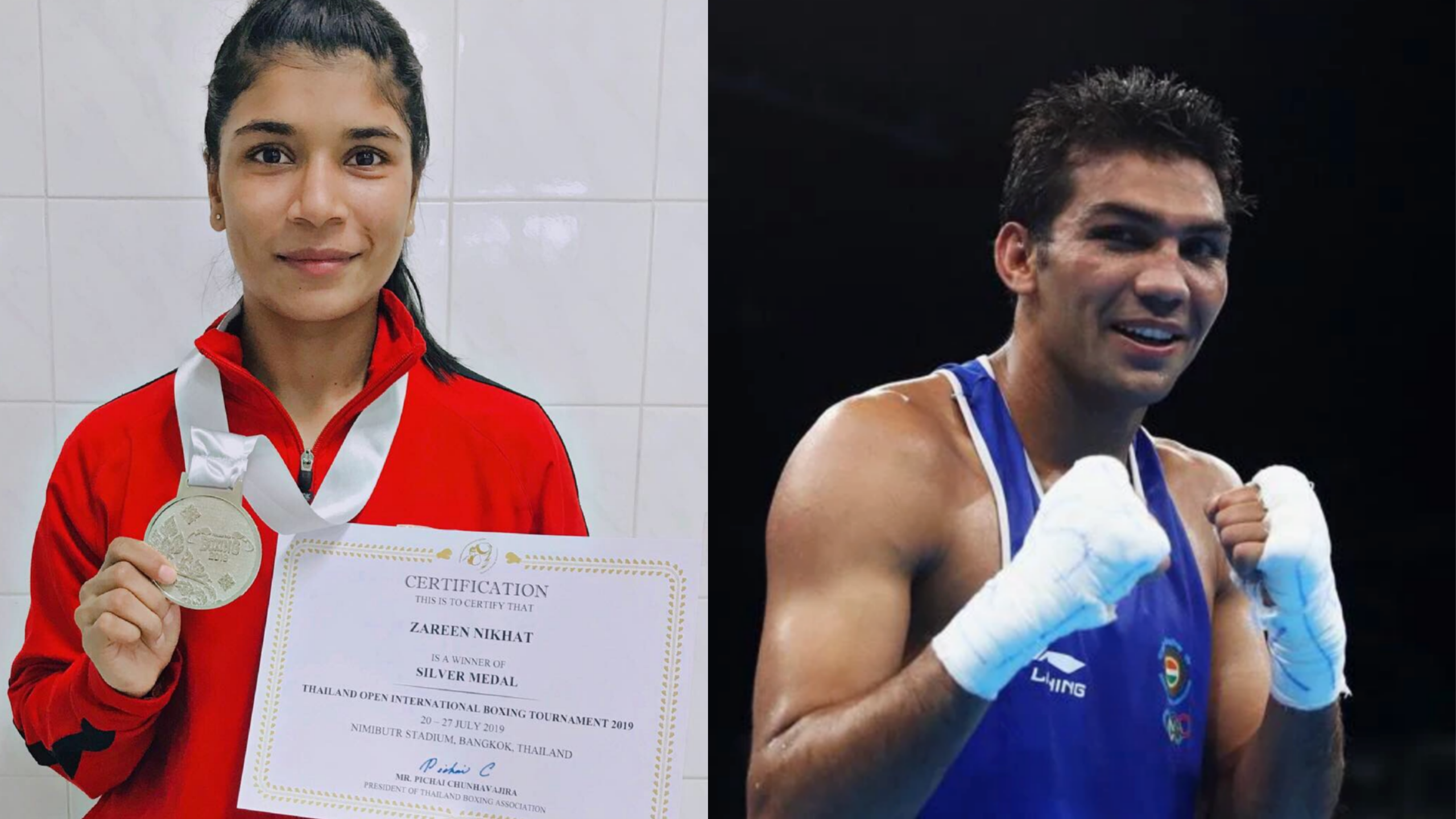
Former world junior champion Nikhat Zareen, and GeeBee Boxing silver-medallist Mohammed Hussamuddin, once again made the country proud by winning the silvermedal in the 51 kg category and 56 kg category respectively at the summit clash of the Thailand Open International Boxing Tournament on Saturday.
Nikhat, the Strandja Cup gold medallist and also the Asian Championships bronze-medallist, had to settle for silver as she lost to China’s Chang Yuan in the final.
The Chinese proved too tough for 23-year-old Nikhat and was handed a 5-0 blow. Although disappointed, the Hyderabad girl said she has learned many things which will be helpful in the world championship contest.
Nikhat took to Twitter to celebrate her commendable performance and said that she is only getting better. “Will come back fighting even stronger in the upcoming competitions. Thank you all for your continuous support! (sic),” she tweeted. Nikhat Zareen will compete with six-time world champion Mary Kom at the World Championships trials next week.
In 56kg, reigning India Open champion Chatchai Decha Butdee of Thailand continued his fine form to inflict a 5-0 defeat on Hussamuddin.
Overall, Indian boxers finished their campaign with a rich haul of eight medals at the championship.
source: http://www.thecognate.com / The Cognate / Home> News / by Shaik Zakeer Hussain / July 29th, 2019