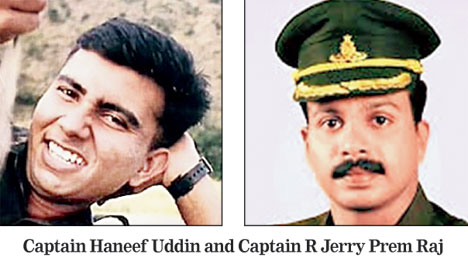
Captain Haneef Uddin was preparing to celebrate his 25th birthday at an altitude of 18,500 ft in Kargil when a bullet fell him in the summer of 1999.
Calcutta:
Captain Haneef Uddin was preparing to celebrate his 25th birthday at an altitude of 18,500ft in Kargil when a bullet fell him in the summer of 1999.
The young officer’s story of valour remains at the centre of a 13-part series on little known heroes of the Kargil war on All India Radio’s FM Rainbow station that is played out at 3pm every Sunday.
On Kargil Vijay Diwas on Thursday, Major Akhil Pratap, an ex-army officer who has been hosting the series, will have family members of 13 such unsung heroes as guests for a live-chat on AIR.
“Kargil was one of those battles which witnessed many casualties. There are several faces whose stories have remained unheard and untold despite all the coverage by the media. I have tried to dust out some of those faces and present them to India,” said Akhil, who was last posted with the Rashtriya Rifles in Jammu and Kashmir in 2010.
“I believe this is the first time that AIR is hosting such a show on the occasion of Kargil Vijay Diwas.”
Born in Delhi, Captain Haneef was a service code officer attached to Rajputana Rifles and posted at Turtuk during the war. His body lay at the height for 46 days before it was handed over to his family.
The army later renamed a sub-sector in Kargil after Captain Haneef.
Apart from Captain Haneef, those feature in the radio series are Captain R Jerry Prem Raj from a small village in Venganoor near Thiruvananthapuram and several others who fell to bullets at Kargil.
“Each of these men had responded to the war-call differently. But they died almost the same way,” Akhil said.
Captain Prem Raj was with his wife on honeymoon in Ooty when a call came from his headquarters and he rushed to Drass.
On the intervening night of July 6 and 7, he was on duty as observation post officer, trying to locate enemy camps. A bullet first hit his shoulder. He fell down, stood up and fired back. A shower of bullets pierced Captain Prem Raj. The army has a hill to his dedication – the gun hill in the Drass sector.
Commissioned in June 1997, Haneef was doing his rounds braving the sub-zero temperature in Turtuk when he suddenly faced a shower of bullets from an altitude.
“Haneef’s parents didn’t seek anything, just his body. The government honoured him with Vir Chakra posthumously,” said Akhil.
Prem Raj, too, was honoured the same for taking bullets in the Drass sector two years after he was commissioned as an artillery officer.
“Prem Raj’s brother is an IAF person and elder to him by three years. Together, the two brothers had brought home several trophies and laurels. But when Prem Raj’s body arrived, his brother stood all alone,” said Akhil. “We want to share these stories with India.”
The Thursday’s live chat is scheduled for 8 am.
source: http://www.telegraphindia.com / The Telegraph, online edition / Home> West Bengal / by Kinsuk Basu in Calcutta / July 26th, 2018
THE TRIBUNE COMMEMORATES JALLIANWALA BAGH CENTENARY
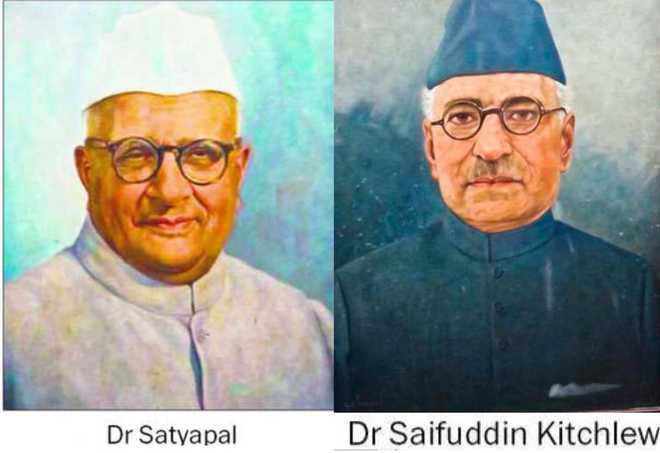
Dr Kitchlew & Dr Satyapal were towering freedom fighters, their arrest led to Jallianwala rally
Dr Saifuddin Kitchlew and Dr Satyapal — a hundred years after Jallianwala, these are the two names with which each conversation about the massacre starts in Amritsar. But in the past 100 years, the governments have rarely mentioned their names.
The meeting that was “dispersed” by General Dyer’s bullets had been called to protest Dr Kitchlew and Dr Satyapal’s arrest. The two towering leaders had emerged as great symbols of Hindu-Muslim unity during the April 6 hartal and, on April 9, people had raised slogans of ‘Kitchlew ji ki jai’ and ‘Satyapal ji ki jai’ during Ramnavami jaloos. It was the collective charm of both the leaders that the Hindus and Muslims were publicly drinking water from the same glass.
Dr Kitchlew’s father Azizudin, a prominent Kashmiri businessman dealing in embroidered shawls, had moved to Amritsar in the 19th century. He sent his son to England and Germany from where he obtained his PhD degree and also developed close ties with Jawaharl- al Nehru. “Kitchlew was widely admired in Amritsar and his picture would be seen hanging in almost every shop as a tribute to the sacrifices he made during the freedom struggle. Tall, fair-complexioned and mostly attired in white khadi, he was known for his unfailing courtesy and winsome smile,” historian Prof VN Datta, hailing from Amritsar, recalled in the preface of a book.
A few days before his death, Dr Kitchlew told Prof Datta that the trouble on April 10 in Amritsar could have been averted had he and Satyapal not been arrested. The government was absolutely despotic and never understood what the people felt and wanted, he said.
After Partition, Dr Kitchlew refused to move to Pakistan and decided to stay back in Amritsar. He, however, was forced to leave the city he loved the most and shift to Delhi after rioters burnt down his four-storey house and the family-owned Kitchlew Hosiery Factory in the heart of Amritsar.
During his last meeting with Dr Kitchlew in Delhi, Prof Datta saw a bare cot, old furniture and broken pieces of crockery eloquently speaking of the financial difficulties he was facing. Yet, there was no bitterness for anyone. “I manage to live because Jawahar sends me some briefs,” he would say.
The last tragic memories of Dr Kitchlew’s family were related to his youngest son Toufique, who spent his last days in penury. Before he passed away, he had expressed a desire to shift to Amritsar and the Punjab Government even annou-nced rent-free accommodation, but the address was never shared with him.
Dr Satyapal, on the other hand, became the Punjab Vidhan Sabha Speaker post-Partition. He had famously said: “I was never a rebel, but to revolt for righteousness is our religion and duty.” He completed his MBBS with a gold medal from Punjab University and became active in the freedom struggle.
Dr Shailja Goyal, a lecturer at DAV College, Jagraon, who has done her PhD on Dr Satyapal, says he was a man of rare integrity and character. She says he was vocal even about the wrongs within the Congress. “He was instrumental in organising the AICC session in Amritsar.” He died in 1954 and his two daughters moved abroad.
Darbari Lal, former Deputy Speaker of Punjab Assembly, says Dr Kitchlew was a powerful orator and his words would sway the masses. “Dr Kitchlew and Dr Satyapal are household names in Amritsar and will surely remain so.”
source: http://www.tribuneindia.com / The Tribune / Home> Punjab / by Vishav Bharti, Tribune News Service, Amritsar / April 13th, 2019
A vivid piece of maritime history is hidden in the memories of the cooks and deckhands who once sailed off the Malabar coast
By noon, the sun would heat up the vast blue expanse through which they sailed at great risk to their lives. By evening, when salt and dirt clung to their bodies, the skies would turn crimson, symbolising streaks of revolt. Later, weather permitting, the shimmering stars would give them clues to the voyage that lay ahead through the inky waters of the Arabian Sea, often to the Persian Gulf. On the shore, they would unload the goods they had loaded on to the wooden dhows: timber, bamboo, coconuts, tapioca, tiles, salt, sugar, fertilizers. And sometimes, hidden among the cargo, people .Being smuggled to the far shores.
But even when they returned to their homes in Kerala, none of the deckhands of the dhows wrote about their experiences; in fact they actively strove to forget this tempestuous period in their lives that ended when better transportation facilities arrived. It’s been nearly four decades since these traditional vessels with their distinctive masts set sail from the Malabar coast, either along the coastline or farther afield. But it’s only now that the world has begun to hear the stories of these intrepid men, an integral part of the maritime history of peninsular India.
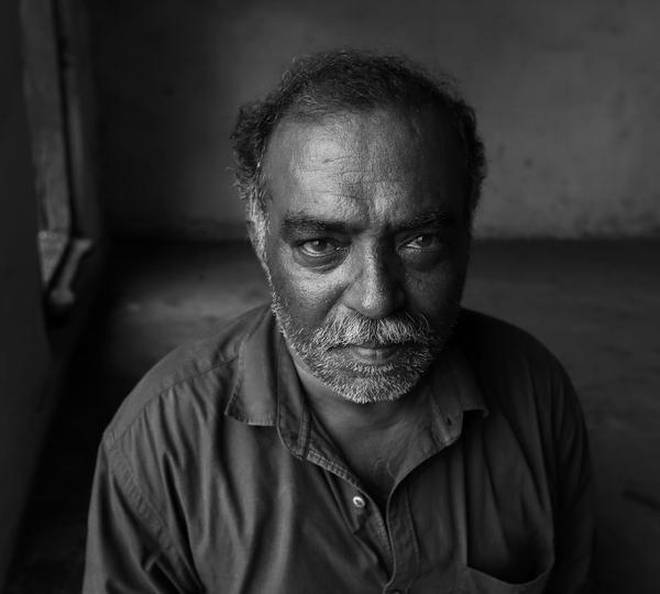
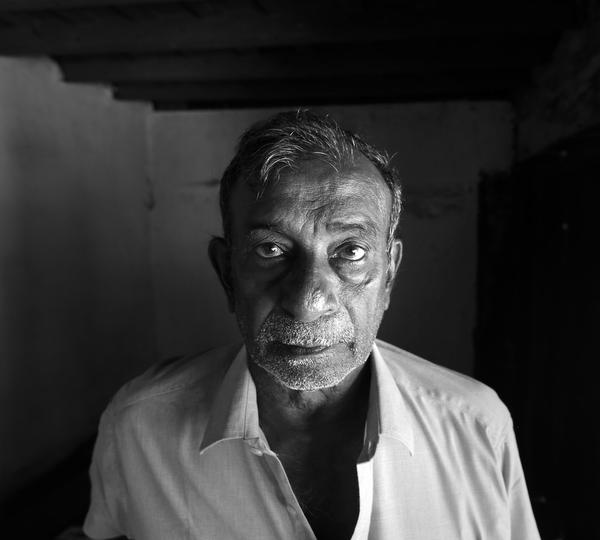
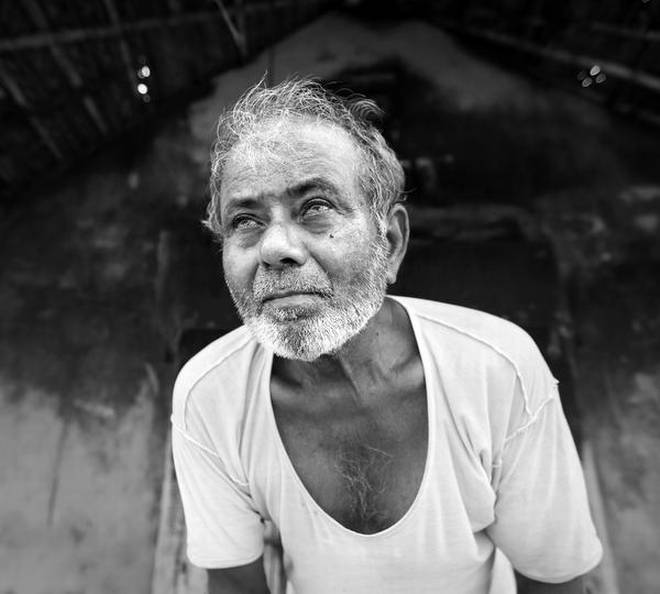
And this is thanks to a photo artist from Kerala’s port town of Kodungallur, around which scholars speculate the ancient Muziris harbour existed until destroyed by the 1341 calamity. K.R. Sunil’s photographs, a series titled ‘Manchukkar — The Seafarers of Malabar’, captures the faces of 34 deckhands. It was on show last month at URU Art Harbour in Kochi. Through them we learn of the misery of people caught in a vortex of exploitation and unshielded from nature’s furies.
Bare frames
The faces are stark, the frames bare. But every black-and-white image tells a story. Of how poverty forced pre-teen boys to pack themselves off in an uru or sailing vessel on long-distance voyages battling rough seas and uncertainty for weeks on end, and then return home — if lucky — only to set off on another strenuous voyage. Years would pass, the boys would turn into middle-aged men. Then, seen as worthy of nothing else, plagued by ill-health, they would be sent home, discarded like boats with rotten hulls.
T. Ibrahim is now 80 and lives an unremarkable life in Ponnani, a fishing town in Malappuram district. He considers himself fortunate to have lived this long. As a youth, he recalls how he once sailed a dhow laden with tiles and a dozen sailors that got caught in a storm on its way to Ratnagiri in Maharashtra. Ibrahim joined his panicked colleagues and began jettisoning cargo. The vessel sank nevertheless. “Some of them managed to get away on a lifeboat. Ibrahim and four others held on to a piece of wood and floated for two days,” says Sunil, recalling his meetings with Ibrahim.
Ibrahim’s …
The youngest in Sunil’s photo series is also called Ibrahim, or simply Umboocha. Now 53, the man from Kasargod, along the Karnataka border, had his final sailing trips on motorised dhows in the 1990s. Memories of manchu, as the boat is called in his part of Malabar, where people also speak Tulu and Kannada, still make him shudder. Their vessel once sank during a cyclone when they were bound for Iran. They roped together emptied cargo barrels and drifted on the improvised float for three days. Rescue came, but they landed in jail: all of them had lost their identity documents.
Siva Sankaran, also from Ponnani, remembers that his first trip on a dhow to Bombay took seven weeks instead of four days. Reason: bad weather. But tempests were just one part of the deckhands’ ordeal, says Sunil. From starvation to sexual exploitation to unhygienic conditions to taxing work hours, the voyages were invariably hellish. “Circus in the seas,” is how Abdul Rahiman, 68, recalls them. “One had to climb 50 feet up on swinging ropes to set the sail. You may have to do it deep in the night, when the boat is violently rolling,” Sunil quotes the sailor as recalling.
The artist’s first trip to Ponnani was in 2014, though it was only two and a half years ago that he turned his focus on these deckhands of yore. “As a child, I had heard a lot about Ponnani. We had country boats with merchandise travelling there from Kodungallur.” The town charmed him on his first visit and inspired several more. The next time he brought his camera along. A photo series from these trips was shown at the 2016 Kochi-Muziris Biennale.
Steeped in pathos
Then, four months before the biennale, Sunil stumbled upon an old man singing a song to his friends. “There was something curious about its lines and the tune steeped in pathos. I thought I should explore more,” he says.
This was T. Ibrahim and this wasn’t the only sailing song he knew. He had learnt several from Rasakh Haji, a merchant of essential oils who owned the boat in which Ibrahim was a deckhand. Haji had a talent for creating songs and had composed one about the dhow. They sailed together from Mumbai to Kerala and “the ditties seeped into Ibrahim too,” says Sunil.
Most deckhands began their careers as cooks (pandari) when they just 11 or 12 and were routinely sexually exploited. Those who moved up the ladder became deckhands or khalasi. The capable among them rose to become captains or srank.
Abdul Lathif thought himself lucky to become a deckhand at 17, but is now repulsed by the memories. “The boat’s woodwork was always infested with roaches and scorpions. You would see them floating even in the drinking water. We were covered with lice. The winter winds gave us mouth ulcers,” he trails off. “After unloading the goods, we would appy a mixture of oil, lime and ghee to the boat’s keel to prevent barnacles. The work was done standing in a slush of mud and human excrement.”
C.M. Ummar was a young man during the 70s when he crewed in dhows carrying people looking for work in West Asia. Illegally. “A couple of hundred job-seekers would be taken aboard along with the cargo. You’d hide them with a tarpaulin. And in the high seas, another boat would come to fetch them,” he recalls. “Sea-sick, they would sometimes plead to be taken back home. Getting them back was equally dangerous.”
Deaths weren’t uncommon — whether from falling from the mast or from disease. Hussain, 64, recalls a friend’s demise: “With a heavy heart we offered prayers, and buried him at sea with a rock tied to his body.”
The primary duty of Muhammad Koya, 81, was to smear kalpath, a mixture of coconut-fibre, cow-dung, sawdust and ghee, on the keel to plug gaps. “It involved holding one’s breath under water for long periods; the job affected Koya’s hearing,” notes Sunil, who is now in the process of making a documentary on this bit of “ignored history”.
Floating bodies
P. Ummar is 20 years younger than Koya, and recalls how armed pirates would sometimes rob their cargo. “Such encounters were common along the Maharashtra coast,” he says. Koran, now an oracle for the traditional Theyyam dance in Kasargod, talks of the dead bodies he saw floating near the Bombay port during his manchu days. He suspects this was from the smuggler-customs encounters.
Kochi, Kerala, 07/02/2019 : K K Khadher, from the series ‘Manchookar – The seafarers of Malabar’ by K R Sunil. Photo: Special arrangement
K.K. Kadar talks of how seasoned sailors would read signs of impending danger in “unusual changes in the colour of seawater, the rising froth, intertwined sea-snakes, dead fish…. they were indicators for the crew to prepare themselves for eventualities,” he says. Today, he is a public worker, and preoccupied with the 80th anniversary of a historic beedi workers’ strike that had once been held in Ponnani.
T.V. Moideenkutty …
For T.V. Moideenkutty, too, life is calmer. The 54-year-old lives on the tranquil shore of Ponnani with his family in a tile-roof house. He started life as a cook in a dhow and then worked as a deckhand for eight years. At least it staved off poverty, he says, smoking a beedi.
Life on the dhow taught him a lesson: the value of drinking water. “I learned the word for water in many languages, especially before hitting ‘Hindistan’ during our Mumbai voyages,” he says, retying his mundu and tucking it in at the waist.
The lighthouse near Moideenkutty’s house stands tall with its gas flasher scanning the ocean. Standing outside URU gallery, I can see the sea dotted with gleaming new-age ships filled with crew and cargo heading out to harbours around the world.
The Delhi-based journalist is a keen follower of Kerala’s traditional performing arts.
source: http://www.thehindu.com / The Hindu> Voyager> Society / by Sreevalsan Thiyyadi / April 13th, 2019
Taking up the challenging task of achieving unity and tolerance
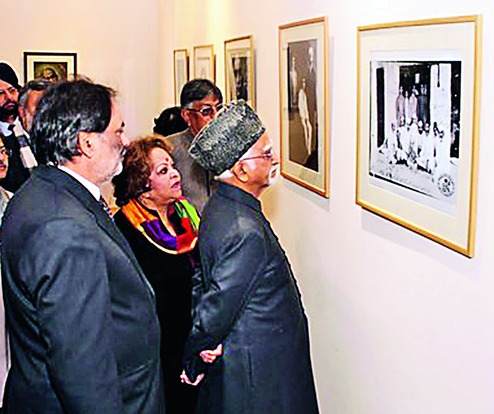
M.H. Ansari viewing an exhibition on Mukhtar Ahmad Ansari at the M.F. Hussain Art Gallery, 2015
Fifty-six is no age to die. Mukhtar Ahmad Ansari, MD, MS, with a tall reputation in London’s Lock Hospital and Charing Cross Hospital, and ‘free Doctor’ to uncountable poor in Delhi, was on a train bringing him back to his hometown, Delhi, from Mussoorie where he had gone to treat the Nawab of Rampur when, on May 10, 1936, a heart attack – his first and fatal – took him away. He was four years short of sixty.
Doctors are human and death’s sudden grasp comes to medical luminaries just as it comes to ordinary mortals. Ansari must have been in some disbelief at his heart’s capitulation. But his death shocked a whole world beyond himself, a world of grateful and trusting patients, former patients, friends, families of patients, countless Congress and Muslim League leaders who were his patients, some of them, and fellow freedom fighters, all. For he had been more, incredibly more, than the ‘good Doctor sahib‘. He had been, for over two decades, a political guide and pathfinder to all those who believed in India’s plural integrity and in India’s destiny as a leader of progressive causes globally.
The Balkan War in 1912 saw 32-year-old Ansari lead a medical team from India to Turkey to help wounded Turkish forces in what was not just a humanitarian act but one that formed lasting bonds, as the medical mission of the doctor, Dwarkanath Kotnis, to China in 1938 during the Sino-Japanese war was to do. The Kotnis Mission has been the subject of a film, Dr. Kotnis Ki Amar Kahani by V. Shantaram, for which K.A. Abbas wrote the script. A film has to come on Dr. Ansari Ki Amar Kahani about that mission’s work. Mrinal Sen could well have made such a film a decade ago but perhaps Javed Akhtar or Shyam Benegal will yet do it, for it cries out, filmographically and civilizationally, to be done.
M.A. Ansari’s life as such needs to be known, not for his sake – he is beyond the reach of recognition or neglect – but ours. Being invited to play a constructive political role in the formulation of the Lucknow Pact between the Congress and the Muslim League in 1916 and to preside over the Muslim League’s sessions in 1918 and 1920, Ansari emerged as a sturdy champion of the Khilafat Movement and Hindu-Muslim unity.
His commitment to that cause soon steered away from League politics, the separate electorates idea and all that was to lead to the demand for Pakistan. This resulted in his becoming inevitably, a general secretary of the Indian National Congress in 1920, 1922, 1926, 1929, 1931 and 1932 and in 1927, its president. A former president of the Muslim League becoming president of the Indian National Congress? Incredible, but incredible things did happen in Gandhi’s and Nehru’s India.
Drawing close to the Mahatma’s eclectic nationalism, Ansari became Gandhi’s ‘Delhi host’ in his old Delhi manor called ‘Darussalam’ and physician to members of Gandhi’s family, including his grandson, Rasik, son of Harilal Gandhi, who contracted typhoid in 1929 while on a visit to Delhi (from eating roadside jalebis, as Rasik himself explained) and in spite of Ansari’s valiant efforts, could not be saved. Gandhi was touring the North West Frontier at the time. Ansari sent him a telegram conveying the news. Gandhi steeled himself. “I loved the boy,” he wrote, “I had placed high hopes on him…” The trauma brought the doctor and the Mahatma closer to one another.
Ansari was instrumental in the founding of the Jamia Millia Islamia, and bringing to it a whole host of nationalists, Muslim and Hindu, to learn and to teach. In return for learning Urdu, Gandhi’s youngest son, Devadas, was recruited to teach the Jamia spinning. Ansari was Jamia’s chancellor when he died.
Liberation from mutual animosity and mistrust among Hindus and Muslims was for him a passion. Ansari was, to use an old-fashioned phrase, a man of God. He was also a man of Science. His being a man of science doubtless had something to do with his harbouring his eminently rational goal of wanting Hindus and Muslims to live in civilized amity, not conflict.
As it happened, on the very day Ansari died, Gandhi was meeting in the Nandi Hills, near Mysore, India’s most famous man of science, Chandrasekhara Venkata Raman. If a man of god can be a man of science, a man of science can be a man of god.
Raman to Gandhi: “The growing discoveries in the science of astronomy and physics seem to me to be further and further revelations of God. (But) Mahatmaji, religions cannot unite. (Only) Science offers the best opportunity for a complete fellowship. All men of science are brothers.”
Gandhi to Raman: “What about the converse? All who are not men of science are not brothers?” ( The Collected Works of Mahatma Gandhi, Volume 62, pages 387-9)
Within a few hours of this conversation, M.A. Ansari, man of science and of god, brother to all who came in contact with him personally, professionally or politically, lay dead in his railway coach.
Gandhi had gone to the Nandi Hills with Sardar Patel, among others, for a ‘health’ sojourn at Ansari’s behest. When the news reached him the next day, he was stunned. Penning a tribute for the Associate Press, he described him as “the poor man’s physician if he was also that of the Princes” and said, “His death will be mourned by thousands for whom he was their sole consolation and guide.” He added: “…He was my infallible guide on Hindu-Muslim questions. He and I were just planning an attack on the growing social evils.”
An attack on social evils. Strong words, scorching words. What was the biggest ‘social evil’ that Gandhi was exercised most about in 1936? Hindu-Muslim mistrust.
He needed a guide from among the Muslim community to tackle this. And, with Ansari, that guide was gone. At a loss to find a successor he turned first to Zakir Husain. “I ask, will you take Dr Ansari’s place?” On Zakir Sahib not agreeing, he turned then to Maulana Azad for that crucial assistance. It is entirely reasonable to suppose that had Ansari lived he would have played a defining role as a symbol, spokesman and strategist for Hindu-Muslim unity in the Constituent Assembly and then, very probably, in 1950, become president or vice-president of India. He would have been only 70, the age at which his grand-nephew, Mohammad Hamid Ansari, first became vice-president of India.
What was the main concern – ‘social evil’ – forcefully, passionately expressed in Vice-President Ansari’s farewell address to Rajya Sabha? The challenge to Hindu-Muslim unity, pluralism, not as mere ‘tolerance’ but in Netaji Subhash Chandra Bose’s words: cultural intimacy.
We know what Vice-President Ansari, descended from that great name in Indian pluralism – Dr M.A. Ansari – who rejected everything that led to Pakistan, has received by way of a ‘reward’.
Seventy five years after the Quit India Movement, 70 years after Independence, we the people of India, brothers and sisters in plural mutuality, must tell the shatterers of India’s unity, Hindu, Muslim and other: Quit, quit terrorizing India.
source: http://www.telegraphindia.com / The Telegraph, online editon / Home> Opinion / by Gopalkrishna Gandhi / August 22nd, 2017
President Kovind presents Shaurya Chakra to Irfan Ramzan Sheikh
President Ram Nath Kovind on Tuesday awarded Shaurya Chakra to 16-year-old Irfan Ramzan Sheikh, a young Kashmiri who took on three armed terrorists to fend off an attack on his family.
Sheikh was a 14-year-old boy when he fought terrorists and forced them to flee when they attacked his residence in Shopian district of Jammu and Kashmir two years ago.
“He exhibited courage and maturity and fought off militants, safeguarding the life of his father and other family members in Jammu & Kashmir,” a tweet by the Rashtrapati Bhavan said.
Shaurya Chakra is usually awarded to armed forces and para-military personnel for “gallantry otherwise in the face of the enemy”. Although Shaurya Chakra may be awarded to civilians as well as military personnel, it is very rare that a military honour is presented to someone who is not part of any security agency or armed forces.
It is third in order of precedence of peacetime gallantry awards and comes after the Ashoka Chakra and the Kirti Chakra.
Who is Irfan Ramzan Sheikh
Currently, studying in Class X, Irfan is a resident of Shopian district of Jammu and Kashmir. His father Mohammad Ramzan is an ex-sarpanch with affiliations to the People’s Democratic Party (PDP).
Sheikh aspires to become an Indian Police Service (IPS) officer and serve the country.
Indomitable courage
During the intervening night of October 16-17 of 2017, terrorists cordoned off the house of Sheikh. When Irfan, the eldest son of Mohammad Ramzan, opened the door, he found three terrorists in the verandah of the house armed with rifles and grenades.
_____
“Sensing that the militants could harm his family, he exhibited highest degree of courage and faced the militants for sometime so as to avoid their entry inside the house. In meantime, his father came out and the militants pounced on him, resulting in scuffle,” the citation for the award read.
The 14-year-old boy did not think for a moment for his own safety and pounced upon the terrorists for safeguarding the life of his father and other family members.
The terrorists also resorted to indiscriminate firing, resulting in severe injury to Sheikh’s father. He later succumbed.
However, Sheikh did not lose courage and continued to engage in scuffle with one of the terrorists, who resorted to indiscriminate firing resulting in severe injuries to terrorists as well.
On seeing one of their associates injured, the terrorists tried to flee. However, Sheikh chased them and they left the body of their fellow terrorist behind.
“Irfan Ramzan Sheikh exhibited the extraordinary show of bravery and maturity in such a small age,” the citation read.
(With PTI inputs)
source: http://www.dnaindia.com / DNA / Home> India / by DNA Web Team / March 21st, 2019
Khan, a computer science student was shortlisted in November last year based on his profile on a programming site.
A 21-year-old, non-IIT engineer from Mumbai, bagged a hefty Rs 1.2 core package at Google’s London office. Abdullah Khan, a student of Shree LR Tiwari Engineering College was called for an interview by Google. Following a couple of rounds of interviews, he was asked to appear for final screening at Google’s London office.
Khan, a computer science student was shortlisted in November last year based on his profile on a programming site. His salary is divided into the base salary of Rs 54.5 lakh per annum, 15 per cent bonus and stock options worth Rs 58.9 lakhs.
“I used to participate as it was fun. I did not even know that firms check programmers’ profile on such sites. I showed the email to my friend who knew someone who had received such an email in the past. I’m looking forward to joining their team. It will be an amazing learning experience for me, ” Khan told TOI.
The average salary offered to a non-IIT engineering graduate is 4 lakh per annum.
source: http://www.newindianexpress.com / The New Indian Express / Home> Cities> Mumbai / by Online Desk / March 29th, 2019
When Sania Mirza burst upon the global scene, the London-based New Statesman saw this “slender 18-year-old Muslim tennis player from India” as one of the 10 people who could change the world.
Jason Cowley, who wrote the article, believed that she had the “potential to change the world” for the following reasons: 1. She was the first Indian female tennis player to be ranked among the world’s Top 40. 2. She had made a breakthrough in sport despite coming from a country that usually discouraged women in sport. 3. She had discipline, tenacity, flamboyance. And all of this amounted to 4. She was going to “inspire a whole new generation of Indian girls”. Cowley’s article was written in October 2005, soon after a fatwa stipulated that Mirza should be prevented from playing tennis in skirts and T-shirts. Mirza instantly became a symbol of defiance, a “slender 18-year-old” girl who could stand up to Muslim hardliners. At around the same time, Time magazine hailed her as one of Asia’s heroes. AndThe New York Times said the weight of the country’s expectations rested on her.
I am at a loss to explain how or why the Sania phenomenon fizzled out in mainstream media. To be sure, she remains a remarkable player who will continue to inspire a whole generation of young women. But Mirza is no longer feted and hailed for her potentially transformative powers. I thought of Muslim role models once again when I saw the modest, self-effacing Allah Rakha Rahman accept his twin Oscars in Los Angeles.
There he was, up on stage in his very Indian designer sherwani singing Jai Ho, the song from Slumdog Millionaire. Or there he was on the red carpet with his wife, her head covered as she shyly posed for photographs. On stage, he was thanking God (“all glory and fame to God”) and his mother, talking of the path of love rather than hate that he had opted to follow. There was quiet dignity about him rather than the usual over-the-top Oscar exuberance. I suspected he would have had the same quiet smile had he lost.
Rahman is not known to be a man of many words. So, it was the subtext of what he said (or didn’t), that struck me as significant. Here was a Muslim who was confident in his identity as an Indian Muslim (in fact, with Maa Tujhe Salaam, he has done more to popularize Vande Mataram than the entire Sangh parivaar put together). Like the majority of Muslims everywhere, he believes in his God, in family values, in love and brotherhood. He was not out of place on the world stage performing with artistes drawn from all over the globe.
Rahman does not conform to any of the Muslim stereotypes. But he is undeniably an adherent of Islam, converting to the faith at the age of 21 along with his family. His views on politics are not widely known. But as a believing Muslim, he is reported to earmark one-third of his earnings to charity. Significantly, one of his first acts on returning home to India was to visit the Ameen Peer dargah at Kadappa in Andhra Pradesh to offer special prayers.
India’s Muslims have been singled out for their many unique qualities.
Thomas Friedman recently hailed the community’s decision to refuse burial in Mumbai to the Pakistani terrorists killed in the 26/11 attack. By denying terrorists the status of martyrs, the world’s second largest Muslim community was doing a “great service to Islam”, he said. Yet, one of the laments among Muslims is the lack of credible role models.
Bollywood within its secular framework has been able to throw up some figures—Javed Akhtar and Shabana Azmi most notably speak up for a pluralistic, democratic framework, but they’re not necessarily seen as strong adherents of Islam. Aamir Khan is the sensitive voice for the marginalized, not really a strong Muslim figure. Azim Premji is probably the richest Muslim in India but, once again, his success is defined in business, not religious terms.
In cricket, you could certainly look at the Pathan brothers who straddle both worlds—cricket and Islam. The sons of a poor muezzin who couldn’t afford even a pair of shoes, they now symbolize a can-do spirit. In a TV ad, they refer to their father as “abba”. It’s as if they’re saying, like Omar Abdullah, “We are Indians and Muslims and see no contradiction between the two.”
With his stunning Oscar win, Rahman reaffirms the same message to emerge as a new role model for young Indian Muslims. In equal parts a proud Muslim, proud Indian and proud professional, he stands as a counter to both the fanatic and the stereotype of the fanatic that many believe represent the average Muslim.
For this reason alone, I’m singing the new anthem: Jai Ho.
Namita Bhandare writes every other Tuesday on social trends. Respond to this column at lookingglass@livemint.com
source: http://www.livemint.com / Live Mint / Home> Explore> Looking Glass / by Namita Bhandare / March 02nd, 2009
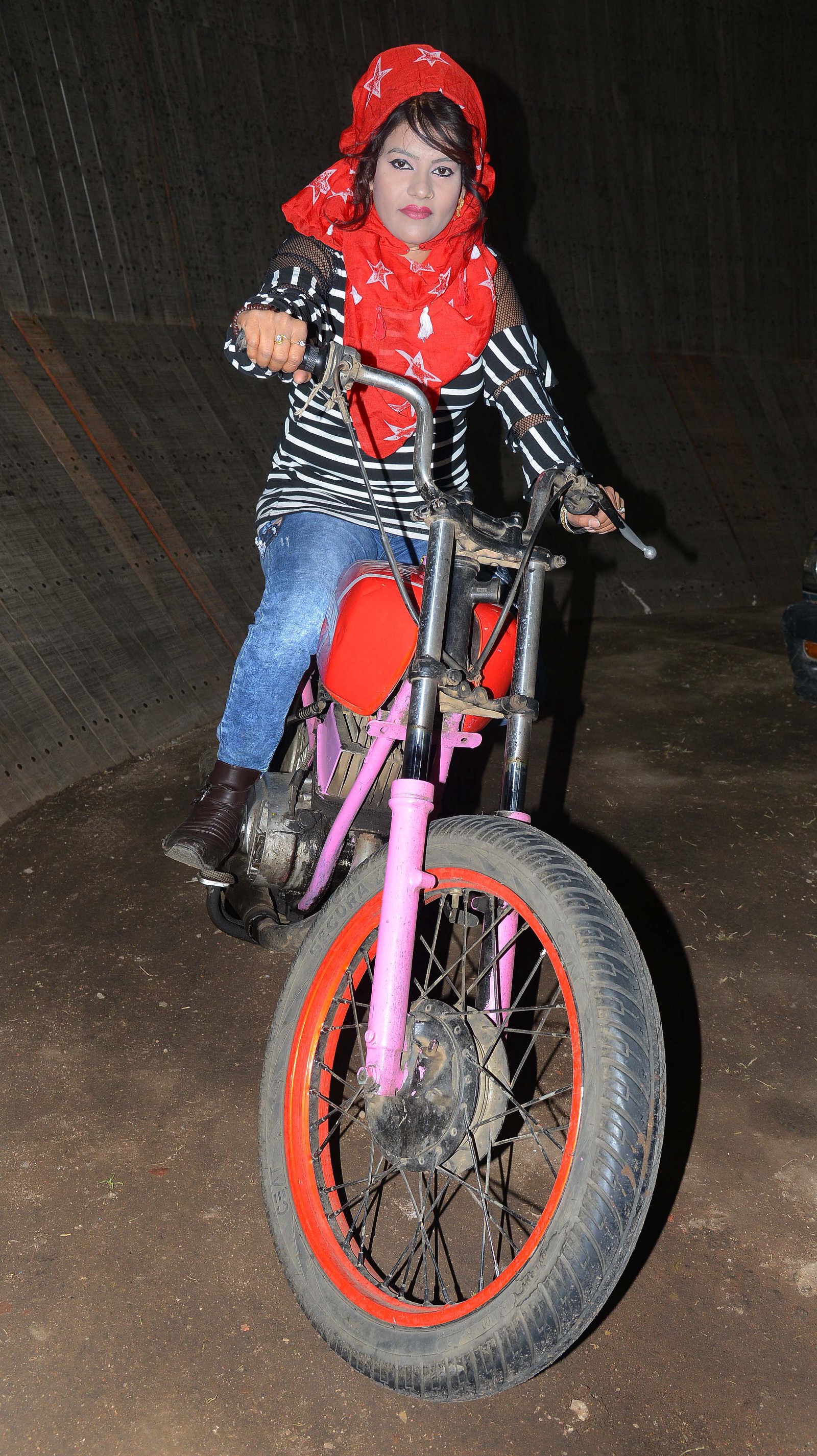
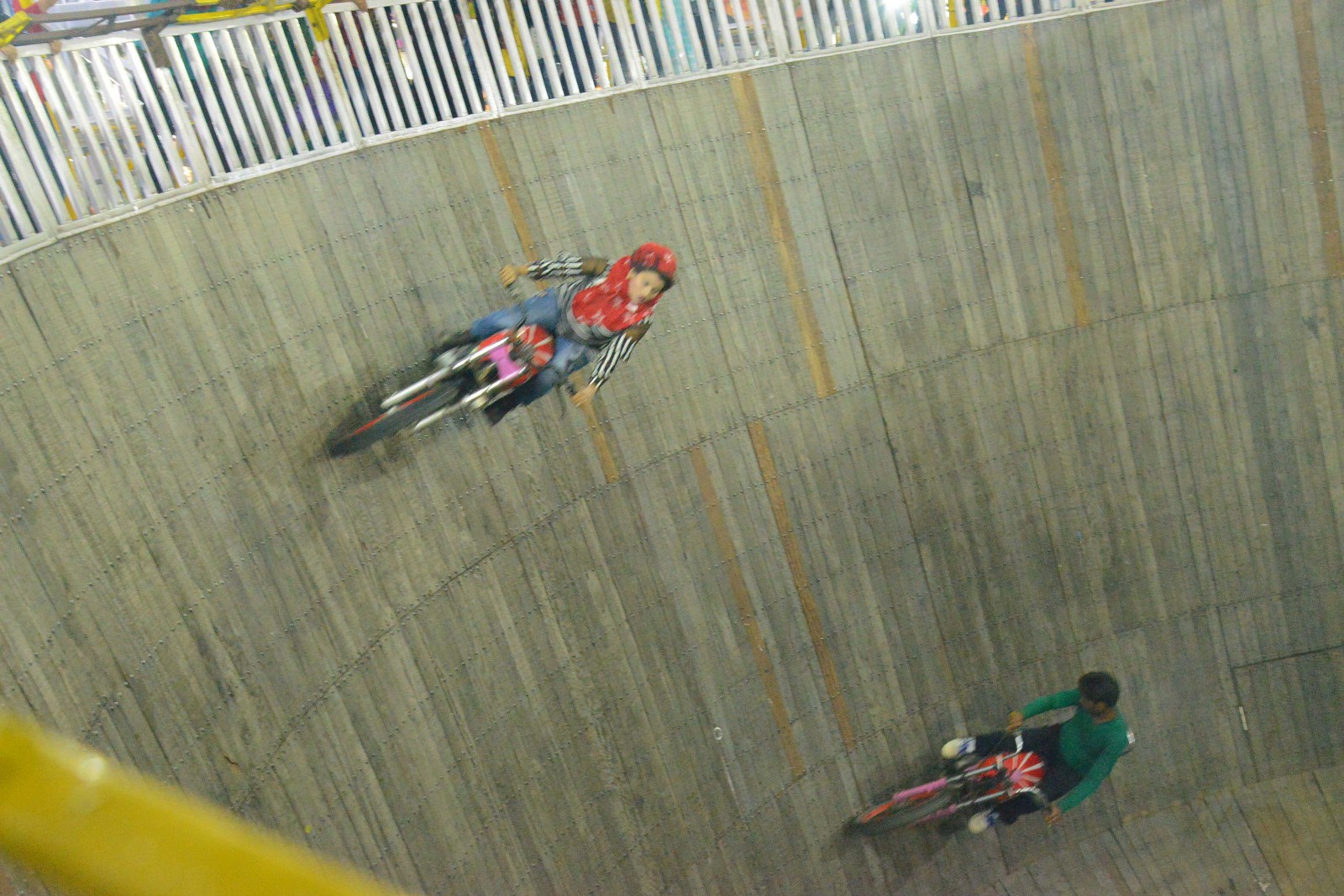
Rehana Khan, perhaps the first female stunt-woman to entertain the guests at Maut ka Kuan in Numaish, Hyderabad
28-year-old Rehana Khan
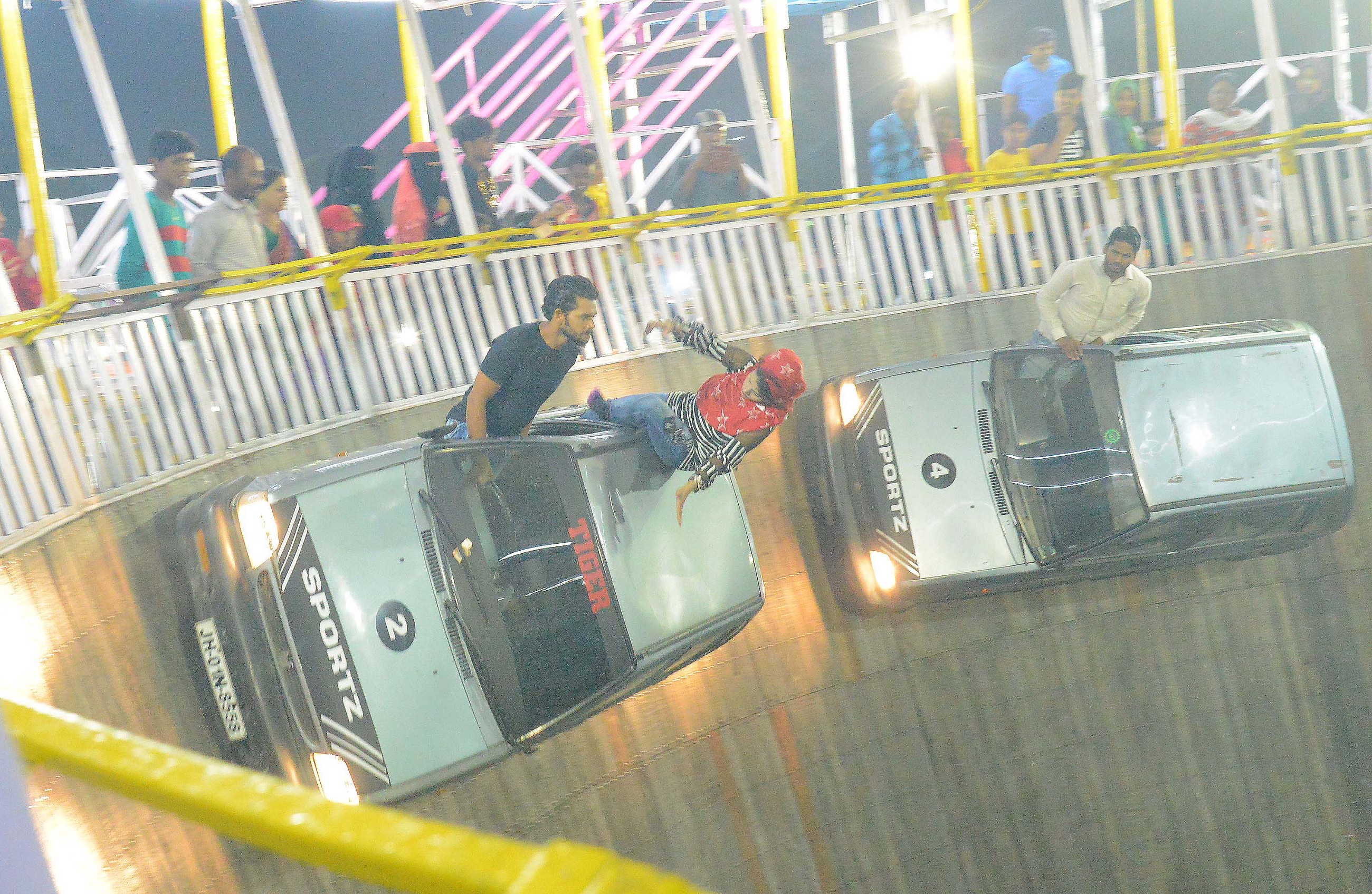
Numaish has been an integral part of every Hyderabadi, where year after year one doesn’t miss to take a stroll around the many stalls and rides. Not just the stalls but also the well of death — or maut ka kuan as it is popularly known — has always been a crowd-puller. Kids and adults alike would be excited to watch men get onto their bikes and cars as they take a round of the near-vertical pit with walls lined by wooden planks, at a high speed, often giving the audience a high five as they ride up!
However, this year the crowd hooted and cheered, as a stuntwoman made her entry and joined the team for the first time. 28-year-old Rehana Khan, who hails from Uttar Pradesh, has been performing stunts for the last six years and has been invited to be a part of Numaish for the first time.
Calling it her passion, Rehana says, “I would watch men do stunts on their bike and think to myself that if they can, then I can do it too. That is when I took it up as a challenge and started practising. It feels good that being a girl from a small town, I am doing something different, and not treading on the usual path.”
It’s been a little over two weeks and Hyderabad has welcomed the daredevil with open arms. “The audience here is very happy to watch my performance. They meet me after the show and I love the respect I have been getting. As girls have a bad (and clichéd) reputation for not riding properly on the road, when people see one attempt such deadly stunts, it leaves them in awe. Women feel happy and tell me that girls are not behind boys anymore,” she adds further.
Rehana stuns the audience at Numaish, Hyderabad
Stunts take Rehana to different parts of the country — Ranchi, places in Bihar and Chhattisgarh and Assam among others — but it is the respect she is getting in Hyderabad that she will “cherish forever”.
Rehana started practising right after college and it took her about six months to perfect the stunts. “If someone wants to pursue a career in it, they would require proper training. You have to make sure that you have no dizziness during or after riding on the ground. It would take a while for it to go, but once you get rid of it, the path ahead would seem easy,” she says adding, “Girls should try to create their own identity and not bow down to the stereotypes of the society. In today’s time, they are not behind men and can work as hard as them or even more.”
Her husband is always by her side, encouraging and proudly watching Rehana perform the stunts. “My family sees it as a dangerous profession but at the same time supports it since it is my passion,” she says adding that the money a stunt-woman earns is decent but it is the respect that she gets that makes it all worth.
Rehana stuns the audience at Numaish, Hyderabad
She entertains the audience from 5 to 11 pm every day with minimal breaks, but Rehana has no complaints and says with pride that she took the right path. “I wanted to be known for what I do, for the society to recognise me, to meet new people and to travel to different parts of the country showcasing my talent. Money is decent but what gives me happiness is to be among people, and be known for my talent. They respect you for taking up an unusual career. I must add that Hyderabad’s reaction has been very encouraging. I like it here,” concludes the daredevil, as she rushes to get ready for another show.
source: http://www.medium.com / Medium / Home / by Neha Jha / January 20th, 2019
A night’s stay in the hotel, which is set to open later this year, might cost up to Rs 8 lakh.
A view of the Great Scotland Yard (Photo | http://www.twenty14holdings.com)
Kochi :
Malayalee billionaire Yusuff Ali, who bought the Great Scotland Yard, which served as headquarters for the Metropolitan police in London, has converted it into a luxurious 5-star hotel. The renovation that cost Rs 685 cr. (£75 Million) was done in 3 years.
The business tycoon, who is chairman of Abu Dhabi-based retail giant LuLu Group had earlier bough the iconic building in 2015 for Rs 1000 crore (£110 Million). The renovated hotel is all set to open later this year and will be managed by the Hyatt Group.
When asked about the property, Yusuff Ali said: “This is a very prestigious project for us as this is one of the most well-known property not just in the UK but around the world. We have not left any stones unturned to make this the most sought-after hotel while retaining the essence of the original building, so that each of our guests get a truly memorable experience”.
Great Scotland Yard has special relevance in UK history as it was chosen by the then Prime Minister Sir Robert Peel as the headquarters for the Met police in 1829. Even after the renovation, the essence of the original building has been preserved.
The hotel will have 153 rooms and the tariff per night is expected to go up to Rs 7,79,842 (10,000 euro). These suites offer guests picturesque views of Nelson’s Column, Westminster Abbey and Buckingham Palace, making it one of the most unique locations in London.
The luxury hotel that is steeped in British political history will include references to the famous criminals of the time gone by. In a secret whisky bar, a decadent chandelier made of glass shards will be a nod to the Forty Elephants, the 19th-century gang of women known for smashing shop windows to steal jewellery. There will also be artwork by prisoners and old military uniforms.
Adeeb Ahamed, Son-in-law of Yusuff Ali and the Managing Director of Twenty14 Holdings, the hospitality arm of Lulu Group said, “Renovating the Great Scotland Yard building and unveiling the UK’s first Unbound Collection hotel will bring a truly individual and world-class hotel to London.
“The Great Scotland Yard is really an important part of the fabric of London and it is a great opportunity for us to be a part of the culture and legacy of this great city and help in its development. The Great Scotland Yard will be an enriching landmark in Westminster as a high-end luxury boutique hotel that recaptures the history, culture and essence of the London of yore.”
source: http://www.newindianexpress.com / The New Indian Express / Home> States> Kerala / by Express News Service / March 26th, 2019
Never for a moment could he take his eyes off the handle, because enjoying the vistas would mean falling…
Muhamed Musadhiq
Thiruvananthapuram :
“All I could see was the handle and the front wheel,” says Muhamed Musadhiq, after a 504 km journey on a cycle that turns left if you turn the handle right. All day long, during the six-day ride, he had his eyes fixated on the handle and the wheel, riding at a pace below 25kmph. Never for a moment could he take his eyes off the handle, because enjoying the vistas would mean falling. Manoeuvring this cycle is not a leisurely, easy breezy task, but a very demanding one. Because the cycle has a mind of its own, acting in contrary to the brain’s command.
‘Brain Cycle. Abnormal Cycle. Keep Distance’, so reads the warning note plastered on Musadhiq’s cycle. It has been several months since he remodelled the cycle and crafted a brain cycle out of it. But then, riding it still needed one to be careful enough. “At first the note was plastered for fun, but then after a few falls, I knew there was indeed a need to keep distance,” chuckles the final year mechanical engineering student.
He rode all the way from Kozhikode to Thiruvananthapuram along with his college mates attached to the College of Engineering, Thiruvananthapuram as part of promoting cycling across the state. Through the ride, he was also attempting a Guinness World Record in riding the max distance in the brain cycle. “Till now, no one has attempted the ride in the brain cycle. So it is a new event I am attempting,” says Musadhiq.
According to Musadhiq, the mechanics implemented in the cycle is simple.It was during the tech fest of his college that Musadhiq put forth this cycle, arguably the first in India to be made. “I am not aware of anyone who has made the brain cycle in India. At first, I made it for fun. But after making this, someone had to ride this. And that forced me to learn to ride the cycle,” he recalls. The result was numerous falls. “Oh, I fell a countless number of times. It might look simple from the outside. But to ride it is challenging. You have to train your brain accordingly,” he says.
His cycle is the connoisseur of all eyes, wherever he goes. Having introduced the cycle at various colleges, his aim is to popularise the art of cycling amongst the public. There are also plans to set up brain training centres in schools and colleges using the brain cycle to popularise cycling among the younger generation.
He has even put forth a challenge- ride 10 metres in the cycle and it will fetch you Rs 500. More than 2000 people have attempted the challenge, but none has won it.
“There are no tricks to ride the brain cycle, but practice,” says Musadhiq. “At one point I hope I will reach a state where I can ride the cycle at the same leisurely pace I do on a normal cycle,” he adds.
source: http://www.newindianexpress.com / The New Indian Express / Home> Cities> Thiruvananthapuram / by Aathira Haridas / Express News Service / March 08th, 2019