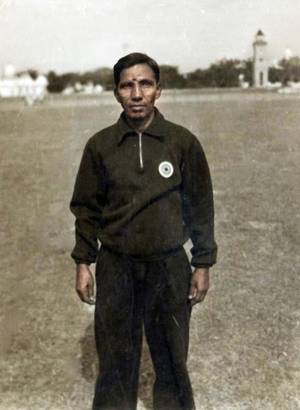
A biopic is being made on Syed Abdul Rahim, the architect of modern Indian football
More than 62 years after an Indian football team came within a whisker of winning an Olympic medal, a Bollywood movie is being made on the Hyderabad coach who made it happen: Syed Abdul Rahim.
“About a year ago, Joy Sengupta, an ad filmmaker, approached me saying he wanted to make a movie about Rahim sahab. I shared all the information with him. They expected I would ask for money. I don’t want money, I want the younger generation to know about the glorious golden period of Indian football and my father’s contribution,” says Syed Shahid Hakim, son of S.A. Rahim and a Dhyan Chand awardee.
Reliving glory
The biopic is expected to bring alive S.A. Rahim’s life, who led a stunning rise of the Indian team in the 1950s. His biggest achievement? Getting a walkover in the 1956 Melbourne Olympics against defending champion Hungary even as its Magic Magyars withdrew due to Hungarian Revolution; beating Australia 4-2 before losing to Yugoslavia 1-4 in the semifinals. At the Asian Games inaugural, Rahim’s team won gold for India as the then Prime Minister, Jawaharlal Nehru, watched from the VIP stand. On Friday, Zee Studios tweeted about its project: “Elated and proud to announce a story never told as @ZeeStudios_ #BoneyKapoor & @freshlimefilms come together for a biopic on India’s legendary #Football coach, Syed Abdul Rahim, starring @ajaydevgn, directed by @CinemaPuraDesi.”
Mr. Shahid Hakim, who played under his father, later coached and was a referee as well before retiring from the National Institute of Sports, Patiala, has been bombarded with calls about his father since then.
The trigger was perhaps Novy Kapadia’s book Barefoot to Boots that’s partly instrumental in spotlighting the coach, who was almost forgotten except in the rarefied field of Hyderabad’s football circles. Rahim worked his magic on Indian football teams between 1948 and 1960 bagging Asian Games gold in 1951 and 1962. In the 1960 Rome Olympics, India was jinxed in the death group ‘D’ which had Hungary, France and Peru. India lost to Hungary 2-1 and drew 1-1 with France before losing 2-0 to Peru. It was here that Balaram and P.K. Banerjee scored a goal each. In that period, the Hyderabad police team brought home five Rovers Cup trophies.
Football prophet
Rahim was a school teacher who drifted into football coaching. Noticing that Indian footballers used to dribble needlessly, he came up with the concept of one-touch football. “The player had to get the ball and pass it. A dribble would be considered a foul and a free kick awarded,” says Hakim, as he reels out names of playgrounds in Hyderabad and tournaments that used to be played here.
“People bemoan our football skills. But where are the grounds for children to play? Football is the most democratic game. One ball and two goal posts can engage 22 players. But our government is interested in promoting individual sports. Money, land, academies are gifted to players. Team games get a short shrift,” rues Mr. Hakim, promising to share all the trials and tribulations of his father with the movie-makers. “He was a strict disciplinarian. I was treated as just one of the players. There were so many talented players that we used to hide injuries, lest someone else play and take our slot. He used the 4-2-4 combination before anyone used it,” says Mr. Hakim.
While football grounds have disappeared and the beautiful game is played only by a few expats in Hyderabad, the biopic is sure to make Indians remember a time when India was a name to reckon with in world soccer scene.
source: http://www.thehindu.com / The Hindu / Home> News> Cities> Hyderabad / by Serish Nanisetti / Hyderabad – July 14th, 2018
“Honesty is a very expensive gift. Don’t expect it from cheap people – Warren Buffett’.
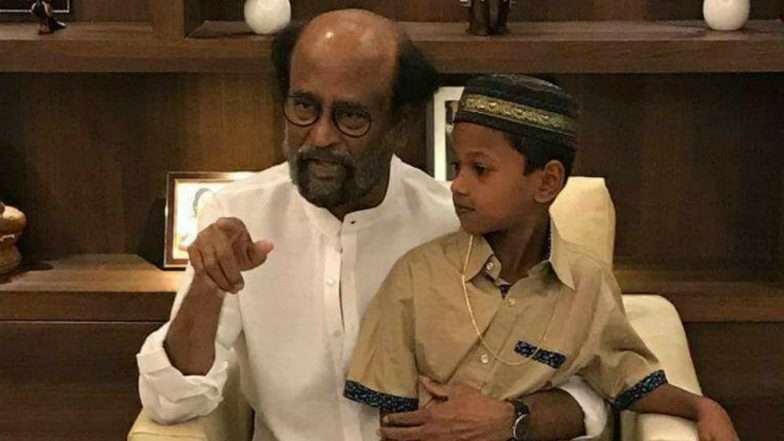
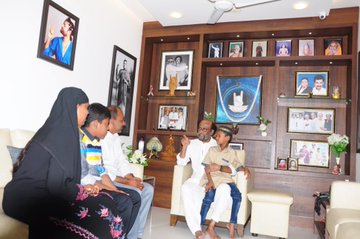
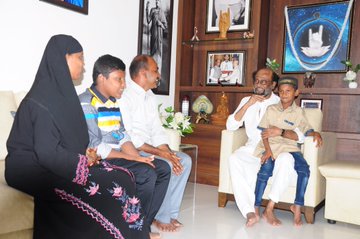
Rajinikanth with the kid (Photo Credits: @rameshlaus/Twitter)
Mohammed Yaseen appears as any regular kid, but he possesses something that not even the best of men does – the gift of honesty. The young boy from Erode, a municipality in Tamil Nadu depicted a rare act of virtue that left none other than superstar Rajinikanth.
Yaseen who had found a bag containing Rs 50,000 chose to return to its rightful owner. Mind you, he belonged to an economically backward family, but that didn’t deter him from doing what is right. Mohammed Yaseen’s honesty was not only acknowledged, but the actor-turned-politician Rajinikanth offered to help him with his educational expenses.
Ramesh Bala, an entertainment industry tracker, shared pictures of Rajinikanth meeting young Yaseen at a felicitation ceremony held in honour of the boy’s remarkable deed.
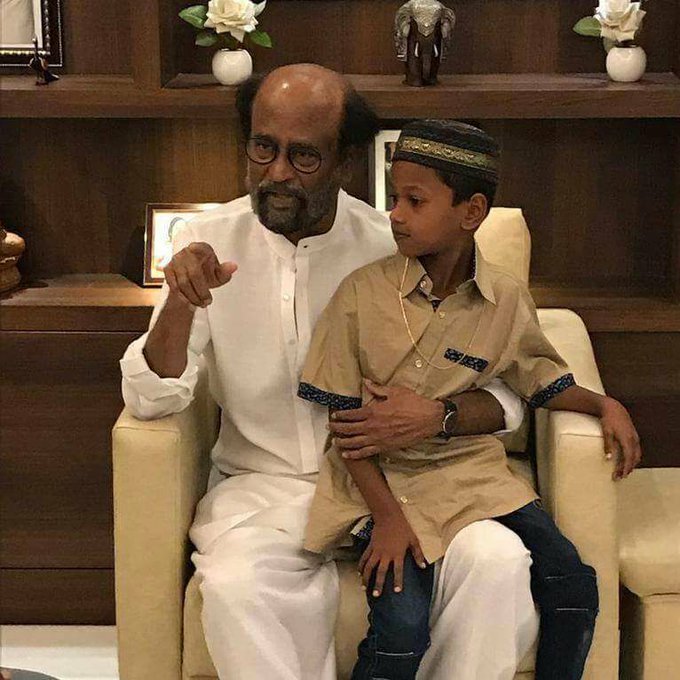
Bala captioned the image of the boy sitting on Rajinikanth’s lap by writing, “#Superstar @rajinikanth met the #Erode Kid #MohammedYaasin who handed over ₹ 50,000 he found near his school to Police Authorities.. #Superstar is very impressed with the kid’s honesty and assured financial help for his future studies.”
#Superstar@rajinikanth met the #Erode Kid #MohammedYaasin who handed over ₹ 50,000 he found near his school to Police Authorities..#Superstar is very impressed with the kid’s honesty and assured financial help for his future studies..
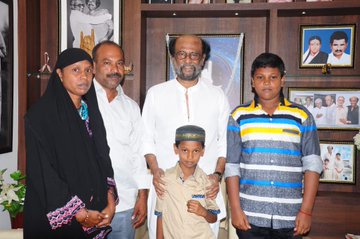
Mohammed Yaseen’s parents were also present at the event. The boy’s mother and father looked proud of their son’s deed as Rajinikanth also met them. It was so pleasing to see the South Superstar who is admired by millions across the globe be mighty impressed with the young kid.
Rajinikanth was quoted saying about Yaseen, “What honesty. Despite being from a poor family, he said, ‘this is not my money’ and handed over to the police.” The superstar further made a heart-warming statement, “I will take care of his entire educational expenses, whatever field he wants to pursue. I will consider him to be my son.”
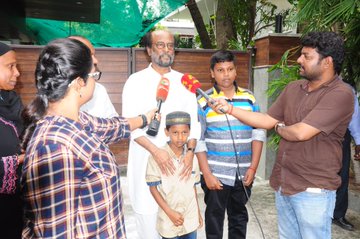
The Kaala actor was beaming with pride narrating to the reporters how Yaseen had told ‘This is not my money’ before handing it over to his school principal who took him to hand it over to the police.
Yaseen had found a bag containing cash near a bush close to his house in Erode. Without having a second thought of keeping it with himself, the boy rushed to take the matter to his school authorities. Just like Rajinikanth, we are also simply blown away by the little boy’s act of honesty.
source: http://www.latestly.com / Latest Ly / Home> Viral / by Rashmi Mishra / July 15th, 2018
Maulvi Barkatullah Bhopali believed the spirit of Marx’s thought and divine religions was the same. “The objective of both is to provide a dignified and peaceful life to the oppressed.”
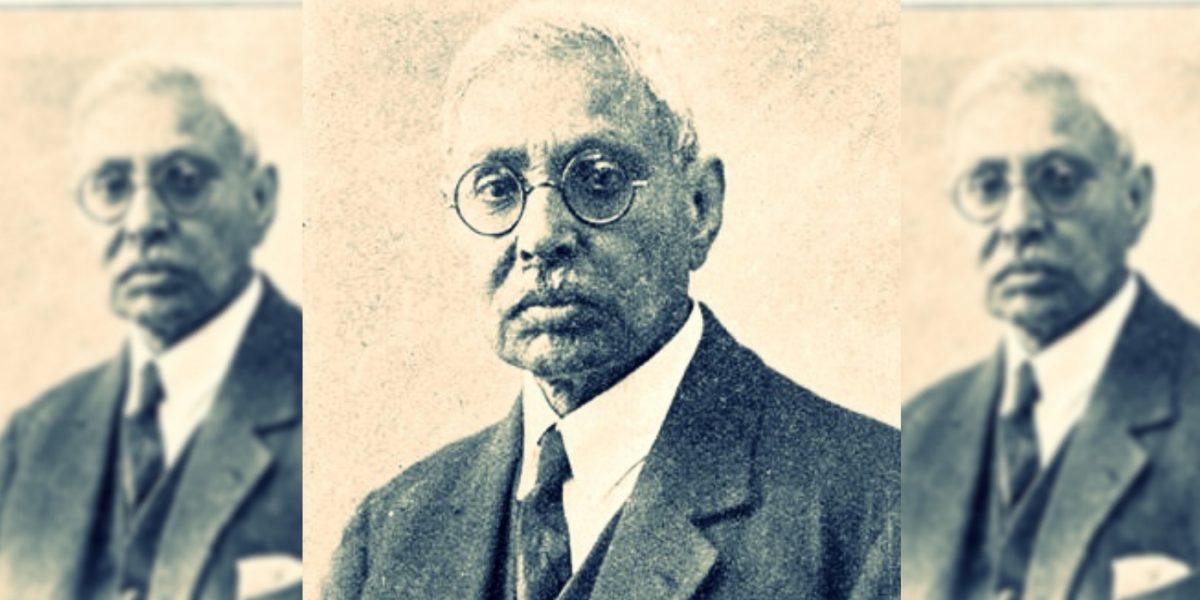
Maulvi Barkatullah Bhopali, who was born 164 years ago this month, was a glorious standard-bearer of the Indian independence movement. He toured Great Britain, Europe, Japan and America, in addition to the Soviet Union in connection with the struggle against British imperialism. He was among those few ulema who travelled to Moscow in May 1919, just a short period after the Bolshevik Revolution; he saw the conditions there with his own eyes, and met Lenin and other Bolshevik leaders. During his stay in Moscow, he said during an interview with the Izvestia newspaper:
“I am not a communist or a socialist, but right now my political program includes throwing the British out of Asia. I am a staunch enemy of European capitalism in Asia. Therefore, there is complete compromise between myself and the communists over these objectives and we are allies on this field. I do not know what shape the future events will take, but what I can definitely say is that the famous appeal of the Soviet government of Russia, in which the people of all nations have been requested to rise up and conduct jihad against capitalists, has greatly influenced us, and what we like more than that is that the Soviet Union has revealed all the secret agreements (between Russia and Great Britain) whose objective was to enslave other nations, especially the Eastern nations. Not only this, but the Soviet Union has unilaterally cancelled all such agreements. Russia accepts the principle of equality and evenness between all small and great nations. The ideas of the Bolsheviks, which we call socialism, are also making a place in the hearts of the common Indian people.”
In his book, Bolshevism and Islamic Nations, Maulvi Barkatullah writes, “The actual spirit of Marx’s thought and divine religions is the same. The objective of both is to provide a dignified and peaceful life to the oppressed, punished people of god by freeing them from cruelty and oppression.”
“The philosopher Plato has presented such a map of his ideal Republic in which ownership would be common and public. The provision of basic needs, sources of entertainment, opportunities for employment will be equal for all. Because of the progress of education, every individual of the nation will benefit from knowledge in a way that his every act will be reasonable and right. These are the basic principles on whose foundation Karl Marx presented the majestic structure, behind which was the knowledge and experience of many generations,” he continued.
Maulvi Barkatullah bemoans the fact that in his time, there is not even a single Muslim kingdom which can be called independent in a meaningful sense. He writes, “Today not even a single independent Muslim state remains because Muslim countries have been subdued at the hands of British imperialism and the dictatorial royal tsar, French or Italian colonialism in the 20th century. They are being fully exploited.”
But he is not hopeless with this situation. He says,
“There is no cause for hopelessness. After the dark night of the czar’s oppression and tyranny, the dawn of human freedom has arisen on the horizon of Russia in which Lenin is giving the good news of human prosperity, sprinkling the light of his ideas like the sun (sic). That grand scheme which was presented 2000 years before by the philosopher Plato, which was transferred as a great heritage from one generation to the other; today the principles and ideologies of this ideal republic are being given practical shape. Under the leadership of Lenin, this is being popularly accepted as a reality. Across the length and breadth of Russia and in Turkistan, the entire arrangement and administration has been given to workers, people employed in agriculture and ordinary soldiers. The equal rights of all classes and nations have been accepted, every individual has been guaranteed a better life.’
Maulvi Barkatullah not only completely supported the Bolshevik government of Russia, but appealed forcefully to the Russian people, especially the Muslims of the eastern region, to support the Soviet government wholeheartedly and array themselves against its enemies so that the successes of the revolution could be defended; and the intervention and conspiracies of the imperialists could be countered.
He says, “Now the time has come that the Muslims of the whole world and Asian nations obtain complete information about Russian socialism, understand those golden principles and accept them with full passion and sincerity. The noble and high objectives hidden in the foundation of this modern system demand that Muslims should completely support and defend it. They should unite with Bolshevik forces to make the aggression of British followers and other tyrant rulers unsuccessful; send their children to Russian schools without wasting time so that they can obtain modern science, high arts, practical physics, chemistry and mechanical technique.’
In her book, Haj to Utopia, Maia Ramnath writes that Barkatullah “single-handedly embodied the overlap between the Bolshevik and Pan-Islamist networks, utilising the connective tissue of the Ghadar infrastructure to do so. She cites a foreign office report of 1915 as saying: “It would appear that Barkatullah was a sort of connecting link between three different movements, namely, the Pan-Islamic, Asia for the Asiatics and the Indian Sedition”. A German diplomat wrote that he was “first in line a nationalist and then a Moslem”.
Maulvi Barkatullah’s was a warrior life. He passed away in San Francisco on September 20, 1927.
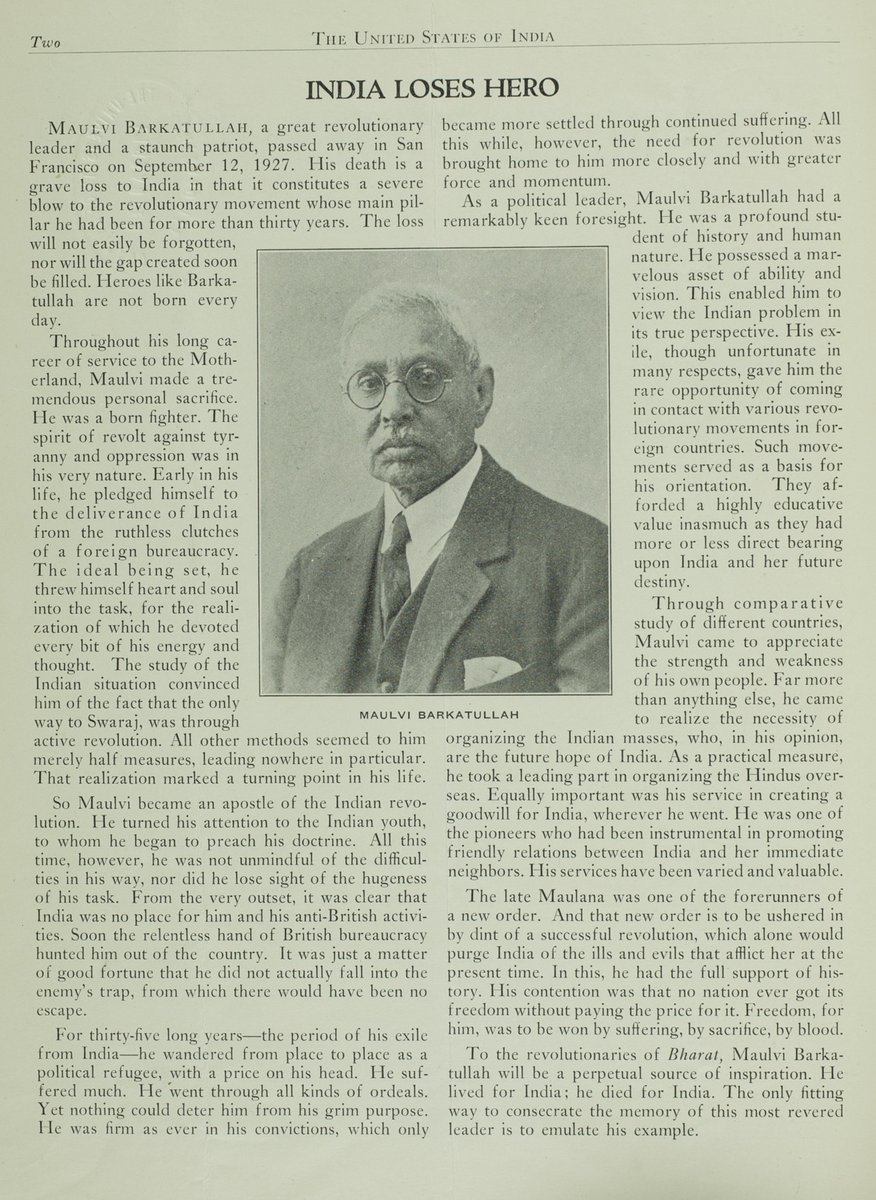
Tribute paid to Barkatullah in the United States of India, a publication of the Ghadar Party in the United States, in 1927. Credit: South Asian American Digital Archive
Barkatullah had been one of those who had backed the Ghadar uprising against the British during and after World War I. In a tribute to him after his death, published in the United States of India, a publication of the Ghadar Party in the US, the magazine wrote:
“To the revolutionaries of Bharat, Maulvi Barkatullah will be a perpetual source of inspiration. He lived for India; he died for India. The only fitting way to consecrate the memory of this most revered leader is to emulate his example.”
Raza Naeem is a Pakistani social scientist currently teaching in Lahore. He is also the president of the Progressive Writers Association in Lahore. His most recent work is an introduction to the reissued edition (HarperCollins India, 2016) of Abdullah Hussein’s classic novel The Weary Generations. He can be reached at: razanaeem@hotmail.com .
source: http://www.thewire.in / The Wire / Home> History / by Raza Naeem / July 15th, 2018
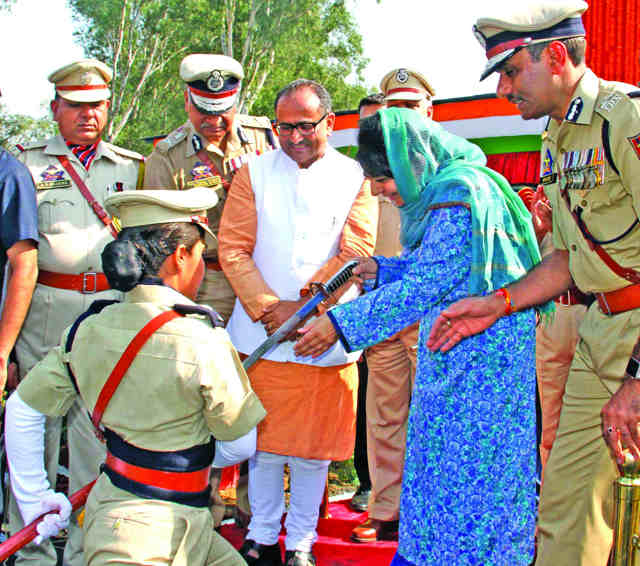
It was a moment of great pride for Deputy Inspector General of Police (Jammu-Kathua Range) Ashkoor Wani as his daughter was the only woman in the passing-out parade of the 11th batch of Deputy Superintendent of Police here today.
Dr Sunniya Wani was the only woman among the 17 officers in the passing-out parade at the Sher-i-Kashmir Police Academy.
Wani also became the first woman Kashmir Police Service (KPS) officer to get the best all-round award for her performance during her over-a-year-long training. She was awarded the trophy and citation by Jammu and Kashmir Chief Minister Mehbooba Mufti, who is also the first woman to hold the post in the state.
Lauding Wani, the chief minister said she was proud of her achievement.
“I am proud of your achievement and I wish more and more girls follow your footsteps.
I am also happy to see girls competing in every field and in many fields outnumbering boys,” she said. Ashkoor Wani said: “I am really proud of my daughter for her achievements. It is really a matter of pride and honour for me and my family that my daughter became the first female KPS officer to get the all-round award that too from the hands of Chief Minister Mehbooba Mufti.”
He said that his daughter always enjoyed the freedom to follow her dream and that he always encouraged her for that. “She is a medical doctor by profession and then she decided to wear the uniform. From childhood, she always wanted to contribute to the society and I hope and pray that she will become a good and dedicated police officer and would serve the nation, state and the community,” Wani said.
Sunniya Wani said that her father has always been an inspiration for her and she would follow the footsteps of her father to become a dedicated police officer.
“My father has always been an inspiration for me. I grew up watching him in uniform and I always wanted to follow his footsteps and wear the same uniform. I am happy that I made my father proud today,” she said.
Dr Wani said the sky was the limit for today’s women. “I want to tell girls to follow their dreams as nothing is impossible and the sky is the limit for them,” she said. (PTI)
source: http://www.news.statetimes.in / State Times / Home> News> Jammu & Kashmir > Jammu / by Tejinder Singh Sodhi / October 29th, 2016
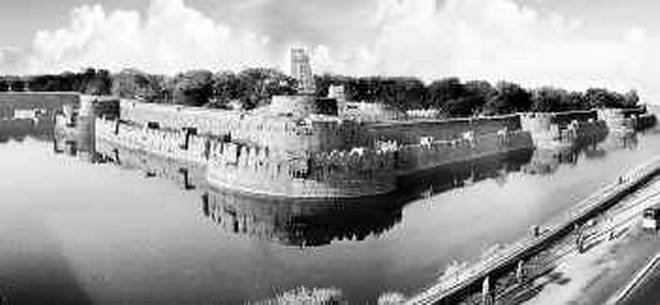
Site of awakening: The Vellore fort today. Photo: Curator, Government Museum, Vellore
Though it preceded the First War of Independence by almost 50 years, not much is known of this brief act of valour by the sepoys of the Vellore fort.
In the late-18th Century, the fakeers played a key role in spreading the message of unity amongst Indians and the need to throw out the British.
AT three, in the stealth of the dawn, on July 10, 1806, when it was still very quiet and the calm enveloped the Vellore fort, the doors of the native barracks suddenly flung open. Five hundred brave Indian sepoys were on the threshold of a mutiny they had so carefully plotted. Armed with muskets, they tiptoed out, dragging in their midst two heavily muffled six-pounder guns. They reached the European barracks, briefly halted, lifted the muskets to their shoulders and waited expectantly. The signal they anticipated was issued presently. It was at once fire works that shattered the still and the quiet. Windows and glass crashed while the English inmates woke up to their peril. Either they were killed in their beds whilst in deep slumber or were put down while running out in night robes trying to make sense of the pandemonium that had broken out so suddenly.
Losing direction
The Vellore War of Independence against the East India Company occupation was now well on its bloody course with all the trappings of romance associated with mutinies manifesting itself on that fateful morning. Underdogs defying authority, secretive planning, courage against intimidating authority, bravery and fearlessness towards death – all moved by a deep sense of right being on their side. By the time the smoke cleared and the guns became quiet by 5 a.m., about 15 British officers and about 100 English soldiers had been killed.
Col. Fancourt, the Commander of the Fort and Garrison was the first to be shot. Jamaidar Shaik Cossim, one of the principal leaders of the rebellion, had arranged to hoist Tipu’s Mysore flag over the fort signalling that the fort had been taken over. As the flag was fluttering proudly, the course of the mutiny floundered and lost its sense of direction and purpose.
Some of the sepoys started looting the houses of the Europeans, whilst others were busy abusing sepoys who did not take part in the mutiny. Yet others were conducting inconclusive discussions with Tipu’s sons, who were held captive within the fort, to come out openly and lead. Tipu’s princes hesitated and vacillated.
Though this rebellion preceded the First War of Independence (Sepoy Mutiny of 1857) by over 50 years, it has not been given the importance and significance it deserves as a determined early attempt to throw out imperialism and alien rule from Indian soil. We will take a brief pause from the fast-paced events of that fiery morning and analyse the causes for and significance of this rebellion before coming back to July 10, 1806 once again to complete our story.
Key influence
At the time of the Mutiny, the Vellore fort was station to the following Infantry Military units.
Battalions of the 69th Regiment and 23rd Regiment with 1,500 native troops and about 370 white officers and men present inside.
And great dissatisfaction was brewing amongst the Indian troops on various counts. And this had a good deal to do with the Fakeer Movement of the late 18th Century.
These fakeers were mystic mendicants (at times doubling up as mercenaries!) commanding the respect and affection of both Hindus and Muslims. In large numbers, they went from town to town conducting discourses, prayers and even puppet shows. They played a key role in spreading the message of unity amongst Indians and the need to throw out the British. They often got in touch with sepoys and native officers and instigated them to rebel. Their methods were secretive and the appeal powerful. These fakeers fanned all over the South and hence one can see that in the early 19th Century, there were several rebellions in the South.
The Chittoor polygors fighting the British between 1804 and 1805, the Travancore Mutiny in the same period and the Madurai outbreak of 1804 are examples to cite.
The famous valiant Wayanad hero, Pazhassi Raja gave the English anxious times till his capture and death in 1805. There was a ground swell of nationalism and a strong undercurrent of hope. And the fakeers sure had a significant role to play. Cantonments from Wallajahbad to Palayamkottai had been caught up in this freedom fervour.
The fakeers had a simple and enduring message: “we are many and they are few”.Like the gunpowder in the cartridge that needs a spark to ignite, the spark for the Vellore uprising came in the form of new uniform regulation announced by John Cradock in March 1806.
Cradock was the Commander-in-Chief the Madras Army. A new cap was prescribed in place of the turban and caste markings on the face were prohibited. The beard was to go. The hair over the upper lip was to be regulated and the wearing of earrings abolished. The troops saw this as the first step to Europeanisation and conversion to Christianity. Hindu and Muslim soldiers resented the regulations. Muslim soldiers expressed solidarity with Hindu sepoys who despised the use of cow leather in the new cap prescribed in the revised uniform regulation issued by the office of Cradock. Hindus and Muslims together rose as one in the name of religion and liberty.
Yet another factor that helped shape events in Vellore was the presence of Tipu’s family in the fort. They were confined and housed in the palaces and mahals formerly of the Nawabs of Arcot which lay within the precincts of the fort. After his heroic death on May 4, 1799, Tipu’s 12 sons and six of his eight daughters were brought to Vellore along with a retinue of servants and the party totalled 1,378.
In Vellore town itself a number of people had settled down following Tipu’s heirs. A certain Lt. Col. Marriott (pay master of Stipends) and his brother Capt. Marriott (the assistant paymaster) were in charge of the privileged prisoners.
Ironic twist
The presence of Tipu’s princes undoubtedly inspired the sepoys. Ironically, the princes perhaps did not provide decisive and inspiring leadership to the uprising.
Prince Moiz-ud-Deen is reported to have conducted some parleys with the leader of the uprising and Prince Fettah Hyder offered support in the early phase of the planning, albeit not too openly. Prince Moiz is said to have met key leaders like Subedar Noor Mohamed, Subedar Shaik Hossain and Jamaidar Shaik Cossim prior to July 10.
After assuming control of the fort, when Sheik Cossim and the others asked the princes to come out and openly lead them, the princes were insisting that they see the body of Lt. Col. Marriott first. This response did not help the course of the uprising which was already beginning to lack organisation.At that point and at about 9.30 am on July 10, 1806, Col. Gillespie of the 19th Dragoons, commanding the Cavalry Cantonment 16 miles away at Arcot, reached Vellore to put down the Mutiny. One Major Coates of the 23rd Regiment had earlier dispatched a letter through an officer at around 6 a.m. to the Arcot Cavalry unit seeking help. Gillespie arrived with an advance force. Lt. Col. Kennedy from the same cavalry reached a little later with heavy guns.
Swift end
The dislocated mutineers did not regroup in proper defence. The gates were blasted open by the 19th Dragoons and they stormed in. The rebelling native sepoys were mercilessly hounded and killed. It is reported that around 800 of them were found dead at the fort alone. More lives were evidently lost. By 2 p.m. in the afternoon the rebellion had not only been completely silenced but had come to be a brief pale memory of heroism – a flicker that was sadly extinguished.
As was expected, the British ordered a Court of inquiry into the events. It was also considered risky to keep the Tipu’s family in Vellore, so close to the seat of their former glory. They were taken and resettled in faraway Calcutta. The news of the Vellore War of Independence had sent shockwaves in England. The Governor, William Bentinck and Commander-in-Chief of the Madras Army, Sir John Cradock both were recalled on this count.
Historians should do more to research this not so well documented act of heroism, to inquire into questions like the impact of this event on the 1857 great rebellion.
Commemorating this unique rebellion, the State Government on the Bicentennial Anniversary held a function on July 10, 2006 with the Chief Minister participating and releasing a special volume on the Vellore uprising.
Voluntary groups and students are planning cycle rallies to Vellore to take home to the people of India the message of sacrifice behind these sepoys who dared to rebel so that we may live in a free country.
source: http://www.thehindu.com / The Hindu / Home> Features> Sunday Magazine / by A. Rangarajan / August 06th, 2006
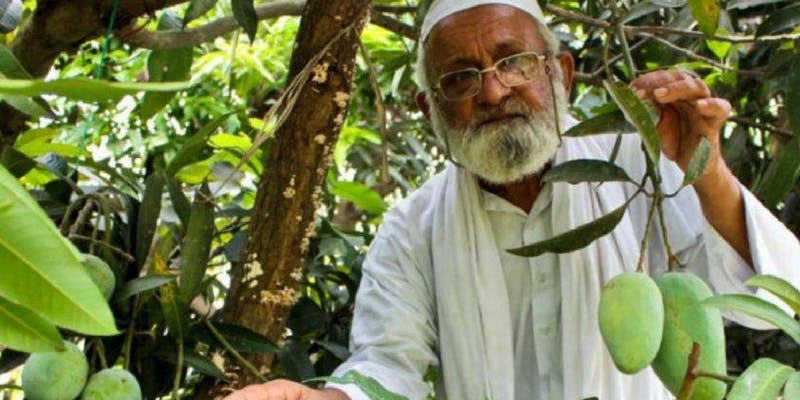
Last year, when newspapers and social media woke up to the news of a certain mango variety being dedicated to Prime Minister Narendra Modi, everyone’s attention shifted to 78-year-old “Mango crusader”. Hailing from Malihabad in Uttar Pradesh, Haji Kalimullah Khan is a mango cultivator who is either growing varieties of mangoes, experimenting with its flavors, naming a celebrity over each of the indigenous brands, or growing 300 varieties of mangoes on a single tree. Yes, you heard it right!
This sixth standard pass-out has pioneered the art of cultivating mangoes. He says,
Mango cultivation runs in our family, and we have been doing this for the past 300 years. Our ancestors in our rajwadas used to have huge mango orchards that grew beautiful hybrids. I cultivated a mango tree at the age of 17, which had seven varieties of mangoes in it, and all had different tastes and flavours.
Since then, I have been trying to grow new hybrids every year to show that it is possible to introduce newer varieties, he told NDTV.
Father of eight children, Kalimullah grabbed the headlines when he named a mango variety after Prime Minister Narendra Modi, and called it “NaMo Aam“. A hybrid of Kolkata’s Husn-e-Aara and Lucknow’s Dussehri, he plans to grow the variety at Modi’s hometown. In the past, he had dedicated mango varieties to yesteryear actor Nargis Dutt, Bollywood actor Aishwarya Rai Bachchan, Cricket prodigy Sachin Tendulkar, and Anarkali, the popular character in the movie “Mughal-e-Azam.”
Source: AmarUjala
“The ‘NaMo’ mango will remain even when we are gone and will remind people of Narendra Modi and his success. We wish to meet him once. We will be very happy if he visits us once and sees the ‘NaMo aam’ ripen, he told Zee News .
He also grows a certain breed of guava, which on ripening becomes as red as an apple. Kalimullah is also the recipient of the Padma Shri award
source: http://www.yourstory.com / YourStory / Home> Social Story> Think Change India / June 07th, 2018
A devout follower of Mahatma Gandhi, he had actively taken part in the freedom struggle, and post-Independence lived only to realise the leader’s principles of serving humanity.
Now in his late 90’s, Mohammed Baji of Nabarangpur district is too frail to work. But, he still holds the Gandhian principles close to the heart. Influenced by Gandhi’s approach of non-violence in his schooldays, he had made up his mind to meet him. And his dream was fulfilled when he met Gandhi at the age of 21 in 1941 at Wardha Ashram. “We had no money. But, I had to meet Gandhi ji. So, I and one of my friends, Lakshman Sahu, cycled around 350km amid forests and hilly terrain to reach Raipur in Chhattisgarh. From there, we boarded a train for Wardha where I met Gandhiji,” said the 98-year-old freedom fighter.
“Gandhi ji asked me if I was a Satyagrahi. When I said I had pledged to be one, he asked me to face the British lathis and sacrifice my life for the nation,” he added.
Seven days later Baji returned to Nabarangpur with a changed mindset. He had performed individual Satyagraha in an anti-war protest outside the Nabarangpur masjid. He was sent to jail for six months in Koraput and fined Rs 50.
“Gandhi ji had asked me to take the slogan of non-violence among the masses. I, along with a group of about 30 people, walked to villages to spread Satyagraha and non-violence among the masses,” Baji said.
On August 25, 1942 during the Quit India movement, he was again jailed for 30 months. In 1945, he had been attacked and arrested at Soraguda during a peace march. Baji’s shoulder was badly damaged in the violence and he was shifted to Cuttack jail, where he was housed, along with Biju Patnaik. He was set free on August 12, 1947.
However, partition pained Baji. “I was against the partition of the country. We had fought for the Independence of a united India,” he said.
During the 1952 general elections, many of his colleagues, including the then chief minister, Sadashiv Tripathy, became MLAs. But, Baji believed in helping people in a different way. “Gandhi’s code was to serve the mankind and I don’t think we always need power and position for that,” said Baji, who remained a bachelor throughout the life.
Post-Independence, from 1955-67, he had been the adviser to the Koraput District Bhudan Board. He played a leading role to collect about four lakh acres and distribute among the landless. Though being a Muslim he had launched a movement against cow slaughtering. “I donated my 14 acres during the bhoodan movement,” Baji said. In 1968 he established an ashram at Bijapur to house the students of adivasi and harijan communities. It is now a high school for the tribal students, and each month Baji donates a certain percentage of his freedom fighter’s pension for school management.
“What hurts me is that people have forgotten Gandhi ji‘s principle. But, I still believe that the India that Gandhi had dreamt of will be realised one day,” he said.
source: http://www.telegraphindia.com / The Telegraph,Calcutta,India / Home> Odisha / by Priyadarshini Pattnaik / January 21st, 2018
Ordinary people continue to talk about the work of Moudgil, Gupta,Jaffer, Tewari, Singh, and Ghosh even today
Bidar district is fortunate to get good officers known for their out-of-the-box thinking. Munish Moudgil, Harsh Gupta, P.C. Jaffer, Anurag Tewari, Naveen Raj Singh and Ujjwal Kumar Ghosh, to name a few, were not only good administrators leading the bureaucratic apparatus but also people-friendly officers who ordinary folk continue to talk about even many years after they have been transferred.
That many of their unique experiments in the district have grabbed the attention of the political class in Bengaluru who, in turn, adopted them for the entire State considering their effectiveness in improving governance is testimony for their outstanding performance.
When Naveen Raj Singh was Bidar Zilla Panchayat Chief Executive Officer (CEO) between 2003 and 2005, the district witnessed a successful experiment of watershed development through arch-check-dams. A civil engineering graduate, Mr. Singh studied the pressure enduring logic behind Idukki Dam, a double curvature arch dam constructed across the Periyar in a narrow gorge between two granite hills in Kerala, and built the first-ever inclined-buttress check-dam, as it was called, in Bidar applying the same logic.
Considering the reduction of construction costs by half as compared to conventional check-dams and increased life expectancy to around 100 years, the arch-check-dams proved to be a successful model in watershed development at affordable costs. The experiment impressed the State government which issued standing directions to all district to adopt the Bidar model for building smaller check-dams.
Munish Moudgil, who served as Deputy Commissioner in the district between 2005 and 2007, was the man who not only forced the mighty to respect and adhere to the law of the land but also significantly contributed to improving the administration. An M.Tech graduate from IIT Bombay, Moudgil was the one who first conceived the idea of time-bound public grievance redressal system.
He began to hold Jana Spandana, a people-meeting programme, on Tuesdays to address public grievances and put a mechanism in place to see that every grievance is addressed within a stipulated time.
Then, all the other department heads also followed him. Impressed by the initiative, the government adopted it for the entire State under a new name, Sakala.
Then came Harsh Gupta. During his tenure as Deputy Commissioner between 2007 and 2010, Bidar saw multi-front development. He put men on task to identify and protect 96 little-known monuments of historical importance. It was during his tenure that around 1,100 acres of public land encroached upon by private parties returned to government’s possession. His groundwork is undeniable in the famous Bidriware getting geographical indication (GI) tag as he was the one who roped in Cauvery Handicrafts Emporium to train Bidri artisans and get their work globally recognised.
Education was P.C. Jaffer’s cup of tea. During his tenure as Deputy Commissioner between 2012 and 2015, he introduced a series of programmes for improving the education scenario in the district. He selected one efficient teacher from each one of the 1,350 government primary schools and get them trained in English teaching training. Experts from English and Foreign Languages University (EFLU), Hyderabad, with whom he entered into an agreement, trained teachers in two sessions with multimedia teaching tools.
Mr. Jaffer conducted a series of career counselling programmes for spreading awareness on UPSC examinations in the backward district. In one of his important initiatives, he conducted a preliminary test for those aspiring for civil services and selected 12 students — eight males and four females, whom he sent to Delhi for higher-level coaching. Two of them cracked the UPSC exams. His efforts to improve the district’s performance in SSLC and PUC examinations were unlimited.
Anurag Tewari, who succeeded Jaffer as Deputy Commissioner and worked between 2015 and 2017, was Bidar’s waterman. In collaboration with Team YUVA, a civil society group of professionals, he identified hundreds of public tanks and wells that were crying for dredging. The collective efforts paved way for the dredging of 100 tanks and 300 open-wells resulting in increased water storage and groundwater table recharge. In 2016, the then Chief Minister Siddaramaiah, who visited a lake in Aurad, locally known as Deshmukh Kere, which was freshly dredged, was so impressed that he extended the initiative to the entire State under the name of Kere Sanjeevini.
Ujjwal Kumar Ghosh, during his tenure as the CEO of Bidar Zilla Panchayat, put a system in place for ensuring punctuality of teachers in government schools. The system inspired the Education Department to further develop it into an SMS-Based School Attendance Monitoring System and extend it to the entire State.
Anirudh Sravan P. is another promising officer that Bidar could expect the furtherance of the legacy from. Transferred as Deputy Commissioner of the district by Election Commission during the recent Assembly polls, he got recognised as people’s officer within a short period. It is his repeated visits to the district hospital that made it a patient-friendly hospital. Known for his style of working more from the field than from office, he is still talked about in the rural areas of Kalaburagi where he had meaningfully implemented MGNREGA as the CEO of Kalaburagi Zilla Panchayat.
source: http://www.thehindu.com / The Hindu / Home> National> Karnataka / by Kumar Buradikatti / Kalaburagi – June 19th, 2018
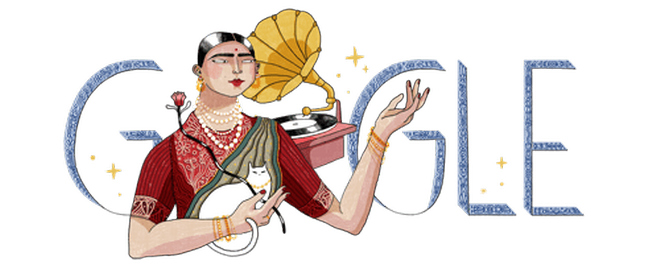
Today’s Google doodle features legendary musician and dancer Gauhar Jaan, the first Indian to record music on a 78 rpm record, thus opening up a new avenue for Indian classical music. Gauhar Jaan was born on this day in 1873.
The illustration is by Aditi Damle, showing Gauhar Jaan with her cat, and the gramaphone in the background.
Gauhar Jan
Gauhar Jaan was born Angelina Yeoward to an Armenian Christian father and an Indian Jewish mother. Angelina converted to Islam along with her mother in the 1880s and became Gauhar Jaan. Her mother, ‘Badi’ Malka Jaan, was an accomplished Kathak dancer and singer and was a courtesan in Benaras. Gauhar learned classical music and dance from her mother. The duo moved to Kolkata later, where Gauhar learned more classical forms such as the Patiala gharana, Dhrupad, Thumri, and the Bengali keertan. She started singing songs penned by Rabindranath Tagore much before it came to be known as ‘Rabindra Sangeet.’
Her maiden music concert was when she was as young as 17 years. Gauhar began giving dance performances too after a few years. She went on to perform in many parts of India, including Mysuru, Chennai, Dharbanga, and Allahabad. Gauhar used her travels as an opportunity to learn regional art forms. She could sing in as many as 20 languages.
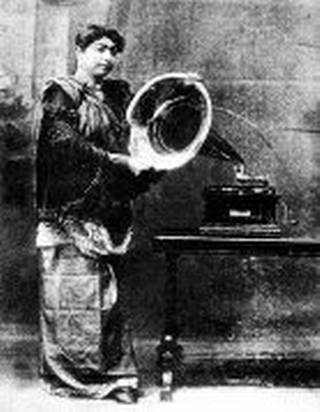
When Frederick William Gaisberg, the iconic recording engineer from the Gramophone Company, visited India to record Indian music, Gauhar Jaan was the first musician to accept his offer. This was at a time when her male counterparts were reluctant to accept a new technology, which they feared would spoil their voice. On the day of the trial recording, she is believed to have said “My name is Gauhar Jan,” according to Suresh Chandvankar of the Society of Indian Record Collectors.. This eventually became the label of the first Indian album. Gauhar has over 200 records to her credit. In 1994, the Gramophone Company re-released 18 of her songs as a collection.
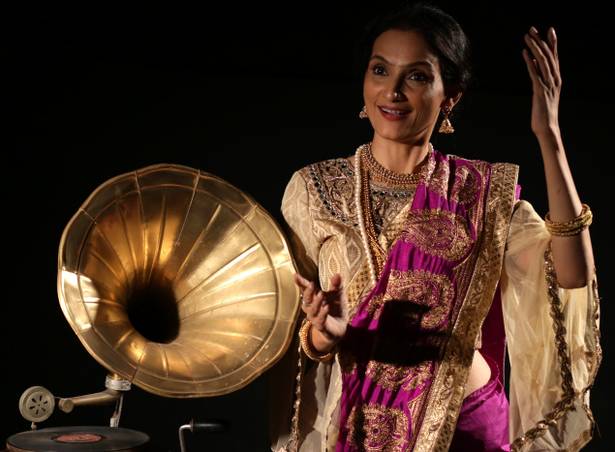
Rajeshwari Sachdev as Gauhar.
“Gauhar Jaan was exceptional in more ways than one… she created a template to showcase something as expansive as Hindustani music in just three minutes!” said Vikram Sampath, who wrote her biography ‘My Name Is Gauhar Jaan! The Life and Times of A Musician.’ . Earlier gramaphone records would last only for three minutes and artists had to scream into horns as the acoustic technology was in its nascent stage. Gauhar’s method of recording was adopted by many women singers, which eventually led to more women taking up recording.
In the book, Mr. Sampath has chronicled the life and times of Gauhar, including her lavish lifestyle, her ill-fated relationships, and dwindling health during later years. There is an interesting story about the cat that is featured along with Gauhar in Tuesday’s Doodle. It is said that Gauhar spent ₹20,000 in the early 1900s and threw a party when her cat delivered a litter of kittens, according to historian V. Muthiah. However, she spent her last days as a court musician in the Mysore Maharaja’s palace for a sum of ₹500 per month, before she passed away on January 17, 1930.
Director Ashutosh Gowarikar has bought the movie rights for Mr. Sampath’s book, hoping to bring Gauhar’s life to the silver screen. Gauhar’s life had been enacted as a play directed by Lillete Dubey. Singer Rajeshwari Sachdev played the title role, while Zila Khan played the older Gauhar.
source: http://www.thehindu.com / The Hindu / Home> Sci-Tech> Internet / by K. Deepalakshmi / June 26th, 2018
Nada Village, Belthangandy Taluk (Dakshina Kannada District) , KARNATAKA :
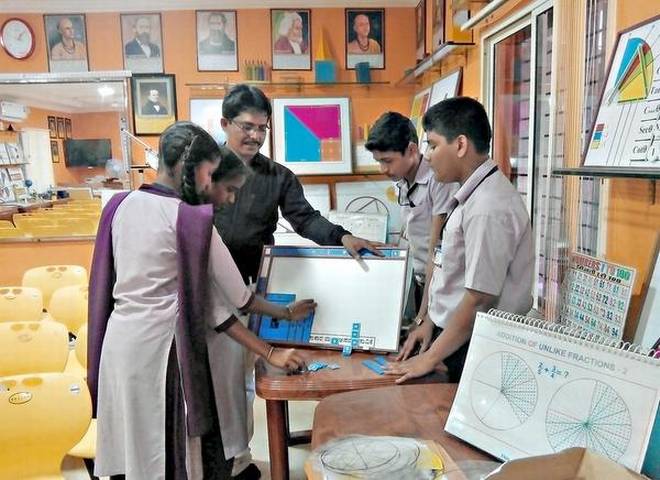
Yakub Koyyur, assistant teacher in mathematics, at the lab opened by him at Government Kannada Medium High School in Belthangady taluk of Dakshina Kannada district.
All SSLC students pass the maths paper; their success is being attributed to a laboratory in the school
A government school teacher setting up a laboratory to help students overcome their fear of mathematics four years ago appears to have borne fruit in a Dakshina Kannada village school as all the 43 students who appeared for the mathematics paper in the recently held class 10 exam have passed.
The Government Kannada Medium High School at Nada village in Belthangady taluk had previously recorded cent per cent results in mathematics way back in 2002.
It was Yakub Koyyur, an assistant teacher in mathematics, who opened the laboratory in the school in February 2014. But it was effectively put to use one year later, from the 2015–16 academic year.
It was the first such laboratory opened in a government school in the State. The objective was to make students having less-than-average learning ability score well and at least pass the mathematics paper.
When the first batch of class 10 students who used the laboratory wrote the exam in March 2015, the pass percentage in mathematics went up to 77.35 from 69.38 in 2014. It further rose to 95% in 2016 and witnessed a slight decrease — 94.59% — in 2017. The dream of the teacher to see all class 10 students pass in the subject was achieved this year.
Mr. Koyyur said many students end their education in class 10 for having failed in mathematics as they feel it is tough nut to crack. He, however, wanted to make the students first shed the fear about the necessary evil and pass the SSLC exam.
Before setting up the laboratory, the pass percentage in mathematics in class 10 in the school varied between 62.6 and 86.76 during 2008–13.
All those students who passed in mathematics in class 10 this year had made use of the laboratory since they joined the school for class 8 in 2015–16. “The laboratory inspired the students to shed the fear and also provided a base to understand the concepts of mathematics. Three years of continuous exposure of students to the laboratory could be one of the reasons for all having passed this year,” Mr. Koyyur said. But the pass percentage also depended on the questions asked and the learning ability of students, he added.
In his bright and colourful ‘Maths World’ laboratory, all students from class 8 onwards get hands-on experience through models, audio-visual tools, and charts. The laboratory was opened with a partial government funding of ₹2.5 lakh and ₹13 lakh contributed by the school alumni.
source: http://www.thehindu.com / The Hindu / Home> News> States> Karnataka / by Ravi Prasad Kamila / Mangaluru – June 18th, 2018