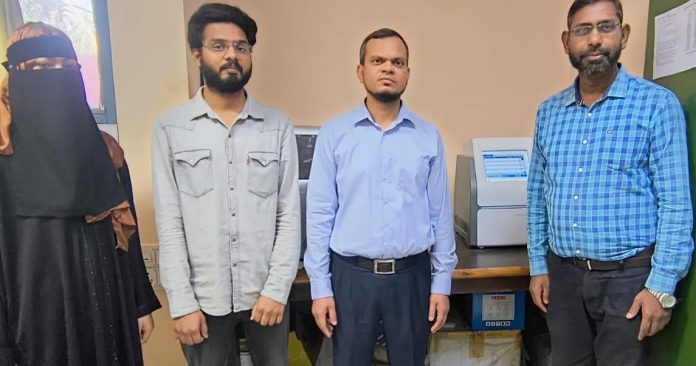
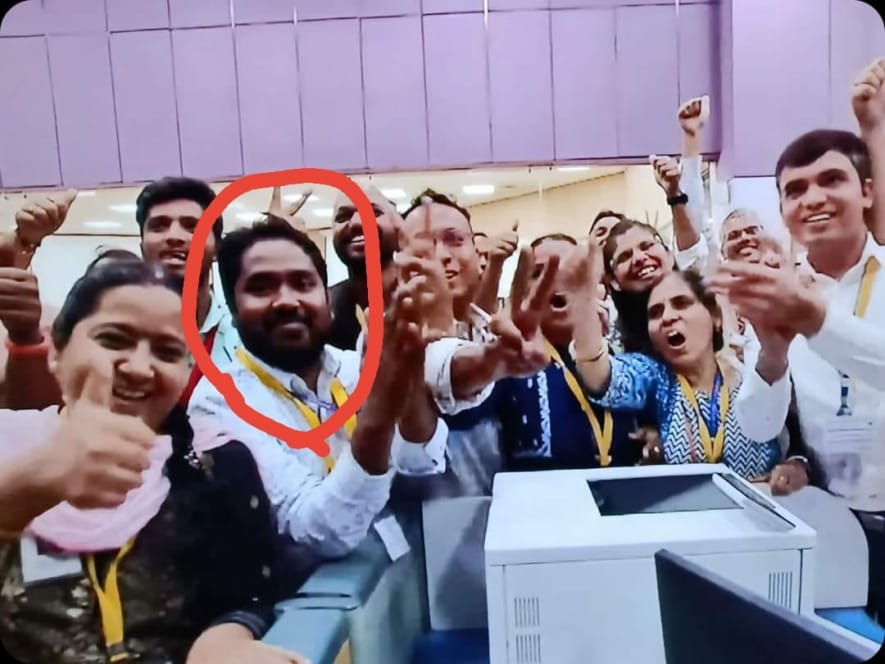
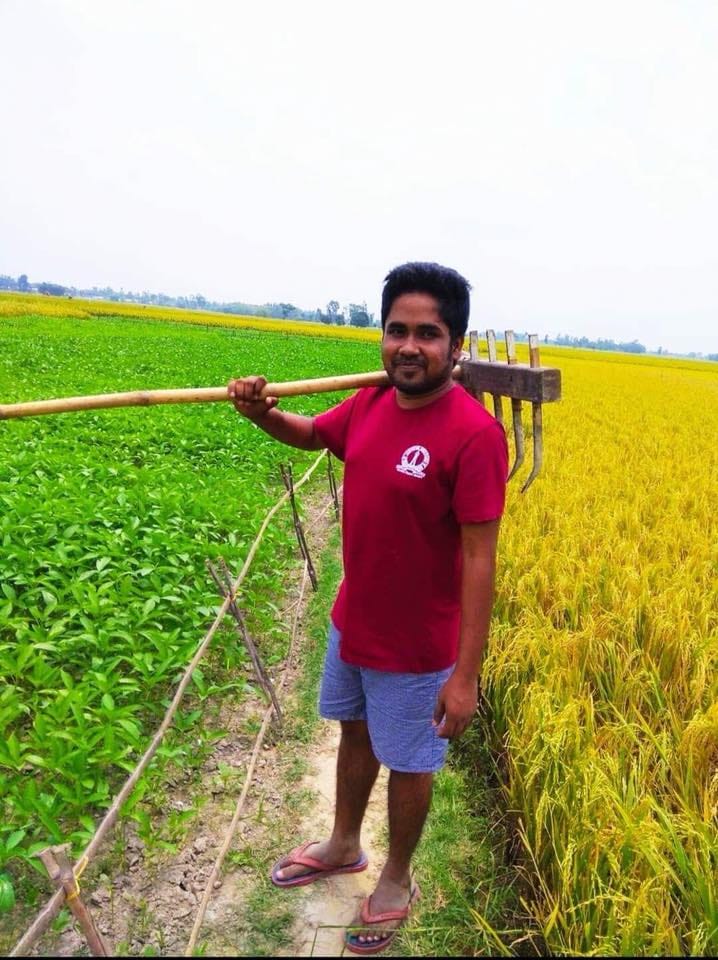
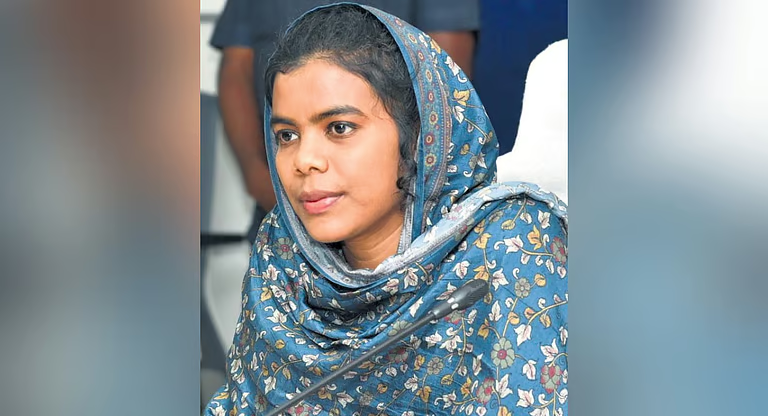
After three years of relentless efforts, mathematics teacher Bilal Ahmad Mir is set to launch his solar-powered car, RAY, revolutionizing eco-friendly transportation. The much-anticipated vehicle will hit the roads on Monday, February 10, marking a significant step in clean energy innovation.
Mir, who entirely self-funded his project with an investment of ₹20-22 lakh, embarked on this journey in 2022. He extensively studied automobile designs from the 1950s to modern-day luxury cars, incorporating cutting-edge technological advancements into his solar vehicle. His research, published in six countries, has earned him the moniker ‘Elon Musk of Kashmir’.
The RAY solar car boasts a 1 kW solar-powered engine, a high-tech Battery Management System (BMS), and autonomous parking sensors. Its gull-wing doors, embedded with solar panels, enhance both aesthetics and energy efficiency. Unlike traditional electric cars that require sunlight for charging, RAY can charge itself even in cloudy or snowy conditions.
Mir initially caught the attention of Mahindra Group Chairman Anand Mahindra, but a potential collaboration fell through due to technical constraints. Despite this, Mir remains optimistic about his prospects in the global market.
While Indian manufacturers are producing electric vehicles, Mir believes his solar innovation faces no domestic competition. Instead, he aims to compete with international firms like Lightyear and Aptera Motors, both pioneers in solar-powered vehicles. His research continues to receive global recognition, further strengthening his reputation in the field.
The prototype of RAY was developed by modifying a 1988 Nissan Micra, a process that took Mir 13 years of dedication. The car, which features a dual power system—solar energy and a rechargeable battery—will officially launch on February 10 and is expected to hit the roads by June 2025. However, Mir remains tight-lipped about future production plans.
As the world shifts toward sustainable solutions, Bilal Mir’s innovative solar car serves as an inspiration for India’s clean-energy future.
source: http://www.radiancenews.com / Radiance News / Home> Pride of the Nation / by Radiance News Bureau / February 11th, 2025
He can afford to hand out fistfuls of Liv.52 to anyone feeling liverish, although he would prefer to sell the pill. As Meraj Manal says, one Liv.52 is bought every second somewhere in the world. The only ayurveda pill among the 12 bestselling medications in India, Liv.52 has powered its manufacturer The Himalaya Drug Co into the ranks of Big Pharma in India.
But ask Manal to sell a slice of his privately-held company and you are shown the door. Many consumer care companies have tried to acquire a stake in Bangalore-based Himalaya. Dealmakers know it is not up for sale, but they do not give up hope or stop making bids.
Why should they? Himalaya, started by Manal’s father, the late M. Manal, in 1930 to make herbal tablets in the Himalayan town of Dehradun, is today an established brand in over 70 countries with about 160 products – 66 in pharma, 63 in personal care, nine in baby care and 22 in animal care.
After India, its three top markets are West Asia, Russia and the CIS, and South East Asia. In 1999, Himalaya took its personal care range into global markets, piggybacking the equity of its pharma products.
Figures are not available, but Manal says turnover has crossed Rs 1,000 crore on the back of Liv.52, some similar pills and the personal care products. “Liv.52 is one of the biggest successes of my father,” says Manal, Chairman of Himalaya Global Holdings, which owns the nine operating subsidiaries in different regions.
___________________________
I get 3 or 4 offers a year: Meraj Manal
Meraj Manal, 62, has always let his business heads to do the talking. In a rare interview with BT’s K.R. Balasubramanyam, he explains why he does not want outside investments, and why values count more than profits. Edited excerpts
How did your father get into the herbal medicine business? My father spent his lifetime gathering knowledge about traditional household remedies, standardising them, testing them for safety and efficacy and demonstrating them to doctors. He was the first who thought of producing herbal medicines in tablet form so doctors can prescribe them… Whenever he heard about a remedy, he would jot it down on a plain card to work on them later. We have tens of thousands of such cards stored in boxes. Our toothpaste is a product from one such card scribbled 40 years ago.
Why are you still not a public company? I don’t want a rupee from anyone other than the bank, because it is difficult to explain what we do to a shareholder. Can I accept outside investments and allow these cards (pointing to the stacks of his father’s cards) to disappear? Our whole philosophy, our value system is so different, how do I explain this to investors? All my children – four daughters and three sons – think so.
Do you get offers? I receive three or four offers a year. Multinationals have spoken to me and one of them even said we are the nugget of the herbal industry. If I accept these offers and put that money in a bank, I would no doubt get millions every month… What will I do with that money? I don’t want the liability of someone else’s money with me, big or small. Once you accept outside investment, they will start advising us on things like cutting the number of curries in the lunch at our canteen… or the staff transport. They will ask us why you are doing this and that. There is no “why” here. This is how it is. Since we are closely held, I have the luxury to say profits are not everything.
How much of your revenues goes into R&D? In this company, there is no limit on expenses on R&D. That is the only division without a budget. These (pointing to the cards) have to be converted into products.
How are you professionalising the company? As you grow, you need people who know more than you do. You cannot reach the next step unless you professionalise…. We will reserve the holding company for family members and the subsidiaries will have only professionals. We have separated ownership from management. Family members will be responsible for nurturing our value system. I don’t want family members on the business side. If they have energy, they are free to go out and pursue their interests.
So a family member becomes part of the holding company by default? Admission is not by default. They must have something to contribute….My son heads the US business, and not because he is my son, but because he is a professional who knows the US market the best. He is doing remarkably well.
What about this Deputy Chairman’s post? I created the post two years ago and appointed Ravi Prasad for a very special reason. To send a strong message that the operational head does not have to be a Manal. People were astonished and are happy about the decision. Like any CEO of any other region, my son too reports to Ravi. (Ravi Prasad was elevated as Executive Chairman in October. He leads the global management team.)
Are you satisfied with your growth? The growth we have had is more than satisfactory. If I want more than that, then we are greedy. We crossed Rs 1,000 crore in revenues last year. I don’t know much about finances. Professionals handle that. I just sign on the papers. …When I joined the business in 1965, the revenues were Rs 40 lakh…. The way we are growing in North and South America tells me that 20 years from now, they could possibly be our largest markets by volume.
Where is Himalaya headed? We will never move from our core competence. I am not for diversifying. I am not a person who can do other things. Opportunities for growth are unlimited and there is no real need to diversify. Our global operations have taught us many things. The country does not matter. As long as there are homes with people, we will go there.
_______________________________
Research backbone Although Himalaya’s reliance on Liv.52 has come down after both its new as well as old pharma products picked up steam in the market, and it launched personal care products, it all began with this blockbuster, whose recipe was among the many jotted down by Manal’s father on a card.
(Himalaya’s future lies in thousands of similar cards with notes that are stacked in boxes in Manal’s room.) The 52nd formula was a hit. Manal senior’s aim had been to make herbal remedies available in tablet form, scientifically tested for efficacy, identified by name and prescribed by doctors. The passion for research continues.
Ravi Prasad
Himalaya has raised its research, development and manufacturing standards so that its products clear regulatory hurdles abroad. “Apart from ayurvedic institutions, we also do clinical trials in leading allopathic institutions both in India and abroad,” says Ravi Prasad, Executive Chairman of Himalaya Drug Company, who leads the team of professionals worldwide.
“The regulatory picture is not clear in many countries and in some countries our standards have been recognised as the benchmark,” he says. Himalaya’s R&D facility, he says, is one of the biggest for an ayurveda manufacturer, with about 120 multidisciplinary scientists. As Manal proudly declares, R&D is the “backbone” of the company.
Himalaya knows the key to growth lies in its ability to create more patents. The US Patent and Trademark Office has granted it patents for its sunscreen, under-eye cream, laxative, sedative, immunestimulant, anti-acne range and hairloss cream, and 76 applications are pending. It has just released in the US markets a new type of tablet in which the binders are also derived from herbs. “No company has done this before, and we have filed for a process patent,” says Ravi Prasad. Until the 1990s, Himalaya’s portfolio had only pharma remedies. It entered the equally lucrative consumer care market with some 20 products under the Ayurvedic Concepts range in 2001. Two years later, it created the umbrella brand Himalaya Herbal Healthcare. It also began opening exclusive outlets: there are 130 shops in India and 25 in Singapore, Malaysia, South Africa and the Cayman Islands.
Dream run According to Ravi Prasad, Himalaya’s personal care products are growing much faster globally than pharma products, because pharma faces tough regulations in some countries. As of now, Himalaya gets 58 per cent of its revenues from pharma products, but that seems set to change. Saket Gore, Business Head of the consumer products division, says: “Today, we are the market leaders in face washes in the UAE, India and Malaysia.”
According to The Nielsen Co figures for April-June 2010, Himalaya face washes had a 17.8 per cent market share in India, less than two percentage points behind multinationals Hindustan Unilever Ltd and L’Oreal. Himalaya’s individual products also face competition from firms that are strong in one or just a few products, such as Colgate in toothpaste and Fair & Lovely in face masks. Doctors have been Himalaya’s biggest brand ambassadors in pharmaceuticals.
Philipe Haydon, President & CEO for pharmaceuticals, says Himalaya is in touch with about 3.75 lakh doctors and reaches 94 per cent of pharma retailers. “We are the modern face of ayurveda in India and our medical representatives promote products with scientific detailing,” says Haydon, who is also the CEO of the Asia Pacific region. In ayurveda retail, Himalaya competes with the likes of Dabur, Charak, and Baidyanath
Source: Indian Pharmaceutical Market rankings based on Org SSA report / Aug 2010
__________________________
Internationally, consumer care and pharma contribute equally to revenues. “In 20 years from now, North and South America could possibly be our largest markets by volume. They are very big on herbal medicine,” says Manal. These markets are headed by his son Nabeel, 36.
The Prognosis Industry observers believe that while Himalaya has built a cult in Liv.52, it needs more such blockbusters to make up for its low-key marketing and a distribution network weaker than that of rivals such as Dabur India.
“Today, the brand Himalaya is recognised and closely associated as a natural remedy, but on the personal-care front it sends out no cues to a consumer. This is important in the FMCG category where it competes with many others,” observes Kannan Sitaram, a former chief operating officer of Dabur.
Analysts say that opening shop-in-shops and branded stores is a good strategy. “But brandbuilding investments are required so that consumers will walk into a shop only for the Himalaya display. Also, being positioned as a mass brand, it needs greater presence and investment in distribution,” says Sitaram. But the company has to figure out if its returns are justified. “After all, rentals are going up,” he says.
In pharma, Himalaya is stronger. “It has very sharply- positioned products for the eyes, liver, bones and so on. It is also present in areas that are not crowded. Besides, it spends huge sums on R&D and can compete with some of the best pharma companies in India,” says R.B. Smarta, Managing Director, Interlink Marketing Consultancy.
This also gives it an edge in global markets, where the demand for natural, ayurvedic and herbal remedies is growing. “They have very precise and extensive documentation on each of their ingredients, that can withstand the rigor of clinical trials. Their patents also stand them in good stead,” says Smarta.
By buying raw materials directly from growers, collectors and nongovernmental organisations, Himalaya keeps costs under control. Recently, it signed an agreement with the Sikkim government to prepare farmers in organic farming of herbs and sustainable collection. In September, Himalaya, along with a few others, came under fire from the Centre for Science and Environment or CSE, which claimed that Himalaya’s honey contained antibiotics beyond the stipulated standards. Ravi Prasad denies the charge. “The same batch was tested at three independent laboratories and none found any trace of antibiotics.
Our technical team will soon meet the CSE with these findings and seek its comments,” he says.
No entry Manal does not run day-to-day affairs and has professionalised the company by elevating Ravi Prasad as the executive head, so that his father’s legacy grows independent of the family. “My father’s life’s mission was to help people and we will move in his footsteps,” says Manal, who follows the modest example set by his father. (In September, when Ravi Prasad called on Manal at his apartment in Dubai, the chairman travelled with him to Himalaya’s office in the Metro and then took a bus to attend another meeting.)
Of Manal’s seven children, only Nabeel works for the company. Two daughters are married and homemakers, and the other two daughters and a son are still studying. One son works in the financial sector in the US. Manal is content with bank funding, and proud of his 40-yearold relationship with Union Bank of India. In turn, M.V. Nair, the bank’s Chairman and Managing Director, says its long relationship with Himalaya is a wonderful example of a banker- entrepreneur growth story.
Himayala’s requirement of funds depends on projects. It borrowed Rs 100 crore two years ago from the bank to make its manufacturing unit in Bangalore compliant with European and American standards.
Dealmakers and investment bankers are not put off by Manal’s “No Entry” board. Recently a personal-care multinational contacted Bangalore’s Viedea Capital Advisors, looking for a sizeable stake in Himalaya. Deepak Srinath, cofounder of Viedea, says: “The management did not entertain any conversation on the subject.”
Himalaya, Srinath says, is a dream mandate for any investment banker because it has all the ingredients that a PE or strategic investor looks for – a highly credible brand name, an impressive product portfolio, a professional management and profitability.
“Also, the promoters have a reputation for being ethical,” says Srinath. According to the India head of an American PE firm, Himalaya is an ideal target since its capex needs are not large and can be met by internal accruals and bank funding. Such companies usually give robust returns.
But Manal is focused on different things: “The scope for growth is unlimited. As long as there are homes with people, that family is our customer. We don’t recognise borders.”
With inputs by Shamni Pande
source: http://www.businesstoday.in / Business Today.in / Home> News> BT Magazine> Features / by K R Balasubramanyam / Print edition / November 28th, 2010
Students of Bearys Institute of Technology (BIT) have made the institution proud with their achievements at the 24th Visvesvaraya Technological University (VTU) Annual Convocation held today.
Thasnim Khalid, an M.Tech CSE graduate, secured the 8th rank with a CGPA of 9.43 and received her award during the ceremony.
Ayshuthul Sajeena, another M.Tech CSE graduate, achieved the 5th rank with a CGPA of 9.53. However, she could not attend the event due to the recent passing of her father.
The BIT management, faculty, and staff have congratulated both students on their accomplishments, appreciating their hard work and dedication.
source: http://www.english.varthabharati.in / Vartha Bharati / Home> Karavali / by Vartha Bharati / February 08th, 2025
Kalakappar Village (Nagrota Tehsil), JAMMU & KASHMIR :
Heavily garlanded Nazia Bibi with her family including her grandmother, and visitors at her home
Weeks after the nomadic Gujjar-Bakerwal community of Jammu and Kashmir plunged into a state of shock as 17 tribesmen, women and children died of a mysterious disease in village Budhaal in Rajouri, a young woman has brought cheers to and restored the pride of the community.
Nazia Bibi, a 21-year-old college student has become the first athlete from J&K to win gold in the International Kho Kho championship. Nazia, who hails from village Kalakappar of tehsil Nagrota on the outskirts of Jammu city, is a member of the Indian women’s Kho Kho team which recently lifted the maiden World Cup in Delhi by trouncing Nepal in a convincing victory.
Nazia Bibi also became one of the few tribal women from J&K to reach the international level in sports.
Her achievement is more important given the fact that the Gujjar-Bakerwal community is backward and also conservative in its outlook for women.
However, Nazia today doesn’t hold any grudges against her family for asking her to stop playing because of society’s disapproval.
International Kho Kho player Nazia Bibi
“I can understand when my family asked him to stop playing since people made uncharitable comments and fun of me because I didn’t wear a conventional dress while practicing. I had my Chachu (Uncle) Master Iqbal who is a teacher to fall back upon. I would explain to him my problems in pursuing Kho Kho and he, in turn, convinced my father,” she said.
Her father Sabar Ali is an unlettered person and earns his livelihood by rearing cattle – sheep and goat. Nazia has a sister and two brothers and the family lives in a two-room house in the village.
A BA fifth-semester student of the Padma Shri Padma Sachdev Govt College for Women Gandhi Nagar, Jammu, Nazia says lifting the gold cup for India was her proudest moment and brought her struggle to a logical and happy end.
“Today, at 21, I am overwhelmed as so many people are coming to congratulate me. It’s too much for me to handle,” she says in a video interview to a local channel.
Nazia is amused to see her relatives and neighbours announcing that they would encourage their children to play sports as well.
“One person’s struggle can open opportunities for so many,” she said.
Nazia was invited by the LG Manoj Sinha to the Raj Bhawan for a meeting. The DIG of Jammu felicitated her for her achievement.
Advocate Zulkarnain Choudhary, a community activist said Nazia should be given a decent job of the rank of a gazette officer by the J&K government, as is done in other cases.
Nazia however says her struggle and achievement must bring focus on better infrastructure for sports. “We don’t have good stadiums or coaching family in Jammu. Practicing in an open field and on mats indoors are so different,” Nazia said.
Nazia Bibi with LG Manoj Sinha and officials of the Kho Kho association
As a promising athlete, she says she was encouraged by her teachers in the local school and also by the J&K Kho Kho association officials.
“I continued playing kho kho because it doesn’t require expensive tools and sports kits. However, my skill was honed in the national camps for which I was selected. Also, a team game requires you to bring sharp skills to the table.”
Nazia said she practices three hours at home and for 7-8 hours in the camps. “Joining the preparatory camp for the International Kho Kho competition was very helpful. It brings discipline in an athlete and also makes one realize of competition.”
An international gold medal in hand though Nazia wants to forget her struggle against society’s attitude. She said, “Even I felt uncomfortable with the tracksuit and uncovered hair because we, as tribal women, are conditioned to conservative dressing.”
Her father Sabar Ali says, “I am an illiterate person. I would get upset with people making jokes about my daughter’s dress and her sports. Today, the same people are coming to congratulate us and I am so happy.”
Sabar Ali and his five brothers live close by in the village and have unity. Advocate Choudhary who visited the 2-room house of Nazia told Awaz-the Voice, “They are a simple and pure united family. I don’t think they fully understand the scope of their daughter’s achievements.”
Fighting society in pursuing one’s passion is not so easy for women.
Nazia says at one stage she had decided to give up. As luck would have it Nazia was playing for India and the team won gold unmindful of the celebrations of her brother’s wedding back home.
source: http://www.awazthevoice.in / Awaz, The Voice / Home> Stories / by Aasha Khosa, New Delhi / February 04th, 2025
American Specialty Foods Co has been honored with the prestigious Westford Award for Business Excellence in the Food & Beverage category. The award was presented at a grand ceremony held at Madinat Jumeirah, Mina Al Salam, Dubai, on January 24, 2025.
The award was received by the company’s Founder and CEO, Hany M. Haneef, along with Co-founder and Director, Shahanaz Haneef. Expressing his gratitude, Haneef stated, “I am truly honored to receive this award. It belongs to our incredible team, partners, and supporters. Success is built on dedication, teamwork, and excellence. This is just the beginning; there is so much more ahead.”
Established in 2013, American Specialty Foods Co has grown into a leading provider of premium global food solutions. Headquartered in Maryland, USA, the company also has offices in New York, Mexico, the UK, and the UAE. With a distribution network spanning over 50 countries, the company offers more than 20 specialty food categories and actively participates in major international food trade events worldwide.
The Westford Awards recognize outstanding business achievements across various industries, providing winners with greater visibility and networking opportunities. “This recognition further cements American Specialty Foods Co’s position as a leader in the specialty food and beverage sector,” a statement from the company added.
source: http://www.english.varthabharati.in / Vartha Bharati / Home> Gulf / by Vartha Bharati / January 31st, 2025
Nawab Shafan Khan, the heir of Nawab Khan Bahadur Khan, who kept the Rohilkhand region free from British rule for eleven months during the 1857 freedom movement, has passed away.
Nawab Shafan Khan breathed his last at the age of 80. The sacrifices of his ancestors are recorded in golden words in the pages of history.
Death of Nawab Shaffan Khan, heir of Nawab Khan Bahadur Khan
Nawab Shafan Khan, a resident of Shahabad area of Bareilly city, has passed away. He was laid to rest in Bhor graveyard near his home after Zuhr prayers. He was the heir to a great family whose ancestors ruled not only Bareilly but also in about 9 surrounding districts. His great-grandfather Nawab Khan Bahadur Khan had set a great example of bravery and sacrifice in the style of his namesake.
He was a hero of the 1857 revolution. He was born in 1791 into a Nawab family. He was the grandson of Rohilla Sardar Hafiz Rehmat Khan.
The slogan of revolution was raised in Meerut on 10 May 1857 and when the news of it reached Bareilly on 14 May, preparations were intensified here too. On 31 May, Khan Bahadur Khan and his generals and soldiers, led by Subedar Bakht Khan, declared a rebellion against the British government.
Tomb of Nawab Khan Bahadur Khan
The then magistrate, civil sergeant, jail superintendent and principal of Bareilly College, “C.Buk”, were killed by the revolutionaries. By five in the evening, the revolutionaries had taken control of the Bareilly division.
On June 1, these revolutionaries took out a triumphant procession. When the procession reached Kotwali, a large number of Bareilly citizens crowned Nawab Khan Bahadur Khan and elected him the Nawab of the Bareilly division.
Heir of Nawab Khan Bahadur Khan
An example of the bravery of Nawab Khan Bahadur Khan is that despite the numerous atrocities and abuses of the British government and being a powerful ruler, he kept the Bareilly division free from the rule of the British government for eleven months.
However, later, the British government arrested Nawab Khan Bahadur Khan while fighting a war at one place. He was brought to the same Kotwali where he was awarded the title of Nawab. He was imprisoned and kept in an unknown place.
Then on February 24, 1860, the hero of the urban people was brought on foot to the Kotwali and hanged on the same day at 7:10 am. A strange silence fell in the city and darkness prevailed.
Heir of Nawab Khan Bahadur Khan
To prevent any unrest in the city after the hanging of Nawab Khan Bahadur Khan, his body was taken to the district jail in an armored police vehicle and buried in the premises of the district jail.
Heir of Nawab Khan Bahadur Khan
The special thing is that he was buried with irons. Even today, the irons are clearly visible on the head of his grave. The British government had also buried Khan Bahadur Khan in the prison premises so that people could not gather at his grave and there would be no further excitement in the revolution.
Now let us mention Nawab Shafan Khan, the heir of Khan Bahadur Khan. He struggled for life and livelihood till his last breath. Despite belonging to the Nawab family, his family had to face difficulties for years or even their entire lives. Despite this, the struggle did not end in his life till his last breath.
According to his younger brother Nawab Liaquat Khan, Nawab Shaffan Khan’s health had deteriorated for the past five days. He was unable to go to the mosque to offer prayers during those days. Due to the weak financial condition of the family, he was undergoing treatment at home. But in the morning, his health deteriorated further and he died after a few moments.
source: http://www.etvbharat.com / ETV Bharat – Urdu / Home> Urdu> State / by Urdu translation into English / July 02nd, 2021
“When you help someone, you don’t think of his religion or sect; saving a life is human and a duty. Religion also teaches that human life is the most precious thing in the world.”
This is what Farhan Alam, a young lawyer and social worker from Prayagraj, who saved Ramshankar by giving him timely CPR when the former suffered a heart attack during the Mahakumbh at Prayagraj, Uttar Pradesh, said. Cardiopulmonary resuscitation (CPR) is an emergency treatment done on someone who se breathing or heartbeat has stopped.
Last week’s incident came to light when a video of Farhan Alam administering the life-saving procedure on Ramshankar went viral on social media. In the clip, Farhar is seen applying pressure with both hands on the chest of an unconscious Ramshankar as his wife and child are seen crying.
Later it was revealed that Farhan Alam had saved the life of Ramshankar, a devotee who had come to Maha Kumbh.
Speaking with Awaz-the Voice, Farhan Alam said this was not unusual for him. “It was a part of my responsibility that I performed well. The important thing is that I tried reviving him through CPR and Allah helped me.”
pix02
Remembering the incident, he said, “I was posted at the railway station, but one of my colleagues Muhammad Arshad told me about the passing out of a devotee on the walkie-talkie. I rushed there within a few minutes. He was unconscious and his breathing had stopped. I quickly started the CPR procedure. After a few moments of hard work, he started breathing; his heart was beating. As the wave of life ran through Ramshankar, it also rejuvenated the people around – onlookers and most importantly his child and wife.”
Farhan Alam is working with UNICEF on behalf of the Prayagraj-based NGO HAQ that works on child rights. Along with HAQ, he is also the founder of Prim Rose Siksha Sansthan.
Farhan’s interest in volunteering as a social worker comes from his late father Dr. Noor Alam. In 1994, he trained the Railway Protection Force personnel in emergency medical assistance procedures.
However, Farhan Alam says saving life is always a challenge; so it was in the case of Ramshankar. “I can do my best with all the courage I have. The rest is Allah’s will”.
Farhan Alam told Awaz-The Voice that before the Maha Kumbh, he trained Railway Protection Force jawans led by Inspector Shiv Kumar Singh in the run-up to the Mahakumbh. He imparted them training on administering CPR. This was part of the preparations for the Mahakumhb which is expected to be visited by a record 45 crore people.
Farhan Alam says that the Maha Kumbh Mela is the center of the faith of Hindus, but we all respect it and the residents of Prayagraj are ready to take up every kind of responsibility for its smooth conduct as “All devotees are our guests.”
He says being from Prayagraj it’s “our responsibility and duty to protect them till they return from the Kumbh Mela. I believe that this is the Maha Kumbh of brotherhood and communal harmony. There are also Muslims here who volunteer to serve crores of devotees. Muslim volunteers work day and night with great pride to help the devotees.”
pix03
Farhan Alam told Awaz-The Voice that at the Maha Kumbh Mela, there is no difference between Hindus and Muslims. “No one stopped us from serving because of our religion nor did anyone object. We, the people of the city, consider it our social and human responsibility to serve the visitors. We all work with the spirit that we should tackle problems that devotees might face. Volunteers have no religion; they are in the service of humanity.”
Later, Farhan Alam met Ram Shankar in the hospital in Prayagraj. All those in the hospital came to meet and thanked him for his act. However, Farhan Alam was happy to see Ramshankar’s smiling countenance.
Interestingly, Farhan Alam also shared a video clip in which he is seen administering CPR on a devotee at a religious festival on social media.
Speaking as a volunteer, Farhan Alam told Awaz that this incident demonstrated to common devotees how much preparations have been done by the administration for the Mahakumbh.
People are praising Farhan Alam for this deed and calling him the real hero of Mahakumbh.
source: http://www.awazthevoice.in / Awaz, The Voice / Home> Stories / posted by Aasha Khosa, ATV / January 30th, 2025
From technology to hospitality, Muslim businessmen are raising India’s stature on the global stage
New Delhi :
In the ever-evolving world of business, several prominent figures are not just shaping the Indian economy but also placing the country on the global map. Among them, six Muslim businessmen stand out, with their remarkable ventures spanning across various sectors, such as technology, healthcare, retail, and hospitality. These influential entrepreneurs are enhancing India’s image worldwide, further solidifying its position in the global business arena.
Azim Premji – The Tech Magnate Azim Premji, often regarded as the richest Muslim businessman in India, has played a pivotal role in the growth of India’s technology sector. As the chairman of Wipro, one of the country’s largest IT companies, Premji’s leadership has helped the company expand its reach across various international markets. His contributions extend beyond the business world as well. “India’s rise in the global tech landscape is closely tied to Wipro’s innovation and excellence,” said Premji. Through Wipro, Premji has established himself as a philanthropist, with substantial donations to charitable causes.
Meraj Manal – The Herbal Business Visionary Meraj Manal, the driving force behind the success of ‘Himalaya,’ India’s prominent herbal company, is known for his dedication to promoting natural wellness. His business expertise has helped Himalaya expand into a globally recognised brand, selling products in over 90 countries. Manal attributes his success to innovation and a commitment to quality. “We’re not just selling products; we’re selling a way of life,” he shared. His continued success has played an essential role in reinforcing the global appeal of Indian herbal and natural products.
Rafiq Malik – Footwear Industry Leader Rafiq Malik, founder and owner of ‘Metro,’ one of India’s leading footwear brands, has seen significant international growth. His entrepreneurial vision has positioned Metro as a key player in the retail space, both in India and abroad. Under his leadership, Metro has expanded its footprint, contributing to the growing demand for Indian brands in global markets. “Metro is about more than just shoes; it’s about delivering quality and style to every customer,” said Malik.
Yusuf Ali – Hospitality and Retail Mogul Yusuf Ali, owner of ‘Lulu,’ one of the largest retail chains and shopping malls in many world countries and in India, has firmly placed his mark in the retail and hospitality sectors. With Lulu Mall’s presence in multiple countries, his business is recognised globally. From large-scale shopping centres to luxury hotels, Yusuf Ali’s diverse portfolio is a testament to his entrepreneurial prowess. “Our mission is to provide an unparalleled shopping experience for our customers, no matter where they are,” Yusuf Ali explained.
Other Notable Names While Premji, Manal, Malik, and Yusuf Ali are among the most prominent, several other Muslim businessmen are also contributing significantly to India’s economic growth. Their ventures span multiple industries, from healthcare to infrastructure, highlighting the diversity and dynamism of Muslim entrepreneurs in India.
These businessmen not only continue to lead successful ventures but also serve as role models for the younger generation, proving that entrepreneurship knows no bounds. Through their business acumen, these individuals are ensuring that India continues to grow as an economic powerhouse on the global stage.
source: http://www.clarionindia.net / Clarion India / Home> Editors Pick> India / by Team Clarion / December 07th, 2025
Shiv Sena (UBT) chief Uddhav Thackeray on Tuesday felicitated Arif Bamane who rescued around 35 passengers following the collision of a Navy speedboat with a passenger ferry off the Mumbai coast that resulted in the death of 15 people.
In a post on X, the party informed about the felicitations. The post also contains photographs of Thackeray with Arif.
“Arif Bamane, who showed bravery in saving the lives of 35 passengers in the Nilkamal boat accident, was honoured by party chief Hon. Uddhavsaheb Thackeray. Shiv Sena leader MP Arvind Sawant, Secretary MLA Milind Narvekar and Deputy Leader MLA Manoj Jamsutkar were present on this occasion,” said the party.
The tragic maritime accident occurred on December 18 near Mumbai when an Indian Navy boat collided with the passenger ferry Neelkamal causing it to capsize. The ferry was headed to the Elephanta Caves from Gateway of India. A total of 101 people were rescued.
According to reports, on receiving a distress call, Arif and his team rushed to the accident site, traversing a distance typically covered in 18–20 minutes in just eight minutes. Describing the horrific scene to reporters, Arif said, “It was devastating. People were crying for help, some floating on the waves, while others struggled to stay afloat without life jackets. I saw a little girl lying motionless, with her lungs filled with water. I also rescued a newborn who wasn’t breathing and revived him by hanging him upside down.”
Arif, aboard his boat Porwa, a pilot vessel used to assist larger ships in anchoring, led his team in pulling people out of the treacherous waves. While many at the Gateway of India stood as helpless spectators, praying for the victims, Arif jumped into action. His priority was the vulnerable — children and women — whom he dragged to safety, calmed with reassuring words, and provided them with life jackets.
source: http://www.clarionindia.net / Clarion India / Home> Editors Pick> India / by Team Clarion / December 24th, 2024
Dr. Fasna K receiving the best paper award at Mumbai
Aligarh:
Dr. Fasna K, a Junior Resident-III in the Department of Pediatric and Preventive Dentistry, Dr. Z.A. Dental College, Aligarh Muslim University got the Best Paper Award at the 21st National Postgraduate Convention of the Indian Society of Pedodontics and Preventive Dentistry (PedoSoch 2025), held in Mumbai, recently.
Her Guide, Prof Saima Yunus Khan, Chairperson of the department congratulated Dr. Fasna on the achievement.
source: http://www.radiancenews.com / Radiance News / Home> Pride of the Nation> Awards> Latest News / by Radiance News Bureau / February 05th, 2025