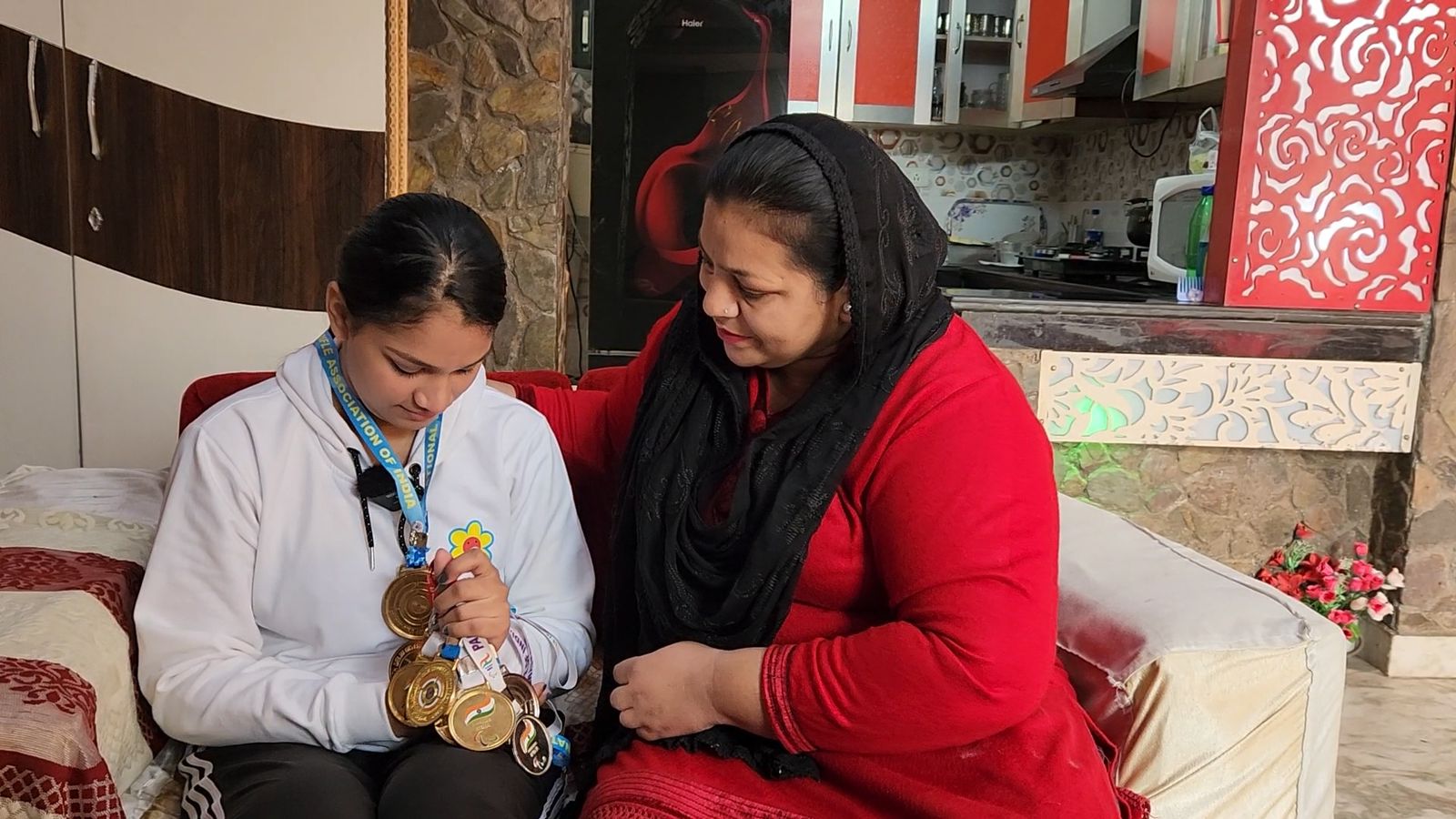
Adeeba Ali showing her gold and silver medals with her father
The 19-year-old Adeeba Ali of Nizamuddin Basti, New Delhi, has raised the bar for those seeking to rise in life notwithstanding physical limitations. The para-athlete recently ended up becoming an inspiration to thousands of people as she won gold and silver medals in the 26th National Shooting Championship competition organized by Madhya Pradesh State Shooting Academy, Bhopal.
Amina Majeed Siddiqui of Awaz spoke with her at her home. Excerpts from the conversation:
How did you think about going to the National Shooting Championship competition and how many days did you prepare for it?
I had always liked sports, but soon after the accident, I started finding what was best for me. After a lot of searching, I met my coaches Subhash Rana and Rohit Sir. They showed me the path to getting back into sports. They suggested I start with competing on the track and gradually aim for the zonal, and the nationals. So after gradual preparation, I qualified for the National championships. It has been 10 months since I started preparing.
How did this accident happen?
It was five years ago, I was looking out from the balcony of my house (Fourth floor). I foot slipped and I fell on the ground floor. I felt dizzy. At first, I thought I was falling backward but no, I was falling forward. Because of that my spine was fractured and due to that my legs do not work.
Have you participated in other competitions before this?
I have also participated in District Level, Zonal, para-zonal, North Zone, and Para National. This is my 5th match.
What inspired you to take up sports?
My inspiration is my father. He has always been promoting sports. He is very fond of cricket. So Papa knows the importance of playing sports. Just as education is important, sports are also important. Secondly, my ideal is Avni Lekhara (Olympian); she is the first woman who won gold medal in shooting and the Para Olympics, she is a big inspiration to me.
How did your journey in sports start, when did you think that you should go into this field?
I wanted to be associated with sports, so I started searching. Earlier I used to participate in basketball, football, and other sports. But after the accident, everything seemed to be over for some time. I searched for a new sport that I could play with my physical limitations. I wanted to leave the accident behind because whatever happened had happened. I had to see what I could do. I came to know about Para Games which people with disabilities can also play. This gave a new meaning to me. I came to know that despite being disabled one can still play. I came to know about shooting and that yes, I realized I am made for it, then I started playing. It was not so good in the beginning. Then with time, I got better. I gained a new identity and now shooting has become an important part of my life, if I don’t practice for a day, I feel something is missing in life.
What is your plan for the future?
I intend that I want to do better every day. I want to work very hard.
What message would you like to give to those who give up on small things?
Adeeba Ali with her mother Reshma Ali
I would like to say that you should have faith in yourself, because if you give up on yourself, how will others support you? If you have this feeling within you that no matter what happens to me, you can still do this work, then you can achieve anything. The most important thing is to have faith in yourself.
I also spoke with Adiba Ali’s mother Reshma Ali. She told me:
“Adiba used to lie on the bed after the accident and had lost courage. Then one day she thought about how she could move on in life and do better. Initially, she was bedridden for one and a half years. She slowly started reconciling to her condition and began painting. Despite being bedridden, she wrote examinations for 12th standard and did well. She is now pursuing a BA in English. After that she saw what else she could do, and then she watched Avni Lekhara’s videos and said that if she can do it, I can also do it.
“She had never held a pistol in her hand. Her coach Subhash Rana worked very hard on her. Adeeba practices for 8 hours. If one wants to achieve something in life one surely has to do a lot of hard work and Adeeba did the same. She has made all of us proud. I intend to organize motivational camps for people facing disabilities. I want to tell them my daughter’s story. I want to tell people that you can do a lot despite being disabled. We will guide people on how a new life starts from here.”
source: http://www.awazthevoice.in / Awaz, The Voice / Home> Story / by Ameena Majid Siddiqui / December 25th, 2023
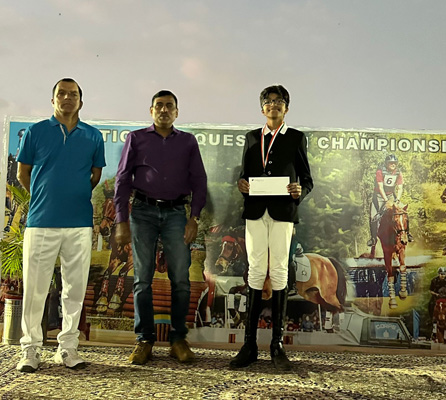
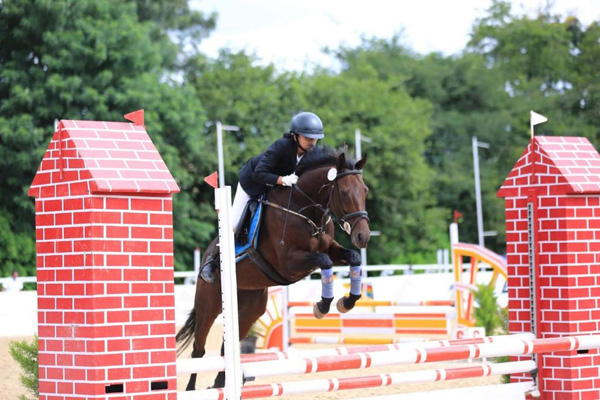
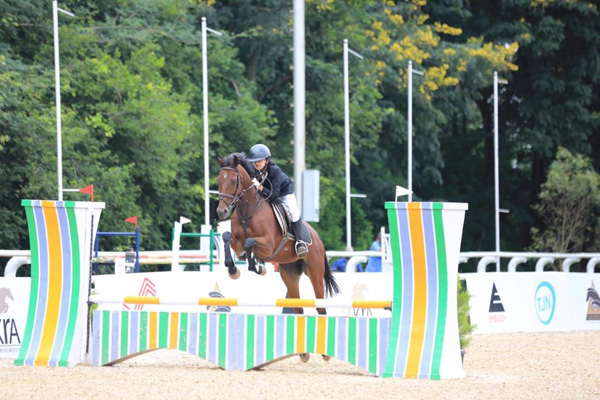
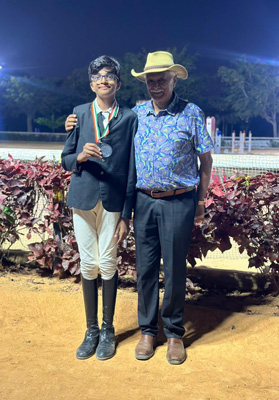
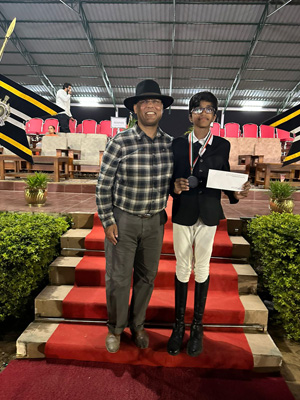
In a remarkable feat of equestrian prowess, a young talent from Mangaluru Armaan Mohammed Asif galloped his way to victory, clinching a bronze medal at the Junior National Equestrian Championship held in Bengaluru on December 22 and 23.
He rode his horse Tara from Covai stables and clocked timing of 47.12 seconds, enabling him to win the Bronze in children 1 category.
It was national championship where a total of about 800 plus entries from all over India had reached to participate.
The Junior National Equestrian Championship is India’s biggest national equestrian championship where the top riders of the country compete with their best horses to get the top positions.
Armaan is the first rider from Mangaluru who won the national equestrian championship whose name is now etched in the annals of equestrian history, displayed a perfect blend of skill, finesse, and a deep connection with his equine partner. The duo maneuverer through challenging courses with grace and precision, earning accolades from spectators and judges alike.
The bronze medal not only symbolizes the individual triumph of the Mangalorean rider but also reflects the growing prominence of equestrian sports in India. As the sport gains traction, such achievements contribute to the broader narrative of the nation’s prowess in diverse fields of competition.
The entire community in Mangaluru is celebrating this victory, proud of their local hero who has made a mark on the national equestrian stage. This accomplishment not only brings glory to the rider but also shines a spotlight on the rich potential that exists in smaller towns and cities across India, reinforcing the belief that talent knows no geographical boundaries.
Armaan is in his 7th grade and the son of Mohammed Asif and Sajida.
Armaan received his initial training at Mangaluru Horse Riding Academy by Avinand Anchanahalli. Since two years, he is been riding and getting trained for nationals in Bengaluru under guidance of Abdul Rahman Shariff and Rajan Diwakar.
source: http://www.daijiworld.com / Daijiworld / Home> Karnataka / by Media Release / December 29th, 2023
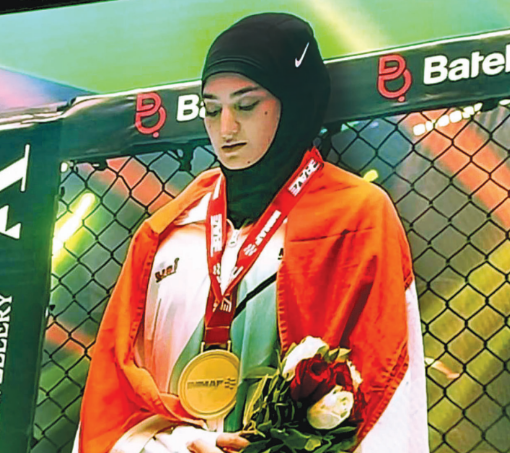
Fiza Nazir, the emerging martial arts sensation hailing from Jammu and Kashmir, has etched her name in the annals of sports history by clinching the gold medal in the senior women’s -56.7 kg weight category at the Asian MMA Championship 2023 (IMMMAF) held in Bahrain.
With unwavering focus, dedication, and a relentless pursuit of her dreams, Fiza Nazir has consistently demonstrated her mettle on grand stages. Currently training at one of Asia’s premier MMA schools, Fiza’s triumph in Bahrain has propelled her to new heights in the world of martial arts.
The gold medal at the Asian MMA Championship marks a pivotal moment in Fiza’s career, and she is now setting her sights on representing India in the upcoming World Championship later this year. Her success is a testament to her resilience, skill, and commitment to excellence.
Expressing her gratitude, Fiza acknowledges the crucial support of her sponsors, TCI Cements, along with the unwavering backing from her family and coaches. Their encouragement and support played a vital role in her journey to becoming a trailblazer for Indian women in the field of mixed martial arts.
source: http://www.greaterkashmir.com / Greater Kashmir / Home> Latest News / by GK News Service / December 26th, 2023
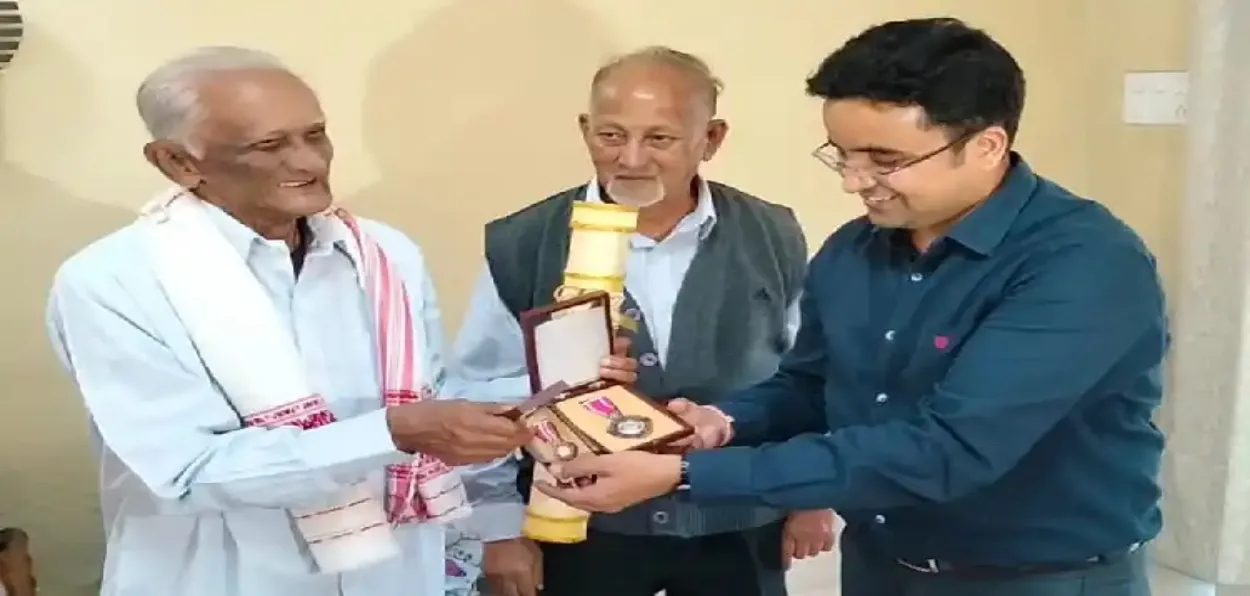
If Dr Bhupen Hazarika is known as the Bard of the Brahmaputra, Imran Shah is the Nawab of Assamese literature. Known for his powerful writings, this soft-spoken and shy doyen is one of the literary giants of Assam. Imran Shah, 90, invariably wears a smile on his face and flashes it even to strangers. Honoured with the Padma Shri in 2021, Imran Shah, a wizard in wordplay, the poet, lyricist, writer, novelist, playwright, scholar and educationist has enriched Assamese literature with his works.
He is generally called the Nawab of Assamese writing but he also writes under the pen names Ishan Dutta, Anamika Baruah, Kumbhakarna, and Animesh Baruah. He has also been conferred with the Assam Valley Literary Award (2009) by Magor Education Trust, Ajan Pir Award (2008) by the government of Assam, Sahityarathi Lakshminath Bezbarua Award (2022), Sabdwa Sahitya Award, Syed Abdul Malik Award (2013), Rangpur Gaurav Award (2016), Bor Asom Samannoy Award (2021) and many more for his contributions to the Assamese literature. He has so far published his 19 Novels, innumerable short stories, and poetry collections and many more manuscripts are ready to go to press.
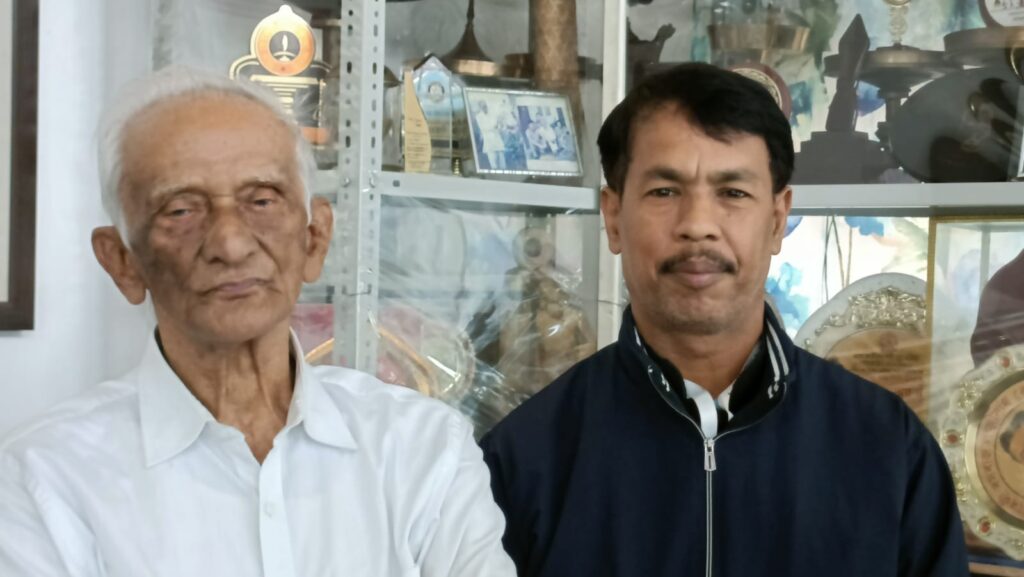
Imran Shah with Rajib Dutta
Born on 23 November 1933 at Dhai Ali, Sivasagar, Imran Shah rates Assamese literature as the best in contemporary India. He says three Assamese litterateurs have so far been awarded the – Jnanpith – India’s highest award in litterateur. This distinction is achieved by no other Indian language so far. The former Asam Sahitya Sabha president is disappointed to see the lack of promotion of Assamese literature. He feels Assamese literature is still facing a lack of patronage as far as publishing is concerned. The ‘Assamese by heart and soul’ is also unhappy with the government trying to create a divide in the Assamese society – majority, minority, indigenous, etc.
Awaz-The Voice caught up with Imran Shah for a tête-à-tête at his Dhai Ali residence in Sivasagar town in eastern Assam. Excerpts:
To begin with, please tell us what inspired you to take up the pen and paper.
It all started during my school days (at Sibsagar Govt HS & MP School) when I used to compose poems for my friends. I penned several short poems for them. However, I was not seriously into poetry at that time. Soon I gained confidence, and my first anthology Banavashi (1951) was published while I was in Class IX. (His classmate Liyakat Hussain was the publisher). Inspired by my friends in Class X, I wrote my first novel Sangeetor Hkhipaare (1952, again published by Liyakat Hussain).
Soon after my college life started, I took up the pen to write seriously. My short story was published in Ramdhenu, then a highly influential Assamese literary magazine in 1957-58. Since then I have been writing without a break. I write whatever I like, and people give me a lot of love in return.
Which is your most prized work so far and why do you like it so much?
I have no answer because I love all my creations. If you ask me which one is your favourite creation, I would say I like all the short stories, novels, and poems I have penned. Based on contemporary psycho, I go on writing on varied subjects. I can’t answer which is my favourite.
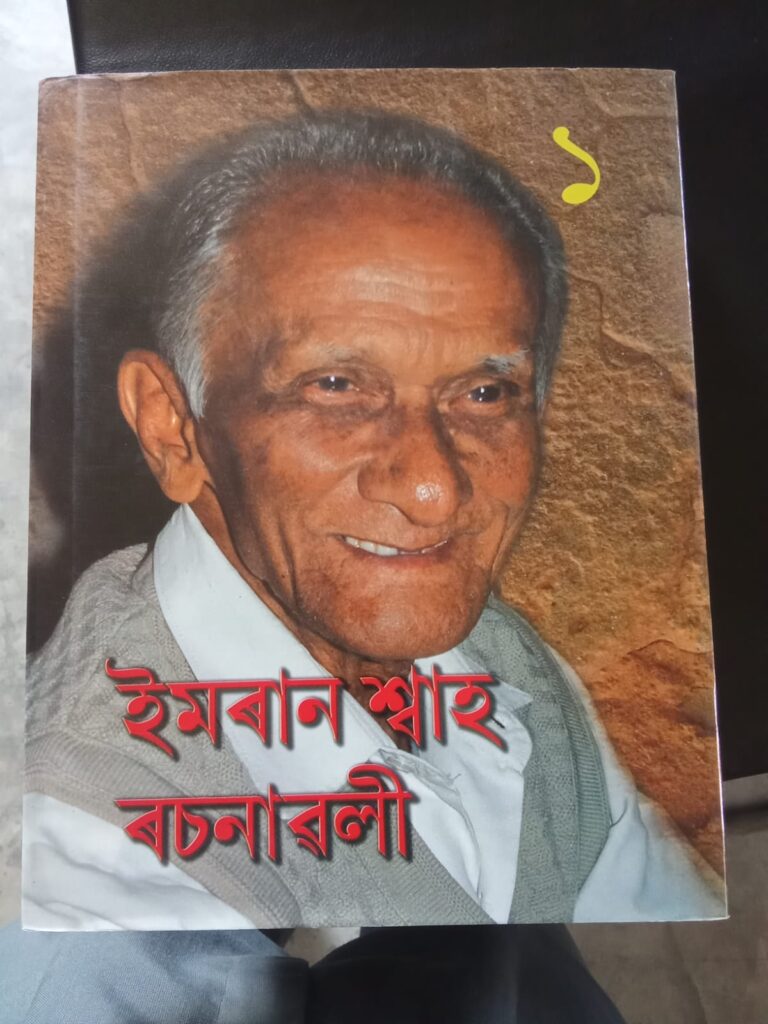
A book on Imran Shah’s writtings
For which work you had to work the hardest and why?
Imran Shah: All of my creations needed equal efforts. I haven’t encountered any hardship in writing. Whenever I find myself free I sit down with my ink and paper. Whenever I have resources enough, I indulge in my habit (writing).
Do you feel recognitions came on time? Or was it late?
I don’t think so. I have never written for awards, prizes, and recognition. Based on my literary achievements, I have been awarded by the people. Only the readers reserve the right to evaluate me.
Belonging to a small community (Assamese Muslim) as far as number is concerned, how do you feel about your rise to the pinnacle of literature in Assam?
The question has pained me. I am neither a minority nor a majority. I am an Assamese by heart and soul. Why should I be singled out only for my name? Religion in personal belief. I always keep myself far away from the division of minority and majority. This kind of bifurcation harms the society. Presently it is also included in our textbooks. This is an irreparable injustice to the Assamese community and society. Any answer to this question can mislead our society.
Did you face any kind of hurdle during your accent to the position of president of Assam Sahitya Sabha?
There had not been any issue in my becoming the president of Asam Sahitya Sabha. My name was proposed by someone. Till then I was a person who would not step out of my home. I never campaigned or lobbied. I was elected the president with a majority of votes which was undoubtedly a big recognition of my work.
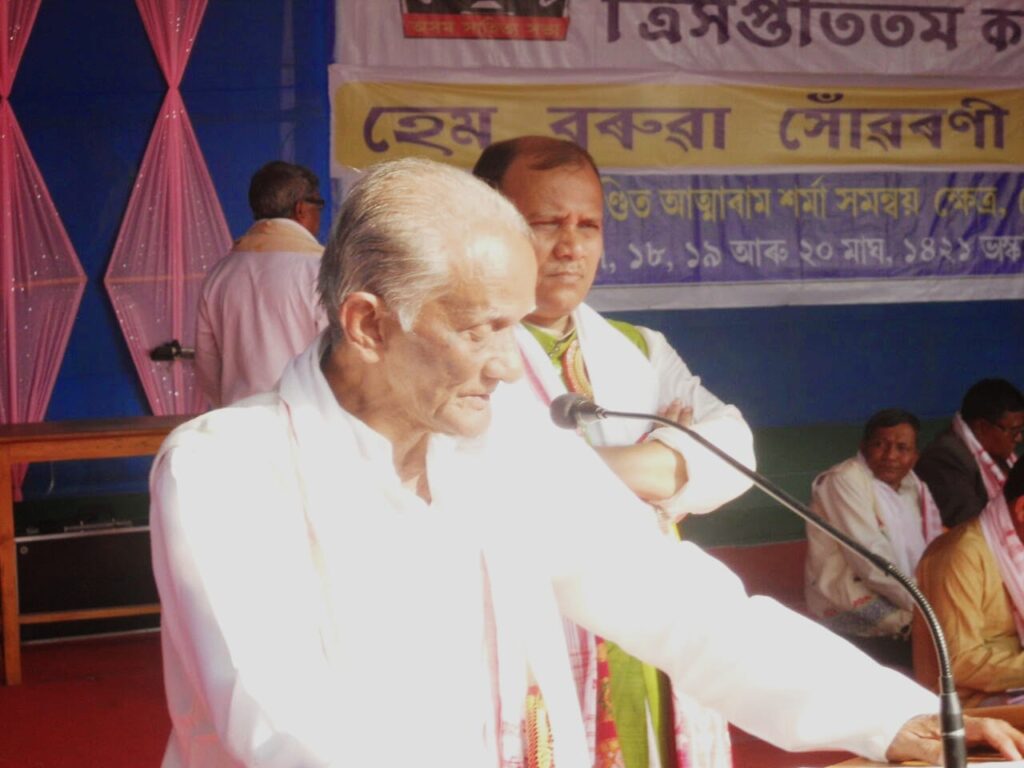
Imran Shah speaking as President of Assam Sahitya Sabha
What is your take on contemporary Indian literature?
Very bright, Assamese literature is lagging due to a lack of publishers. No publisher at all! The writers are publishing themselves. There are a large number of colleges and universities in Assam. I don’t understand why those institutions don’t come forward to publish. One of my stories, Etuku Dukh was translated into Hindi by a former professor of Banaras Hindu University Dr Charbey. After three months, the story was translated into English with the title A Piece of Sadness. Later on, it was translated into Bengali, Telegu, Tamil, Malayalam, and other languages of the world. Besides my short stories Morom, Yudha, and other select stories were published in various Indian languages. You see if my works or those of Syed Abdul Malik and Saurav Chaliha get translated into different Indian languages, the Assamese language can gain a lot.
Where do you think is Assamese literature placed in the contemporary Indian literary scenario?
It’s in definitely number one. You know Jnanpith is the highest literary award in India and it has been conferred on 3 Assamese writers, namely Birendra Kumar Bhattacharya, Dr Mamoni Roisom Goswami alias Indira Goswami, and Nilamani Phukan. Then why do we suffer from an inferiority complex? Can anyone take away that position from us?
How can Assamese literature grow further?
Our publishing agencies are very weak. There is no publisher to publish and that can lead to the development of Assamese literature. They do only business. In developed countries, the universities have their publications and this is something we lack in our country. Even during British rule, the PhD thesis of Dr Moidul Islam Borah, the first Assamese doctorate, was published by the then-education department of Assam. The developed nations have a culture of patronizing literature which we have to emulate.
Although Assam’s population comprises over 34% Muslims, the Assamese Muslim community is still a negligible minority as far as numbers are concerned. The present Assam government has recognized 5 ethnic groups of Assamese Muslims as indigenous. What is your take on it? How should the government take it forward to develop the community?
I think otherwise. Those who are concerned with these issues, let them solve it. I do never take part in any kind of conflict arising out of the issue and shall never claim as majority, minority, or indigenous. My forefathers have passed away living here as Assamese. I also think of myself as an Assamese from the core of my heart. The government should not take any initiative, especially for the minorities. They should be made part of the all-round development process meant for all the communities. Then all would prosper.
source: http://www.awazthevoice.in / Awaz, The Voice / Home> Stories / by Rajib Dutta, Sivasagar / December 19th, 2023
In your final rest
on a rope-cot,
were you still dreaming
of a piece of bread?
Beloved one,
we the people
of this country,
of that country,
can make anything
but a piece of bread
for you.
--Evening with a Sufi: Selected Poemsby Afsar Mohammad, translated from the Telugu by Afsar Mohammad & Shamala Gallagher, Red River Books, 2022.
These lines send shivers down the spine and recreate an empathetic longing for immigrant souls in search of succour. They also swiftly draw an image laced with poignancy — a loss, a regret, the economics that deny innovative young men their keep and force immigration in search of sustenance. Would the poet have been one of them?
Travelling from a small village in the South Indian state of Telangana, Afsar Mohammad has journeyed across continents and now teaches South Asian Studies at the University of Pennsylvania. Known as a trendsetting poet and literary critic for post-1980s Telugu literature, Afsar has brought out five volumes of poetry, one collection of short stories and two volumes of literary theory essays. He is also a distinguished scholar of Indian studies and has published extensively with various international presses, including Oxford and Cambridge. He is currently working on a translation of Sufi poetry from Telugu to English. In this interview, we trace his growth as a writer and editor of the webzine, Saranga, which now seems to be transcending linguistic barriers to give voice to multiple cultures…
Tell us about your journey as a writer. When and how did it start?
It’s a long story, but to cut it short — the beginnings were somewhat puzzling… Inspired by Shakespearean sonnets, I first wrote some sonnets in English, and then switched to free verse. Since most of my friends in my high school started pushing me to write something in Telugu, I had to migrate to Telugu. Quite surprisingly, I was first published in English, and then it took me a while to get something published in Telugu. I had hard time getting published in Telugu due to its newness in expressions and most editors felt that there was nothing “Telugu” in that kind of writing. So, my early writings quite naturally found their home in some English journals!
Your poetry rings with the pain of distance, the pain and struggle from others’ suffering transcending your own self. What is the source of your inspiration — is it your past or your present?What affects you more — your being an immigrant or a Sufi?
We’re distanced by many things — not just physically! We live in many shattered and scattered worlds, and sometimes we fail to reflect on those worlds. I feel like I’m a constant immigrant — despite my formal citizenship and legal boundaries. Sufism is merely a segment of this expansive realm. Both past and present define our destiny, right?! Of course, I try to live in the present rather than in the past, but never deny the baggage of the past.
Why do you subscribe to the Sufi school of poetry? What is Sufism all about?
I come from an extremely local rural setting where such Sufi mystical practices openly defined my everyday life. It’s not about the technicalities and theories or institutionalised Sufi schools of their philosophies, this is more about what I learned from my childhood, and its physical surroundings dotted by several hybrid shrines. I’ve described this cultural setting in my 2013 Oxford University Press publication, The Festival of Pirs: Popular Islam and Shared Devotion in South India. This version of Sufism has more to do with everyday life rather than a spiritual domain.
You have lived away from your country for long, and yet the past seems to still haunt you. What is the identity you seek as a poet? Is it necessary to have a unique identity or can one be like a drop that flows and moulds as per the needs of the vessel?
In a way — physically– I’m away from my birth place, but in many ways, I’m also closer to my homeland than in my past. When I moved away from the actual picture, I see many dimensions from a new lens. Each dimension contributed to my rethinking and reconsidering the idea of India. As I wander around and meet totally different places and people, I learn more about my birthplace and moved a little closer to it. I totally understand this as a process to reconcile with the past and connect it to a new present intensified by many factors, not just personal. We’re living in a virtual world, which also looks like “real” in its sounds, colours and words. Every moment it makes me realise that I’m actually not that far. On the other hand, I also see the people in my homeland who are far more removed by their immediate reality and everyday experiences. We need to read this conditionality more in terms of perspective rather than physical distance.
You are fluent in Telugu, Urdu and English. You started writing in English and then moved to Telugu. And all your poetry collections have been in Telugu. Why? Would the outreach of English not have been wider? What made you pick Telugu over English?
Great question! My literary graph is neither linear nor simplistic. When I look back and reflect on it, it’s a quite messy roadmap — actually, there’s nothing like a map to get its contours. Yes, I started writing in English and then suddenly stopped sending out the poems to magazines. In fact, I write more in my personal journals rather than in print journals. Theoretically, I saw poetry as a personal diary for my experiences for many years. Due to financial concerns within my family, I had to start working very early on and left most of my journals at home. Then, my friends found them by chance and put them together that became my first collection of poems in Telugu. The collection was an instant success for its innovative style and then that opened up my career in Telugu rather than English which was my first language of literary expression.
You are now bringing out a bi-lingual online magazine, Saranga? What made you think of a magazine in two languages?
Before entering into teaching career, I worked as an editor of the literary supplement and Sunday magazine for a largest circulated Telugu newspaper. When we moved to the USA, I thought it would be better to have some outlet to engage with my home language and literature. In the early phase, Saranga was primarily a Telugu webmagazine. When I started teaching South Asian literature, then I realised the importance of making Indian literary texts available to contemporary generation in the USA. That was just one reason, but there’re were many factors as our team saw a rise in the Indian diaspora writings in the new millennium. Luckily, we got wonderful support from writers and poets in various Indian languages. The humble beginnings have actually ended up as a rewarding experience.
What is it you look for in contributors from two languages? Is it the same guidelines or different?
We’re still learning how this works! As it appears now, these two sections require two different approaches and guidelines. Since the English section has been now attracting writers from various languages, it’s moving more towards a multi-lingual base. We’re trying to accommodate more translations into English from different Indian languages. We still need to do lots of work there.
Is the journal only aimed at South Asian diaspora or would you be extending your services to all cultures and all geographies?
Saranga, as we see it right now, is more about South Asia and its diaspora. As you know, we need more such spaces for South Asia and its diaspora. Not sure about its future directions at this point, however, if the situation demands, we will extend its services further.
You have number of essays and academic books in English. But all your creative writing is in Telugu. Why? Would you be thinking of writing in English too because proficiency in the language is obviously not an issue?
Most of my academic writing came out of my teaching experience. As I started teaching new courses, I then realised that we need more material from South Asia. I started focusing on producing such materials primarily for my courses and then gradually, they became useful for many academicians elsewhere too. I still believe creating writing as a more personal space — that enables me to articulate more about myself. However, the publication of Evening with a Sufi, brought a new change — as I’ve been getting more requests for more writing in English for the last two years. As you know pretty well, I’m an extremely slow writer.
How do you perceive language as a tool for a poet?
I see language working many ways since I dwell in multiple languages. I started my elementary education in Urdu, and my middle school was in Telugu, and the subsequent studies were in English. Through the last day of her life, my mother was extremely particular about me learning Arabic and Farsi. So, I believe that helped me so much to understand how language works in a poem. When I published my first poem in Telugu, the immediate critique was it was a not a “Telugu” poem. Telugu literary critics labelled me as a poet who thinks either in Urdu or English, then writes in Telugu. Of course, most of them were also fascinated by the new syntax of my Telugu poems and the new images and metaphors—that totally deviate from a normative or mainstream Telugu poem of those days. The uses of language in a poem varies for each poet. If you’re reading, writing and thinking in just “one” language, that might be a safe condition. A contemporary or modern poet, however, belongs to many languages and cultures. We also migrate from one language to another in our everyday life.
Do borders of nationalism, mother tongue and geographies divide or connect in your opinion? Do these impact your writing?
The response to this question might be an extension to the above conditionality of a person. Anyway, I’m not a big fan of those ideas of nationalism, mother tongue and singular geographies. They don’t exist in my world. Most of my writings both creative and academic contest such boundaries and borders. To describe this in a single term- borderless. In fact, I believe we’re all borderless, but unfortunately, many boundaries and borders are now being imposed on our personalities.
(The online interview has been conducted by emails by Mitali Chakravarty)
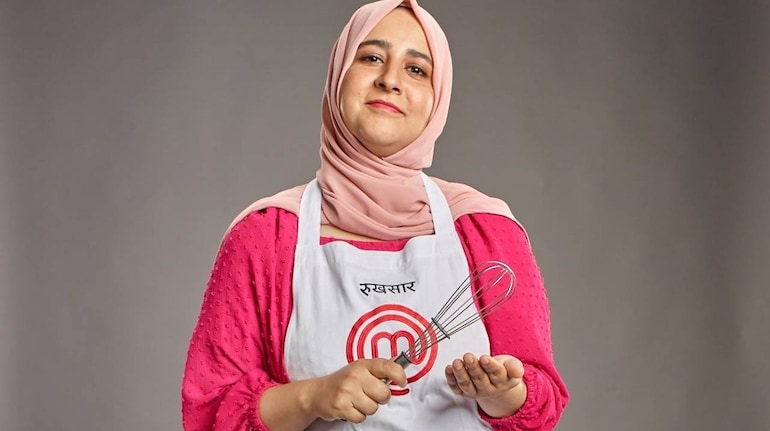
Rukhsar Sayeed wishes to see a lot more young Kashmiri girls and boys in MasterChef India.
Kashmir’s Rukhsar Sayeed.
A 34-year-old woman food entrepreneur has become the first contestant from Kashmir to participate in MasterChef India, a cooking reality show which is being broadcasted on SonyLIV.
Hailing from south Kashmir’s Pampore, where India’s 90 per cent saffron is cultivated, Rukhsar Sayeed has shown a tremendous culinary passion and determination by reaching among the top 12 contestants of the show.
“Breaking barriers and stereotypes I have finally made it to MasterChef India to fulfil my dream. I no doubt had culinary passion since I was a teenager, then the food-specialised education was also at my back but on top of all the support shown by my family was unwavering,” says Sayeed who is currently in Mumbai for the shooting of the show.”
Born and brought up in Srinagar’s Hyderpora, in the year 2010 Sayeed was watching the shows of MasterChef Australia from which she developed the culinary passion and decided to study food technology. “I am on the top of the world to see myself among the top 12 contestants of MasterChef India, the country’s favourite cooking reality show. I am really proud of where I am standing today. I am also overwhelmed to find the support of my family including my husband, parents and in-laws, ” Sayeed tells Moneycontrol.
Calling herself an avid foodie Sayeed has two children while her husband Saqib Javaid Qadri is an assistant executive engineer.
After completing B.Tech in food technology from Islamic University of Science and Technology, Awantipora Sayeed did M.Tech in food technology from Amity University and finally completed her PhD in food technology in 2020.
Sayeed has not only made J&K Union Territory proud by being selected to compete in the prestigious MasterChef India but also expressed her feelings through Kashmiri cuisine and eventually impressed the judges. “So far I had a roller-coaster ride with ups and downs in the kitchen like other contestants but I have made some very good dishes which impressed the judges sitting in the show. I am confident to become the winner of the show because for the first time Kashmiri food is being presented on a large platform. I am trying my best to innovate something with our Kashmiri food. For example, I made Rogan Josh, (mutton dish with red gravy) which apparently does not look Rogan Josh but it does taste like Rogan Josh.”
So far in 11 episodes Sayeed says she made mouth watering cuisines like Babri Boul Falouda (basil seeds drink) usually served during Ramadan in Kashmir, Kashmiri Dhaniwal Korma (lamb curry bursting with coriander) and Kashmiri Dodhe Aal (pumpkin chutney), mesmerizing the judges and celebrity chefs like Vikas Khanna, Ranveer Brar, and Pooja Dhingra.”
Her father M Sayeed Shah says, “It is a dream come true for the whole family. It is a great honour to see her in Masterchef India. I don’t have words to express my happiness. I wish a great future and good luck to my darling daughter.”
Her mother Naseema Kirmani while expressing her happiness says that she is the happiest person to see her daughter in MasterChef India and wishes her best of luck for the show.
Before reaching the MasterChef India show in 2019, Sayeed emerged as the first woman from the Valley to start a frozen food venture — Khalis Foods. “After doing my PhD I was not interested in conventional jobs and therefore I opened a startup to provide people with unadulterated snacks and other healthy foods mainly for children. I along with my six employees are operating from my home in Pampore.”
The young food technologist explains that she is getting to see some of the ingredients for the first time in her life. “I am using some ingredients which are new to me in various foods. For instance, I use some of the popular food ingredients from down south with Kashmiri food.”
Sayeed maintains that being a mother of two children the decision to become a part of Masterchef India show was not easy. “It was a big sacrifice to leave behind my two children at home and participate in the show in Mumbai. I miss my children a lot but I am confident that I will return home as the winner of the show.”
Before getting selected for Masterchef India, Sayeed had participated in the state-level culinary competition and bagged second position in the competition.
She had also served her homemade snacks at an exhibition held at Sheri Kashmir International Convention Centre (SKICC) Srinagar, tickling the taste buds of people around.
In June this year, Rukhsar went through a rigorous audition process before being among the 12 contestants.
For young techie, the MasterChef India journey is a stepping stone in realising her dream of setting up a culinary school in the Valley and creating a chain of restaurants to provide healthy food for the food lovers. “I hope this show can give me limelight and help to boost my food business venture, currently operating in Srinagar. I am also thinking of creating a chain of restaurants in the Valley to provide healthy dishes to people. As a food technologist I am fully conscious of the hazardous preservatives, taste enhancers and food colours that go into our daily food and which is why I lay emphasis on healthy, pure and safe food.”
Regarding her favourite food Sayeed names Hakh (collard green; the staple diet of Kashmir) and Wazwan, (Kashmir’s famous multi-course meal). “Every dish is special but I am in love with Kashmiri food, mainly Hakh especially prepared by my mother and Wazwan prepared by our amazing cook locally known as Waza. From the beginning of my childhood the dishes prepared by my mother in the kitchen have been unmatched.”
Sayeed wishes to see a lot more young Kashmiri girls and boys in MasterChef India. “Since I am the first Kashmiri woman who has reached the famous cooking reality show I would want more people from my homeland to come here and show their food skills.”
She also claims that despite facing criticism from the people in Kashmir she managed to participate in the show to represent the Kashmiri cuisine and culture to a larger audience.
source: http://www.moneycontrol.com / Money Control / Home> News> Trends> Lifestyle / by Irfan Amin Malik / November 05th, 2023
What’s striking is that nearly 80% of the clinic’s beneficiaries are Hindus, a fact that Maulana Majid considers instrumental in fostering communal harmony. “Serving these impoverished communities is our way of contributing to unity in diversity,” he stated with conviction.
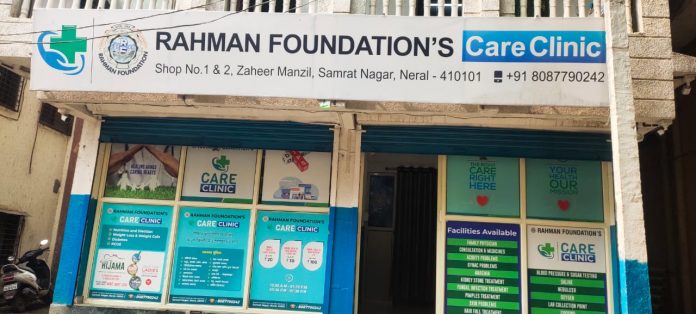
Rahman Care Clinic nestled within the heart of Samrat Nagar in Neral
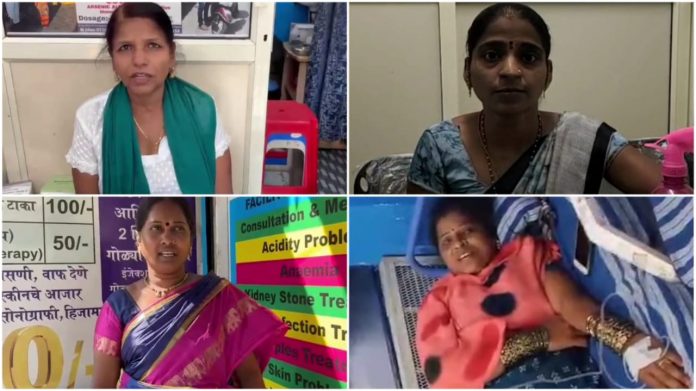
As Lakshmi made her third visit to the Rahman Foundation Care Clinic nestled within the heart of Samrat Nagar in Neral, Maharashtra, She couldn’t help but praise the unparalleled treatment offered at nominal charges. “It’s my third time here, and each visit reaffirms the exceptional care and expertise of the doctors. The nominal fees we pay for such quality treatment is unparalleled,” she expressed gratefully.
Some Hindu patients at Rahman Care Clinic.
Echoing Lakshmi’s sentiment, Maulana Shaih Majid, overseeing the medical section of the Rahman Foundation, emphasized the significant role the clinic plays in the lives of the predominantly Maratha Hindu population. “The locals, hailing from modest backgrounds, hold the clinic staff and doctors in high regard, almost akin to semi-gods,” he mentioned with pride.
What’s striking is that nearly 80% of the clinic’s beneficiaries are Hindus, a fact that Maulans Majid considers instrumental in fostering communal harmony. “Serving these impoverished communities is our way of contributing to unity in diversity,” he stated with conviction.
Kavita, another patient, expressed her regularity at Rahman Clinic. “I’m a frequent visitor. The care and treatment we receive here, priced at a mere 20 rupees including medication, is a lifeline for the underprivileged. A simple injection costs just 10 rupees,” she shared, highlighting the clinic’s affordability and accessibility for those in need.
Other patients echoed similar sentiments, praising not only the cost-effective treatment but also the warm and courteous demeanor of the entire clinic staff. “Here, we receive top-notch treatment at minimal expenses, and the staff’s friendliness adds a comforting touch to our visits,” remarked another patient.
The clinic’s roster of highly qualified doctors further elevates its reputation. Professionals like Dr. Vajaykumar Pawar (MBBS), Dr. Dipnayan Shinde Pawar (MBBS, MD), Dr. Samiya (BUMS), and Dr. Sana (MPTH) cater to the medical needs of patients at Neral Rahman Foundation Clinic, ensuring expert care within a modest setting.
Rahman Foundation’s reach extends far beyond the boundaries of Neral. With a network encompassing nine Rahman Clinics, four hospitals, and a diagnostic center spread across Maharashtra, Karnataka, Gujarat, Madhya Pradesh, and Uttar Pradesh, the foundation extends its services to 8,000 to 10,000 patients monthly, all at nominal charges. Additionally, the foundation actively conducts medical check-up camps to further extend its outreach.
The journey of Rahman Foundation, initiated in 1995 under the guidance of the visionary Islamic scholar Maulana Khaleelur Rahman Sajjad Naumani, has been nothing short of remarkable. From establishing Islamic seminaries to introducing CBSE pattern English medium schools, the Foundation’s evolution has been multifaceted. In 2017, it ventured into providing medical services. Over the last five years, the foundation has expanded its footprint, setting up Rahman Care Clinics, Rahman Hospitals, and Rahman Diagnostic Centers across five states, catering to approximately 8,000 to 10,000 patients every month.
‘Our vision is to expand and replicate this model across India’ said Maulana Majid with promising eyes.
source: http://www.muslimmirror.com / Muslim Mirror / Home> Health> Indian Muslim> Positive Story / by Special Correspondent, Muslim Mirror / December 19th, 2023
“Asma Banu, collector of seeds of various paddy breeds, helping in social and farming activities will be felicitated with B Appanna Hegde agriculture award during an award program on the birthday of religious leader and former MLA B Appanna Hegde on December 24,” said trust president B Rama Kishan Hegde.
He further said, “Asma who works saying that work is worship is collecting various paddy breeds that are on the verge of extinction from various states. She has collected and grown more than 840 varieties of paddy this year. She is conducting a study about those seeds and creating awareness about their benefits to health. She has been selected for the award considering her rare achievements.
“The award programme will be held by Basrur Appanna Hegde Prathistana in the premises of Sharada college, Basrur. Monetary help will be distributed to students, the sick and weak during the program.
“The award will be presented by Ishapriya Theertha Swamiji of Adamar math. Karnataka backward class commission president K Jayaprakash Hegde will preside over the programme,” he said.
source: http://www.daijiworld.com / DaijiWorld.com / Home> Karnataka / by Silveste D’Souza / Daijiworld Media Network – Kundapur (EP) / December 20th, 2023
Mohammed Abdul Lateef Khan, Founder Trustee and Chairman MS Academy. / Muslim Mirror Photo
“You are not meant for crawling, so don’t. You have wings. Learn to use them and fly,” this inspirational quote of Rumi is best suited for Mohd Abdul Lateef Khan, Chairman and managing director of Hyderabad based MS Education Academy.
His team under his leadership has successfully created a brand name in the field of education and revolutionized the concept of education across the country.
Khan is a man who believes in ‘education as a social service and moral responsibility than a profession to earn money’.
MuslimMirror spoke to Khan, exclusively. In this tete-e-tete, he spoke about his journey.
A young Khan right after finishing his 12th had a strong urge to serve the community.
Recognizing his talent, one of his friends suggested him to enter in the field of education. Hence, to materialize his dream Khan started a coaching institute that was operated from a two-room rented house and with only 15 students. This was in the year 1990.
However in the first year, Khan had to face a loss of Rs 30,000, but he did not lose his heart. He continued his journey with same vigor and subsequently during the initial three years he faced the loss of more than one lakh rupees and still he did not give up.
Khan continued to pursue his engineering course and completed his BE in Electronics and Communication Engineering from Osmania University.
During those years, his institute grasped a respected position in the area and people started trusting his institute. This boosted his morale and gave him confidence.
After completing his engineering degree, Khan thought of pursuing his studies in a foreign country but later changed his mind.
He decided to continue his journey in the field of education.
In 1998, Khan collaborated with renowned Urdu daily, Siasat, which started publishing model SSC exam papers which was widely accepted and became an instant hit. It resulted in popularizing his method of education and unique technique to crack medical and engineering examinations.
(HERE WHAT IS THE POPULAR TECHNIQUE HE USED AND HOW COME HIS TECHNIQUE BECAME A HIT IS MISSING!)
Later with the support of Zaheeruddin Ali Khan, the managing editor of the newspaper he shifted the institute to a bigger space. It was Zaheeruddin Ali Khan who inaugurated the first branch of MS Academy. After that Lateef Khan never looked back and the popularity of his coaching institute continued to soar by each passing day.
Two years later, Khan started to look out for a school for his son but in vain. Unable to find any such, later in the year 2000 he opened his own school and named it MS Academy, with the aim to facilitate thousands of children with education.
Khan introduced the junior school (intermediate) in the year 2002; they successfully produced their first batch in 2004, while their second batch (2005) grabbed the first position in the state of Andhra Pradesh.
Later, the then chief minister of the state visited the school and decided to declare four percent reservation for the Muslim minority.
While interacting with Muslimmirror.com, Khan said, “Since 2005 our academy has continued to remain in the top ten list of the state board. In our academy, we admit a student on the basis of his or her merit performance and not by asking for any donation.”
“Currently, MS academy has 80 branches in 20 cities across eight different states with more than 27000 students enrolled. We have produced over 1200 MBBS doctors , 5000 engineers and shaped the life of 78000 youths who are alumni of our institutes, Only this year 150 students from our institutions cracked NEET ” he added.
Explaining further, he said “We never invested in purchasing of land or any property. We never focused on that, we have continued to run our educational institutes in rented spaces which is our uniqueness.”
Khan’s academy also has focused on modern and Islamic education. On this he said, “We stress on imbibing Islamic moral and values to shape the personalities that can lead tomorrow. Islamic environment facilitates Muslim students to compete and turn them into achievers.”
Khan, is a pioneer in integrating Modern and Islamic Education with academic excellence.
A certified mind map instructor and an international memory trainer, he is a visionary entrepreneur, positive thinker, an able administrator and a good decision maker.
A firm believer in team work Khan has a team of reliable professionals who are committed to achieve the vision Khan shared and inculcate the spirit of generative thinking, creativity, positive approach and mind mapping.
He devised many innovative methods to help students excel in competitive exams and face real life challenges. He also designed and introduced Memory Curriculum in Schooling that helps students learn ‘How to Learn and Remember’.
In Khan, one can definitely see Sir Syed and his thoughts!
source: http://www.muslimmirror.com / Muslim Mirror / Home> Exclusive Reports> Indian Muslim> Positive Story / by Khusboo Khan , Muslim Mirror / July 12th, 2018
On Thursday, the Secretary-General at a press conference announced the creation of a new Artificial Intelligence Advisory Body on risks, opportunities and international governance of Artificial Intelligence (AI) . That body will support the international community’s efforts to govern artificial intelligence.
Among the members of AI Advisory Body, two are from India — Sharad Sharma (iSPIRT) and Nazneen Rajani (Hugging Face).
Sharad Sharma is a co-founder of iSPIRT, a non-profit think tank that wants India to be a product nation. He was the CEO of Yahoo India R&D and dubbed as the architect of Indian software products ecosystem.
About Nazneen Rajani, she is a Research Lead at Hugging Face, which is building an open-source alternative to ChatGPT called H4, a powerful LLM, “aligning language models to be helpful, honest, harmless, and huggy”.
U.N. Secretary-General Antonio Guterres on Thursday launched this 39-member advisory body of tech company executives, government officials and academics from countries spanning 6 continents.
The panel aims to issue preliminary recommendations on AI governance by the end of the year and finalize them before the U.N. Summit of the Future next September.
The full members list are as below:
Anna Abramova, Director of the Moscow State Institute of International Relations-University AI Centre, Russian Federation
Omar Sultan al Olama, Minister of State for Artificial Intelligence of the United Arab Emirates, United Arab Emirates
Latifa al-Abdulkarim, Member of the Shura Council (Saudi Parliament), Assistant Professor of Computer Science at King Saud University, Saudi Arabia
Estela Aranha, Special Advisor to the Minister for Justice and Public Security, Federal Government of Brazil, Brazil
Carme Artigas, Secretary of State for Digitalization and Artificial Intelligence of Spain, Spain
Ran Balicer, Chief Innovation Officer and Deputy Director General at Clalit Health Services Israel, Israel
Paolo Benanti, Third Order Regular Franciscan, Lecturer at the Pontifical Gregorian University, Italy
Abeba Birhane, Senior Advisor in AI Accountability at Mozilla Foundation, Ethiopia
Ian Bremmer, President and Founder of Eurasia Group, United States
Anna Christmann, Aerospace Coordinator of the German Federal Government, Germany
Natasha Crampton, Chief Responsible AI Officer at Microsoft, New Zealand
Nighat Dad, Executive Director of the Digital Rights Foundation Pakistan, Pakistan
Vilas Dhar, President of the Patrick J. McGovern Foundation, United States
Virginia Dignum, Professor of Responsible Artificial Intelligence at Umeå University, Portugal/Netherlands
Arisa Ema, Associate Professor at the University of Tokyo, Japan
Mohamed Farahat, Legal Consultant and Vice-Chair of MAG of North Africa IGF, Egypt
Amandeep Singh Gill, Secretary-General’s Envoy on Technology
Dame Wendy Hall, Regius Professor of Computer Science at the University of Southampton, United Kingdom
Rahaf Harfoush, Digital Anthropologist, France
Hiroaki Kitano, Chief Technology Officer of Sony Group Corporation, Japan
Haksoo Ko, Chair of Republic of Korea’s Personal Information Protection Commission, Republic of Korea
Andreas Krause, Professor at ETH Zurich, Switzerland
James Manyika, Senior Vice-President of Google-Alphabet, President for Research, Technology and Society, Zimbabwe
Maria Vanina Martinez Posse, Ramon and Cajal Fellow at the Artificial Research Institute, Argentina
Seydina Moussa Ndiaye, Lecturer at Cheikh Hamidou Kane Digital University, Senegal
Mira Murati, Chief Technology Officer of OpenAI, Albania
Petri Myllymaki, Full Professor at the Department of Computer Science of University of Helsinki, Finland
Alondra Nelson, Harold F. Linder Professor at the Institute for Advanced Study, United States
Nazneen Rajani, Lead Researcher at Hugging Face, India
Craig Ramlal, Head of the Control Systems Group at the University of The West Indies at St. Augustine, Trinidad and Tobago
He Ruimin, Chief Artificial Intelligence Officer and Deputy Chief Digital Technology Officer, Government of Singapore, Singapore
Emma Ruttkamp-Bloem, Professor at the University of Pretoria, South Africa
Sharad Sharma, Co-founder iSPIRT Foundation, India
Marietje Schaake, International Policy Director at Stanford University Cyber Policy Center, Netherlands
Jaan Tallinn, Co-founder of the Cambridge Centre for the Study of Existential Risk, Estonia
Philip Thigo, Adviser at the Government of Kenya, Kenya
Jimena Sofia Viveros Alvarez, Chief of Staff and Head Legal Advisor to Justice Loretta Ortiz at the Mexican Supreme Court, Mexico
Yi Zeng, Professor and Director of Brain-inspired Cognitive AI Lab, Chinese Academy of Sciences, China
Zhang Linghan, Professor at the Institute of Data Law, China University of Political Science and Law, China
“The transformative potential of AI for good is difficult even to grasp,” Guterres said. He pointed to possible uses including predicting crises, improving public health and education, and tackling the climate crisis.
However, the UN Secretary-General cautioned, “It is already clear that the malicious use of AI could undermine trust in institutions, weaken social cohesion and threaten democracy itself.”
source: http://www.indianweb2.com / Indian Web2 / Home> AI Governance / by Indian Web2 / October 27th, 2023