Category Archives: Arts, Culture & Entertainment

Athar Siddiqui breaks away from tradition and pens some highly evocative sketches

Sahranpur, UTTAR PRADESH / NEW DELHI :

The evocative recapitulation of eminent personalities provides a quick, candid, exquisite and scrupulous portrayal of those who retain their abiding presence without being physically present in the world.
The unprecedented acceptance of monolingualism has put a big question mark on the existence of numerous languages through which people stitch up a warm social rapport and seek to fulfill their cultural aspirations. India, an awe-inspiring repository of innumerable dialects, languages and different linguistic traditions, finds it nerve-racking to carry through the challenges thrown open by the technology-savvy language-English. The domination of English has taken a heavy toll on regional languages, and Urdu, once considered a significant link language, is no exception. Though Urdu is widely used as a spoken language, and its sensitively rendered poetry gets across the country, its script has been fading away with bewildering speed.

It aches much to realize that the popularity draws its sustenance from its oral rendering, and familiarity with its distinct script has been melting away steadily. Barring some notable exceptions, only faculty members and research scholars associated with various departments of   Urdu of the universities and colleges use Urdu as the medium of trifling academic discourse. At a time when Urdu faces the threat of obsolescence,   the gleam of hope emerges from the citadel of learning, Aligarh, where academicians not belonging to humanities draw on Urdu to initiate a perceptive discourse on a plethora of issues without bringing rhetorical flourish into play.

Professor Saeeduz Zafar Chagatai (Physics), Professor  Faseeh Ahmad Siddiqui (Chemistry), Professor  Athar Siddiqui (Zoology), Professor Shaan Mohammad (Political Science), Professor Iftikhar Alam Khan (Museology), Professor Zilur Rehman (Unani Medicine), Professor Mohammad Sajjad( History ), Professor Zafar Mahfooz Nomani (Law) Dr Asad Faisal Farooqui (Mass Communication) and the like seek to strengthen non-fiction prose in Urdu.

Autobiography, memories, diary, letters, sketches and anecdotal scrolls are much-adored genres of non-fiction prose, but in Urdu, they usually betray a strong sense of gushiness and sickening self-adulation. The preponderating narrative of reminisces does not go well with the celebrated author, Professor Athar Siddiqui, whose evocative recapitulation of eminent personalities appeared.

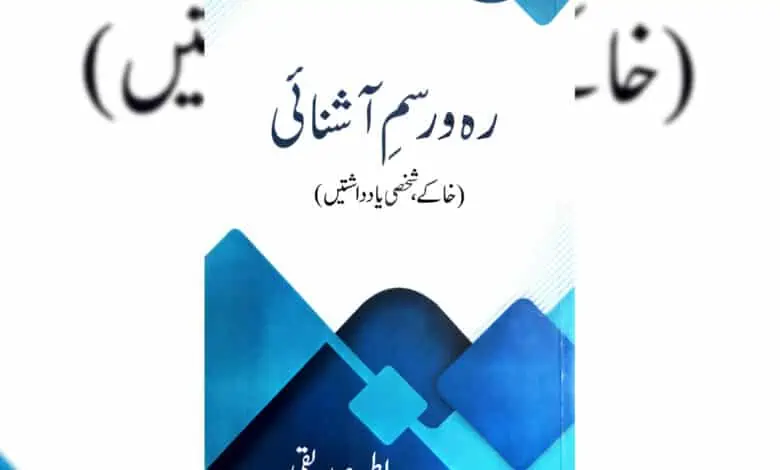
The book Rahe wa Rasm-e-Aashnai (sketches and personal memoirs) provides a quick, candid,   exquisite and scrupulous portrayal of those who retain their abiding presence without being physically present in the world.

Professor Athar Siddiqui, a widely recognized scientist, has produced a captivating narrative of his eventful life, Main Keya Meri Hayat kaya, with disarming humility and jotted down travelogues vividly calling attention to down reaching human experiences that frequent foreign travels produce. Interactive media frequently carry intriguing stories featuring commonplace occurrences. The stories with a strong sense of moral tutoring dished out by the digital world need to be shared with non technology conversant Urdu knowing people.

He left Professor Athar Siddiqui to supplement what had been missing and started translating these pulsating stories into Urdu. It was left to Professor Athar Siddiqui to supplement what had been missing, and he translated these pulsating stories into Urdu.

Tahzibul Aklaqh, a prestigious periodical launched by Sir Syed in 1870, started serializing it with a suggestive title Hairat Sarai Ki Kahaniyan (The stories of wonderland), and two volumes of these laconic and absorbing stories have appeared so far.

He meticulously edited two autobiographies of two illustrious alums of Aligarh Muslim University–Dr. Sheikh Mohammad Abdullah (founder of women’s college, AMU) and Nawab Ahmad Saeed Khan Chattari ( former Governor of Uttar Pradesh). He had astutely done over translating books on Shaheryar and Musa Raza.

Athar Siddiqui’s recently published book, Rah-o-Rasam-e – Aashnai,” creatively maps out the accessible and unchartered terrains of thirty-five personalities in candour-driven idiom, and he hardly holds with the popular notion that put a lock on showing the slightest discourtesy to the deceased. The author asserts, “It is widely mentioned that the sketch writer must not use any indecent or improper word for those resting in the peace. If this sort of exhortation is adhered to, then the sketch, personal article and memories will be read as appreciation and admiration-filled text. If history writing sticks to this principle, then the authentic history of any period could not be produced. I do not buy this argument.”


The subtle wised-up mélange focuses on nine creative writers such as Shahryar, Iqbal Matin, Sajida Zaidi, Qazi Abdus Sattar, Professor Mukhtar Uddin Arzoo, Syed Hamid, Lateefuz Zaman and a couple of close relatives, teachers, friends and former vice-chancellors.

Iqbal Matin, whose awe-inspiring artistic sensibility could not get him the recognition across the country he fully deserved, has come in for a  refined exploration. Athar Siddiqui’s reminiscence is peppered with unusual but fascinating details about the author. The author living in Aligarh tried desperately to contact Iqbal Matin (Hyderabad) when the letter was the preferred communication medium. He realized that his letters were not delivered to the addressee, who was prone to change houses. Iqbal changed thirty-five houses and bore testimony to his nomadic lifestyle.

Much has been written on Jnanpith awardee and prominent poet  Shahryar but a comprehensive and insightful article highlighting his distinctive personal traits and oeuvre is still looked-for. The piece titled  “Shahryar as a man and poet” fills the bill with remarkable ease. Athar saheb cites many instances to prove Shahryar’s unflinching loyalty to his friends but never spitting upon the rivals. The voice of modernism with strong traces of neoclassicism, Shahryar never nurtured animosity and did whatever he could for those who looked up to him in their hours of peril. People, even authors and pushover critics tend to read creative texts in the backdrop of personal details; hence when Shahryar suffering from a terminal illness- cancer–composed a couplet; Aasman ab kuch nahi tere karney ke liye/Ham ne sab taiyaariyan karli hain  marne ke liye (O sky,  now you have nothing to do/I have completed all the preparations for dying) it was considered as the affirmation of impending death. Employing critical acuity, Athar saheb mentioned that the couplet has nothing to do with a nagging sense of personal extinction; the poet laments how we perfected the art of self-destruction reflected in the depletion of Ozone layer manufacturing of weapons of mass destruction.

Athar Siddiqui wrote an immensely readable sketch of Qazi Abdus Sattar, a much overrated and pretentious writer who always took pride in using ornate and florid language in his fiction. His novel Tamam Sultan has been described as magnum opus, but it is hardly more than an oft-repeated titillating story of unrequited love. Athar Saheb and Qazi have had close ties for over fifty years, but Qazi was so intemperate that he pulled ties into pieces as Athar could not attend his facilitation function. It was an act of civility to describe this narcissism as uniqueness of personality.

Prof Zilur Rehman, a widely- respected academician of Unani medicine, is a well-known scholar of Urdu, Persian and Arabic and has more than fifty books to his credit. His books, especially on Ibne Sina, Hakim Ajmal Khan, Sir Ross Masood, Hakim Ehshanullah Khan, and Hakim Abdul Moid, got widespread admiration. In addition to discussing his well-documented and invigorating writings, Athar Siddiqui effortlessly unravels his amenable nature and inimitable passion for books and artefacts. He has a collection of over 70,000 and set up a museum and library, Ibne Sina Academy, which has its website.

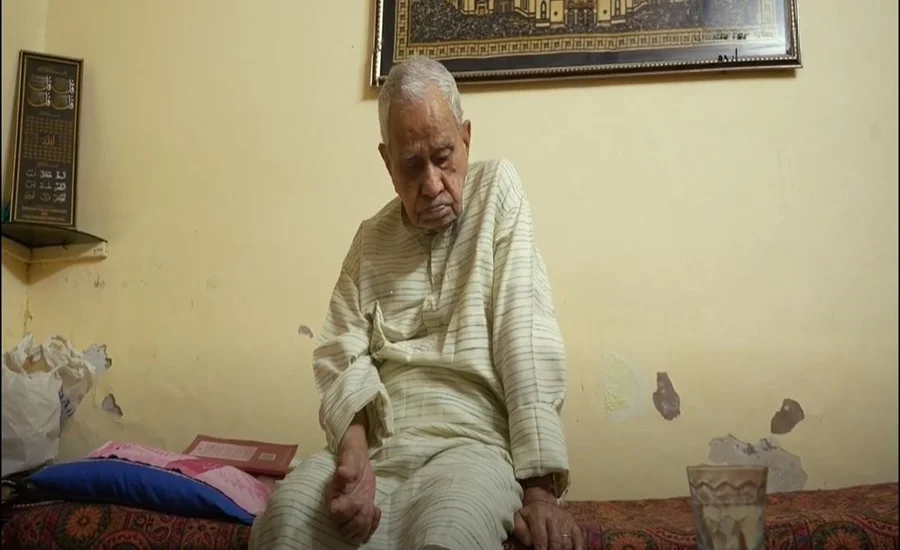
Seldom does one attempt to spell out what essentially embodies his wife, going beyond the adulation and berating with a sense of objectivity. This nagging edginess seems to have no bearing on Athar saheb, who painted a stirring wordy portrayal of his wife Zakia Siddiqui, a renowned academician and former principal of Women’s College, Aligarh Muslim University.

One tends to agree with the author when he asserts that during the first ten years wife is treated as the beloved; with the birth of children, she takes over the role of the mother. If harmonious marital life continues, she becomes an inseparable friend who hardly gets perturbed, no matter how annoying one becomes. It is all momentary, and the bond of affinity never weakens.

Athar saheb also evocatively narrated his mother’s life story, and he recollects his memories and anecdotes to document her extraordinary considerate nature. Suhail (son) and Taab (daughter) get pat on the head by the caring and unerring father for their abiding sympathy for others.

The book turns attention to a dozen vice-chancellors and pro-vice-chancellors of AMU, such as Dr Zakir Hussain, Bashir Hussain Zaidi, Badruddin Tyabji, Abdul Aleem, Ali Mohammad Khusro, Syed Hamid, Syed Hashim Ali, Wasiur Rehman, Naseem Farooqui, Mahmoodur Rehman, Hamid Ansari and Abul Hasan Siddiqui.

The author’s appraisal of them looks convincing, but occasionally subjectivity surfaces. The assortment of sketches offers a discerning peep into the life of all who impressed the author. The nuanced and readable prose is used impeccably, and Athar Siddiqui deserves accolades for producing such picturesque vignettes.

Shafey Kidwai is an Indian academic, communication scientist, translator, columnist, and author. He is the chairman of the Department of Mass Communications at Aligarh Muslim University.

source: http://www.siasat.com / The Siasat Daily / Home> Featured News / by Shafey Kidwai / September 26th, 2025
Delhi’s Historic Madrasa Rahimiya Struggles to Protect Its Rich Legacy

DELHI :

The centuries-old Islamic educational centre, birthplace of the Urdu Qur’an translation, struggles to protect its legacy amid growing Hindu-led development projects.

New Delhi :

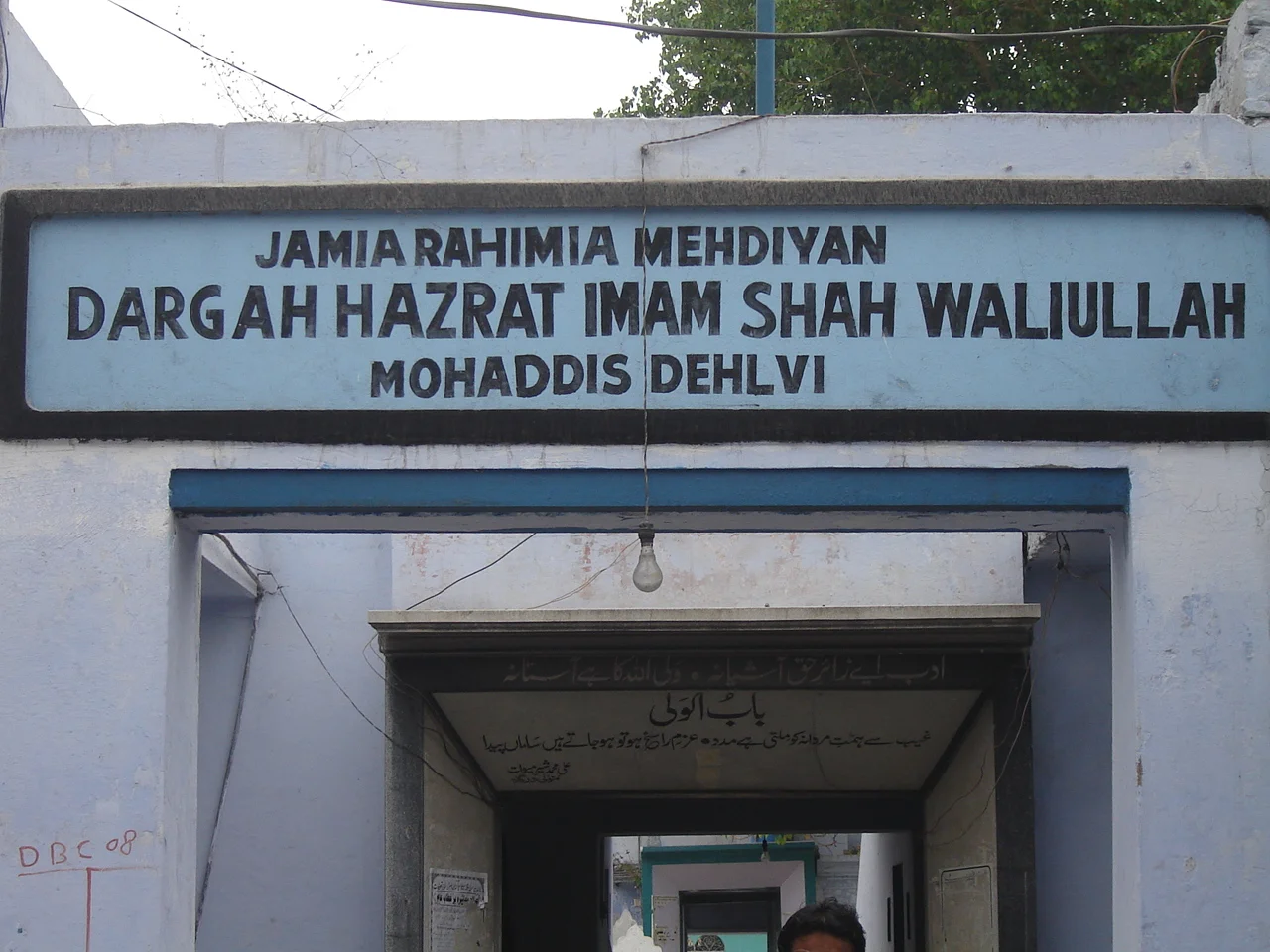
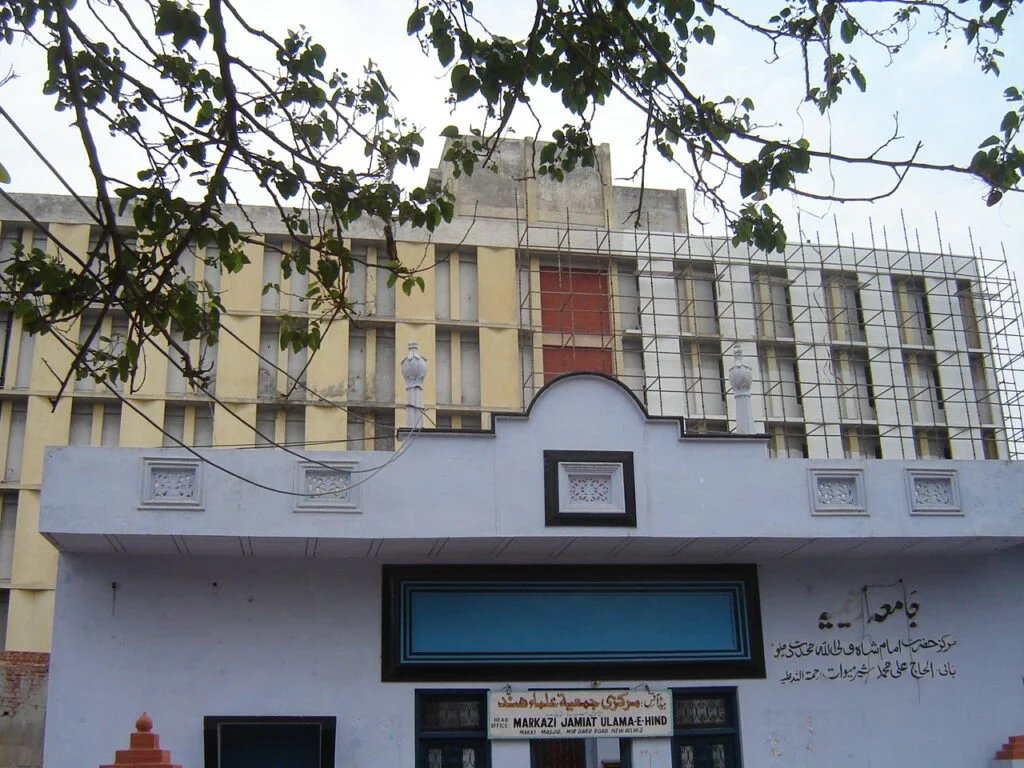
Hidden along the busy Bahadur Shah Zafar Highway, Mehdiyan — home to the revered Madrasa Rahimiya, also known as Jamia Rahimia — stands as one of Delhi’s oldest Islamic learning centres. Established by Shah Abdul Rahim, father of the famed scholar Shah Waliullah Muhaddith Dehlvi, this madrasa has for centuries served as a vital institution nurturing Islamic scholarship. However, today its existence is threatened by creeping urban development dominated by Hindu groups, threatening to erase a vital piece of Muslim heritage.

“Madrasa Rahimiya was not just a school; it was a movement to bring Muslims closer to the Qur’an’s true teachings,” explains Mufti Muhammad Sabir, a Hadith instructor at the madrasa. “But its history is being erased by those who prioritise development over our heritage.”

Madrasa Rahimiya holds a proud place in history, especially for pioneering the first Urdu translation of the Qur’an. In the late 1700s, Shah Abdul Qadir, a key scholar educated under his father and others, undertook the translation project at the Akbarabadi Mosque. This effort laid the foundation for making Islamic scripture accessible to millions of Urdu-speaking Muslims across India, who were otherwise unable to understand the original Arabic text.

“Shah Abdul Qadir’s translation was revolutionary, yet it faced strong opposition from scholars who considered translating the Qur’an sacrilegious,” says Maulana Sabir. “Despite this, his work endured and shaped generations.”

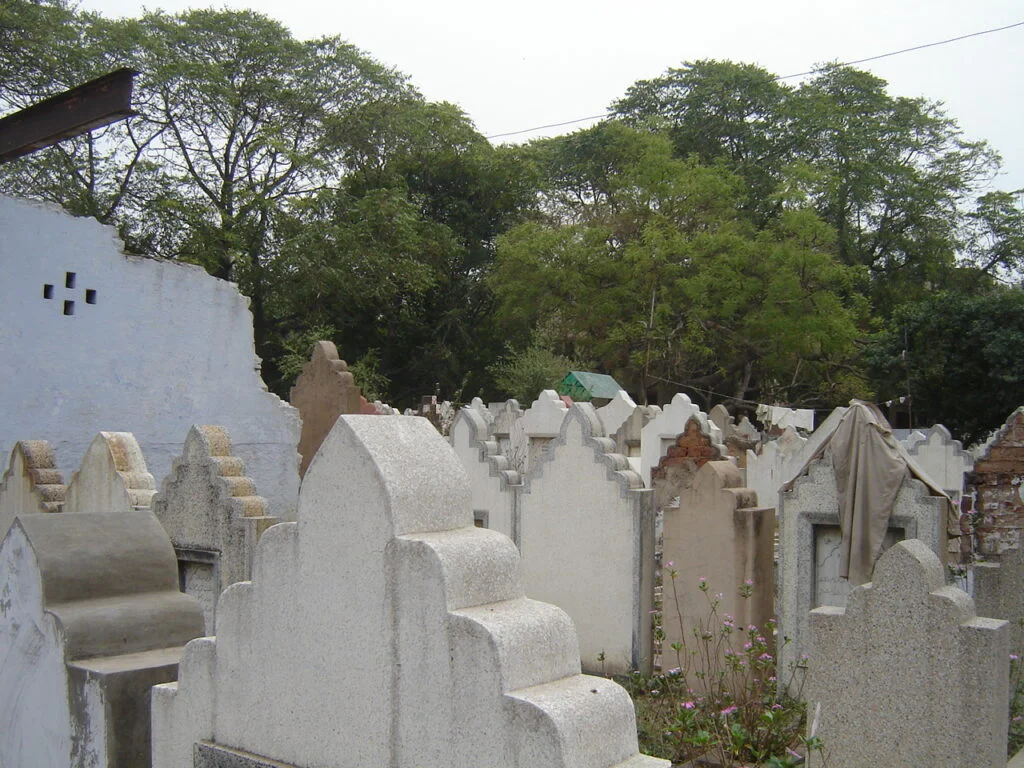
But this rich history has not been free from hardship. After the 1857 War of Independence, British colonial forces destroyed the Akbarabadi Mosque and shuttered the madrasa. The adjoining Mehdiyan cemetery, the resting place of Shah Waliullah and his family members, was drastically reduced. Historian Rana Safavi laments, “Mehdiyan was once a vast necropolis for saints and commoners alike. Now, much of it is lost to encroachment, with what remains used merely as a washing place.”

In the 1960s, Delhi’s expanding urban sprawl posed new threats. Plans to demolish Mehdiyan to build flats and houses were only halted because of the heroic resistance of Ali Muhammad, known locally as Sher-e-Mewat. “He lay down in front of bulldozers and even Pandit Nehru’s car to protect these sacred shrines,” recalls resident Bilal Ahmed. “He broke his leg but ensured our heritage survived.” Jawaharlal Nehru himself was moved by Ali Muhammad’s determination and ordered the preservation of these sites, which were later enclosed by a boundary wall.

Yet, the madrasa’s survival is once again at risk. Critics point out that the latest wave of urban planning, heavily influenced by Hindu groups, disproportionately targets Muslim heritage areas. Historian Zafar Khan asserts, “Hindu groups have long viewed places like Mehdiyan as obstacles to their vision of a ‘modern’ Delhi. This is not just about land — it’s an attempt to erase Muslim identity.”

Local Muslims feel the marginalisation acutely. “Our history is being systematically sidelined,” says Ayesha Begum, a teacher at Jamia Rahimia. “While Hindu temples receive government protection and funding, our sacred sites are neglected, ignored, or demolished.” She highlights the glaring lack of state support for the madrasa compared to the ample aid granted to Hindu religious institutions.

Despite the ongoing pressures, Madrasa Rahimiya endures as a symbol of resilience and faith. Its small mosque and student quarters continue to operate, preserving the teachings that Shah Waliullah and his predecessors established centuries ago.

“We teach the same Qur’an and Hadith that Shah Waliullah did,” says Mufti Sabir. “No matter the encroachment or neglect, that legacy will not disappear.”

The battle to save Mehdiyan reflects wider tensions in India, where Muslim cultural and religious heritage frequently confronts Hindu nationalist agendas. For now, the madrasa stands firm — a testament to Delhi’s Muslim scholars’ enduring spirit and their steadfast commitment to preserving Islamic knowledge and identity.

source: http://www.clarionindia.net / Clarion India / Home> Culture> Editor’s Pick> India / by Mohammed Bin Ismail / May 24th, 2025

2022: 10 must-read stories on Muslim women

INDIA :

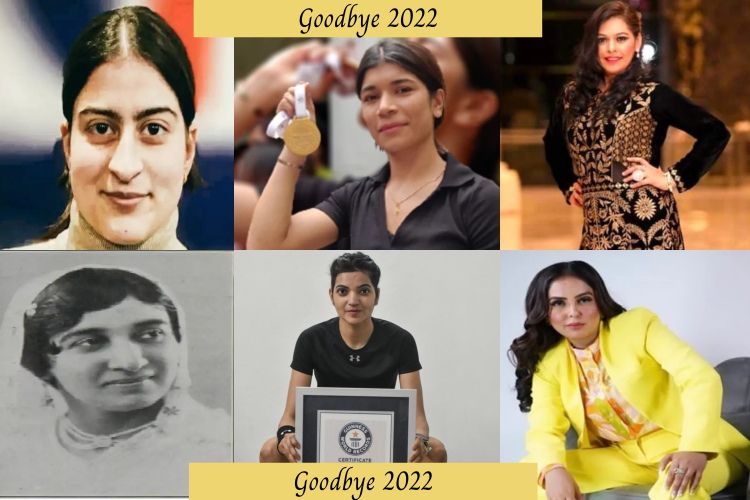
Influential Muslim Women of 2022

As we gear up to bid goodbye to the year 2022, here’s an about-turn to look at the most influential Muslim women who with their girt and strength have embedded their names in history.

Meet Mehr Sheikh from being a news anchor working with a company in Noida, Uttar Pradesh, to setting up her office in front of the same company, she has come a long way. She is presented as one of India’s youngest mainstream female motivational speakers, founder-director of Papr Network, and Editor-in-Chief of Nikology, a YouTube channel with nearly 2 million subscribers.

From being routed in regular corporate life to breaking the barriers and taking running as a full-time profession Sufiya Sufi set many records. From being the fastest female to run the Indian Golden Quadrilateral Road in 6 days, 12 hours, and 6 minutes to taking up the challenges of running continuously 200 km in Qatar and later running across the globe she has come a long way.

With many beauty pageants coming back to India in 2022, Tabassum took the podium a notch up when she represented India as one of the jury members in a beauty event held in South Korea’s Seoul

In the field of sports, Nikhat brought laurels to India as apart from winning the gold at the world championship, she won gold at the National Championship, the CWG and the Stranjde Memorial championship.

Do not marry your sisters, daughters, and other relations to men as their second wives or to those who are inclined on marrying another woman for no reason.” Hundreds of Muslim women unanimously passed the above resolution moved by Begum Jahanara Shahnawaz at the 7th All India Muslim Ladies Conference in 1920.

The All India Muslim Ladies Conference was established in 1914 under the presidentship of Begum Sultan Jahan, the ruler of Bhopal, and the leadership of women like Begum Waheed, Abru Begum, and Begum Shafi to bring social, educational, and economic reforms among Muslim women. Within six years of its inception membership of the Conference increased from a few dozens to hundreds. These women raised money to open and maintain girls’ schools in different parts of India and formed a public opinion in support of education.

Apart from the white robe of a doctor and the operation theatre, Dr. Jahanara Begum, a prominent obstetrician of Assam, also dons colourful costumes and has a wide stage to perform. Away from the hospitals and clinics, Dr. Begum has made theatre a part of her life despite her hectic professional schedule. While she has healed thousands of people as a doctor, she has also impressed numerous playwrights and audiences as an actor. 

Syeda Salva Fatima – Amazed at her confidence, he decided to give wings to her dreams and she was enrolled in the Andhra Pradesh Aviation Academy in 2007. Despite failures, she remained undeterred and finally completed her training. She logged in 200 hours of flying in the Cessna 152 aircraft and 123 Hours of solo flight. She says,My best moment was when I flew for the first time. Also, every time I fly the big bird Airbus 320 in command, that’s the best feeling ever!

Farida Jalees, the founder of Lucknow Mahila Sewa Trust, who had boldly four startups during the Covid-19 lockdown to sustain the livelihoods of some 2.5 lakh women associated with her self-help group, said, “we have never felt these two (festivals) are different. We endeavor to make Jeevika Bakers viable and for this, I have been making use of every festival to sell baked foods under a canopy in marketplaces.”

Dr.Muhammad Raziul Islam Nadvi is a renowned Urdu author advocates Muslim women’s participation in mosques and namaz

Naseem Shafaie, the only Kashmiri woman to get the Sahitya Akademi award and the recipient of this year’s State Award for Literature rues that the Kashmiri language is being ignored by natives who prefer to speak with their children in Urdu (Hindustani) and not in their mother tongue. She laments that the language was not getting due treatment by its natural speakers. “Let all read it and be it our language,” she told Awaz-the Voice. She said there is a general trend among people in Kashmir to speak in the Urdu (Hindustani) language to their children at their homes.

source: http://www.awazthevoice.in / Awaz, The Voice / Home> Stories / by Shaista Fatima, New Delhi / December 29th, 2022

Begmati Language: The Forgotten Voice of Old Delhi’s Muslim Women

DELHI :

Once confined to royal palaces, the Begmati language shaped the unique feminine idioms of Muslim households but now survives only in whispers and memories.

New Delhi :

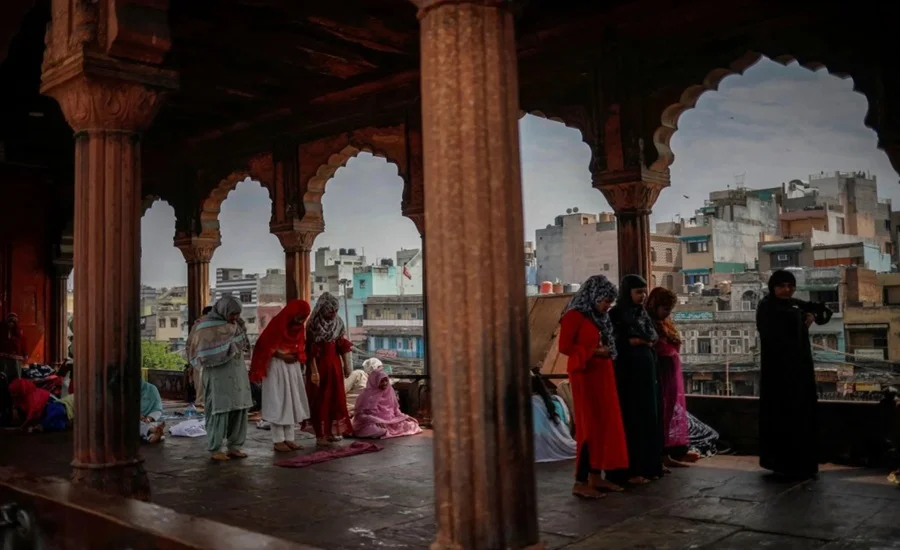
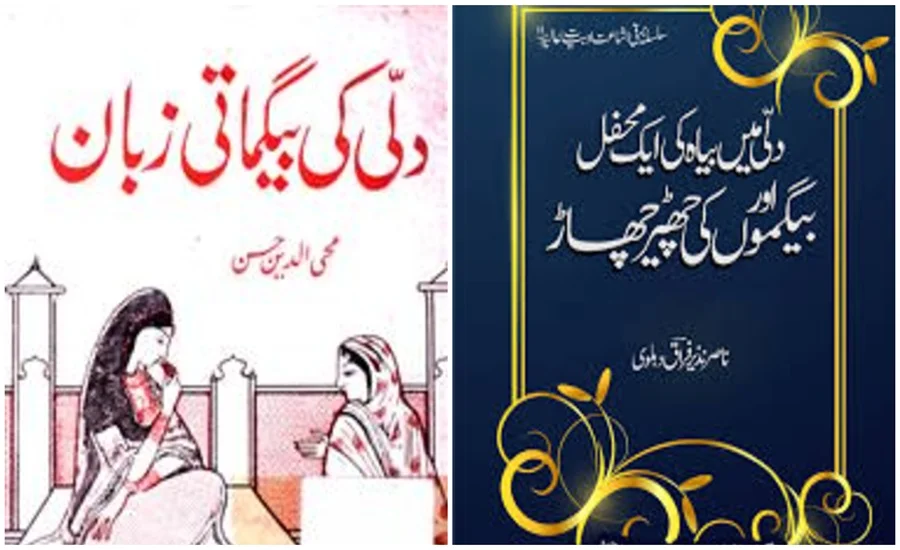
In the narrow lanes of Old Delhi, the echoes of a unique language once spoken behind the veils of royal and noble Muslim households are gradually fading. Known as the Begmati language, this distinctive way of conversation carried the idioms, proverbs, and expressions exclusive to the women of the forts and palaces — a language that was as much about identity as it was about communication.

Sania, a doctoral researcher from Jamia Millia Islamia University studying the Begmati language, explains that “Begmati language is actually Urdu, but used in a very special way during conversations among women.” She notes that it was initially limited to the ladies of forts and royal palaces, who communicated through a code rich in kitchen-related idioms and feminine references.

“After the political turmoil in Delhi, this language spread beyond the confines of the forts and into the streets of Old Delhi,” Sania says. “Even today, many old families in Delhi retain the flavour of Begmati.

The Begmati language thrived as a cultural vessel among women — grandmothers, aunts, sisters, daughters, and household maids — who managed and nurtured the home. Sania remarks, “The language women spoke had a completely different flavour, a vocabulary distinct from that of men. Just as men’s conversations were incomplete without poetry, women’s speech was never without proverbs or idioms, sometimes sharp with scorn, other times filled with desire.”

One example she shares is the word ‘Nikhto’, once used to describe women who were considered impolite or outspoken — a word now absent from modern male speech. Another charming idiom contrasts male and female speech: men might say “Reinhold the tongue” to tell someone to be quiet, referencing horse riding, but women, unfamiliar with horses, would say, “Is the stitch of the tongue broken?” borrowing from the language of sewing and embroidery.

The deep roots of Begmati language lie in everyday female experiences — kitchen work, childcare, household management — shaping a linguistic heritage that remains unique. Sania adds, “Many proverbs related to maternal care or household chores are pure Begmati. For instance, if someone repeatedly visits a place, it’s said their ‘umbilical cord is stuck there,’ a phrase reflecting the language’s intimate connection with womanhood.”

Despite its rich cultural value, the Begmati language is now nearly extinct. Social reformers in the 19th century, including figures like Deputy Nazir and Hali, criticised it as a “bad language,” leading to its decline. The spread of education among girls also meant that standardised languages replaced the once-vibrant Begmati. “Begmati language is no longer in vogue,” Sania laments. “It was not preserved strictly because there was no need, and much of what remains has been recorded by male writers raised in women’s homes.”

The word ‘Begum’ itself hints at class and caste dimensions embedded in the language, which also found variants in places like Lucknow, Bhopal, and the Deccan region — areas with strong veiling traditions and feminine cultures. “The songs and speech of women in Hyderabad, for example, have a melody and rhyme much like the Begmati language’s rhythm,” Sania observes.

Political and social changes in the 19th century further pushed the language into obscurity. As wealth and status became more important, “people lacked taste,” and the Begmati language was dismissed as the talk of a “special kind of women” who should not be emulated. Sania quotes a popular saying mocking women of the time: “I forgot the lime, I forgot the tot, I started eating wheat, I started sleeping on khat,” illustrating how Begmati was ridiculed and sidelined.

Yet the language’s musicality and self-mockery shine through in its verses: “Wood burns like coal, coal burns like ash, I don’t burn coal like ash,” a phrase women would use to express frustration or resignation with their fate.

Today, while the Begmati language no longer flourishes as it once did, its traces linger in the conversations of old Delhi’s Muslim families — a living heritage of a time when women’s voices spoke their own truths behind palace walls.

source: http://www.clarionindia.net / Clarion India / Home> Culture> Featured> India / by Mohammed Bin Ismail / May 23rd, 2025

Mujawar Hussain Unveils Harsh Realities of Ghostwriting in Pre-TV Literary World

Allahabad, UTTAR PRADESH :

The acclaimed Urdu and Hindi writer from Allahabad exposes how poverty forced him to ghostwrite 1,065 novels.

New Delhi :

In the decades before television became a household staple in India and Pakistan, millions turned to novels filled with mystery, romance, and detective tales for entertainment.

One Muslim writer’s story reveals the untold hardship and exploitation faced by many like him during that time. Mujawar Hussain, a prolific Urdu and Hindi author from Allahabad, has exposed the difficult truth behind the 1,065 novels he ghostwrote for Hindu publishers, many under pseudonyms.

Now in his elderly years but still sharp, Hussain shared his painful journey of writing stories for survival rather than pride. “The number of such books combined is 1,065,” he told Clarion India recently. “But the books I consider a source of pride are my research paper, Elements of National Unity in Urdu Poetry, and a collection of my religious essays,” he said.

Hussain’s writing career began in the 1950s when major publishers churned out fiction in bulk to satisfy growing demand. Muslim writers like him were often paid meagre sums to produce thick novels under pseudonyms for Hindu authors and publishers, including names such as Janardan Prasad Jaiswal, Shambhu Prasad Jain, Ashok BA, and the mysterious “Neqab Posh Bedi.” Hussain estimates he wrote 30 to 32 novels under Bedi’s name alone.

“Some of them were non-Muslims,” Hussain said, naming former students turned authors. “I wrote in their names because I had to. The money kept my family alive.”

His words underline the economic hardship faced by many Indian Muslims, forced to work behind the scenes without recognition while Hindu publishers reaped profits. Hussain recalls the pressure of poverty pushing him to write constantly. “I remember those days when I’d enter the house, and my wife would tell me food and drinks would last until the next evening. I’d sit down with a pen, write, and hand over the manuscript to the publisher. I’d take money — 30 rupees at first, then 60, then 100, and finally up to 2,500 rupees. With that, household expenses were met.”

Hussain’s experience highlights the sidelining of Muslim talent in the Indian literary scene, where Hindu publishers held most of the power. “That forced me,” he said. “The memory of that time is painful, and the work was painful. After that, I put down the pen.”

He also revealed working for Nikhat Publications, famous for publishing the works of legendary Urdu detective novelist Ibne Safi. When Ibne Safi’s manuscripts stopped coming to India due to political tensions between India and Pakistan, Hussain was asked to fill the void by writing novels under his name. “When I realised the institution was going to close, I started writing under his name,” he said. “I wrote very few novels in Urdu under his name — half partridge, half quail, meaning some was his, some I mixed.”

In Hindi, Hussain wrote extensively in Ibne Safi’s style, including the novel The Barrister’s Wife, though he remains uneasy about these works. “Even now, I don’t feel good about them,” he admitted. “I didn’t consider them a source of pride.”

Despite his difficult path, Hussain’s academic achievements stand tall. He earned an MA in Urdu in 1958 with two gold medals, a silver medal, a Victoria Gold Medal, and another prize he cannot recall. “No one has ever scored higher than me,” he said proudly. Yet this success did not shield him from the economic hardship that forced him into ghostwriting.

Dr Ayesha Khan, a literary historian specialising in the pre-television literary world, explains that Hussain’s story reflects a larger pattern of exploitation faced by Muslim writers. “Many Muslim authors like Mujawar Hussain were sidelined, forced to write under pseudonyms or for others to survive,” she said. “Hindu publishers often held the power, dictating terms and profiting from their work.”

Hussain’s reflections carry a sense of regret. Quoting a poem, he said, “Remembering the past is a punishment.” He sees much of his commercial writing as a compromise born of necessity, not passion. “Due to the compulsion of circumstances, I wrote some books that I do not consider a source of pride,” he said. “I was writing incessantly.”

Today, Hussain hopes that sharing his story will reveal the struggles of Muslim writers who toiled behind the scenes while others took credit. “I wrote for survival,” he said quietly. “But I want people to know the real story behind those books.”

source: http://www.clarionindia.net / Clarion India / Home> Editor’s Pick> Featured> India / by Mohammed Bin Ismail / May 26th, 2025

The Rich Legacy of Mughal Era Drinks: How Muslims Preserved Royal Recipes

INDIA :

From rose syrup to mango panna, Indian Muslims continue the Mughal tradition of crafting cooling summer drinks originally developed by royal physicians.

New Delhi :

Muslims in India proudly carry forward the centuries-old tradition of crafting refreshing drinks that originated in the Mughal era, a time when royal physicians invented syrups not only for their enduring taste but also for immense health benefits.

Salma Hussain, a researcher who has studied Mughal food and drink habits for over fifty years, explained: “Most of the drinks were invented by the royal physicians, who sometimes prepared drinks for medicinal purposes and sometimes for a refreshing taste, and they were very popular.”

She shared how the art of making these drinks flourished under royal patronage, especially during the reign of Empress Noor Jahan, whose influence in the royal kitchen brought many innovations. “Noor Jahan had creative talent. Under her leadership, excellent syrups were developed. The food was also good, tasty. She especially supervised the royal kitchen,” she told Clarion India recently.

Salma recalled an interesting anecdote from the Mughal court: “Once Queen Noor Jahan was strolling in the garden. Rose flowers were in full bloom. Noor Jahan’s mother, Ismat Ara Begum, used to make perfumes from these flowers. Noor Jahan called the royal physician and said many medicines were made from flowers; why cannot a syrup be extracted from the roses? ‘Many people drink in the name of medicine, but you should make something that will relieve us from the heat and be refreshing, and we will also enjoy it.’”

This simple request from the queen gave birth to the now-famous rose syrup, a cooling drink cherished across the Indian subcontinent to this day.

According to Salma, syrups were not limited to rose alone. “Syrups started to be made from roots, like khus syrup; Panna from mango. Similarly, vine syrup came up. Pomegranate syrup was made by cooking sour and ripe fruit, both said to be very beneficial for the skin,” she said. These drinks were especially popular among the royals, famous for their passion for beauty and health.

Salma further highlighted how Indian Muslims and Mughal royalty took special care to combat the intense Indian heat. “The heat in India was extreme, like today’s heat. Kings also used to cool drinks. Emperor Akbar started ordering ice from the mountains.”

The knowledge of cooling drinks extended to using yoghurt, lemon, and various salts to make beverages like shikanji and lassi, which remain popular today. 

“Rose syrup was made from flowers, custard from custard. Jamun syrup was made from fruits, vine syrup was made from mango syrup. Yoghurt was used a lot then. We learned how to make raita from it. They used to cool the yoghurt or mix it in water and make a drink,” she said.

She also pointed to the influence of neighbouring cultures: “A syrup came from Turkey, Aryan, which is the buttermilk we drink today. Almonds were used to make a lot of syrups. It is said that in Iran, almonds were put in hot water and savoured.”

Salma stressed the importance of these drinks beyond refreshment. “There are some unsubstantiated stories about drinks, but all of them seem appropriate, such as the first among the sages who made syrup; his name was Fitha Ghoras. Sage Fitha Ghoras was the first to give a medicinal drink the form of a syrup, like a decoction, etc. Over time, the trade in syrup gradually started and all kinds of syrups started being made.”

She also mentioned that in 1906, Hakim Abdul Majeed (founder of Hamdard) made the spirit-enhancing syrup. The same refreshing syrup is still alive, and we drink it to relieve the heat.

The purity and quality of ingredients were also important to the Mughals. Salma explained: “The water mixed in the syrup was from the Ganges, although the Yamuna River was closer to Delhi. Its water was not used because of the belief that it caused diseases.”

Water management was taken seriously: “The Mughals used to inspect water tanks. Special officers were assigned to procure and preserve the Ganges water.” 

This careful tradition of preserving royal recipes and using pure ingredients continues in India’s Muslim communities, who keep the memory of Mughal cuisine alive through generations.

Local historian Ahmed Khan commented, “These drinks are not just a part of our culture, they connect us to our glorious past. They remind us of the wisdom of our ancestors and the care they took in making life enjoyable and healthy.”

As the summer sun blazes, families across the subcontinent continue to enjoy these time-honoured drinks, a tribute to the enduring legacy of the Mughal era and the Indian Muslim custodians who have preserved these traditions.

source: http://www.clarionindia.net / Clarion India / Home> Editor’s Pick> Indian Muslims / by Mohammed Bin Ismail / May 26th, 2025

Veiled and Visible – Stories of Three Niqabi Faith-Based Business Owners

INDIA :

That women’ s bodies and choice of clothing are ostracized and politicized, is not new discourse. Much discussion on the subject has ensued in recent decades by liberals, feminists, progressives and conservatives alike. Add to that visible religious practices, such as head covers (Hijab) and  face veiling (Niqab) among Muslim women, and the scrutiny is further exponentialized. So much so, that it disrupts the principles of liberal and western feminists, and suddenly women’s rights to choose what they want to wear begins to be rephrased, and women’s agency to choose to cover themselves is questioned and looked down upon as ignorance or backwardness. As such, Muslim women who practice various degrees of visible modesty, from Hijab to Niqab navigate feelings of discomfort, unwelcome, as well as (c)overt violence when accessing public spaces, including schools, workplaces, markets, restaurants and more. They are often perceived as beings without agency and intellect, and far removed from the mainstream intellectual public realm. Their choice to dress themselves in accordance with their religious and spiritual goals makes their presence in public unwelcome and politicized. 

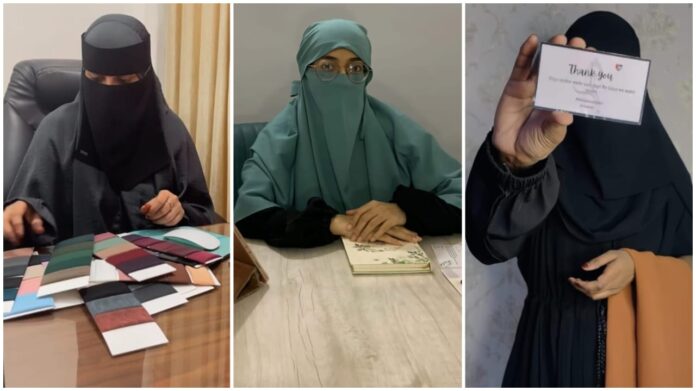
In this article, through interviews with three Niqab-observing Muslim women who have successfully curated , established, and operate their own faith-based businesses primarily selling products through digital means,we draw attention not only on the discomfort and challenges faced by Muslim women in public spaces and traditional office workplaces, but we also highlight  the agency embodied by these women to pursue their professional goals in accordance with their personal religious beliefs.

Residing and operating their businesses in India, our interviewees – Kehkashan, Asma Nafis Ansari and Mantasha – have been able to capitalize on the growing adaptation of digital technologies in recent years and produced workspaces for their businesses that offer them the safety and flexibility to pursue their multifaceted aspirations holistically. Rather than waiting for space to be given to them or created for them, they have taken the initiative upon themselves, and are doing so with grit, faith and vision. In doing so, they not only benefit themselves, but also provide employment opportunities, inspiration, and alternative workplace options to others who may find themselves facing similar challenges of discomfort in the public realm.

Faith as an anchor

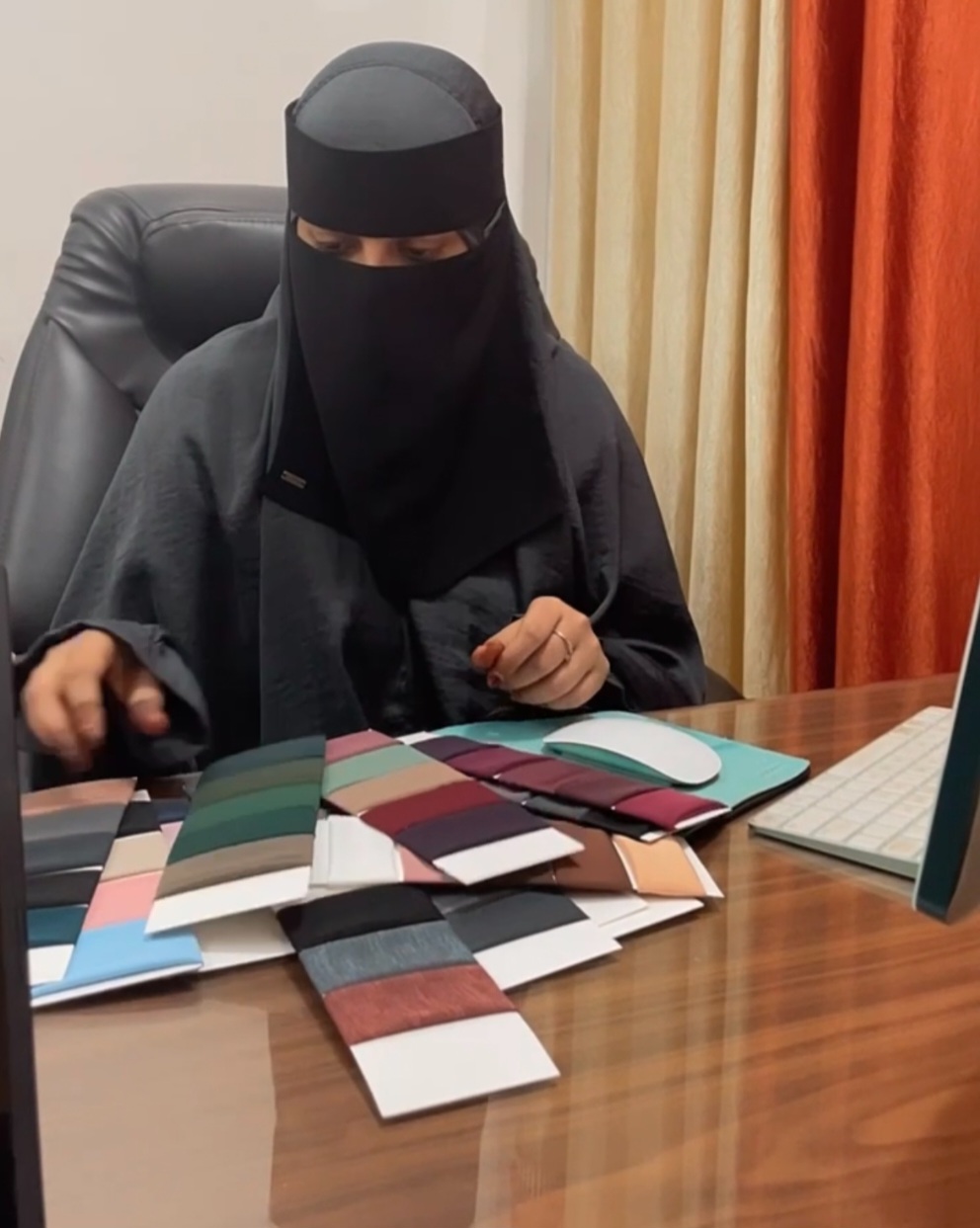
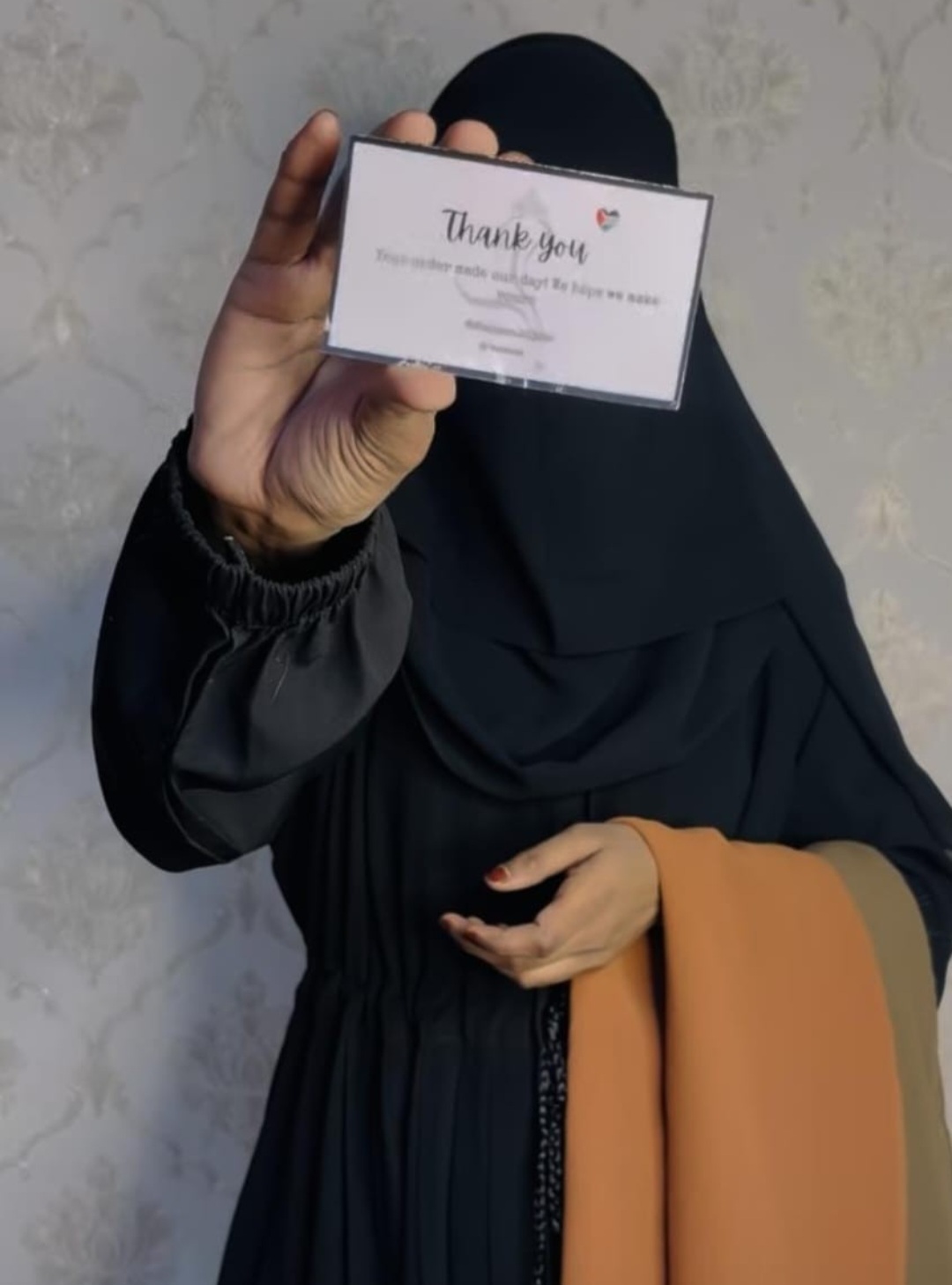
For these three muslim women, faith is not just a silent actor, but the compass that guides their journeys. Kehkashan, who co-founded ‘Shop Taaseen’ with her business partner Saida Moin, says that they started with a small product, an Umrah dua card in 2024. Today, Shop Taaseen offers a range of faith-based lifestyle products—designed to make Islamic knowledge and reminders part of everyday routines, especially for young Muslims in India. Early on in her academic life, Kehskashan says, she recognized a desire in her to create something of her own but did not know what it would be. She describes herself as someone who has always leaned into creativity with a strong sense of self –  “Whatever I do, I want it to be for the sake of Allah.” she shares. That clarity guided her decisions, especially when the spaces around her were not accommodating to her identity. When asked what helped her stay rooted in her vision, Kehkashan said, “the Niqab became my north star. It shaped how I wanted to show up in the world.”

Kehkashan co-founder of Shop Taaseen

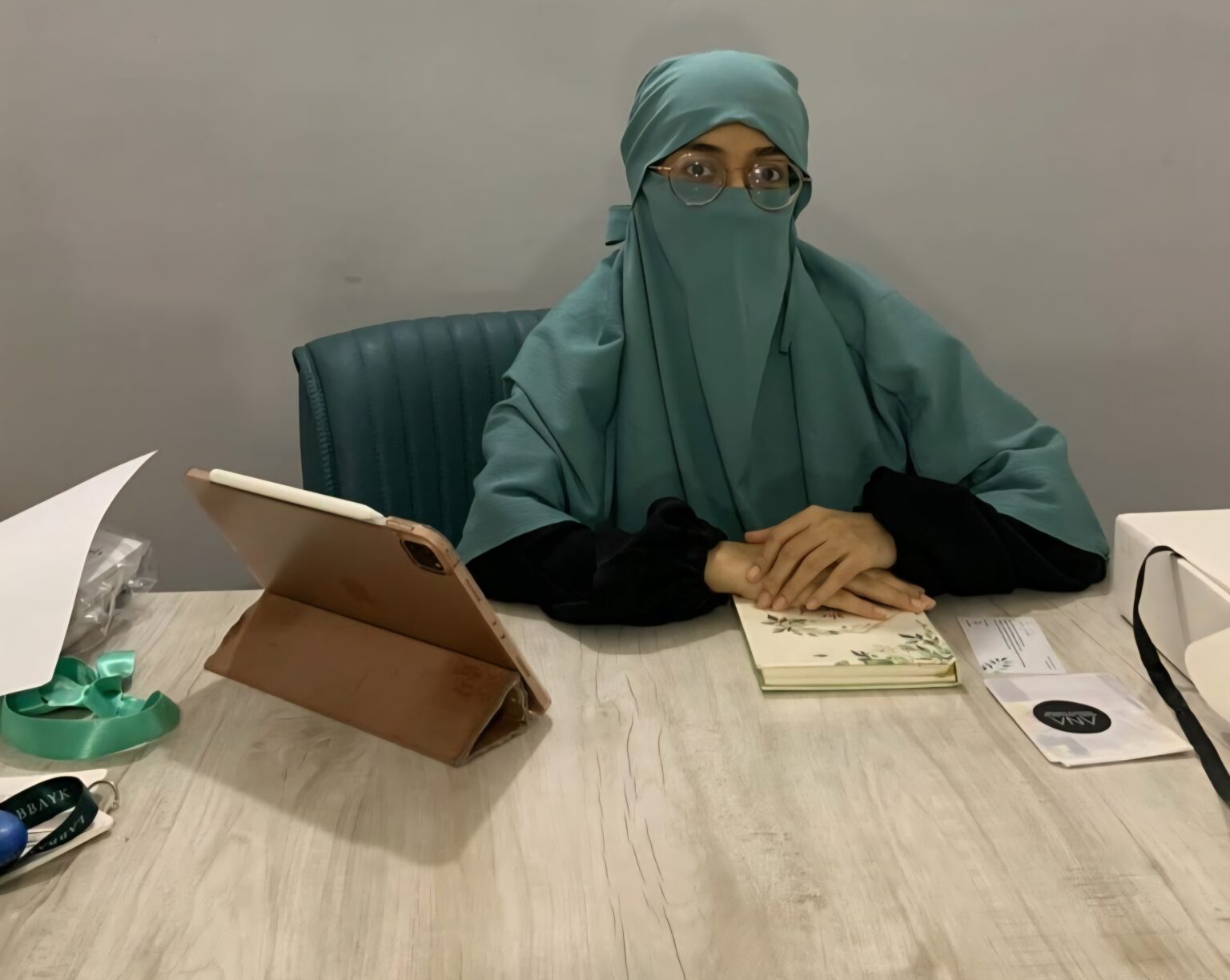
Similar to Kekhashan, our second interviewee, Asma Nafis Ansari, founder of ANA, a modest wear brand, spoke of her strong aesthetic sense, shaped by her training at the National Institute of Fashion Technology (NIFT) Kolkata. As a student at NIFT, Asma developed a signature style for her designs over the years, eventually winning her school’s Graduation Award in her final year, for her knitwear collection inspired by the mid-20th century style, Brutalism. Before launching ANA, Asma began a more intentional journey of reconnecting with the Qur’aan. It was during her study of Surah An-Nur, she says, that her personal understanding of purdah or veiling/modesty deepened. “That connection with the Qur’aan gave me clarity…” she says, “… I didn’t just want to work in fashion —I wanted to create something deeply rooted in modesty and meaning.” Today, ANA is not just a clothing brand, but a value-aligned space for modest fashion.

Asma Nafis Ansari the founder of ANA.

Our third interviewee, Mantasha, who holds a postgraduate degree in development communication from Jamia Millia Islamia, launched Shaheen Hijabs after realizing that mainstream, traditional workspaces would not be welcoming of her niqab. After post-graduation, she accepted a position in the development sector that involved extensive fieldwork. While her supervisor remained supportive, she realized that navigating public-facing roles as a Niqabi came with quiet, persistent tensions. “In that environment, personal identity played a critical role…” she reflects, “… people advised me to remove my niqab temporarily—saying it was not obligatory. But no matter how practical their advice sounded, I could not bring myself to do it.” She underscores that,  “My niqab is not just a piece of cloth, it is a reflection of my faith.”  What followed was a phase of uncertainty, reflection, and quiet resistance. Eventually, she decided to start something of her own and launched Shaheen Hijabs.

Mantasha, the owner of Shaheen Hijabs

For these women, faith is not just their religious belief. It is the guiding principle in their work. They refused to be reduced to stereotypes or forced into palatable molds, and instead have each chosen to build businesses that reflect their aspiration, purpose, religious, spiritual, and personal values.

(In)visible Practices of Faith

For Muslims, religious faith is embodied and  practiced in a myriad of ways. Some aspects remain quietly held within—like Taqwa (consciousness of God) or Tawakkul (trust in divine will) – are inward practices that guide one’s principles.

However, there are other religious practices that present more visibly, like offering Salah or dressing modestly in accordance with religious guidelines. Similarly, for many Muslim women who adorn the hijab or niqab, their choice to do so is rooted in faith, devotion and identity.

For Kehkashan, the tension between her visible and invisible religious practices became apparent during a fellowship she had joined before Shop Taaseen. She recalls, “Her cohort of Fellowes were mostly non-Muslim, but they were respectful and very welcoming towards me. I felt seen.” But that feeling did not last long for her. She goes on to say, “[However,] The founder would question my practices, compare me to other Muslims. Many times I was subjected to tokenism disguised as inclusion.” She says that her choice to wear the niqab was repeatedly framed as a limitation – “I was told that niqab will hinder my growth. That it would isolate me and hold me back professionally.” It was in these moments of subtle exclusion — more than overt rejection —that she became more certain that her faith would not be negotiable. 

In such ways, niqab-practicing women face exclusion, rejection, humiliation and suppression in traditional workplaces, particularly from those in higher and more powerful positions. These unwelcoming experiences inevitably discourage women from either practicing their faith wholeheartedly, or pursuing their professional aspirations wholeheartedly, pushing them to pick between one or the other.

In Asma’s story, we see a higher degree of exclusion from the public realm. After her graduation from NIFT, Asma was placed at a company in Gurgaon along with two other peers. The three of them then began to look for housing in the vicinity of their new workplace. Through an online portal, they found a potential apartment, and one of her two peers visited the flat, viewed it, and sent a video of the apartment to Asma. Satisfied with the place, Asma and her peers agreed to put down a deposit on the flat. Asma emphasizes that the management knew that someone named ‘Asma’, a common Muslim name, would be moving in. However, when she arrived with her sister at the apartment on a rainy day, they were stopped at the gate and denied entry because of their appearance as veiled Muslim women. “There are many Muslims here… ” the guard told her, “… but they do not dress like you.” It did not matter that she was a skilled designer or that she was simply looking for a place to live. Her Niqab and possibly her Abaya/Burqa ascribed her a communal and/or political identity, and that identity was decidedly excluded . She recalls being told, “If you want to live here, you can’t wear these things.” In that moment, Asma became a symbol of something “other,” something unwanted. Eventually, Asma had to find other housing accommodations. This is the quiet violence many veiled Muslim women face: being tolerated only if they erase or soften visible parts of their identity. It is an expectation that to belong, one must visibly look less Muslim or act less Muslim, and appear more as everyone else. This kind of politics of visibility relies on the erasure of visible culture and tradition that is not just harmful to Muslims, but all social groups and cultures that present more visibly. These stories give us an insight into the direct co-relations between degrees of unwelcome in public space and degrees of visible practice of religious faith. Therefore, much dialogue is needed on the reception of visible practices of faith in a society that portrays itself as a democratic and egalitarian one.

Agency X (Niqabi) Women

Women’ s struggles for agency are multifold. On the one hand, historically, women have had to fight for the right to vote, to be in the workforce, for banking rights, financial freedom, and more. On the other hand, women who exercise agency over their lives have to deal with persistent undermining of their achievements and independent decision making. This kind of undermining is further exacerbated for Niqabi Muslim women, with the most common assumption made about them that they wear it on orders from a male member of family – like a father, husband, or brother – rather than of their own convictions. They are often presumed to be voiceless, passive, or lacking autonomy. To be visibly Muslim, for veiling women, is to constantly push back against the erasure of one’s intellect and agency. 

The veil has widely been painted as a symbol of restriction and oppression. Like the other two interviewees, Asma rejects this thinking and instead describes her choice to veil as an expression of deep personal identity. “People see me with respect,” she says, describing how clients and collaborators from across India engage with her during business travel. Her presence, veiled, carries authority. But that authority is also questioned and undermined by others. For instance, at an award ceremony where she was being honored as women entrepreneur of the year, a senior government official turned to her husband and asked, “She is doing such good work, why have you made her cover her face? “, to which her husband responded, “This is her choice. It wasn’t imposed on her by me.” This attitude is not uncommon, and is reflective of how, even in spaces meant to celebrate her success, the assumption of male control and female subservience still lingers. These narratives uncover deeper problems concerning women’s rights, often held by those with saviour complexes, without a true commitment to the cause. It victimizes the Muslim woman and villainizes the Muslim man, framing the problem as ‘saving muslim women from muslim men’. Not only does it misrepresent social issues, it further exacerbates the actual problems Muslim women face by consciously ignoring them. Furthermore, in denying women their proven potential, it highlights the discomfort society still holds about women who achieve success while staying true to their self and not following orders set by and within patriarchal frameworks – that a woman can be successful and devout, that she can lead and be veiled, that she can dress in faith and still possess sharp, unshakeable agency.

Although this article highlights the stories of three Niqab-wearing Muslim women, similar experiences are faced by the broader veiling, Muslim women community. From unwelcoming experiences to rejections, Niqabi women are forced to navigate a number of identity-based hindrances in their personal, professional, and spiritual journeys.

To compensate for their perceived incompetence, many feel forced to overperform, overachieve in comparison to their peers for the same level of acceptance.

Our three interviewees have shown that they do not seek validation in the language or frameworks of others. Their choices are not compromises—their decisions anchored in faith, and carried out with purpose. Agency, for them, is not about abandoning identity to gain access. It is about bringing their whole selves into every space—and reshaping what power, intellect, and leadership look like. What sets these women apart is not just their ability to navigate exclusionary spaces, but their refusal to be defined by them. In centering their faith, they have not only claimed their agency but have also carved out paths of success that are deeply rooted in service to their communities. Women like Asma, Kehkashan, and Mantasha are writing a different story—one where agency is not hidden beneath their veil, but asserted through it.

Kehkashan, through Shop Taaseen, is cultivating a space of belonging. The Taaseen Tribe, a growing digital initiative, brings together Muslim women from across the walks of life to reflect, learn, and connect.

It is a community that echoes Kehkashan’s own journey—a space for young Muslim women to feel seen, intellectually engaged, and emotionally supported.

Asma, from her small town of Mau in Uttar Pradesh, established ANA, that not only reaches customers across India and abroad but also creates livelihood for a team of about 30, consisting of kaarigars, accountants, managers, and assistants. In a world that often parades notions of diversity and inclusivity, but then almost exclusively produces urban, English-speaking workspaces and equates them with success, Asma’s journey redefines what inclusivity looks like. ANA prides itself in maintaining a balance of 1:1 ratio of men to women across their workforce. She is proof that one can build while holding fast to faith, staying rooted in place, and uplifting others along the way.

Mantasha’s story is one of resilience, where she was willing to risk uncertainty to preserve her identity and stay true to herself, rather than diluting her identity to fit in. With no prior business experience, she started Shaheen Hijabs teaching herself the ropes of the business along the way. “I rushed into it… ” she says. “… there were mistakes. I’m still learning. But I’m doing it in a way that doesn’t require me to compromise on who I am or how I want to live my faith.” 

So, what then does it mean, to navigate public spaces where one is made hyper-aware of themselves, simply for living in accordance with their faith, which in a democracy, is apparently their fundamental right? What does it mean to carry the weight of assumptions—about agency and intellect—before one even speaks? What could our society look like if we stopped incessantly asking Muslim women to prove their worth, and instead, started paying attention to how they are already building, leading, and transforming the world around them? And more importantly, what could our society look like if we stopped tokenizing identity in the name of (pseudo) diversity and (pseudo) inclusivity, and started creating truly inclusive and democratic spaces for all?

****

About the Authors

Aazeen Ghaus is a Development Communication practitioner & freelance writer, based in India.
Saba Fatima is an architect based in Albuquerque, USA. She is an incoming PhD student (Fall 2025) in the Built Environments program at the University of Washington, Seattle

source: http://www.muslimmirror.com / Muslim Mirror / Home> Exclusive Reports> Positive Story> Women / by Aazeen Ghaus and Saba Fatima / July 03rd, 2025

Fasihuddin Balkhi: the forgotten historian of Bihar

Patna, BIHAR :

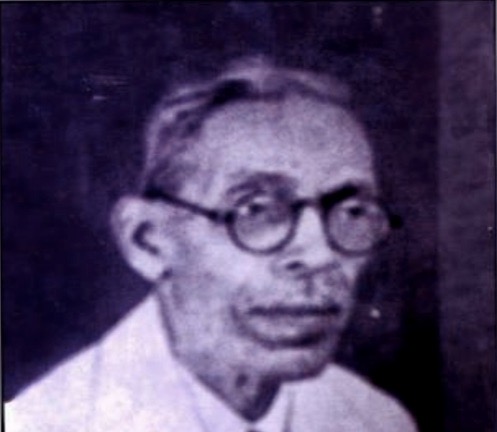
Fasihuddin Balkhi was born in 1885 in Bakshi Mohalla of Patna city. | Picture: Rekhta

Born in Patna, Bihar during the British era, Fasihuddin Balkhi made a tremendous contribution to history-writing in Urdu. Despite this feat, he remains largely unknown to this day. 

Many historians have written about the history of Bihar. After taking a cursory overview of the works written by different scholars, one finds that history writing on Bihar, especially in the Urdu language has not yet received due attention in academic circles. Among many others who have written on Bihar and its history, the notable ones include Fasihuddin Balkhi (1885-1962); Taqi Rahim (1921-99); and Shad Azimabadi (1901-1978).

This piece is an attempt to highlight the life and works of Fasihuddin Balkhi. His work has received scant attention from those working in the Bihar region. His contribution remains largely under-acknowledged and under-explored in the existing literature of the Bihar province.   

Balkhi was born in 1885, the same year that the Indian National Congress (INC) was founded, in Bakshi Mohalla of Patna city. After receiving his early education at home, he went to Calcutta where he completed his higher education. He became a teacher and initially taught at Poona Military School and later in Calcutta Fort William. Later on, he passed the law examination and was employed in the Bihar government. In 1914, he opted for military service which enabled him to visit different parts of the world like Palestine, Egypt, Iraq and Lebanon. 

As India’s independence movement was drawing more followers, Balkhi too joined the movement. In 1921, he became part of the non-cooperation movement. After refusing to accept the post of deputy in Jaunpur, he had to face many hardships. Between 1926-27 he worked as the revenue officer and magistrate in Sarai Kela state.

After retirement, he left his ancestral home and lived the rest of his life till 1962 in his new house in Guzri Bazar Patna city (just behind the present Mohammedan Anglo Arabic school). In the last two years of his life, he worked at Patna University in the department of manuscripts. His hardworking and organizational abilities infused a new spirit in the department. 

Although Balkhi was known as a good teacher and a successful officer, he was primarily a historian and researcher, as he stepped into some areas of research that were hitherto almost invisible. Even the noted Bihar-based historian, Syed Hasan Askari (1901-1990) has acknowledged Balkhi’s scholarly and literary abilities. Unfortunately, most of the works of Balkhi could not reach their desired audience. Some of his works remain unpublished even now.  

Balkhi’s first book Tarikh-e-Magadh was published by Anjuman-e-Taraqqi-Urdu-Hind (Delhi) in 1944. The second book, Tazkira, was published as Tazkira-e-Niswane Hind (1956).

According to one source, he wrote his first work at the age of 25 in 1910 in Urdu on astrology, a rare case in Urdu, titled as Ilmi-e-Najoom. This work is not easily available or accessible to the readers. A pamphlet on the poetry of Shad Azimabadi titled as Inshad-e-Shad (Qaumi Press Bankipore, Patna, 1939) is his signature piece. The pamphlet demonstrates his power of critique. 

Balkhi’s work only gained wider attention after his death. Well-known Urdu publisher Nadeem Bhatti published one of Balkhi’s works Tazkira-e-Hindu Shora-e-Bihar (Poets in Bihar/Urdu) in 1962. Some of Balkhi’s unpublished works such as Dastur-e-Sukhan, a collection of his works on historical places of Bihar province, Aasar-e-Balkhiya, are collected in the book. Several of his scholarly, literary and historical articles are also available in different magazines and journals. A well-researched article on Balkhi’s personality and research guidance was written by Qayyum Khazar for ‘All India Radio Patna.’ Khazar states that “Fasihuddin Balkhi was a great historian and researcher as well as a good poet.”  

Balkhi’s work as historian
Tarikh-e-Magadh is the first book that earned Balkhi fame as a historian. This seminal work in Urdu was published in 1944 by Anjuman Taraqqi Urdu (Delhi), which was then under the supervision of Maulvi Abdul Haq (Baab-e-Urdu). The book chronicles the history of Bihar province from the earliest times (642 BC) up to the second World War in 1943. The book contains as many as twenty chapters. The book is considered one of the most reliable accounts of the history of Bihar in the Urdu language. The work was constructed from authentic historical sources. 

Patna-based historian Imtiaz Ahmad, commenting on the significance of Tarikh-e-Magadh, has said, “It is written authentically and professionally, with proper references from sources (Persian texts).” 

Balkhi also wrote another significant work entitled Wahabi Movement, posthumously published in 1983. This book along with Qeyamuddin Ahmad’s seminal work The Wahhabi Movement in India (1966, reprinted 1994) are the most cited works on the history and role of the Wahhabi movement in India.

Balki’s slim book, despite being confined to the Bihar region, is distinctive in many new ways. The sources he cited are primary and useful, such as letters of Syed Ahmad Shah, Calcutta Review, Indian Muslim by Wilson Hunter, Tazkira-e Sadiqa and biographies of Syed Ismail and Syed Ahmad, the founding fathers of the movement in India.

Emphasizing the legacy left behind by the Wahhabi movement, Balkhi writes, “It is highly interesting to note that the use of three great weapons, namely, non-cooperation, passive resistance and establishing of parallel Govt. which the Congress leaders adopted in their fight against the bureaucracy, was originally advocated and preached by the Wahhabis in 1854.” (p. 16).

Apart from these historical accounts, Balkhi wrote another path-breaking book Tazkirah Niswan-e-Hind (1956) in which he documents the short biographical accounts of the notable women of India. He starts his book with Raziya Sultan of the early 13th century and covers the women from various fields across India such as Askari Begum ‘Hijab’ (Lucknow), Chander Mukhi Bose (Bengal), Lal Ded (Kashmir), Raziya Sajjad Zahir (Rajasthan/Bombay), Bibi ‘Tahira’ (Bihar), etc. This book serves as an important source of information on Indian women and their role in different times of history. 

Balkhi has also written about the lesser-known aspects of Bihar. This can be gauged from his book Patna Ke Katbe in Urdu, published by Khuda Bakhsh Library, Patna in 1993. This book is a unique study of inscriptions found on graves, mosques, and tombs located in Patna. 

Balkhi has made a tremendous contribution to writing the history of Bihar in Urdu. His work serves as a guiding light on the lesser known and under-explored aspects of Bihar. His work needs to be revisited and re-assessed to throw light on many ignored dimensions of Bihar history.

Mohd Hussain Ganie is a PhD student at Aligarh Muslim University (AMU). He tweets at  @GanaiHussain1

source: http://www.twocircles.net / TwoCircles.net / Home> Art-Culture / by Mohd Hussain Ganie, TwoCircles.net / August 12th, 2022

A worthy example of communal harmony

Rasipuram Town (Namakkal District) , TAMIL NADU :

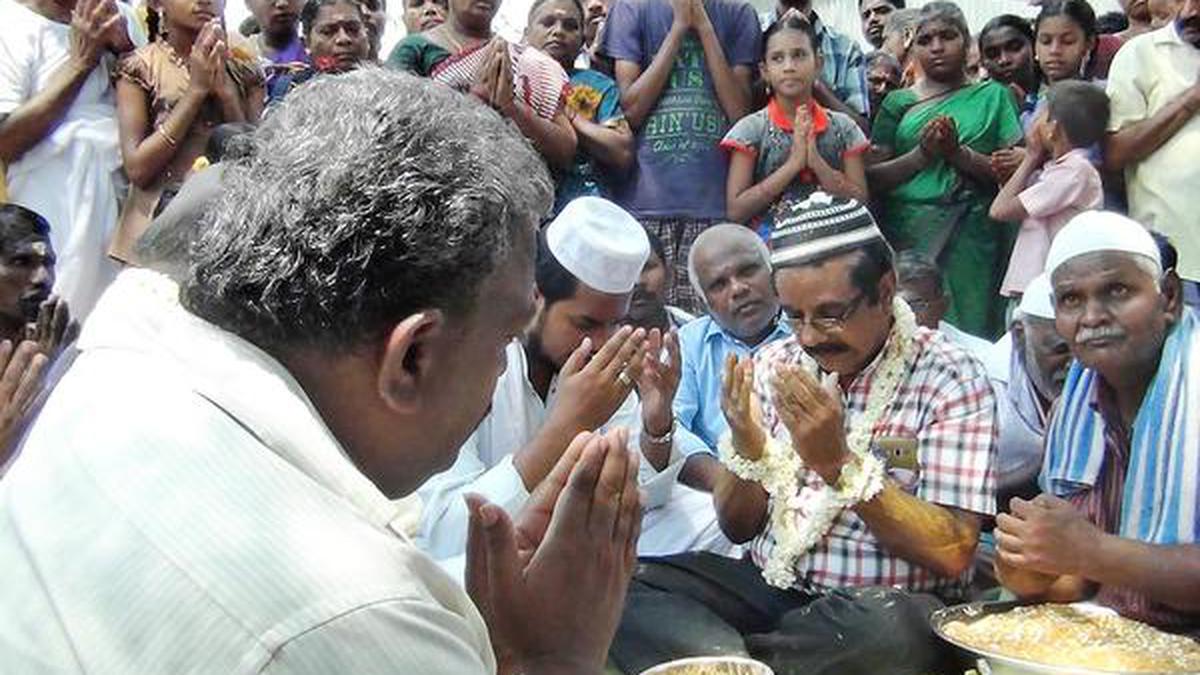
Joint celebration: Hindus and Muslims at the valediction of the Panguni Uthiram festival in Namakkal.

By honouring members of the Muslim community at the annual Panguni Uthiram festival on Wednesday, the Hindus in Gurusamipuram, a small village near Rasipuram, have set a worthy example of communal harmony.

It is a thanksgiving gesture to the Muslims of Rasipuram town, whose forefathers were believed to have cured through prayers many children of the Hindu community of cholera.

This practice has been in vogue for over a century now, the village elders say.

The Panguni Uthiram is a major festival of Arulmigu Sivasubramaniar Temple and is celebrated with usual gaiety every year. It is at the valediction of this festival the Hindus honour the Muslims.

According to K. Thalamuthu, a former school headmaster and president of the Sengunthar Nala Kalvi Arakkattalai, and Devarajan, its treasurer, many children of the weaver community in Gurusamipuram were affected during a cholera outbreak in the village.

On learning about this, the Muslims of Raispuram who used to visit the village for business transactions, offered special prayers by tying a white holy flag to a tree. They smeared sandalwood paste on the doors and walls of each and every house in the village. Following this, all the children were believed to have recovered.

Since then, the residents of the village make it a point to honour the Muslims of Rasipuram at the annual Panguni Uthiram festival.

The organising committee of the festival visited Rasipuram and extended invitation to members of the Muslim community belonging to Achukatti Street Mosque Jamath.

The Jamath members, accepting the invitation, visited the village on Wednesday with fruits and sweets . The Hindus and Muslims holding the holy white flag went through all the streets in the village, when the Muslims smeared sandalwood paste on the doors of all the houses. After tying the flag to the tree, which is popularly known as ‘jhanda’ (flag) tree, they assembled at the Paavadi ground.

The Hindus honoured the visiting Muslims with garlands and vice-versa. Special ‘fathiha’ was recited by the Muslim religious scholar for communal harmony , followed by the distribution of a mixture of jaggery and roasted gram by the visitors.

Later the Muslims took leave.

“This is a worthy gesture practised by our forefathers and we are continuing this tradition in the interest of strengthening the bond between both the communities for decades together,” says Mr. Thalamuthu.

source: http://www.thehindu.com / The Hindu / Home> Today’s Paper> National> Tamil Nadu / by Syed Muthahar Saqaf / April 15th, 2017

Focus on communal harmony

Salem, TAMIL NADU :

The Margazhi Peruvizha Committee functioning in the city has set a worthy example for communal harmony for other associations to emulate by inviting scholars of other faiths to address the Margazhi and Navarathri festival programmes.

T.M. Abdul Khader, an eminent Tamil scholar and former Head of the Department of Tamil, Islamia College, Vaniyambadi, is a regular at the Margazhi and Navarathri festival programmes here for the past 15 years at a stretch, along with the scholars of other faiths.

The Margazhi Peruvizha Committee has been organising special discourses, lecture programmes and poets’ symposium etc for the past 33 years without any break during the Margazhi and Navarathri festivals.

The committee members have been ardent followers of Vallalar, a famous Tamil saint and one of the greatest poets, who endeavoured to eliminate caste and promote a society sans religious and caste considerations.

The committee has been organising programmes to create awareness on the religious practices which had negative impact on the entire society. It invited scholars of all religious faiths from across the country and also from Sri Lanka to address its members.

According to A.K. Palaniappan, president of the Margazhi Peruvizha Committee, the Navarathri festival is celebrated for 10 days and the Margazhi festival for about a month every year.

The committee has made it a point to invite like-minded scholars from all faiths to participate in their programmes. “Kavikko” Abdul Rahman and Periyar Dasan, who later converted to Islam, have addressed the Margazhi gatherings in the past.

Mr. Palaniappan said that Prof. Khader has been attending the Margazhi and Naravathri programmes for the past 15 years. His lectures always evoked good response and the jam-packed hall on Saturday when he spoke on the topic ‘Bothimarathu Kilaiyil Poonthamizh’ (Tamil on the branch of Bothi tree) was an ample proof of his popularity with the local audience, he said.

Prof. Khader also presided over the poets’ symposium on the topic ‘Kodugalal or Kolam’ on Sunday evening.

Mr. Palaniappan said Jegath Gaspar Raj, a Chennai-based Catholic priest and founder of the “Tamil Maiyam”, will be addressing the gathering on January 5.

Politicians including Vaiko and Nanjil Sampath have also addressed these festivals.

Another highlight of both the festivals organised by the committee is the equal importance given to women. Many women scholars are regular in delivering special addresses at these meetings.

Uma Devarajan of Salem, N. Vijayasundari of Tiruchi, Devi Gunasekaran of Salem, Desa Mangaiyarkarasi of Chennai, and M. Uma Maheswari of Coimbatore are among the list of speakers for this year’s meetings.

source: http://www.thehindu.com / The Hindu / Home> Today’s Paper / by Syed Muthahar Saqaf / January 02nd, 2017