This is expected to boost the writing of people belonging to Nawayat community from Bhatkal, who use the Persian script to write their unique language ‘Nawaiti’ — a rare language and script.
Karwar :
A 1,000-year-old language is complete only now after a team of software engineers from Mumbai developed three of its characters to crack its Unicode script.
This is expected to boost the writing of people belonging to Nawayat community from Bhatkal, who use the Persian script to write their unique language ‘Nawaiti’ — a rare language and script.
Nawayat is an Indian-Muslim community, which lives in Bhatkal of the Uttara Kannada district.
Mohammed Mohsin Shabandri, a community member, pointed out that due to three missing characters in Unicode fonts, people were not able to write as they pronounced.
“About three years ago, we decided to develop these three characters and called a meeting of Nawaiti-speaking people. After eliciting their opinion and conducting proper research, we finalised three new characters,” he said.
“Nawaiti is an endangered language. Three months ago, we approached a software development firm in Mumbai. After studying the language, they developed phonetic characters and its software, which is called ‘Nawayat language solution’,” he said.
source: http://www.newindianexpress.com / The New Indian Express / Home> States> Karnataka / by Arunkumar Huralimath / Express News Service / January 16th, 2019
Mehmood is an electrician whose business of setting up lights for festivals spans from Janmasthami celebrations in Muzaffarnagar to the famous Nauchandi Mela in Meerut
Prayagraj:
In a sea of saffron, he stands out with his skull cap and gray beard. To the first time visitor, a board reading ‘Mullah Ji Light waale’ (Mullah Ji, the lighting man) at the Kumbh Mela may be an odd sight but to the Sadhus who have gathered at the confluence of the Ganga and the Yamuna , Mohammed Mehmood aka Mullah Ji is a permanent feature of every Kumbh. To some, he is even a friend.
Mehmood is a 76-year-old businessman from Muzaffarnagar in Western UP. In 1986, he acquainted himself with the Sadhus of the Juna Akhara – the largest and one of the fiercest Akharas of the Naga Sadhus; an ancient order of warrior monks. They hired him to set up the lights around their tents. Today, every six years, he travels over 800 kms to Allahabad, now named Prayagraj, and camps out at the Kumbh Mela.
Sandwiched between the tents of the Juna Akhara, he talks of his journey to Kumbh. “I am an electrician. When you come here at night, you will see that the entire area where Sadhus have pitched their tents is dazzling with bright lights of all colours. That is my doing,” he says proudly. Mehmood’s business of setting up lights for festivals spans from Janmasthami celebrations in Muzaffarnagar to the famous Nauchandi Mela in Meerut. ‘Mullah Ji’ had started his business from scratch.
“The first Kumbh I ever attended was the 1986 Kumbh in Haridwar. Apart from the mela that happens in Nashik, I have attended every one. I haven’t kept count of how many Kumbh Melas I have attended, maybe you can do the maths,” he jokes, sipping a cup of tea at his 11th mela.
Naga Baba Sangam Giri, a warrior monk from the Juna Akhara, is Mehmood’s neighbor on the sands in Kumbh. “I have seen him at nearly every Kumbh Mela I’ve been to. I never even bothered to ask him, his real name. For us he is, and will always be, simply ‘Mullah Ji’ – our friend,” he says, adding, “For Hindus, we are gurus. For Muslims, we are Pirs. They (Muslims) worship niraakar (a formless God) and we worship aakar (idol worship). There may be different routes, but we are all going to the same place. There are 25 different ways to get to Allahabad. Everyone takes a different route to the railway station. But eventually, everyone ends up at the railway station.”
Mehmood says he is treated with respect among the Sadhus. The day that stops, he says, that will be his last Kumbh. “The Babas make me feel at home. Sometimes they ask me to sit on their gaddi (padded mattress), but I respect them too much to do that. I read my namaz five times a day in the presence of these Sadhus and they always give me the space,” he said.
If the Sadhus hadn’t treated Mehmood differently, he probably would not have come to Kumbh, he recalls in nostalgia.
Over the last three decades, Kumbh has become an integral part of his life. Will Mullah Ji come back for his 12th Kumbh? “Inshallah! If Allah commands me to, I will come back,” he says.
source: http://www.news18.com / News18 / Home> English> India / by Uday Singh Rana / January 15th, 2019
Many prizes have come her way in subsequent years and there has not been any looking back ever after that
Farnaaz Islam
Farnaaz Islam of Guwahati is an engineer by qualification but a flourishing artist by passion. She is one of the two artists from Assam who feature in the 11th Contemporary Painting Exhibition organised by the Bengal Art Foundation (BAF) which is going on now at the Gauhati Artists’ Guild here.
BAF is a platform and a beacon light for practising artists. The Foundation is committed to support artists around the country who are working with a contemporary attitude to art by projecting their works through exhibitions, art workshops, art seminars at major centres and creating awareness among the collectors and the connoisseurs of art in the country.
The Foundation is also inviting artists from various countries to integrate and create bonhomie among the practising artists of the world. It is indeed an honour and privilege to be featured in a BAF exhibition. Farnaaz has attained the feat at an early age.
Farnaaz did her schooling at the Blue Bells School and Holy Child School in Guwahati. Her father is a doctor and a professor at Gauhati Medical College and her mother is a lecturer. She herself has done M Tech in Electronics and Communications Engineering. But more than her profession, it is her passion for painting that is taking her places these days.
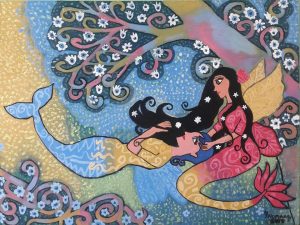
An art work by Farnaaz
Expressing gratitude to her parents, Farnaaz says, “I have memories of my parents dropping me at Gauhati Artists’ Guild, my alma mater for painting lessons, and then my parents taking me to various art competitions, and me getting a 2nd prize in an art competition organised by the Productivity Council of India when I was just a KG student.”
Many prizes have come her way in subsequent years and there has not been any looking back ever after that.
Speaking on the sidelines of the painting exhibition, Farnaaz further added, “I learnt to draw before I could speak …no matter how clichéd that sounds…it’s true… my parents encouraged me a lot. My mentors were my teachers at Gauhati Artists’ Guild, especially Debananda Ulup sir, Kishore Kumar Das sir, and Aminul Haque sir… each one of them a legend by their own merits.”
Farnaaz has in the recent past organised a solo exhibition of her paintings at the State Art Gallery Guwahati. It was Debananda Ulup who introduced her to Ashoke Roy, the founder of Bengal Art Foundation paving the way for her to make an entry in the current exhibition in Guwahati which commenced on January 9 and will continue through to January 14.
Asked about her most memorable experience, Farnaaz says, “My most memorable experience was my grooming at Gauhati Artists’ Guild… at the age of 12, I completed the Visual Arts course there. It was an awful feeling; I can’t express it in words.”
As for the future, Farnaaz wants to continue experimenting with acrylic and watercolour using various styles, and learn more and more tricks of the trade until she is able to open her own you-tube art channel.
source: http://wwwnenow.in / NorthEast Now / Home> North East News> Assam / January 12th, 2019
Each award carries Rs 1 lakh, gold medal and a citation.
Chennai :
The State government on Monday announced the names of recipients of nine awards being presented to mark the Thiruvalluvar Day celebrations.
The awardees are: Pazha Nedumaran (Kamarajar award), C Ponnaiyan (Periyar award), Soolur Kalaipithan (KAP Viswanatham award), Poet Thiyaroo (Bharathidasan award), Dr K Ganesan (Thiru.Vi.Ka award), M Bharathi Sugumaran (Bharathiyar award), M Aikkan (Perarignar Anna award) C Ramaguru (Ambedkar award), and MG Anwar Batcha(Thiruvalluvar award).
Each award carries Rs 1 lakh, gold medal and a citation. It will be presented by the Chief Minister on January 21.
source: http://www.newindianexpress.com / The New Indian Express / Home> Cities> Chennai / by Express News Service / January 15th, 2019
Amidst reports of a few women activists of a Right wing group attempting to enter forcibly the prayer hall of the Nainar Mosque (Vavar Palli) at Erumely, its management has clarified that devotees of all religion, gender and age groups can visit the mosque as part of their pilgrimage to Sabarimala.
P.H. Shajahan, president, Erumely Mahalla Muslim Jamaat, which manages the mosque, said here on Tuesday that they had not imposed any restrictions on the visit of Sabarimala devotees before or after the Supreme Court’s verdict that lifted the ban on women in the 15-50 age group from entering the Sabarimala temple.
“We have been receiving women of all age groups as visitors for a long time and the trend continues even after the recent SC verdict. There is no restriction on them entering the mosque, circumambulating it and providing offerings, as is the tradition,” he said.
A large number of Sabarimala pilgrims visit the mosque throughout the annual pilgrim season, reviving the the local myth of Lord Ayyappa’s friendship with the Muslim youth Vavar. Besides pilgrims, the location has witnessed a huge inflow of tourists, including women, who come to Erumely during the pilgrimage season. It, however, does not permit the entry of Muslim women to the prayer hall.
The other day the police had arrested six people, including three women from Tamil Nadu, while on their way to visit the mosque here. The accused were booked under various Sections, including attempts to promote animosity between different religious groups, and were remanded.
In the face of reports that some women belonging to a Right wing group would attempt to enter the prayer hall here, additional police personnel were posted here to prevent their entry to the prayer room.
source: http://www.thehindu.com / The Hindu / Home> News> States> Kerala / by Staff Reporter / Kottayam – January 08th, 2019
Fellows from the Godrej Culture Lab Leadership Programme examine the role and relevance of Urdu in contemporary culture
A poster by Nasheet Shadani
On display today at the Godrej India Culture Lab are posters with lines which might seem oddly familiar. ‘Tu vastu badi hai anandmayi anandmayi…’, reads one, and ‘Jeevan ek yatra hai mangalmayi…’ reads another. It’s not difficult, if one focuses a little and, uses a dictionary (if required) to understand these lines, and neither is it difficult to identify them as what they are — lyrics from well-known Hindi film songs, in which all the Urdu words have been replaced by Sanskrit-origin Hindi words.
Shorn of the original words, these lines present a disconcerting picture, showing us what we would lose without the Urdu words that still make up so much of our culture. And that exactly is the point being made by visual artist Nasheet Shadani in these posters, part of the series of works he calls ‘Bollywood Without Urdu’.
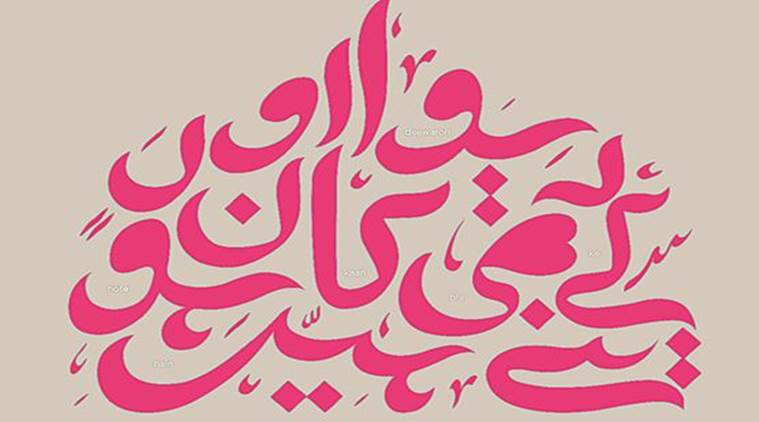
Zeenat Kulavoor’s calligraphy
These works by Shadani are being displayed as part of ‘Urdu Culture Now’, a celebration of contemporary Urdu culture. “Despite Urdu having had such a strong influence, it doesn’t seem to have much presence in Mumbai right now. We wanted to challenge this underrepresentation of the language in the city’s culture and show the different ways in which it is used in contemporary culture,” says Pallavi Khare, a student of Media and Cultural Studies at Tata Institute of Social Sciences, who is one of the curators. Khare, along with six other Humanities students from colleges across the city, is a Fellow in the first batch of the Lab’s Leadership Programme, the first of its kind in the city.
Besides, Shadani’s works, also on display will be graphic designer and typographer Zeenat Kulavoor’s contemporary takes on Arabic calligraphy. The event will also have a panel discussion on ‘Urdu Revival Through the Internet’, featuring lyricist and poet Hussain Haidry, Kulavoor, and executive editor of The Wire Urdu, Mahtab Alam. This will be followed by a Qissabaazi performance by actor and storyteller Danish Husain and an Urdu rock performance by independent musician Winit Tikoo. “There are so many misconceptions about Urdu — that it isn’t an Indian language or that it is all about this old world ‘pehle aap’ culture, and we wanted to challenge that,” says Divya Vaidya, a third year student of architecture from the School of Environment and Architecture. Also available at the event will be a specially curated collection of books by city-based library and book store, Trilogy, as well as a daawat representing Hyderabadi and Lucknowi cuisines.
For the Lab itself, an important reason for hosting the event is to give its Fellows a good grounding in what it takes to be engaged with art and culture in the city. Parmesh Shahani, who heads the Lab, explains that this falls within the larger goal of enabling more people to engage productively with the city’s, and the country’s, culture scene. He explains, “We started the leadership programme for three reasons. The first one was the need to formalise our internship. The second reason, which is more ambitious, is to create a pipeline for people who want to work in culture because in the seven years that we’ve existed, we realised that almost everyone who is currently working in culture has either stumbled onto it or somehow figured out their way in. The third reason comes from a strong impetus we have to innovate. We have a super focused calender of events, but we also try to make some innovations every year. This time, one of the innovations is this programme.”
source: http://www.indianexpress.com / The Indian Express / Home> Lifestyle / by Pooja Pillai / June 08th, 2018
The dilemma of a child who had to straddle two cultures, as distinct as Keralite and Burmese, form writer U.A. Khader’s memories of his early life.
Speaking at a session of the Leisure Programme organised by the Kozhikode Public Library and Research Centre, Khader narrated the story of his life, beginning with his time in Burma, the land of his mother and where his father worked till he was eight. He also spoke about the isolated life he led as a student in Koyilandy where other students found him strange because of his Burmese face and “big size.”
Khader, who shot to fame with his ‘Thrikkottur Peruma,’ recalled Mammumusliyar who was entrusted with teaching him the Koran. He narrated how the man who became an indelible influence in his life taught him the Arabic alphabets through pictures of animals. It was Mammumusliyar who enrolled him in the first standard of a Mappila school at the age of eight.
Khader remembered how he had to make double the effort of students whose mother tongue was Malayalam to learn its words. Other students just had to learn the alphabets ‘pa’ and ‘na’ to know it was ‘pana,’ but little Khader had to know what ‘pana’ (palm tree) meant.
Another decisive time in his life was when his grandmother died and the question of who will take custody of Khader arose. His father had married a second time and he shifted his stay to his step-mother’s residence.
He spoke about his association with former Chief Minister C.H. Mohammed Koya. It was CH who initiated him into the world of reading by gifting him Vaikom Muhammed Basheer’s ‘Balyakalasakhi.’
The audience was in splits when the writer narrated how his first story, based on a real life incident in which he sold his watch and bought a dinner set as a wedding present for a friend, was published in a totally different form. He had written quite harshly about his father and step-mother when he put the story to paper. He handed over the story to CH who published it in the Chandrika, but in a totally different form. His message to Khader was that story writing was not about writing ill of others. CH’s words “to write more and not to write if the urge is not felt; but to read a lot, including the stories of Maupassant and Anton Chekov,” still echo in his ears.
He also narrated his journey to Madras (now Chennai) to learn painting, where he got in touch with writers such as K.A. Kodungalloor.
Speaking about his masterpiece, ‘Thrikkottur Peruma,’ he said that the novel was noted because it espoused the essence of Kerala culture. Other works during that period lacked this and were also difficult to understand, he said. His next ambition was to write a novel that explores the northern Kerala Kalari system. He had been working on it for sometime but could not start writing.
The Leisure Programme is a continuing learning programme in which people who have excelled in various walks of life share their experiences and expertise in various sessions.
M.M. Basheer, literary critic, presided. Paramesharan Potti, librarian, also spoke.
source: http://www.thehindu.com / The Hindu / Home> National> Kerala / by Staff Reporter / August 11th, 2008
Samatala Village, Tarikere Taluk, Chikkamagalur District – KARNATAKA :
Tarikere, the Dean of the Languages Discipline at the Hampi Kannada University won the award for his work Kattiyanchina Daari.
The others who have been chosen for the awards are former union minister Veerendrakumar (Malayalam), Aurobindo Uzir (Bodo), Arun Sakhardande (Konkani), Gopi Narayan Pradhan (Nepali), Vanita (Punjabi), Mangat Badal (Rajasthani), Mithila Prasad Tripathi (Sanskrit), Laxman Dubey (Sindhi), Sheen Kaaf Nizam (Urdu), Bani Basu (Bengali), Esther David (English), Dhirendra Mehta (Gujarati), M Borkanya (Manipuri), Manoj (Dogri), Uday Prakash (Hindi), Nanji Nadan (Tamil), Keshada Mahanta (Assamese), Basher Bashir (Kashmiri), Ashok R Kelkar (Marathi) and Pathani Pattnaik (Oriya).
Tarikere told Deccan Herald: “I had authored this book in 2006 itself. The joy is manifold as the award comes at a time when Kannada University is celebrating the 19th ‘Nudihabba’. I dedicate the award to the university”.
source: http://www.deccanherald.com / Deccan Herald / Home> State / by New Delhi – Hospet / DHNS / December 20th, 2010
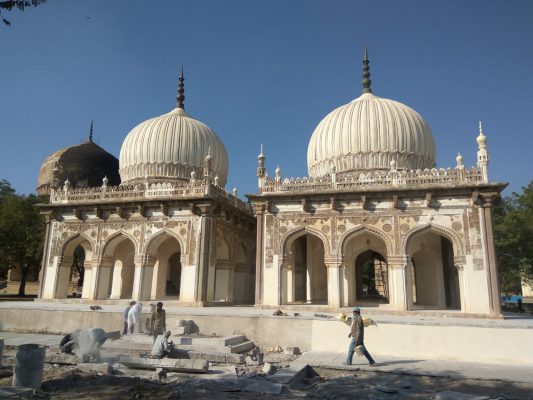
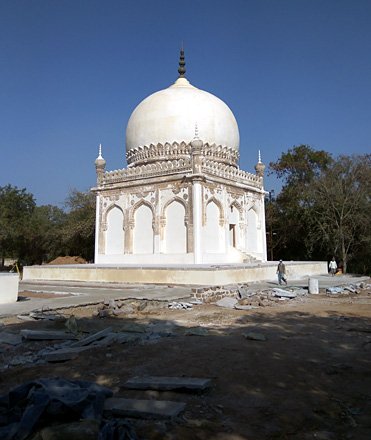
Workers giving final touches to the restoration work on Hakims’ tombs.— Photos: Mohd Azharuddin
The restoration work on Hakims’ tombs being done by the Aga Khan Trust for Culture (AKTC) is nearing completion and is expected to be thrown open for visitors soon.
Hyderabad:
A search for Hakims’ tombs in Google will take you to a monument in Pakistan! However, the little less known fact is that there are two such tombs in the heart of Hyderabad, located within the seven tombs complex.
The restoration work on Hakims’ tombs being done by Aga Khan Trust for Culture (AKTC) is nearing completion and is expected to be thrown open for visitors soon, said Ganesh Reddy, Manager Operations for AKTC.
Nizamuddin Ahmed Gilani and Abdul Gaffar Gilani were the two favourite Hakims (Doctors) of Sultan Abdullah Qutb Shah. The twin tombs were built in 1651. The Commander’s tomb, which is also next to the Hakims’ tombs, will also be opened on the same day.
Architectural marvels
All the tombs, mosques, baolis (step wells) and other monuments in the seven tombs complex are the architectural marvels of Qutb Shahi dynasty, which was established in the 16th century. The Qutb Shahi rulers, whose dynasty survived till 1687, were great builders, whose structures include Charminar, Golconda Fort and several other monuments in Hyderabad, historians here aver.
The Qutb Shahi Heritage Park served as a necropolis to the dynasty. Monarchs and other prominent nobles were buried here during the 169-year rule of Qutb Shahis. The tombs complex has 80 monuments, which include 40 mausoleums, 23 mosques, seven baolis, a hamam, pavilions, tanks, wells, garden structures and enclosure walls.
Twin tombs
It is a twin tomb structure with both the structures identical and on the same platform. The square tomb covers an area of 10.35 m x 10.35 m and follows an open pavilion plan with three arched openings on each side. Internally, these have an arcaded octagonal grave chamber roofed with a bulbous dome raised on a 16-sided drum. Dome internal ceiling is decorated with merlon bands and flower bands.
Externally, all the facades are identical and have extensive stucco decorative in the form of medallions, floral bands and panels. Each facade has merlon shaped parapet wall over the stone brackets and chajja. The dome is extensively decorated with ribs and leaf pattern band at the base. The German Consulate based in Chennai has sponsored for the conservation of Hakims’ tombs, said Yoshowant Purohit, AKTC Project Manager.
Integration of Deccan Park
The Deccan Park is seen as the ideal entrance zone to the grand complex there by creating a suitable entry point to the heritage zones wrapped by ecological and formal landscape. The infrastructure development works such as amphitheatre and parking facility were also on track.
Restoration works
In January 2013, a MoU was signed between the Department of Archaeology and Museums, now Department of Heritage Telangana, the Quli Qutb Shah Urban Development Authority, Aga Khan Foundation and the Aga Khan Trust for Culture to undertake conservation works on all monuments with a holistic landscape development of the 106-acre Qutb Shahi Heritage Park.
The Tata Trusts also pledged its support to conserve 10 major monuments. The Ministry of Tourism (Govt of India) has announced its support for the development of the landscape.
On World Heritage Day, April 18, 2018, the first phase of conservation and landscape restoration works were completed. Prominent structures conserved in Phase-1, include the mausoleum of Sultan Quli Qutb Shah, Jamshed Quli Qutb Shah, Ibrahim Quli Qutb Shah, Muhammad Quli Qutb Shah. Other structures such as Idgah, Hamam, three baolis, mosques, grave platforms, chaukhandis were also developed.
The Commander’s tomb.
Under Phase-2, conservation works are being carried out on tombs of Muhammad Qutb Shah, Hakims, Commander, Premamati, and Taramati, Hayat Bakshi Begum and great mosque, while Phase-3 will focus on the entrance zone and few other structures.
Footfall
The Aga Khan Trust for Culture will also carry conservation works on Paigah Tombs and Ashoor Khana based in the old city. Footfall at Heritage Park has increased since the opening of Phase-1. The Telangana government’s extensive focus on introducing the history of Telangana and Hyderabad in school curriculum is also attracting students of all ages to the site.
source: http://www.telanganatoday.com / Telangana Today / Home> Hyderabad / by Mohd. Azharuddin / January 02nd, 2019
Mumbai-based theatre actor and model makes his debut in Kannada films
Ashraf Khan always dreamt of being an actor. With no connection to the film industry, the task seemed an uphill journey for him. “We were exposed to a lot of classical music as my father worked as a tabla artiste with the AIR, Delhi,” explains Ashraf, who soon started accompanying his father to his concerts and was noticed by a modelling agency and bagged his first assignment. “That boosted my confidence and I took to theatre,” shares the actor, who then shifted his base to Mumbai.
But, filmdom seemed distant for Ashraf, who then started getting involved in theatre and soon established himself as an actor. That opened more doors for modelling and now he has signed a Hindi film, Mumbai Pipeline, which he says will go on floors later this month.
Ashraf is also thrilled he has bagged his first Kannada film — Laila Majnu Love Story. “The film is a modern take on the original love story. I play a villain in the film. But the character will not be seen weilding guns, chasing the heroine or driving rich cars. It is a subtle shade of grey which is manipulative and cunning in a sleek manner.”
The film is produced under the banner of Krupa Entertainment and is directed by MGR.
Will he be delivering his own dialogues or will someone dub for him? “During the shoot, I said my own dialogues. I did learn a bit of Kannada so I could understand the lines and emote better. But as I am still new to the language, I think it is better that someone dubs for me as my diction is not perfect,” says Ashraf, who adds he is open to any kind of roles. He now looks forward to working in more Kannada films as he “fell in love” with this industry.
He dreams of making his mark “in films and people’s heart. I want to be remembered for the characters I portray on screen and not just as Ashraf. Every character I depict on screen should have an impact on my audience,” he adds.
source: http://www.thehindu.com / The Hindu / Home> Entertainment> Movies / by Shilpa Sebastian R / January 02nd, 2019