Growing up in Lucknow meant chef Mujeebur Rehman heard many tales of kings, queens and the nizams.
Bengaluru :
Growing up in Lucknow meant chef Mujeebur Rehman heard many tales of kings, queens and the nizams. Since his great-grandfather worked in the royal kitchen, he also learned of the food the royals feasted on.
Many years later, we are treated to a replication of these fond memories as the chef and his team personally come down from Lucknow to give Bengalureans a taste of Awadhi food, at JW Kitchen, JW Marriott Hotel.
It’s a good thing we went on empty stomachs since the buffet didn’t seem to end. We started with soups -–Gosht Arq Shorba and Shorba Bhune Badam Ka. Both the vegetarian and non-vegetarian soups were just the right consistency – not too watery, not to thick, just perfect. What’s Awadhi food without some kebabs? Both the non-vegetarian starters – Murgh Tikka Mirza Hasnu and Galawati Kebab – were a hit. In the vegetarian variants, surprisingly, the Kale Chane Ke Asharfi shone brighter than the Paneer Tikka Achar Masala. It was, however, quite the challenge to not load our plates with just the kebabs and leave room for the rest of the dishes.
In mains, the vegetarian dishes comprised everything. However, it was the Nawabi Baigan Bhurta and Lahsunni Zeera Bhindi that stole our hearts. And made their way to our stomachs as we scooped up seconds on to our plates. Who knew the vegetables we often ignored would turn out to be our favourites?
Among the non vegetarian dishes, the Lagan Ka Murgh and Bong Zafrani Nehari were softer than imagined, each bite melting in our mouths, but not before exploding in vibrant flavours, leaving behind a tinge of a smoky aftertaste. We learn that this has more to do with the technique of cooking – slow cooking. The food is cooked on a low flame to let the flavours develop longer. The dhungar process (pouring ghee or butter over live coal and then placing a bowl of this with the dish as it cooks) gave the food a distinct rusty flavour that instantly won us over.
To conclude this royally gastronomical affair, we ended our meal on a sweet note with the Sheer Khurma and Doodh Ki Kheer. The cold kheer complemented the warm khurma well and we were left looking forward to the deep slumber only a good, satisfying meal can induce. The buffet will be served at JW Marriot Hotel, Vittal Mallya Road, till November 4, 2018. Costs: `1750 ++ for adults and `875 ++ for kids
source: http://www.newindianexpress.com / The New Indian Express / Home> Cities> Bengaluru / by Express News Service / November 02nd, 2018
Indira Iyengar’s book flounders on history, making some foundational conclusions untenable.
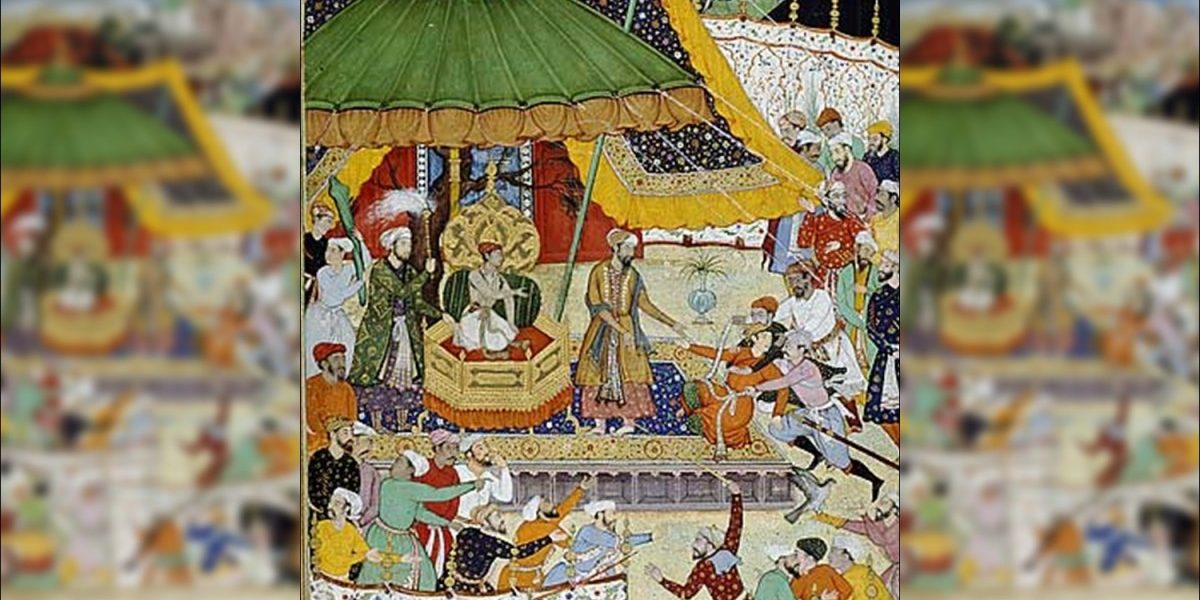
Shazi Zaman who has recently written a well-researched book on Akbar and has a detailed account of Akbar’s contact with the Europeans who visited his court, makes no mention of a Bourbon. Credit: Wikipedia
Some books need to be read because they are likely to tell you things you have always wanted to know. Some stories need to be told because they make for riveting narratives or expand your frontiers of knowledge in exciting and dramatic ways.
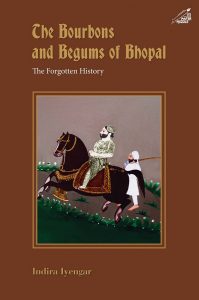
It is with such noble (and hopeful) intentions that one embarks upon The Bourbons and Begums of Bhopal: The Forgotten History despite its awkward size and substantial weight. In its size and appearance, it is is an unfortunate mix of a book with pictures and copious amounts of running text: too large to carry while travelling and not sufficiently picturesque to qualify as a coffee-table book. Its contents prove to be an awkward mix too, floundering between academic research and family lore.
The Bourbons and Begums of Bhopal: The Forgotten History Indira Iyengar, Niyogi Books Private Limited, 2018.
Indira Iyengar’s tale is part family history, part archival research and part anecdotal memoir. It opens with a disarming admission: ‘I am no historian, but I have a story to tell.’ Iyengar’s mother, Magdaline Bourbon traced her lineage to Jean Philippe de Bourbon who left his native France to arrive in Mughal India, sought and received employment in Emperor Akbar’s court, was actively involved in Akbar’s meeting with the Jesuit priests from Goa. For his services, Akbar is said to have gifted him a small principality, Shergarh near Narwar in present-day Madhya Pradesh and the sister of his Christian wife, an Armenian woman (Portuguese by some accounts) by the name of Juliana who apparently also served as a doctor in Akbar’s harem. Thus began the Bourbon line in India which spread its roots from the Mughal court to the princely state of Bhopal where the descendants of this first Bourbon eventually settled down. Being neither Muslim nor Hindu the Frenchmen were viewed as unbiased and loyal to their masters. The stories of their swashbuckling past and alleged purported ‘royal bloodline’ no doubt added to their mystique.
While Iyengar is at pains to establish her ancestor’s descent from the Bourbons of Navarre, historians are divided as to whether Jean Philipe was indeed from the royal house of Bourbon or simply a fugitive Frenchman, a mercenary who found name and fame in distant India, established a lineage and bestowed a legacy. Iyengar seems to be working on the principle that her mother’s version of the family history should suffice and she, as the custodian of that family history, is obligated to tell the story. ‘My mother’s narration of the family was also very interesting,’ Iyengar writes, ‘and I feel it needs to find a place in recorded history’. It is this assertion that proves to be problematic. For, had it been told as a colourful yarn with anecdotes and family portraits or even bits and pieces of trivia and family lore it could have been a charming story – as history it is on decidedly shaky grounds.
Also, while Iyengar’s research in the archives of the Agra Archdiocese may well establish the role of her French forefathers in various administrative capacities, it does not satisfactorily establish Jean Philippe’s link with Duke Charles III de Bourbon (1490-1527), also known as Connetable de Bourbon. The earliest account of Jean Philippe she is able to offer is by Madame Dulhan Bourbon, wife of Balthazar Bourbon; this comes in the form of a testimony made to a British general. Coming from a family member, that too as late as the late-19th century, it carries dubious weight at best. All other accounts, by missionaries, are in the nature of hearsay, urban legends that acquired veneers of half-truths with each telling. Jean Philippe himself is said to have presented a document to Jahangir in 1605 or 1606, according to Iyengar, stating that he was the son of Charles Connetable de Bourbon and that he had to flee France after arranging a mock funeral for himself. Since such a document does not exist, we can only rely on the author’s mother, Magdaline Bourbon’s memory of a ‘certain priest from Bombay’ who possessed the Bourbon family records that were subsequently ‘lost with time’. Shazi Zaman who has recently written a well-researched book on Akbar and has a detailed account of Akbar’s contact with the Europeans who visited his court, makes no mention of a Bourbon.
While Jean Philippe’s relationship with the House of Bourbon may be in dispute, Iyengar’s research in the archives of the Agra Archdiocese shows that there existed a certain Jean Philipe de Bourbon, who was married to a certain Bibi Juliana (referred to in later Jesuit accounts as Dona Juliana Dias da Costa) who helped build the first Catholic church in Agra in 1588 on land gifted by Akbar. Jean Philipe is said to have died in Agra in 1592 leaving behind two sons one of whom, according to Iyengar, was in charge of the seraglio. At the time of Nadir Shah’s invasion, the Bourbons left poor, ravaged Delhi and the clan, by now comprising 300 men and women, sought refuge in the family estate in Shergarh and thence began the southern sojourn of Jean Philippe’s descendents. Mamola Bai, the first woman ruler of Bhopal, offered Salvador Bourbon the position of general in the Bhopal state army. Salvador married a certain Miss Thome and the family then embarked on a long innings serving as confidantes, generals, even Prime Ministers to the Bgeums of Bhopal.
Already carrying two names, a European and a Muslim one, the Bourbons began to wear Bhopali dress and live like the local nobility. However, the fleur de lis in their coat of arms never failed to remind them and their local patrons of their royal past in distant France.
Rakshanda Jalil is a writer, translator and literary historian.
source: http://www.thewire.in / The Wire / Home> Books / by Rakshanda Jalil / October 05th, 2018
Serials produced by Lucknow Doordarshan were considered to be the best. Our serials like ‘Neem Ka Ped’, ‘Bibi Natiyon Wali’, ‘Bandhuji’, ‘Akkad Bakkad’ and ‘Hatimtai’ won national awards. ‘Bibi Natiyon Wali’ was praised internationally as well.
It started with the beaming of Ustad Bismillah Khan’s shehnai recitation on November 27,1975. Doordarshan Lucknow begun operations at 22 Ashok Marg, with a temporary studio. Today, at 43, the television channel is going strong with programmes like ‘Namaste UP’, ‘Once more’ and ‘Krishi Darshan’ — all of which have good ratings.
“The building of Doordarshan studio at Ashok Marg is a witness to many historical programmes,” said senior programme executive and deputy director, Lucknow Doordarshan, AP Mishra.
“We can proudly say that serials produced by Lucknow Doordarshan were considered to be the best. Our serials like ‘Neem Ka Ped’, ‘Bibi Natiyon Wali’, ‘Bandhuji’, ‘Akkad Bakkad’ and ‘Hatimtai’ won national awards. ‘Bibi Natiyon Wali’ was praised internationally as well,” he said.
Recalling the talent nurtured by the channel, Mishra said, “The old faces of Lucknow Doordarshan, such as Shobhna Jagdish (news reader) and Nirmala Kumari were very good singers. In fact, they were trained classical singers!”
“The popularity of veteran journalist and news reader Mohammed Noor Baksh and Naresh Srivastava was no less than that of cine stars of the eighties. Both of them are no more, but their legacy continues,” he added.
Former director Vilayat Jafri, who has worked with Lucknow Doordarshan and writtenthe serial ‘Neem Ka Ped’ for it, said, “I came from Delhi to Lucknow in 1986. In Delhi, I had made projects like ‘Bharat Ek Khoj’ (directed by Shyam Benegal) and ‘Tamas’ (by Govind Nihlani). In Lucknow, serials were not being made. I decided to do something for the city — something that could be remembered for long. I had written this story in 1956 (Neem Ka Ped), and decided to make a serial based on it.”
He said he contacted Dr Rahi Masoom Raza for working on the serial’s script and dialogues. “He (Raza) agreed. He wrote the dialogues without charging a single penny because the story was close to his heart — it was about a ‘zamindar’ (landowner) and his people . Dr Raza came from a family of zamindars of Ghazipur, so he was able to understand the subject better than others,” said Jafri.
However, Dr Raza died after writing 24 episodes of the serial. “After that, I decided to pen the dialogues for the next 34 episodes. Interestingly, no one noticed any difference in the writing style. People thought Dr Raza died after completing the serial,” he said.
Mishra said ‘Neem Ka Ped’ is a part of Doordarshan’s glorious past and is still one of the most watched serials ever. “All artists except two were from Lucknow. Doordarshan is still the best medium to promote local talent,” he said.
In the years gone by, Doordarshan went through its own journey of evolution. The channel, which started in black and white, became coloured on August 15, 1982, during the then Asian Games. The first coloured OB van, equipped with four coloured cameras, was introduced in 1987, during the Cricket World Cup (Reliance Cup).
“Today, despite stiff competition from private channels, ‘Namaste UP’ and ‘Once More’ by Lucknow Doordarshan are among top-rated programmes,” said Mishra, adding that DD had also succeeded in maintaining its unique identity, especially when it came to programmes that created awareness on culture, heritage, literature and knowledge.
“Programmes like ‘Vigyan Se Dhyan’ have recorded the highest number of hits on YouTube,” he said.
source: http://www.hindustantimes.com / Hindustan Times / Home> Lucknow / by Anupam Srivastava / Hindustan Times,Lucknow / November 28th, 2018
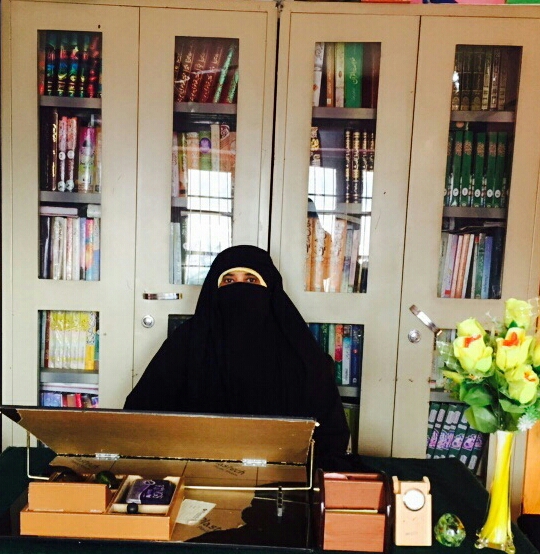
Dr Mubeena Ramza, head of Ansar-un-nissa’ a soio religious organisation (Photo: Auqib Javeed/ TwoCircles.net)
Dr Mubeena Ramzan of Kashmir created history earlier this month when she became the first Kashmiri woman to be enlisted among the 500 most influential personalities in the Muslim world. The list was released by The Royal Islamic Strategic Studies Centre, an independent research entity affiliated with the Royal Aal al-Bayt Institute for Islamic Thought.
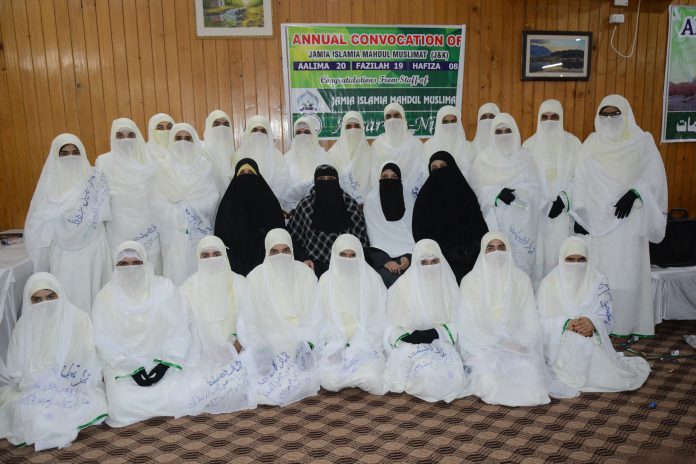
The list named Dr. Mubeena from North Kashmir’s Sopore as one among the world’s most influential persons. Dr Mubeena heads the women-only socio-religious organization ‘Ansar-un-Nissa’ and is the Rector of ‘Jamia Islamia Mahdul Muslimat’, which has its branches in Sopore (Baramulla), Baghat (Srinagar) and Sumbal (Bandipora) under the aegis of a registered public trust namely ‘Mahdul Muslimat Educational Trust’ in Kashmir. Dr Mubeena travels extensively across the valley for women’s rights and ensure that women suffering from domestic violence are provided “a vent”. In an exclusive interview with TwoCircles.net, Dr Mubeena talks about her activism, journey and her views regarding role of women in conflict-torn state.
Here are the experts
Could you please tell us a little about yourself?
I was born in Sopore of District Baramulla and had my initial schooling from Islamia High School, Sopore where we were taught Islamiyat, Arabic and Hindi, which broadened our thought process.
Students of the madarsa run by Dr. Mubeena (Photo: Auqib Javeed/ TwoCircles.net)
After pursuing Bachelor’s degree in Islamic Studies, Education, Political Science and Philosophy from Islamia College, Sopore. After that, I completed my B.Ed, Masters degree and Research from University of Kashmir (KU). During my Research in Kashmir University, I had specialised in Islamic Law, Jurisprudence (Fiqh) and Orientalism.
Besides all this, I had learned Islamic Sciences from Hazrat Mufti Muzaffar Hussain Qasimi Sahab, Head Mufti, Darul-ul-Uloom Sopore.
When did the idea of setting up your own institute for women come to your mind and why?
As a scholar, my research on Kashmiri Society and its social evils had made me realise that I must play an active part in mitigating the crisis. The very idea motivated me to quit lectureship in a B.Ed college in Kupwara and started Jamia Islamia Mahdul Muslimat under the aegis of Mahdul Muslimat Educational Trust in 2002, from a rented building in Sopore and took us eight years to purchase a land and built a proper girls-only seminary-cum-skill school there.
The objective was to inculcate education with Islamic integration and impart skills among women. We started another branch in Baghat area of Srinagar city and recently, opened another campus at Sumbal-Hajin area of Bandipora district.
What do you teach to your students?
Jamia Islamia Mahdul Muslimat is a seminary-style girls only institute where besides teaching of religious text we impart worldly education also. But main thrust is on religious scriptures like Quranic exegesis, science of Hadith, Jurisprudence and History.
We also teach languages viz, Arabic, English, Urdu and train them in the field of Computers, Cutting & Designing skills to help them become competent and self-reliant.
Tell us about this institute and your journey with it?
We empower our students through education and skills, which boosts their confidence to face different realities of life. I believe that training a girl on these parameters was not possible by mere religious sermons, debates, seminars, etc.
We had to upgrade our religious syllabus on modern lines to make our girl students relevant to the contemporary society. We believe in natural upbringing of students, especially girl. We understand it well that apart from education and shelter, orphans also need motherly love and care. While we try to provide that, we also counsel and guide them regarding their future. This is what our Institute Jamia Islamia Mahdul Muslimat provides.
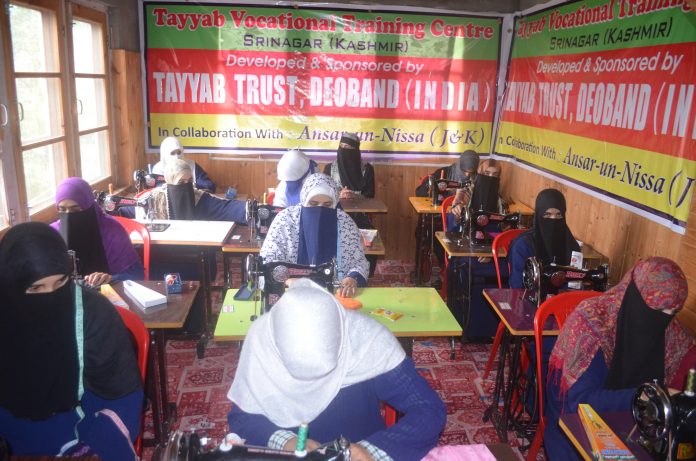
In 2013, we called a meet of women from different walks of the life-around 100 of them-in Sopore where we decided to have some welfare initiatives among women. And as a result, in March 2014, we floated “Ansar-un-Nissa”, a women welfare body which provides a helping hand to the needy, would-be brides, widows, orphans, and also establishes vocational training centres.
What challenges do you face during your activism in a society that can be patriarchal?
When it comes to a woman who observes Hijab, challenges are tremendous. Women now-a-days is sandwiched between two extremes – Religious and Western. A man is called qawwam in Quran, which means head / protector / sustainers of the family but this status has been misused by some by enslaving women.
I was opposed by so-called Moulvis for starting girls only seminary style institute (Madrassa) as it was in their mind how come a female run a Madrassa. But Alhamdulillah, now their perception has changed as we are successfully running three branches now.
The need of the hour is to have a very balanced approach where woman and man both would take care of their roles and responsibilities. Men and Women are equal, but not similar.
Reportedly, you were associated with Dukhtaran-e-Millat (DeM) of Aasiya Andrabi and later on due to some differences you left from the organisation. What were the differences?
Yes, I was associated with the organisation till 2004. Later on the differences grew with the organization for it being more into political spectrum. I left the organization as I wanted to do activism on academic parameters and started academic activism among women folk.
Do you think there are need for more Muslim women scholars in Kashmir?
Obviously, yes. In the rest of the Muslim world, we have good number of women Islamic Scholars but in Kashmir we are lacking them. We need more and more women scholars in Kashmir in order to educate common women-folk.
You must be knowing that in Ottomans Empire, 40% of contribution to Bait-al-Mal (House of money) was by the women and the oldest degree-granting university in the world i.e., Al-Qarawiyyin University was founded by Fatima al-Fihri, a women.
Women have been the pioneers of the education from the beginning of the Muslim society which is evident from the fact that a great major of Ahadiths (sayings of the Prophet, saws) are quoted by none other than his wife, Hazart Ayesha Siddiqa (r.a).
You have conducted various religious gatherings in different parts of the valley.
What draws you to that endeavour?
There are many issues related to women where she needs to be educated in right perspective. People often gossip about four wives, but no one thinks about having four daughters. Even a mother’s face turn pale now-a-days on the birth of a girl child.
The experiences which I gained after travelling throughout the Valley and beyond it for conduct of various religious gatherings are quite astonishing and still prevalent in this century. Most of the daughters and sisters are being debarred from the property / inheritance while Islam and Islamic law have given them a Right to Inheritance. Remarriage, Widow Marriage is still considered something evil in this Kashmir.
Daughters, Sisters, Wives are being forced to work outside for earnings and height of the things are that now-a-days it is difficult for an unemployed girl to get a suitable match as most mothers prefer to have employed daughter-in-law.
The hadiths of the Prophet (peace and blessing be upon him) about raising girls are beautiful and amazing. Girl children come with great rewards and blessings. If you offer care, love, support and education to your girl child, Paradise awaits you.
At a time when baby girls were deemed a source of shame, even buried alive, the Prophet (peace and blessing be upon him) came to rectify this grave wrong. The Prophet (peace and blessing be upon him) said: If anyone has a female child, and does not bury her alive, or slight her, or prefer his male children to her, Allah will bring him into Paradise. (Ahmad). On one other occasion, The Prophet (peace and blessing be upon him) said, “Whoever supports two girls till they attain maturity, he and I will come on the Day of Resurrection (close to each other) like this –The Messenger of Allah (peace and blessing be upon him) joined his fingers to illustrate closeness.” (Muslim)
These are just examples of how Islam cared for the girl children. The care mentioned in these hadiths and others is comprehensive. It covers the girls’ physical, emotional and mental needs. Such is the care and affection that our daughters deserve. The Prophet (peace and blessings be upon him) commands us to be loving, patient and supportive parents.
You were recently listed as one among the most influential 500 personalities in the Muslim world. Do you have any comments on your selection?
I came to know through my husband about it and I believe that real action and delight comes from helping your people grow. But yes, if your welfare activism is being recognised in any way, it does boost you.
Do you have any personal Muslim women heroes you would like to mention?
Not Hero, but inspiration. Maryam Jameela is one in this regard. She was brought up in a modern society but did not get getting influenced by it. On the contrary, she was able to influence and inspire people with her thought. Yvonne Ridley is other one.
Dr. Mubeena Ramza with her students at the convocation in Srinnagar (Photo: Auqib Javeed/ TwoCircles.net)
Do you have any messages for young Kashmiri Women?
As Muslims, they should believe that their rights, duties and status are justified. They don’t need any westerner or any ragtag activist to tell them their rights as a woman. Those who are rallying behind it are knowingly and unknowingly attempting to overlook the dignified status and rights given to women by their religion.
Islam invites you to a mission based on obedience to Allah and Islam addresses person’s spirit, emotions, belief, etc. West is dragging women from homes, only to fulfil economic and materialistic objectives. It’s intended to commercialize things but Islam gives dignity and status while addressing the soul.
There are some jobs in the field of Education and Health and other suitable fields, where women have a primary role. However, in choosing any job, your home should be your preference. Your family should not suffer at the cost of earning. People in Kashmir nowadays prefer earnings over other things which need to be discouraged.
Almighty Allah says in the Qur’an …..“For Muslim men and women, for believing men and women, for devout men and women, for true men and women, for men and women who are patient and constant, for men and women who humble themselves, for men and women who give in charity, for men and women who fast, for men and women who guard their chastity, and for men and women who engage much in Allah’s praise, for them has Allah prepared forgiveness and great reward” (Al-Ahzab 33:35)
source: http://www.twocircles.net / TwoCircles.net / Home> Indian Muslim> Lead Story> Women / by Auqib Javeed, Twocircles.net / November 30th, 2018
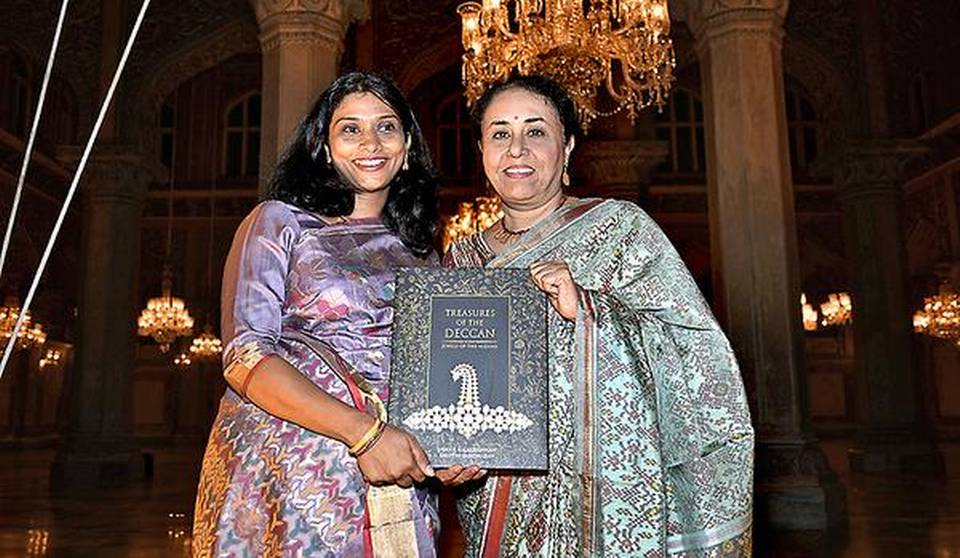
Deepthi Sashidharan and Usha Bala Krishnan releasing a book on Nizam’s jewellery at Chowmohalla Palace on Thursday. | Photo Credit: G_RAMAKRISHNA
Treasures of the Deccan – Jewels of the Nizam released
Princess Esra lent a royal touch to the release of the Treasures of the Deccan – Jewels of the Nizam in Hyderabad’s Chowmahalla Palace on Thursday evening. “I can imagine Alexander Jacob walk into this very same Chowmahalla Palace holding in his hand the 184.5 carat diamond and climb the stairs to meet the Sixth Nizam Mahbub Ali Khan,” said Usha Bala Krishnan, who has co-authored the two-volume work with Deepthi Sashidharan.
The book documents the fabulous collection of the Nizam’s Jewellery, some of which is currently locked up in vaults of banks, while other pieces are in private collections.
The authors made a short presentation about how the book has evolved.
“Earlier, I worked on the Jewels of the Nizam which was more in the nature of a catalogue.
Launching this book in Hyderabad is special, as the jewellery has a special, almost metaphysical, connection to this place,” said Ms. Krishnan who is a well-known historian of jewellery and was commissioned by the Central Government before the jewels of Nizam were put on display in Hyderabad’s Salar Jung Museum in 2001.
“Matching some of the black-and-white photographs with the jewellery that the royalty was wearing at that time was an a-ha moment.
We discovered the jewels in private collection as well as what is known as Nizam’s Jewellery,” said Deepthi Sasidharan who trawled through a vast collection photographs to bring alive the story of Nizam’s jewellery.
source: http://www.thehindu.com / The Hindu / Home> News> States> Telangana / by Special Correspondent / Hyderabad – November 30th, 2018
Former Director General Central Council for Research in Unani Medicine (CCRUM) Dr Mohammed Khalid Siddiqui has been selected for Life Time Achievement Award on the occasion of World Urdu Day. World Urdu day is celebrated every year on November 9 on the occasion of the birth anniversary of the poet of the east Dr Allama Iqbal by Urdu Development Organisation and United Muslim of India.
This year the function will be held at Ghalib Academy. The programme will be presided over by veteran journalist Jalaluddin Aslam.
National convener World Urdu Day Dr Syed Ahmed Khan told that those who have been selected for the award are Dr Azizullah Sheerani for Munshi Prem Chand Award for constructive literature, Moin Shadab Delhi for Hafeez Meerathi Award for poetry, Dr Razaur Rahman Aakif Sumbhuli for Maulana Ismail Meerathi award for children’s literature and Dr Imran Andaleeb for Qazi Adeel Abbasi award for literature.
source: http://www.siasat.com / The Siasat Daily / Home> India> News / by Rasia Hashmi / September 24th, 2018
Alipura Village (near Gauribidanaur &, Bengaluru, KARNATAKA :
It was the most uplifting experience of their lives. Two young Muslim couples from Alipura village near Gauribidanur in Karnataka got married in a helicopter yesterday, thereby creating a first of sorts. “It was a combination of the two best experiences of my life: getting married and flying in the air,” said Zameen Abbas, one of the two bridegrooms, after he returned to the ground. The two teenage brides had to content themselves with just watching the whole show from terra firma.
Alipura is actually a small village with a large Muslim population. Most of its residents had never even seen a flying vehicle of any kind, even at election time when politicians like S Bangarappa zip around merrily in choppers. So the drama unfolding before their eyes brought out a record turnout from all the surrounding areas, and gave captain Jayanth Pooviah a few unpleasant moments as he tried to navigate around spectators.
The whole project was thought up by Abbas’s elder brother Kareem, a chilly wholesaler of Alipura. Kareem’s grandfather had had an elephant brought into Alipura for his wedding half a century ago, and had been known ever since as ‘Aane Sahibru’ (lord of the elephants.)
The story goes, in the village, that so many other young bridegrooms demanded the same pachyderm procession for their weddings that the original elephant, which Kareem’s grandfather had brought from Mysore, permanently made its home in Alipura!
Kareem himself had an elephant procession to mark his marriage some time ago. However, he decided that it was time his family created history again, and so he came up with this novel idea to mark the joint celebration of the marriages of his brother and sister. He approached Deccan Aviation, an aircraft charter firm in Bangalore that frequently advertises its availability for offbeat uses of this kind.
“When he first came to me some months ago, I thought that he was playing a practical joke on me,” says Vijay Athreye, general manager of Deccan Aviation. “Still, I told him to pick a Sunday as we are a little freer on that day and could offer him a better price. Sure enough, he came back a fortnight ago with a serious offer and the marriage date of December 13. Our rate per hour is over Rs 50,000. But when we realised that he genuinely could not afford that price, we cut our rates down by almost half.”
Kareem finally got himself a deal at Rs 30,000 for what took almost two hours. He was to report at the Jakkur helipad of Deccan Aviation before 1500 hours on Sunday, December 13, ready for take-off.
The aviation company promptly informed the local media, and even asked Kareem to accommodate a couple of television reporters on the helicopter, which was to fly almost empty to Alipura. An excited Kareem, turned out neatly in a shiny, new suit, clutching a plastic bag full of jasmines in his sweating hands, agreed readily.
A representative of the aviation company went to Alipura a few days earlier, marked out space for a helipad and had the area cleared by enthusiastic villagers. The local police were also informed, and asked to cordon off the helipad. As the chopper descended, Kareem scattered jasmines over the heads of the waiting marriage party and spectators. The helicopter came down with aplomb and was examined carefully by waiting villagers for a half hour as its engine had to cool off before the next flight. Rest time over, the maulvis, the two bridegrooms the fathers of the brides all crowded into the aircraft and took off into the air.
Pooviah circled the village carefully, in full view of the assembly, as the maulvis recited their prayers and conducted the wedding ceremony. “I could not really see what they were doing as I was too busy flying carefully,” he said later, talking to Rediff On The NeT. “I have flown a birthday party in the air some months ago, but this ceremony was so fascinating that it really took the cake!”
Wedding over, he circled the village a little more to allow the bridal party to enjoy the scenery and then brought them back to earth.
A grand wedding spread of biryani and sweets followed. “I have never seen anything like this,” remarked Abdul J, an elderly bystander. “How much did it all cost? Kareem told us that it was almost Rs 100,000.” Added another spectator: “Some more of us might like to repeat this exercise for weddings in our family, you see…”
A stony-faced Pooviah, who had already been sworn to secrecy by Kareem, made some non-committal noises. The women in purdah,who were clustered in a group nearby, took in the unfolding drama from a discreet distance, and the two brides refused to face the television cameras without their veils. The stuttering bridegrooms gasped out a few excited reactions. And then it was time to leave, at least for the two newly married couples and the helicopter.
The ecstatic couples boarded the craft along with aviation company Managing Director C R Gopinath and Pooviah. As they took the half hour trip back to Bangalore, Gopinath urged the veiled brides to look out of the chopper and see the passing scenery, a suggestion that they accepted with alacrity. It was over all too soon for them.
Pooviah gave them a further small aerial tour of the parts of the city close to Jakkur and then returned to his helipad. The young couples alighted quickly and were whisked into a waiting car, which took them off to spend their wedding night in a five-star hotel. However, when this Rediff On The NeT tried to contact them at the hotel later in the evening for a more leisurely chat, the hotel staff said that no such couples were registered with them!
Gopinath and Pooviah sat back in their comfortable office, sipping cups of hot sweet tea to make up for the wedding repast that they had had to forego, and talking to returning journalists, most of whom took local buses back to Bangalore.
The words of the modest, simply dressed Kareem, spoken a few hours earlier, still hung in the air. “Why should only the affluent jetsetters have experiences like this?” he had asked. “Ordinary people like us should also prove that it is possible for us to make our dreams come true.”
source: http://www.rediff.com / rediff.com / Home> News> Report / by M D Ritti – Bangalore / December 14th, 1998
Guma, North 24 Parganas, WEST BENGAL / Mumbai, MAHARASHTRA :
His popular songs include My Name is Lakhan, Mere Do Anmol Ratan and Aap Ke Aa Jane Se.
Mohammed Aziz/Facebook
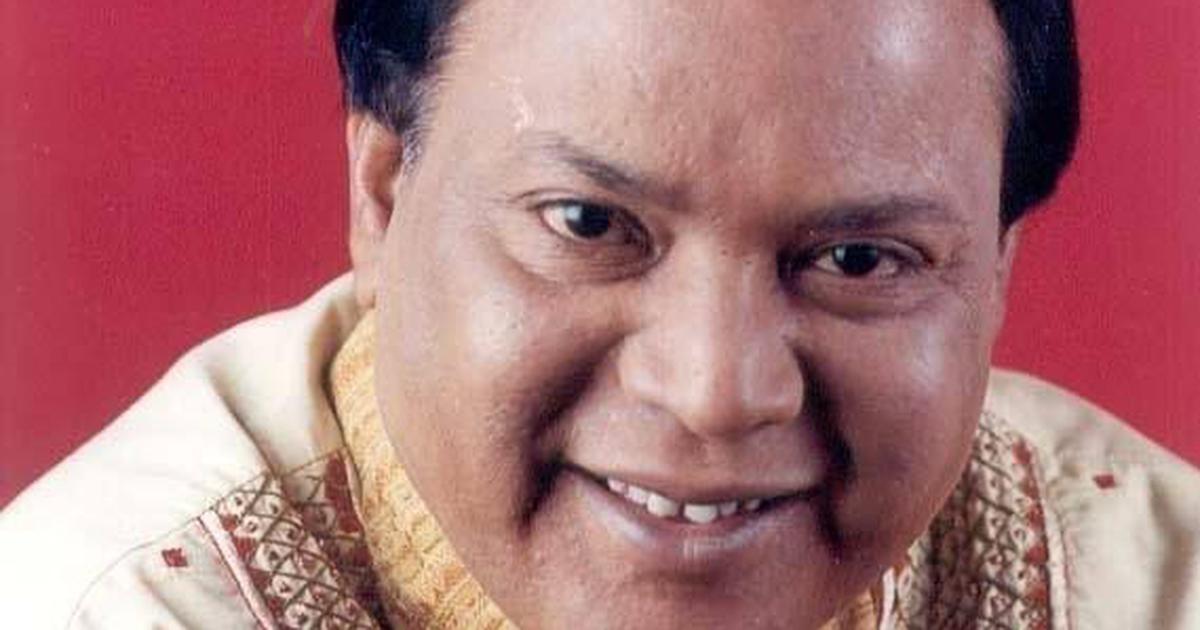
Playback singer Mohammed Aziz died in Mumbai on Tuesday after suffering a cardiac arrest. He was 64.
The singer’s daughter Sana Aziz said he had collapsed at the Mumbai airport while returning from Kolkata where he had performed at a show, reported The Indian Express. He died at Mumbai’s Nanavati Hospital.
Aziz made his singing debut in Bengali film Jyoti. He got a big break when Anu Malik offered him the chance to sing a song for Mard (1985)starring Amitabh Bachchan.
Aziz had been a part of the music industry for over three decades and worked as a playback singer in Bollywood, Odia and Bengali movies. His popular songs include My Name is Lakhan, Mere Do Anmol Ratan, Aap Ke Aa Jane Se, Main Teri Mohabbat Main and Dil Le Gayi Teri Bindiya.
Aziz frequently worked with music directors Laxmikant-Pyarelal, RD Burman, and Anu Malik.
source: http://www.scroll.in / Scroll.in / Home> The Latest> Passing On / by Scroll Staff / November 27th, 2018
With possibly the largest collection of Malayalam film prints, Poonam Rahim played a vital role in Kerala’s unique film distribution market
For those of us who grew up in the 70s and 80s, POONAM RAHIM 16 MM (and a telephone number) was a familiar sight, blazing out from all imaginable surfaces.
It was seen on crumbled walls, electric posts, sides of KSRTC buses and even on heaps of waste. And no one knew what the words meant.
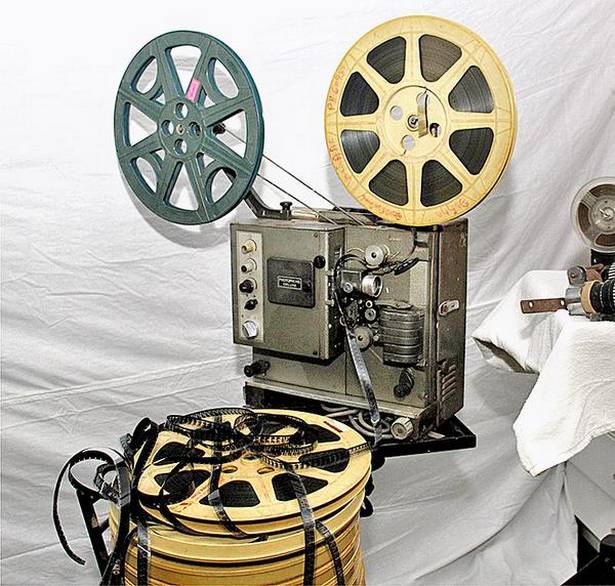
Until they saw a 16 mm film screening at their local festival ground. The projector spluttering the light beam, which carried the images of Prem Nazir and Sheela and Sathyan and Sarada on to the white cloth stretched out in front. The name appeared on the print, ‘Contact Poonam Rahim for 16 mm projectors and film screening.’
It will not be hyperbole to say that it was Poonam Rahim, the Cinema Man of Thrissur, who brought cinema out into the open ground from the confines of the theatres. The 16 mm revolution that he had sparked off in Kerala during the 1970s created a unique distributing market for the films that is still very much alive. And, down the years, Rahim has become the owner of one of the largest collections of Malayalam film prints.
______________________________
Unique advertisement
For advertisement- the stencil images- Rahim used to employ a team of four persons. They would travel on a jeep seeking out the dirtiest corners and junk heaps for painting the stencils. And the logic – “No one would bother to overwrite in such corners!”
It was those stenciled ads which established his 16 mm projectors in the mindscape of Malayalis, Rahim believes.
______________________________
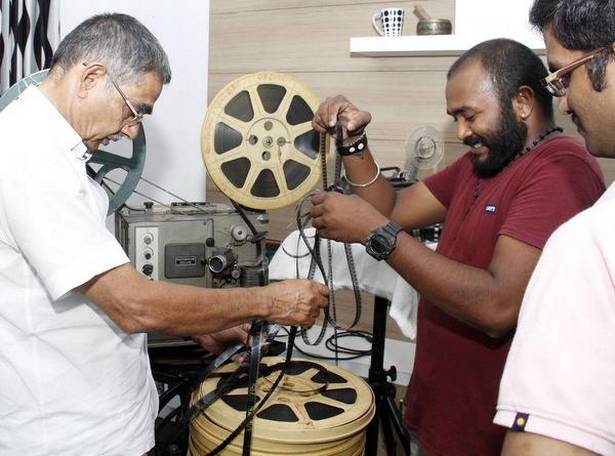
More than 400 original prints are stacked up along the shelves in his storehouse in Thrissur. Researchers on Malayalam cinema seek him out. Those who want to screen footage from the old black and white films also approach him. He provides footage of old films to be used in the production of new movies, like in Blessy’s Mammotty-starrer Kazhcha, that told the story of a 16 mm film operator.
And he can rattle off the complete history of Malayalam film industry right from the 60s in a jiffy. No wonder, as he was smitten by the film bug at a very young age.
Born in Kattoor, near Irinjalakuda in Thrissur district, Rahim’s school days were mostly spent lapping up the latest films that were released in Irinjalakuda’s two theatres – Pioneer and Konni. As his academic records plunged, the familypacked him off to his father who was running a provision store in Bhilai.
Rahim soon realised that he was not cut out to run a provision store. The world of films drew him on. And in no time the young boy formed a tie-up with the local distributor of Malayalam films. KT Abdulla was a relative of the famed producer TK Pareekutty of Chandrathara Films.
At first, the boy took the film boxes to cities like Korba, Chappa, Bilaspur, Jagdishpur and so on. Soon he started direct distribution rather than pay rent to Abdulla. And he named his enterprise as ‘Poonam Films.’ It was a random pick, as ‘Poonam’ was a popular name in North India.
As his very orthodox father never approved of cinema, Rahim was almost thrown out of the provision store.Rahim took a train to Chennai, the film capital of south India, armed only with the address of Bharat Film Corporation, one of the largest film distribution companies there. He had found the address on the film boxes.
Chennai did not open too many doors.
_____________________________
Chase Films
In the 1900s, continuity of action across successive shots was achieved and the first close-up shot was introduced.Most films of this period were what came to be called “chase films.” The first feature length multi-reel film was a 1906 Australian production.
____________________________
Then Rahim had that life changing encounter, with a Marwari film distributor who offered the print and distribution rights in Kerala of Arappavan, the Sathyan-starrer Malayalam film directed by K Shankar. Paying ₹ 2,000 for the print and six posters along with the distribution rights for Kerala, Rahim boarded the train to Thrissur, where he had no contacts. Within no time, Rahim opened his office in Everest Hotel, which was a kind of hub for film distributors. Most of the rooms in that hotel were, however, rented by Kathaprasangam artistes, Rahim noticed, who would be camping there during their December – March season.
“Kathaprasangam artistes were stars in those days. Even average performers had a rate of ₹700 per show, while for stars like Aryad Gopi, it was ₹1000. I’d get a commission of ₹50.” Soon he became a full-fledged agent for Kathaprasangam.
Kathaprasangam quickly gave way to professional drama. “Drama was in high demand and the companies could not meet the demand. Often I’d to arrange two shows of the same play on the same day in different venues. Suppose the first show started at 8 pm, the second show would be scheduled at 10 pm. Naturally, the second show would be delayed as the troupe took time to travel. However, people would wait patiently as this was the only source entertainment available and was a big event. But we needed a stop-gap entertainment.”
It was into this vacant lot that Rahim brought in the film screenings. He offered free film screenings, which made both the organisers and the audience happy. Soon, Rahim purchased his first set of projectors. Janakshakti Films, a people’s venture into film production that had Left leanings, was on the verge of closing down and Rahim bought out their three projectors and 11 film prints for ₹30,000. The films included John Abraham’s Agraharathil Kazhuthai, PA Bakker’s Kabaninadi Chuvannappol, Ekakini, and some commercial hits like Kalliyankattu Neeli, and Ramanan.
Rahim used commercial hits for the festival grounds. Horror stories like that of Neeli, and the sentimental ones like Ramanan were big hits with the women. At a time when going to the theatre was a costly affair , these free screenings were quite successful. As the demand for the film screenings started to outdo that of drama, Rahim began to charge.
“Soon some 106 film operators sprang up all over Kerala. We would rent out prints to them, besides holding our own screenings. With the profits, I’d buy the next print,” Rahim recalled.
Slowly the nature of the entertainment industry changed. But Rahim was far-sighted and stepped in with the changing times. He started renting out the projectors, moving from 16 mm to overhead projectors and to LCD projectors, running one of Kerala’s leading projector rentals. He works with major festivals including the International Theatre Festival of Kerala (ITFoK).
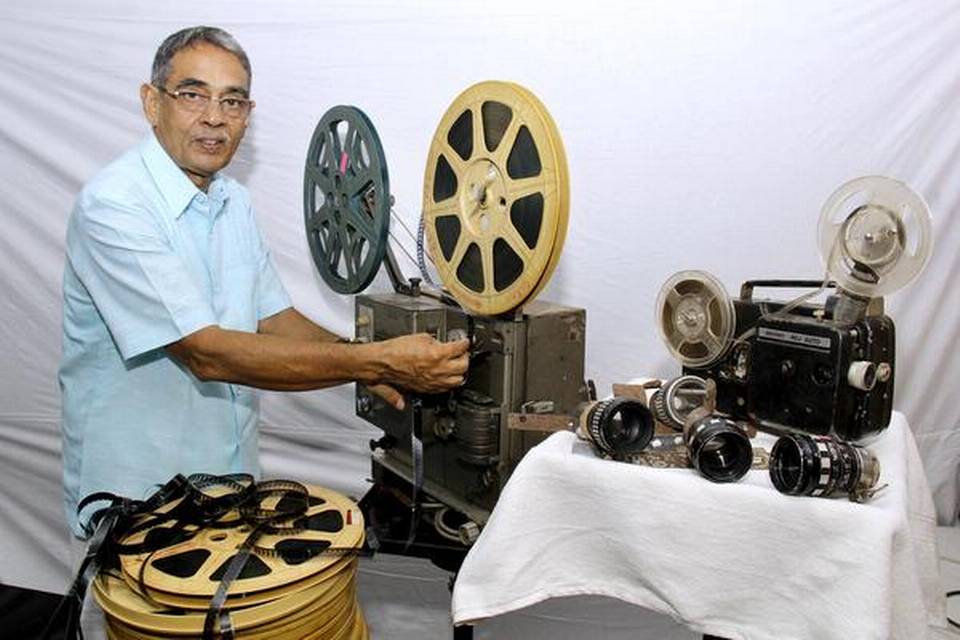
At his Thrissur home is his precious collection of the projectors and various related equipment that Rahim takes out only for the benefit of the researchers. The rare collection of more than 400 film prints line up the shelves. “The last print I collected was that of Manassinakkare, he points out. And he does not have a website, or Facebook page. “People who need me, come in search of me,” says the 68-year-old quite confidently.
source: http://www.thehindu.com / The Hindu / Home> Entertainment> Movies / by Reun Ramanath / November 24th, 2018
The Paigah Tombs not only symbolise the nobility’s love for magnificient edifices but also represent different styles of architecture.
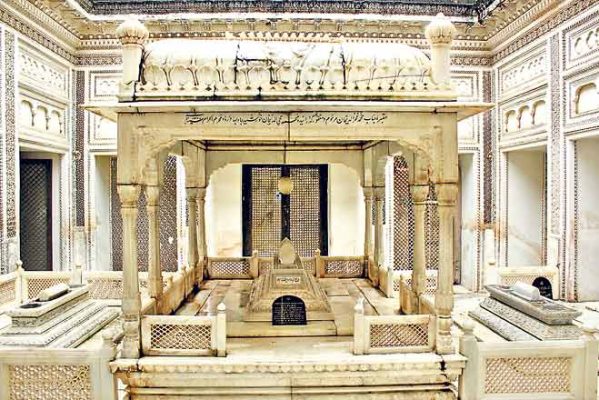
Tucked away in the quiet bylanes of the Phisal Banda suburb near Owaisi Hospital, Santosh Nagar, is an architectural marvel, a serene mausoleum which is the final resting abode of erstwhile Hyderabad’s celebrated nobility – The Paigahs. The word Paigah, which means pomp and rank in Persian, was a title given by the second Asaf Jahi Nizam of Hyderabad to the estate of Abul Fateh Khan Taig Jung Bahadur in appreciation of the royal services rendered by him. He was also conferred with the title of Shams-ul-Umra, which gives the tombs their name.
Although the Paigahs were noted and rewarded for their contribution as army officers, ministers and aristocrats, Sir Viqar-ul-Umra is popularly remembered as the man behind one of the finest masterpieces of Hyderabadi architecture – the Falaknuma Palace. Legend has it that the 6th Nizam Mahboob Ali Khan loved the palace so much that Viqar-ul-Umra gifted it to him.
One such masterpiece symbolising the Paigahs’ love for architectural edifices are the Paigah Tombs. The spectacular beauty of the mausoleum is said to have earned it a title of the Taj Mahal of South India among connoisseurs of art and architecture. The Paigah Tombs also include a mosque where prayers are held every day.
The Paigah Tombs were constructed in the late 17th century, and later it was made a family maqbara by his son Fakhruddin Khan Amir-e-Kabir – I. Later, some additions were also made by Sir Viqar-ul-Umra, Sir Asman Jah and Sir Khurshid Jah. The tombs are magnificent structures decorated in stucco work and represented the Mughal, Greek, Persian, Asaf Jahi, Rajasthani and Deccani style of architectures.
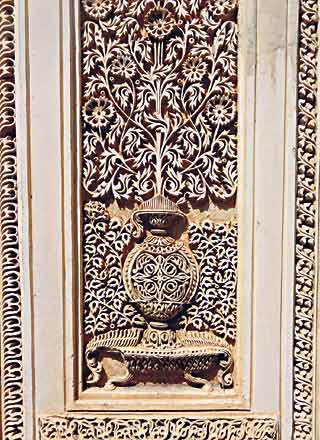
The geometric designs in the Paigah Tombs are unique and the perforated screens are examples of the finest craftsmanship. Some screens have flowers and motifs of fruits; others have serpents, drums, and vases.
There is a great amount of effort put into the detailing of the walls, arches, pillars and even of the graves. Floral and geometric patterns are characteristic of medieval Islamic architecture.
The most striking element of the Paigah Tombs is the intricately carved teakwood doors as entrance to each tomb. The carving of the doors is so fine and so regal it only makes one wonder the way art was encouraged and appreciated in the Asaf Jahi era.
The tomb of wife of Khursheed Jah is the most beautiful of the tombs with exquisite marble inlay work. One can still see the hollows in the marble carvings where precious gems were once encrusted on the grave.
Nawab Bashir-ud-Daulah’s grave stands out with a beautifully carved marble chowkhandi which is adorned by a carved mysterious green stone. Legend has it that the lighting doesn’t strike the place where it is placed.
The Paigah Tombs are under the care of the Department of Archaeology and Museums. As one of the most marvellous symbols of Hyderabad’s rich culture and royal heritage, the Paigah Tombs deserve nothing less than the government’s attention to ensure that it is not just preserved and valued but also promoted and highlighted.
Historian Dr Anand Raj Varma says, “I don’t see much improvement and restoration taking place at the Paigah Tombs; it is in the same state for years now. If you see the entrance, it’s in a very shabby state. There is no significant deterioration but there is also no tourist attraction or promotion of Paigah Tombs either. Most people don’t even know that the Paigah Tombs are located there.”
However, says the historian, the contribution of Rahmatullah, the caretaker of the Paigah Tombs, is appreciable as he keeps it going thanks to his passion and love for the Paigah family and the tombs. “The Tourism Department or the government should take this up as a project. It is the heritage which connects us our past and to our present. It is our treasure, heritage our virasat, and it should be protected,” he adds.
Mohammed Safiullah, managing trustee of The Deccan Heritage Trust, says, “The Paigah Tombs are in desperate need for restoration as the structure is in a dilapidated state and deteriorating. Some places have grown moss all over. The government should invest in the restoration of the Paigah Tombs because there is a scope of return on investment. Once proper restoration work is done, there will be easily about a 1,000 visitors every day.”
A nominal entry ticket would become a means for generating revenue which would help in future maintenance. Simple things like a cafeteria, a souvenir shop and proper toilets could make it more tourist-friendly.
(The writer is a heritage enthusiast)
source: http://www.telanganatoday.com / Telangana Today / Home> SundayScape> Telangana Diaries / by M D Taher Hussain / November 25th, 2018