Category Archives: Arts, Culture & Entertainment

A crafts teacher spreads communal harmony in Hubballi

Jamjhandi, Bagalkot District , KARNATAKA :

The 25-year-old crafts teacher, who follows the Muslim faith, conducts daily classes on Hindu epics and prayers for her students, many of whom hail from Muslim families, in Old Hubballi area.

Hubballi :

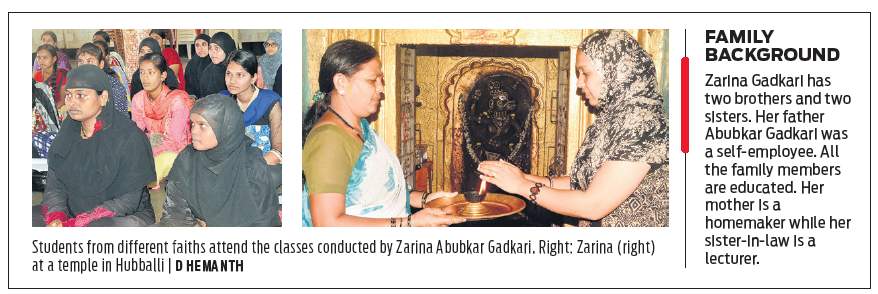
Zarina Abubkar Gadkari is quietly practising what most people only preach — spreading communal harmony. The 25-year-old crafts teacher, who follows the Muslim faith, conducts daily classes on Hindu epics and prayers for her students, many of whom hail from Muslim families, in Old Hubballi area.

Zarina, a teacher at Spoorthi Rural Skill Development Training Centre, which provides free training to women in craft-making and sewing, conducts her spirituality class on the premises every evening. She does not charge anything for the lessons, which include Sanskrit verses, songs and stories from the Ramayana and the Mahabharata, and hymns on gods such as Ganesha and Hanuman.

Hailing from Jamkhandi in Bagalkot district, Zarina started learning devotional songs and shlokas after getting inspired through the Ramayana and Mahabharata serials on television. When she joined the training centre as a craft teacher, she also started singing and teaching them to students.
”It’s a wonderful feeling to recite the shlokas,” she says. “Sanskrit words never seemed difficult to me while I was learning them, and my family members gave me big moral support,” adds Zarina, who performs namaz every day, and also visits the church and reads the Bible.
ZarinaMPOs26nov2018

“When I go to Bengaluru, I visit St Mary’s Basilica in Shivaji Nagar. It is one of my favourite places, and my family members also visit it with me,” she says, adding that such gestures from her family lend her huge moral support.

“We live in a country where communal harmony is everything, and each of us must work hard to achieve it,” she says.

The number of students in her classes has only increased over time, and they love every minute of it.
“I have been attending the classes of Zarina madam for over six months and she is a role model for many,” says Nasereen Attar, a student. “We never faced any restrictions in our homes about attending classes related to Hinduism. In fact, our parents encourage us to learn new things,” she adds.

Most students hail her as a motivating figure. “Her way of teaching and her commitment to religious harmony, besides her reciting of Sanskrit verses, left me stunned,” Shynaz Nadaf, another student, says. “It’s surprising to see Zarina madam perform namaz and as well as have darshan at temples,” Shreya M pitches in.

Zarina’s endeavour is praised by her colleagues too. “Her work shows that attachment to a religion is no hindrance to good work. She is a good human being,” says Mukthambika Narebol, a co-worker at the institute.

Zarina was introduced to the Ramayana and Mahabharata through teleserials by her parents when she was a child. She got interested in reciting the mantras and shlokas when she started teaching at the Spoorthi centre, where daily prayers are conducted.

“I also practised other verses like the Hanuman Chalisa and Gayatri Mantra. Initially, I faced problems in pronunciation but within 2-3 months I was able to recite them well in Sanskrit,” says Zarina, who draws a lot of strength from her family.

While her father Abubkar Gadkari is self-employed, her two brothers and two sisters are well-educated too, and her sister-in-law is a lecturer.

Zarina feels that the task of uniting people of different faiths has assumed greater significance today. “We live in the world’s largest democratic and secular country where all religions exist together. But in recent times, society has seen changes after the social media took the front seat,” she says.

Greater onus rests on the youth to build a cohesive society, adds Zarina. “Several young lives are going waste by getting involved in violence triggered by communal hate. We must also educate women about the ill-effects of religious divide, and bring awareness about nation-building activities,” she says, admitting that the task, however, is far from being easy.

source: http://www.newindianexpress.com / The New Indian Express / Home> States> Karnataka / by Kiran Balannanavar / Express News Service / November 25th, 2018

Choosing to shed victimhood

Kottayam, KERALA :

MariamMPOs25nov2018

Mariam Rauf urges schools to include personal safety education in syllabus

As an impressionable child, Mariam Rauf — a 22-year-old life skills and English language educator from Kottayam — never knew what paedophilia was. It took her many more years to realise that she herself had been one of its victims.

Abused on multiple occasions between the age of 3 and 14, the ordeals surely left an imprint on her.

Confused, ashamed, and lost for years on end, she eventually managed to pull herself up and is now busy training children and adults about personal safety.

Driven by her own experiences of abuse as a child, Mariam has now kick-started a campaign to include personal safety education in schools. She feels this is achievable as there is a strong intent on the part of the government to clamp down on child abuse. It is unlikely to affect academics either as it may need only a couple of sessions in a year.

Online petition

As part of the initiative, she has also chosen to shed her right to anonymity and launched an online petition on Change.org, which opens up on her ordeal and makes an appeal to the State government to introduce compulsory training in Personal Safety Education (PSE) for students, parents, teachers, and staff of all government schools.

The petition is addressed to Education Minister C. Ravindranath and the Kerala State Commission for Protection of Child Rights (KeSCPCR).

“About 38,200 people, who have endorsed my petition thus far, believe it is possible. By realising it, I can save at least one child from undergoing what I had to face,” she says.

According to Mariam, personal safety education for children is about making them aware of their body and empowering them to express their discomfort in case of physical transgressions.

“For most of us, personal safety of our children is limited to the ‘Stranger-Danger’ equation, while the actual threat can come from even inside the family. All people can do their part by recognising the physical and emotional signs shown by a child who is being abused and the signs that an adult is abusing a child,” she said.

source: http://www.thehindu.com / The Hindu / Home> News> States> Kerala / by U. Hiran / Kottayam – November 20th, 2018

Anti-dowry drive: Thousands of Indian Muslims return millions to bride families

JHARKHAND :

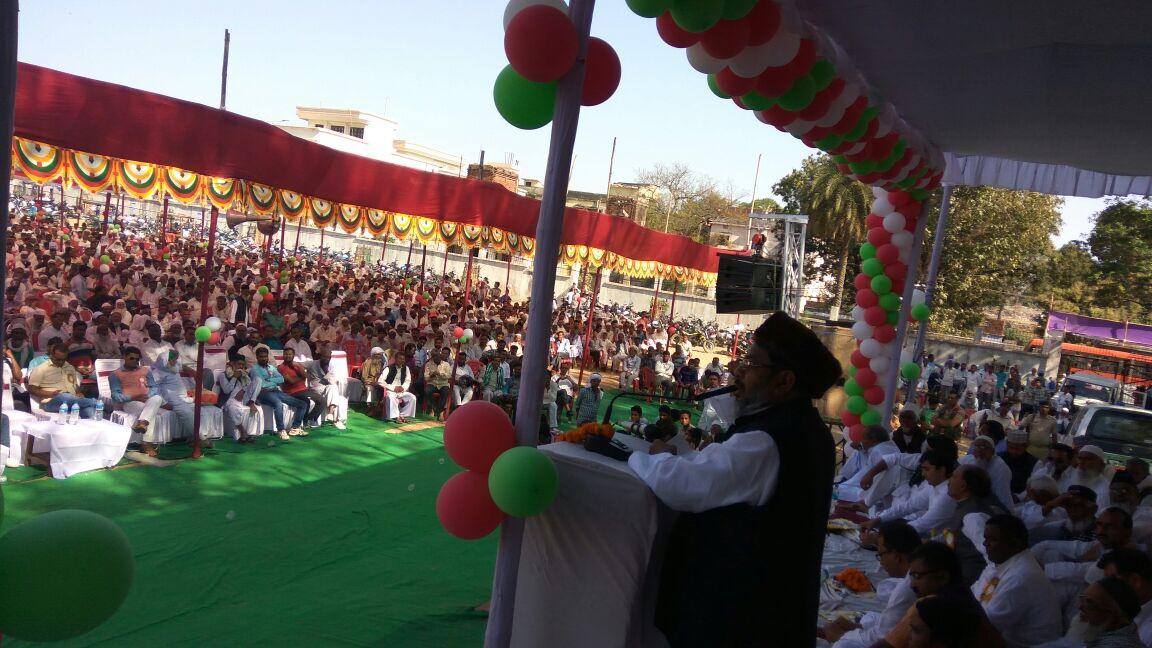
Haji Mumtaz Ali addressing anti-dowry campaign in India’s Jharkhand state. (Supplied)

A man in India has launched a massive campaign against dowry, one of the biggest social evils claiming hundreds of lives every year in the country. Such is the impact of the campaign that close to 1,000 Muslim families have now returned dowry to the bride families, expressing regret over their conduct in public and vowing not to repeat it in future.

The credit to this unique campaign straightway goes to Haji Mumtaz Ali who has launched the campaign in the eastern Indian state of Jharkhand. The success of the campaign is underlined from the fact that villages after villages are joining it every day, openly taking an oath not to accept dowry in future.

Initially, the campaign was started in Palamu district but now it has gone beyond its boundary and spread to several others districts as well. But what’s further fascinating about it is that the campaign is not limited to any particular community only as the Hindus too have lent a wholehearted support to this campaign, joining the anti-dowry rallies in large numbers.

“I am happy to inform you that what started as a silent campaign against this social evil two years back has now turned out to be the mass movement. Now it’s not limited to any particular area or the community only but Hindus too are joining us in large numbers,” said Ali who happens to be the brainchild of the campaign.

The peak of the campaign was when the Muslim villagers began returning dowries years after they had taken them at the time of their son’s wedding. (Supplied)

Rs 60 million returned

The peak of the campaign was when the Muslim villagers began returning dowries years after they had taken them at the time of their son’s wedding. According to Ali, close to 1,000 Muslim families have returned dowries worth Rs 60 million to the brides’ families so far, impressed by his appeals to give up dowry.

One of them was Nizamuddin Ansari who returned Rs 40,000 to the bride families. “I regret about taking dowry from my daughter-in-law’s families but feel proud to return it now,” Ansari told an anti-dowry meeting held in Palamu recently.

However, the campaign didn’t reach at this level all of a sudden. Ali had to work hard, day and nights for months during which he held more than 100 such meetings and rallies in entire Palamu division to convince his community members not to take dowry, braving sweltering heat and chilling winter.

But what compelled him to launch the campaign? “I saw many families getting destroyed under the impact of dowry although it was not initially prevalent in Muslim families. I came across many poor families selling their ancestral properties or taking loans on high interest to arrange money to solemnize wedding of their daughters”.

“What was terrible this money was being wasted on arranging decoration, DJ, orchestra and various types of dishes; it was not being used for important works! So I decided to launch a campaign in the society, sooner the better,” Ali said, in a telephonic interview on Thursday.

“I was aware of the economic status of my co-villagers. I knew their financial background just wouldn’t permit them for lavish wedding. They were doing so just because they had taken dowry from the brides’ families. So it was necessary to alert them,” he said.

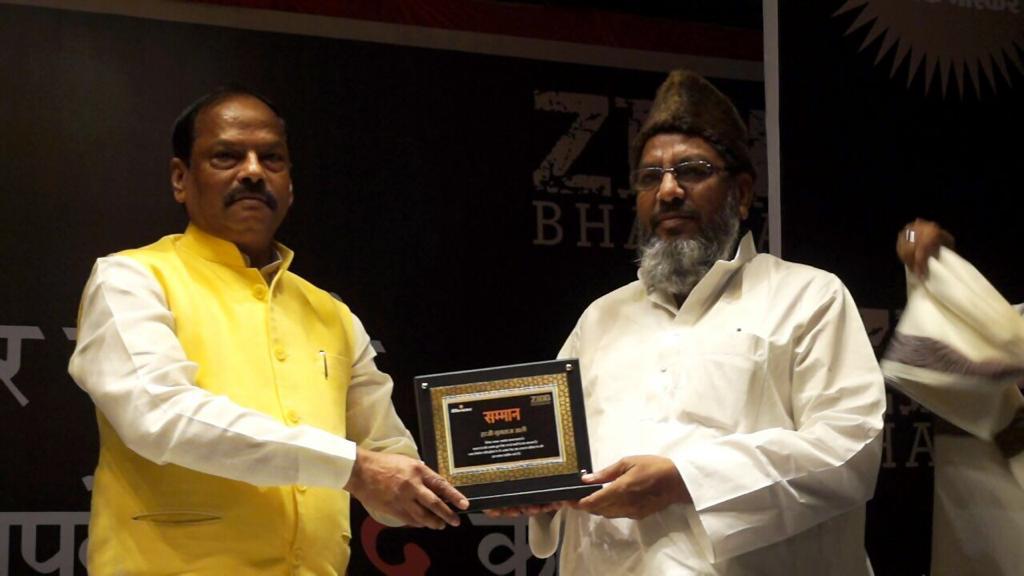
Haji Mumtaz Ali being honoured by Jharkahnd Chief Minister Raghubar Das. (Supplied)

Crowds of villagers

Eventually, Ali launched the campaign in April 2016 but got encouraged to focus on it after seeing huge crowds of villagers attending his each rally and meeting.

“I told the Muslim villagers to fear from the almighty and swear in the name of Allah not to take dowry in future and this ultimately clicked,” Ali revealed, describing his campaign as a “huge success”. Recently, Ali was honored by Jharkhand chief minister Raghubar Das for his campaign against dowry.

Ali is happy to tell that villagers are now opting for “dowry-less” marriages. “Now, the general masses have taken over my campaign. This indicates the success of my campaign, Ali remarked, with his voice exhibiting satisfaction and delight.

Dowry has been claimed hundreds of lives every year in India. As per an official report, a total of 24,771 dowry deaths were reported in India in between 2012 and 2014 with Uttar Pradesh taking the lead with a maximum of 7,048 deaths. This information was given to the Lok Sabha in a written reply by federal minister for Women and Child Development Ministry Maneka Gandhi in April 2016.

The minister further told the House that India recorded 348,000 cases of cruelty by husband or his relatives during this period with the West Bengal topping the chart with 61,259 such cases, followed by Rajasthan (44,3111) and Andhra Pradesh (34,835), as per the National Crime Records Bureau data.

source: http://www.english.alarabiya.net / Al Arabiya – English / Home> Features / by Manoj Chaurasian / Special To Al Arabiya English / November 08th, 2018

Young Kashmiri plays the rabab back into the limelight

Srinagar, JAMMU & KASHMIR :

SafyanMalikMPOs23nov2018

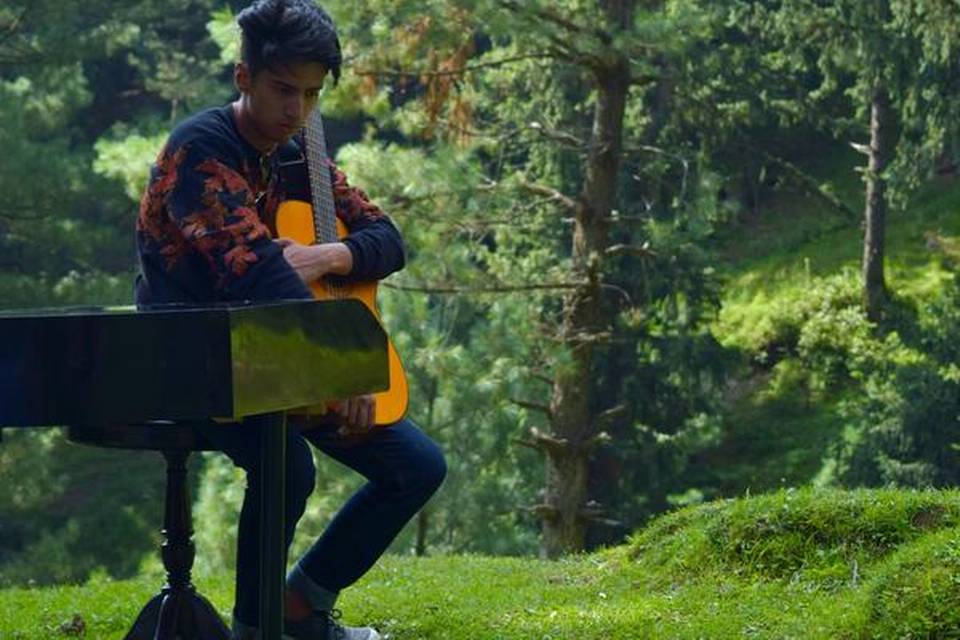
Sufyan Malik’s 45-second video finds receptive new audiences for the fading soul of the region’s folk music

A 19-year-old Srinagar boy, enabled by social media platforms, is infusing new life into what is considered the soul of Kashmir’s folk music — the rabab, a long-necked lute.

Sufyan Malik’s 45-second video, shot on a mobile phone against the backdrop of the heavy snowfall witnessed on November 3, has stormed the internet, with over 4 lakh views and counting.

“I came for a short vacation to Kashmir. As my parents left home in the morning, my friend and I decided to shoot the video with snowfall as the backdrop. Initially, I played it for my friends in Pune, to show them snow. To my surprise, the tune of a local song, ‘Janaat-e-Kashmir’, on the rabab, became an instant rage on Internet,” Mr. Malik, a student of engineering at Pune’s MIT College, told The Hindu.

Mr. Malik shot the video 18 times because his hands fingers in the cold weather. “There was no electricity to warm my hands. I had to match the speed. It was hard to play three beats down and one beat up. Finally, we did it,” said Mr. Malik, a resident of Srinagar’s Nowshera area.

The effort paid off as the video attracted 1.54 lakh views on Twitter in just a couple of days, with more views on Facebook and Instagram in the weeks that followed. From politicians like National Conference’s (NC) Nasir Sogami to activist Shehla Rashid Shora, the young player earned plaudits from across the spectrum in the Valley and outside.

“Snow and the rabab probably reflect our identity. People felt an immediate connection. I have pledged to play the rabab all my life. I will do my Masters in composition to enable the survival of the rabab,” said Mr. Malik, the son of a doctor mother and a hotelier, Wahid Malik, who support their son’s efforts.

The makers and listeners of the rabab are both fast dwindling in Kashmir. In north Kashmir, only two families continue with the trade of crafting the rabab, from the dozens of just a few decades ago.

Seen in many variants across central Asia, the rabab arrived in Kashmir from Afghanistan many centuries ago. “Compared to the seven strings of the Afghan rabab, the Kashmiri version has 22 strings, with two strings crafted out of goat gut through an elaborate process. It’s these two strings that create its mesmerising echo,” Mr. Malik said.

Soul-stirring

Ghulam Muhammad Ganai, 63, from Ganderbal’s Kangan area, is among the few instrumentalists left from the old school. “I play the rabab only in Sufi mehfils (night-long devotional gatherings). The word ‘rabab’ comes from rooh(soul) and bab (expression). It should stir the soul. Only those who are nearer to god value the instrument. Around 15 of us are left now,” said Mr. Ganai.

However, young players like Mr. Malik are bringing the instrument back into mainstream culture. “I played the rabab for a musical fusion called ‘Firdous X-He is a pirate’ based on the theme song of [the film] Pirates of Caribbean and the theme music of [TV show] Game of Thrones in 2017. It was an instant hit here,” he said.

On June 28 2018, Mr. Malik played the rabab at The Hilton hotel in Los Angeles. “Many Kashmiri-origin people in the audience wanted to have a workshop for their kids after the show. After the hits we produced in 2017, at least 50 students registered to learn to play the rabab at the Delhi Public School (DPS) in Srinagar,” said Mr. Malik.

source: http://www.thehindu.com / The Hindu / Home> News> States> Other States / by Peerzada Ashiq / Srinagar – November 21st, 2018

J&K artists weave life back into the antique shawl

JAMMU & KASHMIR :

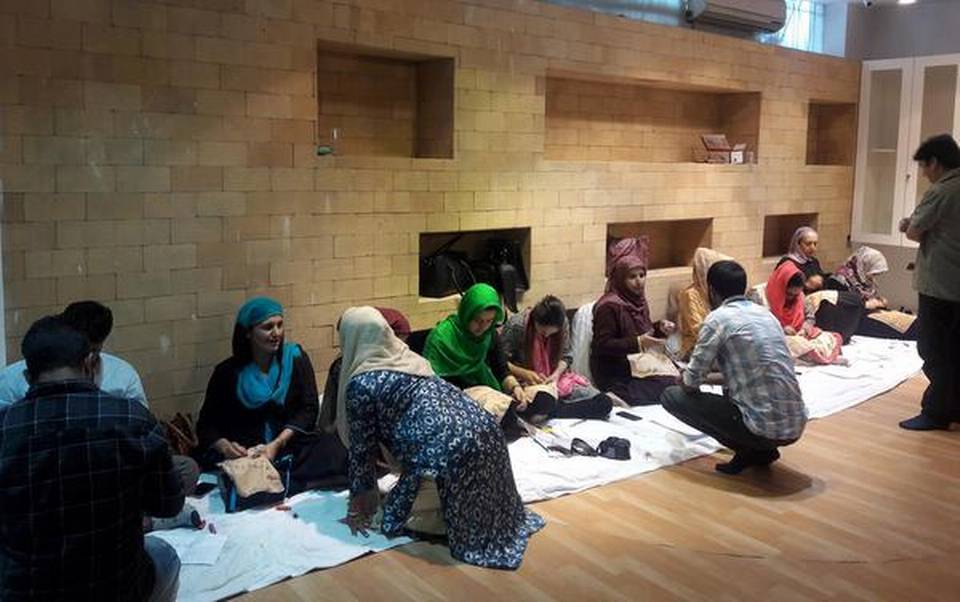
Silken touch: Experts display the skill at the special event at Srinagar’s SPS Museum. | Photo Credit: The Hindu

Workshop to revive Valley’s vanishing breed of master darners

Once sought after by Mughal emperors for their finesse, Kashmir’s master darners, known as rafugars, have become an endangered species. The Jammu & Kashmir government is now making efforts to revive this dwindling breed of craftsmen whose rare ability to repair expensive antique shawls is in great demand across the country and abroad.

J&K’s Department of Archives, Archaeology and Museums and the Indian National Trust for Art and Cultural Heritage (INTACH) have decided to identify and expose these traditional Valley darners to the market.

Toward this end, at least 25 master darners and embroidery artists have been invited to exhibit their skills at a six-day workshop, organised from September 17-22, at Srinagar’s SPS Museum. Two masters from Uttar Pradesh’s Najibabad are among those sharing their knowledge.

J&K’s Handicraft Department says, of the 56 traditional skills (such as wood-carving), only 26 are practised today. One indicator of the decline: a post for ‘Darner Instructor’ in the department has been lying vacant for many years.

Rafugari survives

“Among the surviving skills is rafugari, which is also dying. Darners from Kashmir once impressed the Mughal emperors, who hired them to keep their shatoosh and pashmina shawls intact,” said Saleem Beg of INTACH’s J&K chapter. The workshop, Mr. Beg said, was aimed at transmitting the art to the next generation. The museum has displayed 63 rare shawls, many dating back to 1893, including one with a map of Srinagar on it.

“The darners will understand the artwork that our artists had mastered in the past. They should be able to identify problems and suggest methods of restoration. This exercise will help them hone their skills,” Mr. Beg said.

Master darner Muhammad Rafiq Kozghar, in his mid-50s, has been repairing antique shawls and sarees for 40 years now. “I picked up the skill from three teachers in Srinagar. All of them have passed away. I am the only student alive, taking it forward. Darning requires fine hands and eyesight. A darner dies once his eyesight fails him,” said Mr. Kozghar, who works in Delhi.

Mr. Beg said that there was great potential for textile conservation in Srinagar. “We need to upgrade the skills of the existing rafugars and needle work artisans to create a market for textile conservation,” he added.

source: http://www.thehindu.com / The Hindu / Home> News> States> Other States / by Peerzada Aashiq / Srinagar – September 20th, 2018

Lucknow: Now, ‘water gateway’ to Chattar Manzil unearthed

Lucknow, UTTAR PRADESH :

Slice of history: Nawabs probably used fish-shaped boats for transport in 17th century, says historian.

The ongoing excavation work at Chattar Manzil reached another level on Monday as workers unearthed a ‘water gateway’ leading to this iconic structure.

The UP Rajkiya Nirman Nigam (UPRNN), the construction agency engaged in the restoration of the structure, termed it one of the major discoveries so far.

Officials said workers engaged in the excavation stumbled upon a ‘cylindrical structure’ that was lying buried for years.

On clearing the debris, it was found that the structure made of lakhauri bricks was a tunnel, which connects the over 200-year-old Chattar Manzil to river Gomti, flowing just a few metres away.

“This tunnel is around nine metres beneath the ground,” said Nitin Kohli, the contractor supervising the excavation work.

The task is being performed under the supervision of a high-powered committee comprising Archaeological Survey of India (ASI), Abdul Kalam Technical University (AKTU), State Archaeology Department and officials of the civil engineering department, IIT BHU.

Experts said once they are done with the excavation work, they would explore details like the total length of the tunnel and where it leads to.

Officials said the discovery of the tunnel would unravel another chapter from the history of Chattar Manzil and Kothi Farhatbaksh.

The tunnel would also demystify myths and folklore about the Nawabs using water boats to sail within the palace complex, they added.

However, historians have a different take on this tunnel.

PC Sarkar, a noted historian, said: “The structure seems more of a water gate than a tunnel.”

He said some old timers who have been to Kothi Farhatbaksh (Lakhi Pera), residence of major general Claude Martin, had mentioned the structural uniqueness of the twin structures. “In fact, it is on record that the structures were easily approachable from the northern (river Gomti) side by boat also,” added Sarkar.

“After Nawab Saadat Ali Khan bought the fortress-like structure, it was remodelled into a palace-like structure. However, the river side entrance remained the principal one, with the Nawab adding pavilions in the middle of the river itself,” he said.

He said Gomti was the main channel of transport – the nawabs used barges (boats) of various shapes and sizes, some looking like fishes, crocodiles, for transport in the 17th century. The famous ‘More Pankh’ boats were in vogue during that era, said Sarkar.

He said ‘water gates’ may sound unique now, but they were common in the olden days.

The Lucknow Residency too had a ‘water gate’. But it became defunct when Gomti changed its course and more means of road transport came up, he said.

source: http://www.hindustantimes.com / Hindustan Times / Home> Lucknow / by Oliver Fredrick, Hindustan Times,Lucknow / November 20th, 2018

The mystery of the two saints

Hyderabad, TELANGANA :

The structure lies in neglect | Photo Credit: Serish Nanisetti

Forgotten and vandalised tombs show the sorry state of heritage

The tip came last week. “There are these maqbaras in Balapur. One of them is double-storied, like that of Jamsheed Quli Qutb Shah. They must belong to someone important. We could climb up and the decoration is largely intact,” said P N Praveen, who teaches architecture. He sent a location map. A satellite map showed a square open area with two round structures.

The location turned out to be beyond the Barkas area in Old City. Beyond the shanty town of Rohingya refugee camps is the open area where the two domes pierce the sky. If shouts and laughter echo from one side where children gather to play cricket, on another side a Greater Hyderabad Municipal Corporation vehicle comes to dump garbage from the surrounding areas. “I make four or five trips per day,” says the driver of the garbage tipper. When the garbage reaches a certain height, he sets the heap alight. The fire and smoke envelop the area.

The two domes are raised on a square platform. The small, low and squat, more ornate dome would easily fit into the landscape of the Qutb Shahi tombs complex at the foothills of Golconda Fort. The other one appears to be double-storied, but with something amiss with the symmetry. “It lacks a defined parapet with battlements,” says Prashant Banerjee, a conservation architect after seeing a photograph.

“These tombs belong to the Qutb Shahi era. Two Sufi saints Bhole Shah and Bhale Shah are buried here. Over time people have vandalised and removed all signs of the graves but they are buried inside the tombs,” said Muhammad Shareef, who is secretary of the Roushan Ud Dowla Masjid, that abuts the tombs. A sign painted in Telugu speaks about the property being under the care of the Waqf Board. How these two tombs slipped out of the net of the memory of the city is anybody’s guess. The tombs are from a layer of history which hasn’t got much attention from historians.

Golconda/Hyderabad has been attacked multiple times. After Aurangzeb’s final conquest, he oversaw its sack by staying put near the eastern side of Charminar. All the glorious palaces draped with glazed enamel tiles with seven colours were pulled down in the hunt for the fabled treasure.

One of the Qutb Shahi palaces was a seven-storied one which was a marvel for even a well-heeled traveller like Jean Baptiste Tavernier. Now, nothing of that era remains, save the four ceremonial arches, the Charminar and the fountain in the royal piazza. Later, Hyderabad was subjected to a series of raids by the Marathas. The sacking, the raids, the unsettled conditions meant that the once grand city and its surrounding areas slipped into a state where people were only bothered about saving their life and limb. Not surprisingly, religious and spiritual monuments survived intact and in some cases emerged grander and more powerful. But how these two tombs in Balapur, despite being associated with Sufi Saints, slipped into disuse and became a den for vagabonds remains a mystery.

source: http://www.thehindu.com / The Hindu / Home> News> Cities> Hyderabad> Living Hyderabad / by Serish Nanisetti / November 17th, 2018

Meet Rafia Rahim, First Woman Radio Jockey In Kashmir’s Budgam

Charari Sharief, Budgam District , JAMMU & KASHMIR :

Rafia Rahim, the first woman RJ in Kashmir’s Budgam, has become a household name in the Valley after she hosted various local programs on the radio station.

Rafia Rahim studied in the University of Kashmir.

Srinagar :

Like a positive ray of sunshine, 24-year-old Rafia Rahim has become the first woman radio jockey from Kashmir’s Budgam district. She lives in Charari Sharief town and has now become a household name after she hosted various local programs on the radio station.

Rafia, who has become the first woman radio jockey on a private radio station, is a 2016 pass out from the Media Education and Research Centre in the University of Kashmir.

Rafia Rahim lives in Charari Sharief town.

Long before she enrolled in the journalism programme at the University of Kashmir, Rafia Rahim hosted Good Morning Jammu and Kashmir on Doordarshan, a show that comprises debates on social issues.

Rafia Rahim joined a local English daily as a paid intern. Later, after going through an audition, she got selected for the said radio station as an RJ.

“In February, I got selected for Radio Jockeying. I received proper training in Chandigarh from the radio station. With my program, I try to entertain people and take away all their tensions, sadness and tiredness,” she said, adding that she wants to entertain the Kashmiri audience.

“It feels nice when people recognise me due to my work. I feel very grateful,” she added.

source: http://www.ndtv.com / NDTV / Home> Sections> All India / by ANI / November 16th, 2018

Vizag girl wins Google doodle contest

Visakhapatnam, ANDHRA PRADESH :

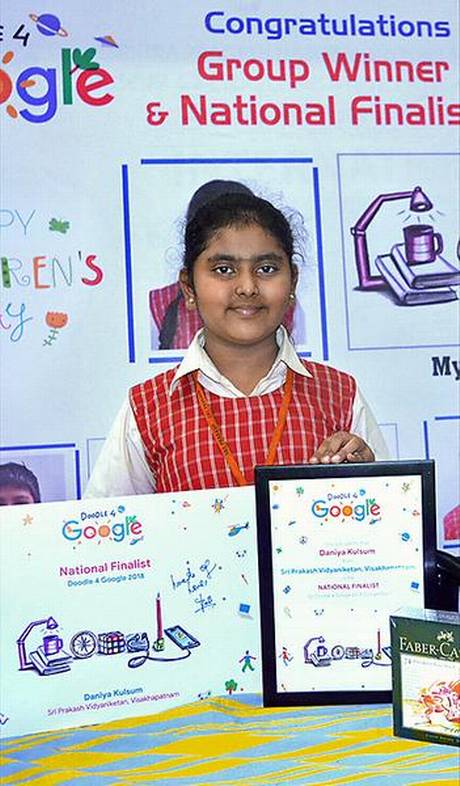
Daniya Kulsum, the winner of the Doodle 4 Google-2018 contest

3 Sri Prakash students among the finalists

Daniya Kulsum, a student of Sri Prakash Vidyaniketan, has won the Doodle 4 Google-2018 contest in the Group-3 category.

Twenty 20 doodles from the ones made by 70,000 participants were selected for the finals and among the finalists, three are from Sri Prakash Vidyaiketan. Daniya Kulsum, a fifth standard student, won the contest with the theme ‘What Inspires me’. The other two finalists were 2nd standard student C. Jayavant Kamesh and Bogaruapu Saathwik of sixth standard.

Felicitated

All the three finalists were felicitated at the Google office in New Delhi in presence of the noted artist Rob. Later, they were presented with a citation of recognition, a certificate of achievement, a Googley Swag and a Google Home, along with a stay at Taj Hotel with free air tickets.

School director Chitturi Vasu Prakash congratulated the students on the achievement.

source: http://www.thehindu.com / The Hindu / Home> News> Cities> Visakhapatnam / by Special Correspondent / Visakhapatnam – November 15th, 2018