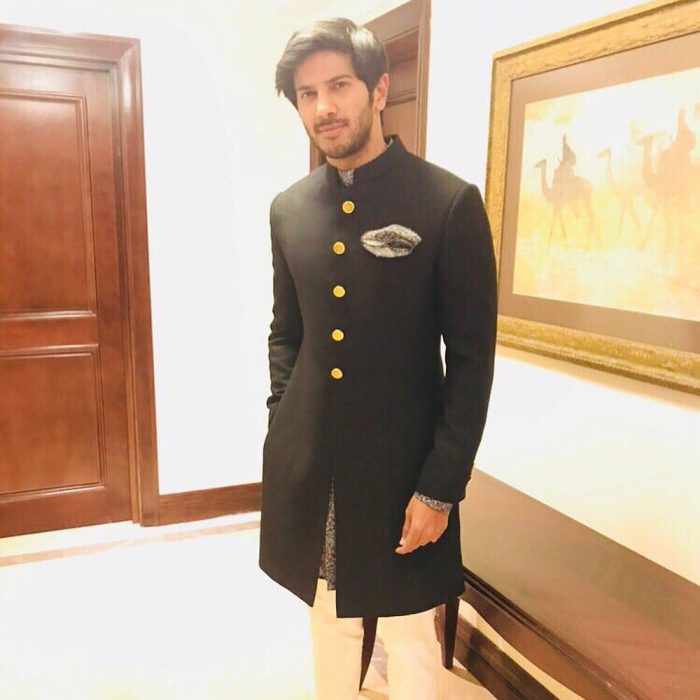
Dulquer Salman slays in a bandh gala as he was spotted at an event.
The super dapper Dulquer Salman was recently spotted at an event looking all debonair.
The popular Malayalam actor wore a black bandh gala with statement golden buttons pairing it up with off-white tapered pants and a grey printed pocket square.
We love how he has kept it simple and formal yet adding a bit of his own style with that pocket square.
We are totally crushing on this look let us know your comments too.
source: http://www.regionalpinkvilla.com / PinkVilla / Home> Tamil> Fashion / by Avantika Gupta / November 18th, 2017
Urdu writer Rahman Abbas on the challenges of being defiant
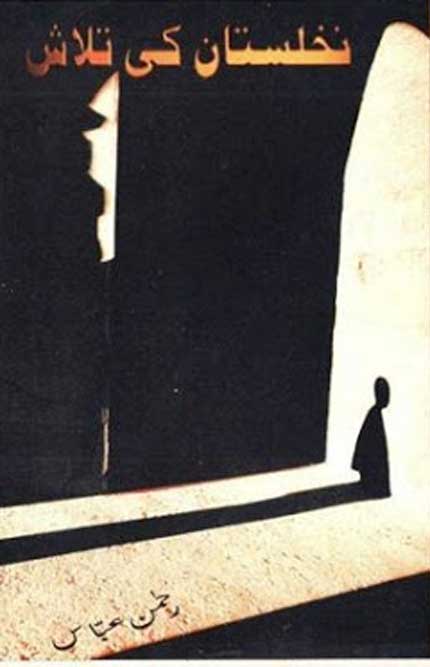
A few paragraphs were all it took for the trouble to start. Thirteen years ago, Urdu writer Rahman Abbas was booked for obscenity for his debut novel Nakhlistan ki Talash, a love story set in Bombay following the 1992-93 riots. The offending two or three paragraphs dealt with love and sex.
It’s been more than 10 years since that particular combination of words got him arrested and two since the case of obscenity was closed. But aside from polishing the rawness of a first novel, he probably wouldn’t change the words.
“I may [take] care about a few words; I will use those words but will try to use them more creatively,” he says, when asked what he would have done in hindsight. “But I don’t think there is any word we should hide. I, for one, cannot.” He continues, “As Manto said, you say ‘breast’ for ‘breast’, you can’t use another word. Or for a ‘chair’ you have to say ‘chair’, you cannot say ‘donkey’.”
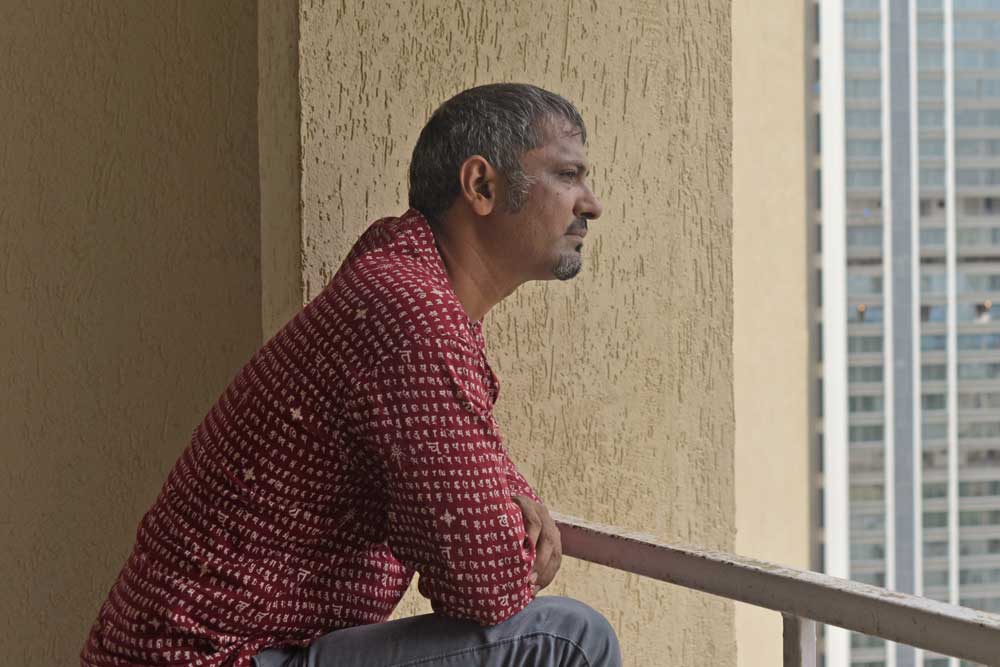
A medium-height man with a soul patch and a disarming frankness, Abbas, 46, is currently translating Nakhlistan into English, and expects it to be published next year. He has just come back from a tour of Germany with the German translation of his fourth and latest novel Rohzin—the first time any of his novels has been translated. Next month, Rohzin’s English translation, by Sabika Abbas Naqvi, is slated for release. Set in Mumbai, the love story opens with the flood of July 2005 and won a state Sahitya Akademi award in 2017.
But to a general audience Abbas, a former teacher, is still perhaps best known as the writer who found himself in the crosshairs of an outdated legal provision: Section 292 of the Indian Penal Code that punishes obscenity in writing and art.
“I don’t regret what happened,” he says. “These are the challenges you have to face as a writer or creative person. If your society is orthodox, it is your duty to challenge the orthodoxy.”
And that is precisely what he plans to do. Since the police case that changed his life, Abbas has left the teaching profession, won and returned a Sahitya Akademi award, won and retained a Sahitya Akademi award, and is in the incipient stages of launching a broader campaign against Section 292. That section, among others, has for years been a part of the restrictive free speech architecture that bedevils Indian writers and artists.
“There is freedom for people to protest against a book, to dislike a book. I respect that freedom. If I have the freedom to write, people have the freedom to criticise,” says Abbas, who won his first state Sahitya Akademi award for his third novel, Ek Mamnua Mohabbat ki Kahani . “But a [legal] provision that gives people an opportunity to send a writer to jail, that should be stopped.” He adds, “For a democracy, this is crucial.”
The first step, Abbas believes, is to galvanise public opinion through writing and advocacy against Section 292 in particular. A public interest litigation (PIL) opposing the use of this provision against writers and artists is already in the works.
Abbas is also busy working on a fresh piece of Urdu fiction, his first literary effort since the case against him was closed in 2016, liberating him in several ways. “For my next novel, I will try to explore the things I couldn’t explore in my previous three novels,” he says. “Since the case has ended, I feel I am free to write.”
Abbas denies the impact that fame— or infamy—can have on the reception of a work. “I think if you aren’t a good writer, it will not help,” he says. “Nothing can help.” He names Sadat Hasan Manto and Ismat Chughtai as illustrious Urdu predecessors who were prosecuted (though ultimately unsuccessfully) under the same law he was. Then he chuckles: “There is no single example of bad writers having any problem.”
Good or bad, Indian filmmakers and artists have consistently faced oppressive free speech laws, whether through criminal prosecution, government bans or threats from conservative factions.
In 2016, various groups protested against Tamil writer Perumal Murugan’s One Part Woman and sought a ban on it. In 2015, Jharkhand-based writer Hansda Sowvendra Shekhar’s The Adivasi Will Not Dance was banned by the state government on allegations of having violated Section 292, among others. Earlier this month, the Supreme Court dismissed a plea seeking a ban on the Malayalam novel Meesha. To Abbas, this is part of a wider pattern. “English writers enjoy more freedom than us. I don’t know why. Alice Walker’s novel was in our syllabus and used those same words that I did and went to jail for,” he says. “On the one hand, the Government makes you read a book; on the other hand, if you use the same word in your text, you are a criminal.”
Though he was let off without a trial—the complainant told the court she had misunderstood the offending passages and the case was closed—Abbas spent one night under arrest in Arthur Road jail until his lawyer was able to complete the bail formalities. “It was quite a humiliating process,” he says, its memory still fresh more than a decade later. “When you go to jail, you feel your whole freedom is gone, that you will never get out of there.”
The experience was both debilitating and transformative. “I remembered Manto and wrote about how I felt the pain of Manto,” says Abbas, a touch dramatically. “If you are a writer or journalist and you experience jail, you understand the importance of freedom. I had it when I was writing; when it is stopped, you realise the importance of maintaining it. It’s not only your struggle, but a struggle of humanity.”
Though he lost his job, was pilloried at the time by the Urdu media, and still faces the censure of conservative Muslims, he now has more enthusiastic readers, he believes. “Now my writing has been accepted in a big way. Urdu readers are not that narrow minded,” he says. “They are openly reading and I am happy when young people appreciate the work which the previous generation had condemned.”
Abbas taught at a Muslim institution for several years and was also the principal of one. He later decided to leave academia and joined a think-tank fulltime in 2012. “If you are liberal Hindu, you won’t work in an RSS shakha,” he says of leaving that minority institution. “It is very conservative. Through education, they want to promote their religious ideas. I believe education should be 100 per cent secular; there shouldn’t be any discussion on religion. But now both communities are insisting on preaching religion and morality, and that is antieducation, anti-scientific temper.”
In 2015, Abbas joined the awards return protests initiated by authors disturbed by the silence of institutions and the apathy of the Government to violence against free thinkers. Like many writers and intellectuals, he too is concerned about what he perceives as the shrinking space for dissent in the country and the rise of divisive politics. “The right-wing is gaining. And only because it is doing the same ugly, dirty propaganda and dividing people in the name of religion,” he says. “There is a feeling that Dalits, Muslims, Christians, Adivasis can be targeted. Yes, there is a fear. And people should speak up.”
source: http://www.openthemagazine.com / Open / Home> Salon > Web Exclusive: Books / by Bhavya Dore / September 21st, 2018
Amir Ali Shah (23) from Bijbehara town of the district has spent more than two years to come up with the website ‘Stop Fake in Kashmir’, reported The Tribune.
Amir Ali Shah
A youth from south Kashmir’s Anantnag district has created a website to tackle the menace of fake news.
Amir Ali Shah (23) from Bijbehara town of the district has spent more than two years to come up with the website ‘Stop Fake in Kashmir’, reported The Tribune.
The website is the first of its kind developed in the Kashmir valley, said the report.
The website is already up on the Internet though it is waiting for formal launch which will take place in coming weeks.
Shah claimed that the website will act as a watchdog to keep tabs on unverified and fake news circulated on the social media where users can upload a link or screenshot of the news they want to verify.
“The website will give a feedback on whether the news is true or fake based on web searches,” Shah was quoted as saying by the report.
He said that the back-end team of the website will also run the information through its sources on the ground and check the veracity of the news.
Shah said he conceived the idea of developing such a platform in January 2016 after the entire Kashmir valley went into mass hysteria following fake news that suggested that the polio vaccine administered to children was expired and had caused some deaths.
source: http://www.greaterkashmir.com / Greater Kashmir / Home> Kashmir / by GK WebDesk, Srinagar / September 24th, 2018
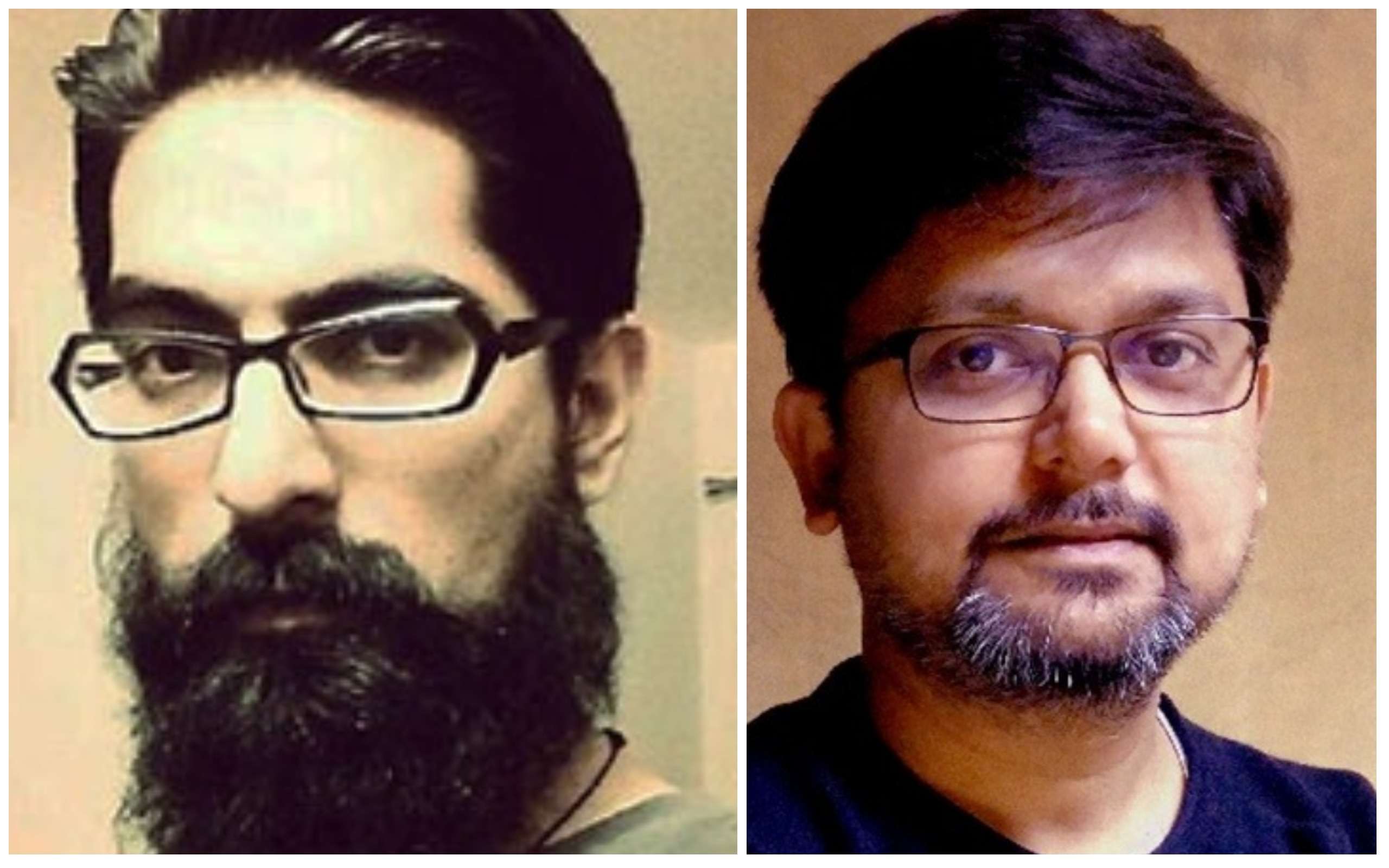
Cheil India has appointed Moosa Khan and Nitin Pradhan in their senior creative leadership. The duo will report to Sagar Mahabaleshwarkar.
Khan joins as head of digital (creative) and Pradhan takes on the role of senior executive creative director.
Speaking on the appointment, Atika Malik, chief operating officer, Cheil WW India, said, “We are the Agency of Now where creativity is inspired by technology. I am extremely happy that Moosa and Nitin will add their digital capability, creativity and energy to Cheil. I look forward to working closely with them to inspire new ideas and solutions for our progressive brands. For 15 years Cheil in India has provided brand solutions across retail, experiential, digital and communication to transform our client’s businesses. They will be a great asset to our creative strength and we welcome them warmly into the Cheil family.”
“I am delighted to welcome Moosa and Nitin to our team. Both of them are exceptional creative talents to have on board. While Moosa has immense understanding of new age digital media, Nitin is a fantastic creative talent with great ability of storytelling. Most importantly, we all have a shared passion for creative excellence and digital innovation. With these beliefs firmly at the heart, Moosa and Nitin will be a tremendous asset to our bold creative ambitions. Wait and watch as magic happens!” added, Sagar Mahabaleshwarkar, chief creative officer, Cheil WW India.
What it takes to build the reputation of a brand
Khan brings with him over 10 years of experience in digital as well as traditional advertising. He has worked across agencies such as Dentsu Webchutney, Madison, TBWA and Jack in the Box Worldwide.
Pradhan, a known name among the advertising fraternity, has 17 years of experience working with– Ogilvy, JWT, McCann, Leo Burnett and the likes.
source: http://www.brandequity.economictimes.indiatimes.com / ET Brand Equity / Home> The People Report / June 02nd, 2018
South African Indian cinema doyen Moosa Moosa has passed away. He was 75. Moosa succumbed to a heart attack on Sunday after undergoing surgery.
He was buried in Johannesburg on Monday according to Muslim rites.
Moosa had earned the title of being the longest-serving cinema group executive in the world, adding to the company’s reputation of having the longest relationship with Hollywood production house 20th Century Fox for almost eight decades now.
In 2007, Moosa received the South African Film and Television Industry Lifetime Achievement Award.
Tributes from all across the world continued to pour in for Moosa as the news of his demise spread.
Family and friends recalled how Moosa had taken over the family cinema business of the Avalon Group, started by his father 79 years ago as the first and still only Indian-owned cinema group in South Africa, after most of the 18 cinemas in the group were shut down by the draconian apartheid-era laws restricting property ownership in city centres to the minority white community.
Undeterred by this as the Avalon Group continued with just one cinema in an area designated for Indians in Durban, Moosa took on the seemingly impossible task of challenging the monopolies of white-owned major national cinema chains and won legal battles in the new democratic South Africa headed by President Nelson Mandela.
Moosa then started rebuilding the business as his son Aboobaker, popularly known as AB, also joined the business as the chief executive officer.
Currently they have cinemas in three major South African cities where new Bollywood releases play alongside Hollywood titles every week.
“My father showed tenacity and strength in keeping alive the Avalon dream through the tough times,” AB Moosa said in paying tribute to his father.
“When many had already begun to write the company’s obituary, my father’s resolve never wavered,” he added.
Many community leaders also paid tribute to Moosa for his support of community initiatives.
“He was always willing to support a variety of important social justice issues and always availed Avalon cinema venues for such events at no charge,” said Lubna Nadvi, from the University of KwaZulu Natal’s School of Social Science.
“Moosa will be justly remembered as a courageous and articulate businessman who was determined in his challenge of white monopolies in the 1980’s,” businessman Nirode Bramdaw recalled.
source: http://www.thehindu.com / The Hindu / Home> News> International / by PTI / June 26th, 2018
Shahid Amin, one of India’s most creative and learned historians, explores Indian syncretism through the legend of an 11th century warrior-saint.
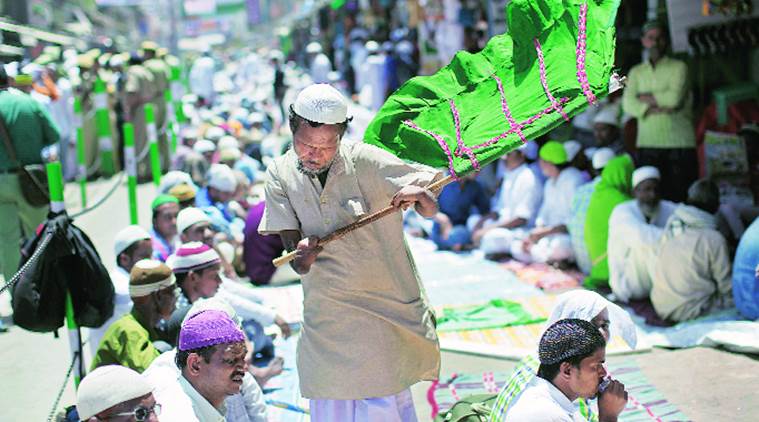
Dargahs such as the one in Ajmer (above) and Bahraich symbolise India’s syncretic heritage. Vishal Srivastav
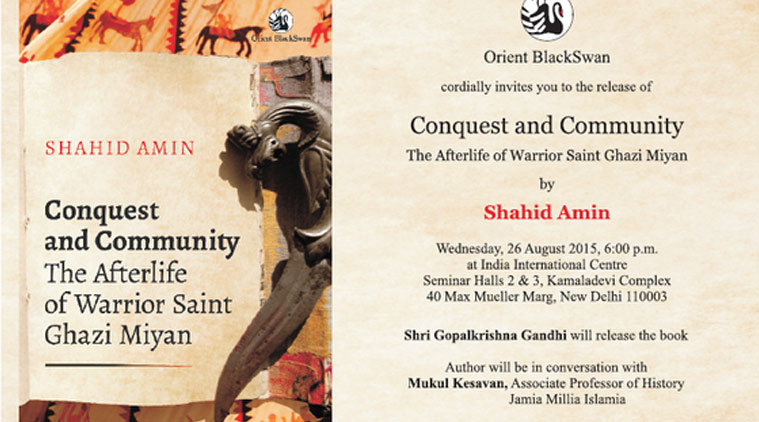
Book- Conquest and Community: The Afterlife of Warrior Saint Ghazi Miyan
Author: Shahid Amin
Publication: Orient BlackSwan
Pages: 348
Price: Rs 850
Three decades ago, the historian Shahid Amin wrote a brilliant piece, ‘Gandhi as Mahatma’, which is in many respects the locus classicus of what became the subaltern school of Indian history. What he offered was far more than what is ordinarily called “history from below”, showing that the masses made of Gandhi what they could, stepping outside the role habitually assigned to them by nationalist historiography. The Mahatma, Amin suggested, had been metamorphosed into a floating signifier.
In the present work, Conquest and Community, which cements Amin’s reputation as one of India’s most creative and learned historians, he extends this mode of analysis and turns his attention to Salar Masud or Ghazi Miyan as he is more popularly known, a warrior saint whose cult appears to have been well established by the 14th century.
The story of Ghazi Miyan begins, we may say, with Sultan Mahmud of Ghazni, whose name is calculated to turn the middle-class Hindu into a figure of rage: this early 11th century warrior made repeated incursions into India, “utterly ruined the prosperity of the country” and desecrated the shrine of Somnath. Folklore would inscribe a place for Salar Masud as Mahmud’s nephew, though contemporary records make no mention of such kinship, and representations of him as a warrior taking up arms on behalf of his uncle until he was felled in battle in 1034 against a confederation of Hindu kings began to proliferate.
More surprising still is the fact that the Ghazi was transformed into a Sufi saint, the extent of whose following and reputation might be gauged by the presence at his dargah of Mohammad bin Tughlaq, the Sultan of Delhi. Abdur Rahman Chishti’s 17th century hagiography, Mirat-i-Masudi, would displace Mahmud with Miyan Ghazi. To this day, the cult of the 11th century Indo-Turkic warrior saint thrives in north India, and Hindus and Muslims continue to be drawn in large numbers to his dargah at Bahraich.
Just how is it that the popular assent to the cult of Ghazi Miyan was garnered across the religious divide, and that too with respect to a figure associated in educated Hindu minds with the image of the rapacious Muslim invader? Amin says rather modestly that his “book eschews definitive explanations” and that he is not interested in asking why a 17th century Sufi wrote the text “at the time that he did,” or why “Hindu castes felt no compunction in installing a Muslim warrior on their domestic altar”.
He sets out, rather, to explore those aspects of the Ghazi Miyan narrative which took hold firmly in Gangetic popular culture. This leads him knee deep into some extraordinary anomalies. The commonplace view of Muslims in India renders them as beef eaters, but the Ghazi Miyan of folklore is a protector of cows, the saviour of oppressed cowherds, and a determined foe of the landlords who claimed as their prerogative the right to impregnate the virgin daughters of the Ahirs. In a similar vein, the ballads celebrate the story of the married Brahmin woman, Sati Amina, at whose home the sandalwood tree has dried up.
The family priest avers that the tree will regenerate upon the Ghazi’s arrival — and so it does. In gratitude, Amina washes the feet of the Ghazi and his followers, the Panchon Pir, and then serves them a lavish meal. What could be more violative of the social order than for a Brahmin woman to cook for a Muslim man? Yet, as the very name Sati Amina signifies — Amina is the Prophet’s mother — this is a story about in-between spaces and the risks (and pleasures) of transgressive and forbidden acts.
By the 19th century, as Amin shows, the cult of the Ghazi had become a source of acute anxiety to British, Muslim, and Hindu elites alike. Colonial ethnographers and officials had set out to clearly differentiate “Hindu” and “Muslim” communities, and the presence of a large number of Hindu worshippers at the sites associated with the Ghazi was immensely bewildering to them. On the specious ground that Bahraich was a “cosmopolitan” site and therefore not deserving to be characterized as a special religious endowment of the Muslims, the British sought to bring the dargah under their control and pocket the considerable donations left by devotees.
To the Ashraf or Muslim elites, their low-class and illiterate brethren who consorted with Hindu devotees were little better than idolaters, and the Muslim clergy had no difficulty in attributing the ignorance of Muslim devotees to their frequent social intercourse with Hindus. The zealots of the Arya Samaj and Hindu revivalists expressed alarm that “their” women were willing to surrender their dignity before a Muslim warrior saint, all too often in the hope of gaining male progeny. Such had been the consummate nature of Muslim dominance that, in Amin’s marvelously elegant and provocative rendering of the revivalist view, Hindus “partaking of holy unction” at “the altars of Muslim saints” were “virtually ingesting the leftovers from their Muslim neighbours’ kitchen.”
Few questions have animated Indian historiography, and discussions in the public sphere, as much as the relations between Hindus and Muslims. Amin’s study is a signal contribution to this literature, and he is particularly enlightening in his suggestion that while we cannot be dismissive of those who have posited a syncretic Indian past, it behooves us to view syncretism not only as a narrative of pluralism and accommodation but also in equal parts as a story of agonism, conflict and clash. His masterful study argues that while our narrative understanding of the Ghazi Miyan saga cannot stop at viewing him as “just a conqueror”, it must also contend with the fabrications and the verisimilitude engendered by local histories, ballads and folklore.
In what Amin calls “the quotidian culture of north India” reside perhaps our best hopes for neutralising those who would seek to homogenise the Indian past in the vain and dangerous quest to create the patriotic and “new Indian national”.
The writer is professor of history, University of California
source: http://www.indianexpress.com / The Indian Express / Home> Lifestyle / by Vinay Lal / October 10th, 2015
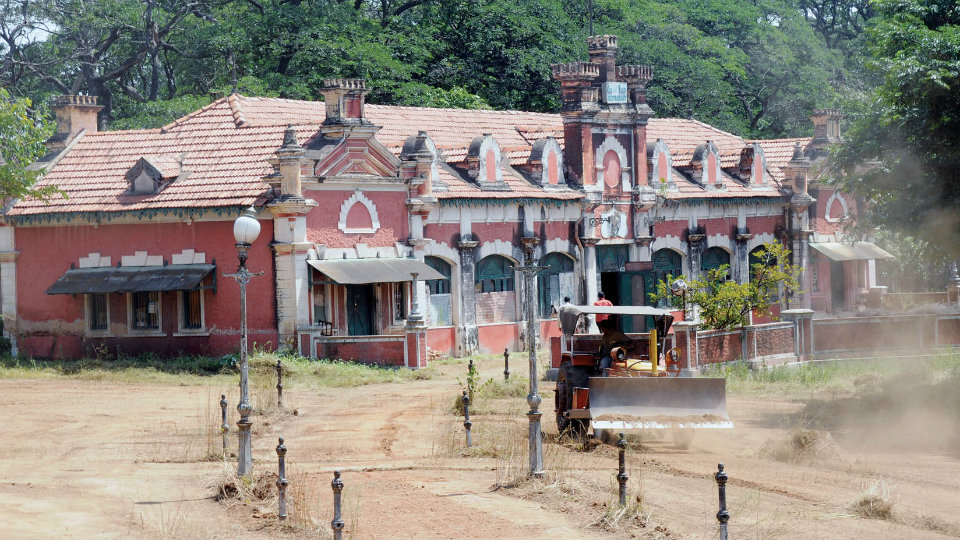
Yesterday evening as I was turning the pages of SOM to scan the headlines, I literally jumped out of my skin in excitement upon stumbling on the news that the Gun House Imperial Restaurant that used to once function from the Palace Gun House was soon going to throw its doors open once again to customers after a gap of thirty long years. I do not know what this bit of news is going to mean to other people but to me it perhaps is the beginning of the coming true of a long cherished dream and the end of a sense of anguish that had been gnawing at my heart strings ever since the hotel suddenly shut its doors without as much as a hint that it was going out of business.
My first memory of this once very beautiful landmark of our city is from the early sixties when I used to go there once a year in the company of Prof. M. Salar Masood, the younger brother of my maternal grandfather Alhaj M. Khaleelur Rahman. He was a Professor of Geography at Manasagangothri and it was he who usually took all the children of the large household on frequent excursions to the Palace, the Jagan Mohan Art Gallery, the Zoo, the Brindavan Gardens and Srirangapatna.
The large household that I am talking about was more of a hostel than a home as at any given time it used to have at least a dozen children of all shapes, sizes and ages! This was the result of my grandfather’s penchant for inviting all his relatives, especially those from the Malnad areas, to leave their children under his care here in Mysuru for their education. That is how I became an inmate of this warm and cozy nest of immeasurable happiness when I joined the Good Shepherd Convent School in the year 1960.
Our visits to the Palace Gun House used to be an annual affair to watch the ceremonial firing of the canons housed there to mark the beginning of the Dasara festivities. It used to be a very exciting moment with all of us expectantly staring with unblinking eyes at the red-turbaned guard on horseback at the Southern Gate of the Palace. Upon a cue from the Durbar Commandant that the Maharaja had arrived, he would raise the red flag which used to be the signal for the head of the battery to shout “Fire” at the top of his voice. That was when the gunners in green tunics and red turbans would start touching the firing holes of their loaded canons with smouldering wicks in a sequence. The almost blinding orange flash would be accompanied by a deafening boom followed by a thick cloud of acrid black smoke that I would find intoxicating!
The batch of seven cannons would be reloaded twice to complete the volley of the twenty-one shots that had to be fired for the occasion. And, this reloading had to be done only after thoroughly rinsing the barrels with cold water and brushing them dry once again. This precaution was most essential to ensure that there were no traces of smouldering gunpowder inside that could prematurely set off the powder charge the moment it was rammed down the barrel!
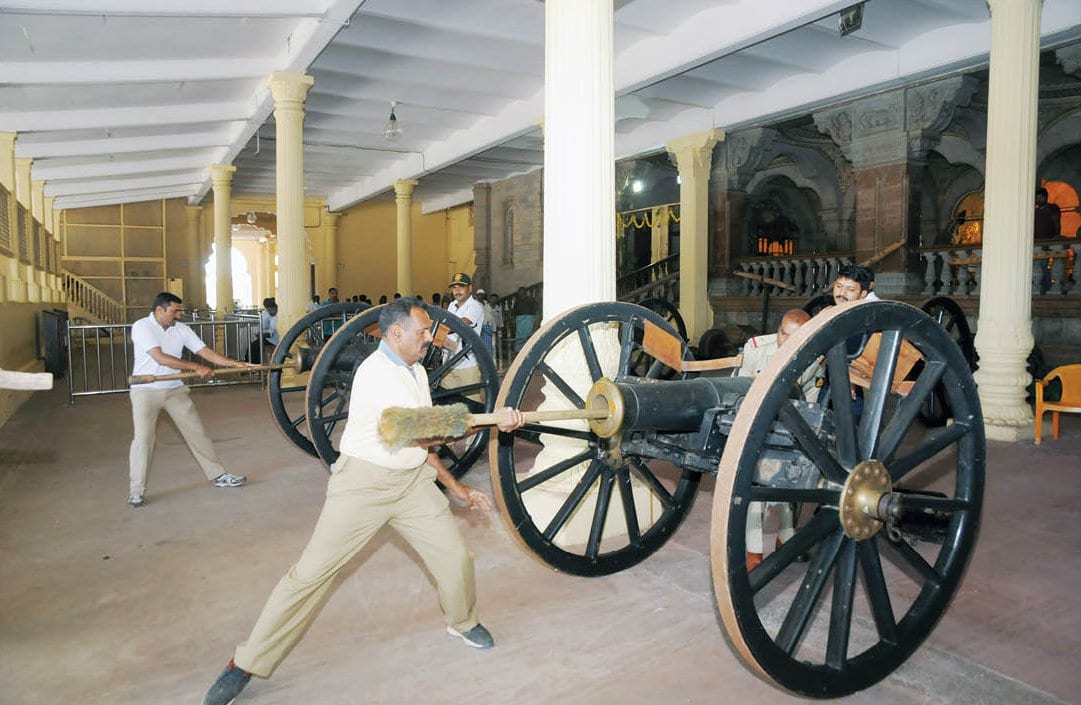
A team of City Armed Reserve (CAR) Police personnel conducting dry practice of cannon firing at the Mysore Palace
Somewhere down the years, for some inexplicable reason, these seven cannons along with their four accompanying ox-drawn powder carriages were shifted to the long verandah of the Palace where they now stand all through the year except when they are taken to the Bannimantap Grounds on Vijayadashami Day for the breathtaking Torchlight Parade that is undoubtedly the pride of our annual Dasara!
Now, it is not just for the annual firing of the cannons that the Palace Gun House had become dear to me. Long after the show had stopped there and well after I had grown up into a man from the school boy that I was, I found myself drawn to it for a completely different reason. Very soon after I joined the Mysore Medical College to do my MD in Medicine the Mysore royal family converted the place into a restaurant. Because of its unique ambience and the excellent food it served, most of our unit get-together and dinners used to take place there. Then, when I got married, soon after passing my MD, it also became the favourite dining-out place for me and my wife, especially on every Saturday evening!
Incidentally, on the days when my practice was unusually good, I would invariably take her to the Metropole Hotel, which was again in a building that was once a royal Guest House. These two places were the ones that served the best chilli chicken and egg fried rice, which accompanied by some chilled Torino and the timelessness of each others’ company was nothing but pure Nirvana for the two of us!
Gun House also had a live band where Sebastian Deniz, my favourite singer, used to perform with his fellow musicians on weekends. Fondly known to all as ‘Singing Seby,’ he knew all my favourite Jim Reeves and Frank Sinatra numbers so well that without the slightest need to be told he would start singing them the moment he would see us walking in! He had a voice that could make even unwilling hearts melt which was why perhaps we used to see so many boys taking their still undecided lady loves there for dinner!
Along with Seby’s voice the irresistible chilli chicken too perhaps played its part in breaking down any remaining traces of indecision and resistance to the proposals they made! So when the magical Gun House suddenly shut shop, it was sudden heartbreak for my wife and me and ever since then it has always been a bitter-sweet experience to drive past it. Sweetness from the warm recollection of the almost magical time we once had there and bitterness that it was the end of an era that was so dear to us! Hopefully, the clock is now all set to turn back and the good old days of our nostalgia are poised to come back once again!
source: http://www.starofmysore.com / Star of Mysore / Home> Columns: Over A Cup of Evening Tea / by Dr.K. Javeed Nayeem MD – email:kjnmysore@rediffmail.com / September 21st, 2018
Do you know how it feels to stay cooped up inside your room for five months with shattered window panes reminding you of the constant presence of violence? Nousheen Baba, 21 Science student, Government College for Women, Nawakadal | Photo Credit: V. V. KRISHNAN
It is one step at a time for these Kashmiri women as they break away from traditional strangleholds and dare to dream differently, reports Peerzada Ashiq
Srinagar’s sprawling Eidgah ground is teeming with people. Despite the onset of Chillai Kalan, the harsh 40-day winter spell, there is a hubbub. Some are playing cricket, the rest looking on. Soldiers from the Central Reserve Police Force (CRPF) in mobile bunkers stand guard on the boundary wall; fingers locked on the trigger which, at the hint of any trouble, can spray pellets or tear gas. Three newly dug graves in the ‘Martyrs Graveyard’ bear testimony to the violent and troubled times of 2016.
Just metres away from the graveyard, Nousheen Baba and her sister Iqra Baba recall how they could not hold themselves back from watching the funeral procession of 12-year-old Junaid Ahmad on October 9. Security forces allegedly emptied an entire pellet cartridge from close range at Ahmad and the Valley exploded in anger and sadness at the loss of a young life. “Do you know how it feels to stay cooped up inside your room for five months with shattered window panes reminding you of the constant presence of violence,” asks Nousheen, a second-year science student of Government College for Women, Nawakadal and aspiring chartered accountant. The windows of the Baba household bore the brunt of the clashes which erupted between security forces and protesters.
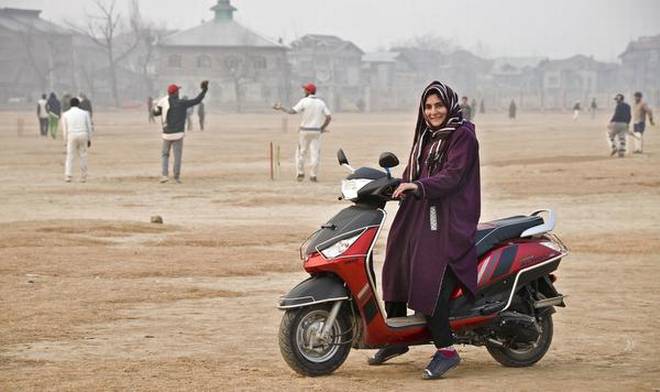
But Nousheen is eager to put the painful year behind her and even manages a shy smile. As a warren of houses in the highly congested Narwara locality in downtown Srinagar greets the eye, a tiny silhouette in a shiny grey cover makes its presence felt in the small courtyard of the Babas. Beneath the cover is the family’s first motor-driven two-wheeler. Courtesy Iqra, a Bachelor of Commerce student at the same college her elder sister goes to, who was rewarded by the State government for securing 85 per cent marks in her Class XII exam. “It’s our first scooter in the family. We are all learning to drive it,” says Iqra’s father Mushtaq Baba, a weaver. The Scooty is Nousheen’s constant companion too ever since Iqra brought it home nearly two months ago. From college to market, to visiting her friends, it is her lifeline to a future she dreams about.
Dreams on wheels
In the first phase of the two-wheeler scheme, Chief Minister Mehbooba Mufti handed over the keys to 450 scooters to graduation-level students of Government College for Women, Nawakadal and Government Women’s College, Baramulla on November 6. Only meritorious students whose family income is under Rs.4 lakh per annum are eligible for the scheme, which is being extended to all degree colleges of the State. In Jammu, 300 scooters were handed over to eligible students.
Mufti sees the Scooty as a game changer in improving the education of girl children who come from economically weaker sections. “I have lived a common man’s life and gone to college on a bus. I know the difficulties women face while using public transport. You feel it is safe sitting next to an old man, till he starts nudging you in the elbow; the unwelcome attention can be harrowing for any woman,” says Mufti, explaining the rationale behind her scheme. She recalls a young woman she spotted riding a scooter in Srinagar earlier this year while on her way to the State Assembly. “This girl was short and slim but it was her confidence that was striking. The idea took shape right there. We took the decision to bear 50 per cent of the cost of the bike,” she says.
The government has dovetailed many Central schemes meant for women empowerment to provide these scooters. “I wish I had one and could ride it freely. A girl who owns a Scooty now will never have to request her brother or father to go places. The two-wheelers give women a sense of control of things,” says the Chief Minister, adding, “Women are the first casualty of violence. Investments must be made to empower women.”
Iqra, for one, feels empowered, never mind the taunts of the local boys as she drives past: “The two-wheeler has earned me azadi (freedom) enough to go to tuitions late in the evening.” Five km away from the Baba household, Nargis Rasool, the eldest of four sisters and a brother, borrowed money to avail the Scooty scheme. “My father treats me like my brother’s equal now since I started driving the Scooty. It is like taking part in a revolution. Though many elders did object to my driving saying ‘how can a girl ride a Scooty on the street?’, my parents supported me,” says Nargis, a final-year Arts student of Government College for Women, Maulana Azad Road. Her 90-plus percentage in the Class XII exam helped this civil services aspirant to bring the first-ever vehicle to the Rasool household, a family of shawl weavers. Nargis has become an inspiration for the extended family, including six female cousins. “Their parents are now forcing them to study hard to secure a Scooty on merit,” she says.
I am rooted in Kashmiri art and culture. I want wages and artworks of women to shift to a competitive level. Arifa Jan, 31 Owner, carpet manufacturing unit | Photo Credit: V. V. KRISHNAN
Reviving an old craft
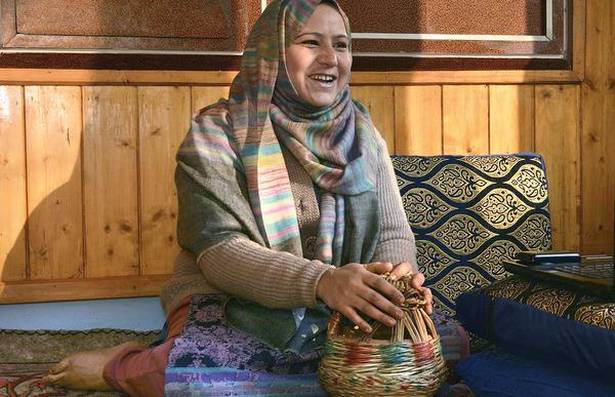
Namda, a carpet made through the process of felting by hand, needs both muscle and money. For Arifa Jan, 31, who completed in 2010 her Craft Management Entrepreneurs’ Leadership Programme from the Craft Development Institute, Srinagar, the challenge was to turn around the fortune of this dying craft at a time when exports of the once-world-famous Kashmiri carpet had plummeted. According to a government survey, the total production of handicrafts rose to Rs.1,614.59 crore by 2008 against Rs.200 crore in 1990-91 but Namda exports had gone down 97 per cent and amounted to less than Rs.40 lakh annually.
“The use of cancer-causing dyes and poor cotton mix pushed Namda to the verge of extinction,” says Arifa. She infused science and healthy processes back into the craft to make it market-friendly. In 2010, she had to brave prolonged curfew spells to reach her unit to weave the first-ever assignment of 300 Namdas, meant for an exhibition in New Delhi by Dastkar, an NGO working with craftspeople across India.
“Eight-five per cent of my Namdas were sold. I still remember the taunts of a German buyer who kept saying we were producing fake Namdas,” says Arifa, who credits an unknown buyer from Delhi for her first brush with success. The buyer later turned out to be Gulshan Nanda of the Crafts Council of India. Nanda reposed faith in Arifa and the money flowed. “Ms. Nanda would come to me and ask serious questions about the craft,” says Arifa.
In 2013, the Crafts Council of India selected Arifa for a trip to Kyrgyzstan to study their processes of carpet-making. Back home, she scouted for an Australian merino sheep hybrid that was introduced in the Valley in the 1960s. “Its wool is what goes into exquisite Namdas,” she says.
For the first time, Arifa introduced pre-processes to weed out hazardous particulates from the wool and ensured no cancer-causing dyes make their way into it. “Even artisans who’d make chain stitches on the carpet used to complain of chest pain earlier due to the use of synthetic ingredients,” she says.
The daughter of a retired State Road Transport Corporation employee, Arifa is now eyeing business opportunities in the U.S. even as her stable has expanded to 27 artisans, 17 of them women. “I am rooted in Kashmiri art and culture. I want wages and artworks of women to shift to a competitive level. Artisans have suffered a lot in Kashmir — we have to bring them on a par with sellers,” she says.
A girl from Kashmir, counting one lakh rupees and all the men around looking in awe at her… A strange feeling seeped in. Shaeena Akhtar, 31 Owner of a shawl loom | Photo Credit: V. V. KRISHNAN
Weaving a new formula
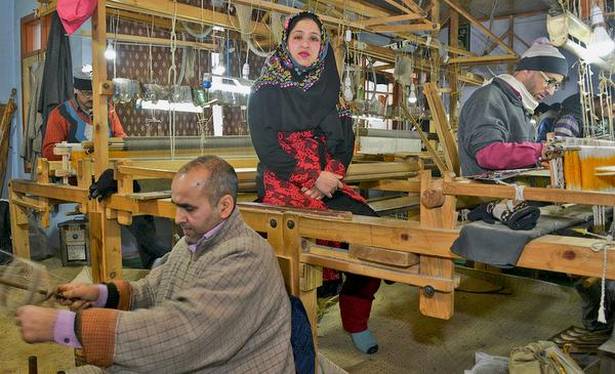
It’s 4.30 p.m. The rolling wooden bobbins with multi-coloured fine threads and the neatly thrown over-and-under shuttles meant for woofs and warps are showing no signs of the day’s tiredness. Bollywood music from the 1980s breaks the monotony of the shuttles at work. It’s the first loom in Kashmir where a woman is at the helm, and an attempt is underway to replicate the famous floating garden on Dal lake, Char Chinari, as a design relief from traditional motifs in Kani shawls, a fine handwoven mix of pashmina and shahtoosh wools. “We have developed a new formula for shawls. No one can steal it. It’s original and a major departure from the past. My work drives my clients to my loom — I have requests pending from many exporters,” says Shaheena Akhtar, 31. Like Arifa, Shaheena, a resident of Srinagar’s Nowshera area, too comes from a humble weavers’ family, but in just five years, she is being credited with giving a new identity to the Kani shawl, picking up the State’s Best Entrepreneur award along the way three years ago.
Shaheena’s journey to finding acceptability in markets in Italy, Germany and Dubai has been anything but easy. “Not everyone treats you as a daughter or a sister when you start something like a shawl business. My character was questioned because I used to meet officials. I struggled to have bank guarantors because my father was just a small-time weaver. It was not easy to raise money,” she recalls.
Following a training stint at the Entrepreneurship Development Institute, Pampore, in 2011, Shaheena was able to start with an initial investment of Rs.8 lakh. In a year she counted her first one lakh rupees in earnings. “My father had never counted Rs.1 lakh at a time. I am good at counting money. But that Rs.1 lakh was something I could not count for a while. A girl from Kashmir, counting money, and all the men around looking in awe. A strange feeling seeped in,” she recalls. As business grew, she enlisted her brothers’ help. “Of the 18 workers at the loom, 12 are relatives. I am proud that in such a short span I have a turnover of Rs.1 crore,” she says.
Roh-i-Kashmir (Soul of Kashmir), Shaheena’s company, has tie-ups with six major exporters for the 60-70 shawls her loom produces annually. “My thrust is quality. My shawl sells for Rs.4.5 lakh in the international market for its intricate and exquisite work. It takes more than nine months and two labourers to finish one intricately woven Kani shawl,” Shaheena adds.
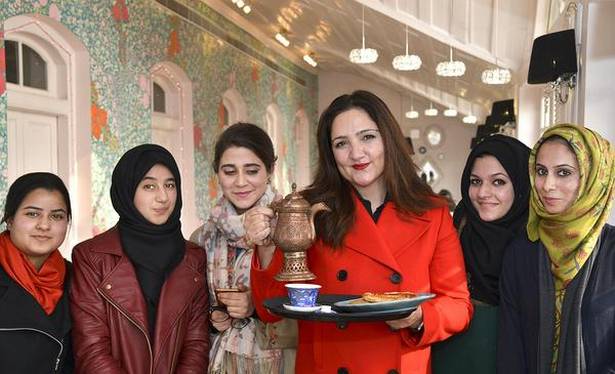
Every time I watch a fisherwoman of Srinagar, I can see her making her own rules as she negotiates her space and life. Roohi Nazki, around 40 Owner, Chai Jai | Photo Credit: V. V. KRISHNAN
An English tea room in Srinagar
Historically, Kashmir has drawn its taste buds from Central Asia, including the famous kahwah (a traditional green tea preparation) and multi-cuisine wazwan. Roohi Nazki, a former employee with Tata Interactive Systems, is trying to get Kashmiris hooked on something very different: the tea room. It’s been worth the effort, if increasing footfalls at her small joint, Chai Jai — modelled after tea rooms in England — are anything to go by.
It was a solo holiday trip to England in 2013 that changed Roohi’s life and introduced her to the niceties of tea rooms. In the Cotswolds villages of south-central England she saw mirror images of the Kashmir Valley. Moving back to the Valley after living in Mumbai for 22 years, Roohi’s parents initially persuaded her to stay on in a corporate job, but she just knew what she wanted to do next.
As one walks down the British-era manicured embankment of the Jhelum river in Srinagar’s Polo View area, Roohi’s ‘little England’, complete with castle-room interiors and cobblestone floors, is hard to miss in the age-old Mahatta Building.
Launched in July this year, Roohi is reviving teas from bygone times like Daam Tyooth (a herbal tea), Bunafshan tea (flower tea), Qadri tea (a herbal tea with sugar mix), Nettle tea and Gulkand kahwah (mix of saffron and sun-dried rose petals). “I have 28 varieties as of now and I am working on a collection of 200 varieties,” she says.
Small steps to giant strides
While it is too early to see these women as enduring successes, having a woman Chief Minister at the helm seems to have given a fresh impetus to a more inclusive society in a State which has primarily been in the news this year for its mind-numbing violence. A slew of measures initiated by Chief Minister Mufti — including reservation of 10 per cent land in industrial estates for women entrepreneurs, the Ladli Beti scheme aimed at the economically poor, an all-woman entrepreneurs’ market, all-woman buses and all-woman police stations — are aimed at women.
The opposition National Conference spokesperson Sarah Hayat Shah acknowledges that every step towards empowerment of women is always appreciable, but simultaneously points out the troubled ground reality in Kashmir where even young girls have been killed or blinded in the wave of protests since July. “I am afraid the scooters may not be able to heal the wounds,” she says.
Ultimately, beyond the overhang of violence, a lot of the contestations with patriarchy are essentially atomic. “Every time I watch a fisherwoman of Srinagar, I can see her making her own rules as she negotiates her space and life,” says Roohi, now in her 40s.
Just like she fights her own little everyday battles, such as taking trolls — who were ‘outraged’ at her bringing a feel of Christmas to Chai Jai with cakes and candies from Mumbai — off her Twitter feed, one resolute click at a time.
source: http://www.thehindu.com / The Hindu / Home> News> National> Ground Zero / by Peerzada Ashiq / December 31st, 2016
In 1857, the mosque built by Shah Jahan’s wife was confiscated by the British
When the city of Shahjahanabad was being built by Mughal emperor Shah Jahan, his wives and daughter were also involved — they built mosques, markets and sarais to embellish the city.
The emperor’s daughter, Jahanara Begum, was the most prolific, and is best known for building the famous Chandni Chowk (moonlit square), a sarai or inn for travellers, and a beautiful garden known as Begum Ka Bagh.
The road to the mosque
Shah Jahan’s wives — Akbarabadi Begum, Sirhindi Begum and Fatehpuri Begum — built mosques in 1650 CE. The Fatehpuri mosque built by Fatehpuri Begum was aligned to the Red Fort — more specifically, to the Diwan-e-Am via the Naqqar khana (drum house) and Lahori Gate. Nobles who came to the court of the public audience had to dismount here and walk up to the court. As this was inconvenient for them, Aurangzeb had a barbican built in front of the Fort’s Lahori Darwaza so that they could dismount closer to it. Shah Jahan, who was then under house arrest in Agra Fort, sent a note to his son saying that the beautiful bride (Qila) had now been veiled.
The road from Fatehpuri mosque to the Fort passed through Chandni Chowk and Urdu Bazar (the original Urdu Bazar was located in front of the Lahori Gate till part of present day Chandi Chowk) and was lined with trees and flowers. These were cut in the beginning of the 20th century. Basheeruddin Ahmed, the writer of Waqeat e Dar ul Hukumat Dehli (1919), lamented that “the trees on both sides of the road provided solace to the inhabitants in the severe Delhi heat with its summer wind, the loo, in which the eagle abandons the eggs and deer become dark.” Today, when you go from the Red Fort to Fatehpuri mosque at the end of Chandni Chowk, you have to navigate your way through the nightmarish traffic, carts with goods, rickshaw-pullers, e-rickshaws, salesmen calling out to passers-by, and busy shoppers.
Crowded outside, peaceful inside
The mosque is next to the Khari Baoli, or spice market, so the entrance is always crowded. However, once inside the masjid, you realise that you’re in a different world — a world in which you feel a sense of peace and which is in stark contrast to the scenes outside.
Apart from the main entrance in the east, there are two other doorways — one in the north and the other in the south. With their arched entrances and parapets, these doorways have obviously seen better days. Shops outside flank them.
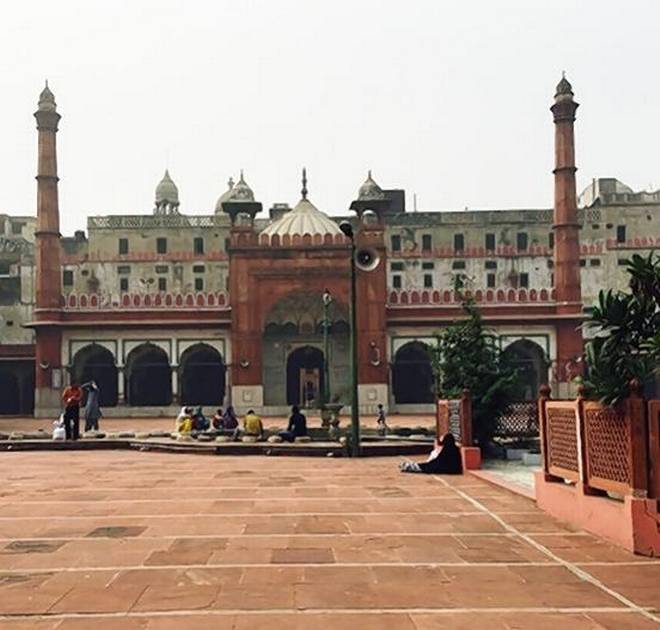
In the courtyard, the first thing that catches the eye is the lovely white dome with its longitudinal green stripes and green lotus finial. A masonry finial crowns it. Though the dome is made not of marble but red sandstone, it has been plastered so perfectly that it gives the impression of being made from marble when seen from afar. Red battlemented parapets run all along the roof in front of the dome.
The mosque, too, is built of red sandstone. Its unique feature is that it is the only medieval mosque with a single dome, flanked by two 80 ft tall minarets on both sides.
The mosque is built on a plinth of 3.5 ft. In the centre is a lofty archway with two wings which have three scalloped arches on each side. The central mihrab (in the direction of the qibla) is deep and high, and gives a beautiful appearance to the interior of the mosque. The pulpit next to the mihrab is the only piece of marble in the mosque. A mukabbir, or platform, was added in front of the main arch later, so that the imam’s words could be repeated from there and reach all those gathered in the courtyard.
There is a huge oblong tank for ablution in the courtyard that used to be fed by the famous Faiz Nahar (canal) in the Mughal era. A red sandstone enclosure next to it has graves of religious leaders who lived, prayed and taught in the mosque. There are galleries, with rooms on the ends on both sides.
From 1857 till today
The Indian sepoys, or ‘rebels’ as the British called them, who had risen up against the East India Company in 1857 had used this mosque. After the fall of Delhi in September that year, the mosque was confiscated by the British, and the courtyard, galleries and arcades on the three sides were put up for auction. As the dispossessed and displaced Muslims of Delhi post-1857 were in no position to buy it, Lala Chunnamal, a rich merchant of Delhi, bought it at the cost of ₹29,000.
In 1873, Anjuman Rashidin Sulah e Kul Islamia applied for return of the mosque. The British government agreed and tried to buy it back, but Lala Chunnamal refused. In 1877, the British offered an increased amount as well as four villages and bought it back from Lala Chunnamal’s son and restored it to the Muslims of the city. The masjid was brought back into use as a masjid, and remains so till today.
source: http://www.thehindu.com / The Hindu / Home> Opinion> Columns / by Rana Safvi / September 16th, 2018
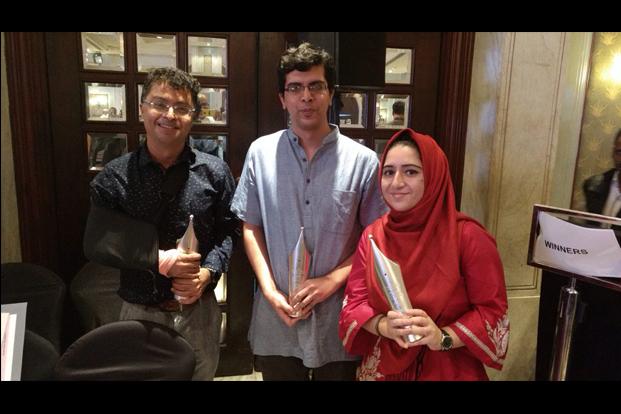
Ashwaq Masoodi, Pramit Bhattacharya and Shamik Bag were winners of the top journalistic awards in their respective categories
(From left) Shamik Bag (Feature Writing category), Pramit Bhattacharya (Commentary and Interpretative Writing) and Ashwaq Masoodi (Uncovering India Invisible). Photo: Mint
Mint’s journalists won three prizes at the Ramnath Goenka Awards, India’s top journalistic award.
Ashwaq Masoodi won the award for the category ‘Uncovering India Invisible’ for her aspirations series, narrating the stories of young men and women who, like millions of their peers in the country, are striving to make it (and make it big).
Shamik Bag won the award under the category ‘Feature Writing’ for his moving profile of mountaineer Malli Mastan Babu, who died alone on an Andes peak. And Pramit Bhattarcharya won the award under the category ‘Commentary and Interpretative Writing’ for anchoring Economics Express, which uses the lens of economics (and published research) to look at everything from communal riots to marriage to diets to climate change.
There’s more to the Mint newsroom’s brand of journalism than awards, but it hasn’t escaped my attention that these three awards reflect our mission statement—to serve as an unbiased and clear-minded chronicler of the Indian dream. —R. Sukumar.