Category Archives: Arts, Culture & Entertainment

Man feeding the poor gets Yudhvir award

Hyderabad, TELANGANA :

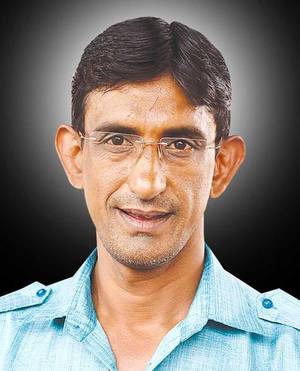
Syed Osman Azhar Maqsusi

Social worker Syed Osman Azhar Maqsusi has been named to received the 27th Yudhvir Foundation Memorial Award in recognition of his dedication to uplifting the lives of people in marginalised communities by feeding the hungry. The award for this year includes a citation and cash of ₹1 lakh.

Mr. Azhar was only four-years-old when his father, an auto driver, passed away. His mother struggled to care for him and three other siblings. He gave up his studies at the age of 10 and took up odd jobs to support his family. In 2001 he started a Plaster of Paris unit which remains his only source of income even today.

A stray encounter with a hungry woman led Mr. Azhar to start his campaign to feed hungry persons in 2012. This has grown into a daily food camp for over 150 hungry mouths. In October 2015 he set up the NGO Sani Welfare Foundation to carry the work further.

Inspired by his example and at times aided by him, free food programmes for over 1,000 people have come up in different cities across India in coordination with local trusts and authorities. Free clinic, free educational academy and a free tailoring centre for needy women have also been set up.

His selfless perseverance has brought dramatic changes in the lives of those he has helped and he remains an inspiration for all of us, said a press release. Member of Parliament Kalvakuntla Kavitha will present the award on April 30 at KLN Prasad Auditorium, FTAPCCI Bhavan, Red Hills.

source: http://www.thehindu.com / The Hindu / Home> News> Cities> Hyderabad / by Special Correspondent / Hyderabad – April 19th, 2018

Artist Wajid Khan making India’s tallest Swami Vivekanand statue

Indore, MADHYA PRADESH :

International artist Wajid Khan, famous for his ‘iron nail art’, is making the tallest statue of Swami Vivekanand in India that would be installed in Uttar Pradesh.

International artist Wajid Khan, famous for his ‘iron nail art’, is making the tallest statue of Swami Vivekanand in India that would be installed in Uttar Pradesh. The statue made of ashtdhatu (alloy) will be 170-feet tall and will be installed either in Lucknow or Agra, said Khan.

He said the statue will be completed in six months. Khan is here to take part in the four-day International Art Festival being organised at the Aligarh Muslim University (AMU).

Though Wajid Khan has not studied in any university or college, he has made a mark for himself by his craftsmanship in metal statue making. He is also making a sculpture for FIFA 2022 to be held in Qatar. The project will take five years to complete.

“A 40-feet statue of Swami Vivekanand is installed in Kolkata and that is his tallest statue. Now, the work on making his 170-feet statue has started in Indore,” said Khan.

“The project is being financed by some businessmen from UP, Delhi and Gujarat. They will decide on the place where the statue will finally be installed. As of now, the first preference is Lucknow and the second is Agra. Due to any reason, if the statue is not installed these cities, the third option will be Delhi,” he added.

“The statue is being made from eight metals including iron, zinc and copper. For the time, the total cost of the statue cannot be revealed,” he said.

Wajid Khan said he is also making a 10×8 ft statue of British Queen Elizabeth, which will be installed at the Royal Palace in London.

Khan has embarked upon a new venture. A proposed retro Bhopal city will be established in 40 acres area in Bhopal and the artist will give it a 2,000 years old look. The project is being financed by some businessmen.

source: http://www.hindustantimes.com / Hindustan Times / Home> Cities> Lucknow / by Pradeep Saxena, Hindustan Times,Aligarh / March 15th, 2018

Islamic scholar dead

Edavanna (near Manjeri), KERALA / Sharjah, UAE :

His books on Madhabs are popular

Islamic scholar Abdul Salam Sullami, 67, died in Sharjah on Wednesday.

His body will be brought to his home at Edavanna, near Manjeri, on Friday. The funeral will take place at the Edavanna Juma Masjid at 4.30 p.m. on Friday.

A leading Mujahid scholar, Sullami wrote several books on Shariat, Koran, and Hadith.

His books on comparative religious study and Madhabs are popular. His commentary on Sahih-ul-Bukhari and translation of Riyad-u-Swaliheen earned him much fame in Kerala .

source: http://www.thehindu.com / The Hindu / Home> News> States> Kerala / by Staff Reporter / Malappuram – February 01st, 2018

What made N.A. Ansari’s films so entertaining?

Jhansi, UTTAR PRADESH  / Mumbai, MAHARASHTRA  / Ontario,  CANADA   :

MAansariMPOs20apr2018

They were your classic B-rated thrillers, engaging and very watchable

My uncle had the most eclectic collection of books. He bought volumes on chemistry, Russian folktales, Andalusian cooking, Mandarin grammar, sericulture; he didn’t care about the subject, it was the artwork in them that appealed to him. That’s how I too got attached to ’60s pulp art, most of which was European or American; fascinating but foreign.

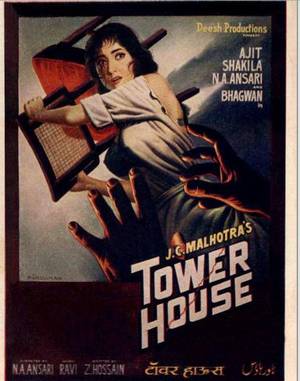
Then, one fine day, I came across a booklet on N.A Ansari’s film Tower House, and couldn’t take my eyes off the cover. It was done in quintessential ’60s style, which of course made sense because it was a ’60s film. The cover had actor Shakila, in a torn white nightgown, holding a chair, even as a pair of hands tried to grab her.

This artwork is what drew me to Ansari’s cinema.  His films had everything I enjoyed. They were mostly thrillers that frequently started out with faux hauntings. Soon the suave detective would take over and all the staples would be in place. Romance, action, comic sub-plot, the Anglo-Indian vamp, cabaret, a few red herrings, poignant family moments, and a team of really bad ‘bad guys’. I used to watch them while eating dinner and found great comfort in their predictability. It was very similar to the drive-in cinema in North America, only India did not have the concept of drive-ins then. They were your classic B-rated thrillers, engaging and very watchable.

One may argue with this categorisation because Ansari always worked with mainstream actors like Pradeep Kumar, Ajit, Balraj Sahni and Johnny Walker. The films were fairly well-produced, the music was decent, and some of them did good business at the box office as well. My reasons for comparing them to drive-in cinema are primarily based on the content and the unapologetic slapdash treatment of it. The stories were straightforward and most of the characters were two-dimensional. However, there was one distinguishing feature in almost all of his films. The arch-villain’s character was well-written and nuanced. It is no surprise that Ansari himself played the villain frequently, and he was easily the most attractive part of the film. No matter how shoddy the rest of the film, Ansari’s part would always be well done.

For example, in Tower House, the writing is very inconsistent and the two mysteries are actually disconnected. The main story revolves around a haunted tower where the ghost of Shakila’s mother reenacts her suicide every night. Even though Shakila and her father try to live a normal life, the rumoured haunting of the tower continues to affect their lives. The first 30 minutes of the film focus on the investigation of the haunting. After that, the emphasis shifts to a mysterious stranger with an eye-patch, played by Ansari himself, who suddenly arrives at their house. The movie then becomes his backstory, and another parallel mystery begins.

Even though the stranger claims to be an old family friend, it becomes evident that he is plotting something frightfully evil. But once again, we are left without answers when the stranger gets killed by a tiger and, without further explanation, we dive straight into an unrelated comic sub-plot. Later, it turns out that Ansari’s character had masterminded the whole tower house mystery by capturing Shakila’s mother and throwing actual dummies every night, to recreate the suicide. We never find out why he was doing it. All we are told is that he is tremendously wicked. This film contains all of Ansari’s common elements including my personal favourite, the Anglo-Indian vamp called either Rita, Rosie, or Lily, and always played by Nilofar.

The consistent illogicality is what made Ansari’s films so entertaining. The synopsis card of Zindagi Aur Maut (1965) encapsulates its essence: “Life & death two common phenomenon associate with all living beings. But when the calamity is national embracing the whole nation, it is not just the few individuals who die but thousands, lacs and even millions. It is to avoid such disasters hand-picked, super courageous, intelligent men work round-the-clock to uncover plots, treacheries, spys espionage…. ESPIONAGE…..”

Ansari’s most talked about, and complicated, film is Wahan Ke Log (1967). It is an unusual film, an interesting blend of a ghost and thieving aliens. In one plot, there are aliens who come down from Mars in flying saucers and steal diamonds from rich men. If the men resist, they are fatally shot with laser guns. There is a scientist called Professor Chakravarthy (played by Ansari himself) who claims he has made a machine through which he can communicate with the aliens.

The second plot is about Chakravarthy’s son, Anil (once again, Ansari), an evil genius who has invented a machine that can control people through a locket. Of course, Anil is assisted by Margaret, played by none other than Nilofer. Their hobby is blowing up people and cars and bragging about their wickedness. Anil has only one threat, a brilliant secret agent played by Pradeep Kumar.

The third plot involves the secret agent and his relationship with a 200-year-old ghost of a princess. Eventually, it turns out that Anil, after murdering his father, bought an island near Mumbai. He used it as a base to control spaceships that were used to steal diamonds from rich men in Mumbai. The Martians were robots he had designed to get rid of his opponents and steal their money. His brilliant project was being funded by an unnamed enemy country. The ghost story is also solved when it turns out that the ghost is a real girl, who just favoured an unusual courtship.

It would be imprudent not to mention Black Cat (1959), another spy thriller where the lead actor was Sahni, the last name anyone would associate with a ‘B’ thriller. It is important to bear in mind that Sahni’s presence doesn’t change the basic fabric of Ansari’s films. It contains all the Ansari staples, including Nilofar as Lily.

The writer is a historian based in Queen’s University, Canada. Watching old Bollywood films keeps her going.

source: http://www.thehindu.com / The Hindu / Home> Entertainment> Movies>  Odd Film Out / by Aditi Sen / April 14th, 2018
IIT-Madras to map Golconda’s Bagh-e-Naya Qila

Hyderabad, TELANGANA :

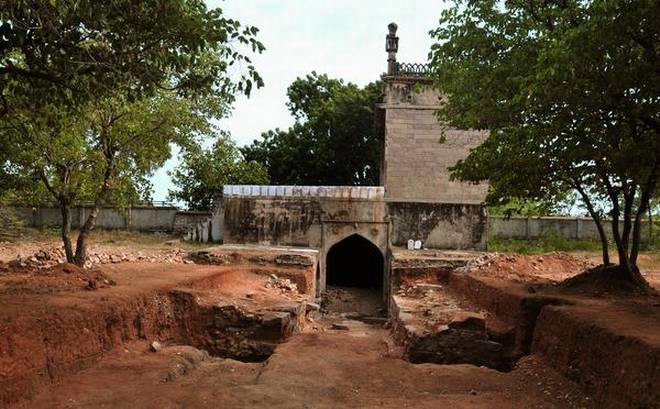
A tunnel hidden below the garden layout at the Qutb Shahi tombs and connecting with Golconda Fort was unearthed during excavations. File | Photo Credit: G. Ramakrishna

ASI wants to ensure medieval relics aren’t destroyed by an expanding golf course

In another instance of modern technology coming to the aid of medieval heritage, the Archaeological Survey of India (ASI) will be using Ground Penetrating Radar (GPR) to map the contours of the area around the Bagh-e-Naya Qila excavated garden inside the Golconda Fort. It has roped in the Indian Institute of Technology-Madras (IIT-M) to carry out the mapping.

This medieval garden in Hyderabad  is the only one of its kind still intact. All the others – built during the Qutb Shahi rule (1518-1687) — have either been built over or have disappeared. The contour mapping was necessitated by the impending advance of the Hyderabad Gold Club, which wants to expand its 18-hole course into a 21-hole one by taking over some of the land adjoining the Bagh-e-Naya Qila site. A GPR map would reveal any medieval relics that may lie buried under the ground, and could thus be saved by the ASI.

“The Hyderabad Golf Club, which has built a golf course in the Naya Qila area, wants to add a few more holes on the other side of the garden. We don’t want to lose any more history. We want to ensure that there are no relics of the Bagh-e-Naya Qila underneath and hence we are planning to map the area with GPR. We would have liked to do this with a Light Detection and Radar (LiDAR) but for that we need the permission of the Defence Ministry,” said ASI Superintending Archaeologist Milan Kumar Chauley.

The Naya Qila garden inside Golconda Fort was built by successive rulers of the Deccan and is one of the few symmetrical gardens extant. In 2014, when the ASI excavated the area after diverting the water flow, it discovered water channels, settlement tanks, walkways, fountains, gravity pumps, and a host of other garden relics.

An earlier excavation unearthed gold coins in the area where the golf course has been created. According to author Ali Akbar Husain, the Naya Qila area also has multiple chabootras (raised platforms) which are remains of garden structures that pre-date the Qutb Shahi rule. In the 1940s, the garden was even used for celebrating Basant Panchami.

The team from IIT-Madras will do a preliminary survey to ascertain the path for the contour-mapping. “We have told the IIT-Madras team that the survey and mapping have to be finished before the monsoon sets in. We will do the preliminary study by end of this month and the mapping might be completed in May,” Mr. Chauley said.

While there is a semi-collapsed ‘baradari’ (a gazebo-like structure with many pillars) in the garden, historians believe that another baradari might lie buried in the ground. GPR uses electromagnetic radiation in the microwave frequency for imaging sub-surface area.

source: http://www.thehindu.com / The Hindu / Home> News> Cities> Hyderabad / by Serish Naninsetti / Hyderabad – April 17th, 2018

The art of writing time

hennai, TAMIL NADU :

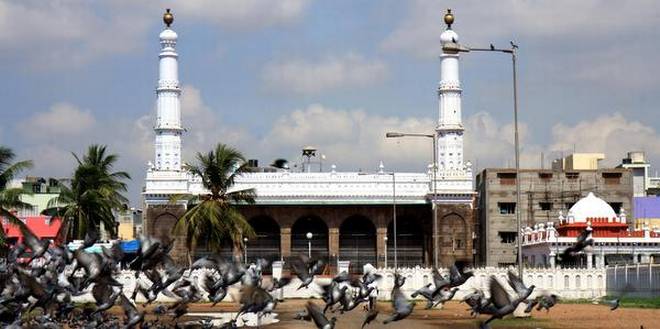
The chronogram by Raja Makhan Lal Khirad at the Wallajah mosque and the exterior of the mosque. Photo: S. Anwar

As part of the Madras Week, S. Anwar throws light on the chronograms etched in mosques across the city.

When Saadathullah Khan, the new Nawab of Arcot created a beautiful garden in his capital city Arcot, and was looking for a suitable name, Jaswant Rai, his chronicler presented him with the name ‘Humayun Bagh,’ meaning ‘Auspicious Garden.’ The Nawab was very impressed and mighty pleased as he also understood that his chronicler had offered him much more than a name.

Earlier the Nawab had gone to great lengths in adorning Arcot with stately buildings. What was missing was the gardens. Being a Mughal protégé, the Garden was important. And so next to the river he laid an extensive garden with flower beds and fruit bearing trees of different kinds. He further decorated it with one hundred and fifty fountains that were perennially fed by a system of waterworks.

Keeping the climatic conditions of Arcot in mind the Nawab ordered for trees from Telengana to be planted in the garden. Once the work was done, he was equally keen to have a worthy name for his royal garden. That was when Jaswant Rai pleased him not just with a name but a skilfully composed ‘Chronogram’ which, when carefully read, also revealed the year of its (Garden) creation in the Islamic calendar of Hijri as 1,113 (corresponds to 1,701 CE).

Before the Indo-Arab numerals came into wide use, it was common to assign numerical value to alphabets as the Greeks did. Chronograms essentially took it one step further where the numerical value assigned to each letter in the text when added, the sum total reflected the year of the event on which the chronogram is composed. Essentially the word “Chronogram” meant “time writing,” derived from the Greek words chronos (“time”) and gramma (“letter”).

Typically the chronograms could be just one word, a verse or verses including those from the Holy Scriptures of any of the Abrahamite religions. The Jews composed chronograms using Hebrew numerical system and it was known as Gematria. The Abjad system assigns numerical value to the Arabic letters and it is common to see the important Islamic phrase, a phrase with which Muslims begin their prayer or any good deed – ‘Bismillahir Rahmanir Rahim’ (“In the name of Allah, the most merciful, the most compassionate”) – with a numeric value of 786.

Though this tradition of composing chronograms was prevalent among various societies, it came into its own during the medieval period with the Jews, Christians and Muslims taking to composing ‘chronograms’ to commemorate events. It could be a victory of an army, inauguration of a palace, a church, a mosque or could be even death.

When Begum Sahiba, the Nawab’s companion of many years, died during the month of Muharram, many a poet in Saadathullah Khan’s court wrote elegies and as was the tradition some of them attempted composing chronograms. The most appropriate one was of course composed by the Nawab’s elder brother Ghulam Ali Khan. It was a verse from the Holy Quran, Wadhkhuli Jannati (“And enter my Paradise”). It gave the year of her death as 1114 Hijri era, which in Gregorian calendar translates to 1702 CE.

A year after her death the Nawab built another garden of the same dimension as the Humayun Bagh. Jaswant Rai called the new garden the ‘Nau Jahan Bagh,’ which when read as a chronogram, revealed the year of opening the garden as 1115 A.H (corresponds to 1703 CE)

In Madras, we do have a number of mosques that have their year of construction beautifully camouflaged in chronograms. Nawab Muhammad Ali Walajah, another celebrated Nawab of Arcot, was equally known for his liberal donations cutting across religions. The Kapaleeswarar temple tank at Mylapore was his donation. He moved the court to Madras and built a palace for himself at Chepauk. When the Muslim merchants of George Town approached him for a mosque, he built the Masjid-e-Mamoor mosque for them on Angappa Naicken Street. From the chronogram composed in Persian and inscribed inside the mosque, it is understood to have been constructed in the Hijri year 1199, which corresponds to 1784 CE.

A little later when the Nawab wanted to build a Big Mosque in Triplicane, nearer to his palace at Chepauk, he held a competition for the best chronogram to be inscribed. Interestingly it was won by Raja Makhan Lal Khirad, a Hindu who was a munshi and in the employment of the Nawab. His chronogram, ‘Dhikrullahi Akbar’ (Remembrance of God is great) is inscribed above the Mihrab (a semicircular niche in the wall of the mosque that indicates the qibla; that is, the direction of the Kaaba in Mecca and hence the direction that Muslims should face when praying) and gives us the year of construction as 1209 Hijri which translates to 1794 CE.

These are just a few examples of the many chronograms that dot our landscape. The chronograms of the Arcot Nawabs were not just about the art of writing time but also a reminder of our secular past we can be rightfully proud about.

source: http://www.thehindu.com / The Hindu / Home> Friday Review / by Kombai S. Anwar / August 25th, 2016

Hyderabad boy’s life holds spotlight in London

Hyderabad, TELANGANA :

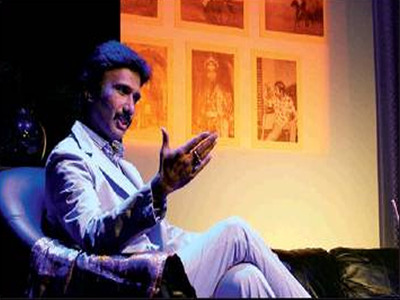
Mohammad Ali Baig in a scene from 'Under an Oak Tree' in London
Mohammad Ali Baig in a scene from ‘Under an Oak Tree’ in London

Hyderabad :

A play based on a Hyderabadi palace set in the mid-19th century has taken centre stage in London. The play’s premier attracted connoisseurs of theatre and enthusiasts of Hyderabadi history, drama and heritage.
“Under an Oak Tree”, presented by Hyderabadi theatre revivalist Mohammad Ali Baig, is based on the story of a boy born in the 19th century Ahmed Bowla Bagh Palace built by Nizam V Nawab Afzal Jah Bahadur. The play was produced by Qadir Ali Baig Theatre Foundation. The premiere show was sold out one week before the play was staged.

“The hour-long bio-play retraces the protagonist’s journey from the seclusion of a 19th century palace spread over 100 acres with a 100-horse stud farm, to the glitzy world of advertising and ultimately, to the intense spotlight of theatre, getting him one of the highest civilian honours of the country. The play aptly presents the changing political and social scenario in a post-Independence, post-Privy Purse era of the princely state of Berar and Deccan and consequently, the changing times,” Mohammad Ali Baig told TOI.

He said the play beautifully captures the story of a boy growing into adolescence without any friends, where the next neighbour was 5km away. The boy had more ponies than toys to play with. Written by Noor Baig, the play was directed by Mohammad Ali Baig. He also acts in it.

Mohammad Ali Baig has presented his plays earlier in Turkey, US, Canada and UK, taking Hyderabadi heritage to the global spotlight. The play is scheduled for its Indian tour in Bengaluru, Mumbai and other places this month.

“It’s really fulfilling when global audiences, accustomed to the best of world theatre, give an original Hyderabadi flavour such an amazing response with full house attendance,” he said.

According to Rehana Ameer, councillor of the City of London (the first Indian-origin woman of the elite Westminister district), the buzz was such that people from the Edinburgh and Oxford Universities came to London to watch the show. Prof Tariq Muneer, Millennium Fellow at Edinburgh University, also lauded the Hyderabadi play.

source: http://www.timesofindia.indiatimes.com / The Times of India / News> City News> Hyderabad News / by Syed Akbar / TNN / April 12th, 2018

65th National Film Awards: AR Rahman bags Best Background Score for ‘Mom’ and Best Music Direction for ‘Kaatru Veliyidai’

Chennai, TAMIL NADU :

ARRahmanMPOs17apr2018

The 65th National Film Awards were announced on Friday by Shekhar Kapur, the head of the Jury for feature films.

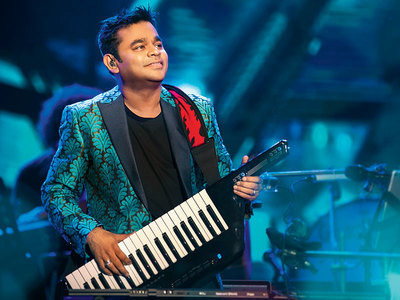
Music director AR Rahman has been honoured with two prestigious National Awards for the year 2018. He has bagged the Best Music Director award for ‘ Kaatru Veliyidai ‘ directed by Mani Ratnam and also won the Best Background Score award for the film ‘ Mom ‘ starring the late  Sridevi.

The 10-member-panel reportedly comprised of screenwriter Imtiaz Hussain, lyricist Mehboob, actress Gautami Tadimalla and Kannada director P. Sheshadri among others.

source: http://www.timesofindia.indiatimes.com / The Times of India / Home> E-Times – Entertainment News / News> Entertainment> Hindu> Music> News / TNN / April 13th, 2018

Love and Life in Lucknow: An Imaginary Biography of a City by Mehru Jaffer reviewed by Mihir Vatsa

Lucknow, UTTAR PRADESH :

LifeinLucknow17apr2018

An enjoyable ride through Lucknow, but is it real?

Mehru Jaffer’s Love and Life in Lucknow takes us through the lives of the city as well as its people. Written in a light vein in the first person, each chapter introduces us to different aspects of Lucknow’s history and culture while also keeping us close to Jaffer’s own experiential world. The narrator is a shadow of Jaffer, who travels back and forth in time to associate events in her life with the city’s larger contextual fabric.

The book is an unsure khichdi of genres. The title suggests an exploratory memoir, the subtitle asks us to think of it as an “imaginary biography”, the publisher, Niyogi Books, categorises it as a work of fiction, and once we start reading, what should have been a creative narration often steers into dry history. It is left to us to decide how best to read the book. According to Jaffer, the characters belong to “different recesses of the region, from its imaginary past to records preserved in archives and in history books.”

Colourful citizens

What roots the city’s dynamism is the narrator’s experiences of living in it. She steers our perception of Lucknow as we are introduced by her to the city’s “colourful citizens”, its monuments, its heritage. The commanding presence of Bano Bua is palpable, at times coming dangerously close to overriding the presence of the city as well as of the narrator. Though Jaffer stops short of expressly identifying the city with her, the old but resolute Bano Bua nonetheless emerges as a key character who holds everything together.

But Bano Bua is not alone in Lucknow. We are introduced to the quick-witted vegetable seller who counters Bano Bua’s sharp rebukes with a honey-laced tongue. Such seduction through words may appear extraordinary in other cities but not so in Lucknow, where the culture of language and lyricism is embedded deeply in the city’s spirit.

We are also introduced to Naresh, a rickshaw-puller who is a successful nautankibaaz but carries in his heart the wish to play Laila in a Laila-Majnun production. Similarly, we learn about the wonderfully named Baba of the Bottles, who lives in a cave at Lakshman Tila, accepts folded currency in a bottle, and who, with one neat trick, converts the currency into a piece of paper on which he gives his expert advice to get rid of problems.

Monotony of facts

The memorable characters are not always alive. The book goes to great lengths to take us through the city’s past, from the time of the Ramayana to the arrival of the British, from the birth of Urdu to the cultivation of English, from Sita gazing at the golden deer to the courageous Uda Bai firing at the British colonialists.

It is through these explorations of Lucknow’s history that Jaffer establishes her credibility as an informed writer. However, it is also in these explorations that Jaffer’s strength as a writer is tested. Some passages are rescued in time from the monotony of facts, but reading the rest, one wishes to be taken back immediately to the people.

The book is not bereft of tenderness. A remarkable moment occurs between the young narrator and her grandmother. It is her grandparents’ wedding anniversary which the grandfather forgets. The grandmother, having prepared a nice anniversary dinner for the evening, waits for her husband to return. Slowly the night mutates into dawn, and when he does return, he informs his wife that he has already eaten and makes for the bathroom.

When the narrator asks her grandmother to remind her husband the importance of the date, she refuses. “It is not enough for just one person to consider something important that requires two people to do so,” she says and closes the conversation.

Jaffer’s book should be read for the people in it. Though the writing is of varying merit, when it does succeed in bringing out nuances, the experience of reading is elevated and the city becomes immediately accessible. But the book also struggles to sustain this elevation. Jaffer’s writing undulates through the pages, taking us on both enjoyable drives and tiring detours.

The writer is the author of Painting That Red Circle White, a poetry collection.

Love and Life in Lucknow: An Imaginary Biography of a City; Mehru Jaffer, Niyogi Books, ₹395

source: http://www.thehindu.com / The Hindu / Home> Books > Imaginary Biography / by Mihir Vatsa /  April 14th, 2018

Fahadh Faasil on National Award win: I’ll continue to do films that excite me

KERALA :

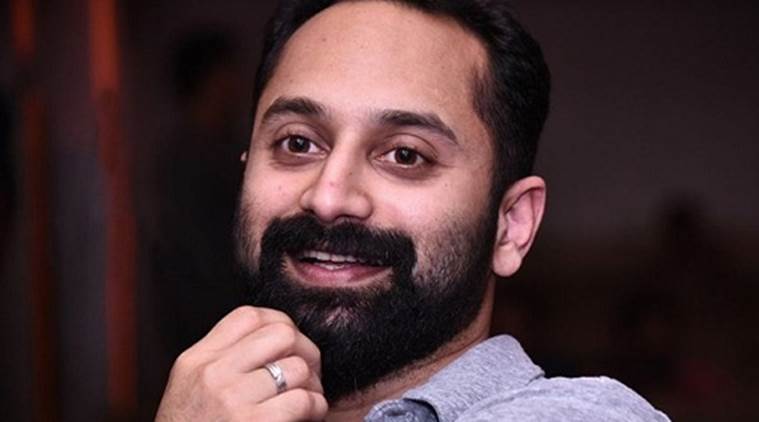
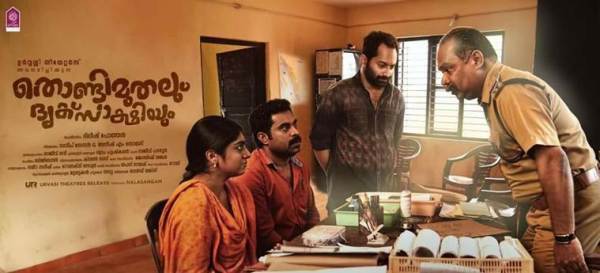
Actor Fahadh Faasil won the best supporting actor (male) award for his performance as a petty thief in the drama Thondimuthalum Driksakshiyum, that also became a successful venture at the box office.

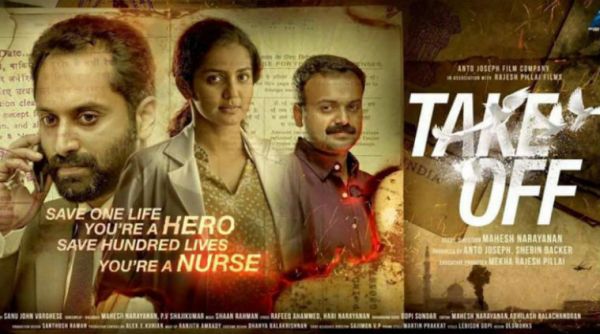
Fahadh Faasil congratulated his fellow cast and crew of Take Off for winning the coveted awards.

Critically acclaimed Malayalam film Thondimuthalum Driksakshiyum, which was directed by Dileesh Pothan, bagged several top honors at the 65th National Film Awards on Friday. Actor Fahadh Faasil won the best supporting actor (male) award for his performance as a petty thief in the drama, that also became a successful venture at the box office.

“When I began acting, my biggest fear was whether the audience will appreciate the kind of films I do. It is because I was born a Malayalee, I’m able to do such films. I feel blessed and very happy,” Fahadh, who is shooting for director Amal Neerad’s next, told the media.

“Whenever I work with Amal, something good happens in my life. While shooting for Iyobinte Pusthakam I won Kerala State awards and I also got engaged (to Nazriya Nazim),” he recalled.

Thondimuthalum Driksakshiyum was named the best Malayalam film and its writer Sajeev Pazhoor won the recognition in the best original screenplay category. It may be recalled that the film, which was unanimously liked by critics and the audience, failed to make a cut in the recently announced Kerala State Film Awards.

“I don’t expect to win awards while working in films. I want my films to make money first. Awards and all can come later,” said Fahadh.

“I was afraid of the commercial viability of this film (Thondimuthalum Driksakshiyum), but Dileesh was very confident and assured that this film will be appreciated by the masses and will become a bigger hit than Maheshinte Prathikaaram,” revealed the National Award winner.

Fahadh02MPOs17apr2018

He also added that the film was a different experience to him as an actor. “It is by far the most challenging role I have played. The story of this film happens at a police station. In real life, I have never stepped inside a police station so far. I’m not sure about the future though.”

“I was completely unaware of the way a police station works. But, I played a character, who is a regular at a police station. The director and my fellow actors helped me to understand my character and improved my performance,” added the actor.

“Dileesh is one of the finest directors I have worked with. He will ask actors to suggest what we want to do in a scene and work on it. It makes him stands out from the rest,” quipped Fahadh Faasil.

Fahadh’s hit film Take Off also bagged two National Awards, including a special mention award and best production design award (Santhosh Raman). The debut of editor Mahesh Narayan, which was inspired by real events, had Parvathy in the lead role.

Fahadh03MPOs17apr2018

Fahadh Faasil congratulated his fellow cast and crew of Take Off for winning the coveted awards.

He said his approach to cinema will remain the same. “I will continue to do films that excite me. I won’t change my methods because I got an award like this,” said the actor.

source: http://www.indianexpress.com / The Indian Express / Home> Entertainment> Malayalam / by Manoj Kumar, Bengaluru / April 13th, 2018