Category Archives: Arts, Culture & Entertainment

History Revisted : How knowledge travelled from East to West (and back again) in the early modern world

The flow of scholarly work between the Mughals and Europe involved translation, re-translation, re-interpretation and development.
Mughals&EuropeMPOs01apr072016

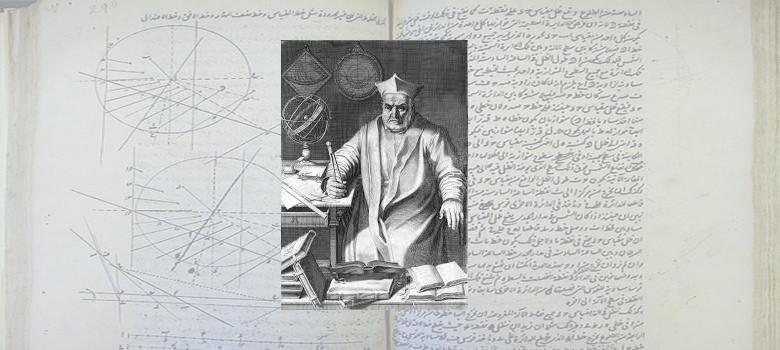
Christoph Clavius was born in Bamberg in either 1538 or 1537 (an amusing discrepancy for a scientist whose fame derives from his work on calendar reform) and was initiated into the Jesuit order by Saint Ignatius Loyola in Rome in 1555, and passed away in 1612, an eminent scholar.

Many of Clavius’ works were influenced by Latin translations of Arabic scientific works, including those of Ibn Rushd (in particular his commentary on Aristotle), the astronomers Abū Ma‘shar, al-Biṭrūjī and al-Farghānī, as well as the mathematician Thābit b. Qurra, among many other scientists writing in Arabic and Persian whose works Clavius cites.
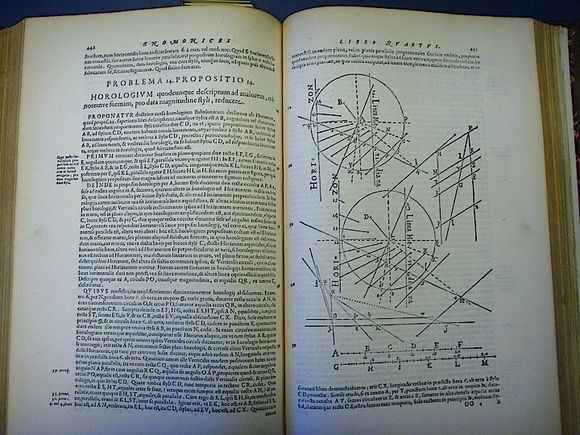
Book 4 of Christoph Clavius, Gnomonices Libri Octo, published in Rome in 1581 (533.k.2, pp. 442-43).

Clavius is an excellent example of the many Jesuit scientists of his age who continued to teach Ptolemaic astronomy (i.e. a geocentric vision of the solar system, indeed the universe, in which the planets and stars orbited the earth in concentric circles), despite the rise of – and often despite their own familiarity with and endorsement of – Copernican astronomy.

Christoph Clavius’ Gnomonices Libri Octo, on the art of gnomonics (timekeeping through the use of a sundial), was published in 1581
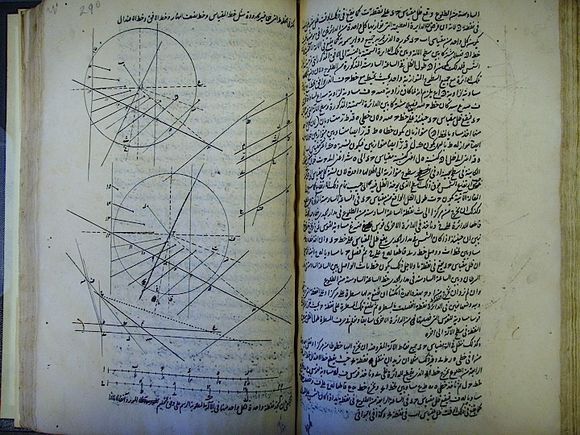
Mu‘tamid Khān's Arabic translation of the identical passage (IO Islamic 1308, ff. 289v-290).
Mu‘tamid Khān’s Arabic translation of the identical passage (IO Islamic 1308, ff. 289v-290).

Arabic version

This work also exists in a fascinating Arabic translation emanating from the Mughal empire that was purchased by Richard Johnson (1753-1807), a well-known collector of manuscripts and miniature paintings who worked for the East India Company.

Johnson made an annotation on the flyleaf of the manuscript that the translator of Clavius’ work was sent to Portugal by Aurangzeb – presumably to study or in some diplomatic capacity.

The full note reads, “Upon Dialling. Work of Clavius in Latin translated into Arabic by Maatemed Khan who went to Portugal in the time of Aurungzebe. This is the original foul copy of the translation in the hand of the translator (i.e., the ‘foul copy’ being the first draft, in contrast to the ‘fair copy’).”
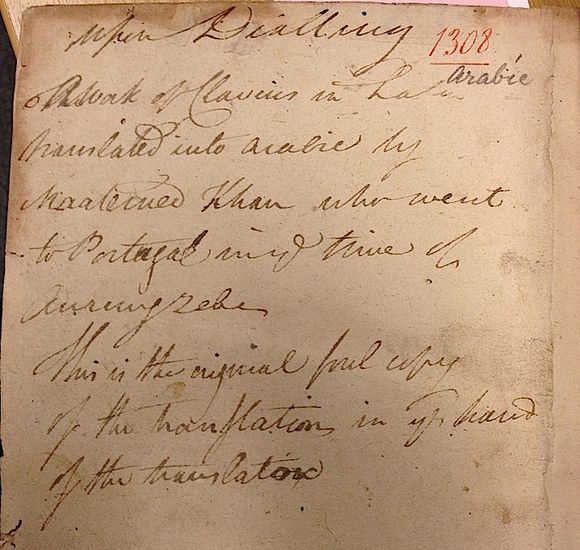
Richard Johnson's explanatory note (IO Islamic 1308).
Richard Johnson’s explanatory note (IO Islamic 1308).

A further note, in Arabic, added by the translator’s son, reads: “Draft of the Book of Measures [Kitāb al-Maqāyīs] which was composed by Clavius the Frank [Kalāwīūs al-Firinjī] in the Latin language, and my father, God have mercy on him, translated it into the [clear – mubīn?] Arabic language, possessor of virtuous talents including the perfection of acquired knowledge,

Rustam called Mu‘tamad Khān, the son of Qubād, gatherer of proofs of knowledge, perceiving the secrets of the spoken and the tacit, given the name Diyānat Khān al-Ḥārithī al-Badakhshī, may God be fair with both of them and elevate them.

Signed: I, who am a feeble slave begging for the mercy of the One and the intercession of the Prophet, Mīrzā Muḥammad, may God cause him to attain eternal happiness”.
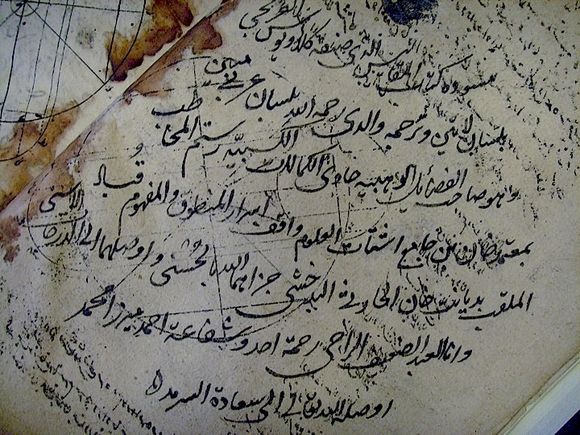
Note by Muʻtamad Khān's son (IO Islamic 1308, f.1v).
Note by Muʻtamad Khān’s son (IO Islamic 1308, f.1v).
 Complex process

This translation offers some fascinating possibilities.

The first is the demonstration of how knowledge circulated in the early modern world.

Clavius’ work, which responded to and was inspired by Arabic mathematicians and scientists in Latin translation, here a generation after its publication is translated back into Arabic to be read, presumably by elites at the court of Aurangzeb, where the work’s translator and his son were courtiers.

This translation demonstrates the complexity of knowledge flows – that they were synchronic as well as diachronic, and also involved a process not just of translation, but of re-translation, re-interpretation and development as they travelled.

Furthermore, the inscriptions taken in tandem, one in English made by an East India official, the other in Arabic by a Mughal courtier, open the possibility that already in Aurangzeb’s reign, Mughal elites travelled to Europe perhaps to study.

In the case of Mu‘tamid Khan, the translator of this text, he mastered the technical idiom of geometry and mathematics in Latin, and then translated it into an equally complex scholarly language, Arabic. Not an uncommon intellectual feat at the Mughal court, this process of scientific translation remains to be studied in depth.

It is also possible that the presence of the Jesuits at Goa had an influence on the production of this translation, but firm evidence remains to be found.

 This article first appeared on the British Library’s Asian and African Studies blog.

source: http://www.scroll.in / Scroll.in / Home> History Revisited / by Nur Sobers-Khan / March 30th, 2016

Mumbai cinema turned into mosque

Mumbai, MAHARASHTRA :

CinemaMumbaiMPOs04apr2016

Mumbai :

Cinema buffs of a certain vintage still wax eloquent about Mumbai’s erstwhile Alexandra Cinema’s hammy film title translations. On its marquee, Alfred Hitchcock’s ’39 Steps’ was dubbed ‘Ek Kum Chaalis Lambe’, ‘Double Impact’ became ‘Ram Aur Shyam’ and ‘Bruce Lee – The Legend’ morphed into the quintessentially-Bombaiya ‘Dadaon Ka Dada — Bruce Lee’.

By the early 2000s, however, Alexandra Cinema had graduated from showing Hollywood fare to B and C-grade films interspersed with adult films. It was a time when local residents asked school bus drivers to switch routes so that impressionable school kids weren’t exposed to the “dirty” posters.

Then about three years ago, in a startling about-face, the cinema hall took on a new avatar as a mosque-cum-Islamic institution. Today, the Dolby Digital speakers, which once blared item numbers, call the faithful to prayer and the audience’s catcalls have given way to an imam chanting Quranic verses five times a day.

The transformation began in 2011, when south Mumbai-based builder Rafiq Dudhwala bought the sprawling 15,000sq ft property for several crores and donated it to an Islamic NGO, Deeniyat, which deals in printing, distribution and the sale of Islamic books to Urdu and Arabic schools across the country. The huge structure stands bang opposite the Maharashtra College at Belasis road near Mumbai Central’s Nagpada junction.

At one time, scores of cinema halls dotted this 3km radius. Ardeshir Irani, who began his career as an exhibitor in the early days of Indian cinema, opened Alexandra Cinema in 1921 along with co-owner Abdulally Esoofally, another tent showman-turned-movie magnate.

From the outside, the theatre looks the same but its interiors have been transformed.

Dudhwala declined to comment on the transformation but the change was welcomed by residents of surrounding Muslim-dominated areas like Clare road, Nagpada, Agripada and Mumbai

source: http://www.timesofindia.indiatimes.com / The Times of India / News Home> India / by Ahmed Ali, TNN / April 03rd, 2016

PM gifts replica of Kerala mosque to Saudi King

Riyadh, KINGDOM OF SAUDI ARABIA :

ModiMPOs04apr2016

Riyadh :

Prime Minister Narendra Modi today gifted Saudi King Salman bin Abdulaziz a gold-plated replica of Kerala’s Cheraman Juma Masjid, believed to be the first mosque built in India by Arab traders around 629 AD.

“PM @narendramodi gifted His Majesty King Salman bin Abdulaziz Al Saud a gold-plated replica of the Cheraman Juma Masjid in Kerala,” the prime minister’s office tweeted.

The mosque in Karala’s Thrissur district is believed to be the first mosque built in India by Arab traders around 629 AD.

“Cheraman Juma Masjid is symbolic of active trade relations between India and Saudi Arabia since ancient times,” it said.

According to oral tradition, Cheraman Perumal was the Chera King and a contemporary of the Holy Prophet who went to Arabia and embraced Islam after meeting the Holy Prophet at Mecca, the PMO said.

Before he died in Oman due to some illness on the way back to India, he wrote letters asking the local rulers, to whom he had handed over his empire, to extend all help they could to Arab merchants who were planning to visit India.

The mosque has an ancient oil lamp that is always kept burning and believed to be over a thousand years old. People from all religions bring oil for the lamp as an offering.

Many believe that the mosque is a testimony to Islam’s arrival to India long before the Mughals came in from the northwest.

Modi, who is on a two-day visit to Saudi Arabia, was today received at the Royal Court here by King Salman.

He is the fourth Indian Prime Minister to visit Saudi Arabia after Manmohan Singh in 2010, Indira Gandhi in 1982 and Jawaharlal Nehru in 1956.

source:  http://www.ptinews.com / Press Trust of India / Home> International / by Manash Pratim Bhuyan / Riyadh – April 03rd, 2016

Hyderabad body to honour city founder

Hyderabad, TELANGANA :
Trust plans to take it up with the govt to issue a stamp and coin in the king’s name besides building a fitting memorial in his honour.
 The Trust plans to host an international seminar on the relevance of the king in today's world.
The Trust plans to host an international seminar on the relevance of the king in today’s world.
Hyderabad:
The Deccan Heritage Trust is planning to host year long celebrations to mark the 450th birthday of Muhammad Quli Qutub Shah, the  founder of Hyderabad city, which falls  on  April 4, 2016. The Trust plans to host an international seminar on the relevance of the king in today’s world.

According to Dr Mohammed Safiullah, historian and expert on Hyderabad, the Trust plans to take it up with the government to issue a stamp and coin in the king’s name besides building a fitting memorial in his honour.

source: http://www.deccanchronicle.com / Deccan Chronicle / Home> Nation> Current Affairs / Deccan Chronicle / April 03rd, 2016

Blissfully devoted to music

Kolkata, WEST BENGAL:

Ustad Jainul Abedin’s talent is indisputable but is yet toget his due.

The coveted “Sangeet Bharati” title was bestowed on Ustad Jainul Abedin, in a devotionally charged ambience at Sree Satyananda Devayatan on the final day of the 115th birth anniversary of Thakur Satayananda. “Sur-yoga is the easiest way to reach God,” was the philosophy of Thakur who groomed Archana Puri Maa, his spiritual daughter, to lead the way through her divine creativity in the arena of music and literature. She, as the beacon of the Devayatan, converted it as the haven of music where eminent musicians offer their music and receive blessings; Abedin being one of them who also encourages his disciples to begin their melodic journey with divine sanctions.

An ardent admirer of the young Ustad, Maa did the honours and listened to his melodious renderings that once again proved that he remains a devout devotee of his Ustad, the late Latafat Hussain Khan and his unalloyed Agra Gharana tradition replete with the elaborate alap. The latter’s intangible beauty, carefully avoided now by almost all Agra exponents, pulsates with piety in Abedin’s musically rich voice and lingering notes which have no trace of the gruff utterances associated with the gharana. All this makes the slow segment of his alap a real treat!

But Agra is far away from the modern abstract-ism a la Indore gharana. Conversely, it is incorrigibly tangible. Abedin’s warm persona unfurls petal by petal during his typically gharana-based “extrovert” style of handling the jod segment of the alap, the bol-baant (lyrics-based rhythmic divisions), the bol-banav (melodic improvisation of the lyrics), the bold and powerful taans, the varied patterns of rhythm-play, the saath-sangat (simultaneous improvisation) and sawal-jawab (dialogue) with the tabla and make his presentations remarkably charming.

Despite being blessed with all the virtues of a great musician, what keeps him under-rated and out of star-studded concert stages; so much so that at a recent all India congregation of Agra gharana representatives in Bhopal did not see him participating while many pedestrians found entry.

Abedin refuses to be despondent and gracefully accepts all as his “destiny”. His attitude reminds one of a sportsman’s spirit or a farmer’s resilience. Curiously, he is both! Born at Bashirhat, far away from Kolkata, he belongs to a family of well to do landlords; loves fishing and is passionate about cricket. Inspired by his latent talent, several eminent musicians groomed him. Hailed as a child prodigy, he started performing successfully in concerts and competitions since the early age of 9. He stood first at a talent search contest organised by the ITC Sangeet Research Academy in 1978.

This was destiny which saw him as one of SRA’s earliest scholars at the tender age of 11. Away from home rigorous taaleem in the true guru-shishya tradition from the legendary Ustad Latafat Hussain Khan, followed by training under Pandits Vijay Kichlu and Sunil Bose after the Ustad’s demise, ensured that he learn the true nuances of the Agra gharana gayaki. Growing up in an enviable musical atmosphere amidst some of the greatest luminaries of music world, Abedin also received invaluable guidance from Pandit K G Ginde and Vidushi Dipali Nag.

But destiny prolonged the usual change of voice of the starry-eyed young teen and there came a plateau in his ascending career which, due to the unprecedented success of SRA’s ‘first flush’, placed him in the second row. Though he featured in almost all the major festivals and various ITC Sammelans in India; toured Canada, USA and Bangladesh; successfully conducted workshops in India and various cities in Bangladesh, worked with the prefect’s department of his Alma Mater, the stigma of the ‘second best’ never left him; even if requests came solely for Jainul Abedin’s recitals, they would get spurned for mysterious reasons! When he started enjoying teaching, some of his brilliant disciples were placed under other ‘seniors’!

Destiny it is; especially because Abedin still remains a village-boy at heart and refuses to fight the system by maligning names of his ‘elders’or ‘friends’. Instead, he is blissfully devoted to his music, independently giving taaleem to innumerable students, giving concerts regularly and conducting successful workshops both in India and Bangladesh. He is also an examiner for Hindustani classical music of various universities. His social organisation “South Kolkata Music and Art Foundation” whose primary activities are to help aged musicians, is presently working on building an old-age home for distressed artistes. The divine blessings in the form of “Sangeet Bharati” will see him through ultimately, he knows!

source: http://www.thehindu.com / The Hindu / Home> Friday Review / by Meena Banerjee / March 11th, 2016

Abou Ben Adhems at Kalamandira

Anekal, KARNATAKA / NEW DELHI :

Abou Ben Adhem is a poem by Leigh Hunt. Some may say it is old hat. But, for ever its philosophy is relevant; in truth in today’s world of war, strife and self-obsession among people.

Abou Ben Adhem wakes up from his deep, peaceful sleep and sees an angel writing in a book. What are you writing?, asks Abou Ben Adhem.

The angel says, “The names of those who love the Lord.”

“And is mine one?, asks Abou

“Nay, no so,” says the Angel

Then Abou, humbly says, “I pray thee, then, write me as one that loves his fellow men.”

The Angel writes so and vanishes.

The next night, the angel appears again and shows the names whom God had blessed. And lo! Ben Adhem’s name led all the rest. This, even though Abou Ben Adhem, instead of saying “he loved the Lord” he had said he “loved his fellow men.” It simply means in this world it is more important to love fellow men rather than merely loving God. We all know what is happening in West Asia as a result of loving God too much and fellow men less.

Last evening, I was witness to a number of Abou Ben Adhems on the vast stage of Kalamandira. The occasion was the first award presentation to those who have “Loved their fellow men,” to use the words of Abou Ben Adhem, by the partners of city’s Ganesh Beedi Works under the auspices of their Charitable Trusts in the name of their parents M. Govinda Rao and D. Ramabai. It is known as Ramaagovinda Puraskar-2016.

Yesterday, I was caught in a web struggling to decide to which of the three programmes I was invited I must go — one wedding, a dinner at Palace in connection with MRC election and the function at Kalamandira. I decided on Kalamandira and happier for that. A memorable awards function indeed, made more memorable by the cultural event ‘Miracle on Wheels’ a performance by the specially-abled youngsters on wheelchairs par excellence.

There was yoga on wheels, Dashavathara on wheels, Bhagavad Gita on wheels and more. Performing with clock-work precision, timing of movement well synchronised as they criss-crossed the stage while the audience wowed wonder-struck. The accompanying music and song, mostly verses from Hindu Mythology, held the audience spellbound.

Dr. Syed Salauddin Pasha

The innovator-choreographer of this extraordinary show by the specially-abled performers was Dr. Syed Salauddin Pasha, a Kannadiga from Anekal near Bengaluru, now settled in Delhi. I learn he is a follower of Sufism. No wonder he came on the stage wearing a dhoti and a white manila bush coat, crimson nama glowing vertically on his broad forehead. He looked younger for his fifty years. But for his name you wouldn’t know he is a Muslim.

It was revealed by himself that as a student he was given a Quran by his parents and sent to school but he would go to his Brahmin friend’s house and return as Pasha Iyer ! From what he spoke from the stage it was clear that he has mastered both Islamic studies, Hindu Mythology and religion. He was so eloquent in chanting the sacred verses the audience applauded him with clapping ever so often.

Star of Mysore had published about his achievements on Saturday, 19th March, 2016. If Karnataka Government has not recognised him with a Rajyotsava Award or some other award, he indeed deserves one because he is a Kannadiga who speaks impeccable Kannada with ease and eloquence and wants to shift to Bengaluru for good for love of his roots.

Be that as it may, I must conclude this column by appreciating two anecdotes one of the awardees, Sanskrit scholar Lakshmisha Tolpadi, narrated to underscore two values of idealism in our lives:

There was a guest who had come to the house at lunch time but there was no rice ready to cook. There was paddy, though. The housewife, being alone in the house and believing in the ideal ‘Athithi Devo Bhava’ (Guest is Divinity incarnate) requested the guest to wait till she cooked food.

She then starts pounding the paddy. Realising that the clinking sound of her bangles in her hands would betray her pounding of the paddy which would make the guest know that she was taking extra trouble, she quietly removes all the bangles, makes rice out of paddy, cooks food and serves the guest.

Moral: Let not others know the trouble you take or trauma you undergo while helping others. Never say ‘I suffered so much to help you.’ Such help is no help; just craving for appreciation or sympathy. It makes the beneficiary disgusted with himself for being the cause for another’s inconvenience and makes one guilty of troubling others.

Another anecdote relates to one Pakru, an old, poor nonagenarian, known for his knowledge of Tulu Language, a dialect in Dakshina Kannada. Once one Venkataraju, a research scholar collecting Tulu words and vocabulary, went to see Pakru in order to write an article in the newspaper. Venkataraju took a photograph of Pakru using flash. Pakru innocently asked Venkataraju, “What are you doing? What is that flash of light?’’

When told that he was taking his photograph for publishing in newspaper, Pakru innocently said, ‘‘Why photograph when I am here in your presence.”

This kind of innocence of the noble and a simple person, the modern man of education can’t understand, said Lakshmisha Tolpadi.

This incident reminded me of what my friend M.P. Prabhakaran in New York had written in his latest book, sent to me last week, titled ‘‘My Thirty-Day European Odyssey’’ about a similar situation.

Prabhakaran lands in Stockholm airport. He sees a larger-than-life picture on the wall of a statue of Birger Jarl, the founder of Stockholm. It had an imaginative, tourist-friendly caption: ‘Welcome to my hometown.’ Prabhakaran was not sure if he could take a photograph of it for security reasons and asks a fellow traveller, a local person, if he could take a photograph.

He asked: “How long are you going to be in Stockholm?”

“Three days,” said Prabhakaran.

“Then go to the City Hall one day. The statue of Birger Jarl you are seeing in this picture is there in front of the city hall. Instead of taking a photograph of a photograph of the statue, why not take a photograph of the statue itself?”

e-mail: kbg@starofmysore.com

source: http://www.starofmysore.com / Star of Mysore / Home> Abracadabra….Abracadabra… / by K. Ganapathy / March 30th, 2016

Muslim Women Personal Law Board Head Meets RSS Chief

Lucknow, UTTAR PRADESH :

Lucknow :

In a significant development, All-India Muslim Women Personal Law Board president Shaista Ambar met RSS chief Mohan Bhagwat here on Tuesday.

Ambar said she was present at a function in the Post-Graduate Institute area where Bhagwat was visiting. She sought an appointment with the Rashtriya Swayamsevak Sangh (RSS) chief that was immediately granted.

“He was very gracious and in his address he spoke of nation building and character development,” she said.

Ambar also said she requested Bhagwat to visit the mosque which they have got constructed, and he readily agreed to do so.

source: http://www.newindianexpress.com / The New Indian Express / Home> Nation / by IANS / March 29th, 2016

Qazi to lead Ujjain Kumbh parade

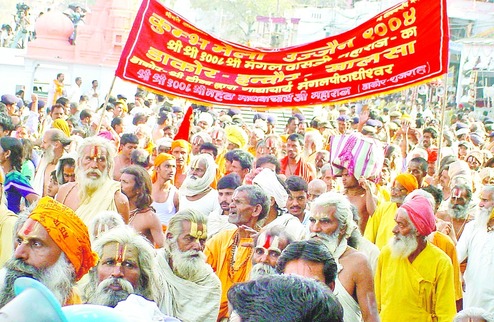
The Ujjain Simhastha in 2004. Picture by Raj Patidar

Ujjain, MADHYA PRADESH :

Bhopal :

When Ujjain city qazi Khaleel-ur-Rahman returned home from juma prayers yesterday afternoon, he was surprised to see a posse of visitors, mostly Hindu seers heading various akharas (monasteries).

Led by the Akhil Bharatiya Akhara Parishad head, Acharya Narendra Giri, the visitors asked Qazi Khaleel to lead the peshwai (procession) that marks the beginning of the month-long Simhastha, starting April 22 this year.

The Ujjain Simhastha is one of the four legs of the Kumbh Mela, each occurring by rotation every 12 years, the other three being the Kumbhs at Haridwar, Allahabad (Prayag) and Nashik.

The qazi – an arbiter for Muslims’ personal matters – said he was “overwhelmed” by the offer. He said he greatly valued the gesture at a time some people were following divisive agendas.

“This is the first time we have formally invited the shahr (city) qazi. The objective is to create goodwill and communal harmony,” Acharya Giri told The Telegraph.

He said that he and the other akhara heads had thought of personally visiting and inviting Qazi Khaleel to “send out a strong signal of communal harmony from the Simhastha”.

For the first time, the transgender community too has been given its own place at the Simhastha – amid resistance from the Akhil Bharatiya Akhara Parishad, the apex body ofakharas.

The Ujjain administration has earmarked five acres of land where around one lakh transgender people would be put up during the Simhastha.

Transgender people from 22 states have formed the Kinnar Akhara for this purpose, said its convener, Rishi Ajay Das.

Traditionally, various akharas take out the peshwai about a fortnight before the Simhastha begins formally with a shahi snan (royal bath). The heads of dozens of akharas join the procession, sitting on silver thrones on elephants, while armed sadhus (ascetics) ride horses and camels.

They are followed by other hermits, monks, priests and devotees on foot while thousands line both sides of the streets. The procession ends at Ram Ghat on the banks of the river Kshipra, which turns holy during Simhastha.

The Shivraj Singh Chouhan government and the various akhara heads have agreed to hold three shahi snans during the Simhastha, on April 22, May 9 and May 21.

More than five crore pilgrims are expected to gather and take a dip in the river. The occasion is called Simhastha because of a rare, 12-yearly configuration of planets with the Sun entering the Aries sign and Jupiter in Leo (Simha).

State minister Bhupinder Singh said that Chouhan had invited Prime Minister Narendra Modi to address a spiritual gathering during the Simhastha.

source: http://www.telegraphindia.com / The Telegraph, Calcutta, India / Front Page> Nation> Story / by Rasheed Kidwai / Sunday – March 27th, 2016

Life and times of Iqbal

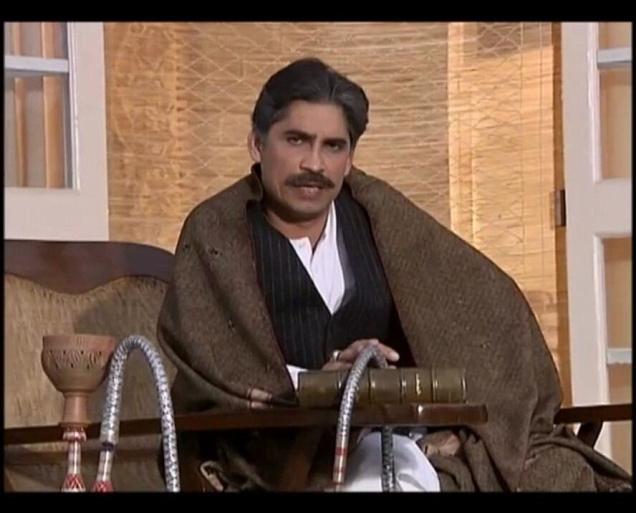
A scene from Sir Iqbal.

M. Sayeed Alam’s “Sir Iqbal” will be staged in the Capital this Sunday

The most sung poet and perhaps the most sung song in India “Saare Jahan Se Accha” written by Allama Muhammad Iqbal is all set to ignite the imagination of theatre lovers in Delhi. Playwright and directors, M. Sayeed Alam and Danish Iqbal’s spring time production ‘Sir Iqbal’ is a biographical work on the life, times and scholarship of Allama Iqbal who continues to be misunderstood in India but is celebrated in Pakistan as the man who came up with the idea of a separate nation for Muslims.

“Iqbal’s love for India which clearly comes through in the poem ‘Saare Jahan Se Accha’ and yet his choice of living in Islamic Pakistan over a secular India is in itself a study in contrast, a paradox that has pushed him far away from public memory in India. Iqbal died in 1938 much before the idea of Pakistan even took shape. Doctored history, misapprehensions about Allama being a fanatical Muslim who chose to live in a Muslim dominated undivided India needs to be closely looked into. My play is an effort to demystify Iqbal and clear some perceptions about the great poet, philosopher and politician and above all a humanist who has given India its most enduring patriotic poem yet remains forgotten in the country,” said Alam in the midst of rehearsals for the play which opens to public on March 20 at Sri Ram Centre.

“From what I have read about Iqbal’s political philosophy, he never demanded a separate home for Muslims outside India. Iqbal’s formulations somehow suited the supporters of Pakistan and they hailed him as the ideological father of the country – something that many Indians came to detest and therefore Iqbal remains forgotten whereas his poem as a song is sung everyday in schools all over the country. Our play brings out this dichotomy,” said Alam.

“Sir Iqbal” had first premiered in Kolkata in November last year to much critical acclaim. The one and half hour play with a 15-member cast will see Alam himself essay the role of Iqbal. The play is centred around the poet and philosopher’s life. In the play, Iqbal’s story is narrated by his trusted servant Ali Baksh who enjoyed Iqbal’s confidence and had witnessed many events in his life. Set in British India in the backdrop of the first half of the 20th Century, ‘Sir Iqbal’ will mirror the socio-political churnings during Allama’s times till his death in 1938 in undivided India. The play will perhaps set some records straight and clear many perceptions about Iqbal, who for many Indians still remains an enigma.

source: http://www.thehindu.com / The Hindu / Home> Features> MetroPlus / by Anasuya Basu / March 18th, 2016