Category Archives: Arts, Culture & Entertainment

Hazrat Baba Khader Auliya’s dargah a symbol of religious harmony

Visakhapatnam  :

Nestled amid greenery away from the humdrum of city life, just 54 km from Vizag on Kumili Road, lies a symbol of communal harmony. Spread over seven acres, the over 60-year-old dargah of Hazrat Baba Khader Auliya is as popular with Hindu pilgrims as it is with Muslims.

Like K Shiva Ram Babu, a taxi driver from Visakhapatnam who visits the dargah regularly. “Though I am from Vizag I had never been to a dargah all my life. It was only when I started travelling to Vizianagaram that I chanced upon the dargah of Hazrat Baba. The tranquility and spiritual ambience of the place caught my attention and when I looked at the image of Khader Baba I was transfixed. I first visited the place during the birth anniversary celebrations of the Baba in November 2011. Ever since, I have been visiting the dargah every month and at times have even spent the night there,” said Ram Babu

Eswar Rao, an auto driver and pilgrim from Vizag, said, “I carry a photograph of the Baba in my pocket as I feel blessed and protected. Though the Baba passed away in 1952, I can still feel his presence at the dargah.”

“At the dargah, they preach that Hinduism and Islam both address the same issue of the God and the Devil within us. They neither preach nor practice hatred against any faith. All the major Hindu fests are celebrated at the dargah, be it Rama Navami or Dasara. Even the prasad offered is simple and vegetarian,” Rao added.

Another proof of this harmony is the fact that the baba and his disciples were laid to rest in the dargah, the land for which was provided by Maharaja PVG Raju of Vizianagaram. “Hazrat Baba Khader Auliya was a symbol of Hindu-Muslim unity and considered one of the foremost Sufi saints of the 20th century. His dargah is mainly visited by Hindus, who believe that the Sufi saint’s spirit will guide them in their endeavours,” said Vizianagaram resident Khalil Ur Rehman, who is a regular at the dargah.

Born in Vizianagaram in 1899, Hazrat Baba Khader Auliya received taleem from the Sufi saint Hazrat Tajauddin of Nagpur, who visited Vizianagaram in 1911, at the tender age of 13. After being initiated, Khader Baba dedicated his entire life to promoting peace and harmony and helping people deal with their problems.

Talking about Baba’s childhood and initiation into the Sufi way of life, Rehman said, “The Baba’s desire to become a Sufi was also influenced by the fact that he had read and studied the Hindu texts like Ramayana and Mahabharata as a school kid and was very much moved by the fact that all religions lead to the same ultimate goal.”

When asked about the number of pilgrims that visit the dargah regularly, Salil Kader, a former darbaan at the dargah said, “More often than not, people who frequent the dargah are Hindus. Many Hindus believe that he represents Ram and Rahim and consider him an incarnation of Lord Vishnu. The dargah receives on an average over 40,000 visitors per year.”

source: http://www.timesofindia.indiatimes.com / The Times of India / Home> City> Visakhapatnam / by Venkatesh Bayya, TNN / June 30th, 2015

An Urdu poet and translator

KNOW YOUR NEIGHBOUR: Qaiser Shameem  Urdu poet

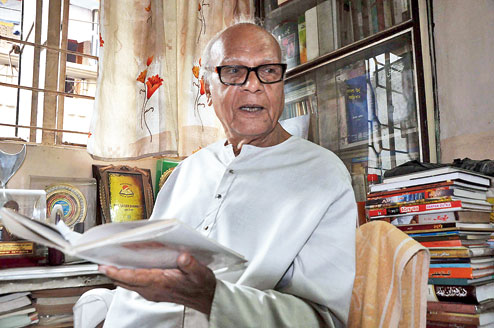
Qaiser Shameem recites a poem from his collection. Picture by Gopal Senapati

 His poetry is about life, society, relationships and his experiences. Those who read him feel that he evokes sentiments that are lost in everyday life. Qaiser Shameem writes in Urdu, the language in which he can express himself best. Living in one corner of Shibpur, Shameem’s works are recognised nationally and outside the country as well. He was invited as chief guest at an international shayari sammelan organised in London in 2006.

In 2013, Shameem was part of a team selected by the Department of Urdu in Jamia Milia Islamia, Delhi for translating selected Rabindranath Tagore’s works into Urdu. “We had to attend a five-day workshop and each writer was assigned a certain poem, novel or short story by Tagore to be translated into Urdu. I translated his poem, Jatri,” said Shameem.

Qaiser has always been involved with various literary activities. When he was a boy, he liked to study. Qaiser Shameem was born as Abdul Qayyum Khan in Angus in Hooghly district. He was the eldest among his siblings. His father worked in a factory, but the young Shameem always told him that he wanted to study. Since 1951, Shameem’s poetry, short stories and critical essays have been published in almost every Urdu magazine and journal in the country. Shameem was also a bright student. He passed the High Madrasa examinations with a first class and was a topper in the board in 1953.

Since he wanted to study further, Shameem had to shift to Howrah, closer to Calcutta for better opportunities. He took admission in Central Calcutta College, better known today as Moulana Azad College. “I had to give tuitions to students to earn a living. I had to send money back home to run the household and also run my own expenses here,” said Shameem. While studying and teaching, Shameem was also writing, attending literary meetings and doing other things. “I was a regular at the Progressive Writers’ Association, where I had met Subhas Mukhopadhyay and Pervez Sahidi and other well-known writers,” said Shameem.

After college, Shameem took up teaching Urdu in a number of schools in Howrah and Calcutta. He was also a professor at the Urdu department of Calcutta University from where he retired. He now teaches at his college, Maulana Azad College. Shameem was also the co-editor of two magazines, Azad Hind and Howrah Times.

From 2002 to 2005, he was the joint secretary of Paschim Banga Urdu Academy.

Shameem’s collection of poetry have been published as books like Saton ka Samandar (1971), Saans ki Dhar (1997) and Pahar Kaatte Huye published in 1998. Tridhara published in 1996 was Shameem’s collection of Hindi poetry. “I always believed that words and literature are a stronger medium than any other form of expression,” he said.

While writing, Shameem has also established Writers’ Association in Howrah in 1966. “The plan was to have a cultural exchange between Urdu writers and writers of other languages. I wanted to start a group where all writers would get an opportunity,” said Shameem.

Other than Tagore, Shameem has also translated the works of Kazi Nazrul Islam and Mahasweta Devi.

MORE ABOUT SHAMEEM

  • DoB: April 2, 1936
  • Born in: Hooghly
  • Education: MA
  • Family: Wife, son, daughter-in-law, grandchildren
  • Loves: Writing
  • Hates: Two-facedness

source: http://www.telegraphindia.com / The Telegraph, Calcutta,India / Front Page> Howrah> Story / Friday – July 03rd, 2015

They raise funds for cancer patient with Ramzan food

Bengaluru :

Every day, before the sun goes down, Khurrum Sheriff (22) and a bunch of other youngsters flock to the masjid at 3rd Cross, Benson Town. They wait for customers to arrive at their makeshift stall to break their fast. They dish out everything from piping hot samosas, spring rolls and biryani to juices and milk shakes, and ensure that all items are sold.

The money racked up from the sales doesn’t end up in their pockets, instead it’s handed over to the mother of a cancer patient.

This is how several residents of Benson Town, who ta ke turns to prepare food and sell it, are observing the holy month of Ramzan. And all this amid their work schedules.

It all started when Tasmeen Farzana Khan, counsellor at a government aided school, came to know about Sunandha R (name changed), a 13-year-old girl in her class suffering from blood cancer. “Sunandha’s father has passed away and her mother, who works as an attendant, is struggling to make ends meet. I learnt that the treatment costs around Rs 16 lakh. And it’s a challenge to keep Sunandha away from the fund-raising as she doesn’t know about her ailment,” she added.

When Tasmeen brought the issue to the Benson Town Youth Association’s notice, members came up with the idea of the stall.

The team comprises 17 members, say AS Nimra Khan (18), a PU student, and Sarah Yaseen (19), a college goer. “Every afternoon, we assemble at the basement of Sarah’s house to cook. We share the task of preparing different food items. By 5pm, we throw open the stall and sales go on till 7pm,” said Nimra.

Khurrum says the response to the initiative has been great and many volunteers have co me forward to offer monetary help. “The month of Ramzan is one wherein we have to donate whatever we can to the needy. Helping a cancer patient, we thou8ght, may be one of t he best ways to do that. We will carry out the exercise throughout the month,” he added.

Sunandha’s mother said she is overwhelmed by the support. “I just want my child to get relief,” she added.

source: http://www.timesofindia.indiatimes.com / The Times of India / Home> City> Bengaluru / by Rohith B R , TNN / July 02nd, 2015

He quits job to fight for ‘one nation, one road tax’

Bengaluru :

The IT City is a gateway of opportunities for many – corporate professionals, students, interns. No wonder, it’s home to a large floating population. But if you stretch your visit beyond a month and bring your vehicle along, you may be in for more than teething troubles.

If you use a vehicle with a non-Karnataka registration number for more then 30 days, you’ll have to shell out a bomb as road tax. For example, if your car costs Rs 20 lakh, you’ll have to pay 25% as tax, which amounts to Rs 5 lakh. Two Facebook groups have now become the epicentre for the fight against this draconian law, a cause of concern for owners of out-of-state vehicles. The man behind the movement, Waseem Memon, has quit his job to concentrate on the campaign. The crusaders seek the right to drive without fear, anywhere in the country.

Memon’s personal mobile number has now become a toll-free number for those in trouble with RTO officials.

He runs Facebook groups ‘Justice for non-KA registration vehicle owners’ and ‘Drive without borders’ (since 2014). The former clinical researcher has taken up the cause on a full-time basis. “Both groups, which have more than 50,000 members, are battling several court cases in multiple states, including Karnataka. We’ve had success in Telangana and are hoping to replicate it here too,” he said.

In 1998, Memon moved to Andhra Pradesh from Karnataka, with a KA registration vehicle. He moved on to Maharashtra and then returned to Hyderabad with an MH registration vehicle. He was pulled up by authorities. In 2010, when he moved back to Bengaluru after his numerous corporate stints, he landed in soup for owning a non-Karnataka vehicle. That’s when he decided he’d had enough.

“Although we started the fight with a Facebook page, we are doing much more. Every month, we hold meetings which are attended by people who face this problem. I get at least 30 calls every day from harried users. Our Facebook pages are flooded with grievances,” said Memon, for whom threat calls have become a norm.

The question Memon and his team want to ask the authorities is when technology parks and IT parks are coming up across the country, which require professionals to relocate frequently, why are these laws in place? “Our goal is one nation, one road tax. And we believe we’re getting close to that,” he pointed out.

source: http://www.timesofindia.indiatimes.com / The Times of India / Home> City> Bengaluru / by Arun Dev, TNN / June 02nd, 2015

The sound of silence

Oscar-winning sound designer Resul Pookutty of Slumdog Millionaire fame says musical elements define his idea of space and time.

He wanted to be a physicist and win the Nobel Prize. Instead, he became a sound designer and won an Oscar. “Not a mean achievement for a boy who walked miles to school in Kerala and studied under a kerosene lamp. Maybe superconductivity was not really for me,” says the 43-year-old Resul Pookutty, who along with Richard Pryke and Ian Tapp, won the Academy Award for Best Sound Mixing for Slumdog Millionaire in 2009.

ResulPookuttyMPOs01juj2015

Pookutty, who has co-produced and designed sound for the Hindi film, Nanak Shah Fakir, based on the life of Guru Nanak Dev, insists that the experience of working for the movie was nothing short of spiritual. “Before signing, I saw 40 minutes of the footage and was spellbound. It was sheer visual poetry. Nothing like that has ever been attempted in mainstream cinema before. When I met the director, Harwinder Sikka, a man who had no experience in the film industry but was guided by a dream to make this film, I instantly decided to become a part of his journey,” says the sound designer, who received the Padma Shri honour in 2010.

Pookutty, who shot to fame after designing the sound for Sanjay Leela Bhansali’s Black, says little or no importance is given to sound designing in India. “We are a 5000-year-old civilisation. As a culture, we have transferred knowledge through memory and not just the written texts. Sound was knowledge. Is it not surprising that we still underestimate the power and magic of sound,” says Pookutty. He recorded the sound of vacuum and Shimla’s ambient sounds in a shankh, then extracted out living elements to produce what you heard in Black.

A Film and Television Institute of India (FTII), Pune graduate, who failed the interview round the first time he appeared for it, Pookutty believes that formal training in arts is indispensable to broaden an artiste’s horizons. “You become organised. Then begins the process of personal reinvention influenced by exposure to works of masters and thought processes of fellow students. One is taught the history of the art form, which not only helps in the understanding of the art’s evolution but also, aids your own,” he says. Looking 14 years back, when the industry did not use even good microphones, Pookutty, who has been making a ‘sound library’ for more than a decade now, says, “I could have settled and worked in the anywhere in Europe, but the whole metaphor of my art is right here and I have always striven to make sound as realistic as possible, and also showcase that at times silence can be most deafening.”

Attributing his success to wife Shadia, who, he says, keeps him sane and has always allowed him to follow his dreams, the sound designer, who suggested A.R. Rahman’s name to director Danny Boyle for Slumdog Millionaire, is always open to working in the regional industry including Punjabi. “I don’t see the script in terms of the language but the magic it is capable of producing. I was supposed to work on the 3-D Punjabi animation film Chaar Sahibzaade but could not because of time constraints. Give me something that will completely bowl me over, and I am in,” he says.

source: http://www.indiatoday.intoday.in / IndiaToday.in / Home> News> Archive> Supplements> Simply Punjabi / / by Sukunt Deepak – May 01st, 2015 / May 11th, 2015

‘I consider myself a global citizen’

Changing lanes

ResulPookuttyMPOs30jun2015

His distinct understanding of sound has made him a household name in the film industry, but Oscar Award winner, Resul Pookutty says that he wants to further explore the various avenues of filmmaking, including direction and production. Known for casting a musical web with movies like ‘Slumdog Millionaire’, ‘Black’, ‘Musafir’ and ‘Saawariya’, the sound designer is of the opinion that his journey into films will be incomplete if he does not try his hand at everything.

“My ultimate desire is to be a filmmaker as I can incorporate the sounds I want only in my film. Not matter how much I try to convince a person about a sound, it is ultimately their film,” he says. It’s only by being a filmmaker that he can sharpen his craft. Although the sounds will depend on a film, he adds that he wants to direct a human drama.

And this is what drew him to the script of ‘Gour Hari Dastaan – The Freedom File’. Directed by Anant Mahadevan and set to release on August 14, the Hindi film has Resul dubbing for a few dialogues. “Each time I see the scenes, I close my eyes and ears; I can’t handle the Malayalam accent that is very visible!” he laughs. While the director seems happy with the scenes, Resul remains embarrassed. As word spreads that this is his first time dubbing in Hindi, Resul smiles and rejects this. “I dubbed for ‘Slumdog Millionaire’ as well.”

Talking about the movie, which stars Vinay Pathak, Konkona Sen Sharma and Tannishtha Chatterjee, he says, “It’s an interesting film and I liked it. When the producer narrated the story to me, I was immensely moved. It rightly sums up things that we ignore. It is a biopic about an Oriya freedom fighter who has to prove to the government who he really is. At least during the time of the British Raj, we knew who our enemy was; but when a freedom fighter says that he has to prove his worth to his own government, we know that we’ve failed as a country.” He adds, “Modern history is something we have glorified and is not something youngsters can relate to anymore. Films like this are capable of changing people; washing them out to make them better people.”

He describes himself as a “global citizen”, saying, “Although there are many things that need to change I wouldn’t be living here if I weren’t happy. I consider myself a global citizen and if I want, I could live elsewhere, somewhere better. There are problems but that doesn’t mean you run away. I’m not a politician or social scientist to comment on the social aspects of society, but it’s important for people to recognise that we are humans, keeping aside religion, politics and everything else.”

source: http://www.deccanherald.com / Deccan Herald / Home> Supplements> MetroLife / by Ananya Revanna / DHNS – June 29th, 2015

Food trucks on a roll

Road rovers

spitfireBF29jun2015

 Thanks to the number of food trucks that have come up in the City, the foodies here are a happy lot. Though the concept of food trucks is not new in India, it has been gaining popularity in Bengaluru only over the last two years. These trucks have found many takers and one can always spot a lot of crowd around them.
Owned by Sudarshan MS and Francis Xavier along with two others, ‘De3-The Eatery’ was started in March 2013 and serves Continental, Italian and American food. One can spot it in Shanthinagar, Kammanahalli and Jayanagar. “We always wanted to do something different and focus on quality and cleanliness. The idea of starting a food truck came in as we wanted to popularise the concept of mobile and clean restaurants with an open kitchen. So when people see how their food is being prepared, they get a sense of satisfaction,” says Sudarshan.

Many of these food trucks have a clear idea of their target customers. ‘The Great Indian Bhukkad’ was started by Suraj Agarwal in 2014 and caters mainly to the students of PES University, Banashankari. Parked at the college premises, it offers a variety of rolls and wraps among other Chinese dishes. “Our USP is that we cater only to students and our prices are reasonable. The students know that we serve clean and hygienic food and really appreciate the taste. We are glad that we have been able to establish a relationship of trust with them,” says Suraj.

‘Spitfire BBQ Truck’, which was started in 2014 by Sidhanth Sawkar and Gautami Shankar, moves around in Sahakara Nagar, Kammanahalli, Indiranagar and Koramangala. As the name suggests, it serves barbecued delights. “Bengalureans today are getting into food culture professionally. As the city is a melting pot of different cultures, people here are open to different types of food. Everyone has high expectations from us not just because of the food we provide but also the personal bond that we have built with our customers,” says Sidhanth.

Their experience of working in the food industry in the United States led Siddharth and Bharath to start ‘Off Road Food Truck’ (ORFT). The place, which was started in January this year, often stops in Sahakara Nagar and Kammanahalli and serves burgers, sandwiches, Spanish rice, chicken and fried ice creams. “We were working for different restaurants in the US. It was our interest for food that brought us together. Our idea was to go up to people and serve them rather than they coming to us,” says Siddharth. According to him, cleanliness, affordability and convenience are the things that attract the crowd to ORFT.

Some of these trucks are area specific too. ‘Frying Wagon’ in RT Nagar was started merely two months ago but has been seeing great business. The truck serves Chinese dishes and rolls and the dishes are served only on eco-friendly paper plates. Vijay Kesarkar and Soujanya Vijay, the owners, say, “Our business is picking up and now people are aware of us. They look for cleanliness, quality and hygiene and come to us because we meet their requirements. Our prices are reasonable thanks to which, we have a lot of students coming to us. Even the IT crowd comprises a chunk of our customers.”

‘Meals on Wheels’ is another such truck that can be spotted near Richard’s Park in Frazer Town. Serving Chinese cuisine with a twist, one can often see foodies relishing a variety of momos, Chinese ‘bhel’ and saucy lollipops here. “The concept of food trucks is becoming popular in India and people in the City are more open to it now. The business too is growing at a fast pace,” says Syed Harris, who owns the truck along with Aftab and Maaz.

source: http://www.deccanherald.com / Deccan Herald / Home> Supplements> MetroLife / by Surupasree Sarmmah / DHNS – June 29th, 2015

Book Review: Muslim Cosmopolitanism in the Age of Empire

With the end of the Mughal Empire and the rise of British power, the 19th century Muslim intellectual had to reimagine his politics.

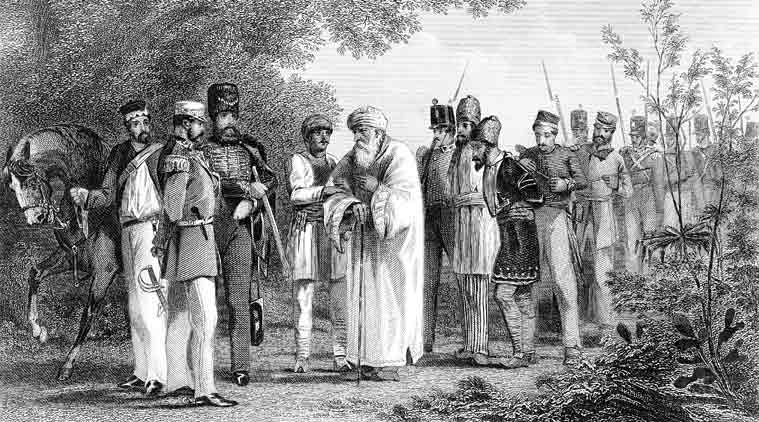
The King of Delhi is brought by guards before Captain Hodson, after the capture of Delhi by the British army during the 1857 rising. (Source: Hulton Archive/Getty Images)

Title:  Muslim Cosmopolitanism in the Age of Empire  / Author: Seema Alavi  / Publisher: Harvard University Press  /  Pages: 504  / Price: Rs 495

Muslim Cosmopolitanism in the Age of Empire is an engrossing, wide-ranging and beautifully written account of an emerging Muslim political imagination in the 19th century. Through an examination of five extraordinary figures, Sayyid Fadl, Rahmat Allâh Kairanawi, Haji Imdadullah Maki, Nawab Siddiq Hasan Khan and Maulana Thanseri, Seema Alavi brings alive the variegated, improvisatory and inventive character of Muslim politics and theology, as it struggled to come to terms with new imperial forms. Each of these figures is deeply fascinating in their own right, chosen in part for the extraordinary geographical range of their influence. There is Sayyid Fadl, who is memorialised in Malabar, but whose political activity and theological influence extended to Egypt, Yemen and the seat of the Ottoman Empire itsef; Thanseri participated in the production of new knowledge forms in the Andamans; and Kairanawi’s pedagogical innovations in Mecca became the inspiration for Deoband. Each of these figures could constitute a lifetime of study and Alavi carries her deep learning lightly and well. 

But Alavi’s intellectual ambitions are considerably larger than the study of five figures. She wants to demonstrate the ways in which new forms of material culture, print media and transnational merchant networks were opening new vistas of knowledge production and circulation. At one level, the 19th century witnessed in the Ottoman and Mughal worlds something Europe had experienced at least three centuries earlier: the ways in which print cultures and merchant networks transformed theological debates by democratising them. These combined with existing religious and ethnic networks (for instance, the Hadrami diaspora, that provided a crucial link between Yemen, Hyderabad and Malabar) to create new political forms. She shows how the end of the Mughal Empire created new political opportunities to replace an Indo-Persianate intellectual formation with a more Arabic engagement within Indian Islam, facilitated by the existence of the British Empire itself.

But, most ambitiously, Alavi challenges staple assumptions about Islamic political thinking. These include, among other things, the idea that the Caliph remained central to the Muslim political imagination. Alavi debunks this notion, arguing that much of the political thought in the period was about desacralising the Caliph. It was, rather, devoted to exploring other political forms, including the authority of the Sayyid, perhaps best captured in Fadl’s career.

Second, she argues that pan-Islamic engagement was not incompatible with particular territorial loyalties. She shows how so much political and theological effort was being expended to prove the idea that loyalty to the British Empire was not incompatible with Islamic allegiances. In a way, it seeks to demolish the canonical image created by W.W. Hunter’s Indian  Musalmans, which centred on the idea that Indian Muslims would remain a political threat to any territorial political formation because their allegiances were transnational. She builds on Ayesha Jalal’s somewhat overstated thesis that pan-Islamism was a British phobia. Third, she seeks to show how political loyalty to territorial forms combined with the creation of a new cosmopolitanism, where the field of thought and action transcended the boundaries of one empire and spilled into the other. And in a theme with the most contemporary resonance, she demonstrates the symbiotic love-hate relationship between the empires and newly emerging theologies. On the one hand, empires feared and demonised new movements like Wahabism; on the other hand, they consistently used them for political ends. If you want to understand the contradictory nature of the engagement of modern empires with Islam, this book provides a fascinating historical guide.

There will be much to quarrel with in a book this rich. The use of the term “cosmopolitan” is misleading and under-theorised. Sure, these are figures that operate on a large geographical canvas, but they could be remarkably insular. Take for instance Kairanawi’s Izharul Haq, which was not an exemplar of modern scientificity as Alavi claims. It was a mean-minded polemic that sought to demolish the authenticity of Christian and Jewish revelation, while establishing the superiority of Islam. It is true, as Alavi argues, that the Muslim political imagination was compatible with a variety of political forms. But she skirts over the thorny question: in the process of producing new interpretations, new forms of authority, new codes of conduct for Muslims straddled in and between empires, what were the kinds of exclusions being produced? How does the language of purity, a recurring theme, sit with the discourse of cosmopolitanism? It is not a cosmopolitanism that is attuned to difference. Alavi’s generosity has opened a fascinating vista of scholarship, but it also prevents her from asking somewhat nastier questions about the evasive exclusions and silences in the figures she studies.

Pratap Bhanu Mehta is president, Centre Policy Research, New Delhi

source: http://www.indianexpress.com / The Indian Express / Home> Lifestyle> Books> Book Review / by Pratap Bhanu Mehta / June 06th, 2015

A bond for communities in Kolkata

Kolkata :

It’s that time of the year again when, every evening, huge crowds line up in front of eateries for the Ramzan dish, the haleem, which ranks high in the order of preference for foodies and, in equal measure, for the faithful who observe ‘Roza’ (fasting).

The stew is a popular ‘iftaar’ dish across the Middle East, Central Asia and the Indian sub-continent. In Kolkata, it is not just the Muslims, but gourmets from other communities too who love ‘haleem’, which means ‘patience’ in Persian because of the time and effort required to prepare it. A debate also rages on which eatery serves the best ‘haleem’.

The top ‘haleem’ picks are from Shiraz, Arsalan, Aminia, Zeeshan, Royal Indian Hotel, Shabir’s (Bowbazar), Islamia, Aliah and Sufia, to name a few. All claim their ‘haleem’ to be special, thanks to the zealously-guarded ‘secret ingredients’ they say they put in.

“Haleem came along with the Arab and Persian settlers to India. But the most remarkable thing about the haleem is that the original way of cooking this dish has not been changed. Arabs used aromatic spices in their food, which has been retained in our version,” said Ishtiaque Ahmed, partner of Shiraz.

Customers at restaurants like Royal Indian Hotel, Aminia, Sabir’s Hotel and Arsalan and Zeeshan don’t mind shelling out Rs 130-180 for each helping. But for those who cannot afford to pay so much, the eateries around Tipu Sultan Masjid are the solution — they sell ‘haleem’ at Rs 75 a plate while the makeshift stalls sell it for as low
as Rs 20.

Aalamir, one such eatery, is popular for its Halim-e-Firdaus. “Firdaus is a Persian word which means heaven. We use a special recipe, which even the staffers do not know. I keep the spices with me here, at the counter,” said Bashir Mohammad, the fourth-generation owner.

Zakaria Street is another favourite destination for ‘haleem’ lovers. Restaurants and halim ‘vendors’ do brisk business as ‘Roza’ ends. Nawaid Amin, the third generation owner of Aminia, says, “We use a blend of 40 ingredients. Sometimes we get ingredients from Unani and Ayurvedic shops. This was a practice started by my grandfather and we have not tampered with the traditional recipe,” he said.

Actor-anchor Mir doesn’t mind queuing up for the stew. “I love the haleem at Arsalan, but there was such a mad rush I had to wait for an hour. I got it packed for my family. Be it Zeeshan, Arsalan or Shiraz — they all make good haleem. But if you want authentic haleem, you need to go to Colootola,” said Mir.

source: http://www.timesofindia.indiatimes.com / The Times of India / Home> City> Kolkata / by Shounak Ghosal, TNN / June 27th, 2015

DOWN MEMORY LANE – Princess still in distress

The pathos of Princess Jahanara’s life is reflected in her grave too

Jahanara Begum led a life of hardships and now more than 300 years after death her agony continues as her grave lies neglected with the Archaeological Survey of India (ASI) and the Nizamuddin Dargah Committee washing their hands off the matter. The ASI says guards are there only to protect the tomb from vandals while the Nizami family, trustees of the shrine of Hazrat Nizamuddin, contend that the ASI is the caretaker since the grave comes under the Ancient Monuments Preservation Act. As it cannot circumvent this it is just a helpless onlooker. But the fact remains that the grave needs repairs and clearing of waste left behind by pilgrims to the adjacent shrine, most of whom don’t even know who Jahanara was!

Illustration by Vinay Kumar

It’s not so much grass that grows on Jahanara Begum’s grave these days as shrubs. Her wish to be buried in a “kuccha” grave was duly fulfilled though a sarcophagus protects it from the elements, open as it is to the sky but situated in an enclosed chamber with perforated marble screens, south of the Dargah of Hazrat Nizamuddin Auliya. Still, when one sees it, one is reminded of the Persian poet Sadi’s poignant lines :

“I saw some handful of the rose in bloom with bands of grass suspended from a dome/I said, ‘What means this worthless grass that it should in the rose’s fairy circle sit?”/Then wept the grass and said, ‘Be still and know the kind their old associates ne’er forgo/Mine is no beauty here or fragrance-true. But in the garden of the Lord I grew.” No wonder grass springs up like hope eternal even on old forgotten monuments, where no roses may bloom. Grass is never a deserter. That was why Shah Jahan’s eldest daughter wanted it to grow on her grave.

Forced spinsterhood found an outlet in poetry and both Jahanara and her sister Roshanara gave vent to their feelings in verse. Persian was the language employed, as Urdu was considered the camp language and was yet to take over its predominant position. Persian similes and metaphors, like the jam (wine cup), the shama (lamp), the moth, the mythical mountain Kohkaf and the bulbul were hardly considered alien at a time when the ambience at the Mughal court was the same as that of Persia, Arabia or Turkey. As a matter of fact, even present day Urdu poetry waxes eloquent on them – and who doesn’t enjoy this escape to a romantic past, so far removed from the mundane image of the modern age when Kohkaf has been identified as the Caucasus mountain?

Even such a selfless person as Jahanara must have no doubt yearned for someone, who could be the master of her heart. Her emotions are portrayed in her poetry, which is that of a pious woman deeply attached to her Maker. She was also a great lover of gardens and laid the Begum Bagh in Delhi, in which was also situated the Begum Sarai. Outside the bagh was the Chandni Chowk, which was also her creation. After Aurangzeb came to power Jahanara preferred to stay with her father, who was held captive in the Agra Fort for seven years until his death on 16th January, 1666. She became a recluse after that and patronized mystics and mendicants until her own death. As per her wishes, she was buried in the tomb she had built for herself in 1681, next to the shrine of the saint she held in high regard.

The hollow sarcophagus is the receptacle, in which the grass grows in accordance with her epitaph. “Let naught cover my grave save the green grass, for grass will suffice as covering for the lowly.” And yet she was the one, who was once the virtual ruler of Hindustan and whose “pandan kharch” (betel leaf expenses literally but pin-money in this case) which was met by the revenue of two flourishing ports of the Mughal empire. Sleep well, gentle princess!

When Rudyard Kipling visited her grave in the 19th Century he couldn’t help comparing her to Christina Georgina Rossetti, the celebrated sister of Dante Gabriel Rossetti (1828-1882) writer of the famous poem “The Blessed Damozel”. Christina too died a spinster in 1894 when the last of the Mughal princess were still alive in the Mori Gate. Hence Kipling’s poignant comparison of the green grass growing over their lowly graves, with Christina’s words ringing in his ears; “Be the green grass above me/With showers and dewdrops wet…/I shall not hear the nightingale/Sing on as if in pain/And dreaming through the twilight/That doth not rise nor set/Haply I may remember/And haply may forget.” Few indeed forget Christina Rossetti after visiting her last resting place! The same is true of Jahanara.

source: http://www.thehindu.com / The Hindu / Home> Features> MetroPlus / by R. V. Smith / June 21st, 2015