Category Archives: Arts, Culture & Entertainment

Confluence of ragas


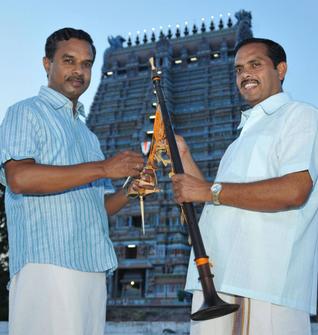
S. Kasim and S. Babu, Nadhaswaram vidwans and grandsons of the legendary nadhaswaram exponent Sheikh Chinna Moulana, feel there is no place for ego in music. / Photo: M. Moorthy / The Hindu

Kasim and Babu are the inheritors of nadhaswaram exponent Sheik Chinna Moulana’s musical legacy in more ways than one. Nahla Nainar listens to their story

Grandsons or disciples? “Before we are grandsons of Sangeetha Kalanidhi Sheik Chinna Moulana, we are his disciples,” asserts Subhan Kasim. Speaking about his maternal grandfather and acclaimed nadhaswaram exponent is clearly a matter of great pride for Kasim, who with his younger brother Babu, was handpicked by the maestro to continue the family’s musical legacy.

Kasim and Babu meet visitors at ‘Alaphana’, the 1950s-era house in Srirangam that was formerly Sheik Chinna Moulana’s residence and is now Kasim’s home. A hot breeze stirs up the dry leaves outside, but the mood inside is one of quiet reflection. It will be 15 years this week since Sheik Chinna Moulana died at the age of 74.

“From 1982, after I graduated from college, until Thatha’s last concert in 1999 in Chennai’s Music Academy, where he was awarded the Sangeetha Kalanidhi title, I was performing with him,” recalls Kasim. “Thatha never had a retirement phase, he just kept working, or teaching.”

The Dr. Chinnamoulana Memorial Trust set up by Kasim and Babu will be hosting its 15th Shradhanjali (commemorative gathering) at Tiruchi this week.

Music in the veins

Originally from Karavadi in Andhra Pradesh, the family has over three centuries of experience in playing the nadhaswaram. “Thatha belonged to the Chilakaluripet school of music,” says Kasim, naming the town in Guntur district. “Among his gurus were his own father, Sheik Kasim Sahib, and later, Sheik Adam Sahib.”

Despite emerging as a noted performer in the Andhra style of Carnatic music, Sheik Chinna Moulana decided to explore the Thanjavur ‘bhani’ (school) which allows for greater variations in presenting ragas. “From an early age, Thatha was influenced by the recordings of T.N. Rajarathinam Pillai (1898-1956). He migrated to Tamil Nadu to get trained in the Thanjavur style of playing by the Rajam-Duraikannu brothers of Nachiarkovil for four to five years,” says Kasim.

Sheik Chinna Moulana’s career took off in the early 1960s, and Kasim believes it was the exposure to the Thanjavur ‘bhani’ that helped immensely. The maestro decided to make the pilgrimage town of Srirangam his home. Kasim, who accompanied his grandfather to Tamil Nadu early on, studied at the Srirangam Boys High School, and went on to graduate in Physics, at St. Joseph’s College, Tiruchi, while getting his music education at home.

Babu joined the in-house gurukul in his teenage years, and was educated up to Standard 8 in Andhra Pradesh. “We started our training with smaller versions of the nadhaswaram,” says Babu in halting Tamil, “Then, as we became older and and our hands grew accustomed to reaching all the fingering holes, we were given the regular-size instruments.”

The nadhaswaram, together with the ‘thavil’ drum, are often referred to as ‘mangala vadyam’ or auspicious instruments, showing their importance to sacred music in southern India.

The nadhaswaram’s use as a solely temple-based instrument for daily prayers and processions was slowly introduced to a more public and secular platform by royal families and later, the landed gentry.

“Nadhaswaram is an integral part of our society,” says Kasim. “Few occasions – weddings, housewarming ceremonies or prayers – are complete without its music.”

The days of concerts that would start late and go on past midnight are well and truly gone, says Kasim. “Artists today have learned to compress what was being done in four hours, to two-and-a-half. Most of the concerts these days are held from 7 to 9.30 p.m., which is a good duration. It allows more women to attend as well,” he says.

Concert exposure is as important to the artist as getting practical instruction, says Kasim. “I learned a lot about presentation and public relations while performing with Thatha,” he says. “These days, with overseas assignments, the artists must be prepared to interact with people of other nationalities too.”

Above all barriers

Kasim and Babu maintain an extensive audio-visual archive of their grandfather’s music concerts at home. Some video samples, such as Sheik Chinna Moulana and shehnai virtuoso Ustad Bismillah Khan exchanging ideas on fingering techniques on the two instruments, are shown to students of the Saradha Nadaswara Sangeetha Ashram, a school established by Sheik Chinna Moulana and today run by his family in Srirangam.

A typical day for the brothers starts off with breathing exercises (pranayama), and is followed by practice sessions on the nadhaswaram. Afternoons are reserved for vocal music lessons for the students, followed by instrument training in the evenings. “We spend the rest of the day in updating ourselves,” says Kasim. “Unlike before, there are hundreds of compositions being brought out these days, so as active performing artists, we must be familiar with what is going on in the arena.”

As to whether there’s any sibling rivalry during concerts, Kasim replies: “I support my brother when he takes the lead, and he supports me when I take the lead. There is no place for ego in music.”

The success of Muslim artists like Sheik Chinna Moulana and Bismillah Khan in a sometimes exclusively Hindu cultural sphere is a great example of India’s syncretism. Both the brothers, presently the special nadhaswaram artists of the Tirumala Tirupati Devasthanams, feel that music is above matters of faith.

“Thatha often used to say ‘music is my religion; perfection is my aim.’ In northern India, most of the doyens of classical music are Muslims. You have the Kirana gharana, Bade Ghulam Ali, Roshanara Begum and so on. Those who speak of religion cannot ignore the contribution of the Mughal dynasty to the field; ragas like Malkauns, Amir Kalyani and Darbari Kanada all have an Islamic origin. Only those who are ignorant about music object to Muslims in the field,” smiles Kasim.

What is more pertinent is institutional support for classical music in India, he says. “The temple’s day begins and ends with nadhaswaram music. But increasingly, even big temples are doing without these musicians. The government should step in by paying exponents a decent salary and encouraging their employment,” says Kasim. “The backing of sabhas is crucial as well, because it helps in the musicians’ professional growth.”

Tribute to the maestro

The Dr. Chinnamoulana Memorial Trust, set up in 1999 by his grandsons Subhan Kasim and Subhan Babu, will be hosting its 15th ‘Shradhanjali’ (commemorative gathering) at Hotel Sangam on April 13 and 14.

At the event, the trust will be presenting nadhaswaram instruments to six deserving students this year, and for the first time, ‘thavil’ drums to three pupils, as part of the corporate social responsibility initiative of Bharat Heavy Electricals Limited (BHEL). In addition to this, a purse and citation each will be presented to senior artists Pandhanallur P.K. Ramalingam Pillai (nadhaswaram) and Needamangalam C. T. Kannappa Pillai (thavil).

Concert performances include a vocal recital by T.K. Krishna on April 13, and a nadhaswaram rendering by M. Sivadivel the next day. The event is being organised in co-operation with Rasika Ranjana Sabha, Tiruchi.

source: http://www.thehindu.com / The Hindu / Home> Features> MetroPlus / by Nahla Nainar / Tiruchirapalli – April 11th, 2014
I am… S. Amjad Ibrahim – Watch and spectacles seller/repairer

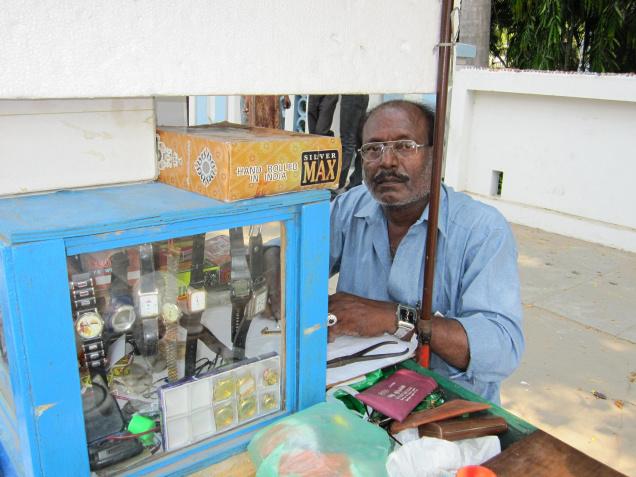
S. Amjad Ibrahim says sometimes business is dull and sometimes there is no business at all. / by Special Arrangement / The Hindu

On some days, I earn around Rs.150-200. Sometimes, there’s no business at all. Then I just sit here and watch the world go by until it is time to go home

It’s just been a few months since I set up my mobile stall here; before this I was selling agarbatti (incense sticks) and attar (fragrant essential oil used in perfumes). I also offer lucky birthstones and sunglasses for two-wheeler users.

Customers can both buy watches and get them repaired by me.

Usually it’s nothing more than a battery change. But watches stop working when they get wet. The water cuts off the battery wire within and also rusts the metallic buttons.

Most of the parts are electronic these days, so they can be replaced piecemeal without damaging the entire watch.

It takes me around 20-30 minutes to repair a watch. And there are days when a watch refuses to work despite all the time I spend on it – I put it away and return to it after a break.

I usually charge Rs. 10 or 20 for watch-repair. Of late I have taken to selling spectacle frames as well.

Shops charge in the hundreds of rupees for a single frame – I buy cheap frames and used ones as well, and sell them for around Rs.20-30 to people who cannot afford the pricey ones.

I push my cart from home, around 2 kilometres away and reach here (Bharatidasan Salai) by 10 a.m.

The traffic policemen often complain about vendors like us being in the way – but as you can see, I’m just minding my own business without troubling anyone.

There’s no breakfast, just a cup of tea at home. For lunch, I usually have a serving of ‘kool’ (porridge) from the stall nearby. It keeps me full until sunset, when I pack up my cart and push it back home in time for dinner. It’s good exercise for me.

On some days, I earn around Rs.150-200. Sometimes, there’s no business at all. Then I just sit here and watch the world go by until it is time to go home. I have six grown-up children, three sons and three daughters.

Most of the watch spares are easily available in Singarathope – you have to ask for ‘China movement’. I’ve spent roughly Rs. 6000 on my stock; I do hope I’ll be able to earn a profit soon.

I’ve dabbled with many other jobs and businesses before – I used to own a grocery store once, but had to close it down because I couldn’t manage it alone.

It’s important to keep earning something, no matter how old you are.

source: http://www.thehindu.com / The Hindu / Home> Features> MetroPlus> Society / by Nahla Nainar / Tiruchrapalli – April 11th, 2014

Drumming up a legacy of 32 generations

Artistes gather this weekend to remember Ustad Karamatullah Khan, who carried a legacy of centuries, Yogesh Pawar reports

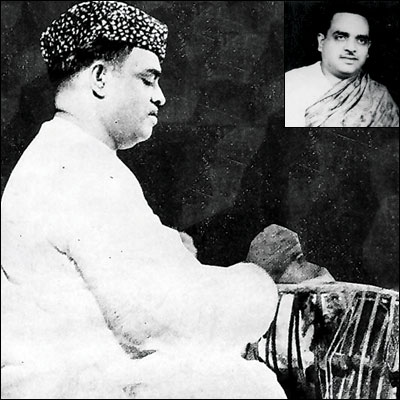
UstadKaramathullahKhanMPos14apr2014

An unbroken lineage going back to the 12th century: that’s the legacy of the late tabla doyen Ustad Karamatullah Khan, who passed away in 1977 after a lifelong commitment to music.

“To carry the weight of the legacy of 32 generations and do it ever so lightly is no joke,” says renowned octogenarian sarod maestro Buddhadev Dasgupta. Though frail in health, his spirits pick up as he remembers Farukkhabad gharana’s Karamatullah Khan, who passed away when he was just 60.

“Just the mention of his name brings memories of his divine tabla,” he adds while addressing a gathering on the occasion of a special tribute to the late legend at the National Council of Performing Arts, Mumbai this weekend.

In fact, there was a time in the 50s and 60s when no top artist would perform without him, remembers well-known vocalist Ustad Rashid Khan, part of the line-up at the event.

“Imagine his formidable talent that he would be the accompanist of choice for the late sarod maestro Haafiz Ali Khan saheb (father of Ustad Amjad Ali Khan), sitar maestros Enayat Khan saheb (father of the late sitar maestro Ustad Vilayat Khan), Pt Ravi Shankar and Kathak legend Pt Birju Maharaj,” he points out. “These are giants in their arts. If all of them insisted on him, can you begin to fathom his exceptional greatness?”

International Kathak legend Pt Chitresh Das, who grew up in the Kolkata of yore, sheds more light on the man. “I grew up watching Ustad Karamatullah Khansaheb performing in all-night concerts in Kolkata. I also saw his father perform. I danced with Ustad Karamatullah Khan when I was just 20 years old at the grand New Empire auditorium in Kolkata. (Karamatullah’s son) Sabir was just three years old then. It’s a great feeling to have performed with three generations of this family,” Das says.

Vocalist Begum Parveen Sultana echoes him. “Music is the only way to pay tribute to a soul as great as him. We can only hope and pray dua for a man who was an exceptional guru, musician and human being. In classical music, the main requirement is surrender and complete bhakti for the art. Without that, there can be no sukoon in your art like the kind Ustad Karamatullah Khan found.”

In this, Karamatullah was taking a leaf from his father, the late Ustad Masit Khan, the unparalleled tabla legend of his time who also performed with most if not all top musicians, such as vocalist Ustad Fayyaz Khan saheb and Ustad Haafiz Ali Khan. In fact, he was primarily responsible for popularising the tabla in West Bengal through disciples like the late Pandit Jnan Prakash Ghosh and, of course, his son who brought in a new dimension as he blended his tabla technique effortlessly with vocal, instrumental and dance, not to mention his solo performances with equal ease.

As India’s top names from the world of classical music come together on one platform, his son and heir to the Farukkhabad legacy, Ustad Sabir Khan, who will a lead a tabla quartet with his three sons, admits to being overwhelmed by the love and respect for both the gharana and his father. A tinge of bitterness escapes him though.”I wish some of this had come in his lifetime. Despite being a pioneering artiste and composer, he never got his due.”

Stating that his father was so devoted to his art that he barely had time to chase honours like the Padma awards, the son says, “But the fact that he is remembered and recognised by music lovers for the unparalleled rich legacy he has left behind is perhaps the best possible award.”

This is not a son’s indulgent hyperbole. Other tabla legends like Ustad Zamir Ahmed Khan point out how no tabla player in the world can be free from the Farukkhabad gharana influence. “Many others have hogged the limelight and become media darlings but the true connoisseurs know when they begin playing how much they borrow from our gharana’s teachings.”

The Farukkhabad gharana of tabla was created in the 12th century by a Rajput court musician, Akaasa, who later converted to Islam and changed his name to Mir Akaasa. Sabir Khan credits him with introduction of bols into percussion. The first bols introduced were tat-dhit-thun-nan. “It began with pakhawaj and later these techniques were brought into tabla too.”

Mir Akaasa died in 1189 AD. He was succeeded by nine sons and a daughter. He passed on his legacy to his eldest son, Ustad Bilawal Khan, who in turn passed the torch of the gharana to Ustad Ali Bux (famous for his kran bols). This tradition continued till the 26th descendant, Ustad Haji Vilayat Ali Khan (1779-1826). It was he who named this gharana after the province he settled in — Farukkhabad.

Soon after his seven pilgrimages to Mecca, Haji Vilayat Khan gained fame for his famous battle of tabla gats with Ustad Salaali Khan saheb who had challenged Ustad Bakshu Khan saheb of the Lucknow gharana. In order to save his pride, Bakshu Khan saheb requested Haji saheb, who was also Salaali Khan saheb’s uncle, to fight the battle with Salaali Khan saheb, on his behalf.

A fortnight-long battle ensued where many gats (authentic compositions of the gharanas) and jodas (pairs of such compositions) were exchanged, Haji saheb played a unique gat (gat of Gazi) whose joda Ustad Salaali Khan saheb could not come up with. Haji saheb was declared the winner.

As a reward, Ustad Bakshu Khan saheb gave his daughter in marriage to Haji saheb, who in return gave Salaali Khan saheb his own daughter in marriage along with 14 authentic gats known as jahezi gats as dowry. Ustad Sabir Khan — the 33rd generation of this unbroken lineage is followed by his sons Arif, Asif and Ameen Khan who take after him.

There is a huge variety in the repertoire of compositions owing to the tremendous creative output of great composers such as Haji Vilayat Ali Khan, Ustad Nisar Hussain Khan saheb, Ustad Nanhe Khan saheb and Ustad Karamatullah Khan. This is of course discounting the huge number of new gats.

Little wonder then that the oldest school of tabla has such a rich and varied repertoire.

Earlier known as the purbi baaj (eastern style), characterised by an extensive use of resonant strokes the playing style contains similarities to the techniques of the pakhawaj certain bols, such as dheredhere, takataka.

Medieval pandits
Mir Akaasa (founder) (1132 – 1189)
Ustad Bilawal Akasa (1151 – 1208)
Ustad ALi Bux (kran) (1182 – 1255)
Ustad Bairam Khan (1204 – 1260)
Ustad Dhamman Khan (1236 – 1292)
Ustad Tajalmulh Khan (1260 – 1297)
Ustad Bunda Khan (1284 – 1329)
Ustad Asgari Khan (1306 – 1348)
Ustad Ali Raza Khan (1331 – 1371)
Ustad Ali Ahmed Khan (1355 – 1398)
Ustad Ramzan Khan (1378 – 1438)
Ustad Bakshu Khan (1397 – 1508)
Ustad Ali Asgar Khan (1425 – 1480)
Ustad Neyaz Khan (1450 – 1525)
Ustad Daulu Khan (1496 – 1548)
Ustad Waheed Khan (1517 – 1565)
Ustad Altaf Khan (1534 – 1574)
Ustad Jannesar Khan (1546 – 1609)
Ustad Dilawar Khan (1570 – 1646)
Ustad Yawar Khan (1602 – 1653)
Ustad Nasru Khan (1628 – 1677)
Ustad Bhurey Khan (1648 – 1691)
Ustad Enayat Khan (1676 – 1732)
Ustad Murad Khan (1705 – 1747)
Ustad Inam Ali Khan (1731 – 1790)
Ustad Shetab Ali Khan (1759 – 1816)
Ustad Aman ALi Khan (1779 – 1826)
Ustad Haji Vilayat Ali Khan (1803 – 1873)
Ustad Nesar Hussain Khan (1824 – 1877)
Ustad Nanhe Khan (1847 – 1902)
Ustad Masit Khan (1872 – 1974)
Ustad Karamatullah Khan (1917 – 1977)
Ustad Sabir Khan (1959)
Arif Khan (1986)
Asif Khan (1990) Ameen Khan (1992)

source: http://www.dnaindia.com / DNA / Home> Lifestyle / by Yogesh Pawar / Place:Mumbai, Agency:DNA / Sunday – April 13th, 2014

Creative collaborations

The father-son duo may not share the same calling, but are not averse to sharing notes on their respective artistic pursuits

YusufArakkalMPOs14apr2014

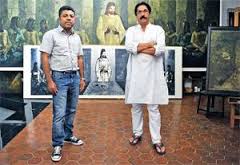
It was going to be different. This meeting. Artist Yusuf Arakkal, famous for his all-black attire as he is for his intense paintings, was dressed in pristine white kurta pyjama. “Don’t I look good?” he asks, leading the way to his large studio bathed in white light from huge north-facing windows. Paintings worth colossal amounts of money are stacked against the wall — some still await the maestro’s final touch.

Shibu, Arakkal’s only child, walks up to one of Arakkal’s paintings — an unnamed abstract — and wipes away a disturbing speck of dust. He then stands back and looks — not at the painting, but at the spot that he’s just cleaned. “I had no interest in art,” he says.

Arakkal cuts in: “In fact, I was worried that he would become an artist. I didn’t want him to be one. He would’ve been subjected to unfair comparisons.” There’s a reason behind Arakkal’s fear.

It was 1983. Arakkal was bestowed the National Award in Delhi along with Shamshad Husain, son of the legendary MF Husain. “After receiving the award,” recalls Arakkal, “we were walking back together when we overheard an artist say, ‘Baap ka beta hai isliye award le gaya.’ (He is THE father’s son, that’s why he took the award). That was terribly unfair to Shamshad.”

Arakkal never wanted Shibu to be subjected to such derision. He needn’t have worried.

Shibu’s calling was different. He wanted to become a photographer, but he didn’t know it at that time. Back then he wanted to be a football player, cricket player and also “an IAF pilot”.

He was a curious child, remembers the father. When he was two-years-old Shibu ripped off the film from his father’s Praktica camera and declared: “There is nothing to see.” Arakkal laughs, remembering the incident.

When he was in the eighth standard, Shibu was enamored by his father’s photographer friend, Regis Richard’s tiny camera. “It was almost like a spy camera,” recalls Shibu. He bombarded Richard with questions. And before he left the city, Richard gifted Shibu his Asahi Pentax 110 camera. “It was my first camera. Ever,” says Shibu.

However, Arakkal was convinced about his son’s talent as a photographer only when he saw a photo of a tiger clicked by him for an inter-college competition. “I looked at it and knew at once that this boy understood lighting,” says Arakkal, whose paintings are renowned for their artistic show of light and shadows. Shibu won the competition for the next three years in a row. “He had begun his journey that led him down an arduous route reserved for artists,” explains Arakkal.

The Arakkals discuss their works with each other freely. Shibu’s panoramic work from his series Passing By occupy pride of place at the Arakkal’s home. Jostling for attention is his baby portrait done by Arakkal during an eclipse when a four-year-old Shibu was more inclined to peer at the sun. “It was a way to keep him indoors and still by asking him to pose for me,” says Arakkal.

The duo might not agree on many things in life, but they firmly believe that to be an artist one has to have in-depth technical knowledge. As an art student at the Chitrakala Parishad College, Arakkal remembers his teachers sending them out “into the world to do live sketching” — 50 sketches a week and 10 watercolour paintings were the norm. The first thing he did after graduating in 1973 was to destroy most of his works done as a student. “I didn’t want to be burdened by those works and wanted to start afresh,” he says.

He then painted eight paintings — and several collages and collographs — depicting abstract and religious themes — and had his first solo show at the Alliance Francaise in 1975. It was a sell-out. “Today, students regularly hold solo shows even while learning art. There is a big hurry,” feels Arakkal. Shibu says the same is true of his world. “Half of the photographers have not seen a dark room and many do not understand the depth of photography.”

Father and son share the creative realm but their approach to it is different. “I am not emotional like him,” says Shibu. That could be because their early, impressionable years were diverse. Arakkal, from the royal Arakkal family in Kerala, had run away from home at 16. He wanted to be an artist. For two years he roamed the streets of Bangalore — unwilling to let go of his dream. “If I am an artist today, it is because I was stubborn about my dream,” says Arakkal. “He is the most stubborn person in our family,” laughs Shibu. His two-year-old daughter Zarah, he says, displays her grandfather’s stubborn streak. “Probably taking after him,” he says.

When Shibu recently won the Florence Biennale Gold Medal (2013) for his Constructing Life, Arakkal’s heart swelled with fatherly pride. The son had made a place for himself under the sun, away from his father’s colossal shadows. But there were detractors. Some of them commented that Shibu got the award because his father had influenced the jury. “Dad wanted to clarify but I told him not to,” says Shibu. “I rather focus on my work than answering them.” Arakkal nods in agreement. His son has indeed charted his own path.

source: http://www.bangaloremirror.com / Bangalore Mirror / Home> Columns> Sunday Read / by Jayanthi Madhukar, Bangalore Mirror Bureau / April 12th, 2014

Gangs of Mumbai

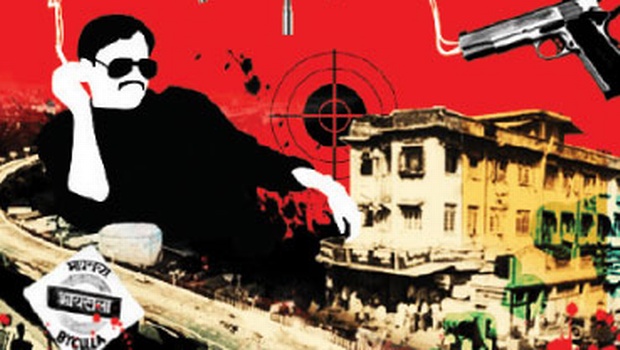
No one will step forward unless he wants to get chopped up like a carrot,” he said coldly. Twenty-four-year-old Amar Naik, wielding a chopper like a vegetable knife, was ready to take that one step that would catapult him from an ordinary youth to a criminal. Working at his brother’s vegetable shop, it was his reaction to paying vargani (contribution) to the Gawli and Potya gangs that operated in the Parel-Byculla belt in Mumbai.

Rakesh Khundongbam
Rakesh Khundongbam

After Dongri to Dubai, which traced the journey of don Dawood Ibrahim, S Hussain Zaidi returns with Byculla to Bangkok. In his new book, he chronicles the lives and times of Mumbai’s Maharashtrian mobsters—from Arun Gawli who went from being a mill worker to a dreaded gangster and part of the incredibly named BRA gang (taken from the initials of its three leading members Babu Reshim, Rama Naik and Arun Gawli), to Ashwin Naik, a civil engineer who joined his gangster brother Amar Naik’s gang and the biggest of them all, Chhota Rajan, who went on to become Dawood’s right-hand man and later foe ultimately joining hands with Dawood’s rival Gawli.

Byculla to Bangkok By: S. Hussain Zaidi Pages: 299 Price: Rs 304 Imprint: HarperCollins

Zaidi makes a connection between the shutting down of mills in the 1980s and ’90s and lack of jobs, and the rise of gangs and their foray into real estate deals besides the liquor dens, extortion, black marketing of cinema tickets and settling of financial disputes.

There is a saying in the underworld, Zaidi writes, ‘Jiski nazar game se hati, woh game se hata’ (He who does not keep his eye on the game eventually loses it). It was a time when reprisal killings —one gang would kill a member of a rival gang and the other would retaliate —were rampant to establish supremacy and ‘shootouts’ constantly made headlines. Family was usually off limits but Dawood went for Gawli’s brother and Gawli retaliated by killing Dawood’s brother-in-law. Killings also extended to businessmen and mill owners who were sources of finance to rival gangs and Zaidi unravels the complex web, trying to bring the shifts in power as each gang tried to decimate the other, into an orderly narrative. It is a difficult task and he goes from past to present, one episode to another, making it somewhat difficult to keep track of.

By 1995, “the mafia had spread its tentacles to real estate, Bollywood, and almost everywhere it could smell money. In the nineties, few flaunted their wealth for fear of being spotted by the mafia, which lost no time in making that ‘Pay or else’ call. Then police commissioner Ram Dev Tyagi greenlighted the era of police encounters, and “between 1993 and 2003, some 600 criminals were killed in Mumbai”.

The press note for all these was standard (A team of officers intercepted a vehicle… the gangster was told to surrender but he opened fire… the cops fired in retaliation and self-defence), but Zaidi, in true potboiler style, tells the stories behind the official versions and of the second and third-rung aides and shooters, from Dawood’s hitman Sautya whose lust was legendary and who deviously plotted to kill the husband of the woman he loved to the diminutive D K Rao who managed to kill his one-time colleague O P Singh in no less than the confines of a jail. Of how India’s biggest druglord got smitten by the charms of a “woman of indescribable beauty…”, and who was ultimately to be his downfall. It is not just a chronicling of the men of the underworld but also the stuff Bollywood dreams are made of.

Byculla to Bangkok

By: S. Hussain Zaidi

Pages: 299  Price: Rs 304

Imprint: HarperCollins

source: http://www.newindianexpress.com / The New Indian Express / Home> LifeStyle> Books / by Monica Bhatihja / April 13th, 2014

Irrfan Khan scores over ‘The Grandmaster’

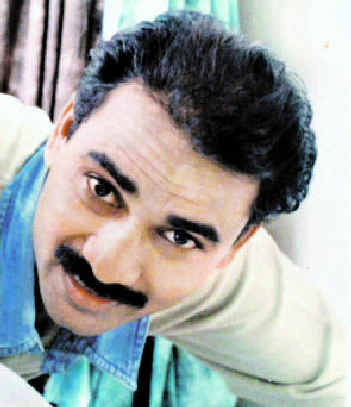
Irrfan Khan has just returned from Macau with the best actor and best screenplay trophies for The Lunchbox at the Asian Film Awards. 

Irrfan Khan
Irrfan Khan

What makes this award precious is that he beat Toni Chiu Wai Leung who was nominated in the best actor category for the Wong Kar Wai film, The Grandmaster.

“I’ve loved Toni’s work—Hero, In the Mood for Love, Chunking Express, Infernal Affairs and The Grandmaster. Even Ang Lee was impressed with The Grandmaster, which picked up the best film and best costume awards. Just being nominated with Toni was an honour,” he exults.

“What’s more encouraging is that The Lunchbox is growing everyday. It has released in around six countries, will open in 63 more. It’s just released in the UK, is growing bigger in the US, and has made a million in Hong Kong. This has never happened for an Indian film. It’s not patronised by only NRIs but the foreign market too.”

Still disappointed about missing out on the Oscar glory? “I was, for a day or two. Now, I’m happy the film is getting its due all over the world,” he asserts.

source: http://www.timesofindia.indiatimes.com / The Times of India / Home> Entertainment> Bollywood / by Roshmila Bhattacharya, Mumbai Mirror / March 29th, 2014

Shazia baaji an icon

Aruti Naya traces the journey of Shazia Ilmi from a middle class Muslim home to the electronic media

For Shazia Ilmi, Senior Anchor, Star TV, Chandigarh was a pleasant surprise, coming as she was after almost a decade. As she puts it, “The city compares favourably with any metro, it is amazing.”

In the city for the programme Match ke mujrim, for Star, which had to be hurriedly refocused because there were no mujrims! The audience was the students on the PU campus at Gandhi Bhavan, who went berserk after the cricket team’s win as Shazia talked to them after the match. “Each of them wanted the name of their department mentioned. Syed Kirmani and Bishan Singh Bedi who were on the live show could barely get a word in, says she.

Thirty-three-year-old Shazia has very good memories of the city because for this student of St. Bede’s, the city was a frequent stopover during the journey to the college in Shimla after the vacations. Shazia’s journey from a girl from a conservative Muslim family of Kanpur to a profession in the electronic media with a high visibility quotient was not easy. She had to persist and doggedly keep doing what she wanted to because no woman in her entire clan had ever worked. In fact, her mother still wears a burqa.

It was her father, the founder-editor of the oldest and largest-selling Urdu daily from Kanpur, Siyasat Jadid, who was her role model and Shazia always wanted to be a journalist. After schooling from St. Mary’s in Kanpur and Nainital and college from St. Bede’s, Shimla, it was mass communication from Jamia Millia Islamia and finally a diploma in broadcast journalism from University of Wales, Cardiff.

The youngest in a family of four brothers and two sisters, she was expected to marry comfortably and settle down or at best (since she was academically bright) become an IAS officer. But as she puts it, “When you have so many problems with the system, how can you become a part of it? Freedom is not economic alone, it is the freedom to make a choice and do what you want to from your heart.”

Five years hence Shazia sees herself in politics. Covering politics was very stimulating for her, especially elections in Bihar and Maharashtra. She travelled through the length and breadth of the states to get the views of people especially at the grassroots for the programme Maratha Express. She is also into programming, writing and production.

Shazia does not believe that “it is not a natural progression for an idealist to become a cynic. In fact, you can retain your idealism.” And she did not view marriage as a passport to a better life and even to happiness.

Icons who she looks up to, Kalpana Chawla and Kiran Bedi because, “They won respect for being action-oriented and decisive.”

Shazia is upbeat about the changes being wrought by the electronic media, it is changing the way the young are looking at themselves. The resonance of this changed perception echoes even in the bylanes of Chamnganj, Kanpur, when Rabia, who has never stepped out, tells her “Shazia baaji, please find out about Frankfinn, I want to become an airhostess,” At least, girls are thinking and dreaming.

In Kanpur Shazia baaji is an icon. Married to investment banker Sajid Mallik, half-Gujarati Muslim and half-Tamil Iyer, Shazia is emotionally dependent upon her extremely supportive husband. Shazia is not overtly religious but is into spirituality and meditation, still seeking answers. How does she distress, “I do not distress. Stress suits me fine and brings out the best in me.”

source: http://www.tribuneindia.com / The Tribune / Home> Lifestyle / Chandigarh – Sunday October 30th, 2005 

Capturing beauty of historical monuments

Private collectors across the world possess Mohammed Ayaz-ud-Din’s photographs

Mohammed Ayaz-ud-Din

Gulbarga, Karnataka : 

The story of lensman Mohammed Ayaz-ud-Din hailing from a remote village in Gulbarga district is an example of how dogged perseverance can take a person to the pinnacle in his profession.

Mr. Ayaz-ud-Din, who was born in a middle class family in Gadikeshwar village of Chincholi taluk, is making waves in the world of photography. Many of his works are owned by private collectors across the world.

Mr. Ayaz-ud-Din completed his post-graduation in photography from the College of Visual Arts, Gulbarga. He has a passion for historical monuments, and his photographs of Khajuraho Temple, Bodhgaya, and Ajmer, and the monuments in North Karnataka have won him laurels not only in India, but also in countries such as the United Arab Emirates (UAE).

The prizes he has received include the All India Exhibition Best Photography Award in 1990; award in the PAC Salon Photography Competition: Best Photography Award during Mysore Dasara in 2000; Tasmiya Art House Best Photography Award; Best Photography Award in the Awantika Art Exhibition in New Delhi. Mr. Ayaz-ud-Din’s love for photography took him from the expansive deserts of Rajasthan to the Khajuraho Temple and fashion shows in Sharjah. Al Sayegh Graphic Company appointed him graphic designer and still photographer in Sharjah for a period of three years from 1991.

Mr. Ayaz-ud-Din helped Mexican researcher Nora Fisher for during her research work on the lives of Lambada women.

His private gallery, “Ayaz Art Gallery,” which will be the second of its kind in the Hyderabad-Karnataka region, is scheduled to be inaugurated next week. Mr. Ayaz-ud-Din has made documentaries on artists, including former Minister Ghorpade, J.S. Khanderao, and Mr. Patil, and also on the Khaja Bande Nawaz Darga and Sharanabasaveshwar Temple in Gulbarga city. He is the founder president of the National Graduate Art and Photography Association.

source: http://www.thehindu.com / The Hindu / Home> Karnataka – Gulbarga / by Special Correspondent / Wednesday – May 03rd, 2006

Historical monuments to receive a facelift

The works will be taken up under NKUSIP

Majestic:  The tomb of Allaudin Hasan Gangu Bahamani, founder of the Bahamani dynasty, in Gulbarga will be one of the monuments to get a facelift.
Majestic: The tomb of Allaudin Hasan Gangu Bahamani, founder of the Bahamani dynasty, in Gulbarga will be one of the monuments to get a facelift.

Gulbaraga, Karnataka :

Some of the monuments in Gulbarga, which date back to the 14th century, are all set for a facelift under the Asian Development Bank (ADB)-assisted North Karnataka Urban Sector Investment Programme (NKUSIP).

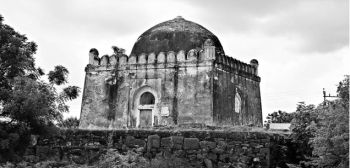
Deputy Project Director of NKUSIP, G.M. Chowdhary, told The Hindu here on Thursday that it had been proposed to give a facelift to the three tombs of the founder of the Bahamani dynasty Allaudin Hasan Gangu Bahamani; Jamia Masjid, constructed on the model of the great mosque of Cordova in Spain inside the Gulbarga Fort; another masjid Sheikh Roza Minar; and Chor Gumbuz, an imposing vacant tomb on the outskirts of Gulbarga city. Also, a heritage track from the government museum to Hafth Gumbuz covering a distance of 1.8 km has been proposed.

Mr. Chowdhary said the total cost was estimated at Rs. 2.01 crore. The work would begin in July.

Proposals

As per the proposals, the approach road to tomb no. 1 of Allaudin Hasan Gangu Bahamani would be improved at a cost of Rs. 7.15 lakh along with restoration of the entrance and walkway from the main gate to tomb at a cost of Rs. 1.91 lakh; illumination and beautification of the outside of the tomb by providing solar lamps would cost Rs. 2.88 lakh. Besides, landscaping and drinking water facilities would be provided at a cost of Rs. 2.92 lakh.

Mr. Chowdhary said that at tomb no. 2, Rs. 6.15 lakh would be spent for improving the area around the tomb and illumination and beautification of the place. At tomb no. 3, Rs. 8.42 lakh would be spent on improving the approach road, entrance to the tomb, construction of compound wall, providing flooring in the tomb and seating arrangements around the tomb for visitors and illumination of the tomb. A sum of Rs. 12.35 lakh would be spent for improving facilities at the Jamia Masjid inside the fort. This included development of landscaping with walkways and seating arrangements at a cost of Rs. 7.37 lakh; providing drinking water facility at a cost of Rs. 2.1 lakh and illumination and beautification outside the masjid at a cost of Rs. 2.88 lakh. A sum of Rs. 1.3 crore would be spent on laying a heritage track of 1.8 km.

Besides, Rs. 3.64 lakh would be spent for improving facilities at Sheikh Roza Minar and Rs. 20.43 lakh on the Chor Gumbuz, one of the important landmarks in Gulbarga city. Also, Rs. 5.38 lakh would be spent for improving facilities at the government museum.

source: http://www.thehindu.com / The Hindu / Home> Karnataka – Gulbarga / by Special Correspondent / Saturday – June 04th, 2011

Lensman pays pictorial tribute to monuments

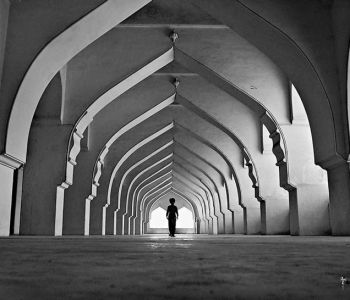
Many layers to it:The interiors of the Jama Masjid captured by photographer Mohammed Ayazuddin Patel and published in his book, ‘Monuments of Gulbarga: Treasure of Islamic Architecture'.
Many layers to it:The interiors of the Jama Masjid captured by photographer Mohammed Ayazuddin Patel and published in his book, ‘Monuments of Gulbarga: Treasure of Islamic Architecture’.

Gulbarga , Karnataka :

Mohammed Ayzuddin Patel, an eminent photographer, has come out with a pictorial tribute to the monuments in Gulbarga district in a book titled ‘Monuments of Gulbarga: Treasure of Islamic Architecture’.

The 96-page book has some rare photographs of the historic monuments in Gulbarga district. This is for the first time that a serious attempt had been made to bring out the breathtaking beauty of these heritage structures in the form of a book. This private initiative is supported by Qamarul Islam, Gulbarga North MLA.

The book was released by Union Minister for Tourism Subodh Kant Sahay during the Gulbarga Utsav on April 15.

One of the features of this book, printed on glossy paper, is the brief historic background of the monuments on each page. The book contains photographs of the crumbling yet imposing tomb of the founder of the Bahamani dynasty, Allauddin Hassan Gangu Bahamani, tucked away in a remote corner in Gulbarga city. This monument, under the control of the State Department of Archaeology and Museums, was a picture of neglect till Mr. Patel took it up with the authorities and the Archaeology Department started conservation work.

Another striking photograph is that of the historic Jama Masjid inside the Gulbarga Fort.

The imposing structure is shown before and after restoration. The book also contains photographs of the interiors of the masjid from different angles. The book also has photographs of the dargah of Hazrat Shaikh Sirajuddin Junaidi, who had come to Gulbarga even before the Bahamani kingdom was established.

The book contains rare photographs of the “mysterious” fort at Holkonda on the outskirts of Gulbarga city with many tombs inside it. The book has some rare photographs of the Nizams of Hyderabad and also the train used by them to visit Gulbarga in summer.

However, Mr. Patel says that only a few monuments have been printed in the book and hundreds of others hidden away from the public need to be brought to the limelight for conservation.

source: http://www.thehindu.com / The Hindu / Home> Karnataka-Gulbarga / by Special Correspondent / Sunday – May 01st, 2011