Category Archives: Arts, Culture & Entertainment

A story in pictures

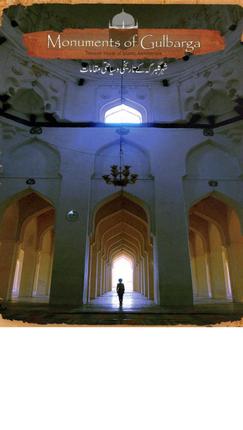
BOOK Monuments of Gulbarga is a book that captures ancient art and architecture through photographs.
Gulbarga01-31mar2014

Domes, tombs, minars , forts, moats and off-course masjids . Are you thinking of Delhi? Why travel thousands of kilometres to experience the reminiscences of the sultanate? Prefer going to Gulbarga, a night’s journey from Bangalore. Instead, feel every bit of Gulbarga’s history by just turning the pages of a book. “Monuments of Gulbarga, Treasure House of Islamic Architecture”, a photo-book authored by Mr. Mohammed Ayazuddin Patel gives you this experience.

Gulbarga, now a district headquarters in northern Karnataka, was the capital city of Bahamani Sultanate for two centuries. It was at its zenith in the 15{+t}{+h}century and was home to hundreds of monuments. The Sultanate was founded by Bahaman Shah or Allauddin Hasan Gangu. He shifted the capital from Daulatabad in the present-day Maharashtra to Gulbarga and laid the foundation for a magnificent city. The other great kings of the dynasty were Mohammed Shah and Mujahid Shah.

Resembles Spain`s Mezquita

The book provides a pictorial account of the history of the Bahamani kingdom. Beginning with a nostalgic photo of a tomb of Allauddin Hasan Gangu Bahamani, the founder of the dynasty, the book vividly portrays the beautiful Gulbarga fort, its ramparts, fine arches and abutments. The Jama Masjid, built within the fort, resembles the Great Mosque of Cordova (Mezquita) in Spain with grand corridors and lofty entrance. Various pictures of Shahi Jama masjid in the book unfurl a tableau in front of the onlooker. This masjid located in Shahbazaar was constructed for the members of the royal family. ‘It has a unique architectural style of Mughals and the Persian style’, the book says.

The mausoleums of Mujahid Shah, Daud Shah, Ghiyat-al-din Shah, and Shams-al-din resemble that of Hasan Gangu. Unique is the Tomb of Feroz Shah, with intricate jalis and twin domes. The pictures of 800-year-old Holkonda fort capture the Islamic culture and the simplicity of Tughlaq style aptly. This fort houses an idgah and a Dargah of Hazarath Mohamad Mashaq Sahib, a Sufi saint believed to have come to Gulbarga at the request of Bahamani Sultans.

Gulbarga is famous for the tombs of Sufi saints and Pirs . Noted among them is Dargah of Khaja Bande Nawaz Gesudaraz, built by Mohammad Shah Bahamani. It has a Bijapuri arch built by Afzal Khan, army general of the Ailshahis. Other Sufi tombs being Dargah Khabullah Hussaini with beautiful paintings and calligraphy, Dargah Hazarath Kamal-e-Mujarrad and Dargah Hazarath Shaik Sirajuddin Junaidi.

Majestic, but dilapidated is the Ferozabad fort, built by Feroze Shah Bahamani. He was known for his flair for fine-arts and architecture. This fort, on the banks of Bheema river, encompasses a huge mosque, Tosha khana , and palacial buildings. In spite of its beauty and historical significance, this fort is ill-maintained. Arrays of dung cakes adorn the walls of the sepulchral edifices. Weed-infested mahals are on the verge of collapse due to vagaries of nature. Crumbling structures like Kanchini Mahal, once magnificent and awe-inspiring narrate a story of wanton negligence.

The Chor Gumbad with floral designs, Chand Bibi Gumbad or Kali Gumbad with exquisite Chajjas andJalis , Upli Gumbad – incomplete, yet beautiful, the utterly neglected tomb of Jaccha Bibi, the Siddi Ambar Gumbad with a rectangular porch, are only a few identified among tens of such monuments wailing for attention.

Water conservation

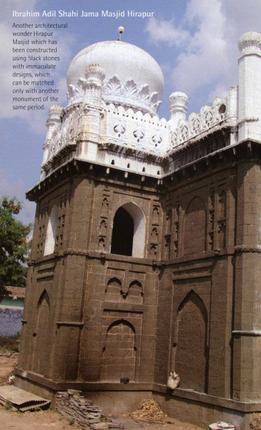
The photos of Hirapur form an interesting set. Hirapur, a suburb of Gulbarga has Ibrahim Adil Shahi Jama Masjid, built in black stone decorated with immaculate designs.

The town has wells, embedded with finely crafted staircases, jharokas and of all, ingenious technology of water conservation to avoid excessive evaporation in soaring temperatures. The wells are still seen as an evidence of splendour, but grossly uncared for.

Strewn inside the fort and atop the bastions are numerous canons, cast in brass and other alloys, weighing several tons, flaunting an intimidating appearance. Famous among these canons is Baragazi Toop atop the Burj in the fort.

Gulbarga is dotted with tombs and mausoleums lost in history, beckoning the curious eyes with their regality. This book displays a tableau of medieval Islamic culture and gives a splendid account of the forgotten monuments. The author also gives an account of Hindu and Jain monuments and pilgrim centres. Patel dedicates quite a bit to the revered Sharanabasaveshwara Temple, Sannati Chandralamba Temple, Ganagapura Dattatreya Temple, and Mallinatha Basadi at Malkhed, but, there is no reference to the nearly 700 year-old-shrine of the Madhwa saint Jayateertha on the banks of river Kagina at Malkhed, a major pilgrim centre.
BookGulbarga31mar2014

Patel, a national award winner, also records Aiwan-e-shahi, Osmania Intermediate College, MSK Mills established in 1884 by the Nizams. He is President of National Graduate Art and Photographers Association.

TAMRAPARNI R. RAGHAVENDRA

source: http://www.thehindu.com / The Hindu / Home> Features> Friday Review / by Tamraparni S. Raghavendra / March 28th, 2014

Religious history should be subjected to a scientific approach: Irfan Habib

Irfan Habib, Professor Emeritus at Aligarh Muslim University (AMU), is a doyen of historical research. Speaking with Eram Agha, Habib discussed challenges like religious fundamentalism facing researchers, the Wendy Doniger controversy — plus AAP and BJP in upcoming polls:

What are challenges in writing history, with fundamentalist forces ready to react?

Well, a primary challenge is the information one would like to have about the past is often missing, partly because historians of an earlier time had a different, more restricted view of history — documents regarding poor peoples’ concerns have not survived. Many matters of their interest were not recorded at all. The major problem for historians is how to fill such gaps.

On the other hand, since all kinds of influences are at work in societies, one cannot confine one’s attention to a locality or country alone — we have to relate the history of one country to others. For instance, we need to explore the relation between modern Indian history and the development of capitalism in Western Europe.

We cannot be like Subalterns who simply concentrate on local communities and forget the larger picture.

Can fundamentalist censorship be dismissed?

Well, religion has been a factor in historical change. Historians need to be careful and rational in assessing religious influences in history.

But it’s not possible to agree with Edward Said when he argues that persons outside any religion or culture cannot study that area. On the contrary, religious history should be subjected to a purely scientific approach — indeed, a refreshingly sceptical attitude towards religious texts might be more desirable than blind belief.

Wendy Doniger tried. Her book was pulped by its publishers. Your thoughts?

The publishers should not have surrendered in the manner they did. They should have waited for court orders before taking any such step.

You’re identified with AMU — what role should an identity-based university play today?

AMU is a university in a poor country, running with generous public financing — it’s important for AMU, as for any other university, to ensure that it offers modern scientific and secular teaching. All marks of identity must subordinate themselves to modern, democratic, secular values.

AMU was established to cater to Muslims but not exclusively for them, and not at the cost of proper education. In the 1950s and 60s, AMU was one of India’s advanced universities — today, partly due to the minority status campaign, it’s lost some of that repute. The religious atmosphere too has grown visibly with official support. That must put off others.

Upcoming polls are considered pivotal in India’s political history — your analysis?

Well, 10 years earlier, BJP was rejected — now, it’ll be interesting to see the reverse of the verdict of 2004. That seems to be the main thing this time.

Personally, for me, it’ll be sad if the Left does not recover.

Can AAP generate enthusiasm amongst Muslims?

The reaction of Muslims will not be different from others because AAP is appealing on an anti-corruption cause and thus securing support. Muslims are being addressed the same way as others.

But AAP will be tested on positive programmes — it has to frame an industrial and labour policy, rules on GM crops, land reforms, etc. Questions like these will arise soon.

A clean government is alright — but it should also be a good government.

source: http://www.timesofindia.indiatimes.com / The Times of India / Home> Opinion> Interview / by Eram Agha / March 31st, 2014

Osmania Medical College team wins Hyderabad round

UnionBankHF30mar2014


Hyderabad :  

A team from the Osmania Medical College pipped five other short-listed teams at the regional round of Cerebrations, The Hindu Business Line Corporate Quiz 2014, held here on Tuesday.

The winning duo, brothers Syed Murtuza Hashmi and Syed Mustafa Hashmi, first and fourth-year students at the medical college, took early lead and managed to retain it, with the team from Reckitt Benckiser coming a close second and Sai Constructions at the third place. Of the 20 teams that took part in the quiz, six were short-listed after they fielded a general elimination round of 25 questions.

source: http://www.thehindubusinessline.com / Business Line / Home> News  / The Hindu Bureau / Hyderabad – March 18th, 2014

Films: a profile of a young star Shan Mohammed

First shot, flashback:   A dark theatre. A child weeps bitterly as Amitabh Bachchan dies one of his heroic deaths.

The first turning point came in 2000 when he got in to Pune’s Film and Television Institute of India (FTII) in the editing course.

Nothing unusual, one would say, even adults sob into their handkerchiefs when something tragic happens in films. But this was one of Shan Mohammed’s early brushes with his calling at an age when ‘A’ stood for both apple and  Amitabh.

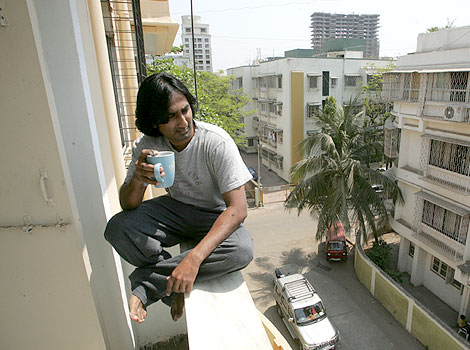
Second shot, 24 years later, sometime in last month: A dark corridor in a three-storied apartment; a man with long locks and a baritone introduces himself as the editor of Abbas Tyrewallah’s forthcoming filmJaane Tu…Ya Jaane Naa.

Meet Shan Mohammed, 29, a film editor who typifies the success of a rising tide of youngsters in the new Bollywood, more daring and professional than ever before.

It’s a successful Shan now in deep focus. But unlike his on-screen counterparts, he doesn’t flaunt his laurels. He embodies a segment of youth that has made it big in the flourishing Hindi film industry. Bollywood has become daring. It is experimenting with themes, narrative styles, cast as well as the look and colour of films. The gamble has paid off. Young people are in demand in every department of filmmaking: writing, direction, editing, acting, costumes, set design and special effects. 

“Cut it,” snapped Shan, the editor, visibly embarrassed. “This is my story, not a film script.”

Shan wanted his story to be told without the dramatic frills.

Jaane Tu…, an Aamir Khan production that launches the actor’s nephew Imran Khan was Shan’s first exposure to a mega-bucks project.

“I met Tyrewallah through Raghav Dar, a friend who is now assisting Sanjay Leela Bhansali,” said Shan. “When I read the script, I fell in love with it. I enjoyed working with the director. He is open to ideas and quite flexible.”

Shan didn’t exactly stumble into films. This commerce graduate had gone to Chennai for his articleship when he bumped into renowned cinematographer PC Sreeram at a photo exhibition. For a guy from the Bhilai steel township, filmmaking was a mystery. “Sreeram, upon knowing my interest in films, asked me to assist someone in Mumbai. I was clueless then; didn’t know what to do, whom to approach,” he said.

After coming to Mumbai, he started staying with a school friend whose grandfather had some connections in the film world. Soon Shan was working with Pankaj Advani on a series of 10-minute films titled Bheja Fryfor Channel V.

The first turning point came in 2000 when he got in to Pune’s Film and Television Institute of India (FTII) in the editing course. Those were the years when he saw the best of Indian and world cinema.

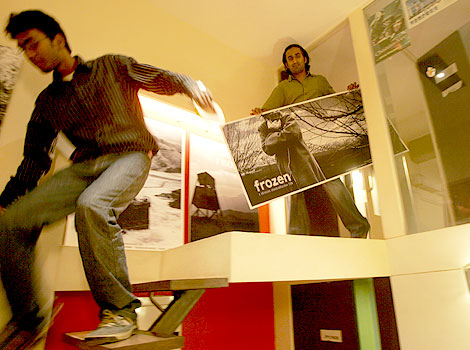
In his third year at FTII, Pune, Shaan made Frozen, a black-and-white feature film, by director Shivaji Chandra Bhushan. It was shot in Ladakh during winter.

“Even as an editing student I was trying to make forays into Bollywood,” Shan said. “I used to come to Mumbai to edit documentaries, which helped me pay my course fee.” He also got friendly with cinematographer Shankar Raman. During his second year at the film school, Raman introduced him to young filmmaker Sarthak Dasgupta, who was doing his first film called The Great Indian Butterfly. Shan edited this road movie that featured Sandhya Mridul and Aamir Bashir.

More documentaries followed, and finally in third year, Frozen happened. Frozen, a black-and-white feature film, by director Shivaji Chandra Bhushan, was shot in Ladakh during winter.

“It was a great learning experience. About 80 per cent of the film was reconstructed on the editing table. It went on to win five jury awards at various international festivals including Toronto, London and Los Angeles. In India, at the Osean Film Festival last year, it bagged the best jury award,” said Shan, beaming with pride. This year’s MAMI festival also has Frozen on its list.

Shan today commands a six-figure monthly salary, and people are willing to oblige. Tyrewallah has only good things to say: “What’s striking about him is his temperament. He will never lose his cool even when people around him are tearing their hair out. He is also extremely self-motivated and disciplined, and that makes a director’s job easy.”

The other vital thing that Tyrewallah probably doesn’t know is Shan’s ability to keep secrets. Even after coaxing him for a good 15 minutes, all that the editor would say about his next snip job was: “It’s a bilingual period film in Hindi and Tamil; shooting will begin some time in May.”

“Time for pack-up,” said Shan. He would want eight-hours sleep to wade through the rushes the following day.

source: http://www.hindustantimes.com / Hindustan Times / Home> India News> India / by Pratik Ghosh, Hindustan Times / Mumbai – March 13th, 2008

Quiet flows the romance

Nawazuddin Siddiqui speaks a subtler language of love than Bollywood is accustomed to, and is all the more effective for it.
Siddiqui’s on-screen romance is definitely of a different brand, but one that many of us can relate to

In the 2011 film Dekh Indian Circus, Nawazuddin Siddiqui played the role of a poor, deaf villager who is exploited by his employers. His kids are unhappy because he cannot afford to give them enough money to watch acircus show.

Then in one the most underplayed scenes, Siddiqui quietly seduces his wife played by Tannishtha Chatterjee. No words are spoken, no songs play and there certainly is no loud orchestral score that pushes the audience to sense the emotions being expressed on the scene.

It is unfortunate the Busan Festival Audience Award-winning film was not released in India. Or else no would have a doubt that Siddiqui (recently referred to as an ‘average’ actor) is one of the most romantic and seductive actors of our times.

In India’s new indie cinema, Siddiqui represents a different language of romance that is quietly spoken all the time, but rarely expressed in Bollywood films that continue to insist on loud proclamation of love through musical numbers (not that there is anything wrong with that).

Siddiqui is a rare actor who has appeared in so many indie films that festivals abroad seem flooded with his work. He had two films at the Cannes Film Festival in 2013 (Monsoon Shootout and The Lunchbox) and three in 2012 (Miss Lovely and Gangs of Wasseypur Part 1 and 2). I am certain no other Indian actor has had that kind of success at just one film festival.

Earlier this year in January, the Sundance and the Rotterdam Film Festivals played Liar’s Dicein the competition sections, where Siddiqui plays a drifter who goes on a road trip with a woman, her child and their goat.

Hardly any conversation takes place between Siddiqui and his co-star, Geetanjali Thapa. And there is never any romance expressed in the traditional sense. But as Siddiqui starts to care for Thapa’s Kamla and her daughter, an unspoken love starts to develop, something rarely shown in Indian cinema.

In moments like this I find Siddiqui to be a deeply romantic actor. There are similar touches in Siddiqui’s subplot in The Lunchbox. Everyone seems to remember the film for its heartbreaking romance between its lead actors – Irrfan Khan and Nimrat Kaur. But Siddiqui’s Shaikh – an orphan had eloped with the girl he is in love with. He madly cares for her, values the home that he has put together with her and will eventually marry her, and it will be the most important day of his life.

In a way The Lunchbox is the story about two colleagues – one who is young (Siddiqui), buzzing with energy, aspirations and ready to start a new life, and the other (Khan), who is facing the end of the purpose of his existence and sets out to look for the one last chance of hope.

Siddiqui, the actor does not need any introduction to those who watch Hindi films of all shades and budgets. He acted with Aamir Khan in Talaash and will be seen in Salman Khan’s Kick. And word is that he has replaced Farhan Akhtar in the Shah Rukh Khan film Raees. How many actors get a chance like this within a span of few years, while also continue to act in films such as Anwar Ka Ajab Kissa, directed by one of the most experimental directors of our times, Buddhadev Dasgupta?

But it is the understated romantic actor in Siddiqui who continues to charm us – the shy Faizal Khan of Gangs of Wasseypur,who suddenly grabs Mohsina’s (Huma Qureshi) hand and is scolded by her. Mohsina’s harsh words bring tears to his eyes, but then she offers him a suggestion. He can hold her hands, but he should seek her permission first.

Siddiqui had told me that the incident had actually happened to him and when he narrated it to Anurag Kashyap, the filmmaker decided to include it in his five-hour long magnum opus. Siddiqui’s on-screen romance is definitely of a different brand, but one that many of us can relate to. It speaks of matters of our hearts.

source: http://www.mumbaimirror.com / Mumbai Mirror / Home> Columns / Columnist Aseem Chhabra / March 23rd, 2014 (print BM March 28th, 2014)

Under his broad brood, swifts ready to fledge

With little expertise, wildlife expert Saleem is trying to give them a new lease of life

The city wildlife team is facing an unusual challenge. They have to pull off what is considered a one-in-a-thousand rescue and rehabilitation of young house swifts (Apus nipalensis), which experts term is a touch-and-go situation.

Despite lack of expertise in rehabilitating the house swifts, which are very delicate, the six young ones are being cared for round the clock with great diligence by wildlife rehabilitator Saleem Hameed.

The birds were rescued from the HAL campus on Friday. At present, Saleem feeds them 24 times in 12 hours, once every half an hour.

This is what Saleem said:

“They were eight birds when they came here. They were rescued after a fall from a hangar. The good thing is, they were rescued along with the nest. Sadly, two died soon, but six are alive.

”They are very difficult birds to raise. With a high rate of metabolism, they have to be hand-fed every half an hour and they need attention round the clock at least till they fledge. The feeding starts at 7 in the morning. They are fed an insect diet, Mazuri, shipped down from the US. They are responding well. They need great care and attention, predominantly between 7 am and 7 pm.

”Unlike most birds, these are very sociable and live in huge colonies. In most birds, we find the territorial fight and new ones are not easily accepted. But here, they are accepted soon as they are sociable. As nothing much is known about swifts, we hope these birds which are roughly about 3-4 weeks-old would take a week or two to fledge. Some birds fledge within a month. Sparrows fledge within 14-15 days.

”An interesting thing is that one of them, probably the oldest of the lot, has already started jumping and is trying to fly. He jumps about 2-3 feet. As they fledge, they have to be launched into air to ensure they can join other swifts that are in a colony.”

source: http://www.bangaloremirror.com / Bangalore Mirror / Home> Bangalore> Others / by  Chetan R,  Bangalore Mirror Bureau / March 27th, 2014

Your STATION has arrived

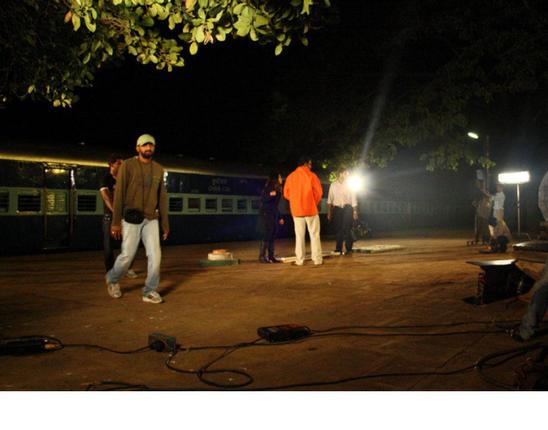
Drumming up interestSaad Khan; on the film set, at a railway station (left) / photo: BHagya Prakash K. / The Hindu

Bangalore boy Saad Khan’s Hindi thriller Station, features city locations, cast and crew. He has also given a new meaning to ‘direct marketing’, thinks BHUMIKA K. as he goes to malls to talk to possible audiences

A director uses his gift of the gab to market his Indie film — he stands in a mall talking to passersby, telling them about his film and urging them to watch it. “I’ve been doing this for the last three days and I must have met about 300 people already. About 20 of them bought their ticket online, standing with me, from their phones!,” says filmmaker Saad Khan. That, now, is his station in life.

Khan’s debut feature film Station , which he claims is the first Hindi movie to come out of Bangalore, releases this Friday with the PVR Director’s Rare label attached to it. Khan expresses the same fears and apprehensions any independent filmmaker today, disadvantaged in the sea of marketing gimmicks that bigger films with A-list stars have. “It’s harrowing, seeing independent films being taken off screens because there are only 10 or 15 people at each show,” says the Bangalore-boy. “Mine is an independent film. We don’t have stars, we don’t have Sunny Leone. I think in my next film, I will have six item numbers…the audience is conditioned to having known faces bring them to a film,” he says evidently frustrated.

A mechanical engineer from M.S. Ramaiah College and with no film background, Khan studied filmmaking in the U.S.A. His short film Another Kind of Black was screened at the 2008 Cannes short film category. While still in college here in India, he got interested in theatre, and wrote and directed plays.

He returned from America to land the enviable position of associate director with Bollywood’s Ashutosh Gowariker on Khelein Hum Jee Jaan Se . When he came home to Bangalore on a break, everyone he spoke to, kept telling him about the vast talent pool in Bangalore. He never returned to Mumbai, and instead decided to set up CenterStage in 2011 that started off holding film acting workshops. Today they’ve expanded to create, among other things, the improvisational comedy show, The Improv.

Station has been long in the making — the cast of the film is drawn from CenterStage, with the training module for the actors starting in 2011. “Every actor in my film has done theatre. Many of them have acted in commercials. We in fact did elaborate rehearsals before the shoot,” says Saad. The film took almost two years to make.

The film, a Hindi thriller, centres around three psychotic assassins at a waiting room in a deserted railway station. “I love the psychology of a criminal’s perspective…the unravelling of the plot is as enjoyable. We had three editors on board and did nearly 40 cuts so that the narrative won’t be slack,” says Saad. “My actors didn’t shave or bathe for days to get the feel of their character right. They walked empty roads at night, sat at small local bars to observe people around them…they came to rehearsal in a dark state of mind.” He chose to make the film in Hindi “because the film’s visual language and narrative could be driven by it. I didn’t think three assassins could talk English, and I don’t speak Kannada fluently. Moreover Hindi appeals to most of the movie-going audience.” None of his actors spoke Hindi fluently either so they were language coached before dubbing for themselves!

ActorsSaadKhanMPos26mar2014

On board Station are actors Siddhanth K. Sundar, model Sameer Kevin Roy, Hardik Sha an actor who’s also the co-producer, and produced by venture capitalist Sumit Ghosh. The film also has a 19-year-old associate producer Neal Bafna, a student of Christ University, who dealt with the everyday logistics of payment of the crew etc. The director however won’t disclose at which railway station they shot. Neither will he reveal the budget.

The film was shot at various locations in Bangalore including Bull Temple Road, Frazer Town, V.V. Puram, Rajajinagar “and wherever the Metro construction is taking place” says Saad.

Bangalore is a place with a heart, he says, recalling how on one of the nights, when the shoot went well into 3 a.m., and they were all craving tea. “We didn’t have caterers because that would be an additional cost. All we would have at that time of the shoot would be chai and biscuit. So a kind lady in the neighbourhood where we shot made us tea at that hour in the morning!”

Station releases March 28 in PVR in Bangalore, Mumbai, Hyderabad, Delhi, Pune, Kolkata, Ranchi, and Ahmedabad.

source: http://www.thehindu.com / The Hindu / Home> Features> MetroPlus / by Bhumika K / March 26th, 2014

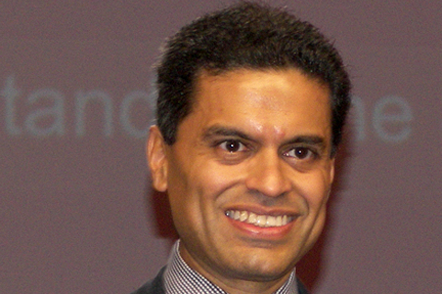
Fareed Zakaria : Acclaimed Journalist

FareedZakariaMPos26mar2014

Fareed Zakaria is a prominent Indian-American journalist and author.

Early life
Zakaria was born in Mumbai on the 20th of January  1964 to parents Rafiq Zakaria, a politician and  Islamic scholar, and Fatima Zakaria, who was the editor of the Sunday Times of India at that time. In his younger days, he was enrolled in Mumbai’s Cathedral and John Connon School.

Zakarai also enrolled into Yale University, where he participated actively in numerous unions and societies. He was the President of the Yale Political Union, the editor-in-chief of the Yale Political Monthly, and a member of the Scroll and Key society and Party of the Right.

Zakarai graduated from Yale University with Bachelor in Arts. In 1993, he also obtained a P.hD from Harvard University in Political Science.

Career
At the young age of 28, Zakaria became the managing editor of Foreign Affairs magazine. He held this post for 8 years, before he became the editor of Newsweek International in 2000. During his stint at Newsweek, he wrote his award winning article, Why They Hate Us, which appeared as a headline story on the cover of the October 2001 issue.

Since 2008, Zakaria has also been hosting Fareed Zakaria GPS, which airs worldwide on CNN. He has interviewed numerous high profile leaders and personalities on his show like Barack Obama, King Abdullah II, Dmitry Medvedev, Muammar Gaddafi and the Dalai Lama.

Fareed Zakaria GPS is broadcasted in approximately 200 million homes across the globe and received an Emmy nomination in its first year.

Zakaria has written best-selling books like From Wealth to Power: The Unusual Origins of America’s World RoleThe Future of Freedom, and The Post-American World. He was also the co-editor of The American Encounter: The United States and the Making of the Modern World.

Awards
The Anti-Defamation League awarded Zakaria with a Hubert H. Humphrey First Amendment Freedoms Prize in 2005. However, he returned the award to the ADL as a sign of protest after the organisation opposed the building of an Islamic centre  two blocks away from Ground Zero.

In 2010, Zakaria received the the Padma Bhushan, the third highest civilian award in the Republic of India, by the Government of India. In the same year, he was named as one of the top 100 global thinkers by Foreign Policy. Zakaria also received a National Magazine Award that year.

Personal life
Zakaria is married to Paula Throckmorton Zakaria, with whom he has one son, Omar and two daughters, Lila and Sofia. Zakaria, a naturalised American citizen, lives with his family in New York.

This biography will be updated regularly.

References

Fareed Zakaria Website

source: http://www.southasiandiaspora.org / Home> Author, People / by Jaclyn / August 02nd, 2012

Rare View Mirror

Sharla Bazliel reviews conversation with Waheeda Rehman by Nasreen Munni Kabir.

Her name means “the unique one” and few actors have had a career, and life, quite like Waheeda Rehman. From being discovered by Guru Dutt by sheer accident at the age of 17 to becoming a successful star in Bollywood, to giving it all up one day and moving-toddlers in tow-to a derelict farm on the outskirts of Bangalore with husband, sometime actor Shashi Rekhi, Rehman has done it all. In Conversations With Waheeda Rehman, the actor tells the entire story in her own words, with insightful prompts by filmmaker and writer Nasreen Munni Kabir that prevent the book from turning into a rambling mess.
Conversation with Waheeda Rehman by Nasreen Munni Kabir


Rehman speaks with honesty and humour and Conversations is filled with interesting anecdotes about her experience of working with artistes such as Satyajit Ray (who first brought up the subject of wanting to make Guide), Raj Kapoor, Dev Anand (who was perpetually late), her friendship with stars such as Nargis, Sunil Dutt and Nanda and her adventures living off the land. Bollywood buffs and collectors of film trivia can look forward to her insights into the craft of filmmaking and an entertaining behind-the-scenes look at the making of some of the key films in Indian cinema.

Although her personal story is fascinating, the heart of the book lies in a few pages about Guru Dutt. With her natural talent and  haunting beauty, Rehman brought to life some of Indian cinema’s most iconic characters-Gulaabo, Shanti and Rosie-but no story about the actor is considered complete without reference to the doomed director who committed suicide in 1964. Although Rehman acknowledges this curiosity, her answers sixty years later remain shrouded in layers.

Excerpts
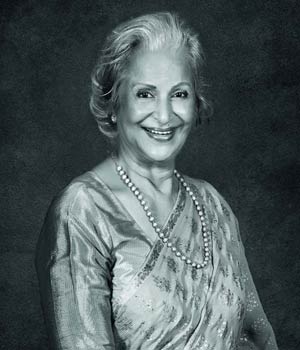
Waheeda Rehman. / Pic by Rohit Chawla
Guruduttji was sitting in a distributor’s office (in Hyderabad) when they heard a commotion outside. Guruduttji asked him if there was some trouble on the street and he was told the stars of a popular Telugu film were passing by and excited fans were making the commotion. The distributor then added: ‘A new girl has performed a song in the film. It has caused a sensation. When the stars go on to the stage, the audience demands to see this young girl. Her name is Waheeda Rehman.’ Guruduttji was surprised: ‘Waheeda Rehman? That’s a Muslim name. Does she speak Urdu?’ ‘I hear she also speaks Telugu and Tamil.’… That’s when Guruduttji told the distributor he would like to meet me because he was looking for new actors to cast in his next production. The distributor then called Mr Prasad to set up a meeting. Mr Prasad had not heard of Guruduttji. Very few people in the south had heard of him in the mid-fifties. I think there weren’t many film magazines at the time and in any case no one in my family read them, so we were unaware of his name. The distributor explained to Mr Prasad that his friend was a well-known Bombay director and had made a number of successful films. Then Mr Prasad called my mother and told us that Guruduttji wanted to meet me. My mother and I made our way to the distributor’s office the next day. I think the meeting lasted about half an hour. Guruduttji hardly spoke. He asked us a few questions in Hindi: Such as where we were from. That was it.
We went back to the hotel where we were staying. When Mr Prasad asked about the meeting, my mother commented that Guruduttji said very little. Mr Prasad said some people were just made like that. We returned home to Madras a few days later.

He hadn’t seen the film. He had no idea what I looked like on camera. He heard my name and asked to meet me without having seen me at all. There was no reason why the distributor had to mention me in the first place. So how could I not believe it was destiny?
After our first meeting in Hyderabad, three months went by and then someone came to see us at our home in Madras. He said he was from Bombay. I think he was a film distributor. He said he had come on behalf of the director whom we had met in Hyderabad. Of course, by that time, we had even forgotten Guruduttji’s name, to which our visitor said: ‘Well, Guru Dutt has asked me to take you to Bombay. He wants to sign you.’ My mother was most surprised and decided to discuss the idea with her friends. They advised her to say Bismillah and go. She was very reluctant. Bombay was like a foreign country to us. As usual she asked Mr Prasad for his advice and he said: ‘Go, Mrs Rehman. There’s no harm if she works in Bombay, but remember she is not a slave. Don’t agree to all their demands. If you don’t agree to something, say it. If you don’t like living there, come back. Just don’t get intimidated.’ So the three of us-my mother, a family friend who was called Mr Lingam and I-landed in Bombay at the end of 1955. We stayed at the Ritz Hotel in Churchgate.
*************
It was finally agreed at the next meeting that I could keep my own name. They asked my mother to go ahead and sign the contract… as I was under eighteen. Just before she could put pen to paper, I said: ‘I’d like to add something to the contract.’ (Director) Raj Khosla was surprised: ‘Newcomers don’t usually make demands. Just sign.’ Guruduttji kept silent. Then I told them if I did not like any costumes, I would not wear them. Guruduttji sat up. Then he said in his quiet voice: ‘I don’t make films of that kind. Have you seen any of my films?’

‘No.’
‘All right. Mr & Mrs ’55 is running in town. Go and see it. We’ll talk about the costumes later.’
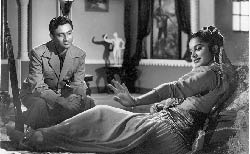
A shot from Waheeda Rehman's first hindi film C.I.D., with Dev Anand
A shot from Waheeda Rehman’s first hindi film C.I.D., with Dev Anand
We were given cinema tickets and we went to see Mr & Mrs ’55. The following day we returned to the office. We said there was nothing wrong with the costumes…But I said I still wanted the clause about costumes added. Raj Khosla looked at Guruduttji and said: ‘This is amazing, Guru. You’re listening to this girl and not saying anything. The choice of costumes depends on the scene and not on the actress.’ I can’t believe I was so outspoken, but I insisted: ‘When I am older, I might decide to wear a swimsuit. I won’t now because I am very shy.’ Raj Khosla retorted: ‘If you’re so shy, why do you want to work in films?’ I said calmly: ‘I haven’t come here of my own accord. You called us.’ No decision was made. We were driven back to the Ritz Hotel. The next day we went back to the office. The clause about my costumes was added and my mother signed my three-year contract with Guru Dutt Films.


*****************

Everyone makes films that don’t work. His sister Lalli [the artist Lalitha Lajmi] told me once that Guruduttji suffered from depression. In the last years of his life he was very confused. We could all see that. He was unhappy. But no one realised just how depressed he was. He started a film called Raaz in which I starred opposite Sunil Dutt… I shot many good scenes, but Guruduttji shelved the film. When we asked why, he said: ‘Nahin jam raha hai.’ [It isnt working.] Then he started Gauri with Geeta (his wife) who wanted to act. He shelved that too.

My husband suffered from depression as well and we didn’t realise it. He started losing interest in everything. He didn’t want to meet people and basically didnt feel like doing anything. In the same way, no one knew how Guruduttji was really feeling.

Waheeda Rehman with Guru Dutt in Pyaasa
His death was a mystery-no one knew for sure whether it was a suicide or an accident-there was much curiosity. His death was such a shock to us all. He was only thirty-nine. He was young. The question everyone asked was: ‘Why did he have to die like that?’ None of my film colleagues have ever asked me personal question about our relationship. It was always other people and the press who were curious, and still are, almost sixty years later. I know we are public figures, but I strongly believe my private life should remain private. What ultimately matters and concerns the world is the work we leave behind.
To read more, get your copy of India Today here.

source: http://www.indiatoday.intoday.in / IndiaToday.in / Home> Archives> Leisure / by Sharla Bazliel / March 21st, 2014

Turkish delights

A cold mezze platter. / Photo: K. Ramesh Babu / The Hindu

The Turkish food festival at Park Hyatt offers a lot more than the staple doner kebab

The connection between Hyderabad and Turkey goes back a few centuries; Alauddin Khilji of the Khilji dynasty which ruled the state in the 14th century was of Turkic origin, Sultan Quli Qutb Shah who founded the Qutb Shahi dynasty too was of the same ethnicity, Princess Durre Shehvar, wife of Azam Jah, the eldest son of the seventh Nizam of Hyderabad is the daughter of the last Caliph of Turkey and more recently, Princess Esra, wife of Prince Mukarram Jah too hails from the country.

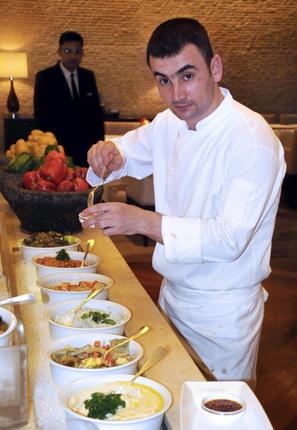
Surprisingly, while Hyderabad still retains much of the Mughlai and Iranian influence when it comes to culinary matters, Turkish food still remains quite different in flavour, ingredients and in technique. Moreover, while Mediterranean food is quite popular in the city, the fare is restricted to Lebanese, Greek and Italian, with the latter being present in almost every restaurant. So we head, all excited, to the Turkish food festival at The Dining Room in Park Hyatt with Turkish chef Turgut Tonbol from the Grand Hyatt in Istanbul. We sit down with the chef, who hails from Bolu, a province which he informs us is a region known for its contribution to Turkish culinary heritage.

“Turkish food mainly consists of the cold mezze and grilled or boiled meat,” he informs us, “but we also have a lot of broad beans, chickpeas and lots of soups in the diet.” Hyderabadis are no strangers to the cold mezze platter which has become a staple in many multi-cuisine and continental restaurants but the platter offered by Chef Tonbol has more than the usual Hummus and Tzatziki. The most interesting of these is the vine leaves, stuffed with rice, nuts and spices doused in olive oil. The platter also contains a simple preparation with broad beans and a mild chilli sauce. The freshly baked pita bread goes well with all or any of these accompaniments.

The cold mezze includes mainly vegetarian dishes. “In Turkey, we don’t have meat for mezze. It is only vegetables,” points out Chef Tonbol who says that the festival includes at least one dish from all the different culinary traditions in Turkey.

Chef Turgut Tonbol./  Photo: K. Ramesh Babu / The  Hindu
Chef Turgut Tonbol./ Photo: K. Ramesh Babu / The Hindu

Ask Chef Tonbol what his favourite dish of the afternoon is and he doesn’t think too much before naming the Shrimp Guvec, a mild stew spiced with chilli and herbs. He also suggests the Chicken Sheesh, a grilled meat dish very similar to our own kebabs, except it is marinated with a special Turkish red chilli, a milder version of the Indian chilli. “It is more similar to Kashmiri chilli which is bright in colour but less spicy in taste,” he informs adding jokingly that to eat Indian food, you “must be a strong man” to be able to take the level of spice. “The Yayla soup, a yoghurt based soup with mint, rice and egg is also a uniquely Turkish dish and a must try.”

Desserts include the favourite Baklava, a Turkish rice pudding and Turkish pumpkin, a simple but fresh and tasty dessert of sweetened pumpkin and cream cheese. But whatever you may pick for the main course, Chef Tonbol advises that you don’t leave without savouring the Turkish coffee accompanied by Turkish delights. The strong black coffee is a must after a meal, “for the gossip sessions”.

source: http://www.thehindu.com / The Hindu / Home> Features> MetroPlus> Food / by Zeenab Aneez / Hyderabad – March 13th, 2014