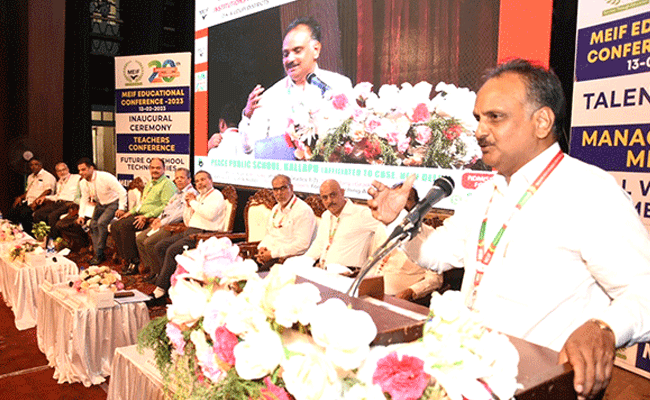
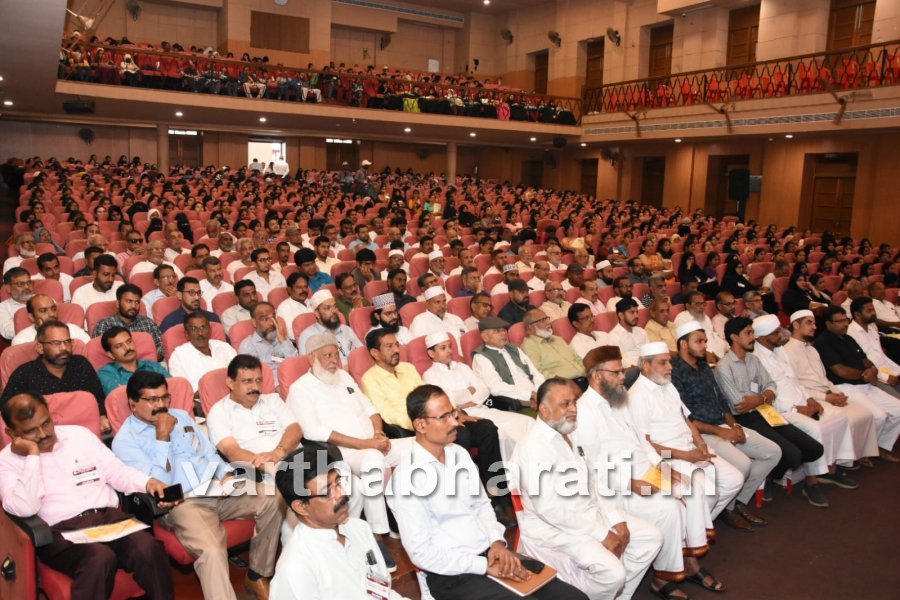
Muslim Educational Institutions Federation (MEIF) is not just providing excellent education, it is also spreading social harmony, Umar Teekay, Honorary President of MEIF and Chairman of Teekays Group, said.
He was addressing the educational conference organized by the Dakshina Kannada and Udupi Districts Muslim Educational Institutions Federation at the Town Hall in the city on Monday.
“Former minister BA Moideen had dreamt of integrating all Muslim educational institutions. MEIF is a step towards bringing that dream to life,” he said.
“Solving a problem is important, but it should not become the priority. The priority should always be of preventing problems,” Teekay advised.
Citing the instance of the recent hijab controversy, he said, “We handled the situation carefully while facing opposition from all ends and ensured that Muslim girls were not deprived of a chance to take the examinations. This was possible through the joint efforts of the members of MEIF.”
Dr. N Vinay Hegde, Chancellor of NITTE Deemed to be University inaugurated the educational conference.
Umar Teekay presided over the conference while Syed Mohamed Beary, Honorary Advisor of MEIF and Chairman of Bearys Group of Institutions, delivered the introductory address.
Yenepoya Deemed to be University Chancellor Dr. Y Abdulla Kunhi, national-level trainer Rajendra Bhat, resource persons Mahesh Masal from Dharwad and Syed Sulthan Ahmed from Bengaluru, MEIF vice-presidents B M Mumtaz Ali, K M Mustafa Sullia, Shabi Ahmed Qazi and B A Nazeer were among those present on the dais.
source: http://www.english.varthabharati.in / Vartha Bharati / Home> Karavali / by Vartha Bharati / February 13th, 2023
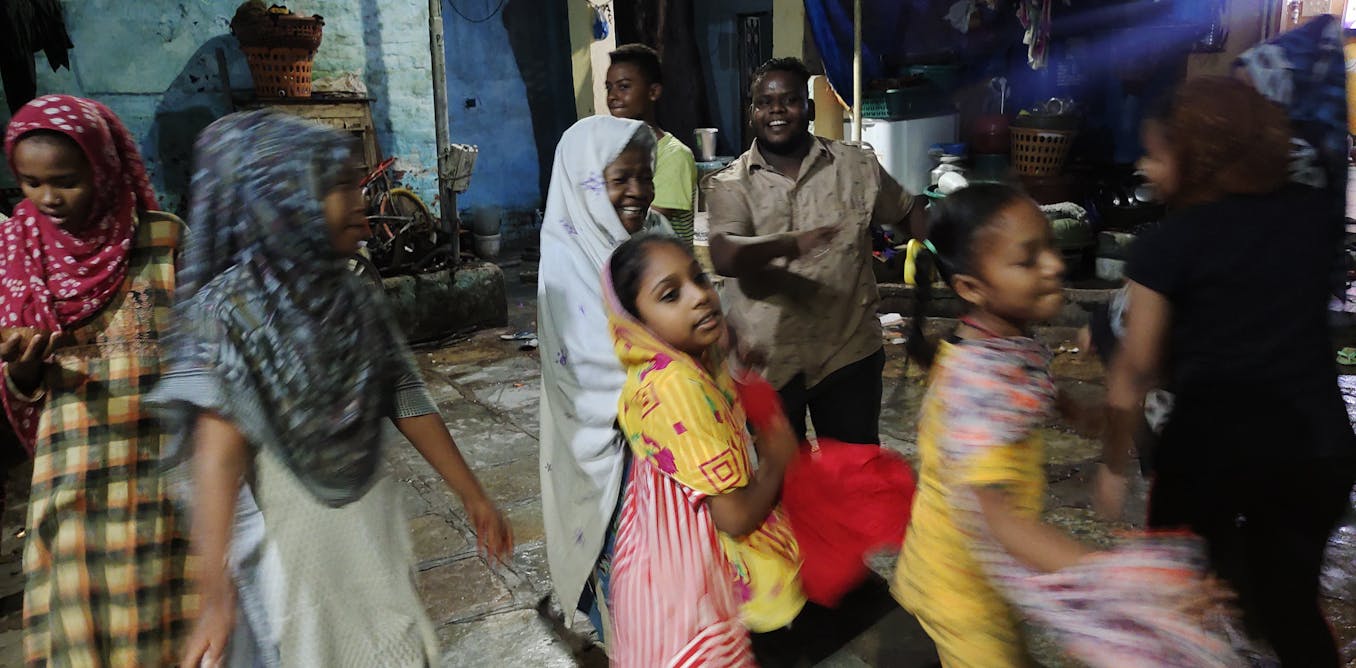
Siddi children performing Dance Dhamaal in Ahmedabad in Gujarat, India. Courtesy Sayan Dey, CC BY-SA
The term Siddi refers to Afro-Indians – Africans who mixed with Indians through marriage and relationships. Africans crossed the Indian Ocean and arrived in India during the 1200s, 1300s and 1400s. They were transported by Islamic invaders and Portuguese colonisers as enslaved people, palace guards, army chiefs, harem keepers, spiritual leaders, Sufi singers singers, dancers and treasurers.
Today, the majority of Siddis are found in the west and south-west of India, in Gujarat, Maharashtra, Karnataka and Telangana states. As they settled, they preserved and practised their African ancestral sociocultural traditions – and also adopted local Indian traditions.
This interweaving of African and Indian cultural values gave birth to various creolised (mixed) food, music and spiritual practices.
As a diversity studies scholar, I have been researching Siddi culture for some time. Working within this community in Gujarat and Karnataka, I found that their creolised cultural practices emerged as a resistance to colonisation, racialisation and victimisation in postcolonial India.
My most recent research – which can also be seen in a new documentary – has focused on the music and dance performances of the Siddi community in Gujarat, called Dhamaals.
The story of Dhamaal performance traditions reveals the rich and complex mixing of cultures in a world shaped by human movement and history.
What are Dhamaals?
Dhamaal is a mix of Sufi and African (mostly East African) musical and dance traditions. It refers particularly to the spiritual practices of the Siddis of Gujarat.
The Siddis begin almost every Dhamaal song by blowing into a conch shell. This is often followed by the slow playing of East African percussion instruments like the musindo and the slow thumping of feet that marks the onset of the singing and dancing Dhamaals. The ritual of foot thumping is a crucial part of spiritual East African dance and musical traditions.
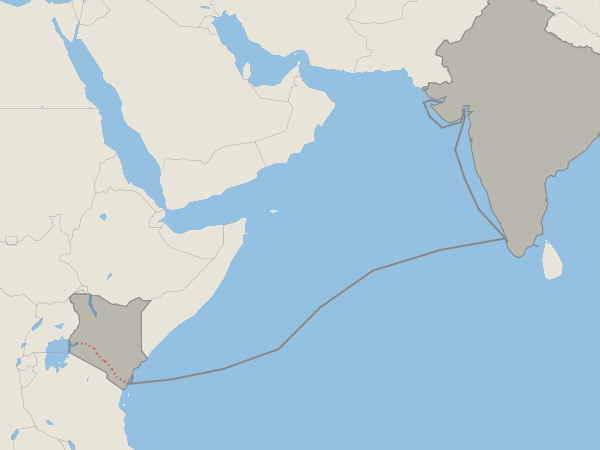
The Siddis are followers of Islam and arrived in India from Muslim communities in East and Central Africa. Dhamaals are performed in memory of their spiritual leaders, among them Bava Gor, Mai Misra, Baba Habash and Sidi Nabi Sultan. According to Siddi folklore they arrived from Ethiopia through the Nubian Valley, Syria and the Indian Ocean to the coast of Kuda in the Bhavnagar district of Gujarat.
Shipping line Shipping ports Railway line Map: Usifo Omozokpea Source: Sayan Dey Created with Datawrapper
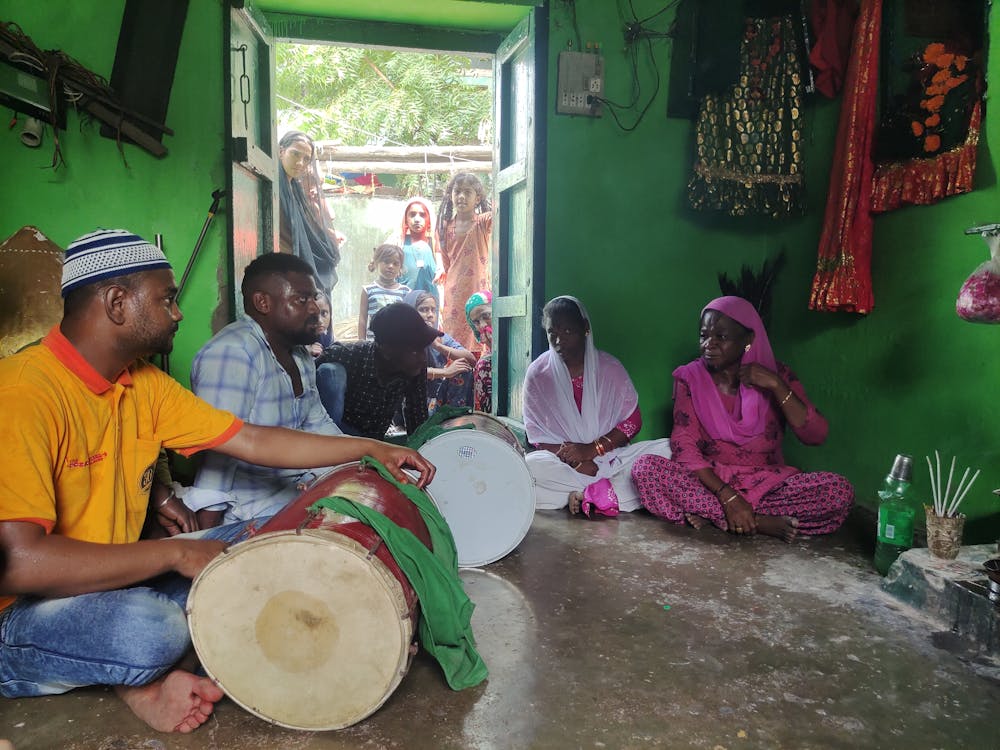
Usually, Dhamaal songs and dances are performed to celebrate the anniversary of the birth and death of spiritual leaders. They are performed in two ways – Dance Dhamaal and Baithaaki Dhamaal. The Baithaaki Dhamaal is performed in the sitting position and the Dance Dhamaal is performed in both sitting and dance positions.
During the performance of Baithaaki Dhamaal the focus is more on the lyrics and less on the musical instruments. During Dance Dhamaal the focus is more on the sounds of the instruments. These are often played in a frenzied manner and accompanied by frenzied dance movements. The spiritual songs that are sung during the Dhamaals are known as zikrs.
A mixing of cultures
The creole cultural aspects of Dhamaals are broadly reflected through the Swahili Creole language used to sing the zikrs, the Indian and African musical instruments used to perform them and the Afro-Indian body movements of Dance Dhamaals.
Historically, the Swahili Creole language in India emerged among the Siddis through the mixing of Kiswahili from East Africa with Gujarati, Hindi and Urdu languages from India. As an example, these are the lyrics of one zikr:
Ya bolo sabaya hua wey
Ya bolo sabaya hua wey
Hu sabaya
Salwale Nabi Sultan
This zikr is sung in the praise of Siddi spiritual leader Nabi Sultan, believed to have arrived in Gujarat from the Nubian Valley. The Swahili words that have been used are “hu” (a common expression of consent) and “sabaya” (meaning that everything is alright). The zikr means that with the blessings of Nabi Sultan no evil can befall the Siddis of Gujarat.
Siddis performing Baithaaki (sitting) Dhamaal in a shrine in Gujarat. Courtesy Sayan Dey, CC BY
The musical instruments used to perform the zikrs are East African percussion instruments. The musindo, for example, is a cylinder-shaped, two-sided drum from Kenya. The misr kanga is a small, funnel-shaped instrument from Ethiopia, containing small stones. The mugarman is a large, cylinder-shaped, one-sided drum from Tanzania. These are played along with traditional Indian musical instruments. These include the harmonium (a keyboard instrument) and the dholak (a two-headed hand drum). The intermingling of Indian and African musical instruments generates creole rhythmscapes which are traditionally African and Indian at the same time.
During the Dance Dhamaal, the hand and the body movements of the Dhamaal dancers in Gujarat are very similar to the Ngoma dancers of East Africa. The Ngoma dancers thump their feet and swing their arms sideways to the rhythm of drums. The Dhamaal dancers also swing their arms sideways, but the thumping of feet depends on the context of their dance. During religious occasions, for example, the foot thumping is slow. This is because the Siddis follow many spiritual aspects of the Sufi tradition. For Sufis, heavy and frenzied feet thumping is prohibited when worshipping spiritual leaders.
Transoceanic roots
These creolised musical and dance performances allow the Siddis in Gujarat to maintain their African ancestral practices. They do so in collaboration with Indian practices so that they do not forget their historical roots yet can respect local traditions at the same time.
Siddis performing Baithaaki (sitting) Dhamaal in a shrine in Gujarat. Courtesy Sayan Dey, CC BY
These creole practices have allowed the community to build a transoceanic identity (one which crosses the oceans). This is done in a collaborative, reciprocal and diverse way.
The Dhamaal tradition of the Siddis has socially, culturally and economically empowered the community as well. Several community members, through the assistance of government and private organisations, travel across India and the world to perform at cultural festivals. This encourages the Siddis to share their creolised cultural values across the globe.
This in turn invites audiences to consider history through an interracial and intercultural lens.
source: http://www.theconversation.com / The Conversation / Home> Global / by Sayan Dey, University of Witwatersrand / February 03rd, 2023
The first mutiny of World War I was led mostly by young men from villages of Hisar, Rohtak, Meham and Gurgaon districts of Haryana. The Singapore Mutiny, which is known as the first mutiny of WW-I and left an indelible mark on India’s freedom struggle, started on February 15, 1915. It was led by Muslim soldiers who belonged to British army’s 5th Light Infantry Brigade.
Even as the world observes the centenary of the Great War, the sacrifice of these soldiers has been all but forgotten as most of the soldiers and their descendants migrated to Pakistan after Partition.
The brigade mainly comprised Rajput Muslims and Pathans and had been sent from Madras to replace the Yorkshire Light Infantry in Singapore. They reached there in October 1914 and were to leave for Hong Kong in February. On the day of embarkment, a rumour spread that they were actually being sent to Turkey and would have to fight Muslims there.
Singapore Mutiny shook the foundation of British rule in Asia
A rumoured triggered the Singapore revolt. The sepoys killed British officers and seized ammunition. The mutiny went on for 5 days. Eight hundred Indian sepoys of the British army killed 47 British nationals; 200 sepoys faced court martial; 73 were given a range of punishments.
As many as 41 sepoys were shot by a firing squad in front of 15,000 spectators at Outram Prison in Singapore.
In his book “The Mutiny in Singapore”, author Sho Kuwajima has argued that the mutiny not only caught the British off-guard but also shook the foundation of British rule in Singapore and forced the British to reconsider their strategy in Asia.
“The mutiny had a great impact on India’s freedom struggle. Freedom fighters, including Ghadarites were vindicated when finally in 1946, the British decided to leave following the naval revolt of February 19, 1946 when they felt that their protective shield, the armed forces, had itself turned against them,” said historian Malwinder Jit Singh Waraich, who has penned a number of books on the freedom struggle.
Four of those executed in public were from Jamalpur (Hisar), three from Jatusana (Gurgaon) and two from Balyali (Hisar). According to Phul Chand Jain’s Swatantarta Sainik Granth Mala, most of these people belonged to Jamalpur, Paten, Balyali, Kirawad and Balliya Ali in Hisar; Jatusana, Karmpur and Kheri Nangal in Gurgaon; Garhi, Kani and Kahnaur in Rohtak. One sepoy each was from Muzaffarnagar in Uttar Pradesh, Karnal and Nabha in Punjab.
“These villages were gripped by violence of Partition, so, there is not much trace of their memories now,” says documentary filmmaker Daljit Ami, who is making a film on the Singapore Mutiny and has visited these villages a number of times. In the course of his research, he came across just one man who had heard about these heroes and their Haryana connection.
According to historians, the Singapore Mutiny was followed by the Russian soldiers’ mutiny in 1917 and a series of mutinies in the French armies.
source: http://www.timesofindia.indiatimes.com / The Times of India / Home> News> India News / by Sarika Sharma / TNN / July 05th, 2014
The jury praised Johari’s work saying it shone through with its combination of meticulous reportage, humanism and empathy, all reflecting a high order of journalistic excellence.
New Delhi:
Mumbai-based journalist Aarefa Johari was picked on Sunday, April 3, as the winner of the Chameli Devi Jain Award for an Outstanding Woman Mediaperson 2021.
Instituted in 1982, the annual Chameli Devi Jain Award is a prestigious recognition for women mediapersons in India who have reported on themes such as social development, politics, equity, gender justice, health, war and conflict, and consumer values.
The Media Foundation announced Johari, who works for Scroll in Mumbai, as the winner of the award, which will be presented on Monday at the India International Centre here.
The winner was decided by a three-member jury, comprising Nirupama Subramanian from the Indian Express, writer Githa Hariharan and Ashutosh from SatyaHindi.
They praised Johari’s work saying it shone through with its combination of meticulous reportage, humanism and empathy, all reflecting a high order of journalistic excellence.
Harish Khare, chair of the Media Foundation, added that Johari’s ground-level reportage was an outstanding example of a journalist’s every day privilege to help society demand fairness and justness.
Nearly 50 journalists from print, digital and broadcast media from all over India sent entries for the award, named after Chameli Devi Jain, a freedom fighter and a community reformer who went to jail during the freedom movement.
(PTI)
source: http://www.thewire.in / The Wire / Home> Media / by PTI / April 04th, 2022
Gone are the days when the Muslims of Kerala were thought to have believed Malayalam as the language of Nairs. The Muslims of modern Kerala are greatly indebted to a number of devoted reformers whose dedicated endeavours liberated them from the yoke of illiteracy and cultural backwardness. Late C.N Ahmad Moulavi, in his book on Muslim literary heritage in Malayalam entitled Mahathya Mappila Sahithya Parambaryam, describes the contribution of such reformers.
In fact, Malayalam has been the mother tongue of the Muslims of this region but their dialect was considered relatively inferior. This was because they had neglected learning and teaching the Malayalam language and literature. They were more concerned with Quranic education. Moreover, for the purpose of imparting Islamic knowledge they used Arabic script when they wrote Malayalam. It slowly developed as a literary branch of Malayalam known as the Arabic Malayalam literature.
Arabic-Malayalam Literature The Arabic-Malayalam literature is exclusively the literature of the Kerala Muslims. It includes more than five hundred books in prose and about the same number of books in verse, on various subjects. Books in prose include translation and explanation of the Holy Quran, Hadith, Jurisprudence, history, stories and fables, narratives, criticism, lexicon, science and etiquette. Many journals and magazines were also published in Arabic-Malayalam.
Critics have wholeheartedly extolled the literary merit of the poems in Arabic Malayalam. They are highly impressed by its originality, rhythmic beauty, lucidity in imagination and expression. The majority of these poems are on religious topics. In fact, this stream of poems had been running parallel to Malayalam poetry for centuries. The earliest work so far traced in Arabic Malayalam poetry is Mohiyauddeen Mala, an ode in praise of Sheikh Mohiyuddheen. Its author, late Khazi Mohammed of Calicut was a contemporary of Ezuthcchan’s (16C) who is considered the father of Malayalam language. A comparative study of Ezuthcchan’s Adhyatma Romayana Khazi’s Mala reveals the latter’s simplicity in expression.
Moin Kutty Vaidyar elevated the Arabic Malayalam poetry to the pinnacle of its golry with his Badr pada pattu (war song on Badr) and Badrul Muneer Husunul Jamal (a love song). War and love have been celebrated topics for poetry of all ages. But what made Vaidyar’s poems real masterpieces of literature is his skilful way of blending form and content into an artistic unity. Through his poems Vaidyar created a language within language, a rare achievement in Malayalam poetry praised equally by famous critics and linguists. Chains of tunes (called Ishals) innovated by Vaidyar still remain to be emulated by latter poets. In fact he is the most popular among Arabic Malayalam poets. His poems provided the Muslims of Kerala with a unique culture identity, uniformity and redouble their pride and prestige. P.K. Haleema, Naduthopil Ayesha Kutty, Kundil Kunhamina are the poetesses whose poems left indelible imprints on Arabic Malayalam poetry.
Though Arabic Malayalam poetry boosted the morale of Muslims in their resistance to colonial invasion. The subjugation of Muslims by the invaders led to a state of stagnation in literary life. Later Muslim reformers used Arabic Malayalam poetry to rekindle the spirit of education and religious awareness. Prominent among these poets cum reformers are T. Ubaid, O. Abu and Punnayarkalam Bapu. The poems fostered by Muslims are generally known as Mappila Pattukal (Mappila songs). The salient feature of these songs is the instantly recognizable peculiarity of its tunes that have by and large influenced the cultural and literary life of Kerala as it is evident in modern Malayalam poetry and film songs.
Muslims today no more use the old script of Arabic Malayalam in their literary contribution. Modern works are all in Malayalam now. However, to a limited extent, efforts are made to preserve the identity of this language through Madrasa education.
Impact of Sanskrit Literary Tradition Though Muslim themes were introduced into Malayalam poetry by non-Muslim poets since the beginning of the 20th century, the entry of Muslims into the Malayalam literature is of late occurrence because of the attachment of the Muslim poets to Arabic Malayalam. In imitation of the Sanskrit literary tradition Maha Kavyam were composed by Malayalam poets. Rama Chandra Vilasam was written by Azakath Padmanabha. Kurp and Kattakkayam cheriyan Mappila wrote Sree Yeshu Vijayam. But Mahammadam was written only after a long period. Ponkunnam saidu Mohammad, a Muslim scholar in Sanskrit and Malayalam, wrote this Maha Kavyam in the same Sanskrit metre and here the poet attempts to narrate the story of mankind in an Islamic perspective. It also contains a description of the Quran in detail.
Yousef Ali Kecheri is a Muslim poet famous for composing poems with Hindu as well as Islamic cultural background. He has written poems on Quranic themes, the prophet and Muslim festivals. He is a famous composer of film songs.
P.T. Abdul Rahiman is another noteworthy poet who wrote a long poem on Bilal entitled, The Black Pearl.
Both Kecheri and P.T. have won literary awards.
Malayalam Fiction Anyhow, the Muslim genius made greater achievement in fiction and short stories. Viakkom Mohammed Basheer, a veteran novelist in Malayalam brought a continent of experience in life into the Malayalam literature. His compassionate attitude towards life accompanied by an ironic vision acquainted the Malayalam readers with a new aesthetic sense. His novels and short stories are translated into other Indian and world languages. Umashankar Joshi, the famous Indian writer, counted Tagore and Basheer as the only two Indian writers of originality. M. Mukandan, the pioneer of modernism in Malayalam fiction, once wrote, the Noble Prize is too small a thing to honour Basheer. Basheer’s novels are poetic expression of Muslim myth and Islamic mysticism. My Grand Dad had an Elephant and pathumma’s goats are his masterpieces. He mercilessly satirises the pervasive degeneration that infects Muslim social life. In his writings he had been attempting to create harmony in life through God consciousness.
N.P. Mohammed, another famous novelist, short story writer and essayist, traces the influence of Aryan, Dravidian and Hindu culture elements in the life of Kerala Muslims. His two famous novels named The Oil field and The Eye of God reveal the peculiar socio cultural life of a particular region. They can be called regional novels. He wrote short stories by perusing the Quranic style of expression. Punathil Kunhabdulla, another novelist and story writer, satirises the outdated view and customs prevailing in Muslim social life. Smaraka Shila Kal (Tomb stones) and Marunnu (Medicine) are his famous novels. Both N.P. and Punathil won awards of Kerala and Kendra Sahitya Academy. P.A Mohammed Koya, the father of sports literature in Malayalam, brought to light the social and religious life of the Koya Muslims of Calicut. His Island Stories have endowed the Malayalam short story with a rare aesthetic dimension. U.A. Khader beat a new path when he wrote his short stories anthologized in his famous Trikkotoor Peruma, which is highly appreciated. His style is inimitable.
The most developed literary genre in Malayalam literature is the short story and there are a number of Muslim short story writers such as T.V. Kuchu Bava, Shibabuddeen poithumkadavu, Akbar Kakratil, M.A. Rahima, N.P. Hafiz Mohammad and P.K. Parakhadavu. They are noted for their highest excellence in handling the Malayalam language in its colourfulness and rhythmic beauty.
The history of Malayalam drama will remain incomplete without mentioning the contribution of K.T. Mohammed. He criticizes the social life of the Kerala Muslims in an aggressive language. Ibrahim Vengara, Mohammed Yousef, K.A. Kondungallor and Azeez were renowned Malayalam dramatist.
Religious Writings In addition to making valuable contribution to the Malayalam literature, Kerala Muslims have been advancing in the field of religious writing. They have published many books aimed at reforming the religious life and introducing Islam to other people as well. Many publishing houses are established. The Holy Quran has been translated into Malayalam by various scholars. Tafheemul Quran of sayyid Maududi has been translated and published in Malayalam through Islamic Publishing House, Calicut, which shines like a pillar of light in the literary life of the Muslims of Kerala. Sheikh Muhammad Karakunnu, the Director of I.P.H., himself wrote about 50 books on various Islamic knowledge. Other publisher like Yuvatha, Hindustan and Al Huda published valuable works on Islam. The Muslims of Kerala constitute more than 20 per cent of the population and their literacy rate is satisfactory. Consequently they have started publishing dailies, weeklies, monthlies and bimonthlies including children’s and ladies magazines.
A close analysis of the literary history of Kerala Muslims will reveal the healthy trend of new awareness and reformation in the field of learning and thinking. And a cream of writers, thinkers, reformers, readers has emerged from various cultural groups among Muslims vying with each other for achieving excellence in developing Malayalam literature. There intense efforts and healthy rivalry enable us to envision a new sky of hope for the community and for the nation. The sea changes that have taken place in the realm of the Muslims of Kerala are promising signs of a new dawn-God willing.
(The writer teaches Malayalam at Government College, Kasaragod, Kerala.)
source: http://www.ummid.com / Ummid.com / Home> News & Analysis / by Ibrahim Bevinje, Ummid.com / March 16th, 2011
At the Battle of Malegaon, Muslim soldiers in the Maratha army defied the British army for a full month when they had no hope of victory as the Chhatrapati and Peshwa had already surrendered.
These battles, says Colonel Anil A Athale (retd), are in contrast to the colonial mindset driven narrative of Muslim separatism.
The current politics of both communities ensures that the heroes of Malegaon — or for that matter personalities like Ibrahim Khan, who led the Maratha artillery at the battle of Panipat in 1761 — are forgotten.
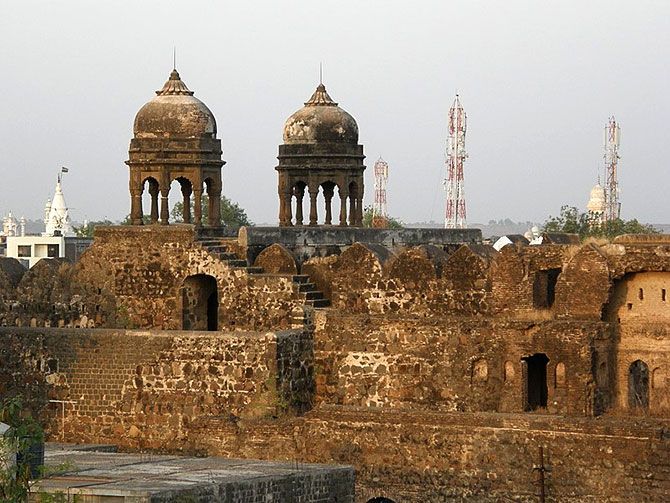
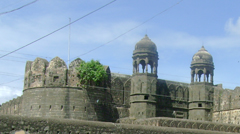
IMAGE: The Malegaon fort. Kind courtesy: Wikipedia
On January 1, 2018, the bicentenary of the defence of Koregaon by a small British force — that had a number of Mahar troops — was observed with great fanfare.
The British — the victors in the third Anglo-Maratha war — erected a pillar to commemorate the event.
During the same war, Muslim troops of the Marathas defied British forces for a full month from May 15, 1818 to June 13, 1818.
Since the Marathas were on the losing side, this saga of bravery was obliterated from history by the British.
As we approach the bicentenary of that event it is time to remember the brave soldiers of the Maratha army who continued to fight even when they had no hope since the Chhatrapati had already been captured by the British and Poona and Satara were under British occupation.
The loyalty to the Maratha flag by its Muslim soldiers even in a hopeless situation deserves to be remembered.
My own research in 1990 began with a question posed by the late Major General D K Palit, a military history scholar of repute.
The question he posed was this: How is it that the Marathas — who spiritedly fought a 22 year-long guerilla war against the mighty Mughal empire — succumbed to the British without a fight?
It is this quest for truth that led me to research the story of the Anglo-Maratha struggles of the 18th and 19th century.
The Battle of Malegaon fought in May-June 1818 was the last major attempt at resistance by the Marathas.
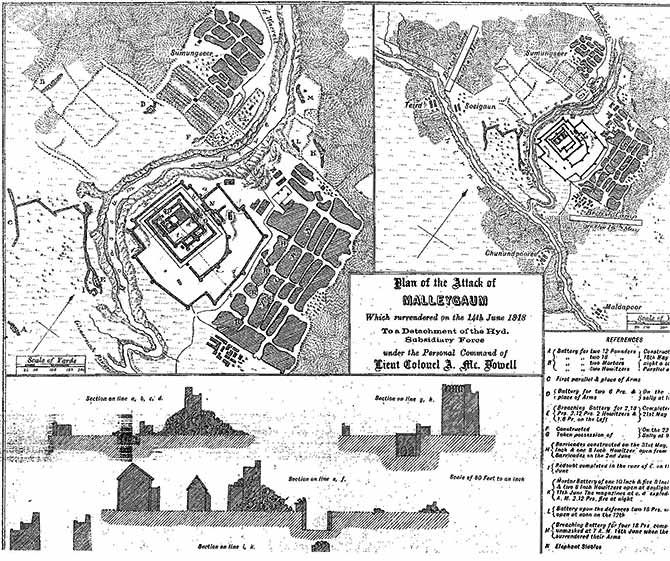
On May 15, 1818, a brigade strength force under Lieutenant Colonel A MacDowell reached the vicinity of Malegaon fort.
The British expected that this show of force would be sufficient to overawe the defenders of the Malegaon fort.
The British were in for a nasty surprise.
In response to summons to surrender, the defenders fired on the British camp leading to panic.
The quadrangular fort of Malegaon is located near the bend in the Musam river so as to cover two side of the fort, Malegaon town being on the other sides.
The fort had two lines of defence built of masonry surrounded by a seven feet wall and a 25 feet deep 16 feet wide ditch.
The outer wall had watch towers built of mud and stone. The inner fort or the citadel was 60 feet high with 16 feet wide ramparts.
On May 16, Colonel MacDowell reached the west bank of the river and began work to erect barriers of breastwork to deploy guns for the final assault.
At 8 am the British began bombardment of the fort with 20 guns, an assortment of 12 pounders (the biggest calibre gun then in India), 8 pounders and mortars.
The defending soldiers sortied out of the fort, destroyed the batteries and killed two British officers and several soldiers.
At the same time 7 guns from the fort opened devastating fire on the British lines on the west bank of the river.
The ding dong battle continued for six days.
On May 22, after particularly heavy shelling from the fort, the British were forced to abandon the breastwork for the guns and retreated.
On May 26, the British — through constant bombardment — succeeded in creating a breach in the inner wall of the fort.
The next day the British launched a three pronged attack after a bombardment lasting nearly two hours.
One column was led by Major Greenhill and consisted of a native battalion of 1,000 soldiers with 100 Europeans to directly go into the fort through the breach.
Another column of 800 sepoys under Lieutenant Colonel Stewart crossed the river downstream to outflank the fort from the west.
The third column consisting of 300 sepoys and 50 Europeans under Major Macbean went towards the river gate.
Each column had pioneers with tools, mines and ladders to tackle the fortification.
But the defenders of the Malegaon fort proved equal to the challenge.
The attacking British were met with a hail of bullets and gunfire. The attempt to scale the inner wall failed. Many of the engineer officers leading the attack suffered injuries.
Both the columns led by Majors Greenhill and Macbean were ordered to withdraw.
Only Lieutenant Colonel; Stewart’s column met with some success and he occupied part of the town.
The stalemate continued till June 4.
On that day another column under Major Watson arrived from Ahmednagar with a battalion of native infantry and a large number of siege guns.
For nine days, till June 13, the fort was subjected to heavy bombardment by the British guns.
On June 13, at 3 pm, the fort garrison accepted surrender and the Union Jack was hoisted in place of the Maratha saffron jari patka flag.
The next morning the garrison of 300 men marched out of the fort and surrendered their arms.
The British strength at Malegaon numbered over 2,000 troops. During the battle the British casualties numbered 11 officers and 220 soldiers (killed or wounded).
Thirty Maratha defenders died while 60 Maratha soldiers were wounded.
The British record states that in the end they used 36 guns, fired over 8,000 shells and used 35,500 pounds of gunpowder.
The British were so impressed with the valour and chivalry of the defenders that they permitted the surrendered soldiers to keep their daggers.
Historian N C Kelkar notes in his Marathi book Marathe ani Ingraj that at one stage the desperate British sent a message to the Muslim soldiers of the Maratha army that since the Chhatrapati had already surrendered, they should do likewise.
The doughty defenders replied that they were indeed aware that their king was in British captivity, but they were yet to receive instructions from him to surrender and therefore would keep fighting.
The devotion to duty and loyalty to their king was of the kind seen later only during World War II when many Japanese soldiers continued to fight even after Japan surrendered.
There is neither any victory pillar nor are the names of these brave soldiers engraved anywhere.
Even two hundred years after the event and the departure of British 70 years ago, the Muslim heroes of battle of Malegaon remain unknown, forgotten and unsung.
Two hundred years ago, the third Anglo-Maratha war fought in 1817 and 1818 ended in the Maratha Chhatrapati and Peshwa (prime minister) surrendering to the English.
After having defeated the Holkars and Shindias in early 1817, the British turned to the conquest of Maharashtra proper.
The full story of the Maratha struggle with the British has for long been swept under the carpet. In its place a modern myth of the British having directly taken over India from the Mughals or accidently acquired an empire has gained currency.
Ignoring the Marathas and their role in ruling most of north and central India was part of the grand colonial project of disinformation that sought to then play up Mughal-Rajput rule.
I recall an interesting news report some years ago, datelined Aligarh, where an Aligarh Muslim university ‘scholar’ had discovered that a major battle between the Marathas and the English had indeed taken place in Aligarh in 1803!
The worthy had, of course, never heard of the second Anglo-Maratha war that took place in 1803-1804 with battles at Delhi, Lassawari near Agra, Aligarh, Shekohabad etc.
The British had sound reasons to whitewash the Maratha period of our history.
Since the Marathas formed a formidable alliance with the Muslims, Jats and Sikhs in resisting the British, they posed a potential threat.
The distortions continued post-Independence as writing and teaching history was hijacked by the left-leaning Delhi elite. But those who ignore the Maratha or Sikh epoch fail to answer a simple question.
The Marathas fought three wars with the British, so did the Sikhs, the Gorkhas and Tipu Sultan in the south. Is there any mention of the Anglo-Mughal wars, even in the doctored historical narrative?
Note: The information about the Battle of Malegaon is based on a British Indian Army General Staff Publication (Simla 1910), Maratha and the Pindari War pages 89-91.
Colonel Anil A Athale (retd) is a military historian. This article is based on extracts from his forthcoming book, The Story of the Mighty Marathas and their Empire.
source: http://www.rediff.com / rediff.com / Home> News / by Colonel Anil A Athale (retd) / April 10th, 2018
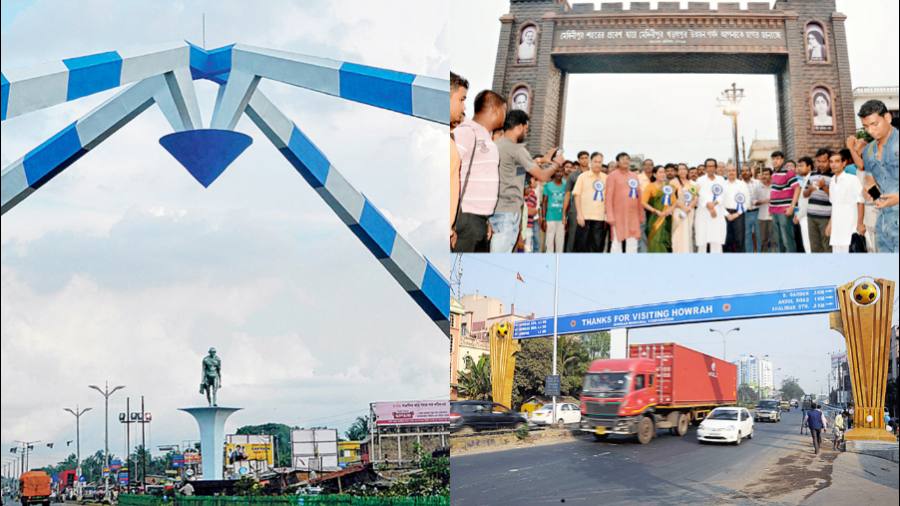
Suddenly, Bengal has become dotted with gateways — elaborate, ugly and expensive.
MONUMENTAL: (Top right) Gate to West Midnapore, a toron near Nabanna and Haldia Gate in East Midnapore.
In Burdwan, Curzon Gate was built even earlier, in 1902, to celebrate the coronation of Maharaja Bijay Chand Mahatab. It was named Curzon Gate later when Lord Curzon paid a visit. Other examples abound — the Pathar Darwaja of Bishnupur Fort in Bankura district; the four gates that lead to the palace of Siraj-ud-Daulah in Murshidabad; Namak Haram Deorhi, so named for his fabled treachery, leading to the house of Mirzafar, also in Murshidabad; the gates leading to Fort William and so on. Recently, there was a proposal to build a gateway to Metiabruz in southwest Calcutta, to mark Little Lucknow, which was Wajid Ali Shah’s home when he was exiled.
Back to the present.
The enormous Biswa Bangla Gate in Calcutta’s New Town came up in 2019. It was designed in 2015 at the time of the launch of the beautification project for New Town. Then there are the Beleghata Gate, Nabanna Gate, Uttarpara Probesh Duar, Jalpaiguri Gate, Birbhum toron, Haldia Gate, West Midnapore toron, Digha Gate, Tarapith toron. The Biswa Bangla Gate cost Rs 25 crore, according to some estimates.
“What is the use of these gateways,” asks Minakshi Mukherjee, who is the state secretary of the Democratic Youth Federation of India, the CPI(M)’s youth wing. She continues, “There is one in Birbhum that lies on the way to Anubrata Mondal’s house in Bolpur’s Nichupatty area. A government tender of Rs 8 crore was sanctioned for this. There is another one in Midnapore, a few kilometres away from Suvendu Adhikari’s house. It was also built on a government tender of Rs 2 crore.”
Mukherjee has reason to be vociferous — the Left, after all, does not have a history of using gateways to make a power point.
“But in 2005 (during Left rule) a very fancy gate came up on Kona Expressway. The ornate gate with horses and elephants was built by the Unitech group,” says Joydeep Mukherjee, a Calcutta-based architect. He adds, “As an architect, I have always thought of gates as something that gives one a sense of reaching or destination. Gates, in modern times, have been used as a line of demarcation. And these recent additions appear to me to be really ornate gates sans any particular motive.”
It is unlikely, though, that so many torons would come up without fulfilling some expectation somewhere but there are no answers, only theories blowing in the wind.
Anindita Chakrabarti, who teaches urban sociology at IIT Kanpur, says, “The gates in ancient times had quite a different connotation. Fortification was important; security mattered. Rajasthan and Gujarat have walled cities. In Rajasthan, even the smallest village was known to have a toron. But the same was not true for Calcutta. The gateway is an Islamic import. It came from Central Asia — in Iran and Iraq, there are gates leading to religious buildings.”
Chakrabarti adds how the Kashmere Gate and Lahori Gate of Delhi’s Red Fort were thus named because one led to the road that goes to Kashmir and another led to Lahore. She says, “They were made with the purpose of the movement of the battalions.”
No matter what purpose they serve or where they draw inspiration from, gates in Bengal continue to mushroom. As you get off the bridge to Nabanna, there is a toron that has two ornate pillars and a football atop them. It appeared in 2021.
The Digha beautification project involved the construction of the Digha Welcome Gate. It was completed in 2014; about Rs 6.57 crores were spent. The Haldia Gate was built in 2017- 18. Another gate came up around the same time at the juncture of Kharagpur and Midnapore. It is decorated with photographs of Ishwar Chandra Vidyasagar, Kazi Nazrul Islam and Shahid Khudiram. The one in Bishnupur has a huge “Om” carved in the middle.
“It is not a Calcutta-specific phenomenon if you ask me,” says Rezavi exasperatedly. “Right here, in Aligarh, where I stay, every now and then a gate is constructed. The purpose could be to welcome someone or to commemorate something.” He adds, “In the medieval era, they were a requirement. Gateways were constructed mostly in the western part of the country where the weather is hot and dry, and also in South India. The gates provided respite to people coming from the scorching heat. It was almost like entering heaven.”
source: http://www.telegraphindia.com / The Telegraph Online / Home> Culture / by Moumita Chaudhuri / September 04th, 2022
At most of the places in the country, the names of the martyrs have been put on specially constructed Memorials. But the Memorial in Malegaon is still waiting for the names of the seven martyrs to be written over it.
“I have always wondered how, the Muslims and the Hindus together, had decided to set a Mandir on fire”, said Dr. Iftekhar Ansari recalling the incident when on April 25 in1921, the Malegaonians set the Pophale Mandir on fire where, Bhaskarrao, the PI and Incharge of the only Police Station in Malegaon was hiding. He was ultimately killed by the people. A Muslim Constable was also killed in the same uprising.
He further said, “It demonstrates not only the harmony with which the Malegaonians were living then, but also shows their eagerness for the country’s freedom. For them, the freedom was above everything, even their religion. In fact, Hindus and Muslims, except few from both the communities as was the case everywhere, had demonstrated a rare unanimity during the whole struggle. I believe if it was a Mosque, a Gurdwara or any other place, it must have met with the same fate.”
Agreeing with Dr. Iftekhar, Ramzan Painter 74, who has collected more than hundred-years of the city records added, “A confirmed account of the exact situation during 1921, clearly suggests the harmony with which people were living.” Mentioning the name of Balu Shah, owner of the first newspaper in Malegaon and a prominent figure of that time who was actively involved in the whole movement with the Muslims, he added, “And who can forget the contributions of Advocate Tatya Khare and Gadgil Wakeel, who remained at the forefront in establishing a separate court in Malegaon.”
“I have always wondered how, the Muslims and the Hindus together, had decided to set a Mandir on fire”
But, as it had done at several other places in the country, the British Police registered the whole incident as rioting and hanged the upfront leaders of the uprising in Yeroda jail. However, after the independence in 1947, the State as well as the Central governments, mentioned the historic event of April 1921 as part of the freedom struggle and included the names of the seven martyrs in their gazettes with due respects. Also, when the Parliament passed a resolution for the construction of a Memorial of similar shape everywhere in the country and to put the names of the martyrs on them, a Memorial was also built in Malegaon.
However in Malegaon, unlike other places in the country, the names of the martyrs have not been put on the Memorial till now. Interestingly the civic body, despite passing many resolutions in its general meeting for putting the names of these martyrs on the Memorial, has also not cared for doing so.
And as if it is not enough to dishonor these martyrs, every year on Kranti Diwas when officials gather everywhere near these Memorials for offering their tributes, in Malegaon, no one cares to honor these martyrs.
source: http://www.ummid.com / Ummid.com / Home / by Aleem Faizee (headline edited)
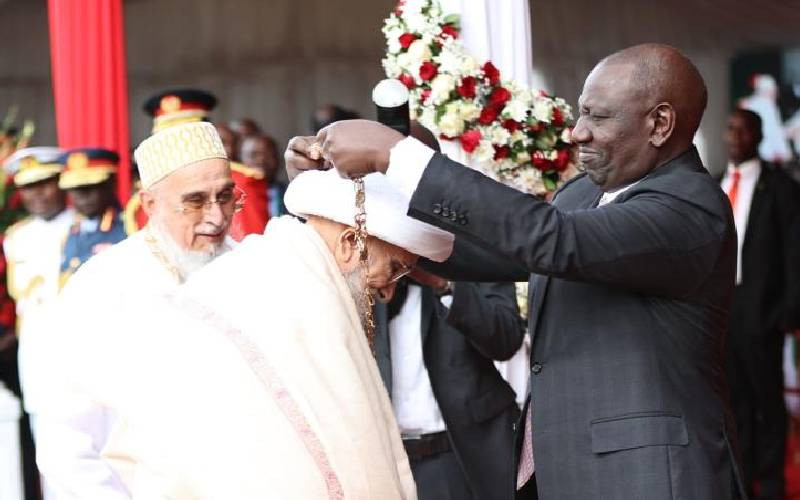
President William Ruto awards the spiritual leader of the Dawoodi Bohra community Syedena Mufaddal Saifuddin on Monday.[PCS]
His Holiness Syedna Mufaddal Saifuddin, the leader of the worldwide Dawoodi Bohra community, was among 460 people who were feted by President William Ruto on Jamhuri Day.
Saifuddin received the most prestigious award of the Order of the Golden Heart for his philanthropic contributions across the world, including in Kenya.
He was among the leaders invited by President Ruto to this year’s celebrations on Monday.
https://www.youtube.com/watch?v=OxGgOs4EnTE&t=2s
Speaking during the ceremony at the State House, the president thanked Saifuddin for supporting the government’s low-cost housing initiative as well as the ongoing drought relief efforts.
“We are collaborating with the Dawoodi Bohra community to build low-cost houses to address challenges facing low-income earners, especially in the informal settlements,” said Ruto.
Bohra community has established affordable houses in Athi River and Rongai.
The President acknowledged the role of Saifuddin in philanthropy across the world and his leadership role in fostering inter-faith dialogue.
Saifuddin joined the list of eminent personalities who have previously received the highest award in Kenya for their exemplary work.
Others include Uganda President Yoweri Museveni, former President of Liberia Ellen Johnson Sirleaf and the Aga Khan Shah Karim al-Husayni.
Saifuddin was previously presented with the Chief of the Order of the Golden Heart award during the inauguration of Aljamea-tus-Saifiyah’s Nairobi campus in 2017, the third campus of the Dawoodi Bohra community’s educational institute.
The award was in recognition of his efforts for the cause of education and literacy. The campus, inaugurated by former President Uhuru Kenyatta, offers higher secondary, undergraduate and postgraduate studies to more than 900 students from 24 countries in various disciplines.
In efforts to restore indigenous tree species, the Bohra community’s spiritual leader donated 76,000 seed balls to Kenya in 2019, which were planted near the Amboseli National Park to mark his 76th birthday.
The East Africa region has more than 10,000 community members and Kenya is home to about 5,500, mostly concentrated in Nairobi and Mombasa and a smaller population in Nakuru, Malindi, Lamu, Kisumu, Eldoret and Kitui.
Saifuddin is expected to meet the community members and deliver sermons in the course of his visit.
source: http://www.standardmedia.co.ke / The Standard, Kenya / Home> National / by Jacinta Mutura / December 16th, 2022
The United Arab Emirates-based entrepreneur/ philanthropist who hails from Kerala donated Rs 11 crore to help relocate the victims of the earthquake that hit Turkiye and Syria last week, killing tens of thousands.
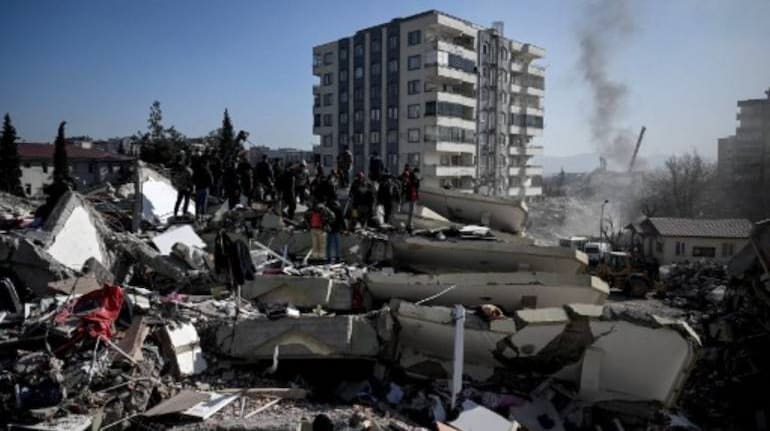
An earthquake ravaged Turkey
Indian-origin businessman Dr Shamsheer Vayalil, who is the founder and chairman of Burjeel Holdings, has donated Rs 11 crore as an aid for the victims of the earthquake that hit Turkey and Syria, killing tens of thousands last week.
The United Arab Emirates (UAE)-based entrepreneur/ philanthropist who hails from Kerala donated Rs 11 crore to help relocate the quake victims. The fund will be used to relocate those who have lost their homes and rehabilitate victims and families, the VPS Group, owned by Shamsheer Vayalil, informed.
Vayalil has said that the amount has already been handed over to the Emirates Red Crescent, which is carrying out relief efforts in the region.
“The fund will be used to support rescue efforts by providing medicine and other supplies, relocating those who have lost their homes, and rehabilitating victims and their families,” the VPS group, which owns the super-speciality VPS Lakeshore Hospital in Kochi, said in a release.
“This donation is part of our ongoing efforts to provide assistance to the relief work. My heart goes out to all affected by the devastating earthquake, and I hope this contribution will support their needs,” Vayalil said.
Thousands were displaced after a 7.8-magnitude earthquake struck the region on February 6, killing more than 34,000 people.
(With inputs from agencies)
source: http://www.moneycontrol.com / Money Control / Home> News> World (headline edited) / February 14th, 2023