When it comes to taking cab rides, there have always been many bad experiences for the commuters compared to the good ones.
Bengaluru Ola cabbie Khateeb UR Rahman (Photo | Facebook and PTI)
When it comes to taking cab rides, there have always been many bad experiences for the commuters compared to the good ones.
Two of the dominant cab aggregators Uber and Ola are no different as they have also been in the wrong side of the news in the past.
But this time around it was an Ola cab driver who is in the news for all the good reasons. On September 17th, a Bengaluru based man took to Facebook and shared a heartwarming story of an Ola cab driver.
The commuter, Sayuj Ravindran, said that the cab driver returned valuables and gadgets worth Rs 2.5 lakh to him after he had left them behind in the cab.
He wrote, “Returning after my cousins wedding, I took an Ola cab (with my family) from KR Puram railway station to home at around 3:30 am. Halfway down, the car tyre got punctured. The driver requested me to book another cab since it will take some time for him to replace the tyre. I got another one in 10 mins and I was about to reach home when I got a call from the first cab driver informing that I left a handbag in the car. I then realized it was my laptop bag which also had some valuables in it. He said he will wait for me right there. I took my car from home and rushed back. He was kind enough to come a little further towards my home. We met at the Marathahalli bridge and he gave me the laptop bag.”
Sayuj also mentioned that the cabbie refused to take money from him as a favour.
“Meet Mr Khateeb UR Rahman, who returned my bag (with stuff worth Rs 2.5 lakhs approx). He refused to take any money from me in return of the favour and got back into his cab. But I did manage to slip in the money to his jacket pocket forcefully. Please reward this gentleman for what he has done, ” he said.
The post had gone viral with over 10,000 people liking the post and over 2,600 people sharing it.
The RT Nagar Old office (SGP Group), who came across the heartwarming act of the Khateeb UR Rahman rewarded him with a cheque of Rs 25,000.
This heartwarming gesture once again proves to be an example of how one will be rewarded according to his/her act.
source: http://www.newindianexpress.com / The New Indian Express / Home> Good News / by Online Desk / September 25th, 2019
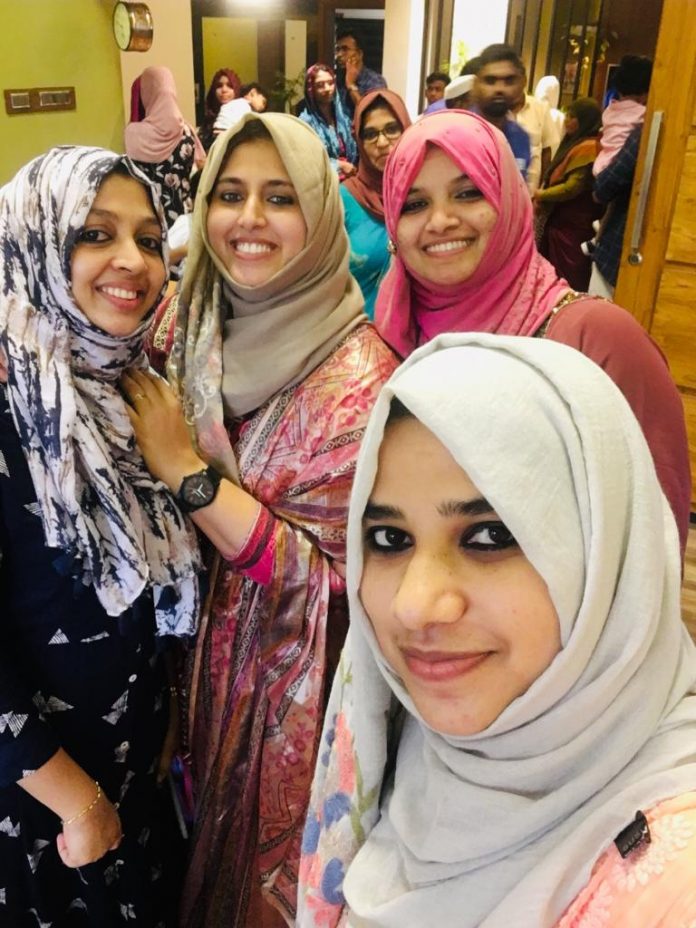
Vlogging or video-blogging is nothing new in this modern age of technology. But there is an interesting vlogger family worth knowing about. Let’s meet four women from a family in Malappuram, who have established their paths in successful vlogging – Shamseera, Femina, Sabeena and Shabna.
Moyin KP and Khadeeja EC belong to the village of Munduparamb in Malappuram. They have four children – a daughter and three sons. Their daughter Shabna and the three daughters-in-law are into vlogging now. It all began with Shamseera, their eldest daughter-in-law. She grew up in Kerala and Qatar and lived with her husband and kids in Dubai where she too worked for a while. But when they moved to Saudi Arabia in 2014, she found it so different from the places she had been till then – it was hard to go out alone, she couldn’t work as job opportunities were very less for foreign women back then.
Her only solace then lay in her cooking experiments, reading and crafts etc. She even joined her kids’ school as an art teacher but soon realised that ‘teaching itself was art I (she) lacked’. In between, she was also watching videos on YouTube, which gradually brought her to the idea of starting a channel of her own. Shamseera began a YouTube channel in 2016 but had to drop it due to some technical issues. She then began another one in 2017 and uploaded the videos of the previous one in it and thus started the journey again. Since then, she hasn’t turned back from her ‘Momtastic’ channel. (https://m.youtube.com/channel/UCL-LW86fWpQejgKbsoWrQqw#menu). She now has 2.98 lakh subscribers from different parts of the world.
Shamseera Sherin and family
The other three were inspired by Shamseera. Shabna Hasker was the second to enter the field. She began her channel ‘Taste Tours’ (https://www.youtube.com/channel/UCwXXEk9v87KS57cFkpoTgIQ) in May 2018, and soon Sabeena Shemin joined with ‘Sabeena’s Spice Diary’ (https://www.youtube.com/channel/UChiazvVDnNGssDgqshIKGAA) in June 2018. And now, Femina couldn’t stay back. She joined the YouTube journey along with her husband Shajin in October 2018 – ‘Femina & Shajin’ (https://www.youtube.com/channel/UCzfIuOwn17TYHnt9NygsWKg) The topics they have selected are all similar – cooking, cleaning, organizing, gardening, crafts, travel, daily house chores etc. Shamseera chose English as the medium for her vlogs, though she has done one in English, Malayalam and Hindi together. Sabeena and Femina began in English and switched to Malayalam owing to the request of viewers. Shabna uses only Malayalam in her videos.
Femina Shejin and family
All the four ladies manage their YouTube channels along with taking care of their respective families and running their houses. Shamseera, a graduate in commerce, lives in Riyadh with husband and two kids. Femina, an MBA graduate, is in Calicut with her husband and two kids. Sabeena, a Statistical Investigator on leave from government service, lives with husband and a kid in Sharjah. Shabna, a graduate in commerce, lives in Malappuram with husband, three kids and parents-in-law. Speaking to TwoCircles.Net, they said that they wished to upload videos twice or thrice a week in a fixed time but were not able to do so always. Shamseera, Femina and Sabeena shoot their videos and do the related works when their kids are away in school, while Shabna has her youngest child always with her at home and so has to do her works at night after the kids go to sleep. All mentioned the support of their families. Shabna’s channel has more than 1.5 lakh subscribers, while Sabeena’s has 1.01 lakh and Femina’s more than 31,000.
Shabna Hasker and family
Shabna now has a cookbook to her credit – ‘Janapriya Ruchikal’ by leading publisher DC Books, expected to be released soon. It was her husband Dr Hasker who suggested the idea and pushed her into writing it when she was reluctant. Shamseera has even starred in an advertisement for the famous Lulu Supermarket.
When asked how they managed their private life and public vlog with the camera inside their homes, all four said they were extremely particular that their vlogging shouldn’t affect their private lives. Shabna said, “We do capture our daily life at home but only for a short time. For example, we capture the first few moments of having food and then turn it off. So we have our time too.” Femina owes the lag between her videos to the priority she has kept.
shabna hasker
While the other three vlog on their own, Femina does it along with her husband. “It is good. We can spend some more time together,” she said. In addition to the usual topics dealt with by all, they also do comedy videos along with their kids. However, there are times when Femina has to do the vlogs alone as Shajin gets busy with work. The daughter of an Army Major, Femina was born in Kerala and grew up in different parts of the country. After completing her graduation in Commerce, she did MBA in HR and worked for a while when they were in Dubai and back in Kerala. Now she is also running a home décor-related business online.
Sabeena Shemin and family
They also try to keep regular contact with their viewers–replying to messages on social media and trying to do videos on request. “Editing and uploading a video is a big task. My eyes get tired, my energy levels fall. But once I publish a video, the comments from my loving viewers are just enough to make my battery level go 100% in a few seconds,” said Shamseera. She recalled an experience she had last month on a trip to Kochi when a lady rode 6-7 kilometers on a scooter with two kids just to meet her.
So, how has YouTube affected their lives? Shamseera confesses she was reserved and shy earlier, but vlogging has made her a more confident person. Life has become busier and more hectic, but now that they are used to it, Femina says it is a beautiful mix. The women are doing their bit for charity too, the latest being during the floods in Kerala. Life has changed for all the four – getting recognized is indeed a matter, but it makes them more responsible too.
source: http://www.twocircles.net / TwoCircles.net / Home> TCN Positive> Indian Muslim> Lead Story> Women / by Najiya O – TwoCircles.net / September 16th, 2019
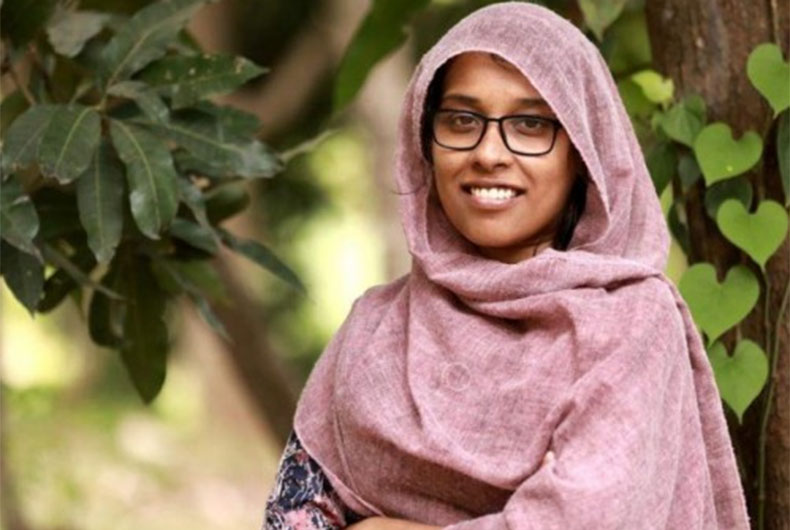
Sifiya started a Facebook page called ‘Chithal’ where she wrote about the issues facing widows
Chandigarh:
A young braveheart from Kerala, Sifiya Haneef, was conferred with the Neerja Bhanot Award in a solemn ceremony here on Saturday.
The award was presented to her by Wendy Sue Knecht, who also worked with the Pan American World Airways in the ’80s and had trained Neerja Bhanot in 1986. Knecht specially came here from Los Angeles for the award function. The award consists of Rs 1.50 lakh, a citation and a trophy.
The award was instituted in 1990 in memory of Neerja Bhanot, who saved hundreds of lives while sacrificing her own when a Pan Am flight from Mumbai to New York was hijacked at the Karachi airport on September 5, 1986.
A specially constituted jury comprising three Rotarians — Sneh Popli, Manjit Kaur and Anu Dhingra — selected Sifiya for the honour after she met the criteria laid down by the Neerja Bhanot Pan Am Trust, which stipulates that the awardee has to be an Indian woman who when faced with social injustice, overcomes it with guts and grit.
Akhil Bhanot, managing trustee at Neerja Bhanot Pan Am Trust, said: “Sifiya got married when she was 16 and her studies were stopped. Unfortunately, her husband died when she was 20. She had two children by then. Sifiya wished to continue her studies, but did not get any support. Not willing to give up, she took on a part-time job and resumed her studies.
“After a lot of struggle and realising that life was very tough not only for her, but also for other widows as well, she started spending her salary on helping widows.”
Sifiya started a Facebook page called ‘Chithal’ where she wrote about the issues facing widows.
She also met a lot of sick mothers, kids, elderly people and cancer patients, among others. She would update her page on the problems these people were facing and get public support to solve their issues.
Today, she is helping more than 300 families by providing them shelters, constructing toilets in colonies, distributing medicines and giving them pension, Bhanot said.
An emotional Knecht said: “Though a lifetime has passed, Neerja’s generosity, her humanity and her sacrifice will never be forgotten.”
“By fighting for justice, Neerja proved that you can re-write your story from being called a ‘victim’ to a ‘hero’. The message that Neerja imparted upon the world was ‘do the right thing, come what may’. This is what all of us must do. I too have been inspired to follow Neerja’s path,” she added.
source: http://www.ummid.com / Ummid.com / Home> Life & Style / September 07th, 2019
As elected members in Tamil Nadu Waqf Board are not more than the nominated members, the Governor has superseded the Tamil Nadu Waqf Board for six months. The Governor has appointed M.A. Siddique as special officer to exercise and perform all the powers and duties as long as the board remains superseded.
As per sub-section (4) of section 14 of the Waqf Act, 1995, the Tamil Nadu Waqf Board would be unable to perform if the elected members were not more than the nominated members. The special officer, at present a Principal Secretary to Government (Expenditure), Finance Department, would perform all the powers and duties under the provisions of the Waqf Act, 1995, according to a notification issued by the State government.
While the board’s chairperson A. Anwhar Raajhaa ceased to be a Member of Parliament, two senior Muslim advocates, who were earlier considered elected members, would have to be considered nominated members, as per the legal advice received by the State government. Although there were two Muslim MPs from the State, even their appointment would still make it six members, whereas the rule demands elected members should be more than nominated members.
Legal opinion
Following show-cause notices sent to all 10 members of the Board as per the rule, only four members replied seeking to drop the superseding process and urged that senior advocates be considered elected members. “The government has received legal opinion that the senior advocates can be considered as nominated members. In view of the above, the elected members are less than the nominated members and the board is unable to perform its functions..,” the notification stated.
The 10 members on the board were: A. Anwhar Raajhaa, K.A.M. Muhammed Abubacker, K.S. Masthan, A. Sirajudeen, M. Ajmal Khan, A. Tamilmahan Hussain, Amatul Aatifa, A.S. Fathima Muzaffer, Haja K. Majeed and Syed Ali Akbar. Mr. Siddique was a government nominee.
source: http://www.thehindu.com / The Hindu / Home> News> States> Tamil Nadu / by Special Correspondent / Chennai – September 20th, 2019
The city has many structures built during the time of Nizam Mir Osman Ali Khan Bahadur
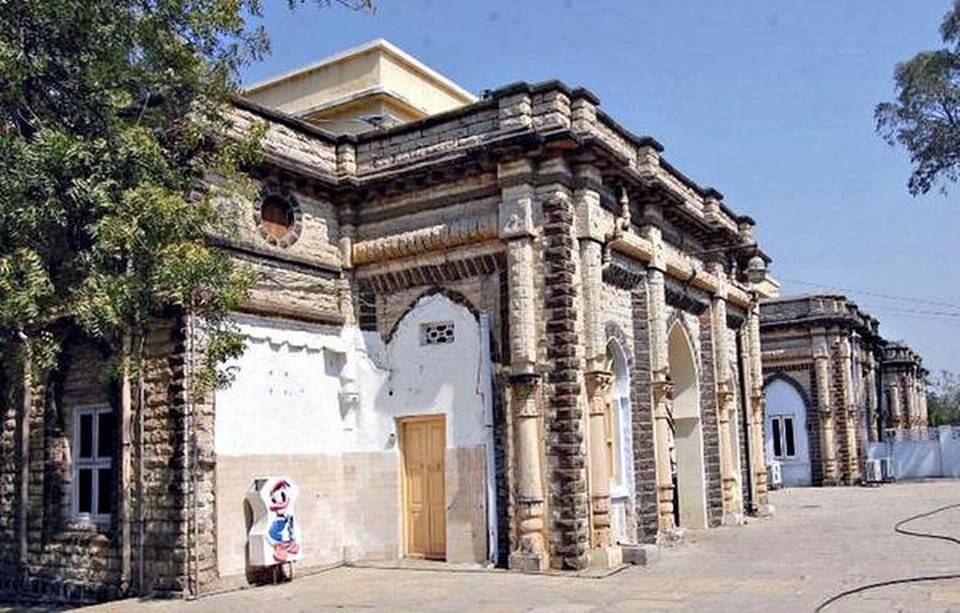
A kilometre away from Kalaburagi railway station is Aiwan-e-Shahi, a magnificent stone structure built in early 19th Century. For political leaders and bureaucrats visiting the city, it’s the most preferred accommodation.
Kalaburagi has several such architectural remnants of the times of the Nizam rule, uniquely Indo-Islamic in style, and still in use. Nizam Mir Osman Ali Khan Bahadur, the last monarch, who ruled the province between 1911 and 1948, stayed in Aiwan-e-Shahi when he visited the city and is today a government guest house. The Nizam used to travel in his own train from Hyderabad to reach the palace in Kalaburagi and a special railway track was laid up to the entrance of the complex for the purpose.
Like most buildings constructed during the Nizam’s rule, the Aiwan-e-Shahi portrays a rich and imposing architecture synthesising medieval and modern styles. It is constructed using local white stones, popularly known as Shahabad stones, abundantly available in the surrounding area. The front view of the palace was greatly inspired by Gothic style architecture.
Kalaburagi-based heritage collector and artiste Mohammed Ayazuddin Patel has copies of some rare photograph of Nizam. In one of them, he is the Nizam is seen playing tennis outside the Aiwan-e-Shahi palace complex. His train is also visible in the background. The picture was said to have been taken by Raja Deen Dayal, the official photographer at the Nizam’s court.
The Nizam, known as the architect of modern Hyderabad, left an impression on Kalaburagi too. The building now houses the tahsildar office, zilla panchayat and central library. The entrance arch gate of Vikas Bhavan, the mini Vidhana Soudha that has the district administrative complex and one of the entrances of Mahbub Gushan Garden in the heart of the city were built during his time. There are several private houses across the city that were built for the families of Deshpande, Deshmukh, Mali Patil, Police Patil, Jamadar, Mansafdar, Pattedar, Inamdar, Jagirdar, Kulkarni, Hawaldar – the official and administrative titles given by the Nizam.
“At least, the Aiwan-e-Shahi should be included in the protected monuments and converted into a museum to showcase the region’s cultural past,” says Rehaman Patel, Kalaburagi-based researcher and artiste. According to him, the Nizam had expanded public spaces such as parks, lakes, town hall, and gardens in the city engaging several engineers. Mahbub Sagar (now called Sharnbasweshwar lake) and Mahbub Gulshan Garden continued to be used by the public. The town hall is used by the Kalaburagi City Municipal Corporation as a conference hall.
The Filter Bed built for providing pure water to the residents continues to supply drinking water to parts of the city. The Mahbub Shahi Kapda Mill that produced high-quality cloth and supplied it not just to various cities across India, but to other countries as well, was in operation till the 1980s. The Nizam had also established Asif Gunj School and MPHS school, the oldest educational institutions of the city.
“In the early 1930s, he formed the Hyderabad Aero Club and built Begumpet Airport for his Deccan Airways, one of the earliest airlines in British India. He had the distinction of employing, perhaps, the world’s first woman commercial pilot, Captain Prema Mathur, during the late 1940s. The other airport built in Bidar in 1942 is now used by the Indian Air Force to train its pilots. The Nizam was also credited for renovating several monuments belong to Buddhists, Jains, Chalukyas, and Bahmanis. The renovation and excavation of the caves of Ajanta and Ellora was undertaken with the funds of the Nizam government and supervised by then archaeology director Ghulam Yazdani,” Mr. Rehaman said.
source: http://www.thehindu.com / The Hindu / Home> News> States> Karnataka / by Kumar Buradikatti / Kalaburagi – September 16th, 2019
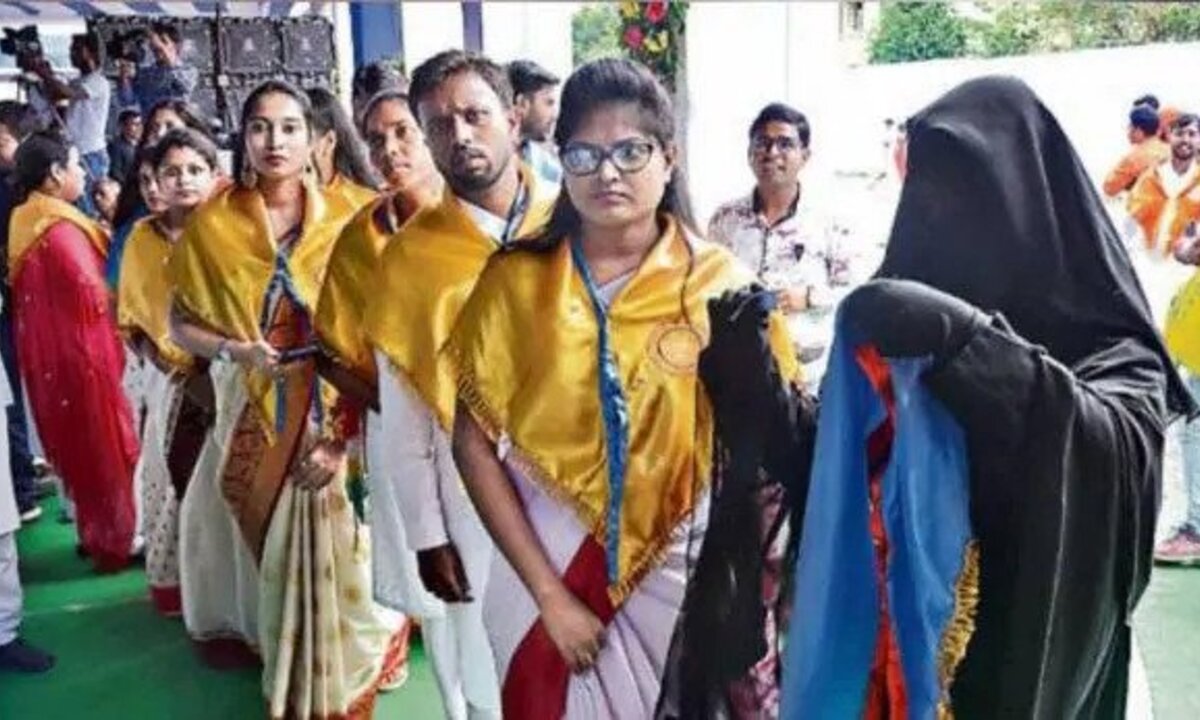
Nishat Fatima, who came to Ranchi’s Marwari College to take her degree in graduation ceremony could not get it in the ceremony
There are bizarre rules being made about clothes in colleges these days. Recently, a girls college in Hyderabad made a strange rule for wearing suits, now a case of a college in Jharkhand has come up in which a student was not given a degree as she was wearing a burqa.
As per reports, the over-all best graduate Nishat Fatima, who came to Ranchi’s Marwari College to take her degree in graduation ceremony could not get it in the ceremony on Sunday.
Nishat Fatima came wearing a burqa to attend the program. Her name was called for the gold medal at the ceremony as she had to take the medal first.
However, at the same time, it was announced that she was not in the dress code fixed by the college, due to which she could not be given a degree in the ceremony. After which the process of awarding medals and degrees to other toppers was started. Despite the dress code being fixed, Nishat’s father Muhammad Ikramul Haq said that the burqa is included in their tradition.
The dress code was decided by the college in which the male student had to come in a white colored kurta pajama and the female students in a salwar-suit, scarf or sari blouse. For this, the college had already issued a notice.
source: http://www.newsd.com / Newsd. / Home> Beyond Metros> Jharkhand / by Newsd / September 16th, 2019
The decision by the Indian Muslims Association of Greater Houston( IMAGH) to become a Welcome Partner for the community reception to Prime Minister Narendra Modi is another step by IMAGH to rise above divisive politics in solidarity with other Indian-American organizations.
It was a unanimous decision by the IMAGH Board of Directors and the Executive Committee to be part of the organizing committee. Some 50,000 people have registered to hear Prime Minister Modi in what will be the largest audience in the US for a visiting foreign leader other than the Pope. 612 organizations have registered so far to be the Welcome Partner and the online registration is still open on howdymodi.org . Over 1,000 volunteers are working tirelessly to make the event a grand spectacle for the Houston community.
“The mission of IMAGH is to foster unity across cultures, communities and religion. We can only work toward this goal by engaging with all groups. We may not agree with their beliefs, practices or ideas but unless we interact with them in a cordial and friendly atmosphere, we cannot get our point of view across to them,” said Dr. Maqbool Haq, Chairman of the IMAGH Board of Directors.
Alluding to plans by a section of the people to stage a protest at NRG Stadium where Prime Minister Modi will be addressing the community on September 22, Dr Haq said,” We feel, we should try to have a seat at the table to present our views rather than not be at the table.”
Latafath Hussain, founding president of IMAGH, said, “I am very proud to be both an Indian and a Muslim. Growing up in Varanasi (Modiji’s constituency), I always felt that I had the same opportunities as everyone else. So when the duly elected leader of mother India comes visiting my adopted home town, it is my duty to give him a warm welcome.”
In a major outreach effort three months ago, IMAGH invited Ramesh Bhutada, national vice president of the Hindu Swayamsevak Sangh in America to be the chief guest at the organization’s signature event to celebrate Muslim festival of Eid al-Fitr, opening a new door for Hindu-Muslim cooperation in Houston and beyond.
Bhutada was forthcoming in his speech and received standing ovation by over 500 people at the event. He introduced himself as vice president of Hindu Swayamsevak Sangh, which is an independent US organization that takes inspiration from RSS in India and declared: “The RSS and the HSS would like communal harmony and unity among all religions.”
He quoted RSS chief Mohan Bhagwat, “India’s development cannot be complete without the development and progress of the minorities.”
Bhutada said: “We all have historical baggage — let’s acknowledge that — but we cannot look backwards. We have to look forward and that is the only way we can lead a peaceful life in this world.”
Hussain thinks that in order to move forward we must understand that we may be Hindus or Muslims or Christians but we are primarily Indian and are “part and parcel” of the Indian community in Houston. “In the community, there are, as there should be, political differences, but that’s for private debate. In front of the larger Houston and American community, we have to stand as one.”
Vijay Pallod, who is on the boards of IMAGH and Hindus of Greater Houston (HGH), says that both the organizations are unique in their role to carry out their missions with respect and understanding for each other.
The close cooperation between Hindu and Muslim organizations dates back to September 2010 when India Culture Center, an umbrella organization of various Indian groups, decided to host an Eid Milan party in collaboration with Indian Muslim groups. The joint event was an instant success and led to creation of IMAGH to foster amity across cultures, communities, and religions.
“We, in Houston, are proud to have a united happy community that respects interfaith customs and traditions by participating and celebrating Diwali, Holi, Eid, Christmas and Baisakhi,” said Col. Raj Bhalla who was the Event Chair of the Eid Milan party in 2010.
Talking about the joint event, Swapan Dhairyawan, president of Houston ICC in 2010, said, “This interaction and pollination has led to several positive and healthy relationships not only among individuals but also between organizations.”
India’s present Consul General in Houston, Dr. Anupam Ray, also helped in promoting cooperation by hosting an Iftar party in the fasting month of Ramadan for the past four years where people professing different faiths and nationalities were invited to break the fast with Muslims at the end of the day.
Although these efforts may appear to be the feeble first steps, the Houston community is showing its determination to move forward as ONE.
source: http://www.indiacurrents.com / India Currents / Home> Latest – Community / by Haider Kazim / September 14th, 2019
Feroz Shah Tughlaq (Reign 1351 – 88), the third ruler of the Tughlaq Dynasty was embarked on a vigorous campaign of construction activity, consisting mainly of public buildings of utilitarian nature.
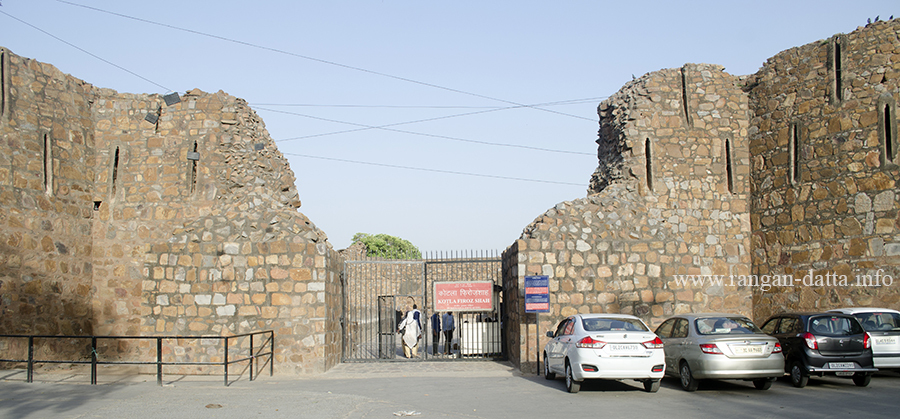
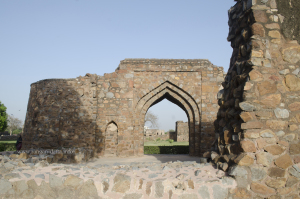
Gate of the citadel of Feroz Shah Kotla or Firozabad, Delhi
He made 1200 garden around Delhi and is credited with the erection of 200 towns, 40 mosque, 30 villages, 30 reserviors, 50 dams, 100 hospitals, 100 public baths and 150 bridges
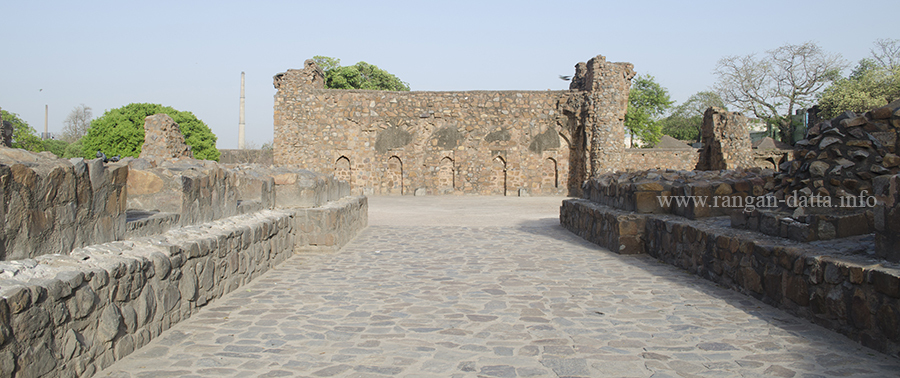
Passageway leading to the interiors of Feroz Shah Kotla or Firozabad, Delhi
In 1354 Feroze Shah Tughlaq built Feroz Shah Kotla or Firozabad, the fifth citadel of Delhi. His predecessors Ghiyasuddin Tughlaq (Reign: 1321 -25) and Muhammad bin Tughluq (Reign: 1324 – 51) has the credit of erecting the third and fourth citadel of Delhi.
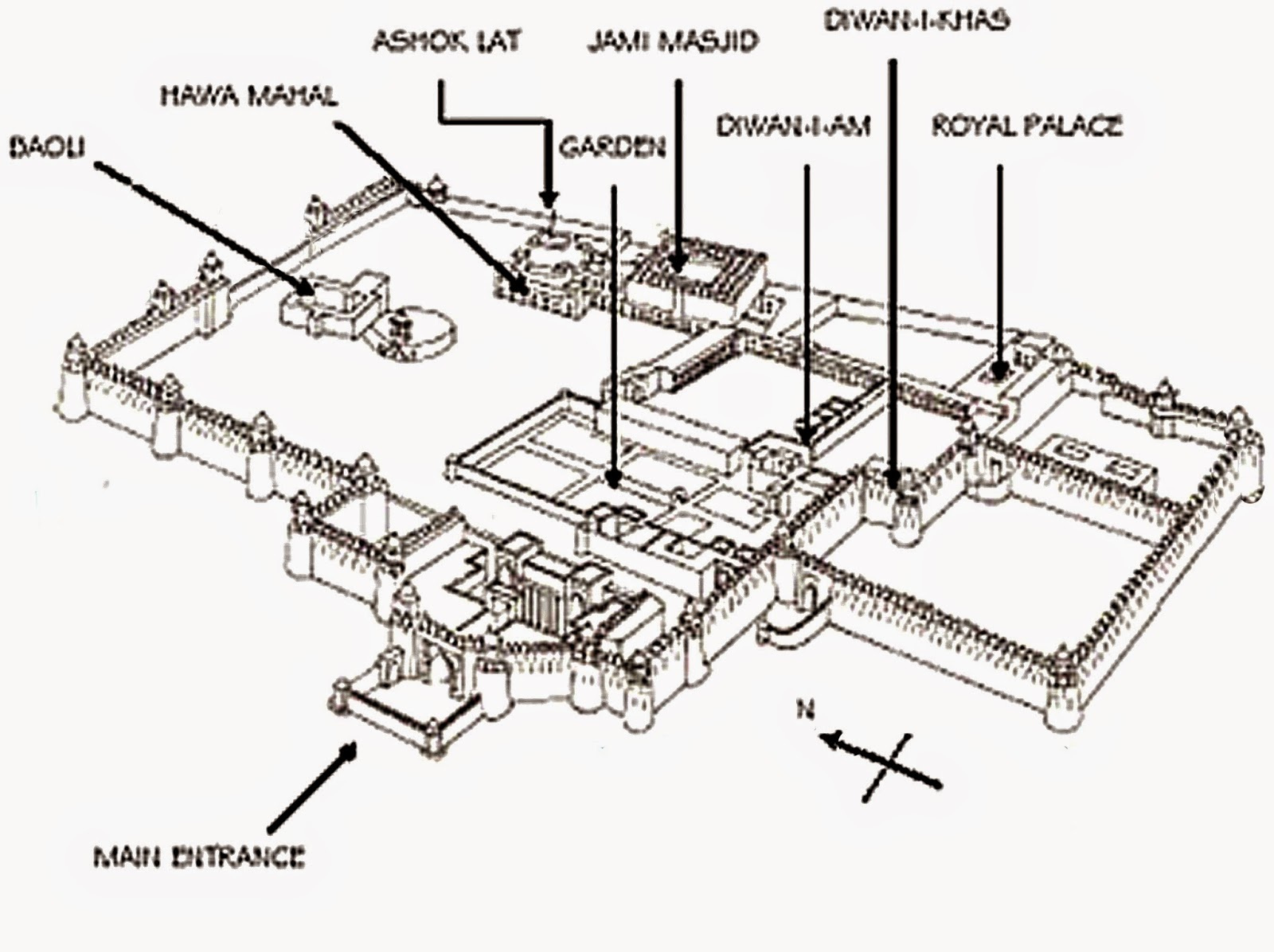
Plan of Feroz Shah Kotla or Firozabad (Source: http://www.pixels-memories.blogspot.in)
Tughlaqbad, the third citadel of Delhi, along with Jahanpanah, the fourth citadel of Delhi were abandoned because of acute water shortage. This lead Feroze Shah Tughlaq to move further north and to construct its citadel along the west bank of Yamuna River.
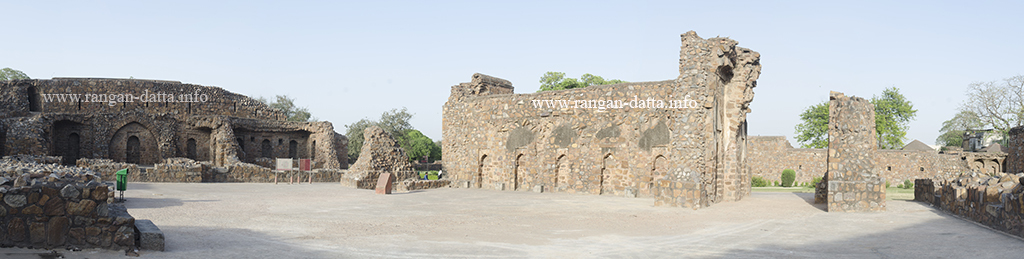
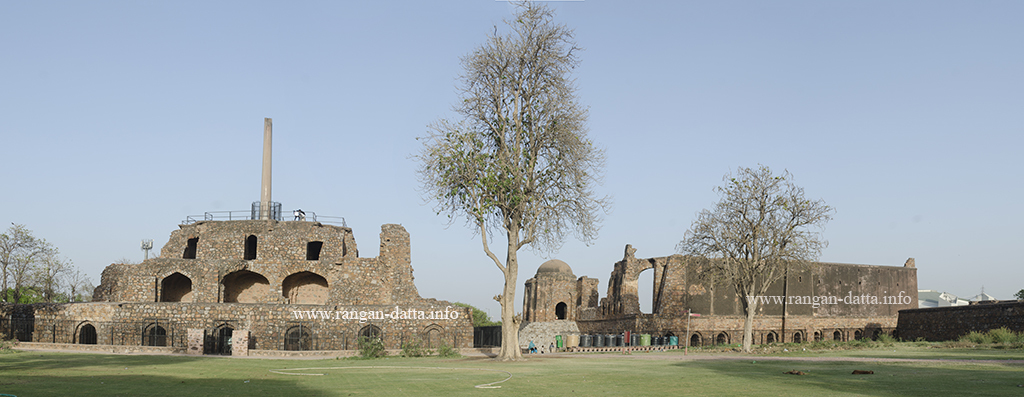
Panoramic view of the ruins of Feroz Shah Kotla or Firozabad, Delhi
Unlike Tuglaqabad, Feroz Shah Kotla lacked the defensive construction and after the collapse of the Tuglaq empire the Mongol invader Timur found it an easy target. In 1398 Timur gladly carried out all the riches of the citadel leaving behind the ruined rubble structures, which was again plundered and reused by Shahjahan (Reign AD 1627-57) for the construction of Shahjanabad, the seventh and last ancient citadel of Delhi.
An arched gateway, Feroz Shah Kotla, Delhi
Despite being plundered by several rulers in the past and with centuries of neglect Feroz Shah Kotla still houses several interesting ruins, although minimalistic in nature, they still reveal the former glory and splendor of the ancient citadel.
Today the ruins of Feroz Shah Kotla nestles between the cricket stadium, of the same name, and the Ring Road. Every Thursday thousand of visitors visit the ruins of the ancient citadel.
Strangely these visitors are not history or heritage enthusiasts but are devotees looking for the blessings of Djinns, who according to legend are residents of the ruins of Feroz Shah Kotla. No wonder Delhi has always been a “City of Djinns.“
Djinns live in the heart of Delhi: they are spirits tending to the faithful seeking help. On Thursdays, they are busy when thousands turn up with letters for them.
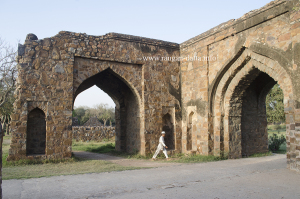
A kid makes his way through the arched gateways of Feroz Shah Kotla, Delhi
Every Thursday hordes of devotees, irrespective of religion, visit the ruins of Feroz Shah Kotla with photocopies of letters, citing there problems. They stick the letters on different strategic spots of the citadel and offer prayers to the Djinns.
Strangely the concept of letters to the Djinns has only been an recent concept in the ancient citadel, which dates back to the 14th century.
The first records of people coming to Firoz Shah Kotla in large numbers began shortly after the emergency of 1977.
It was only in 1977, a few months after the end of the Emergency, that we have the first record of people starting to come to Firoz Shah Kotla in large numbers. This seems significant, given how destructive the Emergency was for the Old City and how many poor and working class people were displaced from the Old City to resettlement colonies across the river
Anand Vivek Taneja, Anthropologist
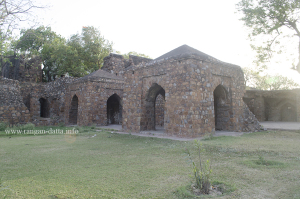
Ruined structures of Feroz Shah Kotla, Delhi
Even on other days large groups of Muslim devotes visit Feroz Shah Kotla to offer their Namaz at the Jami Masjid, one of the few structures of the citadel that have remained, more or less, intact to this day.
Designed by Feroz Shah Tughlaq’s state architects Malik Ghazi Samana and Abdul Haq the citadel of Feroz Shah Kotla follows a rectangular plan with dimensions 800 m by 400 m, with the longer side along the north – south axis.
The entire citadel is encased within a high stone wall. Although the walls look solid but it lacks the massive bastions of Tuglaqabad. The entrance is through a small and simple gateway on the eastern side and a broad passageway leads to the scattered ruins of Feroz Shah Kotla or Ferozabad
Circular Baoli (Stepwell) at Feroz Shah Kotla
Most of the buildings within the citadel are made of rubble masonry covered with heavy plaster and without any surface ornamentation.
The passages leads to series of scattered ruins, which was once part of the citadel’s garden.
It leads further to the Diwan – i – Am (hall of audience) and Diwan – i – Khas (hall of private audience).
A few pavilions and archways are all that remains today of the famed halls of audience of Feroz Shah Tughlaq. The Royal Palace located at the far end of the citadel lies in similar ruined condition.
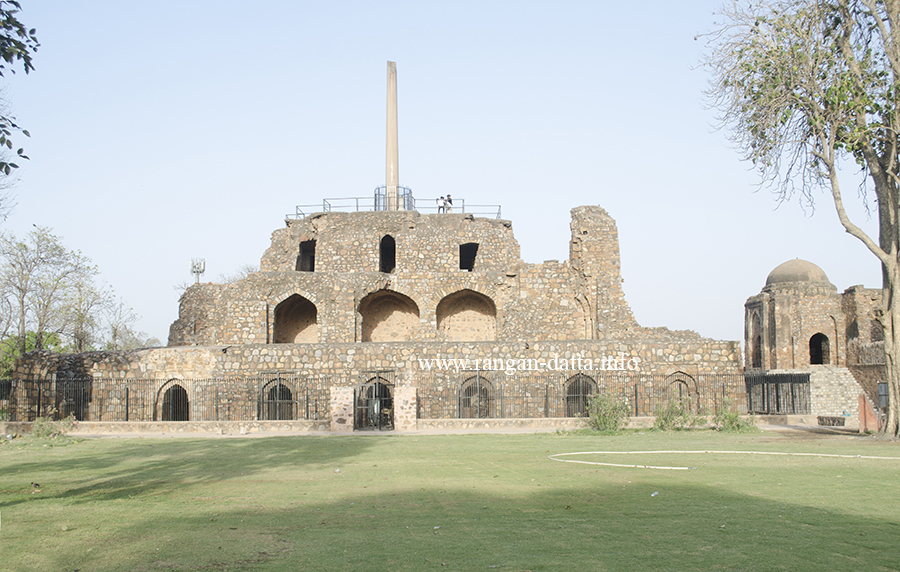
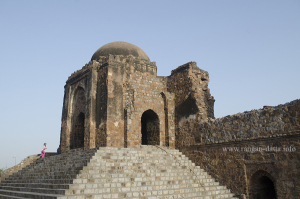
Stepped pyramidal structure, crowned with the Ashokan Pillar, Feroz Shah Kotla, Delhi
The more intact and interesting structures of Feroz Shah Kotla are located on its northern side. Towering above the lawns is the massive Jami Masjid and towards its left is the stepped pyramidal structure, known as the Hawa Mahal or Kushk-i-Shikar. It is crowned with the Ashokan Pillar, also referred as the Minar-e-Zarreen.
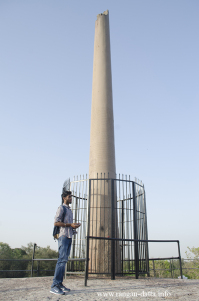
Ashokan Pillar, Feroz Shah Kotla
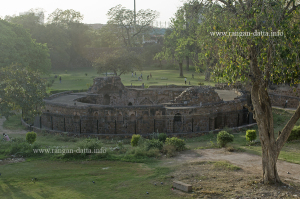
Just in front of the stepped pyramidal structure is a baoli (stepwell).
Delhi is no stranger to Baolis and even a century ago more than a hundred of them existed in Delhi.
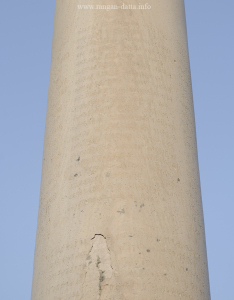
Inscription on Ashokan Pillar
Today more than a dozen remains (Also see: Baolis of Delhi) but what makes the Feroz Shah Kotla baoli unique is its circular shape. It is the only circular baoli in Delhi. Sadly the baoli is kept under lock and key and the interiors are out of reach for the common tourist. But the baoli is best viewed from the differnt levels of the nearby stepped pyramid.
Domed Pavilion at the entrance of Jami Masjid
The Hawa Mahal is a three tired stepped pyramid with diminishing floors. Built with a central solid core and vaulted cells around it. Stairs at the comers lead to the uppermost terrace where the Ashokan pillar is planted.
The Ashokan Pillar was shifted from Topar in Ambala by Feroz Shah Tughlaq and placed atop the Hawa Mahal.
The 13 m high 27 ton pillar was shifted on a custom built 42 wheel carriage operated by 8400 men, which transported it to the banks of Yamuna River. From where it was transported by boat to Feroz Shah Kotla in Delhi
Incidentally Delhi contains another Ashokan Pillar, which was also shifted by Feroz Shah Tughlaq and placed near his hunting lodge on Delhi’s North Ridge, also known as the Kamala Nehru Ridge. (Also see: Historical Trail along Delhi’s North Ridge)
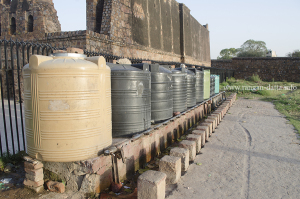
Tanks, along Jami Masjid, for ritual wash
The structure is open to public and one can take the stairs all the way to the base of the pillar. The pillar still maintains its shining police and the inscriptions in Prakrit are clearly visible.
According to popular belief Laat (pillar) Waale Baba, the chief of the Kotla djinns, dwells in the Ashokan Pillar, which is also referred to as the Minar-e-Zarreen. Every Thursdaay devotees ties up their wish letters on the railing surmounting the Ashokan Pillar.
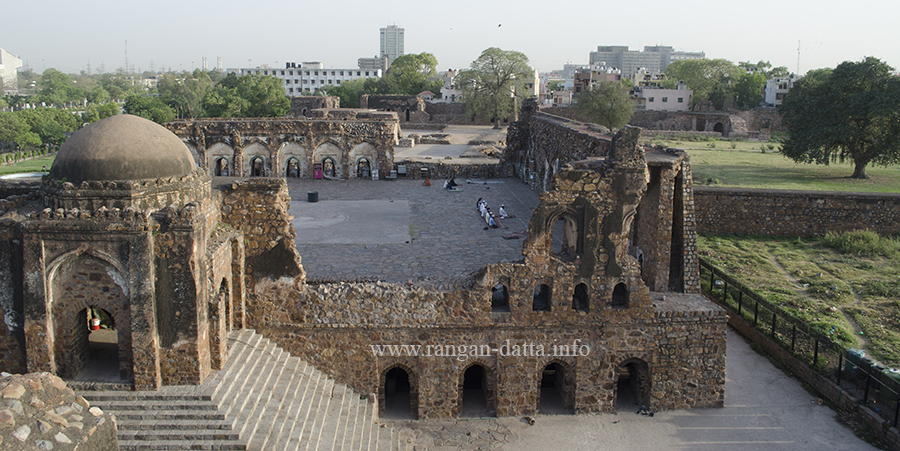
The top story of the Hawa Mahal offers grand bird eye view of the circular baoli (stepwell) and also the Jami Masjid, which lies on its southern side.
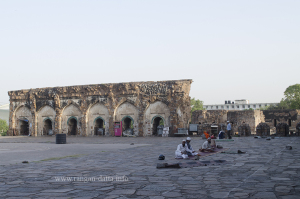
Namaz being offered at the Jami Masjid, Feroz Shah Kotla, Delhi
South of the Hawa Mahal lies the gigantic mosqque of Feroz Shah Kotla, the Jami Masjid. Built of Delhi quartzite stone. During the time of its construction it was the largest mosque in India.
The mosque rests on a series of cells on the ground floor and is approachable by a long flight of stairs leading to a domed pavilion gateway on the northern side. The grand dome pavilion, which once stood at the centre of courtyard has long vanished.
Even Taimur, who plundered Feroz Shah Kotla, was so impressed with the mosque that he commissioned a similar one in his capital Samarkhand. Even Shah Jahan constructed a underground tunnel connecting the Jami Masjid to his newly constructed citadel of Shahjanabad. The tunnel still exist but is sealed for obvious reasons.
Grand view of the Jami Masjid, from Hawa Mahal, Feroz Shah Kotla or Firozabad, Delhi
Strangely the Jami Masjid is still an active mosque and attracts thousand of devotees during the time of eid. Even on normal days large groups of local Muslims along with Muslim office staff from nearby offices drop in for there daily namaz.
Panoramic view of Stepped Pyramid Structure and Jami Masjid, Feroz Shah Kotla or Firozabad
Colourfull plastic tanks, along the eastern wall of the ancient mosque, serve as a makeshift ritual wash (wudu) area for the devotees, who drop in to offer namaz.
Just outside the citadel of Firozabad or Feroz Shah Kotla, on a road divider lies the notorious gateway of Khooni Darwaza.
Kozhikode, KERALA / Hyderabad, TELANGANA / Paris, FRANCE :
Hamna Mariyam, a young diplomat of 2017 IFS batch and wife of Abdul Muzammil Khan, an IAS officer of Telangana cadre of the same batch,
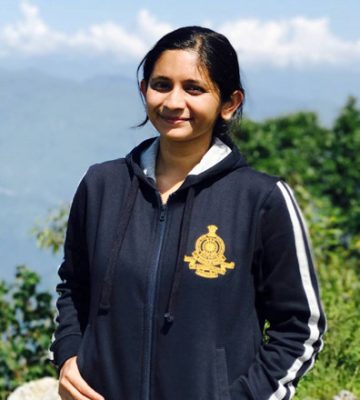
The young diplomat Hamna Mariyam
Jeddah:
A young IFS officer married to a Hyderabadi, is likely to be posted in Saudi Arabia, according to reliable sources here.
Hamna Mariyam, a young diplomat of 2017 IFS batch and wife of Abdul Muzammil Khan, an IAS officer of Telangana cadre of the same batch. Muzammil Khan is the youngest son of retired IPS officer AK Khan, who is presently an advisor to the Telangana government.
The Ministry of External Affairs has reportedly decided to transfer Mariyam to Consulate General in Jeddah, sources told ‘Telangana Today’. She is currently serving at the Indian Embassy in Paris, France.
The Indian government is keen to cement Indo-Saudi relations further and strengthen its missions in the Kingdom, said sources. Shifting Mariyam to Saudi Arabia is perceived to be part of that idea. Hyderabadis and Malayalis constitute a lion’s share of Indian community in Saudi Arabia.
Mariyam hails from Kozhikode in Kerala, where her parents are doctors. An alumna of Ramjas College in Delhi, she taught English literature in a college in her home town. She cracked the civil services examinations and bagged the 28th rank in 2017.
source: http://www.telanganatoday.com / Telangana Today / Home> NRI / by Irfan Mohammed / September 13th, 2019
Shopian District (South Kashmir) , JAMMU & KASHMIR :
When the author asked Ummer’s schoolmates whether they would want to be like Lt. Ummer Fayaz, they said no. ‘’Ma’am he joined the army, the society here does not accept him and some who don’t even consider him a Kashmiri.’’
Bhawan Arora with her book at Chandigarh Press club
“Musrat is my sister, mama. If I don’t come for her wedding, what sort of brother am I? And for how long will I run, Mama? Kashmir is my home. With all of you there, can I stay away forever?” These were the words of Lt. Ummer Fayaz, when his family, fearful for his life, was urging him not to come home, weeks before he was killed by militants on 9 May 2017.
‘Undaunted: Lt. Ummer Fayaz of Kashmir’ by Bhaavna Arora, chronicles his life. The 232-page book took the author two years during which she visited Ummer’s family and met a large number of people who knew him.
Lt. Ummer was born on 8 June 1994, to an apple orchardist of South Kashmir’s Shopian district. He was abducted by veiled gunmen at 8.00 pm from his maternal uncle’s house on 8 May 2017 where he was attending the wedding of his cousin sister Musrat. His body drenched in blood was found at Herman Chowk of Shopian the next morning.
“Three men with scarves covering their face and shawls around their bodies swiftly entered through the front door of the house. They climbed the stairs and threw open the door of the room that Ummer was sitting in and asked, Are you Ummer Fayaz? Yes, I am, Ummer replied. Come with us, one of the veiled man commanded,” writes the book.
The book brings to life the high-spirited youngster, right from his childhood days. ‘’One day, a child from the Ummer’s class lost his geometry box. The teacher called all the students and asked them to swear by the holy Quran that they had not stolen it. One by one the students did and when it was Ummer’s turn, he took one look at the book and said, ‘Sir, this this is a dictionary, not the Quran.’ After that the teacher informed his father of his son’s cheekiness. His father gave him a dressing down, but was secretly pleased that his son had spotted what the entire class had missed.’’
Bhaavna Arora said he was also a very wam-hearted and friendly young man .
Bhawan Arora with Ummer’s famil
“At the National Defence Academy (NDA), he was the first to seek permission from instructors for offering Friday prayers; from then on every Friday Muslim soldiers are allowed to pray even during trainings,” she said.
Piecing together the life of the young officer turned out to be an emotionally charged journey. Bhaavna said, ‘’It is not easy to meet a family that has lost a son. When I first met his sister Asmat, we cried for half an hour. She asked me what does your brother do, and I had no answer.’’
Ummer was 11 when he joined Jawahar Navodaya Vidyalaya (JNV) in Anantnag district. The author recounts in the book how she was bombarded by questions from his schoolmates at JNV Anantnag. ‘’Students were eager to know if I was on their side. They asked me why I was there. When I told them whether they knew Lt. Ummer Fayaz, they said, ‘Yes, ma’am, he was our senior’.’’
When she asked them whether they would want to be like Lt. Ummer Fayaz, they said no. ‘’Ma’am he joined the army, the society here does not accept him and some who don’t even consider him a Kashmiri.’’
Once on his way home from Khodwani to Kulgam he was stopped by Army soldiers near Kulgam. They wanted to inspect his bag but he refused to let them do so. Ummer was trying to free himself from the grip of the soldier but failed. When the soldier could not control him anymore, he slapped Ummer, and he cried. Later, Ummer asked him whether he would let him go if he did not find anything in the bag. The soldier said, of course, and asked him what he wanted to become when he grew up. ‘’Someone like you. How can I become like you?’’, Ummer asked the soldier. When the soldier asked him what was so special about him, Ummer said, ‘’You are not like other soldiers who beat and torture my friends.’’
Before Ummer left the camp, the officer said to him, if you want to be an officer like me, join the National Defence Academy when you complete your Class XII.
Ummer reported at National Defence Academy, Pune, on December 30. Bhaavna Arora, who comes from an Army family, says it was Lt Fayaz’s coursemate who asked her to wrote the book. ‘’They wanted him to be immortalised in words.’’
Arora has in the past written three works of fiction. Her first book ‘The Deliberate Sinner’ revolves around infidelity.
source: http://www.indianexpress.com / The Indian Express / Home> India / by Dar Ovais / Chandigarh – March 29th, 2019



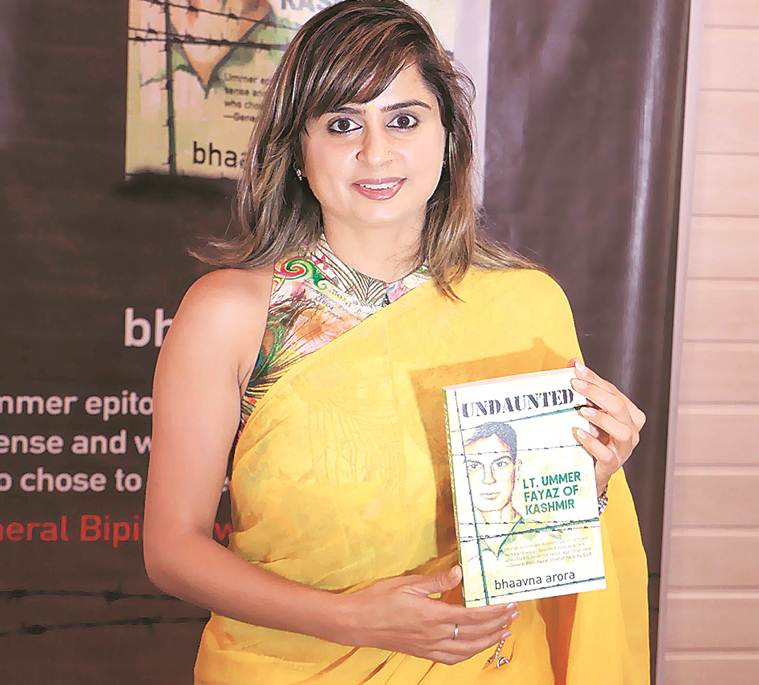 Bhawan Arora with her book at Chandigarh Press club
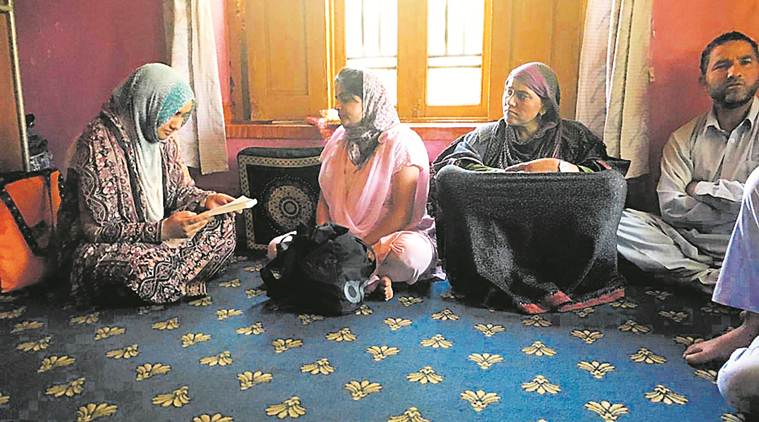 Bhawan Arora with Ummer’s famil